Chapter XII · ASCENT OF ARARAT
Reading edition
Next morning the sun had already risen as I let myself down through the open casement of the window and dropped into the garden among the dry brushwood encumbering its sandy floor. Not a soul was stirring, and not a sound disturbed the composure of an Eastern morning, the great world fulfilling its task in silence and all nature sedate and serene. A narrow strip of plantation runs at the back of Aralykh, on the south, sustained by ducts from the Kara Su or Blackwater, a stream which leads a portion of the waters of the Araxes into the cotton fields and marshes which border the right bank. Within this fringe of slim poplars, and just on its southern verge, there is a little mound and an open summer-house—as pleasant a place as it is possible to imagine, but which, perhaps, only differs from other summer-houses in the remarkable situation which it occupies and in the wonderful view which it commands. It is placed on the extreme foot of Ararat, exactly on the line where all inclination ceases and the floor of the plain begins. It immediately faces the summit of the larger mountain, bearing about south-west (Frontispiece).
Before you the long outline of the Ararat fabric fills the southern horizon—the gentle undulations of the north-western slope, as it gathers from its lengthy train; the bold bastions of the snowfields, rising to the rounded dome; and, further east, beyond the saddle where the two mountains commingle, the needle form of the lesser Ararat, free at this season from snow. Yet, although Aralykh lies at the flank of Ararat, confronting the side which mounts most directly from the plain to the roof of snow, the distance from a perpendicular drawn through the summit is over 16 miles. Throughout that space the fabric is always rising towards the snow-bank 14,000 feet above our heads, with a symmetry and, so to speak, with a rhythm of structure which holds the eye in spell. First, there is a belt of loose sand, about 2 miles in depth, beginning on the margin of marsh and irrigation, and seen from this garden, which directly adjoins it, like the sea-bed from a grove on the shore. On the ground of yellow, thus presented, rests a light tissue of green, consisting of the sparse bushes of the ever-fresh camelthorn, a plant which strikes down into beds of moisture, deep-seated beneath the surface of the soil. Although it is possible, crossing this sand-zone, to detect the growing slope, yet this feature is scarcely perceptible from Aralykh, whence its smooth, unbroken surface and cool relief of green suggest the appearance of an embroidered carpet, spread at the threshold of an Eastern temple for the services of prayer. Beyond this band or belt of sandy ground, composed no doubt of a pulverised detritus, which the piety of Parrot was quick to recognise as a leaving of the flood, the broad and massive base of Ararat sensibly gathers and inclines, seared by the sinuous furrows of dry watercourses, and stretching, uninterrupted by any step or obstacle, hill or terrace or bank, to the veil of thin mist which hangs at this hour along the higher seams. Not a patch of verdure, not a streak of brighter colour breaks the long monotony of ochre in the burnt grass and the bleached stones. All the subtle sensations with which the living earth surrounds us—wide as are the tracts of barren desert within the limits of the plain itself—seem to cease, arrested at the fringe of this plantation, as on a magician’s line. When the vapours obscuring the middle slopes of the mountain dissolve and disappear, you see the shadowed jaws of the great chasm—the whole side of the mountain burst asunder from the cornice of the snow-roof to the base, the base itself depressed and hollow throughout its width of about 10 miles. No cloud has yet climbed to the snows of the summit, shining in the brilliant blue.
For awhile we slowly rode through the camelthorn, the deep sand sinking beneath our horses’ feet. It was nearly one o’clock, and the expanse around us streamed in the full glare of noon. A spell seems to rest upon the landscape of the mountain, sealing all the springs of life. Only, among the evergreen shrubs about us, a scattered group of camels cropped the spinous foliage, little lizards darted, a flock of sand-grouse took wing. Our course lay slantwise across the base of Ararat, towards the hill of Takjaltu, a table-topped mass, overgrown with yellow herbage, which rises in advance of the saddle between the mountains, and lies just below you as you overlook the landscape from the valley of Sardar Bulakh. Gullies of chalk and ground strewn with stones succeed the even surface of the belt of sand, and in turn give way to the covering of burnt grass which clothes the deep slope of the great sweeping base, and encircles the fabric with a continuous stretch of ochre, extending up the higher seams. Mile after mile we rode at easy paces over the parched turf and the cracking soil. When we had accomplished a space of about 10 miles, and attained a height of nearly 6000 feet, the land broke about us into miniature ravines, deep gullies, strewn with stones and boulders, searing the slope about the line of the limit where the base may be said to determine and the higher seams begin. Winding down the sides of these rocky hollows, one might turn in the saddle at a bend of the track, and observe the long line of horsemen defiling into the ravine (Fig. 31). I noticed that by far the greater number among them—if, indeed, one might not say all—were men in the opening years of manhood—lithe, well-knit figures, and fair complexions, set round with fair hair. At a nearer view the feature which most impressed me was the smallness of their eyes. They wear the long, skirted coat of Circassia, a thin and worn khaki; the faded pink on the cloth of their shoulder-straps relieves the dull drab. Their little caps of Circassian pattern fit closely round their heads. Their horses are clumsy, long-backed creatures, wanting in all the characteristics of quality; and, as each man maintains his own animal, few among them are shod. Yet I am assured that the breed is workmanlike and enduring, and I have known it to yield most satisfactory progeny when crossed with English racing blood. As we rounded the heap of grass-grown soil which is known as Takjaltu, we were joined by a second detachment of Cossacks, coming from Akhury. Together we climbed up the troughs of the ridges which sweep fanwise down the mountain side, and emerged on the floor of the upland valley which leads between the greater and the lesser Ararat, and crosses the back of the Ararat fabric in a direction from south-west to north-east. We were here at an elevation of 7500 feet above the sea, or nearly 5000 feet above the plain. Both the stony troughs and ridges, up which we had just marched, as well as the comparatively level ground upon which we now stood, were covered with a scorched but abundant vegetation, which had served the Kurds during earlier summer as pasture for their flocks, and still sheltered numerous coveys of plump partridges, in which this part of the mountain abounds.
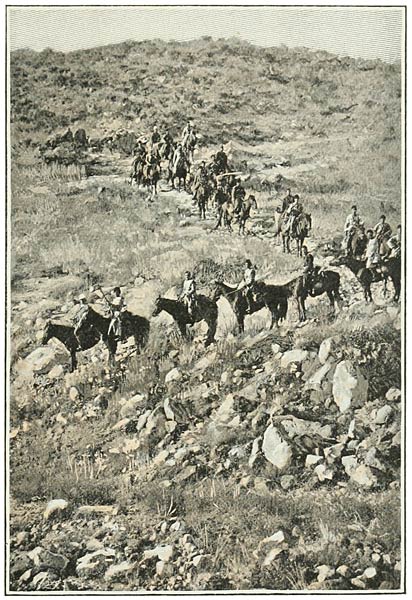
Fig. 31. Our Cavalcade on Ararat.
At the mouth of this valley, on the gently sloping platform which its even surface presents, we marked out the spaces of our bivouac, the pickets for the horses, and the fires. Our men were acquainted with every cranny; we had halted near the site of their summer encampment, from which they had only recently descended to their winter quarters in the plain. As we dismounted we were met by a graceful figure, clad in a Circassian coat of brown material let in across the breast with pink silk—a young man of most engaging appearance and manners, presented to us as the chief of the Kurds on Ararat who own allegiance to the Tsar. In the high refinement of his features, in the bronzed complexion and soft brown eyes, the Kurd made a striking contrast to the Cossacks—a contrast by no means to the advantage of the Cis-Caucasian race. The young chief is also worthy to be remembered in respect of the remarkable name which he bears. His Kurdish title of Shamden Agha has been developed and embroidered into the sonorous appellation of Hasan Bey Shamshadinoff, under which he is officially known.
But the mind was absent from the picturesque bivouac, and the eye which ranged the deepening shadows was still dazzled by the evening lights. Mind and sense alike were saturated with the beauty and the brilliance of the landscape, which, as you rise towards the edge of the platform after rounding the mass of Takjaltu, opens to an ever-increasing perspective, with ever-growing clearness of essential features and mystery gathering upon all lesser forms. The sun, revolving south of the zenith, lights the mountains on the north of the plain, and fills all the valley from the slopes of Ararat with the full flood of his rays—tier after tier of crinkled hummock ranges, aligned upon the opposite margin of the valley at a distance of over twenty miles, their summit outline fretted with shapes of cones and craters, their faces buttressed in sand, bare and devoid of all vegetation, yet richly clothed in lights and hues of fairyland—ochres flushed with delicate madder, amethyst, shaded opaline, while the sparse plantations about the river and the labyrinth of the plain insensibly transfigure, as you rise above them, into an impalpable web of grey. In the lap of the landscape lies the river, a thin, looping thread—flashes of white among the shadows, in the lights a bright mineral green. Here and there on its banks you descry a naked mound—conjuring a vision of forgotten civilisations and the buried hives of man. It is a vast prospect over the world.... Yet vaster far is the expanse you feel about you beyond the limits of sight. It is nothing but a segment of that expanse, a brief vista from north to east between two mountain sides. On the north the slopes of Great Ararat hide the presence of Alagöz, while behind the needle form of Little Ararat all the barren chains and lonely valleys of Persia are outspread.... The evening grows, and the sun’s returning arc bends behind the dome of snow. The light falls between the two mountains, and connects the Little Ararat in a common harmony with the richening tints of the plain. There it stands on the further margin of the platform, the clean, sharp outline of a pyramid, clothed in hues of a tender yellow, seamed with violet veins. At its feet, where its train sweeps the floor of the river valley in long and regular folds—far away in the east, towards the mists of the Caspian—the sandy ground breaks into a troubled surface, like angry waves set solid under a spell, and from range to range stretch a chain of low white hummocks, like islands across a sea. Just there, in the distance, beneath the Little Ararat, you see a patch of shining white, so vivid that it presents the appearance of a glacier, set in the burnt waste. It is probably caused by some chemical efflorescence, resting on the dry bed of a lake. All the landscape reveals the frenzy of volcanic forces, fixed for ever in an imperishable mould; the imagination plays with the forms of distant castles and fortresses of sand. Alone the slopes about you wear the solid colours, and hold you to the real world—the massive slopes of Great Ararat, raised high above the world. The wreath of cloud which veils the summit till the last breath of warm air dies has floated away in the calm heaven before the western lights have paled. Behind the lofty piles of rocky causeways, concealing the higher seams, rises the immediate roof of Ararat foreshortened in the sky—the short side or gable of the dome, a faultless cone of snow.
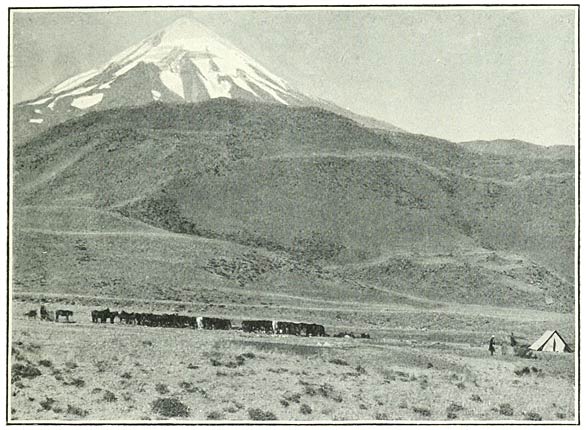
Fig. 32. Our Encampment at Sardar Bulakh.
The space of level ground between the two mountains cannot much exceed three-quarters of a mile. On the east the graceful seams of Little Ararat rise immediately from the slope upon our right, gathering just beyond the covert of low birchwood, and converging in the form of a pyramid towards a summit which has been broken across the point. The platform of this valley is a base for Little Ararat—the rib on the flank of the greater mountain from which the smaller proceeds. So sharp are the lines of the Little Ararat, so clean the upward slope, that the summit, when seen from this pass or saddle, seems to rise as high in the heaven above us as the dome of Great Ararat itself. The burnt grass struggles towards the little birch covert, but scarcely touches the higher seams. The mountain side is broken into a loose rubble; deep gullies sear it in perpendicular furrows, which contribute to the impression of height. The prevailing colour of the stones is a bleached yellow verging upon a delicate pink; but these paler strata are divided by veins of bluish andesite pointing upwards, like spear-heads, from the base (Fig. 33).
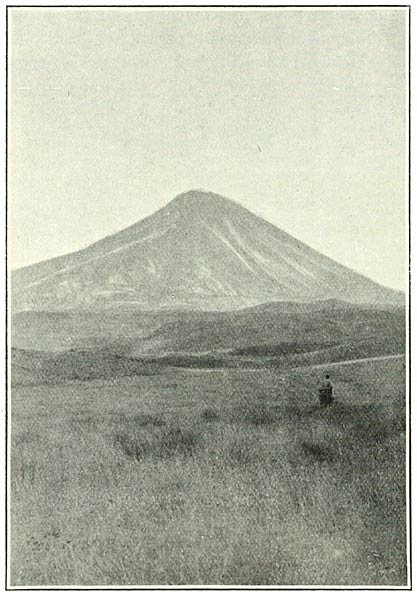
Fig. 33. Little Ararat from near Sardar Bulakh.
Very different, on the side of Great Ararat, are the shapes which meet the eye. We are facing the south-eastern slope of the mountain, the slope which follows the direction of its axis, the short side or gable of the dome. In the descending train of the giant volcano this valley is but an incidental or lesser feature; yet it marks, and in a sense determines, an important alteration in the disposition of the surface forms. It is here that the streams of molten matter descending the mountain side have been arrested and deflected from their original direction, to fall over the massive base. The dam or obstacle which has produced this deviation is the sharp, harmonious figure of the lesser Ararat, emerging from the sea of piled-up boulders, and cleaving the chaos of troughs and ridges like the lofty prow of a ship. The course of these streams of lava is signalised by these causeways of agglomerate rocks; you may follow from a point of vantage upon the mountain the numerous branches into which they have divided to several parent or larger streams. On this side of Ararat they have been turned in an oblique direction, from south-east towards north-east; they skirt the western margin of the little valley, curving outwards to the river and the plain. It is just beneath the first of these walls of loose boulders that our two little tents are pitched; beyond it you see another, and yet another still higher, and above them the dome of snow.
The distance from this valley of the summit of Great Ararat, if we measure upon the survey of the Russian Government along a horizontal line, is rather over 5 miles. The confused sea of boulders, of which I have just described the nature, extends, according to my own measurements, to a height of about 12,000 feet. Above that zone, so arduous to traverse, lies the summit region of the mountain, robed in perpetual snow. From whatever point you regard that summit on this south-eastern side, the appearance of its height falls short of reality in a most substantial degree. Not only does the curve of the upward slope lend itself to a most deceitful foreshortening when you follow it from below, but, indeed, the highest point or crown of the dome is invisible from this the gable side.
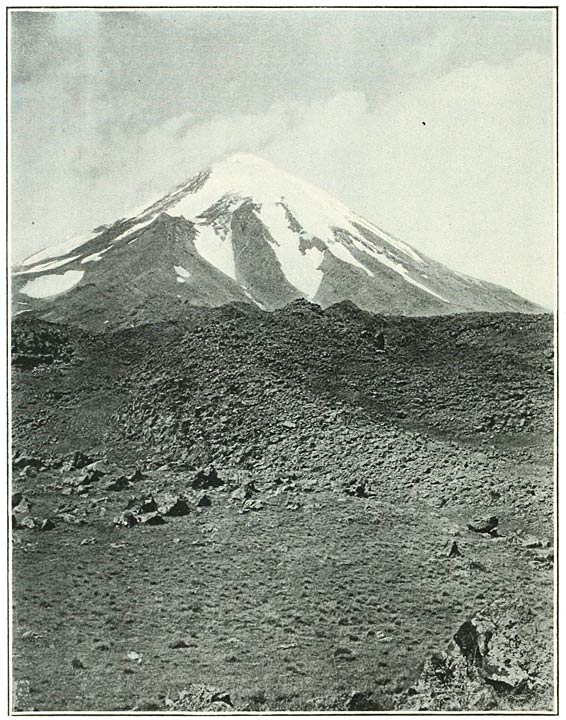
Fig. 34. Great Ararat from above Sardar-Bulakh.
Although the most direct way to the summit region leads immediately across the zone of boulders from the camp by the sirdar’s pool, yet it is not that which most travellers have followed, or which the natives of the district recommend. This line of approach, which I followed for some distance a few days after our ascent, is open to the objection that it is no doubt more difficult to scale the slope of snow upon this side. The tract of uncovered rocks which breaks the snow-fields, offering ladders to the roof of the dome, is situated further to the south-east of the mountain, above the neck of the valley of the pool. Whether it would not be more easy to reach these ladders by skirting slantwise from the higher slopes, is a question which is not in itself unreasonable, and which only actual experience will decide. It was in this manner, I believe, that the English traveller, my friend the Rt. Hon. James Bryce, made an ascent which, as a feat, is, I think, the most remarkable of any of the recorded climbs. Starting from the pool at one o’clock in the morning, he reached the summit, alone, at about two in the afternoon, accomplishing within a space of about six hours the last 5000 feet, and returning to the point from which he started before sunrise on the following day. We ourselves were advised to follow up the valley, keeping the causeways upon our right, and only then, when we should have reached a point about south-east of the summit, to strike across the belt of rock.
At twenty minutes before two on the 18th of September our little party left camp in marching order, all in the pride of health and spirits, and eager for the attack. Thin wreaths of cloud wrapped the snows of the summit—the jealous spell which baffles the bold lover even when he already grasps his prize. We had taken leave of the Cossack officers and their band of light-hearted men. Our friends were returning to Akhury and Aralykh, the one body to hunt the Kurds of the frontier, the other to languish in dull inactivity until their turn should come round again. Four Cossacks were deputed to remain and guard our camp; we ourselves had decided to dispense with any escort and to trust to our Kurdish allies. Of these, ten sturdy fellows accompanied us as porters to carry our effects, their rifles slung over their many-coloured tatters beside the burden allotted to each (Fig. 35). With my cousin and myself were the young Swiss, Rudolph Taugwalder, a worthy example of his race and profession—the large limbs, the rosy cheeks, the open mien without guile—and young Ernest Wesson, fresh from the Polytechnic in London, burning to distinguish himself. My Armenian dragoman followed as best he was able until the camp at the snow was reached; his plump little figure was not well adapted to toil over the giant rocks. Of our number was also an Armenian from Akhury, who had tendered his services as guide; he was able to indicate a place for our night’s encampment, but he did not venture upon the slope of snow.
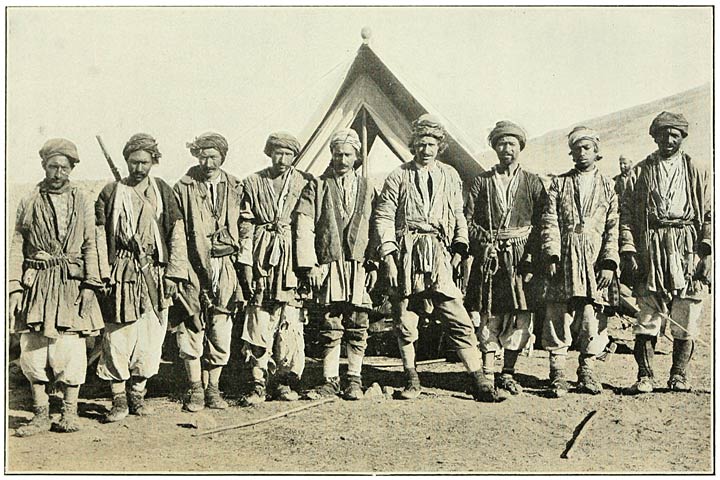
Fig. 35. Our Kurd Porters on Ararat.
By half-past three we had left the gentle water-course, and were winding inwards, up the slope of Great Ararat, to cross the black and barren region, the girdle of sharp crags and slippery boulders which is drawn round the upper seams of the mountain, like a succession of chevaux de frise. We thought it must have been on some other side of Ararat that the animals descended from the Ark. For a space of more than three hours we laboured on over a chaos of rocks, through a labyrinth of troughs and ridges, picking a path and as often retracing it, or scrambling up the polished sides of the larger blocks which arrest the most crafty approach. The Kurds, although sorely taxed by their burdens, were at an advantage compared to ourselves; they could slip, like cats, from ledge to ledge in their laced slippers of hide. In one place we passed a gigantic heap of boulders, towering several hundred feet above our heads. The rock is throughout of the same character and colour—an andesitic lava of a dark slaty hue. A little later we threaded up a ravine or gully, and, after keeping for awhile to the bottom of the depression, climbed slowly along the back of the ridge. I noticed that the grain or direction of the formation lay towards east-south-east. From the head of this ravine we turned into a second, by a natural gap or pass; loose rocks were piled along the sides of the hollow, which bristled with fantastic, but unreal, shapes. Here a seated group of camels seemed to munch in silence on the line of fading sky, or the knotty forms of lifeless willows stretched a menace of uplifted arms. In the sheltered laps of this higher region, as we approached our journey’s end, the snow still lay in ragged patches, which increased in volume and depth.... The surface cleared, the view opened; we emerged from the troubled sea of stone. Beyond a lake of snow and a stretch of rubble rose the ghostly sheet of the summit region, holding the last glimmer of day.
The site of our camp below the snow-line marks a new stage, or structural division, in the fabric of Ararat. Of these divisions, which differ from one another not only in the characteristics presented by each among them, but also in the gradient of slope, it is natural to distinguish three. We are dealing in particular with that section of the mountain which lies between Aralykh and the summit, and with the features of the south-eastern side. First, there is the massive base of the mountain, about 10 miles in depth, extending from the floor of the river valley to a height of about 6000 feet. At that point the higher seams commence to gather, and the belt of rock begins. The arduous tracts which we had just traversed, where large, loose blocks of hard, black lava are piled up like a beach, compose the upper portion of this middle region, and may be said to touch the lower margin of the continuous fields of snow. The line of contact between the extremities of the one and the other stage partakes of the nature of a transitional system, a neutral zone on the mountain side, where the rocky layers of the middle slopes have not yet shelved away, nor the immediate seams of the summit region settled to their long climb. In this sense the fields of stone about our encampment, with their patches of last year’s snow, are invested with the attributes of a natural threshold at the foot of the great dome. The stage which is highest in the structure of Ararat, the stage which holds the dome, has its origin in this threshold, or neutral district, at an altitude which varies between 12,000 and 13,000 feet.
In the attenuated atmosphere surrounding the summit every foot that is gained tells. An approach which promises to ease the gradient at the time when it presses most seems to offer advantages which some future traveller may be encouraged to essay. We ourselves were influenced in the choice of a principle upon which to base our attack by the confident counsels of the Armenian, which the local knowledge of the Kurds confirmed. We were advised to keep to the eastern margin of the depression, by the edge of the great snow-field. You see the brown rocks still baffling the snow-drifts near the point where the deceitful slope appears to end, where on the verge of the roof it just dips a little, then stands up, like a low white wall, on the luminous ground of blue.
The troubled sea of boulders flowing towards the Little Ararat, from which we had just emerged, still hemmed us in from any prospect over the tracts which lay below. The flush of dawn broke between the two mountains from a narrow vista of sky. The even surface of the snow slope loomed white and cold above our heads, while the night still lingered on the dark stone about us, shadowing the little laps of ice. Before six o’clock we were afoot and ready; it wanted a few minutes to the hour as we set out from our camp. To the Swiss was entrusted the post of leader; behind him followed in varying order my cousin and Wesson and myself. Slowly we passed from the shore of the snow-lake to the gathering of the higher seams, harbouring our strength for the steeper gradients as we made across the beach of boulders, stepping firmly from block to block.
At twenty minutes to seven, when the summit of Little Ararat was about on a level with the eye, we paused for awhile and turned towards the prospect, now opening to a wider range. The day was clear, and promised warmth; above us the snowy dome of Ararat shone in a cloudless sky. The landscape on either side of the beautiful pyramid lay outspread at our feet; from north-east, the hidden shores of Lake Sevan, to where the invisible seas of Van and Urmi diffused a soft veil of opaline vapour over the long succession of lonely ranges in the south-east and south. The wild borderland of Persia and Turkey here for the first time expands to view. The scene, however much it may belie the conception at a first and hasty glance, bears the familiar imprint of the characteristics peculiar to the great tableland. The mountains reveal their essential nature and disclose the familiar forms—the surface of the tableland broken into long furrows, of which the ridges tend to hummock shapes. So lofty is the stage, so aloof this mighty fabric from all surrounding forms, the world lies dim and featureless about it like the setting of a dream. In the foreground are the valleys on the south of Little Ararat, circling round to the Araxes floor; and, on the north-east, beside the thread of the looping river, is a little lake, dropped like a turquoise on the sand where the mountain sweeps the plain.
Yet another two hours of continuous climbing, and, at about half-past nine, the loose boulders about us open, and we are approaching the foot of these crags. The end seems near; but the slope is deceitful, and when once we have reached the head of the formation the long white way resumes. But the blue vault about us streams with sunlight; the snow is melting in the crannies; a genial spirit lightens our toil.
And now, without any sign or warning, the mysterious spell which holds the mountain begins to throw a web about us, craftily, from below. The spirits of the air come sailing through the azure with shining gossamer wings, while the heavier vapours gather around us from dense banks serried upon the slope beneath us, a thousand feet lower down.
The rocks still climb the increasing gradient, but the snow is closing in. At eleven we halt to copy an inscription, which has been neatly written in Russian characters on the face of a boulder stone. It records that on the third day of the eighth month of 1893 the expedition led by the Russian traveller Postukhoff passed the night in this place. At the foot of the stone lie several objects: a bottle filled with fluid, an empty tin of biscuits, a tin containing specimens of rock.
At half-past eleven I take the angle of the snow slope, at this point 35°. About this time the Swiss thinks it prudent to link us all together with his rope. The surface of the rocks is still uncovered, but their bases are embedded in deep snow.
It is now, after six hours’ arduous climbing, that the strain of the effort tells. The lungs are working at the extreme of their capacity, and the pressure upon the heart is severe. At noon I call a halt, and release young Wesson from his place in the file of four. His pluck is still strong, but his look and gait alarm me, and I persuade him to desist. We leave him to rest in a sheltered place, and there await our return. From this time on we all three suffer, even the Swiss himself. My cousin is affected with mountain sickness; as for me, I find it almost impossible to breathe and climb at the same time. We make a few steps upwards and then pause breathless, and gasp again and again. The white slope vanishing above us must end in the crown of the dome; and the boulders strewn more sparsely before us promise a fairer way. But the further we go, the goal seems little closer; and the shallow snow, resting on a crumbling rubble, makes us lose one step in every three. A strong smell of sulphur permeates the atmosphere; it proceeds from the sliding surface upon which we are treading, a detritus of pale sulphurous stones.
At 1.25 we see a plate of white metal, affixed to a cranny in the rocks. It bears an inscription in Russian character which dates from 1888. I neglect to copy out the unfamiliar letters; but there can be little doubt that they record the successful ascent of Dr. Markoff, an ascent which cost him dear.
A few minutes later, at half-past one, the slope at last eases, the ground flattens, the struggling rocks sink beneath the surface of a continuous field of snow. At last we stand upon the summit of Ararat—but the sun no longer pierces the white vapour; a fierce gale drives across the forbidden region, and whips the eye straining to distinguish the limits of snow and cloud. Vague forms hurry past on the wings of the whirlwind; in place of the landscape of the land of promise we search dense banks of fog.
We remain forty minutes upon the summit; but the dense veil never lifts from the platform, nor does the blast cease to pierce us through. No sooner does an opening in the driving vapours reveal a vista of the world below than fresh levies fly to the unguarded interval, and the wild onset resumes. Yet what if the spell had lost its power, and the mountain and the world lain bare? had the tissue of the air beamed clear as crystal, and the forms of earth and sea, embroidered beneath us, shone like the tracery of a shield?
We should have gained a balloon view over Nature. Should we catch her voice so well?—the ancient voice heard at cool of day in the garden, or the voice that spoke in accents of thunder to a world condemned to die. “It repented the Lord that he had made man, and it grieved him at his heart. The earth was filled with violence: God looked upon the earth and behold it was corrupt. In the second month, the seventeenth day of the month, the same day were all the fountains of the great deep broken up and the windows of heaven were opened. And the rain was upon the earth forty days and forty nights.”
We are standing on the spot where the ark of gopher rested, where first the patriarch alighted on the face of an earth renewed. Before him lie the valleys of six hundred years of sorrow; the airiest pinnacle supports him, a boundless hope fills his eyes. The pulse of life beats strong and fresh around him; the busy swarms thrill with sweet freedom, elect of all living things. In the settling exhalations stands the bow of many colours, eternal token of God’s covenant with man.
The peaks which rise on the distant borderland where silence has first faltered into speech are wrapped about with the wreaths of fancy, a palpable world of cloud. Do we fix our foot upon these solid landmarks to wish the vague away, to see the hard summits stark and naked, and all the floating realm of mystery flown? The truth is firm, and it is well to touch and feel it and know where the legend begins; but the legend itself is truth transfigured, as the snow distils into cloud. The reality of life speaks in every syllable of that solemn, stately tale—divine hope bursting the bounds of matter to compromise with despair. And the ancient mountain summons the spirits about him, and veils a futile frown, as the rising sun illumines the valleys of Asia and the life of man lies bare. The spectres walk in naked daylight—Violence and Corruption and Decay. The traveller finds in majestic Nature consolation for these sordid scenes; while a spirit seems to whisper in his ears, “Turn from him!—turn from him, that he may rest till he shall accomplish, as an hireling, his day.”