THE VOYAGES OF Captain COOKE.
Reading edition
The rich cargo of the annual ship from Manilla to Accapulco, has ever been the object which private adventurers to the South Seas have had in view, while, on the other hand, the annual ship from Accapulco to Manilla has been the pursuit of the ships of war. This difference has arisen from the different constitution of the two ships; for the galleon, when she sets sail from Manilla, being deep laden with a variety of bulky goods, (such as Chinese silks and manufactures, vast quantities of Indian stuffs, callicoes, and chintz, besides the minuter articles of goldsmiths work, embroidery, &c. wrought at Manilla by the Chinese,) she has not the conveniency of mounting her lower tier of guns, but generally carries them in her hold. Her hands too are as few as are confident with the safe navigation of the ship, that she may be the less encumbered by the stowage of provisions so that being but weakly manned, and indifferently provided for defence, she is thereby more exposed to the attacks of small privateers, and more easy to be made their prey; and, though she does not contain so great a treasure as the other, yet she is sufficiently rich to recompense the undertakers, and to enrich the captors, her cargo being generally estimated at three millions of dollars.
But the ship from Accapulco making her return chiefly in silver and gold, and having little or no bulky goods on board, as her cargo lies in less room, her lower tier is always mounted before she leaves the port, and her crew is augmented with a supply of sailors, and with one or two companies of foot, which are intended to reinforce the garrison at Manilla. Besides, there being many merchants who take their passage to Manilla on board the galleon, her whole number of hands on her return is usually little short of 600 fighting men; so that she is more than a match for such small privateers as are generally sent upon hazardous expeditions, and a prize only for a royal ship of war; and has therefore never been attempted by any other.
The voyage we are now about to relate was purposely fitted out with a view to intercept the Manilla ship at the instance of Dampier, in concluding of whose character (from reading the accounts written by himself) we were led into an error, which the present voyage, written by Captain Cooke, has enabled us to correct. The ill success that attended the voyage to the South Seas, under the immediate command of Dampier, of which a brief relation is given in the first volume of this work, was so far from discouraging that enterprizing officer from pursuing his favourite project of making prize of the Manilla ship, that, after his return, when he had wearied the merchants of London with fruitless solicitations, he repaired to Bristol, where his representations were better understood, and where they were attended with better effect. By his solid remonstrances he prevailed upon nineteen of the principal merchants and gentlemen of that city to unite and form a company, for the purpose of fitting out two private ships of war, to shew what advantages might be derived from a well-conducted enterprize against the Spaniards in the South Seas: and it may, perhaps, be attributed to his judgment and experience, that they were more properly adapted to the service on which they were to be sent, and were better provided against every accident to which they might be exposed, than any privateers that ever were fitted out before them. Add to this, that their crews were furnished with better regulations, and subjected to stricter rules, and under severer penalties, than men listed to go on hazardous adventures are generally willing to submit to.
Their principal officers were gentlemen of experience, or highly interested in the success of the voyage; being the first subscribers, and the chief promoters of the undertaking and these also were assisted with a second set of officers, equally able and experienced, who, in case of accidents, were ready to supply the places of those who might be disabled.
But, besides being awed by penalties from trespassing the articles of agreement that were signed by every man on board from the highest to the lowest, they were likewise encouraged by rewards to behave gallantly; every common sailor who should lose a limb in time of action being entitled to a douceur of 30l. and so in proportion to officers according to their respective ranks: yet, notwithstanding all these precautions, we find them ever ready to mutiny.
The two ships, thus fitted up and regulated, were called the Duke and Dutchess; the first, of 300 tons, 36 guns, and 183 men, was commanded by Woodes Rogers; the other, of 270 tons, 30 guns, and 151 men, by Captain Stephen Courtney.
Captain Rogers, who commanded in chief, was a bold, active man, an indefatigable officer, one who would not give up his opinion readily to others, nor be flattered by other people’s giving up their opinion, without being convinced, to him. He had been, according to Harris, a large sufferer by the French, and was naturally no great friend to that nation; but his most singular quality, and that which indeed recommended him to this command, was a peculiar art he had of maintaining his authority, and at the same time preserving his influence, over his seamen; an art, or gift rather, in which Captain Dampier was remarkably deficient.
Captain Courtney was a man of birth, fortune, and of many amiable qualities; he contributed largely to the expence of the voyage, and took a share in it to superintend the management, and to interpose and qualify the differences that might arise in the course of a tedious and dangerous navigation; being a person of an admirable temper, and remarkable for moderation in all his decisions, in which almost all men were ready to acquiesce.
Besides these two gentlemen, who were first in command, Dr. Thomas Dover (the same, who, about forty years ago, so effectually recommended the use of quicksilver in a little book, entitled Dr. Dover’s Last Legacy to his Country, that ladies as well as gentlemen of rank and fortune bespangled the floors and carpets with quicksilver, and scattered their diamonds wherever they met to dance, or to play) was second Captain on board the Duke; and Captain Edward Cooke, our author, was second to Captain Courtney.
Dover was a considerable contributer to the voyage, but he was of a rough ungovernable temper, seldom pleased with either measures or men; but incapable of forming any party to support his own notions, because no party could ever be brought to approve them.
Captain Cooke was an able and experienced seaman, had been twice taken prisoner, and twice released by the enemy, and now embarked his All in this bottom with a view to make one effort more to gain a fortune.
Captain Dampier, who projected the voyage, was made pilot on board the Duke to direct it. Of him the reader has already heard enough in the former volume of this work; and from the character of the leaders it is natural to infer, that they were choice in the appointment of their inferior officers, and that even the common men were not of the meaner sort.
The general instructions of the owners were, first, to repair to Ireland to take in provisions, and then to proceed with all possible expedition to the South Sea; if luckily they met with any prizes by the way, they were either to send them home or to America, as should best suit; they were ordered by all means to keep together, and to act in concert; to undertake no enterprize of consequence without first deliberating the matter in a general council of officers in both ships; to be particularly careful in assisting each other in every circumstance of necessity; and that in giving relief in times of danger, or in supplying provisions or water in case of want, they should be as one ship, and that on no pretence the one should be suffered to want while the other had any thing to supply; but, as they were to share alike in all advantages, they should share alike too in all sufferings.
Thus fitted out and thus instructed, and the officers of both ships being provided with legal commissions to cruise against her Majesty’s enemies, the French and Spaniards, in the South Seas, on the first of August, 1708, they unmoored from King road, and on the 4th of the same month cast anchor at the Cove in Cork, where they continued victualling, and adjusting their men, changing some and enlisting others, among whom were many foreigners, till the first of September, when they sailed in company with the Hastings man of war, having first agreed, in case of separation, to meet at Madeira, there to take in wine and brandy for the remainder of the voyage.
[Here it is necessary to apprize the reader, that, as there are two very authentic accounts of this voyage, one written by Captain Rogers, and one written by our author, we shall endeavour to reduce them into one, by supplying from Captain Rogers what is wanting in Captain Cooke, and shall, contrary to the method pursued in Harris, continue the narrative in the person of Captain Cooke, though sometimes we may be obliged to use the words of Captain Rogers. And this being premised, we will now proceed:]
On the 10th of September, says Captain Cooke, we spied a sail, which we chaced and came up with. She happened to be a Swede, bound for Cadiz; and though from several circumstances there was reason to suspect that she had contraband goods on board, yet it being difficult to prove it, and we being in haste, dismissed her. This caused a mutiny on board the Duke, headed by the boatswain and three inferior officers, who persuaded the men not to give her up. Captain Rogers confined the authors of this disorder, in which there was not one foreigner concerned. He put ten of the mutineers in irons, a sailor being first soundly whipped for exciting the rest to join him; others less guilty he punished and discharged; but the chief officers continued armed, fearing what might happen, the ship’s company seeming too much to favour the mutineers. They had afterwards a great deal of trouble with these fellows, who did more mischief when in irons than before, by stirring up the men to release them, pretending that they suffered in the cause of the crew, and therefore the crew ought to rise and release them. This determined the Captain to make some examples, but not to irritate too much; he therefore began by removing the boatswain from his office, and appointing another in his room, without intending anything further. But on the 14th this intestine storm rose higher than ever; for then a sailor with the best part of the ship’s company at his heels, went up to the Captain, and demanded the boatswain out of custody. With this man the Captain desired to speak alone, and when he came upon the quarter-deck, the officers seized him, and caused one of his chief comrades to whip him. Thus by different corrections of the like kind, the officers on board the Duke broke the combination, and allayed the tumult. The boatswain they sent home in the Crown galley in irons; the other prisoners they released upon their humble submission; such among them as were petty officers they restored to their commands, and all on board were forbidden to disobey or reproach them: and thus ended an insurrection, which, had it succeeded, would have put a stop at once to the farther prosecution of the voyage.
On the 15th, finding ourselves to the southward, and at the same time somewhat to the eastward of Madeira, we changed our place of rendezvous, and bore away for the Canaries.
On Saturday the 18th, at five in the morning, we saw a sail right a-head, to which we gave chace. About 10, we came up with and took her, being a small Spanish bark bound from Teneriff to Fuertaventura, with several men and women passengers on board, and laden with sundry sorts of goods. Next day we bore away for Oratavia-road, where we stood off and on, and sent away the prize’s boat with one of our owners agents, a priest, and the master of the prize, to treat about the ransom of her, and to get wine, provisions, and other necessaries, for the refreshment of both the ships. About eight next morning, a boat came from the town, with a letter from the English merchants residing there, wherein they expostulated with us for making prize of the bark, alledging that there was a free trade agreed to in these islands between her Majesty of Great Britain and the Kings of France and Spain, so religiously observed by the latter, that they had caused an English ship taken there by a French privateer, to be restored; and farther, representing the danger that might arise to themselves, living by permission in an enemy’s country, if the bark was not immediately given up, for which reprisals would be made on them; as also, that we should be answerable at home for interrupting the settled commerce. This letter was signed by the Consul and three capital merchants. Our Captains immediately returned for answer, that, having no instructions relating to the Spanish vessels trading among those islands, they could not justify the releasing of the ship on their bare opinions, without some order or proclamation of her Majesty, the English being protected there only on anchoring ground, and the bark being taken in the open seas; that, in case Mr. Vanbrugh, the owners agent, was not restored, they would carry away all the prisoners they had; and, if they apprehended any detriment to the factory, they might ransom the bark, and seek their redress in England. They desired dispatch, there being no time to lose; and, upon sending back Mr. Vanbrugh, they would release the prisoners. At night another letter came in answer to theirs, from the Consul, importing, that the English men-of-war were civilly received there, and never committed any hostilities; and that it was strange we should insist on ransoming any Spaniards, who were never made prisoners in England, or elsewhere; and the Governor there delivered up to him any English prisoners that were brought in by Spanish privateers; wherefore he insisted, that those in our custody should be dismissed, and the bark discharged, accepting a present of wine in return. With this from the Consul at the city of Laguna, came another letter from the merchants at Oratavia-port, much to the same purport, only offering to pay to the value of 450 pieces of eight, the sum demanded for the bark, in wine, brandy, sugar, oil, barley, and greens, to prevent incensing the natives against them, not doubting but that reparation would be made them in England. Our Captains replied, by threatening to cruise among the islands to avail themselves for their loss of time, and to cannonade the town of Oratavia, unless they received instant satisfaction. On the 22d, at four in the morning, we stood in for the shore, making a clear ship; but, soon after, we saw a boat coming with our owners agent, and Mr. Cross, one of the English merchants, bringing five buts of wine, and other refreshments. We lay off the town, took the goods out of the prize, sold the bark to Mr. Cross, and put the prisoners on board her. Thus ended this troublesome business, which being unanimously approved of at a council of officers of both ships, they proceeded on their voyage; and, seeing a sail to the westward, gave chace to her, but, night coming on, lost her.
On the 24th we crossed the Tropic of Cancer, and, the Sunday following, performed the ceremony of dipping the men of both ships who had not crossed it before; a ceremony that causes a good deal of mirth among the common men.
On the 30th we passed by Santa Lucia, one of the Cape de Verd islands, and by eight in the morning came in sight of St. Vincent, and about eleven came to an anchor in ten fathom water within the rock.
As we knew the island not to be inhabited, we were not a little surprized to see some people on shore; and, in order to learn who they were, and what their business was, I armed the pinnace, and went on shore, when we found them to be Portuguese come from the island of St. Anthony to catch turtle, who told us we might here wood and water.
This island lies in lat. 16 deg. 55 min. N. and in 25 deg. 36 min. W. long. from the meridian of London. There are on it Guinea-hens, hogs, and goats, and about the shore plenty of fish. In the woods there are spiders as large as little birds, whose webs are not easily broken through, being woven with a substance nearly as strong as ordinary thread.
The Cape Verd islands are eleven in number, St. Anthony, St. Vincent, St. Lucia, St. Nicholas, Sal, Bona Vista, Mayo, St. Jago, Fogo, Romes, and Brava; and take their general name from a promontory on the African shore. They belong to the Portuguese, but are not all inhabited.
While we lay at St. Vincent’s, new disturbances arose among the men in relation to plunder; for here they had an opportunity of trading, and therefore every man wished to have something to exchange. The effects taken in the late prize occasioned a general murmur throughout both the ships; to put an end to which, and to fix the people in a firm resolution of doing their duty, we determined to settle the matter at once, by framing such articles, as, without giving our owners any ground of complaint, might inspire the seamen with courage and constancy, and make them as willing to obey as their officers were ready to command. It cost some trouble to adjust the articles; but that was fully compensated, by their effectually answering the purpose. And now, having composed all differences, the men again chearfully returned to their duty, all but two or three of the Duke’s men, who made their escape on shore among whom was their linguist, who probably had no mind to be left behind; but, having staid beyond his leave of absence, and paid no regard to the orders that were sent him to repair on board, it was thought proper, by way of example, to depart without him. Accordingly on the 7th of October we unmoored, and, on the 8th, after lying by all night for our consort, we set sail together for the coast of Brazil. But on our passage thither some fresh disputes arose among our men and, after various consultations to accommodate the differences, it was resolved, that Mr. Page, who was our second mate, should be sent to serve on board the Duke, and Mr. Ballet to come from the Duke to serve on board the Dutchess in his room. This was not to be effected without force, Page refusing to obey the order; and when it was on the point of being put in execution, he resisted; but, being overpowered, and carried on board the Duke, he was there charged with mutiny. He desired to go to the head, for a necessary purpose, before he made his defence, and was permitted so to do; when he instantly jumped over-board, with the design of getting back again to the Dutchess, but was taken up, tried, and punished, which put an end to the disturbance for that time.
On Wednesday the 27th we crossed the Line, and on Sunday the 14th of November saw land at a great distance, and at noon made Cape Frio, on the coast of Brasil. On the 18th we anchored before Islo Grande, and on the 19th moored our ship in ten fathom water. Here one of our men going from the ship without leave, giving the first Lieutenant foul language, and threatening soon to be revenged, was put in irons; and his messmates and confederates demanding his release, or desiring to share in his punishment, seven voluntarily went into irons.
On the 21st I went on shore in the pinnace with a present to the Governor, and to acquaint him we were friends. At our first landing they fired several shot, taking us for French; but afterwards made an apology, and received us civilly. On the 23d two of the mutineers were whipped, and put in irons again. On the 24th four of the eight men in irons were released, on their submission; and two men went on shore, designing to leave the ship, and, having bargained with a canoe to carry them to the main, they were by mistake put ashore at a distant part of the island, where, finding themselves on an uninhabited coast, they began to relent and, after staying a night in the woods, where they were terrified with the roaring of wild beasts, they came in sight of the ship, and made signs of repentance, humbling themselves in the most suppliant manner, and on their knees, with their hands lifted up, endeavouring to move compassion. After some time the boat went off, and brought them on board, where they were confined in irons till the next day, and then ordered to be flogged and released.
On the 25th two Irish landmen stole away from the Duke, and secreted themselves in the woods, in like manner as the two seamen had done from the Dutchess. About four next morning the watch on the quarter-deck spied a canoe, and hailed her to come on board; but the rowers not answering, but striving to escape, the Duke’s pinnace pursued the canoe, fired into her, and mortally wounded one of the Indian rowers. He that owned and steered the canoe was a Friar, and had a quantity of gold on board, which, after running the canoe ashore, he had just time to hide before the Duke’s pinnace reached the land. A Portuguese, who was in the canoe, and who had no gold to lose, would not follow the Friar; but, on the contrary, knowing the English to be friends, called the Father back, who, upon his return, was carried with the wounded Indian on board the Duke, where the poor man was dressed by the surgeon, but died in a few hours. The officers in both ships were very sorry for this unfortunate accident, and entered their protest against it, and caused the man to be buried on shore in a very solemn manner. The friar, however, who had lost his gold, was not to be appeased, but threatened to seek for justice in Portugal or England.
In towing the ship about the easternmost part of the island, we spied the Duke’s two men waiting for a canoe to carry them over to the main; and two of our Lieutenants manned the boat, and, landing some men in a convenient place to get behind them, to prevent their escaping to the woods, they rowed to the place where the fellows were seen to lurk. When they found themselves beset, they endeavoured to fly; but, being intercepted, they were brought on board, put in irons, and sent to their own ship, where they were afterwards severely punished.
On the 27th the principal officers on board both ships went in their pinnaces to the town of Angra dos Reys on the main, carrying the ships music along with them. They were kindly received and entertained by the Governor and Fathers, who with their servants are the principal inhabitants, there not being more than 50 or 60 low-built houses in the place. They have a guard-house, where, at our landing, we were received by the Governor, with about 20 men under arms, and treated with a dinner, sweet-meats, and rum. The Governor and Fathers desired we would go to see their Franciscan monastery and church, that day being a festival with them, and the people coming from the plantations in the country to celebrate it. We complied; and, at their request, our music, consisting of trumpets, hautboys, and violins, played in a gallery belonging to the church, and assisted in heightening the solemnization, to the no small satisfaction of the Fathers. After divine service we likewise joined in procession with them, and accompanied them from the church in the evening, every one carrying a large wax candle in his hand, according to the custom of the country on such occasions. The procession being closed, we were conducted into a great hall, and treated by the Fathers with an elegant supper of fish, sweet-meats, and fruits of various sorts in the highest perfection. At our coming away, they gave us some volleys with their small arms, and we returned the compliment by a flourish of trumpets, &c.
Fifteen days journey up the country there is said to be a very rich gold mine and it was not long since the French plundered a bark with 800 weight of gold-dust on board, which it was bringing from the mine. Some men of credit told me, that the mines here are more profitable than even Mexico or Peru; but that the Tapoyars, who inhabit the inland plains, are an unconquerable race of men, taller and stronger than the Portuguese, and not to be brought to labour. The Brasilian women are very fruitful, have easy labours, retire to the woods, where they are delivered alone, and return no more till after a certain time allotted for purification.
On Tuesday the 30th of November we weighed anchor; but a tornado coming on, we tacked, and stood under the island till its fury abated. On the 1st of December both ships sailed out of the bay, and pursued their course to the southward till the 21st, without meeting with any remarkable occurrence; but on that day a young man fell from the mizen-top-sail yard, and fractured his skull.
On the 23d we made land, which I supposed to be Falkland’s Island, in lat. 51 deg. 25 min. S. by estimation.
On the 24th, as we ran along shore, the land looked like some part of England, having several good bays and valleys, but believe it to be wholly uninhabited.
On the 5th of January, 1709, we had a violent gale of wind at north-west, and very bad weather. At two in the afternoon we reefed both courses, then lowered our fore-yard, and lay by till five, at which time our waste was filled with water, and we expected the ship to sink every moment: got down our fore-yard as well as we could, and loosed the sprit-sail to wear the ship, which at last we accomplished; but in wearing we thought we should have foundered with the weight of water that was in her waste. Thus we scudded before the wind, the Duke following, and at nine shipped a sea in the poop, as we in the cabbin were going to supper. It beat in all the cabbin-windows and bulk-head, and hove the first Lieutenant halfway between the decks, with several muskets and pistols that hung there, darting a sword that was against the bulk-head of the cabbin through my man’s hammock and rug, which hung against the bulk-head of the steerage; and, had not the bulk-head of the great cabbin given way, all we who were there must inevitably have been drowned before the water could have been discharged. Our yaul was staved on the deck, and it was a wonder that many were not killed with the shutters, the bulk-head, and the arms, which were driven with a prodigious force; but Providence delivered us from this and many other dangers; only one man or two were hurt, and some bruised; but not one rag of dry cloaths was left us, our chests, beds, and bedding, being all soaked in sea-water. Next day the storm abated, and we continued our course, coasting very far to the south, where we endured much cold, by which many of our men were greatly affected, insomuch that a third part of both ships companies fell sick, occasioned, as I suppose, by their being long wet and cold. We were now in lat. 61 deg. 48 min. S. long. from Falkland’s Isles 18 deg. 5 min. W.
Monday 17, by a good observation I found that we were got round Cape Horn, Terra del Fuego, and the Straits of Magellan, and to the northward of Cape Vileria. On the 19th I reckoned we were to the northward of Port St. Stephen on the coast of Patagonia in the Great South Sea.
On Monday the 31st, at eight in the morning, made the Island of Juan Fernandez, where we designed to wood and water. In the afternoon Capt. Dover went off in the pinnace to get some provisions, and in the evening saw a fire ashore, which made us conclude there were ships in the road, as we were assured the island had no inhabitants: we therefore made the signal for the boat to return, and she accordingly come on board about twelve at night.
Tuesday Feb. 1, we rowed and towed into the great bay, and came to an anchor in 50 fathom water. All this day we had a clear ship expecting a rencounter; but were much disappointed when, instead of a valuable prize, we discovered only an odd figure of a man, who had been the sole resident on the island for more than four years. His name was Alexander Selkirk, a Scotchman, who had been Master of the Cinque-ports, the ship that accompanied Dampier in his voyage to the South Seas, and was, as Dampier said, one of the best men in her. Captain Rogers immediately agreed with him to be his mate. It was this man who made the fire in the night when he saw our ships, which he judged to be English. During his stay here, he saw several ships pass by; but only two came to an anchor. As he went to view them, he found them to be Spaniards, and retired from them; upon which they shot at him. Had they been French he would have submitted, but chose to risque his dying alone on the island rather than fall into the hands of the Spaniards, because he apprehended they would either murder, or make a slave of him in the mines; for he feared they would spare no stranger that might be capable of discovering the South Seas. The Spaniards had landed before he knew what they were, and they came so near him that he had much ado to escape; for they not only shot at him, but pursued him to the woods, where he climbed to the top of a tree, at the foot of which they charged their pieces, and killed several goats just by, but went off again without discovering him. He told us, that he was born at Largo, in the county of Fife, and was bred a sailor from his youth. The reason of his being left here was a difference between him and his Captain, which, together with the ship’s being leaky, made him willing rather to stay here, than go along with him at first, and when he was at last willing to go his Captain would not receive him. He had been at the island before to wood and water, when two of the ship’s company were left upon it for six months, till the ship returned, being chaced thence by two French South Sea ships. He had with him his cloaths and bedding, with a firelock, some powder, bullets, and tobacco; a hatchet, a knife, a kettle, a bible, some practical pieces, and his mathematical instruments and books. He diverted and provided for himself as well as he could; but for the first eight months he had much ado to bear up against melancholy, and the terror of being left alone in such a desolate place. He built two huts in Piemento-trees, covered them with long grass, and lined them with the skins of goats which he killed with his gun as he wanted, so long as his powder lasted, which was but a pound, and that being almost spent, he got fire by rubbing two sticks of Piemento wood together upon his knee. In the lesser hut, at some distance from the other, he drest his victuals, and in the larger he slept, and employed himself in reading, singing psalms, and praying; so that he said he was a better Christian while in this solitude than ever he was before, or than, he was afraid, he should ever be again.
At first he never eat any thing till hunger constrained him, partly for grief, and partly for want of bread and salt, nor did he go to bed till he could watch no longer. The Piemento wood, which burnt very clear, served him both for fire and candle, and refreshed him with its fragrant smell. He might have had fish enough, but could not eat them for want of salt, because they occasioned a looseness, except crayfish, which are as large as lobsters, and very good. These he sometimes boiled, and at other times broiled, as he did his goat’s-flesh, of which he made good broth. He kept an account of 500 that he killed while there, and caught as many more, which he marked in the ear and let go. When his powder failed he took them by speed of feet, for his way of living and continual exercise cleared him of all gross humours, so that he ran with wonderful swiftness through the woods and up the rocks and hills, as we perceived, when we employed him to catch goats for us. We had a bull-dog which we sent with several of our nimblest runners to help him to catch goats; but he distanced and tired both the dog and the men, caught the goats, and brought them to us on his back. He told us that his agility in pursuing a goat had once like to have cost him his life. He pursued it with so much eagerness that he catched hold of it on the brink of a precipice of which he was not aware, the bushes hiding it from him so that he fell with the goat down the precipice a great height, and was so bruised with the fall that he narrowly escaped with his life; and, when he came to his senses, found the goat dead under him. He lay there about twenty-four hours, and was scarce able to crawl to his hut, which was about a mile distant, or to stir abroad again in ten days. He came at last to relish his meat without salt or bread. He had a constant supply of good turneps, which had been sown there by Captain Dampier, and have now overspread some acres of ground. He had good cabbage from the cabbage-trees that grow wild upon the island, and seasoned his meat with the fruit of the Piemento-trees, which is the same as Jamaica-pepper, and smells deliciously. He found also a black-pepper, called Malageta, which was very good to expel wind and strengthen the stomach. He soon wore out all his shoes and cloaths by running in the woods; and at last, being forced to shift without them, his feet became so hard that he ran every where without difficulty; and it was some time before he could wear shoes after we found him; for, not being used to any so long, his feet swelled when he came to wear them again. After he had conquered his melancholy, he diverted himself sometimes with cutting his name upon the trees, sometimes with contrivances to vary and increase his stock of tools, and sometimes in clear evenings in counting the stars. He was at first much pestered with cats and rats that had bred in great numbers from some of each species which had got ashore from ships that put in there to wood and water. The rats gnawed his feet and cloaths while he slept, which obliged him to cherish the cats with his goat’s flesh, by which many of them became so tame, that they would be about him in hundreds, and soon delivered him from the rats. He likewise tamed some kids; and, to vary his diversions, would now and then sing and teach them to dance; so that by his natural flow of humour, and the vigour of his youth, being now but 30 years old, he came at last to conquer all the inconveniences of his solitude, and to be very easy. When his cloaths were worn out, he made himself a coat and a cap of goats-skins, which he stitched together with little thongs of the same that he cut with his knife. He had no other needle but a nail; and, when his knife was worn out to the back, he made others of some iron hoops that were ashore, which he beat thin, and ground upon stones. Having some linnen cloth by him, he sewed himself some shirts with a nail, and stitched them with the worsted of his old stockings, which he pulled out on purpose. He had his last shirt on when we found him on the island. At his coming on board us, he had so much forgot his language for want of use, that we could scarce understand him; for he seemed to speak his words by halves. We offered him a dram; but he would not touch it, having drank nothing but water since his being there; and it was some time before he could relish our victuals. He could give us no account of any other product of the island than what we have mentioned, except some black plumbs, which are very good, but hard to come at, the trees which bear them growing on high mountains and rocks.
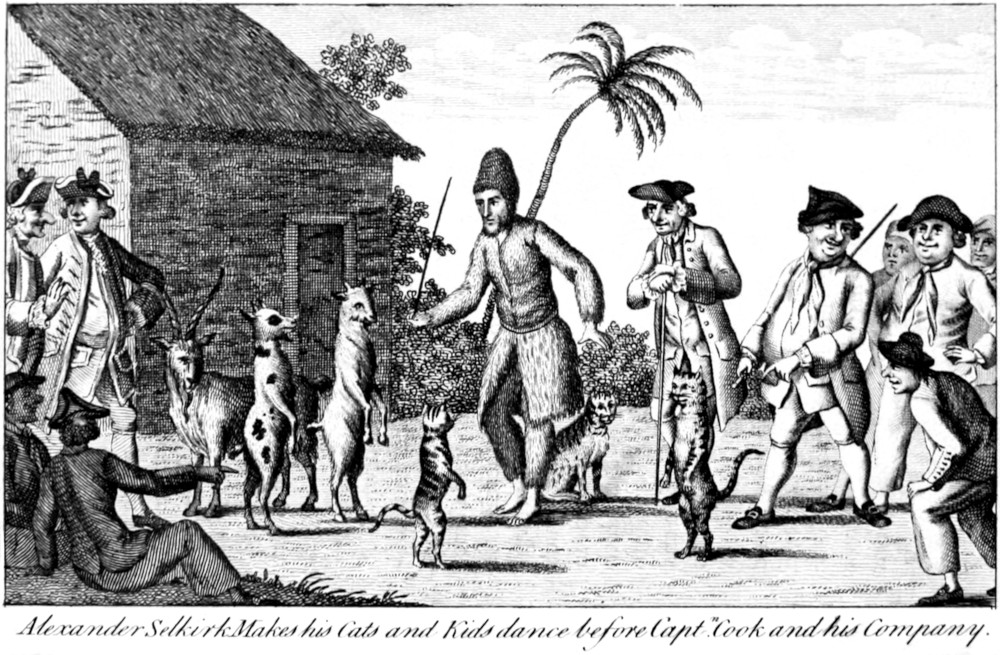
Alexander Selkirk Makes his Cats and Kids dance before Capt
n
. Cook and his Company.
The officers that went first on shore were invited to his retreat; but the way to it being very rugged and intricate, only a very few of them had curiosity enough to visit it. He had conceived an irreconcileable aversion to an officer on board the Cinque Ports, who, he was informed, was on board the Duke; but, not being a principal in command, he was prevailed upon to wave that circumstance, and to accompany Captain Dampier, for whom he had a friendship. He was very useful while the ships staid at Juan Fernandez, in supplying them with fresh provisions, and in facilitating the business of taking in wood and water. He said, he had seen snow and ice in July, which is the middle of winter in that climate; but the months of September, October, and November, are inconceiveably pleasant; the air being perfumed with a fragrance that cherishes and revives the spirits, and has a wonderful effect upon animals, as well as men, which Selkirk remarked by their playwardness and plumpness. He particularly directed us to a plant not much unlike feverfew, of a most grateful and cordial scent, with which we strewed the tents of the sick, who were thereby much comforted, and their cure facilitated. We gathered many bundles of it, dried them in the shade, and sent them on board.
On the 13th of February, a general council of officers was held on board the Duke, when many necessary regulations were agreed to, for the maintenance of order, discipline, and secrecy; among which, two inspectors were appointed from on board the Duke, to take account of all prizes taken by the Dutchess; and the like number from the Dutchess, to register such as should be taken by the Duke.
While we continued in this bay the carpenters fitted up the pinnaces, the frames of which were ready prepared at Bristol, at our first setting out.
On the 14th the pinnaces were launched, and having each a gun fitted to her prow, were tried in the bay, to see how they would sail, being intended to serve as small ships of war, to examine the harbours where the large ships could not venture to approach the shore. And now, having all things in readiness, we began to prepare for our departure, all our sick men being recovered, except two who died, and were buried on the island.
On the 15th we cleared the bay, and pursued a northerly course till the 24th, when we crossed the Tropic of Capricorn, and shot some Tropic birds about the size of a partridge, with only a single feather in their tails, but that very long, and very taper. We had now the sea as smooth as a pond; and, having little to do, we ordered the men to attend prayers regularly twice a day; prohibited gaming, to prevent the artful from taking advantage of the simple; and imposed a penalty against swearing, by which that vice was almost excluded the ships company.
On Monday the 28th I ordered three of our men to be put in irons, for cutting the meat in the steep-tub, and hiding it; and on the 2d of March, Captain Courtney caused them to be whipped and pickled, by way of example.
On Thursday the 14th of March, Captain Rogers, Captain Dover, and Captain Dampier, came on board the Dutchess; and concluded, that the strict observation of Lent having prevented the Spaniards from trafficking in those seas, the most eligible plan would be to bear away under an easy sail for Lobos, and there to supply ourselves with boats to land at Guayaquil; but in the afternoon, saw a sail, gave chace, and took her. She came from Guayaquil, and was bound for Cheripe to load flour, and had been out 16 days. The crew were all Indians, except one Spanish passenger. They had nothing on board but about 50l. in money to pay for their cargo, and told us, that part of the new town of Guayaquil had lately been burnt; that the Jesus Maria, formerly a man-of-war, was coming from Lima to be there rebuilt; that another large ship was expected from Panama at Payta; and that they had heard nothing of any English men-of-war or privateers being in those seas.
On the 16th we made the island of Lobos, and in the evening anchored in the road. It lies in lat. 6 deg. 5 min. S. about 16 leagues from the continent, is barren, and affords neither wood nor water; but there is good riding for ships, and harbours proper for repairing and careening. Here the prize was fitted up, and it was agreed, that I should go out in her with 35 men, to cruise in company with the Dutchess; and with that view she was new named, and called The Beginning Galley.
On the 26th, at day-break, we saw a ship standing to the southward, and soon came up with her. She was a bark of 50 tons, bound from Guayaquil to Truxillo, with timber and cocoa-nuts. It was agreed, that Captain Courtney should stand in with her in the night; and that I should continue to cruise till farther orders, which on the 27th I received, and the same evening came to an anchor by the Duke and Dutchess in Lobos-road. Next day, the prisoners being examined, reported, that a ship of 36 brass guns was expected from Lima with the Viceroy of Mexico and his mother on board; and that they were bound to Panama. Upon this intelligence it was resolved in full council to cruise in quest of this ship, and if she escaped to attack Guayaquil.
While the Duke lay at Lobos, the carpenters built a large boat to land men, in case of an attack; and, having made all necessary preparations, and the sick men from both ships being put on board the last prize, which was called the Increase, our first Lieutenant was ordered to command the Beginning Galley; and on the 31st of March we left Lobos, and agreed to cruise six leagues to the windward of the Saddle of Payta, as the most likely station to succeed in our enterprize.
On the 2d of April we fell in with a large ship, of 400 tons, from Panama, heavily laden with dry goods, commanded by Captain Morel, and thought to be one of the largest merchant-ships in all those seas. He had 50 or 60 blacks on board, besides several passengers.
The next day we took another prize of small value, having only about 90 or 100l. in plate, and a small quantity of timber. She was of 50 tons burden, commanded by Juan Perezillo Bastillo, who told us that a bishop was coming by sea from Panama to Lima with 200,000 pieces of eight, and a considerable quantity of family plate; but no ship appearing in sight from the 3d to the 9th, it was then upon consultation agreed to call in the cruisers, and to attempt the conquest of Puna and Guayaquil. This resolution being taken in council, it was next debated, who should command in chief on shore; and, after a warm contest, it was at length agreed, that Captain Rogers and Captain Courtney should each command a company of seamen, and Captain Dover a party of landmen; that Captain Dover should give the word of command the first night, and the other two Captains take their turns.
On Sunday the 10th, Mr. Vanbrugh, the owners agent, was removed from the council, and Mr. Samuel Hopkins was chosen in his room; the charge against him was founded on killing the Indian, as already mentioned, and engaging to vote with Captain Rogers upon all occasions. Captain Dover likewise charged him with insolence, and with disobeying orders.
On the 12th, the attack of Guayaquil was finally settled, and the whole fleet set sail for that harbour. Some new regulations were framed, and fresh encouragement proposed to animate the men to behave resolutely.
The three commanding officers selected each their respective parties, Captain Dover the marines, and the Captains Rogers and Courtney two parties of sailors, 75 men in each; Captain Dampier commanded the artillery, and was to form a body of reserve, to act as occasion should offer. The whole number employed in this service amounted to 238 effective men. The care of the ships and prizes was at the same time entrusted to the Captains Cooke and Fry, who, besides a small complement of sailors, had 226 Indians and blacks on board.
Friday 15. Saw a sail near the shore, and, having little wind, the Duke’s boat commanded by Captain Fry, and ours by myself, made directly for her, going off in such haste that neither of us had the swivel guns we used to carry, nor our full complement of men. The Duke’s boat nearing her first, she put out Spanish colours, fired a gun, and hoisted her Spanish flag at the main-top-mast head. The Duke’s boat then lay by for us to come up. We saw she was French-built, and, by the description the prisoners had given us, concluded it must be the ship we had been so long cruising for, which was to carry the Bishop. Our ships being almost out of sight, and the Spaniards so near the coast, we resolved to lay her on board on each bow, and accordingly fell to it. The dispute was hot for a long time, we keeping a constant fire, and the enemy returning it, who killed two of Captain Fry’s men, besides wounding one of his and two of mine. One of the killed was Mr. John Rogers, our second Lieutenant, and brother to Captain Rogers. The Duke’s boat, finding the enterprize desperate, bore away; and some time after we did the like: but Captain Fry having put some of his men aboard of us, given us some powder and shot, and taken in our wounded, I made again to the chace, resolving to keep her from the shore, and, rather than fail, to clap her aboard. The Spaniards, perceiving our design, edged off to sea, and we followed them. Our ships came up apace, and the Dutchess having fired a shot or two, she struck her colours, and surrendered. The men begged for good quarter, and we promised them all civility. This ship came from Panama, and was bound for Lima, to be fitted out for a man of war. There were 70 blacks, and many passengers, with a considerable quantity of pearls, on board: the lading consisted of bale goods, and some things belonging to the Bishop; but they had set him, with his attendants, ashore at point St. Helena, from whence he was to go by land to Guayaquil. While the French possessed this vessel, she was called La Lune d’Or. She was of 270 tons burden, and commanded by Don Joseph de Arizabella.
Saturday 16. Took a small bark laden with hides, and some flour, and buried our Lieutenant, being all much concerned for the loss of so good an officer.
Sunday 17. All things being now in order, our men went aboard the two barks in order to land, and Captain Fry and I took charge of the ships, prizes, and prisoners.
Monday 18. At one in the morning, being near the island Santa Clara, our two barks with the land forces left us.
Tuesday 19. The boats rowed with 45 men towards the island Puna, and came to a grappling close under the land, out of sight of the look-outs. We seized the Governor of the island, and sent our carpenter and two or three hands along the shore, to cut all the bark-logs and canoes in pieces, for fear they should get away and alarm the town of Guayaquil.
Thursday 21. I sent the Beginning a-head, for fear of danger, who, seeing a vessel riding close under point Arena, fired two swivel guns at her; but found nobody on board. She was a new Spanish bark going to load salt, and had nothing in her but a few jars of water. At five in the afternoon the transports rowed for the town of Guayaquil, and at eleven at night were so near as to hear one centinel call to another for fire to be brought. Perceiving we were discovered, we rowed over to the other side, and saw a fire made where the centinels talked, and soon after many lights all over the town. We heard them likewise ring the alarm-bell, and fire several volleys; and we observed them to light a fire on the hill to give the town notice of our being come up the river. Hereupon the boats came to a grappling, when such a hot dispute arose among some of our chief officers, that they were heard ashore; the officers differing in their opinions, whether to land immediately, or stay till morning; however, at last it was agreed, that, since we did not know the ground, it was best to stay till day-light.
Friday 22. Our forces being all joined, we sent a flag of truce, with the Captain of the French-built ship, and another prisoner, to the Corregidor, who asked him our number, which the Captain magnified. The Corregidor suggested that we were mere boys; but the Captain replied, he would find we were men, for we had fought him bravely in our open boats, though he had killed one of the Commander’s brothers, and wounded and killed others; and therefore advised him to agree for the ransom of the town.
Saturday 23. The pinnace went up the river after some vessels, and brought six of them to anchor by our barks; and we also took possession of two new ships, of about 400 tons each. We then went ashore with a flag of truce, and the Governor came on board to agree about the ransom of the town and ships; but this not being then concluded, he promised to meet the Captain at seven in the evening, but was not so good as his word.
Sunday 24. The Governor came off again to treat, and our Captains would have seized him for having forfeited his word; but he alledging that it was incompatible with his coming with a flag of truce, was set ashore again, and all things were made ready for the attack. Accordingly the men landed, and, being commanded to proceed, they went on with so much bravery, that the Spaniards fired only their first volley and fled, our people pressing and pursuing them to their cannon, which they soon deserted, the gunner only, who was an Irishman, standing by them till he was wounded in four places, of which wounds he soon after died. Our men then marched in a body through both towns, drove out the enemy, and, placing three guards in the three churches, set fire to five or six houses adjoining to the wood, lest the enemy should annoy our guard, which was within pistol-shot. All this night they kept firing out of the woods at our centinels, but did them no harm. In the mean time, the Dutchess’s pinnace, commanded by Lieutenant Connely, went up the river, landed at every house, took the plate and what else of value they found, and had some skirmishes with the enemy, in which one of our men was wounded.
Monday 25. In the night one of our centinels shot another belonging to us, who was going from his post, and did not answer when challenged three times; our first Lieutenant’s pistol went off by his side, and wounded him in the leg; and another of our men was also shot through the foot by one of our own people: moreover, our surgeon cut off a man’s arm who had been hurt by one of our grenadoe-shells, which broke in the bark when fired out of the cohorne. The afternoon was spent in shipping off provisions from the town, and disposing all things in case of an attack in the night.
Tuesday 26. A flag of truce came to treat concerning ransoming the town, which was at last agreed on for 30,000 dollars. We were to have three hostages, and to stay at Puna till they could raise the money.
Wednesday 27. The hostages came on board; and we took down our Union flag, and hoisted a flag of truce, firing a gun for a signal that the Spaniards might come into the town, and that no farther hostilities should be committed on either side.
Thursday 28. Our barks weighed with the beginning of the ebb, the Duke’s pinnace making the best of her way down to the ships; and the float, after going ashore to fetch off the great guns, weighed also, and fell down the river.
Friday 29. Captain Rogers came aboard, and gave us an account that they had taken, plundered, and ransomed the town of Guayaquil; that three of our men had been killed, two by our own people, and one by the Spaniards, and four wounded; that the inhabitants, whilst treating, had carried off their money and plate, retiring to the woods, and leaving their guns, four whereof were taken, with a considerable quantity of meal, pease, sugar, brandy, and wine, all which was coming down in the barks. This day Hugh Tidcomb, who was shot by his fellow-centinel, died. At four in the afternoon, spied a sail standing up the river with the tide of flood: we sent both ship’s boats after her, and before night they brought her in. She was a small Spanish bark from Cheripe, having on board 330 bags of meal, 35 hundred weight of sugar, some onions, quinces, and pomegranates. This, with the six barks, and two great ships ransomed by the town of Guayaquil, made fourteen prizes taken in those seas.
Sunday 30. Captain Rogers went aboard the French-built ship to carry her up to Puna, in hopes of disposing of her cargo and some of the blacks, who only served to eat up our provisions; as also to bring down what water and provisions could be got; Captain Courtney being gone there before on the same account.
Monday, May 1. A boat came down from the town with part of the ransom, whereupon most of the prisoners were set on shore.
Thursday 5. Captain Rogers returned with the French-built ship, the Spaniards having bought none of her cargo; but they had paid 24,000 dollars, part of the 30,000 ransom; upon which, the Governor of Puna, one of the hostages, was discharged, but the others kept.
Friday 6. In the afternoon the Duke and the prizes joined us, when we were seven sail in all. A boat came down with about 3000 dollars more, in money and plate; and the men told us, that the other 3000 dollars would soon come, and 12,000 more to purchase goods: but this we supposed to be a trick, to keep us till the men-of-war could come from Lima; whereupon we made all possible dispatch to get out of the bay, kept three of the hostages, and sent the prisoners ashore. The Beginning, being of no other use, since we had better vessels, we sold to the Spaniards for the value of 50l. in pearl, gold chains, &c. and put the prisoners aboard, but kept pilots, and a man that could speak English, the President of Panama’s son, and the hostages. The weather being very hot, some of our men fell into fevers; and in a few days we had near 100 sick, and among the number Capt. Courtney.
Sunday 8. Sailed with a small breeze at N. W. At noon it began to blow fresh; but nothing material happened till the 13th, when, believing ourselves near the longitude of the Gallapagoes, where we designed to water, fit our ships, and refresh our men, we lay by from six in the evening till four the next morning, for fear of running by those islands in the night.
Monday 16. Mr. Hopkins, Lieutenant of the marines, and one of the doctors of the Duke, died.
Tuesday 17. Saw land, being one of the Gallapagoe islands. Next day the Duke’s boat went on shore to seek for water, but could find none in any of them, though Captain Cowley, in his voyage round the world, says there is good water in one of them; but we missed the place.
The 20th, 21st, and 22d, we spent in plying among the islands, where the boats found abundance of turtle, large rock-fish, and guanos. These last-named creatures are larger here than those in other parts of the West Indies, and are of several colours and sizes. They are eaten by the seamen, and reckoned good meat, though their deformity made me loath them.
Thursday 26. Captain Rogers and Captain Dover came aboard the Dutchess, and, after holding a council, it was resolved to run in for the island of Plata to water, and so come off again, for fear of meeting with two French ships, one of 60, and the other of 46 guns, and the Spanish men-of-war, which, we were told, would be shortly in search of us. Some days before this we lost Mr. Hatley, who was in one of the prizes, with five or six white men, four blacks, and an Indian, having on board little or no provisions or water, and no boat; and we never more heard of them.
Monday 30. The officers of the Duke came aboard, to consult about the properest place to careen and water at; and ’twas agreed to go to the island Gorgona, to see whether any Spanish ships were there, and from thence to Mangla, where are some Indians, enemies to the Spaniards, who, it was said, would supply us with swine and fowls, good water, turtle, plantains, and other refreshments.
Wednesday, June 1. Some of our men were told, that a conspiracy was forming on board the galleon among the prisoners and blacks. We examined the Spaniards, who protested they knew nothing of it then put matches between the fingers of two blacks, making them believe we would burn them to the bone if they would not confess. They owned there had been a talk of killing the English among the Indians and blacks, but they believed it was not in earnest; however, they were dispersed into several ships to break the combination.
Sunday 5. Saw a sail right-a-head of us, chaced, and at eight in the evening came up with her, fired a chace-gun, and she struck. The vessel was of about 80 tons burden, bound from Panama for Guayaquil, was laden with iron and other merchandize, and had two women, and several passengers of note on board, one of whom was going Governor to Baldivia, whose name was Don Juan Cardoso, and who had been not long before taken on the other side by the Jamaica cruisers.
Monday 6. Made the best of our way for Gorgona; and at three in the afternoon next day, the Duke with the galleon came to an anchor in that harbour. Same day saw a sail bearing down towards the island, till spying the galleon in the offing, she stood to the westward. I went out in the pinnace well-manned, and at noon took and brought her to an anchor. She was a bark of 50 tons, called El Soldado, came out of a small port the night before, and was bound for Guayaquil, to load salt, brandy, &c. She had in her in gold chains and money to the value of 5 or 6 hundred pounds, designed to purchase her cargo.
Monday 13. Held a full council on board the Duke, and resolved to careen our ships here as soon as possible. Here we continued till Sunday, August the 7th; and in the mean time plundered a settlement on the main, right opposite the island, set most of our prisoners on shore on the continent, and brought seven beeves, 14 hogs, some poultry, about 50 bushels of Indian wheat, and a few goats on board: at the same time a black born in Jamaica, who spoke very good English, and had been taken with some Jamaica-men eight years before, came over to us in a canoe. Captain Morel, too, formerly commander of the galleon, brought some money and fruit, and a merchant or two, who bought some of our blacks. During our stay at this island, Captain Rogers, Captain Courtney, myself, and some other officers, underwent much fatigue in fitting up the Marquis, for which ship we were forced to get entirely new masts and yards, make most of the sails, and a great deal of new cordage. The smith also made much new work; as did the carpenters, sail-makers, riggers, and rope-makers, who all came to help us from each ship.
The 6th of August, I received my orders to command the Marquis, carrying 20 guns, 60 white men, and 16 blacks; and, the ships having taken in their loading from the prizes, and all our business being over at the island of Gorgona, we weighed anchor at 10 in the morning, and ran to the north of the island: but the masts of the Marquis being new and heavy, and a great weight of goods between decks, I found she proved crank, and sailed dull upon the wind; so that the Duke and Dutchess were fain to spare a great deal of sail for me to keep up with them.
Friday 12. Held a consultation about sending the Marquis and a bark laden with bale-goods directly for India, to save provisions and gain time; but this was opposed by Captain Courtney, and others, in regard to the Marquis, which being a good vessel, might be of great use in case we should meet with the Manilla ship, or the men-of-war we supposed were looking for us.
Thursday, August 18. At six in the morning saw a sail a-head, gave chace, and the Dutchess soon coming up with her, and firing a few guns, she struck, being a bark of about 70 tons, bound from Panama to Troxillo, with merchants goods, passengers, and blacks, on board. The master told us, he had been detained three months at Panama by an embargo, which being taken off upon advice that we were going to the island of Juan Fernandez, he had set sail. Enquiring what ships were out in quest of us, the prisoners said, they had advice at Panama of five or six ships being ordered after us, two of them French, of 48 guns each, and some Spanish, of the like force, and good sailors. They could tell no other news, than that the whole coast was alarmed.
August 19. The Duke and Dutchess fired some vollies to exercise their men. Next day we fell in with land about a league to the leeward of Tacames, ran within a league of the shore, and on the 24th cast anchor in the bay, from whence the Dutchess sent her pinnace ashore for water, but could get none. Tacames is a village of only seven houses and a church, standing in a bay, about seven leagues to the northward of Cape Francisco. The houses are built of split bamboes, and covered with Palmeto-leaves, standing on stilts or posts; and, instead of stairs, they have a piece of timber cut in notches to ascend by. The men employ themselves in killing wild swine with bows and arrows, and striking fish with their lances, at both which they are very dexterous. The women have only a piece of baize tied about their middle, and carry their children at their backs. They are under the authority of the Spanish priests, and are not permitted to trade without their licence.
On the 27th. They received a letter of leave, and our boats went ashore to the houses for cattle; and on the 28th and 29th continued trading and watering till we had sufficiently supplied the ships. In return for the civility of these Fathers, I sent as a present to the church at Tacames four large images, one of which was the Virgin Mary with our Lord and Saviour in her arms; and I believe Captain Rogers and Captain Courtney also gave something to adorn their church. On Wednesday the 31st of August we set sail, the wind being at S. W.
Thursday, Sept. 1. Saw abundance of water-snakes, one of which was coming up the side of our ship, and our men beat it off. The Spaniards say, there is no cure for such as are bit by them; and one of our blacks happened to fall under that misfortune, and died, notwithstanding the utmost care was taken by our surgeons to recover him.
On Wednesday, Sept. 7. Made one of the Gallapagoe islands. On the 10th, stood close in for the head-land, sending our boat on shore for water and turtle. At night our boat came aboard, bringing 13 turtle, some weighing 200 weight; the other boats got near 50 each; and the Dutchess’s several land-turtle, but no water. Our men saw several jars, and some of the wreck and rudder of a vessel, and should have guessed it to be the prize Captain Hatley lost when here before, but the rudder was too small for her.
Wednesday 14. The Dutchess, Marquis, and small prize, weighed, ran out, and lay by for the Duke, which could not get out for want of wind. On the 15th, set sail in the morning; and, considering the sun was directly over our heads, the weather was cold, occasioned, as I believe, by the southerly winds, which are coldest in those parts.
Thursday, Sept. 22. The Marquis kept the pump continually going, having sprung two leaks, not being well caulked at Gorgona; therefore weared her on the other tack, and stopt one leak, but could not find the other, being about the stern. Weared again, and stood to the westward.
Friday 22. At a consultation on board the Duke, it was agreed to steer to the Islands Marias, for a convenient place to refit, wood, and water; then to cruise in quest of the Manilla ship, which was large, and of great value, being reported by the Spaniards to be worth 2,000,000 sterling.
On the 3d of October. Cape Corientes appeared, bearing N. E. 10 leagues; and on the 4th in the morning we made the islands called Tres Marias, at the distance of about 16 leagues; but could not fetch them till the 6th, when we got under the lee of one of them. I lay off with the ship, and sent the boat ashore for water and turtle; but neither the one nor the other was to be got, because of the surff.
Before our coming to this place, we discovered the white rock, formerly mentioned by Dampier, and took it for a ship on the sight of which the Dutchess let go the bark she had in tow, telling her to make the best of her way to the middle island; under the lee of which both the Duke and Dutchess came to an anchor on the 7th and 8th; and I might have been there as soon, had I not seen the bark six or seven leagues to leeward. It was fortunate that I came in time to relieve her, otherwise she must have perished, having neither wood nor water on board, and not being able to make up against the wind and current to reach the land. I bore down to her, supplied her wants, and took her in tow till the 20th in the morning, when the middle island bearing north, distant about seven leagues, we saw a sail coming from the island before the wind, which proved the Dutchess, who came in search of us, and was glad to find us safe; brought us some water and turtle, and told us there was game enough in the island, if we could bear up to it. Captain Courtney took us in tow, to help us in the sooner, having cleaned his ship’s bottom before he set sail to come to our assistance.
On the 11th, I came to an anchor, after much trouble and fatigue in plying so long against the wind and current. Seven of Captain Rogers’s best blacks this day left him, and ran away. We continued in this bay till
Monday the 24th, when a general council was held, at which it was resolved to cruise off Cape St. Lucas for the Manilla ship, all our ships being now very well fitted, wooded, watered, and provided with turtle. Several warm debates happened in council among our chief officers; and Captain Dover quitted the Duke, and went on board the Dutchess, by his own free choice. I endeavoured to accommodate these differences, but to no purpose, which gave several of us great concern.
The islands of Tres Marias, where we anchored, abound with animals of various kinds, and the shores with fish; among these the sea and land turtle may be accounted of most use to navigators. Of the sea-turtle there are various sorts; as the green, which are the sweetest and best; the hawk’s-bill, which are very good; and the logger-head, which the sailors never refuse when the others are not to be caught. The method of taking them is by turning them, and when they are on their backs, they appear as in the Plate, fig. 1.
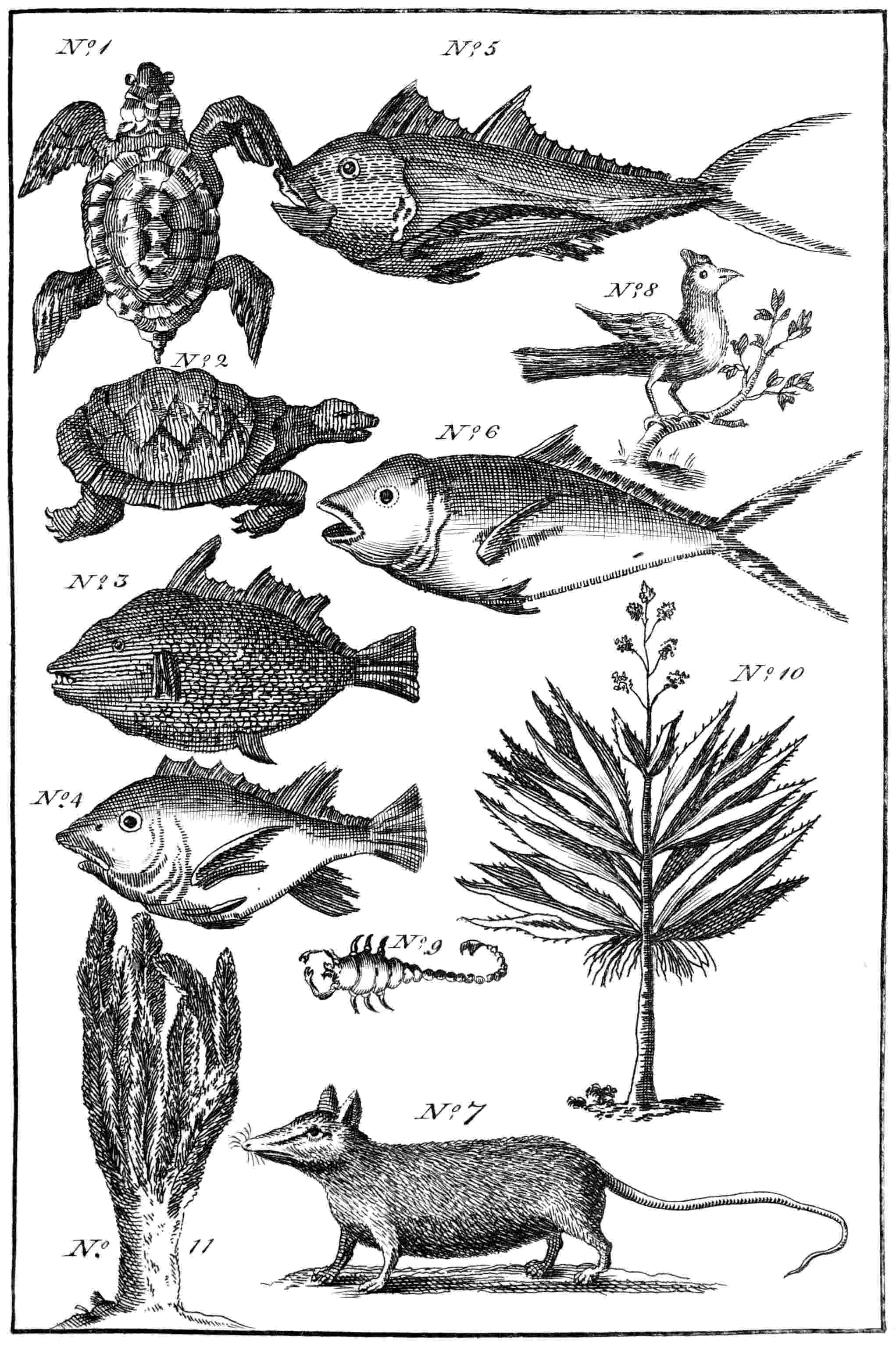
The land-turtle lives constantly ashore, feeds upon grass, moves very slow, and, when an enemy approaches, covers itself under its shell, squatting close to the ground, from which it is not easily discernible, appearing like a bare patch without verdure. The shells of these animals are so hard, that a man may tread upon them without hurting them. Their flesh is very good and nourishing. They will live five or six weeks without food, and appear to be never the worse. They lay round eggs, about the size of a hen’s, and are very good to eat. Some of the sea-turtle taken in the bay where we anchored had 200 eggs in them. Our men lived almost wholly upon turtle, and their eggs, from the time they went first to the Gallapagoes till their departure for the East Indies, saving their ship-provisions till their run across the South Seas. For the land-turtle, see fig. 2.
At these islands our men caught plenty of the fish called old wives. They have very small mouths, large eyes, a high fin on the back, and shaped as you see fig. 3. The colour of the body is a deep blue; the fins of a lighter colour, tipped with yellow. Others are of an ash-colour on the back, and white under the belly.
The rock-fish we caught in the island of Tres Marias were large, had great mottled fins, yellow backs, red bellies, and red and black tails. See fig. 4.
Another fish our men caught was the cavallo, in shape not much unlike the dolphin, with a large bright eye, black back, white belly, a long streak from his gills to the middle of his tail, and is about the size of a mackarel. See fig. 5.
A small fish we found there, about six inches long, was very delicious; the back of an indigo-blue, a deep yellow streak running from the gills to the tail, the belly white, and the tail forked. It seems peculiar to these islands, and wants a name. See fig. 6.
Of the animals, the racoon was the most plentiful. It has a large black eye, whiskers and nose like a pig, tail and feet like a rat, a brownish fur on his back, and a white belly. See fig. 7.
Of the venomous creatures, the scorpion is the most noxious; its tail is jointed with a small sting at the tip; it has two claws like those of the lobster; and its head and feet have a near resemblance to those of the same fish. See fig. 8.
Among the singing-birds found in those islands, the cardinal bird was seen in greatest abundance. It is a very beautiful bird, with scarlet feathers, and on its head the male has a tuft of the same colour. They are of the same kind with those we call the Virginia Nightingale; but the Spaniards call them cardinal birds, from their scarlet feathers. See fig. 9.
Among the vegetables we found the magney-plant, or silk-grass, of which the Indians make ropes, sails, sacks, and all their curious netting. It also yields a liquor of which they make wine, honey, and a good balsam. The liquor as it comes from the plant is as sweet as sugar; after standing it becomes a wine, and will intoxicate powerfully. It has thick juicy leaves, not unlike those of the houseleek, but grows up to a considerable height in the form represented by fig. 10; And, when it has stood about six years, the Indians cut out the middle leaves, leaving the heart of the plant hollow, which of itself fills with the juice, and is every morning during the season taken out and preserved. Of this juice the Spaniards make spirits; and it is so universally used in one shape or other by the Spaniards and Indians in New Spain, that the duty arising from it in one year is said to have amounted to 110,000 pieces of eight at the port of Angels alone.
The prickly tree found on those islands is esteemed a great curiosity. The trunk of it is angular, and covered with prickles; is of a pale green, and yields a gum which the druggists call euphorbium, which is said to be powerful in removing pains in the head. It grows about 12 feet high, in the form represented in the plate, fig. 11.
These were the principal peculiarities observable in the animal and vegetable tribes at the islands of Tres Marias.
On Tuesday, Oct. 2, at two in the afternoon, we weighed, and set sail for Cape St. Lucas, where we spread ourselves for fear the Manilla ship should pass by unseen. The Duke cruised about two leagues to the southward of the Dutchess, the Dutchess in the middle, and the Marquis two leagues to the northward of her. Place of rendezvous six or seven leagues in sight of Cape St. Lucas.
Nov. 1. The Marquis sprang two great leaks, and broke the collar of the fore-stay, which obliged me to wear the ship to fix the stay, and then hauled up after the other ships, and stopped the leaks.
Tuesday 2. All the officers and men on board the Marquis signed an instrument, obliging themselves to stand by the articles agreed to by the companies of the other ships.
Nov. 4. I spoke with Captain Courtney, and changed stations with him, he having better boats than mine to send ashore for water and turtle; or, in case of seeing the Manilla ship, to prevent her sending the passengers ashore with their wealth. The 10th, the Duke and Dutchess having spoken with each other, changed stations, the Duke going in for the shore, and the Dutchess off to the outward station.
Nov. 22. Captain Rogers informed me, that the bark and his boat had been in with the shore, and had spoken with the natives, who seemed very civil, and had pearl and some grain to dispose of; and that there was wood and water enough. Nothing material happened till
Dec. 13, when we had a consultation on board the Dutchess, to enquire into the stock of provisions on board the ships, and found by the accounts given in, that only three months meat at short allowance, and two months bread, remained unexpended; and, as there was no appearance of the Manilla ship, though the usual time of her coming was elapsed, it was agreed to make all possible dispatch in fitting up the ships, in order to make the best of our way across the Pacific Ocean, that we might take the advantage of the trade-winds to carry us to Guam on our return home. In pursuance of this resolution, I was ordered into harbour, as the Marquis wanted more considerable repairs than either of the other two, and the Duke and Dutchess proposed to cruise a few days longer, while I was getting forward to be in readiness to accompany them to Europe.
On the 14th, I bore away for Puerto Seguro, and on the 15th entered the harbour at midnight.
On the 16th proceeded to business, my first orders being to return again to cruise as soon as possible; but these orders were afterwards countermanded, it being absolutely necessary that all the ships should rendezvous together before their final departure from the American coast.
This place is inhabited by about 200 Indians, living in huts made of boughs of trees and reeds, built like a bower, with a fire in the middle, round which they lie and sleep. They all go naked, only the women have short petticoats made of silk grass, or else of pelicans or deers skins. The men are straight, and well limbed; live by fishing and hunting, and value knives, scissars, nails, or iron, beyond gold and silver. They have long black hair, and are of a dark-brown complexion. The women are very ordinary, and employ themselves in gathering and grinding corn, and in making fishing-lines. They are very honest and very civil. They assisted in fitting up the ships, and took nothing away but what was given them. Our people at their first coming got some pearls among them, but I never could see any afterwards. I made signs for them to bring gold; but they pointed up to the mountains. They use bows and arrows, and even the boys are so dexterous as to kill birds flying with them.
Dec 22. Being busy about our repairs, at 10 in the morning heard some guns firing in the offing: I bent my sails to hasten to the assistance of my consorts, but the sea-breeze coming on rendered it impossible; whereupon I ascended an adjacent hill, and saw our ships engage and take the Manilla ship, which we had been so long expecting.
The account Captain Rogers gives of the engagement is as follows: “At day-break, says he, we saw the chace upon our weather-bow about a league from us, the Dutchess a-head of her to leeward, near about half as far. Towards six in the morning our boat came on board, having kept very near the chace all night, and received no damage; but told us the Dutchess passed by her in the night, and she fired two shot at him; but they returned none. We had no wind, but got out eight of our ship’s oars, and rowed about an hour, when there sprung up a small breeze. I ordered a large kettle of chocolate to be made for our ship’s company, having no spirituous liquors to give them. Then we went to prayers; and before we had concluded, were disturbed by the enemy’s firing at us. They had barrels hanging at each yard-arm that looked like powder-barrels, to deter us from boarding them. About eight o’clock we began to engage her by ourselves, for the Dutchess being to leeward, and having little wind, did not come up. The enemy fired her stern chace upon us first, which we returned with our fore-chace several times, till we came nearer, and went close on board each other. We gave her several broadsides, plying our small arms very briskly, which they returned as thick for a while, but did not ply their great guns with the same alacrity. After some time, we shot a little a-head of them, lying thwart her hawse, close aboard; and plied her so warmly, that she soon struck her colours two-thirds down. By this time the Dutchess came up, and fired about five guns, with a volley of small shot; but the enemy, having submitted, made no return. We sent our pinnace on board, and brought the Captain with the Officers away; and, having examined them, found there came another ship out from Manilla with them of larger burden, having about 40 brass guns mounted, and as many patararoes; but they told us they lost her company about three months ago, and reckoned she was got to Accapulco before this time, she sailing better than this ship.
This prize was called by the swelling name of Nostra Signiora de la Incarnacion Desengenio, Sir John Pichberty Commander. She had 20 guns, 20 patararoes, and 193 men on board, whereof nine were killed, ten wounded, and several blown up with powder. We engaged them about three glasses, in which time we had only myself and another man wounded. I was shot through the left cheek; the bullet struck away part of my upper jaw, and several of my teeth, part of which dropt down upon the deck where I fell; and the other, an Irish landman, was slightly wounded in the hip. They did us no great damage in our rigging, but their shot disabled our mizzen-mast. I was forced to write what I had to say to prevent the loss of blood, and because of the pain I suffered by speaking.
On the 23d of December, after putting our ships to rights, we stood in for the harbour, which was distant about seven leagues to the N. E. Our surgeons went on board the prize to dress their wounded men. About four in the afternoon we came to an anchor, and received the compliments of all on board the Marquis on our sudden and unexpected success, which gave us no small satisfaction. We found that ship in good condition, ready to sail, and all the men on board her very brisk, and eager for action.
At eight in the evening, we held a consultation on the two great points; first, what should be done with the prisoners and hostages; and next, how we should act with regard to the other Manilla ship, which we thought at least there was a great probability of taking.
With respect to the first, we proposed, as the hostages from Guayaquil were men of honour, and as we had good reason to believe that the Chevalier Pichberry, being brother to the famous M. du Cass, was the same, to make the best terms we could with them, and set them at liberty. Accordingly, we put a part of the goods on board the bark into the prize, and then offered the remainder with the bark, together with what remained unpaid of the ransom, for 6000 pieces of eight, and to take the Chevalier’s bills payable at London for the money. This they accepted, and gave us an acknowledgement at the same time, that they thought it a good bargain. When this was settled, we had nothing more to do than to provide for our own security, and to look after the other galleon.
I was very desirous of going out with the Dutchess to cruise for her; but there having been some reflections cast, on account of the Dutchess’s not engaging our last prize so soon as it was thought she might have done, Captain Courtney was absolutely bent on going out with the Marquis; and the officers of both ships voting for this in council, my proposal was over-ruled, and we were forced to stay in the harbour against our will. It was, however, agreed, that we should put 10 of our best hands on board the Dutchess; and on Christmas eve she and the Marquis sailed.”⸺We now return to Captain Cooke in the Marquis.
Sunday 25. At eight in the morning, being two leagues off Cape St. Lucas, we saw a sail distant about seven leagues, which we concluded to be the ship we were in pursuit of. The Dutchess was two leagues to the westward, and we both gave chace. At noon the enemy bore south, distant about five leagues. At 12 at night, the Dutchess got along-side, and began to engage her. Captain Courtney fought her bravely about four glasses, and then lay by to secure his masts, and knot his rigging, which were much wounded and shattered. Our ship not being so good a sailor as the Dutchess, could not come up.
Monday 26. As soon as it was day, we saw the Spaniard’s flag, and knew him to be the Admiral of the Manilla. At eight we perceived the Duke coming out to us. At two in the afternoon we got along-side the enemy; but the wind shifting, could fetch no nearer than about half musket-shot to leeward of her. She then fired two shot at us, and we returned a broad side and vollies of small arms, beginning the combat with three cheers. When we had fought two glasses, the Dutchess came up under her stern, and raked her fore and aft, and then fell astern again, we still continuing hot at her for five glasses: then weared, and stood to the westward, to fetch nearer up to her; for firing so many guns had laid us to leeward. The Dutchess went up, and engaged again very briskly for half an hour, and then stretched a-head of her. We could perceive many shot in her between wind and water. At five we tacked, and raked her fore and aft with our starboard broadside, then weared under her stern, and did the same with our larboard broadside; and firing several vollies while we loaded our larboard guns again, gave her the other broadside. By this time it grew dark, and we fell a-stern, to speak with the Dutchess, and to get more ammunition, having but three rounds of shot for most of our guns left. At eight I went on board the Dutchess, and found her much disabled in her masts and rigging, and had seven men killed and wounded. Capt. Courtney and I agreed to be yard-arm and yard-arm with the enemy in the morning, he to lie on the bow, and I on the quarter; and if he boarded, I was to clap him aboard, and enter my men over him. Being supplied with more ammunition, I returned on board the Marquis, both of us keeping close under the chace’s quarter, and firing guns all night, to annoy the enemy, and to give the Duke notice where we were. Before day the Duke joined us. The chace, mistaking him for her consort, had made signals all night, and had edged away to meet him, otherwise the Duke could not have come up, there being but very little wind, and that contrary.
Then we all three agreed to fall upon the enemy at once, as soon as it was light; but while we lay athwart her hawse, those guns that missed the enemy flew through the Duke’s masts and rigging, which obliged him to change his station, and to draw up along-side close aboard her, where he kept up a constant fire of round shot, all other shot proving ineffectual, because of the strength of the ship’s sides, which no other shot would penetrate; and as none of the Spaniards appeared in sight, but all kept to close quarters, it was in vain to make use of small arms, except now and then, when a man appeared to observe our situation, and to keep an eye upon their ensign. In this manner, the Dutchess lying upon her hawse, the Duke along her broadside, and the Marquis athwart her stern, we kept pelting her for four glasses; and, in the mean time, the Duke received a shot in his main-mast, which much disabled it; and, in shifting, both he and the Dutchess came back close under the enemy, and had like to have been all aboard her. The Duke, in endeavouring to recover his station, received a fire-ball, which lighting upon his quarter-deck, blew up a chest of arms and cartouch-boxes, all loaded, and several cartridges of powder in the steerage, by which means Mr. Vanbrugh, our agent, and two others, were very much burnt; the Dutchess going to lash to the enemy, was forced to cast off, and get clear, for fear of being set on fire. The enemy fired at us all three at once, but slowly, seldom missing our masts and rigging, and sometimes hulling us. After lying near half an hour along the chace’s side, the Dutchess lay by to stop her leaks, and secure her fore-mast, being very much disabled, having 25 men killed and wounded, and the sails and rigging much shattered. Captain Rogers some time after lay by to secure his mast. Then I lay athwart the enemy’s hawse till I had fired three broadsides, some odd guns, and several vollies; then gave another broadside and some vollies into her stern. The Duke came up again, and fired several guns, and both fell a-stern the chace, keeping under sail, and standing to the westward. We knotted some of our rigging, and stopt our leaks made with twelve pounders. Our main-mast was disabled also, the sails and rigging much shattered; but the enemy, aiming to disable my masts, I had the good fortune to have only my second mate, and some others, blown up with powder. The ship was once set on fire by the enemy’s stink-pots, but we soon put it out. About eleven I wore the ship, and designed to have attacked the enemy again; but, seeing the Duke and Dutchess lying by, the one with a waist in his ensign, and the other with a Spanish jack, the signals to speak with one another, I brought to. Captain Courtney came on board of me, and we both went on board the Duke; where we considered the condition the three ships were in, their masts and rigging being much damaged in a place where we could get no recruit; that, if we engaged her again we could propose to do no more than what we had already done, which was evident did her no great hurt, because we could perceive few of our shot entered her sides to any purpose, and our small arms availed less, there being not a man to be seen above board; that the least thing in the world would bring the Duke’s main-mast, and likewise the Dutchess’s foremast, by the board, either of which by its fall might carry away another mast, and lay us a perfect butt for the enemy, having nothing to command our ships with; so that by his heavy guns he might either sink or take us; that, if we went to board him, we should run a great hazard in losing a great many men with little hope of success, they having above treble the number on board to oppose us, and there being now, in all our three ships, not above 120 men fit for boarding, and those but weak, having been very short of provisions; so that, if we had boarded her, and been forced off, or left any of our men behind, the enemy by that means would have known our strength, and then gone into the harbour, and took possession of the prize in spite of all we could do to prevent it. Besides our ammunition was very short, having only enough to engage a few glasses longer. All this being seriously considered, and knowing the difficulty we should have to get masts, and the time and provisions we must spend before we could get them fitted, we resolved to forbear attempting her farther, since our battering her signified little, and we had not strength enough to board her; therefore, we agreed to keep her company till night, and then to lose her, and make the best of our way into the harbour to secure the prize we had already taken. We engaged first and last about seven hours, during all which time they had on board the Duke but eleven men wounded, among whom was the Captain for the second time, who had part of his heel-bone struck out with a splinter, and all under his ancle cut above half through with the same; on board the Dutchess, they had eleven killed, and more than that number wounded; and on board us only two men scorched with gun-powder. The enemy’s was a brave, lofty, new ship, named the Virginia, and this the first voyage she had made. Her burden was 900 tons, and her complement of men 450, besides passengers, 150 of whom were European pirates, who, having now got all their wealth on board, were resolved to defend it to the last. The gunner, who had a post at Manilla, was an expert man, and had provided for her defence with great skill. He had filled up all the space between the guns with bales to secure the men. We shattered her sails and rigging very much, shot away her mizzen-yard, and killed two of her men out of her tops, which was all the damage we could see done, though we could not place less than 500 shot in her hull. Thus ended our attempt.