THE VOYAGE OF Captain CLIPPERTON ROUND THE WORLD.
Reading edition
Captain John Clipperton (or, as some write, Clippington) was born at Yarmouth, in the county of Norfolk; and his friends being most of them sea-fearing people, he was from his infancy bred up a mariner. His disposition naturally inclining him to ramble, he embraced every opportunity to embark in new voyages, and there was hardly a corner of the earth which he had not visited before he was thirty years of age. When he was made choice of to take the command of the expedition of which we are now to give an account, he was esteemed, and that perhaps justly, the most experienced seaman of his time. He had been frequently in the East and West Indies; had been in the Northern and Mediterranean Seas, and had once surrounded the whole globe. He was that Clippington, who, in 1704, with a bark, of only 10 tons, two masts, two square-sails, two pattararoes, and 21 men, left Captain Dampier on the coast of Mexico; and, after insulting Rio Leon, where he took two Spanish ships at anchor, one of which was ransomed for 4000 pieces of eight, and after visiting the gulph of Salinas, where he cleaned and refitted his little bark, undertook to sail in her from that coast round half the globe; a great part of which he performed in a track never before attempted, pursuing his course in the 18th degree of north latitude, which former navigators had pursued after each other in the 13th; and, in that direction, he reached the Philippines in 54 days, without seeing land, or meeting with any cross accident to interrupt his passage. While he was embarrassed among those islands, there came off a canoe with a friar on board, to enquire concerning so uncommon a vessel, the like of which was never seen before in those seas. He detained the friar till his crew were furnished with fresh provisions, and then released him.
From the Philippines he steered to Pulo Condore, where he expected to have met with an English settlement; but, to his great mortification, he there learnt, that, some time before his arrival, the English had been all murdered by their Indian guards. Upon this melancholy news, he bore away for Macao, a port in the possession of the Portuguese, near the mouth of the river Canton, in China, already frequently mentioned, and lately made famous by the arrival of some Russian adventurers from Kampschatka, who, by that navigation, have confirmed the reality of a north-east passage to the coasts of China. At this port he arrived, where Shelvock affirms that near half his crew were hanged for pirates, that the rest escaped, some to one place, and some to another; that Clipperton himself, being deprived of his little boat, found means to get on board an English East Indiaman at Canton, and arrived in England in 1706.
Clipperton was a blunt, rough, free-spoken sailor, had not much the air of a gentleman, and therefore never affected it; was free and easy among his seamen; and, though he was passionate, he was soon appeased, and, if in the wrong, ever ready to acknowledge his error, and to repair any injury his hasty temper betrayed him to commit. He had a strict regard to what he thought his duty, and was not to be diverted from the principles of moderation, which ever inclined him to acts of mercy and humanity towards those over whom the chance of war gave him the superiority. Having returned almost destitute from his first voyage round the world, he settled in the north of Ireland, to which retreat he was traced, after more than twelve years retirement, and persuaded to undertake this second voyage, as a means to repair his broken fortune.
The success that had attended the voyage of the Duke and Dutchess to the South Seas under the command of Captain Rogers, had revived the spirit of privateering, which, by former miscarriages, had been reduced to a very low ebb. Dampier, as has already been noticed, was unable, with all his skill and all his experience, to persuade the London merchants to engage in a second expedition into those seas, after having failed in the first, and was obliged to apply to Bristol to raise a new company of adventurers to second his views; but such is the nature of mankind, that emulous, not to say envious, of the success of others, they are ever ready to croud the road that has led to fortune, without considering how unfit they are to undertake the journey. The owners of the Duke and Dutchess had been particularly careful to make choice of gentlemen, not only of ability, to conduct the voyage which proved so successful, but who also had confidence in, and friendship for, each other; and yet, with all this care and caution, it was with the greatest difficulty in the world that they were persuaded to keep together, and to act in concert. On the contrary, the Commanders in the present expedition, were gentlemen of opposite tempers, opposite views, and already, before they set out, engaged in opposite parties; it was therefore very unlikely that two such Commanders should unite in one common interest, or that the one should share the danger where the other was to reap the glory. The event will shew, that the miscarriage of this enterprize was not more owing to the mistakes in the voyage, than in the wrong setting out.
The impatience of the undertakers was so great, and their confidence of making themselves rich by the plunder of the Spaniards so certain, that, unwilling to trust to an eventual rupture between Great Britain and Spain, they took occasion, from the war that then subsisted between the Emperor and Spain, to apply to the Imperial Court for a commission to carry their plan of hostilities into execution. With this view, having equipped two stout ships, the Success and the Speedwell, it was thought necessary to find out some gentleman who had served on board the royal navy, that might take upon him the command of the expedition, and be able to act with propriety in a joint commission, wherein Flemish soldiers and English sailors were to be united in the same design.
For this difficult task no man was thought more fit than Captain George Shelvock, who had been bred from his childhood in the royal navy, had been thirty years in the service, and arrived at the rank of First Lieutenant of one of his Majesty’s ships of war, which he had borne with great reputation; was in his person and behaviour a fine gentleman, and was confessedly a very expert and able seaman. He was, besides, of quick parts, ready speech, and very winning address, but withal rather too sensible of his own accomplishments. This gentleman the undertakers thought themselves happy in having found; and they accordingly not only invested him with the command, but entrusted to him the grand business of the commission, and for that purpose he received instructions to repair to Ostend with the Speedwell, and there, as soon as the commission was obtained, to take on board the complement of Flemings that were to give countenance to the undertaking; and to join the Success in the Downs, which there lay ready under the command of Capt. Mitchell. On this occasion the names of the ships were changed; the Success was called the Prince Eugene, and the Speedwell the Starenberg, in compliment to the Prince and the Imperial Prime Minister. Captain Shelvock was, besides, instructed to lay in such a stock of wines and spirituous liquors, as he should judge sufficient for the use of both ships in a voyage where such refreshments would be absolutely necessary, and without which the climate of Cape Horne could hardly be endured.
In this business, however, the Captain gave some disgust. He was either too extravagant, too ostentatious, or too remiss; and the voyage which the owners had so much at heart, was thought already to have suffered by unnecessary delay. But, what was still worse, the Flemish soldiers, 90 in number, commanded by their own officers, had hardly arrived in the Downs before they became so insolent, that it was presently discovered, that the scheme of their acting in concert with English sailors was utterly impracticable: so that after all this delay and expence, the commission was returned, the Flemish soldiers discharged, and a new plan formed, which gave the first occasion to those dissentions that in the end proved the ruin of the voyage.
Captain Shelvock’s management had much lessened his credit, and his friends were unable to support his interest. The reason for his advancement no longer existed; and it was found, that the discipline to which he had been accustomed on board the royal navy, was not the discipline to be practised on board privateers. It was necessary, therefore, as the circumstances of things were changed, war with Spain declared, and no extraordinary accomplishment required, to look out for an officer to take the command, who had experience in the business in which he was to be employed; who knew the western coasts of America, and was acquainted with the genius of the people with whom he was to contend, as well as the tempers of those with whom he was to attack.
On this new regulation, the character of Captain Clipperton was called to mind. He was known to some of the owners, and strongly recommended by other merchants, as of all men then living the fittest to be entrusted with the conduct of such an expedition. The owners, who had already expended more than 15,000l. began to consider their own interest without respect to persons; and, therefore, they sought out and invested Captain Clipperton with the chief command, continuing Captain Shelvock Commander of the Speedwell, and appointing Captain Mitchell second to Captain Clipperton, and Captain Hatley second Captain to Shelvock. The ships were restored to their former names, an English commission procured for the Commanders, and every thing prepared while the ships lay in the Downs for their immediate departure.
The instructions given to the respective Commanders were, in substance, the same with those given to the Commanders of the Duke and Dutchess, strongly recommending unanimity. But this precaution proved wholly useless. The expedition wore an unfortunate aspect from the beginning. The ships were obliged to lie three months at Plymouth, waiting for a wind. Factions were in the mean time formed, in which the crews as well as the Commanders were involved. Captain Shelvock highly resented the affront that had been offered in depriving him of the chief command; and Captain Clipperton, being a boisterous man, having himself strong passions, and not having art to conceal them, knowing Captain Shelvock’s prejudices, nothing but dissention and discord prevailed. Every post brought the owners fresh complaints; and every post carried fresh reproofs to the Commanders. In this humour the parties continued while the ships lay at Plymouth. At length,
On the 13th of February, 1719, the Success, of 36 guns, and 180 men, commanded by Captain Clipperton, and the Speedwell, of 24 guns, and 106 men, of which Captain Shelvock was Commander, sailed with a fair wind; but, by an unaccountable over-sight, the Speedwell had on board the whole stock of wine and brandy, and the Success the greatest share of other stores.
For several days they had fresh gales, squally, with rain, and the Success was often obliged to shorten sail for the Speedwell. Captain Shelvock tells us, that he complained to Captain Clipperton of the crankness of his ship, and desired him to send for his wine and brandy, that he might strike down some of his guns into the hold, which would enable him to sail much better than he did: but this, it seems, was neglected; a proof that Clipperton had no intention to desert the Speedwell, though it was a slight, which Shelvock could not but resent. On the 19th, a violent storm arose, which obliged both ships to take in their top-sails. The gale increasing, the Success made a signal for the Speedwell to bring to; which Captain Shelvock readily obeyed; and, by eleven at night, both ships were under bare poles. On the 20th, in the afternoon, the storm abated, and Captain Clipperton made sail, steering S. by E. whereas Captain Shelvock, according to his journal, stood north-west; so that from this day they never saw each other, till they met in the South Seas by mere accident. Here then properly begins the history of Captain Clipperton’s voyage round the world. He was now at sea without liquors, and without his consort. The first place of rendezvous appointed by them, was the Canary Islands; and, therefore, he sailed thither, and arrived at Gomera on the 5th of March. Having taken in some wine and refreshments, for which he had great occasion, he continued cruising at the Canaries ten days for his consort; but, missing her here, he continued his voyage to the next place of rendezvous, at the Cape de Verd or Green islands.
The former islands, called by the ancients the Fortunate Islands, from their fertility and temperate air, were discovered by the Spaniards in 1402, who named them the Canaries, or the Islands of Dogs, because no other creatures were found on them. They are eight in number. The Great Canary is the largest, is far distant from the others, and contains 9000 inhabitants. It is the seat of the Bishop, the Inquisition, and of the Council Royal. There is a mountain on the Teneriff, called the Pike of Teneriff, which, according to the common opinion, is the highest in the world. It may be distinctly seen at sixty leagues distance. It is three days journey to the top of it, which, except in the months of July and August, is always covered with snow. Fero is one of the largest, but so dry, that there is not one drop of fresh water to be found in it, except in a few places by the sea-side: but Providence has furnished a supply to remedy that inconvenience; for there grows all over this island a sort of tree, which is pretty large, and full of leaves, that are always green, and covered with a little cloud that wets the leaves by its dew, so that a fine clear water distills from them into little pails, which the inhabitants set to catch it. This water falls in such quantities, that it not only abundantly supplies the necessity of the people, but it is sufficient also to water the cattle. The Canaries in general are very fertile, and abound with wine that is transported into all parts of the world. On the right-hand of those islands, about 100 leagues off, the mariners very often perceived an island named St. Baranora, inhabited, they say, by Christians; but no man can tell of what denomination they are, nor what language they speak. The Spaniards have often attempted to enter it, but could never find the way; which has raised an opinion in the people, that it is an inchanted island.
On the 21st they saw St. Vincent’s, and the next morning anchored in the bay. Here they spent ten days cruising in hopes of meeting with their consort, but in vain; which so disheartened the crew, that Capt. Clipperton found it difficult to persuade them to continue the voyage for the Straits of Magellan, without wine or brandy to keep up their spirits in that uncomfortable navigation. Some are of opinion, that these islands were called Green Islands from the green Cape of Africa, over-against which they lie; others, because the sea that surrounds them is so covered with a green herb, that you can hardly see the water; nor can ships sail through it, but with a stiff gale of wind. It produces berries, much like white gooseberries; but without taste. Nobody can tell how it grows; for there is no ground where it floats upon the water, and it cannot come from the bottom, the sea being in many places unfathomable.
On the 1st of April they left St. Vincent’s, and on the 29th of May they had an observation, and found themselves in lat. 52 deg. 15 min. S. being then off Cape Virgin Mary, the north point of the entrance of the Straits of Magellan. The next day they entered the Straits, and sent their pinnace on shore on the main, to a fresh-water river, which was at this time frozen up. They saw large flocks of geese and ducks, but very shy. The surgeon’s mate, by some accident, was left on shore; and next morning, when brought aboard, was near dead with cold. They anchored at Queen Elizabeth’s Island, and found great plenty of smallage, which was of infinite service to those sick of the scurvy. They eat it raw, boiled it in their soups, and kept the juice of it in bottles. They met with plenty of wild-fowl and shell-fish, filled their casks with water, and continued their course. On the 22d they anchored in a fine bay, which, from its depth, they called No-bottom Bay. The trees were high, loaded with snow, and exhibited a most astonishing prospect. On the 29th came a canoe, with four Indians. They were of a middle stature, dark complection, their faces broad and round, low foreheads, black hair very lank and short, with no cloathing, except a piece of skin to cover their middles. What seemed most remarkable, was a circle round their wrists, of a bright azure. It seems these savages are extremely jealous of their women; for, notwithstanding all that could be said to them, they would not permit a woman, who was of their party, to come on board. Bougainville, and the English voyagers who lately passed the Straits, make the same observation. Capt. Clipperton ordered them bread and cheese, and a dram of brandy, though it was very scarce. The former they eat very heartily, or rather greedily; but the latter they could not be prevailed upon to taste. They had bows and arrows, and some fishing-tackle along with them. After about two hours stay, they rowed ashore, making signs that they would come again. The next day the pinnace was sent ashore, and returned in the evening with the Indian canoe laden with muscles, which the Indians had exchanged for bread, knives, and other trifles. In the beginning of the month of July they found the weather moderate. These natives were a harmless people: one of the crew, being left on shore, lived with them two nights and a day, and was very kindly treated by them; which shews, that, if they are well used, they are not treacherous. All this time their ship’s company was very sickly, and scarce a day passed but some one or other died. On July 8 they buried their master-gunner. They caused a strong plank to be driven at the head of his grave, on which was the following inscription: “Mr. William Pridham, gunner of the Success, deceased July 7, 1719, in this Strait, and lies buried here.” On the 20th Capt. Mitchell and Lieut. Davidson went in the pinnace to Terra del Fuego, in order to make discovery of the passage that a French tartan is said to have went through into the South Sea, May 1713, and to see if there was any anchoring beyond Cape Quad. On the 29th they returned, having found the passage, but so narrow, that it was judged hazardous to go that way. They found likewise several good bays to the north-west of Cape Quad to anchor in. The Indians brought them a seal, which they broiled and roasted, and said it eat like venison.
August 1, they resolved to prosecute their voyage thro’ the Straits, which, with much danger and difficulty, they accomplished. Aug. 18, they arrived in the South-Seas, but so weak, that it was impossible to undertake any thing immediately; they therefore steered directly for the island of Juan Fernandez, the third and last place of rendezvous, where they arrived Sept. 7, and searched diligently in hopes of finding some token of the Speedwell, but to no manner of purpose. According to his instructions, Clipperton continued to cruise a full month, and, before he took his departure, ordered an inscription to be cut on a remarkable tree fronting the landing place; so that it was impossible for any ship’s crew to come ashore, and not see it. The inscription thus: “Captain JOHN W. MAGEE, 1719.” This William Magee was surgeon on board the Success, was well-known to Capt. Shelvock, and all the ship’s company; and therefore his name was made choice of rather than the Captain’s, for a blind in case the inscription should be read by the Spaniards. Here the sick were set ashore, and every means used for their recovery; but the very thoughts of being without any cordial to comfort them, dejected them excessively. The weather was changeable; abundance of rain fell; and they had also some hard gales of wind. They took goats in plenty, which not only served them for the present, but likewise increased their sea-store, having salted a great number with salt they found on the island ready-made. They likewise wooded and watered, and cleaned their ship, ready for action in the South-Seas, where it was now visible they were to cruise alone; for Clipperton was of opinion the Speedwell was lost; or at least he gave out so, to pacify his company, who were continually cursing Capt. Shelvock for running away with their liquors. One thing remarkable was, the beauty and fertility of this island, added to the stories they had heard of others; tempted four of Clipperton’s men, with a view of remaining there, to betake themselves to the mountains, where two of them were made prisoners by the goat-hunters, who were forced to fire at them several times before they would surrender.
October 7, they prepared to sail; and, in the mean time, Captain Mitchell went on shore, to set up a cross already cut for that purpose, at the foot of which he buried a bottle, in which was contained a letter for Captain Shelvock, directing another place of rendezvous, and some proper signal to know each other by at sea. At eight in the morning, they weighed from the island of Juan Fernandez, and left their two men in possession of it, of whom more hereafter.
After leaving this island, Captain Clipperton sailed northward, till he was in the parallel of Lima, where he intended to act, though he was now in a very indifferent condition, having lost thirty men since his passing the Equator; and the remaining crew expressing some uneasiness in relation to plunder, he caused a paper to be fixed to the main-mast, which was assented to by the whole ship’s company.
On October 25, they gave chace to a small vessel, and took her. Being their first prize, she was an ill omen of their future success. She was a snow of 40 tons, laden with sand and rubbish for manure; had seven Indians and two negroes on board; and all the captors could find worth taking, was two jars of eggs, as much treacle, and a couple of pieces of eight in ready money. The next day, they met with a ship called the St. Vincent, of 150 tons, laden with wood from Guiaquil, with two friars, sixteen Indians, and four negroes aboard. On the 30th, they took a large ship called the Trinity, of 400 tons, taken by Captain Rogers when he plundered Guiaquil, ten years before. She had a great many passengers on board, and a cargo of considerable value.
On Nov. 2, they took another prize, of 70 tons, with the Countess of Laguna and several other passengers on board, a great deal of money, and upwards of 400 jars of wine and brandy, articles very much wanted. Captain Clipperton desired the Countess to make her choice, either to stay on board the prize, or accept of the accommodations they were able to afford her on board the Success. She chose the former; and the Captain sent an officer with strict orders to suffer nobody to enter her cabbin but her own domestics: he likewise appropriated a part of the wine and brandy found on board the prizes for the use of his seamen, to whom, no doubt, it was a welcome refreshment.
He had already detached several officers, and above a third part of his company, to take care of his prizes; and yet was as eager to take more, as if, instead of a privateer weakly manned, he had commanded a squadron of ships of war. On the 12th, he discovered at some distance, a London-built pink, of 200 tons, laden with wood, named the Rosario, the Master of which being a very cunning fellow, soon saw the error that Clipperton had committed, and resolved to take advantage of it. He guessed, by the number of prizes, that many men could not be sent on board his ship; and, having about a dozen passengers, he directed them, under the command of a French boatswain, to hide themselves in the hold, with orders, on his making a certain signal, to seize as many of the English as came down; assuring them, that he, with the ship’s company, would be able to manage the rest. As soon as the ship struck, Captain Clipperton sent Lieutenant Serjeantson, with eight men, to take possession of her; who, as soon as he came on board, ordered all that appeared into the great cabin, and placed a centinel at the door of it. Thinking every thing secure, and not in the least apprehensive of danger, he with some of his men went into the hold to see what was in the ship; on which the passengers, who were concealed, sallied out, knocked most of them down, and the French boatswain, coming behind Mr. Serjeantson, knocked him down likewise, and then ordered them to be all bound. The Spaniards in the great cabin secured the centinel; and, having thus recovered their ship, made instantly for the shore, where their own company and the prisoners were all in equal danger of perishing; which the Captain no sooner perceived, than he ordered the English to be unbound; and, by good fortune, every man escaped upon the rocks, against which the Spaniard in his eagerness had run his vessel, and against which she was dashed to pieces. Lieutenant Serjeantson and his people were secured, and sent prisoners to Lima. The Viceroy of Peru was no sooner acquainted with this gallant action, than he ordered a new ship to be built at Guiaquil for the Captain, and taxed the traders towards the expence of her, intending this as a reward for the service he had rendered the public, and hoping thereby to encourage others to behave as nobly. On the arrival of the prisoners at Lima, they were closely examined and one of them gave a full account of every thing he knew, particularly of the two men left upon the island of Juan Fernandez, and of the bottle with a letter in it; upon which, the Viceroy ordered a small vessel to be fitted out, to fetch both the one and the other, which was accordingly performed.
It was not till the 20th that Captain Clipperton perceived that his last prize was retaken; when, considering what was best to be done, he prudently determined to set his Spanish prisoners at liberty, as well to save provisions, which, at that time, he could very ill spare, as that their good usage might be speedily known, and returned to such of his men as were in the enemy’s power.
Accordingly, on the 27th, they came to an anchor with all their prizes, at the island of La Plata, and, in his way, took another prize, called the Cayetan, of 200 tons, having on board 40 negroes, and 30 Spaniards, most of them passengers. Here the Captain began seriously to consider how he should make the most of this expedition for his owners, as well as himself, and his company. He knew that all the coast was alarmed; and that two men of war, one of fifty, and one of thirty guns, were fitted out on purpose to take him: he was sensible, that the goods he had on board were not likely to be ransomed in that part of the world; and that they would prove mere drugs, if brought into this; and therefore laid all these things together; and, reflecting on a proposition made by Captain Woods Rogers, to send a cargo of such prize-goods to Brazil, he resolved to try the experiment; and, accordingly, he fitted out the bark in which he took the Countess of Laguna; mounted her with eight guns; and, putting on board of her thirteen Englishmen, and ten negroes, with what provisions and other necessaries he could spare, he sent her with a cargo of European commodities, valued at 10,000 pounds, for Brazil, under the command of Captain Mitchell, his second in command. As soon as he was gone, the Captain parted with all his other prizes, presenting them to the Spanish prisoners, after taking out of them what he thought valuable, and detaining only the Captain of one of them for his pilot, and all the negroes; after which he sailed from that island, in order to cruize in his former station.
December 12, they saw a sail about five in the evening, and, at seven, took her. She was called the Rosary, and laden with provisions. The launch and pinnace were all the next day employed in bringing on board the cargo, and having got out of her as much as they could stow, they cut her main-mast by the board, lest she should overset, and so let her go. The prisoners informed them that the men taken by the Rosario were sent to Lima by land. On the 27th they looked into Guanchaco bay, and found two ships at anchor. They fired a shot at each, but they made no return. Sending then their boats aboard, they found them abandoned, and could discover nothing left, except some bread, and a few jars of water. They hung out a flag of truce, and fired two guns at half an hour’s interval, hoping they would have come aboard to ransom their ships. They were answered from shore; but no boat coming, they waited till next day, and then set them on fire.
It was now resolved to bear away for refreshment to the Gallapagos islands, where they might remain unmolested till the alarm of their being in those seas should be over; and, accordingly, put their design in execution. On January 9, 1720, they anchored on the north side of the Duke of York’s island, immediately under the Equinoctial, where they found good water, and cleaned their ship, which confirms the account given by Captain Cowley, though Captain Rogers could not find the place.
On the 21st of January they observed a sail, and about eleven at night came up with her; and, on firing of their first gun, she struck. She was called the Prince Eugene, and had on board the Marquis de Villa Roche, and all his family, who were going to Lima.
On February 26th, a Spaniard dying of a wound he had received at the taking this ship, the Marquis desired he might be buried according to their ceremonies; which was granted. When the office for the dead had been performed, and the corpse thrown over-board, with a large bag of ballast tied at his feet, the Spaniards crying thrice, as their custom is on such occasion, Bon Voiage, i. e. a good voyage, the body, to the admiration of every one, presently floated, and continued floating as far as they could see it; which the Marquis concluded to be an ill omen, and declared that some surprising accident would be the consequence.
On March 8, a priest, who was on board the Prince Eugene, desired leave to go on shore on the island of Velas; which was granted, on his promising to persuade the inhabitants to drive some black cattle to the shore, in order to exchange them for what goods they liked best. On the 16th, he returned with four head of black cattle, some fowls, and fruit, as a present to the Marquis; but at the same time declared, that the Governor would not suffer the inhabitants to trade. He said, Captain Mitchell had been ashore there, and had shot some of their cattle; but that 200 men appearing under arms, they had forced him to retire. The next day some letters from the Marquis were intercepted, very little to his honour, since they tended to stir up the people to surprise, and secure the boat when it came next ashore to water. Upon this, Captain Clipperton confined him for some days; yet, on the 20th, he allowed both the Marquis and his lady to go ashore, leaving their only child as an hostage.
On April 14, the Marquis, his lady, and the Governor, came aboard; and, an agreement being made for their ransom, the lady and child were sent on shore, and the Marquis only remained as an hostage. In this transaction Clipperton appears to have been outwitted by this nobleman, who basely broke his word, and provoked the crew for trusting him. On April 20th, they anchored in the gulph of Amapala; and, not being able to water there, repaired to the island of Tigers, where they did it with great ease. On June 4, they sailed to Gorgona on the same errand, and were well supplied. On the 24th, they made prize a second time of the St. Vincent, now commanded by Don Clement de Andrado, laden with timber and cocoa-nuts. On August 11, they anchored, with their prize, at the island of Lobos de la Mar, where they set up tents on the shore, scrubbed and cleaned their ship, and where the crew talked over their affairs, till they began to think them desperate. Sometimes they reflected on the Captain, for pretending to remain in these seas without their consort; at other times, they blamed him for giving in to the Spanish Marquis’s project for ransoming his ship, which, they believed, would never be performed: and, now-and-then, the ship’s corporal, one James Roch, a bold, busy, intriguing fellow, threw in some sly insinuations, that, it they must go through such hardships, it was better they should do it for their own sakes, than for other peoples; and one Joseph Maynard, the boatswain’s mate, pushing things still further, a plot was at last formed for seizing the Captain, the rest of the officers, and running away with the ship. They likewise agreed, that, when their design was brought to bear, the officers should be set on shore on the island of Lobos, and all who afterwards opposed them shot without mercy. This wicked combination, however, was happily discovered, the two ringleaders severely punished, and the rest pardoned; by which wise conduct the conspiracy was suppressed. On the 17th they took a fishing-boat, with a large quantity of salt-fish well cured; but found the St. Vincent, which they had left at an anchor under the island of Lobos, driven ashore, and sunk: here they put thirty-eight Spanish prisoners on board the fishing-boat, and sent them away.
Nov. 1, they entered the bay of Conception, where, missing a prize that outsailed them, they bore away for Coquimbo, and took a ship laden with tobacco, sugar, and cloth, in their passage. On the 6th, in the afternoon, they opened that harbour, where they saw three men-of-war lying, with their top-sails loose; and these no sooner spied them, than they cut their cables, and stood after them. The Success hauled close on a wind, and the prize did the same; upon which the Spanish man-of-war that sailed best gave chace to the latter, and took her. The other two ships crouded all the sail they could to come up with the Success, but she outsailing them, made her escape. In the Spanish prize they lost their third Lieutenant, Mr. James Milne, and twelve of their best men. The Captain who took him was the famous Don Blas de Lesso, Governor of Carthagena, when attacked by Admiral Vernon. Don Blas treated his prisoner a little roughly at first, being enraged to find he had missed the English privateer, and only retaken a Spanish prize; and, in the first transport of his passion, struck Mr. Milne on the head with the flat of his sword; but, when he came to himself, he sent for him, and, finding him stripped by his soldiers, generously asked his pardon, ordered him a new suit of cloaths, and kept him for some time on board his ship. He afterwards procured his liberty at Lima, paid for his passage to Panama, where he gave him a jar of brandy, and another of wine, for his sea-stores, put 200 pieces of eight in his pocket, and sent him to England. This unlucky accident of losing their prize revived the ill humours among Clipperton’s men, who did not indeed plot again, but became exceedingly dejected. On the 16th they saw another sail, and gave chace, which, after a few guns fired on both sides, bore away, being a clean ship, and left them; which proved a lucky escape; for this was likewise a ship of force, fitted out to take Capt. Shelvock, and commanded by one Fitzgerald, who, knowing this was not Shelvock’s ship, and doubting what strength she might be of, had no great stomach to engage her. These repeated disappointments, as they broke the spirits of his crew, so they had a very bad effect on Capt. Clipperton himself, who began now to betake himself to drinking; and, as this vice generally grows upon people under misfortunes, he drank at last to such an excess, that he was hardly ever quite cool or sober. It was chiefly owing to this unhappy practice, that he fell into many errors in his future conduct. They were now in want of provisions, and they resolved to continue cruising to the north, to seek a supply. In this cruize they had but indifferent success; and, therefore, on the 27th, they set ashore their Spanish prisoners, and then determined to go once more to the Gallapagos, in order to refresh. In their passage to these islands, they began to suspect some error in their log-line; and, upon measuring, found it three fathoms too short.
On the 4th of December, they lost their purser; and the same day found themselves very near the Gallapagos islands, but could find no anchoring-place, nor any fresh-water, though they had found a fine road on their first visit, which gave Shelvock occasion to charge Clipperton with want of skill; they therefore made the best way they could to the Isle of Cocoas, where they hoped certainly to get some fish, fowl, and cocoa-nuts, most of their people being very sick and weak. On the 17th in the morning they came in sight of it, which filled them with inexpressible joy. On the 18th, all that could be spared went on shore to build a kind of booth for the reception of their sick, who were all conveniently lodged. The Captain opened here the last cask of brandy for the use of the ship’s company, and gave every man a dram a day; and, on New-Year’s-day, he allowed a gallon of strong beer to every mess; and, by having here plenty of nourishing food and much ease, the crew began to recover, and were able to wood and water, though with much difficulty.
On the 17th of January, 1721, the Captain made the necessary dispositions for sailing; but, when they came to muster the men, there were no less than eleven missing, three Englishmen, and eight negroes, who chose rather to remain in this unfrequented island, than continue exposed to dangers and fatigues on board, and to their living constantly at short allowance.
On the 25th, they arrived on the coast of Mexico, where, discovering a sail, they sent their pinnace to give her chace; to whom she instantly struck. She proved to be Jesu Maria, commanded by Capt. Shelvock; and the account he gave was, That he had no more than forty men alive, the rest being all dead, or dispersed; that he had lost the Speedwell at Juan Fernandez, where they built a bark out of the wreck; that they had coasted along Chili and Peru, till they came to Pisco, near Lima where they took this prize; that they had no regular command among them; that they had chosen a quartermaster, carrying every thing by a majority of votes; and that they had quite broken their articles with their owners, and had shared all among themselves.
On the 27th, Captain Shelvock came aboard, being sent for by Captain Clipperton and the agent, to give an account of his transactions. The boat brought Mr. Dod, Lieutenant of marines, having been used very ill for his attachment to the owners; at least so he asserted, and was firmly believed by Captain Clipperton, and his officers. The next day Captain Shelvock sent on board them six chests of pitch and dammer, and two barrels of tar, with six slabs of copper: Captain Clipperton spared him twenty-four quarter-deck guns, some great shot, a compass, and a few other necessaries: his people purchased cloaths, shoes, hats, and other necessaries; and Mr. Hendric the purser, and Mr. Dod, continued in the Success, designing never more to sail with Shelvock.
In the beginning of March, both time and place favouring, they determined to attempt the Manilla ship, before she entered Acapulco.
On the 13th, they again met Captain Shelvock, and, at a general consultation, agreed to make the attempt jointly. But, previous to the signing this agreement, it was proposed by Captain Clipperton to form a joint stock, to bury all former miscarriages in oblivion, and again to act in concert for the good of the owners. This proposition was rejected by Captain Shelvock and his people, who did not care to part with what they possessed; upon which Captain Clipperton and his company, perceiving there was nothing to be expected from their consort, and that they were too weak of themselves to effect their purpose, determined to sail directly to the East-Indies, and instantly put their resolution in execution, without waiting for or consulting Captain Shelvock.
The run from the coast of Mexico to the island of Guam, they performed in fifty-three days; and, May the 13th, anchored in the road of Umatta,—from whence they sent their pinnace ashore, with a flag of truce, in order to obtain some provisions, which met at first with a favourable reception, being told that, if they behaved civilly, and paid honestly, they should be furnished with what the island could afford. Soon after the launch arrived, and brought on board some cattle, bread, sugar, greens, palm-wine, and brandy, from the Governor, with a large quantity of chocolate. In return for which, his health was drank by the whole ship’s crew, under a salvo of seven guns: this was the last act of civility that passed between them.
On the 18th of May, their prisoner, the Marquis de Ville Roche, went ashore, in company with the agent, the first lieutenant and doctor, having previously agreed with the Governor about his ransom. Our launch was employed six days in bringing wood, water, and provision aboard; during which time, the Governor desired he might have some arms and ammunition in exchange: accordingly Captain Clipperton sent him twelve fuzees, three jars of powder, sixty round shot, four pair of pistols, besides cutlasses, long swords, and daggers. The 25th, they received a letter, in which the Governor demanded the Marquis’s jewels, some consecrated plate, and two negroes, being Christians, and subjects to the King of Spain; as also a certificate, under the Captain and officers hands, that peace was proclaimed, detaining Mr. Godfrey and Mr. Pritty till all this was performed. The Captain returned for answer, that the Solidad, the last prize taken on the coast of Chili, declared there was peace between England and Spain; but, withal, assured the Governor, that, if he did not, in twenty-four hours, send the ransom with the two gentlemen, he would demolish the houses upon the shore, burn the ship in the harbour, and do all the mischief he could at the Philippine islands.
After this declaration, hostilities commenced on both sides. The people on shore had raised a battery from whence they fired at the pinnace. The ship ran a-ground between two fires, one from the battery over their heads, and another from the ship in the harbour. In endeavouring to get their ship off, they ran foul of the rocks. The enemy fired so warmly with stones and shot, that they suffered extremely in their hull and rigging. They had three men wounded, besides the misfortune of losing Mr. Davidson, their first Lieutenant, who was an honest man, and a good officer.
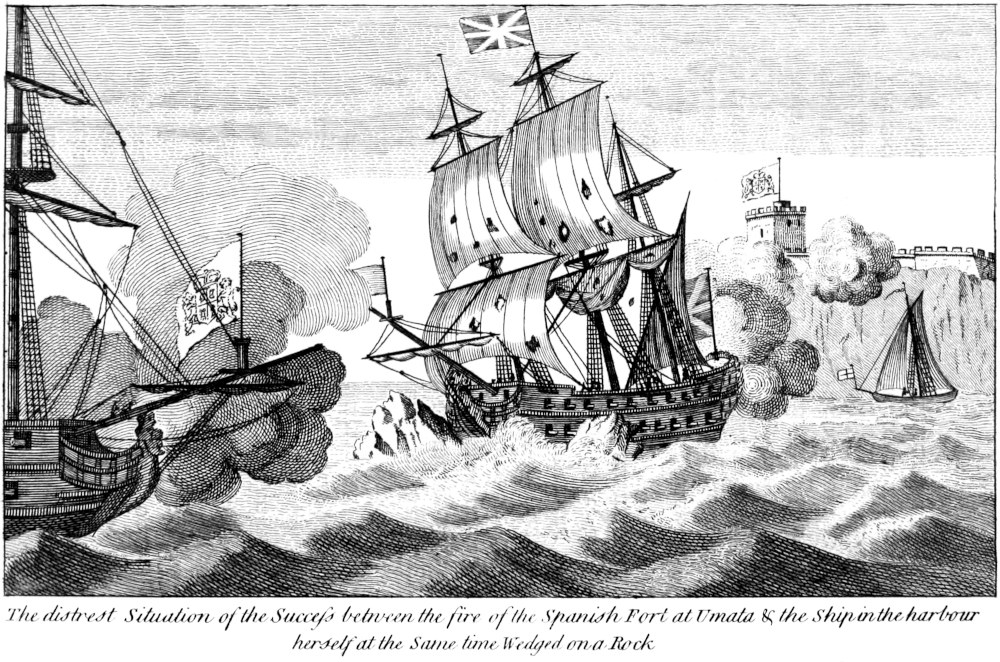
The distrest Situation of the Success between the fire of the Spanish Fort at Umata & the Ship in the harbour herself at the Same time Wedged on a Rock
In this emergency, the Captain being overcome with liquor, the officers signed a paper indemnifying Mr. Cook for taking upon him the command. They cleared away the hold, ready to start their water, to make the ship lighter; and got their upper and lower deck guns forward, to bring her by the head, the ship hanging abaft on the rock.
During the last twenty-four hours, they had happily only one man wounded; but the ship was wretchedly torn and mangled between wind and water. The 30th, at six in the afternoon, the ship floating, they cut away the yawl, she being sunk with the shot; the other boats were much damaged; they hove to their small bower, then cut it away, and the other two hawsers, and sent their pinnace a-head, to tow the ship off. Just as they got afloat, the enemy fired so smartly from the new battery, that their shot raked them through between wind and water, killing one of their people, and wounding two others. They lost both their bow-anchors and cables, the stern and kedge anchors, four hawsers, four of their lower-deck guns, and nineteen barrels of powder, two men killed, and six wounded, having stood for no less than fifty hours a fair mark for the enemy to fire at; and, if they had not got clear, it was believed they would have been sunk before morning. At ten in the forenoon they brought to, and began to splice their rigging, not a rope of which escaped a shot. Their carpenters were employed in fixing the masts and yards, and the rest of their people in fixing the rigging. At six in the afternoon they took their departure, leaving Mr. Godfrey and Mr. Pritty in the hands of the enemy. This was certainly one of the worst errors committed by Clipperton; for he should never have quitted the Marquis, without having the ransom in his hands.
On the 24th of June, they were in sight of the Bashee Islands; and, on the last day of the month, they saw the island-shoals of Prata.
On the 1st of July, they fell in with other islands, and passed several boats that were fishing, though no such islands are laid down in any chart. They anchored under one of these islands, and dispatched their pinnace for intelligence; but not being able to learn their course to Macao, nor to get a pilot, they determined to sail for Amoy; before which port they arrived on the 5th in the evening, but were afraid to enter it in the night, and therefore plied off and on till day-light. They took notice of a great number of snakes in the sea, which were brought down by the rivers that empty themselves on that coast. In the evening of the 6th of July, they entered the port, and were well pleased to find themselves once more in a place where they might hope to obtain refreshments, and to be able to repair their ship; but they were no sooner anchored in this port, than they had 10 custom-house officers put on board them. The first thing these custom-house officers demanded was, what the ship was reputed to be, and what business she had there. Captain Clipperton answered, the ship belonged to the King of Great Britain, and that she put in there by stress of weather, in order to obtain provisions and necessaries. Next morning, the men mutinied, and insisted on being immediately paid their prize-money. Mr. Taylor, to whom we are indebted for this account, interposing, one Edward Boreman told him, he had best desist, unless he had a mind to have a brace of balls through his head. Mr. Cook, who commanded in the affair of Guam, and who succeeded Mr. Davidson as First Lieutenant, now demanded thirty shares, in right of his office; in which he was supported by the men. Captain Clipperton, and the rest of the officers, seeing the turn things were likely to take, were very desirous, that some allowance should be made to the officers that were taken prisoners, and to Mr. Hendry and Mr. Dod, who joined them from the Speedwell: but the men would hear of no such allowances. Whilst these disputes lasted, some took it into their heads to go ashore, without asking leave; and, when Captain Clipperton would have corrected them, the whole company declared on their side, and prevented it. After this, all things fell into confusion: The men refused to work till they had their prize-money; and, upon complaint, a guard of soldiers was sent on board, with a peremptory order from the Mandarin to Captain Clipperton to comply.
On September 16, the distribution was made; and no allowance being reserved for such as were taken prisoners, the representatives of those who were dead, or the two gentlemen who had served on board the Speedwell, the prize-money of a fore-mast-man was 419 dollars. According to this distribution, the owners share in ready money, wrought silver, gold, and jewels, amounted to between 6 and 7000l. sterling, which Captain Clipperton caused to be immediately put on board a Portuguese East-Indiaman, called the Queen of Angels, Don Francisco la Vero Commander, which ship was unfortunately burnt at Rio Janeiro, on the coast of Brasil, June 6, 1722. So that of these effects the owners received no more, the charges of salvage deducted, than 1800l.
On September 30, they weighed anchor from the bay of Amoy, which lies in the province of Tonkin, after having paid, under the article of port charges, the most exorbitant sum of 1700 dollars; and then proceeded to Macao, in the road of which they anchored, Oct. 4. As soon as Capt. Clipperton entered the port, he saluted the fortress; which compliment being returned, he went on shore, and found there the Captain of the Portuguese man-of-war, who had undertaken to carry what belonged to the owners to Brasil. The mutinous crew found themselves at a loss here, the Portuguese Captain declaring absolutely in favour of their Commander; and, therefore, Captain Cook, and another officer, took passage to Canton, to consult Mr. Winder, supercargo to an East-Indiaman, and son to one of the principal proprietors, as to the measures which should be taken about carrying the Success home; and, upon their return, the ship was surveyed, condemned, and sold for 4000 dollars: but Capt. Clipperton, to shew his opinion of her, agreed with the persons who bought her, for his passage in her to Batavia; a plain indication, that there was no danger of her foundering at sea. The ship being sold, every man thought himself at liberty to shift as well as he could, and to use his best endeavour to save what little was left him. They were, by this time, satisfied, that Captain Mitchell, his crew, and cargo, were all gone to the bottom, or else fallen into the hands of the Spaniards; which was to them pretty much the same thing; and, therefore, what they had now in possession was all they had to expect. Twenty of them, however, who had agreed to give six dollars a-piece for a passage in a Chinese vessel to Canton, were taken by a pirate, and most of them lost all their effects. After a short stay at Macao, Mr. Taylor, the chief mate, got safe to Canton in an armed boat, for which he, and the rest of the English seamen that staid with him, paid 20 dollars a-head: and when they arrived, they were well received, and promised all imaginable assistance towards getting home. There were, at this time, several ships there ready to sail. The Captains of these vessels being solicited by the factory to take Captain Clipperton’s men on board, they met, and agreed to carry them to Great Britain for five pounds a man; and accordingly they all paid their money. Mr. Taylor arrived safely at Batavia in the month of December, sailed from thence to the Cape of Good Hope in February, came to St. Helena in March, and, in May 1722, arrived in London. The rest of the ship’s company returned, some sooner, some later, as opportunities offered; but, as for Capt. Mitchell, who was sent to Brasil with a small crew, he was never heard of, and most probably was destroyed on the island of Velas, where he went ashore for the sake of getting fresh provisions.
Captain Clipperton sailed in the Success, after she was sold, as a passenger, from Macao to Batavia; from whence he procured a passage home in a Dutch East-India ship, and arrived, in the beginning of July, 1722, at Galway, in Ireland, where he died in less than a week of a broken heart.
Thus ended the unfortunate voyage of Captain Clipperton; that of Captain Shelvock remains to be related.