THE VOYAGE OF Captain SHELVOCK ROUND THE WORLD.
Reading edition
We have already given an account, in the introduction to the preceding voyage, of the motives that influenced the owners to undertake it, and of the difficulties and discouragements that attended the first setting out. It remains now only to relate the proceedings of Captain Shelvock, the second in command, who has himself been very circumstantial in laying before the public the following particulars.
On the 13th of February, 1719, we sailed from Plymouth, in company with the Success, of 36 guns, Captain John Clipperton, who, in consideration of his knowledge of the coasts and customs of Chili, Peru, and Mexico, was to act as chief of the expedition.
On the 15th, I came under his lee, complained of the crankness of my ship, and desired him to send for his wine and brandy, which he neglecting, lost his sea stock of liquors; for we never saw any thing of each other till about two years afterwards.
Thursday 19, a storm arose, and about midnight a sea drove in our quarter and one of our stern dead lights. For a considerable time we were under apprehensions of foundering; a succession of prodigious seas drove over us; and in this melancholy state, the chain pump was the only means of our deliverance.
February 20, we had no sight of the Success, and at midnight set the topsails and stood to the north-westward.
This storm so terrified my ship’s company, that no less than 70 of them were resolved upon bearing away for England, there to make complaint against the ship. But, on the 23d, perceiving their discontent, I ordered them all on deck, and used what arguments with them I was master of, to encourage them to proceed; but all I could say was but to little purpose. They continued in their resolution to clap the helm a weather; and grew to that height of insolence at last, that I was obliged to call upon my officers to assist in bringing the mutineers to reason. For this end most of them appeared armed; and the sight of this so startled the ringleaders, that they very submissively begged I would forgive them; as I did, upon promise for the future to behave as became them. After this, seeing them inclined to be tractable, I ordered them some brandy, and they drank to our prosperous voyage. But the very next evening, Simon Hatley, my second Captain, had like to have thrown every thing into confusion, by telling me upon deck, before most of the ship’s company, that he had private orders from one of the chief of the gentlemen adventurers, and Captain Clipperton, to take the charge of the ship upon himself. I asked him if he had a private commission too? but to this he returned nothing but expressions of contempt. This unseamanlike behaviour, immediately after my separation from my consort, laid me under a necessity of behaving with all possible circumspection, to prevent our being divided into parties, which would infallibly frustrate the ends of our expedition.
We had a very tedious passage to our first place of rendezvous, the Canary Islands; and did not arrive there till the 17th of March, where having finished our cruise without any thing remarkable, except taking an open boat with salt and wine, hearing nothing of the Success, on March the 29th, we took our departure from the island of Ferro, in hopes of meeting with Captain Clipperton among the islands of Cape de Verd, and we took our prize along with us. But in our passage, my people began again to murmur; and one Turner Stevens, my gunner, very gravely made a proposal to me, in the hearing of all the other officers, to go a cruizing in the Red Sea; for, said he, there can be no harm in robbing those Mahometans; but, as for the poor Spaniards, continued he, they are good Christians, and it would, doubtless, be a sin to injure them. Upon this, I ordered him under confinement; and the man, after that, having threatened, in a very outrageous manner, to blow up the ship, I, at his own request, discharged him as soon as we arrived, together with my chief mate, who had likewise been guilty of many and great misdemeanors.
On the 14th of April, we made the Isle of May; and, running along shore, saw a wreck, which we were told was the Vanzittern Indiaman, Captain Hide, who three weeks before had been cast away. I endeavoured to avail myself of this accident, to supply the necessaries we stood in need of; but could procure nothing but two or three sheathing-boards. At this place I sold our prize for 150 dollars to the Governor; and filled all our water-casks, and gave my ship a very good heel. Six of my people having deserted, I applied in vain to the officer on shore to deliver them up to me; but, threatening the Master of a Portuguese ship to make reprisals, he brought me off two of them, which happened to be the best. They fell on their knees, and asked pardon, assuring me the Commander on shore had seduced them, his design being to fend the bark I sold him on the Vanzittern’s wreck, where he said they might all make their fortunes; so I lost the other four.
Finding I could neither hear of the Success, nor get what might be serviceable to us in this place, and having read in Frezier’s voyage, that in the island of St. Catherine’s, on the coast of Brasil, in latitude 27 deg. 30 min. S. every thing might be had that we stood in need of, I concluded it would be best for me to put in there.
April 20, we sailed from the Isle of May, having wrenched the drum-head of our capstane in weighing anchor, which took us up the remainder of the day to repair. We were 55 days in going to St. Catherine’s, during which little remarkable happened; except that on June the 5th we saw a ship stemming with us, and spoke with her. I ordered the five-oar’d boat to be hoisted out, and sent Captain Hatley in her, to enquire after news, and gave him money to buy us tobacco. The Success, amongst other things, had got our stock of tobacco, and had made what the seamen call a west-country famine on board of us. When Hatley returned, he told me she was a Portuguese from Rio Janeiro, and bound to Fernambuco. Instead of tobacco, which he said the ship had none to dispose of, he had laid out my money in china ware, sweet-meats, and the like; and, upon my expressing my dissatisfaction at his having squandered away my money in so silly a manner, his answer was, that he had laid out his own in the same manner. My reply was, I did not like his proceedings.
On Friday, June 19, we made the island of St. Catherine’s; and at ten the next morning anchored in ten fathom water, the island of Gall bearing E. N. E. distant two leagues, and the eastermost point of St. Catherine’s E. and by S. distant four leagues. The first thing I did, was to send the carpenter on shore, with all the people that could be useful to him in felling of trees, and sawing them into plank, and to order the cooper and his crew to trim the casks, and fill them with water. Those who remained on board, I employed in different services. Mean while the inhabitants came off to us every day with the product of the place, which we purchased with salt.
On July 2, we were alarmed, at break of day, by the appearance of a large ship at anchor four or five miles below the place where we lay. I sent an officer in the launch, well manned and armed, to see what he could make of her, and put my ship into the best posture of defence I could. About noon my launch returned, and brought word that this ship was the Ruby, formerly an English man-of-war, and now one of M. Martinet’s squadron; that she came from the South Seas, and was commanded by M. la Jonquiere; that he, his officers, and seamen, to the number of 420, were all French; and tho’ in the Spanish service, they had not the least design to molest us. My Lieutenant became thus punctually informed, by a direct breach of orders in going aboard, and his temerity might have cost me very dear; for, had they been enemies, I should have lost 23 of my best hands; but their return confirmed the truth of his story: yet it was a great misfortune, that I had not, to the best of my knowledge, one man of experience or capacity sufficient to enable him to perform the common duty of an officer.
The next day, the Ruby turned up towards us, and the Captain sent one of his lieutenants and a priest, to assure me of his friendship, and to desire I would dine with him, which I did, and met with a very handsome reception, with offers of what money I would have upon my bills on London, or in general any thing else his ship afforded. He informed me that the Spaniards in the South Seas had advice of our two ships, and that they talked of fitting out some men of war to receive us.
About this time there was a report spread, that Hatley had taken a bribe of the Master of the Portuguese we met on the 5th of June, or had robbed him of 80 or 100 moidores, had given ten to his cockswain, and six to each of his boat’s crew, not to divulge it. I charged him with what had been said against him; his answer was, He had done nothing he was ashamed of, or that he could not justify. All I could do was to protest against him, and I gave the protest to Captain Clipperton in the South Seas.
July 6, M. la Jonquiere, accompanied by several of his officers and passengers, came to dine with me; but in the midst of our entertainment, my boatswain took it into his head to create a disturbance, because he had not been invited into the cabbin as a guest. He first assaulted Betagh the Captain of marines, and then Mr. Adams the surgeon. This outrage, which was supported by a party he had formed, being, by the help of my officers and the French gentlemen, pretty well quieted, M. la Jonquiere declared, that, if they persisted in their disobedience, he would see the ringleaders punished by carrying them home in irons; and as they grew a little quieter, he expostulated with them, and appealed to themselves, whether they did not think it monstrous for people to behave themselves in such a manner.
The next morning I was informed, that the authors of the disturbance were most of them sorry for what had happened the night before, attributing the whole blame to the boatswain, and the effect of too much liquor. I was glad to hear this, and therefore passed it all over with only threatening how I would manage them, if ever they were guilty of the like again. I had resolved to punish the boatswain in the severest manner; but I was prevailed on not to do it, he, in very humble plight, asking my pardon, and begging I would not use any severity towards him. He said it was drink that had made him mad, and withal desired I would give him leave to go home in the French ship. This I willingly agreed to, he being a very odd sort of a fellow, and always incensing the people against the number of officers, whom he termed Blood-suckers.
July 15, we saw a great ship plying into the harbour’s mouth; but when she discovered us, she made the best of her way out again. This possessed M. la Jonquiere with a notion of her being our consort, and put him into a hurry to be gone. Accordingly, when night came on, he weighed, and went to sea the next morning, and at his departure saluted me with five guns. Three Frenchmen, belonging to me, went away with him; but I had two Frenchmen, and one Morphew, an Irishman, in lieu of them.
During all this, our carpenter went on but slowly in the woods; and at last, when we came to case the stern all over with thick plank, we could find, to my great astonishment, no nails fit for that use. I was now told, that the first carpenter, and his crew, had sold most of the stores before the ship came to Plymouth, which was before I commanded her.
July 25, a large ship came in, called the Wise Solomon, of St. Malo’s, of 40 guns, and about 160 men, commanded by M. Dumain Girard, and bound to the coasts of Chili and Peru to trade. She was the same ship we saw coming in before, and had spoke with the Ruby at sea. This gentleman, I soon perceived, notwithstanding a little forced civility at his first arrival, was a designing mercenary man, and full of all the conceit and vanity ascribed to his nation.
Desiring him to spare me some nails, he readily answered he would; but, at the same time, gave me to understand that he could not afford them for less than 32 dollars a hundred, which sum I was fain to give him; I likewise bought of him 60 cheeses, and 300 weight of butter; so that it happened well for me, that I had some money from one of the Ruby’s people. This done, I now thought of making a quick dispatch from this place, when there came a letter from my ship’s company to me, with articles annexed to it for the immediate division of prize-money, which they said they were resolved to insist on, alledging that they knew by woeful experience how they were used on board the Duke and Dutchess, that they were never paid one tenth of their due, and that they had been well informed what a paymaster a certain gentleman would make, if ever their fortunes should fall into his hands. They were so very importunate with me to comply with their articles, that both myself, and all my chief officers, thought it would be best and most adviseable to sign their papers with them, rather than run the risque of their proceeding, when they should get out to sea, to acts of piracy. As soon as they had gained their point, they expressed great satisfaction, and promised to be always ready to hazard their lives in any undertaking I should think conducive to the ends we were fitted out for.
August 3, there came in here the St. Francisco Xavier, a Portuguese man-of-war, of 40 guns, and 300 men, from Lisbon, bound to Macao in China, commanded by Captain la Riviere, a Frenchman. I made no doubt but that Captain Hatley’s affair would be reported to this gentleman, and, therefore, I told Hatley, that I expected he would go and vindicate himself to the Portuguese Captain, to prevent any disturbances that might arise on his account. To which he readily replied he would.
Hatley, at his return, told me, the Captain seemed to be angry with him for thinking he could harbour any ill thought of a gentleman bound on a voyage, which, to his knowledge, could hardly fail of answering the largest expectations.
August 6, three of my men deserted, and the mate and his party went up to the Portuguese plantations in search of them. It being almost midnight, the inhabitants took the alarm, and planted themselves in ambuscade to destroy them as they came back. No sooner had they returned into the boat, than they heard them rushing out of the woods, crying, “Kill the dogs, kill all the English dogs.” This outcry was instantly followed by a volley of small arms, which wounded three of my men, two through the thigh, and another through the arm.
I sent a letter of complaint, by Hatley, to the Captain of the Portuguese man-of-war in the harbour: but Hatley, at his entrance into the ship, was furiously assaulted by Emanuel Mansa (the Captain of the island), crying out, This was the man who had committed so many insolencies towards them, and that this was he who had burnt one of their houses, and had made it a common practice to abuse and affront him with the opprobrious name of cuckold. Upon this exclamation, the ship’s company sided with Mansa, and fell upon Hatley, and would certainly have used both him and his boat’s crew very severely, had not the Captain and his officers, with much difficulty, prevented it; for the Portuguese seamen were exasperated to that degree, that it is more than likely they would have murdered him, had they not been timely hindered.
The Captain, in his answer to my letter, expressed his sorrow for what had happened, said the people were without law, and that it was out of his power to punish them; that they were wild and lurked in the woods; and that in seeking revenge, it would only expose my men to butchery. He asked my pardon for the ill usage my officer had met with on board his ship; but withal gave me to understand, there could be no greater provocation to the people of that nation, than that which Hatley was accused of by Mansa. That his ship’s company had got Hatley amongst them before he knew any thing of the matter, and that he was obliged to call his priest to his assistance, before he could get him out of their hands, and in a very handsome manner touched upon Hatley’s story. I made no long stay after this disaster, but took our departure from the northernmost point of St. Catherine’s on the 9th of August; and on the 19th, Mr. La Port, my third Lieutenant, broke his leg.
From the time we left St. Catherine’s, till now, we had for the most part squally weather. As we advanced to the southward, my people’s stomachs increased with the sharpness of the air to that degree, that the allowance which the government gives in the navy was not sufficient to satisfy their hunger. Some of my officers, in particular Mr. Betagh, my Captain of marines, who had been formerly a purser of a man-of-war, and a man whom I had a great regard for, was the champion for an addition of allowance at my table; for he told me he had orders from the adventurers to eat with me; and what was my table, if I did not eat better than the cook? He did not stop here, but urged by his intemperance, and finding me unwilling to squander away our provisions, without knowing when or where we might get any more, he at length had the insolence to tell me publicly, that the voyage should be short with me, which he often repeated. I should have had reason to fear it, had he been capable of commanding; but, for his punishment, I excluded him both from my mess and the great cabbin. Upon this, finding I was in earnest with him, and fearing some heavier punishment, he sent me a letter, asking my pardon for what he had done; upon which I again restored him in a handsomer manner than he afterwards deserved, as will appear by the sequel.
Between St. Catherine’s and the river of Plate, the whales, grampusses, and other fish of monstrous bulk, are in such numbers, that I cannot see why a trade for blubber might not be carried on here. I may venture to affirm, it is a safer navigation than that carried on to the northward, and I am apt to believe here is a greater certainty of success in making up a cargo.
Sept. 19, about midnight I perceived the water to be discoloured all at once, and upon heaving the lead, we found ourselves in 26 fathom water; this done, I stood off again to sea, but we did not deepen our water in the running of five leagues. This seems to be a bank very near the entrance of the straits of Magellan. I had a fine opportunity of going through these straits: but Captain Clipperton in his plan pretended, out of the abundance of his judgment and experience, that the straits of Le Mair would be the best navigation for us, though he himself passed through the straits of Magellan. From this I might have conjectured, that he, who never was fond of having a consort with him, designed to make use of this as a likely expedient to separate himself; for he was a man that would do any thing, though ever so dishonest or inhuman;—[a reflection, however, that carries more of malice than of truth on the face of it.]
Sept. 13, the fog clearing up, we had a full, but melancholy prospect, of the most desolate country that can be conceived, seeming no other than continued ridges and chains of mountains, one within another, perpetually buried in snow. Towards noon we were becalmed within three leagues of the mountains called the Three Brothers, so named from their equal height, near resemblance, and proximity to one another. Till now, we had not been sensible of any helps or hindrances by currents; but this afternoon we were hurried with incredible rapidity into the straits, and just as we had gained somewhat more than the mid-passage, the northern tide came rushing upon us with a violence equal to that of the tide which had brought us in, and, to our great astonishment, drove us out of the straits again at a great and extraordinary rate, notwithstanding we had a fresh and fair gale with us at N. W. Upon the shifting of this tide to windward, there arose such a short, and, while it lasted, so hollow a sea, and so lofty withal, that we alternately dipped our bowsprit end, and poop lanthorns, into the water. Our ship laboured in the most alarming manner, and became insensible of the guidance of her helm; but at midnight the tide shifted, and we put through the straits without seeing the land on either side, and in the morning had a very good offing to the southward. We had found it very cold before we came this length, but now we began to feel the extreme of it. The bleak westerly winds of themselves would have been sufficiently piercing, but they were always attended with drifts either of snow or sleet, which, continually beating on our sails and rigging, cased the masts and every rope with ice, so that there was no handling them. It was common with us to be two or three days together lying to under bare poles, exposed all the while to the assaults of prodigious seas, much larger than any I had ever observed before. The winds reigning thus tempestuously, without intermission, in the western board, we had stretched away into lat. 61 deg. 30 min. S. where we were in continual dread of falling foul of islands of ice, and where we found the variation to be 22 deg. 6 min. to the north-eastward.
October 1, as we were furling the main-sail, one William Camell cried out, that his hands were so benumbed, he could not hold himself; but before those who were next to him could lay hold of him, he fell into the sea, and the ship making fresh way, and the sea running high, we lost sight of him before we could bring to. Indeed, one would imagine it impossible that any thing could live in so rigid a climate; and, truly, we saw neither fish nor bird, except one solitary albitross, which accompanied us for several days, and hovered about us, till Hatley concluding, in a gloomy fit, that the company of this melancholy bird brought us ill luck, resolved to destroy him, in hopes we might then have better weather.
October 22, at eight at night, we carried away our fore-top-mast, and rigged another next morning. We crept by very slow degrees, after we had ventured to tack and stand to the northward, in hopes to weather our way into the Great South Seas; and indeed it may be averred, that from the time we passed the straits of Le Mair, till we had the first sight of the coast of Chili, we had been continually distressed by the winds, and discouraged by bad weather.
Nov. 14, we saw the coast of Chili, distant 10 leagues, lat. by observation 47 deg. 28 min. S.
Being now arrived on the confines of the Spanish settlements, we found ourselves under an absolute necessity of contriving some means by which we might recruit our wood and water. We had but seven buts of water remaining, and a much less proportion of wood. I thought it would be best for us to go first to Narborough’s island, and accordingly directed our course to that place.
Nov. 21, at seven in the morning, we had soundings in 28 fathom water, of fine grey and black sand. But here we found a wild road, which could not be deemed safe for us.—[Here Captain Shelvock laments it as a great misfortune, that he could not reach Juan Fernandez, in latitude 33 deg. 30 min. S. without stopping; though at the same time it is plain, that he lost more time in searching for a nearer place of refreshment, than the direct passage to that island would have taken him up. But the imputation he would throw upon Clipperton is applicable only to himself: he never intended to act under him; and all his excuses are mere shifts.]
Surrounded with doubts and apprehensions, says he, lest we should be obliged to advance too far on these coasts, without a competent stock of provisions, one Joseph de la Fontaine, a Frenchman, assured me, that, if I would go to the island of Chiloe, which was at that time a little to the northward of us, there was no place for our purpose like it in all the South Seas; that the towns of Chacao and Calibuco, the first on the island itself, and the second on the continent, were rich places; that the former was the usual place of residence of the Governor, and that at the latter there was a wealthy college of Jesuits; and that there were considerable magazines kept up, which were always well stocked with provisions of all kinds.
On these considerations I formed a resolution of going to Chiloe; and on the 30th of November we entered the channel, with an intent to surprize and attack the towns of Chacao and Calibuco: but, immediately after we had come to, the windward tide made out with prodigious rapidity, which instantly caused a great sea; and the wind increasing at the same time, the channel all about us appeared like one continued breach. In the midst of this our ship laid a great strain upon her cable, which unfortunately parted, and we lost our anchor. We passed by two commodious bays; and, at length, we rounded a point of land out of the tide’s way, where we were commodiously sheltered from all inconveniences; and, the next morning, I sent my second Lieutenant to make a discovery of the towns of Chacao and Calibuco, and, at the same time, Captain Hatley, to find out a watering-place for us. He soon returned again, and brought with him an Indian, who gave us hopes of a sufficient supply of all we wanted, but afterwards came in the evening to tell us, the country was forbidden to supply us with any thing. The Lieutenant not being yet returned, this information made me apprehend the enemy had taken him, and by that means had learned who we were.
December 3, there came to us a Spanish officer, in a piragua rowed by eight Indians, who was sent by the Governor to be informed who we were. As soon as we had a sight of the piragua, I hoisted French colours, and, when the Spaniard came on board, I told him, we were a homeward-bound French ship called the St. Rose, and that my name was le Janis le Breton. Under this notion he staid with us all night, and next morning departed, not seeming to suspect us. I wrote to the Governor by this gentleman, signifying, that I wanted a supply of provisions to carry me back to France, desiring him to assist me in what he could; and received for answer a complaint against the violences of our men, in killing their sheep, and driving away their cattle, by which I knew that they had seen my Lieutenant. But I was in despair of ever seeing him, or the people who were with him, any more. I therefore sent a message to the Governor, that provisions I wanted, and provisions I must have, and that very speedily; and that all the forces of Chacao, Calibuco, Carelmapo, or Castro, should not frighten or deter me from supplying myself. Soon after, there came a piragua with a message, signifying, that if I would send an officer to Chacao, he would treat with me. But I gave him for answer, that I would treat no where but on board my own ship; and farther, that it was now too late, since I had already dispatched 80 men to take all they could find.
Soon after the pinnace arrived, which I had so long given over for lost, with all her crew; but they were so terrified, that I had no hopes of their being fit for service in any reasonable time. The officer had no excuse for not returning as soon as he had got a sight of the town, but that the tide hurried him away at unawares, and that in the fright he had forgot he had a graplin in the boat to come to with, till the tide had shifted. I said but little to him; and only made the officer sensible of his mismanagement, which had been the ruin of the advantageous views I might have had, in taking either Chacao or Calibuco.
December 16, we had now our decks full of live cattle, such as European sheep, hogs, guanicoes, poultry in abundance, and hams, &c. as also a good quantity of wheat, barley, potatoes, maize, or Indian corn; and, in short, I computed that I had added four months provisions to what remained of our English stock, and that without the least hindrance or molestation from the enemy.
December 17, we began to unmoor, and at noon we weighed, and sailed out with the wind at W. S. W. The night before we departed, one of our men made his escape into the woods. It was beyond all dispute that this fellow would give a full account of us. This, added to the ill conduct of my Lieutenant, together with the contrary execution of all my orders, by those officers whom I had hitherto entrusted in affairs of importance, made me despair of ever having any thing done to purpose; and on this occasion, I could not forbear reflecting on the mismanagement of some gentlemen in England, who blindly made use of their interest to prefer persons to posts for which they were utterly unfit.
I sailed from Chiloe with a design to go straight to the island of Juan Fernandez, but was prevented by my people, who were possessed with notions of vast advantages to be made by going to the port of Conception. It was our Frenchman, who had been so instrumental in our Chiloenian attempt, who was the cause of this. Finding his accounts hitherto tolerably just, they once more listened to him; and every one of my ship’s company, who could say any thing at this juncture, did not fail to speak his mind somewhat insolently; particularly William Morphew, one of the men I had out of the Ruby, and who had been in these seas several years, took upon him to tell me that it could not signify much whether we arrived two or three days sooner or later at Juan Fernandez; that I was a stranger here, but that the Frenchman and himself were so well acquainted with these seas, that every body hoped I would be advised and go to Conception, and not put a mere punctilio to orders in the balance against a certainty of success, if we were so happy as to arrive at that port in time. Considering now how easily they might be brought to throw off command, and how little I should be able to help myself, alone, as I might be said to be, if they came to that extremity, I complied with them, and resolved to spend two or three days in going to Conception; and, on December the 23d, we came abreast of the Teats of Bio Bio, and in the evening arrived in the bay, from whence I ordered the boats, well manned and armed, to go up in the night to surprize what ships or vessels might be in the harbour, and to make what observations they could concerning the place.
About noon, Captain Hatley returned in the pinnace, and informed me he had taken the Solidad d’Anday, of 150 tons, the only ship in the road or port, lately come from Baldivia, laden with timber; had no body on board except the boatswain, an old negroe, and two Indian boys. He took also a small vessel of about 25 tons, near the island of Quiriquine, which belonged to a priest who had been gathering fruits, and was now made a prisoner in her, together with four or five Indians. This vessel we found very useful, and called her the Mercury, being well built, and ready upon all occasions to look into port. There was another small vessel that passed within pistol-shot, but Capt. Hatley never once offered to follow her, or bring her to. Hatley, truly, said, he did not mind her, though his boat’s crew all agreed she was full of men. This vessel was bringing advice of us from Chiloe. I did not fail to reprimand him for this, but to what effect!
Dec. 26, the priest being very solicitous to ransom his bark, he left my ship in the morning, and, in my pinnace rowed by Indians, went ashore to get money for that purpose. At noon, Mr. Brooks, first Lieutenant, brought down the ship we had taken, and anchored her about half a mile short of us. The boatswain of her had not been on board above two hours before he gave me information of a vessel laden with wine, brandy, and other valuable things, bound to the island of Chiloe, lying at anchor in the bay of Herradura, about two leagues to the northward of us. Thither I ordered Mr. Randall, our second Lieutenant, with the boatswain of the Solidad, and 25 men, to go; with positive orders not to set a foot on shore, or make any hazardous attempt whatever. But the next evening they returned with a dismal story, that they went into the bay, and finding the vessel hauled dry on shore, the officer ordered his people to land, and bring away what they could out of her; but their career was soon stopped; for they had no sooner got upon the bank, than they discovered the enemy rushing out furiously upon them. They all escaped except five, who were overtaken in shoal water, and they all agreed that those five were cut to pieces. The Spaniards came down upon them, preceded by 20 or 30 horses a-breast, linked to each other. These were two deep; then came the enemy, mounted, and lying upon their horses necks, driving the others before them. They were not once seen to sit upright in their saddles, except when there was no danger, or to fire their musquets. This new addition to our misfortunes quite dispirited the greatest part of my ship’s company. Nothing was now heard but murmuring, and damning the South Seas, and declaring that, if this was making their fortune, they had better have staid at home and begged about the streets; but just as I was expostulating with Mr. Randall, who conducted this unfortunate undertaking, I was agreeably surprized with the sight of a large ship, which we saw coming about the northernmost point of the island of Quiriquine. It was almost dark, and she could not perceive what we were, so that she stood towards us without fear. As soon as she approached near enough, I hailed her, to which she returned no answer, and I fired into her. This was no sooner done, than she came to, and called for quarter. She was called the St. Fermin, came from Callao, burthen about 300 tons, and laden with sugar, melasses, rice, coarse French linnen, and some cloths of Quito, together with a small quantity of chocolate, and about 5 or 6000 dollars in money and wrought plate. I sent Mr. Hendry (the agent for prizes) to inspect her lading, and to order every thing he could find valuable out of her, and the ship’s company sent their agent likewise. In the afternoon they returned, and brought all the bales, boxes, chests, portmanteaus, &c. that were in her; and also all the rice, with a large quantity of sugar, melasses, and chocolate, and about 7000 weight of good rusk, with all her eatables, and stores.
Don Francisco Larrayn, her Captain, desired to ransom his ship, to which I willingly consented, and suffered him to go in his own launch to raise money for that purpose.
Dec. 30, there came a boat with an officer and a flag of truce, who brought word that three only of our people in the skirmish at Harradura were killed, the other two wounded, and in a fair way of recovery, and that the boat had brought advice of us, as I suspected, from that island. The officer brought me seven jars of very good wine, a present from the Governor, and a letter full of civility, but written with a great deal of craft. He desired to see my commission, and then he would treat with me according to the laws of arms.
January 1, Captain Betagh went to Conception with a copy of my commission, the declaration of war, &c. and soon after he returned with a Flemish jesuit, a Spanish lawyer, and an Englishman and a Scotchman. The jesuit assured me he was only come to pay his respects to me, and to do his utmost to promote the affair of the ransom, and bring it to an immediate conclusion. Therefore the first thing I did, was to shew my commission to the Englishman, who read it in Spanish. The jesuit then told me, that the Captains of the St. Fermin and Solidad had resolved to give me 12,000 dollars for the ransom of both the ships, and the Mercury included, instead of 16000 dollars which I had insisted on for the St. Fermin only. To this I positively answered, that all their persuasions, artifices, and pretences, should never make me agree with them. We had taken in the St. Fermin, ten large silver candlesticks, each of them weighing above twenty-five pounds sterling. The holy father, in a suppliant manner, represented to me that they were a legacy to his convent, and hoped I would make no dispute of so noble a charity as it would be to put them into the possession of those for whom they were designed. I offered to let him have them for their weight in dollars, which, considering the great price they pay in those parts for the fashion of wrought plate, was a very advantageous offer. But he said they never bought any thing for sacred uses; and that, as the workmen put a great deal of allay into plate, it would be difficult to determine the different values of the dollars and the candlesticks; so, after a deal of needless dispute and entreaties, both about this, and the ransom of the ships, the jesuit and the rest affirming that the Captains of the St. Fermin, &c. were not able to raise above 12,000 dollars, there was nothing done.
Two days passing without news from the Governor, I began to be certainly convinced they had something else in view more than the accommodation of the ransoms; but on January the 4th, my two wounded men came on board, and with them brought a letter, importing, that, as he had now sent back the prisoners, he hoped no difficulty would remain to prevent my sending on shore all the prisoners belonging to him.
January 6, the morning passed away without any news from the town. I now began to make preparations for sailing, and in those preparations spent the greatest part of the day. There being no appearance of any boat coming off to us, I ordered the St. Fermin to be set on fire. Her cotton sails being loosed, made a prodigious blaze. I had already set fire to the Solidad, to quicken their motions; and now, having concluded the treaty, I immediately got under sail, much chagrined at the loss of so many days without reaping any advantage. I was afterwards informed, that, if they had thought I would have destroyed the St. Fermin, they would have given even 20 or 30,000 dollars to have saved her; for she was one of the best sailers and the best fitted out ship of any of the Peruvian traders. I now directed our course to the island of Juan Fernandez, taking the Mercury with us.
January 8, the sea was all day perfectly red, appearing as if vast quantities of blood had been thrown into it, and curdled by the water. This, the Spaniards say, is occasioned by the spawn of prawns, which must certainly be a mistake. In our passage, the plunder was sold before the mast, by the ship’s company’s agent, at very extravagant prices. At the same time the account of every thing being taken, and the value of the shares calculated, the ship’s company desired me to let them have their dividend, according to the articles at St. Catherine’s, which request I could not withstand. The prize-money and plunder amounting to ten pieces of eight per share, was thereupon distributed; and all the bales of coarse cloth, bays, linnen, ribbons, lace, silk, and several other sorts of mercery wares, were equally divided, half to the owners, and half to the ship’s company.
Jan. 11, at six in the morning, we saw the island of Juan Fernandez, and from that day till the 15th I kept standing off and on the shore for my boats, which were a fishing, who not having hitherto discovered any marks whereby we might conclude that Clipperton had been here, I thought it proper to render my coming hither serviceable in some respect, and therefore sent the Mercury on shore to stop her leaks, while the boats continued catching fish, of which we salted as much as filled five puncheons. At length, going on shore to make a nicer search, some of my men accidentally saw the word Magee, which was the name of Clipperton’s surgeon, and Capt. John cut out under it upon a tree, but no directions left, as was agreed on by him in his instructions to me. His actions being thus grosly repugnant to his instructions, it was evident he never meant I should keep him company, or ever join with him again.—[This reflection may with great justice be retorted on the writer himself, and can in no shape affect Clipperton who followed his instructions in the most scrupulous manner.]—However, being by this confirmed in the certainty of Clipperton’s arrival, I directly made the best of my way, and sailed to the northward.
Jan. 21, having a design to look into Copiapo as I went along shore, I sent Mr. Dodd, second Lieutenant of marines, with eight men, as a reinforcement to the Mercury’s crew, and the next evening they left us steering in for the land, whilst I kept a proper offing, to prevent our being discovered. The next day the officer returned and told me, he had looked into the port, but could see no shipping there, upon which I made him sensible of his error, and sent him to the right place, which was about six leagues to the northward of us, and ordered him to be ready to look into Caldera by day-light the next morning. They did so, and saw nothing; but, instead of making use of the land wind to come off to me, they kept along shore, till the sea breeze came on, and could not come to me till the morning after, by which means they hindered me almost a whole day and night’s sailing; and in this vexatious manner were my orders always executed!
Feb. 5th, I dispatched Mr. Brooks a-head to discover if there were any shipping at Arica, and next day, I had a sight of the head-land of Arica, and the island of Guano, with a ship at anchor on the northern side of it, and saw the Mercury standing out of the bay, by which I judged the ship was too warm for her, and therefore made all possible haste to get up to her with our ship. When I came into the port, I found her already taken, and that the Mercury only went accidentally adrift. This prize was called the Rosario, of about 100 tons, laden with cormorants dung, which the Spaniards call guana, and is brought from the island of Iquique, for the culture of the agi, or cod-pepper, in the vale of Arica. There was no white face in her but the pilot, whom I sent to see if her owner would ransom her. At seven o’clock in the morning I received a letter from the owner, expressing his poverty, and declaring his readiness to comply to the utmost of his power: and the honest man was as good as his word.
I agreed upon restoring to him his ship, and six negroes, for 1500 pieces of eight; and he was so punctual and expeditious, that at 10 the next night he brought the sum agreed on. Soon after the receipt of this, we took a vessel of about 10 tons, as she was coming into the road, with a cargo of dried fish and guana, within a mile of the town. The master of this bark likewise came off upon a balse, which is an odd sort of an embarkation made of two large seal-skins separately blown up like bladders, and then made fast and joined together by a frame of wood. On this he brought off two jars of brandy, and 40 pieces of eight, for his ransom, which, considering his mean appearance, was as much as I could have expected. One part of his freight was valuable, which was his dried fish.
Feb. 9, 1720, I sailed from Arica, and as I went out, the inhabitants placed themselves round the bay, and made a very good hedge fire after me for about half an hour. I judged there could not be less than 5 or 600 of them. I shaped my course for the road of Hilo, which we had a sight of the next day at three in the afternoon, where we saw one large ship and three small ones at anchor. The great ship immediately hoisted French colours, and in the end proved to be the Sage Solomon, of 40 guns, commanded by Mons. Dumain, whom I had left at St. Catherine’s, and who was now resolved to protect the vessels that were with him, and obstruct my coming in. I at first thought of shewing my resentment, but, upon second thoughts, I clapped the helm a-weather, and stood out to sea.
Feb. 12, in the morning, the ship’s company had their moiety of the money taken at Arica divided amongst them, according to their number of shares.
Feb. 22, I came a-breast of Callao, the port for Lima, which is the metropolis of Peru; but there being no great prospect of performing much here in our present situation, I had nothing to do but to slip away from hence in the night, by the help of a favourable breeze.
Feb. 26, the officers in the Mercury desired to be relieved, and it being Capt. Hatley’s turn to go in her, he proposed to me that he might continue along shore, till we had got the length of Lobos, an island in about seven degrees of south latitude. I could not but approve of this, considering the probability there was of his meeting with the Panama ships; and every body being well pleased, I added to their complement of men, and gave them a month’s provisions, and mounted two of our quarter-deck guns on the Mercury, and lent Captain Hatley my pinnace. As soon as every thing was ready for their departure, Captain Betagh, whose duty and turn it was to relieve the marine officer in the Mercury, being unwilling to go on this party, addressed himself to the people, and with a fearful countenance told them, that he, and the rest who were to go with him, were sent for a sacrifice, with many other expressions tending to create a general mutiny. I now imagined no less than that he was about to act what he had threatened when he told me, it should be a short voyage with me; and, therefore, I addressed myself to the ship’s company, desired to know who amongst them were of Betagh’s opinion? Their answer was with one voice, None. This done, I ordered the Mercury alongside, and Hatley and Betagh went on board of her; and, putting off from us, gave three cheers, and stood right in for the land, in the latitude by observation of 10 deg. 9 min. S.
The very next day they took a small bark laden with rice, chocolate, wheat, flour, and the like. The day following they took another. On the fourth day of their absence they became masters of a ship of near 200 tons, worth 150,000 pieces of eight. Flushed with this success, it seems Betagh prevailed on Hatley, and the greatest part of the people with them, to lay hold of this opportunity and go to India: but they no sooner clapped their helm a-weather, than they saw a sail standing towards them, which, in short, proved to be a Spanish man-of-war, who caught them, and put an end to their Indian voyage. The English were treated very indifferently; but Betagh, it seems, who was of their religion, and of a nation which the Spaniards affect to be fond of, was made an officer, and used very respectfully. This he certainly deserved at their hands; for he gave them an account of the whole scheme of our voyage; and not only informed them of what we had done, but also of what I designed to do; so that they did not doubt but I myself should be in their hands very speedily.
Feb. 29, at six in the morning, we saw a sail at anchor in the road of Guanchaco; at eleven we came up, and anchored along side of her. There was no body on board of her but two Indian men and a boy. They informed us, there was a rich ship in the cove of Payta.
March 21, at three in the afternoon, we saw the Pena Oradado, or the Hole in the Rock; and in an hour afterwards, we entered the cove of Payta with French colours flying. There we found only a small ship at anchor with her fore-mast out, and her main-top-mast unrigged; but the taking of this town being considered in the scheme of our voyage as a matter of great importance, I consulted with my officers concerning the properest methods of going about it. At two of the clock the next morning I landed with 46 men, leaving Mr. Coldsea the master, and some others, to bring the ship nearer in, that we might the more expeditiously embark the plunder we might get. Being now on shore, I marched up to the great church without meeting any opposition; and indeed I found the town entirely deserted by the inhabitants. At day-light we saw what seemed great bodies of men on the hills, on each side of us, who, I expected, when they had viewed our strength, would have paid us a visit; but I found, that as we marched up towards them, we drove them before us. The remainder of the day was spent in shipping off what plunder we had got, which consisted of hogs, fowls, brown and white calavances, beans, Indian corn, wheat, flour, sugar, and as much cocoa-nut as we were able to stow away, with pans, and other conveniences for preparing it; so that we were supplied with breakfast-meat for the whole voyage, and full of provisions of one kind or other. In the afternoon there came to us a messenger, to know what I would take for the ransom of the town and ship; to which I answered, I would have 10,000 pieces of eight, and those to be paid in twenty-four hours, if they intended to save the town, or ship either. But the Governor gave me to understand in plain terms, that he neither could nor would ransom the town, and did not care what I did with it, so that I spared the churches. Having received this negative answer, and got every thing serviceable out of the town, I instantly ordered it to be set on fire; and the houses, being extremely dry, consumed away apace. But no sooner was Payta in a blaze than those on board made signals for me to come off, and kept incessantly firing towards the mouth of the harbour. Upon which I ordered all hands off, and went first on board myself in a canoe, with three men only; but, before I had got half way, saw a large ship lying with her fore-top-sail aback, and with a Spanish flag flying at her fore-top-mast-head. At this prospect, two of my three people were ready to sink; and when I looked back on the town, I could not forbear wishing that I had not been so hasty. As the Admiral was coming in with all his sails spread, Mr. Coldsea, by the assistance of the few on board, fired at him so smartly, that he stopped the enemy’s career. The Spaniard apprehending he should have hot work with us, brought his ship to, that he might put himself into a condition of making a vigorous attack upon us. This inactivity of the enemy gave me an opportunity of getting on board, and suffered my men to come off, about 50 in number, but the Spaniard was within pistol-shot before they had all got into the ship; upon which, we cut our cable, and our ship falling the wrong way, I had but just room enough to fill clear of him. Being now close by one another, his formidable appearance struck an universal damp on every one’s spirits; and I myself could foresee nothing but that we should be torn to pieces by him, and longed for an opportunity to try our heels with him, whilst our masts were standing. I expected every minute that he would board us, and, upon hearing a shouting amongst them, and seeing their forecastle full of men, I concluded they had now come to that resolution; but I presently saw that the occasion of this joy was their having shot down our ensign-staff; upon which, they, seeing our ensign trailing in the water, were in hopes we had struck: but I soon undeceived them, by spreading a new ensign in the mizzen shrouds. Upon sight of this they lay snug, and held their way close upon our quarter; at last, designing to do our business at once, they clapped their helm well a starboard, to bring their whole broadside to point at us; but their fire had little or no effect. All stood fast with us, and they muzzled themselves; which gave me time both to get a-head, and to windward of him, before he could fill his sails again; and now I found, that, if our masts, which were by this time but slenderly supported, would bear what sail we had abroad, we should soon steal away from him. After this he was in a great hurry to get his spritsail-yard fore and aft, threatening us very hard, and plying us with his fore-chace: but we soon were out of his reach, and all hands were immediately employed in repairing our damages. This ship was called the Peregrine, of 56 guns, with upwards of 450 men on board of her.
During this action, we had not a man killed or wounded, although the enemy often hulled us, and once, in particular, a shot coming into one of our ports, dismounted one of our guns between decks, tearing off the nut of the gun, and breaking itself into a great many pieces, which flew fore and aft in the midst of a crowd of people, without hurting any one of them. Our stern was also much shattered, and our rigging much disabled. Our main-mast was a little wounded, yet stood a long while with only one good shroud to support it; our fore-mast fared little better, yet I kept all the canvas, except the main-top-gallant-sail, at hard bats-end. An unlucky shot took the bow of our launch, as she lay upon the quarter, and set fire to some cartridges of powder, which were negligently left in her, and which blew away her moorings, and we lost her. Seeing a great smoke arise on the quarter, I at first imagined some accident had happened within board. In short, in about three glasses we got quite clear of the Admiral, who tacked, and stood in for Payta, and we shortened sail. A narrower escape from an enemy could not well have been made, considering the vast difference between us, as to force. The Spaniard had 56 guns; we, on the contrary, had but 20 mounted: they had 450 men; we, on our part, did not exceed 73; and 11 negroes and two Indians were included in that number. He had farther this great odds over us, of being in a settled readiness, whilst we were in the utmost confusion. As for our small arms, they were wet and useless to us; and, what is more, in the midst of the engagement, one third of my people, instead of fighting, were hard at work, to make farther preparation for an obstinate resistance, if we had been pushed to extremities; and particularly the carpenter and his crew were busied in making ports for stern-chace-guns, which, as it happened, we made no use of. Upon the whole, we had the good fortune to escape this danger, which was the more to be dreaded, because, as we had set fire to the town, they were probably exasperated upon the account of the churches, which I never intended to destroy; and, if I had fallen into their hands, they might have given us but uncomfortable quarters. At the best, however, it cannot but be allowed to have been a most unfortunate disaster. The loss of my boat and anchor was irreparable, and may be said to be the cause of that scene of trouble which will take up the remainder of this narrative; for we had now but one anchor, that at Payta being the third we had lost, and were besides entirely destitute of a boat of any kind.
At five, the same evening, we saw a sail under our lee-bow, which I took to be the prize we had left to cruise for us near the Saddle of Payta; and we, therefore, stood to the westward all night, and the next morning we saw two sail a-stern of us. I tacked, and stood towards them, and in a little time could see that one of them was standing in for Payta, while the other kept stemming with us; but the nearer I approached her, the less I liked her, and could not but think it adviseable to put my ship about, and crowd sail from her. However, she gained upon us, and advanced near enough to shew us she was the Brilliant, the Admiral’s consort. She was a French-built ship, of 36 guns, manned with people of that nation, and other Europeans. She was handsomely rigged, which is rare to be seen in those parts, and sailed almost two foot for our one; so that, notwithstanding we had almost a calm all the heat of the day, she neared us apace. But, night coming on, I made use of the old stratagem (I thought it might be new here), of turning a light adrift in a half tub, instead of a boat, darkening one part of the lanthorn, that it might the more appear to be a ship’s light, and then immediately altered my course. As the day broke I handed all my sails, and in full day-light could perceive nothing of the enemy. This was the ship wherein Betagh, my late Captain of marines, was so much respected; and by his advice it was, as I have been told, that the Admiral ordered his consort to ply up to windward to Lobos, our first place of rendezvous, whilst he himself came to Payta in search of us. This separation, though intended as a sure means to catch us, proved to be very fortunately the means of our preservation.
Being thus closely pursued, I took an offing of thirty leagues from the shore, and then brought to, to consider what I had best to do. I was still in the dark, as to my consort; an embargo, as I was told at Payta, was laid on all shipping to leeward for the term of six months; and our prize, which I designed to make a fire-ship of, was taken by the Brilliant; I had but one anchor, and no boat at all; and I was as yet ignorant of what had become of the Mercury.
In the midst of all this peril and perplexity, I called my officers together, to let them know, it was my opinion, we had, as we were thus circumstanced, a much better prospect to the windward than to the leeward; that on the coast of Chili we should not be in the least suspected, and should, at the same time, in the most effectual manner, escape the enemy’s men-of-war; that, after taking in water at Juan Fernandez, we might cruise out the whole season off the ports of Conception, Valparaiso, and Coquimbo, where among the shipping we might be stocked with anchors, cables, boats, and a vessel to make a fire-ship of, on which I mightily depended. All this being universally approved of, we got our tacks on board, and stretched away to windward.
My intentions after this were fixed upon the coast of Mexico. There I proposed to run the height of Tres Marias and California, as the most likely places to meet with the Success. These two places would have been commodious; the first for salting of turtle, and the last for wooding and watering at, and for laying myself in the track of the Manilla ship, which, if I should have had the fortune to meet with, and, having a fire-ship with me, I would have tried what I could have done with her.
March 26, having well secured our mast, and bent a new suit of sails, we stood to the southward, expecting to gain our passage to windward in about five weeks.
March 31, as they were pumping the ship, the water which came out of the well, was not only in greater quantity than usual, but was also as black as ink. This made me judge that some water had got to our powder; and accordingly going into the powder-room, we heard the water come in like a little sluice. This had quite spoiled the greatest part of our powder; so that we only saved the quantity of six barrels. We found upon search a leak to be on the bow, under the lower cheek of the head, occasioned by a shot which had been lodged there in our late engagement, and which falling out by the working of the ship in an head sea, had left room for a stream of water; but we brought the ship by the stern, and, with great difficulty, stopped it securely.
May 11, we saw the great island of Juan Fernandez, bearing east half south. Here I plied on and off till the 21st, but could not get off as much water as we daily expended.
May 21, a hard gale of wind came out of the sea upon us, and brought in with it a tumbling swell; so that in a few hours, our cable, which was never wet before, parted, and inevitable shipwreck appeared before our eyes. But Providence so far interposed in our behalf, that, if we had struck but a cable’s length farther to the eastward or westward of the place where we did strike, we must certainly all have perished. Our main-mast, fore-mast, and mizzen-top-mast, went all away together; and happy it was for us that they did so; for, by making them serve by way of raft, and by the help of those who were ashore before the wind came on, we were all saved, except one man. In the midst of this surprize, the first thing I took care of, was my commission; and, remembering the powder to be uppermost in the bread-room, I got most of it up, with about seven or eight bags of bread: these we saved, as the ship did not come to pieces immediately. In a few minutes, however, after she first struck, she was full of water. We saved, notwithstanding, two or three compasses, some of our mathematical instruments, and books.
When we first got on shore, we were without any one thing necessary for our relief; not so much as a seat whereon to rest our harrassed limbs, except the wet ground, which, as far as we could see, was also like to be our bed and pillow, and indeed it proved to be so.
In the evening, all the officers came to consult with me, how we should get some necessaries out of the wreck; and, having by this time lighted a fire, we wrapt ourselves in what we could get, laid ourselves round it, and, notwithstanding the badness of the weather, we slept very soundly; but, the next morning, getting up with the first glimpse of day-light, we looked at each other like men awakened out of a dream; so great and so sudden was the melancholy change in our condition, that we could scarce trust to our senses.
I went immediately among the people to set them about the work we had resolved upon the night before; but they were so scattered, there was no getting them together, or we might, probably, have regained all our beef and pork. This opportunity, however, was lost, by their eagerness to build huts and tents, in order to settle themselves for good; for, while they were thus employed, a furious gale of wind came on, which destroyed all the provisions in the ship, except one cask of beef, and one of farina de pao, which were washed whole on the strand. I had saved 1100 dollars belonging to the gentlemen adventurers, which were kept in my chest in the great cabbin; the rest, being in the bottom of the bread-room for security, could not possibly be come at. I need not say how disconsolate my reflections were on the sad accident that had happened. My first thoughts were on the means whereby to preserve our lives, and on some scheme of œconomy to be observed amongst the people, in relation to the distribution of such quantities of provisions as should from time to time be obtained.
I found a very commodious spot of ground about half a mile from the sea, on which I set up my tent. There was a fine run of water within a stone’s cast of it on each side, with firing near at hand, and trees proper for our use. The people settled within call about me, in as good a manner as they could: and having all secured ourselves against the inclemency of the weather, we used to pass our time in the evening round a great fire, roasting craw-fish in the embers.
I now began to think of building such a vessel from the wreck as might carry us all off at once from this island; and for that purpose consulted with the carpenter; but was astonished at his answer, ‘he could not make brick, he said, without straw,’ and walked away from me in a surly humour. From him I went to the armourer, and asked him what he could do towards building a small vessel for us; to which he answered, that he hoped he could do all the iron-work; that he had, with much labour, got his bellows out of the wreck, and that he did not doubt but we should find a great many other useful things, when we came to set about a search for them in good earnest.
June 8, we laid the blocks to build upon, and had the bowsprit ready. The carpenter for a little while went on with seeming good temper, but suddenly turning short upon me as I stood by him, he swore a great oath, he would not strike another stroke, ‘he truly would be no body’s slave, and thought himself now upon a footing with myself.’ This provoked me to use him a little roughly with my cane; but afterwards came to an agreement with him to give a four-pistole piece as soon as the stem and stern-post were up, and 100 pieces of eight when the bark was finished. He then went to work on the keel, and in two months time we made a tolerable show, owing to the diligence and ingenuity of Popplestone, the armourer, who made us hammers, chissels, files, gimlets, bullet-moulds, and an instrument to bore our cartouch-boxes. These last we covered with seals skins, and contrived them so as to be both handy and neat. He, besides all this, began and finished with his own hands, a large serviceable boat, which was what we very much stood in need of.
For a few days the people behaved themselves very regularly and diligently, half of them working one day, and half another. But the time soon arrived when we fell into such confusion and outrageous disorder, that it was a miracle we ever got off from this place by any assistance of our own; for, one afternoon, I missed all the people, and could see no body but Mr. Adams, our surgeon, Mr. Hendry the agent, my son, and Mr. Dodd, lieutenant of marines, who, for some reasons best known to himself, had a mind to act the madman. At night I was informed, they had assembled together at a great tree, had formed a new regulation and new articles, had excluded the gentlemen adventurers in England from having any part of what we should take for the future, and had divested me of the authority of their Captain, having regulated themselves according to the discipline of Jamaica. They had chosen Morphew to be their champion and speaker. This man addressed himself to me, and told me, ‘that, as the Speedwell was cast away, they were now of consequence at their own disposal, so that their obligations to the owners and me were of no validity, the ship being now no more; they therefore, he said, had now thought fit to frame such articles as would be most conducive to their own interest; and, if I would sign them, well; if not, they would not trust themselves under my conduct, as they should always be apprehensive that I should serve them as Clipperton had served some of his men, who (they heard) happening to be taken separately, he denied them, and suffered eight of them to be hanged as pirates before his face.’
In these articles, besides casting off the owners, I found myself reduced from sixty shares to six; and I at last was at a loss what to do in this dilemma; but I found myself under an indispensible necessity of signing the articles, in order to get off from the island, where otherwise I might have been forcibly left behind.
And now, having very unwillingly satisfied them in all I thought they could ask, I recommended to them the vessel we had begun, not doubting but after this they would have used their constant endeavours to finish her, that they might have an opportunity of putting their project in execution; and they said they would.
But early the next morning, going down to the beach as usual, and expecting to find every one employed, I saw none of them, except the carpenter, and two or three more; for, notwithstanding they were abettors of the designs that were carrying on, yet the hopes of a little money from me had made them work pretty diligently, though I cannot say they fatigued themselves. Upon enquiry, I was informed, that the rest of the people were again adjourned to the great tree; and it was not long before I was made acquainted with the result of their meeting; for, betimes the next morning, they surrounded my tent, while Morphew, and Stewart, their agent, came in to me, and told me, They came in the name of all the people to demand every thing belonging to the gentlemen adventurers out of my possession, and particularly 750 weight in Pinna or virgin silver, a silver dish weighing 75 ounces, and 250 dollars in money. I did not easily part with all this: but they desired I would make no dispute; for, as all this came out of the wreck, they insisted, the owners could have nothing to do with it, and they were determined to have it. In short, I was obliged to give it all up, and they shared it amongst them that very moment, according to their new regulation.
After this, they entirely destroyed what little power they had allowed me over them; and the meanest of them were taught they were as good as I. They sometimes denied me a quota of the fish, and wondered I could not go out to catch it as well as they; at best, they would give my servant who used to fetch it but the leavings, after they had chosen the prime: and, to complete their insults, my first lieutenant, who used sometimes to eat with me, entirely deserted my mess to join Morphew, to partake of his better fare.
Quite tired out with their incessant mutinies, I became at length so desperate, that I began to think of preferring the dangers of the sea, in a small open boat, to what I thought myself exposed to on this place from my ship’s company. I apprehended, they would never rest till they had made themselves entirely their own masters, by privately making away with me; and this made me melancholy and pensive, preparing myself for the worst that could happen. They perceiving this change in me, grew suspicious that I was now contriving some means to reduce them; and, therefore, they determined to get the arms out of my possession. To this purpose they all came in a body, headed by Brooks and Morphew, who, in the presence of all the people, used me with insupportable impudence; and even went so far as to threaten the life of my son, for only telling Morphew, that every one present had not chosen him for his speaker.
Having gained that point also, they had the pleasure of squandering away their time, and powder and shot, in firing at cats, or any thing else, to waste the ammunition.
What I have now related, is the substance of what occurred from May 24 till August 15, when we had sight of a large ship, which put us into a great hurry, and gave us a considerable alarm. Before she crossed the bay, I ordered all the fires to be put out, and confined the negroes and Indians, lest the ship should be becalmed under the land, and any of them should attempt to swim off to her. However, I was not long in fear, for she kept away large, and at too great a distance to perceive any thing distinctly of us.
On this occasion I got most of the people under arms, and was glad to see so many of them, in some measure, obedient to command. I told them, I was pleased to see their arms in such good order; to which they answered impertinently, that it was for their own sakes. But this alarm was scarce subsided before they became divided among themselves. The question started was, whether or no the bark should be carried on, or, whether they should not build two large shallops, and set what was done of the bark on fire. The workmen, and a considerable majority of the rest, sided with me in behalf of the bark: but at night the carpenter sent me word, that, if I did not deliver him the money agreed on at the beginning, notwithstanding the terms of the payment of it were not yet fulfilled, I should not see his face again; so I was obliged to treat this gentleman as he pleased to have me, and raise the money for him.
To complete the number of our divisions and dissentions, there arose a third party, who were resolved to have nothing to do with the other two, they purposing to stay on the island. These were to the number of 12, who accordingly separated themselves from the rest, and never appeared amongst us, except in the night, when they used to come about our tents, and the bark we were building, to steal powder, lead, and axes, and in short, whatever else they could lay their hands on. These, however, I found means to manage, and took from them all their arms, ammunition, and the rest of their plunder, and threatened, that, if they were found within musquet-shot of our tents, they should be treated as enemies.
In a little time these divisions had so far weakened the whole body, that, by degrees, they began to listen a little to what I said to them; and I prevailed so far as to get most of them into a working humour. Mr. Brooks now came with a feigned submission, and desired he might eat with me again; but this, in the main, abated nothing of his esteem for Morphew. His dissimulation, however, proved of signal service, as it contributed to the speedy finishing of the bark. This claimed the assistance of all our heads and hands; for when we came to plank her bottom, we had most disheartening difficulties to encounter; for, having no plank but pieces of the wreck’s deck, we found it so dry and stubborn, that fire and water had scarce any effect in making it pliable and fit for use. It rent and split, and flew like glass; so that now I had sufficient reasons to believe, after all our labour, that we must patiently wait to be taken off from hence by some Spanish ship, and, after all our troubles, be led to a prison, to reflect on our misfortunes past. However, by constant labour, and a variety of contrivances, we, in the end, patched our bark up in such a manner, than I dare say the like was never seen, and I may venture to affirm, that such a bottom never swam on the surface of the sea before.
Sept. 9, the boat, which I have already mentioned to be begun by the armourer, was launched; and, being now in a fair way of compleating our bark, there yet remained unconsidered and undetermined, what provisions we should get to support us in our present voyage. All the stock we had consisted of but one cask of beef, five or six bushels of farina or Cassader flour, together with four or five live hogs.
I made several experiments to cure both fish and seal, but found it impossible. At length, we luckily thought on a method of curing the conger-eel, by splitting it, and taking out the back bone, then dipping it in salt-water, and afterwards hanging it up to dry in a great smoke. As no other fish could be preserved after this manner, the fishermen were ordered to catch what congers they could. And now several of the people, who had not yet struck a stroke, began to repent of their folly, as they grew weary of living on this place, and offered their service to go a-fishing, every one making some foolish excuse or other, for having been so long idle. The new boat being sent to try her fortune, returned at night, and brought in a great parcel of fish of several sorts, amongst which were 200 conger-eels. This was a good beginning, and every tent took a proportion of them to cure.
Having this conveniency of a large boat, I desired Mr. Brooks, our only diver, to try what he could recover from that part of the wreck which lay under water. He accordingly undertook it, and could find but one small gun, which he weighed and brought on shore, together with two pieces of a large church-candlestick, which was a part of the plate which belonged to the gentlemen adventurers.
Our boat was now daily employed in fishing. The armourer constantly supplied them with hooks, and there was no want of lines, which were made of twisted ribbon. In the mean time, those who were ashore, made twice layed stuff for rigging and other uses. We patched up the canvas for sails; the cooper completed his casks; and, in a short time, we had masts an-end tolerably well rigged, and thought we made a comfortable figure.
And now, having done all we could, when we came to put in water, to try the tightness of our work, it was followed by an universal outcry, A sieve! a sieve! I was afraid the people would have despaired, and desisted from using any farther means: but, in a little time, and by incessant labour, we repaired the ship’s pumps, and fitted them to our bark. The next spring-tide we found means to launch her, which fell out on the 5th of October, by which time we had saved about 2300 conger-eels, weighing, one with another, about one pound each, and made about 60 gallons of seals oil to fry them in. This, with what I mentioned before, was all our sea-stock. As she went off the blocks, I named her the Recovery, though I was sadly afraid of hearing ill news from those afloat in her; but all proved indifferently well; and, knowing it to be dangerous for her to lie here long, especially having no other anchor than a great stone, and a slight rope to hold her with, and that the least puff of wind might have driven and destroyed her upon the rocks, we got all the water off that day, which we did so much easier and quicker, because the casks were ready stowed in the hold. She had two masts, and was of about the burthen, of twenty tons; and, to my great satisfaction, I found, that one pump, constantly working, kept her free. The next day, October the 6th, we got every one on board and embarked, leaving behind us eleven or twelve of those who had deserted us. They were deaf to all persuasions; and, in short, sent me word, ‘They were not yet prepared for the other world;’ so they, with the like number of blacks and Indians, remained behind on the island.
This island enjoys a fine wholesome air, insomuch that, out of 70 of us that were on it for the space of five months and eleven days, not one of us had an hour’s sickness, notwithstanding we fed on foul diet, without bread or salt. For my own part, I must acknowledge the bounty of Providence; for, although I lost much of my flesh, I became one of the strongest and most active men on the island, from being before very corpulent, and almost crippled with the gout. On the tops of some of the mountains of this island, are plains covered with groves of the Italian laurel. Palm-trees are likewise found in most parts, growing in smooth joints like a cane, some 30, some 40 feet high. What seamen call palm-cabbage is the very substance of the head of this tree, which being cut off, you find inclosed a white and tender young cabbage: but, for every one we got, we were obliged to cut down a fine lofty tree.
The northern part of this island is very well watered, and the water keeps well at sea, and is, I dare say, as good as any in the world. Down the western peak descend two cascades, to appearance, at least 300 feet perpendicular; which, with the palm-trees that grow up close by the edges of them, exhibit a very grand and romantic prospect.
We might have found goats enough in the mountains, if we had been able to follow them; and cats are so numerous, that there is hardly taking a step without starting one. Those whose stomachs could bear their flesh for food, found a more substantial relief from hunger by one meal of it, than from four or five of fish.
The Spaniards, who first flocked this island with goats, have since endeavoured to destroy these goats by dogs, which are likewise very numerous; but the goats have many inaccessible places of refuge, where no dogs can follow them; and they still continue to afford a plentiful supply to strangers.
While we were here, it was the season for the sea-lionesses to come to land, to bring forth their young. These have bodies of a monstrous bulk, being from 10 to 12 feet long, and near as much in circumference. I may venture to affirm, that, one with another, they would yield each a butt of train oil. They are so indolent, that, as soon as they have gained the land, they fall asleep, and in that condition remain a month together so torpid, that you might fire a pistol at their heads without disturbing them; but where the sea-lionesses lie, as they do in companies after they have yeaned, to give suck to their young, there is always an old lion, of the largest size, incessantly on the watch, and at the approach of an enemy makes a hideous roaring, threatening death to him who should be so hardy as to molest his charge; and, in truth, were they not so unwieldy, they would be a desperate creature to encounter. We were accustomed to walk amongst them without dread; for all, but those who were to take care of the young, were lost in the profoundest slumbers. On the land they ingender, and bring forth their young, who ingender also before they go off, against the next season; so quick and suddenly do they increase and propagate.
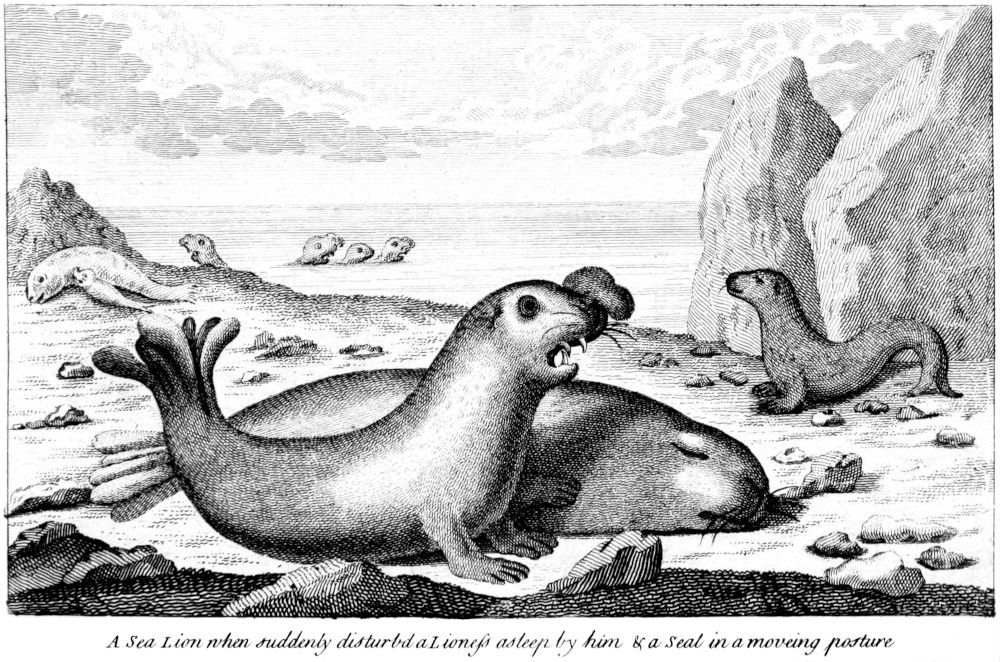
A Sea Lion when suddenly disturbd a Lioness asleep by him & a Seal in a moveing posture
The seals here may properly be called sea-wolves, from the resemblance of their heads to the heads of wolves, differing in that particular from the seals in the northern hemisphere, where their heads are more like the dog’s. They are naturally surly, and snarl in an angry manner, on the approach of any body. Two fins compose their tails, and with the help of these they get along much faster than the lions.
Every thing one sees or hears in this island is different from what is elsewhere to be found. The very structure of the island, in all its parts, appears with a certain savage, irregular beauty, not easy to be expressed. The several prospects of lofty inaccessible hills in the day, and the solitariness of the gloomy narrow vallies in the night, added to the mixed, confused noise of the surge continually beating against the shore, the tumbling of the waters from an immense precipice, the roaring of sea-lions and sea-wolves, whose voices are more or less shrill or hoarse according to their youth or age, compose so wild and horrible a medley, that the stoutest man must long be accustomed to it, before he can taste the sweets of refreshing sleep, or wholly divest himself of terror.
October 6, we set sail, with nothing to subsist on at sea but the before-mentioned smoked congers, one cask of beef, and four live hogs, together with three or four bushels of farina. We were upwards of forty of us crowded together, and lying upon bundles of eels, with no convenience of keeping the men clean, nor any thing to defend us from their abominable stench; not a drop of water to be had without sucking it out of the cask through a pipe, which being used promiscuously, became intolerably nauseous. The unsavoury morsels we daily ate created perpetual quarrels amongst us, every one contending for the frying-pan. All the conveniency we had for firing, was an half tub filled with earth, which made our cooking so tedious, that we had a continual noise of frying from morning till night.
Thus we traversed the ocean: happy, however, in the thought of being once more afloat, and cherishing the hope that something would speedily fall into our hands. Every day, while the sea-breeze continued, we were hard put to it, for not having above 16 inches free board, and our bark tumbling prodigiously, the water continually ran over us; and, having only a grating deck, and no tarpaulin to cover it, our pumps would but just keep us free.
October 10, being the fourth day of our new expedition, we fell in with a large ship, which I could plainly see was Europe built. This struck me with the dread of her being a man-of-war; however, our case being desperate, I stood for her, and, before we could get quite up with her, the enemy discovered the brownness of our canvas, and, suspecting us, wore ship, and hauled close on a wind to the westward. This done, they hoisted their colours, fired a gun, and crouded away from us at a great rate; but, in about two hours it fell calm, and we had recourse to our oars. In the mean time we over-hauled our arms, which we found to be in very bad condition, one third of them being without flints, and we had but three cutlasses; so that we were but ill prepared for boarding, which was the only means we could have of taking any ship. We had but one small cannon, which we could not mount, and therefore were obliged to fire it as it lay along upon the deck; and to supply it we had no more ammunition than two round shot, a few chain-bolts and bolt-heads, the clapper of the Speedwell’s bell, and some bags of beach-stones to serve for partridge. In about four hours we came up with this ship, and every one seemed as easy in his mind as if actually in possession of her. But, as we advanced nearer, I saw her guns and patararoes, and a considerable number of men upon deck, with their arms glittering in the sun, who called out to us by the name of English Dogs, defying us, in a scornful way, to come on board of them, and at the same time gave us a volley of great and small shot, which killed our gunner, and almost brought our fore-mast by the board. This warm reception staggered a great many of my men who before seemed the forwardest, insomuch that they lay upon their oars for some time, in spite of all I could do to make them keep their way. We recovered ourselves again, and rowed close up with the enemy, and engaged them till all our small shot was expended, which obliged us to fall astern to make some slugs. In this manner we made three attempts, but with no better success.
All the night it was calm, and we were busied in making slugs, and had provided a large quantity by the next morning, when we came to a final determination of either carrying the ship, or of submitting to her; and accordingly, at day-break, I ordered twenty men in our yaul, to lay her athwart the hawse, whilst I boarded her in the bark. The people in the boat put off, giving me repeated assurances of their good behaviour; but, at the very juncture we were coming to action, a gale sprang up, and she went away from us.
This ship was called the Margarita, and was the same which had been a privateer belonging to St. Malo’s, and mounted forty guns, all the last war. In the skirmishes we had with her, we had none killed, except Gilbert Henderson, our gunner; and only three were wounded, viz. Mr. Brooks, First Lieutenant, through the thigh, Mr. Coldsea, the Master, through the groin, and one of the fore-mast-men through the small of his back. Two of these did very well, and I think there was something extraordinary in their cure; for the surgeon had nothing to apply to their wounds, but what he himself had prepared with seals oil, and other matters he had found on the island. Mr. Coldsea, indeed, lingered in a miserable manner for nine or ten months; but at length recovered.
Our condition now grew worse and worse; for soon after we had parted from this ship, a hard gale came on, which lasted four days without ceasing, during all which time we had not an hour’s hope of living a minute. We were obliged to scud away under bare poles, with our yaul in tow; and, having but a short scope of boat-rope, we were, on the descent of every sea, in the greatest danger of having the bark’s stern beat in by the violence of the boat’s precipitate fall after us; and, once in particular, a great hollow sea had like to have thrown her upon our deck, which would have put an end to our voyage immediately. The excessive fright of this storm made many of our people form a resolution of going on shore the very first opportunity.
In this extremity, calling to mind M. Frezier’s account of Iquique, I mentioned the surprizal of that place to the crew, which being universally approved of, we directed our course to that island.