THE VOYAGE OF Captain SHELVOCK ROUND THE WORLD. (continued 2)
Reading edition
It was three weeks before we got this length; and having nothing to ride the bark with, we were obliged to keep the sea with her, whilst the boat went in between the rocks, and was received by some Indians on the strand with a sort of welcome. The men, being landed, went to the Lieutenant’s house, broke it open, and rummaged the whole village, where they found a booty more valuable to us at that time than gold and silver. It consisted of about sixty bushels of wheat-flour, 120 of calavances and corn, some jerked beef, pork and mutton, some thousand weight of well-cured fish, a good number of fowls, some rusk, and four or five days eating of soft bread, together with five or six jars of Peruvian wine and brandy; and, to crown all, they had the good fortune to find a large boat near the shore, to bring off the booty with, which otherwise would have been of little use to us, our own boat being already sufficiently laden with the men.
Words cannot express the joy that reigned among us when they came on board: the scene was now changed from famine to plenty; the loaves of soft bread were distributed to every one, and the jars of wine were broached; but I took care they should drink but moderately of it, each man having no more than half a pint to his share: and, after a day or two’s living on wholesome diet, we wondered how our stomachs had been able to digest our rank and nauseous eels fried in train-oil, and could scarcely believe we had lived upon nothing else for a month past.
Mr. Randall, our Second Lieutenant, who commanded in this enterprize, told me, they did not meet with the least opposition, and that the few Indians they found seemed to be as glad of this opportunity of pillaging the Spaniards as we were.
The settlement at Iquique consists of about 60 scattered ill-built houses, which hardly deserve that name, and a small church. There is not the least verdure to be seen in or about it, nor does it afford the least necessary of life, of its own product, not even water, which they are obliged to fetch in boats from Pisagua, ten leagues to the northward.
By two Indian prisoners we took here, we were informed, that the Lieutenant’s boat was then at Pisagua, and that it would not be long before her return; however, being determined to make some attempt in the road of le Nasco, in lat. 16 deg. S. and at Pisco, in lat. 13 deg. 45 min. S. we set sail, and the very morning we came off the Sierra or high-land of le Nasco, two hours before day-light, we fell in with a large ship. The circumstances of our meeting and engaging her were, in some measure, the same with those we had with the Margarita. We met with both at the same time in the morning, and, whilst in pursuit of both, had the misfortune of being becalmed. We struggled with this last for six or seven hours, and were at length obliged to leave her, because the sea-breeze came in so strong, and the sea ran so high, that, had she been of no force, our slight bark must have been in pieces before a third part of us could have entered her. This ship was called the St. Francisco Palacio, of 700 tons, eight guns and ten peteraroes, and was well manned and provided with small arms.
It happened very unfortunately, that we should thus miss two of the best equipped ships in the private trade at that time in the South Seas. This last repulse was made a pretence for much murmuring; many, despairing of ever being able to take any thing as our condition was, were for surrendering to the enemy, who was all the night becalmed near us. To prevent their design, I took care to remove the two boats out of their power, by ordering two men in each of them, such as I thought I could trust, and to cast off from us at a little distance, that none might escape in them. But, notwithstanding the confidence I had in these four, the two in the best boat ran away with her; and the next day I was informed, that the First Lieutenant and Morphew had made a party, too strong for me to oppose, to go away with the boat that was left; but, it blowing fresh the next night, they were prevented from executing their design.
The next day we stood into the road of Pisco, as we had designed, where we discovered what appeared to be a large ship. We bore down to her with a resolute despair, and laid her athwart the hawse; but, to our great satisfaction, we met with no resistance, and were received by the Captain and his Officers with their hats off, in the most submissive manner asking for quarter. Before we came up, I had ordered our boat to intercept theirs, which was going on shore. They clapped her on board, but, not holding fast, they fell astern, and could not fetch up with her again; so that in this boat was conveyed away every thing that might have been valuable in the prize. She was a good ship, of about 200 tons, called the Jesus-Maria, almost laden with pitch, tar, copper, and plank, but nothing else. The Captain offered 1600 dollars for her ransom, but I could not give ear to it in the condition which I was then in.
The Spanish Captain informed me, that the Margarita had been arrived some time at Callao, where she had given a full account of us; that the Captain of her, and three more, were killed in the action with us, and that the Priest and several others were wounded; and that she was now ready to put to sea again, with an addition of ten guns and fifty men, to cruise for us: and, moreover, that the Flying fish, a frigate of 28 guns, was already out with the same intent. Upon this advice, having cleared our bark, we gave her to the Spanish Captain, and as soon as the breeze sprang up, we weighed, and went to sea, and in going out met with our boat, which I have mentioned to have left us in the night; they edged towards us, imagining we were Spaniards, by which means we got them again. The two fellows in her were almost dead, having ate or drank nothing for three days, and had just been ashore on a small island, to kill seals to drink their blood. They had no excuse for themselves, but that they fell asleep, and the faint breezes of the night had wafted us in the bark away from them.
Pisco being 40 leagues to the windward of Callao, I kept close hauled till I had gained a two degrees offing, and kept that distance till we had got well to the northward of Callao, and hauled in again for the land, a little to the southward of Truxillo, and looked into the roads of Guanchaco, Malabriga, and Cheripe; but, seeing no ship at those places, I passed between the island of Lobos de Tierra and the continent; and, Nov. 25, found ourselves near the Saddle of Payta, where having made some prisoners, I examined them concerning the condition of the town, which they answered was very poor at present, there being neither money nor provisions in it, and shewed me a small bark on the shore, which Capt. Clipperton had sent in here a little while before with some of his prisoners, which had given them such an alarm, that every thing had been again removed into the country. This unwelcome news did not hinder us from keeping on our way, with our Spanish colours flying, till we came to the place of anchorage.
No sooner was our anchor down than I sent away Mr. Brooks, with both the boats, armed with 24 men; no more of them, however, appeared than those who rowed, and two or three sitters in each, the rest, with their arms, lying in the bottom of the boat. Thus they advanced towards the town, without giving the least umbrage to the inhabitants, who were so thoroughly persuaded of our being Spaniards, that, when the people landed, they found the children playing on the beach, who were the first that took the alarm, and ran away at the sight of armed men. In an instant the whole place was in confusion; the town was deserted, and nothing left in it but a few bales of coarse cloth, about 500 of dried tole or dog-fish, two or three pedlars packs, and an inconsiderable quantity of bread and sweet-meats; so that we unluckily had but little employment for our boats.
As we lay at an anchor in the ship, we took a boat with about fifty jars of Peruvian wine and brandy, the master of which told us, he was come by stealth from Callao, there being orders that none but ships of some force should stir out. This man was the first who acquainted me with Captain Hatley’s being taken, and the value of his prizes; and likewise assured me, that, if Captain Clipperton had landed the first time he was here, there were 400,000 pieces of eight in it, besides a great quantity of jesuits bark, and other valuable commodities, of all which he might easily have made himself master; but he wanted courage. Some of the King of Spain’s treasure is frequently lodged under the Governor’s care; and, if he had made an attempt, even the second time, it would have been worth his while. As for Collan, which is two miles to the northward of this, situated near the mouth of a little river, it is a mean place, being entirely inhabited by Indians.
From this place we directed our course for the island of Gorgona, in the bay of Panama, and in our passage thither built a tank, or wooden cistern, big enough to hold 10 tons of water, wherewith to supply our want of casks, as without the help of some such contrivance we should have but little hopes of being ever able to return home. In our way we made the island of Plate, Cape St. Francis, and Gorgonella; and on Dec. 2, we came to anchor to the leeward of the northernmost point of Gorgona, within less than a quarter of a mile of the shore. Here we had the advantage of filling our water-casks in the boat, the water running in small streams into the sea, and cut down our wood at high water mark; so that in less than 48 hours we had done our business here, and hurried away to sea, for fear of those who might be in quest of us.
Having got out of the track of the enemies ships, we consulted on the best methods of proceeding, when the majority were for going directly over to the coasts of Asia. Upon this we changed our ship’s name from the Jesus Maria to the Happy Return, and applied all our endeavours towards abandoning these coasts; but the winds and currents were averse to it; and some of those who opposed our departure, did so much damage clandestinely to our tank, that the greatest part of our water leaked out. This, together with continual contrary winds and dead calms, which detained us till our provisions were much exhausted, rendered us incapable to undertake so long a run; and therefore, to furnish ourselves with what we wanted, I proposed a descent on the island of Quibo, in lat. 7 deg. 40 min. N. where, by Captain Rogers’s account, I guessed there must be inhabitants who lived in a plentiful manner on the product of the country.
On January 13, 1721, we anchored between Quibo and the isle of Quivetta, in a sandy bay, commodious for wooding and watering. The morning after our arrival, we saw two large piraguas rowing in for the isle of Quivetta, one of them with Spanish colours flying; and, after a little debate, whether it would be prudent for us to attack them in our boat or not, it was resolved, at all hazards, to go after them in our yaul. This enterprize was commanded by Mr. Brooks, our First Lieutenant, who found the men on shore, brought away their piraguas, and two prisoners, the one a Mulatto, and the other a Negro; the rest sought for refuge in the woods. The Mulatto mortified us very much, by telling us, that a vessel laden with provisions had passed by very near us in the night; but, to make amends, promised to conduct us to a place where we might supply ourselves without any hazard, provided we were not above two or three days about it. No news could be more welcome to us than this, wherefore we were very brisk in getting off our wood and water; and, on January the 19th, we got safe in between Mariato and the island of Sebaco, and anchored in six fathom water, over against a green field, which is instruction sufficient, there being but that clear spot hereabouts. Our guide desired we might be going at least three hours before day-light, and that then we should be in good time at the plantations. Accordingly I embarked at two the next morning in our own boat, and ordered the two lieutenants in the two piraguas, leaving my son and a few men with him, to take care of the ship. Our guide carried us up some part of the river St. Martin, and out of that into several branches of very narrow creeks amongst mangroves, where we had not room to row, which made me suspect he had no good design in his head; but we landed just at day-break on a fine savannah, or plain; and, after a march of about three miles, came to two farm-houses, whose owners had made their escape, except the wife and children of one house.
The place answered the man’s description, being surrounded by numerous herds of black cattle, hogs, and plenty of fowls of all sorts; and here we found some dried beef, plantains, and Indian corn; and, for present use, were entertained with a wholesome breakfast of hot cake and milk, a diet we had been long unacquainted with. When it came to be broad day, I saw our ship close by us, upon which I asked our Mulatto, How he came to bring us so far about? He answered, There was a river between us, and he did not know whether it was fordable or not. I therefore sent some to try, who found it was not above knee deep. Wherefore, to avoid the trouble of carrying our plunder so far as we had been led, I ordered our boats to row out of the river St. Martin, and to come to the beach over against the ship. We had not been long here before the master of the family we were with, being anxious for their safety, returned, and made an offer of as many of his black cattle as we should think fit to require; which offer we kindly received: and he brought us the number we thought we could save; for, having but little salt, and not being able to spare water to keep them alive when at sea, our demands were moderate; and the few we required, as soon as they were carried on board, were killed. Their flesh we preserved by cutting it into long slips of the thickness of a finger, and then sprinkling it with so small a quantity of salt, that we did not use above four or five pounds to a hundred weight; then letting it lie together two or three hours, we hung it up to dry in the sun, which perfectly cured it, and that better than it could have been done by any other way.
Having done all we proposed in coming here, we departed with our decks full of fowls and hogs, amongst which there was one with its navel, or something like it, on its back. The Spaniards say, that this, when wild in the woods, is a terrible animal to meet with, although at full growth it be but small.
January 25, we made a sail about two leagues to the leeward of us: we gave her chase till we found she was of European structure; and fearing she might be one of the enemy’s ships of war, I clapped on a wind, and in half an hour’s time it fell calm. Soon after, we saw a boat rowing towards us, which proved to be the Success’s pinnace, commanded by Mr. Davidson, their first Lieutenant. My first interview with him was attended by an astonishment equal on both sides; he could hardly believe that he saw us in so mean and forlorn a condition; and I could scarce believe that the Success (if in being) had been all this while wandering up and down these seas.
I entertained him with a rehearsal of the constant run of misfortunes which had befallen us in the long interval since we separated near the coast of England, till our present meeting that day; and he, on his part, entertained me with several remarkable incidents, which had happened to them in the course of their voyage. Particularly, he told me, that, about a twelvemonth before, they had taken a new French-built brigantine, and put their officers and ship’s company’s plunder on board of her, which they valued at ten thousand pounds sterling; that their second Captain, Mr. Mitchel, was intrusted with the command of her, and was ordered to go to some island on the coast of Mexico, and to stay there till Captain Clipperton should join him with his ship; but that they never could find the island since, and, therefore, judged that poor Mitchel, and his men, were either starved, or murdered by the Spaniards or Indians, or that he had perished with the island, such submersions being frequent on those coasts. The story of Captain Mitchel, who was a very worthy man, and an expert sailor, is, in all its circumstances, a very tragical one. There was always a jealousy between him and his Captain, who ordered him to a place, and pretended to give him infallible directions to find it, which never could be found afterwards, and, ’tis my opinion, never was above water; and the unfortunate gentleman, without doubt, perished in some obscure, miserable manner, in quest of a place that was never yet, and perhaps never may be discovered. In our discourse, I asked Mr. Davidson the value of the booty they had made, and he assured me it did not exceed 70,000 dollars—but that they had lost great opportunities—that in October, 1720, they were in the bay of Conception, and had the misfortune to leave three laden ships behind them, and missed a fourth, which was coming into the bay, and which was so near as to hail and talk to them, besides being becalmed by them;—that though it was probable their launch could have taken them all four, yet, through their Captain’s deafness to advice, they took none of them:—that, moreover, they had never yet cleaned their bottom, notwithstanding they had had it in their power to do it; and that this negligence had like to have cost them dear; for that, in their return from Conception, they looked into Coquimbo, where they saw five ships at anchor, three of which let slip after them, and overtook them apace, but by the favour of thick weather, and a hard gale of wind, they got clear of them; and further, that, off the port of Callao, they fell in with the Flying-fish frigate, which was cruising for me in the bark, and which, by unpardonable mismanagement on the part of Clipperton, got safe from them, although deeply laden with a valuable cargo designed for Cadiz. I have been since informed of this by one of my surgeon’s mates, who was taken in the Mercury, and was surgeon of the Flying-fish at that time.
This was the substance of my discourse with Mr. Davidson, when, in the mean time, a gale sprung up, which interrupted us, and I bore down to the Success, and went on board of her. I gave Captain Clipperton, and Mr. Godfrey, the agent-general, the whole history of my voyage hitherto, and expected that I should have been treated by them as one belonging to the same interest, but found I was mistaken; for they were unwilling to have any thing to do with me since my ship was lost. However, I conceived, that he could not be so inhuman, as to deny me the supply of such necessaries as I wanted, and he could conveniently spare. The answer I had to this was, that I should know more of his mind the next day. Amongst the rest of the discourse I had with him, he told me he was just come from the island of Cocos, that his people were sickly, and at very short allowance. Upon this, I offered my service to pilot him to Mariato, which was not above thirty leagues distant from us, where he might have refreshed his people, and supplied himself with what he would. But this was not accepted, he being resolved to make the best of his way to the Tres Marias, where, he said, there was turtle enough to be had; so I left him for that night.
The next morning, as I was going on board of him again, with some of my officers, he suddenly spread all his canvas, and crouded away from us, who were in the boat: upon which I returned to our ship again, and made signals of distress, and fired our gun several times, which was not regarded by him, till his very officers cried out on his barbarity, and, at last, he brought to. When I had sailed up with him, (being exasperated at such inhuman treatment) I sent Mr. Brooks, our First Lieutenant, to know the reason of his abrupt departure, and to tell him that we stood in need of several necessaries, which, if he was not inclined to give, I would purchase of him. Upon these terms he spared me two of his quarter-deck guns, sixty round shot, some musquet-balls and flints, and a Spanish chart of the coast of Mexico and part of India and China, a half-hour and a half-minute glass, a compass, and about 300 weight of salt; but with all the arguments I could use, I could not prevail on him to spare us the least thing out of his surgeon’s chest for the relief of Mr. Coldsea, our master, who had been ready to die of his wounds received in the engagement with the Margarita, for above three months past. When this was concluded, I again asked him if I could be of any service to him, and assured him, I had a pretty good ship under foot, though she made but a poor figure, and believed I could hold him way, and that he knew our cargo was pretty valuable. To all this he answered, that, if I had a cargo of gold, he had no business with me, and that I must take care of myself. Mr. Hendry, the agent, and Mr. Rainer and Mr. Dodd, Lieutenants of marines, seeing but little prospect that we should ever get home, and being weary of the work that was imposed upon them, desired I would let them go on board the Success, for a passage to England; which I consenting to, they went on board accordingly, and Clipperton left us to shift for ourselves, near the island of Cano. Having purchased this supply, I was for going to the southward into the bay of Panama, to try our fortune there; but the majority opposed me through fear, and were for going to the Tres Marias, to salt turtle there, and then stretch over for India. We directed our course thither; and, a few days after, met with the Success in quest of Sonsonnate, where they expected to receive the Marquis of Villa Roche’s ransom. That nobleman had been some time a prisoner with them, and his wife was now at Guatimala, a city within 30 leagues of that port. We ranged close under their stern, and asked how Captain Clipperton and the rest of the gentlemen did, but it was not thought proper to return any answer; so, without any concern, he steered one way, and we another. After this, calms, and contrary winds, and unaccountable currents, reduced us to a very small allowance, which we were obliged to diminish daily, and should have been in deeper distress than ever, had it not been for the turtle which we took on the surface of the water. We had a continual look-out for them, and they were easily known, at a great distance, by the number of sea-birds that perched on their backs. Upon sight of these, we used to lay aside the advantages we might have made of the wind, to embrace the opportunity of prolonging our provisions. Upon the whole, though we lost some of our way in pursuit of turtle after this manner, it was not the greatest inconvenience that attended us; the dressing it made a great consumption of our water, the quantity of which decreased upon us very suddenly, by the continual use of it in boiling the turtle with plantain flower. This relapse into a state of famine, threatening us with speedy and certain perdition, if means were not used to avert it, made me propose the plundering of some small town as we coasted along the shore. Guatulco was the nearest to us: but the very morning we were steering in for this place, at sun-rising we saw a sail a considerable way to leeward of us. We thought it would be better to take this ship than to venture on shore, and therefore we bore down to her, who in the end proved to be the Success. We now met with a double baulk, both as to our hopes of Guatulco and the ship; for we were by this accident got so far to the leeward of Guatulco, that it was needless to beat up so far against the wind for an uncertainty, when we had a gale, that, had it continued, would have carried us to some better port.
But the winds were but a few hours propitious, and were succeeded by perpetual contrary gales, which destroyed all our hopes, and brought us down to a small earthen plate of calavances, a kind of small bean, for 24 hours, which not being sufficient to keep us alive, we had recourse to the remainder of our smoked congers, which had for some months been neglected, and lain soaking and rotting in the bulge water. They were certainly as disagreeable food as ever men eat.
Under these calamitous circumstances did we meet with the Success a fourth time, near the port of Angels; and, after having made the appointed signal, we stood so near to one another, that, to use the sea phrase, a bisket might have been tossed from ship to ship, but we did not change a word with each other; for, Captain Clipperton, as I have since been informed, had ordered all his officers and ship’s company to take no notice of us: and, though he was so truly sensible of the difficulties and hazards we had to cope with, if our design was to go for India, that he said, The child that was born the day before would be grey-headed with age before we should arrive there (intimating by that expression, that it was impossible for us to do it), yet, notwithstanding, he, without any remorse, could see us on the brink of suffering the greatest severities our ill fortune could load us with, and not lend us a helping hand to deliver us from the impending ruin.
Thus surrounded on all sides by present want and threatening disasters, we, on the 12th of March, being off the port of Acapulco, saw a ship between us and the shore. I bore down to her, till perceiving her to be a large Europe-built ship, with Spanish colours flying, I concluded she was the Peregrine, who, as I had been informed, had carried the Prince of St. Bueno, who had been Viceroy of Peru, to this port in his way to Spain. With these suspicions, being as yet unwilling to run ourselves so immediately into the enemy’s clutches, I hauled again on a wind, which he seeing, he pulled down his Spanish, and hoisted an English ensign, and made the signal agreed on between Clipperton and me for knowing one another. Had they been in any other part, I should have been so far from entertaining any thoughts of such a change in him, that I should have looked on all his signals as the artifices of the enemy, who might have acquainted themselves with them by the information of such of our men as they might have taken prisoners. But now, making no doubt that it was he, I bore down to him, and being come along his side, he sent Captain Cook, his second Lieutenant, in his yaul, with an obliging letter to me, to inform me, he was cruising for the homeward-bound Manilla ship, and desiring I would assist him in the enterprize, and come on board of him the next morning, proposing a union of our two ships companies. I was very well pleased with this offer, and, without hesitation, returned him word that I would be with him early.
In the mean time, I read over his letter publicly to my people, and exhorted them seriously to consider of the great benefits that would accrue to us on all sides from it. Upon which they all expressed the most resigned willingness to join in the undertaking. But, as Clipperton had used us so unhandsomely before, they desired I would get some security for their shares, signed by Captain Clipperton, Mr. Godfrey the agent, and the rest of their officers. I went on board, and, according to their request, Capt. Clipperton, and Mr. Godfrey, the owners agent, immediately drew up an instrument fully worded for the purpose, and they and all the other officers signed it. This was all my people wanted to make them easy.
We then proceeded upon our main business; and, after mature deliberation, it was thought most adviseable, that I should send the greatest part of my men on board the Success, as soon as we saw the Manilla ship come out of Acapulco, and leave only a boat’s crew with me to bring me away, in case I should have occasion to make use of my ship as a fire-ship, or a smoaker, which we jointly proposed to do, if we found the enemy too hard for us; and it was determined to board her at once, as we should otherwise have much the worst of it, on account of their superior weight of metal, and the better capacity of their ships, which are built very strong, to bear a cannonading. Clipperton assured me, he was certain of the time when she would sail from this port, which the Spaniards say is always within a day or two after Passion-week, of which we had a fortnight yet to come.
Before I returned to my own ship, I acquainted Captain Clipperton with our slender stock of provisions, but particularly with our shortness of water; and he told me he had 80 tons of it on board, and he would spare me as much of it as I would have, or any thing else his ship afforded.
I had now the pleasure of being restored to my command in as regular a manner as ever; every one, from the highest to the lowest, expressing the satisfaction he had in the prospect before us. But, Morphew, that ringleader of all our disorders, fearing my resentment, thought it was his best way, to insinuate himself into the favour of the Captain and Officers of the Success, which he did effectually, by an humble, submissive, outward deportment, and prevailing presents. In short, he had his end, and left me; but, the next morning, Mr. Rainer, who acted with us afterwards as Captain of marines, came on board of us to visit his old shipmates, and so continued.
Thus we cruised in good order, and with a great deal of hope, until March 17, when, towards evening, Clipperton, contrary to his usual custom, stretched a-head of us about two leagues, without lowering so much as a top-gallant-sail for us to come up with him. I could not but be a little startled at this, as being quite contrary to his usual method. However, I kept standing after him, as I thought, in the night, till we were almost in the breakers on the shore, which of course obliged us to tack, and stand out to sea again, admiring all the time that we had had no signal for going about. The next morning we had no sight of any ship near us, which laid me under the most terrible apprehensions, considering the bad condition we were in for want of water, and the vast distance we were at from any place where we could expect to get a recruit of any, having now no choice left, but either to beat up 220 leagues against the wind, to go to the Tres Marias, or bear away a much more considerable distance for the gulph of Amapala, or the island of Cocos.
But, notwithstanding our distress, I kept our cruising station for him two or three days. At last it was resolved to bear away to the first convenient place to water at; and, in truth, it was time, for we were now 40 odd men, who had but three buts of water for a run of 300 leagues and upwards, on a coast subject to long calms, variable winds, and uncertain currents.
It was afterwards told me, that the night Clipperton left us, he assembled all his officers, and told them it was his intention immediately to quit the coast. His officers remonstrated to him on the barbarity of doing this without acquainting Captain Shelvock with his intention, and sparing us some water. But he put off their serious expostulations with an inhuman sneer, saying, That, if I should, through want, be obliged to surrender to the enemy, I should only share the same fate, that, perhaps, some others had met with before me.
Thus this man, perhaps, through an excess of mean-spiritedness, and dreading the engagement with a ship that was always known to defend itself with some obstinacy, neglected as fine an opportunity as most of our nation have ever had of taking this ship, which, as I was informed, by some Spaniards from Manilla, when I was in China, came out of Acapulco about a week after we left the cruize.—[For Capt. Clipperton’s account of this transaction we refer the reader to the preceding voyage.]
On March 30, in the evening, we entered the road of Sonsonnate, and, as the sun set, saw a ship at anchor there. It being a moon-light night, I sent the first Lieutenant, with some of the best hands, to discover what this ship might be. On his return he informed me, the ship was a large one, of one tier of guns at least. I nevertheless continued to ply in all the night, and prepared for action. At day-light we found they had hoisted a jar of powder, containing about ten gallons, with lighted match, at each main and fore yard arm, and at the bowsprit end, with design to let them fall on our decks if we boarded them. This contrivance, if it had taken effect, would have soon made an end of both ships, and of all that were in them. Seeing them so desperate in their preparations, I expected a warm dispute with them; and, by what I could see, they were, in all points, superior by much to us in strength.
At eleven in the morning, the sea-breeze came in, and ran us upon them very fast, whilst our small arms were briskly and effectually employed to break their powder jars, before we came to board them, which we did without delay, and, after the exchange of a few shot when on board of each other, they submitted.
This ship was called the Sacra Familia, of 300 tons, six guns, and 70 men; besides a great number of small arms, with some grenade shells and shot. She had been, for some time before, arrived from Callao, with wine and brandy; but had now nothing in her but fifty jars of gunpowder, and a small parcel of rusk and jerked beef. In short, she could hardly be said to be worth the trouble we took, and the risques we ran for her: but she was reputed to be a better sailor, and was visibly better fitted out than our own; wherefore I changed ships, and we all went on board our prize, which was equipped in the warlike manner we found her, and commissioned, on purpose to take us.
A merchant, the escrivan of the ship, being on board, desired we would sell him the Jesus Maria, which we agreed to, and sent him on shore to raise the money for that purpose; and at night he came off with another Spanish gentleman, and brought us a letter of advice from the Governor on shore, signifying that there was a treaty of peace on foot between their Britannic and Catholic Majesties, which was what we had not before heard of. However, I sent to the Governor, signifying that I should be very glad to see the proclamation and articles; and that thereupon, I should be ready to obey the commands of my Sovereign; so we came to an agreement with the Governor to lye in the road till he sent to Guatimala, 50 leagues distant, for those papers, provided he would supply us with water and provisions. On the 5th of April, the Governor sent on board two papers, which, by the best interpretation we could get of them, did not appear to us to be in the form of proclamations. We told those who brought the papers aboard, that we were in great want of an interpreter; upon which they said, there were some Englishmen at Guatimala, whom they would send for, if we would stay three days for them, and that they would supply us with water and provisions till that time; which we agreed to, and they desired we would send our boat on shore every morning for the supply. Accordingly, on the 7th of April, we sent our boat on shore with Mr. Brooks, our first Lieutenant, and five men. This officer, men, and boat, the Governor detained under a flag of truce, and, at night, sent off a small boat, with two of our men, with a letter from himself, and another from Mr. Brooks. His letter signified, that, if we did not deliver up our ship to him, he would declare us pirates. And Mr. Brooks, by his, informed me, that it was his opinion, that the Governor was endeavouring to bully me into a surrender, having spoken very ambiguously of a cessation of arms: notwithstanding which, I sent the Governor a letter, signifying, that, if we could be secured of a safe and sure conduct for ourselves and effects to Panama, and from thence, by the way of Porto Bello, be conveyed to any of our British plantations, we would come to a farther treaty; which if he intended, he was desired to signify it by firing two guns as soon as he had received this advice, and by sending back my officer and men; if not, necessity would oblige us to sail. At three in the morning (the Governor having shewn no signal, nor sent any word) we weighed our anchor, yet lay to in the bay till ten, but then made sail, being forced thereto for want of water; having, however, no other intent, in case of the certainty of a peace, than to deliver up the ship we were now in at the first convenient port, as was signified to the Governor by letter.
Being now got out to sea, we reduced ourselves to a pint of water for 24 hours each man, and directed our course for the gulph of Amapala, which was about 35 leagues to the E.S.E. of this place, in order to get a fresh supply. The loss of my officer and boat’s crew, sensibly diminished the number of white faces, and we should have been so much weakened by it, that we should never have been able to manage this great ship, with her heavy cotton sails, if we had not taken with us our negro prisoners, who proved to be very good sailors. The loss of our boat was also a very great inconvenience to us; but as I only thought of taking water enough to carry us to Panama, where we were fully resolved to surrender, if it was really peace, I imagined we might make shift without her, and get such a quantity as we might want in two or three days time.
The winds were favourable, and we arrived there on the tenth following in the evening. As soon as we had entered the gulph we found ourselves in the midst of several small islands, one of which was the island of Tygers, where we expected to find water; but our expectations proved vain, for, after a hazardous and fruitless search not only on that, but on some of the greenest of the other isles, there was not the least drop of fresh water to be found, by us, on any of them.
In this miserable condition, threatened on all sides with inevitable destruction, unfit for the sea, fearful of trusting ourselves in the cruel hands of the inhabitants on the shore, quite dispirited by the continued course of misfortunes which had hitherto been our constant attendants; but, above all, lamenting this unhappy baulk in not finding water where we so much expected it, which had reduced us to such extremities as we had never known before; in short, ready to sink under the burden of our calamities, we weighed our anchor on the 13th of April before day-break, and stood out from this gulph. And now having the open sea before us, I brought my people in general to an obstinate resolution not to surrender on this part of the coast, let the consequences be ever so miserable. Upon this unanimous agreement, with not 40 gallons of water in the ship, and no other liquids to supply the want of it, we came to so small an allowance as half a pint of water for 24 hours; and even this allowance was rather too large, there being no place, that we knew of, where we could get any more, nearer than Quibo, to which island, about 200 leagues distant from us, we shaped our course, but having very uncertain winds and weather, we were 13 days at this allowance. Our sufferings from the extremity of thirst are hardly to be conceived; some drank their own water to allay the burning heat within them, but though this moistened their mouths, it increased their misery; some drank large draughts of sea-water, which was near putting a period to their lives; while others eat just enough of the calavances moistened with water to sustain life, and these suffered the least.
At length we were fortunately relieved, by falling in unexpectedly with the island of Cano, in lat. 9 deg. N. where seeing a run of water, Mr. Randall, without dreading the dangerous surf, passed through the breakers, and, to the unspeakable joy of all the company, soon returned on board with his jars filled; but as he could not bring off more than 60 or 70 gallons, I took care to restrain our people in the use of it, allowing to each man only a quart for their immediate use: and I was the more strict in this distribution, because Mr. Randall assured me, the breakers were so dangerous that he believed we should not be able to get at any more.
Being willing, however, to make another trial, I next day sent the boatswain, to endeavour to procure a further supply; but, after wasting the whole day in search of a smooth beach to land upon, he could not see one spot where he durst venture on shore. Therefore, thinking we had a stock sufficient to carry us to Quibo, I weighed anchor, and in ranging the island I accidentally discovered a smooth beach, where the little boat getting on shore, the crew filled nine jars, which lasted till we arrived at Quibo, where we anchored at the same place we had twice anchored at before. Here we consulted about surrendering ourselves to the Spaniards, being within 80 leagues of Panama, a place of little or no strength towards the sea, and but little frequented by the enemy’s ships of war, where we could treat with them at a distance, and be truly informed how affairs stood in Europe. During our deliberations we wooded and watered at leisure; and some searched the woods for fruits to refresh us, by way of prevention against the scurvy, which we had been all along less subject to than any ship I ever saw or heard of in such long runs. Those who were thus usefully employed brought us papas, guayavas, cassia, limes, and a small kind of white sour plumb, which was much eaten and admired by most of us; but, by its violent operation, it put stop to our proceedings for some days. However, we soon recovered, without any bad symptoms, and made an end of wooding and watering, and set sail, fully determined to surrender at Panama. In our way we passed by a great many small islands, but the most remarkable are, Montuosa, Sebaco, and the isle of Picara, which lies on the western side of Quibo.
May 15, a small bark, taking us for Spaniards, bore down to us, the master of which was in the greatest consternation when he found his mistake, but recovered when he heard we were bound for Panama to surrender, and readily offered his pilot thither, his vessel, called the Holy Sacrament, being bound to that port, laden with dried beef, pork, and live hogs, which, as she was leaky, he desired that I would take in tow. I was glad this bark fell into our hands, and readily complied with his request, because, if we found the Governor of Sonsonnate’s account to be false, we might be thoroughly enabled by this help to go to India. In the mean while, it had remained a point yet undetermined, who should be the person entrusted with the flag of truce; for my people, having known much treachery, were apprehensive the person sent would only, or chiefly, make good his own case and that of his friends to the Governor, and not care what became of the common men. At last, my son was judged the fittest to go, as he would surely return, if it were purely for my sake. Other difficulties were started that could not so easily be removed, notwithstanding which, we kept on our way, fully fixed in our resolution.
May 17, another small bark came down upon us, but having stood pretty near to us, she bore away again, and ran on shore directly, at the hazard of the lives of every soul on board. This unaccountable behaviour, gave us good reason to believe that the Governor of Sonsonnate’s account of a cessation of arms was groundless.
May 19, we saw a sail a-head of us, standing along shore, and being desirous of speaking with her, I let go the bark we had in tow, and made all the sail we could after her. We gained very little upon her all the day; but had, nevertheless, got a great way a-head of our bark, wherein were four of our own people and five Spaniards. However, notwithstanding night came on, all our sail was kept abroad, and next morning we were within gun-shot of her. I immediately ordered our colours to be spread, fired a gun to leeward, and set a man to wave a flag of truce; but, on sight of out English ensign, she fired at us, and so continued to do, with her decks full of men, abusing us with the grossest appellations. I made no return until I came close upon their quarter, and then I sent one of their countrymen to the bowsprit end, to inform them in Spanish, that we were bound to Panama, and desired to treat peaceably with them, and hoped, at least, they would have some regard to the white flag which they saw flying; but they still continued their fire; and presuming, as I supposed, by our quiet behaviour, that we were unable to defend ourselves, they were preparing to board us, which I no sooner perceived than I met them with our helm, and gave them so warm a salute, that they sheered round off from us. We just missed getting hold of them, but it falling almost immediately calm, we continued our engagement for the space of two or three hours at the distance of musquet-shot. At length, a breeze wafting us nearer to them, we found that as fast as we approached, so fast did their courage cool. Their Captain, however, still bravely encouraging his people, and exposing himself in the openest manner, was shot through the body, and dropped down dead; upon which they immediately, and with one voice, cried out for quarter, and put an end to the dispute. Mr. Randall, and two or three more, went on board the prize, and found the prisoners, in the most submissive posture, asking for mercy, which was granted, though they had no great reason to expect it, after their direct breach of the laws of arms and nations in firing at a flag of truce.
The most considerable prisoners, being brought on board, informed me, that their ship, called the Conception de Recova, belonging to Callao, was of the burthen of 200 tons, and laden with flour, loaves of sugar, bales of boxes of malmalade, jars of preserved peaches, grapes, limes, and the like, mounted six guns, and had 70 odd men on board. In this engagement, the Spanish Captain and a negroe were killed, and one or two slightly wounded. On our part, our gunner was slightly wounded by a pistol ball, and our main-mast had a small piece carried out of the side of it. We had now about 80 prisoners of all colours, though we ourselves were not above 26.
Amongst our prisoners we had several of note, particularly Don Baltazzar de Abarca, Conde de Rosa, an European nobleman, who had been Governor of Pisco, and was now upon his return to Spain, together with Captain Morel, who had formerly been taken by Captain Rogers. They were all treated with the utmost civility, which they the more wondered at, because, from a self-conviction of their own ungenerous behaviour towards us, they could not but expert to have been dealt with quite otherwise.
The winds and calms prevented our joining the Holy Sacrament, the prize we had left behind us, till May 22, when we bore down to her, and were surprized to find no soul on board, but that her decks and quarters were covered with blood. By many circumstances it plainly appeared, that the Spanish crew had butchered those who were left to assist them, while they were asleep; otherwise it could not have happened, that five unarmed Spaniards could have overpowered four Englishmen completely provided with arms for their defence. It is very probable, however, that these murderers paid with their lives, the loss of those lives they had taken away; for, being above four leagues from the land, and having no boat with them, they probably jumped into the sea on our approach, fearing, if they fell into our hands, to meet the vengeance due for so horrid a crime. That part of the deck which was dyed with gore they endeavoured to cover, by throwing the flocks and stuffings of beds over it; so that till these were removed, the blood was not to be seen.
This tragical accident put a damp to the pleasure we had enjoyed for a day or two past on the account of our late prize. Our prisoners, at such a sad and sudden change, began to be alarmed, and looked at one another as if they all expected to be the victims of our revenge upon this unhappy occasion. On the other hand, I was fearful lest these apprehensions should urge them to some desperate attempt, they being 80 in number, and we not above 17 on board of our own ship, and, when we were all together, not above 25 that could stand to arms. In this dilemma, I ordered all the prisoners into the stern-gallery, except the nobleman, and some of the chief officers, and a guard to be kept in the great cabbin.
The Spanish gentlemen observing this, let fall some expressions whereby I perceived they were afraid I intended to proceed to severities towards their people; but I assured them, that, if I was of so revengeful a nature, the laws of my country forbad me from indulging it; that I acted under my King’s commission; and that the natural abhorrence our nation had to barbarity, might quiet their fears, and make them perfectly easy. They then, on their part, in the most solemn manner disclaimed the very thought of an attempt upon our lives; and assured us, on their honour, that they thought they should never be able to make a just return for the generous treatment they had met with. It was, however, prudent to secure our prisoners of the meaner sort, and when we had so done, we hauled the Holy Sacrament along-side of us. She was half full of water, and the greatest part of her dried beef was wet and spoiled, but all that was not damaged we took out, together with some live hogs. We also took out of the Conception a twelvemonth’s provision of bread, flour, sugar and sweetmeats, and a like proportion for the Success, whom I expected to find at the Tres Marias, being then a stranger to Clipperton’s faithless desertion. I likewise took from them their launch and their negroes; for considering we had a large ship, and a run of 175 degrees of longitude to sail, which was little less than half way round the world, I thought we could do no other than reinforce ourselves with these blacks, who are commonly good sailors in these parts; and, indeed, we afterwards found we should never have reached the coasts of Asia without them.
Thus having supplied ourselves with every thing the Conception afforded, I suffered our prisoners to return to their own ship again; but the chief of them would not leave me till they had drawn up a writing, which they signed, whereby they acknowledged the circumstances of our engagement, in the manner I have already related. In short, no people, circumstanced as we were, could part in a more friendly manner than we did.
Thus were we put by our design of surrendering, and were going to undertake a long and hazardous voyage to Asia. Our strength was indeed considerably augmented, for we had now 15 guns, and ammunition enough to supply them.
Before we proceeded any farther, it was necessary to get in a full stock of water. The island of Quibo was hazardous for us, being too near Panama; it was therefore determined to ply up to Cano, where, having a good boat, we soon did our business. In our passage thither, the sweetmeats of all kinds, which we had taken out of our late prize, were divided among the messes. It happened that one of the fellows, one day, complained he had a box of malmalade which he could not stick his knife into, and desired it might be changed. I opened it, and found in it a cake of virgin silver, moulded on purpose to fill such boxes, and being very porous, it was of near the same weight of so much malmalade. In overhauling the rest, we found five more of these boxes. This was a contrivance to defraud the King of Spain of his fifths, which he claims in all the silver taken out of any of the mines in Peru. We doubtless left a great many of these boxes behind us, so that this deceit served them in a double capacity, to defraud their king’s officers, and blind their enemies. An affair as vexatious as this, is said to have been discovered too late on board a prize the Success had taken, where they found a very considerable quantity of Pinna’s or virgin silver, in the form of bricks, very artfully plaistered over with clay, and dried in the sun, which being all the consistence they give their bricks in that country, they were taken to be really such, and a great number of them were thrown overboard as so much rubbish, without any discovery of what they were, till the four or five last pieces. How true this may be I can’t say, but it was reported to me, as matter of fact, by several of the officers belonging to Captain Clipperton.
I must here observe, that every thing we took in the Conception was divided among us according to the Juan Fernandian articles, and that I had no more than six instead of sixty shares. They would not so much as allow me the money I had out laid at St. Catherine’s, which was upwards of a hundred pounds. I had some difficulty to persuade them to run to the northward so far as California; and was obliged to use many arguments to prevail upon them to believe that the harbour of Puerto Seguro was the only port of security where we could safely lay down and refit our ship; but having at last obtained their consents, I weighed from Cano, steering to the northward, and had favourable gales for 48 hours; but then came on the constant, or what may be called the trade wind on this coast, which being as contrary to us as they well could be, I was willing to try how far off these winds might prevail, which, in my opinion, may be called the eddy of the true trade wind, whose course may be perverted by the interposition of this vast mountainous continent.
Accordingly I found, that, at the distance of 60 leagues, we had light winds and variable, and that, at the distance of between 70 and 80 leagues, it settled at E. N. E. and N. E. I therefore kept at this distance from the land till we had run up to the height of 20 degrees north. In all this passage, we were not in the least sensible of any currents, and entirely out of the way of certain riplings and overfalls of water, which we frequently met with nearer to the land, and which often surprized us when we were becalmed in deep water.
In this passage we were accompanied by vast shoals of fish, and were continually incommoded by numerous flocks of the birds called boobies, making our ship their resting place, which fouled our yards and deck with their dung as fast as we could clean them. However, for change of diet, some of my people made ragouts of them, and the smoakers made stems for their pipes of their long wing-bones.
We fell in with Cape Corientes in the beginning of the month of August, and were carried away to the islands called the Tres Marias, by a hard gale at south, and came to an anchor under the lee of the middlemost of these islands, but could see no sign of the Success having been there. After a tedious search on all the three islands for fresh water, there was nothing like a stream of it that we could find. This was the more astonishing to us, as one or two of our late navigators have reported that fresh water is to be found there in sufficient plenty. It may have been so when they were there; but we were unfortunate enough to seek, when none was to be found.
After employing three days in a fruitless search, I stretched over for the coast of California, and arrived thereon the 11th of August. The inhabitants, as soon as they discovered us, made fires all along the shore as the ship ran by them; and, towards the evening, it falling calm, two of them came off to us on a bark-log, but were a long time before they would accept of our invitation to come on board of us. At length, they ventured in; when, in a moment, seeing our blacks promiscuously standing together with us white men, they, with very angry countenances, separated them from us; and would hardly suffer them to look at us. They talked to us with great vehemence, but we could comprehend nothing more of their meaning, than that they rejoiced to see us. Night coming on, they took their leave, and we gave them a knife or two, an old coat, and some other trifles, which seemed to please them very well. They expressed themselves by signs in such a manner, that we could guess they gave us repeated invitations to go on shore with them.
On Sunday the 13th of August, at day-break, we found ourselves near Puerto Seguro, which may be readily known by three white rocks, not much unlike the Needles of the Isle of Wight, and you must keep close on board the outermost to fetch into the bay. We entered Puerto Seguro, surrounded by numbers of small embarkations of the inhabitants, while the shore, on all sides, was crouded with Indians, whose numbers visibly encreased by multitudes which flocked together from the adjacent parts. Our anchor was no sooner down, than they came off to us in shoals, some few on their bark-logs, but most of them swimming, talking and calling out to one another in a noisy and confused manner, but such as plainly shewed how desirous they were to come to us. Our ship was in an instant full of these swarthy gentlemen quite naked, and amongst the rest was their King, or Chief-man, who, unexpectedly, delivered to me his batoon, or ensign of royalty, which I immediately returned to him. This man, notwithstanding the wildness of his appearance to us, had a good countenance, and his behaviour had something that was very engaging in it. I was, at first, at a loss to know how to entertain our numerous guests, but at length I thought of regaling them with some of our liquid sweetmeats, which we had in great plenty. This they liked extremely, and the spoons, which were mostly silver, they returned with great honesty.
Having thus commenced a friendship with them, at day-break next morning our boat went on shore to cut wood and fill water; and before the sun was up, we were again crouded with our former guests, who seemed as if they could never be weary of gazing at us. To keep up the amity we had already contracted with them, I ordered a great boiler to be carried on shore, with good store of flour and sugar, and a negroe cook, who was continually boiling of hasty pudding for the numbers of spectators on the beach; and it really behoved us to endeavour to keep in their favour, for on seeing a few of our men rolling great and cumbersome casks of water over the heavy sand, it inclined them to help us. To this may added, a sense of the kind treatment they met with from us, and the particular readiness of their Chief to serve us, by shewing his people a good example; for, after Mr. Randall, my Lieutenant, he himself took up the second log of wood to carry to the boat, and was immediately followed by two or three hundred of them, who, encouraged by his example, all took to the work, repaying our civilities with their services, and every day they seemed more and more fond of us.
Mean while, the rumour of our arrival was spread through all the neighbouring parts, and some of the clans, different from those who inhabited the shores, came daily to take a view of us. Those who came from any distance in the country could not swim; and that they were different from those we had first seen on our arrival here, appeared by their manner of painting themselves, and by other little distinctions which were visible amongst them; but they all united to assist us, nor were any of them idle but the women, who used to sit in companies on the scorching sand, waiting for their share of what was going forward, which they used to receive very thankfully and without quarrelling.
Having done all our business here, in the space of five days, on the 18th of August, in the morning, we prepared for our departure in the afternoon. We employed the morning in making a large distribution of sugar amongst the women. To the men we gave a great many knives, old axes, and old iron, which we had taken in our prizes. These were the most useful things to them, and of which they stood most in need; in return for which, some of them gave us bows and arrows, deer-skin bags, live foxes, squirrels, and the like. Great many of the men staid in the ship all the while we were purchasing our anchor, and it was not till we were under weigh that they all jumped overboard to join in the lamentations of their countrymen on shore.
The men in this southern part of California, are tall, straight, and well made; their limbs are large, their hair coarse and black, and barely reaches down to their shoulders. The women are of a much smaller size; their hair is much longer than the mens, and with it some of their faces are almost covered. The men go quite naked, and have not the least thing to cover any part of them, except their heads, round which they wear a band of red and white silk-grass, adorned on each side with a tuft of hawk’s feathers. The women, on the contrary, wear a thick fringe of silk-grass, which hangs down to their knees, and have either a deer’s skin, or the skin of a large bird, carelessly wrapped over their shoulders.
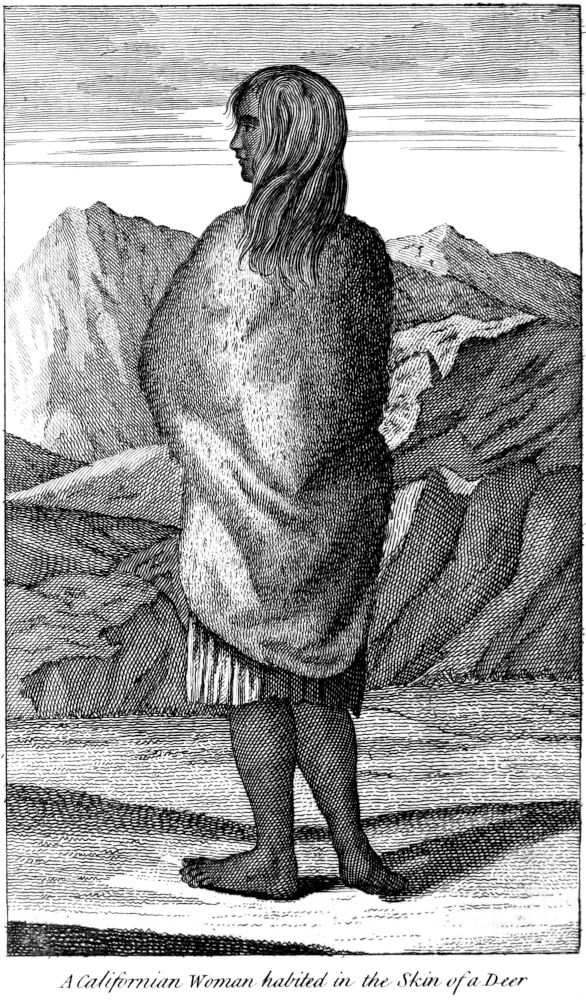
A Californian Woman habited in the Skin of a Deer
Nothing can be more wild and savage to look at, than these people at first sight: but there is a wide difference between what they seem, and what they really are; for, by all we could discern in their behaviour towards one another, and in their deportment towards us, they are endued with great good nature.
They seem to lead a careless life, and to enjoy every thing in common amongst them; and, having nothing but their daily food to provide, they are strangers to those numerous gratifications, the want of which multiply distresses among nations more civilized and more refined. Their contentment makes them honest, for they never offered to steal even the things most useful to them. In a word, they seem to pass their lives, according to the notions we have of the purest simplicity of the earliest ages of the world, before discord and contention were heard of amongst men. Having no enemies, they live in perfect peace and harmony with one another. Hunting and fishing are their only employments, except making the instruments they use in these pursuits, which are the simplest that can be. They have no canoes, and go to sea on bark-logs; but they are the most expert divers I ever beheld. By their simple manner of living, and their continual exercise, they live to a great age; and yet, what is very surprizing, they do not appear to be very numerous, considering the extent of their country. Their only enemies are the wild beasts, and of these there are plenty in the woods and forests. They do not appear to be so jealous of their women as they have been represented; for we had the company of some hundreds of them, young and old, without any restraint from the men. Two things were remarkable, that they never would suffer us to take snuff, but would earnestly take it from us whenever we attempted it; nor would they ever suffer us to look through a spying-glass, which I had frequent resort to, to see how our work of wooding and watering went on. In these two instances, they always took upon them to controul us, and in these two only; the causes of which we could never learn.
They go out to sea on their bark-logs, which are only composed of five logs of a light wood, made fast to each other by wooden pegs, rowing with a double paddle and with their harpoons, which are made of a sort of hard wood, they strike the largest albicores, and bring them in when struck. This was altogether surprizing to us, who had so often experienced the strength of that fish, and the difficulty of getting them into our ship, when either hooked or struck. One would imagine, that as soon as these Indians had struck one of these albicores, on his light embarkation, it would run away with him and his bark-log; but they either strike them so as to give them some mortal wound, or have some particular way of managing them, for they struggle and resist in vain. When we were in this port, it was apparently their fishing season; but by the number of deer-skins one sees amongst them, it is natural to conclude they have also their season for hunting. The skins of their deer are grey, and so are the skins of their foxes and squirrels; of all which, it is likely, they eat indifferently, as of most other animals that become their prey. Of birds amongst them we saw scarce any, but a few pelicans.
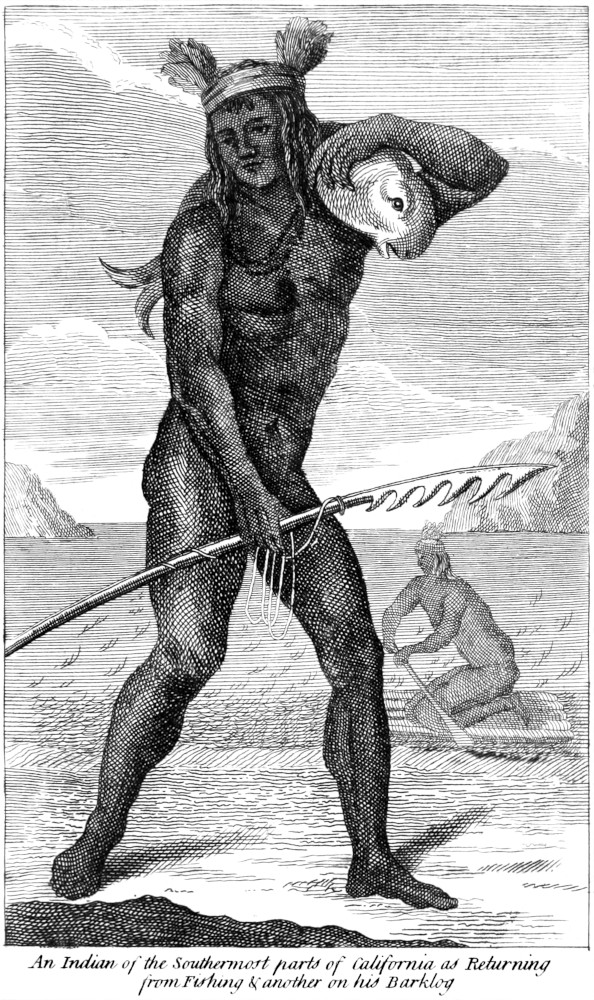
An Indian of the Southermost parts of California as Returning from Fishing & another on his Barklog
What these Indians used instead of bread is very remarkable. It is a small black seed of an oily substance, which they grind much the same way as we do our chocolate, and afterwards make it up in some such manner. The look of these black lumps or rolls so made up, is not very inviting, yet the taste is not very disagreeable. When they want to drink, they go to the river.
Their arms are bows and arrows. Their bows are about six feet in length, and their arrows seem to be somewhat too long for their bows. Their bow-strings are made of deer’s sinews, and their arrows are composed of a hollow cane for two-thirds of their length, and the other third next the point is of a heavy kind of wood, which is headed with a piece of flint, and sometimes with a kind of agate, the edges of which are indented, or cut in teeth like a saw. They made no manner of shew of their arms to us, and it was rarely that we saw them in the hands of any of the men. The women had them in the woods in search of game, which may be thence presumed to be some part of their employment. Upon the whole, they may be truly said to be a happy people.
Aug. 18, I sailed, as before-mentioned, from Puerto Seguro, and the same evening we took our departure from Cape St. Lucar, in latitude 23 deg. 50 min. N. bound to Canton, in China, the most likely place where we could hope to meet with English ships homeward bound for Europe.
Aug. 21, we discovered an island bearing W. S. W. 110 leagues distant from Cape St. Lucar. I endeavoured to get in with it; but night coming on, I could not lose time to view it. This isle my people called after my name. From hence we steered gradually into the parallel of 13 deg. N. but had our way stopped for two or three days by westerly winds. We were astonished at such an unforeseen delay, and began to dread we might meet with many such reverses of winds in this passage; nor could we conjecture, or conceive what might be the cause or causes of them. In the midst of this, the usual trade-wind prevailed again, and delivered us from the fears and apprehensions we had been involved in upon this occasion. With this we proceeded on our passage, keeping the parallel or track of the thirteenth degree of northern latitude, except when we judged ourselves to be near the shoals of St. Bartholomew. We then ventured to sail a degree, more northerly, and so continued to do for a run of 60 or 70 leagues.
About a fortnight after we had left California, my people, who had hitherto enjoyed an uninterrupted state of health, began to be afflicted with a sickness which particularly affected their stomachs. This we took to be owing, in a great measure, to the quantities of sweetmeats they were continually devouring, together with the dried beef, half devoured with ants, cockroaches, and other vermin, which was their daily food. This sickness increased every day, insomuch that, out of our small number, we once buried two in one day, one of whom was John Popplestone, our ingenious armourer, who was of such use to us on the island of Juan Fernandez. Before we had stretched with favourable gales the length of Guam, most of my people were sick and disabled, my ship began to be very leaky, and, to add still to our misfortunes, we had the ill luck to have one of our pumps split, and rendered useless.
Under these circumstances, we met with black and dismal weather, with tempestuous winds, flying and varying all round the compass. These boisterous gales raised such a tumbling sea, and our ship laboured so much in it, that the knee of her head, and the whole beak-head, became loose; so that the bowsprit fetched way, and played with the motion of the ship, which it continued to do all the time we were out at sea, and till we arrived at Canton. Our main-mast stood for some time without shrouds on the larboard side, till we could unlay our best cable to make more, having knotted and spliced the old shrouds till our labour was in vain.
In the midst of all this sickness and distress, I myself was taken violently ill, and had no hope to recover till a fit of the gout gave me some relief. Great was our want of every thing fit or comfortable for persons in such a state of sickness; yet, about the beginning of October, we passed by Guam; and, though upon the very brink of perishing, we dared not venture in, for fear the inhabitants should take the advantage of our weakness, and make some attempt upon our lives.
From Guam I directed my course for the island of Formosa. And now, though the length of our voyage was decreasing very fast, our sickness was daily increasing upon us in a much greater proportion; and most truly it may be said, that both our ship and ourselves were no longer fit for the sea. It was the 3d of November before we had sight of that island, and the 10th, before we could get any sort of directions to enable us to reach our intended port. At length, as we were passing through a very narrow channel, between a couple of islands, a fisherman took notice, by our cautious manner of working, that we were strangers, and made signs to us to bring our ship to, till he came up with us; when we made him understand in general, that we were bound to Macao, and he made signs that he would conduct us thither, if we would give him as many pieces of silver as he counted little fish out of his basket, which amounted to 40. We accordingly counted out 40 dollars into a hat, and next day he took us in charge, and anchored us safe in the road of Macao, near the entrance of the river of Canton.
Soon after our arrival, there came off to us a great many of the Success’s people, to make us a visit; I was amazed at the sight of them, and was very glad to hear their story. They said, their Commander, Clipperton, left me designedly; that they went directly to Guam, where they were very well refreshed, and supplied with provisions; that their Captain sold the Governor a great quantity of powder and shot, and several other valuable things, and permitted the Marquis of Villa Rocha, who was his prisoner, to go on shore there; that Mr. Godfrey the agent, and a marine officer, went to settle the accounts for what supplies of things they had had; and that, as soon as they were landed, and the boat come off again, Captain Clipperton weighed with his ship, in order to attack a ship of 20 guns from Manilla, that had lain quietly in the road in company with him all the time: that in approaching her he ran his own ship upon the rocks, and soon found the enemy was prepared for him: that, his condition being desperate, and supposing the loss of his ship inevitable, he had recourse to his case of brandy, and took so abundantly of it, that he fell on the deck, and snored out his time in a beastly manner, whilst his First Lieutenant, Davidson, in his stead, undertook the command of the ship, which he bravely executed till he was killed: he was succeeded by Captain Cook, their Second Lieutenant, who made a handsome resistance, and got the ship afloat again, after she had lain on the rocks forty-eight hours: that they lost their prisoner the Marquis de la Rocha, and also Mr. Godfrey the agent-general, with the officer already mentioned; which gave the ships company so much distaste, that they would not suffer him to have the command of them any more, and, locking him up in his cabbin, chose Captain Cook to take charge of the ship.
They had, it seems, much bad weather between Guam and Amoy in China, whither they got with much difficulty; and there made a dividend of all they had taken, half to the owners, and half to the ship’s company. Clipperton designed for the straits of Malacca; but his people, fearing he had no good intentions, would go no farther with him than Macao, that being a Christian port. Upon their arrival there, the Governor ordered Clipperton into custody. It seems he had broke prison formerly from thence, where he had been confined (as far as could be learned) on account of his having run away with Dampier’s commission and one of his prizes; but upon producing his Majesty’s commission now for the Success, they gave him no farther trouble, and only contented themselves with fleecing him a little. Here he sold his ship, the Success, for about 1000l. sterling.—[Such is the account given by Captain Shelvock, for the information, as he says, of the gentlemen-owners, who will never, either publicly or privately, be let into the truth of that story.]
But to go on, Nov. 12, about noon, a pilot came off to us, and we immediately weighed, and entered the river of Canton, where, finding the Bonita and Hastings, two English country-ships, I anchored, and sent off an officer, to desire them to instruct us how to behave ourselves in this port, and to acquaint me with the customs of it. To this they answered, that, since the Cadogan and Frances, two European English ships were lying at Wampo, they would advise me to send up to their factories at Canton, to acquaint them of our arrival, and with the reasons which obliged me to come into that river, which I accordingly did the next day. I now thought I was going to rest a little from my labours; but, to my misfortune, I suffered as much here, all circumstances considered, as I had in any former part of my voyage; for the evening we anchored at Wampo, where the English ships commonly lie, there happened an accident which gave occasion to much trouble. One of my men, being in a hurry to remove his effects on board the Bonita, in order to go in her to Fort St. George, the Bonita’s boat was, in her way to their ship, pursued by a Hoppo, or custom-house boat, who wanted to search her. The fellow, being in liquor, and fearing they would take away the silver he had with him, fired a musquet at the pursuers, and killed the officer. Early the next morning, the corpse was laid at the door of one of the English houses or factories, where Chinese officers, appointed for that purpose, waited for the first considerable Englishman that should come out, without any regard to whom this act of violence and murder was to be imputed. It happened that the Supercargo belonging to the Bonita, was the first that came out; on him they seized, put him in chains, and led him, by way of example, about the suburbs of Canton. All that could be said or done by the most considerable of the Chinese merchants who were in commerce with the English, availed nothing; till my man, who committed the fact, was delivered to them, and then the Bonita’s Supercargo was soon after released.
It is the custom in China, at least at Canton, to exact a certain sum of money from all ships that come there, according to their measurement, which is divided into rates or portions of first, second, and third. I therefore every day expected the Hoppo to come to measure my ship, but was given to understand, that I must go up to Canton before that could be done, though even at the hazard of my life. I accordingly went, and staid two days at the Cadogan’s factory, during which time I was hourly alarmed by such stories as made me fear that I should, indisposed as I was, be dragged away from my bed, and put in irons: but at the end of two days, I was obliged to go down again to the ship, to be present at the measurement; and a day afterwards the Hoppo came with a numerous retinue, and seemed to do his business very quietly, but would not let me know what was the sum he intended to exact. This gave me much trouble, for I began to think the Chinese, through a false report of our great riches, had an intention to gratify their love of money by a heavy imposition; and in this I was not mistaken.
I had not been here many days before I was deserted by all my officers and ship’s company, who were continually employed in removing their effects from on board my ship to some of the Europeans, without my knowledge, as I was all the time confined to my bed. My officers were engaging the Indian gentlemen in their interest, and had left me and my son, with a few negroes, to look after the ship. In short, my ship’s company had so many ways of disposing of their effects, that it was impossible to oblige them to do what I should have thought justice to the gentlemen in England and to myself. In a word, they were all soon recovered of their illness by the assistance they met with here, and were become their own masters. The gentlemen who presided over the trade, so little considered our case, that they had half a mind to refuse me a passage in one of their ships; and, in effect, I was treated by them almost as one enemy might treat another in a neutral port.
The Captains Hill and Newsham, when they first came to see me, were astonished at the ruinous appearance of my ship; and when I had given then a short history of my voyage, and desired they would receive me with my effects, they answered, that, since they plainly saw my ship was in no condition to stir any farther, upon paying our passage, they would entertain us as soon as we pleased. This I depended upon, and expected to have no farther trouble than to remove ourselves at any time; but, on the contrary, I found that I had ignorantly applied to the wrong persons, and that my address should have been to the Supercargoes, by which means I was left neglected, while the English Captains were ordered to fall down with their ships five or six miles below us. Thus was I left destitute in the company of five foreign ships, who, perceiving my own countrymen to be so careless of me, were so kind as to offer me their service, and assisted me with what they could; and, had it not been for them, I don’t know what I might have suffered; for I was under perpetual alarms that the Chinese had a design to chop my ship, that is, to seize her.
Having found out my error in applying to the Captains, and not to the Supercargoes, I sent up a letter to them, not to desire, but to demand a passage for me, my officers, and ship’s company, which I was sensible they could not refuse, and indeed they did not; but their condescension was accompanied with a charge to the English Captains, not to receive any thing belonging to us, except it was consigned to the India Company in England. This was an article which my people utterly rejected, vowing they would as soon throw what they had into the sea, as comply with such a demand; for my part, it gave me no concern, being conscious to myself that I had infringed none of their privileges. At the same time that I was acquainted with this intention of receiving us as passengers, I was also informed of the Hoppo’s demand for anchorage in the river, which was no less than 6000 tahel; and, to quicken me in the payment of this exorbitant sum, there was a penalty annexed to this extortion of 500 additional tahel for every day we failed in the payment of it. In short, there was no means by which I could evade this unconscionable imposition; and as it was a day before I could possibly send the 6000 tahel up to Canton, they required 500 tahel more for neglect of payment; so that they received from me, upon this extraordinary occasion, the full sum of 6500 tahel, equal to 2166l. 13s. 4d. English money. This was, as is apprehended, about six times as much as the Cadogan paid, which was the largest English ship there, and measured a third more than mine. It was now high time to get out of my ship; but before I quitted her, I sold her for 2000 tahel, which money, and the rest of my effects, were consigned to the India Company.
Towards the latter end of December, 1722, I sailed in the Cadogan, commanded by Captain John Hill, in company with the Frances, Captain Newsham, who, sailing better than we, left us as soon as we were out at sea. Captain Hill, finding his ship very tender, put into Batavia, where we continued about 10 days, and were informed there were several pirates in those seas; we, therefore, when we departed from Batavia, joined the Dutch homeward-bound fleet in Bantam-bay. The Dutch Commodore promised to assist us in wooding and watering at Mew-island, the water at Batavia being very bad; but on our joining Capt. Newsham in the straits of Sunda, the Dutch made that a pretence to leave us before we got the length of Mew-island; and Capt. Newsham also deserted us the same evening, so that we were left to ourselves.
We continued at Mew-island six or seven days, during which time several boats came to us from Princes-island, and brought us turtle, cocoa-nuts, pine-apples, and other fruits.
Some of the people having seen wild cattle grazing near the strand, went on shore with design to kill them; but before they had advanced near enough, they discovered a small tyger, and saw the track of an old one, upon which they retired to the boat. At this place some of the gentlemen belonging to this ship, in their outward-bound passage, saw a rhinoceros.
From Mew-island we had a very pleasant passage to and about the Cape of Good Hope, which, in my opinion, was greatly owing to Captain Hill’s good conduct, in coming in with the land betimes, I mean upon the easternmost part of the bank, and keeping a moderate distance from the land. I cannot be positive, but I think we never exceeded a degree in distance from it, generally less, and some times even made the land itself.
In this course, I do not remember that we took in our top-sails above twice; once for a squall, which was over in an hour’s time: and, another time, being threatened by the appearance of bad weather, Capt. Hill made all the requisite preparations to receive it, which done, he stood in for the land; and, in a few hours, we had fair weather, a favourable gale, and all our small sails set, at the same time that there remained great appearance of foul weather to the southward of us, which continued for several days afterwards.
I have observed before, that the Frances and the Dutch ships had seven days the advantage of us, by leaving us in the straits of Sunda, notwithstanding which, we gained the Cape about as many days before the Frances, although she sailed so much better than we: and, as to the Dutch ships, there was no appearance at all of their arrival when we left the Cape.
The officers of our ship, by comparing their accounts with those of some of the gentlemen belonging to the Frances, found that she had suffered a great deal of bad weather; whilst we, who were 10 leagues, or thereabout, to the northward of them, or nearer the shore, enjoyed fine pleasant weather and fair wind continually, till we arrived in the Table-bay, which we did the latter end of March. This I should think of sufficient weight for any other to pursue the same track. Here we found Governor Boon, in the London East Indiaman, and others, bound for England.
Whilst we lay at the Cape of Good Hope, nothing remarkable occurred, and it has been so often described, that I can say nothing of it that has not been said by most who have been there before.
From the Cape of Good Hope we had an agreeable passage to the island of St. Helena, and from thence to England.
We made the Land’s-end in the latter end of July; and, being come into the British Channel, met with brisk gales from the western quarter, with thick foggy weather.
On July the 30th, in the evening, we anchored under Dungeness, and the same night some of the Supercargoes and passengers, and amongst the rest myself, hired a small vessel to carry us to Dover, where we arrived early the next morning, and the same day proceeded towards London, where we arrived on the first of August.
Thus ended a long and unfortunate voyage of three years, seven months, and some days; after having sailed very considerably more than round the circumference of the earth, and having gone through a great variety of dangers and distresses, both on sea and shore.