Commodore ANSON’s VOYAGE ROUND THE WORLD.
Reading edition
When, in the year 1739, the Spanish depredations had roused the national resentment, and the pacific ministry who then were entrusted with the administration of affairs, found it impossible any longer to prevent a war with Spain, several projects were proposed, and several plans formed, for distressing the enemy in the most effectual manner, by cutting off the resources by which alone they were encouraged to continue their insults, and by which alone they could be enabled to support a war.
Among the rest, two expeditions were planned by Sir Charles Wager, then at the head of the admiralty, and two gentlemen named by him for carrying them into execution; which were no sooner laid before the privy council to be examined than they were unanimously approved.
Captain Anson, who was nominated to command the one, being out upon a cruise, a vessel was dispatched to order him to return with his ship, the Centurion, to Portsmouth; and Mr. Cornwall, who was appointed to command the other, was acquainted with the honour conferred upon him, and directed to prepare accordingly.
There are not to be found in the annals of Britain two expeditions, remote in the destination, yet having a connection one with the other, that promised equal advantages with these to the nation, equal honour to the promoters, or equal wealth and glory to the commanders: but by what fatality these expeditions were changed, or by what state-craft one came to be laid aside, and the other delayed,—who were the traitors that betrayed the secret of their destination, or who the demon of seduction was that perverted the grand design to the pitiful purpose of one single pilfering project,—remains at present among those secrets, which, perhaps, a second Dalrymple, in some remote period of time, may discover; when it will probably appear how much the influence of Chilian gold had operated in defeating the most formidable project for the humiliation of Spain that ever was devised; and how easy it is for a prime minister of England, in the plenitude of power, to defeat the best-concerted measures, backed and supported by the King in his council, when either pride, envy, avarice, or emulation, may prompt him to opposition.
The project, as first intended, was to consist of two strong squadrons; one under Captain Anson was to take on board three independent companies of 100 men each, and Bland’s regiment of foot (who was himself to command the land-forces), and was to sail with all possible expedition by the Cape of Good Hope to the city of Manilla, in the island of Luconia, of which city and island frequent mention has already been made in the course of this work; while that commanded by Captain Cornwall, of equal force, was to proceed round Cape Horn into the South Seas, there to range the coasts of Chili, Peru, and Mexico; and when the Commander in Chief had made himself master of the royal treasures in that quarter, he was then to direct his course to the Philippines, and join the squadron of Captain Anson. This done, they were to act in conjunction, as circumstances should arise, or to wait for fresh orders from Government to proceed on fresh enterprizes. The reader will perceive, at first view, the vast importance of this noble undertaking, calculated at once to enrich the nation, and to determine the war without the effusion of much blood; for the places intended to be attacked were at that time incapable of resistance; and as they were in possession of the royal treasures, any failure in the return of which must of necessity oblige Spain to sue for peace, that haughty nation must thus have been subdued without a battle. But posterity will stand amazed when they are told the issue of this project, on which Sir Charles Wager was so intent, that, tho’ it was the 10th of September before Captain Anson arrived in town, yet by the 18th he had received orders to take under his command the Argyle, Severn, Pearl, Wager, and Trial sloop, and to proceed to victual the same with the utmost expedition. Before the end of December such dispatch had been made by that vigilant officer, that the ships were in readiness to take the troops on board; but in January, when Captain Anson attended the Board to receive further orders, he was told by Sir Charles, that the Manilla expedition was laid aside, for what reasons he knew not, but that the expedition to the South Seas was still intended; and that he and his squadron, as their first destination was now countermanded, should be employed in that service.
Accordingly on the 10th of January, 1740, he received his commission as Commodore; yet it was not till the 10th of June that he obtained from the Duke of Newcastle his Majesty’s instructions; and even then so many obstacles were thrown in the way, so many difficulties started, and so many delays contrived, that, before he was permitted to sail, which was not till the latter end of September, the Spaniards were so well informed of his designs, that a person who had been employed in the South-Sea Company’s service, arrived from Panama, and was able to relate to the Commodore most of the particulars of his strength and destination, from what he had learnt among the merchants before he left the South-Seas: but a still more extraordinary proof of their early and perfect intelligence was discovered afterwards, in the course of the voyage, when the Pearl, being separated from the rest of the squadron, in a storm, on the coast of Brasil, fell in with the Spanish fleet, that, during the unprecedented delay, had been purposely fitted out to ruin the expedition, and found Admiral Pisarro so well instructed in the form and make of Com. Anson’s broad pendant, and those he employed had imitated it so exactly, that Capt. Mitchell, who commanded the Pearl, was decoyed by it within gun-shot, before he was able to discover his mistake.
All delays being at length overcome, the squadron, consisting of five men of war, a sloop of war, and two victualling ships, namely, the Centurion, of 60 guns, 400 men, commanded by Captain Anson, as Commodore; the Gloucester, of 50 guns, 300 men, of which Richard Norris, Esq; was Commander; the Severn, of 50 guns, 300 men, the Hon. Edward Legg, Esq; Commander; the Pearl, of 40 guns, 250 men, Matthew Mitchell, Esq; Commander; the Wager, of 28 guns, 160 men, the Hon. John Murray, Commander; two victuallers, the Industry and Ann pinks, the largest of about 400, and the other about 200 tons burthen; were ordered to take the troops on board at St. Helen’s. But how much the numbers, strength, and probability of success, of this squadron, were diminished by the various incidents that took place in near a twelvemonth’s procrastination, may fully be conceived by what has already been said. Had the honourable Board from whence the first idea of the expedition originated been permitted to direct, all the old and ordinary seamen on board the ships would have been exchanged for such as were young and able; the full complement of each ship would have been made up; and the salt provisions which had been so long on board in the Channel would have been remanded on shore, and fresh provisions replaced in their room: but, instead of these necessary precautions, the Captains were glad to retain their old crews; the deficiency in the numbers of which, amounting to more than 300 men, was no otherwise made up than by sending on board about 100 cripples from the hospitals, and a party of raw marines who had never been at sea before: nor were they more fortunate in the change that was made in the land-forces; for, instead of three independent companies, of 100 men each, and Bland’s regiment of foot, as first promised, they had only 400 invalids from Chelsea allotted them, one part of whom was incapable of action by their age and infirmities, and the other part useless by their ignorance of their duty. But this diminution of strength was not the greatest misfortune that attended these measures; the importance of the time which was wilfully wasted was in its consequences the source of all those calamities to which the enterprize was afterwards exposed, by obliging the Commodore to make his passage round the Cape in the most tempestuous season, when, as it was foreseen, almost all the invalids, to a man, perished long before they arrived at the place of action, expiring in a most lamentable condition when they came to be attacked with the scurvy, with their wounds bleeding afresh, which had been healed some of them 20, some 30, and some 40 years before.
But to proceed: Of this voyage there are two very authentic and well-written accounts; one by Pasco Thomas, the mathematical master on board the Centurion, who sailed in her out of the British Channel, and returned with her in safety when she arrived at Portsmouth, and was an eye-witness and careful observer of all that passed: the other by the Rev. Mr. Richard Walters, Chaplain to the above ship, who received his materials, and every other assistance necessary to authenticate his narration, from the Commander in Chief.
We have chosen to follow the former in the narrative of facts, as most exact and least liable to imposition; but, in the explanatory part, we shall copy the latter; because, though Mr. Thomas suffered nothing material that passed to escape his notice, there were many things transacted, the motives for which he could only guess at; but these motives Mr. Walters has, by means of the Commodore’s assistance, been able to explain.
“Being quite ready about the beginning of September, 1740, we put to sea three different times, but were as often put back to the road of St. Helen’s, by contrary winds and stormy weather. At last, on Thursday, Sept. 18, we sailed in company with the Lark and St. Alban’s, two of his Majesty’s ships, and several merchant-ships, besides our own squadron; and Saturday evening saw some men-of-war, and a large fleet of merchantmen, waiting for us at Torbay. At one in the afternoon we joined them; and the Commodore hoisted his broad pendant, which was saluted by all his Majesty’s ships in the fleet with 13 guns each. The King’s ships which joined us here were, the Dragon, Chatham, Winchester, and South-Sea-Castle, and near 200 sail of merchantmen under convoy, some of whom were bound to the Mediterranean, and others to several parts of North America. We had at present the command of the whole fleet; and this same afternoon, seeing a ship to the south-west, we made the Dragon a signal for chasing her; but she proved one of our own ships, too far a-head of her station. At four this afternoon, the Start Point bore from us E. by N. at the distance of eight leagues.
Monday the 22d, we saw two sail to the westward, and sent the Trial sloop to speak with them. They were Dutch ships bound to Curasoe, with soldiers for their garrisons there.
Thursday the 25th, the Winchester and South-Sea-Castle, with the merchant-ships under their convoy for Virginia, and other parts of North-America, parted from us, and proceeded on their respective voyages. And Monday the 29th, the Dragon, Chatham, St. Alban’s, and Lark, with the merchant-ships in their charge for the Mediterranean, did the like; and we had now no ships left in company but our own proper squadron.
Tuesday the 30th, we spoke with a Dutch man-of-war, who came from Malta, bound for Amsterdam.
Friday, October the 3d, we spoke with two English merchant-ships from Lisbon for New-York, and the 8th we spoke with a French sloop from Rochelle. The 13th, one Philip Merrit, a common sailor, died, which I mention because he was the first man we lost on the voyage. The next day, by an order from the Commodore, we went to short allowance; that is, one third of the allowance granted by government is kept back, in order to make our provisions hold out the longer. The 23d, we spoke with a ship from Liverpool, and the next day with another from Glasgow, for the Cape de Verde islands; as also with a small brigantine from Falmouth for Madeira, who kept us company thither. The next day we spoke with a Dutch ship from Surinam for Holland. The 26th, at six o’clock in the morning, we saw the land bearing W. N. W. distance six leagues, and at four in the evening anchored in Fonchale road, in forty fathom water, a-breast the town of Fonchale, and about a mile and a half from it. During this whole passage, we had almost continually contrary winds, and boisterous uncertain weather; by which means, a passage which is very commonly made in 10 or 12 days, took us up 38.
Our business in this place was only to water, and take in wine, and some private stocks: but, soon after our arrival, we were informed, that they had seen from the island, to the westward, about 16 or 18 sail of ships for several days together, which were supposed to be a junction of French and Spanish ships of war; and as we had reason to imagine that our expedition had long been known, there was little room to doubt, but that those ships were designed to intercept and destroy us before we could attempt any thing to the prejudice of Spain. On this news the Commodore sent out an English privateer which lay in the road, with one of his own officers, to see if they could discover them at sea, and what they were; but she returned the next day, having made no discovery.
Nov. 2, Captain Norris, at his own request, being in an ill state of health, with the consent of the Commodore quitted the command of the Gloucester, in order to return to England. The Gloucester was hereupon given to Captain Mitchell, the Pearl to Captain Kidd, the Wager to the Hon. Captain Murray, and the Trial sloop to David Cheap, our First Lieutenant; and as one of the Lieutenants of the Gloucester had quitted with Captain Norris, our two mates, who had long depended on the Commodore, were preferred to be Lieutenants on this occasion.
The 4th, at four in the afternoon, we weighed and put to sea, with all the squadron under our command. An English sloop, which lay in the road, saluted us at our departure with nine guns, to which we returned five.
The 6th, at four o’clock in the evening, we saw the island of Palma, one of the Canary islands, in the latitude of 29 degrees north, and longitude from the meridian of London 19 degrees 44 minutes west. The same day we spoke with a French ship from Marseilles bound to Martinico, and the next morning with a Dutch ship from Amsterdam bound to Batavia, the metropolis of the Dutch settlements in the East-Indies.
The 11th, about four in the morning, we crossed the Northern Tropic for the first time in this voyage, in long. 24 deg. 24 min. west from London.
The 16th, being in the latitude of about 12 deg. 20 min. and the contract with our victuallers expiring in that latitude, the Anne pink fired a gun, and hoisted a red flag at her fore-top-mast head, to give us notice of it.
On the next day all the Lieutenants of the squadron were by a signal ordered on board the Centurion, and orders were given to unlade the Industry pink, and each ship to take on board from her their respective quotas of provisions; in pursuance of which we immediately began to unlade her, lying by in the day, and making an easy sail in the night.
The 19th, having unloaded and discharged the Industry, at eight in the evening she parted from us, in order to proceed to Barbadoes, whither she was bound; but the Commodore having entered into a new contract with the master of the Anne pink, she was detained with us for his Majesty’s service, our ships being too much encumbered to admit of taking on board any more provisions at this time.
The 28th, about five in the morning, we crossed the Equinoctial, in the longitude of 28 deg. 15 min. W. from London, the variation of the compass at that place being 35 min. E.
December the 2d, at eight in the morning, we saw a sail to the north-west, to which we gave chace. At night we lost sight of her; but next morning we saw her and gave chace again, but in the afternoon quitted her. We imagined this sail to be a tender on the Spanish fleet, sent purposely to get intelligence of us: but on our arrival at the Cape of Good Hope, in our return home, we learned that she was the East-India Company’s packet bound for the island of St. Helena.
The 10th, expecting to be near the coast of Brazil, we sounded, and found 67 fathom water, on which we fired a gun for a signal, and altered our course more to the southward. This day died Thomas Waller, our surgeon, who was succeeded by Henry Ettrick, surgeon of the Wager; the surgeon of the Trial succeeded him, and Joseph Allen, our surgeon’s first mate, was made surgeon of the Trial.
The 11th, we spoke with a Portuguese brigantine from Rio Janeiro, bound to Santos, one of the principal Portuguese settlements in the Brazils. The 13th, we crossed the South Tropic for the first time, in long. 38 deg. 36 min. W. from London.
The 14th, died Robert Welden, our purser, who was succeeded by John Rule, purser of the Wager, and Commodore’s Secretary; Thomas Harvey, one of our midshipmen, was made purser of the Wager, in the room of Mr. Rule.
The 17th, we saw the land of the Brazils, from W. to W. S. W. very mountainous, and full of woods. I have, for several days last past, found, by my observations, a strong current on this coast, setting to the southward near three quarters of a mile an hour, which, perhaps, may be occasioned by the neighbourhood of the vast river of Rio de la Plata; another observation, which I shall have occasion to make after our leaving the coast of Brazil, will very much corroborate this conjecture.
The same day, at four in the evening, we had 40 fathom of water, muddy ground; the island of Alvoredo, a small island at the north-east end of the large island of St. Katharine’s, then bearing N. W. by N. about eight leagues distant; and the next day at seven in the evening we came to an anchor in twelve fathom water, the north-east end of St. Katharine’s bearing S. S. W. about three miles distant, and the island of Alvoredo, N. N. E. about six miles distant. Here we found the tide to set S. S. E. and N. N. W. We sent ashore a Lieutenant to the fort, to compliment the Governor, and to desire a pilot to carry us into the road. The Governor returned a very civil answer, and granted our request. The next morning we weighed and ran up the harbour, and about noon anchored in five fathom and a half water, in a place they there call Buon Porto; but being still too far from the watering-place, we on the 20th, about eleven in the morning, weighed and ran farther up between St. Katharine’s and the main land of Brazil, and in the afternoon anchored and moored in five fathom water, about two miles from the watering-place; and the same evening our third Lieutenant went ashore with materials for building a tent, to shelter the people who were to be employed in watering. We likewise saluted the Portuguese fort with eleven guns, who returned us the like number.
Our ships beginning to be very sickly, tents were erected on shore, one for every ship, and the sick were sent ashore to them, with surgeons and proper attendance.
The agents for victualling, of which we had two with us, were ordered to procure what fresh provisions we could expend during our stay here, which they accordingly did; but though their meat, which is altogether beef, was both cheap and plenty, it was for the greatest part miserably bad, and scarce fit to be eaten.
The men throughout the whole squadron began now to drop off apace with fevers and fluxes, occasioned chiefly, I believe, by the violent heat of the climate, and the bad air; the country being so very woody that the air must thereby be stagnated, and rendered unhealthful.
We continued here wooding, watering, and overhauling our rigging, till Sunday, Jan. 18, 1741, during which time we had variable uncertain weather, sometimes sea and land breezes, at other times strong gales of wind, with heavy rain, thunder and lightning, but always excessive heat.
While we lay here, we gave our ship a thorough cleansing, smoaked her between decks, in order to destroy the vermin, and washed every part with vinegar, which I mention because it is absolutely necessary in large ships, the stench of so many sick persons being noisome in hot climates.
Dec. 21, I observed an eclipse of the moon, and by comparing the time of the end of it, with a calculation I purposely made of it in the meridian of London, from Sir Isaac Newton’s New Theory of the Moon, I found the place where the ship then lay to be 49 deg. 53 min. to the westward of the meridian of London. The calculation itself, and the time it ended at St. Katharine’s, I have unfortunately lost; but as the longitude is thereby settled, they are of no farther use, and not worth retrieving at the trouble of a new calculation.
Before we arrived at this island, we had received from the descriptions of M. Frezier, a French author, and some other persons who had been on the spot, such accounts as, together with the climate in which it is situated, gave us very great ideas of its fruitfulness, and hopes of a plentiful supply of every thing we wanted for a long run; but we found ourselves miserably mistaken in almost every article we expected.
As here are several fine sandy bays, we had very good fishing with a seine, for mullets, old wives, sting-rays, maids, turbots, and other flat fish, silver fish, bass, a very boney long fish like a bass, but which our seamen call a ten-pounder, and some other sorts. We likewise had fresh beef for present expending plenty enough, but scarce better than the carrion that we gave to our dogs. As for lemons, limes, plantains, bananaes, potatoes, and other roots, fruits, and greens, with which those climates generally abound, which the authors above mentioned aver to be extremely plentiful here, and which we principally depended on for sea-stores, there were so few at the time of our being here, that I believe we could have consumed all that came to our knowledge of those things in one day. The officers, however, no doubt found plenty; as Mr. Walters agrees in his report with Frezier, that there was no want of pine-apples, peaches, grapes, lemons, citrons, melons, apricots, and adds, there were besides potatoes and onions for sea-stores. Sassafrass is here in great plenty, and we cut much of it among other wood for fuel. Guaiacum they report to be very plenty here likewise, but I saw none of it, nor heard of any person who did during our stay. Rum and sugar they have in small quantities, but very indifferent and dear. The inhabitants are a mixture of Portuguese and Indians incorporated together, and appear to be very poor, idle, lazy, ignorant and rude. I believe the original of the Portuguese here was chiefly from felons, who fled hither from other parts of the Brazils to shelter themselves from justice; they never till lately having any government among them, except a Chief chosen from among themselves, who was more like a Captain of thieves and robbers, than the Commander of a colony. At present there are some European Soldiers, and a Governor from Rio Janeiro, whose name was Don Joffe Sylva de Paz, an expert engineer, who, as Mr. Walters observes, understood one branch of his business very well, which is the advantages which new works bring to those who are entrusted with the care of erecting them; for, besides a battery on a neck of land that narrows the channel to a little more than a quarter of a mile, there were three other forts carrying on for the defence of the harbour, none of which were then compleated.
The country, both the main and the island, is mountainous, and all over-grown with thick woods, and those so entangled with the undergrowth of thorny briars, brambles, and the like, that in most places they are scarce penetrable. These woods are reported to be full of very fierce tygers, which makes any excursions into the country dangerous, unless you go well armed, and even then much caution is necessary.
They have here some hogs and fowls, but I believe not very plenty; and in the woods are monkeys, apes, armadilloes, and other wild creatures unknown to me; as also parrots, parroquets, and many other sorts of birds proper to the climate. Alligators are said to be plenty near the shores and in the lakes, but we saw none of them.
The country appears to me to be a good soil, and very capable of improvement, were the inhabitants more civilized and industrious.
This island lies in latitude 27 deg. 30 min. S. longitude, as before determined, 49 deg. 53 min. W. from London; and the variation of the compass 11 deg. 20 min. easterly.
Dec. 27, we discovered a sail in the offing, and the eighteen-oar’d barge was manned, and armed, and sent, under the command of the second Lieutenant of the Centurion, to examine her before she arrived within the protection of the fort. She proved to be a Portuguese brigantine from Rio Grande; but, though the officer behaved to the master with the utmost civility, yet the Governor took offence at our sending our boat, complained of the violation of the peace, and made that a pretence for sending Don Pisarro the most circumstantial intelligence of our force and condition, as we afterwards found by letters intercepted in the South Seas.
January 18, 1741, we left this island, having had a melancholy proof how much the healthiness of this place had been over-rated by former writers; for we found, that, though the Centurion alone had buried no less than 28 men since our arrival, the number of the sick in the same interval had increased to 96; and this very day we had three men die.
Before our departure the Commodore took every precaution to prevent a separation; but considering that, in such boisterous seas as we were about to encounter, he himself might be disabled, he called the officers together, and in a full council so ordered it, that, if but one ship escaped, the expedition should not be abandoned. Proper places of rendezvous were appointed; the time was settled for staying at these places; and, if the Commodore did not arrive in that time, the Captains were ordered to put themselves under the command of the senior, and to proceed without farther delay.
The 22d in the morning, we had very stormy weather, with some thunder, lightning, and rain; and the Trial carried away the head of her main-mast. A thick fog succeeding, we lay to, and soon after lost sight of the Pearl, the Trial, and the Anne pink. In the afternoon we got sight of and joined company with the Trial and the Anne, but the Pearl was still missing.
From hence to February the 13th, very variable weather, mostly foggy from latitude 35, or thereabouts, to latitude 39; the rest a mixture not much unlike our weather in England in the month of October, except that we had pretty often thunder and lightning, which are not so frequent with us in that month. Being past the latitude of 36 degrees to the southward, I observed the current, which had hitherto constantly set southerly, now on the contrary, set to the northward; and the great river of Rio de la Plata being situated in between 35 and 36 degrees south, strengthens my conjecture that those currents are occasioned by the flux and reflux of that mighty river.
February 13, we saw the land from S. by W. to S. half E. appearing plain, with very few risings, and of a very moderate height, our soundings at that time from 46 to 56 fathom, the first mud, the latter stony ground. This day, at four in the evening, we were within about four miles of Cape Blanco on the coast of Patagonia, and in 12 fathom water; on which we hauled off, and ran along the coast, the soundings from 20 to 60 fathom water. At five the next morning we saw the land from W. by N. to S. W. half W. with an opening near the middle; which I believe to be the harbour of Port Desire, so called by Sir John Narborough. The northernmost land in sight is Cape Blanco, and the southermost Penguin Island, so called from the great numbers of penguins about it, of which birds Sir John’s ship’s company killed and salted large quantities for provisions, and which he reports to be very good and wholesome food. Cape Blanco is in the latitude of 47 deg. 10 min. S. longitude from St. Katharine’s 17 deg. 38 min. W. which makes it from London 67 deg. 20 min. W. taking the N. E. point of St. Katharine’s in 49 deg. 42 min. W. to be about 11 minutes to the eastward of the place where the ship lay when I fixed it by observation.
The 17th, in the evening, we anchored about 17 or 18 leagues short of the harbour of Port St. Julian, so called by Sir Francis Drake, who touched there in his voyage round the globe, and where he condemned and executed Mr. Doughty, the next person in command to himself, on pretence of a conspiracy to murder him and ruin the expedition; whence a small island within the harbour is to this day called the Island of True Justice. The next morning we saw a sail at S. by E. which we believing to be the Pearl, made the signal for the return of all cruizers; but she not minding it, as I suppose not seeing it, we ordered the Gloucester to chase, and at two in the afternoon the Gloucester and her chace, which to our great satisfaction proved to be the Pearl, joined us. They informed us, that, on January the 31st, their Commander, Captain Dandy Kidd, died; and that on the 7th instant they were chased by five large ships, which they believed to be Spanish men-of-war, and were some time within gun-shot of them, though they never fired a gun, having endeavoured to decoy the Pearl by hoisting a broad red pendant, like that of the English Commodore, at the Admiral’s main-top-mast head, and hoping by that means to be taken for our Commodore, and so to inveigle and make sure of their prey; Capt. Mitchell, thus decoyed, narrowly escaped them, by running through a space of water, where the tides or currents making a great ripling, the Spaniards, who thought it was rocky and broken ground, were afraid to follow her. These ships we supposed to be the Spanish squadron, commanded by Admiral Pisarro, the same who got so great a name among them for his conduct in bringing home their flota safe into Port Andero the last year, eluding the vigilance of our squadrons who waited for them off Cadiz, and was therefore looked on as the properest person to be sent to intercept us. We should not have been displeased, however, to have met them with our whole force, and did not much doubt to have either destroyed or disabled them. But the time of their destruction was not yet come; their miserable fate shall be related in its proper place.
We were now, being the 18th, sailing along shore for the harbour of St. Julian. I found the tide to set here north and south, about a mile an hour. The time of flowing here on the full and change days is N. E. by E. and S. W. by W. nearest. We sent one of our boats with an officer in-shore, to sound and endeavour to discover the mouth of the harbour. At six in the evening we came to an anchor in 12 fathom water. At eight the Lieutenant returned, having found the harbour. We sent ashore our boats to make farther discoveries, and to endeavour some to get fresh water, and others to procure salt, (of which Sir J. Narborough observed, when he was here, that in February there was enough of it to load 1000 ships) for the use of the squadron in the South Seas. We continued here till the 27th, during which time we stove most of our empty casks, in order to clear our ships as much as possible, and got up and mounted such of our guns as we had before struck down into the hold in order to ease the ships; for now, not knowing how soon we might meet with the Spanish squadron, it was necessary to have them all in readiness. We could find no fresh water here, and but a very small quantity of salt, and no other refreshments whatever; all the country, as far as we could discover, being quite barren and desolate. We got some provisions out of the Anne victualler on board each of the other ships, repaired the Trial’s mast, and assisted her and the victualler to overhaul and new-fix most of their rigging. Having lost the hopes of a supply of water here, we were put to the allowance of one quart a man for one day, and three pints for another, alternately; but, considering our passage had hitherto proved extremely stormy and cold, and a dead time of the year coming on very fast, it was thought proper, in order to keep the people in as good heart as possible, to give them whole allowance of all other provisions, which was ordered accordingly.
Here we farther secured our lower-deck guns, by nailing quoins under the trucks, in case the tackles, breechings, or iron-work, might give way, or fail in the stormy weather which we had much reason to expect.
Here likewise the Commodore removed the Honourable Captain Murray into the Pearl, in the room of Captain Kidd; and Captain Cheap into the Wager in the room of Captain Murray. He advanced Mr. Charles Saunders, his First Lieutenant, to be Commander of the Trial sloop, in the room of Captain Cheap; and made Mr. Piercy Brett, First Lieutenant of the Gloucester, Second Lieutenant of his own ship. The Trial being repaired, and the Pearl, who had thrown about 14 ton of water overboard when chased by the Spaniards, being supplied from the other ships, we made ready to prosecute our voyage.
This harbour of Port St. Julian is a barred harbour, only fit to receive small ships and vessels. We lay off in the road about two miles from the mouth of it. It is not to be seen open from where we lay, one point shutting in another; and before any small ship or vessel pretends to venture into the harbour, they ought to send in their boats at low water, and fix poles or buoys on the ends of the shoals, which, in a manner, block up the passage. The country about it is pretty much on the level, except a few copling hillocks to the northward, and a pretty high one in the bay, which bears W. S. W. from the place where we lay at anchor. The latitude of Port St. Julian is 49 deg. 10 min. S. its longitude from London 69 deg. 48 min. W. and the variation of the compass 17 deg. 20 min. E. We had here uncertain boisterous weather, with much rain, some snow, and generally thick fog, with so much wind and sea as made us ride hard, and hastened our departure from this uneasy situation.
Sir John Narborough and some others write, that they have often seen and conversed with the inhabitants in this and other parts of Patagonia, and have given wonderful descriptions of them; but as we saw none of them, I have nothing to say of that sort, nor indeed do I think there is any thing in this wild part of the world worthy of the least notice.
The 27th, at six in the morning, we made the signal, weighed, and put to sea; but the Gloucester being long in weighing her anchor, and the weather proving thick and hazy, we soon lost sight of her, and at one in the afternoon, tacked, and lay by for her coming up; at seven we fired a gun, a signal for her, and soon after she joined us, having broke her main-yard in the slings.
Previous to our leaving this port, a council was held on board the Centurion, at which all the officers by sea and land attended, when it was proposed by the Commodore, that their first attempt, after their arrival in the South Seas, should be the attack of the town of Baldivia, the principal frontier of the district of Chili. To this proposition the council unanimously agreed; in consequence of which, new instructions were given to the Captains of the squadron, by which they were directed, in case of separation, to rendezvous at the island of Neustra Senoro del Secoro, and there cruise for 10 days; after which, they were ordered to repair to the height of Baldivia, and there between 40 deg. and 40 deg. 30 min. to continue to cruise 14 days longer; and, if in that time they were not joined by the rest of the squadron, they were then to quit that station, and direct their course to the island of Juan Fernandez.
March the 4th, in the morning, we passed by the Streights of Magellan, so near that we saw them very plain; the northernmost point of which, known by the name of Cape Virgin Mary, I found to be in the latitude of 52 deg. 28 min. S. longitude from London 70 deg. 55 min. W. variation of the compass 18 deg. 40 min. E. the soundings, when it bears about S. W. by W. at the distance of eight leagues, from 32 to 50 fathom, the bottom black-grey sand and mud. The afternoon of this day being very bright and clear, with small breezes, inclinable to calm, most of the Captains took the opportunity of this favourable weather to pay a visit to the Commodore; but, while they were in company together, they were all greatly alarmed by a sudden flame which burst out on board the Centurion, and which was succeeded by a cloud of smoak. However, they were soon relieved from their apprehensions, by receiving information, that the blast was occasioned by a spark of fire from the forge lighting on some gunpowder, and other combustibles, which the officers on board were preparing for use, in case we should fall in with the Spanish fleet; and that it had been extinguished without any danger to the ship.
The 6th, in the morning, we saw the land of Terra del Fuego, consisting of high craggy hills, towering above each other, mostly covered with snow, with deep horrid vallies, some few scattered trees, no plains, nor one chearful green through all the dismal prospect; so that the whole may not improperly be termed the Land of Desolation; and I much question whether a more dreary aspect is to be seen in any other part of the habitable earth; for voyagers say this is inhabited, but surely its inhabitants must be the most miserable of human beings. This evening we lay by, that we might not overshoot the Streights of Le Maire in the night; though I believe, had we kept on, and passed round Staten Land, a small island or two, which lie to the eastward of those Streights, and together with Terra del Fuego frame them, it would have been more to our advantage than by passing through them.
The 7th, at eight in the morning, we were very near a point of land on Terra del Fuego, called Cape St. James, bearing E. S. E. another called Cape St. Vincent, S. E. half E. the middlemost of the Three Brothers, being three high hills on Terra del Fuego, appearing almost contiguous to each other, S. by W. and a very high Sugar-loaf Hill, called Monte Gorda, farther up in the country, and appearing above them, bore south from us. It is by these marks that you know you are near Strait Le Maire; and indeed we began to open them in this position. By noon we were almost through them, being assisted by a very strong tide with much rippling, and which made to the southward somewhat before 10 o’clock in the morning. The course through is almost directly south, and there are no shoals nor rocks in the passage from whence you may incur any danger; the only thing you have to fear is, the tide’s turning against you while you are in the straits, for in that case you are certainly hurried back again, and can have no passage there till the next turn of the tide. The breadth of this strait may be about six or seven leagues, and its length about seven or eight; which being passed, you enter into a vast open ocean, commonly known by the name of the South Sea. This strait lies in latitude 55 deg. south, longitude from London 67 deg. 30 min. west, variation of the compass 21 deg. 36 min. east, soundings in the straits from 43 to 58 fathom, the bottom black sand and pebble-stones. In passing through here, our joy was increased by the brightness of the sky and the serenity of the weather, which was indeed remarkably pleasing; for though the winter was now advancing apace, yet the morning of this day, in its brilliancy and mildness, gave place to none we had seen since our departure from England. But we here found what was constantly verified by all our observations in these high latitudes, that fair weather was ever the forerunner of a succeeding storm, and that sunshine and tempest followed one another like light and shade. We had scarcely reached the southern extremity of the straits, when the serenity of the sky, which had so much flattered our expectations, was all at once obscured, the wind shifted to the southward, and the sea began to swell to an astonishing height. Before night the tempest arose, and the tide, which had hitherto favoured us, turned furiously against us; so that, instead of pursuing our intended course, we were driven to the eastward, by the united force of wind and current, with so much precipitation, that in the morning we found ourselves seven leagues to the eastward of Streight Le Maire. From this time we had such a continual succession of tempestuous weather as surprized the oldest and most experienced mariners on board, and obliged them to confess, that what they had hitherto called storms were inconsiderable gales compared with the violence of these winds, which railed such short and at the same time such mountainous waves, as greatly surpassed in danger all seas known in any other part of the globe: and it was not without reason that this unusual appearance filled us with continual terror; for, had any one of these waves broke fairly over us, it must in all probability have sent us to the bottom. Nor did we escape with terror only; for the ship rolling incessantly gunwale-to, gave us such quick and violent motions, that the men were in perpetual danger of being dashed against the masts or sides of the ship: and though we were extremely careful to secure ourselves from these shocks by grasping at some fixed body, yet many of our people were forced from their holds, some of whom were killed, and others greatly injured; in particular, one of our best seamen was carried over-board and drowned, another dislocated his neck, a third was thrown into the main hold, and broke his thigh, and one of our boatswain’s mates broke his collar-bone twice; not to mention many other accidents of the same kind. These tempests, so dreadful in themselves, though unattended by any other unfavourable circumstance, were rendered more mischievous to us by their inequality, and the deceitful intervals which they at some times afforded; for, though we were often obliged to lie-to for days together under a reefed mizen, and were frequently reduced to lie at the mercy of the waves under our bare poles, yet now and then we ventured to make sail with our courses double reefed; and the weather proving more tolerable, would perhaps encourage us to set our top-sails: after which, the wind, without any previous notice, would return upon us with redoubled force, and would in an instant tear our sails from the yards. And, that no circumstance might be wanting which could aggravate our distress, these blasts generally brought with them a great quantity of snow and sleet, which cased our rigging, and froze our sails, thereby rendering them and our cordage brittle, and apt to snap upon the slightest strain, adding inexpressible difficulty and labour to the working of the ship, benumbing the limbs of the people employed in handing the sails, or handling the ropes, and making them incapable of exerting themselves with their usual activity, and even disabling many by mortifying their toes and fingers.
And now, as it were to add the finishing stroke to our misfortunes, our people began to be universally afflicted with that most terrible, obstinate, and, at sea, incurable disease, the scurvy, which quickly made a most dreadful havock among us, beginning at first to carry off two or three a day, but soon increasing, and at last carrying off eight or ten; and as most of the living were very ill of the same distemper, and the little remainder who preserved their healths better, in a manner, quite worn out with incessant labour, I have sometimes seen four or five dead bodies, some sown up in their hammocks, others not, washing about the decks, for want of help to bury them in the sea. But as the particulars of all the various disasters and sufferings of various kinds that befel us, would be endless, I shall only mention a few.
The 10th, 11th, and 12th, very stormy weather, with snow and sleet, and a very great over-grown sea from the S. W.
The 15th, one William Baker fell overboard and was drowned. The 16th, the Anne pink, which had separated from us the 11th in the storm, again joined us, in lat. 59 deg. 20 min. S.
Part of the 17th, 18th, and 19th, very strong gales, and a great rolling sea from the N. W.
The 18th, we had again strong gales of wind with extreme cold, and at midnight the main-top-sail split, and one of the straps of the main dead-eyes broke.
The 23d, and part of the 24th, a most violent storm of wind, hail, and rain, with a very lofty sea. The 23d, in the evening, we sprung the main-top-sail yard, and split the main-sail into rags, the greatest part of which was blown overboard. On these accidents we furled all our other sails, and lay-to under a mizzen.
The latter part of the 24th proving more moderate, we bent a new main-sail, got down the broken main-top-sail yard, and got up and rigged another in its place.
The 25th, it blew a very hurricane, and reduced us to the necessity of lying-to under our bare poles. As our ship kept the wind better than any of the rest, we were obliged in the afternoon to wear ship; in doing of which, we had no other expedient but clapping the helm a-weather, and manning the fore-shrouds; in the execution of which we had one of our best men canted overboard. We perceived, that, notwithstanding the prodigious agitation of the waves, he swam very strong; and it was with the utmost concern that we found ourselves incapable of assisting him. Indeed we were the more grieved at his unhappy fate, as we lost sight of him struggling with the waves, and conceived, from the manner in which he swam, that he might continue sensible for a considerable time longer of the horror attending his irretrievable situation.
The 26th being somewhat more moderate, we found two of our main-shrouds broke, which we repaired; we likewise bent our main-top-sail, and made sail.
The 30th, in the evening, the Gloucester made a signal of distress; and, on speaking with her, we found she had broke her main-yard in the slings; an accident the more grievous, as it tended unavoidably to delay us in these inhospitable latitudes, where every moment we were in danger of perishing. The weather proving favourable, all the carpenters were ordered on board the Gloucester, and next day she was ready to sail.
The 3d, 4th, 5th, and 6th of April, a continued storm of wind and rain; a dreadful sea, and very cold weather. We lowered our yards, furled our courses, and lay by for the most part under a mizzen and mizzen-stay sail. The 3d, about 11 o’clock at night, a raging sea took us on the larboard quarter, where it stove in the quarter gallery, and rushed into the ship like a deluge. For some time it laid the ship down upon her side; but she providentially righted again, though slowly; it threw down and half drowned all the people on the deck, broke one of the straps of the main dead-eyes, and snaped a mizzen and puttock shroud. This was the greatest sea which we had encountered since we came into those parts, and we met with but one such stroke more in the whole voyage; two or three such succeeding must certainly have sent us to the bottom.
The 7th, 8th, 9th, and 10th, continued very stormy and squally, with snow, hail, rain, and a large sea; the weather continuing very cold.
The 8th, at four in the evening, the Anne pink made a signal of distress; and, on speaking with her, we found she had sprung her fore-stay, and the gammoning of her bowsprit. This was the more unfortunate, as none of the carpenters were yet returned from the Gloucester. Nor was the Anne the only ship that suffered in this storm; the Wager lost her mizzen-mast and main-top-sail yard, owing to the badness of the iron work. In this dilemma we were obliged to bear away till these ships had made all fast.
The 10th, foggy and hazy. This afternoon the Severn and Pearl were far a-stern, and seemed to me to lag designedly. We made a very easy sail all day, and lay by at night, and fired several guns as a signal for them to join us; the weather being pretty moderate, and the wind fair for them, they might have effected it with ease. By the close of the evening we could but just see them, and from that time saw them no more. However, we heard afterwards in the South Seas, by letters taken on board some of the Spanish ships, of their arrival at Rio Janeiro, in the Brazils.
The 15th, the weather proved somewhat more moderate. At half an hour past one in the morning we saw two islands right a-head, at about two leagues distance; we immediately wore our ship, and stood off to the southward. Those islands were very unexpected, as well as unwelcome, we imagining we had been to the westward of all lands and islands of the coast of Terra del Fuego; but we now found our mistake, and that there was a necessity of our standing farther to the southward, in order to get a sufficient westing. Those islands I find to lie in the latitude of 54 deg. 20 min. S. longitude from London 84 deg. 10 min. W. Mr. Walters supposes the land we fell in with on this occasion to be Cape Noir, and a part of Terra del Fuego.
From this time to the 23d we had nothing remarkable, the weather continuing very uncertain and variable, with a large sea and a very cold air; and the 21st, at nine at night, we were in the latitude of 60 deg. 5 min. S. being the greatest south latitude we made during the voyage.
The 23d, very hard gales and squalls, with much rain. This evening we lost sight of the Gloucester, Wager, Trial, and Anne pink, being all the remainder of our squadron, after the defection of the Severn and Pearl. The Wager’s unfortunate catastrophe is well known; the others afterwards joined us at Juan Fernandez, as shall be related in its proper place.
The 24th, 25th, and 26th, the wind being mostly fair, though still blowing hard, we made pretty good runs under an easy sail to the north-westward. The 24th it blew a hurricane, and the men endeavouring to hand the topsails, the clew-lines and bunt-lines broke, and the sheet being half flown, every seam in the fore-topsail was soon split from top to bottom, and the main-topsail shook so strongly in the wind, that it carried away the top lanthorn, and endangered the head of the mast; however, at length, some of the most daring of our men ventured upon the yard, and cut the sail away close to the reefs, though with the utmost hazard of their lives, whilst at the same time the fore-topsail beat about the yard with so much fury that it was soon blown to shreds: nor was our attention to our topsails our sole employment; for the mainsail blew loose, which obliged us to lower the yard to secure the sail, and the fore-yard being likewise lowered, we lay to under a mizen. The 25th, we found much of our running rigging broken, which we repaired. The 27th, we bent other topsails in the places of those split. Nothing more remarkable the rest of this month and the first week in the next, but stormy uncertain weather, and great sickness and mortality among our people.
Friday, May 8, at seven in the morning, saw the main land of Patagonia appearing in high mountains covered mostly with snow. We likewise saw several islands, one of which we took to be the Island del Soccoro, so called by Sir John Narborough, in his account of his voyage into those parts; and from the fine description this gentleman had given of this island, (having been there in the very height of summer), this place was appointed for our first general rendezvous in the South Seas. An unhappy appointment it was in its consequences; for when the people, already reduced to the last extremity, found this to be the place of rendezvous, where they had hoped to meet the rest of their companions with joy, and what a miserable part of the world it appeared to be, their grief gave way to despair; they saw no end of their sufferings, nor any door open to their safety. Those who had hitherto been well and in heart, now full of despondency, fell down, sickened, and died; and, to sum up this melancholy part, I verily believe, that our touching on this coast, the long stay we made here, and our hinderance by cross winds, which we should have avoided in a direct course to Juan Fernandez, lost us at least 60 or 70 of as stout and able men as any in the navy. This unspeakable distress was still aggravated by the difficulties we found in working the ship, as the scurvy had by this time destroyed no less than 200 of our men, and had in some degree affected almost the whole crew. It were, indeed, endless to recite minutely the various disasters, fatigues, and terrors, which we encountered on this coast; all these went on increasing till the 22d of May, at which time the fury of all the storms which we had hitherto experienced, seemed to be combined, and to have conspired our destruction. In this hurricane almost all our sails were split, and great part of our standing rigging broken; and, about eight in the evening, a mountainous overgrown sea took us on our starboard quarter, and gave us so prodigious a shock, that several of our shrouds broke with the jerk, by which our masts were in danger of coming by the board; our ballast and stores too were so strangely shifted, that the ship heeled afterwards two streaks a-port. Indeed, it was a most tremendous blow, and we were thrown into the utmost consternation, from the apprehension of instantly foundering. Our deplorable situation allowing no longer any room for deliberation, we stood for the island of Juan Fernandez; and, to save time, which was now very precious, our men dying four, five, and six in a day, we endeavoured to hit the island upon a meridian course. On the 28th of May, being nearly in the parallel in which it is laid down, we expected to have seen it, and indeed the Commodore was persuaded that he did see it; but all the other officers being of opinion that it was only a cloud, to which the haziness of the weather gave too much colour, we made sail to the eastward, and by so doing lost near 14 days in recovering our westing again. This was a most fatal disappointment; for in this run we lost about 80 of our men, which, probably, had the Commodore’s advice been attended to, would most of them have been saved.
The 8th of June, at six in the evening, we at length saw the island of Juan Fernandez, bearing N. by E. half E. about 15 or 16 leagues off. The 10th, at two in the morning, we anchored in 56 fathom, close under the N. E. end of the island. At 10 in the morning of the 11th, we with much labour and difficulty weighed our anchor, and at noon happily moored our ship in the Great Bay, about a mile from the shore, in 52 fathom water, to our inexpressible joy, having been from St. Katharine’s in the Brazils to this place 148 days, on such a dreadful and fatal passage as I believe very few other persons ever experienced.
The 11th, at two in the afternoon, the Trial sloop appeared in the offing. We immediately sent some of our hands on board her, by whose assistance she was brought to an anchor between us and the land. We soon found that the sloop had not been exempted from the like calamities which we had so severely felt; for her Commander, Captain Saunders, waiting on the Commodore, informed him, that, out of his small complement, he had buried 34 of his men; and those who recovered were so universally afflicted with the scurvy, that only himself, his Lieutenant, and three of his men, were able to stand by the sails.
The same day we got out our long-boat, and sent her on shore with materials for building tents for the sick, and with orders to bring on board some water.
The 15th, we sent our pinnace to assist the Trial, she being driven from her anchors to sea, by the violent flaws of wind which blow off the high lands. This and the next day we put ashore 75 sick men, in so weak a condition, that we were obliged to carry them out of the ship in their hammocks, and to convey them afterwards in the same manner from the water-side over a stoney beach to the tents prepared for their reception. In this work of humanity, not only the officers, but the Commodore himself, chearfully lent their assistance.
The 17th, the Trial came again to an anchor, and moored. This day and the next we sent on shore the remainder of our sick people, the whole number now on shore being 135, many of whom, being too far gone in the scurvy, died one after another to the number of not less than sixty.
We now began to send on shore materials for tents for the coopers, sail-makers, and some of the officers; a copper oven which we had with us for baking soft bread for the ship’s company, and the smith’s forge for making or repairing such iron-work as was necessary: and, after a short interval of relaxation, all hands were busily employed, some in cutting large quantities of wood for the ship’s use, some in making charcoal for the smith, and for a farther store; the bakers in baking bread, the coopers in making up and cleaning the casks for water, the sail-makers in mending the sails and making others; some in fishing for the sick, and the rest were otherways employed: and here being very great plenty of fine fish, all taken by the hook, two or three people could never fail to take us as much in about two hours as all the ship’s company could eat: besides this we took great quantities for salting and curing; and some private persons who had hooks and lines fished for themselves, and never failed of enough for their own use, and to give to those who had none. The people on board were employed in cleaning the ship, which was in a very filthy condition, and in stripping the masts, and overhauling the rigging. One of the boatswain’s mates, with some assistants, having run up a rope-walk on shore, was employed in making what small cordage we might want; others in watering, and, in short, in every thing that might contribute to put us in as good a condition, and in as short a time as possible; and as fast as the sick recovered, they were put on the like employments.
At first sight of this island, it appeared with a most unpromising aspect, being extremely mountainous, rugged, and irregular; but, upon our nearer approach, it improved upon us; and when we were landed, we found all the vegetables which are usually esteemed to be peculiarly adapted to the cure of those scorbutic disorders which are contracted by salt diet, and long continuance at sea; for here we found water-cresses and purslain, wild-sorrel, and Sicilian-radishes, in profusion. These vegetables, not to mention the turneps which now abound in every plain, with the fish and flesh we got here, were not only grateful to us in the extreme, but were likewise very refreshing to the sick, and contributed not a little to the recovery of those who were not already too far advanced in the disorder to admit of relief; and to the restoring of others to their wonted vigour, who, though not apparently under the malignancy of the distemper, and its baneful concomitants, were yet greatly debilitated by continual watching and anxiety of mind, from which not a soul on board was exempt.
During the time of our residence here, we found the inland parts of the island no ways to fall short of the sanguine prepossessions we had first entertained in its favour; for the woods, which covered most of the steepest hills, were free from all bushes and underwood, and afforded an easy passage through every part of them; and the irregularities of the hills and precipices, in the northern part of the island, necessarily traced out, by their various combinations, a great number of romantic vallies, most of which had a stream of the clearest water running through them, that tumbled in cascades from rock to rock, as the bottom of the valley by the course of the neighbouring hills was at any time broken into a sudden sharp descent. Some particular spots occurred in these vallies, where the shades and fragrance of the contiguous woods, the loftiness of the over-hanging rocks, and the transparency and frequent falls of the neighbouring streams, presented scenes of such elegance and dignity, as would with difficulty be rivalled in any other part of the globe. It is in this place, perhaps, that the simple productions of unassisted nature may be said to excel all the fictitious descriptions of the most animated imagination. The spot where the Commodore pitched his tent, and where he chose, during his stay, to fix his residence, exceeded in beauty any thing that words can be supposed to represent. It was a delightful little lawn, that lay on an easy ascent at the distance of about half a mile from the sea, and was probably the very spot on which Shelvock twenty years before had pitched his tent. In front there was a large avenue cut through the woods to the sea-side, which slopping to the water with a gentle descent, opened a prospect to the bay and the ships at anchor. This lawn was screened behind by a tall wood of myrtle sweeping round it in the form of a theatre, the slope on which the wood stood rising with a much sharper ascent than the lawn itself, though not so much but that the hills and precipices within land towered up considerably above the tops of the trees, and added to the grandeur of the view. There were, besides; two streams of chrystal water, which ran on the right and left of the tent, within an hundred yards distance, and were shaded by the trees that skirted the lawn on either side, and completed the symmetry of the whole. Add to these, the gentle murmuring of the distant brooks, the music of the birds among the myrtles, the sweet aromatic odour of the spice-trees that every where perfumed the air with their fragrance, and you may form in imagination a faint idea of this second paradise, which could only be exceeded by the perfection of the first.
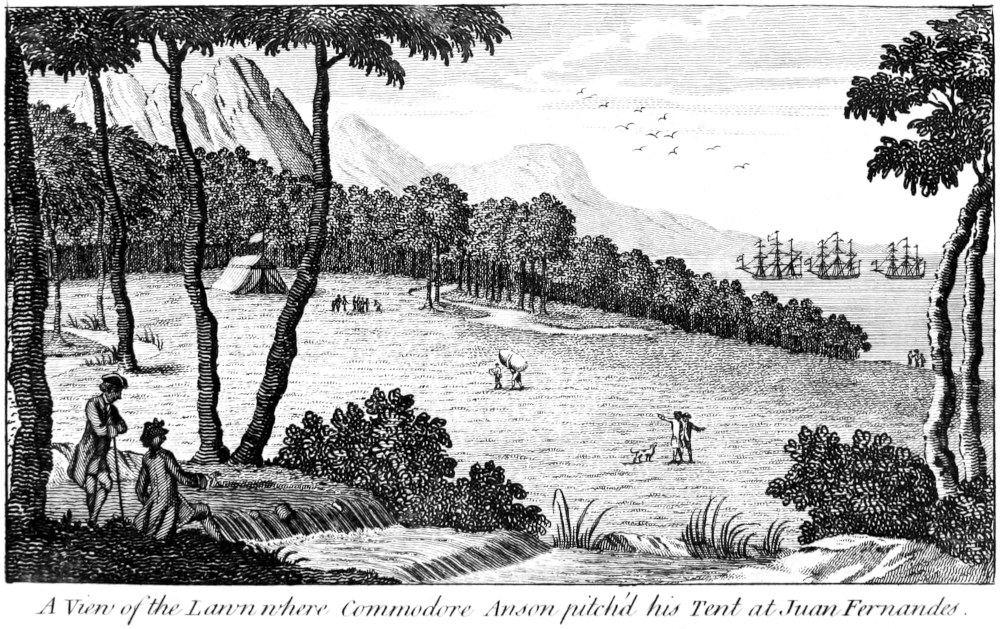
A View of the Lawn where Commodore Anson pitch’d his Tent at Juan Fernandes.
It is astonishing, that, among all the voyagers who have visited this fortunate island before us, and who have obliged the world with descriptions of it, none of them have mentioned a charming little bird that, with its wild, various, and irregular notes, enchants the ear, and makes the woods resound with its melody. This untutored choirister is somewhat less in size than the goldfinch, its plumage beautifully intermixed with red and other vivid colours, and the golden crown upon its head so bright and glowing, when seen in the full light of the sun, that it surpasses all description. These little birds are far from being uncommon or unfamiliar; for they perched upon the branches of the myrtle-trees so near us, and sung so chearfully, as if they had been conscious we were strangers, and came to give us welcome.
There is, besides the above, another little bird, unnoticed by any former writer, and which seems likewise peculiar to the island, and consequently without a name; it is still less than the former in size, but not inferior in beauty, though not so musical; the back, wings, and head, are of a lively green, intermixed with fine shining golden spots, and the belly a snow white ground, with ebony coloured spots, so elegantly varied as no art can imitate. To the catalogue of birds mentioned by former writers as inhabitants of this island, should also be added blackbirds and thrushes very like those in England; and owls, but of a diminutive size.
Of four-footed animals we saw none but dogs, cats, rats, and goats; and of the latter but few, as the dogs of various kinds, greyhounds, mastifs, pointers, spaniels, and mungrels, have thinned them in the plains, and driven them to the inaccessible mountains; yet some were shot by the hunters, and were preferred by them to the best venison. Among those presented to the Commodore were two or three venerable through age, that had been marked more than thirty years before by Selkirk, who trained them for his sport, slit their ears, and turned them loose to graze the mountains.
I remember we had once an opportunity of observing a remarkable dispute betwixt a herd of those animals and a number of dogs; for going in our boat into the eastern bay we perceived some dogs run very eagerly upon the foot, and being willing to discover what game they were after, we lay upon our oars some time to view them, and at last saw them take a hill, where, looking a little farther, we observed upon the ridge of it an herd of goats, which seemed drawn up for their reception. There was a very narrow path skirted on each side by precipices, in which the leader of the herd posted himself fronting the enemy, the rest of the goats being ranged behind him where the ground was more open; as this spot was inaccessible by any other path, excepting where this champion had placed himself, the dogs, though they ran up hill with great alacrity, yet when they came within about twenty yards, found they durst not encounter this formidable Goliah, for he would infallibly have driven the first that approached him down the precipice; they therefore quietly laid themselves down, panting, and did not offer to stir while we remained in sight.
These dogs have multiplied prodigiously, and have destroyed most of the cats as well as goats: the rats, however, keep possession, and were very troublesome guests in the night, when they generally paid us their visits. It is not easy to determine in what manner such a multitude of dogs subsist, as they are much more numerous than all the other four-footed creatures upon the island. Our people, indeed, were inclined to think, that they lived in a great measure upon the young sea-lions and seals, and supported their opinion by the report of the sailors, some of whom killed the dogs for food, who said they tasted fishy: and, truly, there is hardly any other way of accounting for the subsistence of these animals; for, as has been said, they have already destroyed all the goats in the accessible parts of the country; so that there now remain only a few among the crags and precipices, where the dogs cannot follow them. These are divided into separate herds of 20 or 30 each, which inhabit distinct fastnesses, and never mingle with each other; by this means we found it extremely difficult to kill them, and yet we were so desirous of their flesh, that we discovered, I believe, all their herds, and it was thought, by comparing their numbers, that they scarcely exceeded 200 upon the whole island. The dogs had destroyed the pardellas, too, of which former writers have given a large account, so that there was not one of them to be seen; we found indeed their boroughs in the earth, which leaves no room to doubt of their being found in plenty in Selkirk’s time, as well as cats, of which there is now scarce one alive.
Flesh meat being thus extremely scarce, our people, being tired of fish, though excellent in their kind, at length condescended to eat seals, which, by degrees, they came to relish, and called them lamb. Of these, it being their brooding time, the numbers were incredible;—and likewise of the sea-lion,—these animals have frequently furious battles among themselves, principally about their females; and we were one day surprized by the sight of two animals, which, at first, seemed different from all we had ever observed; but, on a nearer approach, they proved to be two sea-lions that had been goring one another with their tushes, and were covered with blood, with which they plentifully abound. This led us to watch them more closely, and one was observed larger than the rest, and from his driving off other males, and keeping a great number of females to himself, he was by the seamen humorously stiled the Bashaw. To this pre-eminence, however, he had not arrived without many bloody contests; for, on our people’s attacking him in the midst of his seraglio of females, he made a desperate defence, and, when overpowered, the signals of his bravery appeared in numerous scars on every part of his body.
We had now been ten days on this island, when some of our people from an eminence discerned a ship to leeward with her courses even with the horizon, without any other sail abroad than her main-topsail; from which circumstance, it was immediately concluded, that it was one of our own squadron; but the weather being hazy, no definitive conjecture could be formed concerning her. She again disappeared for some days, and we were all thrown into the deepest concern, fearing the weakness of her condition had disabled her from working to windward, and that all her people had perished.
We continued our employ till the 26th, when we again saw the same ship; and, on her nearer approach, could distinguish her to be the Gloucester; and, making no doubt of her being in distress, the Commodore sent our boat on board her with water and refreshments. We found her in a miserable condition, not many above 100 people alive, and almost all those helpless with the scurvy; their water so very short, that they were obliged to allow but one pint a day to a man; and the continual flaws off the land, together with their being disabled in their sails and yards, hindered them from getting into the bay. The next day we sent them a fresh supply of fish, greens, water, and men to help to work the ship; soon after which the flaws drove them off again, and the ship appeared no more till the 30th, when at two in the afternoon she fired a gun, and made a signal of distress. She continued in this manner off and on, sometimes in sight, and sometimes not, till July 23, during which time, though we often relieved the people on board with water and other necessaries, yet their sufferings were insupportable, and their whole complement were reduced to about 96 living persons, all of whom must have perished in a few days more, had not the wind proved favourable to bring them into the bay; but providentially a fresh gale sprung up from the sea, and brought them to an anchor. We immediately sent men on board to assist in mooring the ship, and continued our constant assistance afterwards, during our stay at this place.
The 5th of August, the Commodore sent the Trial sloop to search the island of Little Juan Fernandez, lest any of the squadron should have mistaken that island for the place of rendezvous, and might remain there in expectation of meeting the rest of the fleet.
On the 16th, the Anne pink, which was separated from us with the rest of the squadron the 23d of April, appeared in sight. Her arrival gave us new spirits, she being laden principally with provisions, and we immediately were ordered full allowance of bread. This ship had been about two months in a safe harbour, on the main land, near the same parallel with del Soccoro, where she had been directed by Providence, and where she lay in security, enjoyed plenty, and her people, 16 in number, being once freed from their fears of shipwreck, very soon recovered their wonted vigour, having experienced none of those hardships that were endured by the rest of the fleet. They told us they had seen some Indians, and one time took one of their canoes with a man, a woman, some children, a dog, a cat, &c. and some implements for fishery; but in a day or two the whole family, the dog excepted, made their escape from them in the ship’s small boat, and left them their canoe in her stead. Those Indians, they say, understood a few Spanish words, and probably might have some little correspondence with the southern Spaniards of Chili, or their nearer bordering Indians; or, perhaps, some of the Fathers for propagating the faith may now and then have been among them. The principal refreshments they met with in this port, were wild celery, nettletops, and sorrel; cockles and muscles of an extraordinary size; good store of geese, sheep, and penguins. They judged it to lie in lat. 45 deg. 30 min. S. and it may be known by an island which faces it, and which the inhabitants call Inchin, and by a river in which they found excellent fish.
This vessel, the Anne pink, was the last that joined us at Juan Fernandez. The remaining ships of the squadron were the Severn, the Pearl, and the Wager store-ship. The Severn and Pearl, as has been already observed, parted company off Cape Noir, and, as we afterwards learned, put back to the Brazils; so that of all the ships that came into the South Seas, the Wager was the only ship that was missing. Captain Cheap, who commanded her, knowing the importance of the charge he had in trust, without which no enterprize on shore could be undertaken, was extremely solicitous to reach Baldivia as the last place of rendezvous, and the first to be attacked, before the rest of the squadron should have finished their cruise, that no blame might rest upon him, if the attack of that city should be judged improper to be carried into execution. But, whilst this brave officer was exerting himself in endeavouring to keep clear of the land in making the island of del Soccoro, he had the misfortune to dislocate his shoulder, and thereby to disable himself from prosecuting with vigour the purpose he had in view. The ship being little better than a wreck, the crew in a miserable desponding condition, the officers quite exhausted, the weather cold and stormy, and the wind and currents bearing in-shore, all these unlucky circumstances concurring, so entangled the ship with the land, that all the efforts of the feeble crew could not prevent her from running upon a sunken rock, where she grounded between two small islands, not a musquet-shot from the shore. In this situation she continued entire till every one on board might have reached the land in safety, and might have stored themselves with provisions, and every necessary for their present, subsistence and future escape: but the moment the ship struck, all subordination ceased; one part of the crew got possession of the liquors, intoxicated themselves in a beastly manner, and grew frantic in their cups; another part began to furnish themselves with arms, and to make themselves masters of the money and things of most value on board; while the Captain, and some of the principal officers, endeavoured in vain to maintain their authority, and to preserve a proper discipline among them, in order to effect the deliverance of as many as it was possible from the common danger in which all of them were involved; but the mutinous disposition that prevailed rendered every effort for their preservation ineffectual. Those who remained in possession of the ship and her stores, pointed the cannon, and fired at those who had gained the land; those at land grew riotous for want of provisions; nothing but anarchy and confusion prevailed; and, what added to the catastrophe, a midshipman named Cozens, who had busied himself in opposition to all good government, was, by the Captain, shot dead upon the spot. This put an end at once to all manner of subserviency; and after this every one thought himself at liberty to pursue what scheme he thought best for his own preservation.
Of about 130 persons who reached the shore, 30 died on the place; about 80 others, having converted the long-boat into a schooner, sailed to the southward, attended by the cutter. These, being distressed for want of provisions in re-doubling Cape Horn, and having lost their cutter in a storm, suffered unprecedented hardships in their return to the coast of Brazil, where only 30 of them arrived to give an account of the miserable fate of their companions, several of whom died of hunger; others desired to be set on shore; and some, beginning to be mutinous, they landed and deserted. Of the 19 who were left behind in Wager-Island with the Captain, 16 embarked on board the barge and the yawl, and attempted to escape to the northward; of these one was drowned in the yawl, and four were left on a desart part of the coast, where it is probable they all perished; the remaining 11, after a fruitless attempt to weather a point of land, called by the Spaniards Cape Tresmentes, were forced to return to Wager Island, from whence they first set out, where meeting with a Chiloen Indian, who could speak a little Spanish, they agreed with him to pilot them to Chiloe; but, after coasting along for four days, the Captain and his officers being on shore, five in number, the other six persuaded the Indian to put to sea without them, by which the rest were reduced to the sad necessity of travelling near 600 miles, sometimes by land, and sometimes by water, till at length, after a variety of misfortunes and hardships not to be parallelled in romance, four of them, namely, Captain Cheap, the Hon. Mr. Byron, who lately went round the world, Mr. Hamilton, and Mr. Campbell, arrived at Chiloe, where they were received by the Spaniards with great humanity. After some stay at Chiloe, the Captain and his three officers were sent to Valparaiso, and thence to St. Jago, the capital of Chili, where they continued above a year; but on advice of a cartel, the Captain, Mr. Byron, and Mr. Hamilton, were permitted to return to Europe; and Mr. Campbell, who in the mean time had changed his religion, chose to embark for Spain; but not meeting there with the encouragement he expected, he soon after returned to England, where he published an account of his adventures, but mentioned not a word of changing his religion, neither does he assign his reason for leaving Spain.
It is very remarkable, that the place where the Wager struck upon the rock, was so near the harbour where the Anne pink found shelter during the winter, that the Wager’s people were within hearing of the pink’s evening and morning gun, yet never had the thought to follow the sound, or to look out for any straggler from their own squadron.
On the 22d, the Trial arrived from searching the island of Little Fernandez, and reported that it lies about 20 leagues due west from this where we lay; that it is about three leagues in compass, being very mountainous, with some woods and good runs of water, with multitudes of goats, fish, sea-lions, and seals, as with us; but no ships were to be seen, nor any marks of any having been there.
While we continued at Juan Fernandez, besides our necessary employments, we likewise began, and pretty far advanced, a wharf for the better landing and embarking such necessaries as we had occasion for. We kept two ovens employed in baking bread for the ships companies, two smith’s forges for repairing old and fitting new iron-work, and made abundance of charcoal for future use. The Commodore likewise ordered the carpenters to take a careful survey of the Anne pink, the master of which set forth, that she was in so rotten a condition, as not to be fit to proceed nor return without very considerable repairs; which representation upon a survey being found to be true, the Commodore purchased her materials at a fair valuation, and ordered her to be broke up, and her crew to be put on board the Gloucester, that ship not having hands enough left to navigate her, much less to fight her, in case of an attack from the enemy.
This island lies in latitude 33 deg. 40 min. S. and longitude 87 deg. 37 min. W. from London; distance from the main continent 105 leagues; compass, by the best accounts of those who had been round it, 12 or 13 leagues. There are two small and very commodious bays within the points, which form the large one where we lay, one to the eastward, the other to the westward of us, and no doubt several others in other parts of the island; variation, by an observation July 2, in the morning, 8 deg. 4. min. half E. ’Twas reported, that the S. W. end of the island is much more flat and level than that where we resided, and the goats more numerous, but wood scarcer.
On Tuesday, Sept. the 8th, at noon, we saw a sail at sea bearing N. E. by E. and, perceiving by our glasses that she could be none of our squadron, nor an English-built ship, we fired a gun as a signal for getting all our people on board; and, having taken several men out of the Trial, bent our sails, set up our rigging, and slipt our small bower cable, at six in the evening we weighed in pursuit of her. In the morning of the next day we got down our stumps, which are generally set up in bad weather instead of top-gallant masts, and in their place got up our top-gallant masts and yards, rigged them, and bent their sails. At eleven the same morning we mustered and quartered the ship’s company. At noon the island of Juan Fernandez bore W. half S. distance eight leagues; the two next days we saw nothing of the chace, nor any thing remarkable.
Saturday, Sept. 12, at five in the morning we saw a sail to windward, which bore down towards us, and at about two leagues distance she hawled up the lee clue-garnet of her foresail, shewed her Spanish colours, and fired a gun, which we supposed to be a signal concerted between her and others which came out in company with her; but we not answering nor regarding it, she hauled close on a wind and stood from us, endeavouring to escape; upon which we gave chace, and it proving sometimes hazy and foggy, we were in danger of losing sight of her. About nine in the morning we tacked, and at noon coming within gun shot, we fired five shot at her rigging to bring her to; but she keeping on her course, we fired four more, on which she struck her colours, and surrendered without making any opposition. This ship happened not to be the same we went out after. She proved a rich merchant-ship, having on board 18,000l. sterling in dollars and plate, with some jewels, and abundance of gold and silver twist; but the bulk of her cargo consisted in sugars and bale goods, most of the latter European, but some the produce of the country. She was called the Nuestra Senora del Monte Carmelo. She was of about 500 tons, was commanded by Don Manuel Zamorra, and had on board 13 passengers, most of them persons of fortune, amongst whom was the son of the Governor of the city of St. Jago, the capital of Chili. She came from Callao, a port of Lima, the capital of the empire of Peru, bound for Valparaiso in Chili, where those ships annually trade, exchanging silver in return for gold and corn, the latter being very scarce in Peru. Some of the prisoners informed us, that, if we had taken her in her return from Chili to Peru, we should have met with as much gold in her as we had now found silver. She had in the whole a-board her 67 persons, many of them Indians and black slaves, who were afterwards very useful to us in assisting towards the ship’s duty. She had been 27 days from Callao, and wanted not above two days sail to compleat her voyage when we took her.
We found in this ship, on search among the letters from some merchants in Lima to their friends in Chili, an account of the fate of the Spanish squadron which had been sent after us, viz. that, in attempting to pass the Cape, they had been forced to put back, after encountering the most terrible storms and most pressing famine, being reduced to two ounces of bread and half a pint of water each man a day; that, besides being grievously attacked by the scurvy, which had made greater havock among them than among us, their ships were almost entirely disabled, their masts, sails, yards, rigging and hulls in a manner shattered and torn to pieces; that Admiral Pisarro, and one more of his squadron, after having suffered the greatest extremities, had got, with the utmost difficulty, to Buenos Ayres, on the River Plate; that another of the squadron, a ship of 70 guns, had been entirely lost near Rio Grande, and that two more had never been heard of; that on their return they had seen two large ships pass by very near them, which they supposed to be two ships of our squadron, but the weather proving stormy, and the sea running mountains high, they could not interfere with or attack each other. Those ships of ours we believed to be the Severn and the Pearl, and hoped they were safely arrived at some port of the Brazils. Those letters came over land from Buenos Ayres to Lima, and with them came others containing Admiral Pisarro’s advice and instructions to the Viceroy of Peru concerning us; wherein he told him, that, though he himself had been forced back in such a miserable condition, not having above 80 or 100 of his men living, and his ships in so ill a state, that, till sufficient reinforcements could come to him from Old Spain, he could not possibly come into those seas, yet as the English were a stubborn and resolute people, and daring enough to persist obstinately in the most desperate undertakings, he did believe some of us might possibly get round; but as he experimentally knew what of necessity we must have suffered in that dreadful passage, he made no doubt but we should be in a very weak and defenceless condition; he therefore advised the Viceroy to fit out all the strength of shipping he could, and send them to cruise at the island of Juan Fernandez, where we must of necessity touch to refresh our people, and to repair our ships; and farther advised, that, in case of meeting us, they should not stand to fight or cannonade at a distance, in which possibly we might have the advantage, or make our escape, but should board us at once sword in hand; which must, if well executed, in our weak condition, infallibly prove the means of taking us.
This was a well-laid scheme, and in pursuance of it the Viceroy equipt three ships at Callao, one of 50, one of 30, and one of 20 guns, all double manned with the choicest men they could possibly procure, and sent them to wait for us accordingly. Those ships arrived at Juan Fernandez some time, I think, in May, and continued till about June the 6th, when, imagining that we must be either put back or lost, they quitted their station, and sailed for the port of Conception in Chili, and by this means we luckily missed them: had it happened otherwise, as we arrived there with only our single ship, in such a defenceless condition, and had they put their orders in execution with any tolerable degree of resolution, we must in all human probability have fallen into their hands.
Our prisoners informed us further, that those ships, during their cruise, had met with a storm, in which they had received so much damage, that it must be at least two months before they could again be fit to go to sea. The whole of this intelligence was as favourable as we could have wished; and now we were at no loss to account for the fresh marks we found at Juan Fernandez, of that island’s having been lately visited by some white people.
Sunday the 13th, having got on board most of the prisoners of note, and all the silver, we made sail for Juan Fernandez; and the weather proving very moderate, at six in the evening that island bore N. W. by N. at the distance of five leagues. At three the next morning we fired three guns, as a signal to the ships in the bay. At four we anchored, got in our small bower cable, which we had slipped at leaving the place, and moored our ship.
The 15th we employed in watering, and setting up our rigging, in order to pursue our voyage. And this day, the Commodore being informed that several merchant-ships were now pursuing their trade without fear of any surprize, the Trial was ordered out on a cruise, and proceeded immediately.
The 16th we got up a new top-gallant-mast, and wanting some cordage we were supplied with it from the Gloucester. This and the following days, until the 19th, we spent in getting every thing ready for sea with the utmost expedition.
The 19th we sent 28 of our prisoners on board the Gloucester, she being weakly manned, and those prisoners being good sailors. We likewise supplied the prize with two months provisions of all sorts, at full allowance, for 20 men; put all the guns belonging to the Anne pink on board of her; and, having left orders with Captain Mitchell, of the Gloucester, to burn the pink, together with her useless stores, and appointed him his station off the town of Payta, which is the place where the ships between Lima and Panama generally touch to deliver part of their cargoes to be dispersed through the inland parts of Peru, with orders to sail to that station as soon as possible, we weighed, and took leave of our winter residence, in company with the prize, which the Commodore had fitted up to cruise against the enemy.
The 21st, at four in the evening, we had the last sight of this island, it then bearing from us W. by N. at the distance of 17 leagues. The remaining days, until the 24th, we had variable and uncertain weather, in which we split our main-top-sail and fore-sail, and received some other slight damage.
The 24th, at five in the evening, being somewhat hazy, we saw two sail to windward, on which we cleared ship, in order to be ready to engage, the largest of the two ships bearing down upon us. At seven she came so near, that we haled her in Spanish, and she answered in English, and told us, that she was a prize taken by the Trial, and that her consort was the Trial itself, which was very much disabled. At 11 the next morning, there being a hard gale and high sea, the Trial fired two guns as a signal of distress, and bore away before the wind, and we after her. The same day half an hour past noon we spoke with the Trial, and found she had sprung her main-mast, and that her main-top-mast had come by the board: and as we were all of us standing to the eastward next morning, with a fresh gale at south, she had the additional misfortune to spring her fore-mast; so that now she had not a mast left. This was a great obstruction; for now we had intelligence by the Trial’s prize, that there were many ships at sea richly laden, and that they had no apprehensions of being attacked by us, having received intelligence that our squadron was either put back or destroyed. In the course, therefore, of the 48 hours we were detained in waiting upon the Trial, I am persuaded we missed the taking many valuable prizes. The result was, that a council being called, and all the officers convened together on board our ship, it was there concluded, that in her present condition the Trial could be of no farther service; and the Commodore, being resolved to separate the ships, in order to cruise upon the coast to the greatest advantage, gave orders to Captain Charles Saunders, the Commander, to burn the Trial, and in her room commissioned the Trial’s prize for his Majesty’s service, with the same Commander, officers, and people. This ship, the Trial’s prize, was called by the Spaniards the Nuestra Senora de Arinzazie; but, being now commissioned for his Majesty’s service, she was henceforth called the Trial’s Prize. She was the largest ship we took in those seas, being between five and six hundred tons, and loaded with bale goods, sugar, and other commodities, to a considerable value, and about 5000l. in specie and wrought silver.