THE VOYAGES OF Captain COOKE. (continued 2)
Reading edition
These large ships are built at Manilla, of excellent timber that will not splinter; and their sides are thicker and stronger than those of ships of the same burden constructed in Europe. Had we been together at first, and boarded her, we might, perhaps, have taken her; but, after her netting and close-quarters were fixed, she valued us but little. We might, indeed, have burnt her, at the expence of one of our ships; but that was objected to, not only from a principle of humanity, but because we had goods of great value on board all our ships.
The enemy had heard at Manilla, that there were two ships fitted out at Bristol to cruise in the South Seas, and that Captain Dampier was to be their pilot; they had, therefore, provided for their own defence accordingly. However, to do them justice, they fought gallantly, and, had the two ships been together, it is more than probable that neither of them had been taken; but as it happened, had not our unreasonable squabbles prevented our sailing out together, the chance would have rather been in our favour: yet this miscarriage, instead of leading to a reconciliation, served only as a foundation for new disputes.
On the 1st of Jan. 1710, we returned again into port, and determined to hasten home with all possible dispatch. The first thing of consequence was to discharge our prisoners, and to provide for their voyage to Accapulco; and this being dispatched, we applied to the settling of our own affairs. We spent our time till the 7th in repairing the damage our ships had received from the enemy, in taking in wood and water for our voyage to the East-Indies, and in taking an account of the goods and stores on board the prize: and it was no small satisfaction to find as much bread on board the prize as with our own stock would serve us, at short allowance, during our long run to Guam.
About this time a warm contest arose about appointing a Commander of the Manilla ship, which was looked upon as a trust of no small consequence. Captain Dover, being an owner, desired he might command in chief on board her. Captain Rogers and several officers of the council contended, that, as Captain Dover was wholly unacquainted with the navigating part of the business, the command should be given to Captain Fry, or myself; but, as I had already the command of the Marquis, I declined any farther charge, and voted for Captain Dover; at the same time recommending Captain Fry and Captain Stretton to act under him; against which Captain Rogers and his officers entered their protest. However, on the 9th of January, at a full council, it was carried against them, and voted by a great majority, that the Captains Fry and Stretton should both act in equal post in the sole navigating the Batchelor Frigate (for that was the name now given to the Manilla prize), and in fighting her, if occasion should require, under Captain Dover, who at the same time was restrained from interrupting them in their business, but charged to be careful of what was in the ship, and to see that nothing was acted on board contrary to the interest of the owners and captors. The matter being thus qualified, the nominal command given to Captain Dover, and the executive power vested in the naval officers, Captain Rogers withdrew his protest, and the council proceeded to the choice of the inferior officers, appointing Alexander Selkirk master, and Joseph Smith chief mate: they also agreed to furnish her complement of men, by selecting 30 from the Duke, 25 from the Dutchess, and 13 from the Marquis, which, with 36 Lascars taken on board her, formed a tolerable crew of more than 100 mariners. This business being thus fully settled, and the island of Guam pitched upon as the place of rendezvous in case of separation, on the 10th of January we weighed anchor, and ran out at midnight. At 12 the next day Cape St. Lucas bore north, distant about five leagues. We steered away for some days S. W. by S. till we got into the trade-winds, and then our course was uniform.
All the natives of California that we saw during our stay at Puerto Seguro did not amount to 300. They had large limbs, were very straight and tall, and of a much darker complexion than any other people that we had met with in the South Seas. Their hair was long, lank, and black, and hung down upon their hips. The men were all stark-naked; but the women had a covering about their waists made of the silk-grass already mentioned, fringed and knotted. All of them that we saw were old, and miserably wrinkled; perhaps they concealed from us their maidens, for reasons that need not be explained. The language of the natives was guttural, very harsh, and unpleasant. They seemed to covet nothing that we had, except axes, saws, and knives; and even these they did not attempt to steal. Their huts were low, and wholly made up of branches of trees; and seemed rather a kind of temporary coverings than settled dwellings. While we lay in port they subsisted chiefly on fish; and though they neither made use of nets or lines, yet they had a method of striking them with lances that was very dexterous, and at which they were very expert. They were besides most excellent divers, and instead of canoes made use of rafts. They were very civil and inoffensive; and were observed to pay great respect to one among them, whose head was adorned with feathers very artificially combined, and who probably was their wizard, or cunning-man. Some of them had strings of pearls, and party-coloured shells so prettily intermixed, that, though we had glass-beads, and other showy trinkets, yet they paid no sort of attention to any of them; but prized their own ornaments above every thing but cutting instruments. Their arms are bows and arrows, in the use of which their boys were so expert as to shoot birds flying by way of amusement. They grew very familiar with us while we staid, and came frequently to gaze at the men as they cut wood and filled water, but never offered to assist in any thing like labour. They get fire like other Indians, by rubbing two sticks together, which kindle almost instantaneously.
From this harbour we departed but very slenderly provided, having but little live-stock, and hardly any liquors but what were found in the prize. As soon as we were out of sight of land, we were all put to short allowance, officers and men: to the latter four-and-twenty ounces of flour, four pounds of meat, and two gallons of water, to a mess of five men in 24 hours. But in a few days, the Batchelor made a signal to give us some bread, they having found a large quantity concealed, with some sweet-meats. We had 500 weight for our share, the Duke 1000 weight, and the Dutchess as much; in return for which we sent back to the prize some casks of flour, and a barrel of English beef; and the like present was returned from the other ships. From this time till the 10th of March nothing remarkable happened.
On that day we made the island Saraua, one of the Ladrones, and the same evening came in sight of Guam, distant about three leagues. Next day we came to anchor in the port of Umatta, at about a mile distance from the houses, in lat. 13 deg. 30 min. N. by estimation; long. from Cape St. Lucas, 100 deg. 19 min. W. We went in with French and Spanish colours, that they might not suspect us to be enemies. Several of their boats came about our ships; but none would venture on board, till being off the anchoring place, one was sent by the Spanish Governor, desiring to know who we were, and what we wanted. We presently dispatched our interpreter with a letter, purporting, that we were subjects of Great Britain, and driven by necessity to stop at those islands to purchase provisions and other necessaries; that, if our wants were supplied with civility, we should pay generously; but, on the contrary, if our request was denied, we should proceed to act according to the laws of war. To this letter we received a very obliging answer from the Spanish Governor, Don Juan Antonio Pimental, and were furnished with hogs, oxen, rice, maize, poultry, and other necessaries in a more plentiful manner, and at a cheaper rate, than we could expect. We continued at Guam till the 21st of March, during which time reciprocal civilities daily passed between the officers on board and the gentlemen of the island; and we parted perfectly satisfied with each other’s behaviour. We found the variation in these parts only half a point to the eastward, though in our run across the Great South Sea, we had it 12 degrees: the reason I take to be, the unevenness of the globe, and its unequal mixture of much matter differing in itself as to the magnetical quality; as having large and stoney mountains, spacious vallies, deep seas, long-continued continents, with mighty scattered rocks of load-stone, iron mines, and other magnetical substances.
The natives of Guam are of a dark complexion, but not so black as the Indians of California. They are in general the largest and best limbed men I ever saw, and some of them hairy, and very strong. The women are straight and tall, and in the neighbourhood of the Spaniards go decently cloathed; but in the remote parts of the island they go quite naked. They are said to be man-eaters, and to have no settled way of worship, but every one pays a kind of adoration to they know not what. The island is plentifully supplied with cattle, and might be made the garden of the world, if the Spaniards were not as idle as the Indians; but as nature spontaneously produces sufficient for sustenance, they avail themselves but little of cultivation. Of all the works of art for which the Indians are remarkable, the paroas, or boats, of this island are certainly the most wonderful, as they exceed in swift sailing every other vessel yet seen throughout the world. We were assured upon the best authority, that they will sail 20 leagues an hour; and the Captain of the Spanish guard said, he would lose his head if they did not perform it.
On Tuesday, March 21, 1710, we were under sail, and steered away W. by S. with moderate gales from the N. N. E. which continued so for some weeks; but about the middle of April the blowing weather came on, and continued till the 27th of that month, during which time most of our main-shrouds, several of our stays, most of our running-ropes, and the mizzen-gears, gave way, so that the yard came by the board, and by its fall wounded the first Lieutenant, so that we feared he never would have recovered. Most of our sails too were split; but, being supplied with new shrouds by Captain Rogers, and with other ropes by Captain Courtney, I bent new sails; but found the ship very leaky. The Duke and Dutchess too suffered much by the tempestuous weather, and the Batchelor split her sails; but being otherwise stoutly built and rigged, nothing but running against a rock could hurt her. I had no conception of meeting with such boisterous weather so near the Line, which proved as bad as that we encountered in surrounding Cape Horn, with this difference only, that the one was intensely cold, and the other intolerably hot. And being now crossed by variable winds, sometimes lying by, sometimes scudding before the wind, and unable to pursue our direct course, our provisions began to fail, and on board of us rats rose to a very high price. The ships were besides leaky, and our men began to sicken with excessive labour and hard living. A general council was therefore called to consider what was best to be done in our present condition, when it was agreed to make the island of Talao, that of Ternate, or, if neither of them could be reached, then to put into some part of Mindanao.
On Tuesday, May the 2d, we observed a ring about the sun, and were apprehensive of more bad weather. In the night we passed by Talao without seeing it; and Captain Dampier, who had been twice in these seas before, gave out, that, if we could not reach Ternate, it would be impossible for us to get refreshment on the coast of New Guinea, which proved true; yet it was with the greatest difficulty the men could be prevailed upon to submit to short allowance.
Monday the 8th, having had tempestuous weather, we perceived that a strong current had set in to the eastward; and to our astonishment we found the land in sight to be Cape Noba, a promontory at the east end of Gilolo, bearing S. S. E. distant 15 leagues. Perceiving now that we could not get to the island of Ternate, nor to that of Mindanao, we resolved to make the best of our way through the straits of Gilolo: but, notwithstanding our utmost efforts, we continued sailing among a cluster of islands, most of them uninhabited, but all capable of producing spices, during the whole month of May, without being able to avail ourselves of any of their refreshments. On the 20th of May we came in sight of the island of Ceram, as we then thought, but afterwards found it to be the island of Bouro.
On the 25th, we came in sight of a low island right-a-head of us, and about noon observed an opening, which, when we came near, we found to be a passage between two little islands that almost joined. They were very full of green trees, and by the sea-side we beheld many groves of cocoa-nut, plantain, and other fruit-trees, that exhibited a very pleasant appearance.
In a capacious bay we likewise took notice of a little town, and saw several inhabitants passing and re-passing along the shore. We sent in our boats for provisions and pilots, and the Duke and myself turned up towards the village, but on sounding found no ground. The natives informed us, there was a bank opposite a certain land-mark, on which we might anchor. Abundance of people came off with Indian wheat, cocoa-nuts, yams, potatoes, papas, poultry, and several beautiful birds, which they exchanged for knives, scissars, and other toys, being very civil, and to all appearance honest. They are Mahometans, of a middle stature, and tawney; but the women are fairer than the men, having very long, lank, black hair; their mouths, lips, and noses remarkably small. The women were decently covered; but the men in general were naked. These islands were named Camhava and Wanshut; but, not answering our purpose, we agreed to steer for Bonton, where we arrived on Monday the 29th of May; and, the same day, Captain Dampier, Mr. Connely, and Mr. Vanbrugh, went with a present to the King of Bonton, at the same time requesting him to supply us with provisions, and to send us a pilot to carry us to Batavia.
On the 30th, a paroa came from the King with one of his nobles on board, and a pilot to carry us into harbour. He put on an air of importance, and asked, How we dared to come to an anchor there, without leave from the Great King of Bonton? However, he brought each Commander a piece of his country-cloth, a bottle of arrack, some rice in baskets, as a present from the King; as also a letter from the officers we had sent on shore, giving an account, that they had been well received, and that the town where the King resides was large, walled, fortified, and defended after the European manner with a number of heavy cannon. Another present was returned, and five guns fired by every ship at the messenger’s going off; at which he seemed very well pleased. Our people trafficked with the natives for poultry, maize, pompions, papas, lemons, Guinea corn, &c. and gave them in exchange knives, scissars, old cloaths, and old nails. The people were civil; but our officers making a longer stay than they intended, we began to suspect that the moors had detained them; for they are very treacherous. However, we heard from them every day; and at length the Dutchess’s pinnace came down with Lieutenant Connely, who told us, they had purchased four last of rice, which cost 600 dollars; and that Mr. Vanbrugh was detained for the payment of the money. The next morning it came, and was equally distributed among the four ships, some great men coming to deliver it, and receive the money.—The town of Bonton is very populous, and by it runs a fine river, but is barred so that ships of burden cannot approach it. About 50 islands are tributary to this King, who gives audience in a chair of state covered with scarlet-cloth, and is always attended by a guard of nine men, armed, after the European manner, with muskets and scymitars. He has, besides, four or five slaves, who sit at his feet, and are ready whenever he commands to do the most servile offices. The petty Princes and great men sit on his left hand, and the strangers stand before him.
Wednesday, June the 7th, all the provisions and necessaries which this town could supply being brought on board, and the officers who went to wait upon the King, returned, the signal was given to weigh, and at four in the afternoon we set sail without a pilot, there being none to be had on this island. Captain Dampier pretended to be acquainted with the passage, and mentions the same in his book, but now he remembered nothing of it but the story.
On Friday the 9th, we came in sight of Solayo, lying close to the island of Celebes, and inhabited by Malayans, who are tributaries to the Dutch. Between the south-end of Celebes and the island of Solayo, are three small low islands, and the best passage is between that which lies next to Solayo, and a little one lying to the northward of it. It is very dangerous going to the southward of Solayo, the Dutch never daring to attempt it.
On the 10th we made prize of a country paroa, and brought the master on board the Dutchess. He was a Malayan belonging to Macassar, bound thither, came last from Bonton, and undertook to pilot us to Batavia for a good reward, provided we would promise to keep the matter a secret from the Dutch, to both which conditions we very readily agreed; and the man performed what he undertook with great skill and fidelity. We passed through the straits of Salango, having always from five to seven fathom water in our passage; then steering to the westward, our pilot’s boat attended us till we were through the last strait, and then bore away towards Macassar.
On Tuesday the 20th of June, 1720, according to our reckoning, we came to an anchor in Batavia road; but with the Dutch it was Wednesday, June 21; for we had lost 18 hours in going round to the westward, and they had gained six in sailing to the eastward, which made a whole day difference between our account and theirs. The reason is, that a ship sailing to the westward, and so following the course of the sun, makes every day something longer than in any fixed station it would be. Thus in every 15 degrees she removes to the westward from the meridian from whence she first set out, she gains an hour; in 90 degrees, six hours; and in 360, which compose the whole circumference of the globe, she will find a whole day short in her reckoning, according to the account of the place she arrives at. The contrary happens to the ship that sails eastward; for, as she advances against the course of the sun, she loses so much of every day, which is thereby shortened, and becomes less than 24 hours, by consequence losing an hour in every 15 degrees, and consequently will be a day before the account of the place she arrives at. By this it appears, that the ship which sails round the world westward, loses a whole day, and that which performs the same voyage eastward gains a day. So we having made the greater part of the circumference, and the Dutch at Batavia the other part the contrary way, our loss and their gain made up the twenty-four hours; and thus we came to differ a day.
When we came to an anchor, the Dutchess fired thirteen guns to salute the Dutch flag; but it being night, the Commandant did not then answer; but in the morning sent his boat to make an apology, and then fired gun for gun with every ship. Soon after this friendly salute taken on both sides, the Commanders went on shore; and, after waiting upon the Shebander, were introduced to the Governor, who received us with civility, examined our commission, and enquired much concerning the success of our voyage; but, not being King’s ships, would not permit us to heave down in the States dock at Orerest, but gave us leave to careen at the island of Hern, which is at no great distance from the other, and allowed us some Malayan caulkers to assist in stopping our leaks.
As the Marquis was in the worst condition, she was ordered to be laid down first; but upon examination she was judged unfit to proceed upon the voyage; and therefore was unladen and put up to sale. We then hove down the Duke and Dutchess, and found their sheathing much worm eaten; but otherwise not much damaged: the Batchelor wanted no repairs but in her rigging. The weather was extremely hot during our stay, at this city; many of our men and officers fell sick; and I was among the number. The master of the Duke, the gunner of the Dutchess, and several of the common men, fell a sacrifice to this unfriendly climate. One Read, a young man belonging to the Dutchess, venturing to swim, had both his legs snapt off by a shark, which at the second bite, before we could get him on board, cut him in two in the middle, and put an end to his misery. During our stay, though we had the run of the markets, we found it very difficult to procure salt provisions to lay in a stock to serve us till we should arrive at the Cape of Good Hope, and therefore were obliged to purchase live cattle, and to kill and pickle them ourselves. All manner of traffic, except for provisions, was prohibited with the natives or inhabitants of the city, upon the severest penalties, to avoid every occasion of dispute with the East-India Companies of both nations: and, having settled all our affairs in a very amicable manner, new rigged our ships, and disposed of the men belonging to the Marquis among the other ships, we began on the 15th of September to prepare for sailing, when I was appointed second Captain in the Dutchess, and Mr. Ballot, master; Capt. Pope, first Lieutenant of the Duke, and Mr. Selkirk, master; Capt. Dampier, second Captain in the Batchelor, and Mr. Knolman, master.
On the 20th we repaired on board; but before we were ready to sail, it was the 14th of October; when, about six in the morning, we weighed anchor; but in the afternoon the sea-breeze took us, and we were forced to return.
On the 19th we made sail with a fresh breeze, and at two in the afternoon came to an anchor off Java-head, when two English gentlemen came off to us, to demand the release of a man who had concealed himself, unknown to the officers, on board the Batchelor, and who was given up without opposition. In the mean time, while the gentlemen were in conversation with the officers, a party from the ship went off with their boat to buy fowls, for which they gave in exchange knives, toys, and other trifles, which the natives value more than money.
On the 23d the gentlemen took their leave; and the party who went off to truck for fowls having reported that there were buffaloes in abundance to be had for shooting, another party were sent off to bring some on board; but they returned without success. They came in sight of whole herds, but so exceeding wild, that the moment they saw the appearance of a man, they all took the alarm, and fled to the woods with so much swiftness that it was impossible to come within musket-shot of them. One of the party, who had ventured to follow them into the woods, was surprized by a tyger, who was within less than a hundred yards of him before he thought proper to make his retreat; and was pursued by the creature so close, that, had he not reached the water, he must have been devoured. His companions fired more than twenty shot at the tyger before he went off, which he did at last, though sorely wounded.
We staid here till the 26th, when we made sail, and about noon Java-head bore E. by N. distant about seven leagues. From hence to the Cape of Good Hope we met with nothing remarkable; and, on the 30th of December, came to an anchor in Table-bay, in seven fathom water. We saluted the fort with nine guns; and they returned seven. As soon as the ships were moored, the Captains and principal officers went ashore to pay their compliments to the Governor, by whom they were honourably received. The place and people have been so often described already, that we shall not disgust the reader with useless repetitions.
During our stay here, we employed the time in victualling, watering, and refitting our ships, for the remaining part of our voyage home. The Duke, commanded by Captain Rogers, had been leaky ever since her departure from California; and, notwithstanding all that could be done both at Batavia and this place, it could not be stopped; but what was remarkable, in a few days after we left the Cape, it stopt of itself.
Here we had an opportunity of writing to our owners, by means of an East-India ship just ready to sail when we arrived. In the letter we acquainted them with our having made prize of a small Manilla ship, and of our having her in our possession; and also, that we intended to take the advantage of returning home in company with the Dutch East-India fleet, who were hourly expected, which would occasion us to tarry till the latter end of March, when it was imagined they would be ready to sail.
On February the 22d, the Dutch fleet arrived, being in all 12 sail. We saluted the Admiral at his coming with seven guns, as did likewise the fort. There were at this time in the harbour 17 Dutch ships, and six English. The town was crowded, and many of our men were ill. Mr. Vanbrugh, the owners chief agent, died, as did Mr. Appleby, mate of the Duke, and several others. We began to be impatient; and found it necessary to begin to furnish ourselves with provisions as early as possible, as every thing began to increase in price as the town began to fill. The Batavia fleet was soon followed by four ships from Ceylon. Six came from that island; but near Madagascar met with such a violent storm, that some were forced to cut away their main-masts, and throw over some of their lee-guns, having much water at the same time in their holds. The four came into the Cape much damaged, and believed the other two had foundered at sea. Several English Indiamen arrived also in the road; as also a Portuguese ship from Rio de Janeiro on the coast of Brazil, bound for Mezambique, to take in slaves.
At length, on April the 6th, all the homeward bound ships being ready to sail, we weighed in the morning, and sailed with a small breeze of wind at E. S. E. and by noon came to an anchor at Pengun Island, the east end of the island bearing south-westerly. At three we sailed again, being in all 25 sail of English and Dutch, all good ships, under the command of Admiral Peter de Vos. At six the Cape of Good Hope bore S. by. W. half W. distant about seven leagues; and thus, having taken our departure, we proceeded on our voyage April the 23d, which being St. George’s day, and the anniversary of her Majesty of Great Britain, the Duke and Dutchess saluted each other with drums, trumpets, and other formalities, in honour of the day; and in the evening the respective Captains gave an entertainment, of which all the officers on board partook.
August 3, 1711, we made the island of St. Helena, in lat. 16 deg. S. It lies 1000 miles at least from any land, and is not more than 10 leagues in length, and about eight in breadth, surrounded with rocks, and elevated above the sea by towering mountains, that look at a distance like lofty buildings rising to the clouds. These mountains are covered with wholesome herbs and plants; and the vallies are so fruitful, that they yield an increase of whatever is sown in them an hundred-fold. The Portuguese first discovered this little spot accidentally, as they were ranging along the coast of Africa, in order to find their way to the East-Indies. It was then uninhabited; and, according to their custom, they set some live goats and swine on shore, which multiplied to that degree, that ever since there have been enough to supply the ships that touch at that island with seasonable refreshment. The Dutch first inhabited, and afterwards abandoned it, and removed their settlement to the Cape of Good Hope. The English then took possession of it; when the Dutch, who did not think it worth keeping before, returned, fell upon the English, and drove them out. The Dutch in their turn were expelled by the English, who have now been long in possession, have erected a very strong fort for their security, and built a town near the little bay, where ships generally anchor in their way to and from the East Indies. It is of infinite use in relieving the sailors from that dreadful distemper the sea-scurvy; for, as it naturally produces lemons, oranges, and other fruits, and as greens and roots are planted in abundance, those who are languishing under the last stage of the scurvy are frequently recovered by the use of those refreshments without any other physic. It would be delightful living in this island, were it larger, or more frequented; but the confinement in so small a place in the middle of a vast ocean so remote from all communication with the rest of the world, renders the residence there so lonely, that it has rather the appearance of living in exile than in a land of freedom. And indeed, what makes it still more uncomfortable, our own ships find so much better entertainment at the Cape than can be expected in this little spot, that many of them store themselves there so plentifully, and recover their sick men so effectually, as not to be under the necessity of touching at St. Helena, whereby not only the residence of the inhabitants is rendered more dull, but their means of subsistence is very much restrained; for as they have nothing to depend upon but their traffic with the ships that call to refresh, every one that passes by without touching is a diminution of their profits: so that in fact the people have little or no encouragement to continue there, and many of them make heavy complaints. Indeed, the surrounding sea, that abounding in fish is a considerable help, and the fertility of the soil, which is sure to reward the pains of the cultivator, exempt them from famine; but for cloaths and all other conveniences, their dependance is upon strangers.
On the first of May we took our departure from this island, and on the 7th made the island of Ascension, which is still uninhabited. As the springs, which were discovered by Dampier, lie remote from the shore, very few ships attempt to water, or indeed stop at Ascension; some indeed, who are in want of fresh provisions, fish here for turtle, of which there are great plenty all round the coasts.
Nothing remarkable happened in the course of our voyage till May the 27th, when two of our Dutch sailors died, and were decently buried according to the custom of the sea.
About this time all the flag-ships struck their flags, the Admiral hoisted a broad pendant, and all the other ships did the same. This was done with a view to deceive the enemy, that in case any cruisers should come in sight, they might take us for a squadron of Dutch men-of-war.
On the 12th, a mutiny happened among our men; and two Dutchmen who were the ringleaders were whipped and put in irons. For some days we had but little wind, being in the calm latitude, which we reckon from 22 deg. to 28 deg. N.
June the 13th, the Dutch Admiral made the signal for each ship to keep the Line, and we blacked our ship to make her look the more like a Dutchman.
On the 15th, in the morning, the Admiral made the signal for all the English Commanders, and some of the Dutch skippers, to come on board him, where we were sumptuously entertained at dinner, and the frank humour of the Dutchmen made the company jolly before we parted.
June 23, a Dutch ship being in distress fired several guns; upon which the whole fleet shortened sail. Her damage being soon repaired, the signal was given to continue our course, and we took the Batchelor in tow, being a heavy sailor, and forced to croud the canvas to keep company; but, it blowing hard the next day, we were forced to cast her off.
On the 26th, the Batchelor’s pinnace had her back broke, by the ship’s running over her; but the men that were in her were all miraculously saved, by means of the hawser which they were carrying from our ship to take her in tow. In the evening the King William Indiaman took her in tow, and next morning cast her off.
On the 28th, being got into the latitude of 51 deg. N. we had thick foggy weather, with the wind at south, which continued several days, and all the while the Admiral kept firing two guns every hour, and each ship in the fleet answered with one. This was done to keep the fleet together, and it answered the purpose very well; for when the fog dispersed, and the weather came clear, there was not one ship missing. The Dutch convoy, however, took care afterwards to be well paid for his waste of powder.
Nothing remarkable happened till the 12th of July, when the Donnegall Indiaman lost her fore-top-mast, and made the signal for the fleet to shorten sail. Being now in near 60 deg. N. latitude, we had no night, but cold drizzling weather; yet nothing to compare to the cold in the same latitude in going round Cape Horn southward; for there the cold was so intense that many of our men sickened; and yet we were here and at Cape Horn much about the same time of the year, allowing for the difference of the two climates.
On the 14th, we came in sight of Bera, and spoke with a Danish ship bound to Dublin, who told us the war still continued, and that he had spoke a day or two before with a Dutch squadron of 10 men-of-war, and three victuallers, lying off Shetland to wait for us; so that by keeping between that and Fair Island, we could not possibly miss seeing them. Next day we came in sight of them, when all the fleet saluted the Commodore, and he made the signal for all the Commanders to come aboard of him for sailing orders. The Captains Courtney and Dover went accordingly, and were courteously received, and given to understand, that they might be supplied with whatever provisions they stood in need of, on paying for the same, he having brought victuallers from Holland for that purpose. We lay off Shetland some days, and caught ling and cod in abundance, during which time the Shetlanders came off to us, and brought fowls and sheep, which we purchased at much cheaper rates than of our Dutch victuallers.
We were now very sickly, having been more than three months in our passage from the Cape to this place; and we were besides very peevish and quarrelsome among ourselves; now that we came near home, jealousies arose about embezzlements. The agents had been to the Duke to demand the gold, plate, pearl, and jewels, on board; and they were returned not very well satisfied with their reception. But, while these disputes were at their height, orders were given to set sail. In the mean time letters were dispatched to London and Amsterdam, acquainting the owners with our progress, and present situation, and desiring their instructions to regulate our future proceedings. Before we left Shetland we took four hogsheads of beer on board from the Dutch Commodore, which served us till we arrived on the 23d in sight of Holland, in the evening of which day we came to an anchor in the Texel road.
On the 27th, we received a general letter from our owners, dated, Bristol, June 6th, 1711, in which they acquainted us, that the East-India Company were incensed against us, and had appointed a secret committee to inspect their charter as to privileges; and that they were resolved to take all advantages, in case of the least infringement on what they pretended to be their exclusive right of trading to the East-Indies. This letter likewise recommended the greatest caution on our part with regard to the Dutch East-India Company; for from that Company as well as from our own, they had reason to fear all possible obstruction. It was therefore most strictly enjoined, that neither officer nor sailor should, on any pretence whatever, be suffered to take any goods on shore; nor were we to allow any stranger to come on board to purchase the least trifle; for that, if any such thing should be proved, the whole cargo would be forfeited.
It was a great relief to us, when, on the 5th of August, Mr. Hollidge, one of our principal owners came on board us; for, though we kept the strictest watch, it was hardly possible to prevent the sailors from running things ashore in the night. On this gentleman’s arrival, it was judged necessary to draw up a short account of our voyage from the journals of the respective Commanders, and an affidavit was made to the truth of it. In this memorial we set forth, that we went out as private men-of-war, and not as trading ships; and that no sort of merchandize was shipped on board our ships at any of the islands or ports we touched at in the East Indies, nor any traffic carried on there, other than for necessaries and provisions for the ships and ships company. To this all the officers and most of the seamen voluntarily swore and set their hands. We continued in Holland, without any remarkable event, till the 30th of September, 1711, when we sailed from the Texel, under convoy of her Majesty’s ships, Essex, Canterbury, Medway, and Dullidge, and anchored in the Downs on the 2d of October. On the 13th, the Duke and Dutchess came up to Eriff, where the Batchelor had been moored some time before: and here all the ships continued till they were unloaded. The produce of the cargo, and the treasure brought home in these ships, were supposed to amount to between 3 and 400,000l. for, after all charges of convoy, agency, law-suits, embezzlements, of which great complaint was made, and of every kind of thievery practised in such cases, the nett profits, that were afterwards fairly divided, amounted to 170,000l.
Among the disasters that befel the adventurers in this voyage, that of losing Mr. Hatley, with his little crew, near the islands of Gallapagoes, was most to be deplored; yet, though his death was supposed to be certain, having little or no provisions on board, and still less water, after the conclusion of the war, he returned home, to the astonishment of all who knew him. It then appeared, that, when he parted company with the Duke, having no resource, he made directly for the main; and, falling in with Cape Passao, his little crew almost famished, and himself in a miserable weak condition, he formed the resolution, with the consent of his people, to surrender themselves prisoners to the enemy: but, unfortunately, the enemy to whom they surrendered were not the civilized Spaniards, but a mixed breed of Indians and Mulattos, who bore an implacable hatred to all white men, from a rooted aversion to the Spanish tyranny. These wretches used their helpless prisoners barbarously, tied their hands behind them, and lashed them to posts, where they half-flead them with whips; and most certainly would have tortured them to death, had it not been for the interposition of their priest, to whom these half-heathen converts pay great respect. Being, by the humanity of this good Padre, rescued out of the hands of those barbarians, and conveyed to a Spanish settlement, Mr. Hatley was received with kindness, and used with much civility; and, when peace was declared, was set at liberty, and assisted to return to his country, where he afterwards engaged in a second expedition to the same seas, and again fell into the hands of the same enemy.
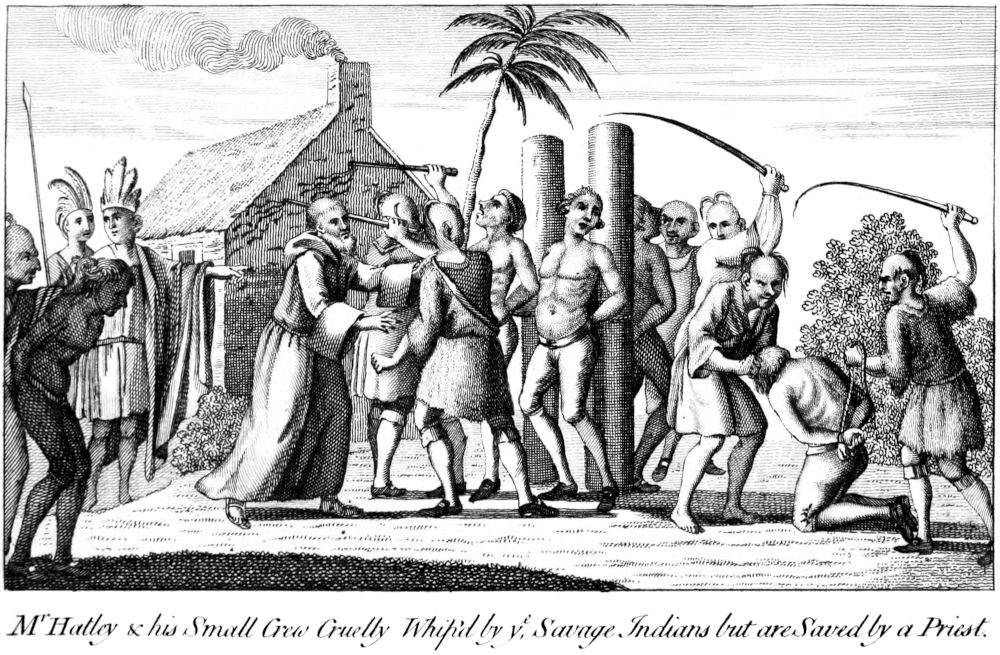
M
r
Hatley & his Small Crew Cruelly Whip’d by y
e
Savage Indians but are Saved by a Priest.
We have not yet been able to learn the future proceedings of the officers who conducted this enterprize. It is more than probable, that, having enriched themselves by the voyage, they retired and lived private. We find, indeed, a Mr. Cooke engaged in a succeeding voyage, but it does not appear that it was the Captain Cooke of whose voyage we have just given an account. Mr. Hatley, indeed, who fell into the hands of the Spaniards, was employed as second Captain under Shelvock, and of him we shall have occasion to speak largely hereafter.