BOOK III. GREAT SPEECHES ON GREAT ISSUES.
Reading edition
Speech of James Wilson,
January, 1775, in the Convention for the Province of Pennsylvania,
IN VINDICATION OF THE COLONIES.
“A most daring spirit of resistance and disobedience still prevails in Massachusetts, and has broken forth in fresh violences of a criminal nature. The most proper and effectual methods have been taken to prevent these mischiefs; and the parliament may depend upon a firm resolution to withstand every attempt to weaken or impair the supreme authority of parliament over all the dominions of the crown.”—Speech of the King of Great Britain to Parliament, Nov., 1774.
Mr. Chairman:—Whence, sir, proceeds all the invidious and ill-grounded clamor against the colonists of America? Why are they stigmatized in Britain as licentious and ungovernable? Why is their virtuous opposition to the illegal attempts of their governors, represented under the falsest colors, and placed in the most ungracious point of view? This opposition, when exhibited in its true light, and when viewed, with unjaundiced eyes, from a proper situation, and at a proper distance, stands confessed the lovely offspring of freedom. It breathes the spirit of its parent. Of this ethereal spirit, the whole conduct, and particularly the late conduct, of the colonists has shown them eminently possessed. It has animated and regulated every part of their proceedings. It has been recognized to be genuine, by all those symptoms and effects by which it has been distinguished in other ages and other countries. It has been calm and regular: it has not acted without occasion: it has not acted disproportionably to the occasion. As the attempts, open or secret, to undermine or to destroy it, have been repeated or enforced, in a just degree, its vigilance and its vigor have been exerted to defeat or to disappoint them. As its exertions have been sufficient for those purposes hitherto, let us hence draw a joyful prognostic, that they will continue sufficient for those purposes hereafter. It is not yet exhausted: it will still operate irresistibly whenever a necessary occasion shall call forth its strength.
Permit me, sir, by appealing, in a few instances, to the spirit and conduct of the colonists, to evince that what I have said of them is just. Did they disclose any uneasiness at the proceedings and claims of the British parliament, before those claims and proceedings afforded a reasonable cause for it? Did they even disclose any uneasiness, when a reasonable cause for it was first given? Our rights were invaded by their regulations of our internal policy. We submitted to them: we were unwilling to oppose them. The spirit of liberty was slow to act. When those invasions were renewed; when the efficacy and malignancy of them were attempted to be redoubled by the stamp act; when chains were formed for us; and preparations were made for riveting them on our limbs, what measures did we pursue? The spirit of liberty found it necessary now to act; but she acted with the calmness and decent dignity suited to her character. Were we rash or seditious? Did we discover want of loyalty to our sovereign? Did we betray want of affection to our brethren in Britain? Let our dutiful and reverential petitions to the throne; let our respectful, though firm, remonstrances to the parliament; let our warm and affectionate addresses to our brethren and (we will still call them) our friends in Great Britain,—let all those, transmitted from every part of the continent, testify the truth. By their testimony let our conduct be tried.
As our proceedings, during the existence and operation of the stamp act, prove fully and incontestably the painful sensations that tortured our breasts from the prospect of disunion with Britain; the 3004peals of joy, which burst forth universally, upon the repeal of that odious statute, loudly proclaim the heartfelt delight produced in us by a reconciliation with her. Unsuspicious, because undesigning, we buried our complaints, and the causes of them, in oblivion, and returned, with eagerness, to our former unreserved confidence. Our connection with our parent country, and the reciprocal blessings resulting from it to her and to us, were the favorite and pleasing topics of our public discourses and our private conversations. Lulled into delightful security, we dreamed of nothing but increasing fondness and friendship, cemented and strengthened by a kind and perpetual communication of good offices. Soon, however, too soon, were we awakened from the soothing dreams! Our enemies renewed their designs against us, not with less malice, but with more art. Under the plausible pretence of regulating our trade, and, at the same time, of making provision for the administration of justice, and the support of government, in some of the colonies, they pursued their scheme of depriving us of our property without our consent. As the attempts to distress us, and to degrade us to a rank inferior to that of freemen, appeared now to be reduced into a regular system, it became proper, on our part, to form a regular system for counteracting them. We ceased to import goods from Great Britain. Was this measure dictated by selfishness or by licentiousness? Did it not injure ourselves, while it injured the British merchants and manufacturers? Was it inconsistent with the peaceful demeanor of subjects to abstain from making purchases, when our freedom and our safety rendered it necessary for us to abstain from them? A regard for our freedom and our safety was our only motive; for no sooner had the parliament, by repealing part of the revenue laws, inspired us with the flattering hopes, that they had departed from their intentions of oppressing and of taxing us, than we forsook our plan for defeating those intentions, and began to import as formerly. Far from being peevish or captious, we took no public notice even of their declaratory law of dominion over us: our candor led us to consider it as a decent expedient of retreating from the actual exercise of that dominion.
But, alas! the root of bitterness still remained. The duty on tea was reserved to furnish occasion to the ministry for a new effort to enslave and to ruin us; and the East India Company were chosen, and consented to be the detested instruments of ministerial despotism and cruelty. A cargo of their tea arrived at Boston. By a low artifice of the governor, and by the wicked activity of the tools of government, it was rendered impossible to store it up, or to send it back, as was done at other places. A number of persons, unknown, destroyed it.
Let us here make a concession to our enemies: let us suppose, that the transaction deserves all the dark and hideous colors in which they have painted it: let us even suppose (for our cause admits of an excess of candor) that all their exaggerated accounts of it were confined strictly to the truth: what will follow? Will it follow, that every British colony in America, or even the colony of Massachusetts Bay, or even the town of Boston, in that colony, merits the imputation of being factious and seditious? Let the frequent mobs and riots, that have happened in Great Britain upon much more trivial occasions, shame our calumniators into silence. Will it follow, because the rules of order and regular government were, in that instance, violated by the offenders, that, for this reason, the principles of the constitution, and the maxims of justice, must be violated by their punishment? Will it follow, because those who were guilty could not be known, that, therefore, those who were known not to be guilty must suffer? Will it follow, that even the guilty should be condemned without being heard—that they should be condemned upon partial testimony, upon the representations of their avowed and embittered enemies? Why were they not tried in courts of justice known to their constitution, and by juries of their neighborhood? Their courts and their juries were not, in the case of captain Preston, transported beyond the bounds of justice by their resentment: why, then, should it be presumed, that, in the case of those offenders, they would be prevented from doing justice by their affection? But the colonists, it seems, must be stripped of their judicial, as well as of their legislative powers. They must be bound by a legislature, they must be tried by a jurisdiction, not their own. Their constitutions must be changed: their liberties must be abridged: and those who shall be most infamously active in changing their constitutions and abridging their liberties, must, by an express provision, be exempted from punishment.
I do not exaggerate the matter, sir, when I extend these observations to all the colonists. The parliament meant to extend the effects of their proceedings to all the colonists. The plan, on which their proceedings are formed, extends to them all. From an incident of no very uncommon or atrocious nature, which happened in one colony, in one town in that colony, and in which only a few of the inhabitants of that town took a part, an occasion has been taken by those, who probably intended it, and who 3005certainly prepared the way for it, to impose upon that colony, and to lay a foundation and a precedent for imposing upon all the rest, a system of statutes, arbitrary, unconstitutional, oppressive, in every view, and in every degree subversive of the rights, and inconsistent with even the name, of freemen.
Were the colonists so blind as not to discern the consequences of these measures? Were they so supinely inactive, as to take no steps for guarding against them? They were not. They ought not to have been so. We saw a breach made in those barriers, which our ancestors, British and American, with so much care, with so much danger, with so much treasure, and with so much blood, had erected, cemented and established for the security of their liberties, and—with filial piety let us mention it—of ours. We saw the attack actually begun upon one part: ought we to have folded our hands in indolence, to have lulled our eyes in slumbers, till the attack was carried on, so as to become irresistible, in every part? Sir, I presume to think not. We were roused; we were alarmed, as we had reason to be. But still our measures have been such as the spirit of liberty and of loyalty directed; not such as the spirit of sedition or of disaffection would pursue. Our counsels have been conducted without rashness and faction: our resolutions have been taken without phrensy or fury.
That the sentiments of every individual concerning that important object, his liberty, might be known and regarded, meetings have been held, and deliberations carried on, in every particular district. That the sentiments of all those individuals might gradually and regularly be collected into a single point, and the conduct of each inspired and directed by the result of the whole united, county committees, provincial conventions, a continental congress, have been appointed, have met and resolved. By this means, a chain—more inestimable, and, while the necessity for it continues, we hope, more indissoluble than one of gold—a chain of freedom has been formed, of which every individual in these colonies, who is willing to preserve the greatest of human blessings, his liberty, has the pleasure of beholding himself a link.
Are these measures, sir, the brats of disloyalty, of disaffection? There are miscreants among us, wasps that suck poison from the most salubrious flowers, who tell us they are. They tell us that all those assemblies are unlawful, and unauthorized by our constitutions; and that all their deliberations and resolutions are so many transgressions of the duty of subjects. The utmost malice brooding over the utmost baseness, and nothing but such a hated commixture, must have hatched this calumny. Do not those men know—would they have others not to know—that it was impossible for the inhabitants of the same province, and for the legislatures of the different provinces, to communicate their sentiments to one another in the modes appointed for such purposes, by their different constitutions? Do not they know—would they have others not to know—that all this was rendered impossible by those very persons, who now, or whose minions now, urge this objection against us? Do not they know—would they have others not to know—that the different assemblies, who could be dissolved by the governors, were in consequence of ministerial mandates, dissolved by them, whenever they attempted to turn their attention to the greatest objects, which, as guardians of the liberty of their constituents, could be presented to their view? The arch enemy of the human race torments them only for those actions to which he has tempted, but to which he has not necessarily obliged them. Those men refine even upon infernal malice: they accuse, they threaten us, (superlative impudence!) for taking those very steps, which we were laid under the disagreeable necessity of taking by themselves, or by those in whose hateful service they are enlisted. But let them know, that our counsels, our deliberations, our resolutions, if not authorized by the forms, because that was rendered impossible by our enemies, are nevertheless authorized by that which weighs much more in the scale of reason—by the spirit of our constitutions. Was the convention of the barons at Runnymede, where the tyranny of John was checked, and magna charta was signed, authorized by the forms of the constitution? Was the convention parliament, that recalled Charles the Second, and restored the monarchy, authorized by the forms of the constitution? Was the convention of lords and commons, that placed king William on the throne, and secured the monarchy and liberty likewise, authorized by the forms of the constitution? I cannot conceal my emotions of pleasure, when I observe, that the objections of our adversaries cannot be urged against us, but in common with those venerable assemblies, whose proceedings formed such an accession to British liberty and British renown.
We can be at no loss in resolving, that the king cannot, by his prerogative, alter the charter or constitution of the colony of Massachusetts Bay. Upon what principle could such an exertion of prerogative be justified? On the acts of parliament? They are already proved to be void. On the discretionary power which the king has of acting where the laws are 3006silent? That power must be subservient to the interest and happiness of those concerning whom it operates. But I go further. Instead of being supported by law, or the principles of prerogative, such an alteration is totally and absolutely repugnant to both. It is contrary to express law. The charter and constitution, we speak of, are confirmed by the only legislative power capable of confirming them; and no other power, but that which can ratify, can destroy. If it is contrary to express law, the consequence is necessary, that it is contrary to the principles of prerogative; for prerogative can operate only when the law is silent.
In no view can this alteration be justified, or so much as excused. It cannot be justified or excused by the acts of parliament; because the authority of parliament does not extend to it; it cannot be justified or excused by the operation of prerogative; because this is none of the cases in which prerogative can operate: it cannot be justified or excused by the legislative authority of the colony; because that authority never has been, and, I presume, never will be given for any such purpose.
If I have proceeded hitherto, as I am persuaded I have, upon safe and sure ground, I can, with great confidence, advance a step farther, and say that all attempts to alter the charter or constitution of that colony, unless by the authority of its own legislature, are violations of its rights, and illegal.
If those attempts are illegal, must not all force, employed to carry them into execution, be force employed against law, and without authority? The conclusion is unavoidable.
Have not British subjects, then, a right to resist such force—force acting without authority—force employed contrary to law—force employed to destroy the very existence of law and of liberty? They have, sir, and this right is secured to them both by the letter and the spirit of the British constitution, by which the measures and the conditions of their obedience are appointed. The British liberties, sir, and the means and the right of defending them, are not the grants of princes; and of what our princes never granted they surely can never deprive us.
“Id rex potest,” says the law, “quod de jure potest.” The king’s power is a power according to law. His commands, if the authority of lord chief justice Hale may be depended upon, are under the directive power of the law; and consequently invalid, if unlawful. “Commissions,” says my lord Coke, “are legal; and are like the king’s writs; and none are lawful, but such as are allowed by the common law, or warranted by some act of parliament.”
And now, sir, let me appeal to the impartial tribunal of reason and truth; let me appeal to every unprejudiced and judicious observer of the laws of Britain, and of the constitution of the British government; let me appeal, I say, whether the principles on which I argue, or the principles on which alone my arguments can be opposed, are those which ought to be adhered to and acted upon; which of them are most consonant to our laws and liberties; which of them have the strongest, and are likely to have the most effectual tendency to establish and secure the royal power and dignity.
Are we deficient in loyalty to his majesty? Let our conduct convict, for it will fully convict, the insinuation that we are, of falsehood. Our loyalty has always appeared in the true form of loyalty; in obeying our sovereign according to law; let those, who would require it in any other form, know, that we call the persons who execute his commands, when contrary to law, disloyal and traitors. Are we enemies to the power of the crown? No, sir, we are its best friends: this friendship prompts us to wish, that the power of the crown may be firmly established on the most solid basis: but we know, that the constitution alone will perpetuate the former, and securely uphold the latter. Are our principles irreverent to majesty? They are quite the reverse: we ascribe to it perfection almost divine. We say, that the king can do no wrong: we say, that to do wrong is the property, not of power, but of weakness. We feel oppression, and will oppose it; but we know, for our constitution tells us, that oppression can never spring from the throne. We must, therefore, search elsewhere for its source: our infallible guide will direct us to it. Our constitution tells us, that all oppression springs from the ministers of the throne. The attributes of perfection, ascribed to the king, are, neither by the constitution, nor in fact, communicable to his ministers. They may do wrong; they have often done wrong; they have been often punished for doing wrong.
Here we may discern the true cause of all the impudent clamor and unsupported accusations of the ministers and of their minions, that have been raised and made against the conduct of the Americans. Those ministers and minions are sensible, that the opposition is directed, not against his majesty, but against them; because they have abused his majesty’s confidence, brought discredit upon his government, and derogated from his justice. They see the public vengeance collected in dark clouds around them: their consciences tell them, that it should be hurled, like a thunderbolt, at their guilty heads. Appalled with guilt and fear, they skulk behind 3007the throne. Is it disrespectful to drag them into public view, and make a distinction between them and his majesty, under whose venerable name they daringly attempt to shelter their crimes? Nothing can more effectually contribute to establish his majesty on the throne, and to secure to him the affections of his people, than this distinction. By it we are taught to consider all the blessings of government as flowing from the throne; and to consider every instance of oppression as proceeding, which, in truth, is oftenest the case, from the ministers.
If, now, it is true, that all force employed for the purposes so often mentioned, is force unwarranted by any act of parliament; unsupported by any principle of the common law; unauthorized by any commission from the crown; that, instead of being employed for the support of the constitution and his majesty’s government, it must be employed for the support of oppression and ministerial tyranny; if all this is true (and I flatter myself it appears to be true), can any one hesitate to say, that to resist such force is lawful; and that both the letter and the spirit of the British constitution justify such resistance?
Resistance, both by the letter and the spirit of the British constitution, may be carried further, when necessity requires it, than I have carried it. Many examples in the English history might be adduced, and many authorities of the greatest weight might be brought to show, that when the king, forgetting his character and his dignity, has stepped forth, and openly avowed and taken a part in such iniquitous conduct as has been described; in such cases, indeed, the distinction above mentioned, wisely made by the constitution for the security of the crown, could not be applied; because the crown had unconstitutionally rendered the application of it impossible. What has been the consequence? The distinction between him and his ministers has been lost; but they have not been raised to his situation: he has sunk to theirs.
Speech of Patrick Henry,
March 23, 1775, in the Convention of Delegates of Virginia, On the following resolutions, introduced by himself:
“Resolved, That a well regulated militia, composed of gentlemen and yeomen, is the natural strength and only security of a free government; that such a militia in this colony, would forever render it unnecessary for the mother country to keep among us, for the purpose of our defence, any standing army of mercenary soldiers, always subversive of the quiet, and dangerous to the liberties of the people, and would obviate the pretext of taxing us for their support.
“That the establishment of such a militia is, at this time, peculiarly necessary, by the state of our laws for the protection and defence of the country, some of which are already expired, and others will shortly be so; and that the known remissness of government in calling us together in legislative capacity, renders it too insecure, in this time of danger and distress, to rely, that opportunity will be given of renewing them, in general assembly, or making any provision to secure our inestimable rights and liberties from those further violations with which they are threatened:
“Resolved, therefore, That this colony be immediately put into a state of defence, and that be a committee to prepare a plan for imbodying, arming and disciplining such a number of men as may be sufficient for that purpose.”
Mr. President:—No man thinks more highly than I do of the patriotism, as well as abilities, of the very worthy gentlemen who have just addressed the house. But different men often see the same subject in different lights; and, therefore, I hope it will not be thought disrespectful to those gentlemen, if, entertaining, as I do, opinions of a character very opposite to theirs, I shall speak forth my sentiments freely and without reserve. This is no time for ceremony. The question before the house is one of awful moment to this country. For my own part, I consider it as nothing less than a question of freedom or slavery; and in proportion to the magnitude of the subject ought to be the freedom of the debate. It is only in this way that we can hope to arrive at truth, and fulfil the great responsibility which we hold to God and our country. Should I keep back my opinions at such a time, through fear of giving offence, I should consider myself as guilty of treason towards my country, and of an act of disloyalty towards the Majesty of Heaven, which I revere above all earthly kings.
Mr. President, it is natural to man to indulge in the illusions of hope. We are apt to shut our eyes against a painful truth, and listen to the song of that siren, till he transforms us into beasts. Is this the part of wise men, engaged in a great and arduous struggle for liberty? Are we disposed to be of the number of those, who, having eyes, see not, and, having ears, hear not, the things which so nearly concern their temporal salvation? For my part, whatever anguish of spirit it may cost, I am willing to know the whole truth; to know the worst, and to provide for it.
I have but one lamp by which my feet are guided; and that is the lamp of experience. I know of no way of judging of the future but by the past. And judging by the past, I wish to know what there has been in the conduct of the British ministry for the last ten years, to justify those hopes with which gentlemen have been pleased to solace themselves and the house? Is it that insidious smile with which our petition has been lately received? Trust it not, sir; it will prove a snare to your feet. Suffer not yourselves to be betrayed with a kiss. Ask yourselves how this gracious reception of our petition comports with those warlike preparations which cover our waters and darken our land. Are fleets and armies necessary to a work of love and reconciliation? Have we shown ourselves so unwilling to be reconciled, that force must be 3008called in to win back our love? Let us not deceive ourselves, sir. These are the implements of war and subjugation; the last arguments to which kings resort. I ask gentlemen, sir, what means this martial array, if its purpose be not to force us to submission? Can gentlemen assign any other possible motive for it? Has Great Britain any enemy, in this quarter of the world, to call for all this accumulation of navies and armies? No, sir, she has none. They are meant for us: they can be meant for no other. They are sent over to bind and rivet upon us those chains, which the British ministry have been so long forging. And what have we to oppose to them? Shall we try argument? Sir, we have been trying that for the last ten years. Have we any thing new to offer upon the subject? Nothing. We have held the subject up in every light of which it is capable; but it has been all in vain. Shall we resort to entreaty and humble supplication? What terms shall we find, which have not been already exhausted? Let us not, I beseech you, sir, deceive ourselves longer. Sir, we have done every thing that could be done, to avert the storm which is now coming on. We have petitioned; we have remonstrated; we have supplicated; we have prostrated ourselves before the throne, and have implored its interposition to arrest the tyrannical hands of the ministry and parliament. Our petitions have been slighted; our remonstrances have produced additional violence and insult; our supplications have been disregarded; and we have been spurned, with contempt, from the foot of the throne! In vain, after these things, may we indulge the fond hope of peace and reconciliation. There is no longer any room for hope. If we wish to be free—if we mean to preserve inviolate those inestimable privileges for which we have been so long contending—if we mean not basely to abandon the noble struggle in which we have been so long engaged, and which we have pledged ourselves never to abandon, until the glorious object of our contest shall be obtained—we must fight! I repeat it, sir, we must fight! An appeal to arms and to the God of Hosts is all that is left us!
They tell us, sir, that we are weak; unable to cope with so formidable an adversary. But when shall we be stronger? Will it be the next week, or the next year? Will it be when we are totally disarmed, and when a British guard shall be stationed in every house? Shall we gather strength by irresolution and inaction? Shall we acquire the means of effectual resistance, by lying supinely on our backs, and hugging the delusive phantom of hope, until our enemies shall have bound us hand and foot? Sir, we are not weak, if we make a proper use of those means which the God of nature hath placed in our power. Three millions of people, armed in the holy cause of liberty, and in such a country as that which we possess, are invincible by any force which our enemy can send against us. Besides, sir, we shall not fight our battles alone. There is a just God who presides over the destinies of nations, and who will raise up friends to fight our battles for us. The battle, sir, is not to the strong alone; it is to the vigilant, the active, the brave. Besides, sir, we have no election. If we were base enough to desire it, it is now too late to retire from the contest. There is no retreat, but in submission and slavery! Our chains are forged! Their clanking may be heard on the plains of Boston! The war is inevitable—and let it come! I repeat it, sir, let it come.
It is in vain, sir, to extenuate the matter. Gentlemen may cry, Peace, peace—but there is no peace. The war is actually begun! The next gale, that sweeps from the north, will bring to our ears the clash of resounding arms! Our brethren are already in the field! Why stand we here idle? What is it that gentlemen wish? What would they have? Is life so dear, or peace so sweet, as to be purchased at the price of chains and slavery? Forbid it, Almighty God! I know not what course others may take; but as for me, give me liberty, or give me death!
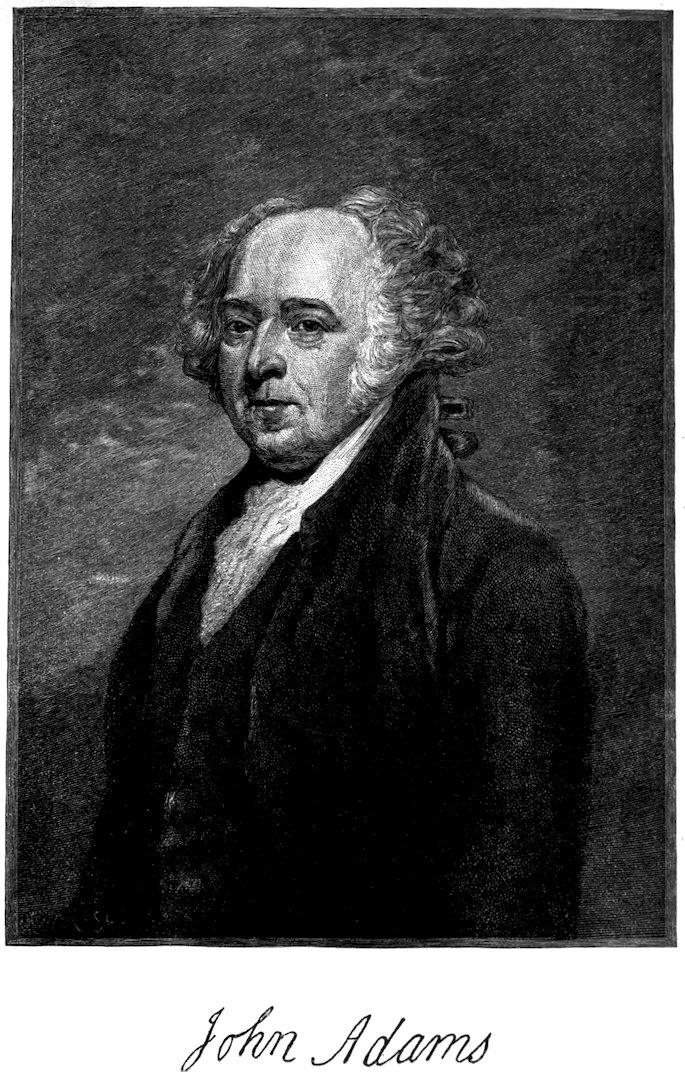
Supposed Speech of John Adams in favor of the Declaration of Independence.
As given by Daniel Webster.
Sink or swim, live or die, survive or perish, I give my hand and my heart to this vote. It is true, indeed, that in the beginning we aimed not at independence. But there’s a divinity which shapes our ends. The injustice of England has driven us to arms; and, blinded to her own interest for our good, she has obstinately persisted, till independence is now within our grasp. We have but to reach forth to it, and it is ours.
Why then should we defer the declaration? Is any man so weak as now to hope for a reconciliation with England, which shall leave either safety to the country and its liberties, or safety to his own life and his own honor? Are not you, sir, who sit in that chair, is not he, our venerable colleague near you, are you not both already the proscribed and predestined objects of punishment and of vengeance? Cut off from all hope of royal clemency, what are you, what can you be, while the power of England remains, but outlaws?
3009If we postpone independence, do we mean to carry on, or to give up the war? Do we mean to submit to the measures of parliament, Boston port bill and all? Do we mean to submit, and consent that we ourselves shall be ground to powder, and our country and its rights trodden down in the dust? I know we do not mean to submit. We never shall submit.
Do we intend to violate that most solemn obligation ever entered into by men, that plighting, before God, of our sacred honor to Washington, when putting him forth to incur the dangers of war, as well as the political hazards of the times, we promised to adhere to him, in every extremity, with our fortunes and our lives? I know there is not a man here, who would not rather see a general conflagration sweep over the land, or an earthquake sink it, than one jot or tittle of that plighted faith fall to the ground.
For myself, having, twelve months ago, in this place, moved you that George Washington be appointed commander of the forces, raised or to be raised, for defence of American liberty, may my right hand forget her cunning, and my tongue cleave to the roof of my mouth, if I hesitate or waver in the support I give him. The war, then, must go on. We must fight it through. And if the war must go on, why put off longer the declaration of independence? That measure will strengthen us. It will give us character abroad.
The nations will then treat with us, which they never can do while we acknowledge ourselves subjects, in arms against our sovereign. Nay, I maintain that England, herself, will sooner treat for peace with us on the footing of independence, than consent, by repealing her acts, to acknowledge that her whole conduct toward us has been a course of injustice and oppression. Her pride will be less wounded by submitting to that course of things which now predestinates our independence, than by yielding the points in controversy to her rebellious subjects. The former she would regard as the result of fortune; the latter she would feel as her own deep disgrace. Why then, why then, sir, do we not as soon as possible change this from a civil to a national war? And since we must fight it through, why not put ourselves in a state to enjoy all the benefits of victory, if we gain the victory?
If we fail, it can be no worse for us. But we shall not fail. The cause will raise up armies; the cause will create navies. The people, the people, if we are true to them, will carry us, and will carry themselves, gloriously, through this struggle. I care not how fickle other people have been found. I know the people of these colonies, and I know that resistance to British aggression is deep and settled in their hearts and cannot be eradicated. Every colony, indeed, has expressed its willingness to follow, if we but take the lead. Sir, the declaration will inspire the people with increased courage. Instead of a long and bloody war for restoration of privileges, for redress of grievances, for chartered immunities, held under a British king, set before them the glorious object of entire independence, and it will breathe into them anew the breath of life.
Read this declaration at the head of the army; every sword will be drawn from its scabbard, and the solemn vow uttered to maintain it, or to perish on the bed of honor. Publish it from the pulpit; religion will approve it, and the love of religious liberty will cling round it, resolved to stand with it, or fall with it. Send it to the public halls; proclaim it there; let them hear it, who heard the first roar of the enemy’s cannon; let them see it, who saw their brothers and their sons fall on the field of Bunker hill, and in the streets of Lexington and Concord, and the very walls will cry out in its support.
Sir, I know the uncertainty of human affairs, but I see, I see clearly through this day’s business. You and I, indeed, may rue it. We may not live to the time when this declaration shall be made good. We may die; die, colonists; die, slaves; die, it may be, ignominiously and on the scaffold. Be it so. Be it so. If it be the pleasure of Heaven that my country shall require the poor offering of my life, the victim shall be ready, at the appointed hour of sacrifice, come when that hour may. But while I do live, let me have a country, or at least the hope of a country, and that a free country.
But whatever may be our fate, be assured, be assured, that this declaration will stand. It may cost treasure, and it may cost blood; but it will stand, and it will richly compensate for both. Through the thick gloom of the present, I see the brightness of the future, as the sun in heaven. We shall make this a glorious, an immortal day. When we are in our graves, our children will honor it. They will celebrate it with thanksgiving, with festivity, with bonfires and illuminations. On its annual return they will shed tears, copious, gushing tears, not of subjection and slavery, not of agony and distress, but of exultation, of gratitude, and of joy.
Sir, before God, I believe the hour is come. My judgment approves this measure, and my whole heart is in it. All that I have, and all that I am, and all that I hope, in this life, I am now ready here to stake upon it; and I leave off as I begun, that live or die, survive or perish, I am for the declaration. It is my living sentiment, and by the blessing of God it shall be my dying sentiment; independence now; and INDEPENDENCE FOR EVER.
3010
Speech of Patrick Henry,
On the expediency of adopting the Federal Constitution delivered in the convention of Virginia, June 24, 1788.[78] Enunciating views which have ever since been accepted by the Democratic party.
Mr. Chairman:—The proposal of ratification is premature. The importance of the subject requires the most mature deliberation. The honorable member must forgive me for declaring my dissent from it, because, if I understand it rightly, it admits that the new system is defective, and most capitally; for, immediately after the proposed ratification, there comes a declaration, that the paper before you is not intended to violate any of these three great rights—the liberty of religion, liberty of the press, and the trial by jury. What is the inference, when you enumerate the rights which you are to enjoy? That those not enumerated are relinquished. There are only three things to be retained—religion, freedom of the press, and jury trial. Will not the ratification carry every thing, without excepting these three things? Will not all the world pronounce, that we intended to give up all the rest? Every thing it speaks of, by way of rights, is comprised in these three things. Your subsequent amendments only go to these three amendments. I feel myself distressed, because the necessity of securing our personal rights seems not to have pervaded the minds of men; for many other valuable things are omitted. For instance: general warrants, by which an officer may search suspected places without evidence of the commission of a fact, or seize any person without evidence of his crime, ought to be prohibited. As these are admitted, any man may be seized; any property may be taken, in the most arbitrary manner, without any evidence or reason. Every thing, the most sacred, may be searched and ransacked by the strong hand of power. We have infinitely more reason to dread general warrants here, than they have in England; because there, if a person be confined, liberty may be quickly obtained by the writ of habeas corpus. But here, a man living many hundred miles from the judges may rot in prison before he can get that writ.
Another most fatal omission is, with respect to standing armies. In your bill of rights of Virginia, they are said to be dangerous to liberty; and it tells you, that the proper defence of a free state consists in militia; and so I might go on to ten or eleven things of immense consequence secured in your bill of rights, concerning which that proposal is silent. Is that the language of the bill of rights in England? Is it the language of the American bill of rights, that these three rights, and these only, are valuable? Is it the language of men going into a new government? Is it not necessary to speak of those things before you go into a compact? How do these three things stand? As one of the parties, we declare we do not mean to give them up. This is very dictatorial; much more so than the conduct which proposes alterations as the condition of adoption. In a compact, there are two parties—one accepting, and another proposing. As a party, we propose that we shall secure these three things; and before we have the assent of the other contracting party, we go into the compact, and leave these things at their mercy. What will be the consequence? Suppose the other states will call this dictatorial: they will say, Virginia has gone into the government, and carried with her certain propositions, which, she says, ought to be concurred in by the other states. They will declare, that she has no right to dictate to other states the conditions on which they shall come into the union. According to the honorable member’s proposal, the ratification will cease to be obligatory unless they accede to these amendments. We have ratified it. You have committed a violation, they will say. They have not violated it. We say we will go out of it. You are then reduced to a sad dilemma—to give up these three rights, or leave the government. This is worse than our present confederation, to which we have hitherto adhered honestly and faithfully. We shall be told we have violated it, because we have left it for the infringement and violation of conditions, which they never agreed to be a part of the ratification. The ratification will be complete. The proposal is made by one party. We, as the other, accede to it, and propose the security of these three great rights; for it is only a proposal. In order to secure them, you are left in that state of fatal hostility, which I shall as much deplore as the honorable gentleman. I exhort gentlemen to think seriously before they ratify this constitution, and persuade themselves that they will succeed in making a feeble effort to get amendments after adoption. With respect to that part of the proposal which says that every power not granted remains with the people, it must be previous to adoption, or it will involve this country in inevitable destruction. To talk of it is a thing subsequent, not as one of your inalienable rights, is leaving it to the casual opinion of the congress who shall take up the consideration of the matter. They will not reason with you about the effect of this constitution. They will not take the opinion of this committee 3011concerning its operation. They will construe it as they please. If you place it subsequently, let me ask the consequences. Among ten thousand implied powers which they may assume, they may, if we be engaged in war, liberate every one of your slaves, if they please. And this must and will be done by men, a majority of whom have not a common interest with you. They will, therefore, have no feeling for your interests.
It has been repeatedly said here that the great object of a national government is national defence. That power which is said to be intended for security and safety, may be rendered detestable and oppressive. If you give power to the general government to provide for the general defence, the means must be commensurate to the end. All the means in the possession of the people must be given to the government which is intrusted with the public defence. In this state there are two hundred and thirty-six thousand blacks, and there are many in several other states; but there are few or none in the Northern States; and yet, if the Northern States shall be of opinion that our numbers are numberless, they may call forth every national resource. May congress not say, that every black man must fight? Did we not see a little of this in the last war? We were not so hard pushed as to make emancipation general: but acts of assembly passed, that every slave who would go to the army should be free. Another thing will contribute to bring this event about: slavery is detested; we feel its fatal effects; we deplore it with all the pity of humanity. Let all these considerations, at some future period, press with full force on the minds of congress. Let that urbanity, which I trust will distinguish America, and the necessity of national defence—let all these things operate on their minds, and they will search that paper, and see if they have power of manumission. And have they not, sir? Have they not power to provide for the general defence and welfare? May they not think that these call for the abolition of slavery? May they not pronounce all slaves free, and will they not be warranted by that power? There is no ambiguous implication, or logical deduction. The paper speaks to the point. They have the power in clear, unequivocal terms, and will clearly and certainly exercise it. As much as I deplore slavery, I see that prudence forbids its abolition. I deny that the general government ought to set them free, because a decided majority of the states have not the ties of sympathy and fellow-feeling for those whose interest would be affected by their emancipation. The majority of congress is to the north, and the slaves are to the south. In this situation, I see a great deal of the property of the people of Virginia in jeopardy, and their peace and tranquillity gone away. I repeat it again, that it would rejoice my very soul that every one of my fellow-beings was emancipated. As we ought with gratitude to admire that decree of Heaven which has numbered us among the free, we ought to lament and deplore the necessity of holding our fellow-men in bondage. But is it practicable, by any human means, to liberate them, without producing the most dreadful and ruinous consequences? We ought to possess them in the manner we have inherited them from our ancestors, as their manumission is incompatible with the felicity of the country. But we ought to soften, as much as possible, the rigor of their unhappy fate. I know that in a variety of particular instances, the legislature, listening to complaints, have admitted their emancipation. Let me not dwell on this subject. I will only add, that this, as well as every other property of the people of Virginia, is in jeopardy, and put in the hands of those who have no similarity of situation with us. This is a local matter, and I can see no propriety in subjecting it to congress.
[Here Mr. Henry informed the committee, that he had a resolution prepared, to refer a declaration of rights, with certain amendments to the most exceptionable parts of the constitution, to the other states in the confederacy, for their consideration, previous to its ratification. The clerk then read the resolution, the declaration of rights, and amendments, which were nearly the same as those ultimately proposed by the convention, for the consideration of congress. He then resumed the subject.] I have thus candidly submitted to you, Mr. Chairman, and this committee, what occurred to me as proper amendments to the constitution, and the declaration of rights containing those fundamental, inalienable privileges, which I conceive to be essential to liberty and happiness. I believe, that, on a review of these amendments, it will still be found, that the arm of power will be sufficiently strong for national purposes, when these restrictions shall be a part of the government. I believe no gentleman, who opposes me in sentiments, will be able to discover that any one feature of a strong government is altered; and at the same time your inalienable rights are secured by them. The government unaltered may be terrible to America, but can never be loved, till it be amended. You find all the resources of the continent may be drawn to a point. In danger, the president may concentre to a point every effort of the continent. If the government be constructed to satisfy the people and remove their apprehensions, the wealth and strength of the continent will go where 3012public utility shall direct. This government, with these restrictions, will be a strong government united with the privileges of the people. In my weak judgment, a government is strong, when it applies to the most important end of all governments—the rights and privileges of the people. In the honorable member’s proposal, jury trial, the press, and religion, and other essential rights, are not to be given up. Other essential rights—what are they? The world will say, that you intended to give them up. When you go into an enumeration of your rights, and stop that enumeration, the inevitable conclusion is, that what is omitted is intended to be surrendered.
Anxious as I am to be as little troublesome as possible, I cannot leave this part of the subject without adverting to one remark of the honorable gentleman. He says, that, rather than bring the union into danger, he will adopt it with its imperfections. A great deal is said about disunion, and consequent dangers. I have no claim to a greater share of fortitude than others; but I can see no kind of danger. I form my judgment on a single fact alone, that we are at peace with all the world; nor is there any apparent cause of a rupture with any nation in the world. Is it among the American states that the cause of disunion is to be feared? Are not the states using all their efforts for the promotion of union? New England sacrifices local prejudices for the purposes of union. We hear the necessity of the union, and predilection for the union, re-echoed from all parts of the continent; and all at once disunion is to follow! If gentlemen dread disunion, the very thing they advocate will inevitably produce it. A previous ratification will raise insurmountable obstacles to union. New York is an insurmountable obstacle to it, and North Carolina also. They will never accede to it till it be amended. A great part of Virginia is opposed, most decidedly, to it, as it stands. This very spirit which will govern us in these three states, will find a kindred spirit in the adopting states. Give me leave to say, that it is very problematical whether the adopting states can stand on their own legs. I hear only on one side, but as far as my information goes, there are heart-burnings and animosities among them. Will these animosities be cured by subsequent amendments?
Turn away from American, and consider European politics. The nations there, which can trouble us, are France, England, and Spain. But at present we know for a certainty, that those nations are engaged in a very different pursuit from American conquests. We are told by our intelligent ambassador, that there is no such danger as has been apprehended. Give me leave then to say, that dangers from beyond the Atlantic are imaginary. From these premises, then, it may be concluded, that, from the creation of the world to this time, there never was a more fair and proper opportunity than we have at this day to establish such a government as will permanently establish the most transcendent political felicity. Since the revolution there has not been so much experience. Since then, the general interests of America have not been better understood, nor the union more ardently loved, than at this present moment. I acknowledge the weakness of the old confederation. Every man says, that something must be done. Where is the moment more favorable than this? During the war, when ten thousand dangers surrounded us, America was magnanimous. What was the language of the little state of Maryland? “I will have time to consider. I will hold out three years. Let what may come I will have time to reflect.” Magnanimity appeared everywhere. What was the upshot?—America triumphed. Is there any thing to forbid us to offer these amendments to the other states? If this moment goes away unimproved, we shall never see its return. We now act under a happy system, which says, that a majority may alter the government when necessary. But by the paper proposed, a majority will forever endeavor in vain to alter it. Three-fourths may. Is not this the most promising time for securing the necessary alterations? Will you go into that government, where it is a principle, that a contemptible minority may prevent an alteration? What will be the language of the majority?—Change the government—Nay, seven eighths of the people of America may wish the change; but the minority may come with a Roman Veto, and object to the alteration. The language of a magnanimous country and of freemen is, Till you remove the defects, we will not accede. It would be in vain for me to show, that there is no danger to prevent our obtaining those amendments, if you are not convinced already. If the other states will not agree to them, it is not an inducement to union. The language of this paper is not dictatorial, but merely a proposition for amendments. The proposition of Virginia met with a favorable reception before. We proposed that convention which met at Annapolis. It was not called dictatorial. We proposed that at Philadelphia. Was Virginia thought dictatorial? But Virginia is now to lose her pre-eminence. Those rights of equality, to which the meanest individual in the community is entitled, are to bring us down infinitely below the Delaware people. Have we not a right to say, Hear our propositions? Why, sir, your slaves have a right to make 3013their humble requests. Those who are in the meanest occupations of human life, have a right to complain. What do we require? Not pre-eminence, but safety; that our citizens may be able to sit down in peace and security under their own fig-trees. I am confident that sentiments like these will meet with unison in every state; for they will wish to banish discord from the American soil. I am certain that the warmest friend of the constitution wishes to have fewer enemies—fewer of those who pester and plague him with opposition. I could not withhold from my fellow-citizens anything so reasonable. I fear you will have no union, unless you remove the cause of opposition. Will you sit down contented with the name of union without any solid foundation?
Speech of John Randolph
Against the Tariff Bill, delivered in the House of Representatives of the United States, April 15, 1824.
I am, Mr. Speaker, practising no deception upon myself, much less upon the house, when I say, that if I had consulted my own feelings and inclinations, I should not have troubled the house, exhausted as it is, and as I am, with any further remarks upon this subject. I come to the discharge of this task, not merely with reluctance, but with disgust; jaded, worn down, abraded, I may say, as I am by long attendance upon this body, and continued stretch of the attention upon this subject. I come to it, however, at the suggestion, and in pursuance of the wishes of those, whose wishes are to me, in all matters touching my public duty, paramount law; I speak with those reservations, of course, which every moral agent must be supposed to make to himself.
It was not more to my surprise, than to my disappointment, that on my return to the house, after a necessary absence of a few days, on indispensable business, I found it engaged in discussing the general principle of the bill, when its details were under consideration. If I had expected such a turn in the debate, I would, at any private sacrifice, however great, have remained a spectator and auditor of that discussion. With the exception of the speech, already published, of my worthy colleague on my right (Mr. P. P. Barbour), I have been nearly deprived of the benefit of the discussion which has taken place. Many weeks have been occupied with this bill (I hope the house will pardon me for saying so) before I took the slightest part in the deliberations of the details; and I now sincerely regret that I had not firmness enough to adhere to the resolution which I had laid down to myself, in the early stage of the debate, not to take any part in the discussion of the details of the measure. But, as I trust, what I now have to say upon this subject, although more and better things have been said by others, may not be the same that they have said, or may not be said in the same manner. I here borrow the language of a man who has been heretofore conspicuous in the councils of the country; of one who was unrivalled for readiness and dexterity in debate; who was long without an equal on the floor of this body; who contributed as much to the revolution of 1801, as any man in this nation, and derived as little benefit from it; as, to use the words of that celebrated man, what I have to say is not that which has been said by others, and will not be said in their manner, the house will, I trust, have patience with me during the time that my strength will allow me to occupy their attention. And I beg them to understand, that the notes which I hold in my hand are not the notes on which I mean to speak, but of what others have spoken, and from which I will make the smallest selection in my power.
Sir, when are we to have enough of this tariff question? In 1816 it was supposed to be settled. Only three years thereafter, another proposition for increasing it was sent from this house to the senate, baited with a tax of four cents per pound on brown sugar. It was fortunately rejected in that body. In what manner this bill is baited, it does not become me to say; but I have too distinct a recollection of the vote in committee of the whole, on the duty upon molasses, and afterwards of the vote in the house on the same question; of the votes of more than one of the states on that question, not to mark it well. I do not say that the change of the vote on that question was affected by any man’s voting against his own motion; but I do not hesitate to say that it was effected by one man’s electioneering against his own motion. I am very glad, Mr. Speaker, that old Massachusetts Bay, and the province of Maine and Sagadahock, by whom we stood in the days of the revolution, now stand by the south, and will not aid in fixing on us this system of taxation, compared with which the taxation of Mr. Grenville and Lord North was as nothing. I speak with knowledge of what I say, when I declare, that this bill is an attempt to reduce the country, south of Mason and Dixon’s line and east of the Alleghany mountains, to a state of worse than colonial bondage; a state to which the domination of Great Britain was, in my judgment, far preferable; and I trust I shall always have the fearless integrity to utter any political sentiment which the head sanctions and the heart ratifies; for the British parliament 3014never would have dared to lay such duties on our imports, or their exports to us, either “at home” or here, as is now proposed to be laid upon the imports from abroad. At that time we had the command of the market of the vast dominions then subject, and we should have had those which have since been subjected, to the British empire; we enjoyed a free trade eminently superior to any thing that we can enjoy, if this bill shall go into operation. It is a sacrifice of the interests of a part of this nation to the ideal benefit of the rest. It marks us out as the victims of a worse than Egyptian bondage. It is a barter of so much of our rights, of so much of the fruits of our labor, for political power to be transferred to other hands. It ought to be met, and I trust it will be met, in the southern country, as was the stamp act, and by all those measures, which I will not detain the house by recapitulating, which succeeded the stamp act, and produced the final breach with the mother country, which it took about ten years to bring about, as I trust, in my conscience, it will not take as long to bring about similar results from this measure, should it become a law.
Sir, events now passing elsewhere, which plant a thorn in my pillow and a dagger in my heart, admonish me of the difficulty of governing with sobriety any people who are over head and ears in debt. That state of things begets a temper which sets at nought every thing like reason and common sense. This country is unquestionably laboring under great distress; but we cannot legislate it out of that distress. We may, by your legislation, reduce all the country south and east of Mason and Dixon’s line, the whites as well as the blacks, to the condition of Helots: you can do no more. We have had placed before us, in the course of this discussion, foreign examples and authorities; and among other things, we have been told, as an argument in favor of this measure, of the prosperity of Great Britain. Have gentlemen taken into consideration the peculiar advantages of Great Britain? Have they taken into consideration that, not excepting Mexico, and that fine country which lies between the Orinoco and Caribbean sea, England is decidedly superior, in point of physical advantages, to every country under the sun? This is unquestionably true. I will enumerate some of those advantages. First, there is her climate. In England, such is the temperature of the air, that a man can there do more days’ work in the year, and more hours’ work in the day, than in any other climate in the world; of course I include Scotland and Ireland in this description. It is in such a climate only, that the human animal can bear without extirpation the corrupted air, the noisome exhalations, the incessant labor of these accursed manufactories. Yes, sir, accursed; for I say it is an accursed thing, which I will neither taste, nor touch, nor handle. If we were to act here on the English system, we should have the yellow fever at Philadelphia and New York, not in August merely, but from June to January, and from January to June. The climate of this country alone, were there no other natural obstacle to it, says aloud, You shall not manufacture! Even our tobacco factories, admitted to be the most wholesome of any sort of factories, are known to be, where extensive, the very nidus (if I may use the expression) of yellow fever and other fevers of similar type. In another of the advantages of Great Britain, so important to her prosperity, we are almost on a par with her, if we know how properly to use it. Fortunatos nimium sua si bona norint—for, as regards defence, we are, to all intents and purposes, almost as much an island as England herself. But one of her insular advantages we can never acquire. Every part of that country is accessible from the sea. There, as you recede from the sea, you do not get further from the sea. I know that a great deal will be said of our majestic rivers, about the father of floods, and his tributary streams; but, with the Ohio, frozen up all the winter and dry all the summer, with a long tortuous, difficult, and dangerous navigation thence to the ocean, the gentlemen of the west may rest assured that they will never derive one particle of advantage from even a total prohibition of foreign manufactures. You may succeed in reducing us to your own level of misery; but if we were to agree to become your slaves, you never can derive one farthing of advantage from this bill. What parts of this country can derive any advantage from it? Those parts only, where there is a water power in immediate contact with navigation, such as the vicinities of Boston, Providence, Baltimore, and Richmond. Petersburg is the last of these as you travel south. You take a bag of cotton up the river to Pittsburg, or to Zanesville, to have it manufactured and sent down to New Orleans for a market, and before your bag of cotton has got to the place of manufacture, the manufacturer of Providence has received his returns for the goods made from his bag of cotton purchased at the same time that you purchased yours. No, sir, gentlemen may as well insist that because the Chesapeake bay, mare nostrum, our Mediterranean sea, gives us every advantage of navigation, we shall exclude from it every thing but steam-boats and those boats called κατ’ ἐξοχὴν, per emphasin, par excellence, Kentucky boats—a sort of huge square, clumsy, wooden box. And why not insist upon it? Hav’n’t you “the 3015power to REGULATE COMMERCE”? Would not that too be a “REGULATION OF COMMERCE?” It would, indeed, and a pretty regulation it is; and so is this bill. And, sir, I marvel that the representation from the great commercial state of New York should be in favor of this bill. If operative—and if inoperative why talk of it?—if operative, it must, like the embargo of 1807–1809, transfer no small portion of the wealth of the London of America, as New York has been called, to Quebec and Montreal. She will receive the most of her imports from abroad, down the river. I do not know any bill that could be better calculated for Vermont than this bill; because, through Vermont, from Quebec, Montreal, and other positions on the St. Lawrence, we are, if it passes, unquestionably to receive our supplies of foreign goods. It will, no doubt, suit the Niagara frontier.
But, sir, I must not suffer myself to be led too far astray from the topic of the peculiar advantages of England as a manufacturing country. Her vast beds of coal are inexhaustible; there are daily discoveries of quantities of it, greater than ages past have yet consumed; to which beds of coal her manufacturing establishments have been transferred, as any man may see who will compare the present population of her towns with what it was formerly. It is to these beds of coal that Birmingham, Manchester, Wolverhampton, Sheffield, Leeds, and other manufacturing towns, owe their growth. If you could destroy her coal in one day, you would cut at once the sinews of her power. Then, there are her metals, and particularly tin, of which she has the exclusive monopoly. Tin, I know, is to be found in Japan, and perhaps elsewhere; but, in practice, England has now the monopoly of that article. I might go further, and I might say, that England possesses an advantage, quoad hoc, in her institutions; for there men are compelled to pay their debts. But here, men are not only not compelled to pay their debts, but they are protected in the refusal to pay them, in the scandalous evasion of their legal obligations; and, after being convicted of embezzling the public money, and the money of others, of which they were appointed guardians and trustees, they have the impudence to obtrude their unblushing fronts into society, and elbow honest men out of their way. There, though all men are on a footing of equality on the high way, and in the courts of law, at will and at market, yet the castes in Hindoostan are not more distinctly separated, one from the other, than the different classes of society are in England. It is true that it is practicable for a wealthy merchant or manufacturer, or his descendants, after having, through two or three generations, washed out, what is considered the stain of their original occupation, to emerge, by slow degrees, into the higher ranks of society; but this rarely happens. Can you find men of vast fortune, in this country, content to move in the lower circles—content as the ox under the daily drudgery of the yoke? It is true that, in England, some of these wealthy people take it into their heads to buy seats in parliament. But, when they get there, unless they possess great talents, they are mere nonentities; their existence is only to be found in the red book which contains a list of the members of parliament. Now, sir, I wish to know if, in the western country, where any man may get beastly drunk for three pence sterling—in England, you cannot get a small wine-glass of spirits under twenty-five cents; one such drink of grog as I have seen swallowed in this country, would there cost a dollar—in the western country, where every man can get as much meat and bread as he can consume, and yet spend the best part of his days, and nights too, perhaps, on the tavern benches, or loitering at the cross roads asking the news, can you expect the people of such a country, with countless millions of wild land and wild animals besides, can be cooped up in manufacturing establishments, and made to work sixteen hours a day, under the superintendence of a driver, yes, a driver, compared with whom a southern overseer is a gentleman and man of refinement; for, if they do not work, these work people in the manufactories, they cannot eat; and, among all the punishments that can be devised (put death even among the number), I defy you to get as much work out of a man by any of them, as when he knows that he must work before he can eat.
In the course of this discussion, I have heard, I will not say with surprise, because nil admirari is my motto—no doctrine that can be broached on this floor, can ever, hereafter, excite surprise in my mind—I have heard the names of Say, Ganilh, Adam Smith, and Ricardo, pronounced not only in terms, but in a tone of sneering contempt, visionary theorists, destitute of practical wisdom, and the whole clan of Scotch and Quarterly Reviewers lugged in to boot. This, sir, is a sweeping clause of proscription. With the names of Say, Smith, and Ganilh, I profess to be acquainted, for I, too, am versed in title-pages; but I did not expect to hear, in this house, a name, with which I am a little further acquainted, treated with so little ceremony; and by whom? I leave Adam Smith to the simplicity, the majesty, and strength of his own native genius, which has canonized his name—a name which will be pronounced with veneration, when 3016not one in this house will be remembered. But one word as to Ricardo, the last mentioned of these writers—a new authority, though the grave has already closed upon him, and set its seal upon his reputation. I shall speak of him in the language of a man of as great a genius as this, or perhaps any, age has ever produced; a man remarkable for the depth of his reflections and the acumen of his penetration. “I had been led,” says this man, “to look into loads of books—my understanding had for too many years been intimate with severe thinkers, with logic, and the great masters of knowledge, not to be aware of the utter feebleness of the herd of modern economists. I sometimes read chapters from more recent works, or part of parliamentary debates. I saw that these [ominous words!] were generally the very dregs and rinsings of the human intellect.” [I am very glad, sir, he did not read our debates. What would he have said of ours?] “At length a friend sent me Mr. Ricardo’s book, and, recurring to my own prophetic anticipation of the advent of some legislator on this science, I said, Thou art the man. Wonder and curiosity had long been dead in me; yet I wondered once more. Had this profound work been really written in England during the 19th century? Could it be that an Englishman, and he not in academic bowers, but oppressed by mercantile and senatorial cares, had accomplished what all the universities and a century of thought had failed to advance by one hair’s breadth? All other writers had been crushed and overlaid by the enormous weight of facts and documents: Mr. Ricardo had deduced, a priori, from the understanding itself, laws which first gave a ray of light into the unwieldy chaos of materials, and had constructed what had been but a collection of tentative discussions, into a science of regular proportions, now first standing on an eternal basis.”
I pronounce no opinion of my own on Ricardo; I recur rather to the opinion of a man inferior, in point of original and native genius, and that highly cultivated, too, to none of the moderns, and few of the ancients. Upon this subject, what shall we say to the following fact? Butler, who is known to gentlemen of the profession of the law, as the annotator, with Hargrave, on lord Coke, speaking with Fox as to political economy—that most extraordinary man, unrivalled for his powers of debate, excelled by no man that ever lived, or probably ever will live, as a public debater, and of the deepest political erudition, fairly confessed that he had never read Adam Smith. Butler said to Mr. Fox, “that he had never read Adam Smith’s work on the Wealth of Nations.” “To tell you the truth,” replied Mr. Fox, “nor I neither. There is something in all these subjects that passes my comprehension—something so wide that I could never embrace them myself, or find any one who did.” And yet we see how we, with our little dividers, undertake to lay off the scale, and with our pack-thread to take the soundings, and speak with a confidence peculiar to quacks (in which the regular-bred professor never indulges) on this abstruse and perplexing subject. Confidence is one thing, knowledge another; of the want of which, overweening confidence is notoriously the indication. What of that? Let Ganilh, Say, Ricardo, Smith, all Greek and Roman fame be against us; we appeal to Dionysius in support of our doctrines; and to him, not on the throne of Syracuse, but at Corinth—not in absolute possession of the most wonderful and enigmatical city, as difficult to comprehend as the abstrusest problem of political economy which furnished not only the means but the men for supporting the greatest wars—a kingdom within itself, under whose ascendant the genius of Athens, in her most high and palmy state, quailed, and stood rebuked. No; we follow the pedagogue to the schools—dictating in the classic shades of Longwood—(lucus a non lucendo)—to his disciples. * * *
But it is said, a measure of this sort is necessary to create employment for the people. Why, sir, where are the handles of the plough? Are they unfit for young gentlemen to touch? Or will they rather choose to enter your military academies, where the sons of the rich are educated at the expense of the poor, and where so many political janissaries are every year turned out, always ready for war, and to support the powers that be—equal to the strelitzes of Moscow or St. Petersburg. I do not speak now of individuals, of course, but of the tendency of the system—the hounds follow the huntsman because he feeds them, and bears the whip. I speak of the system. I concur most heartily, sir, in the censure which has been passed upon the greediness of office, which stands a stigma on the present generation. Men from whom we might expect, and from whom I did expect, better things, crowd the ante-chamber of the palace, for every vacant office; nay, even before men are dead, their shoes are wanted for some barefooted office-seeker. How mistaken was the old Roman, the old consul, who, whilst he held the plough by one hand, and death held the other, exclaimed, “Diis immortalibus sero!”
Our fathers, how did they acquire their property? By straightforward industry, rectitude, and frugality. How did they become dispossessed of their property? By indulging in speculative hopes and designs; seeking the shadow whilst they lost the substance; and now, instead of being, as 3017they were, men of respectability, men of substance, men capable and willing to live independently and honestly, and hospitably too—for who so parsimonious as the prodigal who has nothing to give?—what have we become? A nation of sharks, preying on one another through the instrumentality of this paper system, which, if Lycurgus had known of it, he would unquestionably have adopted, in preference to his iron money, if his object had been to make the Spartans the most accomplished knaves as well as to keep them poor.
The manufacturer of the east may carry his woolens or his cottons, or his coffins, to what market he pleases—I do not buy of him. Self-defence is the first law of nature. You drive us into it. You create heats and animosities among this great family, who ought to live like brothers; and, after you have got this temper of mind roused among the southern people, do you expect to come among us to trade, and expect us to buy your wares? Sir, not only shall we not buy them, but we shall take such measures (I will not enter into the detail of them now) as shall render it impossible for you to sell them. Whatever may be said here of the “misguided counsels,” as they have been termed, “of the theorists of Virginia,” they have, so far as regards this question, the confidence of united Virginia. We are asked—Does the south lose any thing by this bill—why do you cry out? I put it, sir, to any man from any part of the country, from the gulf of Mexico, from the Balize, to the eastern shore of Maryland—which, I thank Heaven, is not yet under the government of Baltimore, and will not be, unless certain theories should come into play in that state, which we have lately heard of, and a majority of men, told by the head, should govern—whether the whole country between the points I have named, is not unanimous in opposition to this bill. Would it not be unexampled, that we should thus complain, protest, resist, and that all the while nothing should be the matter? Are our understandings (however low mine may be rated, much sounder than mine are engaged in this resistance), to be rated so low, as that we are to be made to believe that we are children affrighted by a bugbear? We are asked, however, why do you cry out? it is all for your good. Sir, this reminds me of the mistresses of George II., who, when they were insulted by the populace on arriving in London (as all such creatures deserve to be, by every mob), put their heads out of the window, and said to them in their broken English, “Goot people, we be come for your goots;” to which one of the mob rejoined—“Yes, and for our chattels too, I fancy.” Just so it is with the oppressive exactions proposed and advocated by the supporters of this bill, on the plea of the good of those who are its victims. * * *
I had more to say, Mr. Speaker, could I have said it, on this subject. But I cannot sit down without asking those, who were once my brethren of the church, the elders of the young family of this good old republic of the thirteen states, if they can consent to rivet upon us this system, from which no benefit can possibly result to themselves. I put it to them as descendants of the renowned colony of Virginia; as children sprung from her loins; if for the sake of all the benefits, with which this bill is pretended to be freighted to them, granting such to be the fact for argument’s sake, they could consent to do such an act of violence to the unanimous opinion, feelings, prejudices, if you will, of the whole Southern States, as to pass it? I go farther. I ask of them what is there in the condition of the nation at this time, that calls for the immediate adoption of this measure? Are the Gauls at the gate of the capitol? If they are, the cacklings of the Capitoline geese will hardly save it. What is there to induce us to plunge into the vortex of those evils so severely felt in Europe from this very manufacturing and paper policy? For it is evident that, if we go into this system of policy, we must adopt the European institutions also. We have very good materials to work with; we have only to make our elective king president for life, in the first place, and then to make the succession hereditary in the family of the first that shall happen to have a promising son. For a king we can be at no loss—ex quovis ligno—any block will do for him. The senate may, perhaps, be transmuted into a house of peers, although we should meet with more difficulty than in the other case; for Bonaparte himself was not more hardly put to it, to recruit the ranks of his mushroom nobility, than we should be to furnish a house of peers. As for us, we are the faithful commons, ready made to hand; but with all our loyalty, I congratulate the house—I congratulate the nation—that, although this body is daily degraded by the sight of members of Congress manufactured into placemen, we have not yet reached such a point of degradation as to suffer executive minions to be manufactured into members of congress. We have shut that door; I wish we could shut the other also. I wish we could have a perpetual call of the house in this view, and suffer no one to get out from its closed doors. The time is peculiarly inauspicious for the change in our policy which is proposed by this bill. We are on the eve of an election that promises to be the most distracted that this nation has ever yet undergone. It may turn out to be a Polish election. At such a time, ought any 3018measure to be brought forward which is supposed to be capable of being demonstrated to be extremely injurious to one great portion of this country, and beneficial in proportion to another? Sufficient for the day is the evil thereof. There are firebrands enough in the land, without this apple of discord being cast into this assembly. Suppose this measure is not what it is represented to be; that the fears of the south are altogether illusory and visionary; that it will produce all the good predicted of it—an honorable gentleman from Kentucky said yesterday—and I was sorry to hear it, for I have great respect for that gentleman, and for other gentlemen from that state—that the question was not whether a bare majority should pass the bill, but whether the majority or the minority should rule. The gentleman is wrong, and, if he will consider the matter rightly, he will see it. Is there no difference between the patient and the actor? We are passive: we do not call them to act or to suffer, but we call upon them not so to act as that we must necessarily suffer; and I venture to say, that in any government, properly constituted, this very consideration would operate conclusively, that if the burden is to be laid on 102, it ought not to be laid by 105. We are the eel that is being flayed, while the cook-maid pats us on the head, and cries, with the clown in King Lear, “Down, wantons, down.” There is but one portion of the country which can profit by this bill, and from that portion of the country comes this bare majority in favor of it. I bless God that Massachusetts and old Virginia are once again rallying under the same banner, against oppressive and unconstitutional taxation; for, if all the blood be drawn from out the body, I care not whether it be by the British parliament or the American congress; by an emperor or a king abroad, or by a president at home.
Under these views, and with feelings of mortification and shame at the very weak opposition I have been able to make to this bill, I entreat gentlemen to consent that it may lie over, at least, until the next session of congress. We have other business to attend to, and our families and affairs need our attention at home; and indeed I, sir, would not give one farthing for any man who prefers being here to being at home; who is a good public man and a bad private one. With these views and feelings, I move you, sir, that the bill be indefinitely postponed.
Edward Everett.
The example of the Northern to the Southern Republics of America.
The great triumphs of constitutional freedom, to which our independence has furnished the example, have been witnessed in the southern portion of our hemisphere. Sunk to the last point of colonial degradation, they have risen at once into the organization of three republics. Their struggle has been arduous; and eighteen years of checkered fortune have not yet brought it to a close. But we must not infer, from their prolonged agitation, that their independence is uncertain; that they have prematurely put on the toga virilis of freedom. They have not begun too soon; they have more to do. Our war of independence was shorter;—happily we were contending with a government, that could not, like that of Spain, pursue an interminable and hopeless contest, in defiance of the people’s will. Our transition to a mature and well adjusted constitution was more prompt than that of our sister republics; for the foundations had long been settled, the preparation long made. And when we consider that it is our example, which has aroused the spirit of independence from California to Cape Horn; that the experiment of liberty, if it had failed with us, most surely would not have been attempted by them; that even now our counsels and acts will operate as powerful precedents in this great family of republics, we learn the importance of the post which Providence has assigned us in the world. A wise and harmonious administration of the public affairs,—a faithful, liberal, and patriotic exercise of the private duties of the citizen,—while they secure our happiness at home, will diffuse a healthful influence through the channels of national communication, and serve the cause of liberty beyond the Equator and the Andes. When we show a united, conciliatory, and imposing front to their rising states we show them, better than sounding eulogies can do, the true aspect of an independent republic; we give them a living example that the fireside policy of a people is like that of the individual man. As the one, commencing in the prudence, order, and industry of the private circle, extends itself to all the duties of social life, of the family, the neighborhood, the country; so the true domestic policy of the republic, beginning in the wise organization of its own institutions, pervades its territories with a vigilant, prudent, temperate administration; and extends the hand of cordial interest to all the friendly nations, especially to those which are of the household of liberty.
It is in this way that we are to fulfil our destiny in the world. The greatest engine of moral power, which human nature knows, is an organized, prosperous state. All that man, in his individual capacity, can do—all that he can effect by his fraternities—by his ingenious discoveries and wonders of art,—or by his influence 3019over others—is as nothing, compared with the collective, perpetuated influence on human affairs and human happiness of a well constituted, powerful commonwealth. It blesses generations with its sweet influence;—even the barren earth seems to pour out its fruits under a system where property is secure, while her fairest gardens are blighted by despotism;—men, thinking, reasoning men, abound beneath its benignant sway;—nature enters into a beautiful accord, a better, purer asiento with man, and guides an industrious citizen to every rood of her smiling wastes;—and we see, at length, that what has been called a state of nature, has been most falsely, calumniously so denominated; that the nature of man is neither that of a savage, a hermit, nor a slave; but that of a member of a well-ordered family, that of a good neighbor, a free citizen, a well informed, good man, acting with others like him. This is the lesson which is taught in the charter of our independence; this is the lesson which our example is to teach the world.
The epic poet of Rome—the faithful subject of an absolute prince—in unfolding the duties and destinies of his countrymen, bids them look down with disdain on the polished and intellectual arts of Greece, and deem their arts to be
To rule the nations with imperial sway;
To spare the tribes that yield; fight down the proud;
And force the mood of peace upon the world.
A nobler counsel breathes from the charter of our independence; a happier province belongs to our republic. Peace we would extend, but by persuasion and example,—the moral force, by which alone it can prevail among the nations. Wars we may encounter, but it is in the sacred character of the injured and the wronged; to raise the trampled rights of humanity from the dust; to rescue the mild form of liberty from her abode among the prisons and the scaffolds of the elder world, and to seat her in the chair of state among her adoring children; to give her beauty for ashes; a healthful action for her cruel agony; to put at last a period to her warfare on earth; to tear her star-spangled banner from the perilous ridges of battle, and plant it on the rock of ages. There be it fixed for ever,—the power of a free people slumbering in its folds, their peace reposing in its shade!
Close of the Speech of Daniel Webster
On the Greek question, in the House of Representatives of the United States, January, 1824.
The house had gone into committee of the whole, Mr. Taylor in the chair, on the resolution offered by Mr. Webster, which is in the words following:
“Resolved, That provision ought to be made by law for defraying the expense incident to the appointment of an agent, or commissioner, to Greece, whenever the President shall deem it expedient to make such appointment.”
Mr. Chairman,—It may be asked, will this resolution do the Greeks any good? Yes, it will do them much good. It will give them courage and spirit, which is better than money. It will assure them of the public sympathy, and will inspire them with fresh constancy. It will teach them that they are not forgotten by the civilized world, and to hope one day to occupy, in that world, an honorable station.
A farther question remains. Is this measure pacific? It has no other character. It simply proposes to make a pecuniary provision for a mission, when the president shall deem such mission expedient. It is a mere reciprocation to the sentiments of his message; it imposes upon him no new duty; it gives him no new power; it does not hasten or urge him forward; it simply provides, in an open and avowed manner, the means of doing, what would else be done out of the contingent fund. It leaves him at the most perfect liberty, and it reposes the whole matter in his sole discretion. He might do it without this resolution, as he did in the case of South America,—but it merely answers the query, whether on so great and interesting a question as the condition of the Greeks, this house holds no opinion which is worth expressing? But, suppose a commissioner is sent, the measure is pacific still. Where is the breach of neutrality? Where a just cause of offence? And besides, Mr. Chairman, is all the danger in this matter on one side? may we not inquire, whose fleets cover the Archipelago? may we not ask, what would be the result to our trade should Smyrna be blockaded? A commissioner could at least procure for us what we do not now possess—that is, authentic information of the true state of things. The document on your table exhibits a meagre appearance on this point—what does it contain? Letters of Mr. Luriottis and paragraphs from a French paper. My personal opinion is, that an agent ought immediately to be sent; but the resolution I have offered by no means goes so far.
Do gentlemen fear the result of this resolution in embroiling us with the Porte? Why, sir, how much is it ahead of the whole nation, or rather let me ask how much is the nation ahead of it? Is not this whole people already in a state of open and avowed excitement on this subject? Does not the land ring from side to side with one common sentiment of sympathy for Greece, and indignation toward her oppressors? nay, more, sir—are we not giving money to this cause? More still, sir—is not the secretary of state in open correspondence with the president of the Greek committee in London? The nation 3020has gone as far as it can go, short of an official act of hostility. This resolution adds nothing beyond what is already done—nor can any of the European governments take offence at such a measure. But if they would, should we be withheld from an honest expression of liberal feelings in the cause of freedom, for fear of giving umbrage to some member of the holy alliance? We are not, surely, yet prepared to purchase their smiles by a sacrifice of every manly principle. Dare any Christian prince even ask us not to sympathize with a Christian nation struggling against Tartar tyranny? We do not interfere—we break no engagements—we violate no treaties; with the Porte we have none.
Mr. Chairman, there are some things which, to be well done, must be promptly done. If we even determine to do the thing that is now proposed, we may do it too late. Sir, I am not of those who are for withholding aid when it is most urgently needed, and when the stress is past, and the aid no longer necessary, overwhelming the sufferers with caresses. I will not stand by and see my fellow man drowning without stretching out a hand to help him, till he has by his own efforts and presence of mind reached the shore in safety, and then encumber him with aid. With suffering Greece now is the crisis of her fate,—her great, it may be, her last struggle. Sir, while we sit here deliberating, her destiny may be decided. The Greeks, contending with ruthless oppressors, turn their eyes to us, and invoke us by their ancestors, slaughtered wives and children, by their own blood, poured out like water, by the hecatombs of dead they have heaped up as it were to heaven, they invoke, they implore us for some cheering sound, some look of sympathy, some token of compassionate regard. They look to us as the great republic of the earth—and they ask us by our common faith, whether we can forget that they are struggling, as we once struggled, for what we now so happily enjoy? I cannot say, sir, that they will succeed; that rests with heaven. But for myself, sir, if I should to-morrow hear that they have failed—that their last phalanx had sunk beneath the Turkish cimeter, that the flames of their last city had sunk in its ashes, and that naught remained but the wide melancholy waste where Greece once was, I should still reflect, with the most heartfelt satisfaction, that I have asked you in the name of seven millions of freemen, that you would give them at least the cheering of one friendly voice.