BOOK I. HISTORY OF THE POLITICAL PARTIES OF THE UNITED STATES. (continued 2)
Reading edition
It is not singular then that the administration of Monroe opened what has ever since been known in politics as the “Era of Good Feeling.” Party differences rapidly subsided, and political serenity was the order of the day. Monroe made a tour of the States, with the direct object of inspecting fortifications and means of defence, 21and in this way spread the good feeling, without seeming to have any such object. He was everywhere favorably greeted by the people, and received by delegations which in many instances were specially made up of all shades of opinion.
The Cabinet was composed of men of rare political distinction, even in that day of great men. It was probably easier to be great then than now, just as it is easier to be a big political hero in the little State of Delaware than it is in the big States of New York or Pennsylvania. Yet these men were universally accepted as great without regard to their localities. All were Republicans or Democrats, with John Quincy Adams as Secretary of State, Wm. H. Crawford (Monroe’s competitor for the nomination) as Secretary of the Treasury, John C. Calhoun as Secretary of War, William Wirt as Attorney-General. All of these united with the President in the general desire to call a halt upon the political asperities which were then recognized as a public evil. On one occasion, during his tour, the citizens of Kennebunk and its vicinity, in Maine, having in their address alluded to the prospects of a political union among the people in support of the administration, the President said in reply:
“You are pleased to express a confident hope that a spirit of mutual conciliation may be one of the blessings which may result from my administration. This indeed would be an eminent blessing, and I pray it may be realized. Nothing but union is waiting to make us a great people. The present time affords the happiest presage that this union is fast consummating. It cannot be otherwise; I daily see greater proofs of it. The further I advance in my progress in the country, the more I perceive that we are all Americans—that we compose but one family—that our republican institutions will be supported and perpetuated by the united zeal and patriotism of all. Nothing could give me greater satisfaction than to behold a perfect union among ourselves—a union which is necessary to restore to social intercourse its former charms, and to render our happiness, as a nation, unmixed and complete. To promote this desirable result requires no compromise of principle, and I promise to give it my continued attention, and my best endeavors.”
Even General Jackson, since held up to public view by historians as the most austere and “stalwart” of all politicians, caught the sweet infection of peace, and thus advised President Monroe:—
“Now is the time to exterminate that monster, called party spirit. By selecting [for cabinet officers] characters most conspicuous for their probity, virtue, capacity, and firmness, without regard to party, you will go far to, if not entirely, eradicate those feelings, which, on former occasions, threw so many obstacles in the way of government. The chief magistrate of a great and powerful nation should never indulge in party feelings. His conduct should be liberal and disinterested; always bearing in mind, that he acts for the whole and not a part of the community.”
This advice had been given with a view to influence the appointment of a mixed political Cabinet, but while Monroe professed to believe that a free government could exist without political parties, he nevertheless sought to bring all of the people into one political fold, and that the Democratic. Yet he certainly and plainly sought to allay factions in his own party, and with this view selected Crawford for the Treasury—the gentleman who had been so warmly supported in the nominating struggle by the Clintonians and by all who objected to the predominating influence of Virginia in national politics.
Monroe, like his immediate predecessor, accepted and acted upon the doctrines of the new school of Republicans as represented by Clay and Calhoun, both of whom still favored a tariff, while Clay had become a warm advocate of a national system of internal improvements. These two statesmen thus early differed on some questions, but they were justly regarded as the leading friends and advisers of the administration, for to both still clung the patriotic recollections of the war which they had so warmly advocated and supported, and the issue of which attested their wisdom. Clay preferred to be called a Republican; Calhoun preferred to be called a Democrat, and just then the terms were so often exchanged and mingled that history is at fault in the exact designation, while tradition is colored by the bias of subsequent events and lives.
Monroe’s first inaugural leaned toward Clay’s scheme of internal improvements, but questioned its constitutionality. Clay was next to Jefferson the most original of all our statesmen and politicians. He was prolific in measures, and almost resistless in their advocacy. From a political standpoint he was the most direct author of the war of 1812, for his advocacy mainly brought it to the issue of arms, which through him and Calhoun were substituted for diplomacy. And Calhoun then stood in broader view before the country than since. His sectional pride and bias had been rarely aroused, and like Clay he seemed to act for the country as an entirety. Subsequent sectional issues changed the views held of him by the people of both the North and South.
We have said that Monroe leaned toward internal improvements, but he thought Congress was not clothed by the 22Constitution with the power to authorize measures supporting it, and when the opportunity was presented (May 4, 1822) he vetoed the bill “for the preservation and repair of the Cumberland road,” and accompanied the veto with a most elaborate message in which he discussed the constitutional aspects of the question. A plain majority of the friends of the administration, under the leadership of Clay, supported the theory of internal improvements from the time the administration began, but were reluctant to permit a division of the party on the question.
Mississippi and Illinois were admitted to the Union during the “Era of Good Feeling,” without serious political disturbance, while Alabama was authorized to form a state constitution and government, and Arkansas was authorized as a separate territorial government from part of Missouri. In 1819 President Monroe made a tour through the Southern States to examine their defenses and see and get acquainted with the people. From the first inauguration of Monroe up to 1819 party lines can hardly be said to have existed, but in the sixteenth session of Congress, which continued until May, 1820, new questions of national interest arose, prominent among which were additional protective duties for our manufactures; internal improvements by the government; acknowledgments of the independence of the South American States.
The Monroe Doctrine.
Upon the question of recognizing the independence of the South American States, the President made a record which has ever since been quoted and denominated “The Monroe Doctrine.” It is embodied in the following abstract of his seventh annual message, under date of Dec. 2d, 1823:
“It was stated, at the commencement of the last session, that a great effort was then making in Spain and Portugal to improve the condition of the people of those countries, and that it appeared to be conducted with extraordinary moderation. It need scarcely be remarked that the result has been, so far, very different from what was then anticipated. Of events in that quarter of the globe, with which we have so much intercourse, and from which we derive our origin, we have always been anxious and interested spectators. The citizens of the United States cherish sentiments the most friendly in favor of the liberty and happiness of their fellow-men on that side of the Atlantic. In the wars of the European powers, in matters relating to themselves, we have never taken any part nor does it comport with our policy to do so. It is only when rights are invaded or seriously menaced, that we resent injuries, or make preparation for our defense. With the movements in this hemisphere we are of necessity more immediately connected, and by causes which must be obvious to all enlightened and impartial observers. The political system of the allied powers is essentially different in this respect from that of America. This difference proceeds from that which exists in their respective governments. And to the defense of our own, which has been achieved by the loss of so much blood and treasure, and matured by the wisdom of their most enlightened citizens, and under which we have enjoyed unexampled felicity, this whole nation is devoted. We owe it, therefore, to candor, and to the amicable relations existing between the United States and those powers, to declare, that we should consider any attempt on their part to extend their system to any portion of this hemisphere as dangerous to our peace and safety. With the existing colonies or dependencies of any European power we have not interfered, and shall not interfere. But with the governments who have declared their independence, and maintained it, and whose independence we have, on great consideration, and on just principles, acknowledged, we could not view any interposition for the purpose of oppressing them, or controlling in any other manner their destiny, by any European power, in any other light than as the manifestation of an unfriendly disposition toward the United States. In the war between those new governments and Spain, we declared our neutrality at the time of their recognition, and to this we have adhered, and shall continue to adhere, provided no change shall occur which, in the judgment of the competent authorities of this government, shall make a corresponding change on the part of the United States indispensable to their security.
“The late events in Spain and Portugal show that Europe is still unsettled. Of this important fact no stronger proof can be adduced, than that the allied powers should have thought it proper, on a principle satisfactory to themselves, to have interposed by force in the internal concerns of Spain. To what extent such interposition may be carried, on the same principle, is a question to which all independent powers, whose governments differ from theirs, are interested; even those most remote, and surely none more so than the United States. Our policy in regard to Europe, which was adopted at an early stage of the wars which have so long agitated that quarter of the globe, nevertheless remains the same, which is, not to interfere in the internal concerns of any of its powers; to consider the government, 23de facto, as the legitimate government for us: to cultivate friendly relations with it, and to preserve those relations by a frank, firm, and manly policy; meeting, in all instances, the just claims of every power, submitting to injuries from none. But in regard to these continents, circumstances are eminently and conspicuously different. It is impossible that the allied powers should extend their political system to any portion of either continent without endangering our peace and happiness; nor can any one believe, that our southern brethren, if left to themselves, would adopt it of their own accord. It is equally impossible, therefore, that we should behold such interposition, in any form, with indifference. If we look to the comparative strength and resources of Spain and those new governments, and their distance from each other, it must be obvious that she can never subdue them. It is still the true policy of the United States to leave the parties to themselves, in the hope that other powers will pursue the same course.”
The second election of Monroe, in 1820, was accomplished without a contest. Out of 231 electoral votes, but one was cast against him, and that for John Quincy Adams. Mr. Tompkins, the candidate for Vice-President, was only a little less fortunate, there being 14 scattering votes against him. Neither party, if indeed there was a Federalist party left made any nominations.
The Missouri Compromise.
The second session of the 17th Congress opened on the 4th day of March, 1820, with James Monroe at the head of the Executive Department of the Government, and the Democratic party in the majority in both branches of the Federal Legislature. The Cabinet at that time was composed of the most brilliant minds of the country, indeed as most justly remarked by Senator Thomas H. Benton in his published review of the events of that period, it would be difficult to find in any government, in any country, at any time, more talent and experience, more dignity and decorum, more purity of private life, a larger mass of information, and more addiction to business, than was comprised in the list of celebrated names then constituting the executive department of the government. The legislative department was equally impressive. The exciting and agitating question then pending before Congress was on the admission of the State of Missouri into the Federal Union, the subject of the issue being the attempted tacking on of conditions restricting slavery within her limits. She was admitted without conditions under the so-called compromise, which abolished it in certain portions of the then province of Louisiana. In this controversy, the compromise was sustained and carried entirely by the Democratic Senators and members from the Southern and slaveholding States aided and sanctioned by the Executive, and it was opposed by fifteen Senators from non-slaveholding States, who represented the opposite side on the political questions of the day. It passed the House by a close vote of 86 to 82. It has been seriously questioned since whether this act was constitutional. The real struggle was political, and for the balance of power. For a while it threatened the total overthrow of all political parties upon principle, and the substitution of geographical parties discriminated by the slave line, and thus destroying the proper action of the Federal government, and leading to a separation of the States. It was a federal movement, accruing to the benefit of that party, and at first carried all the Northern democracy in its current, giving the supremacy to their adversaries. When this effect was perceived, democrats from the northern non-slaveholding States took early opportunity to prevent their own overthrow, by voting for the admission of the States on any terms, and thus prevent the eventual separation of the States in the establishment of geographical parties divided by a slavery and anti-slavery line.
The year 1820 marked a period of financial distress in the country, which soon became that of the government. The army was reduced, and the general expenses of the departments cut down, despite which measures of economy the Congress deemed it necessary to authorize the President to contract for a loan of five million dollars. Distress was the cry of the day; relief the general demand, the chief demand coming from debtors to the Government for public lands purchased under the then credit system, this debt at that time aggregating twenty-three millions of dollars. The banks failed, money vanished, instalments were coming due which could not be met; and the opening of Congress in November, 1820, was saluted by the arrival of memorials from all the new States praying for the relief to the purchaser of the public lands. The President referred to it in his annual message of that year, and Congress passed a measure of relief by changing the system to cash sales instead of credit, reducing the price of the lands, and allowing present debtors to apply payments already made to portions of the land purchased, relinquishing the remainder. Applications were made at that time for the establishment of the preemptive system, but without effect; the new States continued to press the question and finally prevailed, so that now the preemptive principle has become a fixed part 24of our land system, permanently incorporated with it, and to the equal advantage of the settler and the government.
The session of 1820–21, is remarkable as being the first at which any proposition was made in Congress for the occupation and settlement of our territory on the Columbia river—the only part then owned by the United States on the Pacific coast. It was made by Dr. Floyd, a representative from Virginia, who argued that the establishment of a civilized power on the American coast of the Pacific could not fail to produce great and wonderful benefits not only to our own country, but to the people of Eastern Asia, China and Japan on the opposite side of the Pacific Ocean, and that the valley of the Columbia might become the granary of China and Japan. This movement suggested to Senator Benton, to move, for the first time publicly in the United States, a resolution to send ministers to the Oriental States.
At this time treaties with Mexico and Spain were ratified, by which the United States acquired Florida and ceded Texas; these treaties, together with the Missouri compromise—a measure contemporaneous with them—extinguished slave soil in all the United States territory west of the Mississippi, except in that portion which was to constitute the State of Arkansas; and, including the extinction in Texas consequent upon its cession to a non-slaveholding power, constituted the largest territorial abolition of slavery that was ever up to that period effected by any political power of any nation.
The outside view of the slave question in the United States, at this time, is that the extension of slavery was then arrested, circumscribed, and confined within narrow territorial limits, while free States were permitted an almost unlimited expansion.
In 1822 a law passed Congress abolishing the Indian factory system, which had been established during Washington’s administration, in 1796, under which the Government acted as a factor or agent for the sale of supplies to the Indians and the purchase of furs from them; this branch of the service then belonged to the department of the Secretary of War. The abuses discovered in it led to the discontinuance of that system.
The Presidential election of 1824 was approaching, the candidates were in the field, their respective friends active and busy, and popular topics for the canvass in earnest requisition. Congress was full of projects for different objects of internal improvement, mainly in roads and canals, and the friends of each candidate exerted themselves in rivalry of each other, under the supposition that their opinions would stand for those of their principals. An act for the preservation of the Cumberland Road, which passed both houses of Congress, met with a veto from President Monroe, accompanied by a state paper in exposition of his opinions upon the whole subject of Federal interference in matters of inter state commerce and roads and canals. He discussed the measure in all its bearings, and plainly showed it to be unconstitutional. After stating the question, he examined it under every head of constitutional derivation under which its advocates claimed the power, and found it to be granted by no one of them and virtually prohibited by some of them. This was then and has since been considered to be the most elaborate and thoroughly considered opinion upon the general question which has ever been delivered by any American statesman. This great state paper, delivered at a time when internal improvement by the federal government had become an issue in the canvass for the Presidency and was ardently advocated by three of the candidates and qualified by two others, had an immense current in its power, carrying with it many of the old strict constructionists.
The revision of the tariff, with a view to the protection of home industry, and to the establishment of what was then called “The American System,” was one of the large subjects before Congress at the session of 1823–24, and was the regular commencement of the heated debates on that question which afterwards ripened into a serious difficulty between the federal government and some of the Southern States. The presidential election being then depending, the subject became tinctured with party politics, in which so far as that ingredient was concerned, and was not controlled by other considerations, members divided pretty much on the line which always divided them on a question of constructive powers. The protection of domestic industry not being among the powers granted, was looked for in the incidental; and denied by the strict constructionists to be a substantive term, to be exercised for the direct purpose of protection; but admitted by all at that time and ever since the first tariff act of 1789, to be an incident to the revenue raising power, and an incident to be regarded in the exercise of that power. Revenue the object, protection the incident, had been the rule in the earlier tariffs; now that rule was sought to be reversed, and to make protection the object of the law, and revenue the incident. Mr. Henry Clay was the leader in the proposed revision and the champion of the American system; he was ably supported in the House by many able and effective speakers; who based their argument on the general distress then alleged to be prevalent in the country. Mr. Daniel Webster was the leading speaker on the 25other side, and disputed the universality of the distress which had been described; and contested the propriety of high or prohibitory duties, in the present active and intelligent state of the world, to stimulate industry and manufacturing enterprise.
The bill was carried by a close vote in both Houses. Though brought forward avowedly for the protection of domestic manufactures, it was not entirely supported on that ground; an increase of revenue being the motive with some, the public debt then being nearly ninety millions. An increased protection to the products of several States, as lead in Missouri and Illinois, hemp in Kentucky, iron in Pennsylvania, wool in Ohio and New York, commanded many votes for the bill; and the impending presidential election had its influence in its favor.
Two of the candidates, Messrs. Adams and Clay, voted for and avowedly supported General Jackson, who voted for the bill, was for it, as tending to give a home supply of the articles necessary in time of war, and as raising revenue to pay the public debt; Mr. Crawford was opposed to it, and Mr. Calhoun had withdrawn as a Presidential candidate. The Southern planting States were dissatisfied, believing that the new burdens upon imports which it imposed, fell upon the producers of the exports, and tended to enrich one section of the Union at the expense of another. The attack and support of the bill took much of a sectional aspect; Virginia, the two Carolinas, Georgia, and some others, being unanimous against it. Pennsylvania, New York, Ohio, and Kentucky being unanimous for it. Massachusetts, which up to this time had no small influence in commerce, voted, with all, except one member, against it. With this sectional aspect, a tariff for protection, also began to assume a political aspect, being taken under the care of the party, afterwards denominated as Whig. The bill was approved by President Monroe; a proof that that careful and strict constructionist of the constitution did not consider it as deprived of its revenue character by the degree of protection which it extended.
A subject which at the present time is exciting much criticism, viz: proposed amendments to the constitution relative to the election of President and Vice-President, had its origin in movements in that direction taken by leading Democrats during the campaign of 1824. The electoral college has never been since the early elections, an independent body free to select a President and Vice-President; though in theory they have been vested with such powers, in practice they have no such practical power over the elections, and have had none since their institution. In every case the elector has been an instrument, bound to obey a particular impulsion, and disobedience to which would be attended with infamy, and with every penalty which public indignation could inflict. From the beginning they have stood pledged to vote for the candidate indicated by the public will; and have proved not only to be useless, but an inconvenient intervention between the people and the object of their choice. Mr. McDuffie in the House of Representatives and Mr. Benton in the Senate, proposed amendments; the mode of taking the direct vote to be in districts, and the persons receiving the greatest number of votes for President or Vice-President in any district, to count one vote for such office respectively which is nothing but substituting the candidates themselves for their electoral representatives.
In the election of 1824 four candidates were before the people for the office of President, General Jackson, John Quincy Adams, William H. Crawford and Henry Clay. None of them received a majority of the 261 electoral votes, and the election devolved upon the House of Representatives. John C. Calhoun had a majority of the electoral votes for the office of Vice-President, and was elected. Mr. Adams was elected President by the House of Representatives, although General Jackson was the choice of the people, having received the greatest number of votes at the general election. The election of Mr. Adams was perfectly constitutional, and as such fully submitted to by the people; but it was a violation of the demos krateo principle; and that violation was equally rebuked. All the representatives who voted against the will of their constituents, lost their favor, and disappeared from public life. The representation in the House of Representatives was largely changed at the first general election, and presented a full opposition to the new President. Mr. Adams himself was injured by it, and at the ensuing presidential election was beaten by General Jackson more than two to one.
Mr. Clay, who took the lead in the House for Mr. Adams, and afterwards took upon himself the mission of reconciling the people to his election in a series of public speeches, was himself crippled in the effort, lost his place in the democratic party, and joined the Whigs (then called the national republicans). The democratic principle was victor over the theory of the Constitution, and beneficial results ensued. It vindicated the people in their right and their power. It re-established parties upon the basis of principle, and drew anew party lines, then almost obliterated under the fusion of parties during the “era of good feeling,” and the efforts of leading men to make personal parties for themselves. It showed the conservative power 26of our government to lie in the people, more than in its constituted authorities. It showed that they were capable of exercising the function of self-government, and lastly, it assumed the supremacy of the democracy for a long time, and until lost by causes to be referred to hereafter. The Presidential election of 1824 is remarkable under another aspect—its results cautioned all public men against future attempts to govern presidential elections in the House of Representatives; and it put an end to the practice of caucus nominations for the Presidency by members of Congress. This mode of concentrating public opinion began to be practiced as the eminent men of the Revolution, to whom public opinion awarded a preference, were passing away, and when new men, of more equal pretensions, were coming upon the stage. It was tried several times with success and general approbation, because public sentiment was followed—not led—by the caucus. It was attempted in 1824 and failed; all the opponents of Mr. Crawford, by their joint efforts, succeeded, and justly in the fact though not in the motive, in rendering these Congress caucus nominations odious to the people, and broke them down. They were dropped, and a different mode adopted—that of party nominations by conventions of delegates from the States.
The administration of Mr. Adams commenced with his inaugural address, in which the chief topic was that of internal national improvement by the federal government. This declared policy of the administration furnished a ground of opposition against Mr. Adams, and went to the reconstruction of parties on the old line of strict, or latitudinous, construction of the Constitution. It was clear from the beginning that the new administration was to have a settled and strong opposition, and that founded in principles of government—the same principles, under different forms, which had discriminated parties at the commencement of the federal government. Men of the old school—survivors of the contest of the Adams and Jefferson times, with some exceptions, divided accordingly—the federalists going for Mr. Adams, the republicans against him, with the mass of the younger generation. The Senate by a decided majority, and the House by a strong minority, were opposed to the policy of the new President.
In 1826 occurred the famous debates in the Senate and the House, on the proposed Congress of American States, to contract alliances to guard against and prevent the establishment of any future European colony within its borders. The mission though sanctioned was never acted upon or carried out. It was authorized by very nearly a party vote, the democracy as a party being against it. The President, Mr. Adams, stated the objects of the Congress to be as follows: “An agreement between all the parties represented at the meeting, that each will guard, by its own means, against the establishment of any future European colony within its own borders, may be advisable. This was, more than two years since, announced by my predecessor to the world, as a principle resulting from the emancipation of both the American continents. It may be so developed to the new southern nations, that they may feel it as an essential appendage to their independence.”
Mr. Adams had been a member of Mr. Monroe’s cabinet, filling the department from which the doctrine would emanate. The enunciation by him as above of this “Monroe Doctrine,” as it is called, is very different from what it has of late been supposed to be, as binding the United States to guard all the territory of the New World from European colonization. The message above quoted was written at a time when the doctrine as enunciated by the former President through the then Secretary was fresh in the mind of the latter, and when he himself in a communication to the American Senate was laying it down for the adoption of all the American nations in a general congress of their deputies. According to President Adams, this “Monroe Doctrine” (according to which it has been of late believed that the United States were to stand guard over the two Americas, and repulse all intrusive colonists from their shores), was entirely confined to our own borders; that it was only proposed to get the other States of the New World to agree that, each for itself, and by its own means, should guard its own territories; and, consequently, that the United States, so far from extending gratuitous protection to the territories of other States, would neither give, nor receive, aid in any such enterprise, but that each should use its own means, within its own borders, for its own exemption from European colonial intrusion.
No question in its day excited more intemperate discussion, excitement, and feeling between the Executive and the Senate, and none died out so quickly, than this, relative to the proposed congress of American nations. The chief advantage to be derived from its retrospect—and it is a real one—is a view of the firmness with which the minority maintained the old policy of the United States, to avoid entangling alliances and interference with the affairs of other nations; and the exposition, by one so competent as Mr. Adams, of the true scope and meaning of the Monroe doctrine.
At the session of 1825–26 attempt was again made to procure an amendment to the Constitution, in relation to the mode 27of election of President and Vice-President, so as to do away with all intermediate agencies, and give the election to the direct vote of the people. In the Senate the matter was referred to a committee who reported amendments dispensing with electors, providing for districts equal in number to the whole number of Senators and Representatives to which the State was entitled in Congress, and obviating all excuses for caucuses and conventions to concentrate public opinion by providing that in the event of no one receiving a majority of the whole number of district votes cast, that a second election should be held limited to the two persons receiving the highest number of votes; and in case of an equal division of votes on the second election then the House of Representatives shall choose one of them for President, as is prescribed by the Constitution. The idea being that the first election, if not resulting in any candidate receiving a majority, should stand for a popular nomination—a nomination by the people themselves, out of which the election is almost sure to be made on the second trial. The same plan was suggested for choosing a Vice-President, except that the Senate was to finally elect, in case of failure to choose at first and second elections. The amendments did not receive the requisite support of two-thirds of either the Senate or the House. This movement was not of a partisan character; it was equally supported and opposed respectively by Senators and Representatives of both parties. Substantially the same plan was recommended by President Jackson in his first annual message to Congress, December 8, 1829.
It is interesting to note that at this Session of 1825 and ’26, attempt was made by the Democrats to pass a tenure of office bill, as applicable to government employees and office-holders; it provided “that in all nominations made by the President to the Senate, to fill vacancies occasioned by an exercise of the President’s power to remove from office, the fact of the removal shall be stated to the Senate at the same time that the nomination is made, with a statement of the reasons for which such officer may have been removed.” It was also sought at the same time to amend the Constitution to prohibit the appointment of any member of Congress to any federal office of trust or profit, during the period for which he was elected; the design being to make the members wholly independent of the Executive, and not subservient to the latter, and incapable of receiving favors in the form of bestowals of official patronage.
The tariff of 1828 is an era in our political legislation; from it the doctrine of “nullification” originated, and from that date began a serious division between the North and the South. This tariff law was projected in the interest of the woolen manufacturers, but ended by including all manufacturing interests. The passage of this measure was brought about not because it was favored by a majority, but because of political exigencies. In the then approaching presidential election, Mr. Adams, who was in favor of the “American System,” supported by Mr. Clay (his Secretary of State) was opposed by General Jackson. This tariff was made an administration measure, and became an issue in the canvass. The New England States, which had formerly favored free trade, on account of their commercial interests, changed their policy, and, led by Mr. Webster, became advocates of the protective system. The question of protective tariff had now not only become political, but sectional. The Southern States as a section, were arrayed against the system, though prior to 1816 had favored it, not merely as an incident to revenue, but as a substantive object. In fact these tariff bills, each exceeding the other in its degree of protection, had become a regular appendage of our presidential elections—carrying round in every cycle of four years, with that returning event; starting in 1816 and followed up in 1820–24, and now in 1828; with successive augmentations of duties; the last being often pushed as a party measure, and with the visible purpose of influencing the presidential election. General Jackson was elected, having received 178 electoral votes to 83 received by John Quincy Adams. Mr. Richard Rush, of Pennsylvania, who was on the ticket with Mr. Adams, was defeated for the office of Vice-President, and John C. Calhoun, of South Carolina, was elected to that office.
The election of General Jackson was a triumph of democratic principle, and an assertion of the people’s right to govern themselves. That principle had been violated in the presidential election in the House of Representatives in the session of 1824–25; and the sanction, or rebuke, of that violation was a leading question in the whole canvass. It was also a triumph over the high protective policy, and the federal internal improvement policy, and the latitudinous construction of the Constitution; and of the democracy over the federalists, then called national republicans; and was the re-establishment of parties on principle, according to the landmarks of the early years of the government. For although Mr. Adams had received confidence and office from Mr. Madison and Mr. Monroe, and had classed with the democratic party during the “era of good feeling,” yet he had previously been federal; and on the re-establishment of old party lines which began to take place 28after the election of Mr. Adams in the House of Representatives, his affinities and policy became those of his former party; and as a party, with many individual exceptions, they became his supporters and his strength. General Jackson, on the contrary, had always been democratic, so classing when he was a Senator in Congress under the administration of the first Mr. Adams; and when party lines were most straightly drawn, and upon principle, and as such now receiving the support of men and States which took this political position at that time, and maintained it for years afterwards; among the latter, notably the States of Virginia and Pennsylvania.
The short session of 1829–30 was rendered famous by the long and earnest debates in the Senate on the doctrine of nullification, as it was then called. It started by a resolution of inquiry introduced by Mr. Foot of Connecticut; it was united with a proposition to limit the sales of the public lands to those then in the market—to suspend the surveys of the public lands—and to abolish the office of Surveyor-General. The effect of such a resolution, if sanctioned upon inquiry and carried into legislative effect, would have been to check emigration to the new States in the West, and to check the growth and settlement of these States and Territories. It was warmly opposed by Western members. The debate spread and took an acrimonious turn, and sectional, imputing to the quarter of the Union from which it came an old and early policy to check the growth of the West at the outset by proposing to limit the sale of the Western lands, by selling no tract in advance until all in the rear was sold out; and during the debate Mr. Webster referred to the famous ordinance of 1787 for the government of the northwestern territory, and especially the anti-slavery clause which it contained.
Closely connected with this subject to which Mr. Webster’s remarks, during the debate, related, was another which excited some warm discussion—the topic of slavery—and the effect of its existence or non-existence in different States. Kentucky and Ohio were taken for examples, and the superior improvement and population of Ohio were attributed to its exemption from the evils of slavery. This was an excitable subject, and the more so because the wounds of the Missouri controversy in which the North was the undisputed aggressor, were still tender. Mr. Hayne from South Carolina answered with warmth and resented as a reflection upon the Slave States this disadvantageous comparison. Mr. Benton of Missouri followed on the same side, and in the course of his remarks said, “I regard with admiration, that is to say, with wonder, the sublime morality of those who cannot bear the abstract contemplation of slavery, at the distance of five hundred or a thousand miles off.” This allusion to the Missouri controversy, and invective against the free States for their part in it, by Messrs. Hayne and Benton, brought a reply from Mr. Webster, showing what their conduct had been at the first introduction of the slavery topic in the Congress of the United States, and that they totally refused to interfere between master and slave in any way whatever. But the topic which became the leading feature of the whole debate, and gave it an interest which cannot die, was that of nullification—the assumed right of a State to annul an act of Congress—then first broached in the Senate—and in the discussion of which Mr. Webster and Mr. Hayne were the champion speakers on opposite sides—the latter voicing the sentiments of the Vice-President, Mr. Calhoun. This turn in the debate was brought about, by Mr. Hayne having made allusion to the course of New England during the war of 1812, and especially to the assemblage known as the Hartford Convention, and to which designs unfriendly to the Union had been attributed. This gave Mr. Webster an opportunity to retaliate, and he referred to the public meetings which had just then taken place in South Carolina on the subject of the tariff, and at which resolves were passed, and propositions adopted significant of resistance to the act; and consequently of disloyalty to the Union. He drew Mr. Hayne into their defence and into an avowal of what has since obtained the current name of “Nullification.” He said, “I understand the honorable gentleman from South Carolina to maintain, that it is a right of the State Legislature to interfere, whenever, in their judgment, this government transcends its constitutional limits, and to arrest the operation of its laws,*** that the States may lawfully decide for themselves, and each State for itself, whether, in a given case, the act of the general government transcends its powers,*** that if the exigency of the case, in the opinion of any State government require it, such State government may, by its own sovereign authority, annul an act of the general government, which it deems plainly and palpably unconstitutional.” Mr. Hayne was evidently unprepared to admit, or fully deny, the propositions as so laid down, but contented himself with stating the words of the Virginia Resolution of 1798, as follows: “That this assembly doth explicitly and peremptorily declare, that it views the powers of the federal government as resulting from the compact, to which the States are parties, as limited by the plain sense and intention of the instrument constituting that compact, as no farther valid than they 29are authorized by the grants enumerated in that compact, and that, in case of a deliberate, palpable and dangerous exercise of other powers, not granted by the said compact, the States who are parties thereto have the right, and are in duty bound, to interpose, for arresting the progress of the evil, and for maintaining, within their respective limits, the authorities, rights, and liberties appertaining to them.”
This resolution came to be understood by Mr. Hayne and others on that side of the debate, in the same sense that Mr. Webster stated, as above, he understood the gentleman from the South to interpret it. On the other side of the question, he argued that the doctrine had no foundation either in the Constitution, or on the Virginia resolutions—that the Constitution makes the federal government act upon citizens within the States, and not upon the States themselves, as in the old confederation: that within their Constitutional limits the laws of Congress were supreme—and that it was treasonable to resist them with force: and that the question of their constitutionality was to be decided by the Supreme Court: with respect to the Virginia resolutions, on which Mr. Hayne relied, Mr. Webster disputed the interpretation put upon them—claimed for them an innocent and justifiable meaning—and exempted Mr. Madison from the suspicion of having framed a resolution asserting the right of a State legislature to annul an Act of Congress, and thereby putting it in the power of one State to destroy a form of government which he had just labored so hard to establish.
Mr. Hayne on his part gave (as the practical part of his doctrine) the pledge of forcible resistance to any attempt to enforce unconstitutional laws. He said, “The gentleman has called upon us to carry out our scheme practically. Now, sir, if I am correct in my view of this matter, then it follows, of course, that the right of a State being established, the federal government is bound to acquiesce in a solemn decision of a State, acting in its sovereign capacity, at least so far as to make an appeal to the people for an amendment to the Constitution. This solemn decision of a State binds the federal government, under the highest constitutional obligation, not to resort to any means of coercion against the citizens of the dissenting State.*** Suppose Congress should pass an agrarian law, or a law emancipating our slaves, or should commit any other gross violation of our constitutional rights, will any gentlemen contend that the decision of every branch of the federal government, in favor of such laws, could prevent the States from declaring them null and void, and protecting their citizens from their operation?*** Let me assure the gentlemen that, whenever any attempt shall be made from any quarter, to enforce unconstitutional laws, clearly violating our essential rights, our leaders (whoever they may be) will not be found reading black letter from the musty pages of old law books. They will look to the Constitution, and when called upon by the sovereign authority of the State, to preserve and protect the rights secured to them by the charter of their liberties, they will succeed in defending them, or ‘perish in the last ditch.’”
These words of Mr. Hayne seem almost prophetic in view of the events of thirty years later. No one then believed in anything serious in the new interpretation given to the Virginia resolutions—nor in anything practical from nullification—nor in forcible resistance to the tariff laws from South Carolina—nor in any scheme of disunion.
Mr. Webster’s closing reply was a fine piece of rhetoric, delivered in an elaborate and artistic style, and in an apparent spirit of deep seriousness. He concluded thus—“When my eyes shall be turned to behold, for the last time, the sun in heaven, may I not see him shining on the broken and disfigured fragments of a once glorious Union; on States dissevered, discordant, belligerent; on a land rent with civil feuds, or drenched, it may be, in fraternal blood. Let their last feeble and lingering glance, rather, behold the gorgeous ensign of the Republic, now known and honored throughout the earth, still full high advanced, its arms and trophies streaming in their original lustre, not a stripe erased or polluted, nor a single star obscured, bearing for its motto no such miserable interrogatory as, What is all this worth? nor those other words of delusion and folly, Liberty first and Union afterwards; but everywhere, spread all over in characters of living light, blazing in all its ample folds, as they float over the sea and over the land, and in every wind under the whole heavens, that other sentiment, dear to every true American heart—Liberty and Union, now and forever, one and inseparable!”
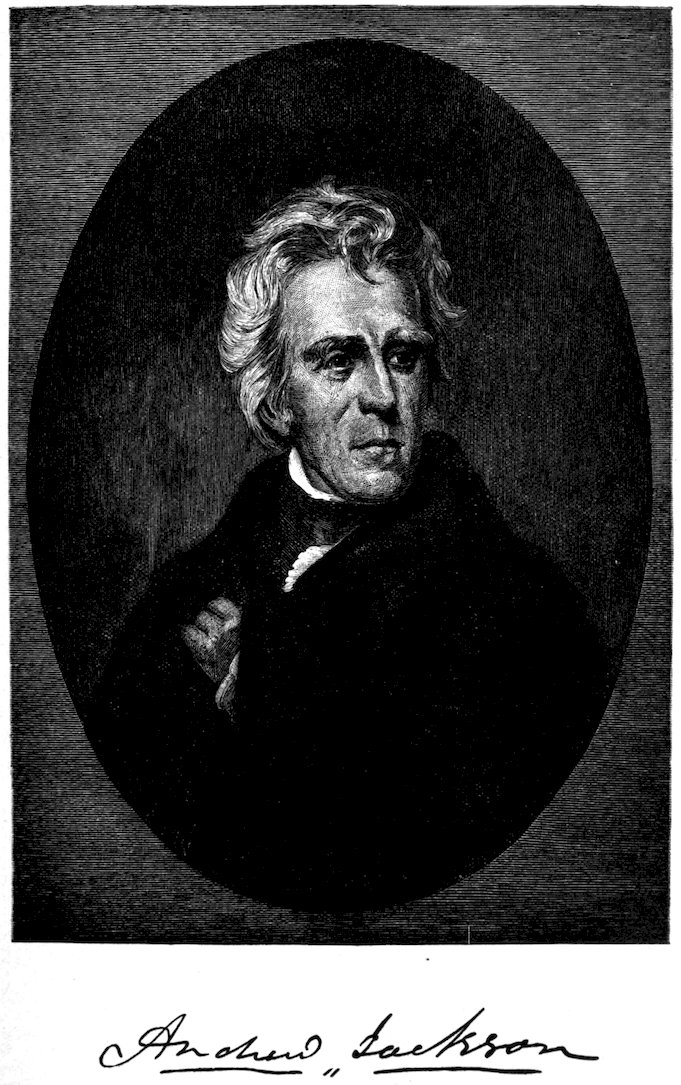
30President Jackson in his first annual message to Congress called attention to the fact of expiration in 1836 of the charter of incorporation granted by the Federal government to a moneyed institution called The Bank of the United States, which was originally designed to assist the government in establishing and maintaining a uniform and sound currency. He seriously doubted the constitutionality and expediency of the law creating the bank, and was opposed to a renewal of the charter. His view of the matter was that if such an institution was deemed a necessity it should be made a national one, in the sense of being founded on the credit of the government and its revenues, and not a corporation independent from and not a part of the government. The House of Representatives was strongly in favor of the renewal of the charter, and several of its committees made elaborate, ample and argumentative reports upon the subject. These reports were the subject of newspaper and pamphlet publication; and lauded for their power and excellence, and triumphant refutation of all the President’s opinions. Thus was the “war of the Bank” commenced at once in Congress, and in the public press; and openly at the instance of the Bank itself, which, forgetting its position as an institution of the government, for the convenience of the government, set itself up as a power, and struggled for continued existence, by demand for renewal of its charter. It allied itself at the same time to the political power opposed to the President, joined in all their schemes of protective tariff, and national internal improvement, and became the head of the American system. Its moneyed and political power, numerous interested affiliations, and control over other banks and fiscal institutions, was truly great and extensive, and a power which was exercised and made to be felt during the struggle to such a degree that it threatened a danger to the country and the government almost amounting to a national calamity.
The subject of renewal of the charter was agitated at every succeeding session of Congress down to 1836, and many able speeches made for and against it.
In the month of December, 1831, the National Republicans, as the party was then called which afterward took the name of “whig,” held its convention in Baltimore, and nominated candidates for President and Vice-President, to be voted for at the election in the autumn of the ensuing year. Henry Clay was the candidate for the office of President, and John Sergeant for that of Vice-President. The platform or address to the people presented the party issues which were to be settled at the ensuing election, the chief subjects being the tariff, internal improvement, removal of the Cherokee Indians, and the renewal of the United States Bank charter. Thus the bank question was fully presented as an issue in the election by that part of its friends who classed politically against President Jackson. But it had also Democratic friends without whose aid the re-charter could not be got through Congress, and they labored assiduously for it. The first Bank of the United States, chartered in 1791, was a federal measure, favored by General Hamilton, opposed by Mr. Jefferson, Mr. Madison, and the Republican party; and became a great landmark of party, not merely for the bank itself, but for the latitudinarian construction of the constitution in which it was founded, and the precedent it established that Congress might in its discretion do what it pleased, under the plea of being “necessary” to carry into effect some granted power. The non-renewal of the charter in 1811, was the act of the Republican party, then in possession of the government, and taking the opportunity to terminate, upon its own limitation, the existence of an institution whose creation they had not been able to prevent. The charter of the second bank, in 1816, was the act of the Republican party, and to aid them in the administration of the government, and, as such, was opposed by the Federal party—not seeming then to understand that, by its instincts, a great moneyed corporation was in sympathy with their own party, and would soon be with it in action—which the bank soon was—and now struggled for a continuation of its existence under the lead of those who had opposed its creation and against the party which effected it. Mr. Webster was a Federal leader on both occasions—against the charter in 1816; for the re-charter in 1832. The bill passed the Senate after a long and arduous contest; and afterwards passed the House, quickly and with little or no contest at all.
It was sent to the President, and vetoed by him July 10, 1832; the message stating his objections being an elaborate review of the subject; the veto being based mainly on the unconstitutionality of the measure. The veto was sustained. Following this the President after the adjournment removed from the bank the government deposits, and referred to that fact in his next annual message on the second day of December, 1833, at the opening of the first session of the twenty-third Congress. Accompanying it was the report of the Secretary of the Treasury, Hon. Roger B. Taney, afterwards Chief Justice of the Supreme Court of the United States, giving the reasons of the government for the withdrawal of the public funds. Long and bitter was the contest between the President on the one side and the Bank and its supporters in the Senate on the other side. The conduct of the Bank produced distress throughout the country, and was so intended to coerce the President. Distress petitions flooded Congress, and the Senate even passed resolutions of censure of the President. The latter, however, held firm in his position. A committee of investigation was appointed by the House of Representatives to inquire into the causes of the commercial embarrassment and the public distress complained of in the numerous distress memorials presented to the two Houses during the session; and whether the Bank had been instrumental, through its management of money, in producing the distress and embarrassment of which so much complaint was made; to 31inquire whether the charter of the Bank had been violated, and what corruptions and abuses, if any, existed in its management; and to inquire whether the Bank had used its corporate power or money to control the press, to interpose in politics, or to influence elections. The committee were granted ample powers for the execution of these inquiries. It was treated with disdain and contempt by the Bank management; refused access to the books and papers, and the directors and president refused to be sworn and testify. The committee at the next session made report of their proceedings, and asked for warrants to be issued against the managers to bring them before the Bar of the House to answer for contempt; but the friends of the Bank in the House were able to check the proceedings and prevent action being taken. In the Senate, the President was sought to be punished by a declination by that body to confirm the President’s nomination of the four government directors of the Bank, who had served the previous year; and their re-nomination after that rejection again met with a similar fate. In like manner his re-nomination of Roger B. Taney to be Secretary of the Treasury was rejected, for the action of the latter in his support of the President and the removal of the public deposits. The Bank had lost much ground in the public estimation by resisting the investigation ordered and attempted by the House of Representatives, and in consequence the Finance Committee of the Senate made an investigation, with so weak an attempt to varnish over the affairs and acts of the corporation that the odious appellation of “white-washing committee” was fastened upon it. The downfall of the Bank speedily followed; it soon afterwards became a total financial wreck, and its assets and property were seized on executions. With its financial failure it vanished from public view, and public interest in it and concern with it died out.
About the beginning of March, 1831, a pamphlet was issued in Washington, by Mr. John C. Calhoun, the Vice-President, and addressed to the people of the United States, explaining the cause of a difference which had taken place between himself and the President, General Jackson, instigated as the pamphlet alleged, by Mr. Van Buren, and intended to make trouble between the first and second officers of the government, and to effect the political destruction of himself (Mr. Calhoun) for the benefit of the contriver of the quarrel, the then Secretary of State, and indicated as a candidate for the presidential succession upon the termination of Jackson’s term. The differences grew out of certain charges against General Jackson respecting his conduct during the Seminole war which occurred in the administration of President Monroe. The President justified himself in published correspondence, but the inevitable result followed—a rupture between the President and Vice-President—which was quickly followed by a breaking up and reconstructing the Cabinet. Some of its members classed as the political friends of Mr. Calhoun, and could hardly be expected to remain as ministers to the President. Mr. Van Buren resigned; a new Cabinet was appointed and confirmed. This change in the Cabinet made a great figure in the party politics of the day, and filled all the opposition newspapers, and had many sinister reasons assigned to it—all to the prejudice of General Jackson and Mr. Van Buren.
It is interesting to note here that during the administration of President Jackson,—in the year 1833,—the Congress of the United States, as the consequence of the earnest efforts in that behalf, of Col. R. M. Johnson, of Kentucky, aided by the recommendation and support of the President, passed the first laws, abolishing imprisonment for debt, under process from the Courts of the United States: the only extent to which an act of Congress could go, by force of its enactments; but by force of example and influence, has led to the cessation of the practice of imprisoning debtors, in all, or nearly all, of the States and Territories of the Union; and without the evil consequences which had been dreaded from the loss of this remedy over the person. The act was a total abolition of the practice, leaving in full force all the remedies against fraudulent evasions of debt.
The American system, and especially its prominent feature of a high protective tariff was put in issue, in the Presidential canvass of 1832; and the friends of that system labored diligently in Congress in presenting its best points to the greatest advantage; and staking its fate upon the issue of the election. It was lost; not only by the result of the main contest, but by that of the congressional election which took place simultaneously with it. All the States dissatisfied with that system, were satisfied with the view of its speedy and regular extinction, under the legislation of the approaching session of Congress, excepting only South Carolina. She has held aloof from the Presidential contest, and cast her electoral votes for persons who were not candidates—doing nothing to aid the election of General Jackson, with whom her interests were apparently identified. On the 24th November, 1832, two weeks after the election which decided the fate of the tariff, that State issued an “Ordinance to nullify certain acts of the Congress of the United States, purporting to be laws laying duties and imposts on the importation 32of foreign commodities.” It declared that the Congress had exceeded its constitutional powers in imposing high and excessive duties on the theory of “protection,” had unjustly discriminated in favor of one class or employment, at the expense and to the injury and oppression of other classes and individuals; that said laws were in consequence not binding on the State and its citizens; and declaring its right and purpose to enact laws to prevent the enforcement and arrest the operation of said acts and parts of the acts of the Congress of the United States within the limits of that State after the first day of February following. This ordinance placed the State in the attitude of forcible resistance to the laws of the United States, to take effect on the first day of February next ensuing—a date prior to the meeting of the next Congress, which the country naturally expected would take some action in reference to the tariff laws complained of. The ordinance further provided that if, in the meantime, any attempt was made by the federal government to enforce the obnoxious laws, except through the tribunals, all the officers of which were sworn against them, the fact of such attempt was to terminate the continuance of South Carolina in the Union—to absolve her from all connection with the federal government—and to establish her as a separate government, wholly unconnected with the United States or any State. The ordinance of nullification was certified by the Governor of South Carolina to the President of the United States, and reached him in December of the same year; in consequence of which he immediately issued a proclamation, exhorting the people of South Carolina to obey the laws of Congress; pointing out and explaining the illegality of the procedure; stating clearly and distinctly his firm determination to enforce the laws as became him as Executive, even by resort to force if necessary. As a state paper, it is important as it contains the views of General Jackson regarding the nature and character of our federal government, expressed in the following language: “The people of the United States formed the constitution, acting through the State Legislatures in making the compact, to meet and discuss its provisions, and acting in separate conventions when they ratified those provisions; but, the terms used in the constitution show it to be a government in which the people of all the States collectively are represented. We are one people in the choice of President and Vice-President. Here the States have no other agency than to direct the mode in which the votes shall be given. * * * The people, then, and not the States, are represented in the executive branch. * * * In the House of Representatives the members are all representatives of the United States, not representatives of the particular States from which they come. They are paid by the United States, not by the State, nor are they accountable to it for any act done in the performance of their legislative functions. * * *
“The constitution of the United States, then, forms a government, not a league; and whether it be formed by a compact between the States, or in any other manner, its character is the same. It is a government in which all the people are represented, which operates directly on the people individually, not upon the States—they retained all the power they did not grant. But each State, having expressly parted with so many powers as to constitute, jointly with the other States, a single nation, cannot, from that period, possess any right to secede, because such secession does not break a league, but destroys the unity of the nation, and any injury to that unity, is not only a breach which could result from the contravention of a compact, but it is an offence against the whole Union. To say that any State may at pleasure secede from the Union, is to say that the United States are not a nation; because it would be a solecism to contend that any part of a nation might dissolve its connection with the other parts, to their injury or ruin, without committing any offence.”
Without calling on Congress for extraordinary powers, the President in his annual message, merely adverted to the attitude of the State, and proceeded to meet the exigency by the exercise of the powers he already possessed. The proceedings in South Carolina not ceasing, and taking daily a more aggravated form in the organization of troops, the collection of arms and of munitions of war, and in declarations hostile to the Union, he found it necessary early in January to report the facts to Congress in a special message, and ask for extraordinary powers. Bills for the reduction of the tariff were early in the Session introduced into both houses, while at the same time the President, though not relaxing his efforts towards a peaceful settlement of the difficulty, made steady preparations for enforcing the law. The result of the bills offered in the two Houses of Congress, was the passage of Mr. Clay’s “compromise” bill on the 12th of February 1833, which radically changed the whole tariff system.
The President in his message on the South Carolina proceedings had recommended to Congress the revival of some acts, heretofore in force, to enable him to execute the laws in that State; and the Senate’s committee on the judiciary had reported a bill accordingly early in the 33session. It was immediately assailed by several members as violent and unconstitutional, tending to civil war, and denounced as “the bloody bill”—the “force bill,” &c. The bill was vindicated in the Senate, by its author, who showed that it contained no novel principle; was substantially a revival of laws previously in force; with the authority superadded to remove the office of customs from one building or place to another in case of need. The bill was vehemently opposed, and every effort made to render it odious to the people, and even extend the odium to the President, and to every person urging or aiding in its passage. Mr. Webster justly rebuked all this vituperation, and justified the bill, both for the equity of its provisions, and the necessity for enacting them. He said, that an unlawful combination threatened the integrity of the Union; that the crisis called for a mild, temperate, forbearing but inflexibly firm execution of the laws; and finally, that public opinion sets with an irresistible force in favor of the Union, in favor of the measures recommended by the President, and against the new doctrines which threatened the dissolution of the Union. The support which Mr. Webster gave to these measures was the regular result of the principles which he laid down in his first speeches against nullification in the debate with Mr. Hayne, and he could not have done less without being derelict to his own principles then avowed. He supported with transcendent ability, the cause of the constitution and of the country, in the person of a President to whom he was politically opposed, whose gratitude and admiration he earned for his patriotic endeavors. The country, without distinction of party, felt the same; and the universality of the feeling was one of the grateful instances of popular applause and justice when great talents are seen exerting themselves for the good of the country. He was the colossal figure on the political stage during that eventful time; and his labors, splendid in their day, survive for the benefit of distant posterity.
During the discussion over the re-charter of the Bank of the United States, which as before mentioned, occupied the attention of Congress for several years, the country suffered from a money panic, and a general financial depression and distress was generally prevalent. In 1834 a measure was introduced into the House, for equalizing the value of gold and silver, and legalizing the tender of foreign coin, of both metals. The good effects of the bill were immediately seen. Gold began to flow into the country through all the channels of commerce, foreign and domestic; the mint was busy; and specie payment, which had been suspended in the country for thirty years, was resumed, and gold and silver became the currency of the land; inspiring confidence in all the pursuits of industry.
As indicative of the position of the democratic party at that date, on the subject of the kind of money authorized by the Constitution, Mr. Benton’s speech in the Senate is of interest. He said: “In the first place, he was one of those who believed that the government of the United States was intended to be a hard-money government; that it was the intention and the declaration of the Constitution of the United States, that the federal currency should consist of gold and silver, and that there is no power in Congress to issue, or to authorize any company of individuals to issue, any species of federal paper currency whatsoever. Every clause in the Constitution (said Mr. B.) which bears upon the subject of money—every early statute of Congress which interprets the meaning of these clauses—and every historic recollection which refers to them, go hand in hand in giving to that instrument the meaning which this proposition ascribes to it. The power granted to Congress to coin money is an authority to stamp metallic money, and is not an authority for emitting slips of paper containing promises to pay money. The authority granted to Congress to regulate the value of coin, is an authority to regulate the value of the metallic money, not of paper. The prohibition upon the States against making anything but gold and silver a legal tender, is a moral prohibition, founded in virtue and honesty, and is just as binding upon the Federal Government as upon the State Governments; and that without a written prohibition; for the difference in the nature of the two governments is such, that the States may do all things which they are not forbid to do; and the Federal Government can do nothing which it is not authorized by the Constitution to do. The framers of the Constitution (said Mr. B.) created a hard-money government. They intended the new government to recognize nothing for money but gold and silver; and every word admitted into the Constitution, upon the subject of money, defines and establishes that sacred intention.
Legislative enactment came quickly to the aid of constitutional intention and historic recollection. The fifth statute passed at the first session of the first Congress that ever sat under the present Constitution was full and explicit on this head. It declared, “that the fees and duties payable to the federal government shall be received in gold and silver coin only.” It was under General Hamilton, as Secretary of the Treasury, in 1791, that the policy 34of the government underwent a change. In the act constituting the Bank of the United States, he brought forward his celebrated plan for the support of the public credit—that plan which unfolded the entire scheme of the paper system and immediately developed the great political line between the federalists and the republicans. The establishment of a national bank was the leading and predominant feature of that plan; and the original report of the secretary, in favor of establishing the bank, contained this fatal and deplorable recommendation: “The bills and notes of the bank, originally made payable, or which shall have become payable, on demand, in gold and silver coin, shall be receivable in all payments to the United States.” From the moment of the adoption of this policy, the moneyed character of the government stood changed and reversed. Federal bank notes took the place of hard-money; and the whole edifice of the government slid, at once, from the solid rock of gold and silver money, on which its framers had placed it, into the troubled and tempestuous ocean of paper currency.
The first session of the 35th Congress opened December 1835. Mr. James K. Polk was elected Speaker of the House by a large majority over Mr. John Bell, the previous Speaker; the former being supported by the administration party, and the latter having become identified with those who, on siding with Mr. Hugh L. White as a candidate for the presidency, were considered as having divided from the democratic party. The chief subject of the President’s message was the relations of our country with France relative to the continued non-payment of the stipulated indemnity provided for in the treaty of 1831 for French spoliations of American shipping. The obligation to pay was admitted, and the money even voted for that purpose; but offense was taken at the President’s message, and payment refused until an apology should be made. The President commented on this in his message, and the Senate had under consideration measures authorizing reprisals on French shipping. At this point Great Britain offered her services as mediator between the nations, and as a result the indemnity was shortly afterwards paid.
Agitation of the slavery question in the United States really began about this time. Evil-disposed persons had largely circulated through the Southern states, pamphlets and circulars tending to stir up strife and insurrection; and this had become so intolerable that it was referred to by the President in his message. Congress at the session of 1836 was flooded with petitions and memorials urging federal interference to abolish slavery in the States; beginning with the petition of the Society of Friends of Philadelphia, urging the abolition of slavery in the District of Columbia. These petitions were referred to Committees after an acrimonious debate as to whether they should be received or not. The position of the government at that time is embodied in the following resolution which was adopted in the House of Representatives as early as 1790, and substantially reaffirmed in 1836, as follows: “That Congress have no authority to interfere in the emancipation of slaves, or in the treatment of them within any of the States; it remaining with the several States to provide any regulations therein which humanity and true policy may require.”
In the Summer preceding the Presidential election of 1836, a measure was introduced into Congress, which became very nearly a party measure, and which in its results proved disastrous to the Democratic party in after years. It was a plan for distributing the public land money among the States either in the shape of credit distribution, or in the disguise of a deposit of surplus revenue; and this for the purpose of enhancing the value of the State stocks held by the United States Bank, which institution, aided by the party which it favored, led by Mr. Clay, was the prime mover in the plan. That gentleman was the author of the scheme, and great calculations were made by the party which favored the distribution upon its effect in adding to their popularity. The Bill passed the Senate in its original form, but met with less favor in the House where it was found necessary. To effectuate substantially the same end, a Senate Bill was introduced to regulate the keeping of the public money in the deposit banks, and this was turned into distribution of the surplus public moneys with the States, in proportion to their representation in Congress, to be returned when Congress should call for it; and this was called a deposit with the States, and the faith of the States pledged for a return of the money. It was stigmatized by its opponents in Congress, as a distribution in disguise—as a deposit never to be reclaimed; as a miserable evasion of the Constitution; as an attempt to debauch the people with their own money; as plundering instead of defending the country. The Bill passed both houses, mainly by the efforts of a half dozen aspirants to the Presidency, who sought to thus increase their popularity. They were doomed to disappointment in this respect. Politically, it was no advantage to its numerous and emulous supporters, and of no disservice to its few determined opponents. It was a most unfortunate act, a plain evasion of the Constitution for a bad purpose; and it soon gave a sad overthrow to the democracy and disappointed 35every calculation made upon it. To the States it was no advantage, raising expectations which were not fulfilled, and upon which many of them acted as realities. The Bill was signed by the President, but it is simple justice to him to say that he did it with a repugnance of feeling, and a recoil of judgment, which it required great efforts of his friends to overcome, and with a regret for it afterwards which he often and publicly expressed. In a party point of view, the passage of this measure was the commencement of calamities, being an efficient cause in that general suspension of specie payments, which quickly occurred, and brought so much embarrassment on the Van Buren administration, ending in the great democratic defeat of 1840.
The presidential election of 1836 resulted in the choice of the democratic candidate, Mr. Van Buren, who was elected by 170 electoral votes; his opponent, General Harrison, receiving seventy-three electoral votes. Scattering votes were given for Mr. Webster, Mr. Mangum, and Mr. Hugh L. White, the last named representing a fragment of the democracy who, in a spirit of disaffection, attempted to divide the democratic party and defeat Mr. Van Buren. At the opening of the second session of the twenty-fourth Congress, December, 1836, President Jackson delivered his last annual message, under circumstances exceedingly gratifying to him. The powerful opposition in Congress had been broken down, and he had the satisfaction of seeing full majorities of ardent and tried friends in each House. The country was in peace and friendship with all the world; all exciting questions quieted at home; industry in all its branches prosperous, and the revenue abundant. And as a happy sequence of this state of affairs, the Senate on the 16th of March, 1837, expunged from the Journal the resolution, adopted three years previously, censuring the President for ordering the removal of the deposits of public money in the United States Bank. He retired from the presidency with high honors, and died eight years afterwards at his home, the celebrated “Hermitage,” in Tennessee, in full possession of all his faculties, and strong to the last in the ruling passion of his soul—love of country.
The 4th of March, 1837, ushered in another Democratic administration—the beginning of the term of Martin Van Buren as President of the United States. In his inaugural address he commented on the prosperous condition of the country, and declared it to be his policy to strictly abide by the Constitution as written—no latitudinarian constructions permitted, or doubtful powers assumed; that his political chart should be the doctrines of the democratic school, as understood at the original formation of parties.
The President, however, was scarcely settled in his new office when a financial panic struck the country with irresistible force. A general suspension of the banks, a depreciated currency, and insolvency of the federal treasury were at hand. The public money had been placed in the custody of the local banks, and the notes of all these banks, and of all others in the country, were received in payment of public dues. On the 10th of May, 1837, the banks throughout the country suspended specie payments. The stoppage of the deposit banks was the stoppage of the Treasury. Non-payment by the government was an excuse for non-payment by others. The suspension was now complete; and it was evident, and as good as admitted by those who had made it, that it was the effect of contrivance on the part of politicians and the so-called Bank of the United States (which, after the expiration of its national charter, had become a State corporation chartered by the Legislature of Pennsylvania in January, 1836) for the purpose of restoring themselves to power. The whole proceeding became clear to those who could see nothing while it was in progress. Even those of the democratic party whose votes had helped to do the mischief, could now see that the attempt to deposit forty millions with the States was destruction to the deposit banks; that the repeal of President Jackson’s order, known as the “specie circular”—requiring payment for public lands to be in coin—was to fill the treasury with paper money, to be found useless when wanted; that distress was purposely created to throw blame of it upon the party in power; that the promptitude with which the Bank of the United States had been brought forward as a remedy for the distress, showed that it had been held in reserve for that purpose; and the delight with which the whig party saluted the general calamity, showed that they considered it their own passport to power. Financial embarrassment and general stagnation of business diminished the current receipts from lands and customs, and actually caused an absolute deficit in the public treasury. In consequence, the President found it an inexorable necessity to issue his proclamation convening Congress in extra session.
The first session of the twenty-fifth Congress met in extra session, at the call of the President, on the first Monday of September, 1837. The message was a review of the events and causes which had brought about the panic; a defense of the policy of the “specie circular,” and a recommendation to break off all connection with any bank of issue in any form; looking to the establishment of an Independent Treasury, 36and that the Government provide for the deficit in the treasury by the issue of treasury notes and by withholding the deposit due to the States under the act then in force. The message and its recommendations were violently assailed both in the Senate and House by able and effective speakers, notably by Messrs. Clay and Webster, and also by Mr. Caleb Cushing, of Massachusetts, who made a formal and elaborate reply to the whole document under thirty-two distinct heads, and reciting therein all the points of accusation against the democratic policy from the beginning of the government down to that day. The result was that the measures proposed by the Executive were in substance enacted; and their passage marks an era in our financial history—making a total and complete separation of Bank and State, and firmly establishing the principle that the government revenues should be receivable in coin only.
The measures of consequence discussed and adopted at this session, were the graduation of price of public lands under the pre-emption system, which was adopted; the bill to create an independent Treasury, which passed the Senate, but failed in the House; and the question of the re-charter of the district banks, the proportion for reserve, and the establishment of such institutions on a specie basis. The slavery question was again agitated in consequence of petitions from citizens and societies in the Northern States, and a memorial from the General Assembly of Vermont, praying for the abolition of slavery in the District of Columbia and territories, and for the exclusion of future slave states from the Union. These petitions and memorials were disposed of adversely; and Mr. Calhoun, representing the ultra-Southern interest, in several able speeches, approved of the Missouri compromise, he urged and obtained of the Senate several resolutions declaring that the federal government had no power to interfere with slavery in the States; and that it would be inexpedient and impolitic to interfere, abolish or control it in the District of Columbia and the territories. These movements for and against slavery in the session of 1837–38 deserve to be noticed, as of disturbing effect at the time, and as having acquired new importance from subsequent events.
The first session of the twenty-sixth Congress opened December, 1839. The organization of the House was delayed by a closely and earnestly contested election from the State of New Jersey. Five Democrats claiming seats as against an equal number of Whigs. Neither set was admitted until after the election of Speaker, which resulted in the choice of Robert M. T. Hunter, of Virginia, the Whig candidate, who was elected by the full Whig vote with the aid of a few democrats—friends of Mr. Calhoun, who had for several previous sessions been acting with the Whigs on several occasions. The House excluding the five contested seats from New Jersey, was really Democratic; having 122 members, and the Whigs 113 members. The contest for the Speakership was long and arduous, neither party adhering to its original caucus candidate. Twenty scattering votes, eleven of whom were classed as Whigs, and nine as Democrats, prevented a choice on the earlier ballots, and it was really Mr. Calhoun’s Democratic friends uniting with a solid Whig vote on the final ballot that gained that party the election. The issue involved was a vital party question as involving the organization of the House. The chief measure, of public importance, adopted at this session of Congress was an act to provide for the collection, safe-keeping, and disbursing of the public money. It practically revolutionized the system previously in force, and was a complete and effectual separation of the federal treasury and the Government, from the banks and moneyed corporations of the States. It was violently opposed by the Whig members, led by Mr. Clay, and supported by Mr. Cushing, but was finally passed in both Houses by a close vote.
At this time, and in the House of Representatives, was exhibited for the first time in the history of Congress, the present practice of members “pairing off,” as it is called; that is to say, two members of opposite political parties, or of opposite views on any particular subject, agreeing to absent themselves from the duties of the House, for the time being. The practice was condemned on the floor of the House by Mr. John Quincy Adams, who introduced a resolution: “That the practice, first openly avowed at the present session of Congress, of pairing off, involves, on the part of the members resorting to it, the violation of the Constitution of the United States, of an express rule of this House, and of the duties of both parties in the transaction, to their immediate constituents, to this House, and to their country.” This resolution was placed in the calendar to take its turn, but not being reached during the session, was not voted on. That was the first instance of this justly condemned practice, fifty years after the establishment of the Government; but since then it has become common, even inveterate, and is now carried to great lengths.
The last session of the twenty-sixth Congress was barren of measures, and necessarily so, as being the last of our administration superseded by the popular voice, and soon to expire; and therefore restricted by a sense of propriety, during the 37brief remainder of its existence, to the details of business and the routine of service. The cause of this was the result of the presidential election of 1840. The same candidates who fought the battle of 1836 were again in the field. Mr. Van Buren was the Democratic candidate. His administration had been satisfactory to his party, and his nomination for a second term was commended by the party in the different States in appointing their delegates; so that the proceedings of the convention which nominated him were entirely harmonious and formal in their nature. Mr. Richard M. Johnson, the actual Vice-President, was also nominated for Vice-President.
On the Whig ticket, General William Henry Harrison, of Ohio, was the candidate for President, and Mr. John Tyler, of Virginia, for Vice-President. The leading statesmen of the Whig party were again put aside, to make way for a military man, prompted by the example in the nomination of General Jackson, the men who managed presidential elections believing then as now that military renown was a passport to popularity and rendered a candidate more sure of election. Availability—for the purpose—was the only ability asked for. Mr. Clay, the most prominent Whig in the country, and the acknowledged head of the party, was not deemed available; and though Mr. Clay was a candidate before the convention, the proceedings were so regulated that his nomination was referred to a committee, ingeniously devised and directed for the afterwards avowed purpose of preventing his nomination and securing that of General Harrison; and of producing the intended result without showing the design, and without leaving a trace behind to show what was done. The scheme (a modification of which has since been applied to subsequent national conventions, and out of which many bitter dissensions have again and again arisen) is embodied and was executed in and by means of the following resolution adopted by the convention: “Ordered, That the delegates from each State be requested to assemble as a delegation, and appoint a committee, not exceeding three in number, to receive the views and opinions of such delegation, and communicate the same to the assembled committees of all the delegations, to be by them respectively reported to their principals; and that thereupon the delegates from each State be requested to assemble as a delegation, and ballot for candidates for the offices of President and Vice-President, and having done so, to commit the ballot designating the votes of each candidate, and by whom given, to its committee, and thereupon all the committees shall assemble and compare the several ballots, and report the result of the same to their several delegations, together with such facts as may bear upon the nomination; and said delegation shall forthwith reassemble and ballot again for candidates for the above offices, and again commit the result to the above committees, and if it shall appear that a majority of the ballots are for any one man for candidate for President, said committee shall report the result to the convention for its consideration; but if there shall be no such majority, then the delegation shall repeat the balloting until such a majority shall be obtained, and then report the same to the convention for its consideration. That the vote of a majority of each delegation shall be reported as the vote of that State; and each State represented here shall vote its full electoral vote by such delegation in the committee.” This was a sum in political algebra, whose quotient was known, but the quantity unknown except to those who planned it; and the result was—for General Scott, 16 votes; for Mr. Clay, 90 votes; for General Harrison, 148 votes. And as the law of the convention impliedly requires the absorption of all minorities, the 106 votes were swallowed up by the 148 votes and made to count for General Harrison, presenting him as the unanimity candidate of the convention, and the defeated candidates and all their friends bound to join in his support. And in this way the election of 1840 was effected—a process certainly not within the purview of those framers of the constitution who supposed they were giving to the nation the choice of its own chief magistrate.
The contest before the people was a long and bitter one, the severest ever known in the country, up to that time, and scarcely equalled since. The whole Whig party and the large league of suspended banks, headed by the Bank of the United States making its last struggle for a new national charter in the effort to elect a President friendly to it, were arrayed against the Democrats, whose hard-money policy and independent treasury schemes, met with little favor in the then depressed condition of the country. Meetings were held in every State, county and town; the people thoroughly aroused; and every argument made in favor of the respective candidates and parties, which could possibly have any effect upon the voters. The canvass was a thorough one, and the election was carried for the Whig candidates, who received 234 electoral votes coming from 19 States. The remaining 60 electoral votes of the other 9 States, were given to the Democratic candidate; though the popular vote was not so unevenly divided; the actual figures being 1,275,611 for the Whig ticket, against 1,135,761 for the Democratic ticket. It was a complete rout 38of the Democratic party, but without the moral effect of victory.
On March 4, 1841, was inaugurated as President, Gen’l Wm. H. Harrison, the first Chief Magistrate elected by the Whig party, and the first President who was not a Democrat, since the installation of Gen’l Jackson, March 4, 1829. His term was a short one. He issued a call for a special session of Congress to convene the 31st of May following, to consider the condition of the revenue and finances of the country, but did not live to meet it. Taken ill with a fatal malady during the last days of March, he died on the 4th of April following, having been in office just one month. He was succeeded by the Vice-President, John Tyler. Then, for the first time in our history as a government, the person elected to the Vice-Presidency of the United States, by the happening of a contingency provided for in the constitution, had devolved upon him the Presidential office.
The twenty-seventh Congress opened in extra session at the call of the late President, May 31, 1841. A Whig member—Mr. White of Kentucky—was elected Speaker of the House of Representatives. The Whigs had a majority of forty-seven in the House and of seven in the Senate, and with the President and Cabinet of the same political party presented a harmony of aspect frequently wanting during the three previous administrations. The first measure of the new dominant party was the repeal of the independent treasury act passed at the previous session; and the next in order were bills to establish a system of bankruptcy, and for distribution of public land revenue. The former was more than a bankrupt law; it was practically an insolvent law for the abolition of debts at the will of the debtor. It applied to all persons in debt, allowed them to institute the proceedings in the district where the petitioner resided, allowed constructive notices to creditors in newspapers—declared the abolition of the debt where effects were surrendered and fraud not proved; and gave exclusive jurisdiction to the federal courts, at the will of the debtor. It was framed upon the model of the English insolvent debtors’ act of George the Fourth, and embodied most of the provisions of that act, but substituting a release from the debt instead of a release from imprisonment. The bill passed by a close vote in both Houses.
The land revenue distribution bill of this session had its origin in the fact that the States and corporations owed about two hundred millions to creditors in Europe. These debts were in stocks, much depreciated by the failure in many instances to pay the accruing interest—in some instances failure to provide for the principal. These creditors, becoming uneasy, wished the federal government to assume their debts. The suggestion was made as early as 1838, renewed in 1839, and in 1840 became a regular question mixed up with the Presidential election of that year, and openly engaging the active exertions of foreigners. Direct assumption was not urged; indirect by giving the public land revenue to the States was the mode pursued, and the one recommended in the message of President Tyler. Mr. Calhoun spoke against the measure with more than usual force and clearness, claiming that it was unconstitutional and without warrant. Mr. Benton on the same side called it a squandering of the public patrimony, and pointed out its inexpediency in the depleted state of the treasury, apart from its other objectionable features. It passed by a party vote.
This session is remarkable for the institution of the hour rule in the House of Representatives—a very great limitation upon the freedom of debate. It was a Whig measure, adopted to prevent delay in the enactment of pending bills. It was a rigorous limitation, frequently acting as a bar to profitable debate and checking members in speeches which really impart information valuable to the House and the country. No doubt the license of debate has been frequently abused in Congress, as in all other deliberative assemblies, but the incessant use of the previous question, which cuts off all debate, added to the hour rule which limits a speech to sixty minutes (constantly reduced by interruptions) frequently results in the transaction of business in ignorance of what they are about by those who are doing it.