BOOK III. GREAT SPEECHES ON GREAT ISSUES. (continued 3)
Reading edition
It will be recollected, sir, that our great causes of quarrel with Great Britain were her depredations on the northern commerce, and the impressment of New England seamen. From every quarter we were called upon for protection. Importunate as the west is now represented to be on another subject, the importunity of the east on that occasion was far greater. I hold in my hands the evidence of the fact. Here are petitions, memorials, and remonstrances from all parts of New England, setting forth the injustice, the oppressions, the depredations, the insults, the outrages committed by Great Britain against the unoffending commerce and seamen of New England, and calling upon Congress for redress. Sir, I cannot stop to read these memorials. In that from Boston, after stating the alarming and extensive condemnation of our vessels by Great Britain, which threatened “to sweep our commerce from the face of the ocean,” and “to involve our merchants in bankruptcy,” they call upon the government “to assert our rights, and to adopt such measures as will support the dignity and honor of the United States.
From Salem we heard a language still more decisive; they call explicitly for “an appeal to arms,” and pledge their lives and property in support of any measures which Congress might adopt. From Newbury-port an appeal was made “to the firmness and justice of the government to obtain compensation and protection.” It was here, I think, that, when the war was declared, it was resolved “to resist our own government even unto blood.” (Olive Branch, p. 101.)
In other quarters the common language of that day was, that our commerce and our seamen were entitled to protection; and that 3038it was the duty of the government to afford it at every hazard. The conduct of Great Britain, we were then told, was “an outrage upon our national independence.” These clamors, which commenced as early as January, 1806, were continued up to 1812. In a message from the governor of one of the New England States, as late as the 10th October, 1811, this language is held: “A manly and decisive course has become indispensable; a course to satisfy foreign nations, that, while we desire peace, we have the means and the spirit to repel aggression. We are false to ourselves when our commerce, or our territory, is invaded with impunity.”
About this time, however, a remarkable change was observable in the tone and temper of those who had been endeavoring to force the country into a war. The language of complaint was changed into that of insult, and calls for protection converted into reproaches. “Smoke, smoke!” says one writer; “my life on it, our executive has no more idea of declaring war than my grandmother.” “The committee of ways and means,” says another, “have come out with their Pandora’s box of taxes, and yet nobody dreams of war.” “Congress do not mean to declare war; they dare not.” But why multiply examples? An honorable member of the other house, from the city of Boston, [Mr. Quincy,] in a speech delivered on the 3d April, 1812, says, “Neither promises, nor threats, nor asseverations, nor oaths will make me believe that you will go to war. The navigation states are sacrificed, and the spirit and character of the country prostrated by fear and avarice.” “You cannot,” said the same gentleman, on another occasion, “be kicked into a war.”
Well, sir, the war at length came, and what did we behold? The very men who had been for six years clamorous for war, and for whose protection it was waged, became at once equally clamorous against it. They had received a miraculous visitation; a new light suddenly beamed upon their minds; the scales fell from their eyes, and it was discovered that the war was declared from “subserviency to France;” and that Congress, and the executive, “had sold themselves to Napoleon;” that Great Britain had in fact “done us no essential injury;” that she was “the bulwark of our religion;” that where “she took one of our ships, she protected twenty;” and that, if Great Britain had impressed a few of our seamen, it was because “she could not distinguish them from their own.” And so far did this spirit extend, that a committee of the Massachusetts legislature actually fell to calculation, and discovered, to their infinite satisfaction, but to the astonishment of all the world besides, that only eleven Massachusetts sailors had ever been impressed. Never shall I forget the appeals that had been made to the sympathies of the south in behalf of the “thousands of impressed Americans, who had been torn from their families and friends, and immured in the floating dungeons of Britain.” The most touching pictures were drawn of the hard condition of the American sailor, “treated like a slave,” forced to fight the battles of his enemy, “lashed to the mast, to be shot at like a dog.” But, sir, the very moment we had taken up arms in their defence, it was discovered that all these were mere “fictions of the brain;” and that the whole number in the state of Massachusetts was but eleven; and that even these had been “taken by mistake.” Wonderful discovery! The secretary of state had collected authentic lists of no less than six thousand impressed Americans. Lord Castlereagh himself acknowledged sixteen hundred. Calculations on the basis of the number found on board of the Guerriere, the Macedonian, the Java, and other British ships, (captured by the skill and gallantry of those heroes whose achievements are the treasured monuments of their country’s glory,) fixed the number at seven thousand; and yet, it seems, Massachusetts had lost but eleven! Eleven Massachusetts sailors taken by mistake! A cause of war indeed! Their ships too, the capture of which had threatened “universal bankruptcy,” it was discovered that Great Britain was their friend and protector; “where she had taken one she had protected twenty.” Then was the discovery made, that subserviency to France, hostility to commerce, “a determination, on the part of the south and west, to break down the Eastern States,” and especially as reported by a committee of the Massachusetts legislature “to force the sons of commerce to populate the wilderness,” were the true causes of the war. (Olive Branch, pp. 134, 291.) But let us look a little further into the conduct of the peace party of New England at that important crisis. Whatever difference of opinion might have existed as to the causes of the war, the country had a right to expect, that, when once involved in the contest, all America would have cordially united in its support. Sir, the war effected, in its progress, a union of all parties at the south. But not so in New England; there great efforts were made to stir up the minds of the people to oppose it. Nothing was left undone to embarrass the financial operations of the government, to prevent the enlistment of troops, to keep back the men and money of New England from the service of the Union, to force the president from his seat. Yes, sir, “the Island of Elba, or a halter!” were the alternatives they presented to the excellent and venerable James Madison. 3039Sir, the war was further opposed by openly carrying on illicit trade with the enemy, by permitting that enemy to establish herself on the very soil of Massachusetts, and by opening a free trade between Great Britain and America, with a separate custom house. Yes, sir, those who cannot endure the thought that we should insist on a free trade, in time of profound peace, could, without scruple, claim and exercise the right of carrying on a free trade with the enemy in a time of war; and finally by getting up the renowned “Hartford Convention,” and preparing the way for an open resistance to the government, and a separation of the states. Sir, if I am asked for the proof of those things, I fearlessly appeal to the contemporary history, to the public documents of the country, to the recorded opinion and acts of public assemblies, to the declaration and acknowledgments, since made, of the executive and legislature of Massachusetts herself.[79]
Sir, the time has not been allowed me to trace this subject through, even if I had been disposed to do so. But I cannot refrain from referring to one or two documents, which have fallen in my way since this debate began. I read, sir, from the Olive Branch of Matthew Carey, in which are collected “the actings and doings” of the peace party in New England, during the continuance of the embargo and the war. I know the senator from Massachusetts will respect the high authority of his political friend and fellow-laborer in the great cause of “domestic industry.”
In p. 301, et seq., 309 of this work, is a detailed account of the measures adopted in Massachusetts during the war, for the express purpose of embarrassing the financial operations of the government, by preventing loans, and thereby driving our rulers from their seats, and forcing the country into a dishonorable peace. It appears that the Boston banks commenced an operation, by which a run was to be made upon all the banks of the south; at the same time stopping their own discounts; the effect of which was to produce a sudden and almost alarming diminution of the circulating medium, and universal distress over the whole country—“a distress which they failed not to attribute to the unholy war.”
To such an extent was this system carried, that it appears, from a statement of the condition of the Boston banks, made up in January, 1814, that with nearly $5,000,000 of specie in their vaults, they had but $2,000,000 of bills in circulation. It is added by Carey, that at this very time an extensive trade was carried on in British government bills, for which specie was sent to Canada, for the payment of the British troops, then laying waste our northern frontier; and this too at the very moment when New England ships, sailing under British licenses, (a trade declared to be lawful by the courts both of Great Britain and Massachusetts,[80]) were supplying with provisions those very armies destined for the invasion of our own shores. Sir, the author of the Olive Branch, with a holy indignation, denounces these acts as “treasonable;” “giving aid and comfort to the enemy.” I shall not follow his example. But I will ask, With what justice or propriety can the south be accused of disloyalty from that quarter? If we had any evidence that the senator from Massachusetts had admonished his brethren then, he might, with a better grace, assume the office of admonishing us now.
When I look at the measures adopted in Boston, at that day, to deprive the government of the necessary means for carrying on the war, and think of the success and the consequences of these measures, I feel my pride, as an American, humbled in the dust. Hear, sir, the language of that day. I read from pages 301 and 302 of the Olive Branch. “Let no man who wishes to continue the war, by active means, by vote, or lending money, dare to prostrate himself at the altar on the fast day.” “Will federalists subscribe to the loan? Will they lend money to our national rulers? It is impossible. First, because of principle, and secondly, because of principal and interest.” “Do not prevent the abusers of their trust from becoming bankrupt. Do not prevent them from becoming odious to the public, and being replaced by better men.” “Any federalist who lends money to government must go and shake hands with James Madison, and claim fellowship with Felix Grundy.” (I beg pardon of my honorable friend from Tennessee—but 3040he is in good company. I had thought it was “James Madison, Felix Grundy, and the devil.”) Let him no more “call himself a federalist, and a friend to his country: he will be called by others infamous,” &c.
Sir, the spirit of the people sunk under these appeals. Such was the effect produced by them on the public mind, that the very agents of the government (as appears from their public advertisements, now before me) could not obtain loans without a pledge that “the names of the subscribers should not be known.” Here are the advertisements: “The names of all subscribers” (say Gilbert and Dean, the brokers employed by government) “shall be known only to the undersigned.” As if those who came forward to aid their country, in the hour of her utmost need, were engaged in some dark and foul conspiracy, they were assured “that their names should not be known.” Can any thing show more conclusively the unhappy state of public feeling which prevailed at that day than this single fact? Of the same character with these measures was the conduct of Massachusetts in withholding her militia from the service of the United States, and devising measures for withdrawing her quota of the taxes, thereby attempting, not merely to cripple the resources of the country, but actually depriving the government (as far as depended upon her) of all the means of carrying on the war—of the bone, and muscle, and sinews of war—“of man and steel—the soldier and his sword.” But it seems Massachusetts was to reserve her resources for herself—she was to defend and protect her own shores. And how was that duty performed? In some places on the coast neutrality was declared, and the enemy was suffered to invade the soil of Massachusetts, and allowed to occupy her territory until the peace, without one effort to rescue it from his grasp. Nay, more—while our own government and our rulers were considered as enemies, the troops of the enemy were treated like friends—the most intimate commercial relations were established with them, and maintained up to the peace. At this dark period of our national affairs, where was the senator from Massachusetts? How were his political associates employed? “Calculating the value of the Union?” Yes, sir, that was the propitious moment, when our country stood alone, the last hope of the world, struggling for her existence against the colossal power of Great Britain, “concentrated one mighty effort to crush us at a blow;” that was the chosen hour to revive the grand scheme of building up “a great northern confederacy”—a scheme which, it is stated in the work before me, had its origin as far back as the year 1796, and which appears never to have been entirely abandoned.
In the language of the writers of that day, (1796,) “rather than have a constitution such as the anti-federalists were contending for, (such as we are now contending for,) the Union ought to be dissolved;” and to prepare the way for that measure, the same methods were resorted to then that have always been relied on for that purpose, exciting prejudice against the south. Yes, sir, our northern brethren were then told, “that if the negroes were good for food, their southern masters would claim the right to destroy them at pleasure.” (Olive Branch, p. 267.) Sir, in 1814, all these topics were revived. Again we hear of “northern confederacy.” “The slave states by themselves;” “the mountains are the natural boundary;” we want neither “the counsels nor the power of the west,” &c., &c. The papers teemed with accusations against the south and the west, and the calls for a dissolution of all connection with them were loud and strong. I cannot consent to go through the disgusting details. But to show the height to which the spirit of disaffection was carried, I will take you to the temple of the living God, and show you that sacred place, which should be devoted to the extension of “peace on earth and good will towards men,” where “one day’s truce ought surely to be allowed to the dissensions and animosities of mankind,” converted into a fierce arena of political strife, where, from the lips of the priest, standing between the horns of the altar, there went forth the most terrible denunciations against all who should be true to their country in the hour of her utmost need.
“If you do not wish,” said a reverend clergyman, in a sermon preached in Boston, on the 23d of July, 1812, “to become the slaves of those who own slaves, and who are themselves the slaves of French slaves, you must either, in the language of the day, CUT THE CONNECTION or so far alter the national compact as to insure to yourselves a due share in the government.” (Olive Branch, p. 319.) “The Union,” says the same writer, (p. 320,) “has been long since virtually dissolved, and it is full time that this part of the disunited states should take care of itself.”
Another reverend gentleman, pastor of a church at Medford, (p. 321,) issues his anathema—“Let him stand accursed”—against all, all who by their “personal services,” for “loans of money,” “conversation,” or “writing,” or “influence,” give countenance or support to the righteous war, in the following terms: “That man is an accomplice in the wickedness—he loads his conscience with the blackest crimes—he brings the guilt of blood upon his soul, and in the sight of God and his law, he is a MURDERER.”
One or two more quotations, sir, and I 3041shall have done. A reverend doctor of divinity, the pastor of a church at Byfield, Massachusetts, on the 7th of April, 1814, thus addresses his flock, (p. 321:) “The Israelites became weary of yielding the fruit of their labor to pamper their splendid tyrants. They left their political woes. They separated; where is our Moses? Where the rod of his miracles? Where is our Aaron? Alas! no voice from the burning bush has directed them here.”
“We must trample on the mandates of despotism, or remain slaves forever,” (p. 322.) “You must drag the chains of Virginian despotism, unless you discover some other mode of escape.” “Those Western States which have been violent for this abominable war—those states which have thirsted for blood—God has given them blood to drink,” (p. 323.) Mr. President, I can go no further. The records of the day are full of such sentiments, issued from the press, spoken in public assemblies, poured out from the sacred desk. God forbid, sir, that I should charge the people of Massachusetts with participating in these sentiments. The south and the west had there their friends—men who stood by their country, though encompassed all around by their enemies. The senator from Massachusetts (Mr. Silsbee) was one of them; the senator from Connecticut (Mr. Foot) was another; and there are others now on this floor. The sentiments I have read were the sentiments of a party embracing the political associates of the gentleman from Massachusetts. If they could only be found in the columns of a newspaper, in a few occasional pamphlets, issued by men of intemperate feeling, I should not consider them as affording any evidence of the opinions even of the peace party of New England. But, sir, they were the common language of that day; they pervaded the whole land; they were issued from the legislative hall, from the pulpit, and the press. Our books are full of them; and there is no man who now hears me but knows that they were the sentiments of a party, by whose members they were promulgated. Indeed, no evidence of this would seem to be required beyond the fact that such sentiments found their way even into the pulpits of New England. What must be the state of public opinion, where any respectable clergyman would venture to preach, and to print, sermons containing the sentiments I have quoted? I doubt not the piety or moral worth of these gentlemen. I am told they were respectable and pious men. But they were men, and they “kindled in a common blaze.” And now, sir, I must be suffered to remark that, at this awful and melancholy period of our national history, the gentleman from Massachusetts, who now manifests so great a devotion to the Union, and so much anxiety lest it should be endangered from the south, was “with his brethren in Israel.” He saw all these things passing before his eyes—he heard these sentiments uttered all around him. I do not charge that gentleman with any participation in these acts, or with approving of these sentiments.
But I will ask, why, if he was animated by the same sentiments then which he now professes, if he can “augur disunion at a distance, and snuff up rebellion in every tainted breeze,” why did he not, at that day, exert his great talents and acknowledged influence with the political associates by whom he was surrounded, and who then, as now, looked up to him for guidance and direction, in allaying this general excitement, in pointing out to his deluded friends the value of the Union, in instructing them that, instead of looking “to some prophet to lead them out of the land of Egypt,” they should become reconciled to their brethren, and unite with them in the support of a just and necessary war? Sir, the gentleman must excuse me for saying, that if the records of our country afforded any evidence that he had pursued such a course, then, if we could find it recorded in the history of those times, that, like the immortal Dexter, he had breasted that mighty torrent which was sweeping before it all that was great and valuable in our political institutions—if like him he had stood by his country in opposition to his party, sir, we would, like little children, listen to his precepts, and abide by his counsels.
As soon as the public mind was sufficiently prepared for the measure, the celebrated Hartford Convention was got up; not as the act of a few unauthorized individuals, but by the authority of the legislature of Massachusetts; and, as has been shown by the able historian of that convention, in accordance with the views and wishes of the party of which it was the organ. Now, sir, I do not desire to call in question the motives of the gentlemen who composed that assembly. I knew many of them to be in private life accomplished and honorable men, and I doubt not there were some among them who did not perceive the dangerous tendency of their proceedings. I will even go further, and say, that if the authors of the Hartford Convention believed that “gross, deliberate, and palpable violations of the constitution” had taken place, utterly destructive of their rights and interests, I should be the last man to deny their right to resort to any constitutional measures for redress. But, sir, in any view of the case, the time when and the circumstances under which that convention assembled, as well as the measures recommended, render their conduct, in my opinion 3042wholly indefensible. Let us contemplate, for a moment, the spectacle then exhibited to the view of the world. I will not go over the disasters of the war, nor describe the difficulties in which the government was involved. It will be recollected that its credit was nearly gone, Washington had fallen, the whole coast was blockaded, and an immense force, collected in the West Indies, was about to make a descent, which it was supposed we had no means of resisting. In this awful state of our public affairs, when the government seemed almost to be tottering on its base, when Great Britain, relieved from all her other enemies, had proclaimed her purpose of “reducing us to unconditional submission,” we beheld the peace party of New England (in the language of the work before us) pursuing a course calculated to do more injury to their country, “and to render England more effective service than all her armies.” Those who could not find it in their hearts to rejoice at our victories sang Te Deum at the King’s Chapel in Boston, for the restoration of the Bourbons. Those who could not consent to illuminate their dwellings for the capture of the Guerriere could give no visible tokens of their joy at the fall of Detroit. The “beacon fires” of their hills were lighted up, not for the encouragement of their friends, but as signals to the enemy; and in the gloomy hours of midnight, the very lights burned blue. Such were the dark and portentous signs of the times, which ushered into being the renowned Hartford Convention. That convention met, and, from their proceedings, it appears that their chief object was to keep back the money and men of New England from the service of the Union, and to effect radical changes in the government—changes that can never be effected without a dissolution of the Union.
Let us now, sir, look at their proceedings. I read from “A Short Account of the Hartford Convention,” (written by one of its members,) a very rare book, of which I was fortunate enough, a few years ago, to obtain a copy. [Here Mr. H. read from the proceedings.[81]]
It is unnecessary to trace the matter further, or to ask what would have been the next chapter in this history, if the measures recommended had been carried into effect; and if, with the men and money of New England withheld from the government of the United States, she had been withdrawn from the war; if New Orleans had fallen into the hands of the enemy; and if, without troops and almost destitute of money, the Southern and the Western States had been thrown upon their own resources, for the prosecution of the war, and the recovery of New Orleans.
Sir, whatever may have been the issue of the contest, the Union must have been dissolved. But a wise and just Providence, which “shapes our ends, roughhew them as we will,” gave us the victory, and crowned our efforts with a glorious peace. The ambassadors of Hartford were seen retracing their steps from Washington, “the bearers of the glad tidings of great joy.” Courage and patriotism triumphed—the country was saved—the Union was preserved. And are we, Mr. President, who stood by our country then, who threw open our coffers, who bared our bosoms, who freely perilled all in that conflict, to be reproached with want of attachment to the Union? If, sir, we are to have lessons of patriotism read to us, they must come from a different quarter. The senator from 3043Massachusetts, who is now so sensitive on all subjects connected with the Union, seems to have a memory forgetful of the political events that have passed away. I must therefore refresh his recollection a little further on these subjects. The history of disunion has been written by one whose authority stands too high with the American people to be questioned; I mean Thomas Jefferson. I know not how the gentleman may receive this authority. When that great and good man occupied the presidential chair, I believe he commanded no portion of the gentleman’s respect.
I hold in my hand a celebrated pamphlet on the embargo, in which language is held, in relation to Mr. Jefferson, which my respect for his memory will prevent me from reading, unless any gentleman should call for it. But the senator from Massachusetts has since joined in singing hosannas to his name; he has assisted at his apotheosis, and has fixed him as “a brilliant star in the clear upper sky.” I hope, therefore, he is now prepared to receive with deference and respect the high authority of Mr. Jefferson. In the fourth volume of his Memoirs, which has just issued from the press, we have the following history of disunion from the pen of that illustrious statesman: “Mr. Adams called on me pending the embargo, and while endeavors were making to obtain its repeal: he spoke of the dissatisfaction of the eastern portion of our confederacy with the restraints of the embargo then existing, and their restlessness under it; that there was nothing which might not be attempted to rid themselves of it; that he had information of the most unquestionable authority, that certain citizens of the Eastern States (I think he named Massachusetts particularly) were in negotiation with agents of the British government, the object of which was an agreement that the New England States should take no further part in the war (the commercial war, the ‘war of restrictions,’ as it was called) then going on, and that, without formally declaring their separation from the Union, they should withdraw from all aid and obedience to them, &c. From that moment,” says Mr. J., “I saw the necessity of abandoning it, [the embargo,] and, instead of effecting our purpose by this peaceful measure, we must fight it out or break the Union.” In another letter Mr. Jefferson adds, “I doubt whether a single fact known to the world will carry as clear conviction to it of the correctness of our knowledge of the treasonable views of the federal party of that day, as that disclosed by this, the most nefarious and daring attempt to dissever the Union, of which the Hartford Convention was a subsequent chapter; and both of these having failed, consolidation becomes the fourth chapter of the next book of their history. But this opens with a vast accession of strength, from their younger recruits, who, having nothing in them of the feelings and principles of ’76, now look to a single and splendid government, &c., riding and ruling over the plundered ploughman and beggared yeomanry.” (vol. iv. pp. 419, 422.)
The last chapter, says Mr. Jefferson, of that history, is to be found in the conduct of those who are endeavoring to bring about consolidation; ay, sir, that very consolidation for which the gentleman from Massachusetts is contending—the exercise by the federal government of powers not delegated in relation to “internal improvements” and “the protection of manufactures.” And why, sir, does Mr. Jefferson consider consolidation as leading directly to disunion? Because he knew that the exercise, by the federal government, of the powers contended for, would make this “a government without limitation of powers,” the submission to which he considered as a greater evil than disunion itself. There is one chapter in this history, however, which Mr. Jefferson has not filled up; and I must therefore supply the deficiency. It is to be found in the protests made by New England against the acquisition of Louisiana. In relation to that subject, the New England doctrine is thus laid down by one of her learned doctors of that day, now a doctor of laws, at the head of the great literary institution of the east; I mean Josiah Quincy, president of Harvard College. I quote from the speech delivered by that gentleman on the floor of Congress, on the occasion of the admission of Louisiana into the Union.
“Mr. Quincy repeated and justified a remark he had made, which, to save all misapprehension, he had committed to writing, in the following words: If this bill passes, it is my deliberate opinion that it is virtually a dissolution of the Union; that it will free the states from their moral obligation; and as it will be the right of all, so it will be the duty of some, to prepare for a separation, amicably if they can, violently if they must.”
Mr. President, I wish it to be distinctly understood, that all the remarks I have made on this subject are intended to be exclusively applied to a party, which I have described as the “peace party of New England”—embracing the political associates of the senator from Massachusetts—a party which controlled the operations of that state during the embargo and the war, and who are justly chargeable with all the measures I have reprobated. Sir, nothing has been further from my thoughts than to impeach the character or conduct of the people of New England. For their steady habits and hardy virtues I trust I entertain 3044a becoming respect. I fully subscribe to the truth of the description given before the revolution, by one whose praise is the highest eulogy, “that the perseverance of Holland, the activity of France, and the dexterous and firm sagacity of English enterprise, have been more than equalled by this recent people.” The hardy people of New England of the present day are worthy of their ancestors. Still less, Mr. President, has it been my intention to say anything that could be construed into a want of respect for that party, who, have been true to their principles in the worst of times; I mean the democracy of New England.
Sir, I will declare that, highly as I appreciate the democracy of the south, I consider even higher praise to be due to the democracy of New England, who have maintained their principles “through good and through evil report,” who, at every period of our national history, have stood up manfully for “their country, their whole country, and nothing but their country.” In the great political revolution of ’98, they were found united with the democracy of the south, marching under the banner of the constitution, led on by the patriarch of liberty, in search of the land of political promise, which they lived not only to behold, but to possess and to enjoy. Again, sir, in the darkest and most gloomy period of the war, when our country stood singlehanded against “the conqueror of the conquerors of the world,” when all about and around them was dark and dreary, disastrous and discouraging, they stood a Spartan band in that narrow pass, where the honor of their country was to be defended, or to find its grave. And in the last great struggle, involving, as we believe, the very existence of the principle of popular sovereignty, where were the democracy of New England? Where they always have been found, sir, struggling side by side, with their brethren of the south and the west for popular rights, and assisting in that triumph, by which the man of the people was elevated to the highest office in their gift.
Who, then, Mr. President, are the true friends of the Union? Those who would confine the federal government strictly within the limits prescribed by the constitution; who would preserve to the states and the people all powers not expressly delegated; who would make this a federal and not a national Union, and who, administering the government in a spirit of equal justice, would make it a blessing, and not a curse. And who are its enemies? Those who are in favor of consolidation; who are constantly stealing power from the states, and adding strength to the federal government; who, assuming an unwarrantable jurisdiction over the states and the people, undertake to regulate the whole industry and capital of the country. But, sir, of all descriptions of men, I consider those as the worst enemies of the Union, who sacrifice the equal rights which belong to every member of the confederacy to combinations of interested majorities, for personal or political objects. But the gentleman apprehends no evil from the dependence of the states on the federal government; he can see no danger of corruption from the influence of money or of patronage. Sir, I know that it is supposed to be a wise saying that “patronage is a source of weakness;” and in support of that maxim, it has been said, that “every ten appointments make a hundred enemies.” But I am rather inclined to think, with the eloquent and sagacious orator now reposing on his laurels on the banks of the Roanoke, that “the power of conferring favors creates a crowd of dependants;” he gave a forcible illustration of the truth of the remark, when he told us of the effect of holding up the savory morsel to the eager eyes of the hungry hounds gathered around his door. It mattered not whether the gift was bestowed on Towzer or Sweetlips, “Tray, Blanche, or Sweetheart;” while held in suspense, they were governed by a nod, and when the morsel was bestowed, expectation of favors of to-morrow kept up the subjection of to-day.
The senator from Massachusetts, in denouncing what he is pleased to call the Carolina doctrine, has attempted to throw ridicule upon the idea that a state has any constitutional remedy, by the exercise of its sovereign authority, against “a gross, palpable, and deliberate violation of the constitution.” He calls it “an idle” or “a ridiculous notion,” or something to that effect, and added, that it would make the Union a “mere rope of sand.” Now, sir, as the gentleman has not condescended to enter into any examination of the question, and has been satisfied with throwing the weight of his authority into the scale, I do not deem it necessary to do more than to throw into the opposite scale the authority on which South Carolina relies; and there, for the present, I am perfectly willing to leave the controversy. The South Carolina doctrine, that is to say, the doctrine contained in an exposition reported by a committee of the legislature in December, 1828, and published by their authority, is the good old republican doctrine of ’98—the doctrine of the celebrated “Virginia Resolutions” of that year, and of “Madison’s Report” of ’99. It will be recollected that the legislature of Virginia, in December, ’98, took into consideration the alien and sedition laws, then considered by all republicans as a gross violation of the constitution of the United States, and on that day passed, among others, the following resolutions,—
3045“The General Assembly doth explicitly and peremptorily declare, that it views the powers of the federal government, as resulting from the compact to which the states are parties, as limited by the plain sense and intention of the instrument constituting that compact, as no further valid than they are authorized by the grants enumerated in that compact; and that in case of a deliberate, palpable, and dangerous exercise of other powers not granted by the said compact, the states who are parties thereto have the right, and are in duty bound, to interpose for arresting the progress of the evil, and for maintaining, within their respective limits, authorities, rights, and liberties, belonging to them.”
In addition to the above resolution, the General Assembly of Virginia “appealed to the other states, in the confidence that they would concur with that commonwealth, that the acts aforesaid [the alien and sedition laws] are unconstitutional, and that the necessary and proper measures would be taken by each for co-operating with Virginia in maintaining unimpaired the authorities, rights, and liberties reserved to the states respectively, or to the people.”
The legislatures of several of the New England States, having, contrary to the expectation of the legislature of Virginia, expressed their dissent from these doctrines, the subject came up again for consideration during the session of 1799, 1800, when it was referred to a select committee, by whom was made that celebrated report which is familiarly known as “Madison’s Report,” and which deserves to last as long as the constitution itself. In that report, which was subsequently adopted by the legislature, the whole subject was deliberately re-examined, and the objections urged against the Virginia doctrines carefully considered. The result was, that the legislature of Virginia reaffirmed all the principles laid down in the resolutions of 1798, and issued to the world that admirable report which has stamped the character of Mr. Madison as the preserver of that constitution which he had contributed so largely to create and establish. I will here quote from Mr. Madison’s report one or two passages which bear more immediately on the point in controversy. “The resolutions, having taken this view of the federal compact, proceed to infer ‘that in case of a deliberate, palpable, and dangerous exercise of other powers the states who are parties thereto have the right, and are in duty bound, to interpose for arresting the progress of the evil, and for maintaining, within their respective limits, the authorities, rights, and liberties appertaining to them.’”
“It appears to your committee to be a plain principle, founded in common sense, illustrated by common practice, and essential to the nature of compacts, that, where resort can be had to no tribunal superior to the authority of the parties, the parties themselves must be the rightful judges in the last resort, whether the bargain made has been pursued or violated. The constitution of the United States was formed by the sanction of the states, given by each in its sovereign capacity. It adds to the stability and dignity, as well as to the authority, of the constitution, that it rests upon this legitimate and solid foundation. The states, then, being the parties to the constitutional compact, and in their sovereign capacity, it follows of necessity that there can be no tribunal above their authority, to decide, in the last resort, whether the compact made by them be violated, and consequently that, as the parties to it, they must decide, in the last resort, such questions as may be of sufficient magnitude to require their interposition.”
“The resolution has guarded against any misapprehension of its object by expressly requiring for such an interposition ‘the case of a deliberate, palpable, and dangerous breach of the constitution, by the exercise of powers not granted by it.’ It must be a case, not of a light and transient nature, but of a nature dangerous to the great purposes for which the constitution was established.
“But the resolution has done more than guard against misconstructions, by expressly referring to cases of a deliberate, palpable, and dangerous nature. It specifies the object of the interposition, which it contemplates, to be solely that of arresting the progress of the evil of usurpation, and of maintaining the authorities, rights, and liberties appertaining to the states, as parties to the constitution.
“From this view of the resolution, it would seem inconceivable that it can incur any just disapprobation from those who, laying aside all momentary impressions, and recollecting the genuine source and object of the federal constitution, shall candidly and accurately interpret the meaning of the General Assembly. If the deliberate exercise of dangerous powers, palpably withheld by the constitution, could not justify the parties to it in interposing even so far as to arrest the progress of the evil, and thereby to preserve the constitution itself, as well as to provide for the safety of the parties to it, there would be an end to all relief from usurped power, and a direct subversion of the rights specified or recognized under all the state constitutions, as well as a plain denial of the fundamental principles on which our independence itself was declared.”
But, sir, our authorities do not stop here. The state of Kentucky responded to Virginia, and on the 10th of November, 1798, 3046adopted those celebrated resolutions, well known to have been penned by the author of the Declaration of American Independence. In those resolutions, the legislature of Kentucky declare, “that the government created by this compact was not made the exclusive or final judge of the extent of the powers delegated to itself, since that would have made its discretion, and not the constitution, the measure of its powers; but that, as in all other cases of compact among parties having no common judge, each party has an equal right to judge, for itself, as well of infractions as of the mode and measure of redress.”
At the ensuing session of the legislature, the subject was re-examined, and on the 14th of November, 1799, the resolutions of the preceding year were deliberately reaffirmed, and it was, among other things, solemnly declared,—
“That, if those who administer the general government be permitted to transgress the limits fixed by that compact, by a total disregard to the special delegations of power therein contained, an annihilation of the state governments, and the erection upon their ruins of a general consolidated government, will be the inevitable consequence. That the principles of construction contended for by sundry of the state legislatures, that the general government is the exclusive judge of the extent of the powers delegated to it, stop nothing short of despotism; since the discretion of those who administer the government, and not the constitution, would be the measure of their powers. That the several states who formed that instrument, being sovereign and independent, have the unquestionable right to judge of its infraction, and that a nullification, by those sovereignties, of all unauthorized acts done under color of that instrument, is the rightful remedy.”
Time and experience confirmed Mr. Jefferson’s opinion on this all important point. In the year 1821, he expressed himself in this emphatic manner: “It is a fatal heresy to suppose that either our state governments are superior to the federal, or the federal to the state; neither is authorized literally to decide which belongs to itself or its copartner in government; in differences of opinion, between their different sets of public servants, the appeal is to neither, but to their employers peaceably assembled by their representatives in convention.” The opinion of Mr. Jefferson on this subject has been so repeatedly and so solemnly expressed, that they may be said to have been the most fixed and settled convictions of his mind.
In the protest prepared by him for the legislature of Virginia, in December, 1825, in respect to the powers exercised by the federal government in relation to the tariff and internal improvements, which he declares to be “usurpations of the powers retained by the states, mere interpolations into the compact, and direct infractions of it,” he solemnly reasserts all the principles of the Virginia Resolutions of ’98, protests against “these acts of the federal branch of the government as null and void, and declares that, although Virginia would consider a dissolution of the Union as among the greatest calamities that could befall them, yet it is not the greatest. There is one yet greater—submission to a government of unlimited powers. It is only when the hope of this shall become absolutely desperate, that further forbearance could not be indulged.”
In his letter to Mr. Giles, written about the same time, he says,—
“I see as you do, and with the deepest affliction, the rapid strides with which the federal branch of our government is advancing towards the usurpation of all the rights reserved to the states, and the consolidation in itself of all powers, foreign and domestic, and that too by constructions which leave no limits to their powers, &c. Under the power to regulate commerce, they assume, indefinitely, that also over agriculture and manufactures, &c. Under the authority to establish post roads, they claim that of cutting down mountains for the construction of roads, and digging canals, &c. And what is our resource for the preservation of the constitution? Reason and argument? You might as well reason and argue with the marble columns encircling them, &c. Are we then to stand to our arms with the hot-headed Georgian? No; [and I say no, and South Carolina has said no;] that must be the last resource. We must have patience and long endurance with our brethren, &c., and separate from our companions only when the sole alternatives left are a dissolution of our Union with them, or submission. Between these two evils, when we must make a choice, there can be no hesitation.”
Such, sir, are the high and imposing authorities in support of “The Carolina doctrine,” which is, in fact, the doctrine of the Virginia Resolutions of 1798.
Sir, at that day the whole country was divided on this very question. It formed the line of demarcation between the federal and republican parties; and the great political revolution which then took place turned upon the very questions involved in these resolutions. That question was decided by the people, and by that decision the constitution was, in the emphatic language of Mr. Jefferson, “saved at its last gasp.” I should suppose, sir, it would require more self-respect than any gentleman here would be willing to assume, to treat lightly doctrines derived from such high resources. Resting on authority like this, I will ask gentlemen whether South Carolina 3047has not manifested a high regard for the Union, when, under a tyranny ten times more grievous than the alien and sedition laws, she has hitherto gone no further than to petition, remonstrate, and to solemnly protest against a series of measures which she believes to be wholly unconstitutional and utterly destructive of her interests. Sir, South Carolina has not gone one step further than Mr. Jefferson himself was disposed to go, in relation to the present subject of our present complaints—not a step further than the statesman from New England was disposed to go, under similar circumstances; no further than the senator from Massachusetts himself once considered as within “the limits of a constitutional opposition.” The doctrine that it is the right of a state to judge of the violations of the constitution on the part of the federal government, and to protect her citizens from the operations of unconstitutional laws, was held by the enlightened citizens of Boston, who assembled in Faneuil Hall, on the 25th of January, 1809. They state, in that celebrated memorial, that “they looked only to the state legislature, who were competent to devise relief against the unconstitutional acts of the general government. That your power (say they) is adequate to that object, is evident from the organization of the confederacy.”
A distinguished senator from one of the New England States, (Mr. Hillhouse,) in a speech delivered here, on a bill for enforcing the embargo, declared, “I feel myself bound in conscience to declare, (lest the blood of those who shall fall in the execution of this measure shall be on my head,) that I consider this to be an act which directs a mortal blow at the liberties of my country—an act containing unconstitutional provisions, to which the people are not bound to submit, and to which, in my opinion, they will not submit.”
And the senator from Massachusetts himself, in a speech delivered on the same subject in the other house, said, “This opposition is constitutional and legal; it is also conscientious. It rests on settled and sober conviction, that such policy is destructive to the interests of the people, and dangerous to the being of government. The experience of every day confirms these sentiments. Men who act from such motives are not to be discouraged by trifling obstacles, nor awed by any dangers. They know the limit of constitutional opposition; up to that limit, at their own discretion, they will walk, and walk fearlessly.” How “the being of the government” was to be endangered by “constitutional opposition” to the embargo, I leave the gentleman to explain.
Thus it will be seen, Mr. President, that the South Carolina doctrine is the republican doctrine of ’98—that it was promulgated by the fathers of the faith—that it was maintained by Virginia and Kentucky in the worst of times—that it constituted the very pivot on which the political revolution of that day turned—that it embraces the very principles, the triumph of which, at that time, saved the constitution at its last gasp, and which New England statesmen were not unwilling to adopt, when they believed themselves to be the victims of unconstitutional legislation. Sir, as to the doctrine that the federal government is the exclusive judge of the extent as well as the limitations of its powers, it seems to me to be utterly subversive of the sovereignty and independence of the states. It makes but little difference, in my estimation, whether Congress or the Supreme Court are invested with this power. If the federal government, in all, or any, of its departments, is to prescribe the limits of its own authority, and the states are bound to submit to the decision, and are not to be allowed to examine and decide for themselves, when the barriers of the constitution shall be overleaped, this is practically “a government without limitation of powers.” The states are at once reduced to mere petty corporations, and the people are entirely at your mercy. I have but one word more to add. In all the efforts that have been made by South Carolina to resist the unconstitutional laws which Congress has extended over them, she has kept steadily in view the preservation of the Union, by the only means by which she believes it can be long preserved—a firm, manly, and steady resistance against usurpation. The measures of the federal government have, it is true, prostrated her interests, and will soon involve the whole south in irretrievable ruin. But even this evil, great as it is, is not the chief ground of our complaints. It is the principle involved in the contest—a principle which, substituting the discretion of Congress for the limitations of the constitution, brings the states and the people to the feet of the federal government, and leaves them nothing they can call their own. Sir, if the measures of the federal government were less oppressive, we should still strive against this usurpation. The south is acting on a principle she has always held sacred—resistance to unauthorized taxation. These, sir, are the principles which induced the immortal Hampden to resist the payment of a tax of twenty shillings. Would twenty shillings have ruined his fortune? No! but the payment of half twenty shillings, on the principle on which it was demanded, would have made him a slave. Sir, if acting on these high motives—if animated by that ardent love of liberty which has always been the most prominent trait in the southern character—we should be hurried beyond the bounds of a cold and calculating prudence, who is there, with one noble and 3048generous sentiment in his bosom, that would not be disposed, in the language of Burke, to exclaim, “You must pardon something to the spirit of liberty?”
Webster’s Great Reply to Hayne,
In which he “Expounds the Constitution,” delivered in Senate, January 26, 1830.
Following Mr. Hayne in the debate, Mr. Webster addressed the Senate as follows:—
Mr. President: When the mariner has been tossed, for many days, in thick weather, and on an unknown sea, he naturally avails himself of the first pause in the storm, the earliest glance of the sun, to take his latitude, and ascertain how far the elements have driven him from his true course. Let us imitate this prudence, and before we float farther, refer to the point from which we departed, that we may at least be able to conjecture where we now are. I ask for the reading of the resolution.
[The Secretary read the resolution as follows:
“Resolved, That the committee on public lands be instructed to inquire and report the quantity of the public lands remaining unsold within each state and territory, and whether it be expedient to limit, for a certain period, the sales of the public lands to such lands only as have heretofore been offered for sale, and are now subject to entry at the minimum price. And, also, whether the office of surveyor general, and some of the land offices, may not be abolished without detriment to the public interest; or whether it be expedient to adopt measures to hasten the sales, and extend more rapidly the surveys of the public lands.”]
We have thus heard, sir, what the resolution is, which is actually before us for consideration; and it will readily occur to every one that it is almost the only subject about which something has not been said in the speech, running through two days, by which the Senate has been now entertained by the gentleman from South Carolina. Every topic in the wide range of our public affairs, whether past or present,—every thing, general or local, whether belonging to national politics or party politics,—seems to have attracted more or less of the honorable member’s attention, save only the resolution before us. He has spoken of every thing but the public lands. They have escaped his notice. To that subject, in all his excursions, he has not paid even the cold respect of a passing glance.
When this debate, sir, was to be resumed, on Thursday morning, it so happened that it would have been convenient for me to be elsewhere. The honorable member, however, did not incline to put off the discussion to another day. He had a shot, he said, to return, and he wished to discharge it. That shot, sir, which it was kind thus to inform us was coming, that we might stand out of the way, or prepare ourselves to fall before it, and die with decency, has now been received. Under all advantages, and with expectation awakened by the tone which preceded it, it has been discharged, and has spent its force. It may become me to say no more of its effect than that, if nobody is found, after all, either killed or wounded by it, it is not the first time in the history of human affairs that the vigor and success of the war have not quite come up to the lofty and sounding phrase of the manifesto.
The gentleman, sir, in declining to postpone the debate, told the Senate, with the emphasis of his hand upon his heart, that there was something rankling here, which he wished to relieve. [Mr. Hayne rose and disclaimed having used the word rankling.] It would not, Mr. President, be safe for the honorable member to appeal to those around him, upon the question whether he did, in fact, make use of that word. But he may have been unconscious of it. At any rate, it is enough that he disclaims it. But still, with or without the use of that particular word, he had yet something here, he said, of which he wished to rid himself by an immediate reply. In this respect, sir, I have a great advantage over the honorable gentleman. There is nothing here, sir, which gives me the slightest uneasiness; neither fear, nor anger, nor that which is sometimes more troublesome than either, the consciousness of having been in the wrong. There is nothing either originating here, or now received here, by the gentleman’s shot. Nothing original, for I had not the slightest feeling of disrespect or unkindness towards the honorable member. Some passages, it is true, had occurred, since our acquaintance in this body, which I could have wished might have been otherwise; but I had used philosophy, and forgotten them. When the honorable member rose, in his first speech, I paid him the respect of attentive listening; and when he sat down, though surprised, and I must say even astonished, at some of his opinions, nothing was farther from my intention than to commence any personal warfare; and through the whole of the few remarks I made in answer, I avoided, studiously and carefully, every thing which I thought possible to be construed into disrespect. And, sir, while there is thus nothing originating here, which I wished at any time, or now wish to discharge, I must repeat, also, that nothing has been received here which rankles, or in any way gives me annoyance. I will not accuse the honorable member of violating the rules of civilized war—I will not say that he poisoned his arrows. But whether his shafts were, or were not, dipped in that which would have caused rankling if they had reached, there was not, as it happened, quite strength enough in the bow to bring them to their mark. If he wishes now to find those shafts, he must look for them elsewhere; they will not be found fixed and quivering in the object at which they were aimed.
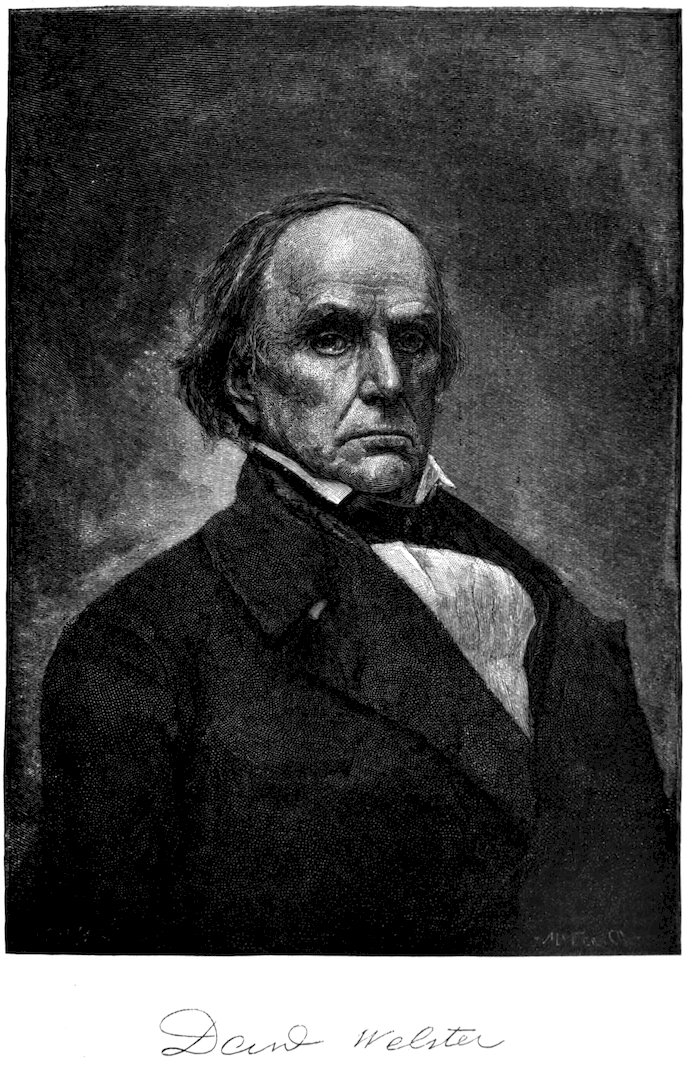
3049The honorable member complained that I had slept on his speech. I must have slept on it, or not slept at all. The moment the honorable member sat down, his friend from Missouri arose, and, with much honeyed commendation of the speech, suggested that the impressions which it had produced were too charming and delightful to be disturbed by other sentiments or other sounds, and proposed that the Senate should adjourn. Would it have been quite amiable in me, sir, to interrupt this excellent good feeling? Must I not have been absolutely malicious, if I could have thrust myself forward to destroy sensations thus pleasing? Was it not much better and kinder, both to sleep upon them myself, and to allow others, also, the pleasure of sleeping upon them? But if it be meant, by sleeping upon his speech, that I took time to prepare a reply to it, it is quite a mistake; owing to other engagements, I could not employ even the interval between the adjournment of the Senate and its meeting the next morning in attention to the subject of this debate. Nevertheless, sir, the mere matter of fact is undoubtedly true—I did sleep on the gentleman’s speech, and slept soundly. And I slept equally well on his speech of yesterday, to which I am now replying. It is quite possible that, in this respect, also, I possess some advantage over the honorable member, attributable, doubtless, to a cooler temperament on my part; for in truth I slept upon his speeches remarkably well. But the gentleman inquires why he was made the object of such a reply. Why was he singled out? If an attack had been made on the east, he, he assures us, did not begin it—it was the gentleman from Missouri. Sir, I answered the gentleman’s speech, because I happened to hear it; and because, also, I choose to give an answer to that speech, which, if unanswered, I thought most likely to produce injurious impressions. I did not stop to inquire who was the original drawer of the bill. I found a responsible endorser before me, and it was my purpose to hold him liable, and to bring him to his just responsibility without delay. But, sir, this interrogatory of the honorable member was only introductory to another. He proceeded to ask me whether I had turned upon him in this debate from the consciousness that I should find an overmatch if I ventured on a contest with his friend from Missouri. If, sir, the honorable member, ex gratia modestiæ, had chosen thus to defer to his friend, and to pay him a compliment, without intentional disparagement to others, it would have been quite according to the friendly courtesies of debate, and not at all ungrateful to my own feelings. I am not one of those, sir, who esteem any tribute of regard, whether light and occasional, or more serious and deliberate, which may be bestowed on others, as so much unjustly withholden from themselves. But the tone and manner of the gentleman’s question, forbid me thus to interpret it. I am not at liberty to consider it as nothing more than a civility to his friend. It had an air of taunt and disparagement, a little of the loftiness of asserted superiority, which does not allow me to pass it over without notice. It was put as a question for me to answer, and so put as if it were difficult for me to answer, whether I deemed the member from Missouri an overmatch for myself in debate here. It seems to me, sir, that is extraordinary language, and an extraordinary tone for the discussions of this body.
Matches and overmatches? Those terms are more applicable elsewhere than here, and fitter for other assemblies than this. Sir, the gentleman seems to forget where and what we are. This is a Senate; a Senate of equals; of men of individual honor and personal character, and of absolute independence. We know no masters; we acknowledge no dictators. This is a hall of mutual consultation and discussion, not an arena for the exhibition of champions. I offer myself, sir, as a match for no man; I throw the challenge of debate at no man’s feet. But, then, sir, since the honorable member has put the question in a manner that calls for an answer. I will give him an answer; and I tell him that, holding myself to be the humblest of the members here, I yet know nothing in the arm of his friend from Missouri, either alone or when aided by the arm of his friend from South Carolina, that need deter even me from espousing whatever opinions I may choose to espouse, from debating whenever I may choose to debate, or from speaking whatever I may see fit to say on the floor of the Senate. Sir, when uttered as matter of commendation or compliment, I should dissent from nothing which the honorable member might say of his friend. Still less do I put forth any pretensions of my own. But when put to me as a matter of taunt, I throw it back, and say to the gentleman that he could possibly say nothing less likely than such a comparison to wound my pride of personal character. The anger of its tone rescued the remark from 3050intentional irony, which otherwise, probably, would have been its general acceptation. But, sir, if it be imagined that by this mutual quotation and commendation; if it be supposed that, by casting the characters of the drama, assigning to each his part,—to one the attack, to another the cry of onset,—or if it be thought that by a loud and empty vaunt of anticipated victory any laurels are to be won here; if it be imagined, especially, that any or all these things will shake any purpose of mine, I can tell the honorable member, once for all, that he is greatly mistaken, and that he is dealing with one of whose temper and character he has yet much to learn. Sir, I shall not allow myself, on this occasion—I hope on no occasion—to be betrayed into any loss of temper; but if provoked, as I trust I never shall allow myself to be, into crimination and recrimination, the honorable member may, perhaps, find that in that contest there will be blows to take as well as blows to give; that others can state comparisons as significant, at least, as his own; and that his impunity may, perhaps, demand of him whatever powers of taunt and sarcasm he may possess. I commend him to a prudent husbandry of his resources.
But, sir, the coalition! The coalition! Aye, “the murdered coalition!” The gentleman asks if I were led or frighted into this debate by the spectre of the coalition. “Was it the ghost of the murdered coalition,” he exclaims, “which haunted the member from Massachusetts, and which, like the ghost of Banquo, would never down?” “The murdered coalition!” Sir, this charge of a coalition, in reference to the late administration, is not original with the honorable member. It did not spring up in the Senate. Whether as a fact, as an argument, or as an embellishment, it is all borrowed. He adopts it, indeed, from a very low origin, and a still lower present condition. It is one of the thousand calumnies with which the press teemed during an excited political canvass. It was a charge of which there was not only no proof or probability, but which was, in itself, wholly impossible to be true. No man of common information ever believed a syllable of it. Yet it was of that class of falsehoods which, by continued repetition through all the organs of detraction and abuse, are capable of misleading those who are already far misled, and of further fanning passion already kindling into flame. Doubtless it served its day, and, in a greater or less degree, the end designed by it. Having done that, it has sunk into the general mass of stale and loathed calumnies. It is the very castoff slough of a polluted and shameless press. Incapable of further mischief, it lies in the sewer lifeless and despised. It is not now, sir, in the power of the honorable member to give it dignity or decency, by attempting to elevate it, and to introduce it into the Senate. He cannot change it from what it is—an object of general disgust and scorn. On the contrary, the contact, if he choose to touch it, is more likely to drag him down, down, to the place where it lies itself.
But, sir, the honorable member was not, for other reasons, entirely happy in his allusion to the story of Banquo’s murder and Banquo’s ghost. It was not, I think, the friends, but the enemies of the murdered Banquo, at whose bidding his spirit would not down. The honorable gentleman is fresh in his reading of the English classics, and can put me right if I am wrong; but according to my poor recollection, it was at those who had begun with caresses, and ended with foul and treacherous murder, that the gory locks were shaken. The ghost of Banquo, like that of Hamlet, was an honest ghost. It disturbed no innocent man. It knew where its appearance would strike terror, and who would cry out. A ghost! It made itself visible in the right quarter, and compelled the guilty, and the conscience-smitten, and none others, to start, with,
“Prithee, see there! behold!—look! lo!
If I stand here, I saw him!”
Their eyeballs were seared—was it not so, sir?—who had thought to shield themselves by concealing their own hand and laying the imputation of the crime on a low and hireling agency in wickedness; who had vainly attempted to stifle the workings of their own coward consciences, by circulating, through white lips and chattering teeth, “Thou canst not say I did it!” I have misread the great poet, if it was those who had no way partaken in the deed of the death, who either found that they were, or feared that they should be, pushed from their stools by the ghost of the slain, or who cried out to a spectre created by their own fears, and their own remorse, “Avaunt! and quit our sight!”
There is another particular, sir, in which the honorable member’s quick perception of resemblances might, I should think, have seen something in the story of Banquo, making it not altogether a subject of the most pleasant contemplation. Those who murdered Banquo, what did they win by it? Substantial good? Permanent power? Or disappointment, rather, and sore mortification—dust and ashes—the common fate of vaulting ambition overleaping itself? Did not even-handed justice, ere long, commend the poisoned chalice to their own lips? Did they not soon find that for another they had “filed their mind?” that their ambition though apparently for the moment successful, had 3051but put a barren sceptre in their grasp? Aye, sir,—
“A barren sceptre in their gripe,
Thence to be wrenched by an unlineal hand,
No son of theirs succeeding.”
Sir, I need pursue the allusion no further. I leave the honorable gentleman to run it out at his leisure, and to derive from it all the gratification it is calculated to administer. If he finds himself pleased with the associations, and prepared to be quite satisfied, though the parallel should be entirely completed, I had almost said I am satisfied also—but that I shall think of. Yes, sir, I will think of that.
In the course of my observations the other day, Mr. President, I paid a passing tribute of respect to a very worthy man, Mr. Dane, of Massachusetts. It so happened that he drew the ordinance of 1787 for the government of the Northwestern Territory. A man of so much ability, and so little pretence; of so great a capacity to do good, and so unmixed a disposition to do it for its own sake; a gentleman who acted an important part, forty years ago, in a measure the influence of which is still deeply felt in the very matter which was the subject of debate, might, I thought, receive from me a commendatory recognition.
But the honorable gentleman was inclined to be facetious on the subject. He was rather disposed to make it a matter of ridicule that I had introduced into the debate the name of one Nathan Dane, of whom he assures us he had never before heard. Sir, if the honorable member had never before heard of Mr. Dane, I am sorry for it. It shows him less acquainted with the public men of the country than I had supposed. Let me tell him, however, that a sneer from him at the mention of the name of Mr. Dane is in bad taste. It may well be a high mark of ambition, sir, either with the honorable gentleman or myself, to accomplish as much to make our names known to advantage, and remembered with gratitude, as Mr. Dane has accomplished. But the truth is, sir, I suspect that Mr. Dane lives a little too far north. He is of Massachusetts, and too near the north star to be reached by the honorable gentleman’s telescope. If his sphere had happened to range south of Mason and Dixon’s line, he might, probably, have come within the scope of his vision!
I spoke, sir, of the ordinance of 1787, which prohibited slavery in all future times northwest of the Ohio, as a measure of great wisdom and foresight, and one which had been attended with highly beneficial and permanent consequences. I suppose that on this point no two gentlemen in the Senate could entertain different opinions. But the simple expression of this sentiment has led the gentleman, not only into a labored defence of slavery in the abstract, and on principle, but also into a warm accusation against me, as having attacked the system of slavery now existing in the Southern States. For all this there was not the slightest foundation in anything said or intimated by me. I did not utter a single word which any ingenuity could torture into an attack on the slavery of the South. I said only that it was highly wise and useful in legislating for the northwestern country, while it was yet a wilderness, to prohibit the introduction of slaves; and added, that I presumed, in the neighboring state of Kentucky, there was no reflecting and intelligent gentleman who would doubt that, if the same prohibition had been extended, at the same early period, over that commonwealth, her strength and population would, at this day, have been far greater than they are. If these opinions be thought doubtful, they are, nevertheless, I trust, neither extraordinary nor disrespectful. They attack nobody and menace nobody. And yet, sir, the gentleman’s optics have discovered, even in the mere expression of this sentiment, what he calls the very spirit of the Missouri question! He represents me as making an attack on the whole south, and manifesting a spirit which would interfere with and disturb their domestic condition. Sir, this injustice no otherwise surprises me than as it is done here, and done without the slightest pretence of ground for it. I say it only surprises me as being done here; for I know full well that it is and has been the settled policy of some persons in the south, for years, to represent the people of the north as disposed to interfere with them in their own exclusive and peculiar concerns. This is a delicate and sensitive point in southern feeling; and of late years it has always been touched, and generally with effect, whenever the object has been to unite the whole south against northern men or northern measures. This feeling, always carefully kept alive, and maintained at too intense a heat to admit discrimination or reflection, is a lever of great power in our political machine. It moves vast bodies, and gives to them one and the same direction. But the feeling is without adequate cause, and the suspicion which exists wholly groundless. There is not, and never has been, a disposition in the north to interfere with these interests of the south. Such interference has never been supposed to be within the power of the government, nor has it been in any way attempted. It has always been regarded as a matter of domestic policy, left with the states themselves, and with which the federal government had nothing to do. 3052Certainly, sir, I am, and ever had been, of that opinion. The gentleman, indeed, argues that slavery in the abstract is no evil. Most assuredly I need not say I differ with him altogether and most widely on that point. I regard domestic slavery as one of the greatest evils, both moral and political. But, though it be a malady, and whether it be curable, and if so, by what means; or, on the other hand, whether it be the culnus immedicabile of the social system, I leave it to those whose right and duty it is to inquire and to decide. And this I believe, sir, is, and uniformly has been, the sentiment of the north. Let us look a little at the history of this matter.
When the present constitution was submitted for the ratification of the people, there were those who imagined that the powers of the government which it proposed to establish might, perhaps, in some possible mode, be exerted in measures tending to the abolition of slavery. This suggestion would, of course, attract much attention in the southern conventions. In that of Virginia, Governor Randolph said:—
“I hope there is none here, who, considering the subject in the calm light of philosophy, will make an objection dishonorable to Virginia—that, at the moment they are securing the rights of their citizens, an objection is started, that there is a spark of hope that those unfortunate men now held in bondage may, by the operation of the general government, be made free.”
At the very first Congress, petitions on the subject were presented, if I mistake not, from different states. The Pennsylvania Society for promoting the Abolition of Slavery, took a lead, and laid before Congress a memorial, praying Congress to promote the abolition by such powers as it possessed. This memorial was referred, in the House of Representatives, to a select committee, consisting of Mr. Foster, of New Hampshire, Mr. Gerry, of Massachusetts, Mr. Huntington, of Connecticut, Mr. Lawrence, of New York, Mr. Dickinson, of New Jersey, Mr. Hartley, of Pennsylvania, and Mr. Parker, of Virginia; all of them, sir, as you will observe, northern men, but the last. This committee made a report, which was committed to a committee of the whole house, and there considered and discussed on several days; and being amended, although in no material respect, it was made to express three distinct propositions on the subjects of slavery and the slave trade. First, in the words of the constitution, that Congress could not, prior to the year 1808, prohibit the migration or importation of such persons as any of the states then existing should think proper to admit. Second, that Congress had authority to restrain the citizens of the United States from carrying on the African slave trade for the purpose of supplying foreign countries. On this proposition, our early laws against those who engage in that traffic are founded. The third proposition, and that which bears on the present question, was expressed in the following terms:—
“Resolved, That Congress have no authority to interfere in the emancipation of slaves, or of the treatment of them in any of the states; it remaining with the several states alone to provide rules and regulations therein, which humanity and true policy may require.”
This resolution received the sanction of the House of Representatives so early as March, 1790. And, now, sir, the honorable member will allow me to remind him, that not only were the select committee who reported the resolution, with a single exception, all northern men, but also that of the members then composing the House of Representatives, a large majority, I believe nearly two-thirds, were northern men also.
The house agreed to insert these resolutions in its journal; and, from that day to this, it has never been maintained or contended that Congress had any authority to regulate or interfere with the condition of slaves in the several states. No northern gentleman, to my knowledge, has moved any such question in either house of Congress.
The fears of the south, whatever fears they might have entertained, were allayed and quieted by this early decision; and so remained, till they were excited afresh, without cause, but for collateral and indirect purposes. When it became necessary, or was thought so, by some political persons, to find an unvarying ground for the exclusion of northern men from confidence and from lead in the affairs of the republic, then, and not till then, the cry was raised, and the feeling industriously excited, that the influence of northern men in the public councils would endanger the relation of master and slave. For myself, I claim no other merit, than that this gross and enormous injustice towards the whole north has not wrought upon me to change my opinions, or my political conduct. I hope I am above violating my principles, even under the smart of injury and false imputations. Unjust suspicions and undeserved reproach, whatever pain I may experience from them, will not induce me, I trust, nevertheless, to overstep the limits of constitutional duty, or to encroach on the rights of others. The domestic slavery of the south I leave where I find it—in the hands of their own governments. It is their affair, not mine. Nor do I complain of the peculiar effect which the magnitude of that population has had in the distribution of power under this federal government. We know, sir, that the representation 3053of the states in the other house is not equal. We know that great advantage, in that respect, is enjoyed by the slaveholding states; and we know, too, that the intended equivalent for that advantage—that is to say, the imposition of direct taxes in the same ratio—has become merely nominal; the habit of the government being almost invariably to collect its revenues from other sources, and in other modes. Nevertheless, I do not complain; nor would I countenance any movement to alter this arrangement of representation. It is the original bargain, the compact—let it stand; let the advantage of it be fully enjoyed. The Union itself is too full of benefit to be hazarded in propositions for changing its original basis. I go for the constitution as it is, and for the Union as it is. But I am resolved not to submit, in silence, to accusations, either against myself individually, or against the north, wholly unfounded and unjust—accusations which impute to us a disposition to evade the constitutional compact, and to extend the power of the government over the internal laws and domestic condition of the states. All such accusations, wherever and whenever made, all insinuations of the existence of any such purposes, I know and feel to be groundless and injurious. And we must confide in southern gentlemen themselves; we must trust to those whose integrity of heart and magnanimity of feeling will lead them to a desire to maintain and disseminate truth, and who possess the means of its diffusion with the southern public; we must leave it to them to disabuse that public of its prejudices. But, in the mean time, for my own part, I shall continue to act justly, whether those towards whom justice is exercised receive it with candor or with contumely.
Having had occasion to recur to the ordinance of 1787, in order to defend myself against the inferences which the honorable member has chosen to draw from my former observations on that subject, I am not willing now entirely to take leave of it without another remark. It need hardly be said, that that paper expresses just sentiments on the great subject of civil and religious liberty. Such sentiments were common, and abound in all our state papers of that day. But this ordinance did that which was not so common, and which is not, even now, universal; that is, it set forth and declared, as a high and binding duty of government itself, to encourage schools and advance the means of education; on the plain reason that religion, morality and knowledge are necessary to good government, and to the happiness of mankind. One observation further. The important provision incorporated into the constitution of the United States, and several of those of the states, and recently, as we have seen, adopted into the reformed constitution of Virginia, restraining legislative power, in questions of private right, and from impairing the obligation of contracts, is first introduced and established, as far as I am informed, as matter of express written constitutional law, in this ordinance of 1787. And I must add, also, in regard to the author of the ordinance, who has not had the happiness to attract the gentleman’s notice heretofore, nor to avoid his sarcasm now, that he was chairman of that select committee of the old Congress, whose report first expressed the strong sense of that body, that the old confederation was not adequate to the exigencies of the country, and recommending to the states to send delegates to the convention which formed the present constitution.
An attempt has been made to transfer from the north to the south the honor of this exclusion of slavery from the Northwestern territory. The journal, without argument or comment, refutes such attempt. The session of Virginia was made March, 1784. On the 19th of April following, a committee, consisting of Messrs. Jefferson, Chase and Howell, reported a plan for a temporary government of the territory, in which was this article: “That after the year 1800, there should be neither slavery nor involuntary servitude in any of the said states, otherwise than in punishment of crimes, whereof the party shall have been convicted.” Mr. Speight, of North Carolina, moved to strike out this paragraph. The question was put according to the form then practiced: “Shall, these words stand, as part of the plan?” &c. New Hampshire, Massachusetts, Rhode Island, Connecticut, New York, New Jersey and Pennsylvania—seven states—voted in the affirmative; Maryland, Virginia and South Carolina, in the negative. North Carolina was divided. As the consent of nine states was necessary, the words could not stand, and were struck out accordingly. Mr. Jefferson voted for the clause, but was overruled by his colleagues.
In March of the next year (1785) Mr. King, of Massachusetts, seconded by Mr. Ellery, of Rhode Island, proposed the formerly rejected article, with this addition: “And that this regulation shall be an article of compact, and remain a fundamental principle of the constitution between the thirteen original states and each of the states described in the resolve,” &c. On this clause, which provided the adequate and thorough security, the eight Northern States, at that time, voted affirmatively, and the four Southern States negatively. The votes of nine states were not yet obtained, and thus the provision was again rejected by the Southern States. The perseverance of the north held out, and two years afterwards the object was attained. 3054It is no derogation from the credit, whatever that may be, of drawing the ordinance, that its principles had before been prepared and discussed, in the form of resolutions. If one should reason in that way, what would become of the distinguished honor of the author of the declaration of Independence? There is not a sentiment in that paper which had not been voted and resolved in the assemblies, and other popular bodies in the country, over and over again.
But the honorable member has now found out that this gentleman, Mr. Dane, was a member of the Hartford Convention. However uninformed the honorable member may be of characters and occurrences at the north, it would seem that he has at his elbows, on this occasion, some highminded and lofty spirit, some magnanimous and true-hearted monitor, possessing the means of local knowledge, and ready to supply the honorable member with every thing, down even to forgotten and moth-eaten twopenny pamphlets, which may be used to the disadvantage of his own country. But, as to the Hartford Convention, sir, allow me to say that the proceedings of that body seem now to be less read and studied in New England than farther south. They appear to be looked to, not in New England, but elsewhere, for the purpose of seeing how far they may serve as a precedent. But they will not answer the purpose—they are quite too tame. The latitude in which they originated was too cold. Other conventions, of more recent existence, have gone a whole bar’s length beyond it. The learned doctors of Colleton and Abbeville have pushed their commentaries on the Hartford collect so far that the original text writers are thrown entirely into the shade. I have nothing to do, sir, with the Hartford Convention. Its journal, which the gentleman has quoted, I never read. So far as the honorable member may discover in its proceedings a spirit in any degree resembling that which was avowed and justified in those other conventions to which I have alluded, or so far as those proceedings can be shown to be disloyal to the constitution, or tending to disunion, so far I shall be as ready as any one to bestow on them reprehension and censure.
Having dwelt long on this convention, and other occurrences of that day, in the hope, probably, (which will not be gratified,) that I should leave the course of this debate to follow him at length in those excursions, the honorable member returned, and attempted another object. He referred to a speech of mine in the other house, the same which I had occasion to allude to myself the other day; and has quoted a passage or two from it, with a bold though uneasy and laboring air of confidence, as if he had detected in me an inconsistency. Judging from the gentleman’s manner, a stranger to the course of the debate, and to the point in discussion, would have imagined, from so triumphant a tone, that the honorable member was about to overwhelm me with a manifest contradiction. Any one who heard him, and who had not heard what I had, in fact, previously said, must have thought me routed and discomfited, as the gentleman had promised. Sir, a breath blows all this triumph away. There is not the slightest difference in the sentiments of my remarks on the two occasions. What I said here on Wednesday is in exact accordance with the opinions expressed by me in the other house in 1825. Though the gentleman had the metaphysics of Hudibras—though he were able
“to sever and divide
A hair ’twixt north and north west side,”
he could not yet insert his metaphysical scissors between the fair reading of my remarks in 1825 and what I said here last week. There is not only no contradiction, no difference, but, in truth, too exact a similarity, both in thought and language, to be entirely in just taste. I had myself quoted the same speech; had recurred to it, and spoke with it open before me; and much of what I said was little more than a repetition from it. In order to make finishing work with this alleged contradiction, permit me to recur to the origin of this debate, and review its course. This seems expedient, and may be done as well now as at any time.
Well, then, its history is this: the honorable member from Connecticut moved a resolution, which constituted the first branch of that which is now before us; that is to say, a resolution instructing the committee on public lands to inquire into the expediency of limiting, for a certain period, the sales of public lands to such as have heretofore been offered for sale; and whether sundry offices, connected with the sales of the lands, might not be abolished without detriment to the public service.
In the progress of the discussion which arose on this resolution, an honorable member from New Hampshire moved to amend the resolution, so as entirely to reverse its object; that is to strike it all out, and insert a direction to the committee to inquire into the expediency of adopting measures to hasten the sales, and extend more rapidly the surveys of the lands.
The honorable member from Maine (Mr. Sprague) suggested that both these propositions might well enough go, for consideration, to the committee; and in this state of the question, the member from South Carolina addressed the Senate in his first 3055speech. He rose, he said, to give his own free thoughts on the public lands. I saw him rise, with pleasure, and listened with expectation, though before he concluded I was filled with surprise. Certainly, I was never more surprised than to find him following up, to the extent he did, the sentiments and opinions which the gentleman from Missouri had put forth, and which it is known he has long entertained.
I need not repeat, at large, the general topics of the honorable gentleman’s speech. When he said, yesterday, that he did not attack the Eastern States, he certainly must have forgotten not only particular remarks, but the whole drift and tenor of his speech; unless he means by not attacking, that he did not commence hostilities, but that another had preceded him in the attack. He, in the first place, disapproved of the whole course of the government for forty years, in regard to its dispositions of the public land; and then, turning northward and eastward, and fancying he had found a cause for alleged narrowness and niggardliness in the “accursed policy” of the tariff, to which he represented the people of New England as wedded, he went on, for a full hour, with remarks, the whole scope of which was to exhibit the results of this policy, in feelings and in measures unfavorable to the west. I thought his opinions unfounded and erroneous, as to the general course of the government, and ventured to reply to them.
The gentleman had remarked on the analogy of other cases, and quoted the conduct of European governments towards their own subjects, settling on this continent, as in point, to show that we had been harsh and rigid in selling when we should have given the public lands to settlers. I thought the honorable member had suffered his judgment to be betrayed by a false analogy; that he was struck with an appearance of resemblance where there was no real similitude. I think so still. The first settlers of North America were enterprising spirits, engaging in private adventure, or fleeing from tyranny at home. When arrived here, they were forgotten by the mother country, or remembered only to be oppressed. Carried away again by the appearance of analogy, or struck with the eloquence of the passage, the honorable member yesterday observed that the conduct of government towards the western emigrants, or my representation of it, brought to his mind a celebrated speech in the British Parliament. It was, sir, the speech of Colonel Barre. On the question of the stamp act, or tea tax, I forget which, Colonel Barre had heard a member on the treasury bench argue, that the people of the United States, being British colonists, planted by the maternal care, nourished by the indulgence, and protected by the arms of England, would not grudge their mite to relieve the mother country from the heavy burden under which she groaned. The language of Colonel Barre, in reply to this, was, “They planted by your care? Your oppression planted them in America. They fled from your tyranny, and grew by your neglect of them. So soon as you began to care for them, you showed your care by sending persons to spy out their liberties, misrepresent their character, prey upon them, and eat out their substance.”