BOOK I. HISTORY OF THE POLITICAL PARTIES OF THE UNITED STATES. (continued 3)
Reading edition
The rule worked so well in the House, for the purpose for which it was devised—made the majority absolute master of the body—that Mr. Clay undertook to have the same rule adopted in the Senate; but the determined opposition to it, both by his political opponents and friends, led to the abandonment of the attempt in that chamber.
Much discussion took place at this session, over the bill offered in the House of Representatives, for the relief of the widow of the late President—General Harrison—appropriating one year’s salary. It was strenuously opposed by the Democratic members, as unconstitutional, on account of its principle, as creating a private pension list, and as a dangerous precedent. Many able speeches were made against the bill, both in the Senate and House; among others, the following extract from the speech of an able Senator contains some interesting facts. He said: “Look at the case of Mr. Jefferson, a man than whom no one that ever existed on God’s earth were the human family more indebted to. 39His furniture and his estate were sold to satisfy his creditors. His posterity was driven from house and home, and his bones now lay in soil owned by a stranger. His family are scattered: some of his descendants are married in foreign lands. Look at Monroe—the able, the patriotic Monroe, whose services were revolutionary, whose blood was spilt in the war of Independence, whose life was worn out in civil service, and whose estate has been sold for debt, his family scattered, and his daughter buried in a foreign land. Look at Madison, the model of every virtue, public or private, and he would only mention in connection with this subject, his love of order, his economy, and his systematic regularity in all his habits of business. He, when his term of eight years had expired, sent a letter to a gentleman (a son of whom is now on this floor) [Mr. Preston], enclosing a note of five thousand dollars, which he requested him to endorse, and raise the money in Virginia, so as to enable him to leave this city, and return to his modest retreat—his patrimonial inheritance—in that State. General Jackson drew upon the consignee of his cotton crop in New Orleans for six thousand dollars to enable him to leave the seat of government without leaving creditors behind him. These were honored leaders of the republican party. They had all been Presidents. They had made great sacrifices, and left the presidency deeply embarrassed; and yet the republican party who had the power and the strongest disposition to relieve their necessities, felt they had no right to do so by appropriating money from the public Treasury. Democracy would not do this. It was left for the era of federal rule and federal supremacy—who are now rushing the country with steam power into all the abuses and corruptions of a monarchy, with its pensioned aristocracy—and to entail upon the country a civil pension list.”
There was an impatient majority in the House in favor of the passage of the bill. The circumstances were averse to deliberation—a victorious party, come into power after a heated election, seeing their elected candidate dying on the threshold of his administration, poor and beloved: it was a case for feeling more than of judgment, especially with the political friends of the deceased—but few of whom could follow the counsels of the head against the impulsions of the heart.
The bill passed, and was approved; and as predicted, it established a precedent which has since been followed in every similar case.
The subject of naval pensions received more than usual consideration at this session. The question arose on the discussion of the appropriation bill for that purpose. A difference about a navy—on the point of how much and what kind—had always been a point of difference between the two great political parties of the Union, which, under whatsoever names, are always the same, each preserving its identity in principles and policy, but here the two parties divided upon an abuse which no one could deny or defend. A navy pension fund had been established under the act of 1832, which was a just and proper law, but on the 3d of March, 1837, an act was passed entitled “An act for the more equitable distribution of the Navy Pension Fund.” That act provided: I. That Invalid naval pensions should commence and date back to the time of receiving the inability, instead of completing the proof. II. It extended the pensions for death to all cases of death, whether incurred in the line of duty or not. III. It extended the widow’s pensions for life, when five years had been the law both in the army and navy. IV. It adopted the English system of pensioning children of deceased marines until they attained their majority.
The effect of this law was to absorb and bankrupt the navy pension fund, a meritorious fund created out of the government share of prize money, relinquished for that purpose, and to throw the pensions, arrears as well as current and future, upon the public treasury, where it was never intended they were to be. It was to repeal this act, that an amendment was introduced at this session on the bringing forward of the annual appropriation bill for navy pensions, and long and earnest were the debates upon it. The amendment was lost, the Senate dividing on party lines, the Whigs against and the Democrats for the amendment. The subject is instructive, as then was practically ratified and re-enacted the pernicious practice authorized by the act of 1837, of granting pensions to date from the time of injury and not from the time of proof; and has grown up to such proportions in recent years that the last act of Congress appropriating money for arrears of pensions, provided for the payment of such an enormous sum of money that it would have appalled the original projectors of the act of 1837 could they have seen to what their system has led.
Again, at this session, the object of the tariff occupied the attention of Congress. The compromise act, as it was called, of 1833, which was composed of two parts—one to last nine years, for the benefit of manufactures; the other to last for ever, for the benefit of the planting and consuming interest—was passed, as hereinbefore stated, in pursuance of an agreement between Mr. Clay and Mr. Calhoun and their respective friends, at the time the former was urging the necessity for a 40continuance of high tariff for protection and revenue, and the latter was presenting and justifying before Congress the nullification ordinance adopted by the Legislature of South Carolina. To Mr. Clay and Mr. Calhoun it was a political necessity, one to get rid of a stumbling-block (which protective tariff had become); the other to escape a personal peril which his nullifying ordinance had brought upon him, and with both, it was a piece of policy, to enable them to combine against Mr. Van Buren, by postponing their own contention; and a device on the part of its author (Mr. Clayton, of Delaware) and Mr. Clay to preserve the protective system. It provided for a reduction of a certain per centage each year, on the duties for the ensuing nine years, until the revenue was reduced to 20 per cent. ad valorem on all articles imported into the country. In consequence the revenue was so reduced that in the last year, there was little more than half what the exigencies of the government required, and different modes, by loans and otherwise, were suggested to meet the deficiency. The Secretary of the Treasury had declared the necessity of loans and taxes to carry on the government; a loan bill for twelve millions had been passed; a tariff bill to raise fourteen millions was depending; and the chairman of the Committee of Ways and Means, Mr. Millard Fillmore, defended its necessity in an able speech. His bill proposed twenty per cent. additional to the existing duty on certain specified articles, sufficient to make up the amount wanted. This encroachment on a measure so much vaunted when passed, and which had been kept inviolate while operating in favor of one of the parties to it, naturally excited complaint and opposition from the other, and Mr. Gilmer, of Virginia, in a speech against the new bill, said: “In referring to the compromise act, the true characteristics of that act which recommended it strongly to him, were that it contemplated that duties were to be levied for revenue only, and in the next place to the amount only necessary to the supply of the economical wants of the government. He begged leave to call the attention of the committee to the principle recognized as the language of the compromise, a principle which ought to be recognized in all time to come by every department of the government. It is, that duties to be raised for revenue are to be raised to such an amount only as is necessary for an economical administration of the government. Some incidental protection must necessarily be given, and he, for one, coming from an anti-tariff portion of the country, would not object to it.”
The bill went to the Senate where it found Mr. Clay and Mr. Calhoun in positions very different from what they occupied when the compromise act was passed—then united, now divided—then concurrent, now antagonistic, and the antagonism general, upon all measures, was to be special upon this one. Their connection with the subject made it their function to lead off in its consideration; and their antagonist positions promised sharp encounters, which did not fail to come. Mr. Clay said that he “observed that the Senator from South Carolina based his abstractions on the theories of books on English authorities, and on the arguments urged in favor of free trade by a certain party in the British Parliament. Now he, (Mr. Clay,) and his friends would not admit of these authorities being entitled to as much weight as the universal practice of nations, which in all parts of the world was found to be in favor of protecting home manufactures to an extent sufficient to keep them in a flourishing condition. This was the whole difference. The Senator was in favor of book theory and abstractions: he (Mr. Clay) and his friends, were in favor of the universal practice of nations, and the wholesome and necessary protection of domestic manufactures.”
Mr. Calhoun in reply, referring to his allusion to the success in the late election of the tory party in England, said: “The interests, objects, and aims of the tory party there and the whig party here, are identical. The identity of the two parties is remarkable. The tory party are the patrons of corporate monopolies; and are not you? They are advocates of a high tariff; and are not you? They are supporters of a national bank; and are not you? They are for corn laws—laws oppressive to the masses of the people, and favorable to their own power; and are not you? Witness this bill.*** The success of that party in England, and of the whig party here, is the success of the great money power, which concentrates the interests of the two parties, and identifies their principles.”
The bill was passed by a large majority, upon the general ground that the government must have revenue.
The chief measure of the session, and the great object of the whig party—the one for which it had labored for ten years—was for the re-charter of a national bank. Without this all other measures would be deemed to be incomplete, and the victorious election itself but little better than a defeat. The President, while a member of the Democratic party, had been opposed to the United States Bank; and to overcome any objections he might have the bill was carefully prepared, and studiously contrived to avoid the President’s objections, and save his consistency—a point upon which he was exceedingly sensitive. 41The democratic members resisted strenuously, in order to make the measure odious, but successful resistance was impossible. It passed both houses by a close vote; and contrary to all expectation the President disapproved the act, but with such expressions of readiness to approve another bill which should be free from the objections which he named, as still to keep his party together, and to prevent the resignation of his cabinet. In his veto message the President fell back upon his early opinions against the constitutionality of a national bank, so often and so publicly expressed.
The veto caused consternation among the whig members; and Mr. Clay openly gave expression to his dissatisfaction, in the debate on the veto message, in terms to assert that President Tyler had violated his faith to the whig party, and had been led off from them by new associations. He said: “And why should not President Tyler have suffered the bill to become a law without his signature? Without meaning the slightest possible disrespect to him (nothing is further from my heart than the exhibition of any such feeling towards that distinguished citizen, long my personal friend), it cannot be forgotten that he came into his present office under peculiar circumstances. The people did not foresee the contingency which has happened. They voted for him as Vice-President. They did not, therefore, scrutinize his opinions with the care which they probably ought to have done, and would have done, if they could have looked into futurity. If the present state of the fact could have been anticipated—if at Harrisburg, or at the polls, it had been foreseen that General Harrison would die in one short month after the commencement of his administration; so that Vice-President Tyler would be elevated to the presidential chair; that a bill passed by decisive majorities of the first whig Congress, chartering a national bank, would be presented for his sanction; and that he would veto the bill, do I hazard anything when I express the conviction that he would not have received a solitary vote in the nominating convention, nor one solitary electoral vote in any State in the Union?”
The vote was taken on the bill over again, as required by the constitution, and so far from receiving a two-thirds vote, it received only a bare majority, and was returned to the House with a message stating his objections to it, where it gave rise to some violent speaking, more directed to the personal conduct of the President than to the objections to the bill stated in his message. The veto was sustained; and so ended the second attempt to resuscitate the old United States Bank under a new name. This second movement to establish the bank has a secret history. It almost caused the establishment of a new party, with Mr. Tyler as its head; earnest efforts having been made in that behalf by many prominent Whigs and Democrats. The entire cabinet, with the exception of Mr. Webster, resigned within a few days after the second veto. It was a natural thing for them to do, and was not unexpected. Indeed Mr. Webster had resolved to tender his resignation also, but on reconsideration determined to remain and publish his reasons therefor in a letter to the National Intelligencer, in the following words:
“Lest any misapprehension should exist, as to the reasons which led me to differ from the course pursued by my late colleagues, I wish to say that I remain in my place, first, because I have seen no sufficient reasons for the dissolution of the late Cabinet, by the voluntary act of its own members. I am perfectly persuaded of the absolute necessity of an institution, under the authority of Congress, to aid revenue and financial operations, and to give the country the blessings of a good currency and cheap exchanges. Notwithstanding what has passed, I have confidence that the President will co-operate with the legislature in overcoming all difficulties in the attainment of these objects; and it is to the union of the Whig party—by which I mean the whole party, the Whig President, the Whig Congress, and the Whig people—that I look for a realization of our wishes. I can look nowhere else. In the second place if I had seen reasons to resign my office, I should not have done so, without giving the President reasonable notice, and affording him time to select the hands to which he should confide the delicate and important affairs now pending in this department.”
The conduct of the President in the matter of the vetoes of the two bank bills produced revolt against him in the party; and the Whigs of the two Houses of Congress held several formal meetings to consider what they should do in the new condition of affairs. An address to the people of the United States was resolved upon. The rejection of the bank bill gave great vexation to one side, and equal exultation to the other. The subject was not permitted to rest, however; a national bank was the life—the vital principle—of the Whig party, without which it could not live as a party; it was the power which was to give them power and the political and financial control of the Union. A second attempt was made, four days after the veto, to accomplish the end by amendments to a bill relating to the currency, which had been introduced early in the session. Mr. Sargeant of Pennsylvania, moved to strike out all after the enacting clause, and insert his amendments, which were substantially the same as the vetoed 42bill, except changing the amount of capital and prohibiting discounts on notes other than bills of exchange. The bill was pushed to a vote with astonishing rapidity, and passed by a decided majority. In the Senate the bill went to a select committee which reported it back without alteration, as had been foreseen, the committee consisting entirely of friends of the measure; and there was a majority for it on final passage. Concurred in by the Senate without alteration, it was returned to the House, and thence referred to the President for his approval or disapproval. It was disapproved and it was promulgated in language intended to mean a repudiation of the President, a permanent separation of the Whig party from him, and to wash their hands of all accountability for his acts. An opening paragraph of the address set forth that, for twelve years the Whigs had carried on a contest for the regulation of the currency, the equalization of exchanges, the economical administration of the finances, and the advancement of industry—all to be accomplished by means of a national bank—declaring these objects to be misunderstood by no one and the bank itself held to be secured in the Presidential election, and its establishment the main object of the extra session. The address then proceeds to state how these plans were frustrated:
“It is with profound and poignant regret that we find ourselves called upon to invoke your attention to this point. Upon the great and leading measure touching this question, our anxious endeavors to respond to the earnest prayers of the nation have been frustrated by an act as unlooked for as it is to be lamented. We grieve to say to you that by the exercise of that power in the constitution which has ever been regarded with suspicion, and often with odium, by the people—a power which we had hoped was never to be exhibited on this subject, by a Whig President—we have been defeated in two attempts to create a fiscal agent, which the wants of the country had demonstrated to us, in the most absolute form of proof to be eminently necessary and proper in the present emergency. Twice have we with the utmost diligence and deliberation matured a plan for the collection, safe-keeping and disbursing of the public moneys through the agency of a corporation adapted to that end, and twice has it been our fate to encounter the opposition of the President, through the application of the veto power.*** We are constrained to say that we find no ground to justify us in the conviction that the veto of the President has been interposed on this question solely upon conscientious and well-considered opinions of constitutional scruple as to his duty in the case presented. On the contrary, too many proofs have been forced upon our observation to leave us free from the apprehension that the President has permitted himself to be beguiled into an opinion that by this exhibition of his prerogative he might be able to divert the policy of his administration into a channel which should lead to new political combinations, and accomplish results which must overthrow the present divisions of party in the country; and finally produce a state of things which those who elected him, at least, have never contemplated.
“In this state of things, the Whigs will naturally look with anxiety to the future, and inquire what are the actual relations between the President and those who brought him into power; and what, in the opinion of their friends in Congress, should be their course hereafter.*** The President by his withdrawal of confidence from his real friends in Congress and from the members of his cabinet; by his bestowal of it upon others notwithstanding their notorious opposition to leading measures of his administrations has voluntarily separated himself from those by whose exertions and suffrage he was elevated to that office through which he has reached his present exalted station.*** The consequence is, that those who brought the President into power can be no longer, in any manner or degree, justly held responsible or blamed for the administration of the executive branch of the government; and the President and his advisers should be exclusively hereafter deemed accountable.*** The conduct of the President has occasioned bitter mortification and deep regret. Shall the party, therefore, yielding to sentiments of despair, abandon its duty, and submit to defeat and disgrace? Far from suffering such dishonorable consequences, the very disappointment which it has unfortunately experienced should serve only to redouble its exertions, and to inspire it with fresh courage to persevere with a spirit unsubdued and a resolution unshaken, until the prosperity of the country is fully re-established, and its liberties firmly secured against all danger from the abuses, encroachments or usurpations of the executive department of the government.”
This was the manifesto, so far as it concerns the repudiation of President Tyler, which Whig members of Congress put forth: it was answered (under the name of an address to his constituents) by Mr. Cushing, in a counter special plea—counter to it on all points—especially on the main question of which party the President was to belong to; the manifesto of the Whigs assigning him to the democracy—the address of Mr. Cushing, claiming him for the Whigs. It was especially 43severe on Mr. Clay, as setting up a caucus dictatorship to coerce the President; and charged that the address emanated from this caucus, and did not embody or represent the sentiments of all Whig leaders; and referred to Mr. Webster’s letter, and his remaining in the cabinet as proof of this. But it was without avail against the concurrent statements of the retiring senators, and the confirmatory statements of many members of Congress. The Whig party recoiled from the President, and instead of the unity predicted by Mr. Webster, there was diversity and widespread dissension. The Whig party remained with Mr. Clay; Mr. Webster retired, Mr. Cushing was sent on a foreign mission, and the President, seeking to enter the democratic ranks, was refused by them, and left to seek consolation in privacy, for his political errors and omissions.
The extra session, called by President Harrison, held under Mr. Tyler, dominated by Mr. Clay, commenced May 31, and ended Sept. 13, 1841—and was replete with disappointed calculations, and nearly barren of permanent results. The purposes for which it was called into being, failed. The first annual message of President Tyler, at the opening of the regular session in December, 1841, coming in so soon after the termination of the extra session, was brief and meagre of topics, with few points of interest.
In the month of March, 1842, Mr. Henry Clay resigned his place in the Senate, and delivered a valedictory address to that body. He had intended this step upon the close of the previous presidential campaign, but had postponed it to take personal charge of the several measures which would be brought before Congress at the special session—the calling of which he foresaw would be necessary. He resigned not on account of age, or infirmity, or disinclination for public life; but out of disgust—profound and inextinguishable. He had been basely defeated for the Presidential nomination, against the wishes of the Whig party, of which he was the acknowledged head—he had seen his leading measures vetoed by the President whom his party had elected—the downfall of the Bank for which he had so often pledged himself—and the insolent attacks of the petty adherents of the administration in the two Houses: all these causes acting on his proud and lofty spirit, induced this withdrawal from public life for which he was so well fitted.
The address opened with a retrospect of his early entrance into the Senate, and a grand encomium upon its powers and dignity as he had found it, and left it. Memory went back to that early year, 1806, when just past thirty years of age, he entered the United States Senate, and commenced his high career—a wide and luminous horizon before him, and will and talent to fill it. He said: “From the year 1806, the period of my entering upon this noble theatre of my public service, with but short intervals, down to the present time, I have been engaged in the service of my country. Of the nature and value of those services, which I may have rendered during my long career of public life, it does not become me to speak. History, if she deigns to notice me, and posterity—if a recollection of any humble service which I may have rendered, shall be transmitted to posterity—will be the best, truest, and most impartial judges; and to them I defer for a decision upon their value. But, upon one subject, I may be allowed to speak. As to my public acts and public conduct, they are for the judgment of my fellow-citizens; but my private motives of action—that which prompted me to take the part which I may have done, upon great measures during their progress in the national councils, can be known only to the Great Searcher of the human heart and myself; and I trust I shall be pardoned for repeating again a declaration which I made thirty years ago: that whatever error I may have committed—and doubtless I have committed many during my public service—I may appeal to the Divine Searcher of hearts for the truth of the declaration which I now make, with pride and confidence, that I have been actuated by no personal motives—that I have sought no personal aggrandizement—no promotion from the advocacy of those various measures on which I have been called to act—that I have had an eye, a single eye, a heart, a single heart, ever devoted to what appeared to be the best interests of the country.”
Mr. Clay led a great party, and for a long time, whether he dictated to it or not, and kept it well bound together, without the usual means of forming and leading parties. It was surprising that, without power and patronage, he was able so long and so undividedly to keep so great a party together, and lead it so unresistingly. He had great talents, but not equal to some whom he led. He had eloquence—superior in popular effect, but not equal in high oratory to that of some others. But his temperament was fervid, his will was strong, and his courage daring; and these qualities, added to his talents, gave him the lead and supremacy in his party, where he was always dominant. The farewell address made a deep impression upon the Senators present; and after its close, Mr. Preston brought the ceremony to a conclusion, by moving an adjournment, which was agreed to.
Again at this session was the subject of the tariff considered, but this time, as a 44matter of absolute necessity, to provide a revenue. Never before were the coffers and the credit of the treasury at so low an ebb. A deficit of fourteen millions in the treasury—a total inability to borrow, either at home or abroad, the amount of the loan of twelve millions authorized the year before—the treasury notes below par, and the revenues from imports inadequate and decreasing.
The compromise act of 1833 in reducing the duties gradually through nine years, to a fixed low rate; the act of 1837 in distributing the surplus revenue; and the continual and continued distribution of the land revenue, had brought about this condition of things. The remedy was sought in a bill increasing the tariff, and suspending the land revenue distribution. Two such bills were passed in a single month, and both vetoed by the President. It was now near the end of August. Congress had been in session for an unprecedentedly long time. Adjournment could not be deferred, and could not take place without providing for the Treasury. The compromise act and the land distribution were the stumbling-blocks: it was resolved to sacrifice them together; and a bill was introduced raising the duties above the fixed rate of twenty per cent., and that breach of the mutual assurance in relation to the compromise, immediately in terms of the assurance, suspended the land revenue distribution—to continue it suspended while duties above the compromise limit continued to be levied. And as that has been the case ever since, the distribution of the land revenue has been suspended ever since. The bill was passed, and approved by the President, and Congress thereupon adjourned.
The subject of the navy was also under consideration at this session. The naval policy of the United States was a question of party division from the origin of parties in the early years of the government—the Federal party favoring a strong and splendid navy, the Republican a moderate establishment, adapted to the purposes of defense more than of offense. And this line of division has continued. Under the Whig regime the policy for a great navy developed itself. The Secretary of the Navy recommended a large increase of ships, seamen and officers, involving a heavy expense, though the government was not in a condition to warrant any such expenditure, and no emergency required an increase in that branch of the public service. The vote was taken upon the increase proposed by the Secretary of the Navy, and recommended by the President; and it was carried, the yeas and nays being well defined by the party line.
The first session of the twenty-eighth Congress, which convened December 1843, exhibited in its political complexion, serious losses in the Whig following. The Democratic candidate for Speaker of the House of Representatives, was elected over the Whig candidate—the vote standing 128 to 59. Thus an adverse majority of more than two to one was the result to the Whig party at the first election after the extra session of 1841. The President’s message referred to the treaty which had lately been concluded with Great Britain relative to the northwestern territory extending to the Columbia river, including Oregon and settling the boundary lines; and also to a pending treaty with Texas for her annexation to the United States; and concluded with a recommendation for the establishment of a paper currency to be issued and controlled by the Federal government.
For more than a year before the meeting of the Democratic Presidential Convention in Baltimore, in May 1844, it was evident to leading Democrats that Martin Van Buren was the choice of the party. To overcome this popular current and turn the tide in favor of Mr. Calhoun, who desired the nomination, resort was had to the pending question of the annexation of Texas. Mr. Van Buren was known to be against it, and Mr. Calhoun for it. To gain time, the meeting of the convention was postponed from December previous, which had been the usual time for holding such elections, until the following May. The convention met, and consisted of two hundred and sixty-six delegates, a decided majority of whom were for Mr. Van Buren, and cast their votes accordingly on the first ballot. But a chairman had been selected, who was adverse to his nomination; and aided by a rule adopted by the convention, which required a concurrence of two-thirds to effect a nomination, the opponents of Mr. Van Buren were able to accomplish his defeat. Mr. Calhoun had, before the meeting of the convention, made known his determination, in a public address, not to suffer his name to go before that assemblage as a candidate for the presidency, and stated his reasons for so doing, which were founded mainly on the manner in which the convention was constituted; his objections being to the mode of choosing delegates, and the manner of their giving in their votes—he contending for district elections, and the delegates to vote individually. South Carolina was not represented in the convention. After the first ballot Mr. Van Buren’s vote sensibly decreased, until finally, Mr. James K. Polk, who was a candidate for the Vice-Presidency, was brought forward and nominated unanimously for the chief office. Mr. Geo. M. Dallas was chosen as his colleague for the Vice-Presidency. The nomination of these gentlemen, neither of whom had 45been mentioned until late in the proceedings of the convention, for the offices for which they were finally nominated, was a genuine surprise to the country. No voice in favor of it had been heard; and no visible sign in the political horizon had announced it.
The Whig convention nominated Henry Clay, for President; and Theodore Frelinghuysen for Vice-President.
The main issues in the election which ensued, were mainly the party ones of Whig and Democrat, modified by the tariff and Texas questions. It resulted in the choice of the Democratic candidates, who received 170 electoral votes as against 105 for their opponents; the popular majority for the Democrats being 238,284, in a total vote of 2,834,108. Mr. Clay received a larger popular vote than had been given at the previous election for the Whig candidate, showing that he would have been elected had he then been the nominee of his party; though the popular vote at this election was largely increased over that of 1840. It is conceded that the 36 electoral votes of New York State gave the election to Mr. Polk. It was carried by a bare majority; due entirely to the Gubernatorial candidacy of Mr. Silas Wright, who had been mentioned for the vice-presidential nomination in connection with Mr. Van Buren, but who declined it after the sacrifice of his friend and colleague; and resigning his seat in the Senate, became a candidate for Governor of New York. The election being held at the same time as that for president, his name and popularity brought to the presidential ticket more than enough votes to make the majority that gave the electoral vote of the State to the Democrats.
President Tyler’s annual and last message to Congress, in December 1844, contained, (as did that of the previous year) an elaborate paragraph on the subject of Texas and Mexico; the idea being the annexation of the former to the Union, and the assumption of her causes of grievance against the latter; and a treaty was pending to accomplish these objects. The scheme for the annexation of Texas was framed with a double aspect—one looking to the then pending presidential election, the other to the separation of the Southern States; and as soon as the rejection of the treaty was foreseen, and the nominating convention had acted, the disunion aspect manifested itself over many of the Southern States—beginning with South Carolina. Before the end of May, a great meeting took place at Ashley, in that State, to combine the slave States in a convention to unite the Southern States to Texas, if Texas should not be received into the Union; and to invite the President to convene Congress to arrange the terms of the dissolution of the Union if the rejection of the annexation should be persevered in. Responsive resolutions were adopted in several States, and meetings held. The opposition manifested, brought the movement to a stand, and suppressed the disunion scheme for the time being—only to lie in wait for future occasions. But it was not before the people only that this scheme for a Southern convention with a view to the secession of the slave States was a matter of discussion; it was the subject of debate in the Senate; and there it was further disclosed that the design of the secessionists was to extend the new Southern republic to the Californias.
The treaty of annexation was supported by all the power of the administration, but failed; and it was rejected by the Senate by a two-thirds vote against it. Following this, a joint resolution was early brought into the House of Representatives for the admission of Texas as a State of the Union, by legislative action; it passed the House by a fair majority, but met with opposition in the Senate unless coupled with a proviso for negotiation and treaty, as a condition precedent. A bill authorizing the President and a commissioner to be appointed to agree upon the terms and conditions of said admission, the question of slavery within its limits, its debts, the fixing of boundaries, and the cession of territory, was coupled or united with the resolution; and in this shape it was finally agreed to, and became a law, with the concurrence of the President, March 3, 1845. Texas was then in a state of war with Mexico, though at that precise point of time an armistice had been agreed upon, looking to a treaty of peace. The House resolution was for an unqualified admission of the State; the Senate amendment or bill was for negotiation; and the bill actually passed would not have been concurred in except on the understanding that the incoming President (whose term began March 4, 1845, and who was favorable to negotiation) would act under the bill, and appoint commissioners accordingly.
Contrary to all expectation, the outgoing President, on the last day of his term, at the instigation of his Secretary of State, Mr. Calhoun, assumed the execution of the act providing for the admission of Texas—adopted the legislative clause—and sent out a special messenger with instructions. The danger of this had been foreseen, and suggested in the Senate; but close friends of Mr. Calhoun, speaking for the administration, and replying to the suggestion, indignantly denied it for them, and declared that they would not have the “audacity” to so violate the spirit and intent of the act, or so encroach upon the 46rights of the new President. These statements from the friends of the Secretary and President that the plan by negotiation would be adopted, quieted the apprehension of those Senators opposed to legislative annexation or admission, and thus secured their votes, without which the bill would have failed of a majority. Thus was Texas incorporated into the Union. The legislative proposition sent by Mr. Tyler was accepted: Texas became incorporated with the United States, and in consequence the state of war was established between the United States and Mexico; it only being a question of time and chance when the armistice should end and hostilities begin. Although Mr. Calhoun was not in favor of war with Mexico—he believing that a money payment would settle the differences with that country—the admission of Texas into the Union under the legislative annexation clause of the statute, was really his act and not that of the President’s; and he was, in consequence, afterwards openly charged in the Senate with being the real author of the war which followed.
The administration of President Polk opened March 4, 1845; and on the same day, the Senate being convened for the purpose, the cabinet ministers were nominated and confirmed. In December following the 29th Congress was organized. The House of Representatives, being largely Democratic, elected the Speaker, by a vote of 120, against 70 for the Whig candidate. At this session the “American” party—a new political organization—first made its appearance in the National councils, having elected six members of the House of Representatives, four from New York and two from Pennsylvania. The President’s first annual message had for its chief topic, the admission of Texas, then accomplished, and the consequent dissatisfaction of Mexico; and referring to the preparations on the part of the latter with the apparent intention of declaring war on the United States, either by an open declaration, or by invading Texas. The message also stated causes which would justify this government in taking the initiative in declaring war—mainly the non-compliance by Mexico with the terms of the treaty of indemnity of April 11, 1839, entered into between that State and this government relative to injuries to American citizens during the previous eight years. He also referred to the fact of a minister having been sent to Mexico to endeavor to bring about a settlement of the differences between the nations, without a resort to hostilities. The message concluded with a reference to the negotiations with Great Britain relative to the Oregon boundary; a statement of the finances and the public debt, showing the latter to be slightly in excess of seventeen millions; and a recommendation for a revision of the tariff, with a view to revenue as the object, with protection to home industry as the incident.
At this session of Congress, the States of Florida and Iowa were admitted into the Union; the former permitting slavery within its borders, the latter denying it. Long before this, the free and the slave States were equal in number, and the practice had grown up—from a feeling of jealousy and policy to keep them evenly balanced—of admitting one State of each character at the same time. Numerically the free and the slave States were thus kept even: in political power a vast inequality was going on—the increase of population being so much greater in the northern than in the southern region.
The Ashburton treaty of 1842 omitted to define the boundary line, and permitted, or rather did not prohibit, the joint occupation of Oregon by British and American settlers. This had been a subject of dispute for many years. The country on the Columbia River had been claimed by both. Under previous treaties the American northern boundary extended “to the latitude of 49 degrees north of the equator, and along that parallel indefinitely to the west.” Attempts were made in 1842 and continuing since to 1846, to settle this boundary line, by treaty with Great Britain. It had been assumed that we had a dividing line, made by previous treaty, along the parallel of 54 degrees 40 minutes from the sea to the Rocky mountains. The subject so much absorbed public attention, that the Democratic National convention of 1844 in its platform of principles declared for that boundary line, or war as the consequence. It became known as the 54–40 plank, and was a canon of political faith. The negotiations between the governments were resumed in August, 1844. The Secretary of State, Mr. Calhoun, proposed a line along the parallel of 49 degrees of north latitude to the summit of the Rocky mountains and continuing that line thence to the Pacific Ocean; and he made this proposition notwithstanding the fact that the Democratic party—to which he belonged—were then in a high state of exultation for the boundary of 54 degrees 40 minutes, and the presidential canvass, on the Democratic side, was raging upon that cry.
The British Minister declined this proposition in the part that carried the line to the ocean, but offered to continue it from the summit of the mountains to the Columbia River, a distance of some three hundred miles, and then follow the river to the ocean. This was declined by Mr. Calhoun. The President had declared in his inaugural address in favor of the 54–40 47line. He was in a dilemma; to maintain that position meant war with Great Britain; to recede from it seemed impossible. The proposition for the line of 49 degrees having been withdrawn by the American government on its non-acceptance by the British, had appeased the Democratic storm which had been raised against the President. Congress had come together under the loud cry of war, in which Mr. Cass was the leader, but followed by the body of the democracy, and backed and cheered by the whole democratic newspaper press. Under the authority and order of Congress notice had been served on Great Britain which was to abrogate the joint occupation of the country by the citizens of the two powers. It was finally resolved by the British Government to propose the line of 49 degrees, continuing to the ocean, as originally offered by Mr. Calhoun; and though the President was favorable to its acceptance, he could not, consistently with his previous acts, accept and make a treaty, on that basis. The Senate, with whom lies the power, under the constitution, of confirming or restricting all treaties, being favorable to it, without respect to party lines, resort was had, as in the early practice of the Government, to the President, asking the advice of the Senate upon the articles of a treaty before negotiation. A message was accordingly sent to the Senate, by the President, stating the proposition, and asking its advice, thus shifting the responsibility upon that body, and making the issue of peace or war depend upon its answer. The Senate advised the acceptance of the proposition, and the treaty was concluded.
The conduct of the Whig Senators, without whose votes the advice would not have been given nor the treaty made, was patriotic in preferring their country to their party—in preventing a war with Great Britain—and saving the administration from itself and its party friends.
The second session of the 29th Congress was opened in December, 1847. The President’s message was chiefly in relation to the war with Mexico, which had been declared by almost a unanimous vote in Congress. Mr. Calhoun spoke against the declaration in the Senate, but did not vote upon it. He was sincerely opposed to the war, although his conduct had produced it. Had he remained in the cabinet, to do which he had not concealed his wish, he would, no doubt, have labored earnestly to have prevented it. Many members of Congress, of the same party with the administration, were extremely averse to the war, and had interviews with the President, to see if it was inevitable, before it was declared. Members were under the impression that the war could not last above three months.
The reason for these impressions was that an intrigue was laid, with the knowledge of the Executive, for a peace, even before the war was declared, and a special agent dispatched to bring about a return to Mexico of its exiled President, General Santa Anna, and conclude a treaty of peace with him, on terms favorable to the United States. And for this purpose Congress granted an appropriation of three millions of dollars to be placed at the disposal of the President, for negotiating for a boundary which should give the United States additional territory.
While this matter was pending in Congress, Mr. Wilmot of Pennsylvania introduced and moved a proviso, “that no part of the territory to be acquired should be open to the introduction of slavery.” It was a proposition not necessary for the purpose of excluding slavery, as the only territory to be acquired was that of New Mexico and California, where slavery was already prohibited by the Mexican laws and constitution. The proviso was therefore nugatory, and only served to bring on a slavery agitation in the United States. For this purpose it was seized upon by Mr. Calhoun and declared to be an outrage upon and menace to the slaveholding States. It occupied the attention of Congress for two sessions, and became the subject of debate in the State Legislatures, several of which passed disunion resolutions. It became the watchword of party—the synonym of civil war, and the dissolution of the Union. Neither party really had anything to fear or to hope from the adoption of the proviso—the soil was free, and the Democrats were not in a position to make slave territory of it, because it had just enunciated as one of its cardinal principles, that there was “no power in Congress to legislate upon slavery in Territories.” Never did two political parties contend more furiously about nothing. Close observers, who had been watching the progress of the slavery agitation since its inauguration in Congress in 1835, knew it to be the means of keeping up an agitation for the benefit of the political parties—the abolitionists on one side and the disunionists or nullifiers on the other—to accomplish their own purposes. This was the celebrated Wilmot Proviso, which for so long a time convulsed the Union; assisted in forcing the issue between the North and South on the slavery question, and almost caused a dissolution of the Union. The proviso was defeated; that chance of the nullifiers to force the issue was lost; another had to be made, which was speedily done, by the introduction into the Senate on the 19th February, 1847, by Mr. Calhoun of his new slavery resolutions, declaring the Territories to be the common property of the several States; denying 48the right of Congress to prohibit slavery in a Territory, or to pass any law which would have the effect to deprive the citizens of any slave State from emigrating with his property (slaves) into such Territory. The introduction of the resolutions was prefaced by an elaborate speech by Mr. Calhoun, who demanded an immediate vote upon them. They never came to a vote; they were evidently introduced for the mere purpose of carrying a question to the slave States on which they could be formed into a unit against the free States; and so began the agitation which finally led to the abrogation of the Missouri Compromise line, and arrayed the States of one section against those of the other.
The Thirtieth Congress, which assembled for its first session in December, 1847, was found, so far as respects the House of Representatives, to be politically adverse to the administration. The Whigs were in the majority, and elected the Speaker; Robert C. Winthrop, of Massachusetts, being chosen. The President’s message contained a full report of the progress of the war with Mexico; the success of the American arms in that conflict; the victory of Cerro Gordo, and the capture of the City of Mexico; and that negotiations were then pending for a treaty of peace. The message concluded with a reference to the excellent results from the independent treasury system.
The war with Mexico was ended by the signing of a treaty of peace, in February, 1848, by the terms of which New Mexico and Upper California were ceded to the United States, and the lower Rio Grande, from its mouth to El Paso, taken for the boundary of Texas. For the territory thus acquired, the United States agreed to pay to Mexico the sum of fifteen million dollars, in five annual installments; and besides that, assumed the claims of American citizens against Mexico, limited to three and a quarter million dollars, out of and on account of which claims the war ostensibly originated. The victories achieved by the American commanders, Generals Zachary Taylor and Winfield Scott, during that war, won for them national reputations, by means of which they were brought prominently forward for the Presidential succession.
The question of the power of Congress to legislate on the subject of slavery in the Territories, was again raised, at this session, on the bill for the establishment of the Oregon territorial government. An amendment was offered to insert a provision for the extension of the Missouri compromise line to the Pacific Ocean; which line thus extended was intended by the amendment to be permanent, and to apply to all future territories established in the West. This amendment was lost, but the bill was finally passed with an amendment incorporating into it the anti-slavery clause of the ordinance of 1787. Mr. Calhoun, in the Senate, declared that the exclusion of slavery from any territory was a subversion of the Union; openly proclaimed the strife between the North and South to be ended, and the separation of the States accomplished. His speech was an open invocation to disunion, and from that time forth, the efforts were regular to obtain a meeting of the members from the slave States, to unite in a call for a convention of the slave States to redress themselves. He said: “The great strife between the North and the South is ended. The North is determined to exclude the property of the slaveholder, and, of course, the slaveholder himself, from its territory. On this point there seems to be no division in the North. In the South, he regretted to say, there was some division of sentiment. The effect of this determination of the North was to convert all the Southern population into slaves; and he would never consent to entail that disgrace on his posterity. He denounced any Southern man who would not take the same course. Gentlemen were greatly mistaken if they supposed the Presidential question in the South would override this more important one. The separation of the North and the South is completed. The South has now a most solemn obligation to perform—to herself—to the constitution—to the Union. She is bound to come to a decision not to permit this to go on any further, but to show that, dearly as she prizes the Union, there are questions which she regards as of greater importance than the Union. This is not a question of territorial government, but a question involving the continuance of the Union.” The President, in approving the Oregon bill, took occasion to send in a special message, pointing out the danger to the Union from the progress of the slavery agitation, and urged an adherence to the principles of the ordinance of 1787—the terms of the Missouri compromise of 1820—as also that involved and declared in the Texas case in 1845, as the means of averting that danger.
The Presidential election of 1848 was coming on. The Democratic convention met in Baltimore in May of that year; each State being represented in the convention by the number of delegates equal to the number of electoral votes it was entitled to; saving only New York, which sent two sets of delegates, and both were excluded. The delegates were, for the most part, members of Congress and office-holders. The two-thirds rule, adopted by the previous convention, was again made a law of the convention. The main question which arose upon the formation of the platform for the campaign, was the 49doctrine advanced by the Southern members of non-interference with slavery in the States or in the Territories. The candidates of the party were, Lewis Cass, of Michigan, for President, and General Wm. O. Butler, of Kentucky, for Vice-President.
The Whig convention, taking advantage of the popularity of Genl. Zachary Taylor, for his military achievements in the Mexican war, then just ended; and his consequent availability as a candidate, nominated him for the Presidency, over Mr. Clay, Mr. Webster and General Scott, who were his competitors before the convention. Millard Fillmore was selected as the Vice-presidential candidate.
A third convention was held, consisting of the disaffected Democrats from New York who had been excluded from the Baltimore convention. They met at Utica, New York, and nominated Martin Van Buren for President, and Charles Francis Adams for Vice-President. The principles of its platform, were, that Congress should abolish slavery wherever it constitutionally had the power to do so—[which was intended to apply to the District of Columbia]—that it should not interfere with it in the slave States—and that it should prohibit it in the Territories. This party became known as “Free-soilers,” from their doctrines thus enumerated, and their party cry of “free-soil, free-speech, free-labor, free-men.” The result of the election, as might have been foreseen, was to lose New York State to the Baltimore candidate, and give it to the Whigs, who were triumphant in the reception of 163 electoral votes for their candidates, against 127 for the democrats; and none for the free-soilers.
The last message of President Polk, in December following, gave him the opportunity to again urge upon Congress the necessity for some measure to quiet the slavery agitation, and he recommended the extension of the Missouri compromise line to the Pacific Ocean, passing through the new Territories of California and New Mexico, as a fair adjustment, to meet as far as possible the views of all parties. The President referred also to the state of the finances; the excellent condition of the public treasury; government loans, commanding a high premium; gold and silver the established currency; and the business interests of the country in a prosperous condition. And this was the state of affairs, only one year after emergency from a foreign war. It would be unfair not to give credit to the President and to Senator Benton and others equally prominent and courageous, who at that time had to battle against the bank theory and national paper money currency, as strongly urged and advocated, and to prove eventually that the money of the Constitution—gold and silver—was the only currency to ensure a successful financial working of the government, and prosperity to the people.
The new President, General Zachary Taylor, was inaugurated March 4, 1849. The Senate being convened, as usual, in extra session, for the purpose, the Vice-President elect, Millard Fillmore, was duly installed; and the Whig cabinet officers nominated by the President, promptly confirmed. An additional member of the Cabinet was appointed by this administration to preside over the new “Home Department” since called the “Interior,” created at the previous session of Congress.
The following December Congress met in regular session—the 31st since the organization of the federal government. The Senate consisted of sixty members, among whom were Mr. Webster, Mr. Calhoun, and Mr. Clay, who had returned to public life. The House had 230 members; and although the Whigs had a small majority, the House was so divided on the slavery question in its various phases, that the election for Speaker resulted in the choice of the Democratic candidate, Mr. Cobb, of Georgia, by a majority of three votes. The annual message of the President plainly showed that he comprehended the dangers to the Union from a continuance of sectional feeling on the slavery question, and he averred his determination to stand by the Union to the full extent of his obligations and powers. At the previous session Congress had spent six months in endeavoring to frame a satisfactory bill providing territorial governments for California and New Mexico, and had adjourned finally without accomplishing it, in consequence of inability to agree upon whether the Missouri compromise line should be carried to the ocean, or the territories be permitted to remain as they were—slavery prohibited under the laws of Mexico. Mr. Calhoun brought forward, in the debate, a new doctrine—extending the Constitution to the territory, and arguing that as that instrument recognized the existence of slavery, the settlers in such territory should be permitted to hold their slave property taken there, and be protected. Mr. Webster’s answer to this was that the Constitution was made for States, not territories; that it cannot operate anywhere, not even in the States for which it was made, without acts of Congress to enforce it. The proposed extension of the constitution to territories, with a view to its transportation of slavery along with it, was futile and nugatory without the act of Congress to vitalize slavery under it. The early part of the year had witnessed ominous movements—nightly meetings of large numbers of members from the slave States, led by Mr. Calhoun, to consider the state of things between the North and the South. They appointed committees who prepared an address to the people. It was in this condition of things, that President Taylor expressed his opinion, in his message, of the remedies required. California, New Mexico and Utah, had been left without governments. For California, he recommended that having a sufficient population and having framed a constitution, she be admitted as a State into the Union; and for New Mexico and Utah, without mixing the slavery question with their territorial governments, they be left to ripen into States, and settle the slavery question for themselves in their State constitutions.
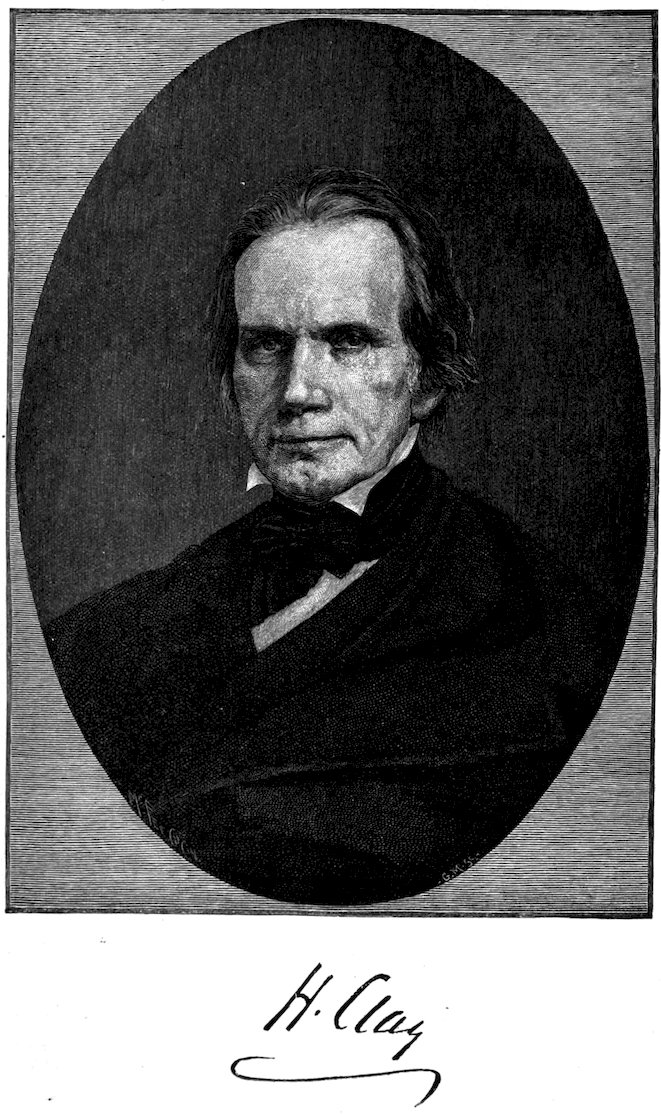
50With a view to meet the wishes of all parties, and arrive at some definite and permanent adjustment of the slavery question, Mr. Clay early in the session introduced compromise resolutions which were practically a tacking together of the several bills then on the calendar, providing for the admission of California—the territorial government for Utah and New Mexico—the settlement of the Texas boundary—slavery in the District of Columbia—and for a fugitive slave law. It was seriously and earnestly opposed by many, as being a concession to the spirit of disunion—a capitulation under threat of secession; and as likely to become the source of more contentions than it proposed to quiet.
The resolutions were referred to a special committee, who promptly reported a bill embracing the comprehensive plan of compromise which Mr. Clay proposed. Among the resolutions offered, was the following: “Resolved, that as slavery does not exist by law and is not likely to be introduced into any of the territory acquired by the United States from the Republic of Mexico, it is inexpedient for Congress to provide by law either for its introduction into or exclusion from any part of the said territory; and that appropriate territorial governments ought to be established by Congress in all of the said territory, and assigned as the boundaries of the proposed State of California, without the adoption of any restriction or condition on the subject of slavery.” Mr. Jefferson Davis of Mississippi, objected that the measure gave nothing to the South in the settlement of the question; and he required the extension of the Missouri compromise line to the Pacific Ocean as the least that he would be willing to take, with the specific recognition of the right to hold slaves in the territory below that line; and that, before such territories are admitted into the Union as States, slaves may be taken there from any of the United States at the option of their owner.
Mr. Clay in reply, said: “Coming from a slave State, as I do, I owe it to myself, I owe it to truth, I owe it to the subject, to say that no earthly power could induce me to vote for a specific measure for the introduction of slavery where it had not before existed, either south or north of that line.*** If the citizens of those territories choose to establish slavery, and if they come here with constitutions establishing slavery, I am for admitting them with such provisions in their constitutions; but then it will be their own work, and not ours, and their posterity will have to reproach them, and not us, for forming constitutions allowing the institution of slavery to exist among them.”
Mr. Seward of New York, proposed a renewal of the Wilmot Proviso, in the following resolution: “Neither slavery nor involuntary servitude, otherwise than by conviction for crime, shall ever be allowed in either of said territories of Utah and New Mexico;” but his resolution was rejected in the Senate by a vote of 23 yeas to 33 nays. Following this, Mr. Calhoun had read for him in the Senate, by his friend James M. Mason of Virginia, his last speech. It embodied the points covered by the address to the people, prepared by him the previous year; the probability of a dissolution of the Union, and presenting a case to justify it. The tenor of the speech is shown by the following extracts from it: “I have, Senators, believed from the first, that the agitation of the subject of slavery would, if not prevented by some timely and effective measure, end in disunion. Entertaining this opinion, I have, on all proper occasions, endeavored to call the attention of each of the two great parties which divide the country to adopt some measure to prevent so great a disaster, but without success. The agitation has been permitted to proceed, with almost no attempt to resist it, until it has reached a period when it can no longer be disguised or denied that the Union is in danger. You have had forced upon you the greatest and gravest question that can ever come under your consideration: How can the Union be preserved?*** Instead of being weaker, all the elements in favor of agitation are stronger now than they were in 1835, when it first commenced, while all the elements of influence on the part of the South are weaker. Unless something decisive is done, I again ask what is to stop this agitation, before the great and final object at which it aims—the abolition of slavery in the States—is consummated? Is it, then, not certain that if something decisive is not now done to arrest it, the South will be forced to choose between abolition and secession? Indeed 51as events are now moving, it will not require the South to secede to dissolve the Union.*** If the agitation goes on, nothing will be left to hold the States together except force.” He answered the question, How can the Union be saved? with which his speech opened, by suggesting: “To provide for the insertion of a provision in the constitution, by an amendment, which will restore to the South in substance the power she possessed of protecting herself, before the equilibrium between the sections was destroyed by the action of the government.” He did not state of what the amendment should consist, but later on, it was ascertained from reliable sources that his idea was a dual executive—one President from the free, and one from the slave States, the consent of both of whom should be required to all acts of Congress before they become laws. This speech of Mr. Calhoun’s, is important as explaining many of his previous actions; and as furnishing a guide to those who ten years afterwards attempted to carry out practically the suggestions thrown out by him.
Mr. Clay’s compromise bill was rejected. It was evident that no compromise of any kind whatever on the subject of slavery, under any one of its aspects separately, much less under all put together, could possibly be made. There was no spirit of concession manifested. The numerous measures put together in Mr. Clay’s bill were disconnected and separated. Each measure received a separate and independent consideration, and with a result which showed the injustice of the attempted conjunction; for no two of them were passed by the same vote, even of the members of the committee which had even unanimously reported favorably upon them as a whole.
Mr. Calhoun died in the spring of 1850; before the separate bill for the admission of California was taken up. His death took place at Washington, he having reached the age of 68 years. A eulogy upon him was delivered in the Senate by his colleague, Mr. Butler, of South Carolina. Mr. Calhoun was the first great advocate of the doctrine of secession. He was the author of the nullification doctrine, and an advocate of the extreme doctrine of States Rights. He was an eloquent speaker—a man of strong intellect. His speeches were plain, strong, concise, sometimes impassioned, and always severe. Daniel Webster said of him, that “he had the basis, the indispensable basis of all high characters, and that was unspotted integrity, unimpeached honor and character!”
In July of this year an event took place which threw a gloom over the country. The President, General Taylor, contracted a fever from exposure to the hot sun at a celebration of Independence Day, from which he died four days afterwards. He was a man of irreproachable private character, undoubted patriotism, and established reputation for judgment and firmness. His brief career showed no deficiency of political wisdom nor want of political training. His administration was beset with difficulties, with momentous questions pending, and he met the crisis with firmness and determination, resolved to maintain the Federal Union at all hazards. His first and only annual message, the leading points of which have been stated, evinces a spirit to do what was right among all the States. His death was a public calamity. No man could have been more devoted to the Union nor more opposed to the slavery agitation; and his position as a Southern man and a slaveholder—his military reputation, and his election by a majority of the people as well as of the States, would have given him a power in the settlement of the pending questions of the day which no President without these qualifications could have possessed.
In accordance with the Constitution, the office of President thus devolved upon the Vice-President, Mr. Millard Fillmore, who was duly inaugurated July 10, 1850. The new cabinet, with Daniel Webster as Secretary of State, was duly appointed and confirmed by the Senate.
The bill for the admission of California as a State in the Union, was called up in the Senate and sought to be amended by extending the Missouri Compromise line through it, to the Pacific Ocean, so as to authorize slavery in the State below that line. The amendment was introduced and pressed by Southern friends of the late Mr. Calhoun, and made a test question. It was lost, and the bill passed by a two-third vote; whereupon ten Southern Senators offered a written protest, the concluding clause of which was: “We dissent from this bill, and solemnly protest against its passage, because in sanctioning measures so contrary to former precedents, to obvious policy, to the spirit and intent of the constitution of the United States, for the purpose of excluding the slaveholding States from the territory thus to be erected into a State, this government in effect declares that the exclusion of slavery from the territory of the United States is an object so high and important as to justify a disregard not only of all the principles of sound policy, but also of the constitution itself. Against this conclusion we must now and for ever protest, as it is destructive of the safety and liberties of those whose rights have been committed to our care, fatal to the peace and equality of the States which we represent, and must lead, if persisted in, to the dissolution of that 52confederacy, in which the slaveholding States have never sought more than equality, and in which they will not be content to remain with less.” On objection being made, followed by debate, the Senate refused to receive the protest, or permit it to be entered on the Journal. The bill went to the House of Representatives, was readily passed, and promptly approved by the President. Thus was virtually accomplished the abrogation of the Missouri compromise line; and the extension or non-extension of slavery was then made to form a foundation for future political parties.
The year 1850 was prolific with disunion movements in the Southern States. The Senators who had joined with Mr. Calhoun in the address to the people, in 1849, united with their adherents in establishing at Washington a newspaper entitled “The Southern Press,” devoted to the agitation of the slavery question; to presenting the advantages of disunion, and the organization of a confederacy of Southern States to be called the “United States South.” Its constant aim was to influence the South against the North, and advocated concert of action by the States of the former section. It was aided in its efforts by newspapers published in the South, more especially in South Carolina and Mississippi. A disunion convention was actually held, in Nashville, Tennessee, and invited the assembly of a Southern Congress. Two States, South Carolina and Mississippi responded to the appeal; passed laws to carry it into effect, and the former went so far as to elect its quota of Representatives to the proposed new Southern Congress. These occurrences are referred to as showing the spirit that prevailed, and the extraordinary and unjustifiable means used by the leaders to mislead and exasperate the people. The assembling of a Southern “Congress” was a turning point in the progress of disunion. Georgia refused to join; and her weight as a great Southern State was sufficient to cause the failure of the scheme. But the seeds of discord were sown, and had taken root, only to spring up at a future time when circumstances should be more favorable to the accomplishment of the object.
Although the Congress of the United States had in 1790 and again in 1836 formally declared the policy of the government to be non-interference with the States in respect to the matter of slavery within the limits of the respective States, the subject continued to be agitated in consequence of petitions to Congress to abolish slavery in the District of Columbia, which was under the exclusive control of the federal government; and of movements throughout the United States to limit, and finally abolish it. The subject first made its appearance in national politics in 1840, when a presidential ticket was nominated by a party then formed favoring the abolition of slavery; it had a very slight following which was increased tenfold at the election of 1844 when the same party again put a ticket in the field with James G. Birney of Michigan, as its candidate for the Presidency; who received 62,140 votes. The efforts of the leaders of that faction were continued, and persisted in to such an extent, that when in 1848 it nominated a ticket with Gerritt Smith for President, against the Democratic candidate, Martin Van Buren, the former received 296,232 votes. In the presidential contest of 1852 the abolition party again nominated a ticket, with John P. Hale as its candidate for President, and polled 157,926 votes. This large following was increased from time to time, until uniting with a new party then formed, called the Republican party, which latter adopted a platform endorsing the views and sentiments of the abolitionists, the great and decisive battle for the principles involved, was fought in the ensuing presidential contest of 1856; when the candidate of the Republican party, John C. Fremont, supported by the entire abolition party, polled 1,341,812 votes. The first national platform of the Abolition party, upon which it went into the contest of 1840, favored the abolition of slavery in the District of Columbia and Territories; the inter-state slave trade, and a general opposition to slavery to the full extent of constitutional power.
Following the discussion of the subject of slavery, in the Senate and House of Representatives, brought about by the presentation of petitions and memorials, and the passage of the resolutions in 1836 rejecting such petitions, the question was again raised by the presentation in the House, by Mr. Slade of Vermont, on the 20th December 1837, of two memorials praying the abolition of slavery in the District of Columbia, and moving that they be referred to a select committee. Great excitement prevailed in the chamber, and of the many attempts by the Southern members an adjournment was had. The next day a resolution was offered that thereafter all such petitions and memorials touching the abolition of slavery should, when presented, be laid on the table; which resolution was adopted by a large vote. During the 24th Congress, the Senate pursued the course of laying on the table the motion to receive all abolition petitions; and both Houses during the 25th Congress continued the same course of conduct; when finally on the 25th of January 1840, the House adopted by a vote of 114 to 108, an amendment to the rules, called the 21st Rule, which provided:—“that no petition, memorial or resolution, or other paper, praying 53the abolition of slavery in the District of Columbia, or any state or territory, or the slave-trade between the States or territories of the United States, in which it now exists, shall be received by this House, or entertained in any way whatever.” This rule was afterwards, on the 3d of December, 1844, rescinded by the House, on motion of Mr. J. Quincy Adams, by a vote of 108 to 80; and a motion to re-instate it, on the 1st of December 1845, was rejected by a vote of 84 to 121. Within five years afterwards—on the 17th September 1850,—the Congress of the United States enacted a law, which was approved by the President, abolishing slavery in the District of Columbia.
On the 25th of February, 1850, there was presented in the House of Representatives, two petitions from citizens of Pennsylvania and Delaware, setting forth that slavery, and the constitution which permits it, violates the Divine law; is inconsistent with republican principles; that its existence has brought evil upon the country; and that no union can exist with States which tolerate that institution; and asking that some plan be devised for the immediate, peaceful dissolution of the Union. The House refused to receive and consider the petitions; as did also the Senate when the same petitions were presented the same month.
The presidential election of 1852 was the last campaign in which the Whig party appeared in National politics. It nominated a ticket with General Winfield Scott as its candidate for President. His opponent on the Democratic ticket was General Franklin Pierce. A third ticket was placed in the field by the Abolition party, with John P. Hale as its candidate for President. The platform and declaration of principles of the Whig party was in substance a ratification and endorsement of the several measures embraced in Mr. Clay’s compromise resolutions of the previous session of Congress, before referred to; and the policy of a revenue for the economical administration of the government, to be derived mainly from duties on imports, and by these means to afford protection to American industry. The main plank of the platform of the Abolition party (or Independent Democrats, as they were called) was for the non-extension and gradual extinction of slavery. The Democratic party equally adhered to the compromise measure. The election resulted in the choice of Franklin Pierce, by a popular vote of 1,601,474, and 254 electoral votes, against a popular aggregate vote of 1,542,403 (of which the abolitionists polled 157,926) and 42 electoral votes, for the Whig and Abolition candidates. Mr. Pierce was duly inaugurated as President, March 4, 1853.
The first political parties in the United States, from the establishment of the federal government and for many years afterwards, were denominated Federalists and Democrats, or Democratic-Republicans. The former was an anti-alien party. The latter was made up to a large extent of naturalized foreigners; refugees from England, Ireland and Scotland, driven from home for hostility to the government or for attachment to France. Naturally, aliens sought alliance with the Democratic party, which favored the war against Great Britain. The early party contests were based on the naturalization laws; the first of which, approved March 26, 1790, required only two years’ residence in this country; a few years afterwards the time was extended to five years; and in 1798 the Federalists taking advantage of the war fever against France, and then being in power, extended the time to fourteen years. (See Alien and Sedition Laws of 1798). Jefferson’s election and Democratic victory of 1800, brought the period back to five years in 1802, and reinforced the Democratic party. The city of New York, especially, from time to time became filled with foreigners; thus naturalized; brought into the Democratic ranks; and crowded out native Federalists from control of the city government, and to meet this condition of affairs, the first attempt at a Native American organization was made. Beginning in 1835; ending in failure in election of Mayor in 1837, it was revived in April, 1844, when the Native American organization carried New York city for its Mayoralty candidate by a good majority. The success of the movement there, caused it to spread to New Jersey and Pennsylvania. In Philadelphia, it was desperately opposed by the Democratic, Irish and Roman Catholic element, and so furiously, that it resulted in riots, in which two Romish Churches were burned and destroyed. The adherents of the American organization were not confined to Federalists or Whigs, but largely of native Democrats; and the Whigs openly voted with Democratic Natives in order to secure their vote for Henry Clay for the Presidency; but when in November, 1844, New York and Philadelphia both gave Native majorities, and so sapped the Whig vote, that both places gave majorities for the Democratic Presidential electors, the Whigs drew off. In 1845, at the April election in New York, the natives were defeated, and the new party disappeared there. As a result of the autumn election of 1844, the 29th Congress, which organized in December, 1845, had six Native Representatives; four from New York and two from Pennsylvania. In the 30th Congress, Pennsylvania had one. Thereafter for some years, with the exception of a 54small vote in Pennsylvania and New York, Nativism disappeared. An able writer of that day—Hon. A. H. H. Stuart, of Virginia—published under the nom-de-plume of “Madison” several letters in vindication of the American party (revived in 1852,) in which he said: “The vital principle of the American party is Americanism—developing itself in a deep-rooted attachment to our own country—its constitution, its union, and its laws—to American men, and American measures, and American interests—or, in other words, a fervent patriotism—which, rejecting the transcendental philanthropy of abolitionists, and that kindred batch of wild enthusiasts, who would seek to embroil us with foreign countries, in righting the wrongs of Ireland, or Hungary, or Cuba—would guard with vestal vigilance American institutions and American interests against the baneful effects of foreign influence.”
About 1852, when the question of slavery in the territories, and its extension or its abolition in the States, was agitated and causing sectional differences in the country, many Whigs and Democrats forsook their parties, and took sides on the questions of the day. This was aggravated by the large number of alien naturalized citizens constantly added to the ranks of voters, who took sides with the Democrats and against the Whigs. Nativism then re-appeared, but in a new form—that of a secret fraternity. Its real name and objects were not revealed—even to its members, until they reached a high degree in the order; and the answer of members on being questioned on these subjects was, “I don’t know”—which gave it the popular name, by which it is yet known, of “Know-nothing.” Its moving causes were the growing power and designs of the Roman Catholic Church in America; the sudden influx of aliens; and the greed and incapacity of naturalized citizens for office. Its cardinal principle was: “Americans must rule America”; and its countersign was the order of General Washington on a critical occasion during the war: “Put none but Americans on guard to-night.” Its early nominations were not made public, but were made by select committees and conventions of delegates. At first these nominations were confined to selections of the best Whig or best Democrat on the respective tickets; and the choice not being made known, but quietly voted for by all the members of the order, the effect was only visible after election, and threw all calculation into chaos. For a while it was really the arbiter of elections.
On February 8, 1853, a bill passed the House of Representatives providing a territorial government for Nebraska, embracing all of what is now Kansas and Nebraska. It was silent on the subject of the repeal of the Missouri Compromise. The bill was tabled in the Senate; to be revived at the following session. In the Senate it was amended, on motion of Mr. Douglas, to read: “That so much of the 8th section of an act approved March 6, 1820, (the Missouri compromise) *** which, being inconsistent with the principles of non-intervention by Congress with slavery in the States and Territories, as recognized by the legislature of 1850, commonly called the Compromise measures, is hereby declared inoperative and void; it being the true intent and meaning of this act not to legislate slavery into any Territory or State, nor to exclude it therefrom, but to leave the people thereof perfectly free to form and regulate their domestic institutions in their own way, subject only to the Constitution of the United States.” It was further amended, on motion of Senator Clayton, to prohibit “alien suffrage.” In the House this amendment was not agreed to; and the bill finally passed without it, on the 25th May, 1854.
So far as Nebraska was concerned, no excitement of any kind marked the initiation of her territorial existence. The persons who emigrated there seemed to regard the pursuits of business as of more interest than the discussion of slavery. Kansas was less fortunate. Her territory became at once the battle-field of a fierce political conflict between the advocates of slavery, and the free soil men from the North who went there to resist the establishment of that institution in the territory. Differences arose between the Legislature and the Governor, brought about by antagonisms between the Pro-slavery party and the Free State party; and the condition of affairs in Kansas assumed so frightful a mien in January, 1856, that the President sent a special message to Congress on the subject, January 24, 1856; followed by a Proclamation, February 11, 1856, “warning all unlawful combinations (in the territory) to retire peaceably to their respective abodes, or he would use the power of the local militia, and the available forces of the United States to disperse them.”
Several applications were made to Congress for several successive years, for the admission of Kansas as a state in the Union; upon the basis of three separate and distinct constitutions, all differing as to the main questions at issue between the contending factions. The name of Kansas was for some years synonymous with all that is lawless and anarchical. Elections became mere farces, and the officers thus fraudulently placed in power, used their authority only for their own or their party’s interest. The party opposed to slavery at length triumphed; a constitution 55excluding slavery was adopted in 1859, and Kansas was admitted into the Union January 29, 1861.
Under the fugitive slave law, which was passed by Congress at the session of 1850, as one of the Compromise measures, introduced by Mr. Clay, a long and exciting litigation occurred to test the validity and constitutionality of the act, and the several laws on which it depended. The suit was instituted by Dred Scott, a negro slave, in the Circuit Court of the United States for the District of Missouri, in April Term, 1854, against John F. A. Sanford, his alleged owner, for trespass vi et armis, in holding the plaintiff and his wife and daughters in slavery in said District of Missouri, where by law slavery was prohibited; they having been previously lawfully held in slavery by a former owner—Dr. Emerson—in the State of Illinois, from whence they were taken by him to Missouri, and sold to the defendant, Sanford. The case went up on appeal to the Supreme Court of the United States, and was clearly and elaborately argued. The majority opinion, delivered by Chief Justice Taney, as also the dissenting opinions, are reported in full in Howard’s U. S. Supreme Court Reports, Volume 19, page 393. In respect to the territories the Constitution grants to Congress the power “to make all needful rules and regulations concerning the territory and other property belonging to the United States.” The Court was of opinion that the clause of the Constitution applies only to the territory within the original States at the time the Constitution was adopted, and that it did not apply to future territory acquired by treaty or conquest from foreign nations. They were also of opinion that the power of Congress over such future territorial acquisitions was not unlimited, that the citizens of the States migrating to a territory were not to be regarded as colonists, subject to absolute power in Congress, but as citizens of the United States, with all the rights of citizenship guarantied by the Constitution, and that no legislation was constitutional which attempted to deprive a citizen of his property on his becoming a resident of a territory. This question in the case arose under the act of Congress prohibiting slavery in the territory of upper Louisiana, (acquired from France, afterwards the State), and of which the territory of Missouri was formed. Any obscurity as to what constitutes citizenship, will be removed by attending to the distinction between local rights of citizenship of the United States according to the Constitution. Citizenship at large in the sense of the Constitution can be conferred on a foreigner only by the naturalization laws of Congress. But each State, in the exercise of its local and reserved sovereignty, may place foreigners or other persons on a footing with its own citizens, as to political rights and privileges to be enjoyed within its own dominion. But State regulations of this character do not make the persons on whom such rights are conferred citizens of the United States or entitle them to the privileges and immunities of citizens in another State. See 5 Wheaton, (U. S. Supreme Court Reports), page 49.
The Court said in The Dred Scott case, above referred to, that:—“The right of property in a slave is distinctly and expressly affirmed in the Constitution. The right to traffic in it like the ordinary article of merchandise and property was guarantied to the citizens of the United States, in every State that might desire it for twenty years, and the government in express terms is pledged to protect it in all future time if the slave escapes from his owner. This is done in plain words—too plain to be misunderstood, and no word can be found in the Constitution which gives Congress a greater power over slave property, or which entitles property of that kind to less protection than the property of any other description. The only power conferred is the power coupled with the duty of guarding and protecting the owner in his rights. Upon these considerations, it is the opinion of the Court that the Act of Congress which prohibited a citizen from holding and owning property of this kind in the territory of the United States north of the line therein mentioned, is not warranted by the Constitution and is therefore void; and that neither Dred Scott himself, nor any of his family were made free by being carried into this territory; even if they had been carried there by the owner with the intention of becoming a permanent resident.” The abolition of slavery by the 13th amendment to the Constitution of the United States ratified and adopted December 18, 1865, has put an end to these discussions formerly so numerous.
As early as 1854, the Kansas-Nebraska controversy on the territorial government bill, resulted in a division of the Whig party in the North. Those not sufficiently opposed to slavery to enter the new Republican party, then in its incipiency, allied themselves with the Know-Nothing order, which now accepting the name of American party established a separate and independent political existence. The party had no hold in the West; it was entirely Middle State at this time, and polled a large vote in Massachusetts, Delaware and New York. In the State elections of 1855 the American party made a stride Southward. In 1855, the absence of naturalized citizens was universal in the South, and even so late as 1881 the proportion of 56foreign born population in the Southern States, with the exception of Florida, Louisiana, and Texas was under two per cent. At the early date—1855—the nativist feeling among the Whigs of that section, made it easy to transfer them to the American party, which thus secured in both the Eastern and Southern States, the election of Governor and Legislature in the States of New Hampshire, Massachusetts, Rhode Island, Connecticut, New York, California and Kentucky; and also elected part of its State ticket in Maryland, and Texas; and only lost the States of Virginia, Alabama, Mississippi, Louisiana, and Texas, by small majorities against it.
The order began preparations for a campaign as a National party, in 1856. It aimed to introduce opposition to aliens and Roman Catholicism as a national question. On the 21st of February, 1856, the National Council held a session at Philadelphia, and proceeded to formulate a declaration of principles, and make a platform, which were as follows:
“An humble acknowledgement to the Supreme Being, for his protecting care vouchsafed to our fathers in their successful Revolutionary struggle, and hitherto manifested to us, their descendants, in the preservation of the liberties, the independence, and the union of these States.
2d. The perpetuation of the Federal Union, as the palladium of our civil and religious liberties, and the only sure Bulwark of American independence.
3d. Americans must rule America, and to this end, native-born citizens should be selected for all state, federal, and municipal offices or government employment, in preference to all others; nevertheless,
4th. Persons born of American parents residing temporarily abroad, should be entitled to all the rights of native-born citizens; but,
5th. No person shall be selected for political station (whether of native or foreign birth), who recognizes any allegiance or obligation, of any description, to any foreign prince, potentate, or power, or who refuses to recognize the Federal and State constitutions (each within its sphere) as paramount to all other laws, as rules of political action.
6th. The unqualified recognition and maintenance of the reserved rights of the several States, and the cultivation of harmony and fraternal good will, between the citizens of the several States, and to this end, non-interference by congress with questions appertaining solely to the individual States, and non-intervention by each State with the affairs of any other State.
7th. The recognition of the right of the native-born and naturalized citizens of the United States, permanently residing in any territory thereof, to frame their constitution and laws, and to regulate their domestic and social affairs in their own mode, subject only to the provisions of the Federal Constitution, with the privilege of admission into the Union, whenever they have the requisite population for one representative in Congress.—Provided always, that none but those who are citizens of the United States, under the Constitution and laws thereof, and who have a fixed residence in any such territory, ought to participate in the formation of the Constitution, or in the enactment of laws for said Territory or State.
8th. An enforcement of the principle that no State or Territory ought to admit others than citizens of the United States to the right of suffrage, or of holding political office.