BOOK III. GREAT SPEECHES ON GREAT ISSUES. (continued 5)
Reading edition
The gentleman has found no case—he can find none—to support his own opinions by New England authority. New England has studied the constitution in other schools, and under other teachers. She looks upon it with other regards, and deems more highly and reverently, both of its just authority and its utility and excellence. The history of her legislative proceedings may be traced—the ephemeral effusions of temporary bodies, called together by the excitement of the occasion, may be hunted up—they have been hunted up. The opinions and votes of her public men, in and out of Congress, may be explored—it will all be in vain. The Carolina doctrine can derive from her neither countenance nor support. She rejects it now; she always did reject it. The honorable member has referred to expressions on the subject of the embargo law, made in this place by an honorable and venerable gentleman (Mr. Hillhouse) now favoring us with his presence. He quotes that distinguished senator as saying, that in his judgment the embargo law was unconstitutional, and that, therefore, in his opinion, the people were not bound to obey it.
That, sir, is perfectly constitutional language. An unconstitutional law is not binding; but then it does not rest with a resolution or a law of a state legislature to decide whether an act of Congress be or be not constitutional. An unconstitutional act of Congress would not bind the people of this district although they have no legislature to interfere in their behalf; and, on the other hand, a constitutional law of Congress does bind the citizens of every state, although all their legislatures should undertake to annul it, by act or resolution. The venerable Connecticut senator is a constitutional lawyer, of sound principles and enlarged knowledge; a statesman practiced and experienced, bred in the 3073company of Washington, and holding just views upon the nature of our governments. He believed the embargo unconstitutional, and so did others; but what then? Who did he suppose was to decide that question? The state legislature? Certainly not. No such sentiment ever escaped his lips. Let us follow up, sir, this New England opposition to the embargo laws; let us trace it, till we discern the principle which controlled and governed New England throughout the whole course of that opposition. We shall then see what similarity there is between the New England school of constitutional opinions and this modern Carolina school. The gentleman, I think, read a petition from some single individual, addressed to the legislature of Massachusetts, asserting the Carolina doctrine—that is, the right of state interference to arrest the laws of the Union. The fate of that petition shows the sentiment of the legislature. It met no favor. The opinions of Massachusetts were otherwise. They had been expressed in 1798, in answer to the resolutions of Virginia, and she did not depart from them, nor bend them to the times. Misgoverned, wronged, oppressed, as she felt herself to be, she still held fast her integrity to the Union. The gentleman may find in her proceedings much evidence of dissatisfaction with the measures of government, and great and deep dislike, she claimed no right still to sever asunder the bonds of the Union. There was heat, and there was anger in her political feeling. Be it so. Her heat or her anger did not, nevertheless, betray her into infidelity to the government. The gentleman labors to prove that she disliked the embargo as much as South Carolina dislikes the tariff, and expressed her dislike as strongly. Be it so; but did she propose the Carolina remedy? Did she threaten to interfere, by state authority, to annul the laws of the Union? That is the question for the gentleman’s consideration.
No doubt, sir, a great majority of the people of New England conscientiously believe the embargo law of 1807 unconstitutional—as conscientiously, certainly, as the people of South Carolina hold that opinion of the tariff.—They reasoned thus: Congress has power to regulate commerce; but here is a law, they said, stopping all commerce, and stopping it indefinitely. The law is perpetual, therefore, as the law against treason or murder. Now, is this regulating commerce, or destroying it? Is it guiding, controlling, giving the rule to commerce, as a subsisting thing, or is it putting an end to it altogether? Nothing is more certain than that a majority in New England deemed this law a violation of the constitution. This very case required by the gentleman to justify state interference had then arisen. Massachusetts believed this law to be “a deliberate, palpable, and dangerous exercise of a power not granted by the constitution.” Deliberate it was, for it was long continued; palpable she thought it, as no words in the constitution gave the power, and only a construction, in her opinion most violent, raised it; dangerous it was, since it threatened utter ruin to her most important interests. Here, then, was a Carolina case. How did Massachusetts deal with it? It was, as she thought, a plain, manifest, palpable violation of the constitution; and it brought ruin to her doors. Thousands of families, and hundreds of thousands of individuals, were beggared by it. While she saw and felt all this, she saw and felt, also, that as a measure of national policy, it was perfectly futile; that the country was no way benefited by that which caused so much individual distress; that it was efficient only for the production of evil, and all that evil inflicted on ourselves. In such a case, under such circumstances, how did Massachusetts demean herself? Sir, she remonstrated, she memorialized, she addressed herself to the general government, not exactly “with the concentrated energy of passion,” but with her strong sense, and the energy of sober conviction. But she did not interpose the arm of her power to arrest the law, and break the embargo. Far from it. Her principles bound her to two things; and she followed her principles, lead where they might. First, to submit to every constitutional law of Congress; and secondly, if the constitutional validity of the law be doubted, to refer that question to the decision of the proper tribunals. The first principle is vain and ineffectual without the second. A majority of us in New England believe the embargo law unconstitutional; but the great question was, and always will be in such cases, Who is to decide this? Who is to judge between the people and the government? And, sir, it is quite plain, that the constitution of the United States confers on the government itself, to be exercised by its appropriate department, this power of deciding, ultimately and conclusively, upon the just extent of its own authority. If this had not been done, we should not have advanced a single step beyond the old confederation.
Being fully of opinion that the embargo law was unconstitutional, the people of New England were yet equally clear in the opinion—it was a matter they did not doubt upon—that the question, after all, must be decided by the judicial tribunals of the United States. Before those tribunals, therefore, they brought the question. Under the provisions of the law, they had given bonds, to millions in amount, and which were alleged to be forfeited. They suffered the bonds to be sued, and thus raised the 3074question. In the old-fashioned way of settling disputes, they went to law. The case came to hearing and solemn argument; and he who espoused their cause and stood up for them against the validity of the act, was none other than that great man, of whom the gentleman has made honorable mention, Samuel Dexter. He was then, sir, in the fulness of his knowledge and the maturity of his strength. He had retired from long and distinguished public service here, to the renewed pursuit of professional duties; carrying with him all that enlargement and expansion, all the new strength and force, which an acquaintance with the more general subjects discussed in the national councils is capable of adding to professional attainment, in a mind of true greatness and comprehension. He was a lawyer, and he was also a statesman. He had studied the constitution, when he filled public station, that he might defend it; he had examined its principles, that he might maintain them. More than all men, or at least as much as any man, he was attached to the general government, and to the union of the states. His feelings and opinions all ran in that direction. A question of constitutional law, too, was, of all subjects, that one which was best suited to his talents and learning. Aloof from technicality, and unfettered by artificial rule, such a question gave opportunity for that deep and clear analysis, that mighty grasp of principle, which so much distinguished his higher efforts. His very statement was argument; his inference seemed demonstration. The earnestness of his own conviction wrought conviction in others. One was convinced, and believed, and consented, because it was gratifying, delightful, to think, and feel, and believe, in unison with an intellect of such evident superiority.
Mr. Dexter, sir, such as I have described him, argued the New England cause. He put into his effort his whole heart, as well as all the powers of his understanding; for he had avowed, in the most public manner, his entire concurrence with his neighbors, on the point in dispute. He argued the cause; it was lost, and New England submitted. The established tribunals pronounced the law constitutional, and New England acquiesced. Now, sir, is not this the exact opposite of the doctrine of the gentleman from South Carolina? According to him, instead of referring to the judicial tribunals, we should have broken up the embargo, by laws of our own; we should have repealed it, quoad New England; for we had a strong, palpable, and oppressive case. Sir, we believe the embargo unconstitutional; but still, that was matter of opinion, and who was to decide it? We thought it a clear case; but, nevertheless, we did not take the laws into our hands, because we did not wish to bring about a revolution, nor to break up the Union; for I maintain, that, between submission to the decision of the constituted tribunals, and revolution, or disunion, there is no middle ground—there is no ambiguous condition, half allegiance and half rebellion. There is no treason, madcosy. And, sir, how futile, how very futile it is, to admit the right of state interference, and then to attempt to save it from the character of unlawful resistance, by adding terms of qualification to the causes and occasions, leaving all the qualifications, like the case itself in the discretion of the state governments. It must be a clear case, it is said; a deliberate case; a palpable case; a dangerous case. But, then, the state is still left at liberty to decide for herself what is clear, what is deliberate, what is palpable, what is dangerous.
Do adjectives and epithets avail any thing? Sir, the human mind is so constituted, that the merits of both sides of a controversy appear very clear, and very palpable, to those who respectively espouse them, and both sides usually grow clearer, as the controversy advances. South Carolina sees unconstitutionality in the tariff—she sees oppression there, also, and she sees danger. Pennsylvania, with a vision not less sharp, looks at the same tariff, and sees no such thing in it—she sees it all constitutional, all useful, all safe. The faith of South Carolina is strengthened by opposition, and she now not only sees, but resolves, that the tariff is palpably unconstitutional, oppressive, and dangerous; but Pennsylvania, not to be behind her neighbors, and equally willing to strengthen her own faith by a confident asseveration, resolves also, and gives to every warm affirmative of South Carolina, a plain downright Pennsylvania negative. South Carolina, to show the strength and unity of her opinions, brings her assembly to a unanimity, within seven votes; Pennsylvania, not to be outdone in this respect more than others, reduces her dissentient fraction to one vote. Now, sir, again I ask the gentleman, what is to be done? Are these states both right? Is he bound to consider them both right? If not, which is in the wrong? or, rather, which has the best right to decide?
And if he, and if I, are not to know what the constitution means, and what it is, till those two state legislatures, and the twenty-two others, shall agree in its construction what have we sworn to, when we have sworn to maintain it? I was forcibly struck, sir, with one reflection, as the gentleman went on with his speech. He quoted Mr. Madison’s resolutions to prove that a state may interfere, in a case of deliberate, palpable, and dangerous exercise of a power not granted. The honorable member supposes the tariff law to 3075be such an exercise of power, and that consequently, a case has risen in which the state may, if it see fit, interfere by its own law. Now, it so happens, nevertheless, that Madison himself deems this same tariff law quite constitutional. Instead of a clear and palpable violation, it is, in his judgment, no violation at all. So that, while they use his authority for a hypothetical case, they reject it in the very case before them. All this, sir, shows the inherent futility. I had almost used a stronger word—of conceding this power of interference to the states, and then attempting to secure it from abuse by imposing qualifications of which the states themselves are to judge. One of two things is true: either the laws of the Union are beyond the control of the states, or else we have no constitution of general government, and are thrust back again to the days of the confederacy.
Let me here say, sir, that if the gentleman’s doctrine had been received and acted upon in New England, in the times of the embargo and non-intercourse, we should probably not now have been here. The government would very likely have gone to pieces and crumbled into dust. No stronger case can ever arise than existed under those laws; no states can ever entertain a clearer conviction than the New England States then entertained; and if they had been under the influence of that heresy of opinion, as I must call it, which the honorable member espouses, this Union would, in all probability have been scattered to the four winds. I ask the gentleman, therefore, to apply his principles to that case; I ask him to come forth and declare whether, in his opinion, the New England States would have been justified in interfering to break up the embargo system, under the conscientious opinions which he held upon it. Had they a right to annul that law? Does he admit, or deny? If that which is thought palpably unconstitutional in South Carolina justifies that state in arresting the progress of the law, tell me whether that which was thought palpably unconstitutional also in Massachusetts would have justified her in doing the same thing. Sir, I deny the whole doctrine. It has not a foot of ground in the constitution to stand on. No public man of reputation ever advanced it in Massachusetts, in the warmest times, or could maintain himself upon it there at any time.
I wish now, sir, to make a remark upon the Virginia resolutions of 1798. I cannot undertake to say how these resolutions were understood by those who passed them. Their language is not a little indefinite. In the case of the exercise, by Congress, of a dangerous power, not granted to them, the resolutions assert the right, on the part of the state to interfere, and arrest the progress of the evil. This is susceptible of more than one interpretation. It may mean no more than that the states may interfere by complaint and remonstrance, or by proposing to the people an alteration of the federal constitution. This would all be quite unobjectionable; or it may be that no more is meant than to assert the general right of revolution, as against all governments, in cases of intolerable oppression. This no one doubts; and this, in my opinion, is all that he who framed these resolutions could have meant by it; for I shall not readily believe that he was ever of opinion that a state, under the constitution, and in conformity with it, could, upon the ground of her own opinion of its unconstitutionality, however clear and palpable she might think the case, annul a law of Congress, so far as it should operate on herself, by her own legislative power.
I must now beg to ask, sir, Whence is this supposed right of the states derived? Where do they get the power to interfere with the laws of the Union? Sir, the opinion which the honorable gentleman maintains is a notion founded in a total misapprehension, in my judgment, of the origin of this government, and of the foundation on which it stands. I hold it to be a popular government, erected by the people, those who administer it responsible to the people, and itself capable of being amended and modified, just as the people may choose it should be. It is as popular, just as truly emanating from the people, as the state governments. It is created for one purpose; the state governments for another. It has its own powers; they have theirs. There is no more authority with them to arrest the operation of a law of Congress, than with Congress to arrest the operation of their laws. We are here to administer a constitution emanating immediately from the people, and trusted by them to our administration. It is not the creature of the state governments. It is of no moment to the argument that certain acts of the state legislatures are necessary to fill our seats in this body. That is not one of their original state powers, a part of the sovereignty of the state. It is a duty which the people, by the constitution itself, have imposed on the state legislatures, and which they might have left to be performed elsewhere, if they had seen fit. So they have left the choice of president with electors; but all this does not affect the proposition that this whole government—President, Senate and House of Representatives—is a popular government. It leaves it still all its popular character. The governor of a state (in some of the states) is chosen not directly by the people for the purpose of 3076performing, among other duties, that of electing a governor. Is the government of the state on that account not a popular government? This government, sir, is the independent offspring of the popular will. It is not the creature of state legislatures; nay, more, if the whole truth must be told, the people brought it into existence, established it, and have hitherto supported it, for the very purpose, amongst others, of imposing certain salutary restraints on state sovereignties. The states cannot now make war; they cannot contract alliances; they cannot make, each for itself, separate regulations of commerce; they cannot lay imposts; they cannot coin money. If this constitution, sir, be the creature of state legislatures, it must be admitted that it has obtained a strange control over the volition of its creators.
The people then, sir, erected this government. They gave it a constitution, and in that constitution they have enumerated the powers which they bestow on it. They have made it a limited government. They have defined its authority. They have restrained it to the exercise of such powers as are granted; and all others, they declare, are reserved to the states or the people. But, sir, they have not stopped here. If they had, they would have accomplished but half their work. No definition can be so clear as to avoid possibility of doubt; no limitation so precise as to exclude all uncertainty. Who, then, shall construe this grant or the people? Who shall interpret their will, where it may be supposed they have left it doubtful? With whom do they leave this ultimate right of deciding on the powers of the government? Sir, they have settled all this in the fullest manner. They have left it with the government itself, in its appropriate branches. Sir, the very chief end, the main design for which the whole constitution was framed and adopted, was to establish a government that should not be obliged to act through state agency, or depend on state opinion and discretion. The people had had quite enough of that kind of government under the confederacy. Under that system, the legal action—the application of law to individuals—belonged exclusively to the states. Congress could only recommend—their acts were not of binding force till the states had adopted and sanctioned them. Are we in that condition still? Are we yet at the mercy of state discretion and state construction? Sir, if we are, then vain will be our attempt to maintain the constitution under which we sit.
But, sir, the people have wisely provided, in the constitution itself, a proper, suitable mode and tribunal for settling questions of constitutional law. There are, in the constitution, grants of powers to Congress, and restrictions on those powers. There are also prohibitions on the states. Some authority must therefore necessarily exist, having the ultimate jurisdiction to fix and ascertain the interpretation of these grants, restrictions and prohibitions. The constitution has itself pointed out, ordained, and established that authority. How has it accomplished this great and essential end? By declaring, sir, that “the constitution and the laws of the United States, made in pursuance thereof, shall be the supreme law of the land, any thing in the constitution or laws of any state to the contrary notwithstanding.”
This, sir, was the first great step. By this, the supremacy of the constitution and laws of the United States is declared. The people so will it. No state law is to be valid which comes in conflict with the constitution or any law of the United States. But who shall decide this question of interference? To whom lies the last appeal? This, sir, the constitution itself decides also, by declaring “that the judicial power shall extend to all cases arising under the constitution and laws of the United States.” These two provisions, sir, cover the whole ground. They are, in truth, the keystone of the arch. With these it is a government; without them it is a confederacy. In pursuance of these clear and express provisions, Congress established, at its very first session, in the judicial act, a mode for carrying them into full effect, and for bringing all questions of constitutional power to the final decision of the Supreme Court. It then, sir, became a government. It then had the means of self-protection; and but for this, it would, in all probability, have been now among things which are passed. Having constituted the government, and declared its powers, the people have further said, that since somebody must decide on the extent of these powers, the government shall itself decide—subject always like other popular governments, to its responsibility to the people. And now, sir, I repeat, how is it that a state legislature acquires any right to interfere? Who, or what, gives them the right to say to the people, “We, who are your agents and servants for one purpose, will undertake to decide, that your other agents and servants, appointed by you for another purpose, have transcended the authority you gave them”? The reply would be, I think, not impertinent, “Who made you a judge over another’s servants. To their own masters they stand or fall.”
Sir, I deny this power of state legislatures altogether. It cannot stand the test of examination. Gentlemen may say, that, in an extreme case, a state government might protect the people from intolerable oppression. Sir, in such a case the people might protect themselves, without the aid of the state governments. Such a case 3077warrants revolution. It must make, when it comes, a law for itself. A nullifying act of a state legislature cannot alter the case, nor make resistance any more lawful. In maintaining these sentiments, sir, I am but asserting the rights of the people. I state what they have declared, and insist on their right to declare it. They have chosen to repose this power in the general government, and I think it my duty to support it, like other constitutional powers.
For myself, sir, I doubt the jurisdiction of South Carolina, or any other state, to prescribe my constitutional duty, or to settle, between me and the people, the validity of laws of Congress for which I have voted. I decline her umpirage. I have not sworn to support the constitution according to her construction of its clauses. I have not stipulated, by my oath of office or otherwise, to come under any responsibility, except to the people and those whom they have appointed to pass upon the question, whether the laws, supported by my votes, conform to the constitution of the country. And, sir, if we look to the general nature of the case, could any thing have been more preposterous than to have made a government for the whole Union, and yet left its powers subject, not to one interpretation, but to thirteen or twenty-four interpretations? Instead of one tribunal, established by all, responsible to all, with power to decide for all, shall constitutional questions be left to four and twenty popular bodies, each at liberty to decide for itself, and none bound to respect the decisions of others; and each at liberty, too, to give a new construction, on every new election of its own members? Would any thing, with such a principle in it, or rather with such a destitution of all principle, be fit to be called a government? No, sir. It should not be denominated a constitution. It should be called, rather, a collection of topics for everlasting controversy; heads of debate for a disputatious people. It would not be a government. It would not be adequate to any practical good, nor fit for any country to live under. To avoid all possibility of being misunderstood, allow me to repeat again, in the fullest manner, that I claim no powers for the government by forced or unfair construction. I admit that it is a government of strictly limited powers, of enumerated, specified, and particularized powers; and that whatsoever is not granted is withheld. But, notwithstanding all this, and however the grant of powers may be expressed, its limits and extent may yet, in some cases, admit of doubt; and the general government would be good for nothing, it would be incapable of long existence, if some mode had not been provided in which those doubts, as they should arise, might be peaceably, but not authoritatively solved.
And now, Mr. President, let me run the honorable gentleman’s doctrine a little into its practical application. Let us look at his probable modus operandi. If a thing can be done, an ingenious man can tell how it is to be done. Now, I wish to be informed how this state interference is to be put in practice. We will take the existing case of the tariff law. South Carolina is said to have made up her opinion upon it. If we do not repeal it, (as we probably shall not,) she will then apply to the case the remedy of her doctrine. She will, we must suppose, pass a law of her legislature, declaring the several acts of Congress, usually called the tariff laws, null and void, so far as they respect South Carolina, or the citizens thereof. So far, all is a paper transaction, and easy enough. But the collector at Charleston is collecting the duties imposed by these tariff laws—he, therefore, must be stopped. The collector will seize the goods if the tariff duties are not paid. The state authorities will undertake their rescue: the marshal, with his posse, will come to the collector’s aid; and here the contest begins. The militia of the state will be called out to sustain the nullifying act. They will march, sir, under a very gallant leader; for I believe the honorable member himself commands the militia of that part of the state. He will raise the NULLIFYING ACT on his standard, and spread it out as his banner. It will have a preamble, bearing that the tariff laws are palpable, deliberate, and dangerous violations of the constitution. He will proceed, with his banner flying, to the custom-house in Charleston,—
“all the while
Sonorous metal blowing martial sounds.”
Arrived at the custom-house, he will tell the collector that he must collect no more duties under any of the tariff laws. This he will be somewhat puzzled to say, by the way, with a grave countenance, considering what hand South Carolina herself had in that of 1816. But, sir, the collector would, probably, not desist at his bidding. Here would ensue a pause; for they say, that a certain stillness precedes the tempest. Before this military array should fall on custom-house, collector, clerks, and all, it is very probable some of those composing it would request of their gallant commander-in-chief to be informed a little upon the point of law; for they have doubtless a just respect for his opinion as a lawyer, as well as for his bravery as a soldier. They know he has read Blackstone and the constitution, as well as Turenne and Vauban. They would ask him, therefore, something concerning their rights in this matter. They would inquire whether it was not somewhat dangerous to 3078resist a law of the United States. What would be the nature of their offence, they would wish to learn, if they, by military force and array, resisted the execution in Carolina of a law of the United States, and it should turn out, after all, that the law was constitutional. He would answer, of course, treason. No lawyer could give any other answer. John Fries, he would tell them, had learned that some years ago. How, then, they would ask, do you propose to defend us? We are not afraid of bullets, but treason has a way of taking people off that we do not much relish. How do you propose to defend us? “Look at my floating banner,” he would reply; “see there the nullifying law!” Is it your opinion, gallant commander, they would then say, that if we should be indicted for treason, that same floating banner of yours would make a good plea in bar? “South Carolina is a sovereign state,” he would reply. That is true; but would the judge admit our plea? “These tariff laws,” he would repeat, “are unconstitutional, palpably, deliberately, dangerously.” That all may be so; but if the tribunals should not happen to be of that opinion, shall we swing for it? We are ready to die for our country, but it is rather an awkward business, this dying without touching the ground. After all, this is a sort of hemp-tax, worse than any part of the tariff.
Mr. President, the honorable gentleman would be in a dilemma like that of another great general. He would have a knot before him which he could not untie. He must cut it with his sword. He must say to his followers, Defend yourselves with your bayonets; and this is war—civil war.
Direct collision, therefore, between force and force, is the unavoidable result of that remedy for the revision of unconstitutional laws which the gentleman contends for. It must happen in the very first case to which it is applied. Is not this the plain result? To resist, by force, the execution of a law, generally, is treason. Can the courts of the United States take notice of the indulgence of a state to commit treason? The common saying, that a state cannot commit treason herself, is nothing to the purpose. Can it authorize others to do it? If John Fries had produced an act of Pennsylvania, annulling the law of Congress, would it have helped his case? Talk about it as we will, these doctrines go the length of revolution. They are incompatible with any peaceable administration of the government. They lead directly to disunion and civil commotion; and therefore it is, that at the commencement, when they are first found to be maintained by respectable men, and in a tangible form, that I enter my public protest against them all.
The honorable gentleman argues, that if this government be the sole judge of the extent of its own powers, whether that right of judging be in Congress or the Supreme Court, it equally subverts state sovereignty. This the gentleman sees, or thinks he sees, although he cannot perceive how the right of judging in this matter, if left to the exercise of state legislatures, has any tendency to subvert the government of the Union. The gentleman’s opinion may be that the right ought not to have been lodged with the general government; he may like better such a constitution as we should have under the right of state interference; but I ask him to meet me on the plain matter of fact—I ask him to meet me on the constitution itself—I ask him if the power is not there—clearly and visibly found there.
But, sir, what is this danger, and what the grounds of it? Let it be remembered, that the constitution of the United States is not unalterable. It is to continue in its present form no longer than the people who established it shall choose to continue it. If they shall become convinced that they have made an injudicious or inexpedient partition and distribution of power between the state governments and the general government, they can alter that distribution at will.
If anything be found in the national constitution, either by original provision or subsequent interpretation, which ought not to be in it, the people know how to get rid of it. If any construction be established, unacceptable to them, so as to become, practically, a part of the constitution, they will amend it at their own sovereign pleasure. But while the people choose to maintain it as it is, while they are satisfied with it, and refuse to change it, who has given, or who can give, to the state legislatures a right to alter it, either by interference, construction, or otherwise? Gentlemen do not seem to recollect that the people have any power to do anything for themselves; they imagine there is no safety for them any longer than they are under the close guardianship of the state legislatures. Sir, the people have not trusted their safety, in regard to the general constitution, to these hands they have required other security, and taken other bonds. They have chosen to trust themselves, first to the plain words of the instrument, and to such construction as the government itself, in doubtful cases, should put on its own powers, under their oaths of office, and subject to their responsibility to them; just as the people of a state trust their own state governments with a similar power. Secondly, they have reposed their trust in the efficacy of frequent elections, and in their own power to remove their own servants and agents, whenever they see cause. Thirdly, they have reposed trust in the judicial power, which, in order that it might 3079be trustworthy, they have made as respectable, as disinterested, and as independent as practicable. Fourthly, they have seen fit to rely, in case of necessity, or high expediency, on their known and admitted power to alter or amend the constitution, peaceably and quietly, whenever experience shall point out defects or imperfections. And finally, the people of the United States have at no time, in no way, directly or indirectly, authorized any state legislature to construe or interpret their instrument of government; much less to interfere, by their own power, to arrest its course and operation.
If sir, the people, in these respects, had done otherwise than they have done, their constitution could neither have been preserved, nor would it have been worth preserving. And if its plain provision shall now be disregarded, and these new doctrines interpolated in it, it will become as feeble and helpless a being as enemies, whether early or more recent, could possibly desire. It will exist in every state, but as a poor dependant on state permission. It must borrow leave to be, and will be, no longer than state pleasure, or state discretion, sees fit to grant the indulgence, and to prolong its poor existence.
But, sir, although there are fears, there are hopes also. The people have preserved this, their own chosen constitution, for forty years, and have seen their happiness, prosperity, and renown grow with its growth and strengthen with its strength. They are now, generally, strongly attached to it. Overthrown by direct assault it cannot be; evaded, undermined, NULLIFIED, it will not be, if we, and those who shall succeed us here, as agents and representatives of the people, shall conscientiously and vigilantly discharge the two great branches of our public trust—faithfully to preserve and wisely to administer it.
Mr. President, I have thus stated the reasons of my dissent to the doctrines which have been advanced and maintained. I am conscious of having detained you, and the Senate, much too long. I was drawn into the debate with no previous deliberation such as is suited to the discussion of so grave and important a subject. But it is a subject of which my heart is full, and I have not been willing to suppress the utterance of its spontaneous sentiments.
I cannot, even now, persuade myself to relinquish it, without expressing once more, my deep conviction, that since it respects nothing less than the union of the states, it is of most vital and essential importance to the public happiness. I profess, sir, in my career hitherto, to have kept steadily in view the prosperity and honor of the whole country, and the preservation of our Federal Union. It is to that Union we owe our safety at home and our consideration and dignity abroad. It is to that Union we are chiefly indebted for whatever makes us most proud of our country. That Union we reached only by the discipline of our virtues in the severe school of adversity. It had its origin in the necessities of disordered finance, prostrate commerce, and ruined credit. Under its benign influences, these great interests immediately awoke, as from the dead, and sprang forth with newness of life. Every year of its duration has teemed with fresh proofs of its utility and its blessings; and although our territory has stretched out wider and wider, and our population spread farther and farther, they have not outrun its protection or its benefits. It has been to us all a copious fountain of national, social, personal happiness. I have not allowed myself, sir, to look beyond the Union, to see what might lie hidden in the dark recess behind. I have not coolly weighed the chances of preserving liberty, when the bonds that unite us together shall be broken asunder. I have not accustomed myself to hang over the precipice of disunion, to see whether, with my short sight, I can fathom the depth of the abyss below; nor could I regard him as a safe counsellor in the affairs of this government, whose thoughts should be mainly bent on considering, not how the Union should be best preserved, but how tolerable might be the condition of the people when it shall be broken up and destroyed. While the Union lasts, we have high, exciting, gratifying prospects spread out before us, for us and our children. Beyond that I seek not to penetrate the veil. God grant that in my day at least, that curtain may not rise. God grant that on my vision never may be opened what lies behind. When my eyes shall be turned to behold, for the last time, the sun in heaven, may I not see him shining on the broken and dishonored fragments of a once glorious Union; on states dissevered, discordant, belligerent; on a land rent with civil feuds, or drenched, it may be, in fraternal blood! Let their last feeble and lingering glance, rather, behold the gorgeous ensign of the republic, now known and honored throughout earth, still full high advanced, its arms and trophies streaming in their original lustre, not a stripe erased or polluted, nor a single star obscured—bearing for its motto no such miserable interrogatory as, What is all this worth? nor those other words of delusion and folly, Liberty first, and Union afterwards; but every where, spread all over in characters of living light, blazing on all its ample folds as they float over the sea and over the land, and in every wind under the whole heavens, that other sentiment, dear to every true American heart—Liberty and Union, now and forever, one and inseparable!
3080
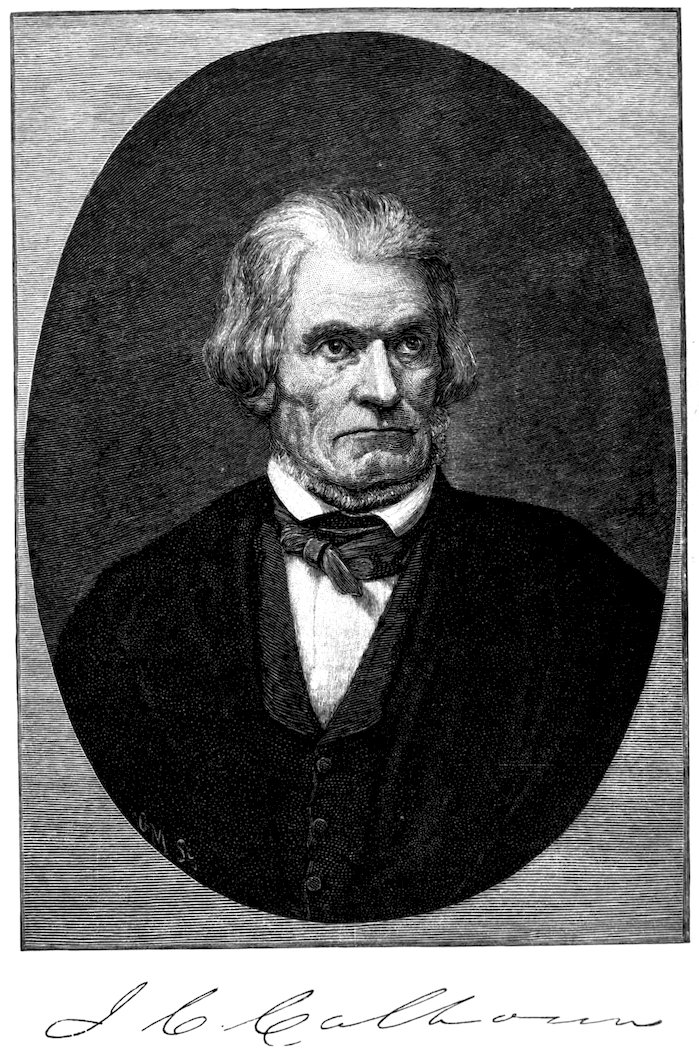
John C. Calhoun on the Rights of the States.
Delivered July 26, 1831.
The question of the relation which the states and general government bear to each other, is not one of recent origin. From the commencement of our system, it has divided public sentiment. Even in the convention, while the Constitution was struggling into existence, there were two parties, as to what this relation should be, whose different sentiments constituted no small impediment in forming that instrument. After the general government went into operation, experience soon proved that the question had not terminated with the labors of the convention. The great struggle that preceded the political revolution of 1801, which brought Mr. Jefferson into power, turned essentially on it; and the doctrines and arguments on both sides were embodied and ably sustained; on the one, in the Virginia and Kentucky resolutions and the report to the Virginia legislature; and on the other, in the replies of the legislature of Massachusetts and some of the other states. These resolutions and this report, with the decision of the Supreme Court of Pennsylvania about the same time (particularly in the case of Cobbett, delivered by Chief Justice McKean, and concurred in by the whole bench), contain what I believe to be the true doctrine on this important subject. I refer to them in order to avoid the necessity of presenting my views, with the reasons in support of them in detail.
As my object is simply to state my opinions, I might pause with this reference to documents that so fully and ably state all the points immediately connected with this deeply important subject; but as there are many who may not have the opportunity or leisure to refer to them, and, as it is possible, however clear they may be, that different persons may place different interpretations on their meaning, I will, in order that my sentiments may be fully known, and to avoid all ambiguity, proceed to state, summarily, the doctrines which I conceive they embrace.
The great and leading principle is, that the general government emanated from the people of the several states, forming distinct political communities, and acting in their separate and sovereign capacity, and not from all of the people forming one aggregate political community; that the Constitution of the United States is in fact a compact, to which each state is a party, in the character already described; and that the several states, or parties, have a right to judge of its infractions, and in case of a deliberate, palpable, and dangerous exercise of power not delegated, they have the right, in the last resort, to use the language of the Virginia resolutions; “to interpose for arresting the progress of the evil, and for maintaining, within their respective limits, the authorities, rights, and liberties appertaining to them.” This right of interposition thus solemnly asserted by the state of Virginia, be it called what it may—state right, veto, nullification, or by any other name—I conceive to be the fundamental principle of our system, resting on facts, historically as certain as our revolution itself, and deductions as simple and demonstrative as that of any political or moral truth whatever; and I firmly believe that on its recognition depends the stability and safety of our political institutions.
I am not ignorant that those opposed to the doctrine have always, now and formerly, regarded it in a very different light, as anarchical and revolutionary. Could I believe such in fact to be its tendency, to me it would be no recommendation. I yield to none, I trust, in a deep and sincere attachment to our political institutions, and the union of these states. I never breathed an opposite sentiment; but, on the contrary, I have ever considered them the great instruments of preserving our liberty, and promoting the happiness of ourselves and our posterity; and next to these, I have ever held them most dear. Nearly half my life has passed in the service of the Union, and whatever public reputation I have acquired, is indissolubly identified with it. To be too national has, indeed, been considered, by many, even of my friends, to be my greatest political fault. With these strong feelings of attachment, I have examined, with the utmost care, the bearing of the doctrine in question; and so far from anarchical or revolutionary, I solemnly believe it to be the only solid foundation of our system, and of the Union itself, and that the opposite doctrine, which denies to the states the right of protecting their reserved powers, and which would vest in the general government (it matters not through what department) the right of determining exclusively and finally the powers delegated to it, is incompatible with the sovereignty of the states, and of the Constitution itself, considered as the basis of a Federal Union. As strong as this language is, it is not stronger than that used by the illustrious Jefferson, who said, to give to the general government the final and exclusive right to judge of its powers, is to make “its discretion and not the Constitution the measure of its powers;” and that “in all cases of compact between parties having no common judge, each party has an equal right to judge for itself, as well of the operation, as of the mode and measure of redress.” Language cannot be more explicit; nor can higher authority be adduced.
3081That different opinions are entertained on this subject, I consider but as an additional evidence of the great diversity of the human intellect. Had not able, experienced, and patriotic individuals, for whom I have the highest respect, taken different views, I would have thought the right too clear to admit of doubt; but I am taught by this, as well as by many similar instances, to treat with deference opinions differing from my own. The error may possibly be with me; but, if so, I can only say, that after the most mature and conscientious examination, I have not been able to detect it. But with all proper deference, I must think that theirs is the error, who deny what seems to be an essential attribute of the conceded sovereignty of the states; and who attribute to the general government a right utterly incompatible with what all acknowledge to be its limited and restricted character; an error originating principally, as I must think, in not duly reflecting on the nature of our institutions, and on what constitutes the only rational object of all political constitutions.
It has been well said by one of the most sagacious men of antiquity, that the object of a constitution is to restrain the government, as that of laws is to restrain individuals. The remark is correct, nor is it less true where the government is vested in a majority, than where it is in a single or a few individuals; in a republic, than a monarchy or aristocracy. No one can have a higher respect for the maxim that the majority ought to govern than I have, taken in its proper sense, subject to the restrictions imposed by the Constitution, and confined to subjects in which every portion of the community have similar interests; but it is a great error to suppose, as many do, that the right of a majority to govern is a natural and not a conventional right; and, therefore, absolute and unlimited. By nature every individual has the right to govern himself; and governments, whether founded on majorities or minorities, must derive their right from the assent, expressed or implied, of the governed, and be subject to such limitations as they may impose. Where the interests are the same, that is, where the laws that may benefit one will benefit all, or the reverse, it is just and proper to place them under the control of the majority; but where they are dissimilar, so that the law that may benefit one portion may be ruinous to another, it would be, on the contrary, unjust and absurd to subject them to its will: and such I conceive to be the theory on which our Constitution rests.
That such dissimilarity of interests may exist it is impossible to doubt. They are to be found in every community, in a greater or less degree, however small or homogeneous, and they constitute, everywhere, the great difficulty of forming and preserving free institutions. To guard against the unequal action of the laws, when applied to dissimilar and opposing interests, is in fact what mainly renders a constitution indispensable; to overlook which in reasoning on our Constitution, would be to omit the principal element by which to determine its character. Were there no contrariety of interests, nothing would be more simple and easy than to form and preserve free institutions. The right of suffrage alone would be a sufficient guarantee. It is the conflict of opposing interests which renders it the most difficult work of man.
Where the diversity of interests exists in separate and distinct classes of the community, as is the case in England, and was formerly the case in Sparta, Rome, and most of the free states of antiquity, the rational constitutional provision is, that each should be represented in the government as a separate estate, with a distinct voice, and a negative on the acts of its co-estates, in order to check their encroachments. In England the constitution has assumed expressly this form, while in the governments of Sparta and Rome the same thing was effected, under different but not much less efficacious forms. The perfection of their organization, in this particular, was that which gave to the constitutions of these renowned states all of their celebrity, which secured their liberty for so many centuries, and raised them to so great a height of power and prosperity. Indeed, a constitutional provision giving to the great and separate interests of the community the right of self-protection, must appear to those who will duly reflect on the subject, not less essential to the preservation of liberty than the right of suffrage itself. They in fact have a common object, to effect which the one is as necessary as the other—to secure responsibility; that is, that those who make and execute the laws should be accountable to those on whom the laws in reality operate; the only solid and durable foundation of liberty. If without the right to suffrage our rulers would oppress us, so without the right of self-protection, the major would equally oppress the minor interests of the community. The absence of the former would make the governed the slaves of the rulers, and of the latter the feebler interests the victim of the stronger.
Happily for us we have no artificial and separate classes of society. We have wisely exploded all such distinctions; but we are not, on that account, exempt from all contrariety of interests, as the present distracted and dangerous condition of our country unfortunately but too clearly proves. With us they are almost exclusively geographical, resulting mainly from difference of climate, 3082soil, situation, industry, and production, but are not, therefore, less necessary to be protected by an adequate constitutional provision than where the distinct interests exist in separate classes. The necessity is, in truth, greater, as such separate and dissimilar geographical interests are more liable to come into conflict, and more dangerous when in that state than those of any other description; so much so, that ours is the first instance on record where they have not formed in an extensive territory separate and independent communities, or subjected the whole to despotic sway. That such may not be our unhappy fate also, must be the sincere prayer of every lover of his country.
So numerous and diversified are the interests of our country, that they could not be fairly represented in a single government, organized so as to give to each great and leading interest a separate and distinct voice, as in governments to which I have referred. A plan was adopted better suited to our situation, but perfectly novel in its character. The powers of the government were divided, not as heretofore, in reference to classes, but geographically. One general government was formed for the whole, to which was delegated all of the powers supposed to be necessary to regulate the interests common to all of the states, leaving others subject to the separate control of the states, being from their local and peculiar character such that they could not be subject to the will of the majority of the whole Union, without the certain hazard of injustice and oppression. It was thus that the interests of the whole were subjected, as they ought to be, to the will of the whole, while the peculiar and local interests were left under the control of the states separately, to whose custody only they could be safely confided. This distribution of power, settled solemnly by a constitutional compact, to which all of the states are parties, constitutes the peculiar character and excellence of our political system. It is truly and emphatically American, without example or parallel.
To realize its perfection, we must view the general government and the states as a whole, each in its proper sphere, sovereign and independent; each perfectly adapted to their respective objects; the states acting separately, representing and protecting the local and peculiar interests; acting jointly, through one general government, with the weight respectively assigned to each by the Constitution, representing and protecting the interest of the whole, and thus perfecting, by an admirable but simple arrangement, the great principle of representation and responsibility, without which no government can be free or just. To preserve this sacred distribution as originally settled, by coercing each to move in its prescribed orb, is the great and difficult problem, on the solution of which the duration of our Constitution, of our Union, and, in all probability our liberty, depends. How is this to be effected?
The question is new when applied to our peculiar political organization, where the separate and conflicting interests of society are represented by distinct but connected governments; but is in reality an old question under a new form, long since perfectly solved. Whenever separate and dissimilar interests have been separately represented in any government; whenever the sovereign power has been divided in its exercise, the experience and wisdom of ages have devised but one mode by which such political organization can be preserved; the mode adopted in England, and by all governments, ancient or modern, blessed with constitutions deserving to be called free; to give to each co-estate the right to judge of its powers, with a negative or veto on the acts of the others, in order to protect against encroachments the interests it particularly represents; a principle which all of our constitutions recognize in the distribution of power among their respective departments, as essential to maintain the independence of each, but which, to all who will duly reflect on the subject, must appear far more essential, for the same object, in that great and fundamental distribution of powers between the states and general government. So essential is the principle, that to withhold the right from either, where the sovereign power is divided, is, in fact, to annul the division itself, and to consolidate in the one left in the exclusive possession of the right, all of the powers of the government; for it is not possible to distinguish practically between a government having all power, and one having the right to take what powers it pleases. Nor does it in the least vary the principle, whether the distribution of power between co-estates, as in England, or between distinctly organized but connected governments, as with us. The reason is the same in both cases, while the necessity is greater in our case, as the danger of conflict is greater where the interests of a society are divided geographically than in any other, as has already been shown.
These truths do seem to me to be incontrovertible; and I am at a loss to understand how any one, who has maturely reflected on the nature of our institutions, or who has read history or studied the principles of free government to any purpose, can call them in question. The explanation must, it appears to me, be sought in the fact, that in every free state, there are those who look more to the necessity of maintaining power, than guarding against its abuses. I do not intend reproach, but 3083simply to state a fact apparently necessary to explain the contrariety of opinions, among the intelligent, where the abstract consideration of the subject would seem scarcely to admit of doubt. If such be the true cause, I must think the fear of weakening the government too much in this case to be in a great measure unfounded, or at least that the danger is much less from that than the opposite side. I do not deny that a power of so high a nature may be abused by a state, but when I reflect that the states unanimously called the general government into existence with all of its powers, which they freely surrendered on their part, under the conviction that their common peace, safety and prosperity required it; that they are bound together by a common origin, and the recollection of common suffering and common triumph in the great and splendid achievement of their independence; and the strongest feelings of our nature, and among them, the love of national power and distinction, are on the side of the Union; it does seem to me, that the fear which would strip the states of their sovereignty, and degrade them, in fact, to mere dependent corporations, lest they should abuse a right indispensable to the peaceable protection of those interests which they reserved under their own peculiar guardianship when they created the general government, is unnatural and unreasonable. If those who voluntarily created the system, cannot be trusted to preserve it, what power can?
So far from extreme danger, I hold that there never was a free state, in which this great conservative principle, indispensable in all, was ever so safely lodged. In others, when the co-estates, representing the dissimilar and conflicting interests of the community, came into contact, the only alternative was compromise, submission or force. Not so in ours. Should the general government and a state come into conflict, we have a higher remedy; the power which called the general government into existence, which gave it all its authority, and can enlarge, contract, or abolish its powers at its pleasure, may be invoked. The states themselves may be appealed to, three-fourths of which, in fact, form a power, whose decrees are the constitution itself, and whose voice can silence all discontent. The utmost extent then of the power is, that a state acting in its sovereign capacity, as one of the parties to the constitutional compact, may compel the government, created by that compact, to submit a question touching its infraction to the parties who created it; to avoid the supposed dangers of which, it is proposed to resort to the novel, the hazardous, and, I must add, fatal project of giving to the general government the sole and final right of interpreting the Constitution, thereby reserving the whole system, making that instrument the creature of its will, instead of a rule of action impressed on it at its creation, and annihilating in fact the authority which imposed it, and from which the government itself derives its existence.
That such would be the result, were the right in question vested in the legislative or executive branch of the government, is conceded by all. No one has been so hardy as to assert that Congress or the President ought to have the right, or to deny that, if vested finally and exclusively in either, the consequences which I have stated would not necessarily follow; but its advocates have been reconciled to the doctrine, on the supposition that there is one department of the general government, which, from its peculiar organization, affords an independent tribunal through which the government may exercise the high authority which is the subject of consideration, with perfect safety to all.
I yield, I trust, to few in my attachment to the judiciary department. I am fully sensible of its importance, and would maintain it to the fullest extent in its constitutional powers and independence; but it is impossible for me to believe that it was ever intended by the Constitution, that it should exercise the power in question, or that it is competent to do so, and, if it were, that it would be a safe depository of the power.
Its powers are judicial and not political, and are expressly confined by the Constitution “to all cases in law and equity arising under this Constitution, the laws of the United States, and the treaties made, or which shall be made, under its authority;” and which I have high authority in asserting, excludes political questions, and comprehends those only where there are parties amenable to the process of the court.[82] Nor is its incompetency less clear, than its want of constitutional authority. There may be many and the most dangerous infractions on the part of Congress, of which it is conceded by all, the court, as a judicial tribunal, cannot from its nature take cognisance. The tariff itself is a strong case in point; and the reason applies equally to all others, where Congress perverts a power from an object intended to one not intended, the most insidious and dangerous of all the infractions; and which may be extended to all of its powers, more especially to the taxing and appropriating. But supposing it competent to take cognisance of all infractions of every description, the insuperable objection still remains, that it would not be a safe tribunal to exercise the power in question.
3084It is an universal and fundamental political principle, that the power to protect, can safely be confided only to those interested in protecting, or their responsible agents—a maxim not less true in private than in public affairs. The danger in our system is, that the general government, which represents the interests of the whole, may encroach on the states, which represent the peculiar and local interests, or that the latter may encroach on the former.
In examining this point, we ought not to forget that the government, through all of its departments, judicial as well as others, is administered by delegated and responsible agents; and that the power which really controls ultimately all the movements, is not in the agents, but those who elect or appoint them. To understand then its real character, and what would be the action of the system in any supposable case, we must raise our view from the mere agents, to this high controlling power which finally impels every movement of the machine. By doing so, we shall find all under the control of the will of a majority, compounded of the majority of the states, taken as corporate bodies, and the majority of the people of the states estimated in federal numbers. These united constitute the real and final power, which impels and directs the movements of the general government. The majority of the states elect the majority of the Senate; of the people of the states, that of the House of Representatives; the two united, the President; and the President and a majority of the Senate appoint the judges, a majority of whom and a majority of the Senate and the House with the President, really exercise all of the powers of the government with the exception of the cases where the Constitution requires a greater number than a majority. The judges are, in fact, as truly the judicial representatives of this united majority, as the majority of Congress itself, or the President, is its legislative or executive representative; and to confide the power to the judiciary to determine finally and conclusively what powers are delegated and what reserved, would be in reality to confide it to the majority, whose agents they are, and by whom they can be controlled in various ways; and, of course, to subject (against the fundamental principle of our system, and all sound political reasoning) the reserved powers of the states, with all of the local and peculiar interests they were intended to protect, to the will of the very majority against which the protection was intended. Nor will the tenure by which the judges hold their office, however valuable the provision in many other respects, materially vary the case. Its highest possible effect would be to retard, and not finally to resist, the will of a dominant majority.
But it is useless to multiply arguments. Were it possible that reason could settle a question where the passions and interests of men are concerned, this point would have been long since settled for ever, by the state of Virginia. The report of her legislature, to which I have already referred, has really, in my opinion, placed it beyond controversy. Speaking in reference to this subject, it says, “It has been objected” (to the right of a state to interpose for the protection of her reserved rights), “that the judicial authority is to be regarded as the sole expositor of the Constitution; on this subject it might be observed first that there may be instances of usurped powers which the forms of the Constitution could never draw within the control of the judicial department; secondly, that if the decision of the judiciary be raised above the sovereign parties to the Constitution, the decisions of the other departments, not carried by the forms of the Constitution before the judiciary, must be equally authoritative and final with the decision of that department. But the proper answer to the objection is, that the resolution of the General Assembly relates to those great and extraordinary cases, in which all of the forms of the Constitution may prove ineffectual against infraction dangerous to the essential rights of the parties to it. The resolution supposes that dangerous powers not delegated, may not only be usurped and executed by the other departments, but that the judicial department may also exercise or sanction dangerous powers beyond the grant of the Constitution, and consequently that the ultimate right of the parties to the Constitution to judge whether the compact has been dangerously violated, must extend to violations by one delegated authority, as well as by another—by the judiciary, as well as by the executive or legislative.”
Against these conclusive arguments, as they seem to me, it is objected, that if one of the parties has the right to judge of infractions of the Constitution, so has the other, and that consequently in cases of contested powers between a state and the general government, each would have a right to maintain its opinion, as is the case when sovereign powers differ in the construction of treaties or compacts, and that of course it would come to be a mere question of force. The error is in the assumption that the general government is a party to the constitutional compact. The states, as has been shown, formed the compact, acting as sovereign and independent communities. The general government is but its creature; and though in reality a government with all the rights and authority which belong to any other government, 3085within the orb of its powers, it is, nevertheless, a government emanating from a compact between sovereigns, and partaking, in its nature and object, of the character of a joint commission, appointed to superintend and administer the interests in which all are jointly concerned, but having, beyond its proper sphere, no more power than if it did not exist. To deny this would be to deny the most incontestable facts, and the clearest conclusions; while to acknowledge its truth, is to destroy utterly the objection that the appeal would be to force, in the case supposed. For if each party has a right to judge, then under our system of government, the final cognisance of a question of contested power would be in the states, and not in the general government. It would be the duty of the latter, as in all similar cases of a contest between one or more of the principals and a joint commission or agency, to refer the contest to the principals themselves. Such are the plain dictates of reason and analogy both. On no sound principle can the agents have a right to final cognisance, as against the principals, much less to use force against them, to maintain their construction of their powers. Such a right would be monstrous; and has never, heretofore, been claimed in similar cases.
That the doctrine is applicable to the case of a contested power between the states and the general government, we have the authority not only of reason and analogy, but of the distinguished statesman already referred to. Mr. Jefferson, at a late period of his life, after long experience and mature reflection, says, “With respect to our state and federal governments, I do not think their relations are correctly understood by foreigners. They suppose the former subordinate to the latter. This is not the case. They are co-ordinate departments of one simple and integral whole. But you may ask if the two departments should claim each the same subject of power, where is the umpire to decide between them? In cases of little urgency or importance, the prudence of both parties will keep them aloof from the questionable ground; but if it can neither be avoided nor compromised, a convention of the states must be called to ascribe the doubtful power to that department which they may think best.”—It is thus that our Constitution, by authorizing amendments, and by prescribing the authority and mode of making them, has by a simple contrivance, with its characteristic wisdom, provided a power which, in the last resort, supersedes effectually the necessity and even the pretext for force; a power to which none can fairly object; with which the interests of all are safe; which can definitely close all controversies in the only effectual mode, by freeing the compact of every defect and uncertainty, by an amendment of the instrument itself. It is impossible for human wisdom, in a system like ours, to devise another mode which shall be safe and effectual, and at the same time consistent with what are the relations and acknowledged powers of the two great departments of our government. It gives a beauty and security peculiar to our system, which, if duly appreciated, will transmit its blessings to the remotest generations; but, if not, our splendid anticipations of the future will prove but an empty dream. Stripped of all its covering, and the naked question is, whether ours is a federal or a consolidated government: a constitutional or absolute one; a government resting ultimately on the solid basis of the sovereignty of the states, or on the unrestrained will of a majority; a form of government, as in all other unlimited ones, in which injustice and violence, and force, must finally prevail. Let it never be forgotten, that where the majority rules, the minority is the subject; and that if we should absurdly attribute to the former the exclusive right of construing the Constitution, there would be in fact between the sovereign and subject, under such a government, no constitution; or at least nothing deserving the name, or serving the legitimate object of so sacred an instrument.
How the states are to exercise this high power of interposition which constitutes so essential a portion of their reserved rights that it cannot be delegated without an entire surrender of their sovereignty, and converting our system from a federal into a consolidated government, is a question that the states only are competent to determine. The arguments which prove that they possess the power, equally prove that they are, in the language of Jefferson, “the rightful judges of the mode and measure of redress.” But the spirit of forbearance, as well as the nature of the right itself, forbids a recourse to it, except in cases of dangerous infractions of the Constitution; and then only in the last resort, when all reasonable hope of relief from the ordinary action of the government has failed; when, if the right to interpose did not exist, the alternative would be submission and oppression on the one side, or resistance by force on the other. That our system should afford, in such extreme cases, an intermediate point between these dire alternatives, by which the government may be brought to a pause, and thereby an interval obtained to compromise differences, or, if impracticable, be compelled to submit the question to a constitutional adjustment, through an appeal to the states themselves, is an evidence of its high wisdom; an element not, as is supposed by some, of weakness, but of 3086strength; not of anarchy or revolution, but of peace and safety. Its general recognition would of itself, in a great measure, if not altogether, supersede the necessity of its exercise, by impressing on the movements of the government that moderation and justice so essential to harmony and peace, in a country of such vast extent and diversity of interests as ours; and would, if controversy should come, turn the resentment of the aggrieved from the system to those who had abused its powers (a point all important), and cause them to seek redress, not in revolution or overthrow, but in reformation. It is, in fact, properly understood, a substitute where the alternative would be force, tending to prevent, and if that fails, to correct peaceably the aberrations to which all political systems are liable, and which, if permitted to accumulate, without correction, must finally end in a general catastrophe.
Speech of Henry Clay
In Defence of the American System[83] in which is given the Previous History of Tariff Contests in the Senate of the United States, February 2d, 3d and 6th, 1832.
[Mr. Clay, having retired from Congress soon after the establishment of the American System, by the passage of the Tariff of 1824, did not return to it till 1831–2, when the opponents of this system had acquired the ascendency, and were bent on its destruction. An act reducing the duties on many of the protected articles, was devised and passed. The bill being under consideration in the Senate, Mr. Clay addressed that body as follows:]
In one sentiment, Mr. President, expressed by the honorable gentleman from South Carolina, (General Hayne,) though perhaps not in the sense intended by him, I entirely concur. I agree with him, that the decision on the system of policy embraced in this debate, involves the future destiny of this growing country. One way I verily believe, it would lead to deep and general distress, general bankruptcy and national ruin, without benefit to any part of the Union: the other, the existing prosperity will be preserved and augmented, and the nation will continue rapidly to advance in wealth, power, and greatness, without prejudice to any section of the confederacy.
Thus viewing the question, I stand here as the humble but zealous advocate, not of the interests of one State, or seven States only, but of the whole Union. And never before have I felt more intensely, the overpowering weight of that share of responsibility which belongs to me in these deliberations. Never before have I had more occasion than I now have to lament my want of those intellectual powers, the possession of which might enable me to unfold to this Senate, and to illustrate to this people great truths, intimately connected with the lasting welfare of my country. I should, indeed, sink overwhelmed and subdued beneath the appalling magnitude of the task which lies before me, if I did not feel myself sustained and fortified by a thorough consciousness of the justness of the cause which I have espoused, and by a persuasion I hope not presumptuous, that it has the approbation of that Providence who has so often smiled upon these United States.
Eight years ago it was my painful duty to present to the other House of Congress, an unexaggerated picture of the general distress pervading the whole land. We must all yet remember some of its frightful features. We all know that the people were then oppressed and borne down by an enormous load of debt; that the value of property was at the lowest point of depression; that ruinous sales and sacrifices were everywhere made of real estate; that stop laws, and relief laws, and paper money were adopted to save the people from impending destruction; that a deficit in the public revenue existed, which compelled government to seize upon, and divert from its legitimate object the appropriations to the sinking fund, to redeem the national debt; and that our commerce and navigation were threatened with a complete paralysis. In short, sir, if I were to select any term of seven years since the adoption of the present constitution which exhibited a scene of the most widespread dismay and desolation, it would be exactly that term of seven years which immediately preceded the establishment of the tariff of 1824.
I have now to perform the more pleasing task of exhibiting an imperfect sketch of the existing state of the unparalleled prosperity of the country. On a general survey, we behold cultivation extended, the arts flourishing, the face of the country improved, our people fully and profitably employed, and the public countenance exhibiting tranquillity, contentment and happiness. And if we descend into particulars, we have the agreeable contemplation of a people out of debt, land rising slowly in value, but in a secure and salutary degree; a ready though not extravagant market for all the surplus productions of our industry; innumerable flocks and herds browsing and gamboling on ten thousand hills and plains, covered with rich and verdant grasses; our cities expanded, and whole villages springing up, as it were, by enchantment; our exports and imports increased and increasing; our tonnage, foreign and coastwise, swelling and fully occupied; the rivers of our interior animated by the perpetual thunder and lightning of countless steam-boats; the currency sound and abundant; the public debt of two wars nearly redeemed; and, to 3087crown all, the public treasury overflowing, embarrassing Congress, not to find subjects of taxation, but to select the objects which shall be liberated from the impost. If the term of seven years were to be selected, of the greatest prosperity which this people have enjoyed since the establishment of their present constitution, it would be exactly that period of seven years which immediately followed the passage of the tariff of 1824.
This transformation of the condition of the country from gloom and distress to brightness and prosperity, has been mainly the work of American legislation, fostering American industry, instead of allowing it to be controlled by foreign legislation, cherishing foreign industry. The foes of the American System, in 1824, with great boldness and confidence, predicted, 1st. The ruin of the public revenue, and the creation of a necessity to resort to direct taxation. The gentleman from South Carolina, (General Hayne,) I believe, thought that the tariff of 1824 would operate a reduction of revenue to the large amount of eight millions of dollars. 2d. The destruction of our navigation. 3d. The desolation of commercial cities. And 4th. The augmentation of the price of objects of consumption, and further decline in that of the articles of our exports. Every prediction which they made has failed—utterly failed. Instead of the ruin of the public revenue, with which they then sought to deter us from the adoption of the American System, we are now threatened with its subversion, by the vast amount of the public revenue produced by that system. Every branch of our navigation has increased.
Whilst we thus behold the entire failure of all that was foretold against the system, it is a subject of just felicitation to its friends, that all their anticipations of its benefits have been fulfilled, or are in progress of fulfillment. The honorable gentleman from South Carolina has made an allusion to a speech made by me, in 1824, in the other House, in support of the tariff, and to which, otherwise, I should not have particularly referred. But I would ask any one, who can now command the courage to peruse that long production, what principle there laid down is not true? what prediction then made has been falsified by practical experience?
It is now proposed to abolish the system, to which we owe so much of the public prosperity, and it is urged that the arrival of the period of the redemption of the public debt has been confidently looked to as presenting a suitable occasion to rid the country of evils with which the system is alleged to be fraught. Not an inattentive observer of passing events, I have been aware that, among those who were most early pressing the payment of the public debt, and upon that ground were opposing appropriations to other great interests, there were some who cared less about the debt than the accomplishment of other objects. But the people of the United States have not coupled the payment of their public debt with the destruction of the protection of their industry, against foreign laws and foreign industry. They have been accustomed to regard the extinction of the public debt as relief from a burthen, and not as the infliction of a curse. If it is to be attended or followed by the subversion of the American system, and an exposure of our establishments and our productions to the unguarded consequences of the selfish policy of foreign powers, the payment of the public debt will be the bitterest of curses. Its fruit will be like the fruit
“Of that forbidden tree, whose mortal taste
Brought death into the world, and all our woe,
With loss of Eden.”
If the system of protection be founded on principles erroneous in theory, pernicious in practice—above all if it be unconstitutional, as is alleged, it ought to be forthwith abolished, and not a vestige of it suffered to remain. But, before we sanction this sweeping denunciation, let us look a little at this system, its magnitude, its ramifications, its duration, and the high authorities which have sustained it. We shall see that its foes will have accomplished comparatively nothing, after having achieved their present aim of breaking down our iron-foundries, our woolen, cotton, and hemp manufactories, and our sugar plantations. The destruction of these would, undoubtedly, lead to the sacrifice of immense capital, the ruin of many thousands of our fellow-citizens, and incalculable loss to the whole community. But their prostration would not disfigure, nor produce greater effect upon the whole system of protection, in all its branches, than the destruction of the beautiful domes upon the capitol would occasion to the magnificent edifice which they surmount. Why, sir, there is scarcely an interest, scarcely a vocation in society, which is not embraced by the beneficence of this system.
It comprehends our coasting tonnage and trade, from which all foreign tonnage is absolutely excluded.
It includes all our foreign tonnage, with the inconsiderable exception made by treaties of reciprocity with a few foreign powers.
It embraces our fisheries, and all our hardy and enterprising fishermen.
It extends to almost every mechanic art: * * *
3088It extends to all lower Louisiana, the Delta of which might as well be submerged again in the Gulf of Mexico, from which it has been a gradual conquest, as now to be deprived of the protecting duty upon its great staple.
It affects the cotton planter himself, and the tobacco planter, both of whom enjoy protection.
Such are some of the items of this vast system of protection, which it is now proposed to abandon. We might well pause and contemplate, if human imagination could conceive the extent of mischief and ruin from its total overthrow, before we proceed to the work of destruction. Its duration is worthy also of serious consideration. Not to go behind the constitution, its date is coeval with that instrument. It began on the ever memorable fourth day of July—the fourth day of July, 1789. The second act which stands recorded in the statute book, bearing the illustrious signature of George Washington, laid the corner-stone of the whole system. That there might be no mistake about the matter, it was then solemnly proclaimed to the American people and to the world, that it was necessary for “the encouragement and protection of manufactures,” that duties should be laid. It is in vain to urge the small amount of the measure of the protection then extended. The great principle was then established by the fathers of the constitution, with the father of his country at their head. And it cannot now be questioned, that, if the government had not then been new and the subject untried, a greater measure of protection would have been applied, if it had been supposed necessary. Shortly after, the master minds of Jefferson and Hamilton were brought to act on this interesting subject. Taking views of it appertaining to the departments of foreign affairs and of the treasury, which they respectively filled, they presented, severally, reports which yet remain monuments of their profound wisdom, and came to the same conclusion of protection to American industry. Mr. Jefferson argued that foreign restrictions, foreign prohibitions, and foreign high duties, ought to be met at home by American restrictions, American prohibitions, and American high duties. Mr. Hamilton, surveying the entire ground, and looking at the inherent nature of the subject, treated it with an ability, which, if ever equalled, has not been surpassed, and earnestly recommended protection.
The wars of the French revolution commenced about this period, and streams of gold poured into the United States through a thousand channels, opened or enlarged by the successful commerce which our neutrality enabled us to prosecute. We forgot or overlooked, in the general prosperity, the necessity of encouraging our domestic manufactures. Then came the edicts of Napoleon, and the British orders in council; and our embargo, non-intercourse, non-importation, and war, followed in rapid succession. These national measures, amounting to a total suspension, for the period of their duration, of our foreign commerce, afforded the most efficacious encouragement to American manufactures; and accordingly they everywhere sprung up. While these measures of restriction, and this state of war continued, the manufacturers were stimulated in their enterprise by every assurance of support, by public sentiment, and by legislative resolves. It was about that period (1808) that South Carolina bore her high testimony to the wisdom of the policy, in an act of her legislature, the preamble of which, now before me, reads:
“Whereas, the establishment and encouragement of domestic manufactures, is conducive to the interests of a State, by adding new incentives to industry, and as being the means of disposing to advantage the surplus productions of the agriculturist: and whereas, in the present unexampled state of the world, their establishment in our country is not only expedient, but politic in rendering us independent of foreign nations.”
The legislature, not being competent to afford the most efficacious aid, by imposing duties on foreign rival articles, proceeded to incorporate a company.
Peace, under the treaty of Ghent, returned in 1815, but there did not return with it the golden days which preceded the edicts levelled at our commerce by Great Britain and France. It found all Europe tranquilly resuming the arts and business of civil life. It found Europe no longer the consumer of our surplus, and the employer of our navigation, but excluding, or heavily burthening, almost all the productions of our agriculture, and our rivals in manufactures, in navigation, and in commerce. It found our country, in short, in a situation totally different from all the past—new and untried. It became necessary to adapt our laws, and especially our laws of impost, to the new circumstances in which we found ourselves. Accordingly, that eminent and lamented citizen, then at the head of the treasury, (Mr. Dallas,) was required, by a resolution of the House of Representatives, under date the twenty-third day of February, 1815, to prepare and report to the succeeding session of Congress, a system of revenue conformable with the actual condition of the country. He had the circle of a whole year to perform the work, consulted merchants, manufacturers, and other practical men, and opened an extensive correspondence. The report which he made at the 3089session of 1816, was the result of his inquiries and reflections, and embodies the principles which he thought applicable to the subject. It has been said, that the tariff of 1816 was a measure of mere revenue, and that it only reduced the war duties to a peace standard. It is true that the question then was, how much and in what way should the double duties of the war be reduced? Now, also, the question is, on what articles shall the duties be reduced so as to subject the amounts of the future revenue to the wants of the government? Then it was deemed an inquiry of the first importance, as it should be now, how, the reduction should be made, so as to secure proper encouragement to our domestic industry. That this was a leading object in the arrangement of the tariff of 1816, I well remember, and it is demonstrated by the language of Mr. Dallas. He says in his report:
“There are few, if any governments, which do not regard the establishment of domestic manufactures as a chief object of public policy. The United States have always so regarded it. * * * The demands of the country, while the acquisitions of supplies from foreign nations was either prohibited or impracticable, may have afforded sufficient inducement for this investment of capital, and this application of labor; but the inducement, in its necessary extent, must fail when the day of competition returns. Upon that change in the condition of the country, the preservation of the manufactures, which private citizens under favorable auspices have constituted the property of the nation, becomes a consideration of general policy, to be resolved by a recollection of past embarrassments; by the certainty of an increased difficulty of reinstating, upon any emergency, the manufactures which shall be allowed to perish and pass away,” &c.
The measure of protection which he proposed was not adopted, in regard to some leading articles, and there was great difficulty in ascertaining what it ought to have been. But the principle was then distinctly asserted and fully sanctioned.
The subject of the American system was again brought up in 1820, by the bill reported by the chairman of the committee of manufactures, now a member of the bench of the Supreme Court of the United States, and the principle was successfully maintained by the representatives of the people; but the bill which they passed was defeated in the Senate. It was revived in 1824; the whole ground carefully and deliberately explored, and the bill then introduced, receiving all the sanctions of the constitution, became the law of the land. An amendment of the system was proposed in 1828, to the history of which I refer with no agreeable recollections. The bill of that year, in some of its provisions, was framed on principles directly adverse to the declared wishes of the friends of the policy of protection. I have heard, without vouching for the fact, that it was so framed, upon the advice of a prominent citizen, now abroad, with the view of ultimately defeating the bill, and with assurances that, being altogether unacceptable to the friends of the American system, the bill would be lost. Be that as it may, the most exceptional features of the bill were stamped upon it, against the earnest remonstrances of the friends of the system, by the votes of southern members, upon a principle, I think, as unsound in legislation as it is reprehensible in ethics. The bill was passed, notwithstanding all this, it having been deemed better to take the bad along with the good which it contained, than reject it altogether. Subsequent legislation has corrected the error then perpetrated, but still that measure is vehemently denounced by gentlemen who contributed to make it what it was.
Thus, sir, has this great system of protection been gradually built, stone upon stone, and step by step, from the fourth of July, 1789, down to the present period. In every stage of its progress it has received the deliberate sanction of Congress. A vast majority of the people of the United States has approved and continue to approve it. Every chief magistrate of the United States, from Washington to the present, in some form or other, has given to it the authority of his name; and however the opinions of the existing President are interpreted South of Mason’s and Dixon’s line, on the north they are at least understood to favor the establishment of a judicious tariff.
The question, therefore, which we are now called upon to determine, is not whether we shall establish a new and doubtful system of policy, just proposed, and for the first time presented to our consideration, but whether we shall break down and destroy a long established system, patiently and carefully built up and sanctioned, during a series of years, again and again, by the nation and its highest and most revered authorities. Are we not bound deliberately to consider whether we can proceed to this work of destruction without a violation of the public faith? The people of the United States have justly supposed that the policy of protecting their industry against foreign legislation and foreign industry was fully settled, not by a single act, but by repeated and deliberate acts of government, performed at distant and frequent intervals. In full confidence that the policy was firmly and unchangeably fixed, thousands upon thousands have invested their capital, purchased a vast amount of real and other estate, made permanent 3090establishments, and accommodated their industry. Can we expose to utter and irretrievable ruin this countless multitude, without justly incurring the reproach of violating the national faith?
Such are the origin, duration, extent and sanctions of the policy which we are now called upon to subvert. Its beneficial effects, although they may vary in degree, have been felt in all parts of the Union. To none, I verily believe, has it been prejudicial. In the North, every where, testimonials are borne to the high prosperity which it has diffused. There, all branches of industry are animated and flourishing. Commerce, foreign and domestic, active; cities and towns springing up, enlarging and beautifying; navigation fully and profitably employed, and the whole face of the country smiling with improvement, cheerfulness and abundance.