Chapter XXXVI
Reading edition
PREPARATION OF THE UNIVERSAL BEVERAGE
The evolution of grinding and brewing methods—Coffee was first a food, then a wine, a medicine, a devotional refreshment, a confection, and finally a beverage—Brewing by boiling, infusion, percolation, and filtration—Coffee making in Europe in the nineteenth century—Early coffee making in the United States—Latest developments in better coffee making—Various aspects of scientific coffee brewing—Advice to coffee lovers on how to buy coffee, and how to make it in perfection
The coffee drink has had a curious evolution. It began, not as a drink, but as a food ration. Its first use as a drink was as a kind of wine. Civilization knew it first as a medicine. At one stage of its development, before it became generally accepted as a liquid refreshment, the berries found favor as a confection. As a beverage, its use probably dates back about six hundred years.
The protein and fat content, that is, the food value, of coffee, so far as civilized man is concerned, is an absolute waste. The only constituents that are of value are those that are water soluble, and can be extracted readily with hot water. When coffee is properly made, as by the drip method, either by percolation or filtration, the ground coffee comes in contact with the hot water for only a few minutes; so the major portion of the protein, which is not only practically insoluble, but coagulates on heating, remains in the unused part of the coffee, the grounds. The coffee bean contains a large percent of protein—fourteen percent. By comparing this figure with twenty-one percent of protein in peas, twenty-three percent in lentils, twenty-six percent in beans, twenty-four percent in peanuts, about eleven percent in wheat flour, and less than nine percent in white bread, we learn how much of this valuable food stuff is lost with the coffee grounds[373].
Though civilized man (excepting the inhabitants of the Isle de Groix off the coast of Brittany) does not use this protein content of coffee, in certain parts of Africa it has been put to use in a very ingenious and effective manner "from time immemorial" down to the present day. James Bruce, the Scottish explorer, in his travels to discover the source of the Nile in 1768–73, found that this curious use of the coffee bean had been known for centuries. He brought back accounts and specimens of its use as a food in the shape of balls made of grease mixed with roasted coffee finely ground between stones.
Other writers have told how the Galla, a wandering tribe of Africa—and like most wandering tribes, a warlike one—find it necessary to carry concentrated food on their long marches. Before starting on their marauding excursions, each warrior equips himself with a number of food balls. These prototypes of the modern food tablet are about the size of a billiard ball, and consist of pulverized coffee held in shape with fat. One ball constitutes a day's ration; and although civilized man might find it unpalatable, from the purely physiological standpoint it is not only a concentrated and efficient food, but it also has the additional advantage of containing a valuable stimulant in the caffein content which spurs the warrior on to maximum effort. And so the savage in the African jungle has apparently solved two problems; the utilization of coffee's protein, and the production of a concentrated food.
Further research shows that perhaps as early as 800 A.D. this practise started by crushing the whole ripe berries, beans and hulls, in mortars, mixing them with fats, and rounding them into food balls. Later, the dried berries were so used. The inhabitants of Groix, also, thrive on a diet that includes roasted coffee beans.
About 900, a kind of aromatic wine was made in Africa from the fermented juice of the hulls and pulp of the ripe berries[374].
Payen says that the first coffee drinkers did not think of roasting but, impressed by the aroma of the dried beans, they put them in cold water and drank the liquor saturated with their aromatic principles. Crushing the raw beans and hulls, and steeping them in water, was a later improvement.
It appears that boiled coffee (the name is anathema today) was invented about the year 1000 A.D. Even then, the beans were not roasted. We read of their use in medicine in the form of a decoction. The dried fruit, beans and hulls, were boiled in stone or clay cauldrons. The custom of using the sun-dried hulls, without roasting, still exists in Africa, Arabia, and parts of southern Asia. The natives of Sumatra neglect the fruit of the coffee tree and use the leaves to make a tea-like infusion. Jardin relates that in Guiana an agreeable tea is made by drying the young buds of the coffee tree, and rolling them on a copper plate slightly heated. In Uganda, the natives eat the raw berries; from bananas and coffee they make also a sweet, savory drink which is called menghai.
About 1200, the practise was common of making a decoction from the dried hulls alone. There followed the discovery that roasting improved the flavor. Even today, this drink known as Sultan or Sultana coffee, café à la sultane, or kisher, continues in favor in Arabia. Credit for the invention of this beverage has been wrongfully given by various French writers to Doctor Andry, director of the Faculty of Medicine in Paris. Dr. Andry had his own recipe for making café à la sultane, which was to boil the coffee hulls for half an hour. This gave a lemon-colored liquid which was drunk with a little sugar.
Early Coffee Making in Persia Showing leather bag for green beans, roasting plate, grinder, boiler, and serving cups
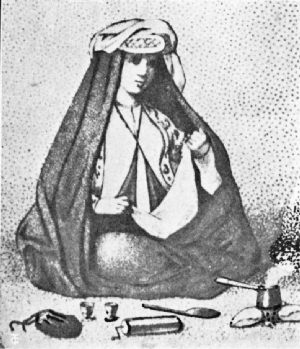
The Oriental procedure was to toast the hulls in an earthenware pot over a charcoal fire, mixing in with them a small quantity of the silver skins, and turning them over until they were slightly parched. The hulls and silver skins, in proportions of four to one, were then thrown into boiling water and well boiled again for at least a half-hour. The color of the drink had some resemblance to the best English beer, La Roque assures us, and it required no sweetening, "there being no bitterness to correct." This was still the coffee drink of the court of Yemen, and of people of distinction in the Levant, when La Roque and his fellow-travelers made their celebrated voyage to Arabia the Happy in 1711–13.
Some time in the thirteenth century, the practise began of roasting the dried beans, after the hulling process. This was done first in crude stone and earthenware trays, and later on metal plates, as described in chapter XXXIV. A liquor was made from boiling the whole roasted beans. The next step was to pound the roasted beans to a powder with a mortar and pestle; and the decoction was then made by throwing the powder into boiling water, the drink being swallowed in its entirety, grounds and all. It was a decoction for the next four centuries.
When the long-handled Arabian metal boiler made its appearance in the early part of the sixteenth century, the method of preparation and service had much improved. The Arabs and the Turks had made it a social adjunct, and its use was no longer confined to the physicians and the churchmen. It had become a stimulating refreshment for all the people; and at the same time, the Arabians and the Turks had developed a coffee ceremony for the higher classes which was quite as wonderful as the tea ceremony of Japan.
The common early method of preparation throughout the Levant was to steep the powder in water for a day, to boil the liquor half away, to strain it, and to keep it in earthen pots for use as wanted. In the sixteenth century, the small coffee boiler, or ibrik, caused the practise to be more of an instantaneous affair. The coffee was ground, and the powder was dropped into the boiling water, to be withdrawn from the fire several times as it boiled up to the rim. While still boiling, cinnamon and cloves were sometimes added before pouring the liquid off into the findjans, or little china cups, to be served with the addition of a drop of essence of amber. Later, the Turks added sugar during the boiling process.
From the first simple uncovered ibrik there was developed, about the middle of the seventeenth century, a larger-size covered coffee boiler, the forerunner of the modern combination brewing and serving pot. This was a copper-plated kettle patterned after the oriental ewer with a broad base, bulbous body, and narrow neck. After having poured into it one and a half times as much water as the dish (cup) in which the drink was to be served would hold, the pot was placed on a lively fire. When the water boiled, the powdered coffee was tossed into the pot; and, as the liquid boiled up, it was taken from the fire and returned, probably a dozen times. Then the pot was placed in hot ashes to permit the grounds to settle. This done, the drink was served. Dufour, describing this process as practised in Turkey and Arabia, says:
One ought not to drink coffee, but suck it in as hot as one can. In order not to be burned, it is not necessary to place the tongue in the cup but hold the edge against the tongue with the lips above and below it, forcing it so little that the edges do not bear down, and then suck in; that is to say, swallow it sip by sip. If one is so delicate he can not stand the bitterness, he can temper it with sugar. It is a mistake to stir the coffee in the pot, the grounds being worth nothing. In the Levant it is only the scum of the people who swallow the grounds.
La Roque says:
The Arabians, when they take their coffee off the fire, immediately wrap the vessel in a wet cloth which fines the liquor instantly, makes it cream at the top and occasion a more pungent steam, which they take great pleasure in snuffing up as the coffee is pouring into the cups. They, like all other nations of the East, drink their coffee without sugar.
Some of the Orientals afterward modified the early coffee-making procedure by pouring the boiling water on the powdered coffee in the serving cups. They thus obtained "a foaming and perfumed beverage," says Jardin, "to which we (the French) could not accustom ourselves because of the powder which remains in suspension. Nevertheless, clarified coffee may be obtained in the Orient. In Mecca, in order to filter it, they strain it through stopples of dried herbs, put into the opening of a jar."
Sugar seems to have been introduced into coffee in Cairo about 1625. Veslingius records that the coffee drinkers in Cairo's three thousand coffee houses "did begin to put sugar in their coffee to correct the bitterness of it", and that "others made sugar plums of the coffee berries". This coffee confection later appeared in Paris, and about the same time (1700) at Montpellier was introduced a coffee water, "a sort of rosa-folis of an agreeable scent that has somewhat of the smell of coffee roasted." These novelties, however, were designed to please only "the most nice lovers of coffee"; for ennui and boredom demanded new sensations then as now.
Boiling continued the favorite method of preparing the beverage until well into the eighteenth century. Meanwhile, we learn from English references that it was the custom to buy the beans of apothecaries, to dry them in an oven, or to roast them in an old pudding dish or frying pan before pounding them to a powder with mortar and pestle, to force the powder through a lawn sieve, and then to boil it with spring water for a quarter of an hour. The following recipe from a rare book published in London, 1662, details the manner of making coffee in the seventeenth century:
Coffee Making in 1662
To make the drink that is now much used called coffee.
The coffee-berries are to be bought at any Druggist, about three shillings the pound; take what quantity you please, and over a charcoal fire, in an old pudding-pan or frying-pan, keep them always stirring until they be quite black, and when you crack one with your teeth that it is black within as it is without; yet if you exceed, then do you waste the Oyl, which only makes the drink; and if less, then will it not deliver its Oyl, which must make the drink; and if you should continue fire till it be white, it will then make no coffee, but only give you its salt. The Berry prepared as above, beaten and forced through a Lawn Sive, is then fit for use.
Take clean water, and boil one-third of it away what quantity soever it be, and it is fit for use. Take one quart of this prepared Water, put in it one ounce of your prepared coffee, and boil it gently one-quarter of an hour, and it is fit for your use; drink one-quarter of a pint as hot as you can sip it.
In England, about this time, the coffee drink was not infrequently mixed with sugar candy, and even with mustard. In the coffee houses, however, it was usually served black, without sugar or milk.
About 1660, Nieuhoff, the Dutch ambassador to China, was the first to make a trial of coffee with milk in imitation of tea with milk. In 1685, Sieur Monin, a celebrated doctor of Grenoble, France, first recommended café au lait as a medicine. He prepared it thus: Place on the fire a bowl of milk. When it begins to rise, throw in to it a bowl of powdered coffee, a bowl of moist sugar, and let it boil for some time.
We read that in 1669 "coffee in France was a hot black decoction of muddy grounds thickened with syrup."
Angelo Rambaldi in his Ambrosia Arabica thus describes coffee making in Italy and other European countries in 1691:
Description of the Vase for Making the Decoction, Dose of Powder and of the Water Necessary and Time of Boiling It.
Two such vessels having a large paunch to reach the fire, two others with long necks and narrow, with a cover to restrain their spirituous and volatile particles which when thrown off by the heat are easily lost. These vessels are called Ibriq in Arabia. They are made of copper—coated with white outside and inside. We, who do not possess the art of making them should select an earth vitriate, sulphate of copper, or any other material adapted for kitchen ware: it might even be of silver.
The quantity of water and powder has no certain rule, by reason of the difference of our nature and tastes, and each one after some experience will use his own judgment to adjust it to his desire and liking.
Maronita infused two ounces of powder in three litres of water. Cotovico in his voyage to Jerusalem affirms that he has observed six ounces of the former to 20 litres of the latter, boiled until it was reduced to half the quantity. Thévenot asserts that the Turks in three cups of water are contented with a good spoonful of powder. I have observed however that in Africa, France and England, into about six ounces of water (which with them is one cup) a dram of the powder is infused and this agrees with my taste—but I have wished at times to change the dose.
Others put the water into the vase and when it begins to boil add the powder, but because it is full of spirit at the first contact with the heat it rises and boils over the edge of the vase. Take it away from the fire till the boiling ceases, then put it on the fire again and let it stay a short time boiling with the cover on: Stand it on warm ashes until it settles, after which slowly pour a little of the decoction into an earthen vessel, or one of porcelain or any other kind, as hot as can be borne, and drink a sip; if it pleases your taste, add a portion of cardamom, cloves, nutmeg or cinnamon, and dissolve a little sugar in the water; yet because these substances will alter the taste of this simple, they are not prized by many experts.
Modern Arabia, Bassa, Turkey, the Great Orient, those who are travelling or in the army, infuse the powder in cold water, and then boiling it as directed above, bear witness to its efficacy. All times are opportune to take this salutary drink (beverage). Among the Turks are those who take it even by night, nor is there a business meeting or conversation, where coffee is not taken. Among the Great it would be accounted an incivility, if with smoke, coffee were not offered: and no one in the day is ashamed to frequent the bazaars where it is sold. When I was in London, that city of three million people, there were taverns for its special use. It is a great stimulant. The sober take it to invigorate the stomach. The scrofulous hated it because they thought it stirred up the bile on an empty stomach—but experience proving the contrary enjoy it as much as others.
In 1702, coffee in the American colonies was being used as a refreshment between meals, "like spirituous liquors."
It was in 1711 that the infusion idea in coffee making appeared in France. It came in the form of a fustian (cloth) bag which contained the ground coffee in the coffee maker, and the boiling water was poured over it. This was a decided French novelty, but it made slow headway in England and America, where some people were still boiling the whole roasted beans and drinking the liquor.
In England, as early as 1722, there arose a conscientious objector to boiled coffee in the person of Humphrey Broadbent, a coffee merchant who wrote a treatise on the True Way of Preparing and Making Coffee[375], in which he condemned the "silly" practise of making coffee by "boiling an ounce of the powder in a quart of water," then common in the London coffee houses, and urging the infusion method. He favored the following procedure:
Put the quantity of powder you intend, into your pot (which should be either of stone, or silver, being much better than tin or copper, which takes from it much of its flavour and goodness) then pour boiling-hot water upon the aforesaid powder, and let it stand to infuse five minutes before the fire. This is an excellent way, and far exceeds the common one of boiling, but whether you prepare it by boiling or this way, it will sometimes remain thick and troubled, after it is made, except you pour in a spoonful or two of cold water, which immediately precipitates the more heavy parts at the bottom, and makes it clear enough for drinking.
Some, make coffee with spring water, but it is not so good as river, or Thames-water, because the former makes it hard, and distasteful, and the other makes it smooth and pleasant, lying soft on the stomach. If you have a desire to make good coffee in your families, I cannot conceive how you can put less than two ounces of powder to a quart, or one ounce to a pint of water; some put two ounces and a quarter.
By 1760, the decoction, or boiling, method in France had been generally replaced by the infusion, or steeping, method.
In 1763, Donmartin, a tinsmith of St. Bendit, France, invented a coffee pot, the inside of which was "filled by a fine sack put in its entirety," and which had a tap to draw the coffee. Many inventions to make coffee sans ebullition (without boiling) appeared in France about this time; but it was not until 1800 that De Belloy's pot, employing the original French drip method, appeared, signaling another step forward in coffee making—percolation.
De Belloy and Count Rumford
De Belloy's pot was probably made of iron or tin, afterward of porcelain; and it has served as a model for all the percolation devices that followed it for the next hundred years. It does not seem to have been patented, and not much is known of the inventor. About this period, it was the common practise in England to boil coffee in the good old-fashioned way, and to "fine" (clarify) it with isinglass. This moved Count Rumford (Benjamin Thompson), an American-British scientist, then living in Paris, to make a study of scientific coffee-making, and to produce an improved drip device known as Rumford's percolator. He has been generally credited with the invention of the percolator; but, as pointed out in a previous chapter, this honor seems to be De Belloy's and not Rumford's.
Count Rumford embodied his observations and conclusions in a verbose essay entitled Of the excellent qualities of coffee and the art of making it in the highest perfection, published in London in 1812. In this treatise he describes and illustrates the Rumford percolator.
Brillat-Savarin, the famous French gastronomist, who also wrote on coffee in his VIme Meditation, said of the De Belloy pot:
I have tried, in the course of time, all methods and of all those which have been suggested to me up to today (1825) and with a full knowledge of the matter in hand. I prefer the De Belloy method, which consists of pouring the boiling water upon the coffee which has been placed in the vessel of porcelain or silver, pierced with very small holes. I have attempted to make coffee in a boiler at high pressure, but I have had as a result a coffee full of extracts and bitterness which would scrape the throat of a Cossack.
Brillat-Savarin had something also to say on the subject of grinding coffee, his conclusion being that it was "better to pound the coffee than to grind it."
He refers to M. Du Belloy, archbishop of Paris, "who loved good things and was quite an epicure," and says that Napoleon showed him deference and respect. This may have been Jean Baptiste De Belloy, who, according to Didot, was born in 1709 and died in 1808, and, it is thought likely, was the inventor of the De Belloy pot.
Count Rumford was born in Woburn, Mass., in 1753. He was apprenticed to a storekeeper in Salem in 1766. He became an object of distrust among the friends of the cause of American freedom: and, on the evacuation of Boston by the Royal troops in 1776, he was selected by Governor Wentworth of New Hampshire to carry dispatches to England. He left England in 1802, and resided in France from 1804 until his death in 1814. In 1772, he had married, or rather, as he put it, he was married by, a wealthy widow, the daughter of a highly respectable minister and one of the first settlers at Rumford, now called Concord, New Hampshire. It was from this town that he took his title of Rumford when he was created a Count of the Holy Roman Empire in 1791. His first wife having died, he married in Paris, the wealthy widow of the celebrated chemist, Lavoisier; and with her he lived an extremely uncomfortable life until they agreed to separate.
In his essay on coffee and coffee making, Count Rumford gives us a good pen picture of the preparation of the beverage in England at the beginning of the nineteenth century. He says:
Coffee is first roasted in an iron pan, or in a hollow cylinder, made of sheet iron, over a brisk fire; and when, from the colour of the grain, and the peculiar fragrance which it acquires in this process, it is judged to be sufficiently roasted, it is taken from the fire, and suffered to cool. When cold it is pounded in a mortar; or ground in a hand-mill to a coarse powder, and preserved for use.
Formerly, the ground Coffee being put into a coffee-pot, with a sufficient quantity of water, the coffee-pot was put over the fire, and after the water had been made to boil a certain time, the coffee-pot was removed from the fire, and the grounds having had time to settle, or having been fined down with isinglass, the clear liquor was poured off, and immediately served up in cups.
Count Rumford thought it a mistake to agitate the coffee powder in the brewing process, and in this he agreed with De Belloy. His improvement on the latter's pot is described in chapter XXXIV. He was a coffee connoisseur; and as such was one of the first to advocate the use of cream as well as sugar for making an ideal cup of the beverage. He refers, though not by name, to De Belloy's percolation method and says, "Its usefulness is now universally acknowledged."
A Few Definitions
Just here, in order to assure a better understanding of the subject, it may be well to clear up sundry misconceptions regarding the words percolation, filtration, decoction, infusion, etc., by the simple expedient of definition.
A decoction is a liquid produced by boiling a substance until its soluble properties are extracted. Thus the coffee drink was first a decoction; and a decoction is what one gets today when coffee is boiled in the good old-fashioned way—as "mother used to make it."
Infusion is the process of steeping—extraction without boiling. It is extraction accomplished at any temperature below boiling, and is a general classification of procedure capable of sub-division. As generally and correctly applied, it is the operation wherein hot water is merely poured upon ground coffee loose in a pot, or in a container resting on the bottom of the pot. In the strictest sense of the term, an infusion is also produced by percolation and filtration, when the water is not boiled in contact with the coffee.
Percolation means dripping through fine apertures in china or metal as in De Belloy's French drip pot.
Filtration means dripping through a porous substance, usually cloth or paper.
Percolation and filtration are practically synonymous, although a shade of distinction in their meaning has arisen so that often the latter is considered as a step logically succeeding the former. Accomplishing extraction of a material by permitting a liquid to pass slowly through it is in fact percolation, whereas filtration of the resultant extract is effected by interposing in its path some medium which will remove solid or semi-solid material from it. Coffee-making practise has in itself so applied these terms that each is considered a complete process. Percolation is thus applied when the infusion is removed from the grounds immediately by dripping through fine perforations in the china or metal of which the device is constructed.
True percolation is not produced in the pumping "percolators" in which the heated water is elevated and sprayed over the ground coffee held in a metal basket in the upper part of the pot, the liquor being recirculated until a satisfactory degree of extraction has been reached. Rather, the process is midway between decoction and infusion, for the weak liquor is boiled during the operation in order to furnish sufficient steam to cause the pumping action.
Filtration is accomplished when the ground coffee is retained by cloth or paper, generally supported by some portion of the brewing device, and extraction effected by pouring water on the top of the mass, permitting the liquid to percolate through, the filtering medium retaining the grounds.
Patents and Devices
From the beginning, the French devoted more attention than any other people to coffee brewing. The first French patent on a coffee maker was granted in 1802 to Denobe, Henrion, and Rauch for "a pharmacological-chemical coffee making device by infusion."
In 1802, Charles Wyatt obtained a patent in London on an apparatus for distilling coffee.
The first French patent on an improved French drip pot for making coffee "by filtration without boiling" was granted to Hadrot in 1806. Strictly speaking, this was not a filtering device, as it was fitted with a tin composition strainer, or grid. It was very like Count Rumford's percolator announced six years later, as will be seen by comparing the two in chapter XXXIV.
In 1815, Sené invented in France his Cafetière Sené, another device to make coffee "without boiling."
About the year 1817, the coffee biggin appeared in England. It was simply a squat earthenware pot with an upper, movable, strainer part made of tin, after the French drip pot pattern. Later models employed a cloth bag suspended from the rim of the pot. It was said to have been invented by a Mr. Biggin; and Dr. Murray, of dictionary fame, seems to have become convinced of this gentleman's existence, although others have doubted it and thought the name was of Dutch origin, the article having been first made for Holland. It has been suggested that, in all probability, the name came from the Dutch word beggelin, to trickle, or run down. One thing is certain, coffee biggins came originally from France; so that if there was a Mr. Biggin, he merely introduced them into England. The coffee biggin with which Americans are most familiar is a pot containing a flannel bag or a cylindrical wire strainer to hold the ground coffee through which the boiling water is poured. The Marion Harland pot was an improved metal coffee biggin. The Triumph coffee filter was a cloth-bag device which made any coffee pot a biggin.
In 1819, Morize, a Paris tinsmith, invented a double drip, reversible coffee pot. The device had two movable "filters" and was placed bottom up on the fire until the water boiled, when it was inverted to let the coffee "filter" or drip through.
In 1819, Laurens was granted a French patent on the original pumping-percolator device, in which the water was raised by steam pressure and dripped over the ground coffee.
In 1820, Gaudet, another Paris tinsmith, invented a filtration device that employed a cloth strainer.
In 1822, Louis Bernard Rabaut was granted an English patent on a coffee-making device in which the usual French drip process was reversed by the use of steam pressure to force the boiling water upward through the coffee mass. Caseneuve, of Paris, was granted a patent on a similar device in France in 1824.
In 1825, the first coffee-pot patent in the United States was granted to Lewis Martelley on a machine "to condense the steam and essential oils and return them to the infusion."
In 1827, the first really practicable pumping percolator, as we understand the meaning today, was invented by Jacques-Augustin Gandais, a manufacturer of plated jewelry in Paris. The boiling water was raised through a tube in the handle and sprayed over the ground coffee suspended in a filter basket, but could not be returned for a further spraying.
In 1827, Nicholas Felix Durant, a manufacturer of Chalons-sur-Marne, was granted a French patent on a "percolator" employing, for the first time, an inner tube to raise the boiling water for spraying over the ground coffee.
In 1839, James Vardy and Moritz Platow were granted an English patent on a kind of urn "percolator", or filter, employing the vacuum process of coffee making, the upper vessel being made of glass.
By this time, the pumping percolator, working by steam pressure and by partial vacuum, was in general use in France, England, and Germany. And then began the movement toward the next stage in coffee making—filtration.
About this time (1840), Robert Napier (1791–1876) the Scottish marine engineer, of the celebrated Clyde shipbuilding firm of Robert Napier & Sons, invented a vacuum coffee machine to make coffee by distillation and filtration. The device was never patented; but thirty years later, it was being made in the works of Thomas Smith & Son (Elkington & Co., Ltd., successors) under the direction of Mr. Napier, the aged inventor. The device consists of a silver globe, brewer syphon, and strainer, as illustrated. It operates as follows: a half-cupful of water is put into the globe, and the gas flame is lighted. The dry coffee is put into the receiver, which is then filled up with boiling water. This will at once become agitated, and will continue so for a few minutes. When it becomes still, the gas flame is turned down, and clear coffee is syphoned over into the globe through the syphon tube, on the end of which, as it rests in the coffee liquid, there is a metal strainer covered with a filter cloth.
Napier Vacuum Coffee Maker Napier-List Steam Coffee Machine
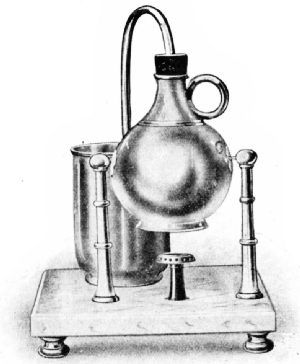
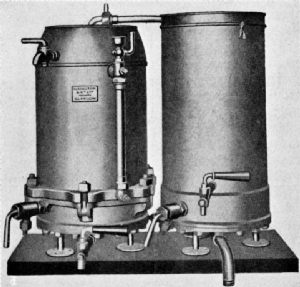
The Napierian coffee machine has enjoyed great popularity in England. The principle has in later years been incorporated in the Napier-List steam coffee machine for use in hotels, ships, restaurants, etc. Steam is used as a source of heat, but does not mix with the coffee. List's patent is for an improvement on the Napierian system and was granted in 1891.
It is related that shortly before he died, old Mr. Napier, at the termination of a dispute in Smith & Co.'s factory at Glasgow, where the device was being made under his instruction, said to old Mr. Smith:
"You may be a guid silversmith, but I am a better engineer."
Showing Method of Operation
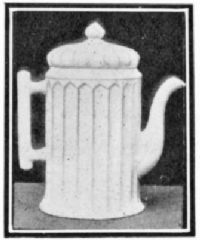
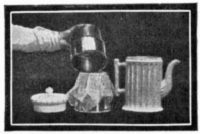
Finley Acker's Filter-Paper Coffee Pot
In 1841, William Ward Andrews was granted an English patent on an improved pot employing a pump to force the boiling water through the ground coffee while contained in a perforated cylinder screwed to the bottom of the pot.
In 1842, the first French patent on a glass coffee-making device was granted to Madame Vassieux of Lyons.
Following this, there were numerous patents issued in France and England on double glass-globe coffee-making devices. They were first known as double glass balloons, and most of them employed metal strainers.
After this, there were many "percolator" patents in France, England, and the United States, some of which were for improved forms of the original drip method of the De Belloy device. Others were for the type of machine which came to be known as "percolators" because they employed the principle of raising the heated water and spraying it over the ground coffee in continuous fashion. The story is told in chronological order in the chapter on the evolution of coffee apparatus; so it is not necessary to repeat it here. Numerous filtration devices also were produced abroad and in the United States.
The Kin-Hee Pot in Operation
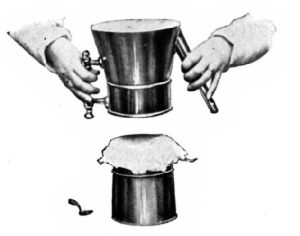
Among the percolators, those of Manning, Bowman & Co., and of Landers, Frary & Clark, became well known here. In the filtration field, the following attained considerable distinction: Harvey Ricker's Half-Minute pot, employing a cotton sack with re-inforced bottom, introduced about 1881; the Kin-Hee pot of 1900; Cauchois' Private Estate coffee maker, using Japanese filter paper, introduced in 1905; Finley Acker's percolator, introduced the same year, which also employed a filter paper between two cylinders having side perforations; the Tricolator, 1908; King's percolator, using filter paper, in 1912; and the "Make-Right", 1911, with its adaptation as presented in the Tru-Bru pot of 1920.
The Tricolator in Operation
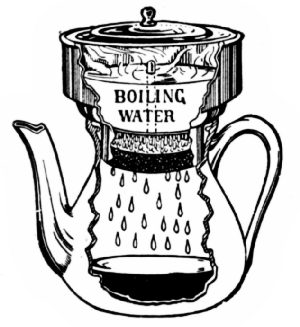
The Make-Right was the invention of Edward Aborn, New York, and comprised two telescoping open wire frames, or baskets, with a flat piece of muslin between them. In the Tru-Bru pot, the same idea was employed, except that the wire frames were so constructed as to furnish four drip points to afford better distribution on the ground coffee and to lessen the time of filtration. There was also a porcelain top, to house and to raise the filtration device, above the brew with an opening through which the boiling water could be poured without exposing the ground coffee.
King Percolator, as Applied to a Hotel or Restaurant Urn
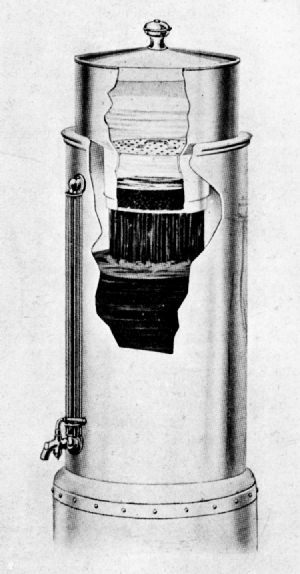
Among later developments of the genuine percolator principle that have attracted attention in this country, mention should be made of the Phylax coffee maker, and the Galt pot.
In 1914–16, there was a revival of interest in the United States in the double glass-globe method of making coffee, introduced into France as "double glass balloons" in the first half of the nineteenth century. American ingenuity produced several clever adaptations, and several notable filter improvements. Advertising developed a great demand for glass percolators, as they were first called; but although five attained considerable prominence, only two survived and, at this writing, are still being manufactured. Both are double glass-globe filters employing a spirit lamp, gas, or electricity as heating agents.
Three Types of American Coffee Makers in Operation Left, Blanke's Cloth Filter—Center, Phylax—Right, Galt Vacuum device
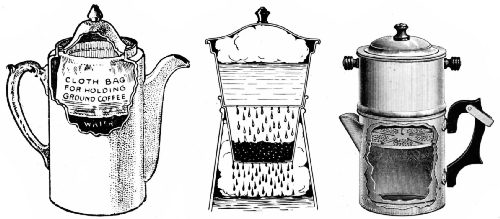
Within the last few years, it has become the fashion to obtain patents in the United States on "the art of brewing coffee", or the "art of making coffee". Instances are the patents issued to Messrs. Calkin and Muller. In the Calkin patent (the Phylax device illustrated at the top of this page) the "art" consists in controlling the flow of the boiling water by means of the number and spacing of the holes in the water-spreader, so as to restrict the volume and the speed, to effect a quick initial extraction; and then, by means of a new spacing of holes in the infuser, retarding the drip "to attain a prolonged extraction of the tannin and other elements of slow extraction and combining the liquids obtained during the initial and subsequent stages of the brew for attaining a balanced liquid extract."
How the Tru-Bru Pot Operates
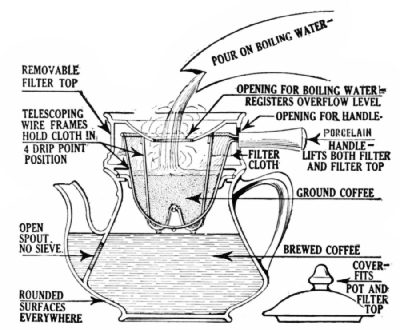
Muller's "art" (the apparatus is described in chapter XXXIV) consisted in so supplying and supporting the ground coffee in an urn that it is never again subjected to the "decoction" after having been exposed to the air and steam following the first application of the water.
In 1920, William G. Goldsworthy, San Francisco, was granted a United States patent on a process for preparing the beans for making the beverage. The process consisted of grinding the raw dried beans; then packing the ground product in non-combustible and non-soluble porous containers, which are securely closed to keep them unimpaired while the contained coffee is being roasted; and, after cooling, sealing them with gelatine. To brew, container and contents are dropped into a cup of hot water.
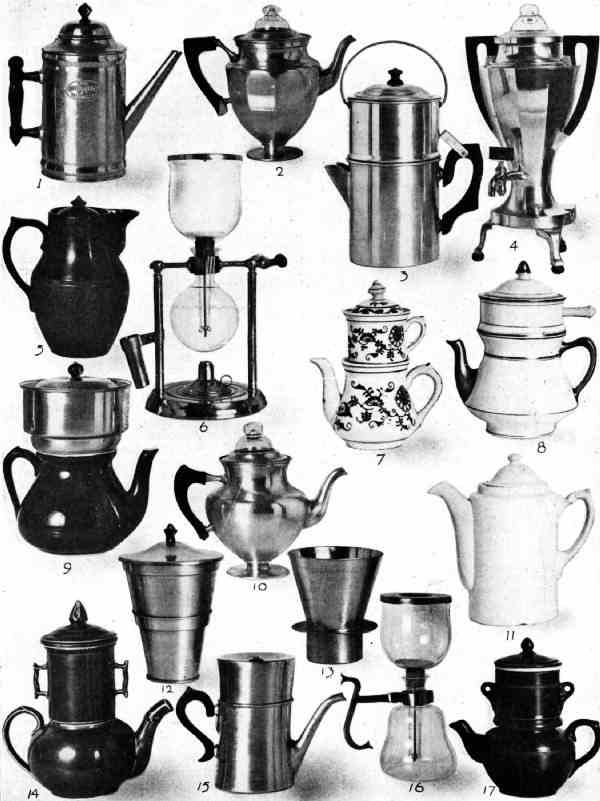
COFFEE-MAKING DEVICES USED IN THE UNITED STATES
1—Marlon Harland Pot; 2—Universal Percolator; 3—Galt Vacuum Process Coffee Maker; 4—Universal Electric Urn; 5—English Coffee Biggin (Langley Ware); 6—Universal Cafenoira (Glass Filter); 7—Vienna (Bohemian or Carlsbad) Coffee Machine; 8—Tru-Bru Pot; 9—Tricolator; 10—Manning-Bowman Percolator; 11—Blanke's Sanitary Coffee Pot; 12—Phylax Coffee Maker; 13—Private-Estate Coffee Maker; 14—American French Drip Pot; 15—Kin-Hee Pot; 16—Silex Opalescent Glass Filter; 17—French Drip Pot (Langley Ware).
This brief review of the evolution of coffee brews shows that coffee making started with boiling, and next became an infusion. After that, the best practise became divided between simple percolation and filtration, which have continued to the present time. Boiling has also continued to find advocates in every country, even in the United States, where it seems to die hard, no matter how much is done to discredit it. Percolation devices are subdivided into the simple drip pots and the continuous percolation machines, as represented by numerous complicated and high-priced contrivances on the market. Gradually, however, true coffee lovers are realizing that the best results are to be obtained through simple percolation or simple filtration. There are good arguments for both methods.
Coffee Making in Europe in the Nineteenth Century
England. We have noted Count Rumford's efforts to reform coffee making in England in the early part of the nineteenth century. Many other scientific men joined the movement. Among them was Professor Donovan, who in the Dublin Philosophical Journal for May, 1826, told of his experiments "to ascertain the best methods for extracting all the virtues inherent in the berry." The Penny Magazine for June 14, 1834, after deploring "the straw-colored fluid commonly introduced under the misnomer of coffee in England", thus digests Professor Donovan's findings:
Mr. Donovan found, that what we shall call the medicinal quality of coffee resides in it independent of its aromatic flavor,—that it is possible to obtain the exhilarating effect of the beverage without gratifying the palate,—and, on the other hand, that all the aromatic quality may be enjoyed without its producing any effect upon the animal economy. His object was to combine the two.
The roasting of coffee is requisite for the production of both these qualities; but, to secure them in their full degree, it is necessary to conduct the process with some skill. The first thing to be done is to expose the raw coffee to the heat of a gentle fire, in an open vessel, stirring it continually until it assumes a yellowish colour. It should then be roughly broken,—a thing very easily done,—so that each berry is divided into about four or five pieces, when it must be put into the roasting apparatus. This, as most commonly used, is made of sheet-iron, and is of a cylindrical shape: it no doubt answers the purpose well, and is by no means a costly machine, but coffee may be very well roasted in a common iron or earthenware pot, the main circumstances to be observed being the degree to which the process is carried, and the prevention of partial burning, by constant stirring. One of the requisites for having good coffee is that it shall have been recently roasted.
Coffee should be ground very fine for use, and only at the moment when it is wanted, or the aromatic flavour will in some measure be lost. To extract all its good qualities, the powder requires two separate and somewhat opposite modes of treatment, but which do not offer any difficulty when explained. On the one hand, the fine flavour would be lost by boiling, while, on the other, it is necessary to subject the coffee to that degree of heat in order to extract its medicinal quality. The mode of proceeding, which, after many experiments, Mr. Donovan found to be the most simple and efficacious for attaining both these ends, was the following:—
The whole water to be used must be divided into two equal parts. One half must be put first to the coffee "cold", and this must be placed over the fire until it "just comes to a boil", when it must be immediately removed. Allowing it then to subside for a few moments the liquid must be poured off as clear as it will run. The remaining half of the water, which during this time should have been on the fire, must then be added "at a boiling heat" to the grounds, and placed on the fire, where it must be kept "boiling" for about three minutes. This will extract the medicinal virtue, and if then the liquid be allowed again to subside, and the clear fluid be added to the first portion, the preparation will be found to combine all the good properties of the berry in as great perfection as they can be obtained. If any fining ingredient is used it should be mixed with the powder at the beginning of the process.
Several kinds of apparatus, some of them very ingenious in their construction, have been proposed for preparing coffee, but they are all made upon the principle of extracting only the aromatic flavour, while Professor Donovan's suggestions not only enable us to accomplish that desirable object, but superadd the less obvious but equally essential matter of extracting and making our own all the medicinal virtues.
When Webster and Parkes published their Encyclopedia of Domestic Economy, London, 1844, they gave the following as "the most usual method of making coffee in England":
Put fresh ground coffee into a coffee-pot, with a sufficient quantity of water, and set this on the fire till it boils for a minute or two; then remove it from the fire, pour out a cupful, which is to be returned into the coffee-pot to throw down the grounds that may be floating; repeat this, and let the coffee-pot stand near the fire, but not on too hot a place, until the grounds have subsided to the bottom; in a few minutes the coffee will be clear without any other preparation, and may be poured into cups; in this manner, with good materials in sufficient quantity, and proper care, excellent coffee may be made. The most valuable part of the coffee is soon extracted, and it is certain that long boiling dissipates the fine aroma and flavour. Some make it a rule not to suffer the coffee to boil, but only to bring it just to the boiling point; but it is said by Mr. Donovan that it requires boiling for a little time to extract the whole of the bitter, in which he conceives much of the exhilarating qualities of the coffee reside.
This work had also the following to say on the clearing of coffee, which was then a much-mooted question:
The clearing of coffee is a circumstance demanding particular attention. After the heaviest parts of the grounds have settled, there are still fine particles suspended for some time, and if the coffee be poured off before these have subsided, the liquor is deficient in that transparency which is one test of its perfection; for coffee not well cleared has always an unpleasant bitter taste. In general, the coffee becomes clear by simply remaining quiet for a few minutes, as we have stated; but those who are anxious to have it as clear as possible employ some artificial means of assisting the clearing. The addition of a little isinglass, hartshorn shavings, skins of eels or soles, white of eggs, egg shells, etc., has been recommended for clearing; but it is evident that these substances, to produce their effect, which is upon the same principle as the fining of beer or wine, should be dissolved previously, for if put in without, it would require so much time to dissolve, that the flavour of the coffee would vanish.
Coffee-making devices of this period in England, in addition to the Rumford type of percolator and the popular coffee biggin, included Evans' machine provided with a tin air-float to which was attached a filter bag containing the coffee; Jones' apparatus, a pumping percolator; Parker's steam-fountain coffee maker, which forced the hot water upward through the ground coffee; Platow's patent filter, previously mentioned, a single vacuum glass percolator in combination with an urn; Brain's vacuum or pneumatic filter employing a "muslin, linen or shamoy leather filter" and an exhausting pump, designed for kitchen use; and Palmer's and Beart's pneumatic filtering machines of similar construction.
Cold infusions were common, the practise being to let them stand overnight, to be filtered in the morning, and only heated, not boiled.
Coffee grinding for these various types of coffee makers was performed by iron mills; the portable box mill being most favored for family use. "It consisted of a square box either of mahogany or iron japanned, containing in the interior a hollow cone of steel with sharp grooves on the inside; into this fits a conical piece of hardened iron or steel having spiral grooves cut upon its surface and capable of being turned round by a handle." There was a drawer to receive the finely ground coffee. Larger wall-mills employed the same grinding mechanism.
In 1855, Dr. John Doran wrote in his "Table Traits":
With regard to the making of coffee, there is no doubt that the Turkish method of pounding the coffee in a mortar is infinitely superior to grinding it in a mill, as with us. But after either method the process recommended by M. Soyer may be advantageously adopted; namely, "Put two ounces of ground coffee into a stew-pan, which set upon the fire, stirring the coffee round with a spoon until quite hot, then pour over a pint of boiling water; cover over closely for five minutes, pass it through a cloth, warm again, and serve."
From observations by G.W. Poore, M.D., London, 1883, we are given a glimpse of coffee making in England in the latter part of the nineteenth century. He said:
Those who wish to enjoy really good coffee must have it fresh roasted. On the Continent, in every well-regulated household, the daily supply of coffee is roasted every morning. In England this is rarely done.
If roasted coffee has to be kept, it must be kept in an air-tight vessel. In France, coffee used to be kept in a wrapper of waxed leather, which was always closely tied over the contained coffee. In this way the coffee was kept from contact with any air.
The Viennese say that coffee should be kept in a glass bottle closed with a bung, and that coffee should on no account be kept in a tin canister.
The coffee having been roasted, it has to be reduced to a coarse powder before the infusion is made. The grinding and powdering of coffee should be done just before it is wanted, for if the whole coffee seeds quickly lose their aroma, how much more quickly will the aroma be dissipated from coffee which has been reduced to a fine powder? Nothing need be said in the matter of coffee mills. They are common enough, varied enough, and cheap enough to suit all tastes.
To insure a really good cup of coffee attention must be given to the following points:
1. Be sure that the coffee is good in quality, freshly roasted, and fresh ground.
2. Use sufficient coffee. I have made some experiments on this point, and I have come to the conclusions that one ounce of coffee to a pint of water makes poor coffee, 11⁄2 ounces of coffee to a pint of water makes fairly good coffee, two ounces of coffee to a pint of water makes excellent coffee.
3. As to the form of coffee pot I have nothing to say. The varieties of coffee machines are very numerous and many of them are useless incumbrances. At the best, they can not be regarded as absolutely necessary. The Brazilians insist that coffee pots should on no account be made of metal, but that porcelain or earthenware is alone permissible. I have been in the habit of late of having my coffee made in a common jug provided with a strainer, and I believe there is nothing better.
COFFEE-MAKING MACHINES POPULAR IN ENGLISH HOTELS AND RESTAURANTS
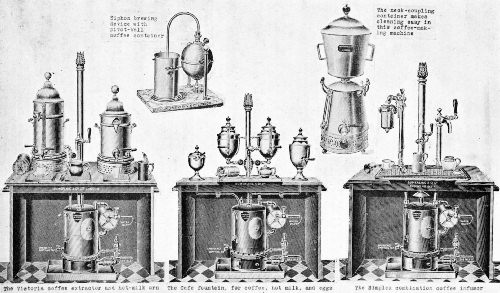
4. Warm the jug, put the coffee into it, boil the water, and pour the boiling water on the coffee, and the thing is done.
5. Coffee must not be boiled, or at most it must be allowed just to "come to a boil", as cook says. If violent ebullition takes place, the aroma of the coffee is dissipated, and the beverage is spoiled.
The most economical way of making coffee is to put the coffee into a jug and pour cold water upon it. This should be done some hours before the coffee is wanted—over night, for instance, if the coffee be required for breakfast. The light particles of coffee will imbibe the water and fall to the bottom of the jug in course of time. When the coffee is to be used stand the jug in a saucepan of water or a bainmarie and place the outer vessel over the fire till the water contained in it boils. The coffee in this way is gently brought to the boiling point without violent ebullition, and we get the maximum extract without any loss of aroma.
Always make your coffee strong. Café au lait is much better if made with one-fourth strong coffee and three-fourths milk than if made half-and-half with a weaker coffee; this is evident.
It is a mistake to suppose that coffee can not be made without a great deal of costly and cumbersome apparatus.
The Continent. Rossignon has given us a general view of coffee making on the continent of Europe in the middle of the nineteenth century. He says:
Formerly small bags of baize were used to percolate coffee. The water was poured on the coffee, and when they were new the coffee percolated through them was pretty good, but when they had been used a few times they became greasy and it was very difficult to clean them by any means. The greasy baize altered the quality of the coffee, and in spite of all efforts to keep it clean the coffee had a tarnished appearance very disagreeable to the view. Very few persons use them at present. The apparatus most in use for the percolation of coffee is a tin coffee-pot composed of two parts. The upper one has a filter or sieve on which the coffee powder is placed and through which the filtered coffee must pass. Boiling water is poured on the coffee. The liquor which percolates falls in the second part. Then the upper part is removed and the coffee is ready as a beverage. There are very many systems of coffee pots. One of the best is the Russian one, which consists of a receptacle composed of two parts resembling two halves of an egg screwed together. One part contains the hot water and the other the ground coffee. In the center there is a filter. Turning the pot upside down the percolation takes place very slowly and no aroma is lost.
The tin plate which is generally used to make the coffee pot has many drawbacks. One of them is the dissolution of iron which takes place after it has been used for a short time.
The quality of coffee, as a beverage, depends principally on the degree of heat of the water. Experience has shown that a medium class of coffee prepared at a moderate heat gives a very good liquor, while excellent coffee on which boiling water has been poured did not give a very good liquor. Therefore, instead of pouring boiling water at 100°C. in a porcelain or silver coffee-pot, those who desire to make a perfect coffee must use water heated from 60° to 75°C.
The Duparquet Still's machine The Kellum
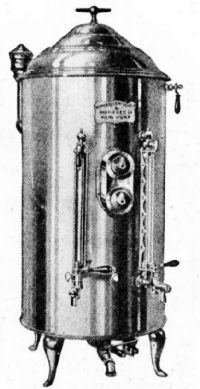
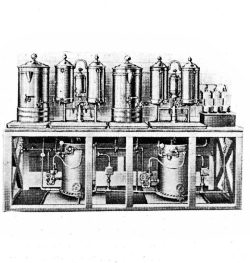
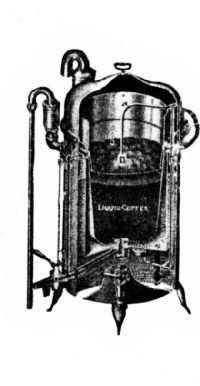
Three Well Known Makes of Large Coffee Urns
France. Also about the middle of the nineteenth century the French naturalist, Du Tour, thus describes one manner of making coffee in France:
Let the powder be poured into the coffee-pot filled with boiling water, in the proportion of two ounces and a half to two pounds, or two English pints of water. Let the mixture be stirred with a spoon, and the coffee-pot be soon taken off the fire, but suffered to remain closely shut, for about at least two hours, on the warm ashes of a wood fire. During the infusion the liquor should be several times agitated by a chocolate frother, or something of the same kind, and be finally left for about a quarter of an hour to settle.
Café au lait was not made by boiling coffee and milk together, as milk was not proper to extract the coffee; the coffee was first made as café noir, only stronger; as much of this coffee was poured in the cup as was required, and the cup was then filled up with boiled milk. Café a la crème, was made by adding boiled cream to strong clear coffee and heating them together.
In France, during the latter part of the nineteenth century, coffee was roasted over charcoal fires in earthenware dishes or saucepans, stirred with a spatula or wooden spoon, or in small cylinder or globular roasters of iron. Gas roasting was also practised. When roasted in large batches, the beans were cooled in wicker baskets, tossed into the air. The grinding was preferably done in mortars or in box mills of pyramid shape with receiving drawers, and was not too fine.
The usual method of making coffee in France among the better classes at this time was by means of improved De Belloy drip devices, double glass vacuum filters, pumping percolators (double circulation devices), the Russian egg-shaped pots, and the Viennese machines. The last-named were metal pumping percolators with glass tops, usually swung between the uprights of a carry arrangement, the base of which held a spirit lamp.
Among the numerous French machines which became well known were: Reparlier's glass "filter"; Egrot's steam cloth-filter machine and Malen's percolator apparatus, both designed for barracks and ships, where previously the coffee had been brewed in soup kettles; Bouillon Muller's steam percolator; Laurent's whistling coffee pot, a steam percolator which announced when the coffee was ready; Ed. Loysel's rapid filter, a hydrostatic percolator; and those pots to which Morize, Lemare, Grandin, Crepaux, and Gandais gave their names.
In 1892, the French minister of war directed that, in the army roasting and grinding operations, the coffee chaff should no longer be thrown away, as it had been found that it was rich in caffein and aroma constituents.
Popular German Drip Pot
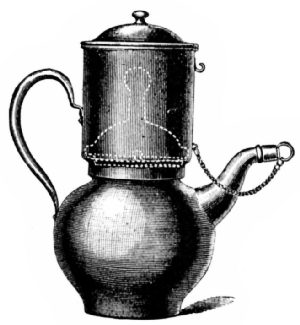
Coffee à la minute, which appeared in France in the nineteenth century, was made by decoction or infusion through a funnel pierced with holes and covered inside with blotting paper, or a woolen strainer cloth. This system, says Jardin, suggested the economical coffee pot.
A popular German drip coffee maker of the late nineteenth century employs a plug in the spout which provides air pressure to hold back the infusion until the plug is removed.
Pierre Joseph Buc'hoz, physician to the king of Poland, in 1787, made a business of supplying roasted coffee in small packets, each sufficient for one cup. He built up quite a trade until one day he was caught substituting roasted rye for coffee. This was the Buc'hoz method of making coffee, much practised by the lower classes because he was looked upon as an authority:
Boil the water in a coffee pot. When it boils, draw it from the fire long enough to add an ounce of coffee powder to a pound of water. Stir with a spoon. Return it to the fire and when it boils move it back somewhat from the heat and let it simmer for eight minutes. Clarify with sugar or deer horn powder.
Early Coffee Making in the United States
The coffee drink reached the colonies, first as a beverage for the well-to-do, about 1668. When introduced to the general public through the coffee houses about 1700, it was first sipped from small dishes as in England; and no one inquired too closely as to how it was made. When, half a century later, it had displaced beer and tea for breakfast, its correct making became a matter of polite inquiry. It was not until well into the nineteenth century that there was any suggestion of scientific interest, and not until within the last decade was any real chemical analysis of brewed coffee undertaken with a view to producing a scientific cup of the beverage.
At first, owing to the great distances, and difficulties surrounding communications, between the colonies, news of improvements in coffee makers and coffee making traveled slowly, and coffee customs brought from Europe by the early settlers became habits that were not easily changed. Some of the worst have clung on, ignoring the march of improvement, and seem as firmly entrenched in suburban and rural communities today as they were two hundred years ago.
Indeed, despite the fact that the United States have been the largest consumer of coffee among the nations for nearly half a century, it is only within the last ten years that coffee properly prepared could be obtained outside the principal cities. Even today, the average consumer is sadly in need of education in correct coffee brewing. It would be an excellent idea if all the coffee propaganda funds could be concentrated on a study of this one phase of the coffee question for several years, and the recommendations published in such fashion as firmly to fix in the minds of the rising generation a knowledge of correct coffee brewing. The facts of the case are that, generally speaking, coffee is still prepared in slovenly fashion in the average American home. However, with the good work done in recent years by organized trade effort to correct this abuse of our national beverage, signs are plentiful that the time is not far distant when a lasting reformation in coffee making will have been accomplished.
In colonial times the coffee drink was mostly a decoction. Esther Singleton tells us that in New Amsterdam coffee was boiled in a copper pot lined with tin and drunk as hot as possible With sugar or honey and spices. "Sometimes a pint of fresh milk was brought to the boiling point and then as much drawn tincture of coffee was added, or the coffee was put in cold water with the milk and both were boiled together and drunk. Rich people mixed cloves, cinnamon or sugar with ambergris in the coffee.[376]"
Ground cardamom seeds were also used to flavor the decoction.
In the early days of New England, the whole beans were frequently boiled for hours with not wholly pleasing results in forming either food or drink[377].
In New Orleans, the ground coffee was put into a tin or pewter coffee dripper, and the infusion was made by slowly pouring the boiling water over it after the French fashion. The coffee was not considered good unless it actually stained the cup. This method still obtains among the old Creole families.
Boiling coarsely pounded coffee for fifteen minutes to half an hour was common practise in the colonies before 1800.
In the early part of the nineteenth century, the best practise was to roast the coffee in an iron cylinder that stood before the hearth fire. It was either turned by a handle or wound up like a jack to go by itself. The grinding was done in a lap or wall mill; and among the best known makes were Kenrick's, Wilson's, Wolf's, John Luther's, George W.M. Vandegrift's, and Charles Parker's Best Quality.
To make coffee "without boiling" the cookery books of the period advised the housewife to obtain "a biggin, the best of which is what in France is called a Grecque."
In 1844, the Kitchen Directory and American Housewife's advice on the subject of coffee making was the following:
Coffee should be put in an iron pot and dried near a moderate fire for several hours before roasting (in pot over hot coals and stirring constantly). It is sufficiently roasted when biting one of the lightest colored kernels—if brittle the whole is done. A coffee roaster is better than an open pot. Use a tablespoonful ground to a pint of boiling water. Boil in tin pot twenty to twenty-five minutes. If boiled longer it will not taste fresh and lively. Let stand four or five minutes to settle, pour off grounds into a coffee pot or urn. Put fish skin or isinglass size of a nine pence in pot when put on to boil or else the white and shell of half an egg to a couple of quarts of coffee. French coffee is made in a German filter, the water is turned on boiling hot and one-third more coffee is needed than when boiled in the common way.
In 1856 the Ladies' Home Magazine (now the Ladies' Home Journal) printed the following, which fairly sums up the coffee making customs of that period:
Coffee, if you would have its best flavor, should be roasted at home; but not in an open pan, for this permits a large amount of aroma to escape. The roaster should be a closed sphere or cylinder. The aroma, upon which the good taste of the coffee depends, is only developed in the berry by the roasting process, which also is necessary to diminish its toughness, and fit it for grinding. While roasting, coffee loses from fifteen to twenty-five percent of its weight, and gains from thirty to fifty percent in bulk. More depends upon the proper roasting than upon the quality of the coffee itself. One or two scorched or burned berries will materially injure the flavor of several cupfuls. Even a slight overheating diminishes the good taste.
The best mode of roasting, where it is done at home, is to dry the coffee first, in an open vessel, until its color is slightly changed. This allows the moisture to escape. Then cover it closely and scorch it, keeping up a constant agitation, so that no portion of a kernel may be unequally heated. Too low and too slow a heat dries it up without producing the full aromatic flavor; while too great heat dissipates the oily matter and leaves only bitter charred kernels. It should be heated so as to acquire a uniform deep cinnamon color, and an oily appearance, but never a deep, dark brown color. It then should be taken from the fire and kept closely covered until cold, and further until used. While unroasted coffee improves by age, the roasted berries will very generally lose their aroma if not covered very closely. The ground stuff kept on sale in barrels, or boxes, or in papers, is not worthy the name of coffee.
Coffee should not be ground until just before using. If ground over night, it should be covered: or, what is quite as well, put into the boiler and covered with water. The water not only retains the valuable oil and other aromatic elements, but also prepares it by soaking for immediate boiling in the morning.
If the coffee pot (the "Old Dominion", of course, for in a common boiler this process would ruin the coffee by wasting the aroma) be set on the range or stove, or near the fire, so as to be kept hot all night preparatory to boiling in the morning, the beverage will be found in the morning, rich, mellow, and of a most delicious flavor.
Coffee used at supper time should be placed on or near the fire immediately after dinner and kept hot or simmering—not boiling—all the afternoon.
Try this method if you wish coffee in perfection.
Wood's improved coffee roaster is acknowledged to be the best article of the kind now in use.
This patent coffee roaster has been improved by the introduction of a triangular flange inside of each of the hemispheres, as seen in the cut. These flanges, as the roaster is turned, catch the coffee and throw it from the inner surface, thus insuring a perfect uniformity in the burning.
The Woods roaster (1849) and the Old Dominion Coffee Pot (1856) have been referred to in chapter XXXIV.
From the Encyclopedia of Practical Cookery, we learn some more about the customs prevailing "among the first cooks in the country" in roasting and making coffee in the United States about the middle of the nineteenth century. For example:
Roasting Coffee Beans
Put the beans in the roaster, set this before a moderate fire, and turn slowly until the Coffee takes a good brown colour; for this it should require about twenty-five minutes. Open the cover to see when it is done. If browned, transfer it to an earthen jar, cover it tightly, and use when needed.
Or a more simple plan, and even more effectual, is to take a tin baking-dish, butter well the bottom, put the Coffee in it, and set it in a moderate oven until the beans take a strong golden colour, twenty minutes sufficing for this. Toss them frequently with a wooden spoon as they are cooking.
Another plan is to put in a small frying-pan 1 1b. of raw Coffee-beans and set the pan on the fire, stirring and shaking occasionally till the beans are yellow: then cover the frying-pan and shake the Coffee about till it is a dark brown. Move the pan off the fire, keep the cover on, and when the beans are a little cool, break an egg over them and stir them until they are all well coated with the egg. Then store the Coffee in tins or jars with tight-fitting lids, and grind it as wanted for use.
Coffee should always be bought in the bean and ground as required, otherwise it is liable to extensive adulteration with chicory (or succory); some persons like the addition, but the epicure who is really fond of Coffee would not admit of its introduction.
Making Breakfast Coffee.
Allow 1 tablespoonful of Coffee to each person. The Coffee when ground should be measured, put into the Coffee-pot, and boiling water poured over it in the proportion of 3⁄4 pint to each tablespoonful of Coffee, and the pot put on the fire; the instant it boils, take the pot off, uncover it, and let it stand a minute or two; then cover it again, put it back on the fire, and let it boil up again. Take it from the fire and let it stand for five minutes to settle. It is then ready to pour out.
This work recommended as among the latest and best devices for coffee making, all those manufactured or sold in this country by Adams & Son; the English coffee biggin; General Hutchinson's coffee pot and urn, combining De Belloy's and Rumford's ideas; Le Brun's Cafetiére for making coffee by distillation and by steam pressure, passing it directly into the cup; a Vienna coffee-making machine, and a Russian coffee reversible pot called the Potsdam.
Among two score of coffee recipes for making various kinds of extracts, ices, candies, cakes, etc., flavored with coffee, there is a curious one for coffee beer, the invention of Frenchman named Pluehart. "The ingredients and quantities in a thousand parts are—Strong coffee 300; rum 300; syrup thickened with gum senegal 65; alcoholic extract of orange peel 10; and water 325."
"It does not appear to have reached any important degree of popularity", adds the editor.
In 1861, Godey's Lady's Book and Magazine noted with approval the growing custom of hotel and restaurant guests to order coffee instead of wines or spirits with their dinners. On the subject of "How to make a cup of coffee" it had this to say:
Which is the best way of making coffee? In this particular notions differ. For example, the Turks do not trouble themselves to take off the bitterness by sugar, nor do they seek to disguise the flavor by milk, as is our custom. But they add to each dish a drop of the essence of amber, or put a couple of cloves in it, during the process of preparation. Such flavoring would not, we opine, agree with western tastes. If a cup of the very best coffee, prepared in the highest perfection and boiling hot, be placed on a table in the middle of a room and suffered to cool, it will, in cooling, fill the room with its fragrance: but becoming cold, it will lose much of its flavor. Being again heated, its taste and flavor will be still further impaired, and heated a third time, it will be found vapid and nauseous. The aroma diffused through the room proved that the coffee has been deprived of its most volatile parts, and hence of its agreeableness and virtue. By pouring boiling water on the coffee, and surrounding the containing vessel with boiling water, the finer qualities of the coffee will be preserved.
Boiling coffee in a coffee-pot is neither economical or judicious, so much of the aroma being wasted by this method. Count Rumford (no mean authority) states that one pound of good Mocha, when roasted and ground, will make fifty-six cups of the very best coffee, but it must be ground finely, or the surfaces of the particles only will be acted upon by the hot water, and much of the essence will be left in the grounds.
In the East, coffee is said to arouse, exhilarate, and keep awake, allaying hunger, and giving to the weary renewed strength and vigor, while it imparts a feeling of comfort and repose. The Arabians, when they take their coffee off the fire, wrap the vessel in a wet cloth, which fines the liquor instantly, and makes it cream at the top. There is one great essential to be observed, namely, that coffee should not be ground before it is required for use, as in a powdered state its finer qualities evaporate.
We pass over the usual modes of making coffee, as being familiar to every lady who presides over every household; and content ourselves with the most modern and approved Parisian methods, though we may add that a common recipe for good coffee is—two ounces of coffee and one quart of water. Filter or boil ten minutes, and leave to clear ten minutes.
The French make an extremely strong coffee. For breakfast, they drink one-third of the infusion, and two-thirds of hot milk. The café noir used after dinner, is the very essence of the berry. Only a small cup is taken, sweetened with white sugar or sugar-candy, and sometimes a little eau de vie is poured over the sugar in a spoon held above the surface, and set on fire; or after it, a very small glass of liqueur, called a chasse-café, is immediately drunk. But the best method, prevalent in France, for making coffee (and the infusion may be strong or otherwise as taste may direct) is to take a large coffee-pot with an upper receptacle made to fit close into it, the bottom of which is perforated with small holes, containing in its interior two movable metal strainers, over the second of which the powder is to be placed, and immediately under the third. Upon this upper strainer pour boiling water, and continue to do so gently; until it bubbles up through the strainer: then shut the cover of the machine close down, place it near the fire, and so soon as the water has drained through the coffee, repeat the operation until the whole intended quantity be passed. No finings are required. Thus all the fragrance of its perfume will be retained with all the balsamic and stimulating powers of its essence. This is a true Parisian mode, and voila! a cup of excellent coffee.
This article is most interesting in that it shows the revolt against boiling coffee had started in the United States; also that the importance of fine grinding was being recognized and emphasized by the leaders of the best thought of the nation.
Probably the first scientific inquiry into the subject of coffee roasting and brewing in the United States was that detailed by August T. Dawson and Charles M. Wetherill, Ph.D., M.D., in the Journal of the Franklin Institute for July and August, 1855. The following is a digest:
There are two classes of beverages: 1, alcoholic, and 2, nitrogenized. Nitrogenized foods are effective to replace the substance of the different organs of the body wasted away by the process of vitality. Coffee is one of these.
Besides the tannin, the coffee berry contains two substances, one the nitrogenized quality, caffeine, which is about one percent and is not altered in roasting, and the other a volatile oil which is developed in roasting and which gives the coffee its flavor. Dr. Julius Lehmann (Liebig's Annales LXXXVII. 205) says that coffee retards the waste tissues of the body and diminishes the amount of food necessary to preserve life. This effect is due to the oil. Much of the nutritive portion of coffee is lost by European methods of making.
Good coffee is very rare. These experiments were made to ascertain whether a potable coffee could not be offered to the public at as low a price as the raw or roasted now is. In order to be successful we needed to extract a larger portion of the nutritive substance than is extracted in the household. The experiments have proved vain.
As a result of our experiments with different ways of roasting and brewing coffee, we have found the following plan to be the most convenient and the best: the coffee will taste the same every time and it will taste good. If a good berry be properly roasted and the infusion be of the proper strength, good coffee must result. A Mocha berry should be selected and roasted seven or eight pounds at a time in a cylindrical drum. After roasting it should be placed in a stone jar with a mouth three inches in diameter. The jar should be closed air-tight. This will furnish two cups of coffee daily for six months. A quart should be taken from the jar at a time and ground. The ground coffee should be kept in covered glass jars.
The best coffee pot was found to be the common biggin having an upper compartment with a perforated bottom upon which to place the coffee. To make one cup of this infusion, place half an ounce of ground coffee in the upper compartment and six fluid ounces of water into the bottom. Put the biggin over a gas lamp. After three minutes the water will boil. When steam appears, take the biggin from the fire and pour the water into a cup and thence immediately into the top of the biggin where it will extract the berry by replacement. (Here follows an experiment.)
This experiment shows that loss of weight is no criterion that coffee is properly roasted, neither is the color (by itself) nor the temperature, nor the time.
Next we experimented to ascertain whether the aroma developed by roasting coffee and which is lost might not be collected and added to the coffee at pleasure. An attempt was made to drive the volatile oils from roasted coffee by steam and make a dried extract of the residual coffee to which the oils were to be later added. Two attempts were made and both failed. It appears that but a small quantity of the aroma is lost in roasting and that is mixed with bad smelling vapors from which it is impossible to free it.
Then we tried to make a potable coffee by making an aqueous extract of raw coffee, evaporating to dryness and roasting the residue. (Here follows the experiment.)
This also was unsuccessful. The great trouble here is a dark shiny residue, which, while tasteless, is very disagreeable to look at. In the preparation of coffee by boiling, two and a half times as much matter is extracted as by biggin.
The proper method of roasting coffee is as follows: It should be placed in a cylinder and turned constantly over a bright fire. When white smoke begins to appear, the contents should be closely watched. Keep testing the grains. As soon as a grain breaks easily at a slight blow, at which time the color will be a light chestnut brown, the coffee is done. Cool it by lifting some up and dropping it back with a tin cup. If it be left to cool in a heap there is great danger of over-roasting. Keep the coffee only in air-tight vessels. Measure the infusions, a half ounce of coffee to six ounces of water per cup.
All "extracts of coffee" are worthless. Most of them are composed of burned sugar, chicory, carrots, etc.
In 1883, an authority of that day, Francis B. Thurber, in his book, Coffee; from Plantation to Cup, which he dedicated to the railroad restaurant man at Poughkeepsie, because he served an "ideal cup of coffee", came out strongly for the good old boiling method with eggs, shells included. This was the Thurber recipe:
Grind moderately fine a large cup or small bowl of coffee; break into it one egg with shell; mix well, adding enough cold water to thoroughly wet the grounds; upon this pour one pint of boiling water: let it boil slowly for ten to fifteen minutes, according to the variety of coffee used and the fineness to which it is ground. Let it stand three minutes to settle, then pour through a fine wire-sieve into a warm coffee pot; this will make enough for four persons. At table, first put the sugar into the cup, then fill half-full of boiling milk, add your coffee, and you have a delicious beverage that will be a revelation to many poor mortals who have an indistinct remembrance of, and an intense longing for, an ideal cup of coffee. If cream can be procured so much the better, and in that case boiling water can be added either in the pot or cup to make up for the space occupied by the milk as above; or condensed milk will be found a good substitute for cream.
In 1886, however, Jabez Burns, who knew something about the practical making of the beverage as well as the roasting and grinding operations, said:
Have boiling water handy. Take a clean dry pot and put in the ground coffee. Place on fire to warm pot and coffee. Pour on sufficient boiling water, not more than two-thirds full. As soon as the water boils add a little cold water and remove from fire. To extract the greatest virtue of coffee grind it fine and pour scalding water over it.
John Cotton Dana, of the Newark Public Library, says he remembers how in his old home in Woodstock, Vt., they had always, in the attic, a big stone jar of green coffee. This was sacred to the great feast days, Thanksgiving, Christmas, etc. Just before those anniversaries, the jar was brought forward and the proper amount of coffee was taken out and roasted in a flat sheet-iron pan on the top of the stove, being stirred constantly and watched with great care. "As my memory seems to say that this was not constantly done," says Mr. Dana, "it would seem that, even then, my father, who kept the general store in the village, bought roasted coffee in Boston or New York."
At the close of the century, there were still many advocates of boiling coffee; but although the coffee trade was not quite ready to declare its absolute independence in this direction, there were many leaders who boldly proclaimed their freedom from the old prejudice. Arthur Gray, in his Over the Black Coffee, as late as 1902, quoted "the largest coffee importing house in the United States" as advocating the use of eggs and egg-shells and boiling the mixture for ten minutes.
Latest Developments in Better Coffee Making
Better coffee making by co-operative trade effort got its initial stimulus at the 1912 convention of the National Coffee Roasters Association. As a result of discussions at that meeting and thereafter, a Better Coffee Making Committee was created for investigation and research.
The coffee trade's declaration of independence in the matter of boiled coffee was made at the 1913 convention of the National Coffee Roasters Association, when, after hearing the report of the Better Coffee Making Committee, presented by Edward Aborn of New York, it adopted a resolution saying that the recommendations met with its approval and ordering that they be printed and circulated.
The work done by the committee included "the first chemical analysis of brewed coffee on record", a study of grindings, and a comparison of the results of four brewing methods. Its conclusions and recommendations were embodied in a booklet published by the National Coffee Roasters Association, entitled From Tree to Cup with Coffee, and were as follows:
Roasting
The Roaster or "Coffee Chef" is the only cook necessary to a good cup of coffee. He sends it to the consumer a completely cooked product.
In the roasting process the berries swell up by the liberation of gases within their substance. The aromatic oils contained in the cells are sufficiently developed or "cooked", and made ready for instantaneous solution with boiling water, when the cells are thoroughly opened by grinding.
The roasting principles of different green coffees vary. Trained study and a nice science in timing the roast and manipulating the fire is necessary to a perfect development of aroma and flavor.
The drinking quality is largely dependent upon the experienced knowledge of the coffee roaster and his scientific methods and modern machinery, by which the coffee is not only roasted, but cleaned, milled and completely manufactured to a high point of perfection.
In their National Association work, the wholesale roasters are giving the public new facts and valuable information, from scientific researches, investigations, etc.
Grinding. The roasted berry is constructed of fibrous tissues formed into tiny cells visible only under the microscope, which are the "packages" wherein are stored the whole value of coffee, the aromatic oils. Like cutting open an orange, the grinding of coffee is the opening of surrounding tissue and pulp, and the finer it is cut the more easily are the "juices" released.
The fibrous tissue itself is waste material, yielding, by boiling or too long percolations, a coffee colored liquid which is fibrous and twangy in taste, has no aromatic character, and contains undesirable elements.
The true strength and flavor of roasted coffee is ground out, not boiled out. The finer coffee is ground, the more thoroughly are the cells opened, the surfaces multiplied, and the aromatic oils made ready for separation from their husks. Hence it follows that:
Coarse ground coffee is unopened coffee—coffee thrown away.
The finer the grind, the better and greater the yield. With pulverized coffee (fine as corn meal) the fully released aromatic oils are instantaneously soluble with boiling water.
In ground coffee the oils are standing in "open packages," escaping into the air and absorbing moisture, etc., necessitating quick use or confinement in air proof and moisture proof protection.
Brewing. From scientific researches by the National Coffee Roasters' Association, including the first chemical analysis on record of brewed coffee, produced by various brewing methods, the fundamental principles of coffee making have been clearly established. These principles are simple, and when once understood equip any person to intelligently judge the merits and defects of the various coffee making devices on the market. They constitute the law of coffee brewing, and may be stated as follows:
Correct brewing is not "cooking." It is a process of extraction of the already cooked aromatic oils from the surrounding fibrous tissue, which has no drinkable value. Boiling or stewing cooks in the fibre, which should be wholly discarded as dregs, and damages the flavor and purity of the liquid. Boiling coffee and water together is ruin and waste.
The aromatic oils, constituting the whole true flavor, are extracted instantly by boiling water when the cells are thoroughly opened by fine grinding. The undesirable elements, being less quickly soluble, are left in the grounds in a quick contact of water and coffee. The coarser the grind the less accessible are the oils to the water, thus the inability to get out the strength from coffee not finely enough ground.
Too long contact of water and coffee causes twang and bitterness, and the finer the grind the less the contact should be. The infusion, when brewed, is injured by being boiled or overheated. It is also damaged by being chilled, which breaks the fusion of oils and water. It should be served immediately, or kept hot, as in a double boiler.
Tests show that water under the boiling point, 212°, is inefficient for coffee brewing, and does not extract the aromatic oils[378]. Used under this temperature, it is a sure cause of weak and insipid flavor. The effort to make up this deficiency by longer contact of coffee and water, or repeated pouring through, results in no extraction of the oils, but draws out undesirable elements, such as coffee-tannin, which is soluble in water at any temperature and is governed by the time of contact.
Coffee-tannin, which is not the commercial tannic acid, is eliminated to practically nothing in the quick brewing methods.
The chemical analysis of brewed coffee shows the following:
Coffee Tannin per Cup Comparative Proportions
Percolator method, [379] fine gran. 5 minutes' steeping 2.90 grains —————
Boiling Method, medium gran. 2.35 grains ————
Steeping Method, medium gran. 2.31 grains ———
Filtration (or Drip) Method Pulverized 0.29 grains —
Brewing is the final manufacturing process of coffee. All previous perfection is dependent upon it. Like food products which lose nutritive value by bad cooking, coffee loses its best values by wrong brewing. Brewed by the very simple correct methods, it is an unfailingly clear, fragrant, taste-charming beverage, universally loved and scientifically approved.
The committee made a further report in 1914, and some of the findings were subsequently published in an association booklet called The Coffee Book, used in connection with the second National Coffee Week campaign in 1915. In it were these:
Grinding Definitions
Powdered Like—flour. Pulverized Like—not coarser than fine corn meal.
Very Fine and Fine Like—from corn meal to fine granulated sugar. Medium Like—coarse granulated sugar.
Also, the committee emphasized its previous findings, particularly this one: "Filter bags should be kept in cold water when not in use. Drying causes decomposition. Keeps sweet if kept wet. Use muslin for filter bag and pulverized granulation."
The association brought out this same year, on recommendation of the committee, its Home coffee mill, an "ideal and standard coffee mill for home use." It was a wall mill equipped with a glass-front metal hopper and employing a ratchet spring-lock nut and double-action grinders. The mill was later improved with an all-glass hopper and a tumbler bracket. More than 20,000 of these mills have been sold.
At the suggestion of the author, the efficiency of nine different coffee-making devices (including boiling and drip pots, pumping percolators, cloth and paper filters) was investigated in the laboratories of the Mellon Institute of Industrial Research of the University of Pittsburgh in 1915; and Dr. Raymond F. Bacon submitted a report that showed that the boiling method produced the highest percentage of caffetannic acid and caffein; the French drip process the lowest. The investigation disclosed also a more palatable brew at 195° to 200° F. than at the boiling point.
Another notable contribution to the science of coffee brewing was made by the Home Economics Laboratories of the University of Kansas in 1916. The experiments extended over one year. They showed that strength and color in coffee brews are independent of blend and price and are most fully obtained by pulverized granulation, which was found to be the most efficient; that the consumer pays for flavor and that filtration yielded the best brew. The French drip, or true percolator, did not figure in these experiments.
At the 1915 convention of the National Coffee Roasters Association, Mr. Aborn reported that 4,000 copies of the committee's findings on grinding and brewing had been given away: and the facts were further circulated in 2,000,000 booklets issued during two years. He told of tests which showed that while there might be reasons of commercial expediency for packing ground coffee, it could not be defended as a quality principle; also that plate-grinders produced a more efficient drawing granulation than roller grinders, and that the idea that the steel-cut process eliminates dirt was an absurdity, as "the finest ground coffee is not dirt but coffee in its most efficient drawing condition." He added, "I have paid no attention to chaff removal in these tests as the uselessness of such removal has been repeatedly shown up." The reference here was to his 1914 and 1913 reports, in which it was stated that "removing the chaff in the steel-cut process does not remove any of the tannin, and for this purpose the steel-cut process is wholely futile, and a wasteful and unnecessary tax upon cost", and that "the removal of the chaff appreciably affects the flavor and depreciates the cup value."
This report repeated previous findings against the pumping percolator as producing an inefficient brew and being a very faulty utensil. Mr. Aborn concluded his report by saying:
The old time boiling method has fewer and fewer defenders and holds its own only as a superstition. I therefore pass it over as a discarded issue.... It is but repetition of former reports for me to say that pulverized granulation is the most efficient granulation; that it assures the highest quality of brew and the lowest proportion of coffee to a given strength; that it is the most saving and most satisfying grinding for all to use; that it (the coffee) must be fresh ground; that the filtration method is the most correct in fundamental principles and that used with a muslin bag it assures the consumer coffee of the purest, finest flavored quality, highest health value and sure economy.
The campaign of education was continued during 1916, producing encouraging results among schools, colleges, the medical fraternity, newspapers, with the trade and the consumer. It marked the first big constructive work combining the practical and scientific phases of grinding and brewing methods. In his report at the 1916 convention of the National Coffee Roasters Association, Mr. Aborn reviewed the four years work, and pointed out what had been accomplished. He told of a new booklet, to be called the True Book on Coffee Grinding and Brewing, and an educational exhibit box for schools about to be issued. Due to opposition which developed from trade interests that were putting out steel-cut and other grinds of coffee not favored by the committee, and also because many members thought the association should not exploit any particular method of grinding or brewing, it was decided to make no further publication of the coffee grinding and brewing conclusions of the committee until they had been confirmed by laboratory research.
Boiling and filtration tests in the mountains of the Yellowstone Park by W.H. Aborn in 1916 showed that the limit of coffee brewing was reached at an altitude of nine thousand feet.
At the 1916 meeting, Dr. Floyd W. Robison of the Detroit Testing Laboratories, read a notable paper entitled "What do we know about coffee?," which hailed coffee as a food product, warned the roasters to beware of half-facts, and urged the importance of a research laboratory. It was published and given distribution by the association.
The educational exhibit box showing samples of coffee from plantation to cup, including five different grinds, was issued in 1917, and sold for one dollar.
The Better Coffee Making Committee also published in this year a booklet entitled Coffee Grinding and Brewing in which it summarized its work to date, and presented its special plea for cotton-cloth filters as the ideal coffee-making device.
This booklet aroused considerable discussion, particularly between those who favored the paper filter and those who, with Mr. Aborn, believed cotton cloth, such as muslin, to be the most efficient strainer. "Cotton", argued Mr. Aborn, "is an ideal sanitary strainer because it contains no chemical or questionable manufacturing element."
It was pointed out by Dr. Floyd W. Robison that while cotton cloth, such as muslin, does give a fairly clear coffee, it is not so clear as by the methods where a filter paper is used. He said:
Both methods have serious objectionable features. The muslin bag, particularly, is decidedly unsanitary, especially when used in restaurants and hotels. It is rarely kept clean, and one who has frequented restaurants and many hotel kitchens knows that it lends itself to very unclean and unsightly methods of handling. The food inspector has to check this up perhaps as often as any one feature about a restaurant.