Chapter XXXVI · (continued 2)
Reading edition
The objection to the filter paper is not at all on the ground of sanitation. It is ideal in this respect. The claim is made, and at least, in part, substantiated, that it does hold back valuable features of the brew.
There are many points about the filter that have not been considered at all. Mr. Calkin believes that the very best type of filter is a bed of coffee itself, and I must say this has the sanction of good laboratory experience.
I.D. Richheimer[380], attacking the cotton cloth filter, said:
It is a known fact that the fats in coffee are very dense and represent twelve to fifteen percent of the coffee weight. These fats—due to the simplest chemical action of contact with air, moisture and continued heat—begin a fermentation in the completed beverage. In the cloth-filtering process—due to the rapid passage of water through grounds almost as quickly as poured—the largest percentage of fats is carried into the beverage. Fat being lighter than water rises to the top of water if given a certain amount of time during the brewing process. Were there no fats (which ferment) in coffee there would be no need for placing cloth-filtering material under water, as suggested, to keep them from becoming sour.
In the booklet referred to, Mr. Aborn expressed himself as follows on the filtration method:
The filtration method is not new, but well tried, thoroughly proven and long used, though often incorrectly. It is the method followed, more or less correctly, by all of the first-class hotels in the world. It is controlled by no patent or proprietary device, and requires a most inexpensive equipment. For a perfect result it but demands an accurate adherence to simple but vital principles. Deviations from these fundamentals, though apparently slight, cause failure. When they, and the necessary exact following of them, are clearly understood, any person, even a small child, can brew coffee with unvarying success.
The first point to consider in filtration is the dimensions of the filter bag, or container of the ground coffee, in relation to the quantity of coffee used and the granulation of same. If the filter be a muslin bag, free on all sides, the filtering surface is considerable and permits the necessary quick passage of water through the grounds, provided the bag is of a wide enough diameter as to prevent too great a depth of grounds through which the water cannot quickly penetrate. The error of too narrow a filter is a common one. It causes a delayed filtration, which means undesirably long contact of water and coffee and also the cooling of the liquid which in a correct, undelayed filtration is smoking hot at completion. The bag should also not be too long or be allowed to hang or soak in the liquid. A filter bag set tightly into a pot against its sides, thus surrounded with impenetrable walls, is greatly reduced in filtering surface, and the filtration is thereby slackened.
The filter material should not be too coarse in texture, like cheese cloth, or too heavy and impenetrable, like very heavy muslin. A moderate weight muslin, not too light, is efficient.
The degree of granulation also, of course, affects the rate of flow. The coarser the grind the faster the flow, which permits a larger quantity of coffee to a given diameter of filter bag.
A most frequent fault in the use of the filtration method is the failure to understand the fine degree of grinding necessary to the best results. When the grind is not sufficiently fine the extraction is, of course, weak. A fine grind (like fine cornmeal) is essential. It does not retard the flow if the filter is of right dimensions. A powdered grind (like flour) is so fine that it is apt to "mat" itself into a resisting floor.
Many users of the filtration method pour the liquid through more than once. This gains some added color, but adds undesirable element, depreciates flavor and is especially inadvisable when the grind is sufficiently fine. One pouring only is recommended for the best results.
The chinaware, or glazed earthenware pot, sometimes called the French drip pot, with a chinaware or earthenware sieve container for the grounds at the top through which the water is poured, being free of all metal, is inviting in purity and in hygienic merit. Together with the filter bag, it is subject to the above remarks on dimensions. A chinaware sieve cannot be made as fine as a metal sieve and cannot of course hold very fine granulation as can cotton cloth. More coffee for a given strength is, therefore, required. The upper container should be wide enough, for a given quantity of coffee, as to allow an unretarded flow, and the more openings the strainer contains the better.
In any drip, filtration or percolating method the stirring of the grounds causes an over-contact of water and coffee and results in an overdrawn liquor of injured flavor. If the water does not pass through the grounds readily, the fault is as above indicated and cannot be corrected by stirring or agitation. Many complaints of bitter taste are traced to this error in the use of the filtration method.
It is not necessary to pour on the water in driblets. The water may be poured slowly, but the grounds should be kept well covered. The weight of the water helps the flow downward through the grounds. Care should be taken to keep up the temperature of the water. Set the kettle back on the stove when not pouring. If the water is measured, use a small heated vessel, which fill and empty quickly without allowing the water to cool.
In 1917, The Tea and Coffee Trade Journal made a comparative coffee-brewing test with a regulation coffee pot for boiling, a pumping percolator, a double glass filtration device, a cloth-filter device, and a paper filter device. The cup tests were made by E.M. Frankel, Ph.D.; and William B. Harris, coffee expert, United States Department of Agriculture. The brews were judged for color, flavor (palatability, smoothness), body (richness), and aroma. The test showed that the paper filtration device produced the most superior brew. The cloth-filter, glass-filter, percolator, and boiling pot followed in the order named.
At the 1917 convention of the National Coffee Roasters Association, John E. King, of Detroit, announced that laboratory research which he had had conducted for him showed that the finer the grind, the greater the loss of aroma, and so he had selected a grind containing ninety percent of very fine coffee and ten percent of a coarser nature, which seemed to retain the aroma. He subsequently secured a United States patent for this grind. Mr. King announced also at this meeting that his investigations showed there was more than a strong likelihood that the much-discussed caffetannic acid did not exist in coffee—that it most probably was a mixture of chlorogenic and and coffalic acids.
The World War operated to interfere with the coffee roasters' plans for a research bureau; and in the meantime the Brazil planters, in 1919, started their million-dollar advertising campaign in the United States, co-operating with a joint committee representing the green and roasted coffee interests. In the following year (June, 1920), this committee arranged with the Massachusetts Institute of Technology to start scientific research work on coffee, the literature of the roasters' Better Coffee Making Committee being turned over to it; and the Institute began to "test the results of the committee's work by purely analytical methods."
The first report on the research work at the Massachusetts Institute of Technology was made by Professor S.C. Prescott to the Joint Coffee Trade Publicity Committee in April, 1921. The committee gave out a statement saying that Prof. Prescott's report stated that "caffein, the most characteristic principle of coffee, is, in the moderate quantities consumed by the average coffee drinker, a safe stimulant without harmful after-effects."
There was no publication of experimental results; but the announced findings were, in the main, a confirmation of the results of previous workers, particularly of Hollingworth, with whose statement, that "caffein, when taken with food in moderate amount is not in the least deleterious," the report was quoted as being in entire agreement.
At the annual convention of the National Coffee Roasters Association, November 2, 1921, Professor Prescott made a further report, in which he stated that investigations on coffee brewing had disclosed that coffee made with water between 185° and 200° was to be preferred to coffee made with the water at actual boiling temperature (212°), that the chemical action was far less vigorous, and that the resulting infusion retained all the fine flavors and was freer from certain bitter or astringent flavors than that made at the higher temperature. Professor Prescott announced also that the best materials for coffee-making utensils were glass (including agate-ware, vitrified ware, porcelain, etc.), aluminum, nickel or silver plate, copper, and tin plate, in the order named[381].
The Joint Coffee Trade Publicity Committee's booklet on Coffee and Coffee Making, issued in 1921, was very guarded in its observations on grinding and brewing. It avoided all controversial points, but it did go so far as to say on the general subject of brewing:
Chemists have analyzed the coffee bean and told us that the only part of it which should go into our coffee cups for drinking is an aromatic oil. This aromatic element is extracted most efficiently only by fresh boiling water. The practice of soaking the grounds in cold water, therefore, is to be condemned. It is a mistake also to let the water and the grounds boil together after the real coffee flavor is once extracted. This extraction takes place very quickly, especially when the coffee is ground fine. The coarser the granulation the longer it is necessary to let the grounds remain in contact with the boiling water. Remember that flavor, the only flavor worth having, is extracted by the short contact of boiling water and coffee grounds and that after this flavor is extracted, the coffee grounds become valueless dregs.
The report contained also the following helpful generalities on coffee service and the various methods of brewing in more or less common use in the United States in 1921:
Although the above rules are absolutely fundamental to good Coffee Making, their importance is so little appreciated that in some households the lifeless grounds from the breakfast Coffee are left in the pot and resteeped for the next meal, with the addition of a small quantity of fresh coffee. Used coffee grounds are of no more value in coffee making than ashes are in kindling a fire.
After the coffee is brewed the true coffee flavor, now extracted from the bean, should be guarded carefully. When the brewed liquid is left on the fire or overheated this flavor is cooked away and the whole character of the beverage is changed. It is just as fatal to let the brew grow cold. If possible, coffee should be served as soon as it is made. If service is delayed, it should be kept hot but not overheated. For this purpose careful cooks prefer a double boiler over a slow flre. The cups should be warmed beforehand, and the same is true of a serving pot, if one is used. Brewed coffee, once injured by cooling, cannot be restored by reheating.
Unsatisfactory results in coffee brewing frequently can be traced to a lack of care in keeping utensils clean. The fact that the coffee pot is used only for coffee making is no excuse for setting it away with a hasty rinse. Coffee making utensils should be cleansed after each using with scrupulous care. If a percolator is used pay special attention to the small tube through which the hot water rises to spray over the grounds. This should be scrubbed with the wire-handled brush that comes for the purpose.
In cleansing drip or filter bags use cool water. Hot water "cooks in" the coffee stains. After the bag is rinsed keep it submerged in cool water until time to use it again. Never let it dry. This treatment protects the cloth from the germs in the air which cause souring. New filter bags should be washed before using to remove the starch or sizing.
Drip (or Filter) Coffee. The principle behind this method is the quick contact of water at full boiling point with coffee ground as fine as it is practical to use it. The filtering medium may be of cloth or paper, or perforated chinaware or metal. The fineness of the grind should be regulated by the nature of the filtering medium, the grains being large enough not to slip through the perforations.
The amount of ground coffee to use may vary from a heaping teaspoonful to a rounded tablespoonful for each cup of coffee desired, depending upon the granulation, the kind of apparatus used and individual taste. A general rule is the finer the grind the smaller the amount of dry coffee required.
The most satisfactory grind for a cloth drip bag has the consistency of powdered sugar and shows a slight grit when rubbed between thumb and finger. Unbleached muslin makes the best bag for this granulation. For dripping coffee reduced to a powder, as fine as flour or confectioner's sugar, use a bag of canton flannel with the fuzzy side in. Powdered coffee, however, requires careful manipulation and cannot be recommended for everyday household use.
Put the ground coffee in the bag or sieve. Bring fresh water to a full boil and pour it through the coffee at a steady, gradual rate of flow. If a cloth drip bag is used, with a very finely ground coffee, one pouring should be enough. No special pot or device is necessary. The liquid coffee may be dripped into any handy vessel or directly into the cups. Dripping into the coffee cups, however, is not to be recommended unless the dripper is moved from cup to cup so that no one cup will get more than its share of the first flow, which is the strongest and best.
The brew is complete when it drips from the grounds, and further cooking or "heating up" injures the quality. Therefore, since it is not necessary to put the brew over the fire, it is possible to make use of the hygienic advantages of a glassware, porcelain or earthenware serving pot.
Boiled (or Steeped) Coffee. For boiling (or steeping) use a medium grind. The recipe is a rounded tablespoonful for each cup of coffee desired or—as some cooks prefer to remember it—a tablespoonful for each cup and "one for the pot." Put the dry coffee in the pot and pour over it fresh water briskly boiling. Steep for five minutes or longer, according to taste, over a low fire. Settle with a dash of cold water or strain through muslin or cheesecloth and serve at once.
Percolated Coffee. Use a rounded tablespoonful of medium fine ground coffee to each cupful of water. The water may be poured into the percolator cold or at the boiling point. In the latter case, percolation begins at once. Let the water percolate over the grounds for five or ten minutes depending upon the intensity of the heat and the flavor desired.
In response to a request by the author, Charles W. Trigg has contributed the following discussion of coffee making:
Various Aspects of Scientific Coffee Brewing
Before converting it into the beverage form, coffee must be carefully selected and blended, and skillfully roasted, in order thus far to assure obtaining a maximum efficiency of results. No matter how accurately all this be done, improper brewing of the roasted bean will nullify the previous efforts and spoil the drink; for roasted coffee is a delicate material, very susceptible to deterioration and of doubtful worth as the source of a beverage unless properly handled.
There probably never was produced a drink which so fits into the exacting desires of the human appetite as does coffee. Properly prepared, it is a delightful beverage: but incorrectly made, it becomes an imposition upon the palates of mankind. Sensitive though coffee is to improper manipulation, the best procedure for brewing it is also the easiest. Cheap coffee well made excels good coffee poorly made.
Constituent Concepts. The roasting of green coffee causes an alteration in the constitution of its constituents, with the result that some of the compounds present therein which were originally water-soluble are rendered insoluble, and some which were insoluble are converted into soluble ones. A portion of the original caffein content is lost by sublimation. The aromatic conglomerate, caffeol, is formed, and a considerable quantity of gas is produced, a portion of which, developing pressure in the cells of the beans, pops, or swells, them so as to increase the size of each individual bean. The constituents which are water-soluble after the torrefaction may be generally classified as heavy extractives and light aromatic materials. The percentages and nature of these materials in the roasted coffee will vary with the type of coffee and with the roast which it is given. In general, and in particular for purposes of comparison of methods of brewing, they may be considered to be the same and to occur in about the same proportions in all coffees.
The heavy extractives are caffein, mineral matter, proteins, caramel and sugars, "caffetannic acid", and various organic materials of uncertain composition. Some fat will also be found in the average coffee brew, being present not by virtue of being water soluble, but because it has been melted from the bean by the hot water and carried along with the solution.
The caffein furnishes the stimulation for which coffee is generally consumed. It has only a slightly bitter taste, and because of the relatively small percentage in which it is present in a cup of coffee, does not contribute to the cup value. The mineral matter, together with certain decomposition and hydrolysis products of crude fiber and chlorogenic acid, contribute toward the astringency or bitterness of the cup. The proteins are present in such small quantity that their only rôle is to raise somewhat the almost negligible food value of a coffee infusion. The body, or what might be called the licorice-like character of coffee, is due to the presence of bodies of a glucosidic nature and to caramel.
As has been previously pointed out[382], the term "caffetannic acid" is a misnomer; for the substances which are called by this name are in all probability mainly coffalic and chlorogenic acids. Neither is a true tannin, and they evince but few of the characteristic reactions of tannic acid. Some neutral coffees will show as high a "caffetannic acid" content as other acid-charactered ones. Careful work by Warnier[383] showed the actual acidities of some East Indian coffees to vary from 0.013 to 0.033 percent. These figures may be taken as reliable examples of the true acid content of coffee, and though they seem very low, it is not at all incomprehensible that the acids which they indicate produce the acidity in a cup of coffee. They probably are mainly volatile organic acids together with other acidic-natured products of roasting.
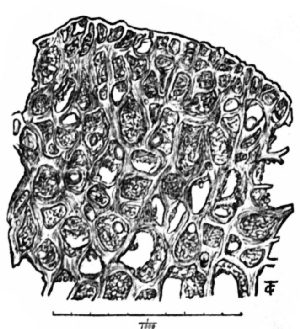
Section of Roasted Bean Magnified 1,000 Times
We know that very small quantities of acid are readily detected in fruit juices and beer, and that variation in their percentages is quickly noticed, while the neutralization of this small amount of acidity leaves an insipid drink. Hence it seems quite likely that this small acid content gives to the coffee brew its essential acidity. A few minor experiments on neutralization have proven the production of a very insipid beverage by thus treating a coffee infusion. So that the acidity of certain coffees most apparently should be attributed to such compounds, rather than to the misnamed "caffetannic acid."
The light aromatic materials, and the other substances which are steam-distillable, i.e. which are driven off when coffee is concentrated by boiling, are the main determining factors in the individuality of coffees. These compounds, which are collectively called "caffeol", vary greatly in the percentages present in different coffees, and thus are largely responsible for our ability to distinguish coffees in the cup. It is these compounds which supply the pleasingly aromatic and appetizing odor to coffee.
All of these compounds, with the possible exception of the proteins, are easily soluble in both hot and cold water. The fact that a clear coffee extract made with hot water does not show any precipitate immediately upon cooling, proves that cold water will give as complete an extraction as hot water. However, speed of extraction is materially increased with rise in temperature, due to the fact that the rate and degree of solubility of the substances in water, and the diffusion of the water through the cell walls of the coffee, are accelerated. Also, the resistance which the fat content of the bean offers to the wetting of the coffee, and the persistency of the "enfleurage" action of the fat in retaining the caffeol, are less with hot than with cold water. Accordingly, the speed of extraction is increased by using hot water, and the efficiency of extraction procured per unit time of subjection to water is higher.
Prolonged contact of coffee with water results in the hydrolysis of some of the insoluble materials and subsequent extraction of the substances thus formed. The rate of hydrolysis also increases with temperature: and as these compounds are of an astringent or bitter nature, the solution obtained upon boiling coffee is naturally possessed of a flavor unpleasant to the palate of the connoisseur. Boiling of the coffee infusion after it has been removed from the grounds also has a deleterious effect, as the local overheating of the solution at the point of application of the heat results in a decomposition, particularly if the solution be converted into steam at this point, leaving a thin film of solids temporarily exposed to the destructive action of the heat. Some of the more delicate constituents are unfavorably affected by such treatment, and undergo hydrolysis and oxidation. The products thus formed are thrown into relief in the flavor by the loss of the aromatic properties through steam distillation which is incidental to boiling.
It is a well known fact that re-warming a coffee brew has a unfavorable effect upon it. This is probably due in part to a precipitation of some of the water-soluble proteins upon standing, and their subsequent decomposition when heat is applied directly to them in reheating the solution. The absorption of air by the solution upon cooling, with attendant oxidation, which is accentuated by the application of heat in re-warming, must also be considered, as well as the other effects of boiling as set forth, and the action of the materials of which the coffee pot is constructed upon the solution.
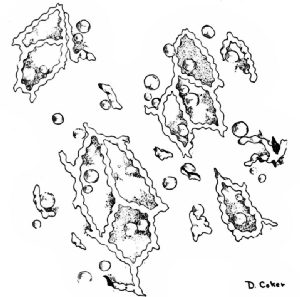
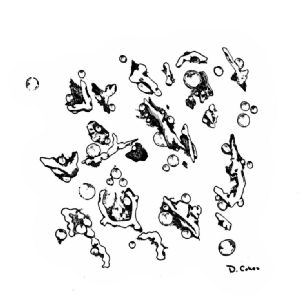
Physical Conception. The coffee bean is composed of a large number of cells which function as natural containers and retainers of coffee fat and of the aromatic flavoring substances. In order to render the soluble solids fully accessible, the resistance which these cells offer to the extracting water must be overcome by grinding so as to break open all of them. In this manner a grind is obtained which will give a maximum removal of the heavy extractives. But when all of the cells are broken, great opportunity is offered for the escape of the caffeol, which is further enhanced by the slight heating which usually accompanies such fine grinding. So much caffeol escapes that even our most expert cup-testers would experience difficulty in identifying powdered coffees in a blind test. What cup-testers, in fact, use powdered coffees for making their cup selections?
Consider powdered coffee, compared with freshly ground coffee of a coarser grind. Neither the former nor its brew possesses the amount of characteristic flavor or aroma, attributable to caffeol, evidenced by the latter. The explanation of this is that the finer the grind, the more readily accessible are the soluble constituents of the coffee to the extracting water. Caffeol, however, in addition to being water-soluble, is extremely fugacious, so that when the grinding is carried to such a fineness that every cell is broken, the greater part of the caffeol volatilizes before the water comes into contact with it. It is therefore highly desirable that a grind be used wherein all of the cells are not broken, but a grind that is sufficiently fine to permit efficient extraction. In the light of this knowledge, the grind advocated by King[384] seems to be logical, for with it—though neither a maximum of the non-volatile extractives nor a maximum of caffeol is obtained—an all-round maximum of cup quality is procured.
The escape, upon grinding, of these volatile aromatic and flavoring constituents which lend individuality to coffees, makes it essential that the roasted beans be ground immediately prior to extraction.
Different Methods of Extraction. The methods employed for preparing the coffee drink may be classified under the general headings of boiling, steeping, percolation, and filtration. True percolation is the simple process known by the trade as filtration; but in this classification, the term indicates the style of extraction exemplified by the pumping percolator.
Boiled coffee is usually cloudy, due to the suspension of fine particles resulting from the disintegration of the grounds by the violence of boiling. The usual procedure in clarifying the decoction is to add the white of an egg or some egg-shells, the albumen of which is coagulated upon the fine particles by the heat of the solution, and the particles thus weighted sink to the bottom. Even this procedure, requiring much attention, does not give as clear a solution as some of the other extraction procedures employed. The conditions to which coffee is subjected during boiling are the worst possible, as both grounds and solution undergo hydrolysis, oxidation, and local-overheating, while the caffeol is steam-distilled from the brew. Many persons, who have long been accustomed to drinking the relatively bitter beverage thus produced, are not satisfied by coffee made in any other way; but this is purely a perversion of taste, for none of the properties are present which make coffee so prized by the epicure.
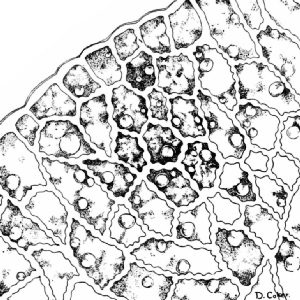
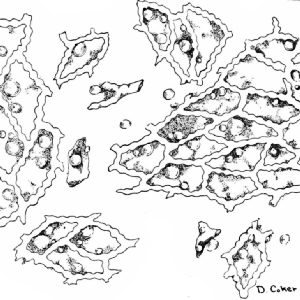
Cross-section of Roasted Coffee Bean Magnified 600 Times Coarse Grind Under the Microscope
Steeping, in which cold water is added to the coffee, and the mixture brought up to a boil, does not subject the coffee to so strenuous conditions. Local overheating and hydrolysis occur, but not to so great an extent as in boiling; and most of the effects of oxidation and volatization of caffeol are absent. However, extraction is rather incomplete, due to lack of thorough admixture of the water and coffee.
When coffee is to be made under the best conditions, the temperature of the water used and of the extract after it is made should not fluctuate. In the pumping percolator, as in the steeping method, the temperature varies greatly from the time the extraction is started to the completion of the operation. This is deleterious. Also, local overheating of the infusion occurs at the point of application of the heat; and because of the manner in which the water is brought into contact with the coffee, the degree of extraction shows inefficiency. Spraying of the water over the coffee never permits the grounds to be completely covered with water at any one time, and the opportunity offered for channeling is excessive. The principle of thorough extraction demands that, as the substance being extracted becomes progressively more exhausted, fresh solvent should be brought into contact with it. In the pumping percolator the solution pumped over the grounds becomes more concentrated as the grounds become exhausted; so that the time taken to reach the degree of extraction desired is longer, and an appreciable amount of relatively concentrated liquor is retained by the grounds.
Medium Grind Under the Microscope
The simplest procedure to follow is that in which boiling water is poured over ground coffee suspended on a filtering medium in such a manner that the extracting water will slowly pass through the coffee and be received in a containing vessel, which obviates further contact of the beverage with the grounds. The water as it comes into contact with the ground coffee extracts the soluble material, and the solution is removed by gravity. Fresh water takes its place; so that, if the filter medium be of the proper fineness, the water flows through at the correct rate of speed, and complete extraction is effected with the production of a clear solution. Thus a maximum extraction of desirable materials is obtained in a short time with a minimum of hydrolysis, oxidation, and loss of caffeol; and if the infusion be consumed at once, or kept warm in a contrivance embodying the double-boiler principle, the effects of local overheating are avoided. Also, with the use of an appropriate filter, a finer grind of coffee can be used than in the other devices, without obtaining a turbid brew. All this works toward the production of a desirable drink.
There are several devices on the market, some using paper, and some cloth, as a filter, which operate on this principle and give very good coffee. The use of paper presents the advantage of using a new and clean filter for each brew, whereas the cloth must be carefully kept immersed in water between brews to prevent its fouling.
Contrivances operating on the filtration principle have been designed for use on a large scale in conjunction with coffee urns, and have proven quite successful in causing all of the water to go slowly through the coffee without channeling, thus accomplishing practically complete extraction. The majority of urns are still operated with bags, of which the ones with sides of heavier material than the bottom obtain the most satisfactory results, as the majority of the water must pass through the coffee instead of out through the sides of the bag. Greatest efficiency, when bags are used, is obtained by repouring until all of the liquid has passed twice through the coffee; further repouring extracts too much of the astringent hydrolysis products. The bags, when not in use, should not be allowed to dry but should be kept in a jar of cold water. The urns provided with water jackets keep the brew at almost a constant temperature and avoid the deterioration incident to temperature fluctuation.
Composition of Brews. The real tests of the comparative values of different methods of brewing are the flavor and palatibility of the drink, in conjunction with the number of cups of a given strength which are produced, or the relative strengths of brews of the same number of cups volume. Chemical analysis has not yet been developed to a stage where the results obtained with it are valuably indicative. Caffeol is present in quantities so small that no comparative results can be obtained. "Caffetannic acid" determinations are practically meaningless. This compound is of so doubtful a composition and physiological action, and the methods employed for its determination are so indefinite as to interpretation, as to render valueless any attempts at comparison of relative percentages. The only accurate analysis which can be made is that for caffein.
Much advertising emphasis has been placed on the small amount of caffein extracted by some devices. What is one of the main reasons for the consumption of coffee? The caffein contained therein, of course. So that if one device extracts less caffein than another, that fact alone is nothing in favor of the former. If the consumer does not want caffein in his drink there are caffein-free coffees on the market.
Fine-Meal Grind Under the Microscope
The coffee liquor acts on metals in such a manner as to lower the quality of the drink, so that metals of any sort, and by all means, irons, should be avoided as far as possible. Instead, earthenware or glass, preferably a good grade of the former, should be employed as far as possible in the construction of coffee-making devices.
Of the various metals, silver, aluminum, monel metal, and tin (in the order named) are least attacked by coffee infusions; and besides these, nickel, copper, and well enameled iron (absolutely free from pin holes) may be used without much danger of contamination. Rings for coffee-urn bags should be made of tinned copper, monel metal, or aluminum. Even if coffee be made in metal contrivances, the receptacles in which it stands should be made of earthenware or of glass.
Painstaking care should be given to the preservation of the coffee-makers in a state of cleanliness, as upon this depends the value of the brew. Dirt, fine grounds, and fat (which will turn rancid quickly) should not be allowed to collect on the sides, bottom, or in angles of the device difficult of access. Nor should any source of metallic or exterior contamination be allowed to go uneliminated.
The Perfect Cup of Coffee
Lovers of coffee in the United States are in a better position to obtain an ideal cup of the beverage than those in any other country. While imports of green coffee are not so carefully guarded as tea imports, there is a large measure of government inspection designed to protect the consumer against impurities, and the Department of Agriculture is zealous in applying the pure food laws to insure against misbranding and substitution. The department has defined coffee as "a beverage resulting from a water infusion of roasted coffee and nothing else."
Today no reputable merchant would think of selling even loose coffee for other than what it is. And the consumer can feel that, in the case of package coffee, the label tells the truth about the contents.
With a hundred different kinds of coffee coming to this market from nineteen countries, so many combinations are possible, that there is sure to be a straight coffee or a blend to suit any taste. And those who may have been frightened into the belief that coffee is not for them should do a little experimenting before exposing themselves to the dangers of the coffee-substitute habit.
Once upon a time it was thought that Java and Mocha were the only worthwhile blend, but now we know that a Bogota coffee from Colombia, and a Bourbon Santos from Brazil, make a most satisfying drink. And if the individual seeker should happen to be a caffein-sensitive, there are coffees so low in caffein content, like some Porto Ricans, as to overcome this objection; while there are other coffees from which the caffein has been removed by a special treatment. There is no reason why any person who is fond of coffee should forego its use. Paraphrasing Makaroff, Be modest, be kind, eat less, and think more, live to serve, work and play and laugh and love—it is enough! Do this and you may drink coffee without danger to your immortal soul.
If you are accustomed to buying loose coffee, have your dealer do a little experimental blending for you until you find a coffee to suit your palate. Some expert blends are to be found among the leading package brands. But you really can not do better than to trust your case to a first-class grocer of known reputation. He will guide you right if he knows his business; and if he doesn't, then he doesn't know his business—try elsewhere. Test him out along this line:
Let us reason together, Mr. Grocer. Let us consider these facts about coffee: green coffee improves with age? Granted. As soon as it is roasted, it begins to lose in flavor and aroma? Certainly. Grinding hastens the deterioration? Of course. Therefore, it is better to buy a small quantity of freshly roasted coffee in the bean and grind it at the time of purchase or at home just before using? Absolutely!
If your grocer reacts in this fashion, he need only supply you with a quality coffee at fair price and you need only to make it properly to obtain the utmost of coffee satisfaction.
Some connoisseurs still cling to the good old two-thirds Java and one-third Mocha blend, but the author has for years found great pleasure in a blend composed of half Medellin Bogota, one-quarter Mandheling "Java", and one-quarter Mocha. However, this blend might not appeal to another's taste, and the component parts are not always easy to get. The retail cost (1922) is about fifty cents.
Another pleasing blend is composed of Bogota, washed Maracaibo, and Santos, equal parts. This should retail from thirty to thirty-five cents. Good drinking coffees are to be had for prices ranging from twenty-five to thirty cents. In the stores of one of the large chain systems an excellent blend composed of sixty percent Bourbon Santos, and forty percent Bogota is to be had (1922) for 29 cents. All these figures apply, of course, to normal times.
If you are epicurean, you will want to read up on, and to try, the fancy Mexicans, Cobáns, Sumatra growths, Meridas, and some from the "Kona side" of Hawaii.
In preparing the perfect cup of coffee, then, the coffee must be of good grade, and freshly roasted. It should, if possible, be ground just before using. The author has found a fine grind, about the consistency of fine granulated sugar, the most satisfactory. For general home use, a device that employs filter paper or filter cloth is best; for the epicure an improved porcelain French percolator (drip pot) or an improved cloth filter will yield the utmost of coffee's delights. Drink it black, sweetened or unsweetened, with or without cream or hot milk, as your fancy dictates.
It should be remembered that to make good coffee no special pot or device is necessary. Good coffee can be made with any china vessel and a piece of muslin. But to make it in perfection pains must be taken with every step in the process from roaster to cup.
Hollingworth[385] points out that through taste alone it is impossible to distinguish between quinine and coffee, or between apple and onion. There is something more to coffee than its caffein stimulus, its action on the taste-buds of the tongue and mouth. The sense of smell and the sense of sight play important rôles. To get all the joy there is in a cup of coffee, it must look good and smell good, before one can pronounce its taste good. It must woo us through the nostrils with the wonderful aroma that constitutes much of the lure of coffee.
And that is why, in the preparation of the beverage, the greatest possible care should be observed to preserve the aroma until the moment of its psychological release. This can only be done by having it appear at the same instant that the delicate flavor is extracted—roasting and grinding the bean much in advance of the actual making of the beverage will defeat this object. Boiling the extraction will perfume the house; but the lost fragrance will never return to the dead liquid called coffee, when served from the pot whence it was permitted to escape.
To recapitulate, with an added word on service, the correct way to make coffee is as follows:
1. Buy a good grade of freshly roasted coffee from a responsible dealer.
2. Grind it very fine, and at home, just before using.
3. Allow a rounded tablespoonful for each beverage cup.
4. Make it in a French drip pot or in some filtration device where freshly boiling water is poured through the grind but once. A piece of muslin and any china receptacle make an economical filter.
5. Avoid pumping percolators, or any device for heating water and forcing it repeatedly through the grounds. Never boil coffee.
6. Keep the beverage hot and serve it "black" with sugar and hot milk, or cream, or both.
Some Coffee Recipes
When Mrs. Ida C. Bailey Allen prepared a booklet of recipes for the Joint Coffee Trade Publicity Committee, she introduced them with the following remarks on the use of coffee as a flavoring agent:
Although coffee is our national beverage, comparatively few cooks realize its possibilities as a flavoring agent. Coffee combines deliciously with a great variety of food dishes and is especially adapted to desserts, sauces and sweets. Thus used it appeals particularly to men and to all who like a full-bodied pronounced flavor.
For flavoring purposes coffee should be prepared just as carefully as when it is intended for a beverage. The best results are obtained by using freshly made coffee, but when, for reasons of economy, it is desirable to utilize a surplus remaining from the meal-time brew, care should be taken not to let it stand on the grounds and become bitter.
When introducing made coffee into a recipe calling for other liquid, decrease this liquid in proportion to the amount of coffee that has been added. When using it in a cake or in cookies, instead of milk, a tablespoonful less to the cup should be allowed, as coffee does not have the same thickening properties.
In some cases, better results are gained if the coffee is introduced into the dish by scalding or cooking the right proportion of ground coffee with the liquid which is to form the base. By this means the full coffee flavor is obtained, yet the richness of the finished product is not impaired by the introduction of water, as would be the case were the infused coffee used. This method is advisable especially for various desserts which have milk as a foundation, as those of the custard variety and certain types of Bavarian Creams, Ice Cream, and the like. The right proportion of ground coffee, which is generally a tablespoonful to the cup, should be combined with the cold milk or cream in the double-boiler top and should then be scalded over hot water, when the mixture should be put through a very fine strainer or cheese cloth, to remove all grounds.
Coffee can be used as a flavoring in almost any dessert or confection where a flavoring agent is employed.
On iced coffee and the use of coffee in summer beverages in general, Mrs. Allen writes as follows:
Iced Coffee. This is not only a delicious summer drink, but it also furnishes a mild stimulation that is particularly grateful on a wilting hot day. It may be combined with fruit juices and other ingredients in a variety of cooling beverages which are less sugary and cloying than the average warm weather drink and for that reason it is generally popular with men.
Coffee that is to be served cold should be made somewhat stronger than usual. Brew it according to your favorite method and chill before adding sugar and cream. If cracked ice is added make sure the coffee is strong enough to compensate for the resulting dilution. Mixing the ingredients in a shaker produces a smoother beverage topped with an appetizing foam.
It is a convenience, however, to have on hand a concentrated syrup from which any kind of coffee-flavored drink may be concocted on short notice and without the necessity of lighting the stove. Coffee left over from meals may be used for the same purpose, but it should be kept in a covered glass or china dish and not allowed to stand too long. A coffee syrup made after the following recipe will keep indefinitely and may be used as a basis for many delicious iced drinks:
Coffee Syrup. Two quarts of very strong coffee; 31⁄2 pounds sugar. The coffee should be very strong, as the syrup will be largely diluted. The proportion of a pound of coffee to one and three-fourths quarts of water will be found satisfactory. This may be made by any favorite method, cleared and strained, then combined with the sugar, brought to boiling point, and boiled for two or three minutes. It should be canned while boiling, in sterilized bottles. Fill them to overflowing and seal as for grape juice or for any other canned beverage.