Chapter XXXIV · (continued 2)
Reading edition
In 1913, F.F. Wear, Los Angeles, perfected a coffee-making device in which a metal perforated clamp was employed to apply a filter paper to the under-side of an English earthenware adaptation of the French drip pot.
In 1912, William Lawton demonstrated in London a gas coffee roaster of his own invention, by means of which he roasted coffee "in suspension" to a light brown color in three minutes.
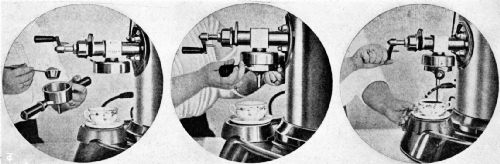
Showing How the Italian Rapid Coffee Machine Works Left, putting coffee in the filter—Center, applying filter to faucet—Right, turning on water and steam to make the drink
Herbert L. Johnston, assignor to the Hobart Electric Manufacturing Co., Troy, Ohio, was granted a United States patent on a machine for refining coffee in 1913.
In 1914, the Phylax coffee maker, embodying an improvement on the French drip principle, was introduced to the trade. The process was demonstrated by Benjamin H. Calkin, of Detroit, in 1921, as "an art of brewing coffee."
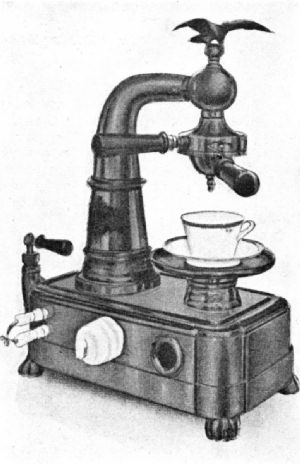
La Victoria Arduino Mignonne An electric rapid coffee maker
In 1914, Robert Burns, assignor to Jabez Burns & Sons, New York, was granted a United States patent on a coffee-granulating mill.
In 1914–15, Herbert Galt, of Chicago, was granted three United States patents on the Gait coffee pot, made of aluminum, and having two parts, a removable cylinder employing the French drip principle, and the containing pot.
In 1915, the Burns Jubilee (inner-heated) gas coffee roaster was patented in the United States and put on the market.
In 1915, the National Coffee Roasters Association Home coffee mill, employing an improved set screw operating on a cog-and ratchet principle, was introduced to the trade.
In 1916, a United States patent was granted to I.D. Richheimer, Chicago, for an infuser improvement on his Tricolator.
In 1916, Saul Blickman, assignor to S. Blickman, New York, was granted a United States patent on an apparatus for making and dispensing coffee.
In 1916, Orville W. Chamberlain, New Orleans, was granted a United States patent on an automatic drip coffee pot.
In 1916, Jules Le Page, Darlington, Ind., obtained two United States patents on cutting rolls to cut—and not to grind or crush—corn, wheat, or coffee. These were subsequently incorporated in the Ideal steel-cut coffee mill and marketed to the trade by the B.F. Gump Co., Chicago.
In 1917, Richard A. Greene and William G. Burns, assignors to Jabez Burns & Sons, New York, were granted patents in the United States on the Burns flexible-arm cooler (for roasted batches) providing full fan-suction to a cooler box at all points in its track travel.
In 1919, Joseph F. Smart, assignor to Landers, Frary & Clark, New Britain, Conn., was granted a United States patent on a percolator.
In 1919, Charles Morgan, assignor to the Arcade Manufacturing Co., Freeport, Ill., was granted a United States patent on an improved grinding mill.
In 1919, Edward F. Schnuck, assignor to Jabez Burns & Sons, New York, was granted a United States patent on an improvement for a gas coffee roaster. In 1920, he was granted a United States patent on an improved process of twice cutting coffee and removing the chaff after each cutting.
In 1920, Natale de Mattei, of Turin, Italy, was granted a United States patent on a rapid coffee-filtering machine.
In 1920, Frederick H. Muller, of Chicago, was granted a United States patent on "an art of making coffee," and on an improved apparatus for hotels and restaurants, which comprised a series of superposed metal containers, or cartridges, of ground coffee placed in a perforated bucket designed to rest in a coffee urn, the cartridges being lifted out as the boiling water poured on them sinks with the drawing off of the "decoction" at the faucet.
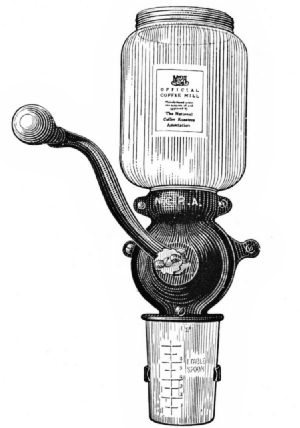
The N.C.R.A. Home Coffee Mill The Manthey-Zorn Rapid Coffee Infuser and Dispenser
In 1920, Alfredo M. Salazar, of New York, was granted a United States patent on a coffee urn in which the coffee is made at the time of serving by using steam pressure to force the boiling water through ground coffee held in a cloth sack attached to the faucet.
In 1920, William H. Bruning, Evansville, Ind., was granted a United States patent on an improved French drip pot made of aluminum and provided with a vacuum jacket in the dripper section, and a hot-water jacket in the serving portion, to keep the beverage hot.
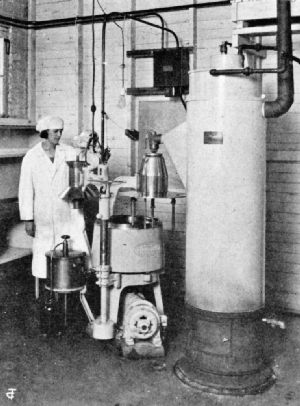
In 1921, the Manthey-Zorn Laboratories Co., of Cleveland, brought out a rapid coffee-infuser and dispenser employing in the infuser a centrifugal to make an extract in thirty-eight seconds, and designed to deliver a gallon of concentrated liquid, or coffee base, every three minutes. The dispenser automatically combines the coffee base with boiling water in a differential faucet in the proportion desired, usually one of base to four of water. The dispenser serves 600 cups per hour. An additional faucet may be added which will double the capacity.
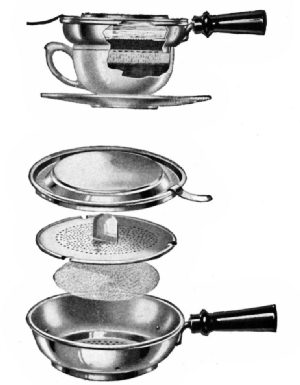
The Tricolette, a Paper-Filter Device for a Single Cup Above; In position on cup—Below; opened, showing parts
Among foreign coffee makers applying the French drip principle, the Vienna coffee-making machine, known in the United States as the Bohemian coffee pot, has met with much favor in this country. Elsewhere it is known as the Carlsbad. It is made of china, and the European manufacturer has a patent on the porcelain strainer, or grid, which is provided with slits that are very fine on the inner side but that widen on the outer side to permit careful straining and to facilitate cleaning.
Some of the latest developments in coffee apparatus were shown at the industrial exposition at the National Coffee Roasters Association, held in New York, November 1–3, 1921. Among items of distinction not heretofore included in this work, mention should be made of: an American-French coffee biggin, being a French drip pot made of American porcelain and fitted with a muslin strainer; a glass urn-liner, intended to supplant the porcelain liner; and an electric repouring pump, designed to be attached to any type of coffee urn.
Careful research of the records of the United States patent office discloses that the number of patents relating to coffee apparatus and coffee preparations, issued from 1789 to 1921, is as follows:
United States Coffee Patents
Devices Patents
Coffee Mills 185
Coffee-roasting devices, and improvements thereon 312
Coffee-making devices 835
Coffee-cleaning, hulling, drying, polishing, and plantation machinery in general 175
Miscellaneous patents (for coating, glazing, treated coffees, substitutes, etc.) 300
———
Total 1,807
It must be borne in mind that there was a number of patents granted on machines that were intended for, and used for, coffee, but that did not mention coffee in the specifications. Many coffee driers were listed as "grain driers," for instance. Also, many excellent devices have been made that were never patented.