Chapter XXXI · (continued 2)
Reading edition
I.D. Richheimer, promoter of the original soluble coffee of Kato and the Kato patent, organized the Soluble Coffee Co. of America in 1918, to supply soluble coffee to the American army overseas. After the armistice, the company began licensing other merchants under the Kato patent or offering to process the merchants' own coffee for them if desired.
William A. Hamor and Charles W. Trigg, Pittsburgh, assignors to John E. King, Detroit, were granted a United States patent in 1919 on a process for making a new soluble coffee. Their process consists in bringing the volatilized caffeol in contact with a petrolatum, or absorbing medium, where it is held until needed for combination with the evaporated coffee extract. The King Coffee Products Corp. of Detroit was organized in 1920 to manufacture this product, known as Minute coffee, and a coffee base for soft drinks, the latter being marketed under the name of Coffee Pep. Mr. King had believed for many years that soluble coffee was destined to solve many of the vexations of the coffee business, and had been experimenting with the idea since 1906. To facilitate his investigations, he established a fellowship at the Mellon Institute of Industrial Research, Pittsburgh, in 1914, in charge of Charles W. Trigg. This chemically controlled research evolved a product which, after passing through the laboratory stage, was placed upon a small unit plan basis, and then patented. Five additional patents on the product were granted Messrs. Trigg and David S. Pratt in 1921; and all were assigned to John E. King.
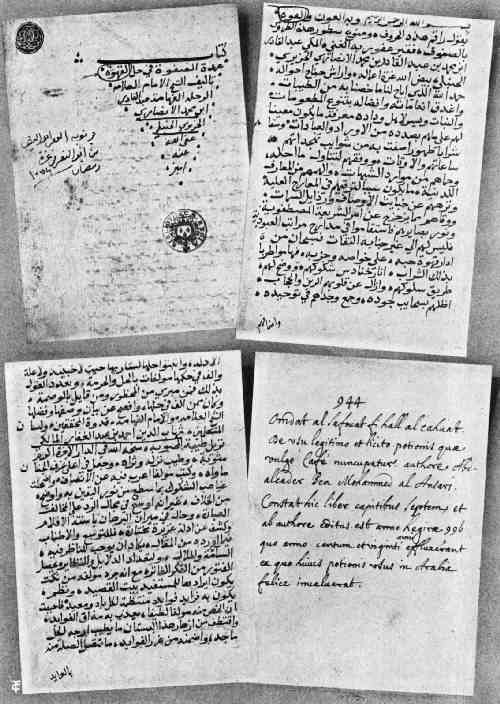
THE EARLIEST COFFEE MANUSCRIPT, 1587 Pages from the Arabian writing by Abd-al-Kâdir, photographed for this work in the Bibliothéque Nationale, Paris.