Chapter XXXII · (continued 3)
Reading edition
Besides this personal attack, various subjects were debated here in the manner of the Robin Hood Society, which filled the Orator's pocket, and proved his rhetoric of some value.
Here is one of his combats with Foote. The subject was Duelling In Ireland, which Macklin had illustrated as far as the reign of Elizabeth. Foote cried, "Order;" he had a question to put. "Well, Sir," said Macklin, "what have you to say on this subject," "I think, Sir" said Foote, "this matter might be settled in a few words. What o'clock is it, Sir?" Macklin could not possibly see what the clock had to do with a dissertation upon Duelling, but gruffly reported the hour to be half-past nine. "Very well," said Foote, "about this time of the night every gentleman in Ireland that can possibly afford it is in his third bottle of claret, and therefore in a fair way of getting drunk; and from drunkenness proceeds quarrelling, and from quarrelling, duelling, and so there's an end of the chapter." The company were much obliged to Foote for his interference, the hour being considered; though Macklin did not relish this abridgment.
The success of Foote's fun upon Macklin's Lectures, led him to establish a summer entertainment of his own at the Haymarket. He took up Macklin's notion of applying Greek tragedy to modern subjects, and the squib was so successful that Foote cleared by it 500£ in five nights, while the great Piazza Coffee-room in Covent Garden was shut up, and Macklin in the Gazette as a bankrupt.
But when the great plan of Mr. Macklin proved abortive, when as he said in a former prologue, upon a nearly similar occasion—
From scheming, fretting, famine and despair. We saw to grace restor'd an exiled player;
when the town was sated with the seemingly-concocted quarrel between the two theatrical geniuses, Macklin locked his doors, all animosity was laid aside, and they came and shook hands at the Bedford; the group resumed their appearance, and, with a new master, a new set of customers was seen.
Tom King's Coffee-house was one of the old night-houses of Covent Garden Market; it was a rude shed immediately beneath the portico of St. Paul's Church, and was one "well known to all gentlemen to whom beds are unknown." Fielding in one of his Prologues says:
What rake is ignorant of King's Coffee-house?
It is in the background of Hogarth's print of Morning where the prim maiden lady, walking to church, is soured with seeing two fuddled beaux from King's Coffee-house caressing two frail women. At the door there is a drunken row, in which swords and cudgels are the weapons[358].
Harwood's Alumni Etonenses, p. 239, in the account of the Boys elected from Eton to King's College, contains this entry: "A.D. 1713, Thomas King, born at West Ashton, in Wiltshire, went away scholar in apprehension that his fellowship would be denied him; and afterwards kept that Coffee-house in Covent Garden, which was called by his own name."
Moll King was landlady after Tom's death: she was witty, and her house was much frequented, though it was little better than a shed. "Noblemen and the first beaux," said Stacie, "after leaving Court would go to her house in full dress, with swords and bags, and in rich brocaded silk coats, and walked and conversed with persons of every description. She would serve chimney-sweepers, gardeners, and the market-people in common with her lords of the highest rank. Mr. Apreece, a tall thin man in rich dress, was her constant customer. He was called Cadwallader by the frequenters of Moll's." It is not surprising that Moll was often fined for keeping a disorderly house. At length, she retired from business—and the pillory—to Hempstead, where she lived on her ill-earned gains, but paid for a pew in church, and was charitable at appointed seasons, and died in peace in 1747.
The Piazza Coffee-house at the northeastern angle of Covent Garden Piazza, appears to have originated with Macklin's; for we read in an advertisement in the Publick Adviser, March 5, 1756; "The Great Piazza Coffee-room, in Covent Garden."
The Piazza was much frequented by Sheridan; and here is located the well-known anecdote told of his coolness during the burning of Drury-lane Theatre, in 1809. It is said that as he sat at the Piazza, during the fire, taking some refreshment, a friend of his having remarked on the philosophical calmness with which he bore his misfortune, Sheridan replied:
"A man may surely be allowed to take a glass of wine by his own fireside."
Sheridan and John Kemble often dined together at the Piazza, to be handy to the theatre. During Kemble's management, Sheridan had occasion to make a complaint, which brought a "nervous" letter from Kemble, to which Sheridan's reply is amusing enough. Thus, he writes: "that the management of a theatre is a situation capable of becoming troublesome, is information which I do not want, and a discovery which I thought you made long ago." Sheridan then treats Kemble's letter as "a nervous flight," not to be noticed seriously, adding his anxiety for the interest of the theatre, and alluding to Kemble's touchiness and reserve; and thus concludes:
"If there is anything amiss in your mind not arising from the troublesomeness of your situation, it is childish and unmanly not to disclose it. The frankness with which I have dealt towards you entitles me to expect that you should have done so.
"But I have no reason to believe this to be the case; and attributing your letter to a disorder which I know ought not to be indulged, I prescribe that thou shalt keep thine appointment at the Piazza Coffee-house, tomorrow at five, and, taking four bottles of claret instead of three, to which in sound health you might stint yourself, forget that you ever wrote the letter, as I shall that I ever received it."
"R.B. Sheridan."
The Piazza facade, and interior, were of Gothic design. When the house was demolished, in its place was built the Floral Hall, after the Crystal Palace model.
The Chapter Coffee-house was a literary place of resort in Paternoster Row, more especially in connection with the Wittinagemot of the last century. A very interesting account of the Chapter, at a later period (1848) is given by Mrs. Gaskell.
Goldsmith frequented the Chapter, and always occupied one place, which for many years after was the seat of literary honor there. There are leather tokens of the Chapter Coffee-house in existence.
Child's Coffee-house, in St. Paul's Churchyard, was one of the Spectator's houses. "Sometimes," he says, "I smoke a pipe at Child's and whilst I seem attentive to nothing but the Postman, overhear the conversation of every table in the room." It was much frequented by the clergy; for the Spectator, No. 609, notices the mistake of a country gentleman in taking all persons in scarfs for Doctors of Divinity, since only a scarf of the first magnitude entitles him to "the appellation of Doctor from his landlady and the Boy at Child's."
Child's was the resort of Dr. Mead, and other professional men of eminence. The Fellows of the Royal Society came here. Whiston relates that Sir Hans Sloane, Dr. Halley and he were once at Child's when Dr. H. asked him, W., why he was not a member of the Royal Society? Whiston answered, because they durst not choose a heretic. Upon which Dr. H. said, if Sir Hans Sloane would propose him, W., he, Dr. H., would second it, which was done accordingly.
The propinquity of Child's to the Cathedral and Doctors' Commons, made it the resort of the clergy, and ecclesiastical loungers. In that respect, Child's was superseded by the Chapter, in Paternoster Row.
The London Coffee-house was established previous to the year 1731, for we find of it the following advertisement:
"May, 1731.
"Whereas, it is customery for Coffee-houses and other Public-houses, to take 8s. for a quart of Arrack, and 6s. for a quart of Brandy or Rum, made into Punch:
"This is to give notice,
"That James Ashley has opened on Ludgate Hill, the London Coffee-house, Punch-house, Dorchester Beer and Welsh Ale Warehouse, where the finest and best old Arrack, Rum and French Brandy is made into Punch, with the other of the finest Ingredients—viz., A quart of Arrack made into Punch for six shillings; and so in proportion to the smallest quantity, which is half-a-quartern for fourpence half-penny. A quart of Rum or Brandy made into Punch for four shillings; and so in proportion to the smallest quantity, which is half-a-quartern for fourpence half-penny; and gentlemen may have it as soon made as a gill of Wine can be drawn."
The premises occupied a Roman site; for, in 1800, in the rear of the house, in a bastion of the City Wall, was found a sepulchral monument dedicated to Claudina Martina by her husband, a provincial Roman soldier; here also were found a fragment of a statue of Hercules and a female head. In front of the Coffee-house immediately west of St. Martin's Church, stood Ludgate.
The London Coffee-house was noted for its publishers' sales of stock and copyrights. It was within the rules of the Fleet prison; and in the Coffee-house were "locked up" for the night such juries from the Old Bailey Sessions, as could not agree upon verdicts. The house was long kept by the grandfather and father of Mr. John Leech, the celebrated artist.
A singular incident occurred at the London Coffee-house, many years since: Mr. Brayley, the topographer, was present at a party here, when Mr. Broadhurst, the famous tenor, by singing a high note, caused a wine-glass on the table to break, the bowl being separated from the stem.
From The Kingdom's Intelligencer, a weekly paper, published by authority, in 1662, we learn that there had just been opened a "new coffee-house," with the sign of the Turk's Head, where was sold by retail "the right coffee-powder," from 4s. to 6s. 8d. per pound; that pounded in a mortar, 2s; East Indian berry, 1s. 6d.; and the right Turkie berry, well garbled, at 3s. "The ungarbled for lesse, with directions how to use the same." Also Chocolate at 2s. 6d. per pound; the perfumed from 4s. to 10s.; "also, Sherbets made in Turkie, of lemons, roses and violets perfumed; and Tea, or Chaa, according to its goodness. The house seal is Morat the Great. Gentlemen customers and acquaintances are (the next New Year's Day) invited to the sign of the Great Turk at this new Coffee-house, where Coffee will be on free cost." Morat figures as a tyrant in Dryden's "Aurung Zebe." There is a token of this house, with the sultan's head, in the Beaufoy collection[359].
Another token in the same collection, is of unusual excellence, probably by John Roettier. It has on the obverse, Morat ye Great Men did mee call,—Sultan's head; reverse, Where eare I came I conquered all.—In the field, Coffee, Tobacco, Sherbet, Tea, Chocolate, retail in Exchange Alee. "The word Tea," says Mr. Burn, "occurs on no other tokens than those issued from 'the Great Turk' Coffee-house, in Exchange alley;" in one of its advertisements, 1662, tea is from 6s. to 60s. a pound.
Competition arose. One Constantine Jennings in Threadneedle-street, over against St. Christopher's Church, advertised that coffee, chocolate, sherbet, and tea, the right Turkey berry, may be had as cheap and as good of him as is anywhere to be had for money; and that people may there be taught to prepare the said liquors gratis.
Pepys, in his "Diary," tells, September 25, 1669, of his sending for "a cup of Tea, a China Drink, he had not before tasted." Henry Bennet, Earl of Arlington, about 1666, introduced tea at Court. And, in his "Sir Charles Sedley's Mulberry Garden," we are told that "he who wished to be considered a man of fashion always drank wine-and-water at dinner, and a dish of tea afterwards." These details are condensed from Mr. Burn's excellent "Beaufoy Catalogue," 2nd edition, 1855.
In Gerard-street, Soho, also, was another Turk's Head Coffee-house, where was held a Turk's Head Society; in 1777, we find Gibbon writing to Garrick: "At this time of year (August 14) the Society of the Turk's Head can no longer be addressed as a corporate body, and most of the individual members are probably dispersed: Adam Smith, in Scotland; Burke in the shades of Beaconsfield; Fox, the Lord or the devil knows where."
The place was a kind of headquarters for the Loyal Association during the Rebellion of 1745. Here was founded "The Literary Club" and a select body for the Protection and Encouragement of Art. Another Society of Artists met in Peter's-court, St. Martin's-lane, from the year 1739 to 1769. After continued squabbles, which lasted for many years, the principal artists met together at the Turk's Head, where many others having joined them, they petitioned the King (George III) to become patron of a Royal Academy of Art. His Majesty consented; and the new Society took a room in Pall Mall, opposite to Market-lane, where they remained until the King, in the year 1771, granted them apartments in Old Somerset House.
The Turk's Head Coffee-house, No. 142, in the Strand, was a favourite supping-house with Dr. Johnson and Boswell, in whose Life of Johnson are several entries, commencing with 1763—"At night, Mr. Johnson and I supped in a private room at the Turk's Head Coffee-house, in the Strand; 'I encourage this house,' said he, 'for the mistress of it is a good civil woman, and has not much business'." Another entry is—"We concluded the day at the Turk's Head Coffee-house very socially." And, August 3, 1673—"We had our last social meeting at the Turk's Head Coffee-house, before my setting out for foreign parts."
The name was afterwards changed to "The Turk's Head, Canada and Bath Coffee-house," and was a well frequented tavern and hotel.
At the Turk's Head, or Miles's Coffee-house, New Palace-yard, Westminster, the noted Rota Club met, founded by Harrington, in 1659; where was a large oval table, with a passage in the middle, for Miles to deliver his coffee.[360]
For many years previous to the streets of London being completely paved, "Slaughter's Coffee-house" was called "The Coffee-house on the Pavement." Besides being the resort of artists, Old Slaughter's was the house of call for Frenchmen.
St. Martin's-lane was long one of the headquarters of the artists of the last century. "In the time of Benjamin West," says J.T. Smith, "and before the formation of the Royal Academy, Greek-street, St. Martin's-lane, and Gerard-street, was their only colony. Old Slaughter's Coffee-house, in St. Martin's-lane, was their grand resort in the evenings, and Hogarth was a constant visitor." He lived at the Golden Head, on the eastern side of Leicester Fields, in the northern half of the Sabloniere Hotel. The head he cut out himself from pieces of cork, glued and bound together; it was placed over the street-door. At this time, young Benjamin West was living in chambers, in Bedford-street, Covent Garden, and had there set up his easel; he was married in 1765, at St. Martin's Church. Roubiliac was often to be found at Slaughter's in early life; probably before he gained the patronage of Sir Edward Walpole, through finding and returning to the baronet the pocket-book of bank-notes which the young maker of monuments had picked up in Vauxhall Gardens. Sir Edward, to remunerate his integrity, and his skill, of which he showed specimens, promised to patronize Roubiliac through life, and he faithfully performed this promise. Young Gainsborough, who spent three years amid the works of the painters in St. Martin's-lane, Hayman, and Cipriani, who were all eminently convival, were, in all probability, frequenters of Slaughter's. Smith tells us that Quin and Hayman were inseparable friends, and so convival, that they seldom parted till daylight.
Mr. Cunningham relates that here, "in early life, Wilkie would enjoy a small dinner at a small cost. I have been told by an old frequenter of the house, that Wilkie was always the last dropper-in for dinner, and that he was never seen to dine in the house by daylight. The truth is, he slaved at his art at home till the last glimpse of daylight had disappeared."
Haydon was accustomed, in the early days of his fitful career, to dine here with Wilkie. In his "Autobiography," in the year 1808, Haydon writes: "This period of our lives was one of great happiness; painting all day, then dining at the Old Slaughter Chop-house, then going to the Academy until eight to fill up the evening, then going home to tea—that blessing of a studious man—talking over respective exploits, what he, Wilkie, had been doing and what I had been doing, and, then frequently to relieve our minds fatigued by their eight and twelve hours' work, giving vent to the most extraordinary absurdities. Often have we made rhymes on odd names, and shouted with laughter at each new line that was added. Sometimes lazily inclined after a good dinner, we have lounged about, near Drury Lane or Covent Garden, hesitating whether to go in, and often have I (knowing first that there was nothing I wished to see) assumed a virtue I did not possess, and pretending moral superiority, preached to Wilkie on the weakness of not resisting such temptations for the sake of our art and our duty, and marched him off to his studies, when he was longing to see Mother Goose."
J.T. Smith refers to Old Slaughter's as "formerly the rendezvous of Pope, Dryden and other wits, and much frequented by several eminently clever men of his day."
Thither came Ware, the architect, who, when a little sickly boy, was apprenticed to a chimney-sweeper, and was seen chalking the street-front of Whitehall, by a gentleman who purchased the remainder of the boy's time; gave him an excellent education; then sent him to Italy, and, upon his return, employed him, and introduced him to his friends as an architect. Ware was heard to tell this story while he was sitting to Roubiliac for his bust. Ware built Chesterfield House and several other noble mansions, and compiled a Palladio, in folio: he retained the soot in his skin to the day of his death. He was very intimate with Roubiliac, who was an opposite eastern neighbour of Old Slaughter's. Another architect, Gwynn, who competed with Mylne for designing and building Blackfriars Bridge, was also a frequent visitor at Old Slaughter's, as was Gravelot, who kept a drawing-school in the Strand, nearly opposite to Southampton-street.
Hudson, who painted the Dilettanti portraits; M'Ardell, the mezzotinto-scraper; and Luke Sullivan, the engraver of Hogarth's March to Finchley, also frequented Old Slaughter's; likewise Theodore Gardell, the portrait painter, who was executed for the murder of his landlady: and Old Moser, keeper of the Drawing Academy in Peter's-court.
Parry, the Welsh harper, though totally blind, was one of the first draught-players in England, and occasionally played with the frequenters of Old Slaughter's; and here in consequence of a bet. Roubiliac introduced Nathaniel Smith (father of John Thomas), to play at draughts with Parry; the game lasted about half an hour; Parry was much agitated, and Smith proposed to give in; but as there were bets depending, it was played out, and Smith won. This victory brought Smith numerous challenges; and the dons of the Barn, a public-house, in St. Martin's-lane, nearly opposite the church, invited him to become a member; but Smith declined. The Barn, for many years, was frequented by all the noted players of chess and draughts; and it was there that they often decided games of the first importance, played between persons of the highest rank.
The Grecian Coffee-house, Devereux-court, Strand, (closed in 1843) was named from Constantine, of Threadneedle street, the Grecian who kept it. In the Tatler announcement, all accounts of learning are to be "under the title of the Grecian;" and, in the Tatler, No. 6: "While other parts of the town are amused with the present actions (Marlborough's) we generally spend the evening at this table (at the Grecian) in inquiries into antiquity, and think anything new, which gives us new knowledge. Thus, we are making a very pleasant entertainment to ourselves in putting the actions of Homer's Iliad into an exact journal."
The Spectator's face was very well known at the Grecian, a coffee-house "adjacent to the law." Occasionally it was the scene of learned discussion. Thus Dr. King relates that one evening, two gentlemen, who were constant companions, were disputing here, concerning the accent of a Greek word. This dispute was carried to such a length, that the two friends thought proper to determine it with their swords; for this purpose they stepped into Devereux-court, where one of them (Dr. King thinks his name was Fitzgerald) was run through the body, and died on the spot.
The Grecian was Foote's morning lounge. It was handy, too, for the young Templar, Goldsmith, and often did it echo with Oliver's boisterous mirth; for "it had become the favourite resort of the Irish and Lancashire Templars, whom he delighted in collecting around him, in entertaining with a cordial and unostentatious hospitality, and in occasionally amusing with his flute, or with whist, neither of which he played very well!" Here Goldsmith occasionally wound up his "Shoemaker's Holiday" with supper.
It was at the Grecian that Fleetwood Shephard told this memorable story to Dr. Tancred Robinson, who gave Richardson permission to repeat it. "The Earle of Dorset was in Little Britain, beating about for books to his taste: there was 'Paradise Lost'. He was surprised with some passages he struck upon, dipping here and there and bought it; the bookseller begged him to speak in his favour, if he liked it, for they lay on his hands as waste paper.... Shephard was present. My Lord took it home, read it, and sent it to Dryden, who in a short time returned it. 'This man,' says Dryden, 'cuts us all out, and the ancients, too!'"
George's Coffee-house, No. 213, Strand, near Temple Bar, was a noted resort in the eighteenth and nineteenth centuries. When it was a coffee-house, one day, there came in Sir James Lowther, who after changing a piece of silver with the coffee-woman, and paying twopence for his dish of coffee, was helped into his chariot, for he was very lame and infirm, and went home: some little time afterwards, he returned to the same coffee-house, on purpose to acquaint the woman who kept it, that she had given him a bad half-penny, and demanded another in exchange for it. Sir James had about £40,000 per annum.
Shenstone, who found "the warmest welcome at an inn," found George's to be economical. "What do you think," he writes, "must be my expense, who love to pry into everything of the kind? Why, truly one shilling. My company goes to George's Coffee-house, where, for that small subscription I read all pamphlets under a three shillings' dimension; and indeed, any larger would not be fit for coffee-house perusal." Shenstone relates that Lord Oxford was at George's, when the mob, that were carrying his Lordship in effigy, came into the box where he was, to beg money of him, amongst others; this story Horace Walpole contradicts, adding that he supposes Shenstone thought that after Lord Oxford quitted his place he went to the coffee-house to learn news.
Arthur Murphy frequented George's, "where the town wits met every evening." Lloyd, the law-student, sings:
By law let others toil to gain renown! Florio's a gentleman, a man o' the town. He nor courts clients, or the law regarding, Hurries from Nando's down to Covent Garden. Yet, he's a scholar; mark him in the pit, With critic catcall sound the stops of wit! Supreme at George's, he harangues the throng, Censor of style, from tragedy to song.
The Percy Coffee-house, Rathbone-place, Oxford-street, no longer exists; but it will be kept in recollection for its having given name to one of the most popular publications of its class, namely, the "Percy Anecdotes," by Sholto and Reuben Percy, Brothers of the Benedictine Monastery of Mont Benger, in forty-four parts, commencing in 1820. So said the title pages, but the names and the locality were supposé. Reuben Percy was Thomas Byerly, who died in 1824; he was the brother of Sir John Byerley, and the first editor of the Mirror, commenced by John Limbird, in 1822. Sholto Percy was Joseph Clinton Robertson, who died in 1852; he was the projector of the Mechanics' Magazine, which he edited from its commencement to his death. The name of the collection of Anecdotes was not taken, as at the time supposed, from the popularity of the "Percy Reliques," but from the Percy Coffee-house, where Byerley and Robertson were accustomed to meet to talk over their joint work. The idea was, however, claimed by Sir Richard Phillips, who stoutly maintained that it originated in a suggestion made by him to Dr. Tilloch and Mr. Mayne, to cut the anecdotes from the many years' files of the Star newspaper, of which Dr. Tilloch was the editor; and Mr. Byerley assistant editor; and to the latter overhearing the suggestion, Sir Richard contested, might the "Percy Anecdotes" be traced. They were very successful, and a large sum was realised by the work.
Peele's Coffee-house, Nos. 177 and 178, Fleet-street, east corner of Fetter-lane, was one of the coffee-houses of the Johnsonian period; and here was long preserved a portrait of Dr. Johnson, on the keystone of a chimney-piece, stated to have been painted by Sir Joshua Reynolds. Peele's was noted for files of newspapers from these dates: Gazette, 1759; Times, 1780; Morning Chronicle, 1773; Morning Post, 1773; Morning Herald, 1784; Morning Advertiser, 1794; and the evening papers from their commencement. The house is now a tavern.
Coffee Literature and Ideals
The bibliography at the end of this work will serve to indicate the nature and extent of the general literature of coffee. Not that it is complete or nearly so; it would require twice the space to include mention of all the fugitive bits of verse, essays, and miscellaneous writings in newspapers, and periodicals, dealing with the poetry and romance, history, chemistry, and physiological effects of coffee. Only the early works, and the more notable contributions of the last three centuries, are included in the bibliography; but there is sufficient to enable the student to analyze the lines of general progress.
A study of the literature of coffee shows that the French really internationalized the beverage. The English and Italians followed. With the advent of the newspaper press, coffee literature began to suffer from its competition.
The complexities of modern life suggest that coffee drinking in perfection, the esthetics, and a new literature of coffee may once more become the pleasure of a small caste. Are the real pleasures of life, the things truly worth while, only to the swift—the most efficient? Who shall say? Are not some of us, particularly in America, rather prone to glorify the gospel of work to such an extent that we are in danger of losing the ability to understand or to enjoy anything else?
Granted that this is so, coffee, already recognized as the most grateful lubricant known to the human machine, is destined to play another part of increasing importance in our national life as a kind of national shock-absorber as well. But its rôle is something more than this, surely. When life is drab, it takes away its grayness. When life is sad, it brings us solace. When life is dull, it brings us new inspiration. When we are a-weary, it brings us comfort and good cheer.
The lure of coffee lies in its appeal to our finer sensibilities; and signs are not wanting that that pursuit of the long, sweet happiness that every one is seeking will lead some of us (even in big bustling America) into footpaths that end in places where coffee will offer much of its pristine inspiration and charm. It probably will not be a coffee house anything like that of the long ago, but perhaps it will be a kind of modernized coffee club. Why not?
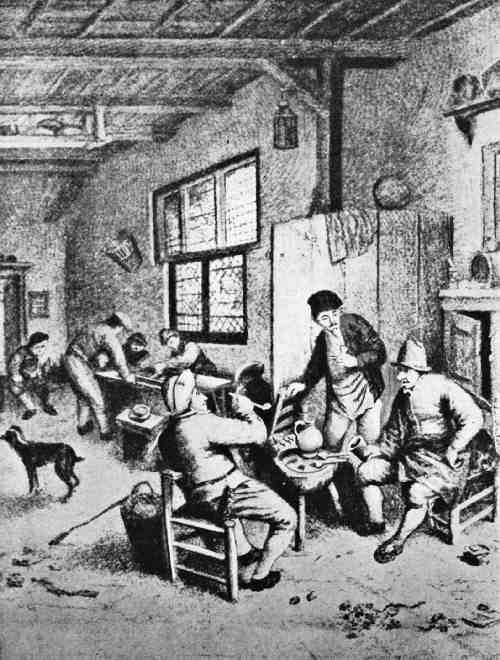
A COFFEE HOUSE IN HOLLAND, ABOUT 1650 After the etching by J. Beauvarlet from a painting by Adriaen Van Ostade (1610–1675), which is said to be the earliest picture of a coffee house in western Europe