Volume 3 — DISEASES OF THE RESPIRATORY SYSTEM. (continued 2)
Reading edition
Treatment will, however, always secure amelioration of the symptoms, and few cases occur which cannot be greatly improved. The general health is invariably benefited. Should a tendency to asthma exist, it is apt to disappear, the complexion clears, and in adolescence the rate of general development is accelerated.
SECOND VARIETY.—The group of nasal diseases included under this head is not a natural one, since it embraces disorders characterized by a negative feature—viz. absence of obstruction to nasal respiration. Nevertheless, it is convenient to consider under a single head a number of relatively infrequent disorders in which there is invariably an underlying constitutional cause. Subjects of disorders herein embraced are not merely sufferers from insufficient oxygenation of the tissues, but have impaired general vitality or possess a decided constitutional taint, whether specific or otherwise. The nasal condition is simply the most prominent of the local manifestations.
Three distinct disorders are herein named: first, chronic inflammation of the nasal mucous membrane; second, atrophy of the turbinals and their associated mucous membrane; third, necrosis of the bones entering into the framework of the nasal chambers.
(a) Inflammatory thickening is a rare affection. It is more frequent in males than in females, and in persons of a sedentary occupation than in those who are actively employed. Those subject to it are apt to have light-blue or gray eyes and auburn or sandy hair. On examination, the chambers may be found free from peculiarities of bony structure, capacious, and without hypertrophy of the cavernous tissues, yet the membranes be of a deep-red color and of cushiony consistence, yield bright reflexes, and the shank of the instrument introduced into the nose is mirrored upon them. The most conspicuous alteration is not seen on the turbinals, but on the septum. The parts are very vascular, and the most moderate manipulation will often end in free capillary oozing. The discharge, though moderate in quantity, is inclined to be purulent, and resembles semi-coagulated albumen. Quite frequently, in the examination of a neglected case, minute flecks of this modified secretion are seen scattered over the septum and the inferior turbinated bone. Rarely, the discharge is maintained by the presence of a morbid growth or inflammatory products, either in the nasal chamber or a chamber accessory to it. The discharge then appears to consist of pure pus mixed with the normal secretion of the nose, and, thus rendered viscid and tenacious, it excites by its presence a condition of the lining mucous surface quite similar to that above described.
Under excitement, as after an attack of coryza, the discharge becomes more serous in character, and is occasionally of a chocolate color from its admixture with blood. It is without odor. There is no obstruction to respiration except during sleep, when, in aggravated cases, mouth-breathing may be established. Thus, the patient will often complain of an obstruction which is never present at the time of the examination. He further complains of a sense of dryness in the nose, with some pharyngeal irritation. The palato-pharyngeal and palato-glossal muscles are weak and often asymmetrical; the tonsils are small, but the adenoid tissues are generally unaffected. In a dry atmosphere, especially if it be loaded with irritating particles, the pharyngeal irritation is increased—a complication which is probably due to the inspired air passing too rapidly through the capacious and imperfectly-guarded nasal chambers and throat. Although I have carefully searched for all indications of aural complications, especially for the symptoms of progressive dry catarrh, I have never detected them but in a single instance.
The prognosis is to be guarded, although a careful course of treatment and proper care of the general health will greatly improve, if not entirely cure, the disease.
TREATMENT.—This consists in the application of nitrate of silver, either in strong solution or in the solid stick, to the under surface of the inferior and middle turbinated bones, of washing the parts with a dilute solution of carbolic acid, and of passing through the cheek tissues a constant electrical current of a strength of from five to ten cells. Tonics and alteratives should not be neglected, and an outdoor life, as far as is practicable, should be enjoined. The galvano-cautery may be used to destroy any nodules of tissue which resist other treatment. All applications are well borne, if indeed we may not look upon the condition of the surfaces as partially analgesic, and thus far of unfavorable significance. It is certain that indurated tags of oedematous and chronically inflamed mucous membrane overlying a bone, such as the middle turbinated or the alveolar line about the necks of the teeth, will never yield to anything but the most powerful astringents. Upon such tissues the most concentrated solutions of nitrate of silver are never caustic. The premaxillary portion of the inferior turbinated bone is frequently seen hopelessly infiltrated, and it must then be destroyed by the electro-cautery. When a discharge of a pus-like character exists, careful search should be made for the cause. If a tumor or foreign body be found, it should be removed, but if the cause lie in one of the outlying spaces of the nasal chamber, it is evident that the above treatment is palliative only.
(b) In atrophy of the nasal mucous surfaces and turbinals we have, as in the last-named group, spacious chambers, a purulent discharge, pharyngeal irritation (in many cases), and always associated a thin and relaxed, if not a paretic, condition of the velal muscles. These cases might be looked upon as an advanced stage of the preceding affection, since it may be surmised that the stage of infiltration has been succeeded by one of atrophy. The mucous membranes are everywhere pale, and closely bound to the underlying bony framework. The discharge is purulent and confluent; where in contact with the air it is desiccated, but where protected, as by crust-like surface-layers, it is semi-fluid and tenacious. There is, consequently, no disposition for the discharge to escape from the nose, and it accumulates until the sense of obstruction induces the patient to remove it by artificial means. When first seen, the nasal chambers are frequently so fully occupied with discharge as to conceal the characteristic appearances of the mucous surface. This prolonged retention induces incipient decomposition of the mass, which gives rise to the odor so characteristic of this group of cases.
The subjects of atrophic catarrh (ozæna) are never in robust health. They are, as a rule, of spare habit, anæmic, and with family histories which, while not distinctive, indicate that the affection is, to some degree at least, hereditary. A few cases have come under my notice in which all the general features of atrophic catarrh were present, but with very slight although confluent discharge, unaccompanied by fetor. Such cases are, strictly speaking, examples of atrophic catarrh, while they could not, under the old nomenclature, be included under the head of ozæna.
The prognosis is unfavorable for entire recovery, but treatment systematically pursued will make the patient entirely comfortable to himself and others—will arrest the progress of the disease and vastly improve the general health. As in other forms of nasal disease, should anosmia be present the prognosis is less favorable.
FIG. 19.
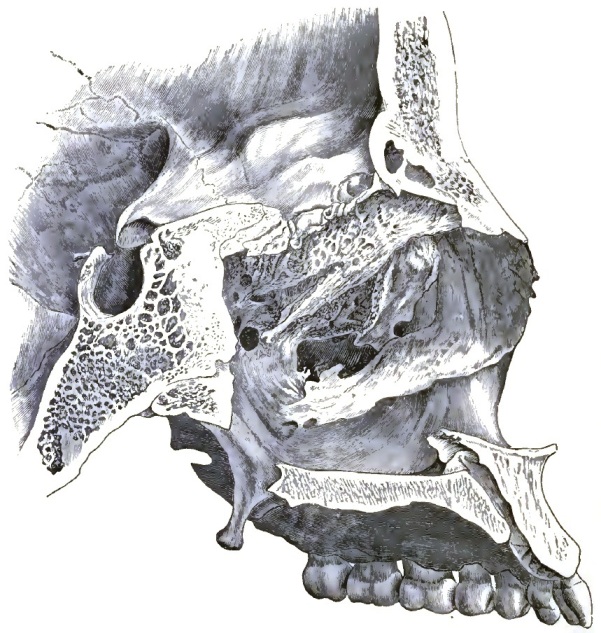
Antero-posterior section of the bones of the face in position, showing the premaxillary portion of the floor of the nose greatly elevated above the plane of the remaining portions. In ozæna, as mentioned in the text, a disposition of parts may exist similar to that delineated, and cause discharge to collect and undergo offensive decomposition.
TREATMENT.—The parts should be carefully cleansed—an act which, while imperfectly accomplished by either the syringe or the douche, is, in my judgment, best performed by the galvano-cautery. This instrument, the one relied upon for the subsequent treatment of the case, is to be selected for its initiation. The largest speculum which the nose will admit being placed in position, a spiral-looped electrode is introduced cold into the nose and held against one of the crusts. When heated it will effect so firm an attachment to it as to enable the mass to be withdrawn with great ease. In patients with whom the palatal portion of the floor of the nose is depressed below the level of the maxillary a considerable quantity of discharge may lie concealed from observation. When, after the removal of all visible crusts, the fetor persists, it is reasonable to suppose that the palatal depression is filled with decomposed pus and mucus. To test such a condition, the electrode should be appropriately curved and introduced. I have been surprised at the quantities of discharge which can in this way be withdrawn from a locality which, as far as I know, cannot be cleansed in any other way.
With the removal of the crust relief is at once experienced, and if the discharge could be removed as fast as it forms the disease would not really be a source of offence. The general health would also improve, from the fact that an atmosphere tainted with a burden of decomposition would no longer be breathed. But in practice this cannot be attained, and it is imperative, after the chambers have been entirely cleansed, to cauterize the lining membrane throughout. I have been in the habit of beginning such cautery treatments with the middle turbinated bone, passing thence to the inferior turbinated bone, then to the roof of the nose in front of the sphenoidal sinus, and lastly to the septum. Small surfaces only should be covered at a single treatment, so that it may take a month or six weeks to finish a single series of applications. This treatment is almost always well borne, nothing ever ensuing beyond a slight headache or a temporary establishment of a serous discharge. Notwithstanding that the condition in question is one of atrophy, the reparative power of the mucous membrane remains apparently unaffected. At all events, no danger from sloughing is to be dreaded after such extensive destruction of tissue. The thin eschars separate within from three days to a week, leaving a healthy mucous membrane beneath. In one instance the cauterization had extended to a sufficient depth to expose the bone, and yet from this denuded surface no exfoliation took place, the parts healing rapidly and satisfactorily. No other local treatment is relied upon for fetid atrophic catarrh than the one mentioned. No disinfectant washes are required if the discharge is removed as described. Should the patient be so situated as to be unable to report regularly for its removal or treatment, a wash composed of one part of Labarraque's solution to sixteen parts of water may be ordered with advantage, or a solution of carbolic acid, gtt. j to fluidounce j, with a little glycerin, may be snuffed up the nose twice a day, or listerine, diluted one-half with water, may be used with advantage. The general health, of course, should be cared for, and any complications met. I have found that during the winter months arsenic and cod-liver oil are well borne, associated with minute doses of Lugol's solution. For adolescents earthy and the calcareous phosphates are indicated, and for all abundant exercise and careful dieting. When the symptoms have been relieved, the patient should be requested to report once a month, for it is not to be expected that all symptoms will disappear, and some point of advice can be advantageously offered at this interval.
(c) Necrosis in the nasal chamber is a cause of catarrh, inasmuch as the fragments of bone lying within the nose excite irritation and induce discharge. I have never seen a case of this form of disease which was not due to syphilis. The remains of syphilitic angina are apt to be present, and the general manifestations of constitutional syphilis are well developed. The septum is more frequently affected than the turbinals.
Discharge due to necrosis can be readily distinguished from that arising from any other cause by the presence of detached fragments of denuded bone, by the characteristic fetor, and by the history of the case.
The prognosis is favorable, for all symptoms will cease upon the extraction of the fragments, or at least those which remain are of an entirely different character, and are due to the resultant imperfections of the septum, and consequent irritation arising from the too free entrance of air into the nose. I have seen in one case an extensive tumefaction and infiltration of the tissues covering the middle turbinated bone at the same time that the septum was breaking down. These masses require treatment with the galvano-cautery and astringents after the dead fragments have been removed.
A TABLE OF NASAL DISEASES GROUPED BY SYMPTOMS.
Cases in which interference with nasal respiration is a conspicuous symptom:
Due to deflection of nasal septum (common). Due to angiose hypertrophy of the mucous membrane (common). Due to tumors lodged in the nasal chamber. Due to adenoid hypertrophy in the naso-pharynx. Due to over-activity of the levator palati muscles (rare).
Cases in which discharge is a conspicuous symptom:
Due to hyperplasia of the mucous membrane over the turbinated bones (common). The discharge when flowing backward is described as a dropping; when forward, as a running at the nose. The discharge is either mucoid or muco-purulent. Due to tumors lodged in the nasal chambers or appendages. The discharge is usually excessive. When due to myxomata (polypi) the discharge is mucoid (common). In inflammatory complications of the same the discharge is muco-purulent (common). When due to neoplasms other than myxomata the discharge is purulent, and rarely muco-hæmic (rare).
Cases in which retention of mucus in the nose or upper part of the throat is a conspicuous symptom:
Due to retention of inspissated mucus at the roof of the naso-pharynx (common). Due to the mucous secretion of the nose and throat being excessively tenacious (rare).
Cases in which fetor is a conspicuous symptom:
Odor putrid. Due to retention and decomposition of plasmic exudation from atrophied bone and mucous membrane (common). Due to necrosis of the bones within or bordering upon the nose (rare). Due to decomposition of muco-pus in the maxillary sinus (rare).
Odor musty. Due to partial decomposition in small patches of desiccated mucous crusts (common). Due to morbid secretion unaccompanied by profound alteration in the structure of the nose (rare). Due to ulcerations of the mucous membrane (rare).
Cases in which a sense of dryness is a conspicuous symptom:
Due to ineffective erectile tissue permitting air imperfectly warmed to enter the nose and the pharynx (often met with in neurosis). It is caused by temporary constriction of the erectile tissue or by the atrophy of the tissue. Due to neurosis. Neurotic patients will often complain of a sense of dryness in the nose and the naso-pharynx when all the conditions of excessive mucoid discharge are present.
Cases in which hyperæsthesia exists, so that slight lesions that in any way interfere with the nasal functions form the basis of persistent complaint (not infrequent).
Epistaxis.
Epistaxis, or nose-bleed, is a form of local hemorrhage perhaps of more frequent occurrence than hemorrhage from any other mucous surface of the body. This is doubtless owing to the extreme vascularity of the lining membrane of the nose and the special arterio-venous (cavernous) spaces of the turbinated bones; and the bleeding may be said to be of grave character in proportion as these spaces are involved. In some individuals a special disposition to nasal hemorrhage exists. From the fact that the affection is transmitted from parent to offspring, and is frequently found in all members of a given family, this form of hæmophilia is probably dependent upon some structural peculiarities in the cavernous spaces.
The causes of epistaxis are both local and general. Among the local causes may be included traumatism, either from blows or other injuries, attempts on the part of the patient to relieve irritation by picking the nose, or from the use of cutting or other instruments in the hands of the surgeon. Septal ulcerations in this way are often accompanied by moderate bleeding. In a case reported by R. G. Curtin the nasal branch of the ophthalmic artery was thought to have been ruptured. Among the general causes the most frequent is undoubtedly the depressed state of the system preceding or accompanying typhoid and other anæmic states. Thus, among the prodromes of typhoid fever epistaxis holds a conspicuous position. It is also seen in chlorotic females, especially in those suffering from that phase of anæmia known as Grave's disease. It also occurs in vicarious menstruation and in local facial or encranial congestions. In those disorders of nutrition accompanied by a tendency to capillary extravasation, such as purpura and scurvy, the nasal mucous surface participates in the general disorder. In a case of the former disorder coming under the notice of the writer the blood had forced its way out in large quantities by every capillary avenue.
TREATMENT.—Epistaxis when a symptom of a dyscrasia is of course to be treated as a local expression of a general condition. In typhoid fever, scurvy, and purpura or anæmia the bleeding is a sign of the general distress, and requires no special local method of treatment. Epistaxis when of local character should be treated, first, by removing the cause; second, by diminishing the flow of blood to the part; third, by cold and astringent washes to the affected surface; and, fourth, by compression.
First. Should the bleeding be kept up by fragments of bone impinging upon or lacerating the mucous membrane, they should be restored as far as possible to their natural position and retained there by appropriate apparatus. If they are entirely denuded of their periosteum and mucous membrane, they should be removed. Foreign bodies should be extracted, and if septal ulceration be present it should be carefully treated, the crusts removed, the ulcerated surfaces touched with nitrate of silver in stick, and the nasal chamber plugged from in front to exclude the outside air.—Second. The position of the body is of great importance in treating epistaxis. The recumbent position is no doubt to be preferred. The patient often holds one arm elevated or ties a cord about the proximal end of a limb. These innocent accessories to treatment may be permitted, since they are based upon well-known physiological principles, although it must be said that the bleeding can in all instances be checked without their aid. Cold applications to the nape and sides of the neck are often of service. Various internal remedies, such as ergot, gallic or sulphuric acid, and erigeron, may be administered with good effect in addition to the local measures.—Third. Astringent washes, such as a solution of alum—about drachm j to the pint—will often check a moderate degree of capillary bleeding without other aid. Tannic or gallic acid may also be used. Should these measures fail, the Monsel solution may be used on pledgets of cotton carried up to the bleeding spots. In Curtin's case, already quoted, a pledget saturated with the solution of the perchloride of iron placed over the nasal branch of the ophthalmic artery promptly arrested the bleeding. In lieu of these styptics the platinum wire loop of the galvano-cautery battery may be used. The writer has often succeeded in checking bleeding after a removal of a polypus or the use of the galvano-cautery when the exact position of the hemorrhage is known by laying upon the affected spot a little square of patent lint. It acts much as in checking the bleeding from a leech-bite.—Fourth. Compression of the mucous lining of the nose and exclusion of these surfaces from the air—a method familiarly known as plugging the nose—is the dernier ressort in the treatment of epistaxis, and is to be relied upon in the event of failure of other methods. This failure is, however, relatively infrequent. Observers agree in describing the procedure tedious and rather disagreeable, as much to the operator as to the patient, who has already been exhausted by loss of blood and the previous measures resorted to for his relief.
FIG. 20.
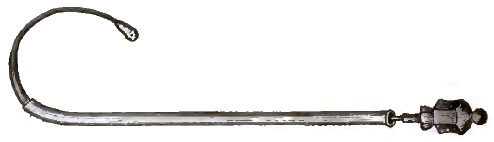
Bellocq's Canula.
The instrument usually relied upon for this purpose is known as Bellocq's canula (Fig. 20). This little instrument consists of a hollow curved tube of metal fashioned somewhat like a Eustachian catheter, and bearing within it a flexible and adjustable metallic band which carries at its extremity an eyelet. Any one who has used the Eustachian catheter will recall the number of instances in which it could not be passed, or if passed the frequency in which great distress followed. If this be true of the Eustachian catheter, it is also true of the Bellocq canula, the difficulty in the case of the catheter, indeed, being the lesser of the two, inasmuch as the physician has a number of sizes to select from. Conceding, however, that the instrument (with a long stout thread passed through the eyelet of the stylet) has been placed in position in the nasal chamber, one end of the thread is seized within the mouth and brought out between the lips, while the other, carried by the instrument, is withdrawn through the nose and is allowed to hang from the nostril. The two ends of the thread are now tied firmly together, and a pledget of lint or cotton, fashioned somewhat after the shape of the posterior naris, is tied to the thread. Traction is now made upon the nasal portion of the thread until the plug is firmly lodged against and within the posterior naris. The remaining portion of the oral thread is now cut off close to the velum, and the free end of the nasal thread secured by adhesive plaster to the integument. The nostril should next be stopped from in front by pledgets of lint or absorbent cotton. The size of the nasal chamber and naso-pharyngeal varies so markedly that a rhinoscopic examination is of use in fixing upon the size of the plug. If it be too small, it will be drawn entirely within the nose, and possibly beyond the bleeding spot. If it be too large, it will partially or entirely occlude the posterior naris of the opposite side, and thus by interfering with nasal respiration greatly increase the distress, or by pressure against the Eustachian fossa and velum interfere with the hearing and with deglutition. The plug should be retained in position until a purulent mucus appears within the nose: this is usually about the third day. The plug now usually becomes a little loose, and can readily be withdrawn by pushing it back into the pharynx, where it is seized with forceps. Too long retention of the plug in position is followed by great fetor and the free formation of muco-pus—conditions which tend to debilitate the patient.
D. Hayes Agnew informs me that he for a long time practised stopping nasal hemorrhage by plugging the chamber from in front. Strips of patent lint four inches long by half an inch wide are employed for this purpose. They are gradually pushed into the chamber until the entire space is filled as far as is practicable. An essentially similar method is described by F. H. Bosworth in his Manual of Diseases of the Throat and Nose.
Morbid Growths.
These may be said to include the myxoma, sarcoma, fibroma, carcinoma, also the true hypertrophies and submucous inflammatory thickening.
The myxoma, more commonly known by the name of soft or gelatinous polyp, is the most prominent of the morbid nasal growths. It occurs ordinarily in small pedunculated seed-like masses, ranging in size from that of a grain of wheat to a grape. The most common seat is on the anterior portion of the middle turbinated bone and on the median surface of the inferior turbinated bone at the palatal portion. Instead of being pedunculated, they may be sessile; that is, each tumor may have a base equal to, if not exceeding, any diameter of the tumor.
The symptoms of nasal polypus are of three kinds: (1) those arising from obstruction of the nasal respiration; (2) those arising from the irritation excited by their presence; (3) the symptoms, reflex in character, manifested at points beyond the limit of the nasal chambers.
(1) The polypi necessarily tend to obstruct the respiratory tract of the nasal chamber. The first symptoms are of this character, and as a rule furnish the first intimation to the patient that trouble exists. Difficulty of nasal respiration is acknowledged, accompanied with a sense of tension and fulness, which is found to be worse during damp weather than when the air is dry and bracing. If the growths are freely pendulous, the act of blowing the nose may change the position of the mass and secure temporary freedom from distress. Incidental to obstruction, an intonation of the voice is often present. Loss of smelling and of taste is a frequent result of the mass interfering with the movement of the odoriferous particles. The loss of the sense of taste is dependent upon the loss of the sense of smelling.
(2) Polypi when large enough to press against the membranes of the nose excite an increased flow of mucus. As a rule, this flows forward, and is removed by the handkerchief. The quantity of fluid thus escaping is often very great. Patients often report the necessity of carrying about with them for a single day's use from eight to ten handkerchiefs. In the turgesence excited by an attack of coryza the mucus becomes thicker and of a yellowish color. Occasionally a sensation of dropping of mucus from the nose into the throat is a source of complaint.
(3) The reflex symptoms belonging to the presence of nasal polypi are, as a rule, referred to the forehead. This is especially the case if the growths involve the middle turbinated bone. When the tumors are so located, and have not impinged upon the respiratory tract, the symptoms of obstruction may be absent, and those of mucus excitement so moderate as not to excite attention, while the tension in the forehead, especially over the frontal bos, is pronounced. This sensation is intensified by prolonged inclination of the head forward, being especially aggravated in the acts of writing at a desk, working at a sewing-machine, kneeling at prayer, etc. Occasionally tinnitus aurium and suffusion of the conjunctivæ are present.
Neglected polypus ends in deformity of the nasal chambers and bones of the face. The face assumes a peculiar expression called by the older observers frog face. This is rarely if ever seen in this country, owing doubtless to the fact that the sufferers from nasal polypus seek medical advice in the early stages of the affection. Moderate degrees, however, of deformation of the turbinated bones are often seen.
Since the symptoms of soft nasal polypus are produced entirely by mechanical means, they can be closely imitated if not replaced by other morbid states of the mucous membrane. A hyperplastic state of the membrane over the middle turbinated bone will give rise to all the symptoms of a sessile polypus in the same situation. It is well to remember that this condition of the membrane often coexists with polypus, and of course will persist after the polypus has been removed. It follows that a guarded prognosis should always be made in case of sessile polypus. A tedious course of treatment of the indurated and chronically inflamed membranes may be required after the tumors have been removed before a cure is effected. The prognosis of soft polypus is more favorable as to the immediate results of treatment than in sessile polypus. The liability to recurrence can be materially lessened by carefully conducted after-treatment.
The diagnosis of soft pedunculated polypus is readily accomplished if the examination is made by aid of an appropriate speculum, the rhinal mirror, and a powerful light. Even without these aids the tumors can be seen by direct sunlight within the nostril if they are entirely occluding the chambers, and even in the event of nothing being visible by such inspection the movement of the masses by the act of blowing the nose will be noticed. The fact that the nasal obstruction is aggravated by damp weather seems to assist the physician in framing a diagnosis.
The diagnosis of sessile polypus requires a careful use of all the aids of rhinoscopy. They can be distinguished from hyperplasia of the mucous membrane by their lobulated form, and from the fact that the probe can move them slightly from their base. They can be distinguished from adenoid growths at the root of the pharynx by the fact that they remain unmoved during the act of swallowing.
The disease is not apt to recur if the treatment is thoroughly carried out.
The treatment of soft polypus consists in their removal. All observers are now agreed on this point. Injection by astringents and acetic acid—a process that at one time held out much promise—has been generally abandoned. In removal of the polypus one of two methods may be resorted to: that by avulsion, and that by the use of the snare. Avulsion is effected by forceps adapted for this special use. With such an instrument the polyps can readily be seized and removed. The rule that nothing should be seized which is not seen is subject to no exception. In no other way can the operator be secure against accidents. Incautious operators have frequently torn away strips of mucous membrane or portions of the turbinated bones in their crude attempts to remove these growths. Severe hemorrhage and death through violent lacerations of the ethmoid bone near the cribriform plate, and subsequent extension of the inflammation thereby excited to the membranes of the brain, have been known to follow these crude surgical procedures.
FIG. 21.
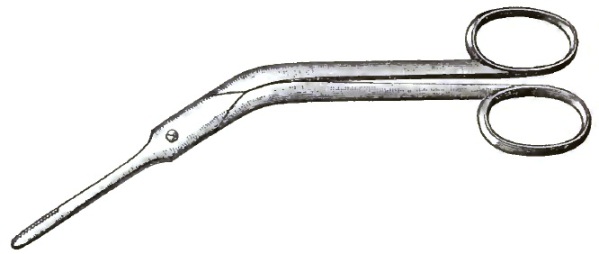
The Author's Nasal Forceps.
W. C. Jarvis of New York has modified the wire snare for application to the nose for the removal of polypi and hypertrophied tissues, and reports that it is a safer, more expeditious, and less painful method of operation than the forceps, which he unqualifiedly condemns. His instrument, while undoubtedly an ingenious adaptation of the principle of the snare, and a valuable addition to our means of treating nasal affections, cannot, in my judgment, take the place of the forceps in removing nasal polypi. As the aurist finds both the forceps and the snare useful in removing growths from the external meatus of the ear, so I am sure the physician will need both in the treatment of nasal polypi. In many cases the malformations of the nasal septum are such that I have been unable to use the snare where the forceps could be used with relative ease. I find when the loop is quickly drawn the same amount of bleeding follows as when the forceps are used. When it is slowly drawn, the sitting is tedious, and both the patient and attendant find the process wearying. The amount of blood lost when the forceps are properly used is not considerable, and is always under control. F. H. Bosworth1 describes the operation as extremely painful. So far from this being the case in my experience, I find the patients complain greatly of the constriction of the wire loop on the pedicle of the polypus, and invariably prefer the forceps. I must add that this preference was in no way influenced by myself, for I was disposed at one time to agree with the writers who have of late criticised the method of removal of the polyps by avulsion.
1 A Manual of Diseases of the Throat and Nose, 1881, p. 241.
No matter which of the methods be accepted, the treatment of polypus resolves itself into two simple propositions. When one or two large polypi are present in a capacious nasal chamber, the removal of the growths either by avulsion or snaring is a simple matter, and can often be accomplished in a single sitting. When numbers of small polypi are scattered over a large surface, particularly if they grow from the sides of the middle turbinated bone, the treatment is tedious, and even after the growths are removed a series of applications are required to cure the thickened and infiltrated mucous membrane.
Sarcoma, fibroma, and carcinoma are infrequent causes of nasal disease. When located in the nasal chambers they do not present any characters with which I am familiar which distinguish them from the expressions they assume in other parts of the body. When involving the respiratory tract they alike create symptoms by obstruction, by excitement of the secretions, and by the reflexes due to the involvement of the branches of the fifth pair of nerves. When situated in the olfactory track the obstruction to nasal respiration is absent, but the reflex symptoms are pronounced: the patient is liable to depression of spirits and to frontal headache. Encroachment upon the orbital, pharyngeal, and encranial spaces is common in the last stages.
Perhaps the most common way in which these morbid growths induce symptoms referable to the nose is by obstruction of the respiratory tract by the incursions of a mass originating at a point beyond the limits of the nasal chambers. In this way a growth in the pharynx may close one or both choanæ, or protrude into the nose from the spheni-palatine space by breaking down the ascending plate of the palatal bone as it forms the median wall of this space; or the growth may project inward from the superior maxilla.
In one case under my care, of obscure growth high up within the nose, which ended fatally by involvement of the membranes of the brain, a tenacious mucus of a dark chocolate color was withdrawn from the nose into the throat. The peculiar color of the mucus was found to be caused by a mixture of blood. In my judgment, this peculiar mixture of blood and pus was significant. The blood and mucus had not been mixed in the nasal chamber to cause the chocolate or rusty hue, for then we would have had the appearance customary in epistaxis of bright blood and frothy mucus mechanically held together. The even dissemination of the blood through the mucus would point to the conclusion that the blood had escaped in small quantity at the time of the formation of the mucus. Why such mucus does not constantly form in inflammatory states of the mucous membrane of the nose, as it does from the pulmonary mucous membrane in pneumonia, I am not prepared to say. But existing as it did in a case where a deep-seated disease was present may be accepted as a fact in some way connected with the invasion of a morbid growth in and upon the nasal mucous surface.
The pharynx is always in a state of hyperæmia when morbid growths of the above groups are present in the nose. The front of the velum is apt to be covered with a great number of minute papillæ, which, however, are often seen in anæmic individuals, and are not therefore pathognomonic.
The treatment of the growths enumerated and the general conduct of the cases are subjects for the general surgeon, and a consideration of them here would be out of place.
It may, however, be well to describe a few instruments which have been found useful in the large group of cases where cauterization is the principal treatment indicated. Foremost among these is the instrument shown in Fig. 22, which combines advantageously the essential features of the galvano-cautery and the wire snare.
FIG. 22.
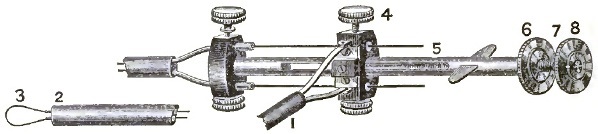
The Galvano-cautery Snare described in the text: 1, the cable of the battery; 2, the canula (which is not shown in full length); 3, the platinum wire; 4, the vulcanite carriage, with screws holding the ends of the platinum wire in metallic contact with the hinge-connections, by which the current is transmitted from the battery; 5, a slotted barrel of aluminium; 6, a movable nut on the screw; 7, a small portion of the screw disengaged from the slotted barrel; 8, milled stationary screw-head.
FIG. 23.
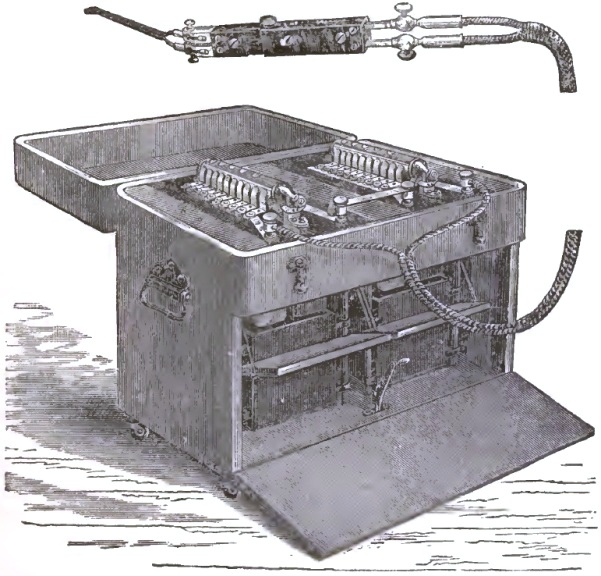
The Double Battery employed by the Author: The two sets of plates are seen united by a flat band of metal. The case which encloses the two separate batteries opens in front, displaying the cells, the plates (which are seen pendent over the cells), and the treadle. Above the figure of the battery lies a figure of the Flemming electrode handle and the electrode in position.
It is well known that a loop of wire which is steadily narrowed has great power in severing the attachment of tumors and other outgrowths. When of a large size, it may be sufficiently powerful to pass through bony structures, as well as the softer parts of the body. The principle of the snare has been employed both in the throat, the ear, and the nose; but when my attention was first directed to this subject the forms available were too large and heavy for the delicacy of manipulation demanded in removing small tumors lodged in the narrower recesses of the nose. Moreover, no snare that I could then find would permit the galvanic current to pass through the loop at the time it was being narrowed. I was led, therefore, to inquire into the practicability of an instrument which would at once be light, be of small size, and yet be sufficiently powerful to remove that class of hypertrophied tissues and polypoid growths which are of such frequent occurrence in the nasal chambers. The instrument shown in Fig. 22 combines these qualifications, and satisfactorily performs the service for which it was designed. The only feature of an essential character which may be said to be novel is the fact that the platinum wire (3, Fig. 22) forming the snare is covered with a uniform coat of copper, excepting alone the portion forming the loop, which is bare. As a consequence of this arrangement the current of electricity from the battery is conducted through a double canula (2, Fig. 22) by means of the copper. The length of the instrument being about 9½ inches, and its weight less than ½ ounce, delicacy of manipulation is not interfered with. Besides possessing all the features of the cold wire snare, it has the additional advantage of securing a more rapid and painless operation, without any hemorrhage. Sessile (pyramidal) or resilient growths may be removed by first burning a groove of any depth into them, after which the loop is drawn while the current is passing through it. For this task the cold wire snare is obviously incompetent. Growths of unusual size or hardness may be destroyed by the same procedure, and nodules no larger than a grain of wheat may also be excised with great nicety. It will be seen that failure to remove at least a portion of the growth attacked is an event exceedingly unlikely to occur. I have been particularly struck with the facility with which hypertrophies of the inferior turbinated bone can in this way be treated; and if cocaine be freely applied before the operation, it constitutes, in my judgment, the most speedy and the least painful of any means by which such conditions can be reduced. By using a canula with a curved end it is easy to snare growths situated on the posterior portion of the inferior turbinated bone. The current passing through the battery (Fig. 23, B) to the instrument can be interrupted by any of the numerous devices with which the practical electrician is familiar; or the treadle of the battery can be depressed and locked by the lever-catch, and the interruption of the current be determined by the pressure of the finger on the knob in the handle (Fig. 23, A). This is under all circumstances desirable, since the weight of the cells is sufficient to demand considerable force to be exerted by the foot—always enough to destroy the delicacy of the manipulation of the instrument.
FIG. 24.
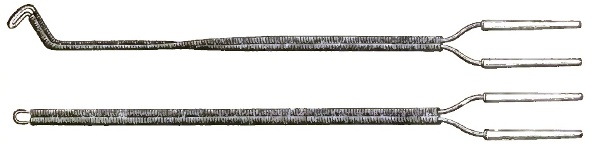
Two Electrodes of peculiar shape in use by the Author.
An electrode which is wrapped nearly to its distal end (Fig. 24), and used either in a straight or a curved form, is of great advantage in reaching growths within the naso-pharynx. The straight form can be thrust directly back through the nasal chamber, and the curved form can be passed from the oro-pharynx to the naso-pharynx without danger of burning the posterior border of the soft palate.
NEUROSES OF THE LARYNX.
BY HOSMER A. JOHNSON, M.D., LL.D.
DEFINITION.—Disorders of sensation or motion, or of both sensation and motion, due to disease, first, of the centres from which the nerves of the organ are derived; second, to disease along the track of the nerves; third, to disease in the terminal distribution of the nerves; fourth, to reflected irritation from neighboring or distant parts; and fifth, to myopathic change. This last condition is not necessarily a neurosis; it is nevertheless a cause of modification of the function of the parts to which the nerves are distributed, often a result of paresis or paralysis, and therefore inseparably associated with the neuroses of the organ. Disorders of innervation, depending upon structural disease of the larynx, such as ulceration or tumor, are not included in this definition.
ANATOMICO-PHYSIOLOGICAL CONSIDERATIONS.—The framework of the larynx consists of cartilages securely but rather loosely articulated with each other. The movements of these cartilages produce changes in the position and tension of the soft parts. The thyro-cricoid articulation allows ginglymoid and sliding motion; the aryteno-cricoid, rotatory and sliding motion; the hyo-thyroid, ginglymoid motion. The physiology of the muscles of the larynx is quite complex, since nearly all have fibres taking a number of different directions, and the changes in the form and positions of the parts depend upon the combined action of different muscles and parts of muscles which may be individually brought into action to produce the required results. The muscles may, however, be roughly divided into groups: 1. Constrictors of the superior strait; 2. Dilators of the superior strait; 3. Adductors of the vocal cords; 4. Tensors of the vocal cords, external, internal; 5. Relaxers of the vocal cords; 6. Abductors of the vocal cords.
The superior strait of the larynx is closed by the action of the oblique portions of the arytenoideus, acting in conjunction with the ary-epiglottici, into which some of its fibres are continued, thus drawing the cartilages of Santorini downward and inward and approximating the ary-epiglottic folds and depressing the epiglottis; while the thyro-epiglottici complete the closure by further depressing the epiglottis. Fibres of the latter muscle, acting alone, may dilate the superior strait by drawing apart the ary-epiglottic folds.
The transverse portion of the arytenoideus and the superior fibres of the crico-arytenoidei postici approximate the arytenoid cartilages. The crico-arytenoidei laterales, and also in a slight degree the external fibres of the thyro-arytenoidei, rotate these cartilages, turning their vocal processes inward: the action of the latter two muscles as adductors is imperfect unless the arytenoids are drawn backward and fixed by the arytenoidei postici.
The tensor group comprises a number both of the extrinsic and intrinsic muscles of the larynx. The crico-arytenoidei postici draw the arytenoids back, external rotation, and consequent abduction, being prevented by other muscles. The anterior fibres of the crico-thyroid and those fibres of the sterno-thyroid inserted anterior to the crico-thyroid articulation approximate the cricoid and thyroid cartilages, and thus tighten the vocal bands. The posterior fibres of the crico-thyroid slide the thyroid upon the cricoid, lengthening the antero-posterior diameter of the larynx. This muscle, acting as a whole, also compresses the alæ of the thyroid with the same effect. The constrictors of the pharynx have a similar function. The hyo-thyroidei, acting in conjunction with the elevators of the hyoid bone, draw the thyroid forward and tilt it downward upon the cricoid. The form and internal tension of the vocal bands are greatly influenced by the thyro-arytenoidei, especially their inner fibres, while the ascending fibres of the muscle draw the inferior portions of the vocal bands upward and prevent the sagging of their edges. This muscle, acting alone, has been thought to cause extreme relaxation of the vocal bands. Modern research renders this statement of relaxation doubtful. The contraction of those fibres of the sterno-thyroidei inserted posteriorly to the crico-thyroid articulation tilts the thyroid upward, and thus relaxes the tension of the bands.
The crico-arytenoidei postici rotate the arytenoid cartilages outward, separating the vocal processes, and, acting in conjunction with the posterior fibres of the crico-arytenoidei laterales, draw the cartilages outward and downward.
In the cadaveric condition, which is one of relaxation of all the laryngeal muscles, the glottis is neither closed nor widely open; the epiglottis is erect against the dorsum of the tongue; the arytenoid cartilages are slightly separated, so that the glottic opening is a triangle with the base posteriorly, as in the act of inspiration, but the separation is much less than in the act of breathing. This condition is met with in paralysis affecting all the muscles of the organ.
The nerves of the larynx are derived from the pneumogastrics. The superior laryngeal is mainly a nerve of sensation for the parts above the edges of the vocal bands. There are some notable exceptions to this statement: a branch, external, descends to the crico-thyroid muscles and is motor in its function. Filaments from the superior laryngeal endowed with motor functions are also distributed to the folds extending from the arytenoids to the epiglottis; these are the ary-epiglottidean bands, and are concerned in the movements of the epiglottis. It is probable that the arytenoids are also in part supplied by the superior laryngeal; in other words, that both the superior and inferior laryngeal nerves are mixed, branches from the spinal accessory, as well as from the pneumogastric proper, entering to each of these nerves. Beclard1 states that the one, the spinal accessory, is a nerve of phonation; the other, the pneumogastric, is a nerve of respiration. The sensations of the mucous surfaces below the glottis depend upon filaments from the pneumogastrics returned along with the motor fibres from the spinal accessory. The two orders of fibres go to make up the recurrents. The relations of the recurrents themselves to the large vessels, as well as to the bronchial glands, are of importance. At the point of their origin they are in close relation with the aorta and right subclavian; they are also in close relation with the top of the lungs. Disease of these organs and structures, especially of the large blood-vessels, such as aneurism of the aorta or subclavian, disease of the glands, tumors, abscess, traumatism, etc., may modify or completely destroy the functions of the laryngeal nerves. In short, anything or any condition by which pressure may be made upon the pneumogastrics or recurrents may become a cause of nervous disturbance in the larynx. In addition to this general source of innervation, Elsberg2 describes a special centre of sensation for the throat in the medulla oblongata. He also describes three kinds of sensibility in the larynx—tactile, dolorous, and reflex. Rossbach3 details experiments from which he concludes that there are nerve-cells in the mucous membrane of the larynx which preside over the function of secretion. The larynx is endowed with at least two kinds of sensibility: the one tactile—when exalted it becomes painful; the other, reflex sensibility, is double. First, there is as a result of excitement a contraction of the subjacent muscle, and there follows closure of the glottis. This is seen in the application of irritants to the parts, such as solutions of nitrate of silver or other escharotics. There is no cough, but great difficulty of inspiration. Expiration is free and easy. There may follow some degree of pain for several hours. It will be seen that the phenomena are the same as those observed in the irritation of other mucous surfaces. The irritation is immediately translated into motion; this motion is probably reflex, but not necessarily through the centres, such as the brain or cord. The motion is of the subjacent muscles. Second, the mechanical irritation produced by the presence of a drop of water or a morsel of food in the larynx results in violent and explosive cough. The cough persists until the offending drop or body has been removed. This kind of sensibility calls into action distant muscles. There is no spasm of the adductors of the glottis, as in the case of the application of caustics. It is probable that the filaments of the nerves, the irritation of which gives rise to spasm, are distributed more generally than those which preside over reflex action at a distance and produce cough. The one set of functions are designed probably to protect the organ from the intrusion of foreign bodies; the other for their expulsion, as well as for the removal of the secretions of the parts or of matter brought up from below. The hypothesis of a third form of sensibility, as described by Elsberg—namely, the dolorous—seems hardly to be demanded for the larynx more than for all other mucous surfaces subject to pain. The nerve-cells of Rossbach in the mucous membrane may be peculiar to the larynx and trachea, as he claims, but further observations are required for the demonstration of this as a special histological fact distinguishing laryngeal from other mucous surfaces.
1 Dic. Eng. des Sci. med.
2 Int. Med. Cong., 1881.
3 Ibid.
PERVERSION OF SENSATION OF THE LARYNX.
There is some difficulty in grouping the derangements of the sensibility of the larynx, for the reason that in many cases the perversion of this function is only a symptom of some other disease of the organ. Probably in all cases the trouble is, in fact, an expression either of disturbance in the structures of the larynx, involving more than the sensory nerves, or it is the result of change in structure or function of neighboring or distant parts. Various attempts have been made to classify these disorders according to the kind of perversion and also according to the cause of the trouble. Elsberg, in a paper presented to the International Congress, London, 1881, p. 224. vol. iii., makes an attempt at a scientific classification based upon anatomico-physiological facts. That there is yet much to learn in regard to these facts, especially the physiological facts, will be admitted by every one at all familiar with the literature of the subject. Elsberg, under the term of dysæsthesia, makes two principal divisions—namely, first, disorders having reference to the quantity or intensity of the sensation; this embraces simple hyperæsthesia and simple anæsthesia. The second grand division relates to the quality of the sensation, and includes only paræsthesia or sensory delusions. These grand divisions are still further subdivided.
In fact, we have to do with exaltation of sensibility simply, with sometimes pain; second, with delusion of sensation; and, third, with lost or diminished sensation. For all practical purposes, therefore, we may adopt this arrangement, but should consider it as only provisional, as has been well observed by Schnitzler. These conditions are described under the terms hyperæsthesia, with or without pain; paræsthesia; anæsthesia.
Hyperæsthesia.
DEFINITION.—Exalted sensibility of the larynx, not necessarily associated with pain or other disorders of function. This condition is rare, but it is nevertheless met with. We sometimes find that the larynx is abnormally sensitive to touch or to an irritant, even though there is no marked inflammation. The symptoms and history justify the consideration of the condition apart.
ETIOLOGY.—Predisposing causes are probably to be found in the general condition of the nervous system. Persons of a highly susceptible nervous organization are, other things being equal, more prone to this affection. Certain habits of life, such as confinement to the house or want of exercise in the open air, excessive use of the voice in singing, especially in unnatural keys or after unnatural methods, have seemed to me to predispose to the exaltation of the sensibility of the organ. It must be confessed, however, that so little is accurately known of the history of the disease that we are left in much doubt as to the rôle of these conditions in the production of the abnormal state. The exciting causes of hyperæsthesia of the larynx are the long-continued action of the predisposing causes—acute and chronic inflammation, mechanical and chemical irritants, etc. So far as my own experience goes, the use of the voice in an unnatural key, or perhaps rather the strain upon the parts by efforts to force the organ to perform the function of phonation in an abnormal manner, has more frequently been assigned by the patient as the cause than any other one thing. I have seen quite a number of singers who have by an effort of the muscles, apparently, produced an intensified irritability of the mucous surfaces. It is possible that in rare instances there may be an exalted activity of the receptive centres, and that the local trouble in the larynx is only a manifestation, in the distribution of the nerves, of the central disease. In such cases, however, the disorder should reach all the parts supplied by the pneumogastrics. Inflammation of the pharynx, soft palate, posterior nares, and perhaps of the structures of the ear, have an influence over the sensibility of the parts below, probably through the relations of the glosso-pharyngeal and other nerves to the laryngeal branches of the pneumogastrics. E. F. Ingals of Chicago has seen a case of laryngeal hyperæsthesia produced apparently by a varicose condition of the vessels about the base of the tongue. Frankel, Tornwaldt, Bayer, Schnitzler, A. H. Smith, Glasgow, and others have reported cases in which there were symptoms of hyperæsthesia or of reflex motor disturbances due to trouble in the nose or pharynx. The general health has much to do with the development of the local trouble. Asthenia is associated so frequently with hyperæsthesia of other parts that we should expect to find this relation also in the larynx.
SYMPTOMS.—The symptoms of hyperæsthesia of the larynx are in part involved in the definition of the affection—exalted susceptibility to the touch, intolerance to the presence of mechanical irritants, a sensation of discomfort in the presence of chemical agents, such as gases or impure air, and, when the exaltation is excessive, positive pain. This pain may be only a soreness or tenderness or it may amount to neuralgia. This last form of exaltation is rare. When present it has been considered a special disease and treated as a separate affection. Von Ziemssen and Mackenzie regard it as a variety of hyperæsthesia. Schnitzler, Jones, Wagner, and Mackenzie report cases. The pain is said to be not confined to the larynx, but to extend up toward the ear and along the course of the superior laryngeal nerve. In two cases observed by the writer the pain not only extended along the course of this nerve, but into the pharynx and posterior nares as well. In these cases the patients were both singers, and both had adopted with great enthusiasm a new method by which the abdominal muscles were brought into action at the expense of the muscles of the thorax. The pain was always aggravated by any effort to sing, but more especially by any return to the method noted. The pain not unfrequently extended to the face as well as to the ear.
Neuralgia of hysterical origin, according to Thaon,4 is more frequently met with on the left side than on the right. Instead of being general, it is not unfrequently limited to points or circumscribed patches.
4 Proceedings Laryng. Cong., Milan.
COURSE AND TERMINATION.—The course of the affection is very uncertain. In the neuralgic variety the pain may be transient, passing away in a few days or hours even, but generally there are frequent recurrences extending through weeks or months. Simple exaltation of the common sensibility is much more persistent and more uniform in its character.
Hyperæsthesia of the larynx is so largely dependent upon the general health that not only is it very irregular in its course and duration, but its termination is equally uncertain. It can hardly be said to be a cause of death, as it does not involve structures necessary to life. It disappears occasionally without treatment. When complicated with other affections, such as acute or chronic inflammation, alterations of the function of the pneumogastrics, with disease of the thoracic viscera or with general derangements of the nervous system, its course and termination must depend largely upon the persistence of these complications.
PATHOLOGY.—So far as the pathology and morbid anatomy have been studied, there is no appreciable change of structure. This is true, of course, only of those cases which are not complicated. Whether the primary lesion is in the mucous membrane, denuding, pinching, or otherwise modifying the terminal portions of the nervous filaments, or whether there is an alteration of the conducting portion of the sensory nerves, or, in fine, whether there is some lesion of the receptive centres, it is impossible in most instances to say. It is probable, however, that in some cases the first morbid fact has been an alteration in the nerves themselves. The cases induced by unnatural methods of using the vocal organs are apparently of this character.
The diagnosis, prognosis, and treatment will be considered in connection with Paræsthesia.
Paræsthesia.
Closely connected with hyperæsthesia of the larynx is a form of sensory delusion consisting of the impression that some foreign substance is lodged in the organ or that there is some alteration an the structure of the parts. This is known as paræsthesia.
ETIOLOGY.—The first variety of sensory delusion depends on a primary injury to the parts. A bone or pin or some other foreign body, perhaps having lodged in the parts for a short time, has left a persistent impression upon the mucous surfaces. It is possible that in some instances there may have been no foreign body in the parts, as we have in many cases only the statement of the patient. Local inflammations, small in extent, may possibly have left the parts in a morbidly sensitive condition justifying on the part of the subject the hypothesis of a foreign body.
The second variety of paræsthesia is the expression of some disturbance in a distant part. It is usually hysterical in its character or a variety of hysteria associated with neurasthenia. It belongs to the same class of phenomena as the sensory delusions in other parts of the body. The globus hystericus is one of its forms. Thaon5 says that hysteria may give rise to neuralgia as well as to other forms of hyperæsthesia of the larynx. It also, according to this author, produces that form of paræsthesia in which there is a sense of a bone or pin or some foreign substance in the larynx. The general condition of asthenia, and especially of neurasthenia, may be assigned as a predisposing cause. The local injury in the one case and the general hyperæsthetic condition in the other, with some determining fact, such as the mental impression or an apprehension of trouble in the larynx, constitute the exciting causes.
5 Proceedings of the International Congress of Laryngology.
SYMPTOMS.—It usually comes on after an injury or as a result of the presence of a mechanical obstruction or irritation, the presence of a bone or pin being frequently invoked as an explanation of the feeling. In a few cases the sensation is suggestive of an alteration of the structure of the parts. Patients are inclined to think that they have a tumor or that there is some deformity. In the first class of cases there is a sense of pricking or of scratching in the larynx. This is not constant in locality or in intensity. There will be times, occasionally days, in which the sensation may be entirely absent, after which it returns with great severity, the patient insisting that the cause of the trouble has simply changed its location—in other words, that there is a migratory body in the throat. That form of paræsthesia in which the sensation is that of a tumor or malformation is also irregular in the mode of its manifestation or kind of disturbance. Like the other forms, it comes and goes, changes its location, and undergoes modification in its character. It may be associated with neuralgia.
DIAGNOSIS.—Hyperæsthesia and paræsthesia are recognized by the symptoms already described and by the aid of the laryngoscope. The mirror reveals the fact that the parts are normal in structure and that there is no foreign body present. The mucous membrane may be hyperæmic or anæmic, but is not the seat of any active inflammation. The excessive sensibility and pain of the larynx in ulceration of the parts will be excluded from this group of troubles by the revelation of the laryngeal mirror. Cases of pain or perverted sensation dependent upon the disorders of the nerve-centres usually involve the whole range of functions supplied by the pneumogastrics, and will generally be recognized by this fact. Such cases can hardly be called local, and do not belong to the group of affections embraced in this article.
PROGNOSIS.—The prognosis of simple paræsthesia of the larynx is not grave. Though it may exist for a long time, it, so far as we know, does not terminate in death. While it sometimes results in recovery without treatment, it in a large proportion of cases yields only to both local and general treatment. Its duration is uncertain. Paræsthesia coming on after the presence of a foreign body in the organ may last many months and then gradually disappear. This result will be largely aided by the moral support which is gained if we can convince the patient that the sensation is entirely a delusion.
TREATMENT.—For the purpose of meeting local indications in hyperæsthesia we may apply with a brush or by the means of the atomizer a solution of morphine and alum of the strength of 15 centigrammes of morphine and 2 grammes of alum to 50 grammes of water, or to this may be added 20 centigrammes of carbolic acid and 10 grammes of glycerin. Of this solution an application may be made each day with the hand-atomizer. The hand-atomizer is preferable to the steam-atomizer, for the reason that we know in the use of the former the strength of the solution. In the use of the steam-atomizer the medicated solution is diluted with the water of the steam, and we are ignorant as to the strength of the application. The method of application by the use of the atomizer is to be preferred to the brush or sponge probang, for the reason that we produce by it no mechanical irritation of the parts. The brush or sponge can hardly be used without giving pain or discomfort. In addition to the solution above indicated, solutions of borax, of sulphate of zinc, of tannin and glycerin with chloroform, of nitrate of silver not too concentrated—2 to 10 centigrammes to 30 grammes of distilled water—tincture of aconite, solutions of the bromides, cocaine and other anæsthetics, may be used with benefit. In many cases the administration of general tonics along with the local treatment will be of the greatest value. The application of electricity to the parts through the surfaces—that is, from one side of the larynx to the other—will add to the efficacy of other local treatment. The strength of the current should not be so great as to give rise to any discomfort. The current should be continuous, and should be repeated every day for several weeks if the disorder does not yield sooner. In cases which have been induced by vicious habits of living or of exercise of the organ there should of course be an entire change of the habits. The producing cause should, if possible, be removed. The exposure of the parts to anything which gives rise to pain is to be avoided. If hyperæsthesia has been induced by unnatural methods of singing or of speaking, these should be remedied.
In neuralgia the general treatment for that affection is indicated. Quinine and iron have especially been found useful. In the hysterical variety of both hyperæsthesia and paræsthesia general treatment is of more value than local measures. General tonics, moral support, such as will be secured if we can convince the patient that there is really no serious trouble with the organ, but that it is only a morbid sensation, will be of the greatest value. In these cases change of climate, change of occupation, diversion by new associations, with expectation of recovery on the part of the patient, often bring about the most satisfactory results. The diagnosis should be certain and the physician should be able to speak with confidence in the matter. This will go far toward effecting a cure. For the purpose of diminishing the general irritability of the system bromine in some of its combinations, potassium, sodium, iron, quinine, etc., may be useful.
Anæsthesia.
DEFINITION.—Diminished sensibility of the mucous surfaces dependent upon lesion of the nerve-centres, alteration of the conductivity of the nerve-trunks, or upon disease in their terminal distributions. It is usually bilateral, but may be limited to one side. This alteration of the sensitive condition of the mucous membranes is usually observed after diphtheria. It is also met with in bulbar paralysis. In this last condition it is only one of the phenomena of paresis or paralysis involving several different organs. It is not, therefore, properly a disease of the larynx, and the consideration of it will not be embraced in this article. It has been stated that hysteria is frequently accompanied with anæsthesia of the larynx. Von Ziemssen, Chairou, and Schnitzler have published cases. It seems very improbable that this condition of the organ is so generally present in hysteria as is claimed by Chairou. It is, however, certain that anæsthesia as well as hyperæsthesia of the larynx exists as a complication of hysteria. In the later stages of all exhaustive diseases, as cholera, etc., the sensibility of this organ is either diminished or abolished. This is not, however, a true paralysis in the sense in which we generally use the term. It is only one of the manifestations of the general failure of the life-forces. The special senses, the reflex functions, all share in this paresis, this severing of the relationships of life. Anæsthesia of the larynx is usually confined to the parts supplied by the superior laryngeal nerves, and is sharply limited by the edges of the vocal bands. If there is anæsthesia of the parts below these bands, it is of much less significance and hardly requires our consideration.
ETIOLOGY.—So far as we know, there are no predisposing causes. The chief exciting cause of this affection is unquestionably diphtheria. It is, in fact, a sequel of diphtheria. It will hardly be necessary to repeat here what the reader will find fully discussed in the sections devoted to diphtheritic inflammation of the fauces and adjacent parts: we are mainly concerned with the phenomena. Just how this morbid process produces paralysis is not known. It is believed by some observers that the disease is produced by the alteration of the nutrition of the parts during the progress of the diphtheria. It is stated that the parts most nearly related to the seat of the exudation are most likely to become involved. This is thought to sustain the theory of the direct propagation of the morbid changes from the mucous surfaces to the nerves and muscles. That the paralysis following diphtheria is not, however, produced alone in this manner seems to be made evident by the fact that distant parts, parts which have not been at all involved in the disease, do nevertheless become affected with paralysis. This paralysis develops when the general health and the nutritive changes are all improving. It is quite evident, therefore, that the loss of power in the laryngeal muscles, as well as the altered sensibility, in part at least, must be due to some lesion of the nerve-centres. In addition to the causes above noted, anything which impairs or destroys the function of the superior laryngeal nerve may produce this affection. In the anæsthesia from hysteria we know only the fact, but do not know just how the derangements of the nerves in a distant part, or in the nerve-centres perhaps, are so reflected as to change the function of this organ. The hyperæsthesias, the paræsthesias, and the anæsthesias of hysterical character are all probably produced in the same manner. Anæsthesia in bulbar paralysis is easily understood, but need not, for the reasons already given, engage our attention.
SYMPTOMS.—This condition is usually associated with paresis or paralysis of the muscles of the part. One of the first symptoms of loss of sensibility is, therefore, a failure of the constrictors of the larynx to protect the organ from the intrusion of foreign substances in the form of food and drink. Particles swallowed find entrance into the respiratory tube, and this with no sense of discomfort. If the paralysis is complete both above and below the glottis, the intrusion of these substances is not recognized. There may be no cough or spasm to indicate the fact. In the mean time, the particles of food descend into the bronchi, and may become the exciting causes of broncho-pneumonia. It is often noticed after tracheotomy for diphtheria that food and drinks gaining access to the respiratory tract are discovered at the tracheal opening. In several cases within the knowledge of the writer this fact has led the operator to fear that the posterior wall of the trachea had been opened. In all cases in which the pharynx is in a state of paresis a careful examination should be made by means of the laryngeal mirror.
There are no subjective symptoms, and this fact makes it probable that the affection is more common than has been supposed. The patient complains neither of pain nor of any other discomfort. This statement is only true, however, when there is simple loss of sensation. There may be paræsthesia associated with partial anæsthesia. In such cases there will be noted the usual symptoms of paræsthesia. In hysterical forms of anæsthesia the appearance of the parts is often variable from day to day. The location of the disordered function is well defined at the time of one examination, while at the next the condition may be quite different. It is stated by Thaon6 that in one-sixth of the cases of hysteria the larynx is in some way affected. The epiglottis is more usually the seat of the affection in the hysterical variety. Several authors have noted that with the laryngeal disorder there is often a zone of modified sensation beneath the chin and on each side of the larynx. This sometimes amounts to absolute loss of cutaneous sensibility.
6 Loc. cit.
COURSE AND TERMINATION.—According to Mackenzie, Von Ziemssen, and others, the anæsthesias following diphtheria usually terminate in recovery. It is quite possible, however, that the literature of the subject does not give us elements on which to base an opinion. I am inclined to think that cases die from this disorder in which the nature of the affection is never recognized. It is quite certain that paralysis of the fauces is not unattended with danger. It is also probable that in many of these cases the real danger is not so much from the loss of muscular power in the pharynx, and consequent inability to swallow, as from the fact that the larynx is not protected from the introduction of foreign substances, that the intrusion of these substances is not recognized, and the consequent disorders of the lungs become the cause of death more frequently than has been supposed.
DURATION.—Paralysis of the sensory nerves of the larynx usually lasts only a few weeks. When a result of diphtheria it disappears with the motor trouble with which it is associated. As a complication of hysteria, or rather when hysterical in character, it may last indefinitely. When dependent upon changes in the centres from which the pneumogastrics are derived it has a history commensurate with that affection.
The PATHOLOGY AND MORBID ANATOMY have been suggested in the discussion of the cause and symptomatology of the disorder. The question of the local or general changes in the diphtheritic variety is noted in the history of the disease.
The DIAGNOSIS is made mainly by the examination with the laryngoscope. The probe will at once determine the presence or absence of the sensibility of the mucous membrane of the parts. In addition to touch, electricity may be employed. In these cases the alteration involves both the tactile and reflex sensory functions. There will therefore be neither cough nor spasm resulting from a mechanical irritation. The surfaces are usually quite normal in color and form. The epiglottis is erect, abnormally so, and there will often be more or less paresis, or even complete paralysis, of the other muscles of the organ. In some cases the difficulty in deglutition due to derangement of the reflex functions may be also suggestive of alterations of sensation in the parts within the larynx, but it is only a suggestion.
The PROGNOSIS is usually favorable, but for the reasons given above this should be accepted with some degree of reservation. The diphtheritic varieties share in the uncertainty of other forms of paralysis in that disorder. The hysterical forms are not dangerous, but may continue so long as the primary affection persists.
TREATMENT.—This should be both local and general. The local treatment consists almost entirely in the application of electricity. Both the galvanic and faradic currents are recommended. In my own practice I have been accustomed to resort to the galvanic, but modified by the introduction of a shunt or switch, so as to produce a wave of electricity. The manner in which this is accomplished is to connect in the circuit a coil such as that used for the faradic current. This takes out of the direct current, with each closure of the circuit in the coil, a portion of the quantity of the current, and without entirely interrupting the working circuit gives a wave of electricity, producing, so far as I can judge, the results of both the primary and secondary currents. There is not the shock of complete interruption, while there is the stimulus of the irregular quantity. The electrode which will be found most convenient is that devised by Mackenzie or some modification of it. It should be applied through the parts from one side of the larynx to the other by placing the tip or point of the instrument in one of the pyriform sinuses over the superior laryngeal nerve. A double electrode will often answer better, placing one point in one sulcus, while the other is in contact with the mucous membrane of some other part of the organ or in the opposite sinus; that is, on the other side of the larynx. The current then passes through the parts and stimulates all the tissues between the two poles. The application should be made every day, and for several minutes at each sitting, interrupted, of course, as required by the variable condition of the parts. The current should not be so strong as to produce positive pain. This is not easily reached, however, for the reason that the response is slow and uncertain. The strength of the current should be tested upon the normal surfaces of the patient, or, better, upon the mucous membranes of the operator, before applying it to the morbid parts.
In case a reliable tangent galvanometer is used, much more certainty can be reached than when the strength is determined solely by the sense of touch. With this exhibition of electricity there should also be administered such remedies as are best calculated to restore the general strength of the patient—quinia and iron, with the bitter tonics, and especially strychnia in what would be considered large doses (.003–.005 grammes), two or three times a day, with interruptions every few days. In the hysterical cases, as well as those following diphtheria, electricity is often of great value.
Attention should also be given to the proper treatment of any local trouble in the viscera of the abdomen or pelvis. Uterine disease, if present, as it frequently is, demands attention. It is believed by some authorities that the unilateral disorders of the larynx dependent upon ovarian irritation generally manifest themselves upon the side corresponding to the diseased ovary. It is, however, rare to meet with complete unilateral anæsthesia. In addition to the use of these measures, change of surroundings, especially in the hysterical variety, diversion by new associations, new occupations, etc., are to be secured whenever practicable.
DISORDERS OF MOTION.
Disorders of motion are perhaps more complex than those of sensation. They may be divided into two general groups—1st, exalted action; 2d, diminished or arrested action. The first group is susceptible of a subdivision: first, those in which the sensory functions are exalted as well as the motor. In some of these cases the real disturbance is very probably hyperæsthesia rather than increased irritability of the nerves going to the muscles. Generally, however, the morbid phenomena are mixed; the two sets of nerves are both in a state of over-action. Spasm, for instance, may be the result of excessive activity of the sensory function coupled with the exaltation of the motor impulses, or exaggerated irritability. Second, the spasm or exalted activity of the muscles may be entirely independent of sensory impressions, possibly, in some instances, dependent upon muscular conditions, but generally only the local expression of some central nervous trouble. Chorea may be cited as an example. The diminished action of the motor system may also be due to either a want of the sensory common or special impressions; or it may be due to failure of the motor centres or some interruption of the continuity of the conducting media; or, lastly, it may be for the reason that the muscles themselves are so changed that they do not respond to the normal stimuli, such as the commands of the will or reflex impressions. It will be seen from this brief statement that the subject of motor derangements is one of much complexity. From the very nature of the complications it is often impossible to satisfactorily analyze the symptoms and to determine with certainty, in a given case, whether we have to deal with a simple or a compound result. We may, it is true, in some instances arrive at approximately correct conclusions by resorting to the physiological methods of testing the muscle by galvanism and faradism. In other instances we may by a careful study of the history of the disease reach at least a provisional opinion. We must, after all, admit that much will in many of these derangements remain to be conjectured.
Exalted Action.
There is quite a difference among authorities as to the place in the classification of disease of the larynx which should be assigned to spasm as met with in childhood, and which is also occasionally encountered in adult life. It is not possible, perhaps, in the present state of knowledge, to separate in every instance those cases in which there is disorder of the circulation and nutrition of the larynx from those in which the spasm is the result of disturbance simply of innervation, or in other cases the reflex manifestations of nervous irritation elsewhere. Generally, however, this can be done. I have for a long time been accustomed to consider the affection known as spasmodic croup to be a mild inflammation of the larynx, and that it differs from the same affection in the adult for the reason that the lumen of the tube is smaller, the cartilages are more yielding, and the susceptibility of the parts is greater, and further for the reason that the nervous system in childhood is always more prone to spasm than in the adult. Stridulous laryngitis, however, is a real disease, and is for the reasons above given a neurosis, even though it is an inflammation. It is entitled to a separate description for the reason that the symptoms are so well marked and differ in so many particulars from those of ordinary inflammations. That there is, besides, a true spasm of the muscles of the larynx, independent of inflammation, by which the vocal cords and the constrictors are brought into action and possibly kept in a state of tonic contraction, is possible.
In a majority of instances of laryngeal spasm there is a degree of inflammation, as above stated, or at least a degree of congestion of the mucous membranes. It is certainly true, however, that in exceptional cases there are no indications of such a condition of the parts, so far as we can determine by ante- or post-mortem study. It seems to be evident, then, that under this name of spasm of the larynx or of some synonym of it many careful observers have recorded facts and have grouped them with the thought that the functional derangement was the main trouble. The real difficulty appears to be that the spasm is in fact a symptom—a symptom of perhaps several different disorders, but so prominent and creating so much alarm that it has seemed for the time being to be the disease itself; and yet in most cases there is a mild form of inflammation, local in its extent, and producing, so long as there is no interference with the function of respiration, no general disturbance. It is perhaps appropriate to include in the discussion not only the purely nervous cases, but also those conditions in which, while there is hyperæmia, and probably always some derangement of secretion, nevertheless the symptoms and dangers concern mainly the motility of the muscles of the organ.
The disease occurs both in children and in adults. There is, however, in its etiology, course, and terminations quite a marked difference, as observed before and after puberty. We shall therefore consider, first, spasm of the glottis in children; second, in adults.
Spasm in Children.
SYNONYMS.—Laryngismus stridulus, False croup, etc.
ETIOLOGY.—Predisposing Causes.—The disease occurs most frequently in children from a few months to two or three years old. It is occasionally met with in those still older and up to puberty. It seems to be more often encountered in patients of a strumous habit than in those of a healthy constitution. Rickety children are especially liable to the affection: the German pathologists especially insist upon this factor. Patients of a nervous temperament predisposed to general spasms are especially predisposed to this affection in the larynx. It is a general law that muscles weakened either by disease or by fatigue or by deficient nutrition are especially irritable. In them mechanical as well as other forms of stimuli produce local contraction with great readiness. These contractions are, it is true, rather the expression of the condition of the muscles than of the nerves. The muscular condition must, however, be regarded as a predisposing cause of the spasm. In the same way, perhaps—namely, by the inherited tendency to lower forms of vitality, weakened muscular power—we may account for the fact that family history of similar conditions, such as false croup in other members or in the parents, should be considered as among the evidences of predisposing tendencies to spasm of the glottis.
Sex has in this affection, as well as in most laryngeal diseases of children, a predisposing influence. Mackenzie has collected in all, from different sources, 8248 cases. Of these, 5378 were boys and 2870 girls—a proportion of nearly 2 boys to 1 girl. In adults the reverse holds good, females being much more frequently seized than males. It is certain that season has something to do with the development of the disease, but this influence should be regarded rather as a producing than a predisposing cause.
Dentition, worms, weaning, or anything which produces an irritation of the alimentary canal may also, by exciting the reflex irritability of the nervous system, become predisposing causes of laryngismus. The influence of dentition has, however, been probably over-estimated.
The exciting causes of spasm of the glottis are not well defined. In a few cases we are able to definitely fix upon something as the occasion of the attack. It is possible that there may be some central lesion, and this may be well defined. This is rare, however. It is nevertheless true that the onset is generally preceded by some derangement of the general health. There has been for a day, or perhaps only for an hour or two, a slight cold, a little hyperæmia of the respiratory mucous surfaces, or disturbances of the digestive tract, or the child has been unusually fatigued or excited from play or study. The secretions have in other cases been deranged. No one of these causes has perhaps been of sufficient gravity to attract the attention of the mother or nurse. The indisposition, if it has been noticed at all, has been regarded as only one of the many ephemeral troubles that so often occur in infancy, and no anxiety has been felt. Of all these possible causes, the one most frequently invoked after the attack is a cold, slight, it is true, but nevertheless, in the light of the subsequent history, evidently a mild form of inflammation of the laryngeal mucous membranes.
SYMPTOMS.—Spasm of the glottis usually takes place at night. It is true that some authorities deny that this is the case. Stefen says "that it is quite as likely to occur during the day as night." In a great majority of instances, however, it will be found that the attack occurs after the child has been asleep. During the day there has been perhaps a slight disturbance of the general health, a little inclination to cough, or there has been a catarrh of the fauces or bronchial mucous surfaces; nothing, however, of a serious character has been observed. At midnight or later the little one awakes with a crowing or whistling inspiration. It starts up in bed, and evidently experiences great difficulty in breathing; this difficulty is manifestly in inspiration; expiration is easy and free. The eyes are prominent, the lips blue, the surface often bathed in perspiration; pulse frequent, small, at times irregular; there is, if the child be old enough to reason in the matter, great alarm; there is often cough, and this cough is characteristic: it is a hoarse, metallic, barking, peculiar cough, described as croupy. If the spasm is limited to the larynx, the other muscles not being affected, the patient clutches at whatever it can reach, and often seizes the throat as though there was something there to tear away. The general surface becomes cyanotic and all the symptoms of asphyxia are present. The voice, though not generally extinct, is altered; it becomes hoarse, or husky, as it is called; in a few minutes the severity of the attack is passed, and the little sufferer sinks exhausted into a sleep more or less disturbed. A second attack may occur the same night, or there may be nothing more to alarm the attendants till the next night. The second attack, if it occurs, as it generally does, on the succeeding night, is less severe than the first; the third still more mild; and this generally ends the case for the time being. During the intervals—that is, during the day—the patient in a majority of cases is up, and seems to be but slightly affected by the seizure of the night before. There will perhaps be a slight cough, with some loss of appetite and indisposition to engage in play. This is the most usual type of the disease. In a few cases there is more marked derangement of the general health. The spasms are more severe; the cramp is not confined to the laryngeal muscles, but involves other parts, such as the muscles of the chest and the extremities. During the intervals of the attack there is perhaps a little fever, the digestive tract is disordered, the cough may be marked during the day, there may be an increase in the secretions of the respiratory surfaces. Attacks may recur during the day and for several days; the cough may retain its croupy character, and the voice may continue to be hoarse.
COURSE AND DURATION.—Spasm of the larynx is usually a transient phenomenon, lasting only from a few seconds in the milder cases to several minutes in the more severe forms of the disease. The attacks are intermittent. The seizures are relieved by intervals of comparative relaxation of the muscles of the parts. Even in the intervals there is, however, a degree of contraction of the constrictors, so that the relief is not absolute. Two or three days elapse before the attack may be said to have entirely ceased. In the severer forms the consequences of the spasm may continue even for a still longer time. There are usually no sequelæ. When the patient has recovered there is nothing left of the disease, though there is often a predisposition to a recurrence; the same causes that produced the first attack, or even slighter causes, may produce a second. These causes are generally persistent; the seizures are therefore usually repeated.
PATHOLOGY.—In cases dependent on central disease the pathological changes are to be sought for outside of the larynx. In rickets and other morbid conditions which by reflection produce spasm of the glottis the pathology proper is distant and not in the organ; there is only an excess of motility in the nerves and muscular apparatus. Efforts have been made to differentiate spasm and false croup, but the confusion is only equalled by the disagreement as to the relation of diphtheria to true croup. It is probably true that the cramp is generally due to some excess of motility in the system at large, and that the larynx is the seat of pathological changes that determine the spasm in that organ. This is especially true in those cases associated with rickets, derangement of the alimentary canal, etc. It seems to be a fact, nevertheless, that in a majority of cases the mucous membranes are, as already stated, the seat of a very mild inflammation. Or perhaps we should say they are slightly hyperæmic. So far as we can judge from examination in cases which have terminated fatally, as well as from ante-mortem observation, there is no structural change of tissue to be recognized by the naked eye, unless it be, during life, a slight fulness of the vessels. There is a change, however, in the form of the organ, at least at the entrance to the larynx. The constrictors are in a state of action, so as to partly close the superior opening to the larynx, and the epiglottis is rolled so as, in some instances, to become almost a tube. I have repeatedly recognized this in the image seen in the laryngeal mirror. Cohn reports a case of impaction even of the epiglottis in the vestibule of the larynx (p. 627). This fact is also suggested by the difficult inspiration and the altered voice and cough. In young children the yielding character of the cartilages probably adds largely to the obstruction produced by spasm of the muscles about the vestibule.
DIAGNOSIS.—The diseases with which spasm of the larynx is most likely to be confounded are true croup, simple inflammation of the larynx, foreign bodies in the larynx, and possibly, in the absence of the history of the case, tumor situated in the glottis or along the vocal cords.
It will readily be distinguished from true croup by the fact that in the one case, true croup, the attack is insidious: the patient has been sick some time, usually several days before spasm occurs; there is also fever, with usually more cough; the voice is altered before the appearance of spasm; the first seizure is slight, almost imperceptible, and the subsequent attacks become more and more severe; dyspnoea is continuous. All these facts are in marked contrast with the picture of an attack of spasm of the glottis as we have attempted to describe it. In the one case the most alarming symptoms are at the beginning. There is an explosion of morbid phenomena, each recurrence less alarming till complete convalescence is established. In the other disease the symptoms and dangers are constantly increasing in severity, till at last the spasms become as fearful as the initial seizure in laryngismus. The morbid anatomy of the two diseases is also widely different; and this difference can be recognized during life. Simple ordinary inflammation of the larynx may give rise to hoarseness and cough; the hoarseness is, however, different from that in laryngismus. There is fever, and the hyperæmia of the organ can be readily recognized. The disease is progressive, does not present its most alarming symptoms at the beginning, and spasm, if it occurs, is a late event.
It is possible that spasm of the larynx might be mistaken for a foreign body in the organ. It will be remembered that the attacks of spasm usually occur at night after the child has been asleep. The history of foreign bodies in the larynx reveals what we should expect—namely, that the accident almost always occurs during the day. In a great majority of cases this history also furnishes reliable information of some substance or object which was in possession of the child, and which has disappeared. The dyspnoea is more continuous and the course and symptoms more variable. There will therefore be no great difficulty in any case, and in most cases no difficulty at all, in making a certain diagnosis as between these two conditions. In a few cases of laryngeal tumor the symptoms are very similar to those of the disease under consideration. The attacks in the case of a pedunculated tumor on the vocal cords may take place at night and may be intermittent. The rarity of this affection in children in comparison with spasm of the larynx, and the further fact that in the case of tumor there is a more continuous disturbance of respiration, make the differentiation easy. Paralysis of the adductors gives rise to more dyspnoea during sleep, but the history and laryngeal mirror make the diagnosis easy and certain.
PROGNOSIS.—The large majority of cases of spasm of the larynx recover. Statistics show that there are deaths from this disease, but in proportion to the number attacked I think the mortality is small; how small we do not know. The confusion in classification is so great that we cannot place much dependence upon published statistics. In our climate I think most observers will admit that a patient seldom dies from this affection unless there be associated with it some morbid condition of a serious nature.
TREATMENT.—The immediate and pressing indication in spasm of the larynx is for something to relax the constrictors and allow the act of inspiration to be accomplished without embarrassment. For the accomplishment of this purpose three methods of treatment may be resorted to: First, heat; second, emetics if there be time; third, anæsthetics and antispasmodics. Of all these measures, the first is the most easily applied, and will probably in a great majority of cases prove efficient. It is usually within the reach of the attendant or nurse. It can in any event do no harm. This fact is not to be overlooked, as the symptoms are so alarming that friends and physicians are often tempted to do too much. Heat may be applied by means of cloths dipped in hot water (110° F., or even more) applied to the neck and chest of the patient, or the child may be placed in a bath of 105° F., while the head is kept cool by cloths wet with cold water. This treatment may be continued till the spasms yield. The second of the measures suggested is usually safe, and may be resorted to along with the first. Those agents should be selected which act with most promptness, and the doses should be adapted to the age and condition of the patient. Alum, sulphate of zinc, sulphate of copper, are perhaps the best, but by no means the only ones. Ipecacuanha, by the relaxing effect which it has upon the muscular and nervous system, may be useful not only in overcoming the spasm, but in preventing the recurrence of the attack. Antimony is unsafe, and the other emetics are quite as useful in relaxing the muscles. The third of the measures suggested should be used with great caution. It may be doubtful whether, in fact, anæsthesia is ever indicated in simple spasm of the muscles of the larynx. The dyspnoea renders it very difficult to produce full anæsthesia, and without this the relaxing effect is not reached. In cases in which there is serious disease outside of the larynx there should be appropriate treatment directed to the extrinsic trouble. During the intermission—that is, during the day following the spasm—attention should be directed to the condition of the digestive and excreting organs as well as to the respiratory tract. In malarial districts I have thought that quinia given in antiperiodic doses the morning after the seizure has been of benefit in preventing or diminishing the severity of the next spasm. In addition to these measures, for the prevention of the subsequent attacks bromide of potassium or bromide of sodium in 3 to 5 grain doses may be given once in three to six hours after the spasm has ceased. Five grains of chloral, as advised by Mackenzie, given at bedtime the night after the attack, will also diminish in a certain number of cases the severity of subsequent seizures, or possibly entirely prevent them. Musk, myrrh, camphor, castor, and other similar antispasmodics are theoretically indicated, but, in fact, are of but little if any value. If the disease is central, involving the floor of the fourth ventricle, the local and general spasms are only symptoms, and the treatment must be directed entirely to the preservation of life. It should be remembered in this connection that in the floor of the fourth ventricle the pneumogastric and the glosso-pharyngeal, as well as filaments of the spinal accessory, have their origin. The range of distribution of these nerves marks to some extent the range of the morbid phenomena in disease of central origin. It may of course be true in any given case that only a small portion of the central gray matter is involved, but as a rule the organic change in one of the nerves at the point of origin does give rise to disorder of function of one or both of the others.