Volume 3 — DISEASES OF THE RESPIRATORY SYSTEM. (continued 12)
Reading edition
The puerperal state does not seem to increase the predisposition, but pneumonia is more apt to occur at the time of the catamenia.
The general condition of the individual at and before the pneumonic seizure seems to have some predisposing influence, although opinion is divided as to whether the strong and robust or the feeble and sickly are the more predisposed to it. Those who are convalescing from acute and severe illnesses, those who are habitual alcohol-drinkers, and those who are under the influence of malarial poison are far more liable to pneumonia than those who are free from such taints. Enervating habits, poverty, antihygienic surroundings and dyscrasiæ (especially cancerous), and chronic nervous diseases act as predisposing causes. Difficult dentition in children seems to act in a similar manner. Diphtheria, erysipelas, measles, small-pox, and other acute infectious diseases must be ranked as causes predisposing to pneumonia.
Chronic and acute uræmia, pyæmia, septicæmia, and all that class of diseases which depend upon the retention of excrementitious substances in the blood, are also powerful predisposing causes. It is also of frequent occurrence in chronic blood diseases, such as chronic alcoholismus. Suppuration in the abdominal cavity, which opens into the thorax, may lead to a pneumonia. Long-continued, passive pulmonary hyperæmia from any cause becomes a predisposing cause to pneumonia. The pneumonia which frequently occurs during acute articular rheumatism has been regarded by some as metastatic from the joints; but the more reasonable explanation is that the blood-changes in rheumatism predispose to pneumonia.
One attack predisposes to others; as many as twenty-eight attacks have been noted in the same individual, the time between the attacks and the number of them being governed by no rule and subject to the widest variations.
When pneumonia follows a severe blow or injury to the chest or shock from any traumatic cause, the injury (or the shock) must be regarded as a predisposing cause. It is noteworthy to observe how often in the aged fracture of the hip-joint is followed by pneumonia. Within four hours after this injury croupous pneumonia has been established.
The influence of prolonged exposure to intense cold and sudden chilling of the surface of the body as a predisposing cause of pneumonia is still undetermined. Cold does not markedly affect the pneumonia-rate, except in the very old. Nearly nine-tenths of the cases of senile pneumonia occur between November and May. The January and February statistics seldom exhibit the highest pneumonia-rate, as they would were there any direct relationship between pneumonia and cold. In elevated regions north-east winds favor the development of pneumonia, and it is most prevalent in any locality during those periods of the year when there are the greatest extremes of temperature. A continuously low or a continuously high temperature has much less influence in its production than great vicissitudes of temperature. In New York City early spring and winter seem to be the periods when it is most prevalent.
A glance at its etiology shows that it is a disease to which all things predispose that depress the general vitality: this is evidenced by the fact that children and old people are greatly depressed by the intense cold of winter and the chilling winds of March and April. Almost unknown in the polar regions, pneumonia is not an infrequent disease along the Mediterranean coast; and one peculiarity is to be noted here, that in cold as well as in warm climates moderate elevation above the sea-level predisposes to its occurrence.
Rainy seasons or moist districts do not influence the pneumonia-rate to any appreciable degree. Both these conditions have a direct effect in increasing the prevalence of bronchial catarrh, but they do not increase the pneumonia-rate.
The well-established facts that pneumonia occurs oftener among the poor than the wealthy; in the sailor when on shore oftener than when he is on shipboard; in soldiers oftener than among civilians at the same military post,—these are explained on the ground of better hygienic surroundings, better mode of life, nourishment, etc., of the one class as compared with the other. And in studying the predisposing causes of pneumonia one is led more and more to observe that it is the more liable to occur the less resistance individuals are able to offer to some (as yet unknown) specific pneumonic influence, and that depressing influences of whatever kind unquestionably predispose to croupous pneumonia.
The more dense the population in a district, the greater the pneumonia-rate. Hirsch says: "The amount of the mean fluctuation in the mortality from pneumonia is in inverse ratio to the density of the population." When a city has attained a certain size, wind, weather, seasons, and races have but a slight influence in varying the pneumonia-rate. Thus, in New York City from 1840 to 1858 (eighteen years) the mortality from pneumonia was 5.85 per cent., while from 1859 to 1877, inclusive, it was 6.2 per cent.
Before considering the exciting causes of croupous pneumonia, or their relation to its predisposing causes, the question meets us, Is croupous pneumonia an acute specific constitutional (infectious) disease or a local inflammation?12
12 Virchow's Archiv, Bd. lxx., Heidenhain.
That it is not a simple local inflammation appears from the following facts: the experiments with the inhalation of hot air, moist warm air, icy-cold air, vapors of various noxious acids and gases;13 the tracheal injection of caustic ammonia14 and mercury; and traumatism,—have all resulted negatively as exciting causes. And these experiments have all the more weight since they have been conducted not only at different times, and in countries distant from each other, but also because they have been repeated by various pathologists, and always with a similar result—viz. the development of lobular or catarrhal, and not of croupous, pneumonia. Section of the vagi certainly produces hepatization of the lungs, but it is not the hepatization of croupous pneumonia. Its distinctive microscopical characteristics are always wanting in the part of the lung consolidated by such experiments. A strong argument of those who adhere to the local theory of pneumonia is, that cold occupies a prominent place in its production. As exposure to cold and to draughts is a common experience, it is easy to ascribe the origin of any disease to cold.
13 Sityl, K. K. Akad. zu Wien, 867, Reitz.
14 Gendrin, Hist. Anat. des Inflam.
"Close rooms and bad air," says Squire, "more predispose than does outdoor exposure, unless that be prolonged or the individual resistance weakened by fatigue or intemperance." Both wet and cold invariably heighten the bronchitis-rate and exacerbate catarrhal processes, but neither of these can be proven to influence the pneumonia-rate. Statistics show that croupous pneumonia is more prevalent in our Southern States than in our Northern States. The epidemics in the West Indies are as well known as, and have been more devastating than, those in Iceland and in the Norse countries. The prevalence of pneumonia in this continent progressively increases from the pole to the equator.
Hirsch's statistics and statement, that "the amount of the mean fluctuation in the mortality from pneumonia is in inverse ratio to the density of the population," is a strong argument in favor of the view that croupous pneumonia is due to some specific pneumonic infection, for all acute general diseases increase where there is over-crowding.
It is often stated that pneumonia is a far more frequent disease now than it was twenty years ago. That I might arrive at something definite on this point, I have carefully examined the death-reports of England from 1840, also those of New York City, dividing them into two periods of eighteen years each; and I find that the average mortality from pneumonia in England from 1840 to 1858 was 5.57 per cent.; from 1859 to 1877, 4.77 per cent., an actual decrease of 14.3 per cent. In New York City from 1840 to 1858 the average ratio of mortality from pneumonia to all other diseases was 5.85 per cent., and from 1859 to 1877 it was 6.20 per cent., showing an increase in New York of 15.2 per cent. Thus it is shown that while in England pneumonia is on the decrease, in New York City it is on the increase.
Those who advocate cold as a cause of pneumonia base their argument on the seasons of the year when it is most prevalent. The winter and spring are pre-eminently the seasons of pneumonia, but cerebro-spinal meningitis, diphtheria, influenza, measles, and other diseases of similar general character occur with greatest frequency in the winter months, yet it is not now claimed that cold causes them. While it is not to be denied that cold is to a limited extent an exciting cause of pneumonia, the belief that it is the primary or principal cause must be held in abeyance if not altogether rejected. Again, the symptomatology of pneumonia seems to militate against its being a local disorder.
There is no relationship between the amount of lung-tissue involved and the intensity of the symptoms; high fever, delirium or convulsions, and rapid heart-failure are often as well marked when a post-mortem reveals only one lobe to be involved as when a double pneumonia exists. "The local inflammation in its gradual extension and composite character offers no sort of parallelism to the fever which for a while accompanies it." In local phlegmasiæ there is a direct ratio between the amount of surface involved and the attendant constitutional disturbances.
Rarely does a second chill occur when there is an extension of the pneumonic process. "Small consolidations with high fever and severe constitutional symptoms, and extensive infiltrations with a comparatively slight fever and general disturbance, are the rule and not the exception."15
15 Ziemssen's Cyclop. Prac. Med., vol. v. p. 146.
The absence of regular and constant prodromata, the absence of a known period of incubation, of a typical temperature-range, and of characteristic surface phenomena, and the fact that it is not contagious,—these must not be overlooked when we are tempted to regard croupous pneumonia as an acute infectious disease.
The points of resemblance between croupous pneumonia and the acute general diseases are the following: It has an initiatory chill, an orderly pyrexia, and a somewhat typical course, inasmuch as there are in many cases a day of abrupt crisis and a definite duration. The symptoms follow in regular sequence.
There is a peculiar countenance, and here we note a resemblance to typhus and typhoid; there are usually herpetic eruptions; the kidneys are not infrequently the seat of a nephritis; and catarrhal pyelitis is a common condition. The cerebral symptoms greatly resemble the condition that accompanies the exanthems. The peculiarity of its commencement in the very young and old—convulsions in the former and coma and collapse in the latter—serves to point to an alliance with those diseases where a specific morbific agent acts primarily and principally on the nervous system. Etiologically, it often arises under precisely similar circumstances as those which give origin to cerebro-spinal meningitis and diphtheria, to both of which diseases it is also allied, since the pathological changes are distinct from those of any other inflammation.
Again, the influence of septic, miasmatic, and atmospheric conditions is certainly almost universally acknowledged. A good example of this is the sewer-gas pneumonia so often occurring in New York City, and of which frequent mention is made by English writers. Again, there have been frequent epidemics of pneumonia in certain districts in garrisons and on board ship, where over-crowding, bad ventilation, and general antihygienic surroundings prevailed.16
16 In the U. S. Sanitary Commission Memoirs, Russel reports: "The surgeons on duty with the regiments in the barracks (Benton, Mo., 1864) report that men occupying the same bunks with those affected were very much more liable to be attacked than those more remote. Some of the most intelligent surgeons were led to believe that the disease was actually contagious."
During the winter of 1881–82 I remember three instances where two individuals in the same house were simultaneously attacked with croupous pneumonia.
Pythogenic pneumonia is a form which arises under miasmatic influences, and is contagious.17
17 Dub. Med. Journal, 1874, vol. i., Grimshaw and Moore.
"The epidemic form of croupous pneumonia at certain times bears the distinct characteristics of a specific infectious disease."18 Miasmatic and zymotic pneumonia are names which have also been given to this form; and indeed it is now generally acknowledged that croupous pneumonia does occur as an epidemic disease when it is, seemingly, dependent upon a specific contagion. Huss thinks that during a typhus epidemic pneumonia is apt to assume the low typhoid form.
18 Berliner klinische Wochensch., 1879, No. 37, A. Kühn.
Moreover, as in typhoid and cerebro-spinal meningitis, so in pneumonia, we have abortive cases, and forms which are distinguished by the names sthenic, asthenic, malignant typhoid, icteric, etc. Still, a pneumonia epidemic is different from a typhoid or cholera epidemic: it does not sweep over large districts and affect all ages and classes indiscriminately.
Every acute general disease has its complications, and the occurrence in pneumonia of peri- and endocarditis, as well as its cerebral and renal complications, allies it to other acute general diseases.
Cerebro-spinal fever has its characteristic lesion in the membranes at the base of the brain and about the cord; typhoid fever, in the lymph-structures of the intestinal tract; diphtheria commences in and chiefly involves the epithelia; and pneumonia has its characteristic local lesions in the vesicular structure of the lungs. Croupous pneumonia is occasionally met with in intrauterine life, and it is to be remembered that acute general diseases occur far oftener in the foetus than local inflammations. Again, the accepted treatment of pneumonia at the present day is an indication of its specific character. Thus the weight of evidence leads to the opinion that pneumonia is an acute specific general disease caused by a specific poison. The nature and action of the pneumonia-poison may be indicated by the following facts and experiments: Hyperinosis does not seem capable of causing croupous pneumonia; the fibrin increases as the consolidation is completed, and does not antedate either the pyrexia or the hepatization. Excessive bleeding increases the amount of fibrin obtainable from the blood; and when, in pneumonia, we find one lung weighing three pounds more than the other, may not the blood-elements effused into the alveoli have much to do with the hyperinosis?
Pneumonia resembles quinsy19 in its pyrexia, temperature-curves, duration, its constitutional as compared with its local symptoms, and its rapid and abrupt decline. Both have a similar herpetic eruption, and in both the amount of chlorides in the urine is subnormal, the urea (in both) being increased.
19 Sturges, Pneumonia, loc. cit.
An analogy has been noted by some observers between pneumonia and acute rheumatism. Trousseau sees an analogy between erysipelas and pneumonia.20 But apart from their etiology it is difficult to recognize any constant resemblances between them. Sturges places "pneumonia in a middle place between the specific fevers, so called, and the local inflammations," and adds that it has something in common with both. Cohnheim classes croupous pneumonia among the miasmatic contagious diseases.
20 Clinical Lectures, vol. iii. p. 353.
The idea of its being a specific disease dates from the latter part of the eighteenth century:21 it is not by any means a modern thought, although it has within the last ten years received a new impulse and given rise to extended discussions.
21 C. Strackius in Nov. Theo. Morg., 1786.
It seems to me that the resemblance of pneumonia to the acute general diseases is to be found for the most part in its nervous phenomena, and that the complications which render pneumonia dangerous are those which interfere directly with the muscular power of the heart or diminish its nerve-supply.
In order that the influence exerted by an abnormal nerve-supply upon the contractility of the cardiac muscles may be more apparent, let us glance at a few modern physiological facts. When the inhibitory nerve of the heart, the pneumogastric, is cut, the heart beats wildly. When the peripheral cut end is stimulated, the heart stops in diastole. But neither of these phenomena instantly follows the operations, on account of the intervening cardiac ganglia, the part of the vaso-motor system which has its centre in the medulla oblongata. Afferent inhibitory filaments (the depressor branch) of the vaso-motor centre are also in the vagus. Now, by injecting atropine into the blood we so influence these cardiac ganglia (which intervene between the conditions of the vagus and the resulting action upon the heart-beat) that the inhibitory action is entirely checked. Thus an intimate connection is apparent between the local heart-mechanisms, the general vaso-motor system, and some filaments of the vagus. Again, we know that the natural explosive decompositions of the nerve-cells of the respiratory centre may be either augmented or enfeebled according to the condition of the blood supplying this ganglion. Now divide the cervical portion of the pneumogastric, and there results, after a more or less prolonged period, an extensive pulmonary consolidation (hepatization), which is not accompanied by the least sign of heart-failure. It is to be remembered that such pulmonary consolidation has none of the essential pathological characteristics of croupous pneumonia.22
22 Michael Foster, Wagner, Goetz, Heidenhain, Du Bois-Reymond, Ludwig, and Pflüger.
From these experiments the following deductions seem at least reasonable: The tonic influence normally held by the vaso-motor system of nerves over the vascular system is either lessened or destroyed by an altered blood-state or by some morbific agent in the blood introduced from without. The large quantity of blood which would then be retained in the arterioles throughout the body, and which could not be returned to the heart, may cause so great a diminution in the blood-pressure as in itself to cause heart-failure. But in addition, and in connection with this, may not the action of a morbific material in the blood upon the intrinsic cardiac ganglia so interfere with their function, or so act upon the medullary vaso-motor centre itself, that the movements of the heart are deranged and its power is more or less diminished?
It would seem that this materies morbi in the blood may as well act upon both the medullary centre of the vaso-motor system and the ganglia in the wall of the heart as upon either alone. The phenomena of asphyxia are brought about by influences acting solely on the medullary centre. Again, the large amount of urea excreted, the result of excessive tissue-change throughout the body, may also be due to deranged nerve-function.
Klebs23 even claims that he has found the infectious agent—a monas pulmonale—which can be inoculated, with the result of developing croupous pneumonia. This has been credited so far as to lead to the subcutaneous injection of carbolic acid to destroy the pneumonic germ. Incidentally, it may be remarked that it has been shown that the contagion of the pleuro-pneumonia of cattle, according to Parkes, "has been found in the pus- and epithelium-cells of the sputa." The true nature of the pneumonia poison, if one exists, is as little determined as that of the other acute contagious general diseases. But, whatever its nature may be, its primary action seems to be on the nerve-centres.
23 Arch. für exper. Path. u. Pharm., vol. iv., 1875.
SYMPTOMS.—The symptoms of croupous pneumonia may be considered under two heads—Subjective, or rational symptoms; and Objective, or physical signs.
Subjective Symptoms.—In only a small proportion of cases are there prodromata. Grisolle found that prodromata occurred in 50 out of 205 adult cases, or in about 25 per cent.; and Fox says that he finds the proportion to be about 28 per cent. In old age they seem to be more frequent, the proportion being about 60 per cent.24
24 Durand-Fardel, Mal. des Viellards.
There may be for a day or two, or even for a week, preceding a pneumonic seizure a feeling of general malaise, accompanied by anorexia, headache, dull pains in the limbs, back, and lumbar region, vertigo, epistaxis, or slight diarrhoea. Sometimes the skin assumes a slightly jaundiced hue, and there may be flashes of heat accompanied by, or alternating with, slight rigors. Flying pains in the limbs and chest and epistaxis are common in senile croupous pneumonia. When prodromes have existed more than three or four days, they will be vague and undefined.
Rise in temperature as a prodrome is by some thought to be caused by a deep-seated and undiscoverable hepatization. But let us take one example from many in support of a contrary view—viz. the case of an inmate of Bellevue Hospital during the winter of 1880–81. For three days preceding the first appearance of consolidation the temperature ranged at 102° and 103° F. During this time there were several slight rigors followed by flashes of heat.
Wilson Fox25 states that he knows of but one case—the one referred to by Monthus in his Essai sur la Pneumonie double.
25 Reynolds's System, art. "Pneumonia."
In epidemics febrile symptoms and diarrhoea often precede for some two or three days the first sign of consolidation.26
26 The Lancet, vol. ii., 1878, p. 701, Couldrey.
In the great majority of cases croupous pneumonia is ushered in by a distinct chill. Huss and Grisolle found a chill in 80 per cent. of their cases; Fismer and Louis in about 77 per cent. of theirs; and Lebert in over 92 per cent. of his. In 84 out of 100 cases admitted to my ward in Bellevue Hospital, a distinct chill marked the invasion of the disease.
Generally, the patient retires in his usual health, to be seized with a severe chill during the night. The chill lasts from half an hour to two or three hours. Its abruptness and severity are almost characteristic of the pneumonia.
In children, headache, nausea, vomiting, delirium, and convulsions may take the place of the chill; its onset then closely resembles that of the exanthemata, indicating the action of some irritating poison upon the nerve-centres. When these symptoms are not present there will be more or less anorexia, thirst, and a tendency to stupor. The child will awake in the middle of the night with a burning skin, a bounding pulse, flushed face, and hacking cough. When there are convulsions, followed by a loss of consciousness, the pneumonia is usually at the apex of the lung.27
27 Rilliet and Barthez.
If an old person is seized with a severe chill during the night, it is almost a certain indication that pneumonia is developing. Although the chill of invasion is of less frequent occurrence, it is more significant than in adult life. A protracted fit of shivering and pain in the side are the two diagnostic symptoms of acute sthenic senile pneumonia. They occur in about 50 per cent. of all cases, and from statistics taken from the Salpêtrière it seems that in March and April these two symptoms are almost always present.
In the other half of the cases of senile pneumonia the onset is marked by a frequent, irregular respiration, slight rise in temperature, short hacking cough, and signs of great exhaustion. Nausea, vomiting, diarrhoea, and collapse or a semi-comatose condition may usher in a senile croupous pneumonia.
Durand and Fardel give the following statistics of the mode of advent in 35 cases of senile pneumonia: 7 began with distinct rigors; 8 with rigors and pain in the side; 6 with rigors and vomiting; 8 with pain in side alone; and 6 with vomiting only. When a chill is the initial symptom, either in childhood, adult life, or at the senile period, it is rarely repeated.
In adults, following the chill there is usually pain underneath the nipple of the affected side; sometimes the earliest symptoms following the chill are headache, vomiting, and diarrhoea, dyspnoea, a hacking cough, and pain that simulates that of lumbago. Within twenty-four hours after the invasion the aspect of the patient becomes characteristic: there is a rapid rise in temperature, attended with great prostration; the pain in the side is aggravated by coughing and deep inspirations; and the respiratory movements are accelerated. The countenance assumes a dull or anxious expression, with a tendency to lividity; the pulse is accelerated, full, and soft; there is complete anorexia and great thirst; speech is difficult, and often there is great restlessness. The urine becomes scanty and high-colored, the bowels are constipated, and the tongue is dry and covered with a white coating.
These symptoms either increase in severity or are attended by exacerbations and remissions until the day of crisis, which usually occurs between the third and the ninth day; when, if recovery is to take place, there is a sudden remission of all the pneumonic symptoms; the temperature falls abruptly; the surface becomes moist; the flush of the countenance disappears; the pulse and respiration become normal; and the patient rapidly passes on to complete convalescence.
In some cases the decline in the symptoms is gradual and the disease terminates by lysis and not by crisis. In unfavorable cases signs of heart-failure appear within the first few days, and the patient sinks rapidly into collapse and dies.
With this brief outline of the disease I will pass to an analysis of its prominent symptoms.
Respiration.—The respirations are more constantly increased in frequency in croupous pneumonia than in any other acute disease. In most febrile diseases the respirations increase in frequency with the pulse-rate. In pneumonia there is no uniform ratio between pulse and respiration; this is regarded by some as an important diagnostic sign.28 In some cases the respirations will be 80, and the pulse only 90, per minute. The acceleration in the respiration is not in proportion to the amount of lung-tissue involved, but seems to be due to a peculiar condition of the nervous system which existed prior to the pneumonic seizure or is caused by a poison acting upon the nerve-centres. Traube29 thinks that it is due to the pain and to the high temperature. This theory would not explain its occurrence in those cases where the pleura is not involved—i.e. when no pain is present—and yet the shallow, panting, rapid breathing is well marked.
28 Dis. of Lungs, Walshe, 1860, p. 366.
29 Annal. de Charité
In other pulmonary diseases, when there is high temperature, as in acute phthisis, the respirations are not so much accelerated as in pneumonia. The character of the respiratory acts is also peculiar: they resemble the panting of a dog. Accelerated breathing may or may not be accompanied by dyspnoea; in many cases the dyspnoea seems to be independent of it, for extreme dyspnoea is often present where the respirations are but slightly increased in frequency.
In children the acceleration of respiration is more marked than in adults, and the ascent of the chest occurs during expiration, and not, as normally, with the inspiration. The diaphragm is markedly contracted with each expiratory act, and the diagnosis will as often be made by the character of the respiration as by the physical exploration of the chest, for in children the early physical signs of pneumonia are often unsatisfactory.
The hurried breathing prevents a young child from nursing; it takes the mother's nipple for an instant, nurses greedily, and then drops back, gasping for breath.
It is to be remembered that in pneumonia in children the pulse and respiration discrepancy will not be so well marked as in adults: the pulse may be 150 to 160 per minute, while the respirations are 80 or 90. In children there will early be noticed the peculiar expansion of the nostrils which comes on late in adults. In senile pneumonia the chest enlarges vertically during inspiration. The whole act has a panting character, and the expiration is prolonged.
In perfectly healthy old people the inspiratory movements are jerky in character. The lungs become fully expanded only after a succession of interrupted efforts. An exaggeration of what is physiological in old age—i.e. catchy breathing—is the most frequent form of abnormal respiration in senile pneumonia.
Dyspnoea, although frequently accompanying accelerated respiration, is by no means a constant attendant of it. When urgent it is not in proportion to the amount of lung involved, since double pneumonia may be accompanied by less dyspnoea than when but one lobe is involved. It can be due only in small degree either to the diminution in the total breathing capacity, to the pain, or to the rapid and destructive tissue-metamorphosis; for on the day of crisis it ceases, although the lung at this time is not relieved of its obstructive exudation. The most intense dyspnoea usually occurs in those cases where there is extensive nervous prostration, and must always be regarded as a symptom of great gravity.
In secondary pneumonias, especially where there is coexistent disease in any part of the respiratory tract, the dyspnoea is usually more marked than in primary and uncomplicated pneumonia. It differs from the labored dyspnoea of general capillary bronchitis. A diagnosis between these two diseases can often be made by the character of the dyspnoea.
When the summit of the lung is involved, the dyspnoea is always greater than when the pneumonia is at the base. In pneumonia of the apex in children the dyspnoea is so great that the nostrils are widely dilated, the mouth is open, and its corners are drawn downward and outward. In senile pneumonia, even when the respirations are 70 per minute, patients do not complain of difficulty in breathing.
When persons over seventy who have been asthmatic or are the subjects of chronic bronchitis develop a pneumonia, they often suffer less from dyspnoea than before the pneumonic attack. They feel exhausted, are unable to move about, and on lying down to rest often suddenly expire.
Immediately after the initial chill pain is present in over 85 per cent. of the cases. It is of a sharp stabbing character, and is usually located over the seat of the pneumonia; it is intensified by coughing, sneezing, and deep inspirations. In some cases there is tenderness on pressure over the seat of the pain. The pain usually disappears after the third or fourth day of the disease; if it continues until the eighth day, it may be regarded as evidence of pleuro-pneumonia. If the pneumonia is central there will be no pain. In old age, even in a pleuro-pneumonia, pain is never severe. It is rather a dull, uneasy sensation referred to the whole chest, or if localized by the aged patient is referred to the pit of the stomach, the nipple, the loins, the hypochondrium, or even to the side opposite to the one involved.
Cough is generally present within twenty-four hours after the accession of croupous pneumonia. At first it is short, ringing, or hacking in character, and increases the pain in the side. It sometimes entirely ceases just before a fatal termination. In children a hacking cough is more constant than in adults. Within a few hours it becomes painful and urgent, and occasionally assumes a paroxysmal character, resembling whooping cough.
Old people with pneumonia often have no cough. When present it is slight, and may escape the notice of the patient as well as of the physician. When an aged person suffering from chronic bronchitis or asthma, who has had a chronic cough, develops a pneumonia, the cough generally becomes less severe, and may entirely cease.
Expectoration.—The sputum in pneumonia is characteristic. During the first forty-eight hours it is simply frothy mucus; then it becomes semi-transparent, viscid, gelatinous, and tenacious, but never opaque. Streaks of blood often appear early, mixed with the sputa. So tenacious is it that the cup which contains it may be inverted without spilling the mass. It can be drawn out between the thumb and finger into thin strings, and its tenacity undoubtedly is one cause of the difficulty in its expectoration. Its color varies: generally on the second day the brick-dust or rusty sputa are observed; still, there are numerous exceptions. The color is due to admixture of blood which extravasates from the capillaries of the alveoli. The rusty sputa are preceded in some cases by a transient brighter red expectoration. In other cases it is of a creamy-yellow color, resembling in this respect ordinary catarrhal sputa; or, again, it becomes dark and of a prune-juice color. A severe pneumonia may have none other than a purulent sputum.
Prune-juice sputa of an offensive odor are indicative of a depraved state, and occur only in grave forms of pneumonia. In alcoholismus and in those markedly septic forms of pneumonia which are to end fatally, the prune-juice or burnt-sienna sputum is usually present. In some instances prune-juice sputa appear before the physical evidences of hepatization.
A watery and blood-stained expectoration indicates pulmonary oedema and congestion, and is an unfavorable symptom. When a case is tending to a fatal termination, the sputa become scanty, less tenacious, more diffluent, and often of a greenish color. But a greenish color may be present during the stage of resolution, and may temporarily occur in the middle period of a pneumonia, without being indicative of serious changes. It is usually present in the so-called bilious pneumonia when there is jaundice.
Pre-existing or complicating lung diseases may mask or alter the ordinary rusty pneumonic sputa. On the day of crisis, when resolution occurs, the sputa usually become abundant and of a creamy-yellow color. But purulent creamy sputa may occur with a complicating abscess and in some cases of purulent infiltration. During the whole course of the disease there may not be a single characteristic sputum, or it may not be present until the fifth, sixth, or even the twelfth day of the pneumonia. Again, the sputa may continue of a brick-dust hue until the ninth or tenth day. There is frequently an entire absence of expectoration in the pneumonia of acute articular rheumatism and in pneumonia of the apex.
Lastly, the sputa may be more or less pigmented, or when venesection or purgation has been extensively practised expectoration may suddenly cease.
In children expectoration is rarely present, but the brick-dust masses may often be detected in the ejected matter after an attack of vomiting. In senile pneumonia expectoration is never an early symptom, and it is liable during any period of the disease to suddenly cease. Rusty sputa occur in only about 33 per cent. of senile pneumonias. They are at first scanty, gray, and frothy, then yellow or catarrhal (sputa cocta). In severe and fatal cases profuse bloody expectoration may be present at the onset. The reason why the viscid (pathognomonic) sputum of pneumonia is so often absent in senile pneumonia is that the stages pass rapidly into each other, and purulent infiltration takes place very early. The day of crisis is not marked by the same changes in the expectoration that mark the crisis in pneumonia of adult life.
A chocolate-looking serous expectoration usually accompanies the so-called typhoid pneumonia.
When examined under the microscope, the sputum is found to contain swollen epithelia, both spheroidal and columnar, red and white blood-globules, minute spherules of fat, and the other elements which were described as filling the alveoli during the stage of red hepatization. (See Morbid Anatomy.)
Walshe affirms that pus-cells are not found in the brick-dust expectoration of pneumonia. The mucoid cells will often be stained by the liberated coloring matter of the blood, and pigment-granules may be found mingled with the granular débris of its resolving stage. In about 75 per cent. of the cases there will be found in the sputa, when floated in water, casts of the alveoli and bronchioles.30
30 Diagnost. u. Pathognos. Untersuch., 1845, Remak.
The chemical constituents of the sputa are albumen, mucus, and mucin. Different observers have found the sputa to contain tyrosin and sugar. There are two explanations of the acid reaction of pneumonic sputa.31 Verdeil thought it due to the excess of pneumic acid in the inflamed lung. Bamberger claims that it is due to the deficiency in alkaline phosphates.32
31 Gaz. méd., 1851, p. 777, Robin et Verdeil; Chem. Anat. Phys., vol. ii. p. 460 et seq.
32 Wurtzburg Med. Zeitschr., ii., No. 506.
It may be noticed that the following differences exist between pneumonic and catarrhal sputa: catarrhal sputa contain 10 to 14 per cent. of alkaline earths; pneumonic sputa contain no alkaline phosphates. In catarrh the ratio of the soda to the potash is 31 to 20; in pneumonia the ratio is 15 to 41. There is 3 per cent. of sulphuric acid in catarrhal and 8 per cent. in pneumonic sputa.
Early in pneumonia there is an increase of the fixed salts, notably chloride of sodium, in the serum of the blood. It has been thought that from the rapid and excessive cell-transformation in the lung the chloride of sodium is attracted to that organ. In one case where no sodium chloride was found in the urine 10 per cent. of the solid material of the sputa consisted of that salt. Still, the presence of it in the sputa and blood, and its absence from the urine, are facts that still need elucidation.33
33 Beale gives the following analytical table of a case of acute pneumonia:
Chloride of Sodium. Per cent. of Solids.
Urine 0.00
Blood from heart 0.68
Hepatized lung 2.59
Healthy lung 1.43
The expired air in croupous pneumonia is colder than normal, and, as in many acute general diseases, there is a diminution in the amount of carbonic acid excreted.
Temperature.—The temperature-range of a typical case of croupous pneumonia shows it to belong to the remittent or subremittent type of diseases rather than to the class of febrile disorders marked by a continuous pyrexia. In rare instances it is intermittent.
As in most acute general diseases which are ushered in by a distinct chill, the temperature rises rapidly during the chill. In two or three hours after the chill it may range from 102° to 105° F. After twenty-four hours it is subject to evening exacerbations and morning remissions, but the morning temperature is rarely more than 2° F. lower than the evening. Indeed, the difference in the subremittent type may amount to only ½° F., and in the remittent type to only 1° F. At midnight a second exacerbation may occur, but not so marked as that occurring early in the evening. Occasionally the remissions occur in the evening and the exacerbations in the morning.
FIG. 33.
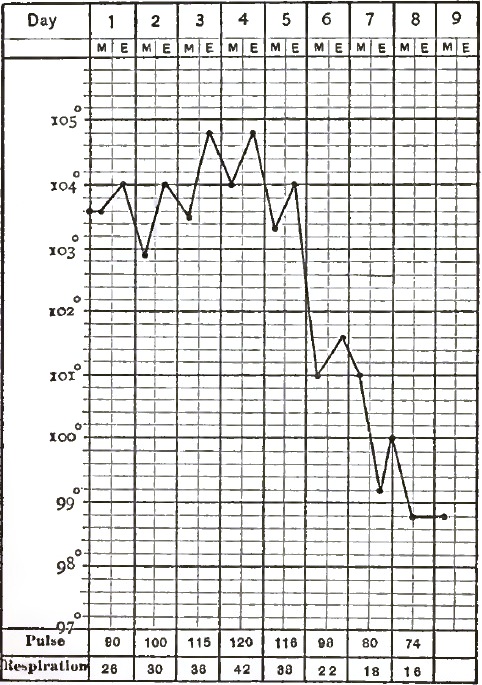
A Typical Case of Lobar Pneumonia in the Adult: Recovery by Crisis.
The temperature is usually highest on the evening of the third day. In some cases the maximum range may not be reached until a few hours before the crisis, on the fifth or sixth day. In fatal cases, just preceding death, the temperature may reach 107° or even 109° F.
An (average) typical temperature-curve is shown on the preceding page (Fig. 33).
If after the fourth day of a pneumonia an unusual remission is followed by a high temperature-range, either an extension of the pneumonia or the occurrence of some active complication is indicated. If in an otherwise mild pneumonia the temperature suddenly rises to a high point, a grave complication is indicated. The sudden fall of temperature on the fifth or sixth day indicates a crisis and the beginning of convalescence; it may occur in the morning or after the evening exacerbation.
In a typical case it is usual to find the temperature on the morning of the fifth, sixth, or seventh day two or more degrees lower than on the preceding night, and subsequently it falls until a normal, or not infrequently a subnormal, temperature is reached. The crisis may occur by successive and increasing remissions, while the exacerbating temperature remains constant (Fig. 34); and indeed it is common for the remissions to be excessive immediately preceding the crisis.
FIG. 34.
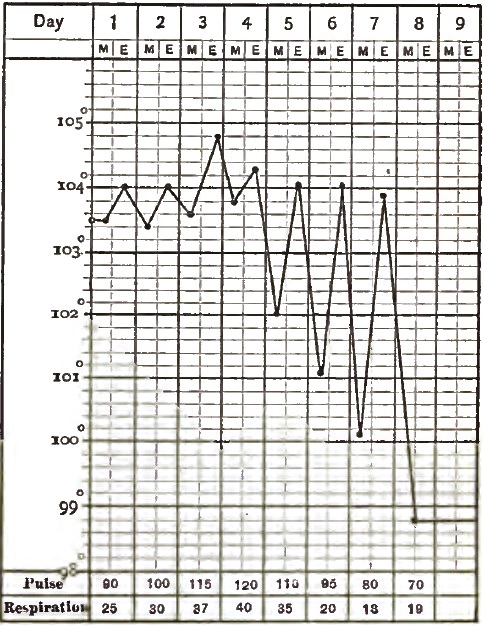
Lobar Pneumonia, where the Crisis was marked with Evening Exacerbations, reaching nearly the highest pyrexia of the second stage: Recovery.
Just before the final fall the fever may be greater than at any time preceding.34 When the decline in temperature is gradual (lysis), the normal temperature is usually reached by the ninth day, but it may be delayed until the twelfth or fourteenth day. A very slow or protracted lowering of the temperature is attended by a coincident slow disappearance of the physical signs of consolidation. There is no explanation for this, except that it is met with oftenest in the weak, debilitated, and dissipated where venesection has been practised or a depressing plan of treatment has been resorted to.
34 See Fig. 33, where a temperature of nearly 105° F. is followed on the evening of the fifth day by the final fall.
A high temperature persisting after the tenth day indicates purulent infiltration (see Fig. 38).
Pneumonia involving the apex of the lung is usually marked by a higher average range of temperature than when it is confined to the lower lobes. Statistics show that the fifth and seventh days are the days of crisis in the majority of uncomplicated pneumonias. Of 867 cases terminating by crisis, in 677 the crisis occurred before the eighth day. Neither the height of the temperature-range nor the amount of lung involved affects the critical day.
In the form of pneumonia sometimes called bilious—a form that prevails in miasmatic regions—the temperature is markedly paroxysmal.
In children the temperature rises very rapidly, sometimes reaching 106° F. within the first twelve hours. The highest recorded temperature in the pneumonia of children, with recovery, is 106°–107° F. The average temperature of pneumonia at this period of life is 104° F., the range being higher than in adult pneumonia.
In children the day of crisis is oftener the seventh than the fifth day. The fall of temperature during the crisis is somewhat remarkable; it often falls two and a half degrees below the normal, and this exceedingly low temperature may be maintained for two or three days, and yet the child recover.
The accompanying charts show ordinary temperature-curves from children with pneumonia (see Figs. 35, 36).
FIG. 35.
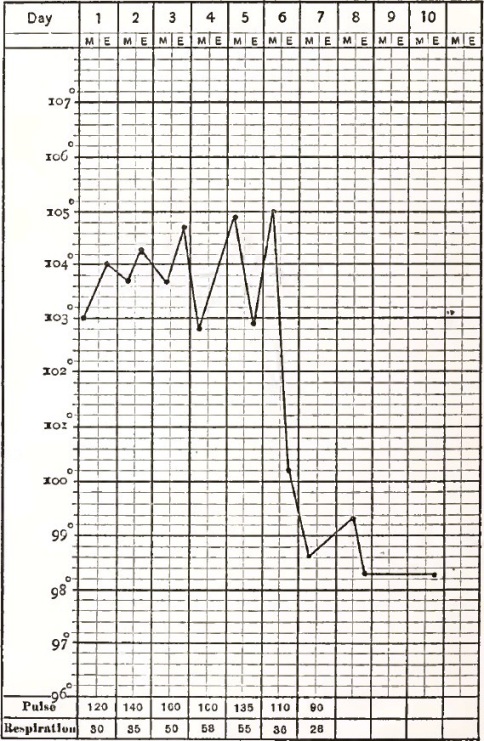
A Typical Case of Lobar Pneumonia in a Child: Recovery.
FIG. 36.
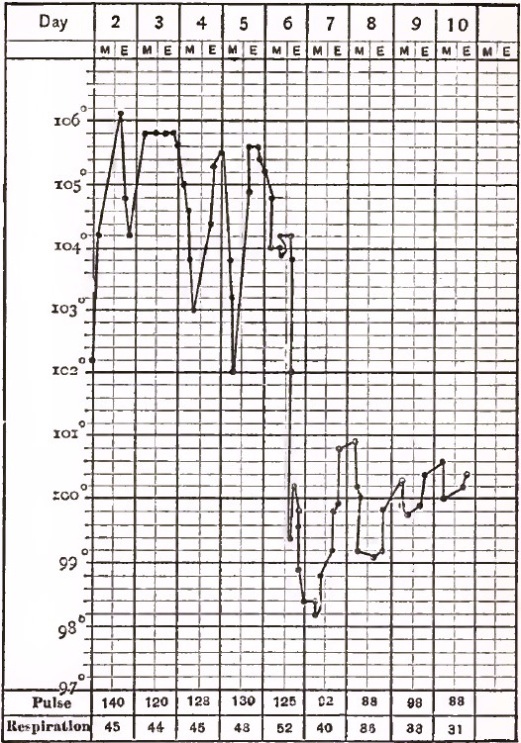
A Case of Lobar Pneumonia in a Boy ten years old, in which thermometrical observations were made every four hours: Crisis on the sixth day.
In old age it is often difficult to determine the exact day of the invasion of pneumonia except by the temperature. The rectal temperature rises to 103° or 104° F., or even higher, on the first days, and continues at about the initial point for three or four days, with daily morning and evening oscillations of a degree or a degree and a half. The temperature-rise does not begin for several hours after the initial chill, if a chill occur (see Fig. 37).
FIG. 37.
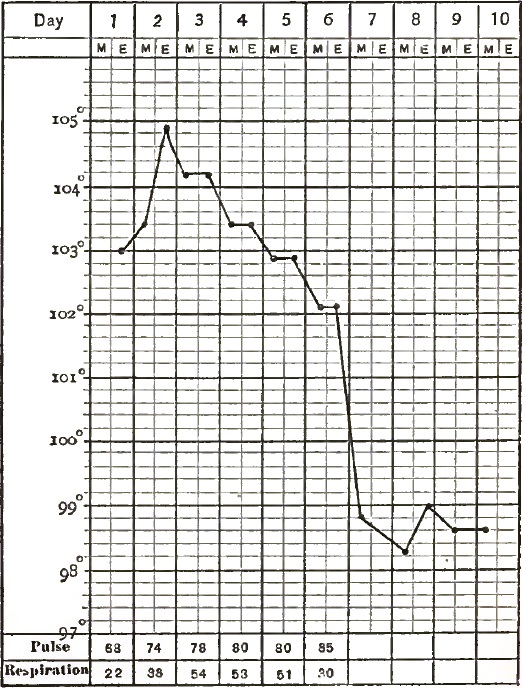
A Typical Case of Senile Lobar Pneumonia: Recovery.
Relapse in pneumonia is a rare event; it is quite phenomenal for it to occur four days after the crisis. The temperature suddenly rises, but usually returns to normal in three or four days.
Pulse.—The pulse in pneumonia varies with the type and extent, as well as with the stage, of the disease. In an ordinary mild case the pulse-rate is usually between 90 and 120 per minute. When the pulse-rate for any length of time is above 120, the case must be regarded as an exceedingly grave one.
The pulse at the onset of croupous pneumonia is usually full and soft. As the disease progresses it becomes small and feeble. In severe cases, and when the nervous system is markedly implicated, it is rapid, and may be 130 to 140, or even 160, at the onset of the disease. In such cases it will also be small and feeble.
A high temperature is usually accompanied by a rapid pulse, and a low temperature by a moderately frequent, full pulse. At the day of crisis, when the temperature falls, the pulse will fall; and this occurs in the severe as well as in the mild cases.
Subsequent to the third or fourth day in severe cases the pulse, in addition to its frequency and feebleness, may exhibit dicrotism, or it may be jerky, very compressible, and intermittent. Sometimes just before death the pulse becomes markedly slow. The feebleness of the pulse is ascribed by some to cardiac depression, the result of the high temperature; by others it is claimed that the afflux of blood to the left ventricle obstructs, and causes a deficiency in, the aortic circulation. In other words, hepatization is adduced as a cause of the feeble pulse. In chronic wasting diseases, in feeble, weak individuals, or in those already suffering from cardiac disease, weakness of the pulse is a very marked symptom.
I cannot regard a feeble pulse in pneumonia as due to the pulmonary hepatization, for it is not that pneumonia which is most extensive that is accompanied by the greatest heart-flagging. Heart-failure may exist before, or just as, consolidation is beginning. In many pulmonary affections the obstruction to the pulmonary circulation is greater than in pneumonia, and yet there is no heart-failure. The pneumonia with the highest temperature-range is not necessarily the pneumonia in which heart-failure is most marked or earliest to develop. There are many diseases in which there is a much higher range of temperature and yet no evidence of heart-failure occurs.
If a prolonged high temperature is the cause of feeble heart-power by the parenchymatous changes which it induces in its muscular fibres, such a high fever is not met with in pneumonia, and the heart is rarely found at post-mortem to exhibit such changes. May not the heart-failure, as indicated by a rapid, feeble, and intermittent pulse in pneumonia, be due to the presence in the blood of a morbific agent (as in certain infectious diseases) which so affects the nerve-centres which supply the heart that its contractile power is diminished and its rhythm disturbed? The pulse early shows commencing heart-failure by each cardiac pulsation producing a variable filling of the arteries with blood; hence the beats first vary in force, then waves occur, then true intermissions. I have been able to detect this heart-insufficiency by these variations of the pulse within twenty-four hours after the onset of a pneumonia, and occasionally during the initiatory chill.
In children the pulse-rate is greatly increased; it may reach 200 in a minute. It is very small, unequal and irregular, but never intermittent.
In senile pneumonia the pulse is not a reliable indication. The pulse may be only 50, and yet this would be a rapid pulse for the particular case in which it occurs.
In old age, both in health and in disease, the pulse has a fictitious hardness on account of arterial changes. The pulse may not be intermittent or irregular, yet the heart may be very irregular and intermittent in its action. Again, the pulse may be feeble and intermittent and the heart be acting regularly.
Remittence of the pulse is quite common in senile pneumonia independent of cardiac changes. The action of cold upon the surface in the aged is very quickly indicated by the radial pulse lessening its volume and strength, so that if the pulse at the wrist is taken it should be from the arm which has been covered. To avoid error, the pulse in senile pneumonia must be counted at the heart.
The surface of the body may be pungently hot and dry until the crisis is reached, or it may be bathed in perspiration from the onset of the disease. A moist surface has been regarded as a very favorable sign, but when in the height of the disease the parched skin becomes moist and the patient is not relieved, it is an unfavorable rather than a favorable symptom, and is met with more often in fatal cases than in those that recover.
In most cases of croupous pneumonia the expression of the countenance is characteristic. It is one of anxiety, and over the malar bones is a mahogany flush—not, as in typhus fever, diffused, but well defined and circumscribed, so that it is sometimes called the pneumonic spot. While the cheeks exhibit a spot of this dusky hue, the rest of the face may have an earthy pallor. Bouillard states that the pneumonic flush on the cheek is most marked when the pneumonia has its seat at the apex of the lung. Some authorities state that the cheek flushes most or solely on the affected side, while others35 have shown that the cheek on the side opposite to that affected is the one that is usually flushed. In this connection it is interesting to mention the case of Jaccoud, who, suffering from an attack of pneumonia himself, noticed for twenty-four hours preceding the pneumonia signs a flush and a burning sensation in the cheek opposite to the side affected. Usually one cheek is more flushed than the other, and this is undoubtedly due to disturbance of the vaso-motor system.
35 Barthez and Rilliet.
When the impediment to the circulation is excessive, or when vaso-motor disturbance is marked, the lips become cyanosed. At the time of crisis the face becomes paler.
In about one-half the cases pneumonia is attended by an herpetic eruption upon the lips, nose, cheeks, or eyelids. It rarely appears before the second or third day. It may not appear until the crisis is reached. Herpes occurs with varying frequency in different years, but is more commonly met in pneumonia than in any other febrile state. One winter nearly every case of pneumonia in Bellevue Hospital was accompanied by herpes labialis. When sweating exists and involves the entire body, it is very frequently accompanied by sudamina, which are either abundant or sparse, and seem to have a critical significance.
In children, while the surface of the body is hot and dry the extremities are cool. The pneumonic flush instead of having a mahogany tint assumes a bluish-white tint. Cyanosis of the extremities is more frequent than in adults, and herpes labialis more common. All the cutaneous symptoms are exaggerated in children.
In old age the pneumonic flush is often the first objective sign of pneumonia. The eyelids alone are cyanotic. If the face is dusky at first, it subsequently assumes a sallow hue, and the surface-heat, which is greatest in the morning, is succeeded by a cold, clammy perspiration.
Cerebral Symptoms.—The cerebral symptoms in the early stage of pneumonia are not very significant. Headache is usually present at the onset, and may continue throughout the disease. It usually steadily diminishes after the third day. If it is severe in the evening, there will be slight delirium at night—so slight as often to escape notice. Delirium and convulsions rarely occur except in debilitated subjects and in persons of enervating habits. It is most frequently met with in alcoholic subjects, and then it assumes the character of delirium tremens. It is an active, busy, restless delirium: the patient is constantly talking, but seldom in a coherent manner. Sometimes, in those who are not alcoholic subjects, the delirium may assume an active and violent character. Whenever active delirium is present, it is important to make careful and diligent search into the previous habits of the patient.
Pneumonia of the apex is more apt to be accompanied by severe cerebral symptoms than when it has its seat at the base.
Delirium may pass into coma. When delirium and headache are marked symptoms, muscular tremors (subsultus tendinum) are very apt to occur, with insomnia and frightful hallucinations. Indeed, these cerebral symptoms are often so prominent in alcoholic pneumonia, and occur so early, that the pneumonia may be wholly masked, and will only be discovered by the temperature-range and by a careful physical exploration of the chest.
When delirium is present in feeble patients, it assumes a low muttering typhoid type, and a state of stupor is soon reached.
Among the rare nervous symptoms met with in pneumonia may be mentioned photophobia, disturbances of vision, and deafness.
In children the cerebral symptoms are more prominent than in adults, and they do not seem to be influenced by the extent of lung involved. Stupor and restlessness on the one hand, or headache, delirium, and convulsions on the other, may usher in pneumonia in children without any prodromata.
Sometimes children pass rapidly into a semi-comatose condition which has not been preceded by delirium or convulsions. Convulsions are as common in children as they are rare in adults, and occur with greatest frequency and severity during dentition. The convulsions may be general and resemble those of epilepsy (pneumonie éclamptique of Barthez and Rilliet), or they may attack single muscles or groups of muscles, the child occasionally passing into a tetanic or opisthotonic condition.
If convulsions do not occur until late they are quickly followed by a deep and fatal coma. A very rare occurrence is partial paralysis of the muscles which were involved during the convulsive period. Such paralysis is often permanent. Again, the cerebral symptoms may closely resemble those which attend cerebro-spinal meningitis—viz. headache, constipation, great prostration, delirium, convulsions, opisthotonos, and strabismus. As in meningitis, there is a peculiar cry, and all the symptoms may point directly to the brain. These symptoms are most likely to be present in the pneumonia of the apex in children from five to seven years of age.36
36 This form is the pneumonie méninges of Barthez and Rilliet.
In senile pneumonia headache may persist throughout the entire attack; it is usually accompanied by delirium of a mild type, especially when the apex of the lung is involved. These patients are very loquacious and have a constant desire to get out of bed.
Alimentary Tract.—The symptoms referable to the digestive apparatus are neither diagnostic nor important. Nausea and vomiting are not infrequent, and in about 15 per cent. of all cases are among the initial symptoms. Gastric symptoms, when severe and persistent, greatly endanger life. There is no characteristic appearance of the tongue: it may be normal throughout, or covered with a creamy-white fur, which becomes dry and brown as the disease advances. In severe cases and toward the end of the disease the lips and tongue become brown, dry, and cracked, and sordes collect on the teeth. Anorexia is marked at the onset, and the thirst is intense. When convalescence commences the tongue becomes clean and the appetite returns. Occasionally there is a catarrh of the oral mucous membrane. Diarrhoea may occur as one of the initial symptoms. It is most apt to be present when there are nausea and vomiting. As a rule, the bowels are constipated and the stools dry. In young children nausea and vomiting are more common, and in 50 per cent. of the cases usher in the disease. They usually cease on the second day, although they may persist until the crisis occurs. Excessive and violent diarrhoea may precede a fatal termination.
In senile croupous pneumonia the tongue early becomes dry, shrivelled, and covered with a thick brown coating, and is protruded with difficulty. Although these patients do not complain of thirst, they take with avidity fluids that are placed to their lips. As the period of crisis is reached critical diarrhoea is of frequent occurrence.
Loss of strength occurs earlier and is more marked in pneumonia than in any other acute disease except typhus fever. Pneumonia patients become very weak within the first five days. The recovery of strength during convalescence is rapid.
Urine.—The urine at the onset of pneumonia is scanty, high-colored, and of high specific gravity. The amount of urea excreted is twice or three times more than the normal. The excess of urea increases until the crisis, and then suddenly diminishes with the fall in temperature, often below the normal standard.37
37 The daily amount of urea normally excreted is subject to great variations: it ranges between 355 and 460 grains. Parkes gives the result of 25 different observations: the lowest estimate was 286.1 gr. and the highest 688.4 gr.
Uric acid is also increased, and follows the same course as that of the urea. The inorganic salts of the urine, especially the sodium chloride, are diminished, and during the height of the pneumonia may be wholly absent. Much has been written concerning this diminution, which is by no means peculiar to pneumonia, but in no other acute disease is its diminution so constant and marked a symptom. Sodium chloride is probably retained in the system, for when the salt has been administered in large quantities none has appeared in the urine. The reappearance of the chlorides in the urine marks the approach of convalescence, and when the crisis occurs they appear in excess, following an opposite course to the urea and uric acid.
Although these last two ingredients are in very rare cases retained, the same as the chlorides, to appear when the crisis occurs, their retention is usually accompanied by a critical diarrhoea, which is followed by a prolonged convalescence. The diarrhoea is undoubtedly due to the irritation caused by the urea.
Parkes38 states that sulphuric acid is increased and phosphoric acid is diminished, but Huss affirms that both acids are diminished. With the increase of the urea and uric acid, and diminution of chlorides, biliary pigment will appear in the urine, and occasionally the biliary acids.
38 On the Urine.
Slight albuminuria is an ordinary phenomenon of pneumonia, and, though usually met with in the second stage, it may appear at any time. This symptom is present in 35 per cent. of all cases. Its presence is a point of resemblance between pneumonia and other acute blood diseases. The more severe the pneumonia, the more marked is the albuminuria. Some have ascribed its presence to passive hyperæmia the result of the pulmonary obstruction. This is questionable, except in those rare cases where venous engorgement is indicated by cyanosis, enlargement of the liver, jugular pulsation, etc.
In children the amount of urine corresponds to the quantity of fluid taken.
Critical Phenomena.—At the end of the first week, during which all the symptoms have increased in severity, the continued fall of temperature tells us that convalescence is established. As the temperature falls, profuse (critical) sweating occurs. Both of these phenomena may occur to such an extent that for hours the condition of the patient is one of collapse.
In rare cases death has occurred in the midst of these symptoms. The respirations and pulse-rate are diminished in frequency, the pulse being small and frequently exhibiting dicrotism. The cough becomes loose, the dyspnoea abates, the flush disappears from the cheek, the sputum is more copious, and is expectorated with less difficulty; it loses the rusty color from metamorphosis of its hæmoglobin, diminishes in viscosity, and no longer adheres to the side of the vessel, but becomes more opaque, of a creamy consistency, and resembles that of simple bronchial catarrh. When resolution is retarded, the creamy-yellow tint may give place to an almost black hue, on account of the excessive amount of pigment present. As convalescence advances, the sputa become scantier, more mucous, watery, transparent and colorless. At the time of crisis the intense thirst diminishes, the appetite returns, pain in the side subsides, and the patient passes into a quiet, natural sleep, to waken fully convalescent, suffering only from extreme exhaustion.
Epistaxis, hæmaturia, and hemorrhage from the bowels sometimes occur at the critical period, and may be regarded either as accidents or as the result of the defervescence. After the crisis the amount of urea in the urine (which during the height of the disease was augmented) falls to normal or nearly to normal. Sodium chloride appears in the urine as soon as the crisis occurs.
The critical phenomena in children are the same as in adults, and frequently the fall in temperature is so great that for hours after the crisis they lie half unconscious, with a cold surface covered with a colliquative sweat. With the critical sweat there is often a catarrhal flow from the nose. When children have been extremely restless or delirious the crisis is marked by the patient passing into quiet sleep.
In old age, when recovery occurs, it is generally by crisis, and a critical diarrhoea is much more frequent than a critical sweat.
In adults and in children the recovery of strength and flesh is rapid; in the aged the period of convalescence is very prolonged, and often does not begin (when the pneumonia is of the asthenic—typhoid—type) until the fourteenth or fifteenth day; still, complete recovery may be reached.
Symptoms indicating Danger.—When croupous pneumonia is to terminate fatally, dyspnoea is greatly increased; the patient suddenly sinks; the pulse becomes extremely small, rapid, irregular, intermittent, and dicrotic. Large moist râles are heard over the larger bronchi and trachea, while the auscultatory signs of pulmonary oedema become more and more apparent. The sputa become frothy, liquid, and blood-stained, or are entirely suppressed. The respirations become more and more hurried, the face is sunken and livid, the extremities are cold, and the superficial capillary circulation is more and more interfered with, as is indicated by the cyanosis. The body is bathed in a profuse cold perspiration. The fatal issue is usually preceded by coma.
The temperature may steadily rise up to the time of death, or death may occur in the defervescence. In alcoholic pneumonia death is preceded by cerebral symptoms, such as somnolence, numbness of the limbs, a sense of formication, and slight convulsive attacks.
In children death is often preceded by convulsions or coma. If the disease is protracted, death may be preceded by extreme exhaustion and collapse. Cyanosis and extreme rapidity of the pulse are usually present in children just before the fatal issue.
Senile pneumonia may end fatally within a few hours after its onset in a most unexpected manner. The aged patient walks apathetically about, totters to the bed, lies down, and dies. If the pneumonia has existed for a number of days, the signs of a fatal termination are sallowness of the face, a cold clammy skin, expansion of the alæ nasi, and a sudden rise or fall of the temperature. The inspirations become mere gasps, and, following the apathy, the patient gradually lapses into complete coma.
Symptoms which attend the Termination of Pneumonia in Abscess.—Acute pneumonia terminates in abscess in from 1 to 2 per cent. of all the cases. It is therefore a rare termination. It is most frequent in debilitated, weak subjects and in those who have received a depressing plan of treatment. The expectoration is exceedingly copious and fetid, and the sputa are yellowish or yellowish-gray in color, consisting almost wholly of purulent matter. Pigment is usually found in the expectorated masses, and when shreds of pulmonary tissue are present the diagnosis is established. The fever assumes a hectic type and is accompanied by rigors and sweats.
After these symptoms have continued for a time, the patient grows weaker and emaciated, and death results from exhaustion, from asphyxia (when a large bronchus is plugged with pus), or from the discharge of the abscess into a neighboring cavity.
DaCosta states that "pulmonary pneumonic abscesses are at the base of the lung;" Fox locates them "at the apex;" Green, "on the upper lobe;" I have found them in both situations.
The physical evidences of a lung-cavity are the most reliable signs of pneumonic abscess. Abscess is a very rare termination of croupous pneumonia in children. In old age the formation of abscesses is never evinced by any well-marked symptoms. The finding of elastic fibres in the sputa with the physical signs of a cavity are the only diagnostic signs.
Symptoms which attend the Termination of Pneumonia in Gangrene.—Gangrene as a termination of pneumonia has been found in about 14 per cent. of cases.39 This must be regarded as an exceptionally high percentage. Its occurrence is usually accompanied by symptoms of sudden collapse. The pulse becomes rapid, feeble, and intermittent, the face is pale and of a deathly hue, and there is a profuse expectoration of blackish-green masses containing shreds of decomposed and decomposing lung-substance of an exceedingly fetid odor. The breath is fetid and the whole body emits a cadaverous smell. The rapidly-increasing prostration is sometimes accompanied by hemorrhage.
39 In 28 out of 200 cases (Guy's Hospital Reports, Sec. vii., 1848).
The sickening and indescribable odor of pulmonary gangrene is most perceptible after an attack of coughing. Gangrene has its most frequent site in the lower lobes of the lung, and it is here that a careful search must be made for the rather ill-defined physical signs which attend its development. In old age, when a pneumonia is to terminate in a gangrene, typhoid symptoms appear very early, and death occurs with symptoms of the profoundest collapse within five days from the initial chill.
Symptoms which attend the Termination of Pneumonia in Purulent Infiltration.—The symptoms of purulent infiltration differ but slightly from those of the third stage of pneumonia. When resolution does not take place at the period of crisis, and the temperature remains high, accompanied by symptoms of prostration and profuse putrid expectoration, with none of the physical signs of resolution, purulent infiltration is to be suspected. Death may result from exhaustion, or recovery take place after a prolonged convalescence (see Fig. 38).
FIG. 38.
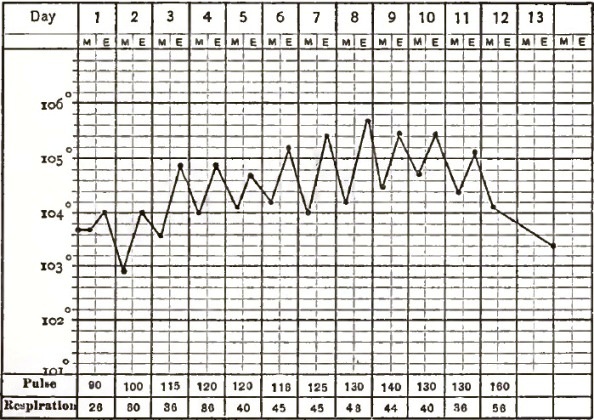
Croupous Pneumonia in the Adult, terminating in Purulent Infiltration: Death on fourteenth day.
Mild delirium is a frequent symptom during the stage of purulent infiltration. The sputa contain a large number of cells in various stages of fatty degeneration. The temperature has regular evening exacerbations, and often ranges higher than during any preceding period of the disease. The tongue becomes brown and dry, sordes collect upon the teeth, and the patient passes into a typhoid state.
Typhoid pneumonia is a term which has been applied to a variety of croupous pneumonia which is attended by typhoid symptoms. It has also been called asthenic, low, or nervous pneumonia. There are symptoms of extreme prostration from its onset. After well-marked pneumonic symptoms have been present for a few days, the patient passes into a condition of extreme prostration.
There is little or no expectoration, no dyspnoea, no pain, no cough. Sordes collect on the teeth and gums; the tongue becomes thickly coated with black crusts; the pulse becomes small, feeble, and rapid, and there is a tendency to the formation of bed-sores; and then occur stupor, somnolence, and a continuous low muttering delirium. This form of pneumonia is met with most frequently in the aged. In some cases there is marked disturbance of the special senses.
Tremors and subsultus tendinum frequently coexist. It may be accompanied by glandular swellings, by sharp and darting muscular pains, by arthritic symptoms, or by great gastric disturbance. It is not infrequent in epidemics, and it may follow or accompany erysipelas, Bright's disease, alcoholismus, or phlebitis. It is always a grave condition, but recovery is possible. Convalescence, which is very tedious, may commence as early as the twelfth or fourteenth day. Sometimes a modification of typhoid pneumonia accompanies dysentery, intestinal catarrh, or a phlegmonous gastritis. There are great sweating, profuse diarrhoea (colliquative), and high fever. The odor of the sputa resembles that of gangrene of the lungs. Such cases commonly end fatally.40
40 Cyclo. Pract. Med., iii., art. "Gastritis."
Bilious or Gastric Pneumonia.—Croupous pneumonia occurring in malarial districts, accompanied by gastro-enteric or hepatic symptoms, is known as malarial or bilious pneumonia. It has all the characteristic symptoms of pneumonia of a very severe type, but the fever is paroxysmal. The tongue is heavily coated; nausea and vomiting are common, and may persist throughout its entire course; the epigastrium is distended and tender; the skin is jaundiced; the liver is enlarged, and there is usually an exhausting diarrhoea, attended by greenish, black, viscid, and inodorous stools. The hepatic congestion and jaundice are due to a coincident gastro-duodenal catarrh.
Bilious pneumonia may be of a sthenic or asthenic type. The theory that the liver becomes inflamed by extension from the lung is untenable.
The symptoms of bilious pneumonia have frequently led to a diagnosis of typhoid gastric fever or some severe acute affection of the intestinal tract. But a reference to the physical signs will remove all doubts.
Bilious pneumonia runs a more protracted course and has a much longer period of convalescence than ordinary croupous pneumonia. In old age this form is not infrequent. The vomiting is distinctly bilious in character, and at this period of life somnolence and stupor are quite common, and are exceedingly unfavorable symptoms.
Latent Pneumonia.—Pneumonia in adults is seldom latent unless it complicates some disease whose symptoms are so severe, and the attending prostration is so great, as to obscure the characteristic signs of the pneumonia. Intercurrent senile pneumonia is always latent, and Grisolle says that an exploration of the thoracic organs in the majority of such cases gives negative results. If, then, an intercurrent senile pneumonia runs its course without expectoration, without dyspnoea, without the pneumonic flush, and without any of the physical signs of pneumonia, its diagnosis must rest—first, on the extreme frequency of pneumonia in old age; secondly, on the fact that of all the phlegmasiæ of advanced life pneumonia is the one which is oftenest latent; thirdly, that of all the acute diseases in old age pneumonia is attended by the highest range of temperature and the greatest prostration. When an old person has a slight rigor followed by febrile movement, with great prostration, for which no explanation can be found, pneumonia may be suspected, even though all its diagnostic signs are absent.
Intermittent or remittent pneumonia, which is described by some authors as a distinct type, is a form of acute pneumonia in which a malarial element is so pronounced that all the pneumonic symptoms, even the physical signs, undergo distinct intermission, returning each day with increasing severity. Occasionally, instead of the quotidian it assumes the tertian type. During the intermission the temperature may fall to normal. Severe chills and sweating are often present, and the pneumonia is not infrequently double.
The malarial conditions which give rise to this type of pneumonia occur more frequently in our Southern and Western States than in any other part of the world.
PHYSICAL SIGNS.—By studying the physical signs of croupous pneumonia in connection with the different stages of its morbid anatomy, their importance as elements in diagnosis and prognosis can best be appreciated.
Stage of Engorgement.—The physical signs indicative of the first stage of croupous pneumonia are usually present within twenty-four hours after its invasion. If the pneumonia is central, their appearance may be delayed until the third day.
Inspection.—On inspection the movements of the affected side are noticed to be more or less restricted, while the unaffected side moves as in health. In double pneumonia the respiratory movements will assume a costal type, attended by an increase in the abdominal breathing.
Palpation.—On palpation there is more or less increase in the vocal fremitus on the affected side. The degree of increase corresponds to the extent of the engorgement. It must always be remembered that normally the vocal fremitus is more marked on the right side than on the left.
Percussion.—There is slight dulness over that portion of the chest-wall which corresponds to the affected portion of lung: its extent varies with the amount of lung involved. It is never well marked until the end of the first stage, although the pulmonary capillaries are engorged with blood from the commencement. Even at the end of this stage the intensity of the percussion sound, although diminished and muffled, has a slightly tympanitic quality, due to the fact that the exudation has not completely displaced the air in the distended alveoli. Very extensive central pneumonia may fail to give either increase in vocal fremitus or dulness on percussion until the second stage is well advanced. Absolute dulness during this stage is of rare occurrence.
Auscultation.—During the dry stage, which according to some41 is said to precede the exudation stage, there will be noticed a feebleness and unnatural dryness of the respiratory murmur. Sometimes it is harsh, at others feeble and loses the peculiar breezy, rustling quality of the normal respiratory sound. If it is less intense over the affected portion of the lung, it is exaggerated over the unaffected portion. These changes are apt to pass unrecognized unless auscultation is practised frequently and early in the disease. As soon as the engorgement is well marked and exudation takes place into the air-cells, fine crackling sounds are heard at the end of inspiration. These sounds are called crepitant râles, and are regarded as the characteristic sign of the first stage of pneumonia. They resemble those produced by throwing salt on live coals or rubbing the hair in the neighborhood of the ear between the fingers. These râles do not necessarily depend upon the presence of fluid in the alveoli, but may arise from the sudden separation of the alveolar walls at the end of inspiration when they have been agglutinated by a tenacious exudation. They are as numerous as they are minute, are unaffected by coughing, and remain audible over a circumscribed space from twelve to twenty-four hours. Whenever the pneumonic stages follow each other in rapid succession, the crepitant râle may not be heard. It is rarely present in a pneumonia which is developed during an attack of acute articular rheumatism. With the crepitant râle the respiratory murmur is feeble or assumes a broncho-vesicular character.
41 Stokes.
When, as often happens, pneumonia has been preceded by or complicates any other thoracic affection, the crepitant râle will be mingled with the sounds arising from that particular condition. It is said42 that bronchial breathing is sometimes heard in this stage of pneumonia. The voice-sounds undergo slight increase in their intensity over the seat of the pneumonic engorgement.
42 Traube, Annal. der Charité, i. 286.
In children the crepitant râle is frequently absent, and, though it may be heard at the end of a full inspiration after coughing, it is never so fine or distinct as in adults. In children there will be no increase in vocal fremitus if, as often happens, a large bronchus leading to the inflamed spot is plugged with mucus.
In old age the physical signs of adult pneumonia are modified by certain physiological changes which occur in the lungs and chest-cavity of the aged. The more complete bony union of the chest-walls, the curvature of the spine, the rigidity of the bronchial tubes, the rounded form of the chest, and the senile rarefaction of the lungs, give rise to extra resonance on percussion as compared with an adult chest. On account of the great arching of the sternum and the deposition of carbonaceous material at the apex of the lung, the clavicular region near the median line gives a dull percussion sound. The scapular and supra-scapular regions are less resonant than in the adult, on account of the tilting of the scapulæ due to curvature of the spine. There is a loss in the vesicular element of the respiratory murmur, and it resembles the sound produced by a forceful expulsion of air from the compressed lips. When the septa or the alveoli are torn and greatly distended, it has a bronchial character. Its intensity varies: at one moment it is loud, at another hardly perceptible; the variation occurs not only in the same individual, but in different individuals of the same age. The vocal sounds are loud and bronchophonic in character, and have a vibration closely resembling oegophony. It is also to be mentioned that it is almost a physiological condition for old people to have bronchorrhoea; hence mucous râles may be present during the whole period of advanced life, and if one relies on the usual crepitating râles of adult pneumonia for a diagnosis he will be misled.
Inspection and palpation in the first stage of senile pneumonia furnish little positive information. Percussion will give little dulness until the lung has reached the stage of red hepatization, and even then it may be so slight as to pass unnoticed. Very early in the disease the respiratory murmur is feeble and indistinct over the affected portion, while the portion of lung that is not involved assumes, for the time, all the characters of a normal adult respiratory murmur. Again, the breathing over the pneumonia may be intensely puerile and interrupted.
The crepitant râle is rarely present in the first stage of senile pneumonia, but subcrepitant râles and large moist râles resembling those of bronchitis are heard during the whole of this stage. The explanation of the absence of the crepitant râle is to be found in the physiological condition of the air-cells just referred to. Sometimes, on a deep inspiration after violent coughing, fine crepitation is heard, but upon careful examination it will not be found to differ from the râles of capillary bronchitis. It may be stated as a general rule that the feebler and more superficial the respirations the less distinct will be the adventitious sounds.
The physiological rigidity of the bronchi in old age favors the early development of bronchial breathing, which is often the first physical sign of senile pneumonia. One of its peculiarities, when occurring in the stage of engorgement, is that it is most distinct at the root of the inflamed lung.
Stage of Red Hepatization.—The physical signs of the second stage of croupous pneumonia are more diagnostic than those of either of the other stages.
Inspection shows the expansive movements of the affected side to be more markedly diminished than in the first stage, while those of the healthy side are increased. Frequently there is absolute loss of motion over the inflamed lung.
Palpation.—By palpation the vocal fremitus is usually increased on the affected side over the consolidated lung-tissue. In some instances it may be only slightly increased, and in rare instances it will be found less marked upon the affected side than upon the healthy. Palpation may also reveal slight displacement of the heart from the pressure of the distended lung; and in rare cases well-marked pulsation is felt over the affected lung.43
43 Skoda, Stokes, and Graves regard this as the result of increased pulsation of the arteries in the inflamed spot; and Walshe and Fox rather admit it, but Grisolle denies it.
It is evident that the vibrations of the vocal cords can be transmitted from the trachea through the bronchi and lung to the chest-wall, and there is no reason why the cardiac impulse may not likewise be transmitted through a solidified lung to the chest-wall.
If the pneumonia is central, the vocal fremitus may not be increased. It is diminished when there is an abundant pleuritic exudation over the pneumonic lung.
Percussion.—On percussion there will be marked dulness over that portion of the lung which is the seat of the pneumonia, while over the healthy portion, as well as over the opposite lung, there will be exaggerated resonance. The nearer the hepatization approaches the surface of the lung, the more marked will be the dulness. There is a peculiar sense of resistance on percussion over a completely airless hepatized lung which is not present in solidification from other causes. The exact outline of an hepatized lobe can often be traced on the chest-wall.
The tympanitic quality which is sometimes present during the stage of engorgement may continue anteriorly during the second stage, and yet posteriorly the dulness will be complete. A tympanitic percussion sound is sometimes elicited over that portion of lung which is adjacent to the consolidated lobe. When an upper lobe is consolidated, forcible percussion may elicit a tympanitic sound, for the column of air in a large bronchus will vibrate under forcible percussion. The cracked-pot sound (bruit de pot fêlé) is occasionally met with over those relaxed and permeable parts of the lung in the immediate vicinity of the consolidation. When this sound is present over the consolidated portion, it is due to the sudden expulsion of air from one of the larger bronchi. It is most frequent in young persons with thin, elastic chest-walls. The cracked-pot sound in pneumonia is not increased in intensity when the patient's mouth is open.
In basic pneumonia the subclavicular percussion note may be distinctly amphoric in character. Dulness may appear within twelve or twenty-four hours after the onset of a pneumonia, or it may be delayed until the fourth day.
Auscultation.—As soon as the air-cells are completely filled by the pneumonic exudation, the crepitant râle ceases and bronchial respiration is heard over the affected lung. The bronchial breathing is due to the fact that the vesicular element of the respiratory sound disappears on account of the complete consolidation of the vesicular structure, and the tracheal element of the respiration is conveyed to the chest-walls through the consolidated lung. It often has a metallic element, or may sound like the tearing of a piece of linen. Bronchial respiration is more intense in pneumonia than in any other disease.
Laennec taught that bronchial respiration was due to the superior conducting power of condensed lung. Skoda combats this view, and says that bronchial respiration is generated or magnified in caverns and in the bronchi of condensed lung-substance by the air in these cavities and in the bronchi vibrating in consonance with that within the trachea. The condition necessary for this consonance is provided in the circumstance that the air is pent up in confined spaces whose walls reflect the sonorous undulations.
The more complete the consolidation, the more intense is the bronchial respiration. At the commencement of this stage the tubular breathing only attends expiration, while later it accompanies both acts. Pleuritic exudation may mask or render this sound very indistinct. It may in rare instances be absent even when extensive consolidation exists and the pleura is perfectly normal. This can be accounted for in most cases by the plugging of a large bronchus. There are cases in which its absence is inexplicable.
The vocal sounds are increased in intensity and bronchophony is heard over the consolidated lung. The physical conditions of the lung which give rise to bronchophony have the same diagnostic significance as the bronchial respiration, and in all instances its occurrence, its distinctness, its temporary disappearance, and its reappearance are dependent upon precisely the same conditions as are the changes in the bronchial respiration. If the pleural cavity is partially filled with fluid, bronchophony will be indistinct or absent below the level of the fluid, while at its level the voice-sounds will be either bronchophonic or oegophonic.
During this stage the heart-sounds are transmitted to the surface over the hepatized lung with greater intensity than normal.
In children dulness is especially marked in the infra-scapular region of the affected side. Some authors44 speak of a feeling of greater solidity below than above the scapula, which can be detected before the ear can detect actual dulness on percussion. Vocal fremitus may be increased, but it is not reliable on account of the changes in the voice.
44 West.
In old age, inspection and palpation give negative results. Dulness on percussion in old age would be regarded as normal resonance in the adult; hence the percussion sound in senile pneumonia may be only relatively dull. The tubular or bronchial breathing in the second stage of senile pneumonia is more intense than in adult pneumonia. Small gurgles or mucus râles generally persist throughout this stage. Bronchophony is not well marked. On causing the aged patient to cough and expire violently, tubular breathing may be heard where it was before absent.
Stage of Gray Hepatization.—There is no abrupt transition from the second to the third stage of pneumonia, so that the physical signs of the early part of gray hepatization are the same as those of the second stage.
Inspection.—As resolution progresses, expansive motion on the affected side becomes more and more apparent.
Palpation.—On palpation the vocal fremitus will be found approaching normal, its intensity diminishing as resolution occurs.
Percussion.—Dulness on percussion becomes less and less marked, but of all the signs this is the last to disappear. Rare cases are mentioned where it has disappeared in twenty-four hours after the commencement of resolution by crisis. As the percussion sound approaches the normal, a tympanic note is again present in circumscribed spots.
Auscultation.—The bronchial respiration that was present in the second stage gives place to broncho-vesicular breathing. This soon becomes blowing, then indeterminate, and finally approximates to, and merges into, normal vesicular breathing. Bronchophony gives place to exaggerated vocal resonance in connection with the changes in the respiratory and vocal sounds. The crepitant râle returns, but is soon obscured by larger and moister crepitating sounds, "the resolving subcrepitant râle of pneumonia," called also the râle redux. Large and small mucus râles, sibilant and sonorous, accompany the subcrepitant râles, to disappear only when resolution is complete. Not infrequently the bronchial râles that are developed during the stage of resolution are of that character called consonant45 or ringing.46
45 Skoda.
46 Traube.
The physical signs of this stage are all retrogressive, and they disappear in the opposite order to that in which they appeared. In rare instances resolution is so rapid that the subcrepitant râle is not heard. In this class of cases dulness on percussion and bronchial breathing continue for some time after the crisis.
In children, bronchial breathing rarely disappears before the seventh day. It is often accompanied by the subcrepitant râle. When resolution takes place, bronchial breathing and the subcrepitant râle will disappear at the same time.
In old age, inspection, palpation, and percussion give similar results as in adult pneumonia. On auscultation coarse crepitating sounds and loud gurgles are often heard at a distance from the site of the pneumonia. The râle redux is not distinctive of or peculiar to the third stage of senile pneumonia. The sounds heard during this stage are called mucous crepitations, by which is meant liquid crepitating râles produced in tubes intermediate between the bronchioles and the larger bronchi.
If pneumonia terminates in purulent infiltration, the temperature remains high and symptoms of great prostration are developed. The bronchial breathing continues, and becomes more intense, dulness on percussion persists, and sharp, high-pitched râles resembling fine gurgles are abundant.
The occurrence of abscess or gangrene is indicated by the physical signs which attend the formation of cavities in consolidated lung-substance.
No one of the physical signs which is present in the different stages of pneumonia is sufficient for a diagnosis, but the manner and order of their occurrence, and their relation to the symptoms which mark the different stages of the disease, enable one to reach a positive diagnosis in all typical cases. The only symptom of croupous pneumonia which can be regarded as diagnosticated is the sputum.
The physical signs of pulmonary abscess in the aged are very generally wanting. Distinctly localized gurgling and cavernous respiration may, when taken in connection with the rational signs, suffice for an approximate diagnosis, but the great rarity of abscess in old age should make one cautious in its diagnosis. The sputa will greatly aid in such cases.
The physical signs of senile pneumonia are subject to greater variations than ever occur in pneumonia in the adult, and often they do not even follow the course, irregular as it is, which has just been described.
Gray hepatization or abscess may be reached without any distinctive auscultatory signs, even after repeated and careful examination. The râle redux of resolution may be absent, dulness and bronchial breathing being immediately followed by normal (senile) resonance without crepitation. This occurs most frequently in the typhoid variety.
DIFFERENTIAL DIAGNOSIS.—In typical cases of croupous pneumonia (except in childhood and old age) the diagnosis is not difficult. The prolonged chill of invasion, the rapid rise of temperature, the accelerated, panting respiration, pain, cough, characteristic sputum, increase in vocal fremitus, dulness on percussion, the crepitant râle, bronchial breathing, and bronchophony are sufficient to establish the diagnosis.
Croupous pneumonia may be confounded with acute pulmonary congestion and oedema, capillary bronchitis, pleurisy, hypostatic congestion, catarrhal pneumonia (in children), pulmonary apoplexy, meningitis, and typhoid fever.
Pneumonia begins with a chill, while pulmonary oedema has no chill. Pneumonia is a febrile disease, while in pulmonary oedema there is no rise in temperature. In pneumonia there is pain in the side; there is no pain in pulmonary oedema. The sputum in pneumonia is viscid, rusty, and microscopically pathognomonic; pulmonary oedema is accompanied by a profuse watery expectoration. Pneumonia is commonly unilateral, and can occur in any part of the lung, while pulmonary oedema is bilateral, and usually occurs in the most dependent portion of the lung. In pneumonia we have the crepitant, dry râle, while in pulmonary oedema we have subcrepitant râles, larger and more liquid than those in pneumonia. Bronchial breathing and bronchophony occur in pneumonia, and are absent in pulmonary oedema. Percussion dulness is more marked in pneumonia than in pulmonary oedema, and the diseases with which the latter condition is apt to arise will aid us very much in the diagnosis. Urinary symptoms are negative in pulmonary oedema, while in pneumonia the chlorides are diminished or absent.
The stage of resolution in pneumonia is not infrequently mistaken for general capillary bronchitis, but, though the subcrepitant râle is present in both, it is heard all over the chest in capillary bronchitis, while it is confined to a comparatively small space in pneumonia. The expectoration is muco-purulent in bronchitis, and viscid and fibrinous in pneumonia. The temperature is lower in bronchitis (100°–103°) than in pneumonia (104°–106°). Capillary bronchitis is bilateral, pneumonia usually unilateral. Capillary bronchitis does not commonly begin with a chill, like that which occurs in pneumonia, but comes on more insidiously and without pain. Capillary bronchitis gives an exaggerated percussion note, while there is dulness on percussion in pneumonia. There is bronchial breathing in pneumonia, and a feeble vesicular murmur in capillary bronchitis. In capillary bronchitis the cyanotic appearances are very much more marked than in pneumonia, and there is no perversion of the pulse-respiration ratio. The breathing is labored in capillary bronchitis, and panting in pneumonia. In capillary bronchitis there are several slight attacks of chilliness; in pneumonia there is usually only one chill, at the onset.
The chief points in making the diagnosis between pneumonia and pleurisy are the pain, sputum, and percussion note. Pneumonia is ushered in by a distinct chill, followed by a rise in temperature to 104° to 105°, while pleurisy begins with chilliness or a number of slight rigors, and the temperature is lower, rarely above 100°. The dry hacking cough of pleurisy may be accompanied by slight mucous expectoration, while in pneumonia the expectoration is characteristic. In pleurisy the breathing is catching; in pneumonia it is panting. In pleurisy the face is pale and anxious; in pneumonia the cheek bears a dull mahogany-colored flush. In pleurisy the pulse is firm, small, tense, and wiry; in pneumonia it is full and bounding. The amount of chlorides in the urine is not altered in pleurisy, but in pneumonia they are diminished or absent. The pulse-respiration ratio is not affected in pleurisy, while in pneumonia it may fall as low as 2:1. There are no critical days in pleurisy, while in pneumonia crisis occurs about the fifth or seventh day. In pleurisy with effusion there may be bulging of the intercostal spaces, and the heart may be displaced; these phenomena never occur in pneumonia. The vocal fremitus is feeble or absent in pleurisy, while in pneumonia it is much increased. In pneumonia there is dulness on percussion, while percussion over a pleuritic effusion elicits flatness, which changes with the position of the patient. In pleurisy the grazing, rubbing, or sticky friction-sound may be heard with both respiratory acts; in pneumonia we hear the crepitant râle. In pleurisy the respiratory sounds are feeble or absent, as are the vocal sounds, while bronchial breathing and bronchophony are marked in pneumonia. It may be remembered, however, that if adhesions from an old pleurisy bind the lung to the chest, vocal fremitus may be increased in pleurisy. Again, bronchophony and bronchial breathing may exist in pleurisy, but they are always diffuse, never sharp and tubular, as in pneumonia, and are usually confined to the scapular region.
Hypostatic congestion of the lungs is accompanied by copious, watery, blood-stained expectoration. In pneumonia the sputa, though bloody, are rarely watery. Pneumonia occurs anywhere in the lung, and has well-marked rational symptoms; hypostatic congestion occurs in the most dependent portion of the lung, disappears when the patient sits up, is accompanied by no rational symptoms except dyspnoea and expectoration, and usually can be traced to a long-continued recumbent posture in those who are suffering from extensive blood-changes.
It is often difficult to decide whether a child has catarrhal or croupous pneumonia. It is to be remembered that catarrhal pneumonia is always secondary, while croupous is primary. Catarrhal pneumonia usually follows a bronchitis, croupous pneumonia rarely. In catarrhal pneumonia both lungs are involved; in croupous but one, and often only a single lobe. Catarrhal pneumonia is accompanied by a catarrhal sputum, while croupous pneumonia has a viscid, rusty, fibrinous expectoration. There is no day of crisis in catarrhal pneumonia, while croupous pneumonia in children almost always ends in well-marked crisis. In catarrhal pneumonia dulness on percussion is generally confined to the posterior dorsal region, and does not extend so far forward as in lobar pneumonia. Again, the extent of the physical signs and the rapidity of their development in catarrhal pneumonia are in contrast with those of croupous.
The range of the temperature is a most valuable guide in their differential diagnosis, since not only the height of the fever is greater in croupous, but the temperature-curve is different, as seen in the accompanying tracings:
FIG. 39.
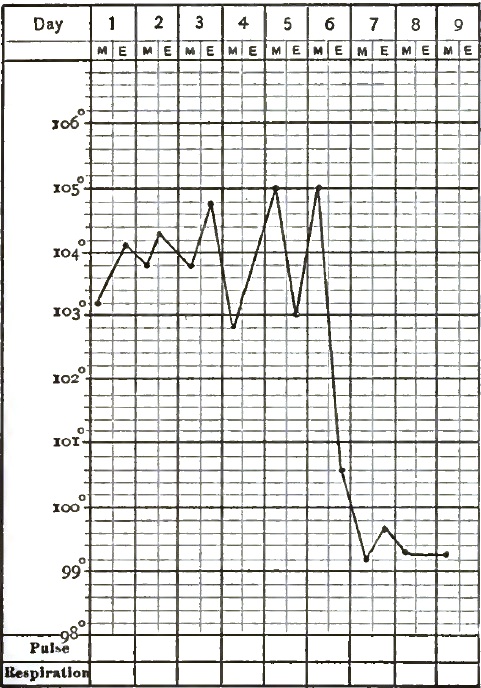
Acute Lobar (croupous) Pneumonia in a Child: Recovery.
FIG. 40.
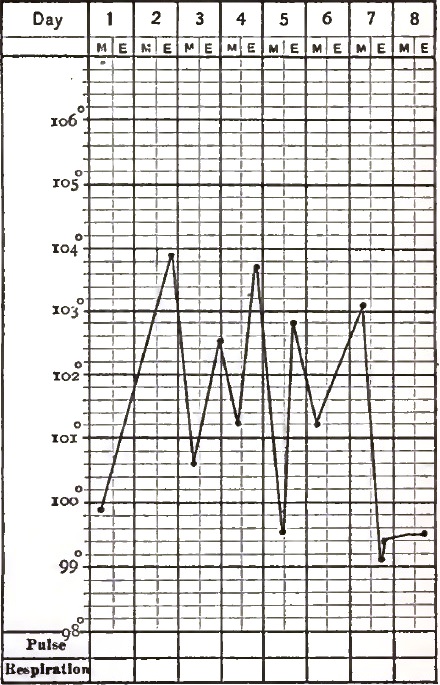
Acute Lobular (catarrhal) Pneumonia in a Child: Recovery.
Pulmonary apoplexy is rarely met with independent of valvular disease of the heart or pyæmia. It is a non-febrile disease, while pneumonia has marked pyrexia at the onset. In pulmonary apoplexy dyspnoea is very intense and comes on abruptly; in pneumonia it comes on slowly and progressively increases. The expectoration in pulmonary apoplexy consists of small, black sooty-looking coagula, while in pneumonia the viscid fibrinous mass contains numerous cell-elements other than blood-corpuscles. In apoplexy the dulness is distinctly circumscribed, and around it moist râles are heard, while in pneumonia the area of dulness is more extended and râles are heard over the seat of the dulness. The urinary symptoms are negative in pulmonary apoplexy; in acute pneumonia the chlorides are diminished or absent. There is a peculiar acid odor to the breath—an odor like that of tincture of horseradish—in pulmonary apoplexy, never found in pneumonia.47
47 Guéneau de Mussey.
When croupous pneumonia has its seat at the apex of the lung, it may be confounded with the first stage of phthisis. But the history of a chill followed by the characteristic pneumonic symptoms will generally enable one to make the differential diagnosis. Besides, the fever in phthisis is irregular and is subject to irregular exacerbations and remissions. If the signs of consolidation persist with little or no change, if the temperature at no time falls to normal, if there are night-sweats, if emaciation is progressive,—then the case is to be regarded as one of phthisis, even though there may have been pneumonic consolidation complicating it.
In children pneumonia is so frequently accompanied by marked nervous symptoms that it may be mistaken for meningitis. Meningitis is developed insidiously; has but slight febrile symptoms (102–103° F.), which remit with comparatively great regularity; has a pulse which is often slower than normal; has no thoracic symptoms, no dyspnoea nor accelerated breathing; the face is pale and anxious; and the physical signs of pneumonia are absent.