← Table of contents
A Review of Algebra

THE THEORY OF QUADRATIC EQUATIONS

Reading edition

I. To find the sum and the product of the roots.

The general quadratic equation is

(1)

Illustration from A Review of Algebra

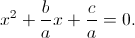
Or, (2)

Illustration from A Review of Algebra

To derive the formula, we have by transposing
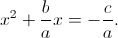
Illustration from A Review of Algebra

Completing the square,

Illustration from A Review of Algebra

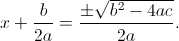
Extracting square root,

Illustration from A Review of Algebra

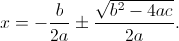
Transposing,

Illustration from A Review of Algebra

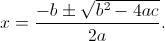
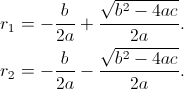
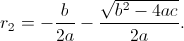
Hence,

Illustration from A Review of Algebra

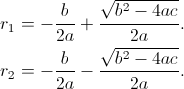
These two values of x we call roots. For convenience represent them by and

Illustration from A Review of Algebra

Hence,

Illustration from A Review of Algebra

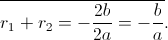
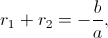
Adding, (3)

Illustration from A Review of Algebra

Also,

Illustration from A Review of Algebra

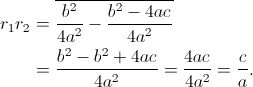
Multiplying, (4)

Illustration from A Review of Algebra

Hence we have shown that

Illustration from A Review of Algebra

and

Illustration from A Review of Algebra

Or, referring to equation (2) above, we have the following rule:

When the coefficient of is unity, the sum of the roots is the coefficient of x with the sign changed; the product of the roots is the independent term.

Illustration from A Review of Algebra

Examples:

1.

Illustration from A Review of Algebra

Sum of the roots

Illustration from A Review of Algebra

Products of the roots

Illustration from A Review of Algebra

2.

Illustration from A Review of Algebra

Sum of the roots

Illustration from A Review of Algebra

Product of the roots

Illustration from A Review of Algebra

3.

Illustration from A Review of Algebra

Sum of the roots

Illustration from A Review of Algebra

Product of the roots

Illustration from A Review of Algebra

II. To find the nature or character of the roots.

As before,
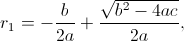
Illustration from A Review of Algebra

The determines the nature or character of the roots; hence it is called the discriminant.

Illustration from A Review of Algebra

If is positive, the roots are real, unequal, and either rational or irrational.

Illustration from A Review of Algebra

If is negative, the roots are imaginary and unequal.

Illustration from A Review of Algebra

If is zero, the roots are real, equal, and rational.

Illustration from A Review of Algebra

Examples:

1.

Illustration from A Review of Algebra

The roots are real, unequal, and irrational.

Illustration from A Review of Algebra

2.

Illustration from A Review of Algebra

The roots are imaginary and unequal.

Illustration from A Review of Algebra

3.

Illustration from A Review of Algebra

The roots are real, equal, and rational.

Illustration from A Review of Algebra

III. To form the quadratic equation when the roots are given.

Suppose the roots are 3, -7.

Then, Or,

Illustration from A Review of Algebra

Multiplying to get a quadratic,

Illustration from A Review of Algebra

Or,

Illustration from A Review of Algebra

Or, use the sum and product idea developed on the preceding page. The coefficient of must be unity.

Illustration from A Review of Algebra

Add the roots and change the sign to get the coefficient of x.

Multiply the roots to get the independent term.

The equation is

Illustration from A Review of Algebra

In the same way, if the roots are the equation is
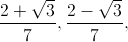
Illustration from A Review of Algebra

Find the sum, the product, and the nature or character of the roots of the following:

1.

Illustration from A Review of Algebra

2.

Illustration from A Review of Algebra

3.

Illustration from A Review of Algebra

4.

Illustration from A Review of Algebra

5.

Illustration from A Review of Algebra

6.

Illustration from A Review of Algebra

7.

Illustration from A Review of Algebra

8.

Illustration from A Review of Algebra

Form the equations whose roots are:

9. 5, -3.

10.

Illustration from A Review of Algebra

11.

Illustration from A Review of Algebra

12. -3, -5.

13.

Illustration from A Review of Algebra

14.

Illustration from A Review of Algebra

15.

Illustration from A Review of Algebra

16. Solve Check by substituting the values of x; then check by finding the sum and the product of the roots. Compare the amount of labor required in each case.

Illustration from A Review of Algebra

17. Solve

Illustration from A Review of Algebra

18. Is a perfect square?

Illustration from A Review of Algebra

19. Find the square root (short method):

Illustration from A Review of Algebra

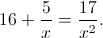
20. Solve

Illustration from A Review of Algebra

21. The glass of a mirror is 18 inches by 12 inches, and it has a frame of uniform width whose area is equal to that of the glass. Find the width of the frame.

Explore with AITake your curiosity a little further.

Reading settings