OUTLINE OF SIMULTANEOUS QUADRATICS
Reading edition
Simultaneous Quadratics
Case I.
One equation linear.
The other quadratic.
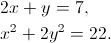
Method: Solve for x as in terms of y, or vice versa, in the linear and substitute in the quadratic.
Case II.
Both equations homogeneous and of the second degree.
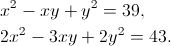
Method: Let and substitute in both equations.

Alternate Method: Solve for x in terms of y in one equation and substitute in the other.
Case III.
Any two of the quantities given.
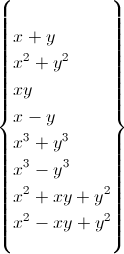
Method: Solve for and then add to get x, subtract to get y.


Case IV.
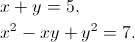
Both equations symmetrical or symmetrical except for sign. Usually one equation of high degree, the other of the first degree.
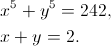
Method: Let and and substitute in both equations.


Special Devices
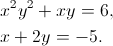
I. Consider some compound quantity like etc., as the unknown, at first. Solve for the compound unknown, and combine the resulting equation with the simpler original equation.


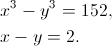
II. Divide the equations member by member. Then solve by Case I, II, or III.
III. Eliminate the quadratic terms. Then solve by Case I, II, or III.
