SIMULTANEOUS EQUATIONS
Reading edition
Note. Up to this point each topic presented has reviewed to some extent the preceding topics. For example, factoring reviews the special rules of multiplication and division; H. C. F. and L. C. M. review factoring; addition and subtraction of fractions and fractional equations review H. C. F. and L. C. M., etc. From this point on, however, the interdependence is not so marked, and miscellaneous examples illustrating the work already covered will be given very frequently in order to keep the whole subject fresh in mind.
1. Solve by three methods—addition and subtraction, substitution, and comparison:
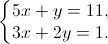
Solve and check:
2.
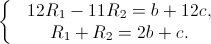
3.
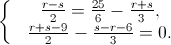
4. One half of A's marbles exceeds one half of B's and C's together by 2; twice B's marbles falls short of A's and C's together by 16; if C had four more marbles, he would have one fourth as many as A and B together. How many has each? (College Entrance Board.)
5. The sides of a triangle are a, b, c. Calculate the radii of the three circles having the vertices as centers, each being tangent externally to the other two. (Harvard.)
6. Solve graphically; then solve algebraically and compare results. (Use coördinate or squared paper.)

Factor:
7.

8.

9.

References: The chapters on Simultaneous Equations and Graphs in any algebra.