CASES IN FACTORING
Reading edition
The number of terms in an expression usually gives the clue to the possible cases under which it may come. By applying the test for each and eliminating the possible cases one by one, the right case is readily found. Hence, the number of terms in the expression and a ready and accurate knowledge of the Cases in Factoring are the real keys to success in this vitally important part of algebra.
Case I. A common monomial factor. Applies to any number of terms.

Case II. A trinomial that is a perfect square. Three terms.

Case III. The difference of two squares.
A. Two terms.

B. Four terms.

C. Six terms.

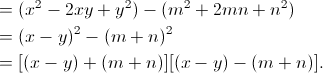
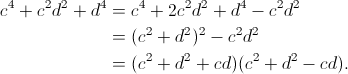
D. An incomplete square. Three terms, and 4th powers or multiples of 4.
Case IV. A trinomial of the form Three terms.


Case V. A trinomial of the form Three terms.


Case VI.
A. The sum or difference of two cubes. Two terms.


B. The sum or difference of two like powers. Two terms.


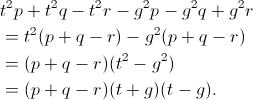
Case VII. A common polynomial factor. Any composite number of terms.
Case VIII. The Factor Theorem. Any number of terms.
