OUTLINE OF ELEMENTARY AND INTERMEDIATE ALGEBRA
Reading edition
Important Definitions
Factors; coefficient; exponent; power; base; term; algebraic sum; similar terms; degree; homogeneous expression; linear equation; root of an equation; root of an expression; identity; conditional equation; prime quantity; highest common factor (H. C. F.); lowest common multiple (L. C. M.); involution; evolution; imaginary number; real number; rational; similar radicals; binomial surd; pure quadratic equation; affected quadratic equation; equation in the quadratic form; simultaneous linear equations; simultaneous quadratic equations; discriminant; symmetrical expression; ratio; proportion; fourth proportional; third proportional; mean proportional; arithmetic progression; geometric progression;

Special Rules for Multiplication and Division
1. Square of the sum of two quantities.

2. Square of the difference of two quantities.

3. Product of the sum and difference of two quantities.

4. Product of two binomials having a common term.

5. Product of two binomials whose corresponding terms are similar.

6. Square of a polynomial.
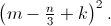
7. Sum of two cubes.
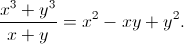
8. Difference of two cubes.
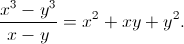
9. Sum or difference of two like powers.


Cases in Factoring
1. Common monomial factor.

2. Trinomial that is a perfect square.

3. The difference of two squares.
(a) Two terms.

(b) Four terms.

(c) Six terms.

(d) Incomplete square.

4. Trinomial of the form


5. Trinomial of the form


6. Sum or difference of
two cubes. See "Special Rules," 7 and 8.
two like powers. See "Special Rules," 9.
7. Common polynomial factor. Grouping.

8. Factor Theorem.

H. C. F. and L. C. M.



H. C. F.

L. C. M.

Fractions
Reduction to lowest terms.
Reduction of a mixed number to an improper fraction.
Reduction of an improper fraction to a mixed number.
Addition and subtraction of fractions.
Multiplication and division of fractions.
Law of signs in division, changing signs of factors, etc.
Complex fractions.
Simultaneous Equations
Solved by
addition or subtraction.
substitution.
comparison.
Graphical representation.
Involution
Law of signs.
Binomial theorem laws.
Expansion of
monomials and fractions.
binomials.
trinomials.
Evolution
Law of signs.
Evolution of monomials and fractions.
Square root of algebraic expressions.
Square root of arithmetical numbers.
Optional
Cube root of algebraic expressions.
Cube root of arithmetical numbers.
Theory of Exponents
Proofs:






Meaning of
fractional exponent.
zero exponent.
negative exponent.
Four rules
To multiply quantities having the same base, add exponents.
To divide quantities having the same base, subtract exponents.
To raise to a power, multiply exponents.
To extract a root, divide the exponent of the power by the index of the root.
Radicals
Radical in its simplest form.
Transformation of radicals
Fraction under the radical sign.
Reduction to an entire surd.
Changing to surds of different order.
Reduction to simplest form.
Addition and subtraction of radicals.
Multiplication and division of radicals


Rationalization
Monomial denominator.
Binomial denominator.
Trinomial denominator.
Square root of a binomial surd.
Radical equations. Always check results to avoid extraneous roots.
Quadratic Equations
Pure.

Affected.

Methods of solving
Completing the square.
Formula. Developed from
Factoring.
Equations in the quadratic form.
Properties of quadratics


Then
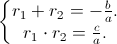
Discriminant, and its discussion.

Nature or character of the roots.
Simultaneous Quadratics
Case I.
One equation linear.
The other quadratic.
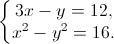
Case II.
Both equations homogeneous and of the second degree.
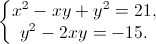
Case III.
Any two of the quantities etc., given.



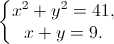
Case IV.
Both equations symmetrical or symmetrical except for sign. Usually one equation of high degree, the other of the first degree.
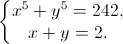
Case V. Special Devices
I. Solve for a compound unknown, like etc., first.

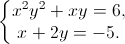
II. Divide the equations, member by member.
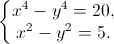
III. Eliminate the quadratic terms.
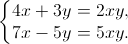
Ratio and Proportion
Proportionals
mean,
third,
fourth.
Theorems
Product of means equals product of extremes.
If the product of two numbers equals the product of two other numbers, either pair, etc.
Alternation.
Inversion.
Composition.
Division.
Composition and division.
In a series of equal ratios, the sum of the antecedents is to the sum of the consequents as any antecedent, etc.
Special method of proving four quantities in proportion. Let etc.


Progressions
Development of formulas.
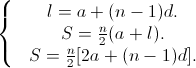
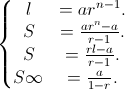
Insertion of means
Arithmetical.
Geometrical.
Binomial Theorem
Review of binomial theorem laws. See Involution.
Expansion of

Finding any term by
key number method.
or term method.

