Chapter XXXI · GAYÂ. ŚÂKYAMUNI’S ATTAINING TO THE BUDDHASHIP; AND OTHER LEGENDS.
James Legge translation
[Chinese]
At the place mentioned above of the six years’ painful austerities, and at all these other places, men subsequently reared topes and set up images, which all exist at the present day.
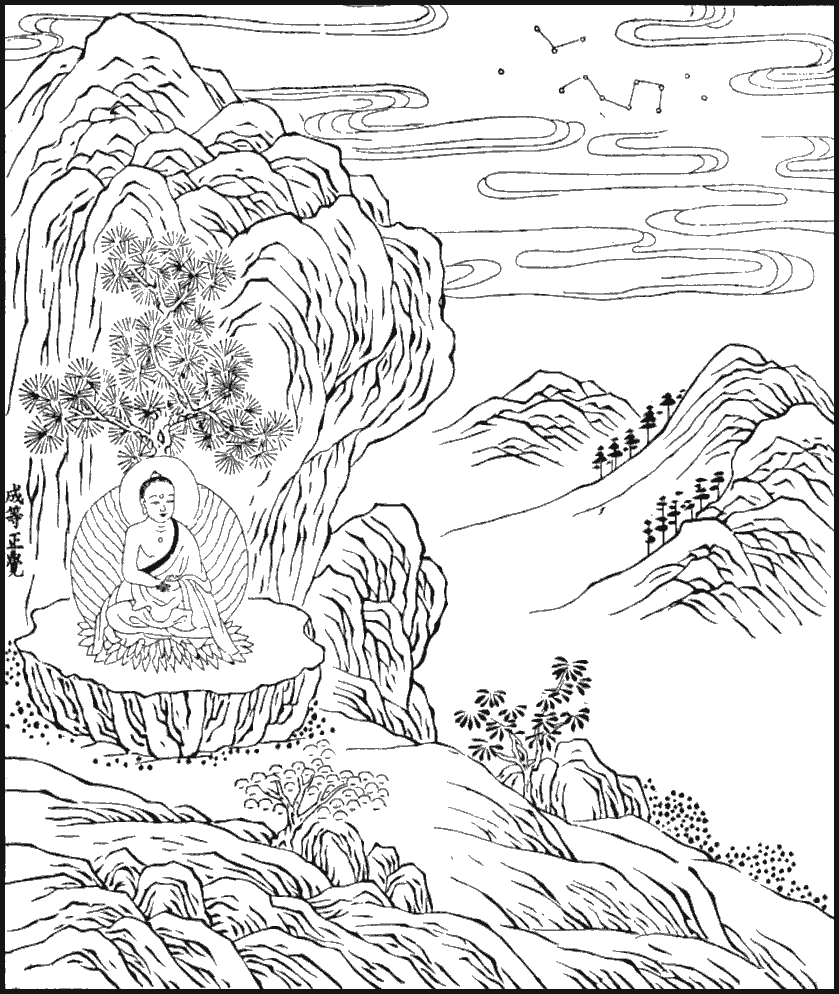
V. BUDDHASHIP ATTAINED.
Notes in this chapter
Note 1 · Gayâ, a city of Magadha, was north-west of the present Gayah (lat. 24° 47′ N., lon. 85° 1′ E). It was here that Śâkyamuni lived for seven yeNote 2 · This is told so as to make us think that he was in danger of being drowned; but this does not appear in the only other account of the incideNote 3 · An incident similar to this is told, with many additions, in Hardy’s M. B., pp. 166–168; ‘The Life of the Buddha,’ p. 30; and the ‘Buddhist Note 4 · Called ‘the tree of leaves,’ and ‘the tree of reflection;’ a palm tree, the borassus flabellifera, described as a tree which never loses itsNote 5 · The kuśa grass, mentioned in a previous note.Note 6 · See the account of this contest with Mâra in M. B., pp. 171–179, and ‘Buddhist Birth Stories,’ pp. 96–101.Note 7 · See chap. xiii, note 7.Note 8 · Called also Mahâ, or the Great Muchilinda. Eitel says: ‘A nâga king, the tutelary deity of a lake near which Śâkyamuni once sat for seven daNote 9 · This was Brahmâ himself, though ‘king’ is omitted. What he requested of the Buddha was that he would begin the preaching of his Law. Nidâna Note 10 · See chap. xii, note 10.Note 11 · The other accounts mention only two; but in M. B., p. 182, and the Nidâna Kathâ, p. 110, these two have 500 well-laden wagons with them.Note 12 · These must not be confounded with Mahâkaśyapa of chap. xvi, note 17. They were three brothers, Uruvilvâ, Gayâ, and Nadî-Kâśyapa, up to this Note 13 · This seems to be the meaning; but I do not wonder that some understand the sentence of the benevolence of the monkish population to the travNote 14 · From this place, after travelling to the west for four yojanas, (the pilgrims) came to the city of Gayâ;1 but inside the city all was emptinNote 15 · Three le west from here they came to the place where, when Buddha had gone into the water to bathe, a deva bent down the branch of a tree, bNote 16 · Two le north from this was the place where the Grâmika girls presented to Buddha the rice-gruel made with milk;3 and two le north from this Note 17 · Half a yojana from this place to the north-east there was a cavern in the rocks, into which the Bodhisattva entered, and sat cross-legged wiNote 18 · Where Buddha, after attaining to perfect wisdom, for seven days contemplated the tree, and experienced the joy of vimukti;7 where, under theNote 19 · At the place where Buddha attained to perfect Wisdom, there are three monasteries, in all of which there are monks residing. The families of