Chapter XXII · KAPILAVASTU. ITS DESOLATION. LEGENDS OF BUDDHA’S BIRTH, AND OTHER INCIDENTS IN CONNEXION WITH IT.
James Legge translation
[Chinese]
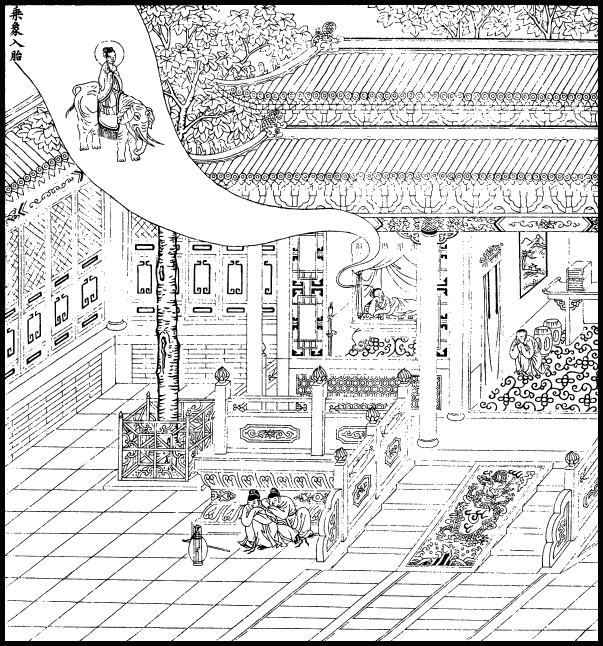
I. DREAM OF BUDDHA’S MOTHER OF HIS REINCARNATION.
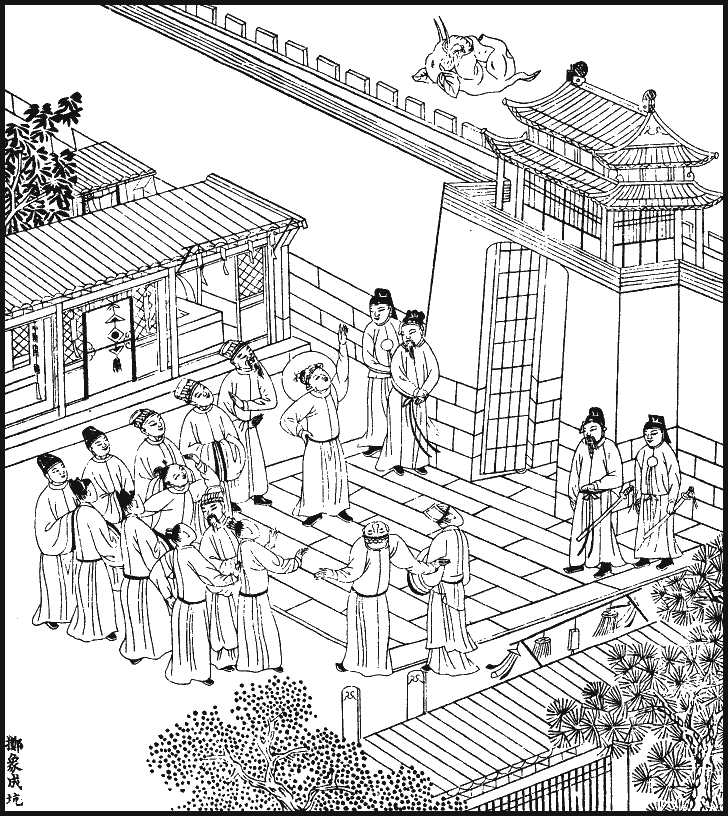
III. BUDDHA TOSSING THE ELEPHANT OVER THE WALL.
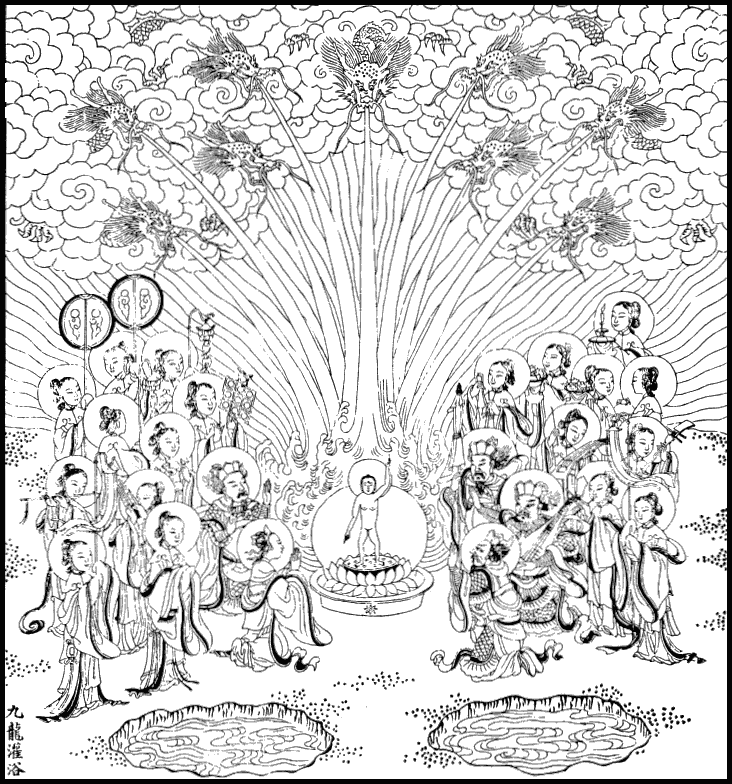
II. BUDDHA JUST BORN, WITH THE NÂGAS SUPPLYING WATER TO WASH HIM.
Notes in this chapter
Note 1 · Kapilavastu, ‘the city of beautiful virtue,’ was the birthplace of Śâkyamuni, but was destroyed, as intimated in the notes on last chapter, Note 2 · The father, or supposed father, of Śâkyamuni. He is here called ‘the king white and pure’ (白淨王). A more common appellation is ‘the king of pNote 3 · The ‘eldest son,’ or ‘prince’ was Śâkyamuni, and his mother had no other son. For ‘his mother,’ see chap. xvii, note 3. She was a daughter oNote 4 · In ‘The Life of the Buddha,’ p. 15, we read that ‘Buddha was now in the Tushita heaven, and knowing that his time was come (the time for hisNote 5 · In Hardy’s M. B., pp. 154, 155, we read, ‘As the prince (Siddhârtha, the first name given to Śâkyamuni; see Eitel, under Sarvârthasiddha) waNote 6 · This is an addition of my own, instead of ‘There are also topes erected at the following spots,’ of former translators. Fâ-hien does not sayNote 7 · Asita; see Eitel, p. 15. He is called in Pâli Kalâ Devala, and had been a minister of Śuddhodana’s father.Note 8 · See chap. xiii, note 12.Note 9 · In ‘The Life of Buddha’ we read that the Lichchhavis of Vaiśâlî had sent to the young prince a very fine elephant; but when it was near KapiNote 10 · The young Śâkyas were shooting when the prince thus surpassed them all. He was then seventeen.Note 11 · See chap. xx, note 20.Note 12 · This was not the night when he finally fled from Kapilavastu, and as he was leaving the palace, perceiving his sleeping father, and said, ‘FNote 13 · They did this, I suppose, to show their humility, for Upâli was only a Śûdra by birth, and had been a barber; so from the first did BuddhismNote 14 · I have not met with the particulars of this preaching.Note 15 · Meaning, as explained in Chinese, ‘a tree without knots;’ the ficus Indica. See Rhys Davids’ note, Manual, p. 39, where he says that a brancNote 16 · See chap. xiii, note 11. I have not met with the account of this presentation. See the long account of Prajâpatî in M. B., pp. 306–315.Note 17 · See chap. xx, note 10. The Śrotâpannas are the first class of saints, who are not to be reborn in a lower sphere, but attain to nirvâṇa afteNote 18 · See the account of this event in M. B., p. 150. The account of it reminds me of the ploughing by the sovereign, which has been an institutioNote 19 · ‘The place of Liberation;’ see chap. xiii, note 7.Note 20 · See the accounts of this event in M. B., pp. 145, 146; ‘The Life of the Buddha,’ pp. 15, 16; and ‘Buddhist Birth Stories,’ p. 66.Note 21 · There is difficulty in construing the text of this last statement. Mr. Beal had, no doubt inadvertently, omitted it in his first translationNote 22 · See chap. xvii, note 8. See also Davids’ Manual, p. 45. The latter says, that ‘to turn the wheel of the Law’ means ‘to set rolling the royalNote 23 · Fâ-hien does not say that he himself saw any of these white elephants, nor does he speak of the lions as of any particular colour. We shall Note 24 · Less than a yojana to the east from this brought them to the city of Kapilavastu;1 but in it there was neither king nor people. All was mounNote 25 · Several le north-east from the city was the king’s field, where the heir-apparent sat under a tree, and looked at the ploughers.18Note 26 · Fifty le east from the city was a garden, named Lumbinî,19 where the queen entered the pond and bathed. Having come forth from the pond on tNote 27 · There are four places of regular and fixed occurrence (in the history of) all Buddhas:—first, the place where they attained to perfect WisdoNote 28 · The country of Kapilavastu is a great scene of empty desolation. The inhabitants are few and far between. On the roads people have to be on