Chapter IV · WITH THE JAPANESE IN KOREA
Reading edition
Having secured a safe landing-place at Chemulpo, Japan poured troops into Korea and along the old Peking Road through Seoul to Ping-Yang and on to the northward toward the Yalu. Russia abandoned all hope of effective aggression by sea with her crippled fleet, and, except for the elusive Vladivostok squadron of four powerful cruisers, Japan was free to rush her troops into Korea. Russia bent all her energies toward hurrying her levies and supplies into Manchuria. Seoul was occupied and the Russian minister invited to leave. He complied at once.
Moving at the rapid pace of from fifteen to twenty-five miles a day, the mobile Japanese pushed on to Ping-Yang. No opposition was met with, the native Koreans staring dumbly at the invaders without much curiosity and with no desire to make resistance. The march from Seoul to Ping-Yang was made along the ancient road to Peking, which was a quagmire most of the distance, crowded with cavalry, infantry, pack-trains, bullock-carts, and long trains of white-clad natives burdened with bags of provisions, plodding knee-deep through slush and mud. Half-frozen at night, stumbling and slipping all day, each soldier carrying sixty pounds of equipment, this infantry column swept along at a speed of from fifteen to twenty-five miles a day. That such speed was possible was due to the lightness of the Japanese baggage and wagon equipment, which had been specially prepared for the heavy Korean and Manchurian roads.
It was apparent even to casual observers that immense military operations were under way, yet the civilized world was wholly in ignorance of their scope or direction. On February 15, for example, scores of crowded transports were leaving the Japanese naval bases, and a small army of alert correspondents from the world over could only guess whether these thousands of troops were going to Korea, to the Yalu region, or within a hundred miles of the Liaotung Peninsula. While the Japanese troops were pushing northward, the advance guard of the Russian army crossed the Yalu into Korean territory and occupied Wiju. The Russian headquarters were established at Harbin, the chief strategic centre of railway communication in inland Manchuria.
Chenampo is one hundred and thirty miles north of Chemulpo on Korea Bay, and correspondingly nearer to the Yalu. Early in April, after the troops which had landed at Chemulpo two months before had completed their arduous march northward through the Korean Peninsula, and had captured the town of Wiju, on the east bank of the Yalu River, what was known as the main army, under General Kuroki, landed from transports at Chenampo. The success of the advance column had given the Japanese control of the mouth of the Yalu before Kuroki began to mobilize his co-operating columns, and two forces were thus ready by the end of April to force the passage of the Yalu and fight their way into Manchuria.
56
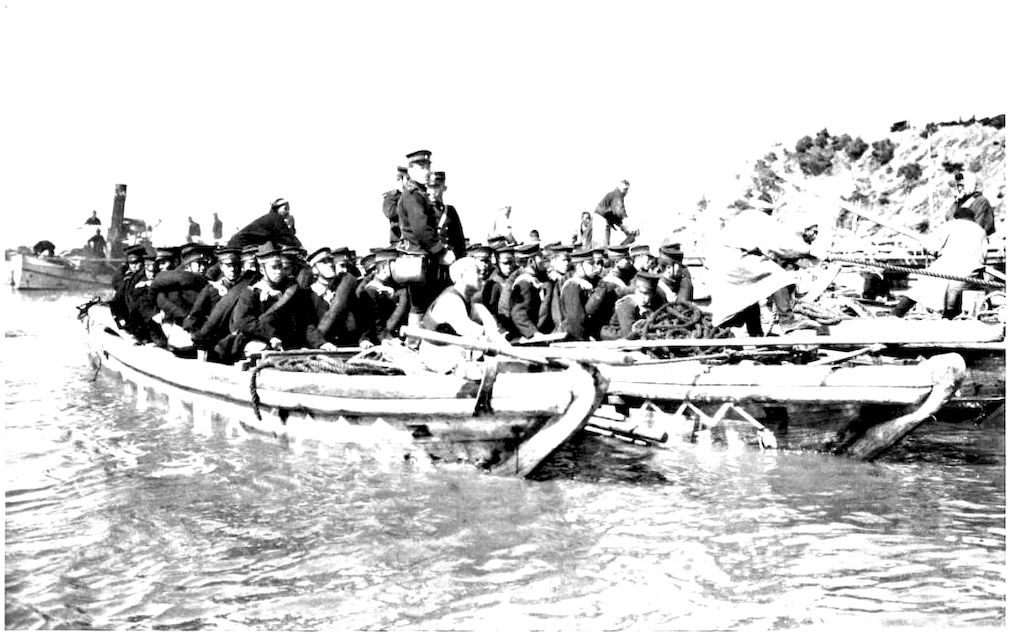
LANDING THE MEN WHO FOUGHT AT THE YALU
The Japanese troops were ferried from the transports to the shore at Chenampo in heavy, blunt-nosed sampans. These sampans are sculled from the stern ordinarily with huge sweeps. The boatmen can be seen over the heads of the seated soldiers, standing over their sweeps like gondoliers. At Chenampo the sampans were in most cases lashed together in groups of three or four and towed by tugs
57
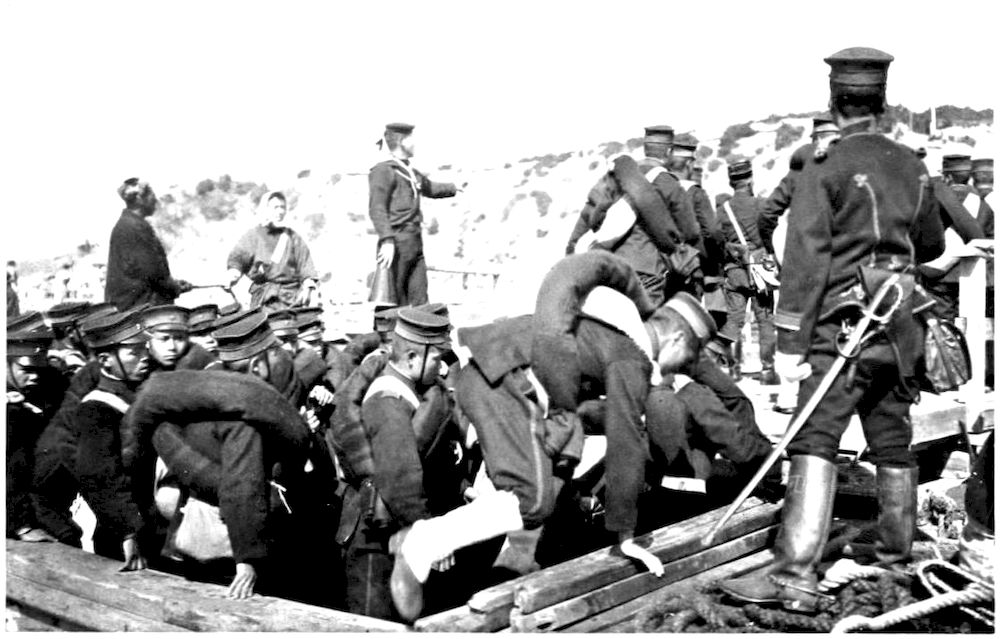
ARTILLERYMEN IN HEAVY MARCHING ORDER LANDING AT CHENAMPO
58
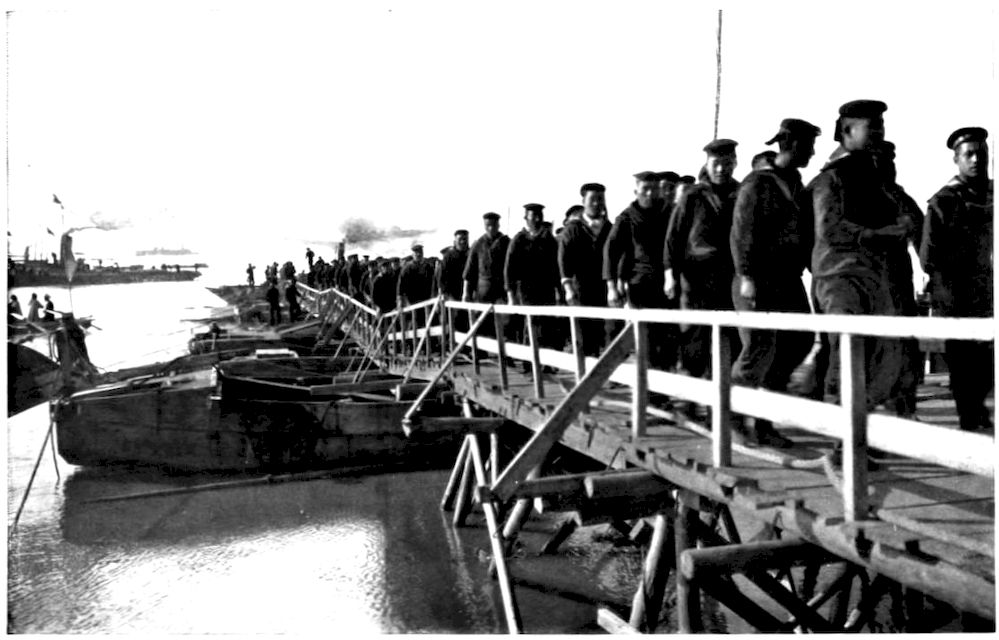
JAPANESE BLUEJACKETS COMING ASHORE AT CHENAMPO
59
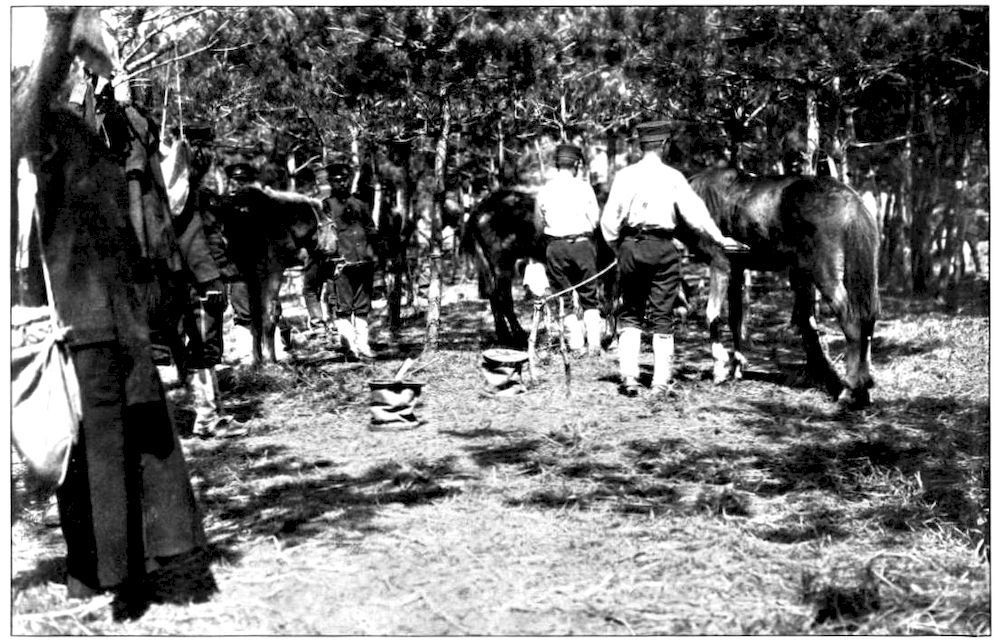
GROOMING CAVALRY HORSES AT CHENAMPO AFTER LANDING THEM FROM TRANSPORTS
60
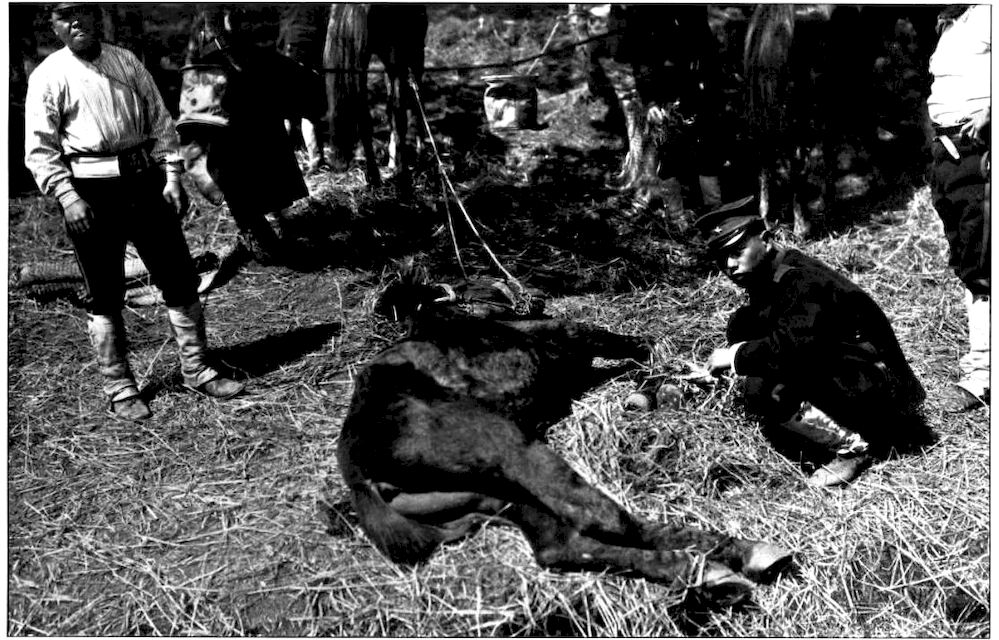
JAPANESE TROOPERS CARING FOR A SICK HORSE
61
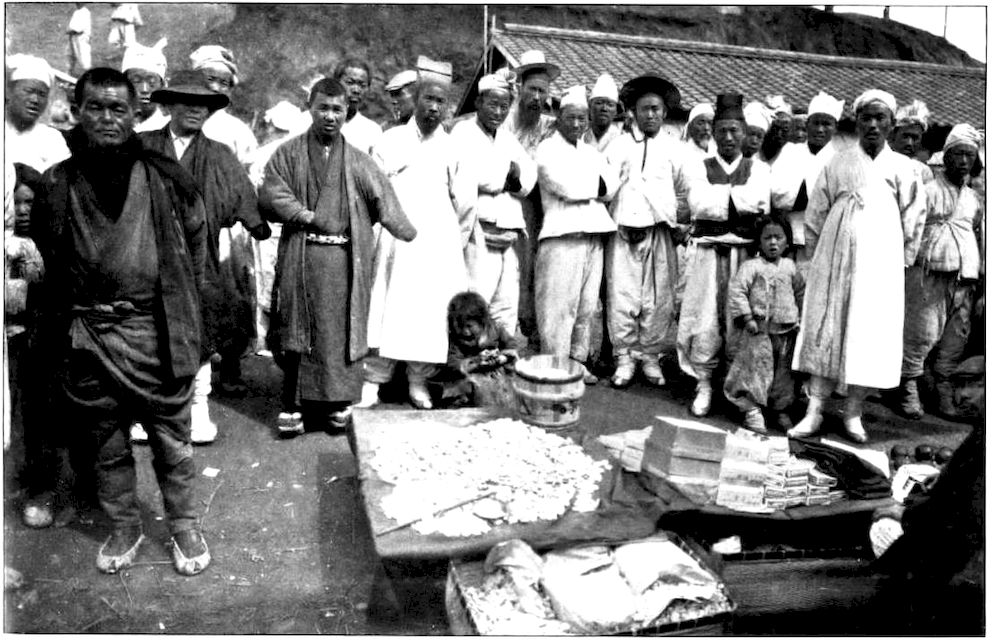
KOREANS AND JAPANESE SALESMAN AT CHENAMPO
The lone Japanese pedler is shown at lower right-hand corner of the picture sitting behind his wares. The men at the left of the picture are not armless, as it might appear, but have their arms inside their kimonos, as is their habit on cold days. The march of the Japanese through their country and the whole excitement of war stirred the placid Koreans to little more unrest than they show here
62
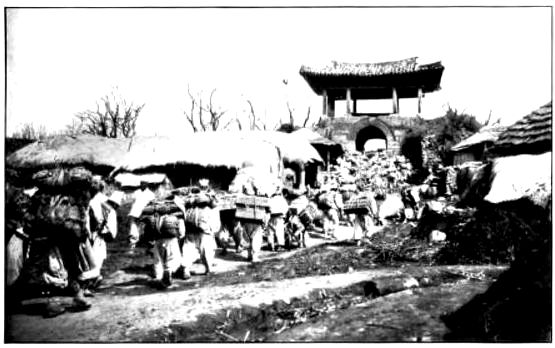
KOREAN COOLIES CARRYING RICE AND BEEF FOR JAPANESE ARMY
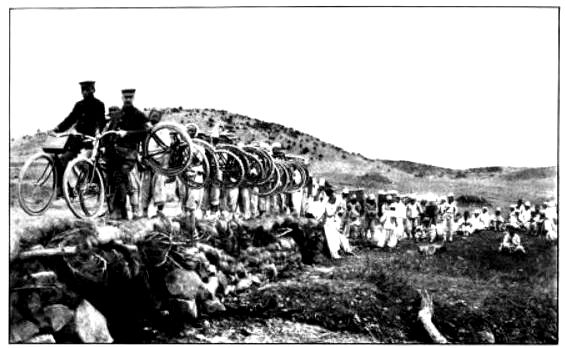
BRINGING LUMBER INTO WIJU FOR BRIDGING THE YALU
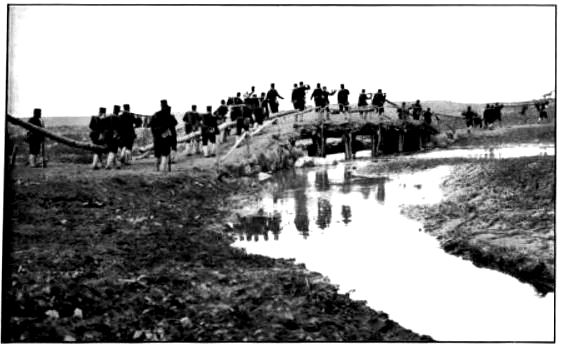
COLLIER’S PHOTOGRAPHER AND COOLIES WITH MILITARY BICYCLES
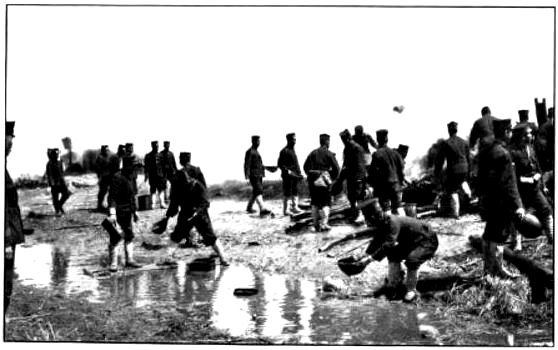
JAPANESE EXTINGUISHING FIRE CAUSED BY RUSSIAN SHRAPNEL
WITH THE JAPANESE ON THE ADVANCE TO THE YALU
63
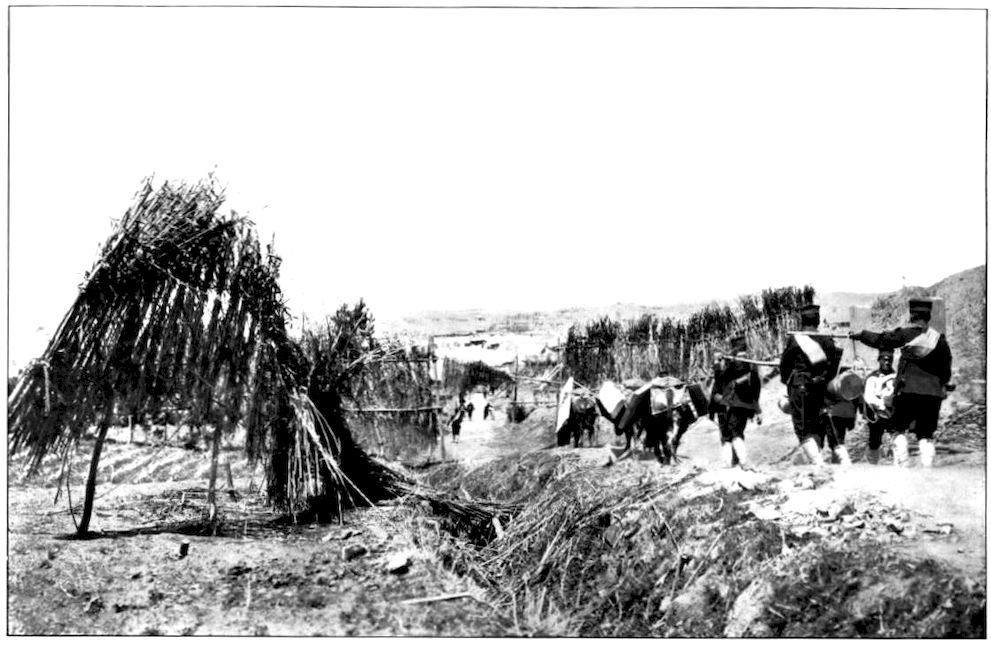
SCREENS WHICH HID THE MOVEMENTS OF THE JAPANESE
General Kuroki not only misled the Russians as to the point at which he would probably cross the Yalu, but masked the march of his forces to the point north of the Wiju, where the crossing was made, by these grass screens and by marching behind hills. The Russians knew that some movement was going on, but could not make out the extent of it
64
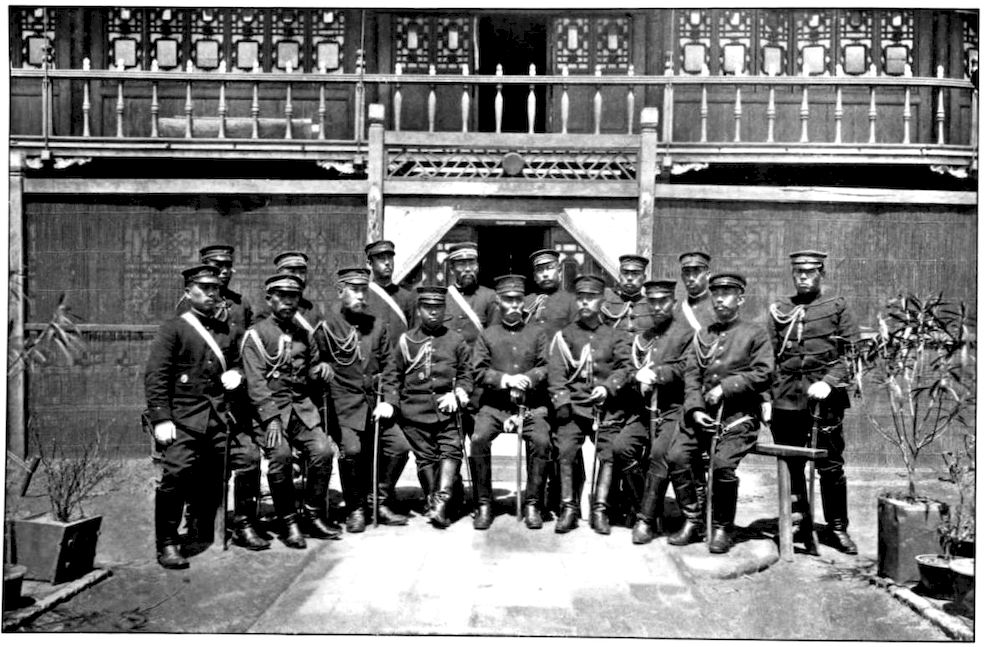
GENERAL KUROKI AND HIS STAFF AT THEIR FIELD HEADQUARTERS IN ANTUNG
On the left of General Kuroki sits General Fuji, his chief of staff, on the right Prince Kuni. Next to Prince Kuni is Colonel Hageno, the Russian scholar of the staff. One of Kuroki’s absolute prohibitions to correspondents was the mention either of the general’s name or of the place from which they wrote, lest news of the army’s location should be brought to the Russians
65