ANTIENT HEROES.
Reading edition
Καθολου δε φασιν (ὁι Αιγυπτιοι) τους Ἑλληνας εξιδιαζεσθαι τους επιφανεστατους Ἡρωας τε, και Θεους, ετι δε και αποικιας τας παρ' ἑαυτων. Diodorus Sicul. l. 1. p. 21.
It has been my uniform purpose, during the whole process, which I have made in my system, to shew, that the Grecians formed Deities out of titles; and that they often attributed to one person, what belonged to a people. And when they had completed the history, they generally took the merit of it to themselves. By means of this clue we may obtain an insight into some of the most remote, and the most obscure parts of antiquity. For many and great achievements have been attributed to heroes of the first ages, which it was not possible for them singly to have performed. And these actions, though in some degree diversified, and given to different personages, yet upon examination will be found to relate to one people or family; and to be at bottom one and the same history.
OSIRIS.
PERSEUS.
Acrisioneïs Danäe fundâsse colonis.
Gentis Achæmeniæ ritu; seu præstat Osirin
Frugiferum; seu Persëi sub rupibus antri
Indignata sequi torquentem cornua Mithram.
OF MYRINA,
AND THE
AMAZONIANS OF LIBYA.
Εν πεδιῳ απανευθε, περιδρομος ενθα και ενθα·
Την ητοι ανδρες Βατιειαν κικλησκουσιν,
Αθανατοι δε τε σημα πολυσκαρθμοιο Μυρινης.
The tomb of this heroïne was in reality a sacred mound, or high altar; and Myrina a Gentile divinity. In her supposed conquests we may in great measure see the history of Osiris, and Perseus, reversed, and in some degree abridged; yet not so far varied, but that the purport may be plainly discerned. Indeed there is no other way to obtain the hidden meaning, but by collating the different histories, and bringing them in one view under the eye of the reader.
HERCULES.
DIONUSUS.
These accounts I have collated, and brought in succession to one another; that we may at a view see the absurdity of the history, if taken in the common acceptation. And however numerous my instances may have been, I shall introduce other examples before I quit the subject. I must particularly speak of an Egyptian hero, equally ideal with those abovementioned; whose history, though the most romantic and improbable of any, has been admitted as credible and true. The person to whom I allude, is the celebrated Sesostris. Most of the antient historians speak of his great achievements; and the most learned of the modern chronologists have endeavoured to determine his æra, and point out the time of his reign. But their endeavours have been fruitless; and they vary about the time when he lived not less than a thousand years: nay, some differ even more than this in the æra, which they assign to him.
SESOSTRIS.
μυρια δ' αστη Νασσατ' εποιχομενος.
He represents him as conquering all Asia and Europe; and this in times so remote, that many of the cities which he built, were in ruins before the æra of the Argonauts.
NINUS and SEMIRAMIS.
Assyriis mentita virum, ne vocis acutæ
Mollities, levesque genæ se prodere possent,
Hos sibi junxisset socios: seu Parthica ferro
Luxuries nasci vetuit lanuginis umbram;
Servatosque diu puerili flore coegit
Arte retardatam Veneri servire juventam.
In respect to Semiramis I do not see how this expedient could avail. She might just as well have dressed up her maids in mens clothes, and with less trouble. In short the whole of these histories in their common acceptation is to the last degree absurd, and improbable: but if we make use of an expedient, which I have often recommended, and for a person substitute a people, we shall find, when it is stripped of its false colouring, that there is much truth in the narration.
ZOROASTER.
The celebrated Zoroaster seems to have been a personage as much mistaken, as any, who have preceded. The antients, who treated of him, have described him in the same foreign light, as they have represented Perseus, Dionusus, and Osiris. They have formed a character, which by length of time has been separated, and estranged, from the person, to whom it originally belonged. And as among the antients, there was not a proper uniformity observed in the appropriation of terms, we shall find more persons than one spoken of under the character of Zoroaster: though there was one principal, to whom it more truly related. It will be found, that not only the person originally recorded, and reverenced; but others, by whom the rites were instituted and propagated, and by whom they were in aftertimes renewed, have been mentioned under this title: Priests being often denominated from the Deity, whom they served.
[1001]DEÆ SURIÆ SUB CALPURNIO LEG. AUG. &c.
Syria is called Sour, and Souristan, at this day.
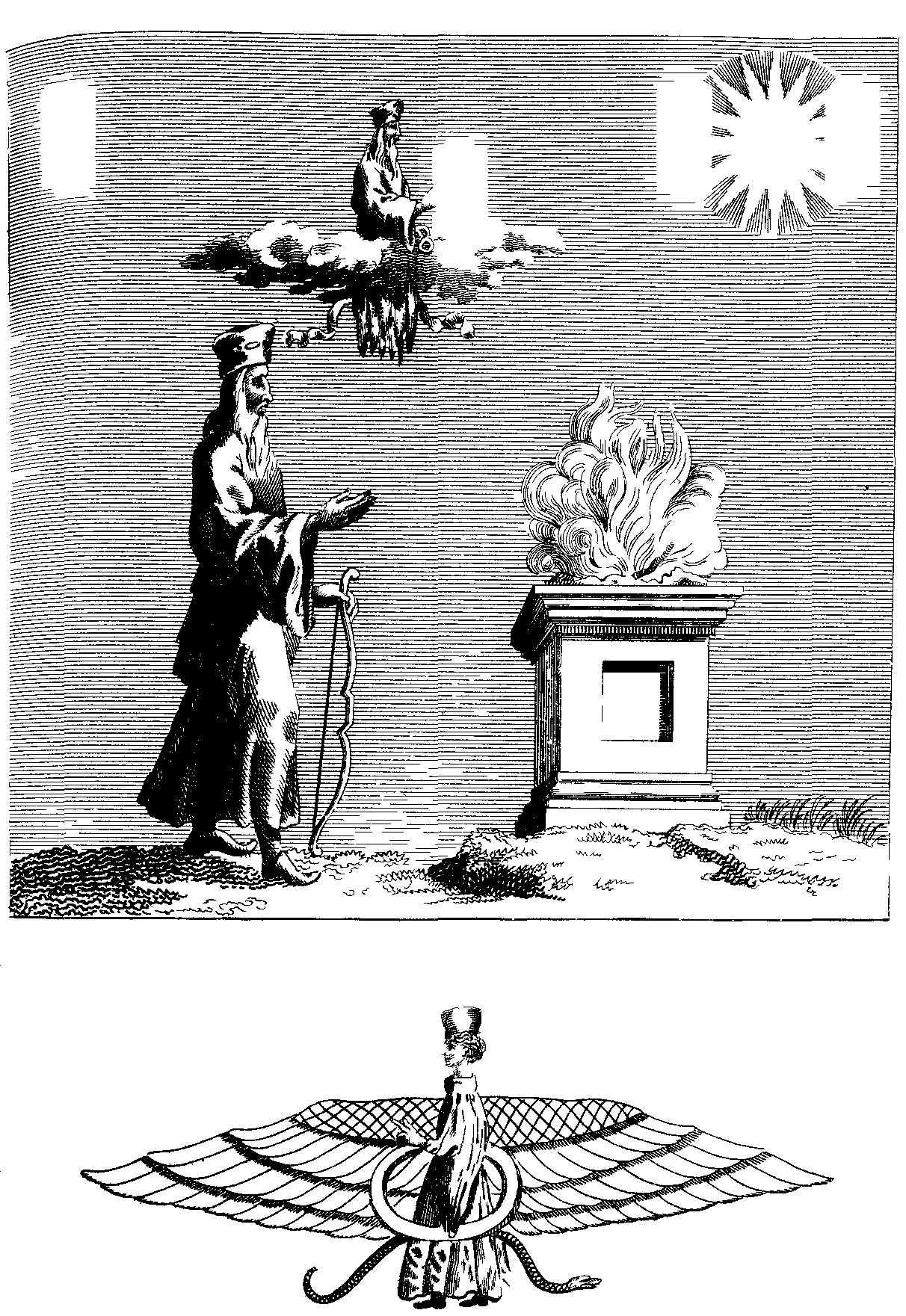
Pl. XI. Deus Azon Persicus.
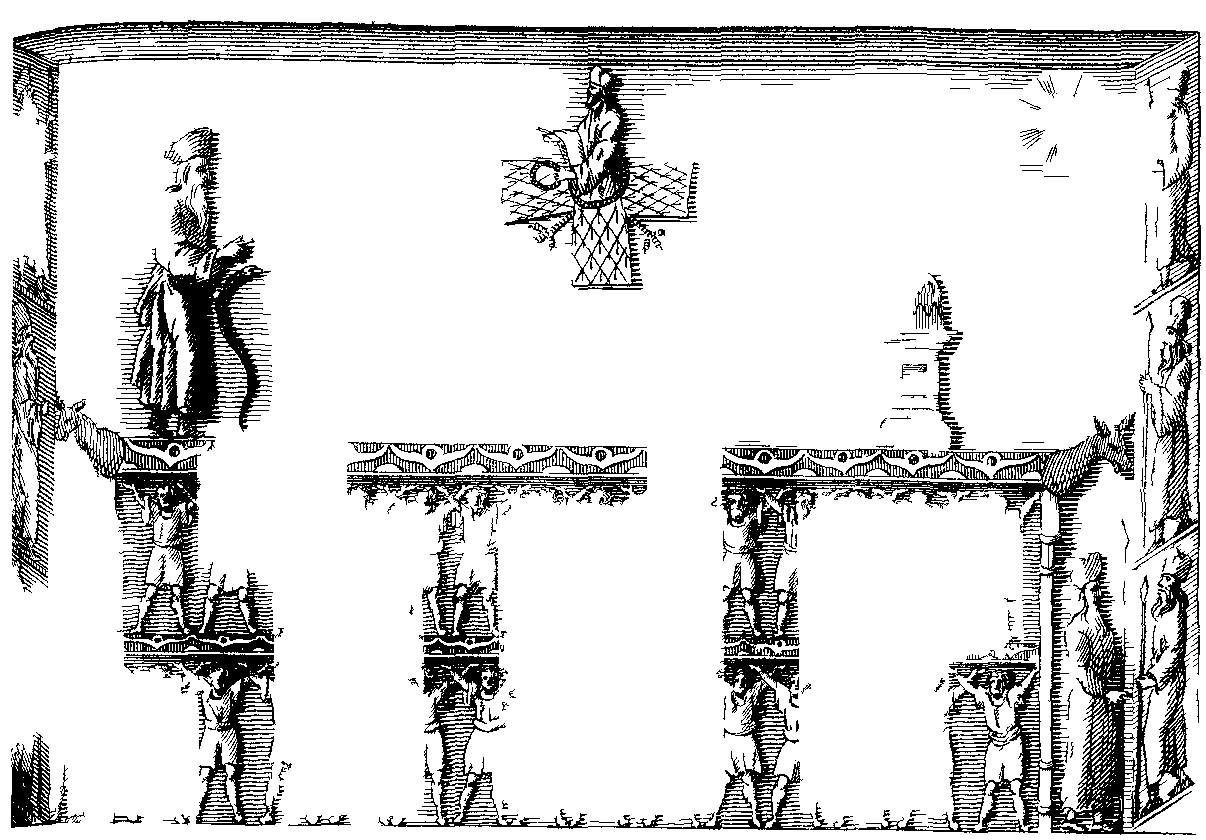
Pl. XII. Apud Kæmpferum in Amœnitat. Exot. p. 312
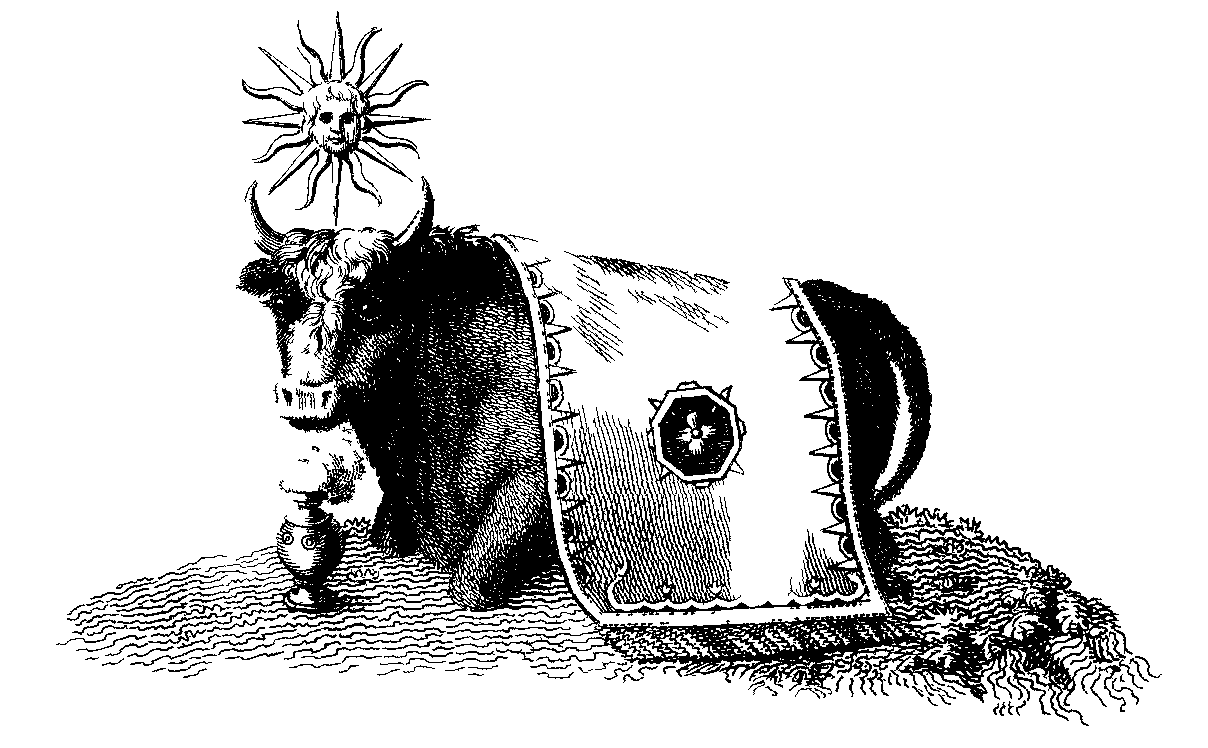
Zor-Aster, sive Taurus Solaris Ægyptiacus
ORPHEUS.
The character of Orpheus is in some respects not unlike that of Zoroaster, as will appear in the sequel. He went over many regions of the earth; and in all places, whither he came, was esteemed both as a priest, and a prophet. There seems to be more in his history than at first sight appears: all which will by degrees be unfolded. His skill in harmony is represented as very wonderful: insomuch that he is said to have tamed the wild beasts of the forest, and made the trees follow him. He likewise could calm the winds, and appease the raging of the sea. These last circumstances are taken notice of by a poet in some fine verses, wherein he laments his death.
Ου νιφετων συρμους, ου παταγευσαν ἁλα.
Ωλεο γαρ. κλ.
Αιγυπτῳ, Λιβυῃ τε, βροτοις ανα θεσφατα φαινων.
In teneros transferre mares: citraque juventam
Ætatis breve ver, et primos carpere flores.
CADMUS.
Αιγυπτιης σοφιης μεταναστιος, ημος Αγηνωρ
Μεμφιδος ενναετης ἑκατομπυλον ῳκεε Θηβην.
Δωμησας πολιων ἑκατονταδα.
Some of these cities seem to have been situated far west in the remoter parts of Africa.
Αγχινεφη ναιοντες Αλημονος αστεα Καδμου.
Ισσῃ φυτευσαι δυσμενων ποδηγετην.
Πρωτογονοιο Φανητος επιγραφε μαντιπολος χειρ.
The first of them is said to have been coeval with the world.
Ειν ἑνι παντα φερουσαν, ὁσα σκηπτουχος Οφιων
Ηνυσεν.
[1140]Malacæ Hispaniæ. MARTI CIRADINO TEMPLUM COMMUNI VOTO ERECTUM.
I may possibly be thought to proceed too far in abridging history of so many heroic personages, upon whose names antiquity has impressed a reverence; and whose mighty actions have never been disputed. For though the dress and colouring may have been thought the work of fancy, yet the substance of their history has been looked upon as undeniably true. To which I answer, that it was undoubtedly founded in truth: and the only way to ascertain what is genuine, must be by stripping history of this unnatural veil, with which it has been obscured; and to reduce the whole to its original appearance. This may be effected upon the principles which I have laid down; for if instead of Perseus, or Hercules, we substitute bodies of men, who went under such titles, the history will be rendered very probable, and consistent. If instead of one person, Cadmus traversing so much ground, and introducing the rites of his country at Rhodes, Samos, Thera, Thasus, Samothrace, and building so many cities in Libya, we suppose these things to have been done by colonies, who were styled Cadmians, all will be very right, and the credibility of the history not disputed. Many difficulties may by these means be solved, which cannot otherwise be explained: and great light will be thrown upon the mythology of the antients.
Μαστευεις τινα Ταυρον, ὁν ου βοεη τεκε γαστηρ.
Curva sequi; quæ jam, vento fluctuque secundo
Lapsa, Palæstinas uncis confixit arenas.
It is said of Cadmus, that at the close of his life, he was, together with his wife Harmonia, changed to a serpent of stone. This wonderful metamorphosis is supposed to have happened at Encheliæ, a town in Illyria, which circumstance is taken notice of by Lucan.
Dispersus sylvis Athamas, et nomine prisco
Encheliæ, versi testantes funera Cadmi.
But the notion in general arose from a mistake; and was owing to a misinterpretation of the word Petra. On this account many personages were said to have undergone this change. Pollux, who was of a character superior to what is generally imagined, was said to have been turned to a stone.
Και φορεων αγραυλον αηθεος ἑιμα Νομηος.
He gives to him the same powers in harmony which were attributed to Orpheus. Hence Cadmus is made to say that he could charm the woods upon the mountains, and sooth the wild beasts of the forest: that he could even calm the ocean, and stop the course of its turbulent waters.
Ωκεανον σπευδοντα παλινδινητον ερυξω.
Αμπεδιον Φθιαν Αθαμαντιον, αμφι τ' ερυμνην
Οθρυν, και ποταμου ἱερον ῥοον Απιδανοιο.
Ηελιε, βροτεοιο βιου δολιχοσκιε ΠΟΙΜΗΝ.
Inventumque focis, omnis quem credidit ætas.
What I have here said, may in some degree prove a basis for the history of Greece. We may indeed talk of Xuthus, Ion, and Hellen: also of the Leleges, and Pelasgi, and thus amuse ourselves in the dark: but no real emolument can possibly arise, till the cloud, with which history has been so long obscured, be done away. This cannot well be effected, till some of the first principles, upon which we are to proceed, be made out, and these great truths determined.
This inquisition I have been obliged to make concerning some of the principal personages in the annals of Greece. For it is impossible to lay a foundation for a future history unless what is true, and what is false, be previously determined. All those, of whom I have been treating, stand foremost in the lists of antiquity, and have been admitted with too little consideration. Many of the first Fathers in the Christian church, seeing the high pretensions of the Grecians, tried to invalidate their claim, by shewing that all their antient heroes were subsequent to Moses. This was the repeated labour of Clemens of Alexandria, Theophilus, Eusebius, Tatianus, and others. It was a point urged by them continually in their recommendation of the Scriptures, as if priority of time were necessarily a mark of truth. The best chronologers likewise admit these personages in their computations; and great pains have been used to reconcile the contradictions in their histories, and to ascertain the æra when they flourished. These learned men acted upon a very laudable principle, but failed in the very beginning of their process. For, as I have before taken notice, the question should not have been about the time when these persons lived, but whether they ever existed. The fathers proceeded upon very precarious grounds, and brought their evidence to a wrong test. They indeed state things very fairly, and have authorities for all that they advance. But the traditions of the Greeks were not uniform. And if any Gentile writer, instead of carrying the æra of Inachus and Phoroneus, or of Dionusus and Perseus, towards the time of Moses, had extended it to the times of the first kings in Egypt, I do not see what they could have done; for this person, in his turn, could have produced authorities. They might indeed have disputed the point, and have opposed evidence to evidence, but nothing certain could have ensued.
END OF VOL. II.
W. Marchant, Printer, 3, Greville-street, Holborn.