1855
Reading edition
COMPLAINTS of neglect and maladministration in the Crimea waxed ever louder. The reports of the war correspondents at the front aroused indignation in London and Paris. Now the London "Times" came out with a leading article which produced a profound sensation throughout England. The burden of it was a bitter complaint that "the noblest army ever sent from our shores has been sacrificed to the grossest mismanagement. Incompetency, Crimean war scandals lethargy, aristocratic hauteur, official indifference, favor, routine, perverseness and stupidity reign, revel, and riot in the camp before Sebastopol, in the harbor of Balaklava, in the hospitals of Scutari, and how much nearer home we do not venture to say. We say it with extremest reluctance, no one sees or hears anything of the Commander-in-Chief. Officers who landed on the 14th of September, and have incessantly been engaged in all the operations of the siege, are not even acquainted with the face of their commander." The exposures of the "Times" were taken up in Parliament. Already Lord John Russell had urged upon the Earl of Aberdeen the necessity of having the War Minister in the House of Commons, and recommended that Lord Palmerston should be intrusted with the portfolio of war. The Prime Minister refused to recommend the proposed change to the Queen, on the ground that it would be unfair to the Duke of Newcastle, against whom, he said, no positive defect had been proved. As soon as Parliamentary inquiry Parliament assembled on January 25, the opposition moved for a commission of inquiry "into the condition of our army before Sebastopol, and into the conduct of those departments whose duty it has been to minister to the wants of that army." Lord John Russell at once wrote to Lord Aberdeen that since this motion could not be resisted, and was sure to involve a censure of the War Department, he preferred to tender his resignation. The retirement of the leaders of the House of Commons served to paralyze the government's resistance. After a debate of two nights the motion for an inquiry was accepted by 305 against 148 votes. As Mr. Molesworth, who was present, wrote:
"Never, perhaps, had a government been more decisively defeated. When the Aberdeen's Ministry defeated numbers were announced, the House seemed to be surprised, and almost stunned by its own act. There was no cheering; but for a few moments a dead silence, followed by a burst of derisive laughter. The Ministers of course resigned."
Lord John Russell and Lord Derby, each in turn, tried to form a Ministry, but both failed. Lord Palmerston was then called in, and succeeded in rallying a Cabinet composed largely of the members of the old Administration. Thus Lord Granville, Earl Grey, the Duke of Argyll, Lord Clarendon and William E. Gladstone were retained. The chief change was the Palmerston, Premier appointment of Lord Panmure to take the place of the Duke of Newcastle as Secretary of War. Lord Panmure, better known as Fox Maule, had already served as Minister of War during the six years of Lord Russell's administration, and had shown himself thoroughly capable in that post. Commissions of inquiry were now sent to the Crimea. At the same time diplomatic conferences were reopened at Vienna.
The evident insincerity of Count Buol stirred up a hornet's nest of indignation. The people of England and France became incensed as they saw Cavour's master-stroke that Austria showed no inclination to fight. Prussia flatly refused to assist Austria in any warlike undertaking. Victor Emmanuel of Sardinia took advantage of the situation to join the allies. On April 21 he sent 15,000 men to the Crimea.
During the diplomatic parleys of the Powers, the siege of Sebastopol wearily dragged along. The commissariat and land-transport systems broke down. The armies were weakened by cholera, cold, and starvation. Negotiations for peace were set on foot by Austria. A conference was opened at Vienna under promising auspices.
Czar Nicholas, with whom the war was a personal grievance, died on March Death of Emperor Nicholas 2—of pulmonary apoplexy, reported the physicians—of bitter disappointment and despair, claimed his people. His son, Alexander II., peace-loving as he was known to be, did not venture to show himself less of a true Russian than his father. The Conference proved a failure. Lord John Russell, England's representative, was instructed to insist upon the admission of Turkey into the Concert of Powers. To secure this end, four principal The Four Points points were to be considered, now famous under the name of the Four Points—the fate of the Danube principalities, the free navigation of the Danube, the limitation of Russian supremacy in the Black Sea, and the preservation of the integrity of the Ottoman Empire. The attempt to limit Russia's supremacy in the Black Sea was the chief point upon which the Powers could not agree.
The operations in the Crimea were vigorously renewed. Lord Raglan died and was succeeded by General Simpson. Long before him, old Marshal St. Arnaud Changes at the front was carried away by disease. His post was taken by Canrobert, who afterward resigned in favor of Pelissier. On August 16, the Russians under Liprandi made a desperate effort to raise the siege by an attack on the allies. The assault was made on the French divisions and on the Sardinian contingent. Liprandi was foiled. Northern Italy was in a delirium of joy when the news came that the banner of Piedmont had been carried to victory over a great Power, side by side with the flag of France. The far-sightedness of Cavour's audacious policy was now fully appreciated.
The repulse proved fatal to the Russians. Nearer and nearer the French drew to the city. But the ingenious Todleben threw up works which also brought the Russians closer to the enemy. Sometimes it seemed as if the allies were the besieged and Russian works assaulted not the besiegers. Malakov Tower and the Mamelon battery in front of it were the scenes of bloody conflicts. Night sorties were made and repelled. On June 7, the English assaulted the quarries in front of the Redan, and the French assailed the Mamelon. Both attempts were successful. On the 18th, a fierce attack was made on the Redan and the Malakov batteries, which resulted in failure, because the French did not act with sufficient precision. A simultaneous assault was made on the Malakov and Zouaves storm the Malakov the Redan on September 5. The French upon capturing the Malakov were to hoist their flag, and thereby signal to the English when to move against the Redan. A brilliant success was won by the Zouaves. Their tricolor waved over the ramparts fifteen minutes after they had started to scale the steep heights. The task of the English troops proved more difficult. They were compelled to advance under a galling fire, but stormed the parapets despite the resistance which they encountered. The attacking force, however, was too small; reinforcements did not come in time, and the remnant of the British beaten off party was compelled to withdraw. It was the story of Balaklava told over again with bloody emphasis—the story of splendid courage on the part of the men, of wretched generalship on the part of their commanders. After the attack, the Russians withdrew from the south side of Sebastopol. That portion of the city had been so thoroughly bombarded that Gortschakov could no longer hold out. "It is not Sebastopol that we have left to them, but the burning ruins of the town, to which we ourselves set fire," wrote the Sebastopol yielded to allies Russian commander after his brave defence. He could indeed boast that later generations would "recall with pride" the great siege and its stirring events. The investment had lasted eleven months. It involved the construction of seventy miles of trenches and the employment of 60,000 fascines, 80,000 gabions, and 1,000,000 sandbags. One and one-half million shells and shot were fired into the town from the cannon of the besiegers. The Russian forces in and about Sebastopol numbered 150,000; their losses sustained in its defence amounted, in killed, wounded and missing, to 90,142. The allied armies numbered 80,650 French, 43,000 English, and Cost of the great siege 20,000 Turks in January, 1855. The British troops suffered terribly from disease. The forty-one English infantry battalions, which embarked originally, mustered 36,923, and were reinforced by 27,884. Their strength at the conclusion of hostilities was 653 less than it was at the beginning. The Sardinians suffered proportionately. The wastage, due principally to disease, thus amounted to 28,537 men.
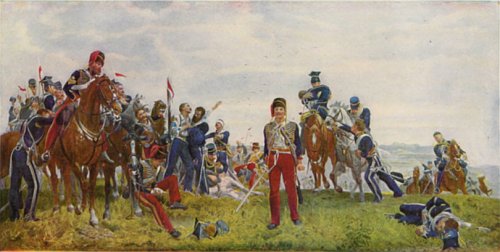
BALAKLAVA—"OUT OF THE MOUTH OF HELL—" Painted by Elizabeth Thompson (Lady Butler) Copyright. By permission of Henry Graves & Co., Ltd., London
With the fall of Sebastopol the war may be said to have ended. A brilliant chapter which had little effect on the Crimean campaign, partly because it occurred after the fall of Sebastopol, partly because it concerned chiefly the Armenians, was the long defence of Kars by Colonel Williams and Wassif The defense of Kars Pasha against an overwhelming Russian army under General Muraviev. Williams sturdily held his ground, bravely repulsed a violent attack in which the Russians lost over 5,000 men, and surrendered on November 27, with all the honors of war, only when starvation stared his little garrison in the face.
Hostilities still continued for a time in the Crimea. The allied fleet was sent to bombard various sea forts. The most important of these naval operations from a historical standpoint was the expedition against Kinburn, for here it was that the modern ironclad was first tried. On September 5, 1854, Napoleon had ordered the construction of five armored floating batteries, which embodied the results obtained in the tests of plating made before the War Ministry's representatives at Vincennes. The ships were of 1,400 tons displacement, were armed with eighteen 50-pounder smoothbores, and protected by four inches of iron armor. They were the prototypes of the First ironclads before Kinburn later ironclads. Not without some misgivings three of these batteries were sent to the Crimea to join the allied fleet under Admirals Lyons and Bruat. The English squadron consisted of six line-of-battle ships, seventeen frigates and sloops, ten gunboats, six mortar-boats and ten transports. The French fleet, besides the three armored batteries mentioned, included four line-of-battle ships, three corvettes, four despatch boats, twelve gun boats and five mortar-boats. The combined fleets prepared to attack the Russian works at Kinburn. On October 18, the bombardment began. The ironclads steamed up to within 800 yards of the main fort; the other ships took up positions at distances varying from 1,200 to 2,800 yards. Without appreciable effect the Russian 32-pound and 18-pound shot and shell dropped into the sea from the iron plating of the French ships. Whatever injury was sustained was caused by the entrance of shot and splinters through the portholes. Unable to withstand the well-directed fire of their invulnerable enemy, the Russians hoisted the white flag, after having lost Success of first trial 45 killed and 130 wounded. The allies lost but two killed and had but forty-five wounded—all on board the armored ships. "Everything may be expected of these formidable engines of war," wrote Admiral Bruat in his report. The Black Sea was the cradle of the modern ironclad.
Another achievement of far-reaching consequences was Captain Henry Bessemer's process for manufacturing steel. He took out a patent for his invention of forcing air through liquid molten iron. Other inventions of interest were Brewster's prismatic stereoscope, Garcia's laryngoscope (a Achievements in Science and Letter mirror for examining the throat), and Drummond's light, patented by Captain Thomas Drummond. Captain Robert Le Mesurier M'Clure of the "Investigator" received the £5,000 prize for the discovery of the Northwest Passage and was knighted. Famous English books of the year were Robert Browning's "Men and Women," Charles Kingsley's "Westward Ho!" and George Henry Lewes' "Life of Goethe."
Charlotte Brontë, the novelist, died on the last day of March. She was born Death of Charlotte Brontë in 1824, the daughter of the Rev. Patrick Brontë of Haworth in Yorkshire. In June, 1854, she married her father's curate, the Rev. Archer Bell Nicholls. Under the pseudonym of Currer Bell she published several novels, in which she displayed great power in the delineation of character. The most important of these were "Shirley," "Villette" and the celebrated "Jane Eyre." At the same time her sister, Emily Jane, who published under the name of Ellis Bell, won fame by her novel "Wuthering Heights." She died six years earlier.
This year Jean-Baptiste Corot, the famous French painter of "Paysage Corot Intime," and follower and modifier of the new realistic schools under the lead of Courbet, exhibited his "Souvenir de Marcoussy," which was purchased later by Napoleon III.
Samuel Rogers, the English poet, wit and patron of art, died, on December 18, in his ninety-second year. The son of a banker, he travelled Death of Rogers extensively while a young man, and applied himself to the study of art and letters. His first published essays and poetry were an "Ode to Superstition" and "The Pleasures of Memory." The death of his father in 1793 left him in the possession of an ample fortune, and he lost no time in retiring from active business. In 1798 he published "The Epistle to a Friend" and other poems. During the early part of the Nineteenth Century, Rogers figured in the foremost rank of the literary and artistic society in London, where he went by the name of "The Banker Bard of St. James's Place." In 1812 he brought out an epic on "The Voyage of Columbus," which met with indifferent success. This was followed by "Jacqueline" and "Human Life." His last and largest publication was his descriptive poem "Italy," brought out in 1822. Rogers devoted the rest of his literary life to the publication of exquisitely illustrated editions of his "Italy" and his "Poems." Shortly after Rogers' death a collection of his witty sayings was published under the title of "Table Talk."
At the Parisian Art Exposition of this year, Horace Vernet, the celebrated Horace Vernet French battle painter, had a Salon devoted entirely to his works. The walls were covered by his immense canvases. At this time Vernet was the most successful of French artists. Born at the Louvre at the outbreak of the French Revolution, Vernet in his early career was identified with the events of that epoch. For the Duke of Orleans he painted his celebrated series of the four revolutionary battles, "Jemmapes, Hanau, Montmirail, and Valmy." In 1812 he received his first important commission from King Jerome of Westphalia, and in 1813 another from Empress Marie Louise. In 1814, Horace Vernet, with his father and Géricault, fought on the Barrière de Clichy, and for his gallant conduct there received the decoration of the Legion of Honor from the hands of Napoleon. After the Restoration, Vernet achieved a great success by his "Battle of Torlosa," which was purchased His early works for 6,000 francs for the Maison du Roi. At the Salon of 1819 Vernet contested the field with Géricault and Ingres, whose "Medusa" and "Odalisque" were the success of the season. By his popular lithographs of Napoleonic scenes, Vernet so jeopardized his interests at Court that it was thought best for him to transfer his studio from Paris to Rome. On his return from there in 1822 he painted his masterpiece, "The Defence of the Barrier of Clichy," for which Odiot paid 4,000 francs. It was presented to the Chamber of Peers, from which it was transferred subsequently to the Gallery of the Louvre. Thenceforward Vernet's pictures, the first of which had sold for a few hundred francs, commanded ever higher prices. For Avignon, his ancestral home, Horace Vernet painted "Mazeppa Pursued by Wolves," a picture which was injured by a sabre stroke in the artist's studio. After his election to the Institute, Vernet changed the style of Vernet's earnings his subjects, charging staggering prices. For a ceiling fresco in the Museum of Charles X. he received 17,910 francs; for "Phillip Augustus Before Bovines," now at Versailles, 24,775 francs; for "The Battle of Fontenoy," 30,000 francs. Still these pictures were scarcely up to the standard of the "Barrier of Clichy," and on Vernet's second removal to Rome his art seemed to decline. After many years spent in Rome and with French armies in Algiers and in the Orient, Vernet went to Russia, where he was Highest artistic honors received with great favor at the Court of the Czar. The highest financial point in his career was marked by a 50,000-franc commission for a portrait of the Russian Empress. He returned to France in good time to receive, in 1855, the greatest honors yet showered upon a French painter.
In America, Longfellow brought out his "Hiawatha" and Walt Whitman "Leaves of Grass" published "Leaves of Grass." At this period the "Know Nothing" Party had come to be a power in politics. The party had started from a New York society formed to check the influence of the Pope, for purifying the ballot and maintaining the Bible in the public schools. It was called the American American "Know Nothings" Party. Wherever the difference of opinion on the Missouri Compromise in 1854 dissolved party ties in the North, multitudes flocked to the new party. Before 1855 it had a million and a half of voters. In 1854 it all but wrecked the old organizations. In Virginia, Henry A. Wise, an old Whig, led the Democratic Party, and overthrew the new organization. At the National Convention of the new party, Southern resolutions were adopted by a vote of 80 to 59. The Northern delegates met and repudiated the anti-slavery alliance. In 1855 the party carried New York, California and Massachusetts, and the Democrats carried New Jersey, Pennsylvania, Indiana and Illinois.
The American Convention met in Philadelphia, February 22, and nominated Stirring party contest Fillmore and Donelson. On the same day a convention met at Pittsburg to effect a national organization of the Republican Party, which appointed a National Convention for the 17th of June, the anniversary of Bunker Hill. The Democratic Convention met at Cincinnati. Pierce, Douglas and Buchanan were candidates. On the seventeenth ballot Buchanan was chosen by unanimous vote with Breckenridge for Vice-President. The Republican Convention met, and in it were King, Clay, Wilson and Wilmot. Fremont was made a candidate by 359 votes against 196 for McLean. For Vice-President, Abraham Lincoln had 110 votes, but Dayton received the majority. The nominees of the American Convention were afterward withdrawn. The various nominees each represented real issues. Buchanan stood for the South, Fremont for Buchanan elected non-extension, and Fillmore for the Union. The election resulted in the choice of Buchanan, who received 1,838,169 votes, to Fremont's 1,341,000, and Fillmore's 875,000. Of the electoral votes, Buchanan received 174, Fremont 114, and Fillmore 8.
At another election in Kansas to choose members of the Territorial Legislature, armed bodies from Missouri took possession of the polls and elected a pro-slavery Legislature. Of 6,218 votes cast but 1,310 were legal. Governor Reeder set the election aside and ordered another. May 22, supplementary elections were held and the Free State men won. June 11, Governor Reeder was charged with fraud in the purchase of the Indian lands, and, on July 26, was removed. Dawson was appointed in his place, with Woodson as acting-governor. On July 2, the pro-slavery Legislature met at Pawnee, organized, expelled nine Free State members, and adjourned to the Shawnee Mission, near the Missouri State line. Thereupon the Free State men Struggle in Kansas met at Lawrence, repudiated the Shawnee Mission Legislature as spurious, and summoned a new convention at Topeka. The Convention adopted a Free State Constitution, and nominated Reeder for Congress. On October 1, the pro-slavery party elected Whitfield for Congress by more votes than the census list contained. The Free Staters declared the pro-slavery "Bleeding Kansas" Legislature to have been elected by fraud. A rival government was organized. Discord, violence, and crime prevailed for a year. "Bleeding Kansas" became an issue in American national politics.
The House resolved by 101 to 93 votes to send a special committee to Kansas to inquire into the anarchy prevailing there. The committee consisted of Howard, Sherman, and Oliver. After several weeks' investigation they returned and reported that every election in Kansas had been carried by Missourians, and the people had been prevented from exercising their rights; that the Legislature was illegal and its acts null and void; that Congress takes action Whitfield held his seat under no valid law, and Reeder had received more votes than he; that a well-devised election law was necessary, and impartial judges should be guarded by United States troops, and that the Topeka Free Soil Convention embodied the will of the majority. A bill admitting Kansas under her free constitution was defeated by 107 to 106, but was subsequently passed by 99 to 97. In the Senate the bill was defeated. Meanwhile turmoil and disorder continued in Kansas. Finally negotiations between Shannon, and the Free State leaders suspended the feud for a time.
The latest attempts to overthrow the government in Mexico, while they brought General Santa Anna once more to the head of affairs seriously imperilled his position. After the release of the United States Government from guarding the frontiers of Mexico, the Indians once more became troublesome. Predatory bands of Apaches and Comanches so ravaged the Mexican filibusters province of Cohauila that the government had to distribute arms among the inhabitants. A filibustering expedition under Major Walker of Kentucky established itself in Lower California. They proclaimed the independence of that province, so as to bring about annexation by the United States. A strong display of Mexican forces had the effect of driving them into Texas. Another filibustering expedition led by a French adventurer who called himself Count Raousset de Bouldon terrorized the north. From Guyamas this Count Bouldon shot expedition marched inland, but was defeated in the first encounter with a strong Mexican force. Raousset de Bouldon was taken captive and was shot. More serious was a military revolution in the south led by General Alvarez. In his proclamation of Ayutla, Alvarez called for a new Constitution and a Alvarez revolution new Congress, and promised such reforms as the abolition of personal taxation, of military conscription, and of the feudal system of passports. Other popular leaders like Bravo and Moreno joined the movement. In vain did Santa Anna put forth all the powers of a military dictator. The revolutionists took Monterey, and the insurrection spread throughout the country until it reached the capital. Santa Anna gathered fourteen hundred Santa Anna withdraws of his best troops and left the City of Mexico to march upon his enemies. Soon the hopelessness of his enterprise became apparent. On the way to Vera Cruz he suddenly abdicated, and embarked on August 19 for Havana. Scarcely had Santa Anna left Mexico when the country was plunged into new disorders. General Carrera, on August 15, declared for the plan of Ayutla and proclaimed himself Vice-President. Funds were raised by a forced loan from the clerical orders. Several provinces of Mexico refused to recognize Carrera. Within a month he had to abdicate. He was succeeded at first by Anarchy in Mexico General Diaz de la Vavaga, and then by Juan Alvarez, the leader of the Puros. While he tried to establish his rule, General Vidini in the north strove to wrest the States of Cohauila, Tamaulipas and Nuego Leon from Mexico, to form an independent republic under the name of Sierra Madre. Before the close of the year Alvarez likewise found his position untenable General Comonfort and resigned. General Comonfort seized the reins of power as substitute president—the thirty-sixth President within forty years, the fifth within four months. He fell heir to the serious international complication with Spain resulting from the unpaid dividends of Mexico's original debt of indemnity to that country.
In China, the Taiping rebels still holding Lintsing were beset by the Growth of Taiping movement imperial troops. They were expelled from the province of Shantung during the spring, but on the other hand carried their arms up the Yangtse-Kiang as far as Ichang, and eastward from Nanking to the sea. The establishment of the Taiping power at Nanking attracted the attention of Europeans. At length a ruthless system of capital executions, by which nearly one hundred thousand victims are believed to have perished, terrorized China.