1843
Reading edition
TO CARRY on the British war with Afghanistan it was necessary to pass troops through Scinde. The Ameers remonstrated. Emaun-Ghur, in the Desert Napier's desert march of Beluchistan, was a stronghold where the Ameers could gather a numerous army unobserved by the English. Sir Charles Napier determined to strike for this point with a small force, capable of speedily traversing the desert. On the night of January 5, he commenced his perilous adventure. With 360 Irish soldiers on camels, with 200 of the irregular cavalry, with ten camels laden with provisions, and with eighty carrying water, he set forth.
When the fortress, which no European eye had before seen, was reached, it was found deserted. Immense stores of ammunition had been left behind. Emaun-Ghur reduced Napier mined Emaun-Ghur in twenty-four places, and blew up all the mighty walls of its square tower. After great privations on the march back, Napier and his men rejoined the main army on the 23d near Hyderabad. The Duke of Wellington said that the march to Emaun-Ghur was one of the most arduous military feats of which he knew. On February 12, the Ameers at Hyderabad, who, according to the British Resident himself, had been "cruelly wronged," came to terms. On the day after their apparent submission the British Resident, Major Outram, was attacked by the infuriated Beluchees. With a hundred followers he barely succeeded in fighting his way through to two British war steamers lying in the river. Napier, with his 2,600 men, now moved against the Beluchee army, numbering nearly 10,000. On February 17, the day of the battle of Meanee, Napier wrote in his journal: "It is my first battle as a commander. It may be my last. At sixty it makes little Battle of Meanee difference what my feelings are. It shall be do or die." It proved an all-day fight. Most of the white officers fell. In the end, Napier closed the doubtful struggle by a decisive cavalry charge. The Sepoy horsemen charged through the Beluchee army and stormed the batteries on the ridge of the hill of Meanee.
Napier followed up his victory the next day by a message sent into Hyderabad that he would storm the city unless it surrendered. Six of the Ameers came out and laid their swords at his feet. Another enemy remained—Shere Mahomed of Meerpoor. On March 24, Napier, with 5,000 Hyderabad troops, attacked this chief, who had come with 20,000 Beluchees before the walls of Hyderabad. Napier won another brilliant victory, which was followed up by the British occupation of Meerpoor. The spirit of the Beluchees was so broken that after two slight actions in June, when Shere Mahomed was routed and fled into the desert, the war was at an end. Scinde was annexed to the British Empire.
At home, in the meanwhile, the Chartist agitation, with its "sacred month" strike, was carried over into this year, while the leaders were tried before the Lancashire Assizes. Popular meetings were held at Birmingham, English free-trade agitation Manchester and London. O'Connor, after his suspension of sentence in court, made the mistake of setting himself against the anti-corn law agitation led by Cobden and Bright. To most Englishmen of the day the free-trade issue appeared the most momentous. O'Connor's star paled accordingly. Early in the year a new free-trade hall had been opened in London, the largest room for public meetings in the United Kingdom. A dozen lecturers were kept busy. Cobden alone addressed some thirty great country meetings during the first half of the year. At the same time the Irish agitation for repeal of Irish disaffection the legislative union with England assumed formidable proportions. The Irish secret society of the "Molly Maguires" spread alarmingly. On March 16, Daniel O'Connell addressed 30,000 persons at Trim, urging repeal of the act of united legislation for Ireland and Great Britain. A few months later several hundred thousand people gathered on the hill of Tara to listen to O'Connell arrested his eloquent words. As a result of this agitation, O'Connell, with several of his followers, was arrested, in October, on charges of sedition. Simultaneously with this the so-called "Becca Riots" against turnpikes broke out in Wales. One month after O'Connell's arrest the greatest free-trade meeting of the year was held at Manchester. Both Cobden and Bright made speeches against the corn laws. One hundred thousand pounds were collected on the spot from wealthy manufacturers who attended the Anti-corn law league meeting. This opened the eyes even of the editors of the London "Times." Under the caption "The League is a Great Fact," it announced that a new power had arisen in the State. This reluctant concession of the leading Tory paper of England caused a great sensation. Other events that excited the attention of Englishmen were the erection of the great Nelson column in Trafalgar Square and the opening of the Thames tunnel for pedestrians. Mill's "System of Logic" Thousands of curious Londoners passed through its shaft, measuring 1,300 feet in length. Nasmyth invented his steam hammer. Mill published his "System of Logic." The event of the year in English letters was the death of Robert Southey, the Poet Laureate. During the last few years his brain had softened, and his mind had become enfeebled. Southey was born at Death of Southey Bristol in 1774. He was educated at Westminster School and Baliol College, Oxford. While still at college he brought out two volumes of poems, together with Robert Lovell. His first long narrative poem, "Joan of Arc," was written at the age of nineteen, and gave him, as he called it, "a Baxter's shove into the right place in the world." At the opening of the Nineteenth Century, he published the "wild and wondrous song" of "Thalaba, the Destroyer," founded on Moslem mythology. "Kehema," founded on Hindu lore, followed. In 1803, after some years of wandering, the poet went to live at Greta Hall, near Keswick, which remained his home until his death. Besides a long line of prose works, Southey wrote innumerable short poems. Famous among them is the ballad of the battle of Blenheim, with its homely irony:
"With fire and sword the country round Ballad of Blenheim Was wasted far and wide, And many a childing mother then And new-born baby died; But things like that, you know, must be At every famous victory."
Southey nourished a passionate hatred against Napoleon Bonaparte. Again and again he invoked the Muse against the world conqueror. Thus he wrote to Landor in 1814: "For five years I have been preaching the policy, the duty, Brilliant occasional pieces the necessity of declaring Bonaparte under the ban of human nature." Under this stress of feeling he wrote his great "Ode During the Negotiations for Peace." It was the most powerful of his occasional pieces. In 1813, he was made Poet Laureate. As such, it fell to him to write another occasional piece on the death of the Princess Charlotte. The grace and beauty of his lines on this occasion have long outlived the memory of that lamented princess. Unlike his great contemporaries, Lord Byron and Sir Walter Scott, Southey never achieved a great material success. Having married young, he often walked the streets, so he himself confessed, "not having eighteen pence for a dinner, nor bread and cheese at his lodgings." In 1835, when he Southey's works was sixty-one years old, he wrote to Sir Robert Peel while declining the offer of a baronetcy, "Last year for the first time in my life I was provided with a year's expenditure beforehand." Yet his works at this time filled nearly a hundred volumes. In the words of his brother poets:
"Southey's epics crammed the creaking shelves."
It was in his declining age that he wrote the prophetic "Stanzas Written in My Library":
My days among the Dead are passed: "Stanzas in My Library" Around me I behold, Where'er these casual eyes are cast, The almighty minds of old; My never-failing friends are they, With whom I converse day by day. My hopes are with the Dead, anon My place with them will be, And I with them shall travel on Through all Futurity; Yet leaving here a name, I trust, That will not perish in the dust.
After Southey's death, William Wordsworth was made Poet Laureate. His Wordsworth, Poet Laureate acceptance of this benefice from the government incensed his more radical friends. Robert Browning then wrote the famous invective lines entitled "The Lost Leader":
Just for a handful of silver he left us, "The Lost Leader" Just for a ribbon to stick in his coat— Found the one gift of which fortune bereft us, Lost all the others, she lets us devote; They, with the gold to give, doled him out silver, So much was theirs who so little allowed: How all our copper had gone for his service! Rags—were they purple, his heart had been proud! We that had loved him so, followed him, honored him, Lived in his mild and magnificent eye, Learned his great language, caught his clear accents, Made him our pattern to live and to die! Shakespeare was of us, Milton was for us, Burns, Shelley, were with us—they watch from their graves! He alone breaks from the van and the freemen, He alone sinks to the rear and the slaves!
America this year lost three of her prominent literary men by the deaths of Prescott's "Conquest of Mexico" Allston, the poet and painter, Noah Webster, the lexicographer, and Key, the author of "The Star-Spangled Banner." The historian Prescott now brought out his great "Conquest of Mexico." Longfellow published his "Spanish Student." Edgar Allan Poe entered upon his new journalistic venture "The Stylus." For this he wrote his stories of "The Tell-Tale Edgar Allan Poe Heart," "Leonore," and his "Notes upon English Verse." For other publications he wrote "The Pit and the Pendulum," and the striking poem, "The Conqueror Worm." His fearful tale of the "Black Cat" was published in the "Saturday Evening Post." At this time he was ailing in health, while "The Gold Bug" his young wife, Virginia, was dying. During these trying months his principal income was a hundred dollar prize received for his famous story of "The Gold Bug," published in the "Dollar Newspaper." The judges confessed later that they awarded the prize to this contribution largely on account of its neat handwriting.
On June 17, the new Bunker Hill Monument of Boston was dedicated amid impressive ceremonies. Daniel Webster, who as a young man had spoken there when the cornerstone was laid by Lafayette, was once more the orator of the day. In the South, Jefferson Davis began his political career as a member of the Mississippi Convention, as did Andrew Johnson of Tennessee, who was then elected to Congress. The pending negotiations with Great Britain concerning the possession of Oregon were Oregon controversy made more momentous by the exodus of some thousand American emigrants from Missouri, on an overland journey to distant Oregon. The first session of the Thirty-eighth Congress, in December, showed a Democratic majority in the House of sixty-nine votes. Under the Whig régime, the policy of a great navy had been developed. A Texas unannexed bill for a large increase in ships was passed. Tyler's last message recommended the annexation of Texas, for which a treaty was pending. It was voted down in the Senate by a two-thirds vote.
Under the shadow of impending war with the United States, a new Constitution was proclaimed in Mexico. Santa Anna prepared for the conflict by assuming the practical powers of a dictator. In Ecuador, too, a new Constitution was adopted. General Flores had himself made President for a Central-American upheavals third time. When the opposition to him became too formidable, he consented to yield and quit the country after accepting a bonus of $20,000 and the title of generalissimo. Another revolution in Hayti resulted in the expulsion of President Boyer.
In Spain a revolutionary junta in June once more assumed power at Revolution in Spain Barcelona. Other parts of the country declared for the ex-Queen Regent Christina. On July 15, General Narvaez compelled the surrender of Madrid to Christina. General Espartero laid siege to Seville. On November 8, the Spanish Cortes proclaimed as queen, Princess Isabella, then in her thirteenth year. With the crown of Spain on the head of a young girl, and Isabella proclaimed queen no immediate successor in sight but her sister, the King of France and his Prime Minister, Guizot, deemed the time ripe for action. It was proposed to marry both Spanish princesses to the sons of Louis Philippe, so as to secure the throne of Spain to the House of Orleans, as it had once been secured to that of Bourbon. For the French people the interest in Spain was revived by Gautier's new book, "Tras los Montes." During the negotiations Spanish marriage projects over the new extradition treaty with England, the project was confidentially broached to Lord Aberdeen. He gave his consent to the proposed marriage of the Duke of Montpensier to the Infanta Fernanda, on the express understanding that it should not be celebrated until Queen Isabella had been married herself, and had children. For some time still the plan hung fire.
In the meanwhile, Hungary was once more in uproar. Kossuth, after his release from prison in 1840, had become the spokesman of the new generation of Magyars. The other wings of the Hungarian party were led by Scechenyi and Déak.
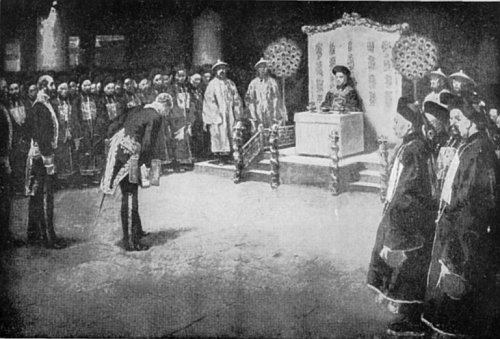
THE EMPEROR OF CHINA RECEIVING THE DIPLOMATIC CORPS
By the time the Hungarian Diet of 1843 was convoked, all parties united in Hungarian reform movement demanding the most important reforms, i.e. of a new electoral system, a new criminal code, trial by jury, and official recognition of the Magyar language. One of the first resolutions of the Lower Chamber was that no language but Magyar should be permitted in debate, and that all persons incapable of speaking Magyar should gradually be excluded from all public employment. Against the prohibition of Latin in the Diet, the Croatians appealed to the government. The Emperor promptly vetoed the resolution. Clash at Agram Upon the publication of the imperial rescript a popular storm broke forth in Hungary. At Agram, the capital of Croatia, the two factions fought on the streets. The Austrian Cabinet receded from its position. A compromise was accepted whereby Latin was to be permitted in the Hungarian Diet for the next six years. Of all the important schemes for reform brought before the Hungarian Diet of this year, only the language compromise became law. This was due to the fact that the members of the Lower House were bound to Kossuth's oratory vote as directed by the Provincial Assemblies, which vetoed everything affecting their local interests. To do away with this anomaly Kossuth and his followers now set themselves to bring their appeal before the country at large. Kossuth dropped the pen and became an orator.
In other parts of the world the spread of Western civilization was carried on with accustomed vigor. A French squadron seized Tahiti in the Society Algerian campaign Islands. In Algiers the war against Abd-el-Kader was kept alive by occasional raids and by buying over the less faithful of his followers. The natives were enrolled in the French army in regiments of Turcos, Zouaves and Spahis. The barbaric glamour of their oriental garb, as well as the reputation of their dashing leader, Colonel Lamorcière, attracted many "Foreign Legion" formed Frenchmen and foreign adventurers to this service. Soon there were enough men to form the famous "Foreign Legion."
In China, after the ratification of the Nanking treaty, the five treaty ports were opened to all foreigners on the same footing as to Englishmen. Chinese treaty ports opened Long before this, the Russians had already established themselves in certain parts of China. The smouldering resentment against the white men found vent in the truculent doings of the anti-foreign society of the "Green Water Lily" in Hoonan. Now trouble broke out in the Punjab. Jankoji Bao Sindia had died in February, and his widow, a girl of twelve, now ruled over the Sikhs. She outwitted her native Minister, who was supported by the British. Lord Ellenborough hastened to interfere. He ordered the British army to advance to Gwalior, under Sir Hugh Gough, in December. All Sindia British seize Sindia made common cause against the foreigner. The Sikh warriors tried to oppose the British advance in two simultaneous battles at Maharajpore and Punniar, fought on the twenty-ninth day of December. Both engagements resulted in their defeat. The Queen and her Ministers submitted to England's terms. They were deposed. The Sikh army was reduced to 6,000 men.