1821
Reading edition
THE Congress of Leibach met in January. It was attended by the representatives of Russia, Austria, Prussia, England, France, Sardinia and Modena. When King Ferdinand of Naples arrived he was received by the Congress of Leibach Emperors of Russia and Austria in person. It was predetermined that absolute government in Naples should be restored by Austrian arms. The only problem remaining to diplomacy was to put a respectable face on King Ferdinand's dishonor. Capodistrias offered to make up some fictitious correspondence in which Ferdinand was proudly to uphold the constitution which he had sworn to support, and to yield protestingly to the powers only after actual threats of war. The device was rejected as too transparent. Moreover, the old king scarcely cared how his conduct appeared to his subjects. A letter was sent in his name to his son, the acting-viceroy, stating that the Powers were determined not to tolerate the order of things Naples under duress sprung from revolution, and that certain securities for peace would have to be given. The reference to securities meant the occupation of the country by an Austrian army. The letter reached Naples on February 9. Three days before the Austrian troops had received their orders to cross the Po.
The invading army of Austria was 50,000 strong. The Neapolitan soldiers numbered a little more than 40,000, of whom 12,000 were in Sicily engaged Battle of Rieti at Palermo in suppressing a counter revolution for home rule. At the first encounter at Rieti in the Papal territory, the Neapolitans under General Pepe were utterly routed. Their forces melted away, as they did when Murat made his last stroke for Italy and Napoleon. Not a single strong point was defended. On March 24, the Austrians entered Naples. Then came a moment of danger. Rebellion broke out in Piedmont, and an attempt was made to unite Revolt of Piedmont the troops of Piedmont with those of Lombardy. The King of Piedmont rather than sign the Spanish Constitution abdicated his throne. On the refusal of the King's brother, Charles Felix, to recognize a constitution, his cousin Charles Albert of Carignano was made the regent and commander of the troops. He advanced so cautiously that the conspirators at Milan dared not follow suit with a revolution of their own. In the meanwhile the Czar had ordered 100,000 Russians to march in the direction of the Adriatic. The Austrian forces advanced westward from the Venetian strongholds, and, brushing aside all resistance, entered Piedmont.
End of Italian revolution
The victory of absolutism in Italy was complete. Courts-martial sat all over Italy. Morelli, the officer who had led out the so-called sacred band of Nola, was shot. His followers were expressly excluded from all amnesty acts. An attempted insurrection in Sicily cost the conspirators their lives. Hundreds of persons were cast into prison, or were marched off to distant fortresses in Austria. It was at this time that Silvio Pellico, the Silvio Pellico author of the famous "Prison Records," was sent to the dungeon of Spielberg. Then began that long stream of fugitives to England and America.
The Holy Alliance, sitting at Leibach, thought the time was ripe to pronounce its anathema against all peoples seeking their liberties Revolt in Brazil elsewhere than in the grace of their legitimate sovereigns. Yet the spirit of revolt was abroad, and its flames continued to flicker up at widely separated points. On February 26, the Portuguese troops in Brazil rose in revolt. The king, still residing at Rio Janeiro, was compelled to appoint a new Ministry pledged to give to both Portugal and Brazil a new representative system. In Mexico, General Iturbide, at the same time, Mexican independence issued a pronunciamiento, containing his so-called "Plan of Iguala," which proposed independence for Mexico under a Spanish Bourbon prince. Several rebel leaders acquiesced in this, and forced the Spanish viceroy to resign. Juan O'Donoju became acting-viceroy. He signed a treaty with Iturbide virtually accepting the plan. The people of Buenos Ayres profited by the military troubles in Brazil to throw in their lot with that of the San Martin's Campaign Argentine Republic. Their popular idol, San Martin, meanwhile was leading his victorious troops from Chile into Peru. Lima, one of the greatest Spanish strongholds in South America, was threatened by the revolutionists.
At the other end of the earth, the new force of national feeling showed itself in popular uprisings. War in Annam In distant Annam the death of Emperor Gia-Long, followed by a bloody struggle for the succession between his sons, incited the people to a national demonstration against the encroachments of the French in Tonquin. In China the new Emperor Taouk-Wang Taouk-Wang was enthroned. He was the first to throw his whole personal influence against the evils of the opium trade inflicted upon China by English merchants since 1800.
Philike Hetairia
In Greece and in the Balkans the people rose against the yoke of Turkey. The plan of the Philike Hetairia—i.e. Patriotic Association—was to begin their revolution on the Danube, so as to induce Russia to take a hand in their favor. They believed that Capodistrias, the Prime Minister of Russia, himself a Greek, would win the Czar to their cause. Unfortunately for them, Metternich's influence proved stronger than that of the Greek Minister. Capodistrias deemed it advisable to publish a pamphlet warning Ypsilanti his countrymen against any rash step. Failing to win the open support of Capodistrias, the Hetairists turned to Prince Alexander Ypsilanti, a Greek exile serving in the Russian army. Ypsilanti agreed to raise the standard of revolt in Moldavia. It was arranged that Theodore Vladimiresco, a Vladimiresco Roumanian who had served in the Russian army, was to call his countrymen to arms against the Turk. Then the Greeks were to step in, and the help of Russia was to be invoked.
Rising of Roumania
In February, Vladimiresco proclaimed the abolition of feudal servitude in Roumania, and marched with a horde of peasants upon Bucharest. Early in March, the Greek troops at Galatz, let loose by their commander, Karavias, massacred the Turkish population of that town.
Ypsilanti, waiting on the Russian frontier, crossed the Pruth and appeared at Jassee with a few hundred followers. A proclamation was issued, calling upon all Christians to rise against the Crescent. Ypsilanti went so far as to declare that "a great European power," meaning Russia, was "pledged to support him." The Greek Hospodar of Jassee immediately surrendered the government, and supplied a large sum of money. Troops to the number of 2,000 gathered around Ypsilanti. The road to the Danube lay open.
Ypsilanti wasted valuable time loitering at Jassee. A month was lost before Ypsilanti repudiated he reached Bucharest. He delayed partly on account of his expectations of Russian help in response to a letter he had written to the Czar. The delay proved fatal to him. The Czar, now wholly under the influence of Metternich, sent a stern answer from Leibach. Ypsilanti was dismissed from the Russian service. The Russian consul at Jassee issued a manifesto that Russia repudiated and condemned Ypsilanti's enterprise. The Patriarch of Constantinople was made to issue a ban of excommunication against the rebels. In an official note of the Powers, the Congress of Leibach branded the Greek revolt as a token of the same spirit which had produced the revolution of Italy and Spain. Turkish troops crossed the Danube. The Roumanian peasants, seeing no help from Russia, held aloof. Vladimiresco plotted against the Death of Vladimiresco Greeks. It was in vain that brave Georgakis captured the traitor at his own headquarters and carried him to his death in the Greek camp. Ypsilanti was defeated in his first encounter with the Turks. He retired before them toward the Austrian frontier. In the end he fled across the border and was promptly made a prisoner in Austria. His followers dearly sold their lives. At Skuleni, 400 of them under Georgakis Georgakis made a last stand on the Pruth. They were surrounded by ten times their number. Georgakis refused to surrender. Bidding his followers flee, at the moment when the Turks broke in the doors, he blew himself up in the monastery of Skuleni.
At the news of Ypsilanti's uprising in Moldavia the entire Greek population of the Morea rose against the Turk. From the outset, the Moreotes waged a Revolt of Morea war of extermination. They massacred all Turks, men, women and children. Within a few weeks the open country was swept clear of its Mohammedan population. The fugitive Turks were invested within the walls of Tripolitza, Patras, and other strong towns. Sultan Mahmud took prompt vengeance. A number of innocent Greeks at Constantinople were strangled by his executioners. The fury of the Moslem was let loose on the Infidel. All Greek settlements along the Bosphorus were burned. But the crowning stroke came on Easter Sunday, the most sacred day of the Greek Church. The Patriarch of Constantinople, while he was celebrating service, was summoned away by the dragoman of the Porte. At the order of the Sultan he was haledGregorios hanged before a hastily assembled synod and there degraded from his office as a traitor. The synod was commanded to elect his successor. While the trembling prelates did their bidding, Patriarch Gregorios was led out in his sacred robes and hanged at the gate of his palace. His body remained hanging throughout the Easter celebration, and was then given to the Jews to be dragged through the streets and cast into the Bosphorus. A similar fate befell the Greek archbishops of Salonica, Tirnovo, and Adrianople. The body of Gregorios floating in the sea was picked up by a Greek ship and carried to Odessa. This return to Christian soil of the remains of the Patriarch was hailed as a miracle in Russia. Gregorios was solemnly buried by the Russian Government as a martyr.
If the will of the Russian people had been carried out, the Russian army and nation would have avenged the murder of their high-priest by an Russia aroused immediate war upon the Turks. Strogonov, the Russian Ambassador at Constantinople, at once proposed to his diplomatic colleagues to join him in calling for warships to protect the Christians there. Lord Stranford, the British Ambassador, refused to accede to this proposition. Single-handed, Strogonov presented an ultimatum to the Sultan demanding the restoration of Christian churches and the Porte's protection for Christian worship. A written answer was exacted within eight days. Encouraged by England's attitude, the Sultan ignored Strogonov's requests. On July 27, the Russian Ambassador left Constantinople. To the amazement of his moujiks, the Czar did not declare war. The councils of Prince Metternich The Czar found wanting prevailed. With the help of the representatives of England, Metternich persuaded the Czar to view the rebellion of Greece as a mere unfortunate disturbance. Any countenance of it, he argued, would imperil the peace of Europe.
Rising of the Greeks
The murder of the Greek Patriarch was followed by risings of the Greeks throughout continental Greece and the Archipelago. Here, as in the Morea, the cause of Greek freedom was disgraced by massacres, and indignities to Turkish women. The Sultan's troops, led by able commanders, retaliated in kind. Khurshid, with a large Turkish army, besieged Janina. He held firmly to his task, even after his whole household fell into the hands of the Moreotes. The Greeks in Thessaly failed to rise, and thus the border Ali Pasha provinces were saved for the Ottoman Empire. The risings in remoter districts were soon quelled. In Epirus, Ali Pasha, the Albanian chieftain, was surrounded by overwhelming numbers and lost his life. On the Macedonian coast the Hetairist revolt, in which the monks of Mount Athos took part, proved abortive. Moreover, the desultory warfare on water carried on by the Moreote campaign islanders of Hydra, Spetza, and Psara served only to annoy the Turks. The real campaign was waged in the Morea, where Tripolitza, the seat of the Turkish Government, was besieged by the insurgents. Demetrios Ypsilanti, Prince Alexander's brother, landed on the coast and was welcomed as a leader by the peasants in arms. Three other leaders rose to prominence. Petrobei First, in the eyes of the people, came Petrobei, chief of the family of Mauromichalis. Surrounded by his nine sons, this sturdy chieftain appeared like one of the old Homeric kings. Second in popular favor was Kolokotrones Kolokotrones, a typical modern Clepht, cunning and treacherous, but a born soldier. The ablest political leader was Maurokordatos, a man of some breadth of view and foresight, but over-cautious as a general. The early Maurokordatos insurgent successes were marred by bad faith and gross savagery. On the surrender of Navarino, in August, a formal capitulation was signed, safeguarding the lives of the Turkish inhabitants. In the face of this Massacre of Navarino compact the victorious Greeks put men, women and children to the sword. Two months later the Turkish garrison of Tripolitza, after sustaining a siege of six months, began negotiations for surrender. In the midst of the truce, the Greek soldiery got wind of a secret bargain of their leaders to extend protection for private gain. In defiance of the officers, the peasant soldiers stormed Tripolitza and scaled the walls. Then followed three days Sack of Tripolitza of indiscriminate looting and carnage. By thousands, the Turks, with their women and children, were slaughtered. Kolokotrones himself records how he rode from the gateway to the citadel of Tripolitza, his horse's hoofs touching nothing but human bodies.
The Greek struggle for independence aroused conflicting emotions in Europe. The passionate sympathy of the Russians rested wholly on their religious bonds. The more enlightened Philhellenes of France and Germany affected to Philhellenism see in this struggle a revival of the ancient Greek spirit that blazed forth at Thermopylæ and Marathon. For this same reason, perhaps, Metternich and his colleagues in the Holy Alliance looked upon the Greek revolution with an evil eye. Any cause espoused by the hot-headed liberals at the universities in those days of itself became obnoxious to the reactionary rulers of the German and Austrian states.
The sympathy with the Greeks was most pronounced in England. There the stirring lyrics of Lord Byron had reached the height of their popularity. Lord Byron's Greek lyrics His songs of Greece and Greek freedom were justly regarded as among his best. It was but a short time before this that the poet, to use his own phrase, had awakened one morning to find himself famous. Now his Greek songs were hailed by the whole world as classics. Notable among them were the "Isles of Greece," embodied in the third canto of his "Don Juan" with the famous stanza:
The mountains look on Marathon— And Marathon looks on the sea; And musing there an hour alone I dreamed that Greece might still be free.
And the equally celebrated lines from "The Bride of Abydos":
Know ye the land where the cypress and myrtle Are emblems of deeds that are done in their clime? Where the rage of the vulture, the love of the turtle, Now melt into sorrow, now madden to crime!
In English literary annals this year was marked furthermore by the death of Death of Keats John Keats. He was but twenty-five, still in the first flush of his genius. Keats was buried in Rome, where he died. On his gravestone is the epitaph composed by himself: "Here lies one whose name was writ in water." It was generally assumed in England that the poet's death was caused by his anguish over the merciless criticisms of "Blackwood's Magazine" and the "Quarterly Review." Lord Byron was unkind enough to exploit this notion in his "Don Juan":
John Keats, who was killed off by one critique, Byron's satire Just as he really promised something great If not intelligible, without Greek Contrived to talk about the gods of late Much as they might have been supposed to speak. Poor fellow! His was an untoward fate; 'Tis strange the mind, that very fiery particle, Should let itself be snuffed out by an article.
As a matter of fact Keats died of consumption. The ravages of this disease in his case were accelerated by his feverish passion for poetry, his love Keats's work affair with Fanny Brawne, financial embarrassments, and only to a slight extent by the inevitable disappointment arising from adverse criticisms. What Byron did for modern Greece in England, Keats may be said to have done for ancient Greece. The beautiful songs of Greece, embodied in "Endymion" and "Hyperion," no less than the enthusiastic odes and sonnets in praise of Hellenic works of art, opened the eyes of many of the contemporaries of Keats to the enduring beauties of Greece. It was in his exquisite "Ode to a Grecian Urn,"that Keats expressed his poetical master passion for beauty:
Beauty is truth, truth beauty—that is all Ye know on earth, and all ye need to know.
LORD BYRON Painted by Maurin
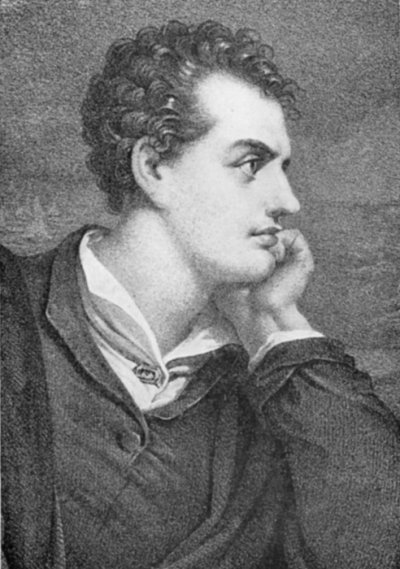
Shortly after Keats's death appeared one of the most beautiful of Shelley's longer poems—"Adonais," written as an elegy on the death of Keats:
I weep for Adonais—he is dead. "Adonais" Oh, weep for Adonais! though our tears Thaw not the frost which binds so dear a head! And thou, sad Hour, selected from all years To mourn our loss, rouse thy obscure compeers, And teach them thine own sorrow! Say. "With me Died Adonais; till the Future dares Forget the Past, his fate and fame shall be An echo and a light unto eternity."
Wilhelm Meister
Other literary events of the year were the publication of Goethe's "Wilhelm Meister's Wander Jahre," and of Alexander Sergeyevich Pushkin's first long poem, "Ruslan and Ludmilla." In this epic, written during Pushkin's early banishment to Bessarabia, an old Russian theme of the heroic times of Kiev Rise of romantic literature was treated much after the manner of Byron's romantic examples. In France the romantic period in literature was inaugurated by young Victor Hugo, who, but the year before, had been crowned as "Maître des jeux floraux" for a prize poem on Henri IV. Now Chateaubriand, in his journal "Le Conservateur," welcomed him as "Un enfant sublime." By his own romantic Victor Hugo followers Hugo was hailed as chief of their poetic "Bataillon Sacré." During the same year the poet, then barely nineteen, married Mademoiselle Foucher, a girl of fifteen.
Death of Napoleon
The most important event of the year for Frenchmen was the death of Napoleon Bonaparte at Longwood, in St. Helena. He died on May 5, after taking the holy sacrament. He left a last will with several codicils. In it Napoleon made the following declarations:
"I die in the Apostolical and Roman religion, in the bosom of which I was born more than fifty years ago. It is my wish that my ashes may repose on the banks of the Seine, in the midst of the French people whom I have loved so well. I have always had reason to be pleased with my dearest wife, Maria Louisa. I retain for her, to the last moment, the most tender sentiments. I beseech her to watch, in order to preserve my son from the snares which yet environ his infancy. I recommend to my son never to forget that he was born a French prince, and never to allow himself to become an instrument in the hands of the triumvirs who oppress the nations of Europe: he ought never to fight against France, or to injure her in any manner; he ought to adopt my Napoleon's will motto—Everything for the French people. I die prematurely, assassinated by the English oligarchy and its tool. The English nation will not be slow in avenging me. The two unfortunate results of the invasions of France, when she had still so many resources, are to be attributed to the treason of Marmont, Augereau, Talleyrand, and Lafayette. I forgive them—may the posterity of France forgive them as I do! I pardon Louis for the libel he published in 1820; it is replete with false assertions and falsified documents. I disavow the 'Manuscript of St. Helena,' and other works, under the title of 'Maxims, Sayings,' etc., which persons have been pleased to publish for the last six years. Such are not the rules which have guided my life. I caused the Duc d'Enghien to be arrested and tried because that step was essential to the safety, interest and honor of the French people, when the Comte d'Artois was maintaining, by his own confession, sixty assassins at Paris. Under similar circumstances I should act in the same way."
The bequests
To his son and immediate relatives, Napoleon left most of his personal effects. Among his relatives and favorite followers he distributed a sum of 6,000,000 francs, left in the hands of his bankers at the time of his flight from Paris; likewise the proceeds of a possible sale of his confiscated crown jewels. Count Lavalette and the children of Labédoyère were remembered with bequests of 100,000 and 50,000 francs, respectively. The final clauses were:
"To be distributed among such proscribed persons as wander in foreign countries, whether they be French, Italians, Belgians, Dutch, Spanish, or inhabitants of the departments of the Rhine, under the directions of my executors, one hundred thousand francs. To be distributed among those who suffered amputation, or were severely wounded at Ligny or Waterloo, who may be still living, according to lists drawn up by my executors. The Guards shall be paid double, those of the Island of Elba quadruple, two hundred thousand francs."
Cantillon remembered
A curious bequest was that of 10,000 francs to Cantillon, a French subaltern, who was tried and acquitted for the attempted assassination of the Duke of Wellington in Paris on February 11, 1818. Napoleon thus explained this bequest:
"Cantillon had as much right to assassinate that oligarchist as the latter had to send me to perish upon the rock of St. Helena. Wellington, who proposed this outrage, attempted to justify it by pleading the interest of Great Britain. Cantillon, if he had really assassinated that lord, would have pleaded the same excuse, and been justified by the same motive—the Last fling at Wellington interest of France—to get rid of this general, who, moreover, by violating the capitulation of Paris, had rendered himself responsible for the blood of the martyrs Ney, Labédoyère, etc., and for the crime of having pillaged the museums, contrary to the text of the treaties."
This last legacy was not paid until 1855, when Napoleon III. discharged it.
Late in the year the Ministry of Duc de Richelieu succumbed to the machinations of Comte d'Artois. Before his resignation, Richelieu complained to the Count, reminding him of his promises of support at the first formation of the Cabinet. "The fact is, my dear Duke," replied Fall of Richelieu's Ministry Monsieur, "if you allow me to say so, you have taken my words too literally. And then the circumstances at that time were so different." The Prime Minister rose abruptly and sought out the King. "Monsieur has broken his word of honor," he said, "he has broken his word as a gentleman." "What would you have me do?" said Louis XVIII. "He conspired against Louis XVI.; he conspires against me; he will conspire against himself." The explosion of a barrel of gunpowder in the royal palace raised apprehensions of Villèle Prime Minister another painful scene, like that preceding the fall of the Ministry of Decazes. Richelieu resigned, and Villèle took his place. Chateaubriand was sent to London as Ambassador. While Parliamentary government in France labored thus under the onslaughts of the Royalist plotters in the Chambers, the so-called Era of Good Feeling in America was continued under the second administration of President Monroe.
Inauguration of Monroe
The 4th of March fell on a Sunday, and Monroe was the first President to be inaugurated on the 5th. Missouri was admitted conditionally, and, on August 10, the President proclaimed its admission as the twenty-fourth State amid a tempest of political excitement. The contest over the slavery question was now supposed to be forever settled. In the debates of 1821, the House stood firmly against Missouri's admission as a slave State, and the Senate was equally determined that the colored citizens of other States should be denied citizenship in Missouri if the people so desired. At last it came to a conference committee. It was decided that the State should be admitted, as soon as its Legislature would agree that the section of the Constitution Missouri admitted to Statehood in question should not be construed as authorizing a law excluding any citizens of other States from the immunities and privileges to which they were entitled under the Constitution. The Legislature of Missouri gave this pledge, but it remained open whether free negroes and mulattoes were citizens in other States, and whether they were to be made citizens in Missouri. In the admission of Missouri there was for the first time an unmixed issue on the question of a free government or a slave-holding government in the United States. Doubtful dealings on the part of the Senators from Indiana and Illinois were followed by an attempt to make these States both slave-holding States, in face of the binding law of the Ordinance of 1787. A popular movement led by Governor Edward Coles of Illinois defeated this project.
Liberia
On May 5, the territory of Liberia was secured on the west coast of Africa, and a colony was founded for the repatriation of negro slaves, with Junius Brutus Booth Monrovia for a capital. During this same period Junius Brutus Booth made his first appearance in America, as Richard III., at Richmond. Late in the year the remains of André, the British officer who was shot as a spy during the American Revolution, were placed on a British ship for interment in Westminster Abbey.