1817
Reading edition
Return of Bolivar
BOLIVAR landed on the north coast of Venezuela on the first day of the new year. His landing place, Barcelona, was a small town at the foot of the Maritime Andes, so unprotected against attack that he resolved to leave it at once. He marched his force in the direction of Santa Fé in New Granada, hoping to push through to Peru. Marino and Piar, two insurgent leaders operating in the south, joined forces with Bolivar, and brought 1,200 additional men. By the time their joint column had penetrated well into General Piar shot Orinoco, the three leaders were at odds with each other. Piar tried to incite revolt among his followers. Bolivar caused Piar to be seized, and after a drum-head trial had him shot. In the meanwhile a Spanish force had swooped down on Barcelona, and massacred the inhabitants. Things were at this pass when the standard of revolt was once more raised in Chile by O'Higgins Bernado O'Higgins. He was a natural son of Ambrosio, and had just returned from school in England. At the time the supreme command of the revolutionary forces was given to him this famous South American leader was still a young man, as was his chief lieutenant, MacKenna. By his clever handling of the campaigns that followed he won the title of "El Primer Soldado del Nuevo Mundo"—the first soldier of America. It was still at the San Martin outset of his career, in 1817, that help came to the Chileans from Buenos Ayres across the Andes. The man who brought this aid was San Martin.
At Mendoza, on January 17, San Martin reviewed his little army of 5,000, all Gaucho horsemen, as lightly clad and provisioned as the Indians of the Pampas. The women of Mendoza presented the force with a flag bearing the emblem of the Sun. San Martin held the banner aloft, declaring it "the first flag of independence which had been blest in South America." This same flag was carried through all the wars along the Pacific Coast. And under its tattered shreds San Martin was finally laid to rest sixty years later.
Marching from Mendoza, San Martin made a feint of crossing the Andes by way of Planchon, thereby inducing a Spanish column under Captain-General Marco del Ponte to concentrate at Talca. During the progress of these movements, San Martin and his followers crossed the mountains by the steep route of Putaendo and Cuevas. Three hundred miles of the stiffest mountain riding were covered in less than a fortnight. Early in February, San Martin's army, now barely 4,000 strong, descended upon Villa Nueva. On February 7, Battle of Chacabuco they fought their first battle on Chilean soil with the Spanish outposts at Chacabuco. Driving the Spaniards before him, San Martin, advanced into the plain, and presently joined forces with O'Higgins' infantry. New mounts were provided for the cavalry. At the strong post of Acuoncagua the Spaniards made a stand, but they were outnumbered by the insurgents. San Acuoncagua Martin delivered a frontal attack, while O'Higgins outflanked the enemy with an impetuous charge, with the result that the whole Spanish force was routed beyond recovery. The officers fled to Valparaiso. By the middle of February, San Martin entered Santiago de Chile. A new republican junta was formed and complete independence of Spain was declared. O'Higgins assumed the position of dictator.
All Chile was free now except in the south. General Ordoñez, commanding the Spanish forces there, was defeated and fell back to Talcahuano. San Martin prepared to invade Peru. Anticipating such an attack, Abascal, the Spanish Viceroy of Peru, despatched Osorio with an expedition of 3,500 veterans, Battle of Talca who had just arrived from Spain, to Talcahuano. As soon as these reinforcements came, Ordoñez set out from Talcahuano with the vanguard to march on Santiago de Chile, and met the patriot forces near Talca. The revolutionists largely outnumbered the Spaniards, but were poorly disciplined and ill-provisioned. While they lost time the Spanish main column under Osorio came up. Ordoñez took advantage of the clumsy manœuvres of the revolutionists to drive a sharp attack between their two wings, piercing their centre. The battle was won after the first fifteen minutes. O'Higgins was wounded and had to be carried out of the fight. San Martin, with his right wing, fell back on San Fernando. With great difficulty O'Higgins managed to reach Santiago, where he was presently joined by San Martin. Steadily the Spanish column advanced on Santiago. The two revolutionary leaders by almost superhuman efforts succeeded in rallying and equipping a force of 5,000 defenders. On April 5, Battle of the Maypo the Spanish army appeared before Santiago de Chile. Near the Maypo, nine miles from Santiago, the revolutionists took up a strong position. Osorio opened the battle about noon with artillery. Soon all the troops were engaged, the fiercest fight raging around a hacienda where San Martin and O'Higgins had their headquarters. Several times the ranch was lost and retaken. By sundown the Spaniards advanced all along the line. The battle seemed lost to the patriots. At this juncture, as the famous regiment of Burgos on the Spanish right was drawing in its deployed lines for a final column attack, Colonel O'Brien, at the head of the insurgent cavalry reserves, charged into the opening and overthrew the Burgos battalions. O'Higgins immediately charged the rest of the Spanish right wing, and San Martin simultaneously attacked in the centre. The whole Spanish army gave Liberation of Chile away. More than 2,000 Spaniards were killed and wounded. Osorio with his staff escaped to Peru. The victory of Santiago not only freed Chile, but left Peru open to the revolutionists.
Monroe's Presidency
In the United States of North America, during this interval, a new President had begun his administration. James Monroe was inaugurated as President in his fifty-ninth year. He had been a member of the Continental Congress, and at thirty-six a Minister to France. Under Madison he served as Secretary of War. Crawford, Calhoun, Meigs, Wirt and Rush were members of his Cabinet, and were all of the dominant Democratic-Republican party. Business throughout the country began to revive almost at once when the re-chartered National Bank went into operation in Philadelphia on the day of Monroe's inauguration.
In June, President Monroe undertook a three months' personal inspection of the military posts of the country. Passing through New York, Boston and Portland, and crossing New Hampshire and Vermont to Ogdensburg, he took a boat to Sackett's Harbor and Niagara. From there he went to Buffalo and Detroit, and returned to Washington. Everywhere the people greeted him by thousands. Monroe on this occasion wore the three-cornered hat, "Era of good feeling" scarlet-bordered blue coat and buff breeches of the American Revolutionary army. The "Boston Journal" called the times the "Era of Good Feeling," and the expression has passed into American history as a characteristic of Monroe's entire administration.
It was an era notable for the extraordinary growth of the Western States. Settlers were encouraged to buy government land on the instalment plan, and the States refrained from levying taxes on these lands until years after the settlers had received their title deeds. Endless processions of prairie wagons passed through New York and Pennsylvania. On one turnpike alone, 16,000 vehicles paid toll during the year. Pittsburg at this time had a population of 7,000 persons. The log cabin was the house of all, with its rough chimney, its greased paper in a single window, its door with latch and string, a plank floor and single room, corn husk brooms and its Dutch oven. In the newly broken ground corn and wheat were planted, which, when harvested, were thrashed with the flail and winnowed with a sheet. Little Western prairies settled settlements sprang up here and there on the rolling prairie, with store-taverns, blacksmith shops and mills. This a thousand times repeated was seen in western New York, Pennsylvania, Ohio, Indiana, Illinois and Michigan.
Steam navigation
During the same year the newly organized territory of Mississippi, formed from a division of Alabama, was admitted as the twentieth State to the Union. The first line of steam propelled ocean packets was organized to run between New York and Liverpool. In the western frontier town of St. Louis the first steamboat made its appearance. On July 4, ground was broken for The Erie Canal the Erie Canal, which was to connect the city of New York with the great inland waters. On the strength of this progressive achievement De Witt Clinton became a candidate for the governorship of New York. Among other notable events of this year were the foundation of the New York State Library, Gallaudet's foundation of the first school for the deaf and dumb at Hartford, and the establishment of the earliest theological seminaries of the Episcopal Church in America, as well as of the first Unitarian Divinity School at Harvard. William Cullen Bryant, barely come of "Thanatopsis" age, published his master work, "Thanatopsis," in the "North American Review."
In other parts of the world, likewise, the return of peace was followed by a general advance in culture and civilization. Shortly after the re-establishment of the American National Bank, Canada followed suit with government banks at Montreal and Quebec. Hanka, in Bohemia, claimed to have discovered the famous medieval lyrics of Rukopis Kralodvorsky written at Stenography the end of the thirteenth century. Across the border in Poland the new University of Cracow began its career. In Munich, Franz Gabelsberger invented the first working system of shorthand, which, in a perfected form, is still in use in Germany. During this year common school education took an immense stride in Germany, after the establishment in Prussia of a distinct Ministry for Public Education. Unfortunately the government soon German liberalism came into conflict with the bolder spirits at the universities. By reason of the more liberal privileges allowed to it by the Duke of Weimar, the University of Jena took the lead in the national Teutonic agitation inaugurated by Fichte. On October 18, the students of Jena, aided by delegates from all the student fraternities of Protestant Germany, held a festival at Eisenach to celebrate the three-hundredth anniversary of the Reformation. It was also the anniversary of the battle of Leipzig. Five hundred ardent young men, among them scholars who had fought at Leipzig, Ligny and Waterloo, assembled in the halls of Luther's Wartburg Castle. They sang and The Wartburg festival drank, and fraternized with the members of the militia of Eisenach. In the evening they had a torchlight procession and lighted a huge bonfire on the hill opposite the castle. In imitation of Martin Luther's burning of the Pope's Bull they consigned a number of their pet aversions to the flames. Thus they burned a soldier's straight-jacket and corporal's cane, as well as a recent pamphlet by one Schmalz written in defense of the old Prussian bureaucracy. Rash words were uttered about the broken faith of princes. They were aimed at King Frederick William of Prussia, who had promised to give his country a constitution, but had failed to keep his word. The Wartburg festival, childish as it was in many of its manifestations, created singular alarm throughout Germany and elsewhere. The King of Prussia sent his Prime Minister, Hardenberg, to Weimar to make a thorough investigation of the affair. Richelieu, the Prime European courts alarmed Minister of France, wrote from Paris whether another revolution was breaking out; and Metternich insisted that the Duke of Weimar should curtail the liberties of his subjects. The heavy hand of reaction fell upon all German universities. German scholars were compelled to turn their interests from public affairs to pure science and scholarship, to the benefit of German learning. The study of history and archeology took an Advances in scholarship upward turn with Brentano's publication of old German ballads and Lachmann's original version of the Nibelungen songs. At this time an Italian archeologist, Belzoni, was adding new chapters to ancient history by his original researches in Egypt, which resulted in the removal of the Colossus of Memnon to Alexandria, and in the opening of the great Cephren African missionary work pyramid. In distant South Africa the first English missionaries began their labors among the blacks. Although the Governor of Natal at first refused to permit Robert Moffat, the first Wesleyan missionary in those parts, to disturb the Kaffirs with his preachings, Moffat pressed on undismayed and soon established a mission beyond the Orange River.
In England, industrial depression dragged on. Early in the year riots broke out in London on the opening of Parliament. While driving to the House of Lords, the Prince Regent, now grown thoroughly unpopular on account of the scandals with his wife, was hooted by a crowd in St. James's Park. The Green Bag inquiry police claimed that an air gun had been discharged at the Prince and made an attack on the crowd. A number of persons were injured. This was followed in February by the great Green Bag Inquiry, when Lord Sidmouth laid before Parliament a green bag full of reports concerning seditions. Bills were introduced to suspend the habeas corpus act and to provide for the coercion Manchester Blanketers of public meetings. Seditious publications were likewise to be suppressed. In March occurred the rising of the so-called Blanketers in Manchester—dissatisfied workingmen who started in a body for London carrying blanket rolls and other necessaries. Their march was stopped by the military. In April, seven members of the so-called society of Luddites were hanged at Leicester for breaking labor-saving machinery. Shortly afterward eighteen persons were hanged for forging notes on the Bank of England. It was found that since the redemption of specie payments no less than 17,885 forged notes had been presented. Nearly two hundred persons Dissatisfaction in England were apprehended and tried in court for this offence. Shortly afterward another insurrection which broke out in Derbyshire, and which was led by Jeremiah Brandrett, was suppressed by soldiers.
"The Revolt of Islam"
While the working classes of England and Ireland were thus struggling against their miseries, English literature shone forth in new splendor. Shelley brought out his "Revolt of Islam" and Tom Moore published his "Lalla Rookh." John Keats at the age of barely twenty-one published his "Lalla Rookh" first poems. The volume attracted little attention. The appearance of Blackwood's new magazine in Edinburgh, on the other hand, was hailed as an John Keats event in English letters. "Blackwood's"
In France, likewise, the return of peace gave a new lease of life to literature. The French Academy was reorganized to consist of forty members, French letters who were elected for life, and who were to be regarded as "the highest authority on questions relating to language, grammar, rhetoric, poetry and the publication of the French classics." Chateaubriand was the Academy's foremost member. Béranger on the other hand, albeit his lyrics had reached Béranger the height of their popularity, fell into official disfavor by reason of his glorification of Napoleonic times, as exemplified in his ballads "La Vivandière," "La Cocarde Blanche," or "Le Juge de Charenton." The last poem, with its veiled allusions to the Lavalette episode, was made the subject of an interpellation in the Chamber of Deputies. While this was still pending further offence was given by the publication of Béranger's satirical piece on "The Holy Alliance." Béranger had to give up his position as secretary at the University of France, and was soon afterward arrested among his boon companions at Madame Saguet's near Le Moulin Vert. He was placed on trial for the alleged blasphemies committed in his song "Le Dieu des Bonnes Gens," and condemned to spend three months in prison and to pay a heavy fine.
Death of Madame de Staël
Other literary events of the year were the publication of Beyle's "Lives of Mozart and Haydn"; the performance of Scribe's early plays, and the death of Madame de Staël, which occurred on July 14. This gifted daughter of Necker had not been allowed to return to France until after the fall of Napoleon. Her last work was a treatise of the Constitutional Government, entitled "Considerations sur les Principaux Evénements de la Révolution Française," and published posthumously by her long time German companion Death of Masséna and adviser, Schlegel. Marshal Masséna died during the same year. His funeral was attended with imposing military honors rendered him by his old followers and comrades-in-arms, who recalled the triumphs of Rivoli, Essling, and a score of other victories in which this famous warrior had borne the brunt of the fighting.
This year would have been one of peace, the first since the outbreak of the French Revolution, but for another uprising of the Wachabites in Arabia Wachabite rebellion under the standard of Tourkee and the re-occurrence of North American Indian troubles. A year had passed after the destruction of Fort Negro in Florida before the whites found a pretext for another attack. King Natchez was accused of receiving fugitive negroes, and he replied: "I have no negroes.... I shall use force to stop any armed American from passing my lands or my towns." The Seminoles looked with alarm on the new forts of the Seminole war United States. At Fowltown, on Flint River, the Indians, in November, put up a war pole, and the chief warned Colonel Meigs in command at Fort Scott not to cross the Flint River. Gaines reached the place with some regular troops and volunteers, and Twiggs, with 250 men, moved upon the town, killed some of the people and burned the village. The revenge of the Seminoles was swift and bloody. Settlers were massacred and the property of the whites within reach of the Indians was destroyed. Over 2,700 Seminoles took the field. General Jackson assumed command on the day after Christmas. He declared that so long as the Spaniards held Florida the trouble would continue.
About the same time the British in India were plunged into further wars with the natives. First the Pindarees sent out plundering bands from Malwa. Pindaree war To suppress them, Lord Hastings had to collect an army of 120,000, the largest force yet mustered in India. From Madras, four army divisions under Sir Thomas Hislop crossed the Nerbudda, and drove the Pindarees toward Bengal. By the great number of his remaining troops Lord Hastings overawed the neighboring rulers, Peishwa Sindia of the Mahratta, Ameer Khan, Holkar Treaty of Toona and Runjit Singh of the Punjab. Peishwa Baji Rao was compelled to sign a treaty of neutrality at Toona. In October, thereupon, Lord Hastings left Cawnpore and crossed the Jumna. The Pindarees were routed in a series of swift-fought engagements. One of their chieftains, Khurin, gave himself up with his whole household, while another, Chetu, was killed by a tiger while hiding in the jungle.
Mahratta war
The Peishwa of the Mahrattas, who was biding his time until the British forces should withdraw from his dominions, grew impatient and threatened open war. To appease him a newly arrived British regiment was withdrawn from Toona to Khirki, a village about four miles from the British Residency. This concession only encouraged the Peishwa to further resistance.
The Mahratta war opened with a romantic incident. Trimbukji Dainglia, one of the favorites of the Peishwa, was held closely confined by the English at Thanna for his share in the murder of one of Baji Rao's enemies. Before the outbreak of hostilities the Mahrattas managed to get word to him of what was coming. A native groom in the service of one of the British officers passed the window of the prisoner every day leading his master's horses. As he did so he trolled a native song the purport of which the British guards neither understood nor suspected. It has thus been translated by Bishop Heber:
Behind the bush the bowmen hide The horse beneath the tree. Hindu Blondin Where shall I find a chief to ride The jungle paths with me? There are five-and-fifty horses there, And four-and-fifty men; When the fifty-fifth shall mount his steed, The Dekhan thrives again.
A few days after this Trimbukji Dainglia was missing. He had broken a bar from its setting, scaled the wall, and joined a party of horsemen lying in Outbreak of Poonah wait. With them he fled to the jungles of Kanderish. Just before the outbreak of hostilities a British officer thought he recognized him at Poonah. On November 5, the British Resident, Elphinstone, left Poonah to inspect the forces at Khirki. On that same day the Mahrattas burned Elphinstone's house and rich Sanskrit library. Baji Rao attacked the military post Khirki with 26,000 men, but was repulsed with a loss of five hundred. The British immediately despatched an army under General Smith for Flight of Baji Rao Poonah. On November 15, they prepared for a general attack on the morrow, but in the night Baji Rao fled from Poonah. Thus he surrendered his dominions without a blow.
Appa Sahib, the Rajah of Nagpore, meanwhile had made common cause with Baji Rao. On the evening of November 24, he brought up his forces and attacked the British Residency at Nagpore. The resulting battle of Sitaboldi is famous in Hindu annals. As Wheeler, the historian of British India, describes it:
Battle of Sitaboldi
"The English had no European regiment, as they had at Khirki; they had scarcely fourteen hundred Sepoys fit for duty, including three troops of Bengal cavalry, and only four six-pounders. Appa Sahib had an army of eighteen thousand men, including four thousand Arabs, the best soldiers in the Dekhan; he had also thirty-six guns. The battle lasted from six o'clock in the evening of the 26th of November until noon the next day. For many hours the English were in sore peril; their fate seemed to hang upon a thread. The Arabs were beginning to close round the Residency, when a happy stroke of British daring changed the fortunes of the day. Captain Fitzgerald, who commanded the Bengal cavalry, was posted in the Residency compound and was anxious to charge the Arabs; but he was forbidden. Again he implored permission, but was told to charge at his peril. 'On my peril be it!' cried Fitzgerald. Clearing the inclosures, the Bengal cavalry bore down upon the enemy's horse, captured two guns, and cut up a body of infantry. The British Sepoys hailed the exploit with loud huzzahs, and seeing the explosion of one of the enemy's tumbrels, rushed down the hill, driving the Arabs before them. The victory was won, but the English had lost a quarter of their number."
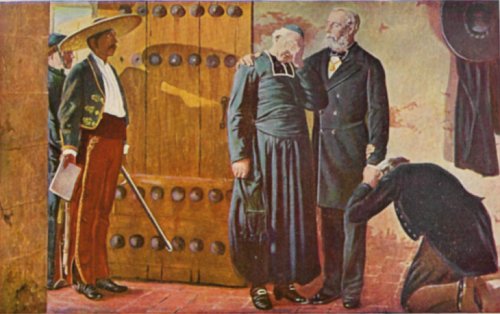
LAST MOMENTS OF MAXIMILIAN Painted by J. Paul Laurens From Carbon Print by Braun, Clement & Co., N.Y.
Appa Sahib surrendered himself and was placed under arrest. Presently he Appa Sahib's escape made good his escape and found a refuge with the Rajah of Jodhpur. In Holkar's State of Indore affairs ran in a similar groove. The Regent Mother showed herself inclined to come to an agreement with the British marching northward under Sir Thomas Hislop. But the Mahratta chiefs were bent on war, and murdered the Regent Mother. A battle, henceforth, was unavoidable. Already the British supply train had been plundered by the Mahrattas. The Battle of Nahidpore battle was fought on December 21, at Nahidpore. On each occasion Sir John Malcolm commanded the British troops and won a complete victory. All the Hindu guns and swords fell into British hands. Then came the heroic defence of Korygaun, still celebrated in British Indian annals. A detachment of Bombay Sepoys and native cavalry, under the command of Captain Staunton and ten English officers, in all 800 men with two guns, were caught unawares by the Peishwa's army of 30,000 Mahratta Gosains. Captain Staunton's force Defence of Korygaun intrenched itself in the village of Korygaun and prepared for the worst. The Mahrattas completely surrounded the place and the defenders were cut off from all water and supplies. Then came a succession of fierce rushes by the Mahratta horse and foot, every one of which had to be fought off in desperate hand-to-hand encounters. Of the ten white officers eight were killed; besides them Staunton lost one-third of his Sepoys. The Mahrattas left 600 on the field. To the present day the exploit is celebrated in the songs and stories of the Dekhan. The Peishwa witnessed the long fight from a neighboring hill, and was beside himself when his discouraged troops refused to renew the battle. After this Baji Rao could no longer hold his End of Mahratta rule army together. By the close of the year his forces were dispersed. It was the end of Mahratta rule in the Dekhan.