1825
Reading edition
CHARLES X. was crowned King of France in the Cathedral of Rheims. His first public measure was the appropriation of a million francs to indemnify the Charles X. French Royalists, whose lands had been confiscated during the French Revolution. Next came the proposal of a law on sacrilege, and one for primogeniture. Both bills were strenuously opposed by the Liberals. Broglie exclaimed: "What you are now preparing is a social and political revolution, a revolution against the revolution which changed France nearly forty years ago." Old Lafayette was glad to leave the country to visit North America.
In the United States the election of 1824 had to be decided by the House of Representatives. For the Presidency the candidates were Andrew Jackson, John Quincy Adams, Crawford and Clay, and for the Vice-Presidency Calhoun, American election contest Sanford, Macon, Jackson, Van Buren and Clay. They all belonged to the Democratic-Republican party. Jackson had received the highest number of electoral votes—99 were for him and 84 for Adams. Calhoun, as candidate for Vice-President, led with 182 votes. In the House of Representatives Clay, as leader, opposed Jackson. Adams was declared President, with Calhoun for Vice-President. The electoral vote of thirteen States was given John Quincy Adams President to Adams, while Jackson received seven. John Quincy Adams was then fifty-eight years of age. Washington had made him Minister to The Hague, and then to Lisbon, and in 1797 his father, then President, sent him as Minister to Berlin. In 1803, he was United States Senator. Six years later he was Minister to Russia. During both of Monroe's terms he was Secretary of State. Upon his inauguration as President, Adams made Clay Secretary of State. Wirt, McLean and Southard were retained in the Cabinet. The adherents of Jackson declared that a bargain had been made between Clay and Henry Clay rewarded Adams, who then paid Clay they alleged for his support in the "scrub race" for the Presidency. Randolph characterized the supposed arrangement as a "bargain between the Puritan and the Black Leg," and in consequence was challenged by Clay to fight a duel. Neither was injured. The election was followed by an immediate reorganization of political parties, on the question of supporting Adams's administration. Whether the successor of Adams should be a Northerner or a Southerner was the question at issue. His Changes in American politics opponents were slave-holders and their Northern friends; his supporters, the antagonists of the Democratic party, whether known as National Republican, Whig or Republican party, all of which terms were in use. For the first time the new Congress, under the reapportionment, represented the entire population of the country, with New York, Pennsylvania and Ohio in the lead. In the Senate were men of brilliant promise. Clay was still a leader, and so was Webster, in the rising majesty of his renown. The contest between the parties was narrowed down to two great issues—internal improvements under national auspices and tariff for the protection of Adams's first message manufactures. President Adams in his first message gave opportunity for concerted opposition. He took advanced ground in favor of national expenditure on internal improvements, and urged the multiplication of canals, the endowment of a national university, expenditures for scientific research, and the erection of a national observatory. He announced that an invitation had been accepted from the South American states to a conference at Panama, in regard to the formation of a political and commercial league between the two Americas. The Senate requested President Adams to give it information "touching the principles and practice of the Spanish-American states, or any of them—in regard to negro slavery." The subject was debated for almost the entire session. When enough had been said to show that slavery must not be interfered with, the delegates were nominated and an appropriation was made. The delegates never went.
On November 4, the first boat travelling along the new Erie Canal reached Erie Canal completed New York. Through the efforts of De Witt Clinton, the State of New York without Congressional aid had completed the great Erie Canal. Its annual tolls were found to amount to half its cost. The financial and commercial results of the great work were immediate and manifest. The cost ofBeneficial results carrying freight between Albany and New York was reduced from the 1820 rate of $88 per ton, to $22.50, and soon to $6.50. Travel was no less facilitated, so that it was possible for emigrants to reach Michigan, Illinois and Wisconsin cheaply. These fertile States grew accordingly in population. In 1825 the Capitol at Washington was nearly completed; the outer walls proved to be uninjured by the fire of 1814. The foundation of the central building had been laid in 1818, and this edifice was now completed on its original plan.
The American visit of the old Marquis de la Fayette—to give him his French name—was celebrated with national rejoicings. Years ago, when he left the American republic after its independence was achieved, it was a poor, weak Lafayette visits America and struggling nation. Its prosperity and increasing power now amazed him. The thirteen colonies along the coast had increased to twenty-four independent, growing and progressive commonwealths, reaching a thousand miles westward from the sea. Lafayette was the nation's guest for a year. On June 17, 1825, just fifty years after the battle of Bunker Hill, he laid the cornerstone of the obelisk which commemorates that battle in Boston. On this same occasion Daniel Webster made one of his great speeches. Lafayette returned to France in the American frigate "Brandywine," named in honor of the first battle in which Lafayette fought and was wounded half a century before. Congress presented him with a gift of $200,000 in money, and with a township of land in recognition of the disinterested services of his youth.
Shortly before President Adams accepted the invitation to send North American representatives to the proposed Congress of Panama, thirteen independent States joined at Buenos Ayres in a powerful confederation and Argentine Republic formed the Republic of Argentine. A national constitution was adopted and Rivadiera elected President. The new republic was soon called upon to prove its mettle in the war levied against it by Brazil for the possession of Uruguay. In the end Uruguay remained a part of Argentina. Brazil had previously achieved its complete independence from the mother country by assuming the public debt of Portugal, amounting to some ten million dollars. England gave its official recognition to these new changes of government as it had to the others.
The British war against the Burmese was nearly over. Early in the year the British forces left at Rangoon advanced up the river Irawaddy toward Donabew. The first attempt to take this stronghold was repulsed, whereupon Burmese reverses the British settled down to a regular siege. While trying to get the range with their mortars the gunners succeeded in killing Bundula, the chieftain of the Burmese. His brother flinched from the command of the army and was promptly beheaded. The Burmese forces went to pieces. The British proceeded to Prome, and inflicted another crushing defeat on the remaining detachments of the Burmese army. At the approach of the British column the Burmese rulers at Ava became frantic. All the demented women that could be found in and about Ava were gathered together and conducted to the front that they might bewitch the English. When this measure proved ineffectual, Prince Tharawadi tried to stem the British approach, but could not get his New British acquisitions followers to face the enemy. All the country from Rangoon to Ava was under British control. The Burmese came to terms. As a result of the conflict the territories of Assam, Arrakan and Tenaserim were ceded to the British.
While the British were still in the midst of this campaign a crisis occurred in Bhurtpore. The sudden death of the Rajah there left no successor to the throne but an infant son of seven. He was proclaimed Rajah under the guardianship of his uncle. A cousin of the dead king won over the army of Bhurtpore, and putting the uncle to death imprisoned the little Crisis in Bhurtpore Rajah. Sir David Ochterlony, the aged British Resident at Delhi, interfered in behalf of the little prince and advanced British troops into Bhurtpore. His measures were repudiated by Lord Amherst. Sir David took the rebuff so much to heart that he resigned his appointment. Within two months after his retirement the old soldier died in bitterness of soul. The sequel vindicated his judgment. In defiance of the British Government, the usurper of Bhurtpore rallied around him all the dissatisfied spirits of the Mahrattas, Pindarees, Jats and Rajputs. Lord Amherst was forced to retreat to Vera. The British army under Lord Combermere crossed the border and pushed through to Summary British dealings Bhurtpore. The heavy mud walls of the capital had to be breached with mines. The usurper was deposed and put out of harm's way in a British prison. With the restoration of the infant Prince in Bhurtpore, all danger of another great Indian rising seemed at end.
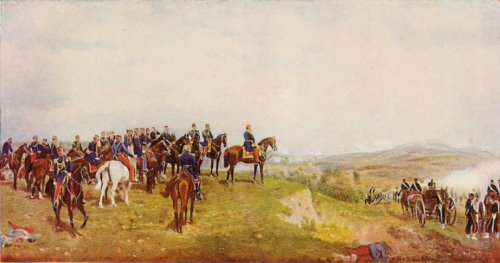
SOLFERINO Painted by E. Meissonier From Carbon Print by Braun, Clement & Co., N.Y.
At home in England it was a period of unprecedented scientific and industrial development. Following Faraday's recent conversion of the electric current into mechanical motion, Sturgeon invented the prototype of The first railway the electro-magnet. The first public railway for steam locomotives was opened between Stockton and Darlington by Edward Peese and George Stephenson—an innovation which caused great excitement throughout England. On the opening day, September 27, an immense concourse of people assembled along the line to see the train go by. Nearly every one prophesied that the "iron horse" would be a failure. The train weighed about ninety English tons, and consisted of six wagons loaded with coal and flour, then a covered coach containing directors and proprietors, with twenty-one coal wagons fitted up for invited passengers, nearly 600 in number. Stephenson's engine, named the "Locomotion," had a ten-foot boiler and weighed not quite 1,500 pounds. As six miles an hour was supposed to be the limit of speed, it was arranged that a man on horseback should ride on the track ahead of the engine carrying a flag. The train was started without difficulty amid cheers. Many tried to keep up with it by running, and some gentlemen on horseback galloped across the fields to accompany the train. After a few minutes, Stephenson shouted to the horseman with the flag to get out of the way, for he was going to "let her go." Ordering the fireman to "keep her hot, lad," he opened wide the throttle-valve and the speed was quickly raised to twelve miles an hour and then to fifteen.
The runners on foot, the gentlemen on horseback and the horseman with the Stephenson's practical demonstration flag were left far behind. So, with the cross-beams and side-rods trembling from the violent motion, the red-hot chimney ejecting clouds of black smoke, amid the cheers of the delighted spectators and to the astonishment of the passengers—the immortal George Stephenson brought his train safely into Darlington.
As the "Newcastle Courant" (October 1, 1825) put it, "certainly the performance excited the astonishment of all present, and exceeded the most sanguine expectations of every one conversant with the subject. The engine arrived at Stockton in three hours and seven minutes after leaving Darlington, including stops, the distance being nearly twelve miles, which is at the rate of four miles an hour; and upon the level part of the railway, the number of passengers was counted about four hundred and fifty, and several more clung to the carriages on each side. At one time the passengers by the engine had the pleasure of accompanying and cheering their brother passengers by the stage coach, which passed alongside, and of observing the striking contrast exhibited by the power of the engine and of horses; the engine with her six hundred passengers and load, and the coach with four horses and only sixteen passengers."
So successful was the Stockton and Darlington railway that a bill was brought in Parliament for the construction of a railroad between Liverpool Immediate railroad development and Manchester after Stephenson's plan. The scheme was violently opposed. Its detractors, among whom were Lords Lefton and Derby, declared that Stephenson's locomotive would poison the air, kill the birds as they flew over them, destroy the preservation of pheasants, burn up the farms and homesteads near the lines; that oats and hay would become unsalable because horses would become extinct; travelling on the highways would become impossible; country inns would be ruined; boilers would burst and kill hundreds of passengers. Indeed, there was no peril imaginable that was not predicted to attend the working of a railroad by steam.
When Stephenson was examined by a Parliamentary committee, one of the members put this question: "Suppose, now, one of these engines to be going along a railroad at a rate of nine or ten miles an hour, and that a cow were to stray upon the line, and get in the way of the engine, would not that, think you, be a very awkward circumstance?" "Yaw," replied Stephenson, in his broad Northumbrian dialect, "ay, awkward—for the coo." On account of his speech Stephenson was denounced as a "foreigner," and the bill was thrown out by the committee, by a vote of 37 against 36. After a second Parliamentary battle, the bill was passed through both Houses by a majority of forty-seven votes. The passage of the act cost £27,000.
Almost coincidentally, Faraday found that benzine was a constituent of petroleum, a discovery destined to affect the modern construction of Other modern inventions automobile vehicles toward the close of the century. A number of other achievements made this an important year for science in England. John Crowther took out a patent for his invention of a hydraulic crane. The steam jet was first applied to construction work by Timothy Hackworth. Joseph Clement built a planing machine for iron. One of the earliest chain suspension bridges was erected at Menai Strait by Thomas Thelford, and at the same time Brunel sunk his first shaft for the Thames tunnel. Significant of the industrial revival of those days was the opening of mechanics' institutes at Exeter and Belfast. In Canada, the newly founded English financial crisis averted McGill College was raised to the rank of a university. A financial measure of far-reaching import was the Bank of England's sudden diminution of its circulation to the extent of £3,500,000 by the combined exertions of the bank and of the royal mint. A crisis in public funds was thus averted. The most important political measure of the year was Canning's attempt to Canning's attempted reforms repeal the political disabilities of the Catholics in England. A bill to this effect was passed through the Commons, but was thrown out by the House of Lords. Canning's friend Huskisson inaugurated a commercial policy, which was founded on the theory of free trade, destined to bring about the repeal of the corn laws.
The situation in Greece was calculated to stiffen the backbone of Canning's foreign policy. On February 22, Ibrahim's Egyptian army had crossed the sea Greek reverses unopposed and overran the Morea. The Greeks were defeated near Nodoni, and the garrison of Sphakteria was overwhelmed. The forts of Navarino capitulated. In vain was old Kolokotrones released from his prison to oppose the onslaught of Ibrahim's Arabs. The Greeks were driven back through Tripolitza, and did not succeed in making a stand until the Turks Nauplia and Missolonghi besieged reached Nauplia. Here Demetrios Ypsilanti with a few hundred men repulsed the Turkish vanguard at Lerna. Ibrahim settled down to the siege of Nauplia and of Missolonghi. The country round about was laid waste and the people killed. Ibrahim's hordes even cut down all trees and saplings. Thus the fertile mountains and hillsides of Greece were changed into the barren rocks they are to-day. Nothing so excited the sympathy of the lovers of liberty in Europe as these wanton ravages on classic soil committed by the Greece devastated savages of the desert. Even Alexander of Russia was so moved by the rising indignation of his people that he dissolved diplomatic conferences at St. Petersburg in August. He issued a declaration that Russia, acting on its own discretion, would put a stop to the outrages of Greece. Accompanied by the leaders of the Russian war party, he left St. Petersburg and travelled to the Black Sea. All Europe waited for the long-threatened Russian advance on Constantinople. Suddenly news arrived that the Czar had died at Taganrog.
Alexander expired on November 19 (December 1), in the arms of Empress Death of Czar Alexander Elizabeth. His last hours were clouded by revelations of a plot to assassinate him. As if to recant his reactionary measures of the last few years, he said: "They may say what they like of me, but I have lived and will die republican"—a curious boast which is justified only by the earlier years of Alexander's reign. In the beginning of his rule the Czar reversed the despotic tendencies of his predecessors. Free travel was permitted; foreign books and papers were allowed to enter; the better classes of the community were exempted from corporal punishments; the emancipation of serfs was begun, and the collegiate organization of the Alexander's early reforms administration was supplanted by ministries modelled after those of the chief European countries. As early as 1802 Alexander could boast of a Cabinet as good as that of any constitutional monarch. Another far-reaching reform was the reorganization of Russian public education, and the encouragement given to the publication of Bibles. A temporary relaxation of the censorship resulted in the foundation of societies of literature and of such journals as the "Russian Messenger," "The Northern Mercury," and the Russian letters stimulated "Democrat." Writers like Pushkin and Gogol brought forth their earliest works. Koltsov discovered a new source of poetry in the popular songs. Lermontov sang the wild beauty of the Caucasus, and Ozerov wrote his classical drama "Dmitri Donskoi," which recalled the struggles of Russia against the Tartars. Modern romantic tendencies were advanced by Joukovsky's translation of Schiller's and Byron's poems. Ginka composed the scores for his earlier operas.
Changes for the worse
When Alexander came under the influence of Madame de Krüdener and the more baneful ascendency of Metternich everything was changed for the worse. The publication of Bibles was stopped; the censorship was re-established in its full rigor; Speranski's great undertaking of a Russian code of laws was nipped in the bud; Galytsin, the liberal Minister of Publication, had to Araktcheyev resign, and Araktcheyev, a reactionary of extreme type, was put in his place. Some idea of the dark days that followed may be gathered from Araktcheyev's first measures. The teaching of the geological theories of Buffon and of the systems of Copernicus and Newton were forbidden as contrary to Holy Writ. Medical dissection was prohibited, and the practice of medicine was reduced to that of faith cure. All professors who had studied at seats of learning abroad were dismissed. Then it was that the The Russian succession secret societies sprang up in Poland and in the north and south of Russia. One of the foremost conspirators was Pestel, who had undertaken to frame a new code of laws for Russia. When Alexander died, Russia was on the brink of a military revolution. It was the intention of the conspirators to assassinate the Czar in the presence of his troops and to proclaim a constitution; but his unexpected departure to the Black Sea frustrated the plan. Alexander's death threw the Russian court into confusion. For a while it was not known who was to succeed him. The supposed heir to the throne was Alexander's brother, Constantine. Unbeknown to the people he had formally renounced his right to the throne. At the time of his brother's Conflicting proclamations death he was in Warsaw. His younger brother, Nicholas, at St. Petersburg, had him proclaimed emperor. When they brought him Constantine's written abdication, Nicholas refused to acknowledge it and caused the troops to take their oath of allegiance to his brother. Constantine in Warsaw proclaimed Nicholas emperor. Nicholas would not accept the crown unless by Nicholas, Czar of Russia the direct command of his elder brother. At length the matter was adjusted, after an interregnum of three weeks. On Christmas Day, Nicholas ascended the imperial throne. The confusion at St. Petersburg was turned to account by the military conspirators who had plotted against Alexander's life. To the common soldiers they denounced Nicholas as a usurper who was trying to make them break their recent oath to Constantine. When ordered to take the Moscow mutiny oath to Nicholas, the Moscow regiment refused, and marched to the open place in front of the Senate House. There they formed a square and were joined by other bodies of mutineering soldiers. It is gravely asserted by Russian historians that the poor wretches, ignorant of the very meaning of the word constitution, shouted for it, believing it to be the name of Miloradovitch shot Constantine's wife. An attack upon them by the household cavalry was repulsed. When General Miloradovitch, a veteran of fifty-two battles against Napoleon, tried to make himself heard, he was shot. The mutineers would not listen even to the Emperor. Not until evening could the new Czar be brought to use more decisive measures. Then he ordered out the artillery End of revolt and had them fire grapeshot into the square. The effect was appalling. In a few minutes the square was cleared and the insurrection was over. Its leaders were wanting at the moment of action. A rising in the south of Russia was quelled by a single regiment. Before the year ended, Nicholas was undisputed master of Russia.
By the death of Augustin Jean Fresnel, France lost a brilliant scientist, Death of Fresnel who shares with Thomas Young the honor of discrediting the old emission theory of light, and of formulating the undulatory theory.
Jacques Louis David, founder of the new French school of classicism in painting, died at the close of the year at Brussels. Many of his paintings Death of David were on exhibition before the fall of the old régime in France. In the days of the French Revolution, David was a Jacobite and friend of Robespierre, and suffered in prison after the latter's fall. It was not, however, until the time of the First Empire that David's fame spread. He then reached the zenith of his success. His masterpieces of this period are "Napoleon Crossing the Alps"—a canvas on which is founded Hauff's story of "The Picture of the Emperor"—"The Coronation of Napoleon," "Napoleon in His Imperial Robes," and the "Distribution of the Eagles." Equally famous is his portrait of "Madame Recamier resting on a Chaiselongue." After the fall of the First Empire, David was exiled from France, and retired to Brussels. David, unlike so many other beneficiaries of the Empire, remained warmly attached to Napoleon. Once when the Duke of Wellington visited his studio in Brussels and expressed a wish that the great artist would paint him, David coldly replied, "I never paint Englishmen." In his declining years he painted subjects taken from Grecian mythology. Among the paintings executed by David during his banishment were "Love and Psyche," "The Wrath of Achilles," and "Mars Disarmed by Venus." The number of David's pupils who acquired distinction was very great, among whom the best known were Gros, Gérard, Derdranais Girodet, Jugros, Abel de Pujel and Droming.