1838
Reading edition
EARLY in the year the Canadian insurgents and their sympathizers at Navy Island were compelled to surrender. United States troops were posted at the Lord Durham in Canada frontier. In the meanwhile Lord Durham had taken charge in Canada with dictatorial powers. He undertook to remodel the Constitution of Canada. His first act was a proclamation of amnesty from the Queen. The beneficent effect of this was spoiled by a clause of exceptions providing for the perpetual banishment of a number of men implicated in the recent rising. On April 2, Lunt and Matthews, two conspicuous rebels, were hanged. Lord Durham's confession that his measures were illegal evoked a storm in Parliament. Lord Brougham, who had a personal quarrel with him, led the opposition there. In Canada, Mackenzie promptly proclaimed a republic. On Napierville June 5, a fight between the rebels and British troops near Toronto quelled the rebellion for a short time. Within a few months it broke out again at Beauharnais. A pitched battle was fought at Napierville early in November. After their defeat there, the rebels made another stand at Prescott on November 17, but suffered so crushing a defeat that the insurrection was Prescott believed to have been ended. In the meanwhile, Lord Brougham had succeeded in passing a bill through the House disapproving Lord Durham's measures. Durham, he said, had been authorized to make a general law, but not to hang men without the form of law. To save his own Administration Lord Melbourne on the next day announced that the Cabinet had decided to disallow Durham's Durham repudiated expatriation ordinances. Durham was called upon to proclaim to the rebellious colonists that the ordinance issued by him had been condemned by his own government. Venting his mortification in a last indignant proclamation, he quitted Canada without waiting for his recall. By the express orders of the government the honors usually paid to a Governor-General were withheld from him. Lord Durham returned to England a broken-hearted and dying man. He was succeeded by Sir John Colbourne. His Canadian interregnum first measure was to offer a reward of £1,000 for the apprehension of Papineau. The storm of indignation that followed was so violent that Colbourne incontinently threw up his post, and hastened back to England. The Hudson's Bay Fur Company improved the interval of the interregnum to monopolize the functions of government in the vast regions of the extreme north of America. An expedition was sent out to explore the northernmost coast. The United States also fitted out an Antarctic exploring expedition, consisting of six vessels, under the command of Lieutenant Wilkes.
In the British Parliament, the question of the adoption of the ballot was raised by Duncombe, but Lord John Russell spoke against it, stating that the majority of the people were against fresh changes, or any renewal of Renewed agitation in England the agitating circumstances which preceded the Reform Bill. But twenty members voted with Duncombe, of whom six were asked to meet six members of the Workingmen's Association to discuss a programme of action. At that meeting a document in the shape of a Parliamentary petition was prepared containing "six points," which were: Universal suffrage, or the right of People's Charter voting by every male of twenty-one years of age; vote by ballot; annual Parliaments; abolition of the property qualification for members of Parliament; members of Parliament to be paid for their services; equal electoral districts. At the conclusion of the meeting, Daniel O'Connell rose and handed the petition to the secretary of the Workingmen's Association, saying, "There, Lovett, is your Charter. Agitate for it and never be content with anything else."
The "People's Charter" was submitted to a large public meeting and enthusiastically approved, and the leaders of the movement began to Feargus O'Connor organize. They soon fell into two factions; those who were in favor of force and those in favor of agitation only. The leader of both parties was Feargus O'Connor, an Irish barrister, and once a follower of O'Connell, with whom he subsequently quarrelled. Associated with him as leaders of the Chartist leaders movement at various periods were Lovett, Heatherington, Henry Vincent, Ernest Jones, and Thomas Cooper "the poet of Chartism."
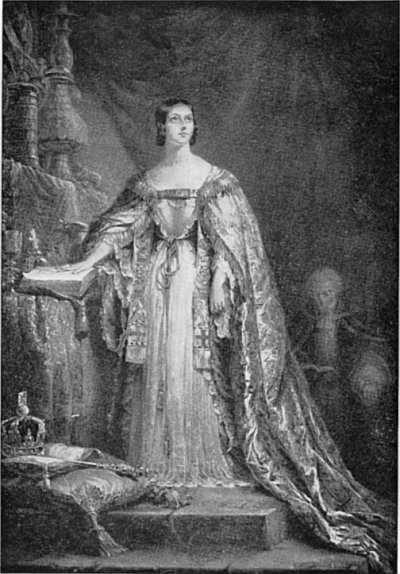
QUEEN VICTORIA TAKING THE OATH Painted by Sir George Hayter
In France, the sympathies of the people with the cause of the French Canadians were kept under firm control by the government of Louis Philippe. A dissolution of the Chambers, which modified the condition of French expedition to Mexico the Assembly, served to strengthen the Ministry of Molé. To vent the feelings excited in behalf of the Frenchmen of Canada, the French Government picked a quarrel with the Republic of Mexico. Reparation was demanded late in March for injuries inflicted on French residents during the internal dissensions of Mexico. The demand was refused. A French squadron of warships, under Admiral Baudin and Prince de Joinville, was Coast towns bombarded sent out to blockade the coast of Mexico. On November 27, San Juan de Ulloa was bombarded. Vera Cruz likewise suffered bombardment. The Argentine Republic became involved and declared war on France. French cruisers blockaded Buenos Ayres.
On the occasion of his mother's death, Prince Louis Napoleon returned to Louis Napoleon returns Europe. His book, "Idées Napoléoniennes," which was widely read throughout France, at once drew attention upon him. At the request of the French Government he was expelled from Switzerland. Louis Philippe's friend, Alexandre Dumas, at this time achieved a popular success with his book "Le Alexandre Dumas Capitaine Paul." Dumas's romantic plays and several of his latest comedies, written in the style of Scribe, were at the height of their vogue.
In the French salon of this year, François Daubigny, the great pupil of Daubigny Delaroche, first exhibited his early masterpieces, "Banks of the River Oulins" and "The Seine at Charenton." Both paintings were purchased by the French Government.
Poe In America, a new writer had arisen in Edgar Allan Poe, who disputed the field with Longfellow and Whittier. Poe's "Narrative of Arthur Gordon Pym," a story of marine adventures, which had begun in Poe's own journal, "The Messenger," was published in complete form by Harpers. Before this several Hawthorne of his works, among them that of "Ligeia," had already brought him into some prominence. Nathaniel Hawthorne during this same year wrote his early stories, which were afterward collected under the title of "Twice Told Emerson Tales." Ralph Waldo Emerson at Concord, Massachusetts, had begun to deliver those penetrating lectures which, rewritten in the form of essays, later established his rank as the foremost philosophic writer in America. Wendell Phillips made his appearance as a lecturer against slavery in Boston. Wendell Phillips Shortly before this a pro-slavery mob at Alton, Illinois, murdered the Rev. E.P. Lovejoy and destroyed the press and building of his newspaper, published in the interests of abolition. Abraham Lincoln, who had been re-elected to the Legislature of Illinois, voiced a strong protest against this and other pro-slavery tendencies in Illinois.
Other acts of persecution during this year brought lasting disgrace upon America. In direct violation of the Federal treaties with the Indians the Removal of Cherokees State troops of Georgia forcibly removed 16,000 Cherokees from their lands in that State. Nothing was done to alleviate the sufferings of the Cherokees, who were driven from their settlements in midwinter. The resulting death rate was fearful. More than 4,500 Indians, or one-fourth of the whole number, perished before they reached their destination in the distant Indian Territory.
The members of the new sect of Mormon, numbering some 12,000 souls, were Persecution of Mormons driven from their homes at Nauvoo in western Missouri. They went across the plains of Iowa, stopping temporarily at Council Bluffs. From there they passed over the great American prairies, and, crossing the Rocky Mountain range, settled near the Great Salt Lake of Utah.
Chicago was incorporated with a population of 4,170 residents. Much comment Record transatlantic trip was excited by a record trip of the steamboat "Great Western," which steamed from Bristol, England, to New York in fifteen days. Among those who lived to witness this event was John Stevens, one of the pioneers of modern steamboat building. Shortly afterward he died in his eighty-ninth year.
Within a short time after suing for peace, the Southern Indians broke the Indian truce broken truce and made a determined effort to take Fort Mellon. In this they were unsuccessful. In March, at Fort Dade, five of the chiefs signed an agreement, in which they stipulated to cease from war until the government decided whether they might remain in Florida. Some seven hundred Indians and negroes were taken by the government before its decision was announced, and were sent off to Tampa for shipment. In violation of a flag of truce, Betrayal of Osceola Osceola and several of his principal chiefs were seized and sent to Fort Moultrie as prisoners. Their treatment there was such that Osceola soon died. In May, Colonel Zachary Taylor succeeded Jesup. The remaining forces of the Indians were now wary. They scattered in the swamps, eluding attempts of organized troops to capture them. In December, Colonel Taylor Zachary Taylor in Florida set out with over a thousand men for their almost inaccessible haunts. On Christmas Day they found the Seminoles prepared to receive them near Okeechobee Lake. After a hard fought battle, in which Taylor lost 139 men, the Indians once more retreated into the swamps of Florida.
In South Africa during this year, the new community of Dutch settlers, who had evaded English jurisdiction, soon revived their peculiar institutions in the region that is now Natal—from the Drakensberg to the sea at Durban, Boers in Natal and from the Tugela River to the Umzimbolbu. The fight against the African savages continued. Early in the spring, a Boer expedition was defeated by the Zulus, who followed up their advantage by an attack on the nearest Boer laager. Seventy Boers, with their Kaffir servants, were massacred. A large Boer settlement, numbering some 800 persons, was saved from extermination only by a timely relief expedition under Pretorius, in December. On the Pretorius other side troubles arose between the Boers and the Bechuanas in consequence of King Moroka's prohibition of the importation of spirituous liquors into Bechuanaland. The growth of a new Dutch State to the north of Cape Colony caused uneasiness among the British authorities at Cape Town. A movement was started to extend British rule to Natal, and to secure the important seaport of Durban.