1845
Reading edition
AT THE beginning of the year, in America, came a literary sensation of Poe's "Raven" unwonted brilliancy. In the New York "Evening Mirror," January 29, Edgar Allan Poe's famous poem "The Raven" was reprinted from the advance sheets of "The American Whig Review," in which the name of the author was masked under the pseudonym of "Quarles." The poem was copied all over America and soon reached England. Baudelaire translated it into French. As Poe's biographer, Woodberry, has said: "No great poem ever established itself so immediately, so widely and so imperishably in men's minds." A literary tradition has it that Poe only received ten dollars for this masterpiece, and had to wait a year and more for his money.
War between the United States of North America and Mexico was now seen to be inevitable. On January 25, a joint resolution for the annexation of Texas annexed to the United States Texas passed through the American House of Representatives by a vote of 120 to 98, and through the Senate by 27 over 25 votes. On March 1, President Tyler signed the bill. The tactics by which Texas was annexed were similar to those by which the Missouri Compromise had been forced through Congress in 1820, and the nullification compromise in 1833. It meant a distinct gain for the pro-slavery party in the United States, and was denounced as such by the abolitionists of the North. Both in Mexico and in the United States active preparations were now made for war. American ships were still welcomed in the ports of Mexico, the more so since many of them brought needed munitions of war. In the United States strenuous efforts were made to settle all pending differences with other countries. In February, Great Britain had already accepted the forty-ninth parallel as a boundary line agreeable to the governments of both countries, and soon the Oregon Florida admitted to Union boundary dispute was likewise settled by treaty. Caleb Cushing's treaty with China was ratified by the Senate. Florida was admitted into the Union on March 3, the day before Tyler ceased to be President. James K. Polk succeeded him as the eleventh President. He had represented Tennessee in the House for fourteen years, serving twice as Speaker. Having declined the re-election to Congress, he was chosen Governor of his State. His James K. Polk, President nomination to the Presidency had been brought about by accident. Immediately after his inauguration, Polk appointed James Buchanan as his Secretary of State. Polk in his inaugural address suggested a settlement of the Oregon boundary dispute with England on the line of 54° 40'. The Democratic platform of 1844 had declared: "Fifty-four-forty, or fight." In other words, both Great Britain and the United States claimed the country on the Columbia River. When Calhoun proposed a line of boundary along the forty-ninth degree of latitude, the British Ministry made a counter Oregon dispute settled. proposition, accepting the line to the summit and thence along the Columbia River to the Pacific. Despite much talk of war, Calhoun's successor in the end accepted the British proposition of a boundary along the line of forty degrees, continuing to the ocean.
By the aid of the Whig Senators a treaty on this basis was approved by the Senate. With this question out of the way, the brunt of preparing for war now fell upon the new administration. Troops were massed within striking distance, and General Taylor was put in command of the American army. He proceeded to St. Joseph's Island, and from there crossed over to Corpus Christi on the mainland, near the mouth of the Neuces. At this point more Death of Andrew Jackson troops were concentrated to remain in winter quarters until the opening of hostilities. On June 8, Andrew Jackson died at "The Hermitage" in Tennessee. He had lived there quietly ever since his retirement from the Presidency. One of his last acts was to write a public letter to President Polk, wherein he urged him to prompt action in the Oregon boundary matter so as to be ready for decisive measures in Texas.
The frustration of the British attempt to keep slavery out of Texas was offset in other directions. A convention was concluded between Ecuador and Slave trade under ban Great Britain to suppress slave trading in that region. In Cuba, likewise, General Concha took measures for the total suppression of the slave trade. A law was passed making the trade a criminal offence in the Spanish West Indies. The government of Spain after much reluctance recognized the General Zurbano shot independence of Venezuela. Affairs in Spain had taken a new turn. On January 21, General Zurbano was betrayed into the hands of his enemies and was shot. The Cortes adopted a reactionary constitution.
In France, a Liberal majority in the Chambers, after a prolonged struggle, brought about the expulsion of the Jesuits. In the midst of this movement, Cavaignac, the great opposition journalist, expired. The French war in Algeria by this time had degenerated into mere guerilla fighting. The chief Atrocities in Algiers event of the year brought execration upon the arms of France. A tribe of Kabyles had taken refuge in the caves of Dahra. Unable to dislodge them from there, General Pelissier gave orders to smoke them out. Some five hundred of the tribesmen, among them women, children and aged people, were suffocated.
Colonial extension in other parts of the world was carried on in like aggressive manner. Thus a joint expedition of France and Great Britain made an attack on Tamatave in Madagascar, but failed of success. Another joint Colonial expansion expedition of the two powers forced the Republic of Argentine to concede free navigation of the La Plata River. From China concessions were wrested by which Christian missionaries were to be admitted to all of the five treaty ports. As a consequence of these concessions a virulent hatred of the foreigners sprang up among the common people of China. In South Africa, Governor-General Maitland of Cape Colony earned the everlasting hatred of the Boers by sending out an armed expedition to assist the black warriors of Griqualand against the Boers. In India, affairs at Lahore had Sikhs belligerent reached a crisis. There the boy Maharajah, with his regent mother and her favorite sirdar, Lal Singh, were at the mercy of their Sikh soldiery. To save themselves they determined to launch their army upon the British.
British enterprise found a vent in other ways beyond colonial conquests. In the spring of this year Sir John Franklin sailed out once more with the John Franklin's Arctic quest "Erebus" and "Terror," in quest of the Northwest Passage. The last message from him was received in July. News also reached England that he had entered Lancaster Sound, but it was long after that before anything was heard concerning him. Since then more than thirty Arctic expeditions have searched in vain for the body of Franklin. About the same time that Franklin sailed on this expedition, a great fire in Quebec destroyed 1,650 Conflagration of Quebec houses, rendering 12,000 people homeless. Just one month later, on June 29, a second fire destroyed 1,365 houses. Two-thirds of the city was laid in ashes. Another serious calamity was the Irish famine of this year, caused by the failure of the potato crop. The distress thus occasioned increased the agitation against the corn laws. As during the preceding year, great mass meetings were held in Birmingham and Manchester. Sir Robert Peel, early in the year, had showed his new leanings toward free trade, by the introduction of a bill for the abolition of import duties on no less than four hundred and thirty articles. The government's discrimination in favor of the duties on sugar provoked a long debate in Parliament. Gladstone Irish famine continued to support his old colleagues in the government, while Cobden and Bright led the opposition on the floor of the House. By the time Parliament was prorogued in August, the Ministry had won a complete victory. The spread of the famine during the summer, when almost all harvests failed, reacted powerfully upon the government. A strong public letter from the pen of Lord Russell brought the precarious position of the government home to Peel's Cabinet resigns the Cabinet. Sir Robert Peel admitted the necessity of an absolute repeal of the corn laws. Rather than confess such a complete change of position, Peel's Cabinet resigned. Lord Russell was summoned to form a new Cabinet.
During this interim the practice of duelling in England, but recently countenanced in the army by the Duke of Wellington, fell under lasting disfavor by the fatal outcome of an army duel, in which Lieutenant Hawkes Death of Hood killed Lieutenant Seaton. About the same time occurred the death of Thomas Hood, the poet and humorist. Born in 1798, as a son of a bookseller, he soon became a writer. As one of the editors of the "London Magazine," he moved among all the principal wits of the day. His first book, "Odes and Addresses to Great People," was written in conjunction with J.H. Reynolds, his brother-in-law. This was followed by "Whims and Oddities," in prose and verse; "National Tales," and "The Plea of the Midsummer Fairies," a Thomas Hood's Works book full of imaginative verse. Hood's rich sense of humor found scope in his "Comic Annual," appearing through ten successive years, and his collection of "Whimsicalities." Among his minor poems, "The Bridge of Sighs" and "The Song of the Shirt" deserve special mention.
LORD TENNYSON Painted by Frederic Sandys
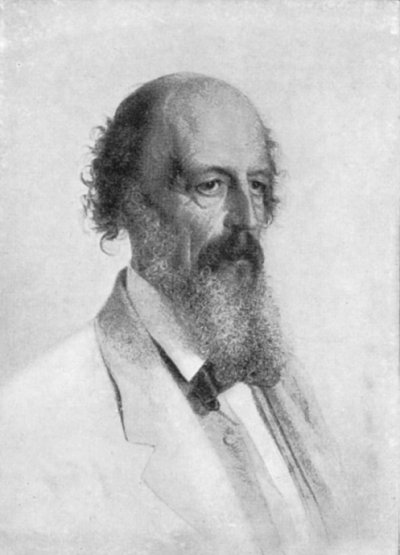
Sir Sydney Smith, the essayist, died shortly before this. Born in 1771, he Death of Sydney Smith studied for orders and became a clergyman. At the opening of the Nineteenth Century he entered the field of authorship with the publication of "Six Sermons Preached at Charlotte Chapel." Then came the famous "Letters on the Catholics, from Peter Plymley to his Brother Abraham." This book established Sydney Smith's reputation as a satirist. For nearly twenty years he published no more books, though a constant contributor to the Pungent satire "Edinburgh Review." Some idea of Sydney Smith's pungent style may be derived from his famous remarks on England's taxation during the wars with Napoleon: "The schoolboy," he said, "whips his taxed top; the beardless youth manages his taxed horse with a taxed bridle on a taxed road; and the dying Englishman, pouring his medicine which has paid seven per cent, into a spoon which has paid fifteen per cent, flings himself back upon his chintz bed which has paid twenty-two per cent, and expires in the arms of an apothecary, who has paid a license of one hundred pounds for the privilege of putting him to death. His whole property is then immediately taxed from two to ten per cent. Large fees are demanded for burying him in the chancel; his virtues are handed down to posterity on taxed marble, and then he is gathered to his forefathers to be taxed no more."
It was Sydney Smith, too, who asked the famous question: "Who ever reads an American book?" In 1824 Sydney Smith broke his long silence as an author, with the fervent pamphlet "The Judge that Smites Contrary to the Law." This was followed by a long series of open letters on clerical and political questions of the day. Shortly before his death he brought out a collection of sermons. A posthumous work was his collection, "Elementary Sketches of Moral Philosophy." Sydney Smith's case has been held up, together with that of Swift, as an example of political ingratitude. Despite all his labors Meagre literary remains for the Whig cause, but slender recognition was given to him by his political friends in office. The excuse for not making him a bishop was that his writings were generally regarded as inconsistent with clerical decorum. Like Jeffrey, Wilson and other distinguished contributors to English periodical literature at this time, he left no truly great work to posterity.
Elizabeth Fry, the great English prison reformer, died on October 15. She Elizabeth Fry's work it was that improved the condition of women prisoners at Newgate. Later her influence was apparent in most of the reforms introduced into the jails, houses of correction, lunatic asylums and infirmaries of England, the abuses of which were so eloquently voiced by Dickens.
Lord John Russell's attempts to form a new Ministry proved unsuccessful, largely because Lord Howick—who by the death of his father had become Earl Peel recalled Grey—refused to join the new Ministry on account of his objections to the foreign policy of Lord Palmerston. Sir Robert Peel was presently recalled. All of his colleagues retained their posts, except Lord Stanley, superseded by Gladstone. Soon after Peel's re-entry into office, the London "Times" A premature announcement announced that the Cabinet had decided on proposing a measure for the repeal of the corn laws. This premature announcement was one of the most startling journalistic achievements of the time. Notwithstanding all the published denials it was generally believed, and was followed by a great fall in the price of corn.
In the mind of the Ministry, as well as of the country at large, the threatening state of foreign affairs claimed precedence. In Autumn the Sikh army of the Khalsa had crossed the Sutlej, to the number of 60,000 War with Sikhs warriors, 40,000 armed followers and 150 guns. Sir John Little marched out of Ferozepore with 10,000 troops and 31 guns to offer battle, but the Sikhs preferred to surround them. Meanwhile, Sir Hugh Gough and Sir Henry Hardinge, the new Governor-General, hurried toward the frontier with a Moodkee large relieving force. On September 18, they met the army of Lal Singh at Moodkee and won a slender success. But for the flight of Lal Singh, the Sikhs might have claimed the victory. The British troops now advanced on the Sikh intrenchments, Ferozeshahar, where they effected a junction with Little. On December 21, the British advanced in force, but encountered such stubborn resistance that the day ended in a drawn battle. Not until after Ferozeshahar sunset did Gough's battalions succeed in storming the most formidable of the Sikh batteries. After a night of horrors the battle was resumed. The Sikh soldiers, who had risen in mutiny against their own leaders, fell back and yielded their strong position. The second army of the Sikhs under Tej Singh came up too late. After a brief artillery engagement, all the Sikh forces fell back across the Sutlej River.