CHAP. XVII. PROVINCE OF PERNAMBUCO.
Reading edition
Voyage from Rio de Janeiro—First Donatories—Taken by the Dutch—Restoration—Reversion to the Crown—Indians—Boundaries—Mountains—Colony of Negroes—Mineralogy—Zoology—Phytology—Rivers—Islands—Comarcas of Ollinda, Recife, Alagoas—Povoações—Ouvidoria of the Certam of Pernambuco—Rivers—Towns—Recife, or Pernambuco—Ollinda—Mattutos—State of Society—Apathy—Environs—Revolution in 1817—Military Government—Adoption of a New Constitution—Holidays—Produce—Inspection—Sugar Engenho—Contribution Fund—Population—Fribourg House.
On the 14th of November, I proceeded on board the brig Columbine, Captain Thomson, lying in the bay of Rio de Janeiro, for the purpose of visiting Pernambuco. A contrary wind prevented our departure for five days. The party on board consisted of Colonel Cotter, his lady and children, Captain Rezende, and Mons. Garay. By way of rendering our detention less tedious, we made two or three excursions to the eastern side of the bay. Our first visit was to the small rocky island with the church of Boa Viagem situated on its summit. We were denied access, from the orders of government, that strangers were not to be admitted up the steep, in consequence of a new fort then erecting upon it. We were therefore excluded from the blessing usually granted at this church to persons upon the point of undertaking a voyage. It was formerly the general custom, and is at present not uncommon, for navigators and others previously to embarking upon the ocean, to present offerings here, receiving in return the prayers of the padre for a good voyage; and hence the place is called Boa Viagem.
The boat proceeded round this island into the bay of Jurufuba, for the purpose of obtaining an additional supply of water. We walked round the back of the hills that edge this bay to the fountain, where the water-casks were filled. Our road led by a delightful pathway embowered by verdant trees intermixed with orange, banana, and other fruits. Here and there a house of good external appearance was seen, and cultivation appeared to be making some progress. We purchased a rich supply of fruits from a widow whose shacara was well stored, and her daughter gratuitously presented us with large bouquets of flowers, whose aromatic scents were gratefully diffused in our cabin for some days. In the common apartment of the widow’s dwelling, secluded in a profusion of trees, was the figure of our Saviour, enclosed in a case with opened doors, illumined by a lighted taper.
Our next excursion was to a small opening between two headlands, not far from the fort of St. Cruz, containing a solitary white cottage, exhibiting much neatness at a distance: we soon, however, discovered that, like most Brazilian residences, its external appearance was not a proof of its internal comfort. There was only one pathway, conducting from this little praya, up a steep rocky mountain, on the summit of which we found a grey-headed old man, seated, with his black boy, and enjoying the varied scenery around. He said, that he frequently came from the city across the bay in a canoe to this retired situation. We descended the opposite side of the mountain, by a narrow and damp avenue, obscured by the meeting of rocks high above our heads, on emerging from which we found our progress stopped by two distinct precipices of granite; it was necessary to cross the first in an oblique direction to arrive at the second, an unlucky slip from which would have precipitated the passenger one hundred feet into the sea. We observed a rope hanging over its side, but could not imagine that it was the only descent into the valley below, until we returned to the old man, who informed us that there was no other way, and sent his boy to show us the mode of descending: with both hands he laid hold of the rope, which was imperfectly secured to a bush, and traversed the first precipice, stepping backwards and allowing the rope gradually to pass through his hands. Arrived at the second precipice, which was to be descended perpendicularly, he took hold firmly of a stronger rope, attached to a hanging tree, growing out of the interstices of the two rocks; he proceeded backwards, moving one foot after the other, horizontally placed against the side of the precipice, till he reached the bottom. Colonel Cotter, Captain Thomson, and myself, took off our shoes and proceeded in the same way, but the Colonel declined accompanying us further than the first precipice, in consequence of a wound received in his hand at the battle of Victoria. The valley we found to be thinly planted with mandioca, which, with a few solitary blacks and some miserable huts, was all that it presented to our observation. We ascended the precipices by placing ourselves in the same posture in which we had descended, and then returned with the rest of the party, who were waiting for us, to the vessel, our surprise being mutually excited at the extraordinary and intricate mode of communication between the two prayinhas. Whilst we lay at anchor, four Russian frigates entered the bay, in very fine order, and took their stations not far from the British ships of war, the Superb and Vengeur, then in the bay. The Russian frigates were proceeding upon a voyage of discovery to the South Seas. On our departure from the bay of Rio de Janeiro we had a favourable breeze, and in five days were in the latitude of Bahia, having run upwards of ten degrees of latitude, and seven of longitude. The wind now became adverse; but in five days afterwards we passed Cabo Calor, Rio Real, and Seregipe d’ el Rey, and on the following day were close in with land, northward of the St. Francisco. The coast was flat and covered with woods, a few huts being all that we could occasionally discover.
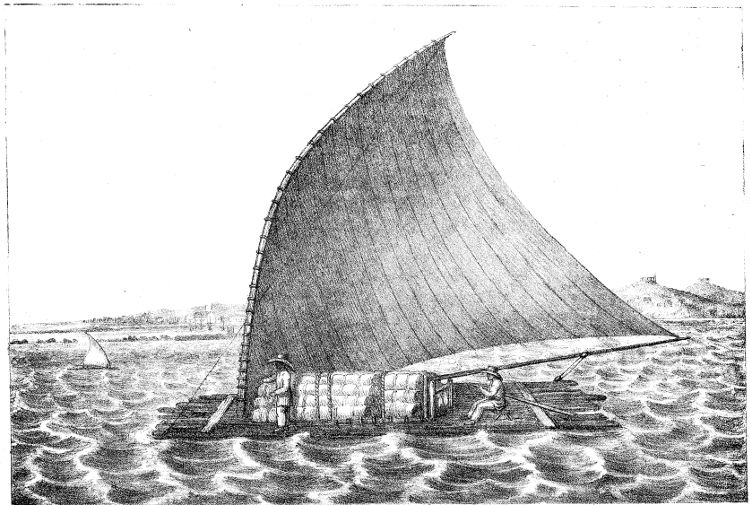
On Stone by C. Shoosmith from a Sketch by Jas. Henderson.
Printed by C. Hullmandel.
A JANGADA OR CATAMARAN NEAR PERNAMBUCO.
The currents we found setting in towards the coast much stronger and to a more considerable degree, than any of the charts extant account for. In the course of the 3d of December we indistinctly perceived some catamarans near the beach, and at dusk discovered Cape St. Augustine, affording us the hope of reaching Pernambuco next morning. At day-break on the 4th, Cape St. Augustine, Pernambuco, and Ollinda, were in view, with the land of the Cape elevated and jutting out into the sea, but presenting nothing remarkable. The coast near Pernambuco is flat, except some elevations in the distant back ground, and Ollinda situated upon an accumulation of rising eminences. On viewing it we could not but acquiesce in the exclamation of the first donatory of this province, “O que linda situacam para fundar huma villa.”[34] The whole country from the sea appeared richly wooded and interspersed with the cocoa-nut tree, and impressed the idea of fertility and cultivation. The jangadas, or catamarans, now passed near us on all sides, with their triangular sails, producing no inconsiderable surprise amongst the whole party. They are constructed of eight, ten, and some of twelve trunks of the buoyant jangada tree, rudely secured together by wooden bolts passing horizontally through the whole, and with cross-bars at the top, attaching the rafts more firmly together. The trunks are not of uniform length, and, being almost hid amongst the waves, would not be discovered at all without the sail and the two men who navigate them. The waves pass through the apertures between each trunk, and the men are constantly standing in water, one of whom steers with a large paddle passed indiscriminately between the ends of two of the rafts. Thus cotton and sugar from the places upon the coast and from the rivers are conveyed to the capital. Voyages of several hundred miles are performed by jangadas. An English gentleman proceeded to sea in one of them from Parahiba to Pernambuco, a small table was attached to the rafts upon which he slept, and although the sea is generally washing over them they are never known to upset. Our voyage had been an extremely pleasant one, and each individual had expressed the highest gratification not only at the mutual good humour that had prevailed, but the very great attention of the captain. The party frequently met on shore afterwards, and I received many civilities from Colonel Cotter and his lady during my stay at Pernambuco. The Colonel, before my departure, was appointed to the command of the militia regiments formed by the population of the town. We will defer speaking of the city of Pernambuco, or Recife, till we have concluded the description of the province.
This province was presented as a captaincy, with less extent of territory than it now contains, to Duarthe Coelho Pereyra, in reward for having repulsed the French from the river St. Cruz, re-establishing the factory which had been destroyed by them, and rendering other important services to the Portuguese government. The letter of donation was granted to him in 1534; and in the following year he set sail from Portugal, accompanied by his wife and some other families, who joined him for the purpose of colonization.[35]
The small village of Hyguarassu, which had its origin about four years before, was for some time the place of his residence, till Ollinda was begun, which he made his capital soon after its foundation. He was engaged in continued wars with the Cahetes, who were the former inhabitants of the country. He died in the year 1554, leaving his wife, D. Brittes d’Albuquerque, in trust of the government of the captaincy till the arrival of his hereditary son Duarthe Coelho d’Albuquerque, who was pursuing his studies in Portugal, and which he left in 1560 by orders of Queen Catharine, to protect the colony from the danger with which it was threatened by the revolt of some tribes of Indians whom his father had reduced to obedience.
The new donatory took with him his brother Jorge d’Albuquerque Coelho, and was accompanied by many friends and hired attendants to his new settlement, and had the promise of others to follow him for the purpose of augmenting the colony. He subjugated the whole nation of the Cahetes and divided them into hordes; and after a residence of many years returned to Europe, in order to accompany D. Sebastiano in his voyage to Africa, leaving his brother administrator of the captaincy, which progressively improved under his management.
In failure of male issue he was succeeded by his brother Jorge d’Albuquerque Coelho, father of Duarthe d’Albuquerque Coelho, who in the second year after the Dutch had possession of the captaincy arrived there with the Count Banholo, where he remained till the end of 1638, when he returned to Portugal. During his residence he kept a diary of the first eight years of the war.[36]
Duarthe d’Albuquerque Coelho had an only daughter, married to the Count de Vimiozi D. Miguel de Portugal, but neither he nor his heirs received any revenue from the captaincy, the dominion of which was disputed; for King John IV. who had expended large sums in its restoration, finding that the donatory had not forces sufficient to prevent the invasion of the enemy, should they make a second attempt, annexed the captaincy to the crown in the first year of its restoration. This the donatory opposed, and his heirs sustained an obstinate suit at law for many years, obtaining various sentences in their favour, which were always abrogated, till finally they desisted from the contest, surrendering whatever right they had to the province; and, in 1717, by the intervention and consent of John V. a convention was made between the Count de Vimiozi D. Francisco de Portugal and the attorney-general, in which it was agreed that the Count should receive in exchange for the captaincy the marquisate of Vallenca for himself and his son, the countship to pass to his son and grandson, and eighty thousand crusades, to be paid from the revenues of the province in ten years at equal payments.
The new colonists, who were sent to it immediately after the restoration of the province, gave it a rapid improvement. The Indians living towards the interior, the principal of whom were Tupinambas, and divided into numerous tribes, were by degrees surrendering the country and allying themselves to the conquerors, or retiring to the western districts. The latter were reduced about the years 1802 and 1803.
These Indians were divided into four nations, who have always exhibited the most irreconcileable hatred to each other, and to this day preserve their ancient animosity undiminished. They were distinguished by the appellations of Pipipan, Choco, Uman, and Vouvé. The language of each differed in idiom, but the general resemblance between them sufficiently demonstrated that they sprung from the same origin. They occupied a wild and uncultivated tract of country, of thirty square leagues, between the rivers Moxoto and Pajehu, near to the serra of Ararippa, a country sterile and deficient in water. All are wandering tribes, ignorant of any kind of agriculture, and support themselves on wild fruits, honey, and game; a hog, a deer, or a bird are all dressed with the hair, feathers, and intestines. The arms of the men are a bow and arrow, and they go perfectly naked. The women cover themselves with a small and elastic net, or with a deep fringe of thick thread much twisted, and made with considerable ingenuity. They inter their dead in a bent posture, having no instruments to make a grave sufficiently large to admit of the body lying at full length. They always bury under the most shady tree, preferring the ambuzo, if it be found near the spot. Of all savage nations they are perhaps the most remarkable for conjugal fidelity; polygamy and adultery are unknown among them, and the latter crime they abominate in their conquerors.
All these savages received baptism; and, after being formed into villages and rendered rather more civilized, they began to cultivate the most necessary provisions of life, as mandioca, Indian corn, gourds, and vegetables. But, notwithstanding their apparent improvement, they still retained their wild and savage propensities for hunting and general depredation: early accustomed to live on plunder, they conceived they had a natural right to the property of each other, and they frequently drove off and appropriated the sheep and oxen of the neighbouring farmers. Independently of these savage propensities to a wild and predatory life, their religious instructors gave them a very good character for innocence of general manners, in which they were said to resemble the primitive Christians.
They suppose, from the above circumstances, that the present race of these Indians are descendants of some who, after having settled in the villages and become Christians, had again returned to their native wilds; and, from a rooted propensity, which no art could remove, preferred the savage to the civilized state. Indeed, the opinion is supported by a fact, already alleged in this work, as well as by recent occurrences, in which individuals who have been civilized, on entering their native wilds, have again adopted their former rude habits.
This province of Pernambuco, which had formerly the title of countship, is bounded on the north by the provinces of Parahiba, Siara, and Piauhy; on the south by the river St. Francisco, which separates it from Seregipe and Bahia, and by the Carinhenha, which divides it from Minas Geraes; on the west by the province of Goyaz; and on the east by the ocean, with seventy leagues of coast from the river St. Francisco to the river Goyanna.
The river Pajehu, which rises in the serra of the Cayriris, and empties itself into the St. Francisco thirty leagues above the fall of Paulo Affonso, divides it into two parts—eastern and western; the latter forming an ouvidoria, which comprehends a great portion of the eastern, the sea-coast of which is divided into three comarcas, Northern or Olinda, Central or Recife, Southern or the Alagoas, whose common limits are in the vicinity of Rio Una, which enters the sea forty miles south of Cape St. Augustine.
This province lies between 7° and 15° south latitude, having a warm climate and pure air. The lands upon the whole extent of the sea-coast are low, with considerable portions of fruitful soil, and although it has many rivers, which are perennial and abundant, yet the inhabitants in many parts suffer from want of water. In the interior of the province the face of the country is very unequal, being in some places mountainous, and very deficient in water, and that which is met with, besides being extremely scarce, is never pure, being of the colour of milk, and drawn from wells where all kinds of animals go to drink, or else from pits dug in the sand. From the town of Penedo to the bar of Rio Grande, which travellers by the windings of the river compute at five hundred miles, there does not run towards the river St. Francisco a single stream in the dry season.
Mountains.—The serra of Borborema, which is the most majestic in the Brazil, has its commencement near the sea, in the province of Rio Grande, and, after having traversed that of Parahiba from north-east to south-west, turns to the west, separating the western part of Pernambuco from the preceding, and from Siara for a considerable space. It then inclines to the north, dividing the last from the province of Piauhy, varying frequently in altitude and name to its termination, where it is denominated Hibiapaba, in view of the coast between the rivers Camucim and Paranahiba. In some parts it is rocky, in others bare and barren, but the principal part is covered with beautiful woods, nourished by strong and fertile soils. In some places it has two or three leagues of luxuriant herbage on its summit.
The mountain Araripe, which is a portion of it, commands a view of the river St. Francisco, at a distance of more than thirty leagues. In this mountain the rivers Jaguariba and Piranhas have their origin, and run to the north. It also gives birth to the rivers Parahiba and Capibaribe, which flow eastward, and likewise to the Moxoto and the Pajehu, which direct their course to the south.
About seven leagues distant from the fall of Paulo Affonso, in the parish of Tarcaratu, is the mountain of Agua-Branca, with its numerous branches, in great part covered with wild and luxuriant woods. Here is a chapel of Our Lady of Conceiçao, and many families of different shades of complexion, equally if not more barbarous than the ancient possessors of the country.
In the vicinity of the river Pajehu, about fifteen leagues from that which absorbs it, is the serra Negra, which is about a league long, and proportionably wide, and covered with thick woods, that are often violently agitated by strong winds. Near it is the site of Jacare, where the Choco Indians lived for some time; but since they have been subjugated, like their neighbours, there is little mention made of them.
At a short distance from the source of the river Una, is the serra Garanhuns. It is covered with woods, where they are introducing plantations of cotton, Indian corn, mandioca, vegetables, and fruits. From this mountain descend many clear streams of water, which vanish on entering the sandy plains that encompass it below. Among other useful plants may be remarked the terminalia, or styrax of Linnæus, which produces the gum-resinous drug called benzoin.
The serra of Russas, two leagues long, and of small width, is situated about sixteen leagues distant from the Recife, in the road which leads towards the certam of the river St. Francisco.
The serra Sellada is four leagues to the south-west of Cape St. Augustine, and little more than two from the sea; and, although of trifling height, is the best land-mark for sailors in these latitudes.
Four leagues to the north-west of Caninde, an insignificant and ill-situated village, on the left bank of the St. Francisco, is the serra of Olho d’Agua, with a circuit of two leagues, and of considerable height. From its summit is discovered a vast chain of inferior mountains on all sides, and at a distance of about six leagues to the west-north-west is seen a column of vapour rising from the cataract of Paulo Affonso, similar to the smoke of a conflagration. Formerly this mountain abounded with numerous tigers, in consequence of the multitude of caverns within the jetting rocks and frowning crags that compose it. Even at present they are the retreats of a formidable species of bat, which proves very destructive to cattle.
The serra of Priaca is about eight leagues to the north-west of the town of Penedo. That of Pao d’Assucar is within sight of the former, and near the river St. Francisco. On the southern skirts of the serra of Pao d’Assucar there is a lake, where bones of an enormous size have been found; and on its northern side there is a most terrific cavern.
The serra of Poco, situated fifteen leagues distant from the last, towards the interior of the province, is covered with woods where trees of the finest timber are produced, some of whose trunks exude precious resins, and oily or balsamic liquors, while the hollow trunks of others serve for the hives of various kinds of bees.
Comenaty is one of the largest mountains in the interior. It abounds with extensive woods in many parts, where the Indians and other inhabitants of the parish of Aguas Bellas have introduced large plantations of cotton and mandioca.
The serra of Barriga is about four leagues distant from the town of Anadia, and twenty from the sea, and is subject to frequent thunderstorms. The occasional and loud noises from its cavities terrify the people of the circumjacent country, and indicate that it has minerals. On its extreme skirts was the fatal band of Africans, called the Quilombo dos Palmares, commenced by three hundred and forty negroes of Guinea, on the occasion of the Dutch disembarking at Pernambuco. They were joined by many others from the neighbouring provinces, and founded the above village, which took the name of Palmares from the number of palm trees which the negroes had planted around it. The village, which was more than a league in extent, was encompassed by a square, consisting of two orders or rows of enclosures of palisadoes, formed of large high trunks of the strongest and most durable wood the country afforded. At equal distances were three strong doors, each having its platform above, and defended by two hundred men in times of assault; the whole flanked by various bulwarks of the same fabric as the walls. Its population amounted to twenty thousand, one-half of whom were capable of taking up arms. They had established an elective and monarchical form of government. The chief was entitled Zumbe, and had his palace more distinguished than the houses of his vassals, which were erected according to the African mode. The most valorous and wise were always selected for this important office. Besides the superior, they had subordinate officers for the administration of justice, which was punctually executed against adulterers, homicides, and thieves.
The slaves who voluntarily came and associated with them had their liberty immediately granted, but those taken by force remained captives. The first incurred the penalty of death if they fled and were taken, a punishment which deserters from the latter class did not experience. Independently of a slight covering the whole were in a state of nudity, except the superiors, who wore such clothes for dresses as the neighbouring people of Quilombo sold to them, together with arms and ammunition, in exchange for provisions. Those only who had been baptized assumed the name of Christians.
Within the square was a vast basin or tank of soft water, well stored with fish, and a high rock, which served them for a watch-tower, from whence they could discover the country all round to a great extent, and could observe the approach of the enemy. The suburbs were covered with plantations of necessary provisions, to protect which there were various hamlets, called mocambos, governed by veteran soldiers.
It is extraordinary that this colony gave much anxiety to the crown, existed for the space of sixty years, and cost much labour to an army of eight thousand men for many months to accomplish its extinction in 1697.
Mineralogy.—Gold, amianthus, stone for water-filters, limestone and grindstone, terra de cores, a sort of plaster for figures, also two or three species of rude marble, and potters’ earth.
Zoology.—All the domestic animals of Spain are bred here. Goats and sheep are less profitable than in the country in which they are natives. The woods abound with all the species of wild animals described in the preceding provinces, excepting the wild dog, in place of which there is the ferret. The hedge-hog has here the name of quandu. The guariba, a species of monkey generally of a red colour, from the river St. Francisco towards the south, is black in this province, and its skin on this account is more esteemed. The tatubola, or armadillo, and the land-tortoise are numerous, as well as the moco, in rocks and stony grounds. Rabbits are very rare. In the open country are the emu-ostrich and the seriema. In the lakes are the colhereira, jaburu, goose, grey and white heron, wild duck, soco, macarico, water hen. In the woods and plains are the jacu, mutun, zabele, enapupe, racuan, arara, parrot, the uru which is a species of small partridge, going always in bands and upon the ground. The bird here called rouxinol, or the nightingale, is very different in its song and plumage from that of Europe. The araponga pours its simple and tender song from the summit of the highest trees. The white-winged dove always avoids strange birds, like other species of its kind. Various sorts of kites and hawks make war upon the other birds. The jacurutu, which is of a large size, has two great horns of feathers, and kills the largest snakes with caution and much dexterity in order to avoid being stung by them. In almost all the rivers there are otters, and no lake is without the alligator.
Phytology.—The cedar, bow-wood, vinhatica, of various colours, the yellow and dark are the most esteemed; the conduru, which is red; barabu, male and female, more or less of a violet or purple colour; pau santo, waved with violet; sucupira and brahuna, both of a blackish colour. The sapucaya affords good masts of a small size, and its towy rind is used by the caulkers. The red camacary, pau d’alho, maçaranduba, angico, coraçao de negro, the pith or heart of which is black and hard: there are many others of fine timber for building. The Brazil wood comes thirty leagues from the interior of the country; here is also the cassia, the carahiba, whose flower is yellow and rather large, constituting delicious food for the deer. This animal, generally feeding beneath the tree upon them, thus becomes an easy prey to the hunter. Amongst the fruit trees and shrubs of the woods are the ambuzo, the cajue, the araçaza, the jabuticaba, the mandupussa, the fruit of which is yellow and grows also round the trunk, like the preceding; the muricy; the cambuhy is a large tree and its fruit about the size of a sour cherry, either red or purple; the piky affords a fruit, from the stone of which is extracted a kind of hard tallow that is used for making imitation candles; the issicariba, which produces gum-mastick, ipecacuanha, and some species of inferior quina, or Jesuit’s bark, to which they give this name; the real one is to be found in the serra Cayriris. The maçanzeira is common in some districts of this province, where it has the improper name of murta.
The comarca of the Alagoas produces great abundance of the best timber in the province; there the canoes are made in which the St. Francisco is navigated. Cocoa-nut tree groves abound in the vicinity of the sea. The mamona is carefully cultivated in some districts, and its oil affords an article of exportation. The opuncia, or palmatoria, is here very common; and the cochineal insect might be cultivated with advantage.
The cotton tree and sugar cane are the principal branches of agriculture, and their productions are the most lucrative. The desire every where of the gain which these two articles afford, unwisely prevents the cultivation of provisions of the first necessity in sufficient quantity for the subsistence of the population. The flour of mandioca is generally scarce and dear, arising in part from the lands in the vicinity of the sea (which alone are fertile) having been given in such liberal portions; so that at the present day they are under the dominion of so few persons that it is calculated that for every two hundred families there are only eight or ten proprietors, or senhores d’engenho, and who generally permit their tenants only to plant the cane. The jangada, a peculiar tree, and one of the most useful in the province, has a trunk commonly straight and scarcely ever attaining a thickness that a man cannot encompass with his arms: it is extremely porous and light. The trunks attached, as already described, constitute the only small craft of the country; fishermen proceed with them to sea out of sight of land, and travellers transport themselves, with their moveables, from one port to another. It is necessary to drag them on the beach at the end of each voyage to dry, in order that the wood may not decay so quickly. The trees which produce the oil of cupahyba are met with in all the woods; also those which produce the gum-copal, the drug benzoin, and the sweet gum storax. The latter is here called the balsam tree; and the honey which the bees make from the sweets of its flower has the smell of cinnamon. Amongst other exotic trees which have been naturalized the precious sandal tree, it is affirmed, would prosper here almost as well as in the island of Timor, and would save to the state many arrobas of gold annually expended in bringing it from India.
The people of the certam catch large quantities of turtle and ring doves with the manicoba-brava, an infusion of which is put into vessels half buried in the sand, in those places where some little water remains after the streams are dried up, and to which those birds are attracted for the purpose of drinking. On taking the infusion, if they do not immediately vomit, they cannot again take wing, but quickly begin to tremble, and expire in a few moments.
Rivers.—The most considerable are in the western part of the province; but we shall defer speaking of them till we come to finish the description of the river St. Francisco, into which they discharge themselves.
The principal ones in the eastern part of the province are the Capibaribe, the Ipojuca, the Una, the Tracunhaen, or Goyanna, and the Serenhen.
The Capibaribe, or river of the Capibaras,[37] has its origin in the district of Cayriris Velhos, about fifty leagues distant from the sea. Its source is brackish; the channel very stony, with many falls, and navigable only for about eight miles. It is discharged by two mouths, one within the Recife, and the other near four miles to the south, at the arraial of Affogados, where there is a wooden bridge two hundred and sixty paces in length. Topacora and Goyta are its principal confluents, both of which join it by the right bank, with an interval of four or five miles. The latter runs from a lake, denominated Lagoa Grande.
The Ipojuca rises in the Cayriris Velhos, near the Capibaribe, and runs through countries appropriated to the culture of cotton and sugar, which productions have been extremely advantageous to the agriculturist. It disembogues between Cape St. Augustine and the island of St. Aleixo, forming a port for the small vessels by which it is frequented.
The Serenhen, which is considerable and advantageous to the cultivator, empties itself almost in front of the isle of St. Aleixo. One of its largest confluents is the Ceribo, which meets it on the left bank, not far from the sea.
The Una comes from the district of Garanhuns, with a course of nearly forty leagues, and in the vicinity of the ocean receives on the right the Jacuipe, which is inferior, and runs into the sea through large woods. Both serve for the conveyance of timber, that is laden in the port at its mouth, which is about seven leagues to the south-west of the island of St. Aleixo.
The Goyanna, which is handsome and considerable, runs into the sea nine miles to the north of Itamaraca, between the point of Pedras and the Cocoa-Tree Point. It takes this name at the confluence of the Tracunhaen, which has a considerable course, with the Capibari-mirim, much inferior, about three leagues from the sea, to which place smacks and small craft ascend. The water of the first is only good at the source.
The other rivers upon the coast are the Cururippe, which discharges itself twenty-eight miles north-east of the St. Francisco; the St. Miguel, twenty-five miles further; the Alagoas, so called from being the mouth of two large lakes; the St. Antonio Mirim; the St. Antonio Grande; the Cammaragibe; the Manguape; the Rio Grande; the Formozo; the Maracahippe, which runs into the sea between the Serenhen and the Ipojuca; the Jaboatao, which receives near the coast the Parapamba by the right bank, their common mouth being designated Barra da Jangada, and is two leagues to the north of Cape St. Augustine; the Iguarassu, which discharges itself with considerable width five or six leagues north of Olinda, and is formed by several small rivers, that unite about seven miles from the ocean. All these rivers admit of the entrance of boats and small vessels. The Moxoto, after a considerable course, empties itself eight miles above the fall of Paulo Alfonso. It is only a current during the rainy season. The delicate mandin fish, which proceed up whilst it is full, as soon as the river ceases to run, and the water begins to grow warm in the wells, pines away, and soon dies. The Pajehu is only a current whilst the thunder showers prevail.
Promontories.—Cape St. Augustine, the only one upon the coast, is the most famous in the new world, and the most eastern land of South America, in the latitude 8° 20’. Here is a religious hospicio of slippered Carmelites, dedicated to Our Lady of Nazareth, which many captains formerly honoured with a salute on passing. It has two forts, each of which defends a small port, where vessels of an inferior class can come to anchor.
Islands.—Itamaraca, for a considerable time called Cosmos, is three leagues long from north to south, and one in the widest part; it is mountainous and inhabited. Its principal place is the parish of Our Lady of Conceiçao, situated on the southern side, about half a league above the mouth of the Iguarassu. This was formerly a town, the prerogative of which was transferred to Goyanna, whose senate goes annually to assist at the festival of its patroness. The mangoes and grapes of this island are highly praised. There are also several very fine salt-pits. The channel which separates it from the continent is narrow and deep. At the northern entrance, called Catuama, there is commodious anchorage for ships in front of the mouth of the river Massaranduba.
The island of St. Aleixo, which is about four miles in circuit, with portions of ground appropriated to the production of various necessaries of life, is five leagues to the south-west of Cape St. Augustine, and a mile distant from the continent.
Ports.—No province has so great a number of ports, though the generality of them are only capable of receiving smacks and small craft. The principal ones are the before-mentioned Catuama; the Recife, which will be described jointly with the town of that name; the Tamandare, which is the best of the whole, in the form of a bay within the river so called. It is securely defended by a large fort, and capable of receiving a fleet, being four and five fathoms deep at the entrance, and six within. It lies ten leagues south-west of Cape St. Augustine.
Jaragua and Pajussara are separated by a point which gives name to the first, where vessels anchor in the summer. The latter one can only be used in winter. They are two leagues north-east of the river Alagoas, and in them people disembark to go to the town of this name, because the river, which formerly afforded passage for smacks, at present will not admit of canoes. It is therefore necessary to go a league by land, and re-embark on the lake.
Cururippe is a beautiful bay, capable of receiving large ships. It is sheltered by a reef, which breaks the fury of the sea. It has two entrances, one to the south and the other to the north; but the anchorage is not generally good. The bay receives the river from which it derives the name. It is a deep and quiet stream of black water, and navigable for canoes some leagues; the least depth is at the mouth. Its banks are covered with mangroves, reeds, and divers trees.
Lakes.—The considerable lakes are the Jiquiba, five leagues long and one wide, brackish, containing fish, and is discharged twelve miles to the north-east of Cururippe; and the Manguaba, ten leagues long and one at the greatest width, is salt, and abounds with fish. It is divided by a straight into two portions, one called Lagoa do Norte, the other Lagoa do Sul, which is the largest. Its channel of discharge is the before-mentioned river of the Alagoas, about a cannon-shot across. Various small rivers here empty themselves. Its banks are cultivated in parts; in others covered with mangoes. In its neighbourhood are various sugar works, the produce of which is transported, with cotton and other articles, in large canoes, to a northern part of the lake, from whence they are carried in carts for the space of three miles to the ports of Jaragua and Pajussara, where the smacks are laden with them for the Recife, or Bahia.
The following are the towns in the three comarcas into which this province is divided.
COMARCAS. TOWNS.
Ollinda Ollinda[38]

Goyanna
Iguarassu
Pau d’ Alho
Limoeiro.
Recife Recife
Serenhen
St. Antonio
St. Antao.
Alagoas Porto Calvo
Alagoas
Atalaya
Anadia
Maceyo
Porto de Pedras
Poxim
Penedo.
Goyanna, situated in low ground between the rivers Capibari-mirim, which washes it on the north, and Tracunhaen on the south, a little more than a league above their confluence, is a large, populous, and flourishing town, well supplied with meat, fish, and fruits. It has a church of Our Lady of Rozario, a hermitage of the same name, others of Amparo, Conceiçao, and the Senhor dos Martyrios, a house of misericordia, a convent of slippered Carmelites, a Magdalen, two bridges, and a Juiz de Fora; there is a royal professor of Latin. It has a fair for cattle on Thursdays. A large quantity of cotton is exported; the principal productions of the farmers of its extensive district, where there are above twenty hermitages almost all with chapels. It is sixty miles north-west of Ollinda, and fifteen from the sea. In 1810 it had four thousand four hundred inhabitants, including its district; but the town itself now contains near five thousand.
Seven miles south of the mouth of the river Goyanna, and near the beach, is the parish of St. Lourenço de Tijucopabo, which is augmenting. Thirty-five miles west of Goyanna is the parish of St. Antonio de Tracunhaen, near to this river: its inhabitants cultivate cotton.
Iguarassu is considerable, and the most ancient town of the province. It is honoured with the title of loyal, and has a church dedicated to the companion Saints of Cosme and Damiao, a house of misericordia, a convent of Franciscans, a Magdalen, four hermitages, and is well supplied with fish, meat, and fruits. It is five or six leagues north of Ollinda, and two from the sea, upon the right bank of the river that gives it the name, and which is formed by the small rivers Ottinga, Pittanga, and Taype, that unite themselves above. There is a bridge over it, and canoes arrive here with the tide, but smacks remain two miles lower down. Sugar and cotton are the articles of exportation.
Two leagues north of Iguarassu, on the Goyanna road, is the considerable village of Pasmado, inhabited by whites, in great part locksmiths.
Pau d’Alho, situated upon the right bank of the Capibaribe, and thirty-five miles from the capital, was created a town in 1812, has a church dedicated to the Holy Spirit, a hermitage of Our Lady of Rozario, and a market every eight days.
Limoeiro, also created a town in 1812, is upon the margin of the Capibaribe, about thirty miles above Pau d’Alho, and has a church, dedicated to Our Lady of Expectaçao, and a market every week. Cotton constitutes the wealth of its inhabitants. Whilst I remained at Pernambuco, an English gentleman proceeded to this town for the purpose of establishing a machine for dressing cotton, in which, I understand, he has been very successful.
Serenhen, founded in 1627 with the name of Villa Formoza, situated on an eminence upon the margin and seven miles above the mouth of the river from which it borrows the name, is small, and has a church, dedicated to Our Lady of Conceiçao, two hermitages, and a convent of Franciscans. Its environs are remarkable for fertility, abounding with water and rich plantations of cane.
St. Antonio, so called after the patron of its church, is nine miles north-west of Cape St. Augustin, near the margin of the Parapamba, and has two hermitages, one of St. Braz, the other of Our Lady of Rozario. It was erected into a town in 1812.
St. Antao, situated near the small river Tapacora, and created a town in 1812, has a church dedicated to the same saint, and two chapels of Rozario and Livramento, and a market every week. It produces much cotton.
Amongst other places and considerable parishes in this comarca, is to be remarked the Ipojuca, upon the margin of the river from which it derives its name, two leagues distant from the sea, with a church of St. Miguel, and a convent of Franciscans.
Muribeca, with a church of Nossa Senhora of Rozario, a hermitage of the same name, and another of Livramento, is situated between the Recife and Cape St. Augustin, about three miles from the sea. Sugar is the produce of both these places.
Porto Calvo, a middling town with some commerce, and a church of Our Lady of Aprezentaçao, is situated upon the margin of the river, from which it takes the name, and twenty miles from the sea. Bom Successo was its first name; to its haven formerly smacks arrived with the tide. It is the native place of the mulatto Calabar, who, passing over to the Dutch in 1632, was to them a great acquisition, and to the Pernambucans a great injury; until he was delivered to the latter, as a reward for their services, in order that he might receive the chastisement due to his perfidy. At the taking of this town, a nephew of the Dutch general, Count Nassau lost his life, and the celebrated Preto Henrique Dias part of an arm. The latter afterwards distinguished himself in the battle of the mountains of Gararappes.
Alagoas, so called from having its site upon a southern portion of the lake Manguaba, created with the name of Magdalen, is considerable, head of the comarca of its name, and the ordinary residence of the ouvidor, who is also inspector of the woods of the royal marine. It has a church of Nossa Senhora of Conceiçao, a convent of Franciscans, another of slippered Carmelites, two orders of devout women, three chapels, with the titles of Amparo, Rozario, and Bom Fim, and a royal professorship of Latin. At all times it is well supplied with fish; and abounds in the jaca and orange tree. In the beginning of last century was exported from the district of this town, two thousand five hundred rolls of tobacco, of eight arrobas each, and of such good quality, that it was bought at fifty per cent. dearer than the same article from Bahia. Sugar is at the present day the riches of its inhabitants. A custom-house has been recently established within its jurisdiction, in consequence of the considerable increase in the commerce of this comarca.
Atalaya, six leagues distant from the preceding place, three by water, and the rest by land, is in a fertile and wholesome country, possessing excellent water, and having a church of Nossa Senhora das Brotas. Its neighbourhood abounds with ipecacuanha, and cotton is cultivated with the common provisions of the country. The number of its inhabitants, including those of its district, amount to nearly two thousand; part of them are Caboclos,[39] white, and with more regular features than any other known tribe of Indians.
Anadia, a middling sized town, with a church of the Lady of Piety, is fourteen leagues from Alagoas. Its inhabitants are Indians, Europeans, whites of the country, and Mestiços, in number about ten thousand, including those of the district; almost all are cultivators or purchasers of cotton, its principal produce. By the same law, of 15th December, 1815, which gave to the town of Penedo a Juiz de Fora, were created the towns of Maceyo and Porto de Pedras.
Maceyo is a dismemberment of the Alagoas, having a district of more than seven leagues of coast, computing from the river Alagoas to the St. Antonio Grande. In this interval the following rivers run into the sea:—The Doce, which is short, and comes from a small lake; the Paratiji, the St. Antonio Mirim, and the Paripueira, which receives the Cabuçu on the right, near its mouth. Maceyo is becoming a place of some commerce, and will be the emporium of the trade of the comarca of Alagoas. One English establishment already exists here, and shipments are made direct from hence to Great Britain. An European first settling in any of the towns of Brazil, and particularly in places of this class, makes a sacrifice of all the comforts common to well regulated society.
Porto de Pedras is a dismemberment of Porto Calvo; its district embraces nearly nine leagues of coast, occupying the interval from the aforesaid river St. Antonio Grande to the Manguape. The Cumuriji and the Tatuamuhy are the principal rivers that empty themselves upon its shores. The two last towns have each two ordinary judges, and one of orphans; three veradores, or species of aldermen, a procurador of the council, a treasurer, two clerks of the market, an alcaide, with a scrivener of his office, two public scriveners, judicial and notarial, the first of which holds that office in the council, also in the customs, and is market clerk; the second also belongs to the office of scrivener of the orphans.
Poxim, a small town upon the margin of the river of the same name, which enters the sea three leagues to the north-east of Cururippe, has a large bridge, and a church dedicated to Our Lady of Madre de Deos. It is two miles from the ocean, is well supplied with fish, and has in its district the new and yet small aldeia of Our Lady of Conceiçao, so called after the patroness of the chapel which ornaments it; and where upon festival days are assembled six hundred families, dispersed around its neighbourhood. It is situated near the river Cururippe, four miles from the sea; and its good port, where at present is only laden some timber and oil of the mamona, with the fertility of the interior territory, will contribute to render this a considerable place at some future day. The land in the proximity of the shore is sandy, and well adapted to the cajue-nut tree, which, in a short time grows to a large size, and its fruit would furnish a branch of commerce.
Penedo, a considerable, populous, and commercial town, is situated partly in a plain along the bank of the river St. Francisco, and occasionally suffering by its inundations, and partly upon a height at the extremity of a range, which is the first elevated land met with on the northern margin, on ascending this river. Besides the church dedicated to Nossa Senhora of Rozario, there is a hermitage with the same title; another of the Lady of Corrente; others of St. Gonçalo d’Amarante, St. Gonçalo Garcia, and a convent of Franciscans, whose ill appropriated grounds occupy a situation the best suited for the improvement of the povoaçao. It has a royal Latin master, and a good house for the ouvidor. The houses were, till lately, miserable buildings of wood; there are now many of stone, with two or three stories, having portals of a species of grindstone. The river is here near a mile in width, and the highest tide is three feet. The greatest height of the river, that can be remembered, reached twenty feet. It is about twenty-five miles from hence to the mouth of the river. The confessional roll, which is a tolerably correct one, estimates the population at eleven thousand five hundred and four, including that of the district. By a law of the 15th of December, 1805, a Juiz de Fora was granted to this town.
About twenty-five miles higher up, on the margin of the St. Francisco, in a delightful situation, is the parish of Collegio, whose dwellers only amount to ninety families, and are mostly Indians, of three different nations. The Acconans who lived in the district of Logoa Comprida, a few miles higher up the river: the Carapotos, who inhabited the serra of Cuminaty: and the Cayriris, who dwelt in the vicinity of the serra which takes from them its name. The main part of this colony wander about when not occupied in fishing, according to the custom of their ancestors, through a country six miles along the river, and three broad, which was given to them for the purposes of agriculture. The wives of these lazy poltroons work daily in making earthenware, seated on the ground. They begin to make an earthen vessel by working the clay on a banana leaf, placed upon their knees; afterwards it is put upon a large dish, with pulverized ashes, when it receives the form and last finish. Without any assistance from the men, they procure and work up the clay, proceed to fetch the wood in order to set up large fires every Saturday night for hardening the vessels made during the week. The church was a Jesuitical chapel, which the district already possessed.
In this comarca is the considerable arraial of St. Miguel, upon the margin and seven leagues above the mouth of the river of the same name. It has a church of Nossa Senhora of O, whose parishioners amount to fifteen hundred, the main part dispersed.
The western portion of the province is much more extensive than the preceding, but is very thinly inhabited, being a sterile and parched up country, without other rains than those afforded by thunder showers. In all parts, however, are met with portions of ground more or less fertile, which would produce mandioca, Indian corn, feijao, hortulans, cottons, fruits, and the sugar cane. Cattle are generally bred in this vast district, and game abounds in great variety. It was included in the jurisdiction of the ouvidor of Jacobina until 1810, when it became a comarca, receiving the interior portion of that of Recife. It is at present called the ouvidorship of the certam of Pernambuco, the magistrate not having chosen the town for its head, by which it ought to be designated. Cattle, hides, cotton, salt, and gold, are the articles of its exportation.
Rivers.—The Rio Grande and the Correntes are the only considerable rivers.
The river St. Francisco, whose description we left off at the confluence of the Carinhenha, only receives from thence to its entrance into the ocean, five streams of any importance, namely, the Rans, the Parimirim, the Verde, on the right, the Correntes, one hundred miles below the first, and the Rio Grande, one hundred and forty lower on the left, continuing from thence northward, with many small windings, being of considerable width, and having many islands and some currents which do not impede navigation. Its margins are flat, and in some parts so low, that at the inundations, they are submerged for more than seven miles. Below the confluence of Rio Grande, its course bends towards the east, and then to the east-south-east, preserving the same width for a long way, to the aldeia of Vargem Redonda, where the navigation terminates from above, and the lateral lands begin to rise. Its channel gradually becomes narrower, and the current is rapidly impelled between blue and black rocks, to the small aldeia of Caninde, (the boundary of the navigation from the ocean,) which is seventy miles below the other. In this interval there are various large falls, of which the most interesting and famous is that of Paulo Affonso. Between these falls canoes navigate during the summer season. Through Caninde it continues to run between stony banks, thinly covered with soil and an impoverished vegetation, being one hundred fathoms in height, the width of the river not exceeding a sling’s throw for the distance of ten miles, to the mouth of the Jacare, where its elevated and rugged banks terminate. Its bed in this part is overspread with cleft reefs, appearing like the relics of a majestic sluice or dock.
Three leagues below is the small island of Ferro, where the margins begin to diminish in elevation, and the river to augment in width, exhibiting crowns of white sand, the resort of the ash-coloured and white heron, and where myriads of black diving birds assemble; forming themselves like a net, they encircle the fish in shoal places, not infested by the dreaded piranha fish. Here the sea-mew, and other aquatic birds, make their nests in small holes, their young being hatched by the heat of the sun.
Six leagues below the island of Ferro, is that of Oiro, also small, high, and rocky, crowned with a hermitage of Nossa Senhora of Prazeres. These are the only islands met with in the space of one hundred miles from Caninde to the town of Penedo, where the small range of hills that borders the left bank of the river terminates. Two miles below Villa Nova, the elevation of the right margin also has its bounds, and the river begins to divide its course, forming a great number of islands, generally low, and abounding with woods, giving them an agreeable aspect. They possess portions of fertile soil, where some rice, maize, mandioca, sugar, and hortulans, are cultivated. Some are sandy, others are composed of grey clay, with a bed of black above, about a foot in depth and above this another, of yellow earth, from three to four spans in thickness. The whole are submerged at the period of the overflowings of this great river. The cassia tree is here numerous, and extremely beautiful while blooming with its rosy flowers. It affords a sort of husky fruit, two spans in length, and of proportionable thickness, and abounds on both margins of the river for about thirty-five miles above the town of Penedo. This river, so deep in the interior of the continent, disembogues by two mouths of very unequal size; the principal one is on the north, being near two miles wide, with so little depth that the smacks can enter it only at high water, and there wait for the full tides to get out. The navigation from the falls, upwards, is performed in barks and ajojos, which are two or more canoes moored together with cross pieces of timber above. All produce descending the river below the falls is disembarked at Vargem Redonda, a district of the parish and julgado of Tacaratu, and transmitted on oxen to the port of Caninde, or Piranhas, which is two miles lower down. The navigation from hence to Penedo, is solely by the ajojos, and upwards always with a sail. The wind is favourable from eight o’clock of the day to the following morning’s dawn, but not without variation according to the age of the moon and the state of the weather; always increasing at evening, and frequently becoming quite calm before midnight. These craft descend always with a strong current, whilst there is no wind to produce an agitation of the water. When the breeze is high the current diminishes, and the river rises above a span. Fish is more abundant above the falls, which difference, the oldest men say originated in the extirpating system of fishing with what are called tapagens, a mode of enclosing them, and which was unjustly countenanced by the chief magistrates, who drew from this abuse considerable revenues, which disappeared without leaving to the public one signal of its expenditure. The most valuable fish of this river are the sorubin, which grows to the size of a man; the mandin, four feet in length, and proportionably thick, with large beards; the pira, two feet long; and the piranha, which is short and thick, with very sharp teeth, and fatal to all living creatures that come within its reach. None of these fish have scales. The camurin, with a white stripe on both sides; and the camurupin, are both thick and scaly.
The dogs, as if by a natural instinct, do not approach the waters that are muddy, but drink only at those parts where there is a current, from an innate dread of the piranhas, which lurk about with destructive intent in the dead waters.
The Correntes, which has a course of about one hundred and forty miles, issues from a lake, and runs first under the name of Formozo, receiving another river of the same name, and afterwards the Eguas, Guara, and Arrojado. It affords navigation for a considerable space, and disembogues into the St. Francisco ten miles below the chapel of Bom Jesus da Lappa. All the branches mentioned issue from the skirts or proximity of the serra of Paranan. Some run through auriferous countries, where mining has originated only a few years, and which has been the occasion of founding in the vicinity of the river Eguas a chapel of Our Lady of Glory, whose parish contained six hundred and eighty-four families, with one thousand nine hundred and ninety-eight adults, in the year 1809; many being breeders of cattle, others agriculturists.
The Rio Grande, whose original name is not known, and for which the present one was substituted, in consequence of the ridiculous and prevailing custom in the Brazil of designating many large rivers, of various districts, by the term of Rio Grande, (Large River,) thereby creating a confusion of names, has fifty leagues of course, and originates in the serra of Paranan, near the register of St. Domingos, about five leagues from the source of the Guara, a branch of the Correntes. After flowing a considerable way, the Mosquito joins it, and five leagues lower the Femeas, which rises fifteen miles from Serra Tabatinga; twelve miles further it is entered by the Ondas, which originates eight miles from the preceding, and nearer the Sobrado, an arm of the Tucantines, and runs rapidly through a gold and diamond country. Fifteen miles below, it receives the Branco, navigable to the situation of Tres Barras, so called in consequence of the union with it of the Riachao and the Janeiro, which enter in front of each other; seventy miles lower also on the left, the Preto joins, which is one of its largest tributaries, and rises in the skirts of the Serra Figuras, which is a continuation of that of Mangabeiro, from whence issue the other branches mentioned, excepting the Riachao. Its first name is the river of Doirados, and its current of clear water is rapidly impelled through a winding bed, edged with steep margins. It passes near the village of Formoza, which has a hermitage of Senhor do Bom Fim, and by the parish of St. Ritta, which is forty miles below the other, and the same distance above the mouth of the river. The Rio Grande, which enters the St. Francisco fifty miles below the confluence of the Preto, is navigable to the mouth of the Ondas, and without falls to the Branco, passes the parish of St. Anna de Campo Largo, which is thirty-five miles above the embouchure of the Preto; it is well stored with the sorubin, crumatan, large doirados, the piranha, piau, martrinchan, and other sorts of fish. Its water has a very different colour from the river which receives it, and remains unchanged for a considerable distance after entering the St. Francisco.
The towns of this ouvidoria are,
Barra do Rio Grande
Santa Maria
Flores
Pilao Arcado
Assumpçao
Symbres.
The town of Barra do Rio Grande is at the northern angle of the confluent which affords it the name, is in a state of mediocrity, well supplied with meat and fish, and has some commerce. The church is dedicated to St. Francisco das Chagas; and the number of its inhabitants is included in one thousand and thirty-six families. The passage of the St. Francisco, here a mile wide, is much frequented.
Pilao Arcado, created a town in 1810, is one hundred miles below the preceding, and is well situated near a small hill upon the margin of the St. Francisco, its only resource for water, and whose greatest inundations always visit it with some injury. The church, dedicated to St. Antonio, is new, and solidly built with bricks and lime. The houses are generally earth and wood, and many of them covered with straw. It has three hundred families, which are increasing, and, with those of its vast district, comprise five thousand inhabitants, who cultivate mandioca, maize, vegetables, good melons, and water-melons, upon the margins of the river. The land around it is generally wild and sterile, and alone appropriated to the breeding of cattle, which are subject to the horrible mortality, produced by frequent droughts. There are a great many small lakes, at various distances from the river, all more or less brackish, and upon whose margins the salt, formed by the ardent heat of the sun, appears like hoarfrost. The water of these lakes (and even soft water) filtered through a contiguous earth in wooden vessels, or leather finely perforated, and exposed on boards to the weather, in eight days of heat crystallizes, becoming salt as white as marine salt. Although in lands which have proprietors, they are, like auriferous soils, reputed common to all those who wish to benefit by them, and are a great resource for the poor, almost all the salt here produced is transmitted to the centre of Minas Geraes.
Villa Real de Santa Maria, situated upon an island three miles long, and a great distance below the preceding, has the aspect of an aldeia, with one hundred and sixty families, chiefly Indians, who are hunters, fishermen, and agriculturists, and are exempt from tribute. Their wives spin and weave cotton, and work in the manufactory of earthenware, of which a considerable portion is exported.
The town of N. Senhora d’Assumpçao takes the name from the patroness of its church. The inhabitants, comprising one hundred and fifty-four families, are all Indians; they fish, hunt, and cultivate mandioca, maize, water-melons, hortulans, and cotton. It is at the western extremity of an island eighteen miles long, and the same distance below the preceding town. In front of this island is the middling arraial and julgado of Quebrobo, with a church of Conceiçao, whose parishioners, about eighteen hundred and twenty-seven families of all complexions, are mostly dispersed over its vast district. Cotton and cattle are their productions.
Flores, erected into a town in the year 1810, is yet small and in the vicinity of the river Pajehu. A filial chapel of the parish of Quebrobo serves it for a church. The inhabitants draw their subsistence from the breeding of cattle, and the culture of cotton.
Symbres, formerly Ororoba, is a small town of Chucuru Indians, with some whites and mesticos, cultivators of cotton and the provisions of the country. The wives of the first make earthenware with considerable art, and spin and weave cotton. They utter great lamentations when their husbands do not bring home game from the woods. The church is dedicated to the Lady of the Mountain; and its population consists of four hundred and eighty families.
The considerable arraial, julgado, and parish of St. Antonio, in the district of Garanhuns, bordering upon the preceding, is of this comarca, having been, with the latter one, dismembered from that of the Recife. Its people grow cotton.
In this ouvidorship is also the parish of St. Anna do Sacramento do Angical, dismembered from that of Campo Largo, from which it is distant thirty miles, and ten from the margin of the Rio Grande.
Having concluded the description of the province, we will now proceed to a consideration of its capital, commonly called Pernambuco, (which name is a corruption of Paranabuco, by which the Cahetes designated the port, where at the present day the smallest class of vessels anchor,) and is understood to comprehend two distinct places, the city of Ollinda and the town of Recife, (so called from the reef in front of it,) with an interval of a league, communicating by a narrow sand-bank from north to south, also by an arm of the sea that enters the small river Biberibe, which runs along the said sand-bank from one place to the other, and likewise by a road on the main land, at no great distance from the western margin of the same river.
Recife, which is the official designation of the capital, the government documents being so signed, is large, populous, and commercial, with tolerable houses, handsome churches, a convent of priests of the congregation of Oratorio, another of Franciscans, a third of slippered Carmelites, an alms and entertaining house of Terra Santa, another of Italian Barbonios, a recolhimento of women, an episcopal palace, and an hospital of Lazarettos. The Jesuits had a college here, which now constitutes the palace of the governors. This town is divided into three portions, or districts, by the river Capibaribe, namely, Recife, St. Antonio, and Boavista. Each of these forms a separate parish, and they communicate by two bridges; that of Boavista, which is chiefly of wood, and paved, is three hundred and twenty paces long; that of St. Antonio, two hundred and ninety paces across, was in great part of stone, but having given way, the remainder is imperfectly supplied with wood, not admitting of the passage of a carriage, and has been allowed to remain for a considerable time in this condition, so disreputable to the town. At each end it has a stone arch of rather an elegant construction, above which there are small chapels, niches, and saints, where mass is celebrated. In the street, fronting the niches with saints, many of the inhabitants prostrate themselves, at dusk, for some time in a posture of devotion. The bridges are flat and not many feet above the level of the sea.
The first part, or the Recife, occupies a peninsula, and is the emporium of the town’s commerce, the stores of the merchants being situated in it. The tongue of land, or sand-bank before mentioned, which extends itself from Ollinda to the south between the sea and the river Biberibe, terminates here. It is the site of the custom-house, which of itself is an indifferent edifice. The Rua das Cruzes is the best street, and although short is wide and neat; the others are mostly paved, but are narrow and inelegant. Its church, which is handsome, and commonly designated Corpo Santo, has for its nominal patron St. Pedro Gonsalvez.
The second portion of the town, called St. Antonio, occupies another peninsula, which is the northern extremity of the island, formed by two arms of the Capibaribe. It was first planted with cocoa-nut trees by Prince Nassau, the Dutch governor, who erected Fribourg House for his own residence, and founded the town of Mauritius upon it. It has better streets than the Recife, although generally sandy, and not paved, with high footways laid with bricks. Here is a small square, surrounded with neat houses, having only a ground floor, with a piazza to the interior front, and may be denominated a species of bazar, consisting solely of shops, where a variety of articles are sold. The mother church is dedicated to SS. Sacramento. The treasury and the governor’s palace are situated here. The latter is not the residence of the governor, but contains various public offices, and is used for a sort of levee, held upon occasions of the birthday of any of the royal family.
The third part of the town, called Boavista, is the only portion susceptible of any considerable increase, being situated on the continent. It has advanced in magnitude with the others, but is destitute of regularity, which may be attributed to the negligence of the senate in not having marked out the streets in right lines at its commencement. Its church is also dedicated to SS. Sacramento. Here also the Dutch governor built the first house, which he called Boavista, and, being a Portuguese name, the place has retained it. These three portions, running in a line from east to west, form this large and flourishing town, which, besides the governor, has an ouvidor, a port admiral, a Juiz de Fora, each of them having various inspections, and three royal professors of Latin, one of philosophy, and another of eloquence and poetry. The usual junta, or council da fazenda real, to decide upon all matters relative to the province, is composed of the governor, the ouvidor, the Juiz de Fora, the attorney-general, the port admiral, the chief of the treasury, and the judge or comptroller of the custom-house, who hold their sittings at the treasury. The suburbs are an extensive plain, with handsome cocoa-nut tree groves, interspersed with sitios, or country-houses. The inhabitants drink the water principally of the Biberibe, collected into a reservoir at Ollinda, formed by a sort of barrier, denominated a varadoiro, which impedes the further advance of the tide, and accumulates the fresh water above. This bulwark, which also serves as a bridge or passage over the river to Ollinda, is in part covered by a handsome archway, below which the water passes through circular spouts, and at the other parts by larger and square channels; presenting altogether twenty-four mouths, from whence the water issues in spray, forming many pleasing cascades. From hence it is conveyed in covered canoes for the supply of the Recife. The water of the Capibaribe is also brought in canoes from Monteiro.
The port of Recife, which is not deep enough for vessels of a large class, is amongst the most wonderful works of nature. A recife, or chain of reef, which extends itself from the entrance of Bahia to Cape St. Roque, parallel with and at no great distance from the shore, in no part appears so much like an operation of human art as here. It is prolonged for the space of a league in a direct line with and about two hundred yards from the beach, having the aspect of a large flat wall, being always above the level of the sea, and at low water six feet is discovered. This reef, which is perpendicular on the land side, and gradually declining on the other, here suddenly disappears opposite the most northern part of the Recife, having on its extremity the fort of Picao, and forming a fine harbour, which must have been the sole inducement for the foundation of the capital in this situation. Vessels entering the port navigate as near as possible to the internal side of the reef, where they require much depth till they arrive at the most commodious place of anchorage. The occasionally agitated ocean here finds its bounds, and dashes in tumultuous and angry waves against the reef, the foaming spray not disturbing the smooth water within, but affording a delightfully cooling freshness, as well as an interesting spectacle, to the houses situated upon the beach, and principally occupied in stores by the merchants. Large ships anchor to the north of the fort of Picao, in a bay without shelter, fronting the forts of Brun and Buraco, situated upon the before-mentioned sand-bank. The fort of Brun, which the Dutch commenced on the 25th of June, 1631, and gave it the name of a maternal relative of their General Theodore, had for some time among the Pernambucanans the appellation of Perreril.
This place, while yet of little consequence, was taken by the Dutch in 1630, who retained it for twenty-four years, and did more for it in public works during that time, as was candidly admitted to me by a Portuguese gentleman holding a public situation here, than has ever been done since. Among the monuments which attest the spirit of improvement that marked the Dutch possession of this part of the Brazil, there is (or was a few years ago) a stone of European marble bearing the following inscription:
Op Gebouwt onder D’Hooge Regeringe van Præsidt en Raden, Anno MDCLII.[40]
This stone was seen by several of the English merchants within the last three years at the door of the church of Corpo Santo, among the masonry work destined for the completion of this fine edifice; but it certainly is not introduced into the walls of the building, nor could I discover any trace of it.
The before-mentioned forts, and that of Cinco Pontas, at the southern extremity of St. Antonio, are the principal ones that defend the place; the two first are in good order.
A league to the south of Recife, near the southern arm of the Capibaribe, is the arraial of Affogadas, which is increasing, and is ornamented with three hermitages, of Nossa Senhora of Paz, of Rozario, and of St. Miguel. There is here a wooden bridge communicating with St. Antonio.
The city of Ollinda, which, as has been observed, constitutes a part of Pernambuco, was burnt by the Dutch in 1631, and is beautifully situated upon a cluster of eminences, which are the commencement of a small cordillera, that extends itself towards the interior of the continent. It was in former times rich, flourishing, and powerful, and was erected into an episcopal city in the year 1676, but continued to fall into decay, and is at present poor and thinly inhabited, owing to the vicinity of the town of Recife, which has deprived it of all its commerce. It is, however, a fine retreat for the studious, convalescent, or misanthropical, who seek retirement from the tumult and bustle of the world. It has a house of misericordia, with its hospital, a recolhimento, or Magdalen house, a convent of Franciscans, one of unslippered Carmelites, another of slippered Carmelites, and a fourth of Benedictines; a palace in which the governors in former times were obliged to reside six months in the year; an episcopal palace, finely situated, but much deteriorated, being unoccupied in consequence of the death of the bishop; a seminary in the ex-Jesuitical college, with schools, and professors of Greek, Latin, French, geography, rhetoric, universal history, philosophy, drawing, ecclesiastical history, dogmatical and moral theology, a great number of hermitages, and a garden of trees and exotic plants, chiefly Asiatic, from whence the farmers can transplant them into their own grounds. It has also the bread-fruit tree and Otaheitan cane, and occupies an advantageous situation, but is not kept in good order. This city is divided into two parishes, one of them being of the cathedral, which is a magnificent edifice, with three naves, dedicated to St. Salvador, and contains eight hundred and eighty houses; the other has for parochial the church of St. Pedro Martin, and comprises three hundred and fifteen houses.
The senate is rich; almost all the houses pay to it a testoon (three hundred reas) of tax for each span of front. Almost all have large gardens, but generally of little or no utility. The ground is appropriated to the cultivation of fruitful trees, of which mangoes are the principal.
The last donatory of this province affirmed that Ollinda, when it was burned, had two thousand five hundred houses, which were estimated to contain twenty-five thousand inhabitants.
The decay of Ollinda was considered by many of its inhabitants as a punishment for the pride of its rich and leading persons, whose libertinism had arrived at such a pitch, that an orator preaching on a festival day in one of the parish churches, and energetically declaiming against the vices prevailing in the country, some of the principal people commanded him to be silent, and dragged him with violence from the pulpit, without the auxiliary priests being able to prevent the outrage.
The convents, which are handsome and well-built, occupy the finest situations in Ollinda, generally upon the acclivity or summits of the eminences, from whence the views are interesting. Some of these religious establishments have now but few friars, and one of them was occupied by a military detachment. The walls surrounding the grounds of several, I observed, were broken down in many parts, and in a state of dilapidation; and the enclosures, which would have formed fine pleasure grounds, were barren, unplanted, and quite neglected.
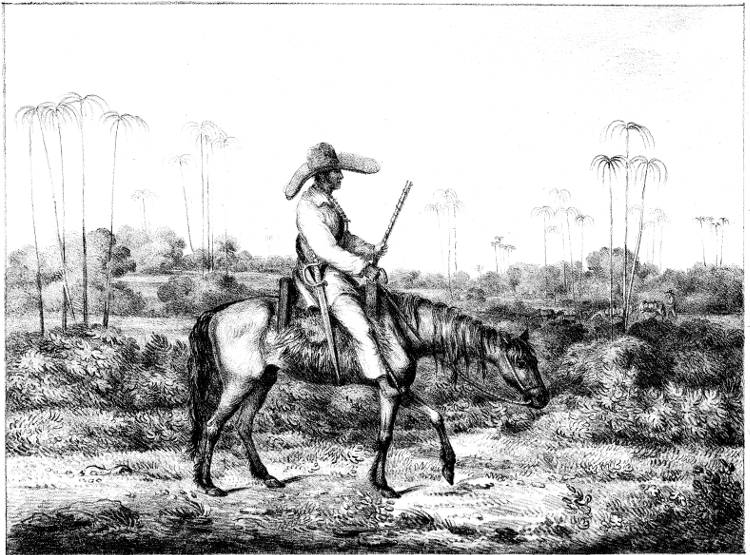
A MATUTO RETURNING FROM PERNAMBUCO.
On proceeding from hence by the sand-bank to the Recife, I was suddenly startled at the appearance of a human skull and bones, near a pillar or beacon situated between the two forts. Considerably impressed by so unexpected a sight, and moving slowly forward with such feelings as it was calculated to excite, not having any other idea but that they were the remains of some murdered person, I found myself in the midst of human bones, over-spreading the summit of the sand-bank. I now began to surmise that it was the cemetery of the blacks, which was confirmed on my arrival at the Recife. The dead bodies of the negroes are wrapped up in a piece of coarse cotton cloth, and being thinly covered with sand is the reason of their remains soon becoming thus indecently exposed. I understand that the white people were at one time also interred here. The English have a burying-ground at St. Amaro, not far from Boavista.
The roads branching off from Pernambuco into the interior are very good for a few miles, although sandy, and in some parts deep. They soon begin to contract into narrow bridle-ways, and are the tracks of troops of horses coming from the certams with cotton principally, and some other produce. The horses here are, from the sandy nature of the roads, never shod, and those driven from the interior by the mattutos[41] (inhabitants of the mattos, or woods) are generally very miserable and poor, and seem almost to give way under the burden of two bags of cotton, attached one on each side to a rudely constructed pack-saddle. Cords are commonly used by these persons for stirrups, into which they introduce the great toe. Their dress, consisting of a coarse cotton shirt hanging loosely over drawers, or trowsers, reaching to the calf of the leg, with a large slouching straw or black hat, a gun occasionally borne over one shoulder, and a sword in a wooden sheath, awkwardly suspended from a leathern belt, gives them a singular appearance. Some of these groups are rather of a superior order, being dressed in brown leathern overalls, a jacket, and a low round hat of the same. Parties of men and horses are thus continually arriving at and departing from Pernambuco. The men exhibit a great variety of complexions, and not one is to be seen that can be said to be of pure European descent, all having a mixture of Indian and African physiognomy. They are generally active and well formed. Few are Indians, more are mesticos.
The cotton planters, as well as proprietors of sugar works, visit the emporium of Pernambucan commerce in their gayest vestments, with their horses caparisoned in all the trappings and paraphernalia of Portuguese saddlery. The Brazilians generally, when they go from home, are fond of external show, without regard to much neatness, and upon those occasions they form a striking contrast to their general disgusting appearance in their domestic circles. There the men are usually seen with a dressing gown, or a shirt worn loosely over drawers, without stockings, their breasts exposed, and indulging inert and slovenly propensities. The females, having this example before them, claim some allowance for their loose and slatternly mode of dressing, when at home, and their worse habit of generally expectorating, without regard to person, time, or place. Young females are entitled to much consideration also, on account of the illiberal system pursued in their education and manner of bringing up. They are, it may be said, almost excluded from society; and the suspicious treatment they experience from their parents must tend to extinguish every liberal and moral sentiment; in fact, it cannot be considered that those very parents themselves possess much, or they would not subject them to an ungracious and scrutinizing watch, by generally keeping them shut up, so that they do not enjoy even the necessary exercise for health, to which their Turkish mode of sitting on the ground or upon mats, is not very congenial. If a family walk out, the daughters precede the father and mother, and the negroes, frequently composing the whole household, bring up the rear. Their grand opportunities for displaying their persons are religious holidays and festivals, and the midnight masses at the churches are said to be fully attended by the females.
The lady of General Rego, the governor, who is a very accomplished woman, has endeavoured, very amiably but ineffectually, to introduce a social intercourse amongst the families, and particularly the females, of Pernambuco; and although this lady succeeded in making a commencement, it was afterwards declined by the families themselves, from the ridiculous excuse that it would become expensive to have new dresses for every fresh visit. The general also gave a public ball to the inhabitants, which was followed by one on the part of the English merchants; but it would appear, with the exception of some of the leading persons, that the inhabitants, from their little intercourse with the world, are yet inimical to any refined system of society.
The cotton planters, and senhors d’engenho in the interior, are stated to be liberal and hospitable to strangers; and many of them, who have been recently acquiring considerable property, live in a comparatively comfortable style.
Apathy is a strong characteristic in the lower orders of Brazilians. In my various excursions near Pernambuco, I have seen men, at all hours of the day, stretched out upon tables, upon mats, or in redes, (nets,) slumbering their time away. If this class of people can obtain sufficient to satisfy the wants of the day, their views extend no further, and industry is no where seen amongst them; besides, the agricultural arm is paralysed nearly one-third of the year by holidays and saint days.
I was very hospitably entertained during a portion of my stay at Pernambuco by John Lempriere, Esq. the British consul, whose sitio is at the Solidado, a small hamlet, in which is situated a palace, formerly belonging to the bishop. It is a fine edifice, and built with uniformity, but is now rapidly sinking into decay, which will not be less accelerated by the use to which it is at present appropriated—that of a barrack. I brought a letter of introduction to Mr. Cockshott, when we immediately recognised each other as old acquaintances, his family and mine having been upon the most intimate terms of friendship for many years. I experienced great kindness from him, as well as many of the English merchants residing here, and spent a portion of my time at his country sitio, pleasantly situated at Ponta de Cho, upon the margin of the Capibaribe, from whence I was accompanied by Mr. Ray, the American consul, who also has a house here, to visit many of the neighbouring places, and cannot upon this occasion refrain from doing justice to my feelings, in acknowledging his frank and spontaneous attention and liberality.
The rides from Recife to Ponta de Cho, by several roads, are equally delightful, being partly bordered with lime hedges, and fences formed of the cocoa branch, interspersed with verdant foliage, and all the variety of fruit trees peculiar to the clime; groups of the high towering cocoa-nut tree heighten the beauty of the scenery, every where richly wooded.
The roads branching from Boavista, and meeting in one, about half-way to Ponta de Cho, are adorned with some elegant white houses, in a very excellent state of exterior repair, the grounds being enclosed by lofty walls, and many of the front entrances, consisting of a handsome portico, excelling any thing in this style near Rio de Janeiro. Every hundred yards, places of this character are met with to Ponta de Cho, where the river opens out and presents a very pleasing scene, the road running for a short distance along its margin, fronted by the residence of the governor, not very gracefully ornamented with a chapel in the middle of the entrance court. From hence the main road leaves the river, and for about two miles presents many neat houses to the Poco de Panela, some of them being the residences of English merchants.
In this interval the village of Casa Forte is passed, celebrated for having been one of the scenes of contest between the Dutch and Portuguese. The village of Poço de Panela is upon the left bank of the river, and is enlivened with houses of much more taste and neatness than a stranger would expect to see, with the impressions made upon his mind on landing at Recife.
It must be observed, that although the environs of Pernambuco have a fertilized appearance, in consequence of being well wooded, the soil is in a miserable state of cultivation, and not rendered so productive, by two-thirds, as it might be, being very generally uncleared of the brushwood, and a great portion remaining in its primeval condition. Proceeding from Ponta de Cho, by the Cruz das Almas road, which leads to Ollinda, a great proportion of the surrounding country is in a wild state; here and there are seen small patches of mandioca, groves of cocoa-nut, and other fruit trees, but the general aspect demonstrates the want of industry, for it would be expected that every yard of ground so near to a commercial city, with nearly one hundred vessels of different classes usually lying in its port, would be in progress at least of agricultural improvement. It is also remarkable, that between Recife and Ollinda, which latter city was formerly the seat of government and the centre of commerce, there is not a good road the whole way, parts of it for a considerable distance assuming the appearance of a mere track. The present governor has ordered a road to be commenced by a nearer route, and in many places the germ of improvement in this essential point is observable, new roads being partly made and staked out. Intelligence and civilization is only diffused through a country by facility of communication, and to General Rego, the Pernambucanans are indebted for promoting this blessing; the roads in the immediate vicinity of the town have been widened and otherwise improved by his orders; and it is highly to be wished that such a spirit, tending so much to the real benefit of the province, may be encouraged. The revolution here, in 1817, is said to have materially retarded improvement, as that measure was brought about, not from any genuine sentiments of liberty, the four or five persons at the head of it being only desirous of procuring their individual aggrandizement; and it is said that such jealousy at last existed amongst them, that they attended the council secretly armed. They were men of no talent, and the principal actor, Senhor Martyens, was a decayed Portuguese merchant, from London. They, as well as many others, paid the forfeit of their lives for prematurely attempting a change which they did not understand, but which the lapse of a few years has, happily for the advancement of this country, brought about.
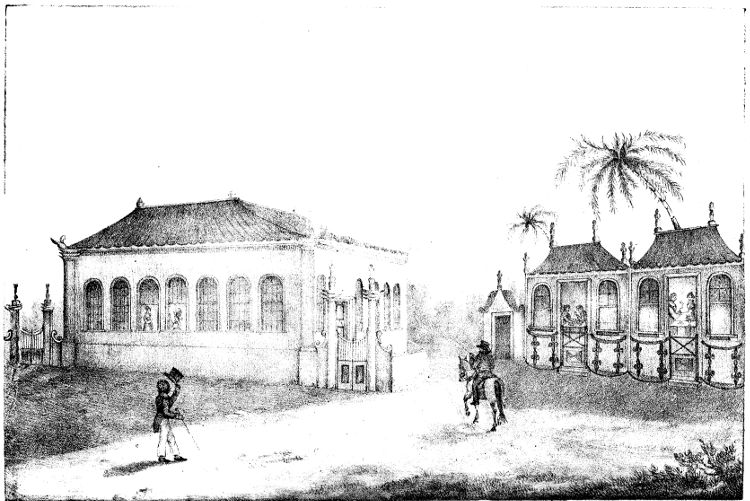
STYLE OF HOUSES AT POCO DE FERNELLA.
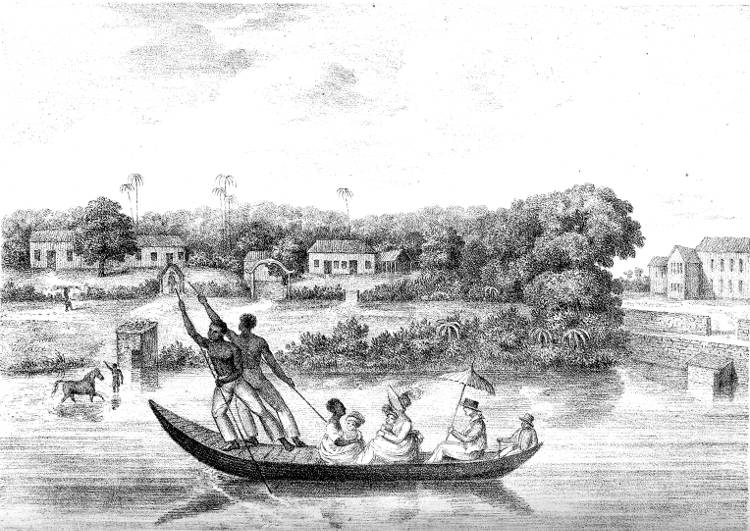
NEGROES IMPELLING A CANOE WITH THE YARA & SCENERY AT PONTA DECHO.
The new constitution of Portugal, already adopted at Para and Bahia, was spontaneously acceded to by the governor, the different public officers, and the people, without any effusion of blood, in the month of January, 1821. The imprisonment at Bahia, since 1818, of some of the first men of Pernambuco, arrested on suspicion of being implicated in the revolution, will now no doubt have its termination. That event brought upon Pernambuco a strict military government, and at the corner of every street after dusk, the ear was assailed by the military watch-word; under such a system, the inhabitants could not have been more fortunate than in the selection of General Rego for their governor, whose military experience was acquired with much credit in the Peninsular campaign, and whose gentlemanly and friendly conduct would tend to soften the rigours of a military occupation of the town. To the ready assistance and attention of the governor to all matters in which their interests are concerned, the English merchants bear their united testimony.
During the Christmas holidays, and the hottest weather, Poço de Panela, Ponta de Cho, and the neighbouring, and more distant villages of Monteiro (the road to which partly leads by a bridle-way through woods) and of Caxanga, (where there is a spring of chalybeate water, approached also by a bye-way after crossing the river,) are fully occupied by the families of Recife, in their gayest attire and the ladies are frequently seen at the windows or at the doors, the men devoting the days of the holidays to gambling, seated in the verandas, playing at cards or backgammon. At this season the roads are also enlivened with horsemen going their evening rounds to these places of resort. Another very pleasing excursion to Ponta de Cho, Poço de Panela, and Monteiro, is by the river Capibaribe, whose winding banks are bordered with white cottages and houses, some of a very superior appearance, also inhabited during this period, and each having a bathing house rudely enough formed of the branches of the cocoa-nut tree. Innumerable canoes are seen gliding along the river, impelled with more velocity than by the oar or the paddle, by two vara men, who are negroes dressed in white cotton trowsers, exhibiting all the muscular movements of their naked arms and bodies in the exertion of using the vara, which, when well and regularly executed, is rather a graceful labour. A whole family, with furniture, and all the et ceteras, are moved up the river to their summer abode in this manner; and the ladies, in their smart dresses, with French hats and white plumes nodding to the river’s breeze, do not seem to regret that it is but transient liberty they are going to enjoy, and which they indulge in by a more free exhibition of themselves, and also by daily bathing in the river, probably two or three times, remaining in the water an hour or an hour and a half at once. They are said to be more expert divers and swimmers than the men, and it is not rare to see parties of them swimming about with much confidence, their hair being generally neatly dressed and bound up. One evening, on approaching the banks of the river beyond Monteiro, with Mr. Ray, some females were bathing, and amongst them were an old gentleman and his young wife, with whom Mr. R. was acquainted. We took off our hats, and the compliment was very cordially returned by the whole party, by a low dip in the water; on re-passing a considerable time afterwards we observed them still enjoying this refreshing amusement. Previously to my leaving Ponta de Cho, the premier chuvas (first rains) were setting in, and the river already conveyed many canoes with families and their furniture on the return. The heaviest rains begin about March, when this part of the country is partially inundated and forsaken till the dry season recommences. There are various religious festivals during the holidays at different churches, in honour of saints. Those that appeared to attract the most attention were at the church of the Mount at Ollinda, at St. Amaro, and the Poço de Panela; to the latter, the English subscribed a certain sum each. Many people were assembled, and the houses were dedicated to the purposes of gambling. The multitude seemed to loiter about without any object, and there was a deadness and want of spirit and gaiety in their general demeanor. The church was open, which I entered in the midst of the ceremony of christening a child; a large lighted wax candle was as quickly introduced into my hand, and I was thus enlisted into the ranks. A band of music was playing in the gallery, to dissipate the shrill notes of the youngster, who was fingered rather roughly by the padre in the course of various ceremonies he performed, and in which he applied a considerable portion of salt. When the infant, after undergoing the last form of having a silver crown placed upon its head, was returned to its mother, it appeared quite exhausted; and a pretty general round of embracing concluded the ceremony. The master of the festa, and his wife and daughters were there: the females were splendidly dressed, but the absence of the graces prevented these adornments from having their due effect upon the imagination. The fire-works supplied by the subscription, and which concluded this festival, were, I understood, very indifferent.
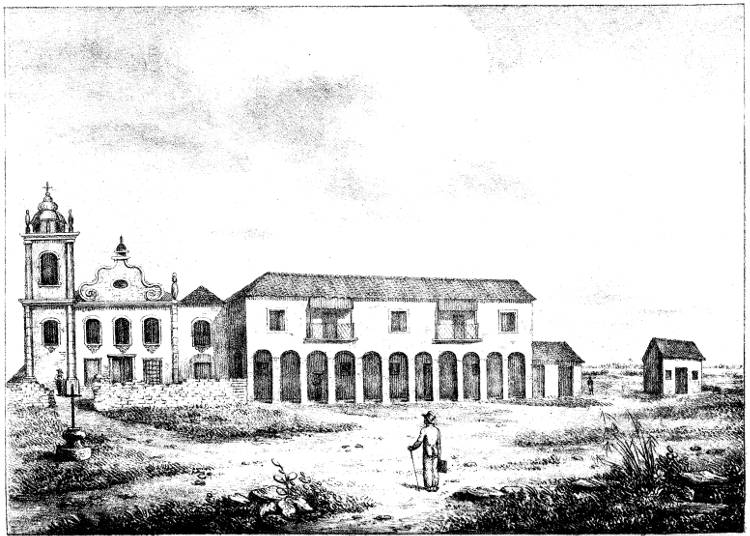
THE HOUSE OF THE SENHOR D’ENGENHO DE TORRE. NEAR PERNAMBUCO.
The Christmas holidays are deemed by the merchants a great interruption to commerce, as no shipments can be made or business transacted during that period. The English establishments here amount to sixteen, and through their medium this province is supplied with every species of English manufactures. They labour, as has been previously stated, under considerable difficulties, in consequence of the mal-operation of the pauta. The produce shipped from hence, consists principally of cotton and sugar; of the latter, about twenty-five thousand cases annually, nearly one-half to England, and the remainder to Lisbon: the quantity of the former averages about eighty thousand bags, sixty thousand being sent to Great Britain, and the remainder principally to Lisbon. The Pernambuco cotton is the best in the Brazil, arising in part from the rigid inspection which it undergoes. A new inspection house was erected here, upon the beach, called the Forte do Matto, in the year 1815. The cotton is bought by the merchant at a certain price, when it is submitted to inspection and divided into three qualities; for the second quality, which is permitted to pass with the first, the merchant receives an allowance of five hundred reas per arrobe, from the planter; the third quality is totally rejected. The bags are then weighed for the merchant to pay the export duty, and as one bag is only weighed at a time, there has been considerable delay in getting the cotton through the inspection house for shipment. The present governor attended here, and attempted to make arrangements for weighing the cotton quicker, but matters shortly afterwards reverted to their anterior state. Sugar is classed into nine different qualities, and distinguished by the following marks, commencing with the finest and continuing by gradations downwards.