CHAP. XVII. PROVINCE OF PERNAMBUCO. (continued 2)
Reading edition
B F Branco Fino. Paying a shipping duty of sixty reas per arrobe.

R F Ridondo Fino.
B R Branco Ridondo.
R B Ridondo Branco.
B B Branco Baixo.
B I Baixo Inferior.
MM Muscovado Macho. Ditto of thirty reas per arrobe.
MR Muscovado Retame.
MB Muscovado Brame.
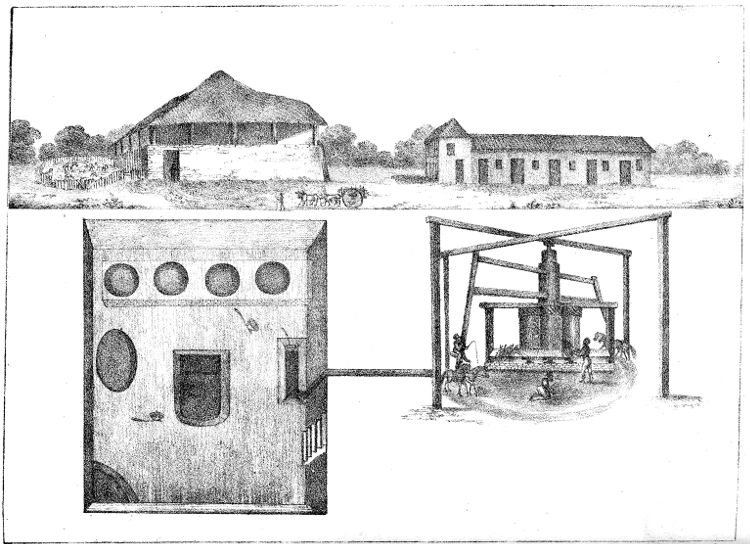
The sugar engenhos are some of them very considerable, and the two accompanying plates are representations of the exterior and interior of the Engenho de Torre not far from the right margin of the Capibaribe. The owner, who has amassed a respectable property, very politely allowed four gentlemen with myself to see this establishment. The juice is extracted by the compressure of the cane between three upright rollers, the centre one moving the other two, and being itself constantly carried round by relays of mares, which have a singular appearance from their ears being closely cropped. The juice flows along a channel to a lower apartment in the building, where it goes through the different processes of boiling, and when completed is much inferior to the West-Indian sugar, and generally in a very dirty state.
The English merchants were desirous of getting a clergyman from England, having been without the performance of divine service for a considerable period; and, besides the want of an opportunity to fulfil one of the most essential and important duties in life, an unfavourable impression could not but operate against them in the minds of the inhabitants, from their having no public observance of religion. The contribution fund, in the hands of the committee, amounts to upwards of five thousand pounds, which those gentlemen have been anxious to apply to the purposes for which it is intended, that of building a church and an hospital, and the payment of a clergyman and a medical man, which latter appointment is filled by Dr. Ramsay, a gentleman of great acquirements in his profession, and deservedly and universally beloved and esteemed.
I accompanied him and some of the merchants, upon one occasion, amongst many others in which they had been endeavouring to obtain suitable buildings for a church, hospital, and residences for the doctor and a clergyman. The building which we saw had been recently erected, was very spacious, surrounded with some grounds, and well adapted for the purpose; the reason it was not rented or purchased arose from the proprietor demanding an exorbitant price.[42]
We, at the same time, paid a visit to Mr. Koster, (a gentleman known to the literary world by the publication of his travels in the northern part of the Brazil,) who had just arrived at Recife from Goyanna, from whence, in consequence of his indifferent state of health, he travelled in a net suspended between two horses, which was rendered, he said, a less disagreeable mode of conveyance, by the ambling pace of the horses. Mr. Koster had removed his residence to Goyanna, in hopes that the climate would be more suitable to his health and constitution; but his very delicate appearance indicated a rapid decline, and I regret to say that he did not long survive.
On Stone by C. Shoosmith from a Sketch by Jas Henderson.
Printed by C. Hullmandel.
THE SUGAR ENGENHO DE TORRE, AND A PLAN OF ITS INTERIOR.
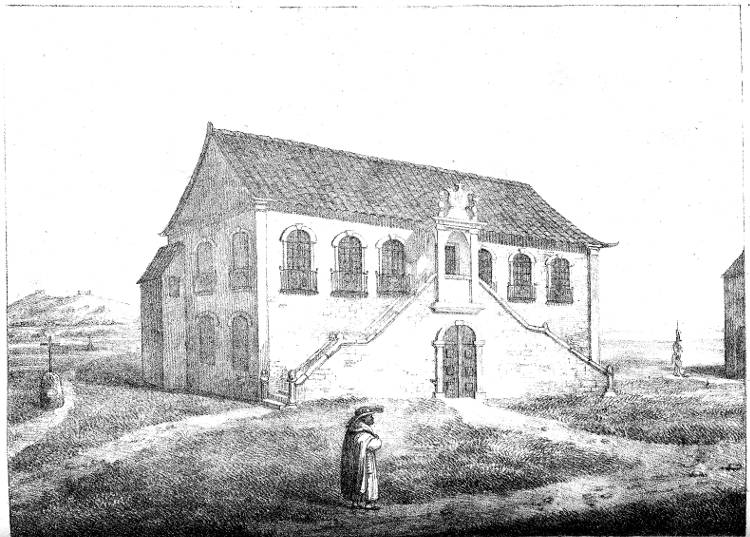
THE SITE AND REMAINS OF FRIBOURG HOUSE, FORMERLY THE RESIDENCE OF PRINCE MAURICE OF NASSAU.
The population of Pernambuco is estimated at about sixty-five thousand persons, St. Antonio containing much the greatest proportion. I endeavoured to discover the site and remains of Fribourg House, the first edifice built upon it by Prince Maurice of Nassau; and was finally assured that its remains constitute the present Casa de Fazenda Real, which, though exhibiting some antiquity in its aspect, in consequence of being white-washed, could not be identified with positive certainty. But its appearance, (pretty correctly represented in the plate,) combined with the tradition that it is actually the remains of Fribourg House, does not leave much room to doubt the fact. The convent fronting it has a great many cocoa-nut trees, which no doubt are the fruits of those he so copiously planted upon the island. A Prince who did so much for Pernambuco, in so short a time, and who here built the first two bridges that were known in the Brazil, is not undeserving of some monument in this place to his memory. There is a theatre in St. Antonio; but the performances are exceedingly indifferent, and the house, which is small, but thinly attended, no spirit existing for the encouragement of such an establishment.