CHAP. III. PROVINCE OF RIO DE JANEIRO. (continued 2)
Reading edition
Here the King will sometimes spend the whole day, and, upon the celebration of some favourite saint’s day, will remain till midnight. These holidays and festivities are usually attended by an immense consumption of gunpowder, in rockets, fire-works, &c. The days of some saints are remarkable for the right every man, bearing the same name, assumes of lighting up a great bonfire in front of his house; and I remember accompanying a friend in his chaise, on the evening of St. John’s day, when we had some difficulty in getting the horse through the flames and sky-rockets that illuminated and occupied the whole street fronting the dwellings of all the Senhor Joaos. The horses generally, however, do not regard it, being so accustomed to fire and gunpowder. During my stay at Rio, a bell was christened, and placed on the south side of the royal chapel with much ceremony. The King was godfather and the widow Princess godmother. The bell was named John the Sixth, in honour of his Majesty, who sprinkled it with salt and water, and at the period that it was hoisted to its ultimate position, the town resounded with fire-works and sky-rockets.
Religious exhibitions and feasts succeed each other with very little intermission; and the Brazilian calendars present an innumerable list of them. At Whitsuntide, three or four days are dedicated to the consecration of oxen, fowls, &c. and their consumption. The churches retail these articles at high prices, producing a considerable revenue. In some of the parishes, at this time, the inhabitants, by turns, are at the expense of a public feast, and it occasionally costs some individuals seven or eight hundred pounds. A boy, the son of the person giving this entertainment, sits upon a throne, attended by boys and girls of his own age; he is called the emperor, and, with a sceptre in his hand, presides over the feast. I saw two exhibitions of this sort on the 1st of June, one in the Campo St. Anna, and the other at the Lappa, accompanied with fire-works. They are extremely ludicrous. The festival of Corpus Christi, on the 10th of June, is one of their grandest processional displays. It is only upon these occasions that the ladies appear in public. Early in the day cabriolets, drawn by mules, are seen driving in every direction towards the Ruas Direita and d’Aquitanda, containing females in their gala dresses, while the military of every description are assembled in the streets to assist in the procession, which consists principally of priests and friars, whose prodigious numbers are calculated to swell out a cavalcade, together with numerous inhabitants of different parishes, wearing cloaks peculiar to the churches, which are various and showy. The whole form two lines, preceded with banners, each person, including the priests, carrying a preposterous-looking wax candle, about six feet high, one end of which is placed, at every step, upon the ground. The royal horses, sumptuously caparisoned, and decorated with ribands from their noses to the end of their long tails, are led by grooms dressed in the most tawdry style, the royal servants of every order following; then the judges, and all classes of people employed by the government. The fidalgos and ministers precede and follow the bishop, who carries the Host, under a superb canopy, attended by Princes Don Pedro and Don Miguel, the supporters of his train! The King usually follows the bishop as a train-bearer, but on this occasion he did not. The dresses of all were rich and costly; and the procession, amounting to some thousand persons, proceeded along the Rua Direita and returned, by the Rua d’Aquitanda, to the palace chapel; after which there was a grand display of fire-works. All the balconies were crowded with females, adorned with precious stones. The fronts of the houses were hung with silks and crimson velvet, gilded with ornaments; and the streets were strewed with green leaves. The general effect of the whole was very imposing.
There is rather a celebrated annual procession, on the 10th of October, in the Rua dos Ourives, having its foundation in some religious observance peculiar to the church of that street. All the houses are hung outside with tapestry and other stuffs, and ornamented with looking-glasses, and a great portion of the furniture which the house contains, not of the most elegant sort, and generally not over abundant. A procession of padres, and numerous others belonging to the parish, takes place during the evening, drawing together an immense concourse of people, while the females, who spend the last penny to procure a gay dress for these occasions, appear at the balconies in a profusion of finery. The houses are illuminated, not with any transparent or appropriate devices, but with wax and common tallow candles; some placed in the front of looking-glasses, in order to produce a double brilliancy at half price.
The funeral processions are rather singular; and the interment of a child particularly would appear to be the season of rejoicing rather than grief. On these occasions the musical performers are the most choice and costly. The corpse is never kept more than one day from the time of the demise, and the funeral rites are usually celebrated after dark; every one that chooses enlisting into the procession by the acceptance of a wax-light. At a funeral which I saw at the Carmo, a large and handsome church adjoining the royal chapel, two lines of persons were ranged along the body of the building, from the entrance towards the altar, facing each other, every one holding a wax-light, nearly six feet high, in the right hand, and projected rather forward. Some of the individuals of this assembly might be friends of the deceased, but the major part consisted of persons casually met with in the streets, or such as were led by curiosity into the church. The acceptance of a light is deemed an honour done to the friends of the dead, and the agents of the padres are not very scrupulous in forcing them, if possible, into the hands of every one they see; the motive for doing this is ascertained on knowing that the remainder of all candles which are used become the perquisite of those very worthy brethren. At the head of the two lines, amounting to perhaps from one hundred to one hundred and fifty persons, the corpse was placed upon a table or elevated platform, with the head exposed to view, while its last vestments displayed the ill-founded notion of importance which its survivors attach to outward and meretricious show. The ceremony of itself not being calculated to impress the mind with awe, none of those feelings of respectful gravity were visible, which so solemn an occasion ought to have produced. When it was finished, the body was conducted, with no regular procession, through some outer avenues of the church, to the catacombs, situated in a passage opposite to the jesuitical library. On arriving at an inner cemetery of the catacombs, the lights of those who followed were extinguished and taken from them by the persons whose duty it was to secure this perquisite; and every one retiring in consequence, the body disappeared by some other avenue, and I could not possibly discover how it was afterwards disposed of. Upon another occasion of the funeral obsequies of a general officer, I attempted to see their mode of executing this last office; but, from the quickness with which they slid away, and the extinguishing of the lights, I was again disappointed. A friend, however, gave me the following description of the interment of a girl, at which he was present. After the ceremony and the music had ceased, they proceeded from the said church of Our Lady of Carmo to the catacombs, where he arrived, with two or three others, at that point of the cemetery which was to receive the remains. The padres had disappeared, and no one was there but the father of the girl and a person who may be styled the sexton. The outer coverings had been taken off, and the girl appeared richly dressed in embroidered muslin, with silk stockings, and new shoes on, as if equipped for an assembly. The coffin had no bottom, but the body was supported upon a piece of satin, securely nailed around the upper part of it, when the nails being withdrawn from the sides, the father, who was not dressed in the sable vestments of a mourner but in those of a bridegroom, disgusted my friend by his wanton and unfeeling conduct, and at this moment threw a piece of muslin to the sexton, urging him to despatch by shouting out “depressa, depressa.” The muslin being drawn over the face of the girl, a large quantity of quick lime was placed upon it, and another portion spread from the head along the breast to the body, with a quantity on each side, when the man, with much ceremony, formed a cross upon it with his trowel. During the operation, the father, devoid of every proper sense of decency, cried out to him, “Vamos, vamos” (let us go); and, at another time, “Vamos, depressa, filho da pouta.” To render this last exclamation into English would only wound the feelings of those who do not understand it. Quick lime being now placed upon the flat stone of the cemetery, which runs horizontally a long way back, exhibiting its awful contents, the coffin was lifted up, and the nails of the end being also taken out, the body and piece of satin fell upon the quick lime, and the coffin was removed away. The cemeteries are afterwards walled up and plastered over in front. This father then, and even before, at the close of the church ceremony, embraced many people for joy, invited some to go home with him to a grand supper prepared for the occasion, and felt convinced that his child was gone to Heaven. Two or three hundred pounds are occasionally expended at funerals.
The catacombs are small but extremely neat, the first part forming a square, ornamented with vases, and containing aromatic shrubs and flowers, is surrounded with a sort of piazza, the inner walls of which present the front of cemeteries, neatly plastered and numbered. Opposite the entrance, and crossing the square, a door-way leads to inner avenues, lined with cemeteries, kept exceedingly clean and in good order. At the extremity of one of these avenues is situated the general charnel-house, where the bones are piled in accumulating masses. After a certain lapse of time, the bones of individuals are taken from the cemeteries, bound together, and a large label, with their names inscribed upon it, affixed to them, then piled upon the bones of their predecessors in the charnel house, where two tapers are constantly burning; and it is not uncommon for the relatives of the deceased to visit this house of the dead on a certain day in the year, offering prayers in their behalf.
The bodies of the churches are open spaces, without seats or pews, and the women sit down in the Turkish style; they, as well as the men, occasionally fall upon their knees, and, during mass, go through the ceremonies of crossing their foreheads, chins, and breasts, at regular stated periods, frequently beating their bosoms with great vehemence, but which probably must not be taken as a positive demonstration of sincerity, however imposing it may outwardly appear.
The relation of one more procession will enable the reader to form some estimate of the religious character of this people. On the event of illness having assumed the appearance of terminating in death, the Host is conducted by one or more padres, and its usual attendants, in much pomp, with a burning of incense and the tinkling of bells, to the house of the dying person, to afford him the last consolations of his religion.
The procession of the Host requires from the public more obsequious reverence than all the other component ingredients of the Catholic faith. Many persons prostrate themselves before it on their knees, in the streets and balconies; others bend the body, and all take off their hats. I have frequently met this procession some miles in the country, the padre mounted on horseback, carrying with the same facility as an umbrella, a canopy in his hand, and under its sacred shade the Host, or emblem of the Holy Ghost, accompanied by some attendants uncovered, and robed in scarlet cloaks, also on horseback; the whole moving on at a quick ambling pace, with the tinkling of bells, the peculiarity of which announces their approach, producing an universal prostration of all persons, white and black, who may be in the fields or houses adjoining the road. There is one custom the Brazilians have, which, if sincere, cannot but be admired; every evening at sun-set, by a simultaneous movement, they take off their hats in the public streets, offer up a prayer, or repeat Avi Marias; from which they have acquired the habit of denoting that period of the evening by the term of Avi Maria. And they say so and so before Avi Maria, at Avi Maria, or after Avi Maria.
I have been in the house of a Portuguese family at Avi Maria, when they appear to repeat a short prayer, after which a general salutation takes place, by saying “boa noite,” (good evening,) and holding out their hands, as if they were mutually bestowing a blessing. It is the custom for all slaves to hold their hands out in a similar manner night and morning, as soon as they see their superiors, for the purpose of offering a blessing, while their usual expression is “Abençoa senhor.”
Rio de Janeiro, although the residence of the court, is centuries behind in the comforts and enjoyments of civilized life. Strangers are disgusted with a first ramble through this city, and would not voluntarily pay it a second visit. Friendly attention to foreigners, although they may have letters of introduction, the Brazilians are seldom or ever known to practise. After some ceremony, they follow the person introduced to the top of the stairs, wait there till he arrives at the bottom, subject him to the further form of turning round to receive their final salutation, and thus the matter briefly ends. How different to the refinement of their neighbouring colonists, the Spaniards, whose houses and tertulas, at Monte Video, at Buenos Ayres, and all other parts of Spanish America, are open to strangers, who experience every liberality and social attention from them. I was assured by an English gentleman, who has resided ten years in the Brazil, that he never witnessed any symptom of genuine hospitality, and he had notwithstanding acted with friendship to many; and to one gentleman, in particular, he had rendered frequent services, at whose house he had called on various occasions, and sometimes casually at the dinner hour, but was never invited to take dinner or any kind of refreshment. Even the principal people have no idea of the comforts of the table; when they give feasts, it is with an extravagant profusion of dishes, without any regard to the arrangement, and unattended with any of that elegant ease and order practised by similar classes in most European countries.
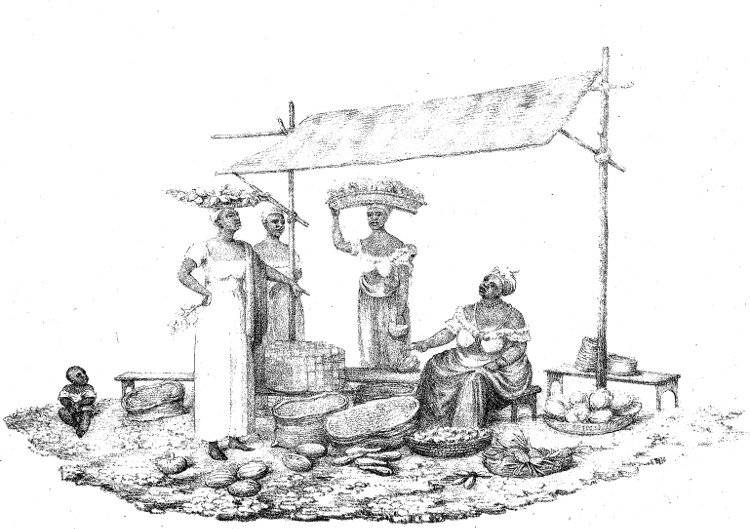
On Stone by C. Shoosmith from a Sketch by Jas. Henderson.
Printed by C. Hullmandel.
A FREE NEGRESS AND OTHER MARKET-WOMEN.
To the want of encouragement and public spirit on the part of the leading inhabitants, and the consequent unwise regulation of the government, may be attributed the present state of the provision-market. The beef is of such a quality, that it is really quite disgusting to the sight. The cattle are certainly driven a great distance, and are in a wretched state on their arrival at the capital; but this difficulty would be remedied by the adoption of a different system. Beef now pays a small duty, and by law is sold at 30 reas (or about 3d.) per lb. and one man has the contract; let it be of the worst quality the price is the same; by the payment of an adequate sum a piece of good beef cannot be obtained. Let this important branch of commerce be thrown open, without any restriction of price; allow it to rest upon the basis of fair competition, and a good quality of this article would be seen in the metropolis, without any great additional price. Mutton is not very generally in use, particularly amongst the Brazilians; I have however seen some very good, which was fed by an Englishman. Veal is rarely if ever seen. Pork is decidedly the best meat obtained here. Vegetables and fruit are very abundant, and at reasonable prices. Potatoes are not produced, except by some of the English; but they degenerate after a year or two, by continuing to plant from the same stock. Poultry of all kinds is dear, and fish is occasionally so, arising more from the indolence of the fishermen, than any scarcity, as the bay and outside of the bar furnish an abundance, and some of a very fine flavour. Upon the whole, living at Rio is as expensive or more so than in London, with none of the comforts of the latter place. A house two stories high, consisting of a store below, and accommodation for a moderate sized family above, will let for two hundred and fifty or three hundred pounds per annum; and houses in the vicinity of the city, with little comparative convenience, will rent at seventy or eighty pounds a year; while those more commodious are proportionably higher.