CHAP. III. PROVINCE OF RIO DE JANEIRO.
Reading edition
Its Colonization—Contests with the French and Tamoyo Indians—Expulsion of the French—Foundation of St. Sebastian—Boundaries—Division into Comarcas—Mountains—Principal Rivers—Lakes—Bays—Capes—Islands—Mineralogy—Zoology—Phytology—Cities and Towns—Boundaries, Towns, and Productions of the Comarcas of Ilha Grande and Parahiba Nova—Boundaries of the Comarca of Rio de Janeiro—The Metropolis—Situation—English Burial-Ground—Streets—Royal Mode of riding—Compulsory Homage upon the Occasion—Churches—Convents—Gloria Hill—Female Convents—Visit to one—Fountains—Visit to the Aqueduct—Squares—Palace—Public Buildings—Public Garden—Library—Manufactories—Theatre—Roads leading from the City—Palace of St. Christovāo—Troops of Miners and others from the Interior—Caza de Don Pedro—Royal Mill, Shacara, and Stables—Fire-Works—Beija Maō—Fidalgos and higher Orders of Society—Splendour of Churches—Royal Chapel—Religious Festivals and Observances—Funeral Processions—Catacombs—The Host—State of Society—Markets.
Joam de Solis, who has been already mentioned, entered the bay of Rio de Janeiro, in the year 1515, on his second voyage to South America; and about four years afterwards Fernando de Magellan, and Ruy Falleiro, a famous Portuguese mathematician who accompanied him, also remained a short time in it, bestowing upon it the name of St. Luzia. Martini Alfonso de Souza, who was engaged in an exploration of the whole coast, went into the bay on the 1st of January, 1532, and very improperly gave it the name, which it yet retains, of Rio de Janeiro, (River of January,) evincing, what would not be supposed to be possible, that he considered it a river. No attempts were made, however, to form any settlements here till the year 1555, when M. Villegagnon, a Frenchman, who had rescued Queen Mary from Scotland, with his comrades, took possession of the second island, after passing the entrance into the bay. His avowed object was that of propagating Calvinism in the new world. On this island, which took and still retains his name, he constructed the fort of Coligni, in honour of the excellent man and famous admiral, Gaspar de Coligni, his patron and warm supporter in establishing this colony, to which, in the following year, he despatched a further succour of three ships of war and near three hundred persons. King John III. of Portugal, receiving intelligence of this event, ordered Duarthe da Costa, then governor-general at Bahia, individually, to make himself acquainted with the actual state of the Protestants; but no attempts were made to displace them till after the death of the King, when Dona Catharina gave instructions to Mendo de Sa, the successor of Duarthe da Costa, to expel them, sending him two armed ships, with some caravels, which the governor augmented by some ships of war and two caravels that were in the port, and putting on board all the people he could assemble, personally embarked with the squadron. He visited all the intervening capitanias of the coast, and received on board all those who were willing to accompany him. The French defended themselves vigorously against the attacks of this fleet; but not being able to remedy the destruction and havoc which they sustained from the more powerful ships of the Portuguese, they retired by night to the continent, uniting themselves with the Tamoyo Indians, whose friendship they had previously conciliated. Mendo de Sa collected the artillery which the French had left, and, with one of their ships, which he found in the port, he returned to Bahia.
Intelligence was received afresh that the Protestants continued to frequent the bay of Rio de Janeiro, and were successively becoming more strongly fortified in the continental situations they had taken up. The crown of Portugal, now discovering of how much importance it would be effectually to take possession of and colonize this fine port, which having no donatory or forces to impede the establishment of whatever enemy might think proper to proceed there for that purpose, resolved to despatch Estacio de Sa to Bahia, with two galliots, and there to receive from his uncle, Mendo de Sa, the governor, such an accession of force as would enable him to extirpate the French. Estacio de Sa, having augmented the squadron as much as circumstances would allow, arrived at Rio de Janeiro in 1565, and took up a station near the Sugar-Loaf Mountain, at the place now called Villa Velha; but in various attacks, which he made upon the united French and Indians, fortune was never decisively propitious to him. This circumstance induced Mendo de Sa to prepare, in the bay of Bahia, an armament, which consisted of three galliots, commanded by Christovam de Barros, two ships of the crown, which were cruizing on the coast, and six caravels. This auxiliary force he accompanied in person to the assistance of his nephew, visiting, as before, the intervening capitanias, and offering to convey, gratuitously, all families who might wish to people the future colony; and, in consequence, a great many did accompany him. He arrived on the 18th of January, 1567, but deferred the attack till the 20th, that day being St. Sebastian’s, under whose auspices he meant to begin and carry on the enterprise. Two years had previously passed in useless and indecisive contention, which, in two days, Mendo de Sa brought to a successful termination, by possessing himself of the forts Urussumiri and Paranapucuy, not, however, without his followers feeling the effect of the arrows of the Tamoyos, which often transfixed the shield to the arm that supported it. Amongst others, Estacio de Sa received a wound from one of them, of which he expired a few days afterwards. The French escaped in four ships which they had in the harbour; and Mendo de Sa did not allow much time to elapse before he removed the first establishment to the situation now forming a ward or district of the present capital, denominated Misericordia, and there marked out its commencement. In honour of his patron saint, he gave it the name of St. Sebastian, which has given way to that of Rio de Janeiro now more generally used. The governor assigned to the celebrated Jesuit, Nobrega, ground, in the midst of the city, for a college, which he endowed for the support of fifty brethren. Having occupied himself near a year and a half in arranging every thing necessary for the continuation and security of the new city, he returned to the capital in June, 1568. He left for governor his nephew, Salvador Corrêa de Sa, whose administration was short, as well as that of Christovam de Barros, who succeeded him by royal patent, and whose jurisdiction over the affairs of the capitania terminated in 1572, when King Sebastian divided the state into two governments; the city of St. Sebastian becoming the capital of the southern division, which was delivered to Dr. Antonio Salema, with power over the capitanias from the river Belmont, southward. The same sovereign, becoming sensible of the inconvenience resulting to the crown from this partition, ordered that the general executive government should revert to its anterior state; and nominated, as successor to Salema, the said Salvador Corrêa de Sa, with patent of captain-general, dated the 10th January, 1576, and who remained in this situation until the year 1598. None of those who followed him governed during so long a period, with the exception of Sandozo Gomes Freyre d’Andrade, who discharged the duties of the appointment from the year 1733 to 1763, and which expired only with his life in the course of the latter year.
This province, which acquires its name from the magnificent port of its capital, now comprehends the ci-devant capitania of St. Thomé, half of that of St. Vincente, and a portion of Espirito Santo. It is bounded on the north by the latter, from which it is separated by the river Cabapuâna, and by the province of Minas Geraes, from which it is divided by the rivers Preto and Parahiba, and in part by the serra of Mantiqueira; on the south by the Atlantic Ocean, which also washes its eastern limits; and on the west by the province of St. Paulo. It is estimated to be sixty leagues in length, from east to west, near its northern extremity; and twenty-three leagues of medium width, reckoning from the fortress of St. Cruz, at the entrance of the bay of Rio de Janeiro, to the river Parahibuna, and to have fifty leagues of southern coast, from Cape Frio to Cape Trinidade, which is near three leagues to the west of Point Joatinga. It is divided by the Organ Mountains into two parts; Northern, or Serra-Acima, (Mountains above,) and Southern, or Beira-Mar, (Sea-coast,) which latter is subdivided into four, and the former into two districts or territories, as follows:—
Beira-Mar Ilha Grande.

Rio de Janeiro.
Cape Frio.
Goytacazes.
Serra-Acima Parahiba-Nova.
Canto-Gallo.
A line drawn from south to north, commencing at the fort of Lage, at the entrance of the port of Rio, passing up the middle of the bay, by the river Inhumirim upwards, and on to the origin of the Piabanha, descending by it to the Parahiba, divides the province into east and west.
Mountains.—All the districts of this province, with the exception of Goytacazes, are picturesquely mountainous, and present an infinite variety of novel, sublime, and wondrous scenery, of which no verbal description can give an adequate representation. The Organ Mountains, so called from the similarity which their pyramidical heads, in various parts, bear to the front of an organ, are the principal. That portion of them which assimilates more distinctly to the object from which the whole range derives the name is an approximation of precipitous pointed masses, separated by profound winding and narrow valleys, through which romantic openings the way leads from Beira-Mar to the district of Canto-Gallo, without having to ascend any comparatively high elevations in traversing them. This is, indeed, the region of solemn and poetic sequestration. Its unchanged and primeval condition would appear to afford a suitable retirement for such as have acquired a calamity-induced distortion of the mind,—a misanthropical distaste to society and the world.
The Macacu, otherwise Serra-Grande, (Great Mountain,) the mountains of St. Anne, of Sambe, of Tapacora, and of Urussanga, are situated in that extremity betwixt the districts of Rio de Janeiro and Cape Frio; the Mount of St. Joam, a league above the emboucheur of the river of the same name, the Serra Jarixina, about twenty miles north-west of the capital, and that of Bocaina, in the district of Parahiba-Nova, constitute, together with the Organ Mountains, those of the greatest altitude in the province.
Rivers.—It cannot boast of any very large or magnificent rivers, although it is irrigated by innumerable streams descending from the mountains. The river Parahiba is the only considerable one, originating in a small lake, situated upon a southern portion of the Serra Bocaina, a continuation of the Organ range, and about five leagues to the north of Paraty. It runs at first under the name of Paratinga, parallel with the mountains prolonged in piles from the south-west, in a line with the coast; enters the province of St. Paulo, where it receives the small river Jacuhy, by the left bank, a little above the town of St. Luiz, and somewhat below it, by the same margin, the river Parahibuna, which rises in the serra of Ubatuba. At this confluence it takes the name of Parahiba, approximates the sea a little to the west of the meridian of the capital, then turns towards the north-north-east, flowing along the base of Serra Itapeva, and by the town of Jacarehy. After a course of twenty leagues, with little variation, it inclines to the east and east-south-east, watering the towns of Thaubate, Pindamonhangaba, Guaratingueta, and Lorena; again turns towards the province in which it has its source, approaching it within five leagues; bathes the town of Rezende; inclines to the north-east, gathering the river Pirahy, (which comes in a northern course from its origin in the serra of Ilha Grande,) and many leagues lower, having taken an easterly direction, it receives the Parahibuna which is its largest confluent, by the left margin, and the afore-mentioned Piabanha, by the right. This part is designated Tres Rios, (Three Rivers.) Ten leagues below, the Pomba enters it by the northern bank, which flows from the western part of the Serra Frecheira principally in a south-east course, through a stony bed, rendering the navigation difficult even to canoes. A little lower it receives the Bengálas, which brings with it various other streams. Soon after this junction, it descends the precipitous fall of St. Fideles, to which point barks ascend. Eight leagues lower down, the Muriahe empties itself into it by the northern margin. Six leagues may be computed from this confluence to the emboucheur of the river Parahiba, and from thence to the fall of St. Fideles, which is the first advancing up the river, seventy-two islands are numbered; and above this fall they are still more numerous. Its waters are precipitated by a great many falls, which run principally through a stony bed, and are discharged into the Atlantic, on the eastern coast of the province. This river does not bring with it to the ocean so large a volume of water as might be imagined from its vast extent, which may be accounted for by its running principally betwixt two cordilleras, (the Organ Mountains and the Mantiqueira with their branches,) the greatest interval of which does not exceed twenty leagues, and almost all its tributary streams are poor and inconsiderable. Eight leagues below Lorêna, where it has already assumed the appearance of a large river, its course is contracted by a long wall of rock, of more than sixty feet high and six hundred yards in extent, reducing its channel to the width of about ten yards. It abounds in a great variety of fish. The adjacent territory, on both banks, from its source to its mouth, is considered to be well adapted for the growth of the sugar cane, and the very small part of it which is cultivated, is appropriated to that purpose; but the far greatest proportion yet remains in a state of wild nature, and although perhaps granted to different donatories, its impenetrable woods form the native retreat of the Indian and the ounce, each still asserting the claim of possession. The river Maccahe, which has a course of fifteen leagues, affording ten leagues of navigation to a fall, rises in the Organ range, and winds amongst mountains and woods, till it encounters the St. Pedro, formed by various small streams in the vicinity of Serra Frade. Three leagues may be computed from this confluence to its emboucheur, which is in front of the islands of St. Anna, thirty miles north of Cape Frio, dividing that district from Goytacazes. The river St. Joam rises in the skirts of the rock of Canudos, with the name of Aguas Claras, (Clear Waters,) more considerable, and affording navigation for a greater space than the Maccahe, runs like it amongst woods and mountains, and disembogues about seven leagues to the south-west of it, bathing the southern skirts of the mountain of its name. Large quantities of timber are exported by it. The rivers Curubichas and Bannanal join it by the left bank, the Bacaxa, which issues from the Serra St. Anna with the appellation of Rio do Oiro, (the Gold River,) unites it on the right by two mouths, having formed, a little higher, a large lake, into which the Capivari, coming from the same serra, empties itself. Below this confluence, little more than three leagues, the Ipuca disembogues, rises near the Maccahe, and forms a considerable island. After it the Lontra, and ultimately the Doirado, near which there is a remarkable production, called the jiquitiba tree, its trunk being fifty-six spans in circumference. All three are navigable, and incorporate themselves with the river St. Joam, by its northern margin.
The river Guandu takes its name at the confluence of the St. Anna with the das Lages, the courses of which are in an opposite direction to this point; the first issues from the Organ Mountains, near the heads of the river Piabanha, and runs south-west till it encounters the other, which flows north-east from its origin in the frontier serra of Ilha Grande. The Guandu passes the royal palace (ex-Jesuitical) of St. Cruz, and discharges itself by two mouths into the bay of Marambaya. The early possessors of this part of the country, in order to evitate the damage which they sustained by the inundations of this river, submerging the extensive and fine campinhas (plains) of the southern part, opened a trench of two miles long from it to the small river Taguahy, which runs in a parallel direction, and by this mode discharged the excess of water which the banks of the Guandu could not contain at the period of the floods. The western mouth, or that of Taguahy, is little more than a league distant from the proper one of the Guandu: barks navigate both. The river Mambucâba, which is a fine river, even beyond the point where the tide reaches, issues from the serra of Bocaina, and disembogues in front of the bar of Cayrussu.
Lakes.—Lakes are numerous in this province. The principal are situated in the districts of Cape Frio and Goytacazes; many of them are surrounded by marshy lands, and none possess, in any point of view, the attractions peculiar to such diffusions of inland water in Europe. The lake of Jacaré-pagua, or Jaracapauha, is narrow and about four leagues long, parallel with and very near to the beach. It abounds with fish, receives some small streams, and has an outlet to the sea at its eastern extremity. It is situated at the eastern base of the picturesque and lofty mountain of the Gavea, about two leagues to the west of the Sugar-Loaf. At its opposite base is the beautiful and highly pleasing cascades of Tejuca.
The lake of Roderigo de Freytas is of a circular form, and half a league in diameter; is about two miles distant from the bay of Bota-fogo, and five from the capital. In its vicinity is the mother-church of the parish of St. Joam Baptista; also the royal manufactory of gunpowder, and a botanical garden of trees and exotic plants. The tea plant is here cultivated, and, unquestionably, would prosper in this climate with proper attention; but this establishment, upon the whole, is miserably neglected. The lake of Marica, which is a league and a half in length, from north-east to south-east, and little less in width, communicates with that of Cururupina, nearly of equal length from east to west, and about the same width from north to south. They both approach very much to a triangular form. The channel which unites them is called the river Bambuhy, and forms a small lake in the centre. The Cururupina is the eastern one, and its extremity is near Negra Point, which is at an equal distance betwixt Cape Frio and the Sugar-Loaf Mountain. The rivulet of Bananal, and that from which it takes its name, are the largest streams that enter it. The Marica, under which name the small one is also comprehended, receives at its southern end the Baccahi, which half a league above its mouth traverses the lake Braba, about a mile long. The small river Itapitiu enters its northern extremity. It is prolonged in a parallel line; and at a short distance from the sea, to which it opens a passage in the winter or rainy season, possesses a great abundance of excellent fish, and, in consequence, furnishes a branch of the dizimos (a tax of one-tenth) of the province. The lake of Piratininga, three-quarters of a league from east to west, and proportionably wide, is about a mile distant from the Sacco, or Gulph of St. Joam de Carahi; it is also abundant in fish, and is separated from the sea by a sand-bank, through which a passage is opened in the rainy season, to prevent its inundating the adjacent country. Near half a league to the east of Piratininga is situated the lake Itaypu, a mile and a half long, and of proportionable width; and betwixt it and the sea is the parish of the same name, the church of which is dedicated to St. Sebastian. Its inhabitants are fishermen and cultivators of mandioca and sugar.
Bays.—This province can boast of two as fine ports as any in the world, the bays of Rio de Janeiro and of Angra dos Reys (King’s bay, or creek.) The first is upwards of twenty leagues from Cape Frio, and, of all others in South America, merits most properly the denomination of a bay; its narrow entrance, embosomed in lofty scenery of the beautiful and sublime, being about eight hundred and fifty fathoms in width, and fourteen in depth, while the bay itself, which is six leagues in length, almost north and south, four at its greatest width, and thirty-two in circumference, is beautified with a great number of islands, and has depth for the reception of the largest fleets. It may be said to be divided into two emboucheurs, as the island of Lage, occupied by a fort of the same name, is situated about the centre. The entrance of the bay is commanded by the additional fort of St. Cruz, on the east, and the batteries of St. Joze and St. Theodozio, on the western side, near an immense naked rock, already mentioned, which is ninety-seven fathoms in perpendicular altitude, and is in the form of a sugar-loaf, and so denominated. The fort of St. Cruz is situated at the base of a high rugged mountain, called Pico, in consequence of its having a pointed termination. From hence signals are made to the city, announcing all vessels as they appear upon the horizon. The two principal bays that branch from it are, Bota-fogo, behind the batteries of St. Jose and St. Theodozio, and the larger one of Jurufuba, to the north of Fort St. Cruz. Upon the beach of the latter is situated the parish of St. Joam de Carahi. The first discovery of this bay and the origin of its improper name have been already alluded to; its more appropriate and primitive name was Nitherohy. Lery, who was there with Villegagnon, says, that the Indians then called it Ganabara; but the first is the most suitable, “nithero” signifying concealed, or hidden, and “hy” water, as it is only on arriving in front of the inlet that the bay is discovered, being previously concealed by mountains. This bay is the receptacle of a vast number of rivers, principally inconsiderable; but, as they are the medium of an easy conveyance to the capital of the productions in their vicinity, it may not be unimportant to describe those of the most consequence. Two leagues and a half, in a direct line, or four by the road towards Campinha, is the mouth of the river Iraja, which issues from one of the small lakes, and affords navigation with the tide to its port of the same name. A quarter of a league to the north of the preceding, the Miriti enters the bay, increased by the junction of the Inhamuahi, (which issues from the Serra Bangu,) and the Pavuna, about two leagues and a half distant from its mouth. It traverses a country in a great measure marshy, and is only navigable for the space of three miles, in a direct line to the port which takes its name, where cases of sugar, and the produce of St. Joam and Our Lady of Apezentacâo, are put on board the bay boats. About a league to the north of it is the Sarapuhi, which originates in the Serra Cachoeira. Its banks are serpentine, and it is only navigable for about a league. The dwellers in the parishes of St. Antonio and Jacutinga export their productions by it. The Iguassu, a mile further to the north-east, has its source in the Serra Tinguá; is navigable for four leagues; brings with it to the bay the waters of the Iguare, which issues from one of the lakes, and affords navigation for a mile to the port bearing its name. Also the Maraby, flowing from the Serra Boa-Vista, and navigable to the port of Couto, three leagues above its mouth. It also receives the Dos Ramos, navigable for a space of eight miles, to the skirts of the Serra Mantiqueira, in which it originates. The river Inhumirim enters the bay about half a league further, and is navigable for three leagues: one of its confluents, the Jaguamirim, flows from the morasses, and affords navigation for six miles; another, the Saracuruna, descends from the serra of its name, and is navigable only for a league; also the Figueyra, which comes from Serra Frade. Boats go up very near to its origin, where it has the name of Cayoába. By the Inhumirim, (the source of which is little distant from the Piabanha,) the miners, amounting to no great number, comparatively, descend by boats to the capital, and return in the same way, with manufactured articles, up its channel to the port of Estrella, where they leave the mules to recruit for the return journey; but the major part of these people, as well as others, proceed the whole way with the mules. The port of Estrella is a flourishing place, (being on the main way to the mines,) with some little commerce, and has a chapel of Our Lady, situated in the angle of the confluence of the aforesaid Saracuruna, four miles from the bay.
From the Inhumirim there is a channel to the river Pilar, the last confluent of the Iguassu. Little more than two leagues to the east-north-east of the Inhumirim, and in front of the small island of Guayanna, the Suruhy, issuing from the Organ Mountains, discharges itself into the bay, and, like the others, admits of the navigation of boats up its channel for about seven miles. It receives the Goya, which comes from one of the morasses. All the productions of the adjacent country are excellent; and there is, perhaps, no soil better adapted for banana groves, which are cultivated here with great care. Half a league further is the mouth of the Iriry, which originates in marshy ground, and is only navigable for two miles.
About two miles to the east of the Iriry, is the emboucheur of the Magéassú, which descends from the Organ Mountains, bathes the town of the same name, and affords navigation for ten miles. The Guapimirim, is about two miles from the Magé. Its course is about six leagues, and originates in the same mountains.
About two miles from hence is the principal of two mouths by which the Macacu enters the bay. It is one of its largest streams, and is navigable for fifteen leagues. Alligators of a very large size inhabit its banks, and take shelter amongst the high reeds which grow in the water. Its source is in the Organ Mountains, near the rock called Canudos, and it is united on its right margin by the rivers Guapiassu, Cabucu, and Varge; on its left by the Cacerebu and the Aldeia. The Guapiassu, which is the most considerable, comes from the same mountains as the Macacu; and, a little before its incorporation with that river, communicates with it by a channel called Rio dos Morros (River of Rocks.) There is a quarry of pedra sabāo, a peculiar stone, near its heads, which is excavated in large pieces, and sawn for the purpose of forming the mouths of furnaces in engenhos, or sugar-works, being considered of eternal duration. The principal confluent of this tributary river is Piracinunga, the main branch of which originates between the high points of the Organ Mountains. Betwixt the rivers Macacu and Guapiassu there is a certain portion of territory, comprising about two leagues, the most fertile in the district, which was bequeathed, in 1718, by André da Costa, as a legacy to some poor persons, with inalienable succession, and an annual pension of two missas, (masses,) for each house. This colony has now arrived at the number of twelve hundred individuals, and this bequest would maintain ten times as many, with adequate industry. The Guaxindiba flows from the Serra Taypu, and, describing numerous windings and turnings, enters the bay about two miles from the Macacu. The Emboassu, disemboguing four miles further, has its source in the Serra St. Gonçalo, and is navigable with the tide for a short distance.
The islands with which this bay is ornamented are numerous, but of inconsiderable extent. The principal is the isle of Governador, which is little more than two leagues long, from east to west, and proportionably wide. It is of an irregular form, having many headlands, and small creeks, and forms the parish of Our Lady of Ajuda. The parishioners are generally agriculturists and labourers. It is situated almost in the middle of the bay. The isle of Bom Jesus, but better known by the name of Frades, is about two miles long, from east to west, and of trifling width. It is the site of a convent of lazy Franciscans, which has a handsome and commanding appearance. The King visits the island occasionally, on the celebration of some particular religious festivity. He spent two or three days with the friars in the summer of 1819. It is not far distant from his palace of St. Christovao. The island of Paqueta possesses more natural charms than any other in the bay, and is situated near its northern extremity. It is about three miles long, from north to south, and of inconsiderable width. Its whole extent constitutes the parish of Bom Jesus do Monte (Good Jesus of the Mount.) A considerable quantity of the timber and branches of the mango tree is exported to the capital for firewood.
Angra dos Reys, the other bay alluded to, is much larger than that of Rio, presenting less regularity, with three entrances open to the south, formed by two islands, Ilha Grande and Marambaya, lying in a parallel line with the coast. The western entrance, denominated Cayrussu, is situated betwixt Ilha Grande and Joatinga Point, on the continent. Bom-Abrigo (Good Shelter) was the name given by the first discoverers to this point. The entrance is eight miles wide, possessing thirty fathoms of depth. The central entrance is betwixt the said island and that of Marambaya, from which latter it derives its name. It is five miles wide, with little less depth than the first. The eastern entrance, denominated the Bar of Guaratiba, is narrow and of little depth. The rivers Guandu and Mambucaba are the principal amongst a great many whose courses terminate in this bay, which can boast of some excellent roadsteads. Ilha Grande is four leagues long, with a proportionable width, having many high mountains covered with wild and verdant woods, and numerous fountains of crystalline water, which produce two abundant streams. This bay has various recesses, which are so many secure anchorage places; the creeks of Abraham, Estrella, and Palmas are the best. This island, which lends its name to the frontier territory of the continent, has a fertile soil, and is partially cultivated. In the year 1811, its population amounted to three thousand souls, at which period the parish called St. Anna was created: a central chapel, of the same name, serves it for a mother-church. In the creek of Abraham there is a village, which, most probably, at a future day, will become the capital of the island. The island of Marambaya is high and rocky, and overspread with wood. The whole of its cultivation and population arises alone from the establishment of two sugar works upon it; and it possesses a hermitage of Our Lady of Griefs (das Dores.) From this island, a narrow sand-bank stretches to the east for six leagues, as far as the bar of Guaratiba, and is covered in the greatest part with vegetation.
Over the bay of Angra dos Reys, a vast number of islands are scattered, amongst which may be enumerated the Supituba, Cunhambyba Grande, Jorge, Palmeira, Algodao, Barra, Caeyra, Redonda, Rafael, Cavaco, Pimenta, and another, also called Jorge, which are each from about a mile to two miles in length. The Gipoya, about six miles long, has some indigo works and fisheries; the Bomfim, very small, has a hermitage of the same name; the Tacoativa, Jacarahy, Paixao, Francisco Nunes, Barro, Pedreiro, Bayacica, Cana, Porcos, Sappe, Boqueirao, Redonda, Buzios, Casca, Brandao, Coco, Algodao, Ferreira, Cavaco, Jappam, Papagayos, Cobras, Sandre, and St. Joam are all small. The majority of these islands are partly cultivated and peopled.
Capes.—Cape Frio is the only remarkable cape of the province. That of St. Thomé is situated about twenty leagues north-north-east from it. The principal projecting points are Negra Point, nine leagues to the west of Cape Frio; Buzios Point, four leagues to the north-north-east of the same cape; and Guaratiba Point, near the bar of its name. The mother-church of the parish of St. Salvador is beautifully situated upon a small eminence in front of the bar of Guaratiba. Its district is twenty miles long, and fifteen wide. In the year 1804, it contained four thousand three hundred and forty inhabitants, dispersed over the parish, the vicar’s house being almost the only one in the vicinity of the church.
Islands.—The islands of this province are numerous, but the greater part inconsiderable, and principally within the two bays already described. Outside of the bar of Rio de Janeiro are the three islands of Palmas; also the islands of Redonda, Comprida, Raza, Cagada, Lage, Catunduda, Toacinho, Pay, and May; the whole of which are small, uninhabited, and extremely barren, except in verdant shrubs and brushwood.
Mineralogy.—This province has some mines of gold, and possesses veins of iron. The rocks of granite are very large and remarkable, being of one solid piece, from whence entire obelisks might be hewn of an immense size. Aqua-marinas are met with; and a variety of different earths, some considered equal to that with which the Chinese manufacture their porcelain.
Zoology.—In this province are found all the domestic and wild animals belonging to the adjacent provinces, with a sort of Sahium monkey, hairy, and of a gold colour. Amongst the birds are remarked various sorts of the beautiful sahy, not met with northward.
Phytology.—This province affords a variety of timber for the purposes of building, cabinet-work, and dying. The tree called here anduassu is nearly fifteen feet high, and two in diameter, grows rapidly, and only in the vicinity of the sea. The Indians make an aperient medicine from its fruit, with which they cure the dropsy. Oil is extracted from it for burning lights, and for the composition of blue ink, and a blue dye. The tatagyba, which is the morus tinctoria of Linneus, affords an excellent yellow dye, extracted by the boiling of its wood in water, with the addition of a portion of alum. The grumixameira is a tree which produces a most excellent fruit, similar to a cherry in appearance, but of a finer flavour. I brought some of its seed to England, but am yet uncertain whether it will prosper in our climate. A small tree produces a clove, said to be superior to that of the Moluccas. The camphor tree, the cane of Madagascar, some African grasses, and a delicate species from Hindostan, have been recently naturalized here. Canes of such thickness and height grow upon the margins of the Suruhy, that ladders are made of them to hang the highest temples with decorations for festivals. In many situations ferns are met with, not differing in the least from those of Europe, except in the immense quantities which grow in uncultivated grounds. In the woods adjacent to Andrahi, near the road leading to the cascades of Tejuco, there is one which has grown, amongst other vegetation of wild trees and brushwood, to the perpendicular height of eighteen feet. In some woods, a sort of almond tree is met with, with fruit almost spherical, and of the magnitude of a hen’s egg. Cocoa trees are not very abundant, owing to an insect which gnaws the sprout after it grows to any size, and prevents their arrival at the perfection they otherwise would. European horticulture succeeds better here than in the northern provinces. The mango tree is only abundant in the suburbs of the capital, and rarely fructifies to perfection. Oranges grow spontaneously, and consist of various sorts; the selectas, which are large, and the tangerinas, both of the most delicious qualities. The coffee tree, having been naturalized here, during the government of Conde de Bobadella, by the attention and care of a magistrate, multiplies prodigiously, and is now one great branch of the riches of this province. The cotton tree does not prosper universally. Apple, pear, cherry, and apricot trees do not succeed. Fig trees grow rapidly, and produce fruit in perfection; but they have an enemy in a little insect, which introduces itself very frequently into the pith, and dries it up. Amongst an infinity of other productions may be enumerated jalap, ipecacuanha, called here poaya, trees of gum, of sangue de drago, (blood of dragon,) of oil of capaiba, and of Peruvian balsam. The cultivation of cochineal is now little attended to.
Cities and Towns.—The cities and towns in this province are remarkable for their small number and general insignificance, considering its extent and capabilities. The same observation is applicable to all the other provinces, and to some infinitely more so. In this province may be reckoned two cities and twelve towns, having no good roads or regular communication with each other by land, but mere tracks and bridle-ways constituting an intricate and difficult medium of intercourse. But we hail, with no common satisfaction, the improvements that will necessarily succeed to the change that has taken place in the system of government in the mother-country, and which has already begun to operate a like change in the provinces of Brazil.
The deplorable want of roads, and all the other facilities of husbandry, commerce, and enjoyment, is the natural consequence of the state of penury and ignorance in which the inhabitants, generally, of this region are involved, by a system that cannot too soon give way to the more enlightened policy which appears to be dawning upon them. This good work, as far as it has proceeded, redounds highly to the honour of the Portuguese people; no sanguinary event having marked their endeavours in the cause of freedom, thereby affording a most satisfactory contrast to the bloody pages that blacken the revolution of many other nations. May they soon regain their former dignity of character.
The places we alluded to are,
CITIES. DISTRICTS.
Cape Frio. Cape Frio.
St. Sebastian (commonly called Rio de Janeiro) Rio de Janeiro.
TOWNS. DISTRICTS.
Marica. Rio de Janeiro.
Macacu. Ditto.
Mage. Ditto.
Villanova. Ditto.
Parati. Ilha Grande.
Angra. Ditto.
Rezende. Parahiba Nova.
St. Joao Marcos. Ditto.
St. Joao de Maccahe. Cape Frio.
St. Salvador. Goytacazes.
St. Joao de Parahiba. Ditto.
Canta-Gallo. Canta-Gallo.
The district of Ilha Grande is mountainous, wholesome, and fertile. It is bounded on the west by the province of St. Paulo; on the north, by the continuation of the Organ Mountains, which separate it from the district of Parahiba Nova; on the east, by the River Taguahi, the limits of the district of Rio de Janeiro, with the exception of which, none of the others exceed it in the prompt means which it enjoys of exporting its productions, which are farinha, or flour of the mandioca, Indian corn, rice, feijao, (black beans,) coffee, sugar, cacháça, (bad rum,) indigo, some cocoa, and timber. Very few cattle of any kind are bred; but it abounds in poultry.
Parati, with the title of a countship, and famous for its cacháça, (rum,) which is reputed to be the best in the state, was created a town in 1660, and is situated in a level country, on the western side of the bay of Ilha Grande, betwixt the river Patetiba, and that from which it derives its name. Its streets are straight, crossing at right angles, with edifices of stone, and a parochial church of Our Lady of Remedies, the chapels of Lapa, and of Griefs. It has a Juiz de Fora, a judicial officer, and royal professors (as they are called) of the primitive letters and Latin. Its commerce is considerable. It is situated about sixty miles west of the metropolis.
Angra dos Reys is a maritime town, in a state of mediocrity, standing among the frontier mountains of Ilha Grande, which name it frequently takes. It is defended by two redoubts, and has a parish-church of Our Lady of Conceiçao; also the chapels of Lapa, and St. Luzia; a convent of Franciscans, and one of slippered Carmelites. The extensive domains of the former have not ceased to increase. Its inhabitants enjoy a salubrious air; and vessels of the largest size can come to anchor in the port. It has a Juiz de Fora, who is the same person that fills that situation at Parati, from whence it is distant twenty miles, and also has professors of the same kind. Its commerce is pretty considerable; the fig and vine trees prosper in its vicinity, and it is the most ancient town of the province. In the adjacent countries of Mambucaba, rice commonly renders one hundred for one; feijao, twenty; Indian corn, forty and fifty; a fertility that has induced many families to move to this district, which, since the year 1811, has been formed into a parish, with the church of Our Lady of Rozario, situated near the emboucheur of the river, upon its eastern bank. A few leagues to the north, and in the vicinity of the same margin of the river, is the picturesque mountain of Taypicu, having the form of a sugar-loaf; and at a moderate distance from the origin of the Mambucaba is the celebrated pinnacle denominated the Friar, from its similitude to a Franciscan with the cawl upon his head.
The district of Parahiba Nova is confined on the south by that of Ilha Grande; on the west, by the province of St. Paulo; on the north, by that of Minas Geraes, from which it is separated by the serra of Mantiqueira. Its territory is generally mountainous, abounding with woods and water. Its produce is rice, Indian corn, feijao, and tobacco; but coffee and sugar are the principal riches of the district. It is alleged, that the frosts, that are consequent on the high elevation of the country, are an obstacle to the culture of cotton and wheat, which flourish only in few situations. It has been demonstrated, that the soil of this district is well adapted for flax; but, as the cultivation of it does not require less labour than in Europe, the apathy of the inhabitants, in a great measure induced by the causes just now glanced at, is the only obstacle to its general production. The orange, pine-apple, bananas, and some other Brazilian fruits, are not abundant. Cattle and horses are bred in very small numbers; pigs and poultry are plentiful. The river Parahiba traverses this district, to which it gives the name, describing innumerable windings, and collecting a great many streams, amongst which may be noted the Barramansa, Bannanal, and Barreiros. The Pirahi is navigable for seven leagues to the church of St. Anna, erected in 1812.
Rezende, created a town during the government of a count of the same name, is situated in an elevated country, upon the right bank of the river Parahiba, which supplies it with fish, and has a parochial church called Our Lady of Conceiçao. Its primitive name was Campoalegre. Coffee and sugar are its exports, and it is distant about sixteen leagues north of Angra.
St. Joao Marcos, erected into a town in 1813, is upon the right bank of the small river Aráras, a western branch of the Lages, and is seven leagues north of Angra, and nineteen west of the capital. Its church is dedicated to the saint from which it takes its name. Its inhabitants cultivate a prodigious quantity of coffee, which is decidedly esteemed the best in the Brazil; also some sugar. It is a halting place for the bands of mules, and travellers coming from the province of St. Paulo to the metropolis; but, like all other towns and places in the Brazil, possesses no inns for the accommodation of the wayfarer, who, if not used to the modes of the country, must cater as well as he can. Proceeding from hence towards St. Paulo, the mountains are of such height, that passes, or ways, are formed only by considerable windings and intricate ascents.
A little above the passage of the Parahibuna, betwixt the Parahiba and the Preto, is the village of Valença, with a hermitage of Our Lady of Glory, (Gloria,) which serves for the devotion of the inhabitants; consisting of four hordes of Christianized Indians, which are the Puris, who are of a small stature; the Araris, whiter and well made; the Pittas, and Xumettos. Some unconverted natives dwell amongst them. Upon the northern bank of the Parahiba, at the passage towards the Parahibuna, is the parish of Our Lady of Conceiçao, (Conception,) inhabited by white people. It is much frequented.
The district of Rio de Janeiro, situated betwixt those of Cape Frio on the east, and Ilha Grande on the south, extends twenty leagues from east to west, and nearly in its centre is the bay of the same name, which receives all the rivers that fertilize this district, with the exception of the Guandu. Its productions do not materially differ from the others, in the conveyance of which to the capital it, however, enjoys greater facility.
St. Sebastian, better known by the name of Rio de Janeiro, is the most important, populous, and commercial city in the Brazil. It was created a bishopric in the year 1776, and the metropolis of this region, in 1763; from which period, to the arrival of Queen Donna Maria and the royal family, on the 7th of March, 1808, it was governed by seven successive viceroys: these were, the Count da Cunha, the Count d’ Azambuja, the Marquis de Lavrodio, Luiz de Vasconcellas e Souza, the Count de Rezende, Fernando Joze de Portugal, (now the Marquis d’Aguiar,) and Count d’ Arcos, a nobleman highly esteemed by the people under his jurisdiction, which terminated before its natural expiration, in consequence of the events in Portugal that drove the royal family to their Trans-Atlantic possessions. It is affirmed that this fidalgo undeservedly suffered some persecution at this period, in consequence of the intrigues or influence which a certain family, who accompanied the court, had over the Prince Regent, (two of whom have since received titles,) but which influence was counteracted in some measure by the Queen. This fidalgo was afterwards sent as captain-general to Bahia, where he displayed considerable ability at the time the revolution burst forth at Pernambuco, and otherwise advanced the prosperity of the province. The termination of the Pernambucan revolt was attributed to the prompt measures which he adopted. He is now minister of marine in this city. His son received the Hon. Mr. Thornton, our minister at the Brazilian court, on his landing at the Palace-stairs, for whom and his suite three of the royal state carriages were in waiting. It was affirmed, that no minister had ever been received with greater marks of respect. This city is situated in a plain, the major part of which, in former times was washed by the sea, at the base of an accumulation of small hills and mountains of all elevations upon its southern precincts. It extends about two miles in length, from east to west. Its northern side is enclosed by a cordon of five mountains, all oblong, and which leave space only for one street, betwixt their eastern base and the pria (beach.) The central one of these mountains is the highest and most extensive: betwixt some of them, there are streets or roads leading to the margin of the bay. Upon the eastern and lowest elevation is situated the monastery of St. Bento. The adjoining one is crowned with the fort of Conceiçao, and the episcopal palace. On the western one, there is a chapel of St. Diogo, and upon the central one towards the beach, another of Our Lady of Livramento.
In front of the granite rock, upon which St. Bento stands, is the island of Cobras, or Snakes, which is one hundred and sixty-five fathoms long, from east to west, and proportionably wide, not very high, and fortified, having within its precincts a loathsome prison, generally appropriated to the confinement of state prisoners, to which, however, Englishmen have been occasionally sent, for trifling irregularities in regard to passports and other matters of no serious import. There are two trapiches, or warehouses, upon its margin next the channel, which is about one hundred and fifty yards in width. At its northern entrance, merchant vessels lie for the purpose of discharging and taking in their cargoes, which are performed by large barges, at no inconsiderable expense. Almost north-west from the granite rocks of St. Diogo, at a distance of about three quarters of a mile across a point of the bay, and upon a gentle eminence, is situated the hospital of Lazaros, which has a very commanding appearance, and was formerly a house of recreation belonging to the Jesuits, but is now used as a barrack for a regiment of Cassadores, from Portugal, who perform the duty of royal guard at the palace of St. Christovao, about a mile distant from it. Between the rocks of St. Diogo and the lazaretto, a branch of the bay forms a small creek, which separates the Cidade Nova from the village of Matta Porcas. The bridge of St. Diogo, by which they communicate, is constructed of wood. The beach leading from St. Bento to this point, describes several windings and sweeping crescents, formed by projecting headlands, in one of which, upon the side of a gently ascending hill, the English burial-ground presents a conspicuous object. In sailing along the bay, the neat white building that crowns it, the over hanging trees dispersed about, with the already accumulating tombstones, produce a corresponding interest in a feeling mind, on passing the bones of countrymen, resting in a situation so picturesque and sadly tranquil, far removed from their native land. May you rest undisturbed, said I, at the sight, and may those estimable relatives and friends who pay the departed spirits the tribute of affectionate remembrance, journey through life in peace and prosperity.
The houses of Rio de Janeiro are generally built of stone, one story high, with balconies, which formerly were barricadoed with latticed doors and windows, but these were ordered to be removed after the arrival of the royal family. The ground floors, which are not used as shops or stores, still exhibit this miserable and gloomy aspect of closely latticed windows and doors. In the upper part of the latter, wooden latticed windows are introduced, and the whole are most commonly suspended from the top lintel, secured with hinges. The inmates push them outwards, with their hands or heads, for the purpose of obtaining a side view of what is passing in the streets. Numbers of the inhabitants of this city are thus seen resting upon their elbows, the head projecting the lower points of those hanging windows, frequently to the annoyance of persons passing along the very narrow footways.
The streets cross each other at right angles. The Rua Direita, running north and south from the base of the St. Bento Hill to the Palace Square, is the best and widest in the city, and the principal head of others branching off in a westerly direction, which are crossed, at certain distances, by other streets running in a parallel line with the first. Amongst those leading from the Rua Direita, may be enumerated the Rua dos Pescadores, Rua do Sabao, Rua d’Alfandigo, and the Rua d’Ouvidor; which latter is the chief outlet to three or four roads leading from the suburbs of the city, and is, in consequence, tolerably thronged with cabriolets, carriages, mules, and horsemen.
The streets being very narrow, foot passengers experience many inconveniences, and not the least from horsemen, who do not scruple to ride upon the narrow foot-path, which scarcely admits of two people passing, in order to avoid the dirt and holes of the badly paved streets. Another annoyance is the Senhors Picadores, or royal gentlemen mule breakers, the most miserable looking wretches, who assume all the self-will peculiar to their animals, and some of that consequence which the servants of the royal family generally think themselves entitled to. The royal attendants are called, by the Brazilians, the largura, that is, the occupiers of all the road, and make no ceremony in upsetting you, or running against the carriage, gig, or horse, of any plebeian they may encounter. Next come the royal cadets, in such a helter-skelter, that it may justly be compared to the suddenness and fury of one of the gusts of wind we experienced in our passage across the Equator. They are the signal of the approach of some part of the royal family; and, as it is the custom for every one they meet to take off their hats, and persons in carriages and on horseback to dismount, it is not a little amusing to see the general bustle that prevails on the occasion of those ceremonial storms, some flying for fear of being ridden over, others drawing up their carriages and horses to a corner or side, and all bending the knee to the royal party. At these times, it is lucky if a person on horseback, caught in such an encounter in a narrow street, gets off without some personal injury.
It may be necessary to observe, that any of the royal family going out are generally attended by a party of cavalry, mounted on small and poor horses, two of which, who are something superior to a common soldier, called cadets, precede the carriage at full gallop, through the streets or along the roads, the rest of the cavalry immediately following it. They are succeeded by other royal cabriolets, with the fidalgos in waiting, the domestic servants proceeding without any order on horseback; amongst whom, he who carries before him, at full gallop, the royal crimson night-stool, is no inexpert horseman.
Some foreigners have resisted the right which the royal cadets assume of compelling them to dismount, and it will be readily conceded, that such a ceremony cannot but be very repugnant to the feelings of Englishmen, Americans, and others, although they have generally complied with it. The Queen, who has the character of being extremely particular and peremptory on this point, a few years since, taking her usual ride to a small cottage and garden, at the bottom of the Orange Valley, met Lord Strangford, who refused to comply with the accustomed ceremony. The cadets instantly insulted his Lordship, by using their swords in compelling him to dismount. The only redress which his Lordship obtained, was the imprisonment of the guards for a short time. About three years ago, Mr. Sumpter, the American minister, met the Queen in the same neighbourhood. The guard rode up to him, saying, “Apea-se Senr.” He replied, that he was the American minister, and that he should not dismount, on which they did not hesitate to compel him. Mr. Sumpter said that he did not require any satisfaction for this gross insult, but stated with great spirit, that he should provide himself with holsters and pistols, and would shoot the first person who offered him a similar insult. Very shortly afterwards, he met the Queen’s guard again, who rode up to him, making the same peremptory demand as before. In answer to which, he frankly told them, that the first man who offered him any violence, he would shoot dead upon the spot. This resolute conduct induced them to retire. Upon this, it is said, the Queen ordered them to proceed a second time to dismount Mr. Sumpter; but they were intimidated by his continued firmness. It is generally affirmed that her Majesty was highly incensed at Mr. Sumpter’s conduct, and requested the minister of state to issue an order for his imprisonment in the island of Cobras. The minister prevailed upon her Majesty to wait the result of a despatch to the King upon the subject, who was then forty miles off at St. Cruz, and who gave orders immediately, that no foreigner should be compelled to pay more courtesy than his own Sovereign would require from him. Since that time, however, an English merchant, who was driving his lady in a chaise, was beat by the Queen’s guards, till his arm became quite black, and his life endangered, notwithstanding he had stopped his horse, stood up in the chaise, and took off his hat. In the month of July, 1819, Commodore Bowles was taking a ride near the Orange Valley, when the Queen’s cadets beat him off his horse with their swords. The cadets were sent on board the Creole to apologize for their conduct, and the commodore advised them in future to draw their swords only against an enemy. To the King, who does not require this ridiculous and inconvenient homage, the English generally are desirous of showing their respect by dismounting.
On the northern side of the city is situated an almost oblong square, called the Campo of St. Anna. It is more than a quarter of a mile in length, and about half the width. A church of the same name divides it into two parts. The western part is destined for the Cidade Nova, (or New City,) and increasing in buildings, denoting, however, very little regard to architecture or general comfort in the edifices. Of the eight streets which run into the Campo St. Anna, those of St. Pedro and Sabao are intended to continue under the same names the whole extent of the new city, which is to terminate at the wooden-bridge of St. Diogo already mentioned.
This city is divided into seven parishes; that of St. Sebastian, or the royal chapel, dedicated to the use of the royal family, with a curate chosen from the canons, that of Se, at present with a chapel and also a canonical curate, St. Joze, St. Ritta, St. Anna, St. Francisco Xavier, and Our Lady of Candellaria, the parish church of which, yet incomplete, presents a very handsome frontispiece, and is also the only parochial church in the kingdom, where chaplains, at this time fifteen in number, officiate daily, in form of a collegiate church. There is a house of misericordia, with a hospital for the sick, and an establishment for the reception of orphans, the legitimate offspring of white parents, which place they leave on being married, and receive a certain dowry. There are eleven chaplains for the purpose of praying at canonical hours in the choir of the church. There is a convent of Benedictines and another of Franciscans. The ci-devant convent of the slippered Carmelites now forms a part of the palace, and their church is the royal chapel. The bishop is the chaplain-mor. The chapter is composed at present of twenty-eight canons, of whom eight use the vestments and adopt the usages of the monsenhores of the patriarchal at Lisbon; the others received, by law, the title of Senhoria, in December, 1808; they dress in cloaks, and the whole wear red stockings. There is an alms’ house of Terra-Santa, to entertain the travelling brotherhood. The two seminaries of St. Joze and St. Joaquim are ill attended and as ill conducted. In the latter Dr. Gardner, an English gentleman, lectures on chymistry, but he has few pupils. He receives a stipulated salary, and is appointed by the crown. Also a third order (Terceiras) of St. Francisco d’Assis, of Our Lady of Carmo, with a beautiful chapel, and of St. Francisco de Paula, each with its hospital, either complete or begun, for the poor brothers. The Jesuitical college is converted into a royal military hospital, with schools of surgery; and, agreeably to the tenure of the respective statutes upon this subject, five years are required for the formation of competent surgeons. Amongst other chapels to be remarked, is that of St. Peter, of a circular form, with an arched roof, where ten chaplains perform divine service, and none are admitted into orders, unless they can demonstrate that they are of the brotherhood of St. Peter: St. Cruz, which has an elegant frontispiece; there the military hold their religious festivals: Hospicio, with an arched roof and a cupola: and Our Lady of Gloria, situated upon an elevated point or headland, in great part surrounded with the sea, which forms a very handsome and conspicuous object when viewed from the bay. The hill upon which it stands runs along in uneven elevations as far as Pria Flemingo, where it terminates in an abrupt precipice of granite rock. The front of this hill, facing the bay, nearly in a state of wild nature, was some time ago purchased by Mr. Maiden, an English gentleman, upon the side of which he has erected a very excellent mansion for his own residence, as well as three or four other neat houses, all occupied by English gentlemen; one at the extremity, near the granite rock, is in the possession of the Rev. Mr. Crane. The Gloria Hill is decidedly the most agreeable situation for a residence in the vicinity of Rio: it is elevated, and commands an interesting view of the harbour and all vessels as they enter and leave the port; at the same time enjoying all the advantages of the land and sea breezes. Its only inconvenience is the approach to it, by a steep ascent on the side of the Gloria Chapel.
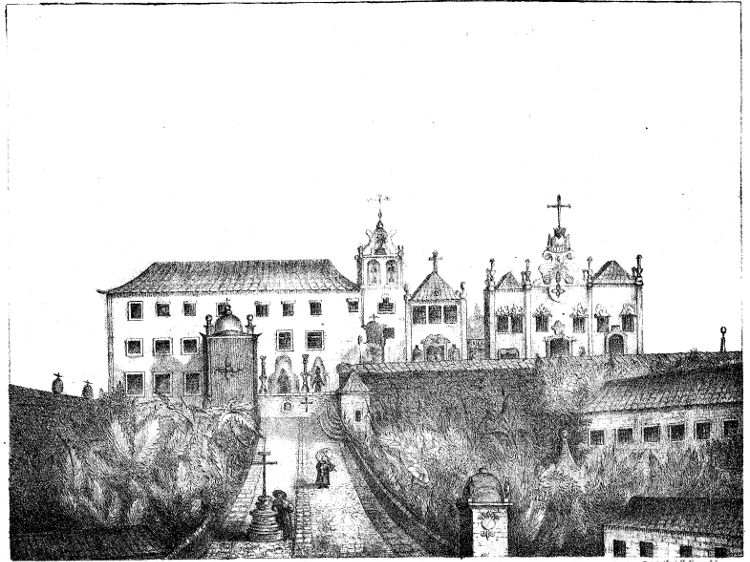
CONVENT OF ST ANTONIO, RIO JANEIRO
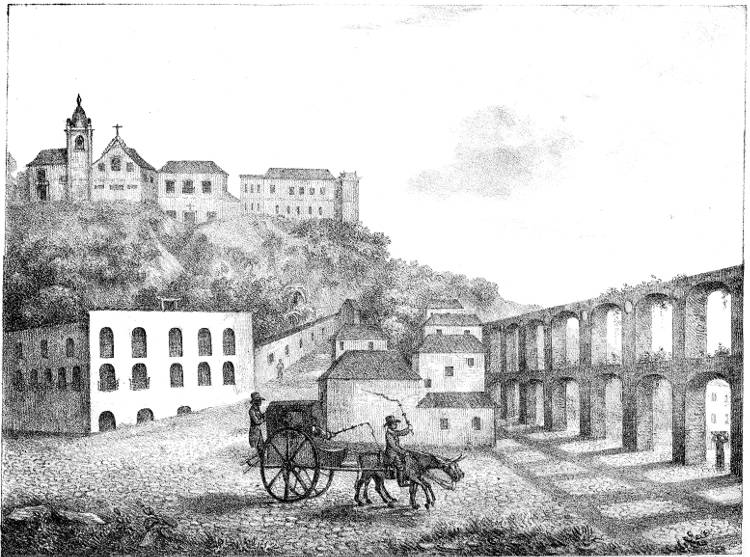
THE CONVENT OF ST THERESA, PART OF THE AQUEDUCT, & A SEGE OR CABRIOLET.
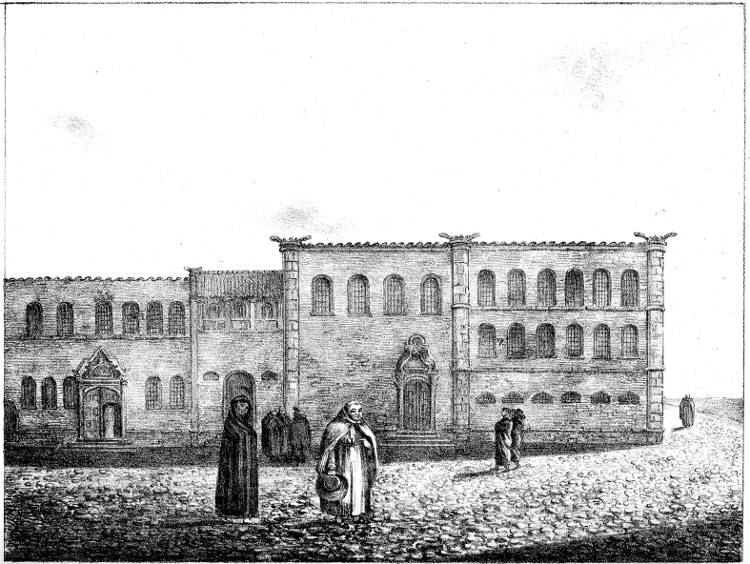
There are two female convents at Rio de Janeiro. The in-dwellers of one adhere rigidly to their system of strict seclusion from all intercourse with the world: they are Therezian nuns, and the convent is agreeably situated upon an eminence, near the double row of arches in which the aqueduct terminates. The others are Franciscan nuns, and an apartment in their convent of Ajuda is appropriated for the admission of their friends, to converse with them through an iron grating. This convent possesses an antiquated organ, coeval with the establishment, and the hand of man had not been allowed, for many a year, to harmonize the discordancy occasioned by the deteriorating lapse of time. An English professor of music was engaged, under considerable penalties to keep the peace, and presented with a carte-blanche to visit the convent, for the purpose of thoroughly renovating this instrument, which, on accomplishing, he declared was as fine a toned organ as he had ever heard. I was permitted to accompany this gentleman, upon one occasion, under the garb of a servant. We approached a door in the corner of a small inner square, which the outer entrance leads to. A respectful knock produced the opening of a small shutter within the door, when the fine face and black eyes of the watchful porteress were presented at the iron grating. After a parley of a few minutes, during which, at intervals, she examined me with rather a scrutinizing eye, the bolts were withdrawn, and, on entering, we found ourselves at the foot of a flight of spacious stairs, which she ascended with us. At the top we were joined by two other nuns, apparently about the age of forty, who conducted us along a passage or avenue; one of them continuing to sound a bell the whole way, with a view of announcing to the sisterhood that man was within the precincts of the building, whose sight they were thus cautioned to avoid. Our three companions were extremely affable, and conversed with much animation. We arrived, after passing through a considerable part of the building, at the apartment where the organ stood, which was also a place of devotion, and ornamented with the figures of various saints. Creolean slaves soon came, to assist in the operations upon the organ, in which I was an equally awkward performer. Those slaves, unnaturally destined also to be here immured for life, were young and some of them very handsome. At intervals many other nuns came to the door and looked in by stealth. Some gradually overcame their shyness, entered the room, offered up their devotions, repeated their “Avi Marias,” and, by degrees, approached the organ, with which our attention appeared to be absorbed. Nature so triumphed over superstitious habits that many of them became very familiar and lively. One of them sung part of an English song, which my companion had translated into Portuguese, he playing upon the organ as an accompaniment; the others appeared quite delighted, and shouted out “Viva, viva.” Upon some of them perseveringly urging me for an air, I gave them a verse of “God save the King,” which, on others coming into the room, I was obliged to repeat. The governesses joined in these occasional bursts of vivacity, and at other times took their stations in different parts of the room, apparently in the posture of devotion, and so situated that they could observe all that was passing. Upon all occasions of their coming in or leaving the room they bent the knee to the figure of Jesus. One of them directed my attention to the beautiful quality of the silk which constituted the vestments on the figure of St. John, and observed, several times, that he appeared muito triste (very sad) that morning. I did not think proper to dissent from this romantic discovery; but I was a little astonished to find that she carried her superstition so far as to imagine that an inanimate figure could actually change its aspect, and, consequently, that it was endowed with vital feeling and thought. She next showed me a menino Jesu, (child Jesus,) richly dressed, with a silken band around the waist, from which was suspended an embroidered bag, containing, she said, a piece of the real bone of our Saviour. I ventured here not wholly to conceal my doubts; but she assured me it was so, and that the Queen, whose remains were deposited in the garden of the convent, brought it from Lisbon, and presented it to them: this was conclusive. No doubt they regarded us as pitiable heretics, one of them taking great pains to teach me Padre Nosso, Avi Maria, Santa Maria, all which I was instructed to write in my book, and then compelled to repeat several times to the rest, who seemed very much pleased at my promising symptoms of Catholicism. A very fine girl, about ten years of age, had just entered the convent. I expressed my surprise and regret, to one of the governesses, that so young a child should be shut up here for life; she replied, that it was infinitely better than being exposed to the wickedness of the world. They are involved in great ignorance, but apparently not only comfortable, but happy, and great cleanliness pervaded that part of the convent that we saw. We returned by the same avenues; and the bell, which had been intrusted to my novel management, sending forth rather unusual sounds, induced some of the more secluded sisterhood to peep, with some surprise, out of their cells; and, as I was found not to be intuitively a bellman to their wishes, I was as quickly deprived of my new situation.
On Stone by C. Shoosmith from a Sketch by Jas. Henderson.
Printed by C. Hullmandel.
THE CONVENT OF AJUDA.
An aqueduct, for furnishing water to the Cidade Nova, is nearly completed; in which quarter some new fountains are to be observed, especially the Lagarto, and another in the Campo St. Anna, large, built of stone, and discharging the water by numerous spouts.
The fountains in the eastern district of the city consist of one in the Palace Square, in the shape of a tower, the Marrecas; one in the Moura Place; and the Carioca, with twelve spouts; all of which are supplied by the aqueduct already mentioned.
A visit to its source I found to be a most interesting excursion. I was accompanied to it by two friends. We directed our course to the village of Matta Cavallos, passing underneath the double arcade, the superior one having forty-two arches, and which conducts the water from the Therezian hill across a valley close to the city. We called upon Mr. Langsdorffe, the Russian consul, and proceeded from his house up a gradual ascent, covered with almost impervious woods, and, after crossing a deep glen, gained the terrace, which is formed by excavation along the sides of mountains and precipices for nearly four miles. As far as two white pillars, opening into the Orange Valley, a distance of about three miles, the terrace has been recently repaired, and forms of itself a very fine promenade. Upon its inner side the range of aqueduct is erected, which is nearly eight feet high, consisting of two walls, a yard from each other, which space is arched over, and encloses the small stream of water that flows rapidly along a channel hewn out of stone. As far as the pillars it has been recently enlivened by white-washing, and at certain distances small apertures are left, for the purpose of ventilation. In some places, small iron gates are introduced into the wall, to admit of the occasional entrance of persons within it; those gates are locked, and an opening is left at the bottom large enough to receive the arm. There is likewise a bason, cut out of the stone, to supply the passers-by with water, which has rather a peculiar flavour.
The eye is delighted with the succession of beautiful scenery which the walk presents, and rambles in undiminished rapture at every point, over the varied and romantic objects which sportive nature has here produced. Precipices above, and accumulated alpines shut in the view to the south and west. Winding glens below, formed by smaller elevations; here and there houses seen almost embosomed in the woody ravines; the valley of Engenho Velho, sprinkled with white houses, which is also the site of the palace of St. Christovao; the city and bay, surrounded with their amphitheatres of mountains; the high soaring masses near the pass to the Tejuca; the towering piles of the Organ range, and others of varied appearance to the right, edging the distant horizon, together form a grand totality, a most animated and animating picture, extending far to the north and east, harmonizing the feelings, and lifting the mind into a profound and pleasing train of wonder and adoration of the all-powerful being who has ordained these noble diversities of nature, over which his creative hand has thrown the graceful and cheerful covering of verdant trees and shrubs, swarming in wild profusion, the hand of man having in few places contributed its aid.
“Hail, Source of beings! Universal Soul Of Heav’n and Earth! Essential Presence, hail! To Thee I bend the knee: to Thee my thoughts Continual climb, who with a master hand Hast the great whole into perfection touch’d.”
This charming picture is lost to view on passing the opening betwixt the pillars, where the prospect, although more confined, is admirable, consisting of the deep recesses of the Orange Valley, the more lofty features of the mountains which encompass it, and the singularly formed Corcovada at its head, all rising into indescribable magnificence. These are scenes that would have delighted and invigorated with new energy the most exalted poets and painters. From hence, a narrower terrace, covered with entwining brushwood, and skirting along the side of the mountains for about a mile, brought us to the head of the valley, where the origin of the aqueduct is marked, by an inscription, to have taken place in the year 1744. Its source is adorned with a fine cascade, at the foot of which, a declining platform of rocks, overshadowed with trees, and refreshed with the falling water, afforded us a delightful retreat from the rays of the sun; and here in reality we enjoyed the refreshment a slave had brought for us: above us the rugged mountains in precipices and the stony bed of the rivulet were seen, overhung with high trees and shrubs as far as the eye could reach. In this place, and from these waters, a poetical mind must, indeed, imbibe those draughts of inspiration which the vale of Tempe, and the mountain and stream of Parnassus are fabled to have produced. A long and intricate path leads from hence to the summit of the Corcovada Mountain; below us there was an abrupt and rocky steep, its sides covered with thickly growing brushwood, down which the water descended in a murmuring course to the valley; the whole of its varieties of verdure and fertility, with the bay of Bota-fogo at its lower extremity, was within our view. A winding road led us to a point, where we descended by a difficult way into the valley, while its fine oranges, growing spontaneously, supplied us with a dessert. It is beautified with some elegant houses, of one of which, at the bottom, almost opposite to the Queen’s cottage, the accompanying sketch is a specimen. Our way from hence continued by the Cateta and the Gloria to Rio.
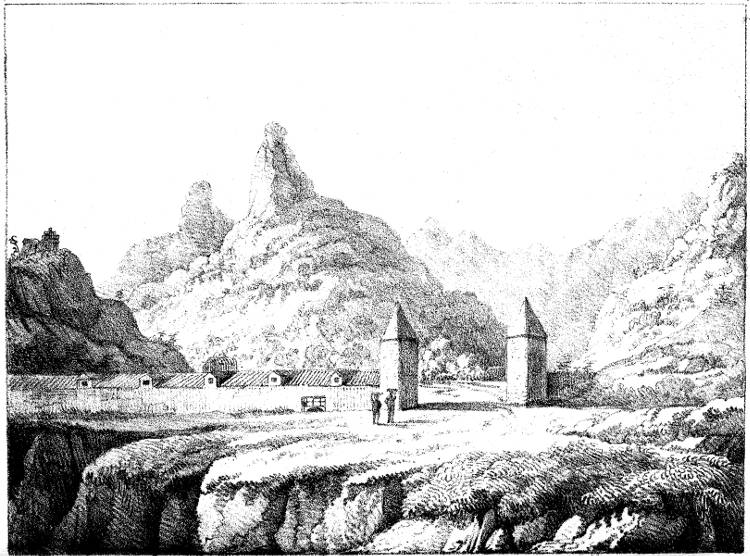
PILLARS NEAR THE SOURCE OF THE AQUEDUCT
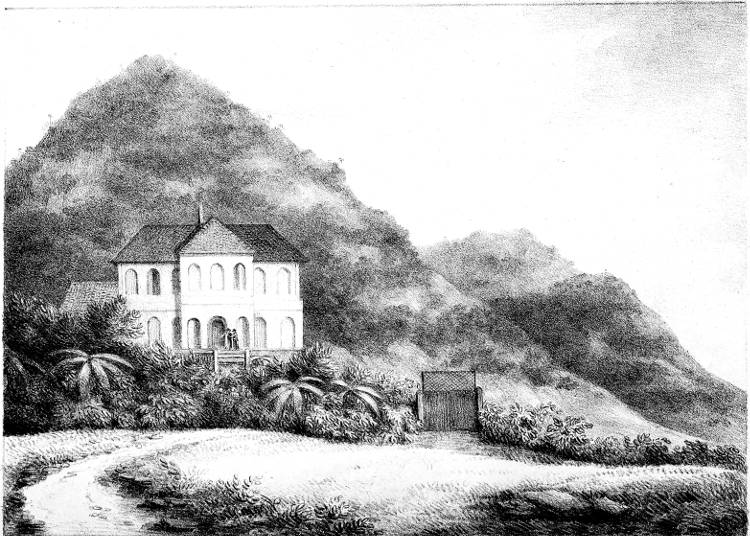
On Stone by C. Shoosmith from a Sketch by Jas. Henderson.
Printed by C. Hullmandel.
HOUSE AT THE BOTTOM OF THE ORANGE VALLEY.
The open spaces of the city, denominated squares, consist of the Palace Square, one hundred and fifty yards long, and eighty wide, with two good landing stairs from the bay; of the Roceo, one hundred and eighty yards long, and one hundred wide; and the Capim, recently called Peloirinho. In the Cidado Nova, there is one which occupies the intermediate space of the crossing of four streets; but, although these are open spaces, they have little regularity or semblance to any thing that produces the idea of a square. The Royal Palace which has more the appearance of a manufactory than the residence of a king, is composed of that formerly occupied by the viceroys, the convent of the Carmelites, and the senate-house, united by passages, the first forming the southern side of the square, and the latter the western. The northern side consists of a row of houses, which are private property, with two stories the same as the others. The first portion has twenty-four windows on the side, and nine in front towards the bay, the lower part of which is occupied by the guards and some public offices, the rooms above are generally used by the King for public levees. Some of the merchants and groups of the male inhabitants frequent every evening that part of the square, and the walls adjoining the landing places and bordering the bay afford convenient seats, which are fully occupied. Here the arrival of vessels is ascertained, and the sea-breeze enjoyed.
The mint, the armory, the naval arsenal, and that of the military, (called trem,) and the custom house, are the principal public buildings; but of themselves present nothing particularly worthy of remark. There are various public trapiches, or warehouses for the deposit of produce. The public gardens, which are stated by some travellers to have been fully and gaily attended some twelve or fourteen years ago, are now quite unfrequented, and sunk into neglect. This place of resort in former times consists of about two acres of ground, bordering upon the bay, enclosed with a high wall, and neatly laid out in walks of trees, overhung with a variety of evergreen foliage. There is a stone terrace at the end, ascended by two flights of steps, commanding a view of the bay, with the remains of two pavilions, and other mutilated objects. This place is not left without regret, that so cool and agreeable a situation, and so well calculated for a public promenade, is permitted to fall into decay. For the administration of justice the same tribunals exist here as at Lisbon. At the period of the suppression of the board of inspection, in 1808, was created the tribunal of the royal junta of commerce, agriculture, manufactures, and navigation, composed of ten deputies, a president, a secretary, and an official maior, (officiating mayor.) The Jesuitical library is open to the public; it contains about sixty thousand volumes, amongst which there are but few modern works, and a great many old ones on theology. I was in the habit of frequenting it, and as is the custom at the national library in Paris, the librarian attends, immediately brings any book that may be required, and places it upon a small reading desk on the table, with which each person is accommodated. The very small number who attended consisted generally of priests and friars. Manufactories have yet acquired no footing in this city; there is however, one of sail-cloth, and another of silk stockings; also, a few miles distant, at Andrahi, there are works for printing cottons upon a small scale, and conducted by a person who has been in England. Coarse cottons are manufactured in the interior of Brazil, and they pass the shuttle with the hand, according to the mode used in England formerly.
The only place of amusement in Rio is the theatre, erected within the last few years, and which, in point of external appearance, is beyond mediocrity. It contains four tiers of boxes on each side of the house, thirteen in each tier, making, in the whole, one hundred and four boxes, which are extremely gloomy, being shut in at the sides. The royal box occupies the whole of the space fronting the stage, above which there is a small gallery; and the pit contains about four hundred persons. The orchestra is esteemed very tolerable; but the performances are indifferent. Two French dancers and their wives are at present the magnets of attraction; and there is great emulation between them for the palm of superiority. The Campo St. Anna contains a large building, erected for the purpose of bull-baiting; but the Brazilian bull not possessing the fire and fury of this animal in Europe, was the reason of its falling into disuse, and creditable would it be if so irrational and cruel an amusement was discontinued. Within the last two years, this building was the scene of the various feats in horsemanship of Mr. Southby and his troop, for which it is well adapted. The clown, soon acquiring some of the local peculiarities of the people, produced amongst them a fund of merriment they had been little accustomed to; and they expressed themselves more highly astonished and pleased with those performances, and the wonderful display of agility by Mrs. Southby on the tight rope, than any thing they had ever before witnessed.
The city of Rio de Janeiro was taken by the French, in the year 1711, under M. Duguay Truin, and afterwards recovered by the people. In the preceding year, M. du Clerc had entered the town, conducted by two fugitive negroes, from Ilha Grande.
There are three principal roads leading from this city, none of which are adapted to the use of a carriage for more than six or seven miles. The first, leading to the southward, after passing the public gardens and the Lapa, proceeds, for a short distance, along the banks of the bay, commanding a view of its entrance, which is soon interrupted by the Gloria Hill, behind which the road passes, and continues in a parallel line with the Pria Flemingo, which is adorned with several neat houses, many of them occupied by English merchants. The Hon. Mr. Thornton had taken up a temporary residence in one of them. After crossing a small bridge at the Cateta, the road conducts, for about a mile and a half, betwixt luxuriant and verdant hedges, to the beach or Pria of Bota-fogo, which is a fine bay, shut in by picturesque promontories and headlands, leaving only a narrow channel for the ingress and egress of its waters. This beach is edged with some of the neatest and most elegant houses in the vicinity of Rio de Janeiro, many of them occupied by fidalgos, and others by English merchants; one of which, in the possession of Mr. Harrison, exhibits all the beauty, elegance, and comfort of an English villa. Bye-roads lead from hence to the Pria Vermelha, to the royal powder manufactory, and the botanical garden already mentioned. In many parts the Cateta road is in a very bad state of repair, and the holes and hollow places form pools of water after the least fall of rain. The other two roads lead to the north of the city, both branching from the Campo St. Anna, and again communicate in passing Matta Porcas. The first and principal one proceeds from the right of the Campo, and continues for about a mile and a half, to the wooden bridge of St. Diogo, across a marshy flat, which eight or ten years ago was impassable, and is now denominated the Cidade Nova, of which it may in time constitute a portion. The road of the Cidade Nova, being the daily route of the royal family, is kept in pretty good order, as well as the whole road as far as the palace of Christovao, which at Matta Porcas turns to the right, and continues for about two miles along a level, with amphitheatres of various and picturesque mountains in every direction. After crossing the third brook, by a small bridge, the way to the palace turns to the left, when a handsome entrance is discovered, not in unison with the palace, but consisting of a wall and iron palisades, extending about thirty yards on each side of it, without any contiguous lodge or building. From hence the road sweeps to the left, up a gentle acclivity, to the eminence upon which the palace stands, fronted by a square, not embellished with shrubs and grass-plots, but of deep sand, which is entered by the left corner, and not by the grand entrance, composed of the elegant gates, a counterpart of those at Sion House, and sent as a present to his Majesty by the Duke of Northumberland. They are placed in the centre betwixt pillars of granite, peculiar to the country, and two lodges, the remainder on each side along the whole front of the palace being completed with palisades of Portuguese workmanship. It will excite some surprise in the reader to be informed, that the outer part, which should form a road to this entrance, is allowed to remain in its natural state of hollow and uneven ground, when no very great labour would be required to render it complete. At present, the gates are in disuse, the lodges closed, and, with the aid of the dirt and gunpowder arising from the fire-works ranged along their front, on occasions of religious festivals, the whole already appears in a course of dilapidation. The palace is one story high, perfectly plain, without any pretensions to elegance, or the semblance of any order of architecture, and can boast of nothing but the beauty of its situation. It might, indeed, be mistaken, at a distance, for a manufactory, in consequence of the windows being so crowded together, and particularly at night, when it is lighted up.
The road, from the point which leads to the palace, continues by either turning a little further on to the left, and ascending a hill, or by the Campo St. Christovao, which sweeps round the hill and meets the other road on the opposite side, and afterwards leads on to the province of St. Paulo and Minas Geraes. It is the grand track of the miners and others coming from distant districts, and presents successive troops of mules, laden with different produce, attached to their curious and rudely constructed pack-saddles, by straps of raw hides.
The road of St. Christovao and the Cidade Nova, are generally crowded by these caravans, their drivers of all complexions, dressed in cotton shirts and trowsers, with slouching hats, and combined with the horses and mules, carrying persons of rather a superior order coming also from the interior, amount to the aggregate number of at least two thousand passing and re-passing daily. It would be difficult to describe the variety of costume and rude appearance of the latter persons, many of whom are dressed in black or dirty white hats, with prodigious rims, a capote, or cloak, frequently of sky-blue, thrown round the front part of the body, and being crossed behind them, hangs in folds on each side of the mule. The bits of their bridles, their saddles, and stirrups, are of various antiquated and fantastic shapes. Some wear boots of brown leather, closely fitted to the leg, bound round the top with a strap and large buckle; others with capotes, large hats, &c. wear neither shoes nor boots, but introduce the great toes only into the stirrups, and with large heavy spurs upon the naked heels, are not the least remarkable among these burlesque figures. I have frequently ridden with them, and always found that they were communicative and civil. Their mules, which had performed journeys of two and three months, did not appear to have sustained much injury. These people mostly frequent certain streets in the city for disposal of their produce, and the purchase of manufactured goods. The Rua de Candelaria is the great mart for cheeses, brought from the interior. The Rua de Violas, Rua de St. Pedro, &c. are visited by the miners; and some of the shopkeepers, of whom they buy their return cargo, occasionally purchase from the English merchants three or four thousand pounds of goods in one bargain.
The other road leading from the Campo St. Anna, does not present so much traffic as the last, and is denominated the old road. It proceeds through the village of Catimby, and from thence to Matta Porcas, one end of which it passes, and advances through the valley, having many good houses by its sides, to Andrahi, contracting afterwards betwixt the mountains into a narrow bridle way, leading to the district of Tejuco. From this road, near the Pedro Mountain, a cross road, with some good houses, the principal one recently occupied by Mr. Gill, an English merchant, conducts through the extremity of the valley of Engenho Velho, and at a distance of about half a mile unites itself with a road coming through another portion of the same valley, from the stone bridge near the turn to the palace. After this junction, the road proceeds through the valley of Engenho Novo, and communicates with the great road to the mines.
The road which turns off at the stone bridge last mentioned is a lane much frequented by the royal family, and is bounded by beautifully verdant hedges, and some neat shacaras, and is not dissimilar in appearance to the green lanes, leading from London to Southgate. It is the limit of the King’s shacara on the right. About three quarters of a mile from its commencement is situated the Casa de Don Pedro, recently erected in the form of a castle, with a flag-staff at the top, the ground-floor consisting of one good sized room, and four smaller, covered with India matting, and furnished with chairs and sofas, but by no means in a royal style. From the palace to this casa is a favourite walk of the King’s; the interval forms the royal shacara, and is laid out in walks, crossing each other at right angles, shaded by an abundant variety of trees, which have been planted only within the last few years, and demonstrate by their state of maturity, the exuberant fertility of the soil and climate.
The road continues from hence, across a brook, by a wooden bridge, which bounds the King’s shacara on that side; and very near to it is the royal mill, which is yet far from being completed, although it was begun five or six years ago. It is intended to have one water-wheel and four pair of mill-stones. The model of the building and the machinery were sent from Lisbon. When the mill is finished, it is expected to grind forty sacks of wheat during the day and night, for which the public will be charged two crusades (about five shillings) per sack, of three alqueiras, or about three and a half of Winchester bushels.
One hundred yards further is situated Bella-fonta, the fine shacara of Mr. Wright, under whose roof I received every kindness and hospitality possible, during my residence at Rio; and am happy in this opportunity of acknowledging, in common with all who know him, the high estimation I entertain of his character.
Within the circuit of the roads described, the valley of Engenho Velho is adorned with numerous neat shacaras, abounding with walks formed of oranges, and all the fruit trees of the tropics. Many give the preference to a residence on the Cateta side; but, in consequence of the royal family frequenting this quarter, I think the spirit of improvement shows itself more decidedly in this direction, and although the sea breezes do not reach it, the land breezes from the adjacent mountains, sweeping along the valley, render the mornings and evenings particularly delightful. The dews are here profuse.
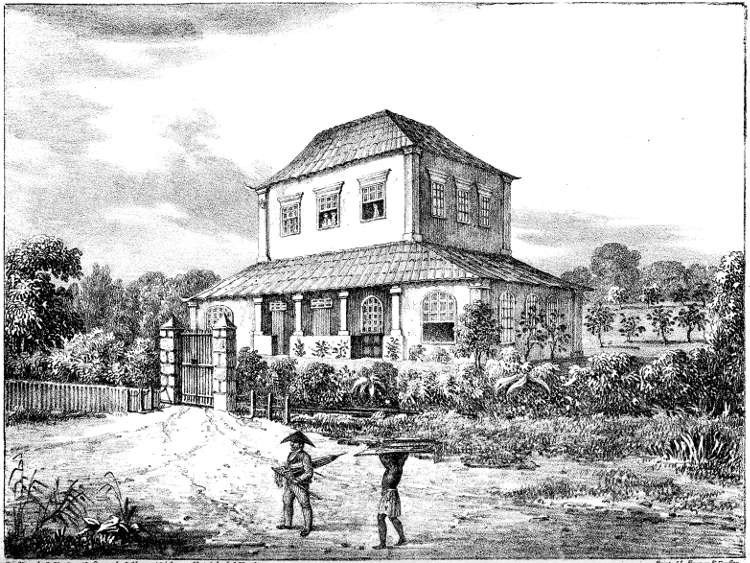
On Stone by G. Hurley; the figures by Shoosmith from a Sketch by Jas. Henderson.
Printed by Romney & Fayter.
A Pedlar & His Slave.
BELLA FONTA, THE SHACARA OF I.E. WRIGHT, ESCa.
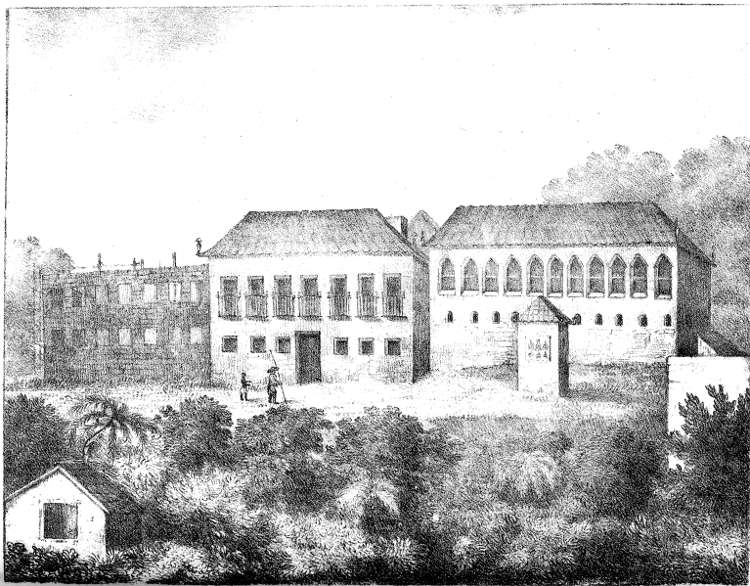
On Stone by C. Shoosmith from a Sketch by Jas. Henderson.
Printed by C. Hullmandel.
PALACE OF ST CRISTOVÃO.
I accompanied a gentleman, in the month of September, to see the Casa de Don Pedro, from whence we proceeded along the delightfully shaded walks of the shacara to the palace, which is in the progress of augmentation by some buildings under the inspection of Mr. Johnson, who came to the Brazil with the gates from the Duke of Northumberland, and who has been since employed by the King in superintending the progressive enlargement of the palace. On this day, all bands were fully employed in finishing a suite of rooms which his Majesty had a great wish to occupy that evening.
On descending a hill from the palace, we perceived Prince Don Miguel in a field below, dressed in a pair of great jack-boots, a cocked hat, and a star upon his breast, with a pole about 10 feet long in his hand, attending a plough with one handle, drawn by six bullocks, followed by five or six negro drivers and a feitor.[12] They executed their work very imperfectly, allowing the greatest portion of the turf to fall down again. From the superfluity of animal power employed in this defective specimen of agriculture, our attention was directed to the royal stables, which contained about three hundred mules and horses of a diminutive size, with double the number of persons to look after them that would have been deemed necessary in England.
Prince Don Pedro had been breaking horses into harness all that morning, and we met him with the fourth pair; he used a large unwieldy whip, which, however, he administered pretty freely, making as much noise as a French postilion would, on announcing his arrival at a town, by the cracking of his whip. On passing him we stood still and took off our hats, which was only returned by an ungracious look. We also met Prince Don Miguel, returning from his agricultural amusement, accompanied by his feitor. He is a spare and pale-looking person, about sixteen years of age. Passing close to his elbow, we paid him the most respectful obeisance, but we were not honoured even with the least inclination of his head.
I walked one evening to see the fire-works, which had been preparing for some time for the celebration of a saint’s day, in front of the palace, ranged along, and a few yards distant from the gates and palisades. The veranda was filled with a great many priests and friars, and others about the person of the King. His Majesty and the rest of the family took their station at the fifth window, on the right of the handsome flight of stairs erected by Mr. Johnson. The fire-works were ill executed, and could not be put in comparison with such exhibitions in Europe, which is much to be wondered at, considering the immense revenue here annually expended in this way, and the great number of persons that live by it and follow no other pursuit. Every evening at eight o’clock, excepting holidays and Sundays, the King receives the public, in a room appropriated for the purpose, at St. Christovao, to the honour of beija-māo;[13] and the roads of Cidade Nova, Catimby, and Matta Porcas are covered, on those occasions, with officers, and numerous persons in cabriolets, on horseback, and on foot, pressing towards the palace, consisting of those who have some object to carry with his Majesty. When the door is opened there is a promiscuous rushing forward, and a mulatto will be seen treading upon the heels of a general. They advance in single rank up one side of the room to the upper part, where his Majesty is seated, attended by his fidalgos in waiting, and, passing him in review, they countermarch in the same order. It is said that the King has an extraordinary memory, and recollects each individual as he passes, and the object of his visit; those who please speak to him, but a great proportion do not. It would appear that his Majesty is partial to seeing people in this way for a considerable period before he concedes what they want. A gentleman from Lisbon informed me that he had come to Rio expressly to gain some object with the government, and he anticipated a residence of twelve months there before he accomplished it. He purposed omitting none of those numerous attendances of beija-māo, unless his neglecting to do so might be observed by his Majesty; who, he observed was particularly desirous of detaining all Europeans there as long as possible. Senhor Thomas Antonio de Portugal, the minister of state, who has a shacara upon the left side of the road, already described, leading to Andrahi, holds a sort of public levee two days in each week, where crowds of officers and others attend, to submit their applications or to solicit his patronage, afterwards proceeding to perform the accustomed ceremony of beija-māo at the palace, during which period, from eight to nine o’clock, a band of music, in no very harmonious strains, is heard through a portion of the valley.
The fidalgos, and those who may be denominated the higher orders of society here, are infinitely behind corresponding classes in the leading states of Europe, both in the knowledge and practice of civilized life. The pleasures and refinements of social intercourse are alike unknown to them: jealous of foreigners, their conduct towards them is not marked by that attention or hospitality so conspicuous in other countries, where the cultivation of a liberal system of society prevails. Their main occupation consists in outward show, in the punctilious observance of court-etiquette, and a regular attendance upon the superstitious rites and festivals of the Catholic religion. Whatever little exists of pomp and splendour in this city is to be discovered in the temples, which are fitted up with rich profusion, more especially the parish churches, their altars and shrines exhibiting decorations of the most costly kind, in which respect St. Sebastian, or the Royal Chapel, stands pre-eminent; its richly-gilded walls, carved work, and splendidly-ornamented altars, glittering with a profusion of gold, silver, and precious stones, surpass in brilliancy any thing that could be imagined, by a plain Christian, as essential to the purposes of divine worship. The chapel has some paintings, and one large piece over the chief altar, into which the late Queen and the principal part of the royal family are introduced. The King has a large box, not unlike an opera-box, above the place where grand mass is performed; here his Majesty and the rest of the family take their seats on festival-days; the bishop, in white or yellow satin, richly embroidered with gold, his mitre of the same, sits in great state below, opposite to the King, when he is not engaged in any part of the ceremony, in which he is assisted by a prodigious number of padres, and the service is performed with vast magnificence. The organ, accompanied by a crowd of vocal performers, amongst whom are five or six eunuchs, gratify, with some of the finest music of the Brazil, the audience, consisting, on some occasions, of many fidalgos, judges, ministers, and various individuals, who, in their gaudy robes, sit upon benches along the body of the chapel. There are others also who are led there by curiosity.