CHAP. IV. PROVINCE OF RIO DE JANEIRO—continued.
Reading edition
Population of the Capital—Negroes—Nocturnal Clamour of Reptiles—Vampire Bat—State of Literature—Jealousy—Dead Bodies—Military—Bank—Revenue—Imposts—Diamonds—Visit to Campinha—Tenure of Lands—Proof of Fertility—Swiss Emigrants—Visit to the Cascades of Tejuca—Commerce—Judicial Procedure—Pauta and Convention—New Exchange—Foundation of English Church—Towns, Villages, and Productions of the Comarca of Rio de Janeiro—Boundaries, Productions, Rivers, Lakes, and Povaoçoes of the Comarca of Cape Frio—Boundaries, Indians, Rivers, Lakes, Towns, and Sugar Works of the Comarca of Goytacazes—Boundaries, Coroado Indians, and Povaoçoes of the Comarca of Canta Gallo.
The population of Rio de Janeiro is estimated at about one hundred and fifty thousand souls, two-thirds of which are negroes, mulattoes, and others, exhibiting every variety of complexion. The Brazilians residing here, and in the vicinity are denominated Cariocas by the European Portuguese; the meaning or origin of which term I could not learn; the latter falsely considering themselves much superior to the former.
The mulattoes are a portion of the population much the most healthy and robust, their mixture of African and Brazilian constitution appearing exactly adapted to the climate. The negroes are probably not used with more inhumanity here than in other colonies. In the interior they are treated much better than at Rio de Janeiro, where, in some instances, much cruelty is practised. For a trifling offence, they are sometimes committed to the charge of two or three soldiers, who pinion them with cords, and beat them in the most unfeeling manner along the streets, to the Calobouco, a prison for the blacks, where they are destined perhaps to receive a severe castigation before they are liberated. Their owners procure an order from the intendant-general of the police, for one, two, or three hundred lashes, according to the dictates of their caprice or passion, which punishment is administered to those poor wretches by one of their own countrymen, a stout, savage-looking, degraded Negro. A gentleman obtained an order for the flagellation of one of his runaway slaves, with two hundred lashes. On his name being called several times, he appeared at the door of a dungeon, where the negroes seemed to be promiscuously confined together. A rope was put round his neck, and he was led to a large post, in the adjoining yard; around which his arms and feet were bound, while a rope secured his body in like manner, and another, firmly fastened round his thighs, rendered the movement of a single member wholly impossible. The black degradado set to work very mechanically, and at every stroke, which appeared to cut part of the flesh away, he gave a singular whistle. The stripes were repeated always upon the same part, and the negro bore the one hundred lashes he received at this time with the most determined resolution. On receiving the first and second strokes he called out “Jesu,” but afterwards laid his head against the side of the post, not uttering a syllable, or asking for mercy; but what he suffered was strongly visible in the tremulous agitation of the whole frame. The scene was deeply afflicting, and it was to be regretted that the man who was capable of such fortitude should be in a condition that subjected him to so painful and degrading an infliction. He received the other one hundred lashes on the third day following, after which, a heavy iron chain to his leg, and an iron riveted round his neck, from which a trident stood up above the head, by way of ornament, would be no pleasant appendages with which to pursue his usual labour.
There are men who profess to be catchers of runaway negroes, and frequently detain and ill use them when they are proceeding upon their employment, keep them confined during a night, conduct them home tied with ropes, and pretend they have detected them running away, for which they demand certain charges and a recompense. I was present when two of those fellows brought a poor negro girl whom they had detained, and it was proved that they stopped her when she was really in pursuit of her occupation. They failed in receiving the recompense they so basely sought, but they ought to have been made a severe example of. It is painful to observe, that if a negro is stopped, or forced away, or in any manner ill-treated, nobody takes his part or believes his story.
A great many persons live entirely in idleness, upon the earnings of one, two, or three slaves, who are denominated “negros de ganho,” and stroll about the streets for employment: they are distinguished by a large basket which they carry; others of both sexes are employed in carrying water in tubs, from the fountains, for the supply of the inhabitants; the fountains are crowded all day, and are attended by a couple of soldiers to preserve order. The streets after dark are most offensively filled with negroes, carrying tubs of soil to empty at the beach, a water-closet, or privy, not being known in this city. If these negroes do not bring a certain sum of money to their owners at night, the penalty is generally a severe castigation. Many of the negro slaves are remarkably well formed, particularly some of those who labour at the custom-house, and exhibit much muscular strength about their whole frames, combined with such symmetry of form, that the lineaments and swelling muscles of their naked bodies reminded me of some fine antique models. They wear cotton trowsers, the rest of the body being exposed. The principal part of the importations are removed from the custom-house by them, and their dreadful shoutings and yellings, as a stimulus under their burdens, resound through the streets and suburbs all day. Few waggons are used, and those of a rude construction; the axle-trees, revolving with the wheels, produce a loud and discordant noise.
The humane attempts of some English merchants to introduce waggons, for conveying goods from the custom-house, were effectually opposed by the clerks of that establishment, who have the privilege through intrigue of exclusively letting out their slaves for this employment. The universal diet of the negroes is the farinha, or flour, of the mandioca root, which they mix up with warm water, and occasionally are indulged with a little toucinho, or fat bacon, to it; but in the mining districts they use the flour of Indian corn, which a negro, who had worked at the gold mines, informed me, was preferred amongst them to the first. The Brazilians themselves use a great deal of farinha, many families almost subsisting upon it; and when dressed up, as is the custom in some parts of the Brazil, particularly at Pernambuco, with green peppers, &c. into a state they call pirao, it is very palatable. Feijaos and carne-secco, which are black beans and dried beef stewed together, is a dish much used amongst the Brazilians, and an European with a sharp appetite will not find it a bad relish.
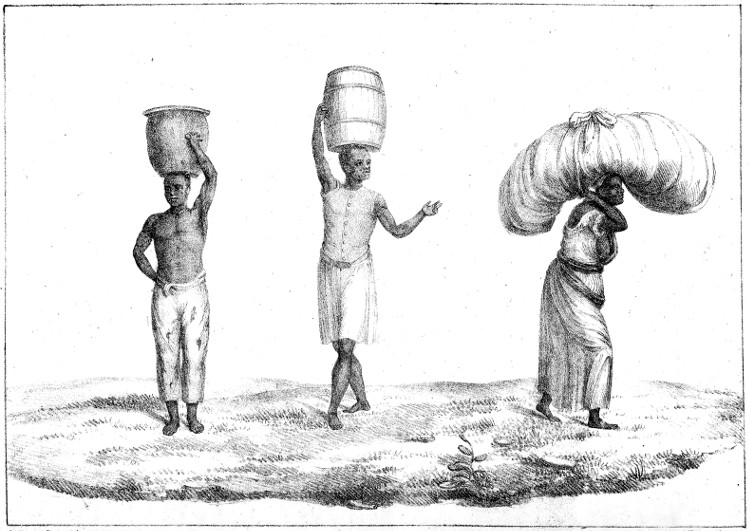
On Stone by C. Shoosmith from a Sketch by Jas. Henderson.
Printed by C. Hullmandel.
NIGHTMAN. WATER CARRIER. WASHER-WOMAN.
The slave-ships arriving at the Brazil present a terrible picture of human wretchedness, the decks being crowded with beings as closely stowed as it is possible, whose melancholy black faces, and gaunt naked bodies, are of themselves sufficient to transfix with horror an individual unused to such scenes, independently of the painful reflections connected with a consideration of the debasing circumstances and condition of this portion of mankind. A great many of them, as they are seen proceeding from the ships to the warehouses where they are to be exposed for sale, actually appear like walking skeletons, particularly the children; and the skin, which scarcely seems adequate to keep the bones together, is covered with a loathsome disease, which the Portuguese call sarna, but may more properly be denominated the scurvy. The poor wretches undergo painful remedies to prepare them as speedily as possible for market. If a visit to the street of warehouses appropriated to their reception be occasioned by a desire of gratifying curiosity, the sentiments brought into operation by such a scene will soon hurry the visitor away in pity and disgust. They are crowded together without regard to sex, and made to sit down in rows upon the ground, being by turns roughly forced upon their feet, for the purpose of exhibiting their bodily powers to a purchaser. Negroes are become very dear; those that might have been procured three years ago for thirty-five or forty pounds, are now worth sixty or seventy.
Strangers coming here are also subject to the sarna, as well as the natives, which is an irruption attended with considerable irritation and itching about the legs, feet, and ancles, and becomes troublesome unless great care is taken, by washing them every night with warm water and cachaça. The bicho is also another annoyance peculiar to the climate, ever filling the air, the water, and the earth with new and infinite animation. This insect generates in the dust and sand, and penetrating the foot not larger than an atom at first, increases to the size of a small white worm, giving considerable pain till extracted; in doing which, it is necessary to remove all the little eggs which it leaves behind, otherwise they would soon acquire life, and, if allowed, eat away the foot. I have seen numbers of negroes, whose legs and feet, with the aid of the sarna, have been literally destroyed, and almost corroded away by them. The little black boys sitting down, and extracting them from their feet with a pin, reminded me of the celebrated bronze figure of a boy, in the attitude of taking a thorn from his foot, which occupies a place in the Salle de Laocoon, at the Louvre.
In traversing the woods, the carrapato, with which the branches frequently swarm, is an annoying and dangerous enemy. It is similar in appearance to a sheep-tick, and introduces the head and main part of the body into the flesh, when, if taken away forcibly, it leaves a disagreeable wound. One of these vermin penetrated the leg of the King, and, being injudiciously forced away, caused a wound, which has been occasionally troublesome to his Majesty ever since. The application of oil is deemed an efficacious mode of removing them; but I found this ineffectual, after using it copiously for about half an hour on one that was nearly buried in the ear of a negro-boy.
On first arriving here, the inharmonious sounds which begin to annoy the ear about Avi Maria, sent forth by field-crickets, frogs, toads, and other reptiles, are quite alarming to a stranger, who anticipates at every step, if he walks into a shacara, to encounter some venomous creature. It is custom alone that reconciles this loud, unceasing, nocturnal clamour. Lizards are very numerous, some of a green colour. They are timid, and are constantly seen running across the roads, up walls, or rustling amongst the hedges. The vampire-bat is very large here, and if they can get access to the stables will fix upon a horse, and suck the blood. I have seen the back of a horse quite saturated with it, in consequence of a bite from one of them. They are said to fan their wings, during this sanguinary proceeding, in order to assuage the pain which their bite creates. It is supposed that they would fix upon the human body in the same way; and this is probable, from the following circumstance. In consequence of the excessive heat, I was in the habit of leaving open the shutter of my bed-room. One evening I discovered a vampire-bat, as large as two hands, upon the bed-post, and, by a blow, stunned it, so that it could not escape by the window, but secreted itself in the room. During the night it got twice upon the bed, but the heat preventing a sound sleep, I was quickly awakened by its attempts.
It is too well known, perhaps, to remark that the Brazil is not the seat of literature; in fact, its total absence is marked by the prohibition of books generally, and the want of any single medium through which its inhabitants can attain even to a knowledge of the existing state of the world, or what is passing in it. The inhabitants are principally involved in great ignorance and pride, its usual consequence; an acquirement of the modes and ceremonies attached to the pompous observance of their religion appearing to be deemed quite adequate to all the purposes of the present system of society. A liberal literary institution of any kind throughout the state, or a stimulus to a man of talent, would be looked for in vain. A gazette, published twice a week, is printed at the royal press, the only one established here; but it affords to the people no intelligence of the state of their own country or that of others. It is the size of a sheet of small letter-paper, and is filled with the arrivals and departures of vessels, and some advertisements, while occasionally two or three heads are extracted with caution from the English newspapers. In the whole of the Brazil there is only one other gazette, and that is published at Bahia. Its neighbouring colony of Spanish South America has already begun to dispel the ignorance in which it was alike enveloped, by the establishment of several public colleges in different places, and the liberal and free introduction of books, which will fast promote the spirit of learning that partially begins to dawn. Jealousy, which acquires a greater sway, from this confined state of education and knowledge, obtains unbounded influence over the minds of many of the Brazilians, and operates in some instances to such a degree that its victims are degraded much below the savage: they do not declare their resentment openly, and demand frankly that redress or explanation which a man sustaining a real or imaginary injury from another has a right to require; but they seek in privacy the destruction of the object who may have created in their breasts sentiments of revenge, frequently resting upon a false and unjust foundation, but which the inveteracy of this diabolical passion will allow them neither to investigate nor to solicit what in Europe is deemed a fair and honourable satisfaction. Jealousy is a highly praiseworthy feeling when it is regulated with candour and justice, but allied with the vile cowardice of clandestine assassination, perpetrated by the hands of the party themselves, or through the medium of a hired agent, it is of all others the most wicked and hellish that can actuate the human mind.
That instances have occurred in the Brazil wherein both those modes have been practised, for the gratification of this passion, unjustly indulged, is but too true. An English gentleman, who has resided in the Brazil nearly forty years, informed me of a circumstance which he witnessed in this city, previously to the arrival of the royal family. A British officer, whose ship was taking in refreshments here, on passing through the Palace Square to a boat waiting to take him on board his vessel, suddenly received a facada by a person who drew a knife from under a capote, or cloak, (which the Brazilians are in the habit of wearing), concealed for the purpose, and which terminated his existence. It was said that this wretch had unjustly encouraged a feeling of jealousy against the British officer in regard to his wife, or some part of his family. Many of the Brazilians carry knives, hid under the sleeve of their capotes, which they throw and use with great dexterity. I was horror-struck to see at Rio the samples of an importation of knives from England, manufactured expressly for this purpose. In cases of quarrels amongst themselves they frequently use them, and quickly fold the capote around the left arm, which serves for a sort of shield.
Religious festas, as has been before stated, are occurring weekly, and amongst other funçons, as they are called, one annually takes place in the beautiful island of Paquata, one of the fairest and most picturesque in the bay. The English merchants are generally applied to for subscriptions for this festival, which they accord with their accustomed liberality. It is a delightful water excursion, which, added to the charms of the island itself, induce all the world to be of the party, and under the religious cloak of these occasions, females always appear in public. A worthy captain of an English merchantman was induced, upon one of those festivals, recently, to accompany a party in his own boat; and, the mode of refreshment being of the pic-nic kind, he came in contact with an adjoining group, including several females, to whom he was tempted to pay some attention, and thereby unconsciously excited the jealousy of a monster in the shape of a human being, who was of the party; and at the moment of his departure from the island, the boat having only proceeded some yards, a knife was thrown with such unerring aim at him that it produced his immediate death. That blacks, slaves, and others, are hired to commit such atrocities, by the payment of a small recompense, is a fact affirmed to be notorious; one authenticated instance will be sufficient to show that it is too correct. It is within a short period that the inhabitants of Pria Flemingo were much shocked at the discovery of a dead body upon that beach, decapitated, and in a state of nudity, so that no trace was left to find out who the unfortunate individual might be. This mysterious circumstance excited deep interest, and produced the offer of a reward for the detection of the perpetrator of so foul a deed. During the interval that the matter was involved in uncertainty, it was known to the friars of a monastery that one of their members was missing; but, it would appear, nothing was said by them regarding the lost brother, from the apprehension, probably, that something vicious or improper might arise out of the investigation, not quite honourable to their sect. At last, from a fear of detection, and a consciousness of guilt, the real culprit came to the determination of communicating the affair to the King, presuming upon the known mercy of his Majesty, which is so unbounded that few persons have suffered the punishment of death since he ascended the throne, although it is possible the royal forbearance may have frustrated, in some instances, the just expiation of guilt.[14] On this occasion also the criminal was not brought to justice, who, it is ascertained, was a fidalgo, whose jealousy was roused by the frequent visits the friar already mentioned paid to his wife, for the professed purpose of exacting the confessional duties of herself and family. It is not ascertained whether he had any real cause or not for the excitement of this passion; he unquestionably conceived he had, from the measures which he adopted of engaging two or three blacks to embrace an opportunity of murdering the friar, severing the head from the body, and divesting him of his sacerdotal robes. The discovery of the body was made under circumstances that did not involve those who found it in any difficulty; but it is possible that an innocent individual finding a dead person, unacquainted with the customs of the country, might be subjected to some inconvenience; and I had almost got into such a predicament myself. Not far from the Campo de St. Christovao, a beach leading to the point of Cajú affords an interesting view of the bay. I had just entered upon it one evening, in September, on horseback, when I was startled at the appearance of a dead man extended upon the sand, which the receding tide had just deposited there: he was very well dressed, in the habit of a sailor, and, the hair being of an auburn colour, I concluded he was the mate of an English ship. My endeavours to procure the aid of some Portuguese at a short distance were unavailing; no one would approach; and two or three persons in a cabriolet, who passed close by, regarded me and the dead sailor with indifference. I also addressed myself to the next person who came up on horseback; he dismounted, and I immediately found that he was an Englishman: he turned the body over, when the face appeared terribly mangled; he suggested that the property upon the person should be secured, which amounted to upwards of one pound in Portuguese money, a silver watch, a gold brooch, and other things, of which an account was taken and delivered to my care, with which I purposed going directly to the minister of police, and to request that the body might be taken care of, as it was impossible to get any one in the neighbourhood to take it in, or even come near the place. After paying two negroes to move the body from the beach, and place it under a hedge, I set off to carry my intentions into effect. On the road to the city I met an English gentleman, to whom I stated the matter; he requested me by no means to go to the police-office, as I should unquestionably be detained and lodged in prison till I proved that I was not the cause of the man’s death. This information deterred me from proceeding farther; but the idea that this unfortunate individual might have a wife, children, and friends at home, determined me to prepare an account of his person, with a view of posting it at the custom-house next morning, which might have led to an identification of his person. I previously called upon Mr. Harrison, a highly-respectable and long-resident merchant here, and he effectually convinced me of the hazardous consequences of a further interference in it. One gentleman said, “If you see a dead body, gallop off;” another, “If you perceive a dispute, from which one of the parties is likely to lose his life, fly, or you may be compelled to prove that you were not accessory to his death.” I immediately deposited the property at the British Consul’s office, being under some apprehension, but I never heard more of the matter. No doubt the body became a prey to the dogs and wild birds, and the friends of this poor man will most probably never hear of his fate.
Upon being detected in the commission of a crime, the perpetrator frequently flies to the altar of a contiguous church; where I once saw a criminal remain for several hours, being privileged from capture till an order was obtained from the bishop for his arrest. This, like many other observances of the Roman Catholics, is a practice derived from the Mosaic law.
The circumstances attending the execution of the criminal alluded to in the last note were rather singular, although common here upon such occasions. He was conducted on foot for a considerable distance through the streets, accompanied by padres, to the place of execution. There he was laid upon his back against the upper part of the ladder attached to the scaffold, and, on the rope being fastened round his neck, he was pushed off, with a negro upon his shoulders to accelerate his death. The head and hands were afterwards severed from the body and placed at each angle of the gallows, as represented in the plate.
The regular military force of Rio de Janeiro, and the immediately surrounding district, may be estimated at five thousand men, consisting of two regiments of infantry and one of cassadores from Portugal, some regiments of Brazilian infantry and cavalry, mulattoes and blacks, including the royal guard, exceedingly ill mounted and ineffective. The police of the city consists of a regiment of infantry and cavalry; this department appears to be well arranged. Although the principal plan for the protection of the Brazil is the militia law, to which all the inhabitants are liable, yet, in point of discipline they are very deficient, but in dress and equipment they reach mediocrity. None of the regular regiments are in a state of good discipline; those from Portugal are the best, but they are dissatisfied with the Brazilian service, and I was assured by one of their officers that they have relaxed very much in their duty. The mining districts and the other adjoining provinces are furnished with light cavalry, to which may be added the militia, who are usually called out for exercise on Sundays and holidays. The force at Monte Video amounts to eight thousand men, under General Le Cour, and the troops under General Rego (the Captain-General) at Pernambuco, are decidedly under the best discipline. Those two officers served with Lord Wellington in the peninsular campaign. The thirty-eighth British regiment proceeding to the Cape of Good Hope put into Rio de Janeiro for refreshment; the men being permitted occasionally to go on shore were soon recognised by one of the regiments from Portugal as their companions in war. The salutations which occurred between them induced the King to make some inquiries respecting this regiment, when he expressed his desire to see them reviewed, which the commanding officer acceded to. Boats were furnished to convey them up the bay to the Campo of St. Christovao, where they went through their evolutions with such precision that the royal family, and nearly the whole population of Rio and its vicinity, assembled upon the spot, were much gratified, and spoke highly of their fine military appearance.
Since the removal of the court to the Brazil, a bank has been established in this city, which commenced upon the plausible plan of affording great facility to commerce, by discounting bills at the rate of six per cent.; but this banking company soon curtailed these accommodations, on finding that, through private channels and agents, they could obtain ten, twelve, and fifteen per cent. by making loans, and advancing their notes upon securities not of the first character and validity. In order to provide against this sort of traffic, and acquire an unfair advantage over the public, they had the address to convince the King that they were entitled to have a prior claim over the property of an insolvent before other creditors, and, in consequence, his Majesty, (then Prince Regent,) passed laws, of the 24th September, 1814, and the 16th February, 1816, conceding to them certain preferences; and, by a decree of the 29th November, 1818, he granted them the full privilege of a first and distinct claim, before all other creditors, which is tantamount to the important public right the British government, by virtue of extents, have over the national property in the hands of any individual, and which every state can, with equal justice, practise for the security of its revenue. But that such a preference should be allowed to a body of merchants, trading for gain, over other claimants precisely in the same circumstances, is an innovation upon the laws of commerce not founded in justice. In most instances, our own countrymen will be found to be the greatest sufferers, their liberal accommodations being too often unfairly taken advantage of. The bank declared a dividend of twenty per cent. last year; and, notwithstanding the profitable operations which afforded such a result, it was very recently involved in a temporary embarrassment, arising principally from the want of a competent knowledge of those financial arrangements, foresight, and ingenuity, so important and essential in the direction of a banking concern. In this dilemma, the directors received effectual pecuniary aid from the English house of Messrs. Samuels, Phillips, and Co. established here, with the same promptitude which marks the financial transactions of its connexions in Europe.
The revenue raised in the Brazil is computed at from six to seven millions sterling, including the pecuniary aid the government receives from Portugal, but which sum is not adequate to the demands upon the treasury; many remaining in arrears, and others, with more influence, getting their claims liquidated, after much delay. The military establishment would not appear to require a very large sum, the militia not creating an item of much expense, and the navy being in a very inefficient state: it would, therefore, be difficult, on a first view of the subject, to account for an expenditure at all proportionate to the income arising from any apparent establishments for the security of the state; but as no details of the financial situation of the country, or the appropriation of the revenue, are ever published, the cause of the embarrassment under which the treasury labours can only be arrived at through the medium of piece-meal information. From the aggregate of such intelligence it is fair to conclude that the great item which disorganizes the financial wheel has its origin not only in the great accumulation of individuals about the court, but also in every department of the state. The King is a man of an easy and amiable disposition, and, from a wish to do something for every one, it is manifest, he has been led to sanction the increase of public situations to an extent beyond what is required. Few European courts, comparatively speaking, have so many persons attached to them as the Brazilian, consisting of fidalgos, ecclesiastics, and numerous attendants. Few governments have so prodigious a number employed in the discharge of public affairs, compared with those holding appointments here. In addition to the three hundred mules and horses at St. Christovao, there is an equal number in the stables at the city, not kept for the use of the royal family alone, but for the supply of fidalgos and the numerous individuals composing the retinue of the court; and, with all this expense, there is no appearance of splendour or elegance. The carriages are large unwieldly cabriolets, drawn by mules; and a fidalgo will be seen using the whip rigorously from his seat in the vehicle, although a postilion is mounted upon one of the mules, to whose management one would expect the whole matter to be left.
The extraordinary number of persons about the court and government are easily distinguished from their practice of wearing cocked hats. The ribands and orders at the button-holes of clerks, and the prodigious display of stars by fidalgos, merchants, and even shopkeepers, which their taste for public show induces them daily to exhibit, prove that these sort of decorations are procured with much facility in the capital.
Many of the claims upon the treasury are satisfied by bills upon the other captaincies, and few military or other persons, receiving appointments to distant places, do not take an order upon the treasury of that province for the liquidation of their arrears; and the provincial erarios are frequently in the same difficulties, in consequence of those demands. The treasury of Rio draws largely upon Bahia and Pernambuco. The latter has generally of late liquidated such demands to the amount of thirty contas of reas (about £9000) per month; but it is not unusual for English merchants receiving those securities to hold them for a long period before payment can be obtained.
The Brazilian government unquestionably might boast of being one of the richest in the world, if the immense capabilities of the country were administered with energy and spirit, and a due regard paid to the measures requisite to derive only a fair portion from them of the advantages they present. The revenue of the Brazil arises principally from the following imposts, viz. one-fifth upon all gold; a decimo upon all productions of the land, upon the annual value of all houses and shacaras, upon slaves, upon the exchange of proprietorship of slaves and property. A duty upon all articles passing the river Parahiba into the mining and interior districts, is collected at a register established for the purpose; and imposts are paid on passing various rivers with mules and horses. New negroes also pay an additional duty on entering the interior districts. All cattle entering the province of Rio de Janeiro pay a tax of nearly ten per cent.; the beef, besides, pays a duty of five reas per pound.
The customs are a very important branch of revenue, and may be estimated to produce at Rio from five to six hundred thousand pounds sterling per annum, of which the English merchants pay upwards of three hundred thousand pounds, and that body collectively do not contribute upon the whole much less than six hundred and fifty thousand pounds sterling annually to the Brazilian customs: fifteen per cent. is paid by them upon all imports, (which by-the-bye is at present very unfairly levied, but more of that hereafter,) and certain duties upon produce exported, which does not appear to be at all equal at the different maritime towns. At Pernambuco fox instance, cotton pays six hundred reas per arobe. White sugar sixty reas per arobe, and brown sugar thirty reas, which, upon the average price of those articles when I left that city, was from six to ten per cent. And at Rio a duty of two per cent. at the market price was, in 1819, laid, generally, upon all produce exported. Coffee previously paid eighty reas per arobe, at a fixed price of two milreas and a half per arobe; and the price in 1819 being about four milreas and two hundred reas, the government collected the two per cent. upon the difference betwixt the two milreas and a half and the current value, which created some perplexity in levying the tax upon that article; and as eighty reas upon the fixed price is about two per cent. it would obviate this difficulty by repealing that law, and allowing the two per cent. to apply to the market price of coffee as well as other articles. The only advantage to be obtained by the government, by continuing this mode, would be in the event of coffee falling in value below two milreas and a half.
The government retain the diamond district of Serro Frio under their own management, and it is extraordinary that, during the last fifty years, it has been so conducted, that this important branch of revenue has been unproductive, and the establishment is considered to be embarrassed. The company, who had it by contract some years previous to its reverting to the government, acquired considerable wealth, partly, however, by intrigue, as their engagement bound them to a fixed number of negroes, and by bribery they introduced a great many more to work the grounds, consisting of twelve or fourteen hundred square miles.
Tijuco is the residence of the governor of the diamond works, which are, and have been some years, under the jurisdiction of Senhor Camara. The mode pursued of hiring all negroes, and making all purchases for the establishment upon the spot, will tend to preclude its ever becoming lucrative in the hands of the government. All persons who hold situations under the governor are allowed the privilege of supplying a certain number of negroes, and the eagerness, intrigue, and influence, exercised by all classes, to get their negroes employed, is a strong testimony of some ulterior object, beyond the mere wages which can be thus acquired, and no doubt exists that an illicit traffic in diamonds, through this medium, is carried on to an immense extent. The royal family have the selection of the finest diamonds; and it is said that the King possesses the best collection of gems in the world, worth upwards of two millions sterling. The diamonds are conveyed to Rio from Tijuco, a distance of six hundred miles, under a strong military guard, and deposited in the treasury, till despatched for London, which is now their great mart. The gold mines are a much less profitable source of revenue than they were formerly.
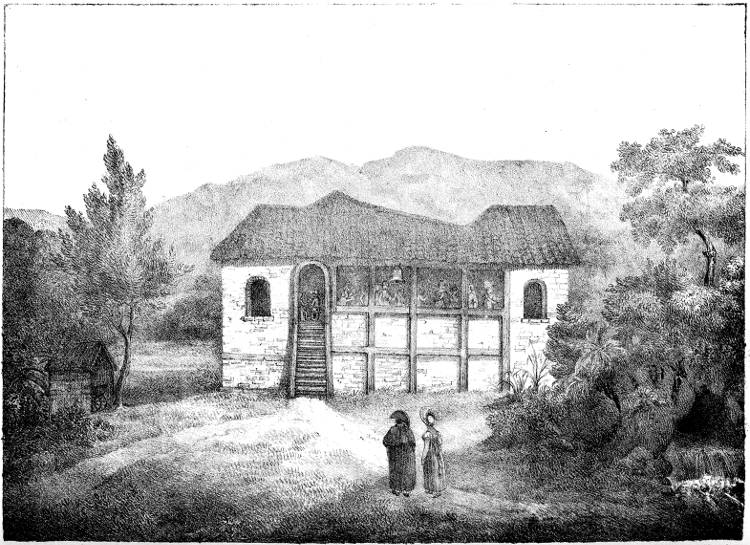
On Stone by C. Shoosmith from a Sketch by Jas. Henderson.
Printed by C. Hullmandel.
THE CASA OF A PADRE IN CAMPINHA.
An English agriculturist would regard with astonishment and regret the extensive tracts of land lying waste in the Brazil, and particularly in the vicinity of the capital and principal towns. On accompanying a party with Mr. M’Keand, from whom I experienced much attention, to Campinha, only eighteen miles from Rio, my surprise was more forcibly excited to see that very fine champaign and extensive valley almost in a wild state, and with its primitive and verdant woods. It is a plain, comprising twenty-five or thirty square miles, interspersed with gentle acclivities, and encircled by graceful and softly undulating eminences, presenting a tranquillizing contrast to the more lofty contexture of alpine objects before described. It is a most inviting situation, and its self-producing vegetation reflects shame upon the indolence it has contributed to create. One of the party joined me in a walk through the intervening woods, to a white house, finely situated upon an acclivity at the edge of the valley, and whose proprietor was a farmer of the sugar cane, and manufactured a fair quantity of rum. His son was a padre; and one end of the veranda formed a small chapel, garnished with tinsel trappings. It was Sunday, and the tocsin had already sounded the signal for mass, and was gradually assembling its votaries. Many of the females, as in Scotland, walked without shoes and stockings. A spring amongst some rocks, served as a purifying fountain, from whence they issued in silk stockings and embroidered shoes, ascended the hill into the veranda, sat down on the floor, beat their bosoms, and with other brief ceremonies concluded the devotional exercise. The padre sat down to gamble at cards, and some of the females danced not ungracefully with the castinets.
The waste lands I had seen on this and other excursions were satisfactorily accounted for, by the circumstances arising out of an attempt made by a friend of mine to purchase about twenty acres, situated upon the margin of the bay, four miles by water and eight by land from the city. Its cultivation had extended no further than the employment one solitary slave could give it; a few patches of mandioca were visible, and two rows of fruit trees, from the eminence on which a clay tenement stood, formed a pathway towards the bay. Nine hundred milreas (upwards of two hundred pounds) was the sum demanded for the everlasting possession of it, subject to the payment of a fine of five pounds per annum to a lady, whose assent to the transfer was required, and could be immediately obtained. My friend determined to be the purchaser, and called upon the donna, to ascertain under what circumstances the five pounds were to be paid. She had no objections to his becoming the purchaser; but said, she thought the sum demanded was too much, and that she would send in a person to value the bemfeitoras; that is, what produce might be upon the ground, if the party wished to sell it. He found, therefore, in place of its being a free purchase, this lady had the full controul over the property, in case of the occupier wishing to dispose of it. He would have purchased her five pounds fine; that she would on no account part with, and further stated, that, for every two slaves more that he employed, he must pay five pounds more fine. The present holder was only to work it with two. The object of this would seem to be, that, in the event of its being disposed of, she would not have so many bemfeitoras to take. This gentleman would have expended a considerable sum, and have brought the land into a state of fine cultivation, if he could have retained it in his own possession, and that of his successors in perpetuity; but, if circumstances compelled him to part with it, this donna, by the Brazilian laws, would have had the preference; and two people, appointed for the purpose, would have been sent to value the produce standing upon the ground, without regard to improvement of times, or the amelioration of the soil; and, in consequence of this fine, she would have unfairly regained possession of the property for a mere bagatelle. This being the state of the case, my friend immediately declined any further treaty upon the subject. This donna and two sisters, all spinsters, possess a most extensive range of land, the whole under similar circumstances, and nearly in the same condition that it was left by the Indians. The parties occupying it live upon the produce of fruit sold at market, and a little mandioca. Under the present system of landed tenure, it will remain covered with wild grass till doomsday.
It is a great misfortune to the Brazil, that extensive tracts of land have been granted to donatories, who do not possess the means of cultivating one-hundredth part of it, but hold it on under the expectation that the gradual improvement of the country will render it daily more valuable, and the residence of the court here induces them to adhere more strongly to this impression: if they dispose of any part of it, they generally subject it to a fine, and the consequences attending such a contract will present a decided obstacle to the agricultural improvement of this country, at all proportioned to its extent or superabundant powers. Individuals who would devote their exertions and property to the culture of the soil, where this mode prevails, must be effectually deterred. The province of St. Paulo, which may be estimated to contain one hundred and twenty thousand square miles, has no land devoluto, or ungranted, although one-thirtieth part of it is not in a state of cultivation. Land of course may be bought without a fine, but not generally. I had some conversation with a Portuguese gentleman, whose intention it was to obtain from his Majesty a grant of land to the extent of two or three square leagues, situated upon the northern bank of the river Parahiba; but he could not have placed more than two slaves upon it, and his avowed object was to retain it under the anticipation of futurity producing him an advantage in the sale of it, by portions or otherwise. The King is very liberal in granting land; and would, no doubt, afford encouragement for the agricultural improvement of the country, and even during my short stay at Rio he supplied some individuals with slaves for the purpose of cultivation; but the parsimonious feeling and apathy which prevails will operate against any speedy change or improvement of the system. In the donation of lands, it would be wise to attach a positive obligation to cultivate, or in a certain period either to revert to the crown or be publicly disposed of to those who are competent, and intend to work them; and further, to grant lands only in quantities proportioned to the means the individual receiving them may possess of bringing them into a state of culture; otherwise it would be infinitely better for the lands to remain with the crown, thereby precluding the practice of retailing them out with a fine.
That small quantities of land, when well cultivated, are, from the exuberance of their productions, adequate to the maintenance, and even enrichment of a family, where industry prevails, is amply demonstrated by the shacara of Bella Fonta, consisting only of eight or ten acres, which is planted with African grass, having a thick stem, and a long and broad lancet leaf, affording grass all the year for daily cutting. When the circuit is made, and the point first commenced at reached again, the grass is a second time in readiness, and so on. The amount of this supply affords food for four horses and two bullocks, besides a surplus conveyed to the city by the latter, producing twenty shillings per week. The fruit trees, which beautify the walks that intersect the grounds, together with a vegetable garden, yield beyond what is fully requisite for domestic consumption, upwards of two hundred pounds a year more. It may be said that this situation is near the capital and possesses advantages which land more distant could not; but that observation cannot apply to the uncultivated tracts stretching along both sides of the bay, enjoying even a greater facility of communication by water.
There does not appear to be any great spirit of emigration from other states of Europe to the Brazil, for the purposes of agriculture; the principal hitherto are French, and I conversed with some of that nation recently arrived at Rio, with the view of forming coffee-plantations, but their expectations appeared to be much moderated, from the system they found existing. To go far into the interior, a man must be expected to sacrifice all idea of society, and to reside amongst a class of people who are strangers to the agreeable intercourses of civilized life, to which he may have been accustomed. The French are understood however to assimilate themselves to the habits and usages of the country with more facility than any other European emigrants. The remains of an unfortunate colony of Swiss emigrants arrived at Rio in the month of October, 1819, having sailed from Hamburgh in ships badly provided for their reception; nearly eighty died during the voyage, including their medical attendant. The King, previously to their departure from Europe, had given them promises of land and encouragement; and those who escaped the fever amounting to about two hundred persons of both sexes, were to proceed, soon after I left Rio, to Canto Gallo, a very fine district, where they would receive an ample donation of land to settle upon; and it is possible that, if the good intentions of the King are not frustrated by intrigue, they may form a valuable and flourishing colony. Their known habits of industry and morality would warrant the most favourable expectations from them. The Brazilians were condemning this measure very much, and intimated that the government might find plenty of their own nation to bestow those lands upon; but the wise policy of the King, in manifesting this encouragement towards these worthy Swiss emigrants, will be demonstrated in the example of industry which they will furnish by their own personal exertions for the improvement of their property. The Portuguese do not labour in the field, but every thing is done by slaves; and, if they were capable of investigating the state of their country, the inference would be, that they ought to hail the arrival of any class of individuals who would promote its improvement, rather than feel a mistaken jealousy of them. Surely there is abundant scope for all their exertions in a region containing nearly two millions of square miles, the sixtieth part of which is not in a proper state of cultivation. The mountains would universally produce coffee-trees; a Mr. Mawke and a Mr. Le Sange have planted them with success in the vicinity of the Tejuca, the cascades of which place present one of the most interesting objects near Rio.
I accompanied a party from Bella Fonta to visit them. We passed the Pedra Mountain and proceeded through that part of the valley called Grande et pequena Andrahi; the road was good, adorned with neat white houses, and fences of lime bushes, orange trees, and flowering shrubs. The ascent leading between higher mountains was till lately very difficult of access, and the immense stones which rendered it so are distributed on both sides of the way. From its different winding points we were gratified with varied and pleasing views of the valley, the city, and the bay, the waters of which presented a silvery hue, caused by the rays of the sun just diffused above the horizon; the tout ensemble producing an animated and pictorial effect, in which the Pedra Mountain, resembling a hay-cock, and detached from all others, formed a singular feature. From the summit of the pass we commanded a view of the sea on the opposite side, and had now to descend by a narrow road of the utmost intricacy, covered with large stones, the horses at every step being liable to fall. It was, however, a most romantic and delightful way; and, although it could not boast of any edifice beyond clay huts, it partook of all the grandeur of the mountain scenery before mentioned, with even more of sublimity in the general and more versatile combination and expression of its objects. A continued charm was produced by a succession of waterfalls, forming a murmuring stream below, and hid in the depth of its descending recesses from the eye by embowering trees, which send forth the music of its feathered inhabitants, variegated in rich and beauteous plumage. Towards the bottom of the descent, stones of a prodigious size were dispersed all around, the rivulet had accumulated into a more considerable body of water, and a lake, situated in the plain below, terminating its course, presented a crystal mirror. We alighted at a farm-house, in the veranda of which the neighbouring population were assembled at mass, and proceeded on foot, by a rude pathway, along the skirts of a wood, at the end of which a narrow opening through the rocks astonished us with the view of those truly fine cascades. It was indeed a profound and perfect seclusion, and the whole may be deemed one of the chefs-d’œuvre of nature, its most fanciful and wondrous operations being here conspicuously displayed. The fine platform upon which the opening enters is nearly one hundred and fifty feet square, and forms the centre of two cascades, the waters passing by a perpendicular rugged precipice of one hundred feet in height, and, flowing in a stream across it, descend by another of almost equal altitude. A fugitive bishop and his followers, wandering over these unfrequented mountains, in the year 1711, when the French had taken possession of the city, accidentally discovered this recluse situation, so well adapted for their concealment. They cut out niches in the rocks for the reception of saints, mutilated portions of which still remained. A large stone table and a seat formed of the rock served as conveniences for our repast, rendered doubly grateful by the noble peculiarity of the surrounding objects. We afterwards crossed the stream, and attempted to explore the precipitous ascent of the Gavea,
“Whose hairy sides, With thicket overgrown, grotesque and wild, Access denied; and overhead up grew Insuperable height of loftiest shade, A woody theatre of stateliest view.”
With cautious steps we retraced our way, and the feelings which the wild and romantic nature of the scene inspired were heightened by the murmuring waters of the hidden cascades. The district of Tejuco is extensive, and belongs principally to one individual, the Conde d’Asceca.
The commerce of the Brazil has increased much since it was thrown open, particularly in British manufactures, as they are now generally used throughout the whole territory. That this augmentation of British commercial intercourse with that country, as well as the aggregate sum of the whole since its commencement, has been essentially disadvantageous to the merchants and manufacturers of England, reducing it into one account, is unquestionable. Suppose the shipments of all goods since the first, to a certain period, where a line could be drawn, were placed on one side at prime cost, and the returns for those shipments in produce, bills, or specie, placed on the other side, (without taking into view the occasional great losses sustained by the sale of the produce,) it would then be too clearly demonstrated, and exhibit by the comparison an actual loss, amounting to a very serious sum. The testimony of one or two merchants connected with this trade since its origin would suffice to show the immense sacrifices British property experienced soon after this new channel induced such large speculations through its medium, as well as the continued sacrifices that have been made at different periods since. Even the years 1819 and 1820, and especially what has passed of the present one, have been distinguished by considerable losses; and, if further corroboration were required, the innumerable failures in England caused solely by this deterioration of property might be adduced. I speak of the trade as a whole, allowing that a great many persons have done well in it, and some made fortunes, particularly the commission-merchants; but I mean to submit, that the advantages those individuals have derived will not bear the test of comparison with the losses sustained by others. The Brazilians, particularly at Rio, have acquired no inconsiderable gains out of the unfortunate circumstances detailed; besides, they enjoy advantages which they are little sensible of, in the supply of British capital, which, at the metropolis, where the longest credits are given, alone extends to more than one million sterling, arising from the too great liberality of the merchants resident there, in granting credits with goods. The number of English establishments of all kinds at Rio amounts to about sixty, and a spirit of competition consequently existing, the native merchants have had the address to turn it greatly to their advantage. For instance, if they could purchase goods from one house at four months credit, they would give the preference to another that would give them six, and so on; till credits have extended, in some instances, to nine, twelve, and even eighteen months, accumulating in their hands the prodigious sum mentioned, and which the Brazilian laws induce some few to take the unfair advantage of retaining as long as they can, and in some cases altogether. English property, in this state of jeopardy, may be computed at two hundred thousand pounds, resulting from the tedious and imperfect mode of judicature. A Portuguese dealer, having exhausted the patience of the English merchant, the latter obtains a summons from the English judge, Senhor Garces, for the former to appear before him within three audiences, (he holds two a week,) when it is at the option of the plaintiff, whether the defendant is put upon his oath or not. If he is put upon his juramente d’alma, and then swears he owes nothing, the cause must finally end; but if the plaintiff will not allow him to swear, he then probably denies altogether owing the money, or admits the account, but says he cannot at present pay, which produces the same delay. The plaintiff then cites him for a libello, and proceeds to prove the fairness of his demand, which the defendant opposes by counter declarations. Up to this point twelve months may be calculated as already consumed. The judge, convinced by the clear evidence of the plaintiff, gives a despatch in his favour, which the other immediately embargos, when a plea for additional time is set up, under the pretence of adducing some other evidence; and, after a further investigation, the judge gives a similar despatch to the first, which is a second time embargoed, and the cause is then removed to the Court of Relaçam, consisting of six or seven judges, three of whom must always attend. Similar delays occur in this court, when the decision of the English judge conservator is confirmed, which, however, is not final; the defendant can carry the case before the Conseil de Fazendes, a supreme authority, consisting of many members, from whose decision there is no appeal. The plaintiff, whose verdict gives him a power over the property only of the defendant, and not over his person, proceeds to take possession of his premises and effects, when, in some cases, I have been informed, he discovers that another person holds them, in virtue of a purchase which he pretends to have made, although the defendant is probably acting in the business as before. The plaintiff, in order to prove this fictitious sale, contemplates a delay of several years in another law process; he therefore submits to any terms that may be offered him.
An instance was related to me of a Brazilian who owed an English house eleven hundred pounds, and, being pressed for a settlement, he disputed the delivery of a quantity of crockery-ware, amounting to nine hundred pounds, but which, from their great bulk, and the circumstances attending his receipt of them, afforded ample proof of the justness of the charge. In the course of the law-process he demanded the production of the plaintiff’s books, in which case every leaf of each book is stamped, and pays a duty to government. The books afforded the clearest testimony of the sale and delivery. The defendant then put in a document, suggesting that the plaintiff might have two sets of books, and this might be a false one; upon this the defendant was ordered to produce his own books, for it is usual for this class of Brazilian dealers to keep a receiving-book, in which all goods are entered when delivered at their shops. He however evaded this order, by replying, that he kept no books, but wrote the receipt of all goods upon the back of the merchants’ invoices, and that he had never received the one in question. This subterfuge produced an immediate despatch in favour of the plaintiff, which the defendant may perhaps yet frustrate, by the dishonest proceedings mentioned. Hence, the laws appear to be rather a temptation to fraud than a preventive.
The appointment of an English judge conservator, who is indeed a respectable man, and disposed to act with promptitude and justice, appears to be perfectly nugatory in cases of importance; and, although his decisions may have some influence with the other courts, they are by no means final or effectual; and the same delay takes place, under such circumstances as have been described, as if this office did not exist. The privilege of having a judge, whose salary of £500 a year is paid out of the contribution fund, would appear to be conceded to the English, without its producing any adequate advantage to them.
From the universal taste for British manufactures, the Brazil presents a great and decidedly increasing field for their consumption; and, although the merchants cannot get rid of the tedious practice in the judicial proceedings, they may, by a system of caution, in some instances, avoid it; and they have already adopted the plan of taking bills from the Portuguese on delivery of goods, which is, at all events, an acknowledgement of the debt. It is still farther to be wished that the increasing demand for English goods would determine the merchants not to part with their commodities under the real value. Competition is, unfortunately, a great obstacle to any unanimity amongst them in this respect, otherwise the Brazilians would have no alternative but to take their merchandise at any fair profitable price that might be determined upon. At present the importations of British goods annually to the Brazil may be estimated at near three millions sterling, one half of which may be computed to arrive at Rio, from whence returns are made in bills, coffee, sugar, hides, &c. and some cotton. Orders are sent to Bahia, Pernambuco, and Maranham, to ship some part of the return, principally in that article, from thence, for which they send specie, or bills upon the treasuries of those places, received from the government for stores supplied. At present two or three English houses at Rio de Janeiro furnish the government with the great bulk of its military and naval stores; but, at different periods, demands resulting from this connexion have met with serious delays in the liquidation, and in cases where the treasury has been under positive engagements by bills, great inconvenience has been sustained, and the parties compelled at last to wait personally upon the King, who has given directions for the payment of those overstanding securities.
The British merchants also labour under some inconvenience, originating in the misconstruction of or non-compliance with the actual intent of the convention for regulating the levying of the fifteen per cent. duty upon that portion of English goods not embraced by the pauta, and which latter instrument is additionally and injuriously partial in its operations, not being a fair standard by which the real value of the article the duty is to be paid upon can be designated. The avowed object between the two governments in this arrangement is, that the British merchant shall pay a duty of fifteen per cent. upon the fair value of the thing imported; but the pauta enumerates a fixed value upon certain articles, without reference to the fluctuation of price, and the tide having uniformly of late years flowed downwards in this respect, goods have experienced a diminution from the average valuation of that instrument, consequently, the duty may amount to twenty-five or thirty per cent. in place of fifteen, upon their actual worth. But this is not the only objection to it as an inefficient medium for levying the duties. The pauta determines the value of certain goods at one, two, or three prices, at the same time that a great variety of qualities exist in the same commodity, which gradations of value are yearly increasing, by the introduction of mechanical power and other improvements into our manufactures. Some printed cottons are worth upwards of two shillings per yard, others nine-pence or one shilling, with intermediate qualities. Cambric muslins bear greater disproportions of quality, yet the duties are exacted upon goods of this kind, worth one shilling per yard, at the same rate as those bearing twice the value. At Rio, where more fine goods are used, they pay the same duty as the merchants of Bahia and Pernambuco, where more of the lower quality of the same articles are imported; and, in consequence, the merchants of the latter place have been entirely precluded, during the last eighteen months, from despatching through the custom-house printed cottons and muslins of a low price, as the valuation they hold in the pauta would have made the duty forty per cent. upon their real worth in lieu of fifteen per cent. Mr. Lempriere, the consul of Pernambuco, did not conceive it his duty to interfere in the matter; but it would appear that the captain-general and the judge of the custom-house, were either influenced by the diminution of customs collected, or by the representations of the merchants themselves, to accede to an arbitration. Messrs. Cockshott, Mitchel, and Todd, three very competent and highly-respectable merchants, were selected, on the part of the English, to meet three Portuguese merchants; and, in the month of January, 1820, during my stay at Pernambuco, the matter was, for the time being, amicably adjusted; but the nature of the pauta will ever present great difficulties, and can never embrace the intended equitable duty upon the imports. The same objections have been raised at Bahia and other places. The arrangement above alluded to did not long continue in operation, in consequence of not receiving the sanction of the Brazilian government. The difficulty is now greatly augmented by the continued depression in British manufactures. Printed cottons, rated in the pauta at seven milreas four hundred reas each piece, and upon which valuation the duty of fifteen per cent. must be paid, were not worth more than from three milreas two hundred reas to three milreas six hundred reas, in the Pernambuco market at the close of 1820. This produces a result so manifestly against the British merchant, that it must ultimately prove ruinous to him. Memorials have been presented to the Hon. Mr. Thornton, relative to these injurious consequences of the pauta, and the British merchants connected with the Brazil are in expectation that the attention of their government will be drawn to this important subject, when its wise and enlightened policy will no doubt obtain the desired relief.
There can be but one opinion that the convention, if it applied to imports generally, is the only just principle upon which this matter should rest, provided it were divested of the grievances just alluded to; for the accomplishment of which, the merchants of Bahia have been the first to present a memorial to the Brazilian court. It was understood, before I left Rio, that the measures which had been practised for the benefit of individuals, and not of the government, were ordered to be discontinued by his Majesty, as contrary to the letter and spirit of the convention. Having, however, referred to those practices, it may not be irrelevant to state one instance out of many that were communicated to me by the merchants at Rio de Janeiro. The obligations of the convention are, that the merchant shall give in an attested invoice of the value of the article, and if the government do not consider it a fair one, they have the option of taking the goods by paying ten per cent. upon the price. A merchant received a quantity of goods, which, had he despatched at the cost price, he would have sustained a serious loss, in consequence of the low ebb at which they then stood. In the course of twelve months, a demand arose for the article, and he gave in an invoice at the cost price to pay the duties upon. The administratador of the custom-house finding, (no doubt from his agents,) that he could obtain a good profit, informed the merchant that the ten per cent. in addition to the price given in, would be paid, and the goods kept; consequently the merchant was deprived of any advantage he might have received from running the risk of retaining the goods for so long a time, without mentioning the loss of interest; besides, in those cases it has happened, that the goods have been previously sold by sample to a dealer, who insists upon their delivery, or a pecuniary allowance. The merchant above-mentioned ascertained that the goods were actually despatched through the custom-house by the very invoice he presented, and the duty paid only upon the value he gave in; demonstrating that the government derived no benefit from those proceedings, but that they were the result of intrigue among inferior officers, for their individual gain. I cannot conclude this important subject, without strongly recommending to the British government the expediency of effecting, if possible, a change in the levying the duty of fifteen per cent. as far as the pauta applies, for it is obvious that an arrangement upon the principle of the convention can alone embrace the infinite gradations of value peculiar to every denomination of British manufactures sent to the Brazil.
It may be here observed, that in all serious difficulties the English prefer going direct to the King, rather than encounter the different ramifications of intrigue publicly known to exist in many departments of the state; and in all those applications his Majesty concedes a ready hearing; and, as far as depends upon himself, the English have, indeed, every reason to acknowledge his readiness to accede to all justly founded requests.
The custom-house door at Rio de Janeiro, is the rendezvous of the merchants, hitherto, not having the accommodation of an exchange. An edifice, however, was commenced by the government, upon a prainha, or small beach, behind the custom-house, and it was anticipated that this praca do commercio, of which I obtained a plan from the architect, would be completed early in the year 1820.
I was present when the foundation-stone of the first protestant church, in South America, was laid at Rio de Janeiro on the 12th of August, 1819. It is for the use of the English, who at present assemble in a room for divine service: the site is in the Rua dos Borbanes, near the convent of Ajuda, and adjoining the house of the Spanish Ambassador. Mr. Stevenson, the treasurer, and the committee for the management of the contribution fund, attended, together with a great portion of the resident English merchants, when a very animated and appropriate address was delivered by the Rev. Mr. Crane. Some coins of Great Britain, a glass bottle securely sealed up, and containing two or three English newspapers of the latest date, (14th of June,) a gazette of Rio de Janeiro, and a navy list, were deposited in the stone. This main stone was dedicated to St. George and St. John, in honour of the sovereigns of England and Brazil. Mr. Johnson, before-mentioned, is the architect, and a Portuguese the builder. Judging from the plan, the structure will be neat, and calculated to contain about five hundred persons, and many more if galleries are added at any subsequent period. The Spanish Ambassador, who was looking out of a window during the ceremony, had made an offer of part of the ground upon which his stables stood, it being deemed necessary to complete the ground-work, which offer was considered highly honourable to him and no obstacle was foreseen in forwarding this good work with all possible despatch. Three months afterwards, however, nothing further had been done, in consequence, I have heard, of the Portuguese dono of the ambassador’s premises, objecting to the transfer of the small portion of ground required, unless he was paid some exorbitant sum. I understand, that an application is to be made, through the medium of the Hon. Mr. Thornton, to the King upon the subject.
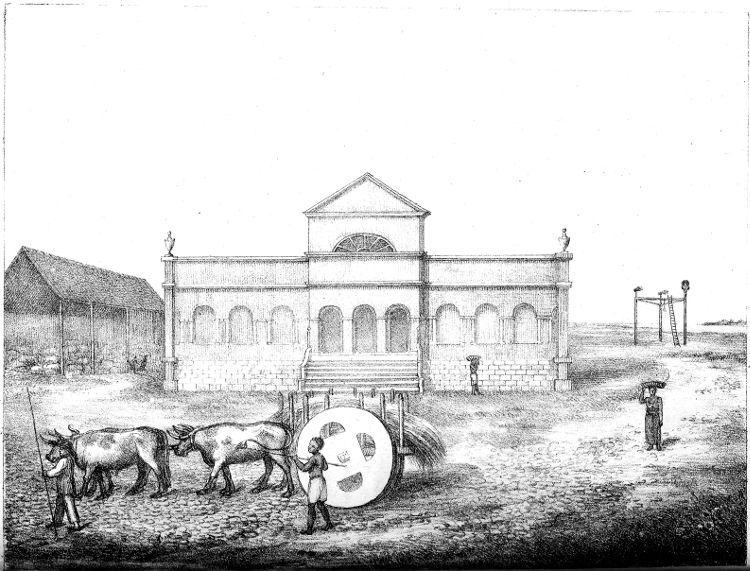
On Stone by C. Shoosmith from a Sketch by Jas. Henderson.
Printed by C. Hullmandel.
THE RIO EXCHANGE, A PUBLIC TRAPICHE, A GRASS WAGON, & THE GALLOWS.
Macacu, which has a church dedicated to St. Antonio, and a convent of lazy Franciscans, is pretty considerable, and was created a town by King Peter II. in 1697. It is situated upon elevated ground, on the left margin of the river of the same name, a little above the embouchure of the Guapiassu, and is about three leagues distant, in a direct line from the bay, and almost ten by the course of the river. Since the year 1808, this place has been the residence of a Juiz de Fora, whose jurisdiction also extends to the town of Mage. The population of Macacu, including its district, amounts to nine thousand souls.
Villa Nova, (de St. Joze d’ el Rey,) created a town in 1772, is two leagues to the south-west of Macacu, and a mile distant from the same river. St. Barnabe was its original name when a village, and its first inhabitants were Indians, with whose descendants a great many Portuguese are now intermixed. Those Indians are celebrated for making mats; a contiguous piece of ground supplying them with abundant materials.
About four miles to the eastward, is the parish of St. Joao d’Itaborahy, in a situation something elevated, with a fine aspect, and near the right bank of the river Vargé, which here takes the name of this parish, more commonly designated by the appellation of Tapacora. Mandioca, feijao, and sugar, are the principal productions, besides a small portion of rice, Indian-corn, and coffee.
The parish of Our Lady of Conceiçao[15] is six leagues east from Macacu, approximating the left margin of the small river Bonito; and the inhabitants are farmers of mandioca, feijao, Indian corn, sugar, and some rice.
Two leagues to the north-east of Macacu, betwixt the two small rivers of Pinto and Entulho, is situated the parish of Santissima Trinidade, (Holy Trinity,) in a fertile country, the productions of which are, notwithstanding, confined to the necessaries of life.
The parish of Tamby occupies an open country, near the left bank of the river Aldeia, about two miles south of Macacu, with a church of Our Lady of Desterro. About a mile to the east of the parish of Tamby, and within its district, is situated the port of Caixas, with a hermitage of Our Lady of Conceiçao, upon the right bank of the Aldeia not far from its confluence with the Macacu. This is the grand point from whence all the productions of the district of Tapacora, and the surrounding parishes, are embarked in boats for the capital, and more sugar is sent from hence than from all the other ports in the bay.
About two leagues to the south-east of Villa Nova, and not far from the bay, is the parish of St. Gonçalo d’Amarante, on the right bank of the small river of that name. Its dwellers produce a large quantity of farinha, feijao, and Indian corn, with the superabundance of which, as well as that of coffee, sugar, and casaçha, much specie is introduced into the district.
Mage, a middling town, with the title of countship, and in an agreeable situation upon the left bank of the river from which it derives its name, has some commerce, and a handsome parish-church of Our Lady of Piedade. It is about three leagues west of Macacu and one from the bay; and the river, which has here a wooden bridge, supplies the town with fish. In boats and craft of considerable burden, a large quantity of farinha, Indian corn, feijao, some sugar, rice, and a little coffee, are from thence exported. This place was erected into a town in the year 1789. An English gentleman has a country house near Mage, where parties occasionally go for the purpose of shooting, particularly snipes, which abound in the neighbouring morasses.
Four miles to the north-east of Mage, near the right bank of the river Guapymirim, is the parish of Ajuda, the soil of which is remarkably fertile, the inhabitants preferring the culture of mandioca, rice, and coffee, to the sugar-cane: they also export a great deal of wood.
Two leagues to the west of Mage, is the parish of St. Nicolau, upon the right margin of the Suruhy, consisting of a mountainous district of ten miles from north to south, and three in width, being partly planted with mandioca, rice, and coffee, but principally with the banana fruit, which introduces annually seventy thousand crusades, arising, it is said, from the industry of the whites, who exceed the number of negroes, but more likely from the properties of the soil and climate.
One league to the south-east of the port of Estrella is situated the parish of Our Lady of Guia, upon the borders of the bay, near the mouth of the small river of Pacobahyba, from whence are embarked various necessaries of life, its principal productions.
About four miles to the north-east of the port of Estrella is the parish of Our Lady of Piedade d’Inhumirim, situated at the angle of the confluence of the river of that name with the small river Cruz. Its parishioners are farmers of Indian corn and mandioca, which prosper abundantly. In this district is situated Mandioca estate, belonging to G. Langsdorff, Esq. the Russian consul-general, a delightful situation, and which he became possessed of in consequence of his pursuits as a naturalist leading him frequently into that part of the country. To accommodate a person, from whom he had received some civilities, with a certain portion of land to form a rancho, for the accommodation of mules and their drivers coming from the mines, he was induced to purchase the whole tract of land, in the possession of one individual, without any fine, and, from its peculiar adaptation to the produce of mandioca, he gave it that name. He paid under one thousand pounds for it, and its extent, which is estimated at ten square miles, he has not yet explored. He has already planted twenty thousand coffee-trees upon it, and the produce of mandioca in 1819 yielded near one thousand sacks of farinha, worth from eight to ten shillings per sack. The King has granted him the important privilege of allowing the neighbouring people, working upon his estate, an exemption from the militia duty, which, of course, induces a great many to offer their services upon moderate terms; so that, with the addition of about sixty slaves working upon it, the property is rapidly improving. He is building a house upon the estate. Mr. Langsdorff is respectably known to the literary world by the publication of his voyages. His pursuit in the obtainment of objects in natural history has been indefatigable, and in butterflies alone he has accumulated sixteen hundred different kinds.[16]
Some leagues from hence, upon the track leading to the mining districts, is situated the extensive establishment of Padre Corre, for shoeing mules, previously to their proceeding into the interior districts. In this trade the padre has accumulated a considerable sum: he grows a prodigious quantity of the finest peaches, and has the character of being exceedingly hospitable to strangers.
A league to the south-east of the port of Estrella is situated the parish of Our Lady of Pilar, upon the left bank of the river from which it derives its name, producing mandioca, Indian corn, rice, and vegetables, for which the soil is well adapted.
St. Maria of Marica was created a town by a law of the 26th May, 1814, with a civil jurisdiction, administered by two ordinary judges, (juizes ordinarios,) one of orphans, three magistrates, (vereadores,) an alcayde, a procurator of council, and two almotaces, or regulators of the market. It is small, but well situated, near the mouth of the little river Itapitiu, upon the margin of the lake from which it is named, and which well supplies it with fish. The church here, of Our Lady of Amparo, is the best in the province, with the exception of some in the metropolis, from whence it is distant about twenty-five miles to the eastward, and near thirty west of Cape Frio. The inhabitants cultivate sugar, mandioca, feijao, Indian corn, and some coffee.
The district of Cape Frio, named from the promontory where the coast changes its direction, is limited on the north, by the river Maccahé, which separates it from the district of Goytacazes, is washed on the east and south by the ocean, and comprises twelve leagues of territory, from north to south, and ten in the widest part from east to west. The country is generally uneven, and the valleys and plains, situated between mountains more or less elevated, are extremely deficient in good water. It produces mandioca, Indian corn, rice, vegetables, and sugar. Cattle, inconsiderable in number, are of a small size. Banana and orange trees, so abundant in various parts of the province, are here exceedingly rare, owing to the negligence of the inhabitants. The produce of indigo, which was formerly considerable, is at present trifling, although this district is well adapted for it. Cochineal was once an important branch of commerce; but the avaricious propensity of several individuals induced them to adulterate it by the addition of farinha. The government took a certain quantity of it, and paid the best price: but, discovering the fraud, declined having any more of it. The merchants of the capital followed this example, and at last the cultivation of it was totally abandoned. To the productions of the district already mentioned must be added, that of timber, which, with management and industry, would form one of the most lucrative and important. The woods are very extensive, abounding in an innumerable variety of trees, well adapted for the purposes of building, cabinet work, &c. Three qualities of the Brazil wood are met with here, of which that denominated mirim is esteemed the best. The rivers St. Joao and Maccahé afford navigation for conveying those fine timbers to the coast. Besides the two last-mentioned rivers, there is the Una, which enters the ocean seven miles south of the first. In front of its embouchure is situated the small island of Branca.
The principal lakes in this district are the Araruama and the Sequarema; the first, twenty miles long, and eight at the widest part, is separated from the ocean by a bank in many parts of small elevation, and empties itself at the eastern extremity, by a channel, which at the mouth is fifty yards in width. Notwithstanding its waters are supplied by various rivers, they have a saline flavour, in consequence of its communication with the sea. It abounds with a variety of fish, and in some situations is many fathoms in depth, in others quite shallow. Various small bays on the southern side are formed by headlands, in which the operations of nature furnish considerable quantities of salt, almost without human aid. Nine places may be reckoned which are apparently destined by Providence for the production of this indispensable article; the whole is not however formed by the sea water, but by the aqueous flow of rain through the saltpetre or saline particles with which the earth is impregnated, subsequently acquiring the consistency of marine water, and which arrives at its ultimate crystalization, by the influential rays of the sun. The largest of the rivers which the lake Araruama receives are the Francisco Leite, which enters it at the western extremity, and the Mataruna, which is crossed by a bridge, and disembogues about four miles to the east of the other; between those streams, and at a short distance from the lake, is situated the parish of St. Sebastian, whose inhabitants are cultivators of mandioca, rice, feijao, a little sugar, and derive some profit from fishing.
The lake Sequarema, in the vicinity of Ponta Negra, is six miles long from east to west, and three at the widest part; the water is salt, abounding with fish, and separated from the sea by a narrow tract of land. During the rainy season, when it inundates the adjacent country, in consequence of the superabundance of waters brought by the small streams, the dwellers near it open a channel to the ocean from its eastern extremity, which is soon filled up again, on the return of dry weather, by the flowing of the sea. The river Tinguy, which runs into its most northern bay, is the principal one that it receives. Upon the neck of land which divides it from the ocean, a parish has originated, called Our Lady of Nazareth, whose parishioners grow Indian corn, mandioca, and feijao, and are fishermen, which occupation constitutes their chief gain.
Between the lake Sequarema, and the Cururupina, is situated the Jacuné, which is near three miles in length, and of proportionable width.
The lake Jacarépua lies between the Sequarema and Araruama, comprising two miles of length, and something less in width. The lake Vermelha, about the same size, is near the western extremity of the Araruama, and although it has no communication with the sea, its waters are saline.
The lake Boacica, situated two leagues to the south of the river Maccahé, and approximating the ocean, is about three miles long, and half a mile at the greatest width, has not much depth, is impregnated with salt, and abounds with fish, which enter it from the sea by the channel formed for the egress of its waters at the period of the floods. It is the receptacle of the river from which it derives its name; also, of the Serraria, the Mutum, the Riacho d’Alagoa, and the Riachinho.
The lake of Juthurnuahibi, two miles in diameter, and one to seven fathoms in depth, receives the rivers Bucasca and Capibary; has an outlet into the ocean, which is winding, deep, navigable, and taking the name of the first river, is seven leagues distant, and only three in a direct line from the lake.
Cape Frio, called a city, although not so large as a moderate town, is divided into two parts, by an interval of half a mile, both being without regularity, and situated upon the southern margin of the eastern extremity of the lake Araruama. The principal portion has a church of Our Lady of Assumption, a hermitage of St. Bento, and a Franciscan monastery. The chapel of Our Lady of Cuia crowns the summit of a rock, from whence is beheld a great extent of sea and land. The smaller portion of the city, denominated Passagem, defended by the fort of St. Mattheus, has another hermitage of St. Benedicto. This city has royal masters of the primitive letters and Latin. The inhabitants eagerly follow the pursuit of fishing, their principal and most lucrative occupation; fish being their common diet and their chief exportation. It was taken in the year 1615, when Portugal was under the dominion of Philip II.; and when, like many other places, it took the title of city, upon the occasion of some Rotterdam pirates being repulsed, who wished to establish themselves there, for the purpose of exporting dye-wood. Here is a Juiz de Fora, whose power extends to the town of Maccahé. Fevers are the prevailing disease of the country.
St. Joam de Maccahé, situated upon both banks of the river from which it takes its name, was created a town in 1814, and has a church called Santa Anna. The inhabitants, who are fishermen, produce some Indian corn, rice, feijao, mandioca, and sugar, but their principal object of trade is timber. The parish of St. Joam, at the embouchure of the river of the same name, is well situated to render it in time a considerable town. Timber forms the riches of its inhabitants, who also export a variety of the necessaries of life.
The district of Goytacazes, comprising twenty-eight leagues of coast, bounded on the south by the river Maccahé, and on the north by the Cabapuana, originally formed the capitania of St. Thomé, and so denominated from the contiguous cape. Pedro de Goes, who had frequented the Brazil for ten years, was its first donatory; and although, the period of this donation is not recorded, it was most probably about the year 1537, as the first allusion to him is in the year 1527, when he transported some Indians from St. Vincente to Portugal. This fidalgo established himself and the colonists who accompanied him, upon the banks of the river Parahiba, where they lived in amity with the Indians two years, succeeded by five of inveterate warfare, in which the aborigines displayed such bravery and determined resistance, particularly the Goytacazes, (the name of which tribe the district retains,) that Goes was compelled to retire to the capitania of Espirito Santo, where the donatory Coutinho was already established. From thence he returned to Lisbon, and, in the year 1549, accompanied Thomé de Souza to Bahia; but neither himself nor successors were fortunate in endeavouring to colonize the capitania of St. Thomé, which was in the possession of three different nations, the Puris, Guarus, and Goytacazas; the latter were the most numerous, and divided into three hordes, the Goytaza Guassu, Goytacaza Moppy, and Goytacaza Jacorito, the avowed enemies of each other. It is affirmed, that the Guarus comprised various nations, one of which, the Sacarus, still exists in the Organ Mountains.
Gil de Goes was its third donatory, at the time of its devolvement to the crown. King Peter II. granted it to Viscount d’Asseca in the year 1674; but, in consequence of the mal-administration of his successors producing considerable dissatisfaction, and various revolts amongst the colonists, King Joseph was induced, by commutation, to incorporate it with the crown lands; and Francisco de Sales, ouvidor of Espirito Santo, took possession of it, in the year 1752, in the name of his sovereign, to the great joy of the inhabitants.
From the river Parahiba, northward, a cordillera runs parallel with, and at no great distance from the coast; the intervening space, denominated Cacimbas, is mountainous, and in parts sterile, and ill adapted to agricultural purposes. From the Parahiba to the Maccahé, the whole country presents campinhas, or continued plains, with some small woods, called capoes, and is irrigated by various streams.
The soil is appropriated to the produce of cocoa, coffee, indigo, and rice; wheat might be cultivated with advantage. Mandioca grows best in the southern parts of the district, and sugar is cultivated in the proximity of the rivers Parahiba and Muriahe, to a very considerable extent. The number of sugar works in this district, in the year 1801, amounted to two hundred and eighty, of which ninety were very large. Since that period they have increased rapidly, and the sugars produced upon the margins of those rivers are esteemed the best in the Brazil, usually known by the denomination of Campos sugars. Indian corn, feijao, mandioca flour, tobacco, and cotton, are produced only in sufficient quantity for the consumption of the district. All the species of domestic animals are bred, none of them, however, are remarkable for their fecundity. Cattle are not in sufficient number for the consumption of the population, and the working of sugar engenhos. The mules are not so large as those of Rio Grande, and Curitiba, but are superior in strength. Goats and sheep degenerate here. Hogs are not numerous, neither is the pork good. The north and south-west winds generally prevail, and scarcely a day passes, that the atmosphere is not refreshed with a strong breeze from one of these quarters. Part of the timber exported by the river Maccahé, is derived from the woods of this district, which afford a variety of medicinal plants.
Rivers and Lakes.—We have already described the Parahiba, which is the chief river of this district, and traverses it from west to east.
The river Muriahe, to which is attributed forty miles of course in a direct line, rises in the serra of Pico, in the territory of the Puri Indians, takes a winding direction to the south-east, until it enters the Parahiba, is navigable for the space of twenty-five miles, and has a fall, where the canoes are dragged over land. When the cultivation of its fertile margins first commenced, (at this day abounding with sugar-works,) its waters were so pestilential, that many who drank of them were attacked with malignant fevers, which either terminated their days, or left them through life pallid and diseased. Even the necessaries of life, which grew upon the lands inundated by its floods, were pestiferous. Its largest confluent is denominated the Rio Morto, or Dead River, in consequence of having a very tranquil current, the waters of which, are muddy, from its origin in a morass. The margins of the Muriahe produce a poisonous cipo plant, with long and flexible shoots, called timbo, or tingui, and a tree denominated guaratimbo, the infectious qualities of which are attributed to the malignancy of its waters.
The river Maccabu originates in the skirt of the Serra Salvador, little removed from the source of the before-mentioned river St. Pedro. It is serpentine, tranquil, flows principally through a swampy country to the north-east, discharges itself into the lake Feia, and is navigable, without falls, pretty nearly to its origin.
The river Imbe, which rises at the base of the above serra, seven miles from the head of the Maccabu, and runs for a considerable space parallel with it, receives near its commencement, by the left bank, three streams, called the Three Rivers of the North, (which have their origin in the situation of Tres Picos, where there is gold,) and traverses the lake of Cima, from whence it flows to the lake Feia, with the name of Ururahi. The bed is winding and the current slow. Large canoes advance up without obstacle, almost to its heads.
The above-mentioned Ururahi, (the outlet to the lake of Cima,) the margins of which abound with plantations of the sugar-cane and mandioca, describes a semicircle to the north, approaching the Parahiba, with which an advantageous communication might be opened, by cutting a canal across a plain, not exceeding four miles in width.
The lake Feia consists of two unequal parts, united by a narrow channel. The one lies to the north, near twenty miles in length from east to west, and upwards of twelve in width; the other to the south, sixteen miles in length, and only two in width. It is an interesting lake, abounds with fish, and so inconsiderable in depth, that canoes can only proceed by certain channels. The water is fresh and wholesome. It has within its precincts a considerable peninsula, upon the isthmus of which is situated the church of the parish of the Lady of Remedios, and presenting a delightful aspect. The margins of this lake are marshy, and it discharges itself by various channels, which, describing extensive circuits, form many islands, and without which, none of those channels would have made their way to the ocean, in consequence of an extensive, high, and solid sand-bank, formed by the sea. All the channels re-unite at divers points, and form another lake, many leagues in length, with the width of a spacious river, stretching, for its whole extent, along the said sand-bank; across a certain part of which it opens annually an outlet, that presents the appearance of a considerable and furious river, called Furado, at the time the internal receptacles are overflown. The southern or principal of these channels is called Iguassu, or the river Castanheta. This district might be cleared from water, by the introduction of some hydraulic machines, (as in some parts of Lincolnshire), when the grounds would afford pasturage, and become susceptible of cultivation at all times.
Three leagues to the north of the river Maccahé, is situated the lake Carapebas, about four miles in length from east to west, of unequal and inconsiderable width, separated from the ocean by a sand-bank, which it breaks down in the rainy season, in some parts, for the egress of the waters. It is well stored with a variety of fish. Near the right margin of the Parahiba, between the towns of St. Salvador, and St. Joam, are the two Jahi lakes; also the Sequarema; the Campelo, upon the north side of the Parahiba, almost in front of the town of St. Joam; and the Pedras, which is a deep lake, having its channel of discharge denominated the Corrego do Jacare, between the town of St. Salvador and the mouth of the river Muriahe. Lake Cima is five miles long, and more than sixteen hundred fathoms at its greatest width, comprehending the gulf called Pernambuca.
The fine campos, or plains, of this district would certainly become the Elysium of Brazil, if its territory, rich in soil, were divided into certain portions and delivered to a people animated with a spirit of agricultural improvement. But the same unfortunate circumstances which we have previously described to exist in the donation of lands, concur, unhappily, to place those campos, at least the greater part, in the hands of three proprietors; namely, the Benedictine monastery of Rio de Janeiro, the purchaser of the ex-Jesuitical possessions, and a titular.
St. Salvador, or Campos, is a large, populous, and flourishing town, situated upon a plain on the right margin of the Parahiba, eighteen miles distant from the ocean, and four below the mouth of the Muriahe. Besides the mother church, it has a house of misericordia, three hermitages dedicated to the Lady of Rosario, Boa Morte, and Lapa; also two Terceira orders of St. Francisco and Carmo, and a hospital. The youth of this place are instructed by persons having the usual high sounding titles of royal professors of the primitive letters and Latin. Justice is administered by a head magistrate, denominated a Juiz de Fora,[17] (a judge without.) An account recently taken of the population of this town states it to contain eleven hundred and fifty families, which may be fairly computed to comprise twelve thousand souls.
The town of St. Joam da Parahiba derives the name from its church and the river upon which it is situated, and is distant about two miles from the sea, in front of the extremity of a small island. Sugar constitutes the riches of its inhabitants, who do not exceed fifteen hundred; and it is the port from whence the principal produce of the Campos, consisting of that article, is shipped in coasting vessels to the capital.
Eight miles up the Maccahé is situated the parish of the Lady of Neves, which originated in an establishment of a tribe of Garulho Indians, but now almost extinct, and succeeded by whites, who fell timber and are farmers of the same necessaries of life as their predecessors.