GEORGE III.
Reading edition
1760-1820.
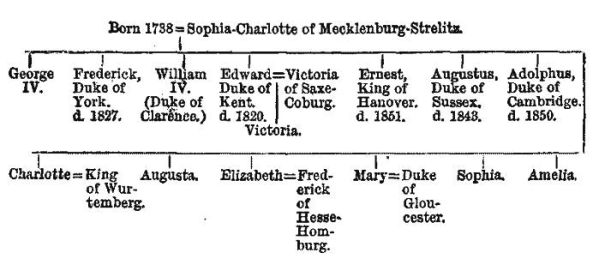
CONTEMPORARY PRINCES.
France. Germany. Spain. Prussia.
Francis I., } 1745. Charles III., 1759. Frederick II., 1740. Elizabeth, 1741.
Maria Theresa, } Charles IV., 1788. Frederick William II., 1786. Peter III., 1762.
Joseph II., 1765. Ferdinand VII., 1808. Frederick William III., 1797. Catherine II., 1762.
Leopold II., 1790. Paul I., 1796.
Francis II., 1792. Alexander, 1801.
Russia. Denmark. Sweden.
Louis XV., 1715. Frederick V., 1746. Adolphus, 1751.
Louis XVI., 1774. Christian VII., 1765. Gustavus III., 1771.
Republic, 1793. Frederick VI., 1808. Gustavus IV., 1792.
Napoleon, 1804. Charles XIII., 1809.
Louis XVIII., 1814. Charles XIV., 1818.
POPES.—Clement XIII., 1758. Clement XIV., 1769. Pius VI., 1775. Pius VII., 1800.
Archbishops.
Thomas Secker, 1758.
Frederick Cornwallis, 1768.
John Moore, 1788.
Charles Manners Sutton, 1805.
Lord Chancellors. First Lords of the Treasury. Chancellors of the Exchequer.
Lord Northington, 1757. Oct. 1760. Newcastle. Oct. 1760. Legge.
Lord Camden, 1766. May 1762. Bute. March 1761. Barrington.
Charles Yorke, 1770. April 1763. Grenville. May 1762. Dashwood.
In Commission, 1770. July 1765. Rockingham. April 1763. Grenville.
Lord Bathurst, 1771. July 1766. Grafton. July 1765. Dowdeswell.
Lord Thurlow, 1778. Sept. 1767. Mansfield. July 1766. C. Townshend.
Lord Loughborough, 1783. Dec. 1767. Grafton. Sept. 1767. Mansfield.
Lord Thurlow, 1783. Jan. 1770. North. Dec. 1767. North.
Lord Loughborough, 1793. March 1782. Rockingham. March 1782. Cavendish.
Lord Eldon, 1801. July 1782. Shelburne. July 1782. Pitt.
Lord Erskine, 1806. April 1783. Portland. April 1783. Cavendish.
Lord Eldon, 1807. Dec. 1783. Pitt. Dec. 1783. Pitt.
Secretaries of State.
Oct. 1760 { Pitt. Oct. 1768 { Weymouth.
{ Holderness { Rochford.
March 1761 { Pitt. Dec. 1770 { Sandwich.
{ Bute. { Rochford.
Oct. 1761 { Egremont. 1771 { Suffolk.
{ Bute. { Rochford.
May 1762 { Egremont. Oct. 1775 { Suffolk.
{ G. Grenville. { Weymouth.
Oct. 1762 { Egremont. Nov. 1779 { Hillsborough.
{ Halifax. { Stormont.
Sept. 1763 { Sandwich. March 1782 { Fox.
{ Halifax. { Shelburne.
July 1765 { Conway. July 1782 { T. Townshend.
{ Grafton. { Grantham.
May 1766 { Conway. April 1783 { Fox.
{ Richmond. { North.
Aug. 1766 { Conway. Dec. 1783 { Carmarthen.
{ Shelburne. { Sydney.
Dec. 1767 { Weymouth.
{ Shelburne.
On the 25th of October news was brought to the Prince of Wales that his grandfather was dead. It was an event which must have been for some time expected, and George III. and his friends were prepared for it. His training had been somewhat peculiar. Bute's influence over the young King. 1760. The Princess of Wales, his mother, had kept him much secluded, and his education had been chiefly withdrawn from the hands of the distinguished men whom the King had given him as governors, and intrusted to sub-preceptors of the Princess's own choosing. Her constant friend and adviser in this and other family matters had been Lord Bute, who had thereby acquired the greatest influence over the young King. It was understood that henceforth his advice would chiefly regulate the policy of the Crown. His influence and that of the teachers he had selected, some of them it is believed nominated by Bolingbroke, had all tended politically in one direction, so much so that complaints had been made, though uselessly, to the late King of the unconstitutional precepts which his heir was being taught. The views with which the young Prince's mind was filled were those which Bolingbroke had developed in "The Patriot King." The beneficent rule of a powerful monarch governing his people by his own will, but for their good, was the ideal he had been taught to set before him. It was pointed out to him that since 1688 the will of the sovereign had been held captive by that great Whig party which had produced the Revolution and secured the Hanoverian succession. And it had been impressed upon him that it was his duty to free the prerogative from this state of servitude, and to annihilate party government by restoring to the Crown its freedom of choice and action. It was with the deliberate intention of carrying out this plan that the King began his reign. Nor was the plan, had it been properly executed, either impossible or unjust. It was felt that the old party divisions were in fact obsolete, that Whig and Tory, in the sense of Hanoverian George's view of royalty. and Jacobite, were things of the past; and that it was highly detrimental to the public service that able and loyal men should be excluded from all share of the Government because, very frequently on only hereditary grounds, they belonged to a party opposed to the great Whig connection. Yet such had been the case. Parliamentary contests had, till Pitt's accession to power, been nothing but greedy struggles for place and power between two sections of the Whig party which had separated in 1716. Had the King made use of his present popularity, and of that advantage which he possessed over his predecessors in his English birth, to exercise his prerogative of choice in selecting eminent men from all parties for his ministry, and had he taken for his chief minister a man who stood well with the nation, the feeling of the country would almost certainly have gone with him. Unfortunately his somewhat narrow intellect and his restricted education made him unable to take a wide view of his position, filled him with a vehement prejudice against the whole Whig party, and made him rest for support on the personal friendship of a second-rate man, who laboured under the unpopularity attending his Scotch birth and his supposed favour with the Princess of Wales.
The behaviour of the young King was at first all that could be desired. In his family relations indeed he was nearly always respectable. He still further added to his popularity by directing a change in the law with regard to the judges, so that their commissions no longer terminated with the death of the King. They henceforward held their commissions for life, unless deprived of them at the joint petition of the two Houses of Parliament. They were thus rendered absolutely independent of Court favour.
First signs of change. 1761.
The six months which elapsed before the dissolution of Parliament passed without any great changes, although there was no lack of indication of what was coming. The King's name was constantly put forward. Newcastle, who had kept all patronage in his hands, found places filled without his knowledge, and complained that he was met with the uniform answer that it was the King's desire; and Bute openly rebuked Lord Anson for filling the Admiralty boroughs without consulting the King. With the dissolution of Parliament the changes in the ministry began. Legge gave place at the Exchequer to Lord Barrington; Charles Townshend became Secretary at War, and Dashwood, another follower of Bute's, took the place that Townshend vacated, while four days afterwards (March 25th) Bute was appointed one of the Secretaries of State in the place of Lord Holderness, who had been removed and handsomely compensated. The admission of Bute to the ministry could hardly fail to produce the dismissal of Pitt, for on the great question of the day they were in direct antagonism. Bute, in pursuance of his policy of opposition to all that the Whigs had done, was determined if possible to break off the English connection with the Continent; and, unable to see the difference between buying troops from a Prince of Hesse and assisting the greatest monarch of the time in a war from which England was reaping nothing but benefit, he intended to refuse the payment of the King of Prussia's subsidy, and was strongly bent upon peace.
The campaign of 1761 produces a desire for peace.
Frederick's own campaign of 1760 had closed, as has been already said, with the dreadful battle of Torgau, and the same year Prince Ferdinand had held the French in check, worsting them at Warburg, but had been unable to keep them out of Göttingen and Cassel; and the hereditary Prince of Brunswick, detached to the siege of Wesel, had been defeated at Kloster-Campen. In 1761 the campaign was continued, and the Duke of Broglie was driven back to the Maine and beaten at Langen-Saltza. But Prince Ferdinand was not strong enough to keep what he had regained. The French again advanced, and in June the Prince of Soubise joined the Duke de Broglie, and they together moved forward to the Lippe. They were defeated at Kirch-Denkern, but the effect of the victory was small, and both armies closed the year in much the same position as they began it. These campaigns, resulting in little but loss of life, and the exertions which they entailed, and which had brought France to the verge of bankruptcy, had become intolerable; and early in the year De Choiseul had induced both Austria and Russia to consent to negotiations at Augsburg. But as the connection of England with the continental question was accidental, and her quarrel with France quite separate from it, it was thought expedient that a separate arrangement should be made between the two countries. For this purpose M. de Bussy was in June sent to England and Mr. Hans Stanley to Paris.
Separate negotiations between France and England. June 1761.
The terms offered by the French were not unreasonable. The difficulties lay in Pitt's views as to the rights of England, which were undoubtedly very high. He had, as he said that he was able to do, raised England from her degradation. He had done this by means of a successful war, and had no mind to lose his work or to consent to what would be but a mere cessation of hostilities. He would have, he said, no new Peace of Utrecht. Choiseul's first offer (on the 26th of March) was, that each of the belligerents should keep what they held in Europe on the 1st of May, in West India and Africa on the 1st of July, and in India on the 1st of September. Pitt refused this, insisting that Pitt opposes peace. the date fixed in all cases should be that of the signature of the treaty. He was hoping in fact that fresh victories would improve his position; nor was he disappointed. Before the end of July Belleisle, an island which must be considered an integral part of France, Dominique in the West Indies, and Pondicherry in the East, were added to our conquests. The territorial arrangements were for the most part easily settled; but three demands of the French Pitt obstinately refused to grant. These were the restoration of one of her African settlements and Belleisle in exchange for portions of Germany then in her possession—these Pitt demanded without exchange; secondly, compensation for prizes taken before the declaration of war, and lastly, the withdrawal of all English troops from Germany. As the first of these demands was not unreasonable, as the second was obviously just, and the third belonged, and could probably have been transferred, to the general Congress, Pitt would scarcely have refused them had he not seen reason for believing that the propositions of the French were hollow. The fact is, he was already beginning to suspect, and more than suspect, the existence of a treaty inimical to English interests between France and Spain. Ever since the accession of Charles III. to the Spanish throne, in the year 1759, the two Courts had been gradually approaching one Suspecting the existence of the Family Compact. another; and the policy which Marlborough's wars had been designed to check was gradually winning its object. In July De Bussy, on presenting the draft of the proposed treaty, appended to it certain claims on the part of Spain, desiring that these might be settled at the same time as the French claims. Pitt was naturally indignant at this, and haughtily replied, that France was "not at any time to presume a right of intermeddling in such disputes between Great Britain and Spain." The Spanish minister, General Wall, owned that he was cognizant of the measure, but expressed peaceful wishes with regard to England. However, though Bristol, the English minister at Madrid, had been so completely deceived that he continued to assert the friendly disposition of the Spanish Court, the correctness of Pitt's surmises became evident, when in August the arrangement known as the Family Compact was signed. By this treaty the Bourbon houses of Spain and France contracted a close and perpetual alliance. Besides France and Spain the Bourbon Princes of Naples and Parma were to be admitted to it. There was a secret clause binding Spain to declare war on England if peace was not made before May 1762. The knowledge of this treaty induced Pitt not only to break off negotiations, but to determine upon war with Spain, for which he immediately made preparations, planning a great expedition against Havannah in the West and Manilla in the East Indies. With his usual haughtiness, he urged these measures Pitt resigns. Oct. 5, 1761. upon the Council, but Temple alone supported him. He indignantly declared that he would not be responsible for measures he did not manage, and on the 5th of October resigned. Thus terminated that splendid administration which had raised England from the depths of degradation to a position of first-rate importance in Europe.
Bute virtual minister.
Bute was at once practically supreme in the Council, although he had yet to rid himself of Newcastle. He was afraid of Pitt's popularity, and did his best to injure him by persuading him to accept a pension, and the title of Lady Chatham for his wife, hoping by that means to make it appear that Pitt was not hostile to his Government, or at all events to wreck his popularity, which rested largely on the public belief in his disinterestedness. Lord Egremont became Secretary in his place. Before the year was over Pitt's wisdom was vindicated. The change of ministry in England and the safe arrival of the treasure-ships, which Pitt would have forestalled, changed the tone of the Spanish Government, and even the pacific Bute found it necessary to declare war in January War with Spain. 1762. 1762. Already the impossibility of Bute's peaceful view was demonstrated, but he none the less prevented the payment of the Prussian subsidy; although this looked very like a breach of faith, it could be urged in extenuation that Frederick's need was much lessened by the death of the Czarina and the accession of Peter III., a devoted friend and admirer of the Prussian King. Bute's policy was indeed so completely opposed to that of his predecessors, that there is reason to believe that he even used his influence to induce Russia to withdraw from its new alliance. This change of policy afforded Newcastle, who was conscious that he was sooner or later to be got rid of, an opportunity of leaving the ministry with dignity. On his resignation Bute at once named himself Prime Minister, and proceeded to carry out, in some points at least, his favourite principles. These were peace at almost any price, and the abandonment of continental connections, the increase and restoration of the power of the Crown, and Government without bribery. But these aspirations degenerated in practice into a war, which was successful owing to his predecessor's arrangements, a vindictive assault upon the Whig party, and the most shameless corruption ever practised in England. The expeditions which Pitt had planned were carried out. Martinique, held to be impregnable, and with it Granada, St. Lucia, and St. Vincent, were captured by a squadron under Rodney, and this was but a stepping-stone to the capture of the still greater prize—Havannah. The expedition against the Philippine Islands was equally successful.
But Bute, in his eagerness for peace, did not even wait to hear the result of the expeditions, but at once reopened peace negotiations with France. Left to himself, he would have taken no account of the last great conquests. Councillors less anxious for peace succeeded in getting them exchanged for Florida. In November the peace was Terms of the peace. Nov. 3, 1762. signed. The conditions were much the same as those of the preceding year. America passed wholly to the English, the French keeping the rights of fishing round Newfoundland. England kept Tobago, Dominica, St. Vincent, and Granada, but restored Martinique and St. Lucia. Minorca and Belleisle were to be exchanged. The French evacuated their conquests in Germany, but on the other hand—and this was a concession Pitt had refused—Goree was restored to France, and the English army was withdrawn from Germany. In India the French were to have no military establishment, but their factories were restored. All claims on the part of Spain were entirely rejected. On the whole, the peace, though it did not destroy the House of Bourbon, as Pitt would have wished, probably gave England as much as she had a right to expect. The conclusion of the treaty was rendered easier by Frederick's continued successes in Germany. Although the Czarina Catherine, who had succeeded Peter, had Close of the Seven Years' War. reverted to the old policy of Russia, and withdrawn her troops from Frederick's assistance, he had been able to retain his superiority throughout the campaign. Prince Ferdinand had gained fresh successes in Westphalia, and had taken Cassel from the French; while Prince Henry, the King's brother, had won a victory at Freiberg, which closed the Seven Years' War.
Bute, while thus obtaining peace, though in a way so irritating to our German friends that England stood henceforward absolutely without allies, had been carrying on his vindictive attack upon the Whigs. The opportunity selected for this purpose was the passage of the peace through Parliament. Grenville, a man of firmness, but Attack on the Whigs. Feb. 10, 1763. without commanding abilities, and deficient in tact, had taken Pitt's place as Leader of the House of Commons. But he was not regarded as strong enough to make head against the opposition which was expected, for the Whigs of all sections, conscious of Bute's designs against them, were beginning to combine. Bute selected a man of greater powers to assist him. He bargained with Fox (whose conscience was not scrupulous when money was to be made) to assume the lead of the House. It was hoped that he might bring some Whigs with him. This he found himself unable to do, and with consummate audacity set to work to purchase a majority. The Paymaster's office became in fact a shop for the purchase of votes, £200 being the least price given. Against such a majority all efforts were of course useless, and the peace received the approbation of Parliament. After this victory vengeance began. The Duke of Devonshire, the head of the great Whig house of Cavendish, for declining to attend a Cabinet Council, was rudely deprived of the office of Chamberlain, and the King with his own hand scratched his name off the list of Privy Councillors. All placemen who had voted against the peace were dismissed. Newcastle and Rockingham were removed from their Lord Lieutenancies, and even the meanest officers of the administration—tax-gatherers and customhouse officers, who owed their places to Whig patronage, were removed. Bute appeared triumphant. Even the cider tax, a ridiculously unfair excise suggested Bute resigns. April 8, 1763. by the ignorance of Dashwood, his Chancellor of the Exchequer, was carried by a large majority in his venal House. Suddenly Bute resigned. It is difficult to explain why. Perhaps it was because he was conscious of the unpopularity he had incurred. His Peace of Paris was distasteful to the nation; he had driven from office Pitt, the favourite of the people; he was a Scotchman; the voice of scandal constantly coupled his name with that of the Princess Dowager of Wales, and the odious name of favourite was indissolubly attached to him. Whether well or ill founded, his unpopularity had reached such a pitch, that he was afraid to leave his house without a bodyguard of prize-fighters. Perhaps experience had taught him his unfitness to conduct the Government. Perhaps, and this was the general belief of the time, he preferred the irresponsible power of the favourite to the dangers and responsibility of He names Grenville as his successor. the minister. He named Grenville for his successor, and as he had always used him as his creature, he probably still hoped to find him a pliant tool. In this he was disappointed; and though for a few years he doubtless had much private influence with the King, this part of his career has been much exaggerated, and he himself complained bitterly of the King's ingratitude.
The Triumvirate ministry. 1763.
With Grenville the Secretaries of State, Lord Egremont and Lord Halifax, were regarded as holding the direction of public affairs. This ministry has therefore been sometimes called The Triumvirate. Bute found them by no means ready to accept his interference, and soon began to intrigue against them. Grenville more than once complained to the King of his want of confidence. The sudden death of Lord Egremont gave an opportunity for a change in the ministry, and Bute so far changed his former policy as to recommend the King to send for Pitt. A long interview with the King, in which Pitt stated the necessity of bringing back some of the Whig connection to power, left him with the impression that he was to be minister, and he wrote to the Whig chiefs accordingly. But two days after, on a second interview, he found matters changed. The King wished the Earl of Northumberland, Bute's intended son-in-law, to be Prime Minister, and desired several of the present ministry to be retained. This Pitt would not hear of, designating Temple, Devonshire, and others who had just fallen under the King's displeasure, as his colleagues. The negotiation Bedford joins the ministry. was broken off. Probably on the day which intervened between the two interviews Bute had changed his mind. In carrying through the peace negotiations he had been assisted by that section of the Whigs which was under the influence of the Duke of Bedford. It is to this section that Fox belonged. The Duke, though of a retiring character, was now induced to accept office by a false rumour, that Pitt had expressly declared that he would not admit him to any Government of which he was the chief. A mixed ministry of the followers of Grenville and Bedford was formed, and is generally known by the name of the Bedford Ministry. The Secretaries of State were Halifax and Lord Sandwich, a man of mean character and licentious morals.
The trial of Wilkes. 1763.
The new ministry met Parliament on the 15th of November, and both Houses were at once occupied with questions with regard to Wilkes. The unpopularity of Bute had found expression in numerous pamphlets. Among the Opposition writers was Wilkes, member for Aylesbury, who, in conjunction with an author of the name of Churchill, had established a paper, The North Briton, in which the favourite and his Government had been very roughly handled, and which won popularity by unreasoning general assaults upon the Scotch nation. He had so far exceeded the usual practice of pamphleteers of the time as to write the names of his opponents at full length, instead of employing initials. When the King had prorogued Parliament (April 23rd) on Bute's resignation, he had spoken of the peace as honourable to his crown and beneficial to the people. This produced an attack in the famous No. 45 of The North Briton. Grenville had at once proceeded against the author. A general warrant (that is, a warrant in which no individual names are mentioned) was issued against the authors, printers, and publishers of the paper, and under it Wilkes was apprehended, his house and papers being also ransacked. He at once became a political martyr. The chiefs of the Opposition, Temple and Grafton, visited him in his prison, and he proceeded to try the validity of his arrest. Chief Justice Pratt, before whom the case came, held that Wilkes was exempted from arrest by his privilege as a member; for a member of Parliament is free from arrest on all charges except those of treason, felony, and breach of the peace, and a libel, he said, could not be construed as a breach of the peace. But though the law had failed to punish him, he was pursued by the vengeance of the Government; he was deprived of his commission in the militia, and his supporter, Temple, was removed from the Lord Lieutenancy of Buckinghamshire. The result of the trial was received with public rejoicings in all corners of England. This dispute between Government and a scurrilous writer, of most licentious morals, would be scarcely worth mentioning, although it occupied nearly the whole session, were it not one of the proofs of the want of harmony existing between Parliament and those whom Parliament was held to represent. It was one of several incidents which showed that the venal House of Commons, consisting of nominees of the Court or great families, was rapidly ceasing to command the obedience of the people, and that the machinery of the Constitution was thereby becoming dislocated.
The question at once came before both Houses. In the House of Lords it assumed a personal form. Lord Sandwich, a former friend of Wilkes, and his associate in his greatest debauchery, but now Secretary of State, did not think it unbecoming to produce an obscene parody on Pope's "Essay on Man," of which Wilkes was the author, and demand his punishment. The book had never been published; fourteen copies had been privately printed; it had come into Sandwich's possession when Wilkes's house was ransacked, and afterwards by tampering with Wilkes's printer. Sandwich complained of it as a breach of privilege, for it was addressed to him. "Awake, my Sandwich!" it began, instead of "Awake, my St. John!" of Pope's Essay, and ridiculous notes were added, attributed to Warburton, Bishop of Gloucester, who had annotated Pope's work. In the House of Commons Wilkes rose and complained of his imprisonment as a breach of privilege, but he met with little sympathy. By a large majority No. 45 was voted to be a seditious libel, and ordered to be burnt by the common hangman. A dangerous riot was the consequence, nor was the operation completed till a jackboot and petticoat, the popular emblems of the Princess of Wales and Lord Bute, were committed to the flames to share the fate of the obnoxious publication. Further proceedings against Wilkes were postponed by a duel in which he was engaged Wilkes is expelled by the Lower House. with a Mr. Martin, who had grossly insulted him, and in which he was wounded; but he was eventually expelled from his place in the House. On the two constitutional questions which were involved in this quarrel—the construction to be given to the privilege of members and the legality of general warrants—the popular party was defeated, in spite of the powerful support of Pitt. In opposition to the Courts of Law, Parliament held that privilege could not cover a seditious libel; and Grenville and his majority contrived to shelve a resolution which was introduced declaring the illegality of general warrants. The whole question excited the intensest interest; the House is said to have once sat for seventeen hours. Wilkes, unable to withstand all the assaults upon him, had, in spite of his popularity, been obliged to withdraw to France.
Grenville and his ministry had hardly completed this quarrel, in which they had wantonly embroiled Parliament and people, when they took a fresh step which, though well intentioned, was destined, from the way in which it was carried out, to lose England the best of her colonies.
Origin of the American provinces.
The thirteen American provinces owed their origin to many different causes, and were very distinct both in their character and laws. There was, in the first place, the group of New England provinces, Connecticut, Massachusetts, New Hampshire (which included what is now called Vermont), and Rhode Island; these owed their origin to the Pilgrim Fathers, and though the first zeal of their Puritan religion had died away, much of the stern character of their original founders remained among the population: their capital was Boston, almost surrounded by the sea, and already a port of very considerable importance and wealth; the Hudson formed their boundary towards the west. Then there came a group of provinces originally belonging to the Dutch, and known as the New Netherlands. These had come into the hands of England during the war between Holland and England in the reign of Charles II., and had been granted to the Duke of York. New Amsterdam became New York, and Fort Orange, higher up the stream, Albany. Another part of the same grant was New Jersey, lying between the Hudson and the Delaware. This had been given for payment by the Duke of York to Lord Berkeley and Sir George Carteret; the western part had been subsequently parted with by Berkeley to the Quakers, and the whole province, which was surrendered to the Crown in the reign of Queen Anne, was therefore known commonly as the Jerseys, and was peopled almost exclusively by Quakers, Presbyterians and Anabaptists. Spreading from their colony in New Jersey, the Quakers, under their great leader William Penn, had occupied the large province of Pennsylvania, with its capital Philadelphia lying inland to the west. One other province belongs to this group, Maryland, which was regarded as a sort of appendage to Pennsylvania, but had a separate assembly of its own; the governor however was generally the same as the Pennsylvanian governor. Below these two groups were three great colonies, owing their origin to less easily defined sources. Virginia, south of the Potomac, originally founded by Raleigh, had then (by a grant of King James I.) passed into the hands of merchant adventurers. Behaving badly, and quarrelling with their colonists, they were deprived of their rights, and in 1624 the colony became a Crown colony. It had been peopled principally by Church of England men and by men of good English birth. As the oldest colony it was the best peopled, while the birth and character of its proprietors, who resembled English gentlemen, caused them to be regarded as the aristocracy of the colonies. The two Carolinas had been granted to a number of proprietors in the reign of Charles II., but, as in most other cases, the original proprietors had quarrelled with the people, and sold their rights to the Crown. Below these Carolinas was Georgia, founded for philanthropic purposes as a refuge for insolvent debtors and persecuted Germans by General Oglethorpe, the originator of the inquiry into the English prisons in 1728. The only power not English now in North America was that of Spain, which had received a portion of Louisiana from the French in exchange for Florida, which they had been obliged to cede to the English. French influence had disappeared after the Peace of Paris.
Constitution of the provinces.
There was an infinite variety of religion, law and government in these provinces, but in all a certain assimilation to the English Constitution; a house of assembly, an upper house or council, sometimes elected, sometimes nominated by the governor, and the governor himself in the Crown colonies nominated by the King and the proprietors in conjunction. The population appears to have been about two and a half millions.
Restrictions on colonial trade.
The old view of the use of colonies was that they should be employed entirely for the advantage of the mother country. It was held that, by the mere fact of their existence, and for the protection they received, they were bound by a debt of gratitude. They were thus the constant subject of mercantile legislation in favour of the mother country, and by the existing navigation laws very close restrictions were laid upon their trade. By those laws the colonies were prohibited from procuring a large number of articles—those, namely, which formed the chief manufactures of England—anywhere except from the mother country. They thus became naturally one of our principal purchasers. Although their imports into England were considerable, the balance of trade was constantly against them—that is, taken as a whole, they constantly owed large sums of money to England. This balance had, of course, from time to time to be made up by payments in actual money, which was chiefly procured by the colonies by means of illicit trade, carried on partly with the West India Islands, but chiefly with the Spanish colonies of America, and was illicit chiefly in that it broke the customhouse regulations of Spain. The colonial illicit or free trade, as it was called, was regarded in point of morality as something quite different from European smuggling. It was carried on openly and systematically by the best colonial merchants, and enabled the colonies to get rid of their timber and those wooden products known under the name of lumber, and also of a considerable quantity of their farm produce which would otherwise have been wasted. A wise minister would not have thought of meddling with such a business, which was in fact the only means by which the colonists were enabled to carry on conveniently their trade with England. But Grenville, with his narrow and legal turn General suppression of smuggling. of mind, could see no difference between colonial smuggling and smuggling in England. This he was determined to put down, and not content with the ordinary means of repression, English men-of-war were employed in all directions as customhouse vessels, and naval officers, people said, were degraded into customhouse officers of the King of Spain. The effect was a crushing blow to the trade of America. And, as if to render the position of the colonists still more distressing, in 1764 a series of enactments were made, laying duties upon various articles for the benefit of England,—at the same time declaring for the first time the right of England to raise a revenue from her colonies; and while the quantity of money in America had been considerably diminished by the stoppage of the free trade, the present Act was rendered more irksome by ordering all the duties imposed to be paid in hard cash into the English Exchequer. It was coupled, too, with another Act stopping the use of paper money in America. Taken together, this series of arrangements had therefore produced the following effects—a large branch of commerce, the chief source of ready money, was destroyed; at the same time more ready money was demanded by England; and the colonists saw themselves prevented even from carrying on their domestic trade in the ordinary channels.
These measures had produced retaliation from the Americans; it had been determined that as little trade as possible should be carried on with England. Lamb was not to be eaten, and lambs were not killed, in order to increase the stock of sheep for the supply of the wool which was England's great manufacture; and in all other possible ways men denied themselves European luxuries. It has been said that the preamble of the Act for the new duties stated the The Stamp Act. necessity for raising a revenue from the English colonies, and at the same time Grenville had proposed a Stamp Act as one of the means of raising such revenue. With singular want of wisdom, though with kindly feeling, he put off bringing in a Bill for the establishment of this tax, which would be an article of excise or inland duty, till the assemblies of the different colonies had stated their views with regard to it. The Americans, though probably without any real legal grounds, drew a line between the levying of customs and the imposing of an inland tax. It is probable that by the strict letter of the law they were liable to both, for even the Long Parliament had only granted temporary exemptions from taxation. But when their attention was drawn to the intentions and claims of the English Parliament, and when a tax, new in fact though perhaps not in principle, was suggested to them, and a year given them to talk it over, it was natural that their opposition should be roused. Five colonies sent petitions against the new measures, but they were wholly disregarded, and the Stamp Act passed without much opposition in Parliament.
The King's illness.
The ministry seemed unusually strong—it had triumphed over Wilkes; and its financial policy, though ruinous, had been accepted—when suddenly the King became alarmingly ill, suffering from that loss of intellect which afterwards incapacitated him from reigning. In alarm at this illness, on his recovery he desired a Regency Bill to be passed. The natural person to have appointed Regent would have been the Queen. The King had been hastily married in the first year of his reign (1761) to the Princess Sophia of Mecklenburg, a marriage which, as it was contracted chiefly by the influence of the Princess Dowager and Lord Bute, and without the will of the King, for the purpose of withdrawing him from his dangerous love for Lady Sarah Lennox, might have been expected to turn out ill, but which became in fact a happy life-long union. The King however, instead of suggesting, as was natural, that his wife should be Regent, desired to keep the appointment in The Regency Bill. 1755. his own hands. The Government objected to this, without limitations, and suggested that the King's choice should lie among the Queen and the members of the Royal Family resident in England. When this Bill was brought forward it was pertinently asked who the Royal Family were? and it became evident that the ministry did not themselves know how to define it. They ultimately concluded, however, that the Princess Dowager was not a relation of her own son. In making this ridiculous assertion, and insulting the Princess by excluding her name, they were probably instigated by the dread of a Bute ministry in case anything should happen to the King. In pursuance of this policy, Halifax hurried to the King, and persuaded him that the unpopularity of the Princess Dowager was such that the introduction of her name in the Bill would infallibly be followed by its omission on the demand of the Commons, and the Princess thus exposed to public insult. The King, taken off his guard, and naturally wishing to spare his mother so public a mark of disrespect, consented to the omission of her name. The Bill was brought into the House of Lords and passed, limiting the regency to the Queen and the descendants of the late King and Queen resident in England. When the Lord Chancellor—an honest man—explained to the King what he had done, he was much disturbed, but no entreaties of his could move Grenville to change the Bill. Upon its introduction into the Lower House the absence of the name of the Princess was at once remarked, and a large majority voted for its introduction; thus making obvious to the King the shameless trick of which he had been the victim. For this he could not forgive Grenville and Bedford, and at once began arrangements for getting rid of them.
Negotiations for a change of ministry.
For this purpose he called in the assistance and experience of his uncle the Duke of Cumberland, whose upright and consistent conduct had given him an authority and importance which he had not sought. He was a firm Whig, and had of late years regarded Pitt as the real head of that great party. To him therefore the Duke now applied. In a long interview Pitt explained his views and stated his terms. He demanded that an alliance with the Protestant powers of Europe should be entered into, to balance the Family Compact, that general warrants should henceforward be declared illegal, and that officers dismissed for political reasons should be restored. Everything seemed to promise success, but Pitt wished to see Temple, to whom he was bound by ties of relationship, party, personal friendship, and even pecuniary assistance. After his interview with Temple it was evident that some obstacle had arisen, and the negotiation was broken off. The fact is, that Temple, infinitely Pitt's inferior, had come to terms with George Grenville, and was planning a family Grenville ministry; and Pitt's lofty view of his obligations to his brother-in-law prevented him from breaking with him. The King was thus thrown back, bound hand and foot, into the hands of his old ministry. They would consent to remain in their places if the King would pledge himself to dismiss Bute from his friendship, to get rid of Fox, now Lord Holland, from the Paymastership, turn Mr. Stuart Mackenzie out of his place as Privy Seal for Scotland, make Lord Granby Commander-in-Chief instead of the Duke of Cumberland, and give Ireland to the ministry, which meant the dismissal of the Earl of Northumberland, Bute's son-in-law, from the Lord-Lieutenancy—a mere set of personal and vindictive conditions, contrasting finely with Pitt's political demands. Such as they were the King was obliged to accept them, but he could not bring himself to like or trust his ministry, and after a strong, though not perhaps unduly strong, representation from Bedford against the underhand employment of the King's influence against his own ministers, he determined that he would rid himself of them, even at the cost of accepting the Whig Houses. Pitt was again applied to, talked honestly and simply to the Duke of Cumberland, stating as his terms an European alliance, the abolition of general warrants, the repeal of the cider tax, and a change in American taxation, thus in his two sets of terms clearing himself of all complicity with the follies of the present Government. But Temple refused to take the position of Prime Minister except Pitt retires into private life. as the head of a Grenville administration, and Pitt with infinite sorrow gave up the negotiation, sold his house at Hayes, and declared his intention of retiring to Somersetshire, where an admiring stranger had lately left him the house of Burton-Pynsent.
Ministry of the Whig Houses.
The Duke of Cumberland, finding that Pitt was by some means separated from the great Whig party, applied directly to its acknowledged family chiefs, who agreed to form a ministry, putting forward as their head Lord Rockingham, a sporting man of sound sense and large possessions, but no power of language or popular government.[9] Under him were the Duke of Grafton with no parliamentary experience, General Conway, a sensible man, but without any of the gifts of leadership, to whom was intrusted the management of the House of Commons, and the veteran Duke of Newcastle, to whom was given the Privy Seal, with a special perquisite of the patronage of the Church. With the exception of Lord Chancellor Northington, there was in fact scarcely any one of the requisite degree of efficiency in the ministry. Its life could not be a long one. It is fair to say that Burke, who was now first introduced to public life by Lord Rockingham, speaks highly of him for enlargement of mind, clear sense, and unshaken fortitude.
This weak Government found on its hands a question of difficulty too great for it. The Stamp Act had been very badly received in America; there had been riots in many of the towns, involving much loss of property; the collectors had been obliged to renounce their offices, and the stamped paper had been destroyed. Virginia had solemnly protested in regular form through the House of Burgesses; and a Congress of delegates of nine or ten of the States had met at Question of American taxation. New York (October), and passed resolutions, claiming for the provincial assemblies the exclusive right of taxation. At home the merchants had begun to feel the effects of the self-denying determination of the Americans, in a diminution of their trade, and of the enforcement of the laws against smuggling, in the impossibility of getting money payments for their goods. The sum due is stated variously at two to three millions. During the recess of Parliament the writings and proceedings of the ministry had an air of weakness, and finally, unable to act vigorously themselves, they determined to put the matter into the hands of Parliament.
In January Parliament met, and on the 14th the subject was brought before the House. There was a great debate. Burke then made his maiden speech, and was followed by Pitt, who had not yet expressed his views, and had indeed absented himself from the House for a year. Expectation was raised to the highest pitch, and in a Return of Pitt, and his declaration of views. 1766. magnificent speech he declared, what till that moment had in England been scarcely thought of, that Parliament had no right to tax the colonies, for taxation and representation went hand in hand. He however, like the Americans, drew a line between taxation and customs. Customs he regarded in the light of trade regulations, and therefore in the hands of the Imperial Legislature. After a speech of weak acquiescence from Conway, Grenville made an able reply; he exposed the fallacy of distinguishing between taxes and duties, alleged many instances of the taxation of unrepresented bodies, and charged the Americans with ingratitude for declining to pay for a war so entirely in their own interest as the last. Pitt, though he had spoken, was, contrary to the rules of the House, called upon by the general voice to speak again. He rose, and declared himself ready to answer Grenville on every point. His reply was such as a statesman must make to a lawyer. "I rejoice," he cried, "that America has resisted; three millions of people so dead to all the feelings of liberty as voluntarily to submit to be slaves would have been fit instruments to have made slaves of the rest." He had not come down with the "statute book doubled down in dog's ears to defend the cause of liberty," and as to gratitude, he supposed that all the bounties to America were for English purposes. There was a trade with America of £3,000,000 a year, and it was trade which carried England through the last war. "This you owe to America, and shall a miserable financier come with a boast that he can fetch a peppercorn into the Exchequer to the loss of millions to the nation?" He closed by stating his belief that England could crush America to atoms, but the triumph would be hazardous. If she fell she would fall like the strong man; she would embrace the pillars of the State, and pull down the Constitution with her. He advised the immediate and entire repeal of the Stamp Act, but that the other rights of Parliament, apart from taxation, should be clearly declared. There was no doubt much weight in Grenville's instances of imperfect representation, but they were not wisely urged against Pitt, who in his first speech had himself pointed out in very trenchant words the wretched state of the representative system in England. Indeed, he almost alone seems to have understood the real meaning of the Wilkes riots, and to have wished to bring Parliament and the people into harmony. Pitt's bold speech encouraged the ministers to act, and after a long examination of witnesses, among The Stamp Act repealed. whom Franklin, who had come over as an agent to oppose the Act, was the most important, the Repeal of the Stamp Act was proposed and carried amid the enthusiasm of the mercantile and liberal world on the 21st of February. For this time Pitt's political wisdom had saved England from a disastrous breach with her colonies.
Once embarked on a policy of repeal, the Rockingham ministry continued to reverse the acts of its predecessors. The trade of America was again fostered, and Dominique and Jamaica were made free ports; the obnoxious cider tax was ameliorated, general warrants were condemned, as was also the practice of depriving military officers of their commands for political opposition. General Conway was himself the last victim of this practice. Foreign manufactured silks were also prohibited, and thus the clamours of the Spitalfields weavers were silenced, which, during Grenville's administration, had produced a riot directed chiefly against the Duke of Bedford. But, in spite of these healing measures, the Government was never strong. The King detested it as being distinctly a party Weakness of the Government. Government, and the abilities of the ministry were not conspicuous. They tried in vain to induce Pitt to join them. Upon the failure of this negotiation the King was glad to have recourse again to that great man. For the third time since the close of his administration Pitt had the destinies of the nation in his hand. Twice his Quixotic attachment to his friend Lord Temple had ruined his plans. He had always aimed at a broader basis of government than mere personal or party connection, and during his great administration had succeeded in acting independently. There was something therefore in common between him and the King, though no doubt their view of the destruction of party was different. To Pitt it meant the selection of able men of all political connections, under his own pre-eminent guidance, to form a ministry, which should work for the national good, and be responsible to the nation. To the King it meant the selection of efficient administrators, without any pre-eminent minister, and answerable to himself. There was apparently, however, enough in common between them to induce Pitt to accept the administration, and to break off his connection with Temple, who insisted, as a condition of his support, that the whole of the Rockingham party should be dismissed. Pitt, on the other hand, determined on a fusion with that party. Pitt becomes Lord Chatham and Prime Minister. July 1766. Rockingham himself left the ministry, but his chief supporters remained under Pitt. Grafton was nominally Prime Minister and First Lord of the Treasury, Conway and Shelburne were the Secretaries of State, Charles Townshend Chancellor of the Exchequer, Lord Northington became Lord President, and was succeeded as Chancellor by Pitt's friend Pratt, Lord Camden. Pitt himself surprised the world by taking a peerage as Lord Chatham and the small office of Privy Seal. In acting thus he no doubt miscalculated his strength; he felt himself unable from his growing infirmities to continue to lead the House of Commons, and believed, as he had indeed good right to believe, that his personal character and influence would enable him, in whatever position he might be, to blend the ministry from whatever party he chose them into an harmonious administration. The effect did not answer his expectations. His acceptance of a peerage was regarded as the acceptance of a bribe, especially as his avowed principle in the selection of his colleagues was the same as that rendered so unpopular by Bute and the King—the destruction of party. He thus lost his popularity; of party influence he had little or none; he was deficient in knowledge of party tactics, which during his great administration had been in the hands of Newcastle. His natural arrogance had grown on him, and was rendered worse by his irritable state of health. He tried to win the Bedford party, but would not give them enough. He introduced a number of Tories and courtiers into the administration, and thus shocked the great Whig party; and when, as shortly happened, illness obscured for a time his intellect, the ministry lost all cohesion and fell to pieces.
Chatham's comprehensive plans.
But though thus failing as a tactician, it was impossible for Pitt to be in office without setting on foot magnificent and beneficial plans. He immediately began the new foreign policy which he had so often sketched. Mr. Hans Stanley was despatched to the Courts of Berlin and St. Petersburg to cement an alliance against the house of Bourbon. But at Berlin he met but a cold reception. Frederick, whose character was as mean and selfish as his abilities were great, did not care in the least for the defence of Protestantism or for the safety of England, now that his own safety did not depend upon her friendship. Indeed, since Bute's withdrawal from the war he had hated England heartily, and alleged the want of continuity in English policy as a reason for engaging in no alliances. In truth, his mind was already fixed upon his wicked plan for the dismemberment of Poland. Pitt, now Lord Chatham, was thus foiled at the outset, and his foreign policy failed. Two other great schemes he was unable to bring to completion; one for the better government of Ireland, and the other for what he saw would speedily become a matter of the greatest importance—the regulation of our Indian conquests. He intended to do what we have but lately seen done,—assume for the Crown the sovereignty of India, and confine the Company to their proper and mercantile pursuits.
In the midst of these vast schemes, having given indications that he contemplated a Reform Bill, an India Bill, the pacification and better government of Ireland, alliances which would have forestalled the great alliances of his son, and a plan which might perhaps have retained America, Chatham fell ill at Bath, and the Government ceased to have a natural head.
While Chatham was thus absent from his post his reckless Chancellor Chatham's illness and mental failure. Jan. 1767. of the Exchequer brought in a scheme for again raising revenue from America. The sum was indeed a very small one—£40,000, and raised upon tea, glass, and paper, and therefore falling, it might be urged, under the head of those mercantile arrangements which the colonies admitted the Townshend's financial measures. right of Parliament to make; but in the present state of affairs in America it was a mere act of madness. The repeal of the Stamp Act had been made conditional on the repayment of property injured in the riots. This the Assemblies had agreed to only with much grumbling, and the Assembly of New York had gone so far in its opposition to a requisition for supplying necessaries to the troops that it had been suspended. While America was in this irritable condition Townshend's measure came to inflame the smouldering mass.
Corruption of Parliament. 1768.
What Chatham had spoken of as the rotten part of the Constitution was, early in the year 1768, brought into full play. There was a general election, in which bribery and the purchase of seats were shamelessly employed. £4000 is said to have been the average price of a small borough. Oxford offered to re-elect its members for £7500, to be applied to the liquidation of a corporation debt; and to show how ridiculously inefficient the representation was, it may be mentioned that in a population of eight millions there were only a hundred and sixty thousand voters. The people were by this time beginning, though perhaps somewhat blindly, to feel that the representative body did not really represent them, and, as usual, they fixed upon one individual, and that not a very worthy one, as a representative of this feeling. Wilkes had already been a popular martyr and the victim of Wilkes elected for Middlesex. 1768. the vengeance both of King and Parliament. He now presented himself for election in London. He was there rejected, but immediately afterwards elected by a large majority in the county of Middlesex. His election produced riots in London, and the Government—contrary probably to their own judgment, and urged by the King—determined to interfere. Wilkes was apprehended as an outlaw, and riots ensued, which were suppressed only by the use of the troops. Twenty people were killed and wounded. The military were not only acquitted when tried upon the charge of murder, but were rewarded by Government. The anger of the people increased, and in the riots which ensued in various parts of England the point immediately at issue was complicated with other social questions, many depressed trades taking the opportunity of exhibiting their discontent. The Government which had to deal with this difficulty was the Duke of Grafton's—Chatham immediately upon his recovery had retired from it, and Lord Shelburne had also left it. Grafton, without views of his own, had become the mere tool in the hands of the King and his party. George was set with dogged obstinacy upon the suppression of insubordination in America and the destruction of Wilkes in England. Under such circumstances the war with the people was carried to extremes. When a vacancy occurred in the representation for Middlesex there was a fresh contest, and Glyn, a partisan of Wilkes, was elected. In the attendant riots blood had been shed. The murderers were convicted, but again pardoned and rewarded, and the anger of the people became still greater. Wilkes's petitions were neglected, and on his publishing a severe letter against Lord Weymouth, Secretary of State, the House, instead of leaving the matter to the Law Courts, declared it a breach of privilege, and unable to pronounce a libel against a Peer a breach of the privileges of the Commons, they proceeded, perfectly illegally, to have Wilkes arrested and brought to the bar of the House, and there tried for libel. Wilkes avowed the letter, and Lord Barrington, Secretary of War, and one of the "King's friends," moved his expulsion. A new writ was issued for Middlesex, and Wilkes was re-elected almost unanimously. The House voted that he could not sit, and a fresh writ was issued, and Wilkes was again unanimously elected. Another election was ordered, and this time the Government contrived to get about three hundred votes for Colonel Luttrell against eleven hundred given for Wilkes. The House declared that Luttrell was the member. So iniquitous a decision raised Wilkes into the position of a great popular leader, and was not carried without many vigorous protests from the most influential members of the Liberal party. It tended much to lessen the power of the ministry; both great cities and great counties held meetings to express their want of confidence in the present representation and to ask for a dissolution.
The difficulties in America.
Nor did the ministry strengthen itself by its dealings with America. The new imposts of 1767 had been received with great indignation by the colonists, especially in Massachusetts. There the governor, Francis Barnard, seems to have been totally destitute of all power of conciliation. He was backed up by Lord Hillsborough, Colonial Secretary, scarcely more temperate than himself. The Assembly, in its quarrel with the governor, issued a circular letter to the other colonies, calling for their co-operation against the new taxes. They refused to retract this step at the command of Lord Hillsborough, and were dissolved. The difficulties of the crisis went on increasing. The customhouse commissioners were foolish enough to capture and detain an illicit trader; serious riots were the consequence; the commissioners were mobbed and their houses robbed. The spirit of resistance spread. The Society of Sons and Daughters of Liberty, who refused to use imported goods, multiplied in other colonies. The view of the Government was not conciliation, but coercion. Troops and ships of war were crowded into Boston. In England the feeling was strongly against the Americans. Coercive measures were recommended and applauded; Francis Barnard was raised to the rank of a Baronet; the conduct of the people of Boston gravely censured in Parliament; and at length Bedford's section of the Whigs produced a motion which could hardly fail to excite resistance. The Duke moved, and the Parliament applauded his motion, that as it was probable that American juries would sympathize with their countrymen, the rioters might be withdrawn from their country, in accordance with an obsolete law of treason of the reign of Henry VIII. This measure, which seemed to deprive the colonists of their first rights as Englishmen, met with deserved execration both at home and in America. But to crown all, and to put the ministers quite in the wrong, some general action on their part was wanting. This want was supplied when the conciliatory efforts of Grafton were defeated in his own Cabinet. He suggested the removal of all taxation of America. English pride forbade the Council to accept a measure which they thought derogatory to the rights of an Imperial nation. Therefore, for the mere purpose of asserting the right, they agreed to the removal of all taxes but one, and insisted that the tax on tea should be kept. Thus the original principle of the right to tax was upheld, and the sting still left to rankle in the minds of the Americans.
Letters of Junius.
The unpopularity which their conduct had brought on the ministry was increased by the vigorous and bitter assaults of Junius. This anonymous writer, probably Sir Philip Francis, lost no opportunity of attacking, with the greatest animosity, the Duke of Grafton and his supporters, not even sparing the King, and by his bold assaults, excellent style, and by the mystery which hung over him, drew upon himself much public attention, and directed men's minds to all the weaknesses of the administration.
Weakness of the ministry.
The incompetency of the ministry was indeed becoming obvious. In the first place it was divided within itself. The Prime Minister, with the Chancellor and some others, were remnants of the Chatham ministry and admirers of Chatham's policy. The rest of the Cabinet were either men who represented Bedford's party, or members of that class whose views are sufficiently explained by their name, "the King's friends." Grafton, fonder of hunting and the turf than of politics, had by his indolence suffered himself to fall under the influence of the last-named party, and unconstitutional action had been the result which had brought discontent in England to the verge of open outbreak. Hillsborough, under the same influence, was hurrying along the road which led to the loss of America. On this point the Prime Minister had found himself in a minority in his own Cabinet. France too, under Choiseul, in alliance with Spain, was beginning to think of revenge for the losses of the Seven Years' War. A crisis was evidently approaching, and the Opposition began to close their ranks. Chatham, yielding again to the necessities of party, made a public profession of friendship with Temple and George Grenville; and though there was no cordial connection, there was external alliance between the brothers and the old Whigs under Rockingham. In the first session of 1770 the storm broke. Notwithstanding the state of public affairs, the chief topic of the King's speech was the murrain among "horned beasts,"—a speech not of a king, but, said Junius, of "a ruined grazier." Chatham at once moved an amendment when the address in answer to this speech was proposed. He deplored the want of all European alliances, the fruit of our desertion of our allies at the Peace of Paris; he blamed the conduct of the ministry with regard to America, which, he thought, needed much gentle handling, inveighed strongly against the action of the Lower House in the case of Wilkes, and ended by moving that that action should at once be taken into consideration. At the sound of their old leader's voice his followers in the Cabinet could no longer be silent. Camden declared he had been a most unwilling party to the persecution of Wilkes, and though retaining the Seals, attacked and voted against the ministry. In the Lower House, Granby, one of the most popular men in England, followed the same course. James Grenville and Dunning, the Solicitor-General, also resigned. Chatham's motion was lost, but was followed up by Camden, Granby and Grafton resign. Rockingham, who asked for a night to consider the state of the nation. Grafton found it nearly impossible to prop up his falling ministry; the Great Seal went, as Lord Shelburne said, a-begging. Charles Yorke was indeed induced to take it in spite of his former political connections, but, overwhelmed apparently by the coldness of his former friends, he committed suicide. Grafton thus found himself in no state to meet the Opposition, and in his heart still admiring Chatham, and much disliking business, he suddenly and unexpectedly gave in his resignation the very day fixed for Rockingham's motion.
The Opposition seemed to have everything in their own hands, but there was no real cordiality between the two sections. The Rockingham party despised the City friends of Chatham, who, under Want of cordial alliance among the Opposition. the leadership of Lord Mayor Beckford, had become prominent in the Wilkite riots, and since that time by a somewhat impertinent use of the right which the City possessed of directly approaching the King with petitions. They dreaded also the paramount influence the Grenville party were nearly sure to possess in any joint Government. On the other hand, Chatham despised the half measures and moderation constantly advocated by the Rockingham party. The King, with much quickness and decision, took advantage of this disunion. To him it was of paramount importance to retain his friends in office, and to avoid a new Parliament elected in the present excited state of the nation.
The King sends for Lord North and avoids a dissolution.
There was only one of the late ministry capable of assuming the position of Prime Minister. This was Lord North, Chancellor of the Exchequer, and to him the King immediately and successfully applied, so that while the different sections of the Opposition were still unable to decide on any united action, they were astonished to find the old ministry reconstituted and their opportunity gone. The new Prime Minister was a man whose unwieldy person and want of grace seemed little to fit him for the command of a popular assembly. His frame was bulky, his action very awkward, and his shortsighted, protruding eyes, swollen cheeks and over-large tongue, enabled Walpole to compare him to a blind trumpeter. But under this awkward exterior he had great capacity for business and administration, and much sound sense; he was a first-rate debater, and gifted with a wonderful sweetness of temper, which enabled him to listen unmoved, or even to sleep, during the most violent attacks upon himself, and to turn aside the bitterest invectives with a happy joke. With his accession to the Premiership the unstable character of the Government ceased. Resting on the King, making himself no more than an instrument of the King's will, and thus commanding the support of all royal influence, from whatever source derived, North was able to bid defiance to all enemies, till the ill effects of such a system of government and of the King's policy became so evident, that the clamour for a really responsible minister grew too loud to be disregarded.
Triumph of the King's policy.
Thus is closed the great constitutional struggle of the early part of the reign—the struggle of the King, supported by the unrepresented masses, and the more liberal and independent of those who were represented, against the domination of the House of Commons. It was an attempt to break those trammels which, under the guise of liberty, the upper classes, the great lords and landed aristocracy, had succeeded after the Revolution in laying on both Crown and people. In that struggle the King had been victorious. But he did not recognize the alliance which had enabled him to succeed. He did not understand that the people had other objects much beyond his own. He saw that they felt thus far with him, that they disliked the comparative servitude in which he was placed, that they felt hurt at the coercion frequently brought to bear upon him by the dominant faction, that they were willing and anxious to assist him in breaking those ties of party, which were little else than the ties of faction and class. Seeing this, he did not recognize that the people were equally disinclined for the establishment of personal government, that they wanted to strengthen the Crown and to weaken the Whig party, chiefly as a means of attaining to a more complete system of self-government. He believed that his own power and his own skill had been chiefly instrumental in the success which had met his efforts. He had no intention of allowing any of the fruits of that success to fall to any but himself. Kind-hearted and well-meaning, he wished to govern for the good of his people, but he distinctly wished to govern for them and not to let them govern for themselves. It is thus that during the ministry of North, and of those who preceded him, the royal influence was constantly employed in repression,—repression of all popular movements at home, repression of all attempts at liberty in the colonies; and this principle Lord North, backed by a servile House of Commons, was able to uphold.
Grenville's reform of election petitions. 1770.
The House was indeed notoriously under ministerial influence, and one of the last acts of Grenville was to attempt a reform in one particular at least. Disputed elections had hitherto been referred to a Committee of the whole House, and had thus become the merest party questions, in which the right and wrong of the case was never thought of. Grenville's measure, which was carried against considerable opposition, gave the cognizance of such questions to a select Committee, with judicial powers, and themselves bound by oath. Even thus justice was not secured, and though the number of the Committee was subsequently again decreased and fresh measures taken to secure fair decisions, it has lately been found necessary to put the settlement of election petitions into the hands of some of the regular judges. This important measure closed the career of Grenville; before the year was out he died. Thus Lord North found himself relieved from an able opponent, while the Opposition lost one of its chiefs, and became still more disorganized. About the same time the death of the Marquis of Granby, who by his popularity had formed a link between Chatham's party and the rest of the Opposition, still further weakened that body, and left North with comparatively easy work on his hands.
Increased irritation in America.
It was the American question which still pressed for solution. Profound anger had been aroused by Bedford's vindictive proposal, and by the maintenance even in a single instance of the right to tax. Hitherto the quarrel had been principally with the New Englanders, but a more general opposition was evidently approaching when the aristocratic province of Virginia came forward to take the lead. When a solemn demand in the House of Burgesses for the repeal of the obnoxious measures of the English Parliament had only produced a dissolution of the House by the Governor, Lord Bottetort, an organized opposition was formed by men who subsequently became the chief actors in the War of Independence. A declaration, signed by Washington, Patrick Henry, Randolph and Jefferson, was issued against importing British goods till the restrictions of 1767 had been withdrawn. In Massachusetts the cry against the troops and the King's ships was continued, and there too the legislative assembly was prorogued. The complaint made against the number of soldiers kept in the province, and the consequent danger of collision, was not groundless. On the 5th of March a riot took place; and though Captain Preston, who commanded the soldiers, gave no orders to fire, the troops were unable to command their temper, and some blood was shed. This "massacre," as it was called, did much still further to embitter the feelings of the people of Boston. It is pleasant to see that even amidst the wild political excitement Preston and his soldiers got a fair trial, and, being defended by John Adams (afterwards President), were Lord North upholds Lord Hillsborough's policy. acquitted. This fray happened the very day that Lord North in England announced his determination of clinging to the policy of Lord Hillsborough, and said he was ready to remove all taxes except that on tea. In vain was it pointed out to him that the value of the tax was little more than £300 a year, and that the Americans had now made up their minds on the principle, and did not care for the mere lessening of burdens. He persisted in his view, saying that the Americans deserved no indulgence, and his motion was supported in the House, by 204 against 142. For a brief space the American question seemed settled. Massachusetts and Virginia still continued loud in their expressions of discontent, but in most parts of the continent the question now seemed rather a small one, and the hostile measures against English trade were generally disregarded.
This period of quiet lasted about three years, during which the ministry of Lord North constantly acquired strength, though there were not wanting signs of the great faults which characterized its policy. In the affair of the Falkland Islands, indeed, in spite of the outcries of the Opposition, there seems to have been no real lack either of prudence or firmness. These desert islands had been occupied by Affair of the Falkland Islands. the English as a point of importance in the South Seas. Both French and Spaniards had turned their attention to them also, and a Spanish settlement, called Fort Soledad, had been formed on one of the islands. The English had, however, no idea that their neighbours intended to dispossess them, when, in June 1770, a force of Spaniards from Buenos Ayres arrived off Fort Egmont, and obliged the garrison to retire. This outrage in the midst of peace very nearly plunged the nation into war with Spain and France; for it was Choiseul who was the instigator of the difficulty, and the skill of Harris (afterwards Lord Malmesbury), Chargé d'affaires in Spain, would probably have failed to avert it had not Madame Dubarry, who had lately gained complete influence over Louis XV., seized the opportunity to overthrow the minister. On his fall Madame Dubarry's clique, D'Aiguillon, Terray, and Maupeou, became paramount in France, and, as might be expected under such circumstances, that country ceased for a time to have much influence in European politics.
Though this affair had on the whole been carried through with success, there had been a certain quantity of opposition in London, showing the unpopular character of the Government. Murmurs against the press warrants had been heard, and opposition to them had been overruled chiefly by Chatham's influence. But the feeling of discontent broke out in full force the following year. Great jealousy had always been felt in Parliament as to reports of the The liberty of reporting Parliamentary debates. debates held there, and such meagre accounts as had been published, from the memory of hearers or other private sources, had habitually been brought out under some disguise and with an affectation of secrecy. In 1770 this habit had passed into disuse. The Commons, already angry with the House of Lords for having excluded strangers, and indignant that, while the Lords secured secrecy their own debates were publicly reported, resolved to enforce the existing orders against some of the printers of reports. Among others, one Miller was summoned to be reprimanded. He however refused to come, saying he was a livery-man of the City. A messenger sent to fetch him was himself apprehended and taken before the Lord Mayor, Brass Crosby, and Aldermen Oliver and Wilkes. These magistrates supported the arrest and held the messenger to bail. The House was very indignant. As the Mayor and Oliver were members, they justified in their places in Parliament what they had done, and were committed to the Tower. This was a sign for a renewal of the riots attending the Wilkite difficulties. Mobs filled the streets, and Lord North was ill used. The City took up the part of its members, who lived in prison at the public expense; and although the law courts held that the City was in the wrong, appearances became so threatening that the House let the matter quietly drop; and on the prorogation in May the prisoners were allowed to leave their confinement in triumphal procession, and the question was not again raised. This secured for ever the liberty of reporting.
Lord North's ministry gathers strength.
In spite of this victory the popular party in the City was losing ground, and Wilkes was not the name of power it once had been; while within the walls of Parliament the ministry was constantly acquiring strength and the Opposition becoming more and more broken up. Grafton had again consented to return to office; Lord Sandwich, a follower of the Duke of Bedford, accepted the Admiralty. Lord Suffolk, the leader of what was left of Grenville's party, became Secretary of State. The Opposition was thus reduced to the party of Rockingham and such few followers as consistently clung to Lord Chatham, but these two sections could never work well together, and the three Whig propositions of the year were all lost by want of union. The want of harmony between the Parliament and the country, and the consequent need of some reform, had been shown by the late quarrels in the City. Chatham brought in a Bill with that object, embodying his old plan of increased county representation. This, as it seemed the only manner of securing an addition of independent members, and as there was not yet in existence an important manufacturing and industrial element unrepresented, was probably the best measure that could have been taken. But it did not find favour with the Rockingham party, and was put aside. The same fate attended an effort on the part of the Rockingham party to define the law of libel, and to give the jury in such cases the right of settling not only the fact of publication, but the character of the libel. Chatham thought that measure should have been left for him, and a ridiculous struggle between the two Whig sections in the House was the result. On the third question, the dissolution of the present Parliament, which had been the favourite object of all the City opposition and addresses, Chatham found himself almost alone. While thus all effective opposition disappeared, Lord North found his chief parliamentary support in his law officers. Thurlow, his Attorney-General, and Wedderburn, his Solicitor, afterwards Lord Loughborough, brought—the one the weight of great legal knowledge, very strong sense, a wonderful power of invective, and a determination of character almost brutal; the other a time-serving readiness and facile elegant eloquence which was always at the service of his chief.
Royal Marriage Law. 1772.
Excellent as the King's domestic life was, he did not escape the family discomforts which so constantly attended the house of Hanover. Two of his brothers gave him much displeasure by their marriages. The Duke of Cumberland,[10] a man of libertine life, after scandalizing the world by appearing as defendant in a case of criminal conversation, married Mrs. Horton, a sister of that Colonel Luttrell who had been forced upon the electors of Middlesex; while the Duke of Gloucester now declared his marriage with Lady Waldegrave, an illegitimate daughter of Sir Edward Walpole. To guard against such marriages in future, the Royal Marriage Bill was passed, which forbids any member of the Royal Family, unless children of princesses married abroad, to marry before the age of twenty-five without the King's consent. After that age they must give a twelvemonth's notice of their intended marriage, which may be completed unless it be petitioned against by both Fate of the Queen of Denmark. Houses of Parliament. A more real disgrace than these marriages was the fate of George's sister, Caroline Matilda, Queen of Denmark. Her husband was a disgusting and licentious sot, whose villanous conduct so changed her naturally good disposition, that it was not found difficult for her enemies to gain credence for a story which connected her name in a disreputable manner with a certain Struensee, at that time favourite and Prime Minister in Denmark. This man, a physician by profession, had acquired absolute control over the King's mind, and had speedily risen to power. His enemies were of course numerous, and the opportunity offered them by the Queen's conduct only too favourable. Struensee and the Queen were suddenly apprehended by night, and the Queen, after some remonstrance from King George, allowed to retire to Zell, where she died after a few years, protesting her innocence. Struensee, however, was executed, and confessed the crime with which he and the Queen were charged.
Division of Poland.
From such comparatively trivial matters as royal marriages and misconduct it is necessary to turn to what forms one of the darkest passages in the political history of Europe. England, under the guidance of a ministry bound to support the selfish policy of a King whose real aim was solely the aggrandizement of the Crown, had held selfishly aloof from foreign affairs. France had just disgraced the last capable and vigorous minister she possessed, and lay supine under the hands of the King's scandalous mistress. So these two great countries, to their eternal disgrace, looked calmly on while the Eastern powers, without reason or plea of reason, dismembered an old kingdom and reduced a noble people to slavery. The institutions of Poland were very different from those of the rest of Europe, and such as lent themselves easily to the plans of encroaching neighbours. Since the failure of the house of Jagellon Constitution of Poland. (1572) the monarchy had been elective. So great a prize had naturally attracted the notice of foreign powers, who sought to secure the advancement of their own interests by obtaining the election of some favourite candidate of their own. Faction within the country was the inevitable consequence, and the arrangements of the constitution made faction permanent. There was no middle class. The nation had not gone through the same processes as other Western people. Nobility was easily obtained, and Its peculiar institutions. each member of the nobility ranked as the peer of all the rest. Below the ranks of the nobility came the serfs. Political power, and also most of the executive, was vested in this wide aristocratical democracy. Usually delegates of the nobles constituted a governing house. Sometimes the whole body could, and did, claim the right of legislating. In the delegates' house one veto could check the progress of any law. If to this is added that the nation was divided by fierce differences in religion, it will be seen that no fairer field for foreign intrigue can be conceived. Nor, in spite of their individual bravery, were the Poles in a position to withstand force; the nobility still clung to their old habit of fighting on horseback, so that, at a time when modern warfare had fairly begun, there was no infantry but such as consisted of serfs. The strength of the army still consisted in an irregular body of light horse. Well might the Czarina Catherine say that anything might be had from Poland for the trouble of picking it up. She had made the experiment. On the death of Augustus of Saxony, in 1764, Russia had compelled the Poles to elect a late favourite of the Empress, Stanislas Poniatowsky, and from the time of his election had in fact treated Poland as her own property. It had been the hereditary policy of France to withstand Russian influence in Poland, and during Choiseul's ministry this policy was continued. The Turks were induced to make a war with Russia, which, though disastrous to them, no doubt somewhat lengthened the dying agonies of Poland. The confederates, who opposed in arms the reigning king and the Russian party, chiefly on the ground that they had insisted on the rights of the dissidents or dissenters in opposition to the orthodox Catholics, received constant though secret help from France. The conduct of Austria also was as yet ambiguous, and, judging by its natural interests, should have been opposed to that of Russia. On such hopes the confederates rested. Occasional success lured them on more rapidly to inevitable ruin. But France was too far away to give real help. Choiseul fell before the intrigues of the Dubarry party, and neither nation nor ministry was in a temper or position to pursue with energy a distant and unselfish policy. On the other hand, Austria speedily began to see more advantage in joining the prosperous and rising powers of Eastern Europe than in trying to prop up against them a falling cause. It became evident that Russia would soon be absolute master of the kingdom. Frederick of Prussia could not see such an accession to the power of his dangerous neighbour without taking some corresponding measures, and as a Prussian army entered and pillaged ruthlessly all the northern provinces, it became plain that there existed some understanding between Frederick and the Empress. The movement of Austrian troops, at first supposed to be friendly to the confederates, soon proved that Maria Theresa, however grandly she might write Treaty of Partition. and speak, had joined in the conspiracy of robbers; and before the year 1772 was over the treaty made early in the year was declared; and the necessary concessions were wrung with much violence from the King and legislature, absolutely unable to assert any will of their own. The final ratification took place in May 1773. The kingdom was to be partitioned. Each of the three great neighbours was to receive a portion somewhat in proportion to its size. Russia got 87,500 square miles; Austria 62,500; Prussia only 9,465 square miles, but these containing the best and most industrious part of the nation. What remained was formed into an hereditary monarchy in the house of Stanislas. It is fair to say, as an excuse for the supineness with which England looked on at this vast national crime, that the best and wisest of her statesmen had systematically directed their attention to the depression of the house of Bourbon. In the system of balance of power, as then understood, nothing was regarded as so likely to prove a check on the power of that house as the increase of the influence of Russia. Any movement in favour of Poland must have been in union with France and in opposition to Russia, and would have tended at first to reverse that action, which was generally regarded as most consistent with the safety of English interests. In the face of recent facts (1871), it may be clearly evident that the dangers of Europe come from the East and not from the West; but it is not fair to blame statesmen or nations because they did not foresee the French Revolution and its consequences, nor to throw indiscriminate censure on the whole system of the balance of power because it has sometimes Balance of Power. produced disasters. As long as the social constitution of Europe remains the same as it has been since the breaking up of the feudal system, as long as the feeling of nationality survives, in some form or other the balance of power is a necessary safeguard to national independence. The fictitious divisions into which Europe has by dynastic influences been forced, and the maintenance of which has been the chief cause of the disrepute into which the system of balance has fallen, have disappeared, or are disappearing, before more natural and truly national divisions; but until these in their turn give way to some wholly new industrial organization the undue preponderance of one nation must be an object of dread to all the rest, and their efforts must be directed, as events afford opportunity, to diminishing that preponderance.
American affairs. 1773.
It is fair also to say that the ministry had enough upon their hands already. Although there had been a comparative cessation of the troubles in America, there had been many signs that they were by no means over. The more advanced leaders, indeed, in Massachusetts were too determined in their views and too skilful as managers of agitation to let the friends of the English connection, though doubtless considerably the larger part of the population, carry the day through their inactivity. The discontent of the colonies had been sedulously kept alive by the skill and vigour of the leaders of the Opposition party. In the midst of constant quarrels with their governor, Hutchinson, an American by birth, the Massachusetts leaders appointed a committee of twenty-one for the purpose of organizing opposition to the Government. This step was followed by Virginia, where, in 1773, a corresponding committee of still wider scope was appointed; and at length two events occurred which entirely destroyed all hope of a peaceful accommodation. These incidents were the publication of some letters of Hutchinson, and an arrangement with the India Company which had in reality no connection with the quarrel. In June 1773, certain letters were laid before the House of Representatives of Massachusetts purporting to be written by Hutchinson, their governor, and his brother-in-law, Oliver, Lieutenant-Governor. These letters, written in 1767 and the two following years to Whately, the private secretary of Grenville, were of a private and friendly character. They took a view favourable to the Government, and stated the opinion of the writer, that a firm exhibition of authority would best tend to check the colonial discontent. The letters had been forwarded from England by Dr. Franklin, who was acting as agent for Massachusetts. As they were private letters, and Mr. Whately was dead, it is impossible that Franklin should not have known that they had come into his hands by unfair means. He had not the least right to use them. Indeed, on sending them to America he made a stipulation that they should not be published. Of course such a stipulation in the heat of a political quarrel was intended to be broken; and they were not only produced and read, and acknowledged by Hutchinson, but published. Their effect was very great; it seemed to the Americans as if the English Government had been urged to all its acts of severity by a party of traitors among themselves. The House of Representatives at once addressed the King, warmly demanding the removal of Hutchinson from his place as governor, since he had, they said, betrayed his trust, and given private, partial, and false information to Government. The petition was sent to Lord Dartmouth, who had succeeded Lord Dunning's petition rejected. 1774. Hillsborough as Colonial Secretary, by him it was laid before the King, who referred it to the Privy Council. The Council, consisting chiefly of "the King's friends," met in January 1774. Franklin, as Colonial agent, was present. The petitioners were represented by Dunning, the great Opposition advocate. The administration had unwisely given the affair the air of a Government question by naming Wedderburn, the Solicitor-General, as Hutchinson's counsel. Dunning contented himself with saying that the petitioners had no impeachment to make, no facts to prove; they only appealed to the King's judgment. With most unwise want of reticence, Wedderburn, feeling himself in the presence of a very favourable audience, gave vent to a furious diatribe against America, and more especially against Franklin—a man, he said, to be shunned by all honest men, from whom men would henceforth hide their papers; in short, a thief. The Council heard, laughed, and applauded. Franklin stood unmoved, no muscle showing how much he felt the insult, but it did not miss its mark. For him from that day no accommodation was possible, and the brown suit in which he stood was put by, to be worn again only when the treaty declaring America independent was signed. The petition, in which a people had expressed their earnest and passionate feelings, was declared frivolous and vexatious, and Franklin was removed at once from his office of Deputy Postmaster for the colonies.
Wedderburn had, no doubt, in his violent invective only expressed the feeling of most of the English nation; only a few weeks after the meeting of the Privy Council news had reached England which was not likely to render the bitterness between the two people less. In 1772 the India Company had come to Parliament demanding a loan. The India Company's difficulties. 1772. Much censure had been thrown on their officers and their manner of action, and alterations had been insisted on, which placed the Company very much at the mercy of Government. As a sort of compensation a Bill was brought in in their favour, by which they were enabled to export their teas from their London warehouses to the American colonies free from the English duties, and liable only to the much smaller duty to be levied in the colony. This measure would allow the India Company to get rid of a large surplus stock of tea then lying on hand, and would enable the colonists to buy their tea considerably cheaper. To the colonists however it bore another aspect. The whole plan seemed to them a scheme to surprise or bribe them into compliance with the very measure of taxation they were so strenuously opposing. This belief was supported by the fact, that all the consignees who were to receive the tea were warm partisans of England, and was fostered by the whole body of tea merchants and free traders, who saw themselves likely to be driven from the market by this direct tea trade. The opposition party took means to organize a resistance. The consignees were duly warned. The tea ships entered Boston harbour, but the captains were so fully convinced of the futility of their speculation, that they would willingly have again withdrawn. Some little customhouse formalities detained them; and meanwhile they were boarded by a body of men dressed as Mohawks, who tossed the obnoxious tea into the sea. Similar steps, though less violent, were taken elsewhere, and none of the tea sent over under this disastrous law found its way into the market.
Such violence, and such contempt of authority, exasperated the minds of the English people. Lord North seems still to have inclined to conciliatory measures, but the remnant of the Bedford party, always particularly bitter against America, was too powerful for him, especially as the King's opinion, before which North always yielded with fatal weakness, was thrown into the scale on the side of severity. Two measures were devised to punish the refractory The Boston Port Bill. 1774. colony. By the first, known as the Boston Port Bill, the customhouse, and consequently all the trade, was moved from Boston, and the port was declared closed; in fact the thriving town was rendered desolate. The warehouses stood empty, the docks and quays were deserted. Salem was chosen to take the place of Boston; but so strong was the feeling against the Bill, that the very merchants of Salem, though the benefit would have been all theirs, petitioned against it. The anger excited by the Bill was not confined to Boston; a feeling of indignation pervaded all the colonies. Their sympathy was soon increased by Massachusetts government Bill. fear for their own liberties; for a second Bill was introduced, abrogating the old charter of Massachusetts. Its popular constitution was to be destroyed, and the colony was to become in the strictest sense a Crown colony; the council was to be named by the Crown instead of by the people; and the judges, magistrates and sheriffs were to be nominated and removed by the governor without consulting the council. All the other colonies naturally felt their charters insecure.
Crisis of the quarrel.
In fact, all seemed to show that the critical time had come. Attempts were indeed made subsequently at reconciliation, but they were hollow, and the proposers of them knew that they were hollow. Henceforward an appeal to arms became almost certain, and the idea of claiming independence, as yet only existing in the minds of a few of the leaders, began to become prevalent. Virginia at once threw in her lot with Massachusetts. A fast was ordered on account of the Boston Port Act, and the governor dissolved the assembly. The leaders met at the Raleigh Tavern, and agreed upon a form of association against trade with England. Washington, hitherto hopeful of reconciliation, declared his readiness to raise 1000 men at his own cost for the support of the people of Massachusetts. In spite of all Government opposition, most of the colonies accepted the lead of Virginia, kept the fast, and agreed to the association, while, as a chief step in the direction of general revolt, a Congress was summoned at Philadelphia, and attended by representatives of the assemblies of twelve colonies, Georgia alone being absent. The English, too, understood that the two great Bills were little short of a declaration of war. Hutchinson was recalled, and General Gage was made Governor of Massachusetts, while Boston was filled with troops. Of course a quarrel between the new governor and the assembly was inevitable. The assembly was dissolved, and refusing to disperse, collected and sat at Concord, constituting thus in fact a rebel government, whose orders were implicitly obeyed. Gage had been obliged to fortify Boston Neck; as a counter measure the Concord assembly established a permanent committee of public safety, organized 12,000 militia, and enrolled minute men, or picked men from the militia bound to serve at a minute's notice. While things were thus drifting into war in Massachusetts, the General Congress issued a Declaration of Rights, setting forth the rights of the colonists as Englishmen, and declaring that the late Acts were infractions of these rights, and must be repealed before America would submit, and passed a resolution forbidding importation Acts of the General Congress. from England, the use of imported goods, and after the interval of a year exportation to England also. These, and other acts and papers of the Congress, acquired much weight by being to all appearance issued unanimously, an important advantage which was only gained after a trial of strength, in which the views of the advanced leaders were carried by a majority of one. When defeated on a scheme of reconciliation proposed by Mr. Galloway, and considered as a test question, the minority wisely accepted their position, and desisted from all protest, so that all the acts of Congress might have their full weight.