GEORGE III.—CONTINUED. (continued 6)
Reading edition
Thus the Tory ministry seemed at last to have reaped the fruit of their lengthened efforts, and to have justified their long retention of office. But we shall look in vain for any merit in their policy but General sketch of the Tory policy. one, and that is steadfastness. The accidental discovery, for it was little more, of a general of surpassing genius had enabled them to hide under his greatness their own mediocrity; his skill had covered their constantly-repeated blunders, and fortune had supplied them with an enemy whose enthusiastic self-confidence, arbitrary temper, and insatiable ambition, had neutralized his transcendent genius, had forced upon them allies whom their own skill could not have secured, and had even alienated the people whose natural representative he was. With these advantages they had been able to obtain that success which a fixed line of policy even when itself erroneous not unfrequently secures. They had raised England to a position of the highest importance, the success of Europe against Napoleon was indisputably due to her. Yet it cannot be said that they were urged by patriotic motives. Throughout their conduct had been dictated by the interests of their class. They had recognized in Napoleon the great subverter of old institutions, the arch-enemy of the aristocratic order. It was in this capacity chiefly that they had pursued him with such firm and undeviating hostility. Of the events which took place during their ministry, of the successful skill and bravery of soldiers and sailors, of the establishment of national independence whether in England or on the Continent, all Englishmen may be proud. Those who, reading history by the light of subsequent events, still hold that a strong aristocratic element is a necessary ingredient of constitutional liberty will admire their motives. But to those who feel that growth and advance is the essential principle of the life of a nation, and that those only are good governors who are capable of understanding and of carrying out the necessities of advancing civilization, their sole claim to respect (and that is after all no small one) will be that they knew their own minds, and in spite of all difficulties realized their object.
Home government.
The same motive of class aggrandizement which detracts from the virtue of the foreign policy of this ministry underlay the whole administration of home affairs. There was an incapacity to look at public affairs from any but a class or aristocratic point of view. The natural consequence was a constantly increasing mass of discontent among the lower orders, only kept in restraint by an overmastering fear felt by all those higher in rank of the possible revolutionary tendencies of any attempt at change. Much of the discontent was of course the inevitable consequence of the circumstances in which England was placed, and for which the Government was only answerable in so far as it created those circumstances. At the same time it is impossible not to blame the complacent manner in which the misery was ignored and the occasional success of individual merchants and contractors regarded as evidences of national prosperity. At the beginning of the year 1810, Perceval, who in the interest of the Government had been preventing as far as possible all inquiry into the Walcheren failure, was bold enough at the opening of the session to take credit to himself for that expedition, and to declare that the national prosperity was great, and that public works had been carried out as successfully as in the times of profound peace. Such assertions could not have been made without some slight foundation. While the Continental System and the Orders in Council had together almost closed the European trade, certain other irregular doors had been opened; the removal of the Portuguese court to the Brazils had given hopes of an enlarged South American trade, and the two islands of Heligoland and Anholt had been fortified and turned into smuggling centres with some success. Certain public works, as the Waterloo and Vauxhall bridges, had been opened. But before the year was over the condition of the country surely proved that the prosperity boasted of was a mere phantom. The American trade proved ruinous to those who had rushed into it; the British goods on the Baltic had been seized and confiscated; the public works had been carried on by a lavish issue of paper money, which was now rapidly depreciating. A bad harvest came to increase the difficulties of the time. Early in the spring wheat was already at 102s. a quarter: though £7,000,000 worth was imported, it rose in August to 116s. But then, under the influence of a good harvest, it suddenly dropped to 94s.—thus the agricultural interest was also involved in ruin.
Depression of trade.
Under all these influences there was a collapse of credit. There were 273 stoppages of payment instead of the ordinary average of 100, and before the year was out no less than 2314 commissions of bankruptcy were issued. This misery and depression lasted till the end of the war. Indeed, in the following years, 1811 and 1812, it was constantly increasing. The depression of commerce was so great and the collapse of credit so general that an advance of £6,000,000 to the merchants on due security was authorized by Parliament. The withdrawal of Russia from the Continental System, and its apparent inclination to throw off Napoleon's influence, slightly revived business. But this improvement was neutralized by the fearful winter and spring, which destroyed much of the harvest, and again raised the price of wheat. The apparent opposition between the interests of the manufacturing and agricultural classes was very curiously marked. A plentiful harvest in 1813, and the opening of many continental ports, did much to revive both trade and manufactures; but it was accompanied by a fall in the price of corn from 17ls. to 75s. The consequence was widespread distress among the agriculturists, which involved the country banks, so that in the two following years 240 of them stopped payment. So great a crash could not fail to affect the manufacturing interest also; apparently for the instant the very restoration of peace brought widespread ruin.
Misery of the lower classes.
But whether for the moment it was the agriculturists or the merchants who suffered most, the lower classes were quite sure to suffer. Not only did the Continental System injure the great branches of English industry, the foreign corn ports were also closed. The increase of population since the large introduction of machinery in the last century had gone beyond the resources of home production. The high price of wheat has been already mentioned. Meat also went up from 4d. or 5d. to 10d. a pound. Considering the enormous rate of the price of corn, it was impossible to give wages sufficient to keep the operatives alive. Before the end of the year 1811, wages had sunk to 7s. 6d. a week. The manufacturing operatives were therefore in a state of absolute misery. Petitions signed by 40,000 or 50,000 men urged upon Parliament that they were starving; but there was another class which fared still worse. Machinery had by no means superseded hand-work. In thousands of hamlets and cottages handlooms still existed. The work was neither so good nor so rapid as work done by machinery; even at the best of times used chiefly as an auxiliary to agriculture, this hand labour could now scarcely find employment at all. Not unnaturally, without work and without food, these handworkers The Luddite riots. were very ready to believe that it was the machinery which caused their ruin, and so in fact it was; the change, though on the whole beneficial, had brought much individual misery. The people were not wise enough to see this. They rose in riot in many parts of England, chiefly about Nottingham, calling themselves Luddites (from the name of a certain idiot lad who some thirty years before had broken stocking-frames), gathered round them many of the disbanded soldiery with whom the country was thronged, and with a very perfect secret organization, carried out their object of machine-breaking. The unexpected thronging of the village at nightfall, a crowd of men with blackened faces, armed sentinels holding every approach, silence on all sides, the village inhabitants cowering behind their closed doors, an hour or two's work of smashing and burning, and the disappearance of the crowd as rapidly as it had arrived—such were the incidents of the night riots.
Perhaps, however, the agricultural labourer was still worse off. While farmers were selling their corn at 112s., or even at 170s., the quarter—while it paid to take in bits of open down land, get three Misery of the agricultural labourer. crops off it without manuring, and then pass on to the next piece,—the wretched labourers were told that prices were so high that but little could be given them for their wages. The misery was therefore exceedingly great among them; and even worse than this, the Poor Law stepped in and destroyed their characters. For the wages were so low that they could not live on them, and they were forced to come upon the parish; and the old Poor Law, in the hands of the farmer guardians, enabled those very employers who kept the wages low to levy a rate upon their parishes to support those people whom they were starving, and to give outdoor relief in aid of wages. In other words, the employer had the right to compel the country to give him the money to pay his labourers enough to keep them alive. Selfish views, too, were mixed with false political economy. Many labourers made cheap labour; many hands, it was thought, made a strong country. So this strange grant in aid of wages came to be apportioned according to the number of the family of the recipient; and when the whole state of the nation pointed to the necessity of a curtailed population, a premium was given for its increase.
Difficulties attending the settlement of Europe.
The termination of a war so new in its character, and so universal as that which for the last eleven years had been wasting Europe, brought with it great difficulties. On the one hand arose the question of the position to be taken up by the allies with regard to France; on the other, the reconstitution of Europe, completely dislocated by the policy of Napoleon. Both questions were rendered difficult of solution by the various interests and mutual jealousies of the powers of the victorious coalition. But,—while those European powers who had suffered most severely from the French arms, and especially Prussia, on which the vengeance of Napoleon had fallen most heavily, were desirous to treat France as a conquered nation, so to curtail its dimensions as to render it harmless for the future, and to lay such burdens upon it as might in some degree recompense them for their losses,—England, which had never felt the sword of the conqueror, and Russia, ruled by a Czar much influenced by notions of chivalry and magnanimity, had already determined upon an opposite course. Following the opinion of the founder of their party, the Tory Government which had succeeded Pitt declared its intention of acting towards France as towards a friendly power, and of allowing it to retain the same frontiers as in 1790. There was not much magnanimity in such conduct; the Tory party, the champions of legitimacy, could scarcely avoid restoring the Bourbons; their view of the balance of Europe rendered a powerful France almost a necessity; they could look for no continental acquisitions for England, and took care to secure the advantages they required for their maritime and commercial superiority in other directions. But, while restoring the Bourbons, the English Government found itself compelled by the temper of the time, the course of circumstances, and the liberal views of the Emperor of Russia, to restore them only upon conditions. A constitutional government was granted to France, ratified by a charter securing the chief personal and political rights of the people, such as the maintenance of the public sales during the Revolution, freedom of religion, and freedom of the press.
A France thus reconstituted, and holding friendly relations with the other powers of Europe, would naturally claim its share in the arrangements of the forthcoming Congress. It would probably have been wiser had the French Government postponed all definite settlements as to its future limits till that Congress met; the jealousies which existed between the allies and their conflicting claims would have afforded opportunity for securing favourable terms, for by the Convention, by which France had surrendered the territories held by her armies in Europe, her troops had been allowed to withdraw unmolested, and a powerful army could have been rapidly reconstituted. But the allies, guided by Metternich, the Austrian minister, and determined to keep as far as possible the management of the Congress in their own hands, insisted on the immediate conclusion Treaty of Paris. May 1814. of the treaty with France. Eager to gain popularity by the establishment of peace, the French Government yielded, and in May the Treaty of Paris was concluded. It was upon the whole more favourable than France, as a conquered nation, could have expected. The frontier of 1790 was even slightly increased: towards the north and towards the Rhine it was advanced so as to include several important fortresses, especially the strong place of Landau, and towards the Alps about half of Savoy was also included. The demands of Prussia for a contribution towards the expenses of the war were rejected by the influence of Austria and England, and the treasures of art collected by Napoleon's armies were allowed to remain in Paris. The one great loss sustained was the Isle of France. It was upon the sea and among the colonies that England looked for its reward; it retained Malta, to secure its influence in the Mediterranean, the Cape of Good Hope, which it had won from the Dutch, and now, to complete its naval stations on the road to India, it insisted on the surrender of the Isle of France. The bases for the forthcoming Treaty of Vienna were also roughly laid by this peace. The published articles declared the independence of the States of Germany, the augmentation of Holland under the rule of the Prince of Orange, the independence of Switzerland and of the Italian States outside the limits of the Austrian possessions. Secret articles explained what these loose expressions meant. Belgium was to form the promised increase of Holland, and thus form with it a kingdom absolutely in the interest of England; the left bank of the Rhine was to supply compensations for the German princes (which meant that it was to be given to Bavaria in exchange for the Tyrol); the Po, the Ticino, and Lago Maggiore were to form the boundaries of Austrian Italy, which thus included the territory of Venice; and Sardinia was to receive Genoa in exchange for the portion of Savoy ceded to France.
Visit of the monarchs to England. Aug. 1814.
The difficulties which were sure to attend the forthcoming Congress were already felt, and it was thought that the solution would be rendered easier by the establishment of personal relations between the powers of the coalition. The great monarchs of Eastern Europe were therefore invited to visit the Prince Regent in England. The Emperor of Austria declined to come, but the Czar and the King of Prussia accepted the invitation, and were received with great pomp and enthusiasm. Several weeks were passed in universal gaiety, but the political object of the visit was not attained. The Czar seemed more than ever to occupy the first place among crowned heads; and the dread of Russian influence, and the determination to oppose its claims in the Congress, were thus only rendered stronger.
Congress at Vienna. Sept. 1814.
The meetings at Vienna, at first appointed for August, had been postponed to September, and thither, after their visit to England, the monarchs themselves, and the ministers who represented the various countries of the Congress, betook themselves. The interests of England were intrusted to Lord Castlereagh, a man of considerable firmness, but of mediocre ability, without accurate knowledge or broad views of the politics of Europe, and deficient in the conciliatory deportment so necessary for a successful diplomatist. The negotiators approached their difficult work in a spirit which promised no very good results. Almost of necessity the character of the Congress, and of the treaty it produced, belonged rather to the past than to the future. It was rendered necessary by the changes created by the French Revolution, and was in the hands of a coalition called into existence to oppose the Revolution, and consisting chiefly of monarchs whose views were both absolutist and dynastic. The Czar alone had certain liberal tendencies, but they were so mixed with personal ambition as to excite mistrust instead of co-operation among the assembled negotiators. The Congress therefore assumed the form of an old European congress. It was occupied with the personal and peculiar interest of each sovereign, the increase of territory and influence of each nation, instead of attempting a settlement of Europe in accordance with any enlarged or general theory suitable to the great change and growth of ideas which had been at once the cause and effect of the Revolution.
The interests of the various countries at the Congress.
As far as England was concerned, its interests had already been chiefly secured by the Treaty of Paris. The new kingdom of the Netherlands, it was thought, would be strong enough to hold the mouths of the great rivers of that country, and thus prevent any revival of the Continental System; the road to India was rendered safe by the possession of the Cape of Good Hope and the Mauritius, while Malta guarded English influence in the Mediterranean. The maintenance of the old European balance was therefore the chief object which Castlereagh had now in view, endangered chiefly by the overwhelming power of Russia, threatening alike the countries of Europe and our own Asiatic dominions. The haste with which the Treaty of Paris had been concluded tied the hands of France, which was represented by Talleyrand; and the very moderate ambition of Louis XVIII. limited the claims of that country to the completion of the downfall of the Napoleonic system by the removal of Murat from the kingdom of Naples, and the establishment of the Spanish Princess, the Queen of Etruria, in the Duchy of Parma, which had been promised to Maria Louisa, Napoleon's wife. Louis was also anxious to save if possible the kingdom of Saxony from annihilation. The really important questions at issue regarded the settlement of the East of Europe and the fate of Poland and Saxony, which appeared indissolubly connected, so closely were the Courts of Russia and Prussia united. The Emperor of Russia was a man of enthusiastic temperament and liberal theories, and at the same time of great ambition. He found satisfaction for both sides of his character in a plan for the reconstitution of the kingdom of Poland, with a liberal constitution, either under his own rule as king or under some prince of his house acknowledging his supremacy. To complete this project he required the possession of the whole of Poland, a reward which the overweening value he set on his own services to the coalition induced him to regard as by no means more than his due. Both Prussia and Austria would have been called upon to restore certain portions of Poland which had fallen to their lot in the different partition treaties, but he supposed that his own resignation of certain portions would counterbalance these sacrifices, while Austria would be well rewarded by the possession of Lombardy and Venice, and Prussia by the whole of Saxony. The adhesion of the Saxon king to Napoleon was thought to justify the sovereigns of the coalition in confiscating his country, which, with the approbation of Russia, was claimed in its entirety by the Prussian Government. It is plain that the claims of Russia and Prussia could not but be in the last degree objectionable to Austria. Absolutist in its tendencies, it cared nothing for the freedom of Poland, while the possession of territory conterminous with the hereditary states of Austria would render Russia a most dangerous rival. At the same time, Prussia, the constant object of Austrian jealousy, if Saxony passed into its hands, would at once lose that broken and dislocated shape which had hitherto been its weakness, and would acquire a position in Germany which Austria could scarcely hope to equal. The policy of Austria was therefore clearly marked.
The policy of England at the Congress.
The position of England was not so obvious. It is possible to say now, guided by the light of subsequent events, and led by the spirit of freedom and nationality which has made such vast strides of late years, that the Government of England, the home of free institutions and avowedly the champion of national liberty, should have come forward even then in that capacity, should have rejoiced at the reconstitution of Poland, and have sought the unification of Germany by supporting the power of Prussia, and should have objected to the establishment of Austria in Italy, a country where her rule was certain to be disliked by the population. But the English Government at the time was a Tory Government, bent rather upon restraining than increasing popular tendencies, and under the dominion of three overmastering influences—the desire to secure England from any possibility of a renewal of the Continental System, an extreme jealousy of the pretensions and power of the Russian Emperor, and the wish to establish for some years at all events the peace of Europe. Its policy was therefore inconsistent and shortsighted, but sensible and practical; the fear of the advance of Russia made the English ministry blind to its duties towards Poland; the satisfaction and friendship of France were more important than the rights of Genoa; the immediate balance of the powers of Germany was more important than the national aspirations either of Italy or of Germany.
The policy of France.
It so happened that the views of France were at this instant similar to those of England. Before the formal opening of the Congress an attempt had been made by the four great powers to get the management of it entirely into their own hands. France would thus have been excluded from the settlement of Europe; but Talleyrand was not a man to hear quietly such an exclusion; he appeared as the champion of the smaller states, and succeeded in thwarting the efforts of the great powers. This, with other less important causes, had embroiled him with the Emperor of Russia, whose objects he was thus bent on thwarting. The King of Saxony was a friend and relative of Louis XVIII.; to save him and his country from destruction was a part of the French programme. It therefore suited Talleyrand to adopt the views of Castlereagh.
Division of the Congress.
Thus Austria, France, and England, in conjunction with the smaller German powers, who looked with great dislike to the annihilation of one of the chief among them, were thrown upon one side, in opposition to Russia and Prussia. The arrogant and high-handed manner in which those two powers proceeded to take temporary possession of the countries which they claimed still further excited the anger of their opponents. So severe did the dispute grow, so indissoluble did the knot appear, that war between the powers themselves seemed threatening. The Treaty of Ghent and the conclusion of the English war with America allowed Castlereagh to act with more vigour, and in January a secret treaty was entered into between France, Austria, and England, by which each country agreed to supply troops to compel, if necessary, the adoption of their combined policy. Although this treaty was kept a secret, the firm attitude and the combination of the three powers were so evident Compromise agreed to. that, as neither party really wished for war, a compromise was discovered. About half of Saxony, with a third of its population, was taken from the King and given to Prussia, while the Czar, withdrawing from his extreme demand with regard to Poland, allowed the Duchy of Posen to remain in the hands of the Prussians, and a considerable portion of Gallicia, together with the district of Tarnopol, to be retained by Austria, while Krakow was to become a free and neutral republic. Poland was thus in part reconstituted, but entirely in the hands of Russia. These great questions being settled, the arrangements upon the minor points proceeded with some rapidity; the left bank of the Rhine was given to Bavaria; Genoa passed into the hands of Sardinia; the two houses of Hesse were re-established; Luxemburg was given to the Low Countries; Mayence became a Federal fortress; the Tyrol was restored to Austria; Switzerland was reorganized chiefly in accordance with the arrangements France had made there; the conduct of Murat, who began to show a tendency towards Napoleonism, facilitated the restoration of the Bourbons in Naples; Parma was given to Maria Louisa for her life; and the Congress completed its work by two great declarations of principle, one securing the freedom of the navigation of rivers, the other expressing, what was very dear to Englishmen at the time, a universal disapprobation of the slave trade.
Before the conclusion of these questions Castlereagh had been compelled by the meeting of Parliament to return to England, and the Duke of Wellington had taken his place at Vienna. His work there was not completed when the news arrived that Napoleon had Escape of Napoleon from Elba. broken loose from Elba, and the Duke was wanted to take command of the allied army in Belgium. The renewal of the common danger produced a temporary harmony among the negotiators at Vienna. The chief questions were rapidly settled, and a joint proclamation, issued by the eight powers which had signed the Peace of Paris, declared Napoleon the public enemy of Europe. The Congress continued its sittings, but military preparations for the time absorbed all attention.
Military preparations against Napoleon.
It was agreed to act in accordance with the Treaty of Chaumont, each of the four great powers supplying its quota of troops, or in the case of England an equivalent in money. While the Prussians and the English with their allies were to advance into France and the Netherlands, the other powers were to pass the Rhine and join in a great advance upon Paris. It was hoped that by the end of April 500,000 men would be ready for the great movement. The French Court had taken refuge in the Netherlands, and as the people of that country were already half inclined to join the French, it seemed certain that that country would be the chief seat of operations; the war there was intrusted to the Anglo-allies under Wellington, and the Prussians under Prince Blücher. The hope of speedy action was quickly seen to be vain. Since the peace many countries had disbanded their troops, many of the best English regiments had been sent to America, and in spite of its long experience, the English Government showed its usual weakness in the war administration. Wellington was convinced of the necessity of postponing the opening of the campaign till June or July.
This delay gave Napoleon an opportunity of striking the first blow, and although he could immediately dispose of not more than 125,000 men, and although the English and Prussian armies amounted to 220,000, the arrangement of the allied troops gave him much hope of a successful campaign. Bent upon covering Napoleon enters Belgium. Brussels, uncertain where the blow which he felt sure would soon be struck would fall and in order to facilitate the subsistence of his troops, Wellington had spread his army over a long line of frontier, from the neighbourhood of Charleroi to Antwerp and Ostend. In like manner the Prussian corps were spread eastward from Charleroi to Liège. Trusting to the wide dissemination of the allied troops to render concentration difficult, Napoleon thought to push between the English and Prussian armies, and to crush them one after the other. With all his old skill, he rapidly collected his army on the Sambre, issued on the 14th June a stirring general order, and on the 15th attacked the Prussians at Charleroi, passed the Sambre, and drove them back along the Namur road to a position near Sombreffe, which Blücher had already appointed as a point of concentration should he be attacked from Charleroi. At the same time the left of the French army under Ney was sent directly northward along the road to Brussels, to clear it of English and prevent the junction of the allies.
Up to this point Napoleon's plans seemed thoroughly successful. He had already rendered any immediate junction of the armies difficult, if not impossible; with one part of his army he had already reached the chosen ground of the Prussians, and found it occupied by one only out of their four corps; with his left he had advanced to the position of Quatre Bras against the English, where as yet no considerable portion of the allies had arrived. But a strange slowness marks his course in this campaign. Instead of bringing up all his troops for an attack in both directions, in the early morning of the 16th, he allowed his main body to pass the night on the Sambre, while there was an interval of twelve miles between Battle of Ligny. Ney's position and that of his rear. Consequently all the morning was passed in bringing up these troops, and it was past noon before either at Quatre Bras or Ligny any formidable attacks were made on the enemy. During that time two more Prussian corps had arrived at Ligny, and Wellington's troops were hastening to support the small force at Quatre Bras. Napoleon therefore, instead of being able to destroy a single Prussian corps, found himself involved in a bloody and hard-contested battle. He was indeed victorious, but the victory was not of that crushing and decisive character which his precarious position rendered necessary Battle of Quatre Bras. for him. At Quatre Bras, instead of a brief skirmish which would have enabled him to give assistance to Napoleon at Ligny, Ney found it necessary to fight a battle, and that not a successful one. The Allies, who in the morning were scarcely 8000 strong, made good their position till reinforcements arrived. When evening closed their preponderance was such that Ney was compelled to withdraw his troops to Frasnes. So hard had he been pressed that he had found it necessary to summon to his aid the corps of D'Erlon, which almost at the same time received orders from Napoleon to fall on the Prussian right flank, and thus complete the victory of Ligny. Confused by these contradictory orders, D'Erlon's corps of 20,000 men passed the day, without striking a blow, between the two battlefields, in either of which his presence might have had a decisive effect. As it was, Napoleon overrated the success against the Prussians, and fell into a fatal error with regard to the line of their retreat. Convinced that they would fall back towards Namur and Liège, he detached Marshal Grouchy with 30,000 men to follow Retreat of Blücher's army. them in that direction, while he himself brought his main body to join Ney, with the intention of following and destroying the English, who were compelled by Blücher's defeat to fall back towards Brussels. But the Prussian generals, Blücher and Gneisenau, the chief of his staff, were not so easily shaken off. Determined still to afford assistance to their allies, they withdrew northwards towards Wavre, while Grouchy and his troops were in vain seeking them towards the east. From Wavre, which was reached late in the evening of the 17th, Blücher was enabled to assure Wellington of his approach, and to promise the assistance not of two divisions only, for which the English general had asked, but of his whole army. Relying on this promise, Wellington determined to fight.
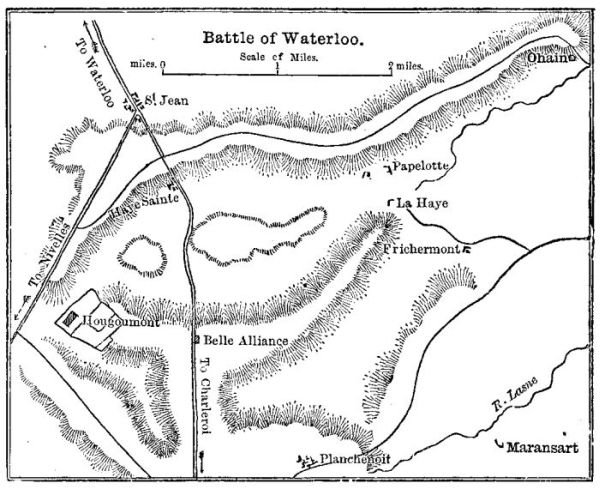
Position of Waterloo.
To give time for the arrival of the Prussians it was necessary that his battle should be a defensive one. The position, which he had long before studied and selected, was admirably adapted for the purpose. Nearly two miles south of Waterloo is the village of St. Jean, where the highroads from Charleroi and Nivelle towards Brussels join. Just south of this the undulating country forms a somewhat continuous ridge, lying east and west, crossed at right angles by the Charleroi road. Along the south of the ridge lies a rich and cultivated valley, which in about a mile swells again into a corresponding range of elevated ground. Three or four farmhouses lie on the foot or on the southern slope of the northern line of hills, so that the position resembles, as Wellington said, a wall of a bastion with advancing angles. The English troops were placed along the ridge, and occupied the farmhouses. The centre was placed between the two highroads, having in front the farm of La Haye Sainte standing on the western side of the Charleroi road. The right was covered by the château of Hougomont, with stone buildings and enclosures, while the left stretched to the farms of Papelotte and La Haye. Wavre is about seven miles from St. Jean, directly to the east, and expecting the arrival of Blücher, Wellington allowed his left to be the weakest part of his line. His care for his right was indeed exaggerated; he thought it possible that an attempt might be made to reach Brussels by outflanking him in that direction, and before all things desirous of preserving the capital, he detached a body of 17,000 men to Hal (eight miles to the west of his position), and thus seriously and uselessly weakened his line of battle. The French position corresponded to the English. Its centre also lay on the Charleroi road and the range of heights parallel to those occupied by the English, on which is the farmhouse of La Belle Alliance. Its right extended to Frischermont, opposite to La Haye, having somewhat in its rear the village of Planchenoit; the left reached beyond Hougomont. In number the armies were not unequally matched. Wellington commanded about 68,000 men, Napoleon 70,000, but the English army consisted of troops of various nations, some of whom were thoroughly untrustworthy, and was inferior in cavalry by at least 3000 men, and in artillery by upwards of 100 guns.
Battle of Waterloo.
By eight o'clock on the morning of the 18th the English were under arms, but Napoleon, ignorant of the movements of the Prussians, and anxious probably to excite the temper of his own troops, and display his power to those of the allies who were already wavering in their allegiance, delayed his attack till nearly mid-day, and employed the morning in a great review of his troops. The weather also on the 17th had been very stormy, the ground was saturated and heavy; and though this difficulty would likewise have affected his opponents, firm ground was no doubt more important for the attack than for the defence. It is probable that those wasted hours saved the English army, for the same condition of the ground told with terrible force upon the advance of the Prussians, who had to make their way through swampy defiles, where the artillery could scarcely be moved. Their advance was very slow, and nothing but the firm determination of their leaders to keep their word to Wellington would have enabled them to overcome the obstacles in their way. The battle began about half-past eleven by an assault upon Hougomont, which Napoleon intended to carry, and thus mask his real great attack upon the centre and left of the English. The firm resistance of the garrison, consisting of a portion of the English Guards and the troops of Nassau and Hanover, frustrated this first move. The capture of the château, which should have been a mere preliminary step in the great plan, became an object in itself; fresh troops were constantly brought against it, it was as constantly reinforced from the English line, and throughout the whole day its defence neutralized a considerable portion of the French infantry. It was not till five o'clock that Napoleon brought a couple of howitzers to bear upon it. Though the buildings were speedily in flames, the defence was continued, and it remained throughout the day uncaptured. During the first attack upon Hougomont skirmishing and firing had been going on along the whole line preparatory to the great movement against the left. That movement was rather hastened than postponed by a discovery which was made about one o'clock. About that time troops were seen moving near a wood to the north-east of the English position between Wavre and Ohain. At first Napoleon took them for the troops of Grouchy, to whom he had sent information of the true direction of the Prussian retreat. They proved however to be the foremost troops of Bülow's Prussian corps. But the Emperor, still believing that Grouchy would at all events prevent the arrival of the main body of the Prussians, determined if possible to complete the destruction of the English before taking notice of the approaching troops. At half-past one, under a furious cannonade, the first corps, D'Erlon's, marched against the English left between Papelotte and La Haye Sainte. Although their peculiar formation, in great closely-packed masses, exposed them fearfully to the fire of the English artillery, they pressed forward up the English slope, threw the first line, consisting of allies, into confusion, and were not repulsed till Picton brought up the main body of the English left, who charged them with the bayonet and drove them backward. As they were already shaken, the English heavy cavalry, the Household Brigade, and what is known as the Union Brigade, consisting of the Scotch Greys, the Enniskillen Dragoons, and Royals, charged with fearful effect. Carried away by their energy, they rode right up the French slope to the battery of La Belle Alliance; scattered and exhausted by their charge, they were fallen upon and very roughly handled by the French Lancers, and only saved from destruction by the advance of the English light cavalry. However, the first great attack of the French had been triumphantly repulsed, though with terrible loss. Both Picton and Ponsonby, who commanded the cavalry, were killed. It was not long before a second attack was made. Apparently about four o'clock, Ney was ordered to assault the centre and right centre of the English to the west of the Charleroi road. The attack was made chiefly with cavalry. Much of the infantry were indeed employed round Hougomont and in the attack of La Haye Sainte, which never ceased. For two hours the cavalry charges continued; they were opposed by the allied troops thrown into square, the squares being placed checkerwise behind the crest of the ridge. It is uncertain whether any squares were broken; it is certain at all events that though the line on the whole held firm, reinforcements had to be brought from the right, and that there was a moment between five and six o'clock when the centre was in the greatest danger. After an heroic defence La Haye Sainte had been abandoned for want of ammunition. The French held therefore a position close to the English ridge, and the infantry of Donzelot's division were gradually making their way to the line which the cavalry charge had shattered. But to complete the lodgment effected in the line on the ridge more infantry were absolutely necessary, and these were not forthcoming. When Ney sent to demand them of the Emperor, his messenger was met with the reply, "Does he want me to make them?" In fact, since about half-past four o'clock the advance of the Prussians had made itself clearly felt. General Lobau had been sent to check them, and with him some battalions of the Imperial Guard. But the numbers of the Prussians constantly increased; it was in vain that they were more than once driven out of Planchenois by the Guard, at six o'clock they had established themselves there, threatening even the rear of the French and the Charleroi road, their line of retreat; and by seven o'clock Ziethen's corps, which had pushed directly westward, had joined the left of the English army, so that the French troops in Papelotte occupied an advanced angle, surrounded both in front and flank by the enemy. It was thus that reinforcements could not be sent to Ney, and the second great effort of the French was rendered useless. But Napoleon did not yet give up all for lost. He knew that the English must be much exhausted, and determined to try one great effort more with that portion of the Imperial Guard which had still been kept in reserve. It was a general assault along the whole line, but the most important part of it was the advance of the Guard upon the English centre. To oppose them the English brigade of Guards under Maitland had been brought forward. As the French columns topped the ridge the Guards sprang to their feet, and at a distance of fifty paces poured in a fire which shook the advancing masses, and charged them with the bayonet. The columns of the Guard rolled backward to the valley. At the same time a second column had met with the same fate; the 52nd regiment under Colborne had advanced so as to form an angle with the main line; as the French column passed them they poured in a destructive fire, and charged directly upon their flank. The course of that charge was unchecked, the 52nd regiment continued to follow the flying French right across the valley. Almost at the same time, the French in the angle at Papelotte had also been driven back by the Prussians; and the English light cavalry under Vandelour and Vivian had likewise charged, overthrowing the troops opposed to them; thus in three parts of the field the French were in flight. A general order to advance was given, and after a short but broken resistance, the whole mass of the French army fled in complete rout. About nine o'clock Wellington and Blücher met at the farmhouse of La Belle Alliance, lately the French headquarters. The pursuit was intrusted to the Prussians, less exhausted than their English allies, and was followed up by Gneisenau along the Charleroi road as far as Frasnes. The loss in this great battle was very heavy on all sides; that of England is put at 13,000, that of Prussia at 7000, and of France between 23,000 and 30,000. It was however decisive.
The allies in Paris.
The advance of the allies into France was unchecked, and on the 7th of July Paris was again occupied. The entrance of the allies upon the country of France at once exhibited the different feelings by which they were actuated; while Blücher and the Prussians thought of nothing but vengeance, Wellington, true to the constant policy of England, insisted upon regarding France as a friendly country to which he was restoring its legitimate sovereign. He succeeded in restraining his violent colleague, who wished to put Napoleon to death, to lay a large contribution on Paris, and to blow up the bridge of Jena over the Seine, the name of which he considered an insult to Prussia. Wellington had no instructions how to act with regard to Napoleon, he therefore allowed him to follow his own course. The Emperor, embarking in an English frigate, the Bellerophon, attempted in his usual theatrical manner to claim the hospitality of the Prince Regent, but the dread of his name and ambition, and the proved danger of allowing him to remain in Napoleon banished to St. Helena. Europe, prevented the English Government from entertaining any such ideas, and Napoleon was sent to end his days as a prisoner in St. Helena.
The influence of England, naturally increased by the great part it had played in the war in Belgium, was sufficient to give the direction to the negotiations which followed the second restoration of the Second Treaty of Paris. Nov. 20, 1815. Bourbons. The Government succeeded in procuring that the Treaty of Vienna completed on June 9th and the first Treaty of Paris (May 1814) should be upon the whole maintained, but it could not refuse to allow some punishment to fall on France for the events of "the hundred days." The country was vigorously confined to its limits in 1790, losing all the additions which the first Treaty of Paris had given it; it was compelled to bear much of the expenses of the war; while its immediate good conduct was secured by an army of occupation, which was for five years to hold the northern fortresses under the command of the Duke of Wellington. The war contribution was to consist of 700,000,000 francs, a sum which was to be paid in five years, during which time the northern fortresses were held as guarantee. This treaty was signed on the 20th of November.
Battle of Algiers. Aug. 27, 1816.
England had one more piece of work to do before laying down her arms. The attention of the Congress of Vienna had been called to the condition of the Mediterranean, where commerce was interrupted, and the liberty of Christians imperilled by the piratical fleets of the slave-holding states of the Barbary coasts. A general co-operation against the pirates had been proposed, but no definite resolution was arrived at. To England, unquestioned mistress of the sea, and herself, by her new position in the Ionian Isles, a Mediterranean power, fell the duty of suppressing the evil. Early in 1816, therefore, Lord Exmouth, in command of the Mediterranean squadron, was instructed to visit the Mahomedan states; he was to insist upon the release of Ionian slaves, and to negotiate a peace with the Mahomedans in the interests of Sardinia and Naples. From Algiers alone could opposition be expected. But the Government there made no objections to the admiral's demands; the Ionian slaves were released freely, those of Naples and Sardinia upon the payment of a ransom. At Tunis, the next port visited, an accident changed the aspect of affairs. Lord Exmouth, took advantage of a mistake of his interpreter to declare that it was not the wish only but the fixed determination of the Prince Regent that slavery should cease altogether. Tripoli and Tunis submitted, and set free their slaves; but Algiers, a stronger power, demanded time to refer the matter to Constantinople, promising to deal directly with the English Government. Meanwhile in Parliament the principle of ransoming the slaves had been strongly censured, and a general feeling that force should be used had arisen. A barbarous attack by Algerine soldiers upon the crews of some coral-ships at Bona allowed the Government to take advantage of this feeling, by despatching Lord Exmouth to complete his work. On the 27th of August, having been joined at Gibraltar by a small Dutch squadron, Lord Exmouth approached Algiers. After waiting two hours for a reply to his terms he placed his ships alongside the batteries in positions carefully marked out beforehand. The work of destruction was complete, the forts were reduced to ruins, the fleet that lay within the mole was burnt. For nine hours the battle raged, then when the ammunition was nearly expended the ships withdrew from their somewhat dangerous position. Their work had been effective: on the following morning the English terms were accepted, and on the 31st, 1200 slaves were embarked in the fleet, making in all more than 3000 whom Lord Exmouth had delivered.
The completion of the settlement of Europe had been carried out during the recess of Parliament. From July 1815 to February 1, 1816, the Government had been able to act entirely unchecked. On that day Parliament reopened, and Castlereagh resumed his seat in Opposition in the Parliament. Feb. 1, 1816. all the triumph of his completed negotiations. But with the conclusion of the war came the hour of trial for the Tory ministry. The mediocrity of their talent, the reactionary character of their political views, had been forgotten, or even regarded as favourable points in their administration, while they stood forth firmly and energetically to express and give effect to the great wish of the nation, the destruction of the Napoleonic rule. With the return of peace the great questions of home politics were again becoming of importance, and the tendencies of the party fostered by their successful warfare were to call into existence an opposition not only in Parliament but among the nation at large. Already voices were raised against the late negotiations; though, no doubt, the real magnanimity shown towards France, the advantages gained for England on the sea, and the security for some years of peace which the elaborate system of balance was thought to give, were fully in accordance with the wishes of the majority of the nation. There were men who, undazzled by the glories of the late war, saw that the policy of England had in fact favoured absolutism,—that, for the sake of the balance of power, countries had been handed over quite irrespective of the wishes of the people to sovereigns for whom they felt no natural affection,—that a dynasty disliked by a large section of the people had been forced upon France, and was upheld by English bayonets, and that in spite of the efforts of England the influence of Russia had been increased. It appeared to them that the intercourse with foreign powers had rendered our negotiators absolutists. Their conduct with regard to the Holy Alliance showed The Holy Alliance. Sept. 1815. that this was not in fact the case. The Holy Alliance, or Convention of September, by which the enthusiastic and sentimental Emperor of Russia joined with his brother sovereigns of Prussia and Austria to declare that henceforward their policy should be ruled on Christian principles alone, had been rejected by the English Government, which saw danger in this brotherly and religious bond between absolute monarchs, and declared through the Duke of Wellington that the English Parliament would require "something more precise." In fact, though in no way wishing to disturb the English Constitution, the Tory Government had been led into a course of policy which was not in accordance with English traditions. The conclusion of a war the burden of which had been upon the whole patiently borne, should have brought with it the real blessings of peace; but these were not found in the declaration of the Government that it intended to keep up the war taxes, and to keep on foot an army of 150,000, an intention which, when taken in conjunction with the close alliances entered into with foreign powers, seemed to mean that England was henceforward to attempt to take its place as one of the great military powers of the Continent.
Extravagance of the Government.
It was upon the two points of taxation and economy that the Government first met with opposition. Mr. Vansittart, Chancellor of the Exchequer, declared his intention of continuing half the income and property tax, which from the first had been avowedly a war tax. The Opposition to this measure was headed in the Commons by Brougham. By a skilful use of parliamentary tactics, he succeeded in gaining time, which he employed in procuring a flood of petitions exhibiting the feeling of the country so strongly that the Government was beaten. Apparently in dudgeon at his defeat, the Chancellor of the Exchequer said that as he had lost the income tax he should also throw over the malt tax, a step which Castlereagh explained by saying that Government was going to contract a loan, and £2,000,000 or £3,000,000 more or less would make no difference. The recklessness of this assertion points to one of the evils which the late war had produced;—an unbounded and lavish supply of money, and the habit of spending almost without question if success could be obtained, had destroyed all idea of economy in the minds of the ministers. The angry feeling excited in the people by this carelessness of the public money was not diminished by the extravagances of the Court, and the constant demands for money to supply the deficiencies of the Civil List. Although £800,000 was the sum granted in exchange for the hereditary revenues, the average of late years had been considerably above a million; in 1815 it had reached nearly a million and a half. On this point the ministers were themselves obliged to take the initiative, and a Bill was passed for the better regulation of the Civil List. But while the demand for economy, for the reduction of the war expenditure, and the return of England to its usual independent position with regard to the Continent, afforded themes for the Opposition in Parliament, an agitation of far more importance had sprung into existence outside its walls.
At the opening of the session the Prince Regent's speech had congratulated the country upon the prosperity of agriculture, and of all branches of trade and manufacture. But it was, in fact, a time of Agricultural depression. unexampled distress. The principle of protection which had found favour with the mercantile world in the seventeenth and eighteenth centuries had been extended to agriculture. In 1670, a period of great plenty having reduced the price of corn, it was thought necessary to impose heavy dues on its importation. Up to 53s. 4d. a duty of 16s. a quarter was imposed, between that and 80s., a duty of 8s. a quarter. The price at which importation, free or at a nominal duty, was allowed had been more than once changed. In 1804 it had been set at 66s. During the latter years of the war there had been constantly deficient harvests. In 1812 and 1813 the quarter of wheat had risen to 171s. The average price during six years, from 1808 to 1813, had been 108s. During several of those years the Continental System had virtually excluded foreign competition. The effect of the high prices was most disastrous upon agriculture; while the suffering of the labourer had, as has been explained, been very great, the class of farmer had changed, the careful small cultivator had given place to ostentatious spendthrifts. To secure great returns land wholly unfitted for the purpose had been brought under the plough, crop after crop of corn had been grown to the exhaustion of the soil, and many advantageous and necessary forms of agriculture had been thrown aside for the cultivation of corn. The year 1813 was one of extraordinary plenty, the surplus crop was enough to continue that plenty during the two following years; the effect was a very rapid fall in prices. Such a fall naturally entailed the restoration of a better system of husbandry, and the ruin of many of those who had embarked on the false course. Peace added still further to this distress. Violent efforts were made in Parliament by the landed interest, which was very strong, to bolster up the evil system. It was proposed in 1813 that importation should be subject to a prohibitory duty till the price of wheat reached 105s. the quarter. This demand was reduced to 84s. in 1814. Circumstances prevented its being carried then, but in 1815, when the foreign markets were again opened, the terror of approaching cheapness enabled farmers and landlords to combine and hurry through the House a Corn Law, fixing the price at which corn might be imported at 80s. In spite of this, however, the distress continued. In fact, the false inflation of late years was giving way, and agriculture entering upon a more natural course. The agricultural interests still complained, and still asserted the necessity of relief, but as, in order to win their support, the Government had already given up the malt tax, there was really scarcely anything left to give them, and their complaints remained unanswered; and as the distress, although it was caused chiefly by the fault of the agriculturalists, and was but a fair counterpoise to the enormous profits they had lately been making, was a terrible reality, the poorer classes continued to suffer.
Commercial depression.
The depression was not confined to the agricultural interest. The removal of the restrictions caused by the Continental System excited lively hopes among the trading community. During the war our exports had chiefly depended upon an organized contraband trade. Even so, in 1811, shipments had been made to the Continent to the value of £11,000,000. It was supposed that, without restrictions, the sum might be doubled. Everybody wished for a share in the golden harvest, and much money was transferred from legitimate and lucrative trade to the purchase of colonial produce for exportation. But what is called effective demand for any commodity depends not on the desire of the purchaser, but upon his power of purchase. The exhausting wars of late years so limited that power of purchase that the exports of England either lay in the ports unsold or were got rid of at less than the cost price. Nor did our restrictive commercial policy allow a ready interchange of commodities, which might have tended to render the disaster less. Peace with America had produced somewhat the same effects. Thus, both in agriculture and in commerce, widespread suffering and distress existed.
The difficulties were increased at the time by a considerable reduction in the circulating medium. The fall in agricultural profits had ruined many banks in agricultural districts, and induced others to Riots and political meetings. restrict their issue of paper money. A severe winter, a deficient harvest, and the rise of the price of wheat before the close of the year (1815) again to 103s., came to complete the general misery. The effect was a widespread series of riots; rick-burning and machine-breaking were constant, especially in the east of England. At Littleport, in the isle of Ely, the town was for two days in the hands of the mob (May 22), and the tumult was only suppressed after the military had been called out. In the coal and iron districts, though the people on the whole behaved well, great meetings of unemployed operatives took place; while in Nottingham and the neighbourhood the Luddite disturbances broke out with fresh vehemence. The discontent and unhappiness of the people before long assumed the shape of a political movement. The change must be attributed to the writings of Cobbett more than to any other single cause. For some years he had published a Liberal periodical called "The Weekly Political Register," in which, with remarkable clearness of style and simple power of argument, he had constantly attacked the Government. In 1816, he changed the price of his paper from a shilling to twopence, and it at once became the oracle of the working classes. His view was, that all the evils of the time might be cured by reform of Parliament. He indeed went far beyond what the nation was then fit for, demanding universal suffrage and annual Parliaments. But his work was the beginning of the great agitation which continued till the passing of the Reform Bill of 1832.
Against this new sort of opposition without the walls of Parliament the Government set to work with violent measures of repression. The Hampden Clubs, which had sprung up in all directions for purposes of parliamentary reform, no doubt had fallen in many cases into the hands of dangerous demagogues. In London they appear to have become connected with a body of men known as Spencean philanthropists, after Spence, who, at the beginning of the century, had made himself notorious by his socialistic plans. To this society belonged Thistlewood, the two Watsons, and a man of the name of Meeting in Spa Fields. Dec. 2, 1816. Preston. Castle, a spy of the police, crept in among them, and probably urged them to more reckless action than they would otherwise have taken. According to his account, a great plot was on foot for taking the Tower, seizing the Government, and establishing a Committee of Public Safety. A meeting in Spa Fields in connection with this plot was held upon the 2nd of December. It was to be addressed by Mr. Hunt, a vain and empty demagogue, but before he arrived the Spenceans had begun to act upon their own authority. Young Watson had led a number of men to Snow Hill to ransack a gunsmith's shop, and had there shot a gentleman who had remonstrated with him. The crowd then marched to the Royal Exchange, where they were met by the Lord Mayor, who courageously withstanding them, with only seven assistants, easily dispersed them. Preston appears also singlehanded to have climbed the wall of the Tower, and have summoned the guard to surrender. Beyond this nothing formidable was done.
While hunger and misery, the depression of trade, and the influence of a few able demagogues, were driving the poorer classes to acts of violence, and a dangerous union was being established between social and political discontent, the middle classes were gradually arriving at the same conclusion as their inferiors with Petition from the Corporation of London. regard to the necessity of a thorough change in the constitution of Parliament. In December, only a few weeks after the uproar in Spa Fields, the Corporation of London, of late the firm supporters of the policy of Government, addressed a petition to the Prince Regent, which throws a striking light upon the feelings which the conduct of Government since the war had excited. After a rapid summary "of the distress and misery, no longer limited to one portion of the Empire, and under the irresistible pressure of which the commercial, agricultural, and manufacturing interests are equally sinking," the address goes on to say: "Our grievances are the natural effect of rash and ruinous wars, unjustly commenced and pertinaciously persisted in, where no rational object was to be attained; of immense subsidies to foreign powers to defend their own territories or to commit aggressions on those of our neighbours; of a delusive paper currency; of an unconstitutional and unprecedented military force in time of peace; of the unexampled and increasing magnitude of the Civil List; of the enormous sums paid for unmerited pensions and sinecures; and of a long course of the most lavish and improvident expenditure of the public money throughout every branch of the Government, all arising from the corrupt and inadequate state of the representation of the people in Parliament, whereby all constitutional control over the servants of the Crown has been lost, and Parliaments have become subservient to the will of Ministers."
Incapacity of the Tory party.
It began to be evident that, as the great common interest of the war disappeared, and the popularity and influence derived from its successful termination wore itself out, the Tory party, with its repressive and reactionary doctrines, would find itself wholly unable to handle with success the domestic questions which inevitably arose. For some years longer it successfully held its position. Circumstances enabled it again to separate the middle and lower classes, and full time was allowed it to exhibit its repressive principles of home government.
The success of the Government was due to the excesses of the mob, and to the exaggerated fear which it was found possible to excite among the propertied classes. The Regent had scarcely opened Parliament, with an assurance that he was well convinced of the Attack on the Regent. June 28, 1817. loyalty of the great body of his Majesty's subjects, but was determined to omit no precautions for preserving public peace, when, as he was returning from the House, he was ill-received by the people, and a missile thrown from the crowd even broke one of the windows of his carriage. This outrage encouraged the Government to take vigorous measures. It was not difficult to represent the whole project of reform as being indissolubly Repressive measures of the Government. March. mixed with the extreme doctrines of Cobbett and the Spenceans. A secret committee of both Houses was appointed to inquire into the public disaffection; that of the Lords reported the existence of a great network of societies and clubs, which, under pretence of parliamentary reform, were attempting to infect the minds of all classes with a spirit of disaffection, and contempt of law, religion, and morality, while no endeavours were omitted to prepare the people to take up arms on the first signal of the accomplishment of their design. The Commons committee declared (Feb. 19) that the Hampden Clubs aimed at nothing short of revolution. Armed with these reports, which were no doubt extraordinarily exaggerated, Government introduced and carried Bills for preventing attempts to seduce soldiers and sailors from their allegiance, to give to the Prince Regent all the safeguards of an actual sovereign, to prevent seditious meetings, and lastly (March 3), for the suspension of the Habeas Corpus Act till the 1st of the ensuing July.
Secret political meetings.
The effect of these Acts was at once to give a certain reality to the dangers on the false apprehension of which they had been based. Public meetings being impossible, secret meetings, with all the dangers which invariably attend them, sprang into existence. The worse affected and more dangerous leaders of the people began to acquire influence, and desperate designs, fomented and betrayed by spies in the employment of Government, began to be entertained. It is impossible to suspect benevolent gentlemen such as Lord Sidmouth of wilfully entrapping ignorant artisans to their own destruction; but it is certain that use was constantly made of spies who found it to their own advantage to concoct and betray treasonable and atrocious conspiracies. The most notorious of these spies was a man of the name of Oliver, who, giving himself out as a delegate of London reforming societies, succeeded in giving a new impulse to the plots in various parts of the manufacturing districts of Yorkshire, Lancashire and Derbyshire. The violent suppression by the military and constables of a peaceable meeting, known as the meeting of blanketeers, at Manchester on the 29th of March, made the people more ready to listen to his suggestions. The meeting was a peaceful one, and acquired its name from the blankets or coats which many of those assembled had strapped upon their backs. A few of them set out upon a foolish march, intending to petition the Prince Regent in person; but their intentions appear to have been quite peaceful, and though many were apprehended, they were all discharged before trial. It seems probable that what is known as the Derby insurrection was one of the consequences of Oliver's representations. A man of the name of Brandreth, known as "the Captain," went from house to house near Pentridge, spreading such assertions as that England, Ireland, and The Derby insurrection. June 10. France were all to rise that night at ten o'clock, and that the "northern clouds," or men from the north, would come down and sweep all before them. A few men collected in arms at his summons. They do not seem ever to have numbered much more than an hundred, and were without difficulty dispersed, and many of them taken prisoners by the military at a short distance from Nottingham. Such disturbances as these were held to justify a second suspension of the Habeas Corpus.
Suppression of seditious writings.
But it was not only against seditious actions that Lord Sidmouth determined to proceed, but against seditious writings also. On the 27th of March he wrote a circular to the Lords Lieutenant of counties, in which he declared that in the opinion of the law officer the justices of the peace might issue a warrant to apprehend any person charged before them on oath with the publication of blasphemous or seditious libels, and compel him to give bail to answer to the charge. Considering the jealousy with which any political interference with the liberty of the press was regarded, and that by Fox's Libel Bill even the judges were held unfit to decide on the character of a libel, which was to be left to the decision of the jury, it is difficult to conceive a more high-handed interference with what was generally regarded as a constitutional privilege. Considerable use was made of the instructions, yet on the whole with so little success that the Government procured but a single conviction. The most important of these trials was that of Mr. Hone's trial. Dec. 18, 1817. Mr. Hone, which must have showed the Government, if nothing else could, how odious and useless their attempts to stifle the free expression of opinion was. Hone was a quiet and inoffensive publisher, a great collector and reader of old books. He had published certain political parodies, of which the subject can be pretty well understood from the titles they bore, "The Sinecurist's Creed," "The Litany, or General Supplication." It was against their alleged blasphemous character that proceedings were taken. Each parody was the subject of a separate trial, and the whole proceedings occupied three days. On the first day Mr. Justice Abbott, on the second and third Lord Chief-Justice Ellenborough occupied the bench. Hone defended himself, basing his argument on the essential difference between parodies intended to throw scorn upon the work parodied and those in which well-known writings were travestied for the purpose of ridiculing some other subject, and supporting himself by innumerable instances of political parodies couched in biblical forms coming from the pens of well-known and respected writers. His erudition enabled him to continue for many hours on each day producing instances of this kind. With astonishing firmness he refused to be browbeaten by Lord Ellenborough, and upon the third day even attacked his judge for the partisan spirit in which he had charged the jury the preceding evening. In all three trials, after a brief consideration, the jury acquitted him. The persistency with which the charges against Hone were pressed after his first acquittal entirely discredited the grounds of public morality on which the Government was professedly acting, and had all the appearance of a vindictive desire for revenge on the part of men smarting under deserved political satire.
The system pursued by the Tories, though for the time it was successful in keeping up a general dread of popular violence, and thus temporarily hushed the agitation for reform, was gradually alienating from Government all classes but the one immediately connected with it, and forcing the nation at large to look upon Government itself as its natural enemy, and to fix its hopes more and more upon some constitutional change. Indeed, though its large majority in the House enabled the Government to reject all liberal measures, and to pass those which it itself produced, a powerful Opposition began to show itself within the walls of the House, which the conduct of the Administration did not tend to conciliate. The extension of the The Alien Act. May 5, 1818. Alien Act, which reserved to the Government the power of removing aliens who were objects of suspicion, and which had already been twice renewed since the peace, for a further period of two years, was regarded as an attack upon the English right of asylum in favour of the Continental despotisms. It was warmly opposed, and a flaw found in it which secured its rejection. By the Act of Union, shareholders in the Bank of Scotland became naturalized subjects. An alien, by taking shares in the Bank, could therefore evade that Act. A clause was introduced to check this means of evading the Act; but as naturalized subjects had certain exemptions with regard to the payment of duties, the Lower House held that the introduction of the clause was an infringement of their privilege, as being in fact the introduction of a money clause. It had therefore to be The Indemnity Bill. March 13. dropped and a new Bill introduced. Even an attempt on the part of Government to gain popularity turned to its discredit. A show was made of destroying numerous sinecures; but as this destruction was coupled with a Pension List of an amount almost equal to that of the sinecures destroyed, the trick excited more anger than gratitude among the public. But the great contest of the time was on the subject of the indemnity demanded by the ministry to cover acts done during the suspension of the Habeas Corpus Act. A sealed bag of papers was laid upon the table of the House, which the Government demanded should be referred to a committee of secresy. The committee was to be appointed by ballot, but lists were circulated among the ministerial majority of the members for whom they should vote; in fact, therefore, the committee was nominated by the Government itself. The report declared that the suspension was necessary, and that the Government had used the powers given them well. But the demand for an indemnity, while the grounds for that indemnity were kept studiously secret and examined only by the Government nominees, for the avowed purpose of keeping from the public the names of the witnesses who had given secret information, increased still further the bad impression which the employment of men like Oliver had already created.
Condition of the royal family.
Under other circumstances loyalty for the Crown might have served to lessen the growing division between the Government and the people; the state of the royal family, and the character of most of its members, was now such as to weaken all such feeling. For the old King and Queen there was doubtless respect and pitying affection; but it was known that both the afflicted monarch himself and his faithful wife and guardian might at any moment die. As it was, they lived retired from the public view. The Prince Regent, the ostensible sovereign of the country, was understood to be little more than a selfish voluptuary. His reception on the opening of Parliament of 1817 shows how much he had lost the affections of the people. His unhappy domestic relations, shortly to become the ground of a keen party struggle, not only afforded a perpetual subject of scandal, but seemed to forbid the possibility of a direct male heir to the throne. The people's hopes were centred on the Princess Charlotte, the Regent's only daughter, but lately married to Prince Leopold of Saxe-Coburg, and the blow was felt to be heavy when she died in 1817, immediately after giving birth to a child which did not live. It seemed for the instant highly probable that the large and strong family of the old King would come to an end in the first generation. Before the close of the following year this probability was lessened. No less than four members of the royal family were then married—Princess Elizabeth, the Duke of Clarence, the Duke of Cambridge, and the Duke of Kent, who married respectively the Landgrave of Hesse Homburg, the Princess Adelaide of Saxe-Meiningen, the Princess Augusta of Hesse, and Princess Victoria of Saxe-Coburg Saalfield, the widow of the Prince of Leiningen and sister of Prince Leopold. Had the family been at all popular such events, under the circumstances, would certainly have afforded joy to the nation. As it was, they only afforded an opportunity for the expression of a deeply fixed belief in the extravagance and wastefulness of the royal family. Of all the marriages that of the Duke of Kent with a sister of Prince Leopold was alone well received. The demand for an increase of income on behalf of the other princes was strongly resisted in Parliament; the sum proposed for the Duke of Clarence was reduced by nearly half, and a grant of £6000 for the Duke of Cumberland, who had been married three years previously, was absolutely rejected by a majority of six members, a result which was received with loud cheers.
The ministers' insecurity with the present Parliament.
The insecurity felt by Government, in spite of its large majority, in the present Parliament betrayed it into conduct which still further increased its unpopularity. The Parliament was now in its sixth session, and therefore approaching its time of dissolution. But several circumstances might call it again into existence. A clause in the Regency Act provided that Parliament should be summoned on the death of the Queen. The ministry had lately got the clause repealed; but the death either of the King or Regent, if happening before the day appointed for the assembling of the new Parliament, would have caused the reassembling of the old. Both King and Queen might die at any moment; nor was the Regent's health good. The dissolution was therefore hurried on in a manner which caused much anger. On the 10th of June Parliament was prorogued and dissolved at the same time, a form of proceeding unprecedented since the days of Charles II. The temper of the country was not improved by this step, and the elections were attended with the bitterest party strife. In Westminster Sir George Murray, who stood on the Tory interest to replace if possible Lord Cochrane, who had withdrawn to take command of the navies of Chili, was so ill-used that his life was thought to be in danger. Several Radical candidates offered themselves, among others Hunt the orator; but the more respectable inhabitants contrived to save themselves from the disgrace of such representatives by bringing in Romilly, without any expense of his own, at the head of the poll. The other member was Sir Francis Burdett. In the same way the City of London elected four Liberals, rejecting three old ministerial representatives. This clearly showed the rising temper of the middle classes. But as the representation was then arranged no great change was possible, and the ministers found themselves still in possession of a large majority (July).
Evacuation of France by the allies. Nov. 30, 1818.
Before the assembling of the new Parliament (Jan. 14, 1819) one piece of foreign history deserves notice. A congress was held at Aix-la-Chapelle (Oct. 2, 1818), at which the final evacuation of France by the allies, although only three of the five years stipulated were accomplished, was agreed upon. This wise and just act seems to have been chiefly due to the Duke of Wellington, in opposition to some of the extreme Tories of the Cabinet.
Resumption of cash payments. May 1819.
In spite of their parliamentary majority, the ministry did not feel very secure upon their seats, and it was perhaps more with a view of re-establishing their credit with the country than from increased wisdom that the Cabinet so far changed its views with regard to the currency question as to accept the truth of the doctrines which Francis Horner had some years (1811) before laid down, and introduced a measure in accordance with the plans of Ricardo, the political economist, for the resumption of cash payments. The Bank had already issued a considerable quantity of gold. Since 1817 as much as £6,000,000 had been put into circulation, but as the paper money still continued, as a matter of course this partial action produced no good effect; the gold had found its way out of the country, chiefly to France. It was now ordered that this voluntary payment in gold should cease. An examination of the affairs of the Bank proved that it was in excellent condition, and a series of resolutions were passed and subsequently embodied in Bills by Mr. Peel. By these, from the 1st of February 1820, the Bank was obliged to exchange its notes for gold ingots, in not less quantity than sixty ounces, at the rate of 81s. the ounce; in October of the same year the rate was to be reduced to 79s. 6d. the ounce; on the 1st of May 1822 the rate was reduced to the regular mint price of £3, 17s. 10½d.; and in May 1823 all notes were to be paid on demand in legal coin. As a fact, on the 1st of May 1821 the Bank resumed complete payment in cash.
Foreign Enlistment Bill.
Several divisions in Parliament clearly showed the growing weakness of Government. The Foreign Enlistment Bill, to prevent English subjects from serving in a foreign service or fitting out ships of war for foreign countries, was carried by a majority of thirteen only, the ground of opposition being that the Bill was in fact directed to the injury of the revolted colonies of Spain in America, in whose ranks many Englishmen were serving. Like the Alien Act of the preceding session, the Bill was considered as a proof of that legitimist and absolute tendency of which the Government was accused. Again, in the great Catholic emancipation rejected. May 3. question of Catholic emancipation, which was brought forward by Grattan in the best speech he ever made in the House, the Government were victorious by a majority of two only in a very full House; while it was actually defeated by Reform of Scotch burghs. May 6. a majority of five on the question of the reform of Scotch burghs, which it had got rid of in the last session. The system in those burghs had been in existence ever since the fifteenth century, and so acted as to perpetuate the administration in the hands of one party, often of one family only, as the retiring members of the corporation had the right of electing their own successors. For years the burghs had been bent upon ridding themselves of this exclusive government; as in the case of other reforms, their efforts had passed out of sight during the tumult of the French wars, again to be called into existence on the resumption of peace. In 1817 certain irregularities of form in the burgh of Montrose had caused the elections to be set aside by the law courts. The Crown had been compelled to give a new charter, in which a certain popular element was admitted. Other burghs at once began to clamour for similar changes. To their petitions, however, the Government turned a deaf ear. When the elections in Aberdeen were quashed by the law courts, as those at Montrose had been, the old constitution had been re-established, and Lord Archibald Hamilton now took up the cause of the burghs. He demanded a copy of the new warrant, and was defeated by five only. Pressing his success, he demanded that the petitions of the burghs should be referred to a select committee. A large majority of the burghs themselves were loudly calling for reform. The population of those who desired it amounted to 420,000, as opposed to 60,000, the population of those who had not petitioned. The proof of the wish of the people most interested was too strong for the House; in spite of the Government opposition, Lord Archibald's motion was carried in a House of nearly 300 by a majority of five. As the ground of opposition had been avowedly that a change in the burghs was but the beginning of parliamentary reform, this victory shows how the opposition to that measure was gradually breaking down.
In spite of these signs of weakness, the ministers were upon the whole well satisfied with the session. They believed in the success of their repressive measures in the year 1817, and thought that the state of the country was both quieter and more prosperous than it Chronic sufferings of the poor. had been. Complaints of the depression of agriculture, and poverty and suffering among the agricultural poor, were indeed chronic; they depended upon causes over which the immediate action of Government had little control. Exaggerated rents were seeking their natural level; over-cultivation, especially of corn, was giving place to more rational agriculture, and the enormous prosperity enjoyed by the agriculturists during the war was shrinking to modest and hard-won profits; the change could not but be attended with some depression and many painful contrasts. At the same time the action of the Poor Law as then administered, the injudicious fostering of the population which had gone on during the war, and the law of settlement which prevented free competition of labour, of necessity caused misery among the labourers. It was when the manufacturing and mercantile interests were also touched, when, under the action of restrictive corn laws, prices rose, while work was not to be had, that the social dangers of the country became from time to time great.
The prosperity of the year 1818 had been rather apparent than real; there had been much over-trading; a more healthy spirit appears to have arisen in the beginning of 1819, but the effects of the preceding folly were now to be felt. In the first half of the year the number of bankruptcies were almost double the average, the price of corn was still as high as 75s., work was scarce, and wages fell, and before the year was over the ministry found upon their hand difficulties even greater than those they had experienced in the Political meetings. gloomy year of 1817. For again the political question was ready to start to life, again leaders of a higher class were ready to take advantage of the sufferings of the people, and men of more extreme views among themselves were eager to lead them into desperate and revolutionary designs. There had been great meetings near Leeds, Glasgow, and at Ashton-under-Lyne, in June. On the 28th of that month, Sir Charles Wolseley and the Rev. Joseph Harrison had made violent speeches at a great assembly at Stockport, and Sir Charles had been elected the "legislatorial representative" for Birmingham. At the same time the reformers were found to be engaged in drilling. No arms were seen, and it is asserted by one of their leaders that the only object of their drilling was to secure order and regularity and the better appearance at a forthcoming great meeting at Manchester. On the other hand, it was held by those who dreaded popular movements that the drilling had been long and secretly continued, and was a part of a great plan for an exhibition of physical force. The object of the Manchester meeting, which was to be held on the 9th of August, was to choose a representative as Birmingham had already done. The meeting was declared illegal; a requisition was therefore sent to the proper officials, begging them to call it legally. On their refusal, it was determined to hold it, legal or not, on the 16th, in St. Peter's Field. Thither, on the day appointed, large bodies of men, well dressed and without arms, but in something like military array, marched from all The Manchester Massacre. Aug. 16, 1819. the neighbouring towns, and collected round a hustings, from which Hunt was to address them. Their number perhaps amounted to about 80,000, all pressed together in a space of not more than three acres. The magistrates had formed no very definite notion of what to do. They had assembled a considerable military force, of which a troop of Manchester yeomen about forty strong and six troops of the 15th Hussars formed a part. A warrant was out against Hunt, and with extreme imprudence it was determined to execute it while he was on the hustings, as had been done in the case of Harrison on a previous occasion. Just as Hunt was beginning to speak, a strange pressure made itself visible to the crowd. The magistrates had come to a house overlooking the field; they had intrusted their warrant to the chief constable; he had declared he could not execute it without military aid, and the yeomen had pressed into the crowded space. As was natural, they had been separated and brought to a complete standstill. Upon this the magistrates seem to have lost their presence of mind, to have believed that the yeomanry were in danger, and to have ordered the 15th Hussars to extricate them. The consequence was a fearful charge, which swept everything before it, and, as one of the officers says, "by the time they had reached the other side of the field the fugitives were literally piled up to a considerable elevation above the level of the ground." The effect of the panic on so closely-packed a multitude, among whom the soldiers were using the sword, sometimes the flat and sometimes the edge, was fearful; about thirty wounded persons were carried to the infirmary, and forty more found their own way there in the course of the day. The actual wounds given by the soldiers do not appear to have been very many. Hunt and some of his followers were apprehended; the charge of high treason against them was subsequently dropped, and they were obliged to find bail to stand their trial for misdemeanour.
Culpability of the Government.
The Manchester Massacre, as it was called, was the result of accident and the bad management of the magistrates, but the Government seemed to make the act entirely their own when they lavished approbation on the conduct of the authorities, and when they induced the Prince Regent himself to write an approving letter. As usual in England, the employment of the military except in the very last necessity excited the anger of very many even of the wealthier classes. Among those who had suffered from it its effect was simply to exasperate; for the time the temper of the people seems to have been really dangerous. The point, on the other hand, which struck the ministerialists was the weakness of the existing laws for the suppression of sedition, and in accordance with their view it was thought necessary to hold an autumnal session, which met on the 23rd of November, and which passed by large The Six Acts. majorities a series of enactments known as "The Six Acts." These were respectively entitled, "An Act to prevent delay in the administration of justice in cases of misdemeanour;" "An Act to prevent the training of persons in the use of arms and the practice of military evolutions;" "An Act for the prevention and punishment of blasphemous and seditious libels;" "An Act to authorize justices of the peace, in certain disturbed counties, to seize and detain arms;" "An Act to subject certain publications to the duties of stamps upon newspapers, and to make other regulations for restraining the abuses arising from the publication of blasphemous and seditious libels;" and "An Act for preventing the assembling of seditious assemblies." Having passed these repressive measures, the Parliament was again prorogued (Dec. 29) till February 1820. In the interval, on the 29th of January, the old King died, in his eighty-second year.