GEORGE II.
Reading edition
1727-1760.
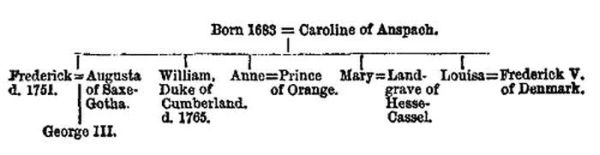
CONTEMPORARY PRINCES.
France. Austria. Spain. Prussia.
Louis XV., 1715. Charles VI., 1711. Philip V., 1700. Frederick William, 1713.
Charles VII., 1742. Ferdinand VI., 1746. Frederick the Great, 1740.
Maria Theresa, 1745. Charles III., 1759.
Russia. Denmark. Sweden.
Peter II., 1727. Frederick IV., 1699. Frederick I., 1720.
Anne, 1730. Christian VI., 1730. Adolphus, 1751.
Ivan VI., 1740. Frederick V., 1746.
Elizabeth, 1741.
POPES.—Benedict XIII., nbsp; 1724. Clement XII., 1730. nbsp; Benedict XIV., 1740. nbsp; Clement XIII., 1758.
Archbishops. Chancellors.
Wake, 1715. King, 1725.
Potter, 1737. Talbot, 1733.
Herring, 1747. Hardwick, 1737.
Hutton, 1757. Northington, 1757.
Secker, 1758.
First Lords of the Treasury. Chancellors of the Exchequer. Secretaries of State.
1727. Walpole. 1727. Walpole. 1727-1757. Newcastle.
1742. Wilmington. 1742. Sandys. 1730. Harrington.
1743. Pelham. 1743. Pelham. 1742. Carteret.
1754. Newcastle. 1754. Legge. 1744. Harrington.
1756. Devonshire. 1755. Lyttleton. 1746. Chesterfield.
1757. Newcastle. 1756. Legge. 1748. Bedford.
1751. Holderness.
1754. Robinson.
1755. Fox.
1757. {Pitt.
{Holderness.
Walpole retains his position.
The ascendancy of Walpole was in great jeopardy on the death of George I. Bolingbroke's intrigues against him, backed by all the influence of the Duchess of Kendal, had indeed been thwarted by the straightforward manner in which George I. had put all complaints against him into the minister's own hands—a striking instance of that love of justice and fidelity to old friends which were the redeeming traits of his otherwise uninteresting character. But Walpole had now to do with a sovereign whom as Prince of Wales he had always opposed, and who had been known to use strong expressions of disapprobation with regard to him. George II., a little, dry man, gifted with the hereditary bravery and obstinacy of his family, but with very limited abilities, and a mind far more easily touched by little things than by broad interests, could not be expected to forget Walpole's opposition, nor to appreciate his calm, tolerant wisdom. When Walpole brought him the news of his father's death, he was at once directed to apply to Sir Spencer Compton, a dull, orderly man, Speaker of the House of Commons and Treasurer to the Prince of Wales. Walpole was wise enough to profess friendship for the new favourite, who even employed the ability of his predecessor to draw up the speech which the King was to deliver to the Council. For some days it was believed that Walpole's power was gone. His usual throng of followers deserted him and crowded to Sir Spencer Compton's levée. But before any definite arrangements had been made, Sir Spencer unwisely gave Walpole opportunities for personally explaining himself to the King. He was thus able to remove the bad impression the King had received as to his foreign policy, and to outbid his rivals in the arrangements he proposed to make for the Civil List, a point very close to the King's heart. He completely succeeded in winning the Queen to his interests; and when she heard that Compton had had to appeal to his assistance in arranging the speech from the throne, she took the opportunity of impressing upon George the absurdity of employing a minister who was obliged to lean for support upon his rival. The Queen's influence, which was very great, turned the scale in his favour. The ministry continued unchanged. Compton, feeling his brief importance at an end, withdrew from the contest, and shortly afterwards accepted the position of President of the Council as Lord Wilmington.
Increase of the Civil List.
The offer which had proved so effective a means for securing Walpole's power consisted of £130,000 to the Civil List, and a jointure of £100,000 to Queen Caroline. The Civil List, which had been settled after the Revolution at £700,000 a year from all sources, had proved insufficient, saddled as it then was with a variety of expenses, such as the judges' and ambassadors' salaries, beyond the mere expenses of the Court. Anne had been £1,200,000 in debt, George I. £1,000,000. Walpole now offered to induce the House to raise it to £800,000 a year, allowing the King to claim anything beyond that sum which should arise from the hereditary revenues.
The influence of the Queen.
Before long Walpole won the entire confidence of the King himself, but it was at first chiefly on the friendship of the Queen that he relied. She was a woman of very considerable ability. Her intellectual fault indeed was an attempt to know too much. She collected around her men of learning of all sorts, dabbled in divinity, dabbled in metaphysics, patronized poetry, and delighted in listening to theological discussions, in which she kept the part of strict neutrality, believing it is thought but little on either side. But her influence in bringing forward men of ability, especially in the Church, was very great. Her sense was excellent, and by means of it, in spite of the King's royal immorality, she contrived to rule him absolutely. She thoroughly appreciated Walpole, and together they pursued that policy, which was no doubt the right one Character of Walpole's ministry. for the maintenance of the Hanoverian succession. This consisted in the pursuit of peace in every direction—peace abroad, peace at home. If any point was strongly contested it was given up; if any abuse was unobserved it was suffered to rest untouched; and in general their object was to let the nation learn by its material prosperity the advantages of an orderly and settled Government. As a consequence of this policy the period of Walpole's government was uneventful, and was occupied rather with the great Parliamentary struggle between himself and the Opposition under Pulteney than by any great national affairs.
Character of the Opposition.
The chief strength of that Opposition consisted of the discontented Whigs, most of whom were driven to oppose Walpole by his insatiable love of power. We have already seen Pulteney and Carteret forced from the ranks of the Government, and all overtures with Bolingbroke rejected. In 1730, Walpole quarrelled with his old friend and brother-in-law Townshend, who was only restrained by his patriotism from joining the Opposition. In 1733, Lord Chesterfield was added to the list. These leaders had behind them a certain quantity of supporters who took the name of Patriots, and wished to be regarded as the true old Whigs, looking upon Walpole with his large majority as seceders from them. There was much plausibility in this view: for the Whig party under Walpole seemed to have become closely attached to the Crown, and was supported principally by Crown influence. As the original principle of the Whigs had been antagonism to the over-great power of the Crown, it could be plausibly urged that they had now assumed the position of their former enemies. The Hanoverian line had ascended the throne with a parliamentary as contrasted with a hereditary title; it had therefore naturally found its chief supporters among the Whigs. With the Hanoverians that party had entered upon power. But the Revolution, while practically subordinating the power of the King to that of Parliament, had constitutionally left it untouched. The Hanoverian kings did not indeed employ it to its full, but placed it in the hands of the minister, who, by means of the royal influence, practically ruled England with as unquestioned a sway as any great minister of the Stuarts. The difference lay in this, that the power of the Crown consisted in the immense influence it possessed by means of pensions, places, and the command of the public money, and worked through the House of Commons, and not in opposition to it. The patriot Whigs were conscious of the power of the Crown, and were true to their principles in opposing it. Their error lay in this, that they did not understand that that power was formidable only so long as there was a venal House of Commons. Eager as they thought for liberty, they formed a close connection with the High Tories and Jacobites, the greatest enemies of liberty; and in their eagerness for office did their best to oppose that Government, which for the present, at all events, was the only safeguard against the restoration of the Stuarts, for the events of 1745 render it plain that danger from the Jacobites was as yet by no means over. In fact, however, principle had little to do with the matter, it was personal animosity to the minister, and anger at exclusion from office, which inspired the Opposition. Even the party names "Whig" and "Tory" were beginning to lose their meaning. By far the greater portion of the House was thoroughly attached to the Hanoverian succession. Some fifty Jacobites sat in it under the guidance of Shippen, and a certain number of country gentlemen, with Wyndham at their head, still retained the title of Hanoverian Tories. But the Parliamentary struggle lay in fact between different sections of the Whigs, either of which, whatever their pretensions may have been when out of office, would probably have acted in much the same way had they succeeded in obtaining it. It was not till the close of this reign and the beginning of the next that the old party names began again to acquire significance. It had become evident that the power and influence of the Crown, but little diminished, as has been said, at the Revolution, had as it were been placed in commission in the hands of the great leaders of the Whig party, who by means of their own Parliamentary influence, added to the King's power which they wielded, had assumed a monopoly of the Government antagonistic at once to the Crown and to the people. Those who regarded this condition of things as a disturbance of the old balance of the Constitution began to rally round the King, and when George III. resumed into his own hands the power of the Crown and broke with the Whig oligarchy, he found his support in this new Tory party.
Strength of the Government.
To oppose the many able men whom enmity to the ministers had driven into the ranks of the Patriots, the Government had little more than the inert strength of an unfailing majority to show. Besides Walpole himself, whose talents were unquestioned, the Government consisted of somewhat second-rate men, such as Newcastle, whose fussy silliness was a constant theme of jest, Stanhope, Lord Harrington, an excellent diplomatist but no politician, and Lord Harvey, a clever but bitter and effeminate courtier. But the Government was supported on almost every question of importance by a vast majority of the House, whose votes the surpassing skill of Walpole as a manager secured—many of them by small places and pensions, or other "considerations," as bribes were then called. That Walpole reduced the purchase of a majority, a practice by no means unknown, to a system must be allowed. It may be urged in his favour, that he used, but did not cause, the venality prevalent among all public men of the time, and employed it so as to secure what was upon the whole the government most advantageous for England at the time.
Depression of the Jacobites.
The folly of the Pretender spared the minister all trouble with regard to the Jacobites, for James had succeeded in alienating his ablest partisans. He had quarrelled with Atterbury as he quarrelled with Bolingbroke, he had excited scandal by his quarrel with his wife, and had suffered an unworthy favourite, Colonel Hay, or Lord Inverness as he called himself, to supplant all his better partisans in his favour. And when the death of Lord Mar was followed by that of the Duke of Wharton and of Atterbury in 1732, the Jacobite cause fell into the hands of very inferior agents, whose intrigues, insignificant as they were, seem to have been thoroughly known by Walpole.
It was thus with one source of danger practically removed that Walpole resumed the threads of foreign policy. The last reign had European complications. closed before peace had been concluded with Spain, and while there were still unsettled difficulties with the court of Vienna, although preliminaries had been signed both in Paris and in Spain by what is known as the Convention of the Pardo. It must indeed have been obvious that the Treaty of Vienna, plausible as it seemed, could not have been a lasting treaty. The Bourbons were upon the throne of Spain, and the close junction of the houses of Bourbon and Hapsburg was an impossible contradiction of all history, especially as the desire which was really the moving passion of the Spanish court, the establishment, namely, of a Spanish kingdom in Italy, was fundamentally opposed to the interests of Austria. At the same time the shadow of the approaching dissolution of his kingdom at his death was constantly overhanging the Emperor. No ideas of present greatness, not even the hope of restoring the Empire to the position it had held under Charles V., appeared in his eyes so important as to secure the reversion of his own estates for his daughter, according to the Pragmatic Sanction, by which, in 1713, he had arranged the succession to his hereditary kingdoms. It was impossible for him to hurry into a general war, which must of necessity prevent the acceptance of that arrangement. There was already a strongly expressed feeling in Germany against the marriages on which the Vienna Treaty rested, and which might have the effect of placing a Spaniard on the Imperial throne. The threatened secession of his chief allies, and the fear of postponing the acceptance of the Pragmatic Sanction, were sufficient reasons to induce the Emperor to withdraw from his bargain. He therefore accepted the mediation of France, where Fleury, though he probably never forgot the old policy of the country which he governed, always apparently exhibited a love of peace; and it was agreed that disputed points should be referred to a general Congress to be held at Aix-la-Chapelle, but subsequently moved to Soissons.
Congress at Soissons.
At the Congress the Emperor, afraid of exciting the national prejudices of the Germans, entirely deserted his Spanish allies, and instead of hastening a favourable negotiation, perpetually threw obstacles in the way. As far as England was concerned, the great point at issue was Gibraltar, which Spain had already besieged in vain. The ministry, both before and now, seem to have regarded the surrender of it as neither impossible nor very injurious; the view of the nation was very different. But as is so often the case, the Congress came to very little. Spain, finding herself deserted by Austria, and observing that the Congress was falling Treaty of Seville. Nov. 9, 1729. to pieces by constant delays, had recourse to a direct treaty; and on the 9th of November 1729 the celebrated Treaty of Seville was signed. It was a defensive alliance between England, Spain and France, to which Holland subsequently acceded. Spain revoked all the privileges granted to Austrian subjects by the treaties of Vienna, re-established English trade in America on its former footing, and restored all captures. The Assiento was confirmed to the South Sea Company, and arrangements made for securing the succession of Parma and Tuscany to the Infant Don Carlos, by substituting Spanish troops for the neutral forces, which since the Preliminaries had been occupying those countries.
The Emperor now found that he had outwitted himself. He had clung to the Treaty of Vienna just long enough to irritate two of the Disappointment of the Emperor. great countries of Europe, he had put difficulties in the way of its completion, and hesitated about fulfilling it, just long enough to irritate the third. Old friends and old foes had made common cause. His hopes for the Pragmatic Sanction seemed entirely gone. It was not likely that he would sit down quietly while Spanish troops occupied fortresses in what he considered his dominions. He broke off all diplomatic relations with Spain, sent troops into Italy, and on the death of the Duke of Parma seized his duchy. But all men really knew that the bribe was ready, if they would only give it, to put an end to all his opposition. And the impatient Queen of Spain—angry with the shilly-shally policy of her new allies (who would not insist with sufficient rapidity on the completion of the Seville treaty), throwing over France, which she regarded as the chief delinquent in the matter—joined with England and Holland to offer the long wished for guarantee. Thus at length by the second Treaty of Vienna all the much vexed questions were decided. Austria was glad to accept the Second Treaty of Vienna. March 16, 1731. terms proposed at Seville, agreed to destroy the Ostend Company, to establish Don Carlos in his duchies, and not again to threaten the balance of European power. And in 1732, under the escort of English ships, the Spanish troops took possession of the disputed fortresses.
Complete supremacy of Walpole.
Both these treaties were arranged in accordance with the pacific views of Walpole. When the second was concluded he was absolute master of affairs in England; for almost immediately after the Treaty of Seville the old jealousy which had long smouldered between him and Townshend burst out, and Townshend had found it necessary to withdraw. Townshend was a proud, rough man, ill fitted to play the subordinate part which Walpole was determined to thrust upon his colleagues. Besides general ill-feeling, several specific grounds of difference existed between them. The first Treaty of Vienna had greatly irritated Townshend, who would have wished to avoid all compromise and to proceed to extremities with the Emperor. The link which had bound the brothers-in-law together had been broken by the death of Lady Townshend, Walpole's sister; and Walpole's conduct with regard to the Pension Bill supplied a fresh ground of quarrel. The Opposition had discovered, without exactly tracing it to its constitutional The Pension Bill. source, the power of the royal influence, and early in 1730 Mr. Sandys introduced the first of those Bills for restraining it which became from this time onwards one of the regular weapons of attack against the ministry. He moved for leave to bring in a Bill to disable all persons from sitting in Parliament who had any pension direct or indirect from the Crown, and proposed that every member as he took his seat should swear that he held no such pension. The attack was exceedingly well judged, for it gave expression to a very general feeling, and Walpole, who studiously avoided shocking the feelings of any large section of the nation, was at some loss how to meet it. But he knew that he could rely upon his great Whig supporters in the Upper House, and of that House Townshend was the leader. Walpole therefore suffered the Bill to pass the Lower House without opposition, so that it was upon Townshend and the Lords that the whole odium fell when, as a matter of course, they rejected it. On these and various other grounds such ill blood sprang up between the brothers, that it is told, though upon doubtful authority, that they nearly came to blows at an entertainment in the house of Mrs. Retirement of Townshend. 1731. Selwyn. It was impossible that both the ministers should remain in office; the influence of the Queen turned the scale in favour of Walpole, and Townshend resigned, withdrawing with unusual patriotism from political life, and devoting himself at Reynham, his house in Norfolk, to the improvement of agriculture. It is to him that we chiefly owe the cultivation of turnips. This change, by allowing a proper rotation of crops, and thus avoiding the necessity of leaving fields to lie fallow, added nearly a third to the cultivable area of England, while by supplying large quantities of cattle-food from a comparatively small space of ground, it enormously increased the food-producing resources of the country.
Walpole's home government.
For two years the ascendancy of Walpole was unquestioned. He was enabled to turn his thoughts to domestic improvements. English was substituted, certainly most reasonably, for the ancient Law Latin in all legal proceedings, to the grief it is said of some conservative lawyers, and against the opposition of most of the judges. There was a Committee of Inquiry also into the condition of public prisons, which brought many revolting horrors to light. Both in the Fleet and Marshalsea torture by thumbscrew and otherwise was constant, and the condition of poor prisoners who could not bribe the gaolers was inconceivably horrid. Forty or fifty of them, for instance, were locked up for the night in a cell not sixteen feet square. Gaol-fever and famine were constantly destroying them, so that the deaths at one prison were frequently eight or ten a day.
His financial measures. 1733.
But it was as a financier that Walpole was most favourably known, and somewhat strangely it was a great financial reform in the year 1733 that almost brought him to ruin. Walpole was desirous of lessening even the weak opposition by which he was confronted in Parliament; and in the hope of attracting to himself the country gentlemen, he appealed, in accordance with his usual principle, to their love of money, and sought some way to lessen the Land Tax. For this purpose he suggested an excise upon salt. This must have been contrary to his own convictions. He could not have been ignorant how important an article salt is in many manufactures, how necessary an article of purchase even among the poorest. He was in fact taxing the poor and the manufacturing classes for the sake of winning the landed interest, which would be called upon to pay a land tax of one instead of two shillings. The new duty was carried, but by no large majority. The chief argument against it was that it was a step towards a general excise, which, because it seemed to infringe on the rights of the subject by giving revenue officers the right of entering houses, was much detested, and regarded as a badge of servitude. Although the tax upon salt was not really intended as a beginning of a general excise, it was nevertheless true that Walpole had a scheme of that nature in his mind: for it was found after a year's experience that the new tax upon salt fell short by two-thirds of the sum required to admit of the reduction of the Land Tax to one shilling. It was to a new measure of excise that Walpole looked to supply the deficiency. The excisable articles at that time were malt, salt, and distilleries, and the produce of the tax in 1733 was about £3,200,000. When Walpole's project of extending the excise got wind it proved most repugnant to the people. Numerous meetings were held, and many members were instructed to vote against any such attempt. But when the project was brought before the House, then in Committee, it appeared that Walpole, disowning all intention of establishing a general excise, confined himself solely to the duties on wine and tobacco; and even on those commodities designed no increase of the present duties, but merely a change in the manner of collecting them. In future the dues were to be collected after the manner of an excise from the retailers, and not as heretofore in the form of customs at the ports. Fraud and smuggling were so prevalent that in tobacco alone the customs, which ought to have produced £750,000 a year, produced in fact only £160,000. As these frauds took place chiefly at the ports or along the seaboard, Walpole hoped by taxing the retail trade, and not the importation, much to lessen them. In addition to this, he would have established a system of warehousing without tax for re-exportation, thus making London a free port. It was undoubtedly an excellent plan. As he pointed out, it was the shops and warehouses alone which were under supervision, not the houses of the retailers; liberty was in no way infringed; it enabled him to remit the Land Tax to the advantage of the country gentlemen; the scheme was advantageous to the importer, who could re-export free of duty; the price of the commodity was not raised. But none the less did it meet with the most violent opposition. Wyndham likened it to the unjust imposts of Empson and Dudley, and Pulteney derided it as a vast plan to cure an almost imaginary evil. The people beset the doors of the House during the debate in great crowds, irritating Walpole till he let fall the unhappy words—"It may be said that they came hither as humble suppliants, but I know whom the law calls sturdy beggars;" an expression which was never forgiven. The resolution was carried, but by an unusually small majority. On this and subsequent motions a Bill was founded, and in the course of many discussions a new cry was raised by Pulteney, that, as most of the seaport boroughs were already in the hands of one or the other branch of the administration, this was a plan for bringing inland towns under the same influences; and before the Bill came to a second reading, the ministerial majority of sixty had dwindled to sixteen. The excitement became dangerous; even the army was infected, and Walpole, according to his usual principle, yielded to the violence of the storm and withdrew the Bill. But though thus thwarted, he did not forego his revenge on the defaulters of his own party. Chesterfield, the ablest man in the ministry, Lord-Steward of the Household, was somewhat rudely dismissed. Lord Clinton, the Earl of Burlington, the Duke of Montrose, the Earls of Marchmont and Stair, and by a questionable exercise of prerogative the Duke of Bolton and Lord Cobham, were deprived of their commission in the army,—an arbitrary act not lost sight of by the Opposition.
His pacific foreign policy.
As Walpole, true to his principles, had purchased peace at home by concession, we find him the next year for the same object keeping entirely aloof from a new war which had broken out in Europe. The Peaces of Seville and Vienna had apparently completed the arrangements of the Treaty of Utrecht, and settled all differences between the courts of Spain and Vienna; but treaties based upon arbitrary territorial arrangements for the purpose of preserving the balance of power are always very liable to be broken. Neither Fresh European war. party considers itself quite fairly treated, and is ever on the look-out for some opening to regain its lost power or to acquire some new influence. The Peace of Utrecht had closed the War of Succession, undertaken solely to establish the balance of power in Europe, and had been exactly such a treaty as has been described. The Peaces of Seville and Vienna had been necessary to modify in some degree its arrangements. A quarrel as to the election of a new King of Poland was sufficient to render for the time all three of them useless. It will be remembered that the French King had married the daughter of Stanislaus, ex-King of Poland. All French influence therefore was now employed to secure his re-election, while the Czarina Anne of Russia and the Emperor strongly upheld the claims of Augustus, son of the late King. A Russian and a Saxon army were sufficient to secure the throne for Augustus; but the Emperor's interference, although indirect, had enabled Fleury to show himself in his true colours, to listen to that great section of his countrymen who were weary of the lengthened peace, and to bring on a war which promised to be far more advantageous to France than any success in Poland could have been. In his attack upon Austria he was joined at once by Spain: for the Queen, the real ruler of the Peninsula, was still discontented with the losses Spain had suffered by the late treaties, and was besides very anxious to secure a crown for her son Don Carlos, who was already Duke of Parma. There was a short campaign upon the Rhine, where Berwick commanded the French, Eugene the Imperial army. Though the French lost their general before Philipsburg, they were everywhere successful, and when the united armies of Spain and Sardinia threw themselves on the kingdom of Naples, they found no great difficulty in conquering the Austrians, and completing the conquest of that country and of Sicily by the victory of Bitonto. Don Carlos assumed the kingdom as Charles III.
Definitive Peace of Vienna. Nov. 8, 1738.
Nothing could induce Walpole to side with either party in this war, although he suffered much obloquy for refraining from it; and the Emperor, unable to secure his assistance, allowed the pacific mediation of France and England to have its weight. Preliminaries of peace were set on foot (Oct. 1735), which ripened in three years into the great treaty called the Definitive Peace of Vienna, by which the Spanish house was allowed to retain Naples and Sicily. Sardinia was rewarded with some frontier towns, among others Novara and Tortona, Lorraine was ceded to France, and the young Duke of Lorraine, Francis, the affianced husband of Maria Theresa (heiress to the Austrian Empire), was persuaded to accept Tuscany in exchange. France and Sardinia again ratified the Pragmatic Sanction. This somewhat trivial war thus completed the incorporation of France, established the Bourbons in Naples, and was the cause of the connection between Tuscany and the Austrian house.
Increasing opposition to Walpole. 1734.
Walpole had been more than usually anxious to keep clear of European wars, because the time for the dissolution of the Parliament under the Septennial Act was rapidly approaching, and there seemed every reason to believe that the struggle at the coming election would be a very fierce one. The Opposition were already supplied with several very effective cries. The Excise scheme, the arbitrary punishment of his opponents, and his determination to keep up a standing army, would all powerfully excite the people against the minister. Before the dissolution they added one more cry against him by making a strong attack upon the Septennial Act. As most of the Opposition Whigs had voted for this Act, they had always shrunk from demanding its repeal. It required all the skill of Bolingbroke, the wire-puller of the Opposition, to induce the two parties to unite in the assault. The debate is interesting, as showing in a great speech of Wyndham the temper of the Opposition and the sort of charges to which Walpole was exposed. "Let us suppose," said Wyndham, "a man abandoned to all notions of virtue and honour, of no great family, and of but a mean fortune, raised to Wyndham's speech against Walpole. be chief Minister of State by the concurrence of many whimsical events, afraid or unwilling to trust any but creatures of his own making, and most of them equally abandoned to all notions of virtue or honour, a man ignorant of the true history of his country, and consulting nothing but that of enriching and aggrandizing himself and his favourites; in foreign affairs trusting none but those whose education makes it impossible for them to have such knowledge or such qualifications as can either be of service to their country or give weight or credit to their negotiations. Let us suppose the true interest of the nation by such means neglected or misunderstood, her honour and credit lost, her trade insulted, her merchants plundered, her sailors murdered; and all these things overlooked only for fear his administration should be endangered. Suppose him next possessed of great wealth, the plunder of the nation, with a Parliament of his own choosing, most of their seats purchased, and their votes bought at the public expense. Let us suppose attempts made to inquire into his conduct, and the reasonable request rejected by a corrupt majority of his creatures.... Upon this scandalous victory let us suppose this chief minister pluming himself in defiances, because he finds he has a Parliament, like a packed jury, ready to acquit him at all adventures. Let us suppose him arrived to that degree of insolence as to domineer over all the men of ancient families, all the men of sense, figure, or fortune in the nation, and as he has no virtue of his own, ridiculing it in others, and endeavouring to destroy or corrupt it in all.... Then let us suppose a prince, ignorant and unacquainted with the inclinations and interests of his people.... Could there any greater curse happen to a nation than such a prince on the throne, advised and solely advised by such a minister, supported by such a Parliament?" Walpole replied in a speech scarcely less vigorous, unveiling the secret influence of Bolingbroke, attributing to him the whole management of the Opposition, and pointing out his vast ambition and unequalled faithlessness.
The election, after a severe struggle, ended by giving Walpole a large majority, although considerably smaller than he had hitherto commanded. The depression of the Opposition was great, especially as Bolingbroke, weary of all exclusion from power, and involved in quarrels with Pulteney, withdrew to France.
Prince of Wales head of the Opposition. 1735.
The leadership which Bolingbroke thus resigned fell in some degree into the hands of the Prince of Wales, not indeed that he possessed any of the talents of a leader, but that he formed a rallying-point for all sections of the Opposition. From his first arrival in England, in 1728, there had been the usual differences between him and his father. He had thought himself ill-used in the matter of his intended marriage with Wilhelmina of Prussia, whom, though he had never seen, he pretended to adore. The mutual dislike of the fathers of the proposed bride and bridegroom had broken off that match. He had since married a sensible wife, Augusta of Saxe-Gotha. But it was the parsimony of his father which had principally excited his displeasure. He held his income of £50,000 a year entirely at his father's will, whereas his father when Prince of Wales had £100,000 secured to him. But parsimony was the ruling passion of George II., and nothing could persuade him to increase his son's income. Round the Prince had collected all the great leaders of the Opposition; Pulteney, Chesterfield, Carteret, Wyndham and Cobham were intimate with him, and Bolingbroke was his political instructor. Nor was this all. Although the Queen had a love of literature, and in some ways patronized clever men (especially in the matter of Church preferment), Walpole had always refused to show them the least favour; and as a natural consequence, all the better writers allied themselves closely with the clever men of the Opposition, especially with Bolingbroke, who had always been their friend. Swift, Pope, Gay, and Arbuthnot, were constantly writing vigorously against Walpole. "Gulliver's Travels" are full of strokes of satire against the conduct of affairs. Some of Pope's sharpest lines refer to the Queen's implacability towards her son. The "Beggars' Opera" of Gay was regarded as being directed almost entirely against the Government. The "Quarrels between Peacham and Lockit" were by some thought to allude to the quarrel between Townshend and Walpole;[4] and in the Craftsman, the organ of the Opposition, letters of the most virulent description were constantly published against Walpole. To this brilliant Court it was natural that the younger men rising to notoriety should ally themselves. The intellect of the political world seemed there to be centred, and the specious name of Patriot was apt to attract enthusiastic youth. Pitt and Lyttelton began their political career as members of this Opposition.
It was not till the year 1737 that a public outbreak between the King and Prince took place. In the preceding year an event had happened, which, though of little historical importance, has been rendered interesting by Sir Walter Scott in his "Heart of Midlothian." During the King's absence in Hanover the Queen was left Regent. Two smugglers, Wilson and Robertson, were imprisoned in the Tolbooth, and tried to escape. Wilson went first, but being a big man, could not get through the aperture they had made. Feeling that he had injured Robertson, on the following Sunday in church he succeeded in grasping one of his guards in each hand, and a third with his teeth, thus giving Robertson an opportunity of escape, of which he availed himself. A strong sympathy was excited for Wilson, and after his execution the soldiers were attacked with stones. Porteous, who commanded the guard, fired upon the crowd. For this he was tried and condemned to death, but, in consideration of the provocation, was reprieved by Queen Caroline. The people, enraged at this, organized a riot, and though notice was given to the magistrates, no efficient means were taken for suppressing it. The gates were locked, and the commander of the troops, frightened by Porteous' example, refused to act. The Tolbooth was broken open, and Porteous hanged to a barber's pole, all with the greatest order and regularity. Having done this, and paid for the rope with which they hanged Porteous, the crowd dispersed, nor could any of the rioters be detected. The Queen, regarding the disturbance as a personal insult to her authority, was extremely angry. It was proposed to abolish the Edinburgh city guard and the city charter, level the gates, and declare the provost incapable of holding any office. The opposition of the Scotch members and of the Scotch nobles was however too great to be disregarded, and ultimately the city being fined £2000, and the provost declared incapable of office, no further punishment was inflicted.
Quarrel of the King and Prince. 1737.
During this year the Prince of Wales had married. But this by no means tended, as it was hoped, to the union of the Royal Family, for the Prince at once renewed his demands for an increase of income. He determined at length to follow Bolingbroke's advice, and demand that the sum he received should not depend on the King's will, but be permanent and fixed by the Parliament. This threat induced the King to make some overtures, with a promise to give the Princess a jointure. They were rejected, however, and the battle fought out. The great flaw in the organization of the Opposition was then made manifest, for the Tories (forty-five in number) refused to vote in favour of a Hanoverian prince, and the ministers were victorious. This dispute was followed by a still more scandalous squabble, the Prince hurried his wife from the King's residence at Hampton Court to the empty palace of St. James's when she was on the point of giving birth to her first child, who would be in the direct line of succession to the throne. This insult was never forgiven, and the King gave his son a peremptory order to leave the Court. He withdrew at once to Norfolk House in St. James's Square, Death of the Queen. which became the centre of the Opposition. The Queen remained implacable, refusing to see him even on her deathbed. Her death happened within a few weeks of this unhappy quarrel, to the great loss of the King, whose want of intellect she had chiefly supplied, of Walpole, whose staunch friend she had always been, and indeed of all England, for by seconding Sir Robert's views she had been mainly instrumental in securing for it that period of comparative rest which was so much wanted to re-establish its wellbeing after the troublous time of revolution it had passed through. It was believed that Walpole's power had rested chiefly on her influence, and there was a general expectation that her death would be followed by his downfall. The Opposition were much disappointed when they found his influence with the King as great as ever. It is Walpole retains his influence with the King. said that with her parting words she had recommended the King to continue to trust in her favourite minister; and her advice was then as always followed by him. For though he was not a faithful husband, having had Lady Suffolk for his mistress during the first years of his reign, and now allying himself with Sophia de Walmoden, created Countess of Yarmouth, his mistresses never had any great political influence over him—no influence at all events comparable to that exercised by the Queen.
The Opposition attacks his pacific policy.
The Opposition, though disappointed, by no means relaxed its efforts, and found a favourable point of attack in Walpole's pacific tendencies. There were still several points of dispute unsettled with Spain. The limits between Georgia and Florida were undetermined. By the Treaty of Seville trade was established on its former footing between the two countries, and the commercial relations between them were therefore regulated by the somewhat indefinite treaties of 1667 and 1670. By these the right of search and the right of seizure of contraband goods was allowed to the respective nations. This right was exercised with varying severity by the Spaniards according to their relation with England at the time. But the trade of English America had very much increased, and would not be restrained from seeking legally or illegally the trade of South America. There was no doubt abundant smuggling. Even the South Sea Company, which was allowed to send one ship a year, contrived in fact much to increase that number by sending tenders with her, which secretly replenished her cargo as she parted with it. On the other hand, it is equally certain that the Spanish Guarda-Costas had exercised their authority roughly, and many tales of the ill-usage of British subjects were current. These stories were collected and brought up in Parliament by the Opposition, the best known being that of Jenkin's ear. Jenkin was a captain, who asserted that his ear had been torn from him, and that he had been bidden to take it to his king. "Then," said he, "I recommended my soul to God and my cause to my country." The George desires war. ear, wrapped in cotton, he was in the habit of showing to his listeners. This claptrap story was most effective in rousing the popular indignation. Walpole resisted the clamour, but met with great difficulties. The King, who was at heart a soldier, now freed from the peaceful influence of his wife, was urgent for war; and in the Cabinet itself Newcastle began to bid for increased power by favouring this desire of the King.
In this eagerness for war, which is frequently represented as a folly on the part of the nation, the people were probably really wiser than their rulers. The state of Europe was becoming such that war was necessary for England, if she was to uphold her position, and to obtain that paramount situation in commerce and on the sea which her people then as now regarded as her due. Walpole's peace policy was certainly directed rather to the aggrandizement of his party than to the general interest of the nation, and in pursuit of it he had allowed himself to be duped by the pacific language of Cardinal Fleury. His attention had been distracted from the broader lines of European politics to the details of the constantly shifting diplomacy of the time. It is now known that, as early as 1733, the Family Compact had been entered into between the two branches of the House of Bourbon, for the express purpose of hampering the trade of England, and with a stipulation for mutual assistance both in war-ships and privateers in case of any encroachment on the part of England. Nor was the agreement a dead letter. M. de Maurepas had been busily and successfully employed in reorganizing the French navy.
Walpole attempted at first to pursue his established policy of peace. He opened negotiations with Spain, supported by such signs of coming hostilities as induced that Court to agree to a convention. Many English prisoners and some English prizes were restored, and Negotiations with Spain. 1739. compensation was promised to the amount of £200,000. Against this, however, was set £60,000 to be paid by England for the destruction of Spanish ships by Admiral Byng in 1718, and in his eagerness for prompt payment Walpole suffered it to be further reduced to £95,000. The disputed points were left for further negotiation. No mention was made of the right of search; the limits of Georgia were not defined. When this convention became known the popular indignation was great. It was regarded as a resignation of our rights. The ridiculously small sum given for compensation was pointed out, and the payment of £60,000 for what the people regarded as a glorious victory was naturally much resented. It was in opposing this convention that Pitt seems first to have shown his great powers of oratory. The ministerial majority was only twenty-eight. Believing that they could now safely proceed to extremities, the Opposition determined upon seceding from the House. With the arguments all on one side, and the votes upon the other, it was impossible, they said, for them to continue to do their duty there. It was a foolish manœuvre, which, though tried more than once, has never been successful. To the public it invariably appears factious, and as no Opposition has been found determined enough to keep it up for any length of time, it has always been made ridiculous by the speedy return of the seceders. In the present instance Walpole sarcastically thanked the Opposition for their withdrawal, and proceeded at once to pass several measures which would otherwise have been sharply opposed; among others, a subsidy to Denmark for a palpably Hanoverian object—the security, namely, of the little castle of Steinhorst in Holstein.
But though he had carried his convention, and although the Opposition had withdrawn, and Cardinal Fleury had offered the mediation of France, it became obvious to Walpole that he must either declare war or resign. His love of power prevented Walpole declares war rather than resign. him from taking the latter and more honourable course, and, to the loss of both power and fame, he suffered himself to be dragged against his convictions into war, which was declared on the 19th of October. The joy of England was very great, although Walpole was full of gloomy forebodings, for, as he himself said, "no man can prudently give his advice for declaring war without knowing the whole system of the affairs of Europe as they stand at present.... It is not the power of Spain and the power of this nation only that we ought in such a case to know and to compare. We ought also to know what allies our enemies may have, and what assistance we may expect from our friends." He felt certain that the area of the war would soon be extended, for, although he had successfully used his efforts to maintain friendship with France, he knew that there was an intimate connection between France and Spain which must sooner or later bring the former into the field. Moreover, his information as to the plans of the Jacobites was exceedingly accurate, and while the Opposition were constantly deriding the notion of any formidable organization of that party, he never ceased to be on his guard against it. The justice of his views was at once shown, when the declaration of war called to life the slumbering energy of the Jacobites. Intrigues were immediately set on foot; a Committee was appointed in England; overtures were addressed to Spain; and, as Fleury gradually grew colder and more estranged from England, proposals were made to him also, to which he listened, and promised that he would send a body of troops, probably the Irish Brigade, to support any attempt in favour of the Stuarts; thus would be fulfilled the condition without which the English Jacobites had always refused to rise. It was hoped that the Duke of Ormond and the Earl Marischal might make a simultaneous expedition from Spain.
Increased vigour of the Opposition. 1740.
Meanwhile, Walpole, having once yielded, seemed conscious that he no longer possessed the absolute dominion over Parliament he had so long enjoyed. Wyndham, his chief enemy, indeed had died: but in the ranks of the Opposition were still to be found all those men of ability whom twenty years of exclusive and jealous power had made his enemies; and to his old foes was now added the exciting eloquence and uncompromising energy of Pitt. To oppose this formidable body Walpole stood almost alone in the Commons, supported only by such men as Henry Pelham, a conscientious and sensible but not first-rate man, Wilmington, and Sir William Young, whose ready ability scarcely atoned for his damaged character. In the House of Lords he still counted the Duke of Newcastle, Lord Hervey, and Lord Hardwicke among his party. But Hardwicke and Newcastle were both opposed to his peaceful views, and the latter was already intriguing against his chief. The Duke of Argyle had lately become hostile to the ministry, and had been deprived of all his employments. Walpole thus became the single object of all the Opposition invectives. Every measure for the last twenty years which had either failed or been unpopular was brought against him. The quarrel had become personal between him and the Opposition. His efforts to retain his power were unceasing. He yielded in the Cabinet as to the manner in which the war was to be carried on; he gave the chief command of the expedition in the West Indies to his political enemy Vernon; to secure the Jacobite votes at the next election he even went so far as to enter into correspondence with the Pretender, although probably without serious intentions. But this conduct did but encourage his enemies, and in the last session of Parliament (1741) Mr. Sandys brought forward a motion, which was repeated in the Upper House, for his removal from the King's councils. Walpole so far rebutted the charges brought against him, that, after a defence of great eloquence, he succeeded in throwing out the motion by a very large majority.
Ill success of the war.
Walpole's forebodings were speedily fulfilled. Not only, as we have seen, was the Jacobite party at once again called to life, but his expeditions against Spain were by no means great successes. Anson indeed, although all his other ships were lost, made several successful attacks upon treasure-ships, captured Paita, and succeeded in bringing 'The Centurion' safe home after a circumnavigation of the globe. But Vernon, though successful in taking Porto Bello (when his conduct was vociferously contrasted by the Opposition with that of Hozier in 1726),[5] was repulsed with heavy loss in an assault on Carthagena. France had become thoroughly hostile, and when, on the 20th of October 1740, the Emperor Charles VI. died, it became evident that the war would shortly become European. In spite, however, of these proofs of Walpole's foresight, in spite of his success against Mr. Sandys' motion, the charges which had been brought against him had such an effect at the next election that the Opposition found themselves with much increased strength, and it became pretty plain that the Government would have but a very small majority. The session opened with a series of close divisions. The Opposition succeeded in carrying their Chairman of Committees against the Government candidate, and when he found Walpole resigns. 1742. himself at last defeated on the Chippenham election petition, Walpole took the resolution of resigning. A few days later he gave up all his places, and was made Lord Orford.
Review of Walpole's ministry.
Thus closed the career of the statesman who for twenty years had been the sole guide of English politics. It is remarkable how few great measures can be traced to him; but he probably displayed true wisdom in allowing all reforms, however much they may have been required, to remain for a time in abeyance. The one thing which England required was rest. The last hundred years had been one continual scene of political turmoil. During the whole of that period the Revolution had been slowly working itself out, and the English Constitution had been changing. The power had gradually shifted from the King to the House of Commons. The ministry had ceased to be a body of secretaries, to whom was indeed intrusted the chief management of all national affairs, but who, inasmuch as they were still in theory, and in a great degree in practice, merely called upon to execute the King's commands, might be chosen indiscriminately from all parties. Instead of this it had become, what it has practically ever since been, a Committee of the majority in the House of Commons. In a social point of view, during much of the same period, England had been perplexed by a choice of masters, and in some degree by a choice of religions. Walpole seems thoroughly to have understood this position, and to have set himself steadily to work to complete and give stability to the changes which had been going on. He had seen, that far more important than any further improvements to the Constitution was the establishment on a firm footing of what had already been done. His chief object was therefore to make himself absolute master of the House of Commons. For this purpose he used means which we should now consider disgraceful. He is reported to have acted on the principle that every man had his price. He steadily opposed all efforts for the exclusion of pensioners, not from a wish to increase the power of the Crown, but because he wanted to secure the power of the minister, who he saw must henceforward be the real governor of England. He opposed the Peerage Bill because it threatened to increase the power of the Lords as against the Commons. He persistently refused all attempts at coalition (such as had been contemplated by Stanhope and subsequently proposed by Bolingbroke), because he wanted the ministry to be the representatives of the party which had the majority in the House, and of that party only. He kept a tight hand throughout his administration upon the Jacobites, conscious that the security of the reigning house was the only way of calming the uneasiness which all classes felt while they had any choice of rulers offered them. For similar reasons, with regard to religion, he refused to listen to any propositions for the relief of Roman Catholics, which Stanhope had also contemplated; and still further to calm religious discords by the sense of one strong paramount Church of England, he also refused all concessions to the Dissenters, although they systematically supported him. In saying, however, that the power had passed to the House of Commons, we must be careful not to regard the House of Commons as a popular assembly. The next phase of our history, the complement to that part of the Revolution which we have now passed, is the struggle of the people to get possession of their own House. At the time of which we are speaking the House of Commons was so filled with nominees of great lords, the electoral body was so limited, and the distribution of seats so arbitrary, that the House of Commons could in no way be regarded as a fair representation of the people, and the great Whig majority rested not on the liberal feeling of the nation, but upon an oligarchy of great Whig nobles. In his foreign policy Walpole was influenced by similar principles. Though the Peace of Utrecht was a Tory peace, its maintenance, and that of the balance of power it had established, was his chief object. Anything was better than that England should be engaged in war. War at once opened the door for Jacobite hopes. War at once touched that material prosperity which was to be the surest claim of gratitude to the reigning house. Moreover, as a financier, Walpole hated war. It was in this capacity, if we set aside his general ability and skill in management, that Walpole was greatest. We have seen how prudently he re-established credit after the bursting of the South Sea bubble, and how wise was his plan in his ill-fated Excise Bill. If some of his measures (as the Salt Tax) were dictated by political rather than economical necessities, it is yet certain that he inspired universal confidence, and owed much of his power to the support of the moneyed interest. His personal character, like that of most of his contemporaries, was not good. A large, coarse-looking person did not belie the coarseness of his tastes. He drank freely, joked coarsely, and had more than one natural child. Although in one of his speeches he plumes himself on having never been charged with corruption, his private fortune was certainly much increased by his ministry, and if we except his collection of pictures at Houghton, there is no sign that he had any appreciation of literature or of the arts. His ignorance of literature, and his contempt for it, is indeed notorious. He spent vast sums of money in purchasing the services of pamphleteers; scarcely one of them was worth anything. He seems to have regarded writing like any other trade, as being capable of being purchased by the piece. Patronage to literary men he systematically refused; we therefore find all the able writers of the time ranged on the side of the Opposition; and it is for the same reason perhaps that the worst points of his character are those which are more commonly known.
The chief fault of Walpole had been his jealousy of talent; on his fall there was no one in the ministry of sufficient influence to take up the reins which had fallen from his hands. Had there been any The new ministry under Wilmington. great difference of principle between him and the Opposition, a complete change of ministry would naturally have resulted. But both the Government and the Opposition had been in the main Whigs. Any man of commanding intellect might have kept the late ministry together. As it was, a sort of coalition was made. Pulteney, it is difficult to say why, avoided the responsibility of the Premiership, and withdrew into insignificance in the Upper House as Lord Bath. The nominal head of the new Government was Wilmington, that same dull man who had for a moment thought to supersede Walpole at the beginning of the reign. Under him many of the old Cabinet were retained; Newcastle, Hardwicke, and Young keeping their offices. The new element was represented by Argyle, who was reinstated as Master of the Ordnance, Carteret, who succeeded Lord Harrington as Secretary, and Sandys, who became Chancellor of the Exchequer. Of Tories there appeared none, and Chesterfield and Pitt were excluded from the arrangement.
So slight a change in the construction of the Government seemed but a poor termination to the fierce opposition to which Walpole had been subjected. In fact, the rivalry had been one of persons Character of the new ministry. and not of principles. The ministry were compelled indeed, by pressure from without excited by their own clamours, to institute a Committee to inquire into the conduct of the great Prime Minister. But though it consisted principally of his personal enemies, too many interests were at stake to render their task easy; and when their report came, it appeared so trumpery, when compared with the charges which had been lavished upon the minister in Parliament, that it was a mere object of ridicule. It seemed as though the system of Walpole was after all to be continued. Many of his followers still remained in the Cabinet, as the Pelhams (Newcastle and his brother Henry Pelham), and Yorke, Lord Hardwicke, and even the virtual Prime Minister, his enemy Carteret, was obliged by stress of circumstances to adopt that very Hanoverian policy which had so often been laid to the charge of the late minister. Carteret was a man of genius, but of irregular life, and so capricious, and sudden in his actions, that his administration has been called the drunken administration. Disregarding home patronage for the higher and more exciting work of foreign diplomacy, he found his influence gradually and surely passing into the hands of the Pelhams. It was necessary for him at all hazards to secure the King's friendship; he therefore allowed 16,000 Hanoverians to be taken into English pay, and it was strange to hear Lord Bath, and Sandys, the accuser of Walpole, upholding the Hanoverian connection.
Pelham succeeds Wilmington. 1743.
A ministry which showed itself thus inconsistent with its assertions when out of office, and in which the elements of disunion were so evident, could not last long. The death of Wilmington (1743), the nominal Prime Minister, was the signal for its dissolution. The candidates for the Premiership were Pulteney on the one hand, supported by the talents of Carteret, and by the favour which this minister's newly-found interest for Hanover had given him with the King; and on the other hand Pelham, as representative of the party of Walpole, and backed by the influence which he still possessed. The question was settled in favour of Pelham, who, though without commanding abilities and constitutionally timid, possessed much of his late leader's love of quiet and power of management. Carteret continued for some time in power under his new chief; but their union could never be cordial, and before the close of 1744, Carteret—who had by continual flattery of the King's weakness so ingratiated himself with his master that the Pelhams thought their legitimate influence damaged by it—was dismissed. But before the confusion which arose on Walpole's fall had settled down one great point in his policy had at all events been reversed—England had thrown itself vigorously into the Continental war.
Such indeed was the position of Europe that it was impossible that England should hold aloof. But Walpole had at least tried, and with some effect, the power of diplomacy. The death of the Emperor Charles VI. of Germany had opened two great questions for which Europe had been long preparing. One of these was the succession to the Austrian dominions, which Charles Question of the Austrian succession. had attempted to secure for his daughter by means of the Pragmatic Sanction, and the other was the succession to the Empire. The questions were closely connected. The most dangerous claimant for the succession to the Austrian dominions was the Elector of Bavaria, who alone of the powers of Europe had refused the acceptance of the Pragmatic Sanction; he was also the most influential candidate for the Imperial dignity. The Elector rested his claim to the Austrian succession upon an arrangement by which, as long ago as the middle of the sixteenth century, Ferdinand I. was said to have substituted the heir of his daughter Anne, from whom the Elector was descended, in the place of any other female heir. A second claimant was the King of Spain, who regarded himself as the heir of all the rights of a descendant of Charles V., who, when he divided his empire with his brother, reserved the right of succession to his own immediate posterity should the direct male line of Ferdinand become extinct. Both Bavaria and Spain were close allies of France, and the possession of the Empire by the Elector, or of the Austrian dominions either by the Elector or the Spanish King, would render the influence of France paramount in Europe. It was necessary for England to oppose such an increase of the power of the Bourbons. For this purpose it had appeared necessary to Walpole to re-establish something resembling the Grand Alliance, a union at all events which should include the maritime powers, Hanover, Prussia (rapidly rising to a first-rate power), and Austria.
Ambition of Prussia.
But Prussia had just fallen into the hands of the ambitious Frederick II., supplied by his father's care with a magnificent army and with a full treasury. He saw that the opportunity had arrived for making good certain long pending claims upon a portion of Silesia, and without declaration of war, occupied the disputed territory, and marching into Bohemia, entirely defeated the Austrian troops at Molwitz. He was however yet so far German at heart, that he was willing to guarantee the election of Maria Theresa's husband to the Empire, and to support the Pragmatic Sanction, if his claims in Silesia were satisfied. To induce the Austrian princess to accept these terms became the object of English diplomacy. It was thwarted by Maria Theresa herself. A strange infatuation had taken possession of the Austrian ministers during the close of the late Emperor's reign; in spite of his action in the Polish war, they believed in the pacific tendencies of Fleury, and relied upon the friendship of France. All overtures on the part of Frederick were therefore disregarded, all appeals from England set at naught. The foolish dreams of Austria were dispelled when Frederick, thus repulsed, threw away his last remnant of German feeling and entered into close alliance with France, offering to renounce the claims which he had upon the Duchy of Berg, and to give his vote for the election of the Bavarian Elector to the Empire if his claims on Silesia were guaranteed.
Position of Maria Theresa.
Thus Maria Theresa found herself standing alone in Europe, supported by England only, which indeed supplied her willingly with subsidies, but still directed its chief efforts to persuading her to purchase Frederick's friendship by the cession of Silesia. In accordance with the convention with Prussia, in August 1741, two French armies were poured across the Rhine, one passing through Swabia to assist the Elector in a direct advance on Vienna, the second through Westphalia. So little was England prepared for war, that the King, as Elector of Hanover, was obliged to declare the neutrality of his Continental dominions for a year, a step which excited great anger in England, where the war spirit ran high, and which was a fresh source of complaint against Walpole. At this crisis of her danger Maria Theresa found assistance in that part of her dominions where she had least right to expect it. The hand of the Hapsburgs had been heavy upon Hungary, yet thither she betook herself, and yielding back to them almost the whole of their constitution, excited the warlike magnates to enthusiasm by confiding to their charge her person and that of her child. As they crowded round to kiss the infant's hand, the hall rang with the shouts, "We will die for our king, Maria Theresa!" A moment's breathing space would allow time to bring the levée en masse of Hungary into the field: the opportunity was afforded by the diplomacy of England, which induced Frederick, who saw with jealousy the advancing power of France and Germany, to check his victorious march and sign a secret treaty at Kleinschnellendorf. The gathering forces of Hungary, the withdrawal of Frederick, and the errors of the Elector and of the French, who were jealous of each other, changed the face of the war. The march to Vienna was postponed for the capture of Prague. The withdrawal of the invaders to Bohemia allowed the Austrians to make a counter blow. As the Elector Charles Albert hastened to Frankfort to secure his election as Emperor, Khevenhüller, with the Austrian troops, was approaching his capital of Munich. Again, at the earnest entreaties of France, Frederick deserted his late engagements and renewed the war, but, unable to hold his advanced position at Olmutz in Moravia, he too fell back upon Bohemia, where the war was now centred.
England supports Austria.
The changed aspect of affairs was completed by the conduct of England: the pride of the country had been touched by Vernon's failure at Carthagena; the neutrality of Hanover had caused great discontent; and when, in February 1742, Walpole had been driven from the ministry, the first act of his successors had been to increase both army and navy, to vote large subsidies to Maria Theresa, to induce the States-General to follow the lead of England, and to send an army of 30,000 English and Hanoverians into the Low Countries. It was understood that, although as yet but auxiliaries in the main quarrel, it was the rivalry of France and England which was again to be decided in arms. Both the arms and diplomacy of England were successful. In the Mediterranean the fleet under Commodore Matthews forced King Charles of Naples to neutrality, and allowed Sardinia, driven by the ambition of Spain to side with Austria, to defeat all the projects of the Bourbons in that country; while the urgent instances of the ambassador at Vienna at length prevailed, and Maria Theresa was induced to give the price which Prussia demanded,—Silesia was conceded by the Treaties of Breslau and Berlin in June 1742. Frederick once more threw over his allies, and the French and Bavarians stood alone in Germany. They were unable to make head against their enemies, their troops were shut up in Prague, and only after a brilliant but disastrous retreat did a shattered remnant of 14,000 men reach a place of safety in January 1743.
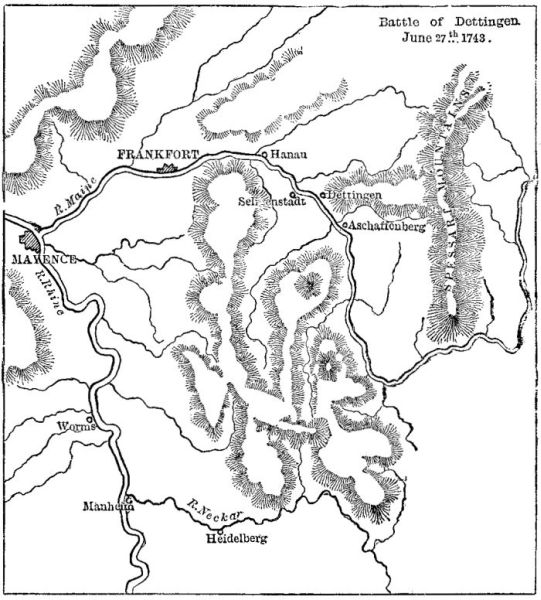
Battle of Dettingen. June 27th 1743.
The English army in Flanders.
The tide of victory was then already turned when the English made their first appearance in Europe, acting in conjunction with some 18,000 subsidized Hanoverians. The command of the English army, which to the number of 16,000 had been all the last year lying inactive in Flanders, was given to Lord Stair, and the object of the allies was to drive the French entirely out of Germany, and if possible invade Alsace and Lorraine, on which the eyes of the Austrians, who had but lately lost them, were constantly fixed. To oppose the movement an army under the Duke de Noailles entered Franconia, and the various divisions of the British army and their allies from Hanover were set in motion towards the Maine. With characteristic slowness, Stair proceeded to collect upon the Maine an army of 40,000 men. Towards the Maine also on the south De Noailles betook himself with about 60,000. Stair lay idly awaiting his 12,000 Hanoverians and Hessians who had not yet appeared, and thus gave De Noailles opportunity of securing the south of the river and holding most of the passages across it. Having waited long enough to be thus Battle of Dettingen. outgeneralled, Stair suddenly changed his plan, and, without receiving his reinforcements, marched up the river towards Franconia. He passed Hanau, where he established his chief magazines, and moved towards Aschaffenberg. Between these two towns branches of the Spessart mountains approach the Maine, and about half way between the two is the large village of Dettingen. From Dettingen to Aschaffenberg extends a narrow plain, entered by a somewhat difficult passage between the mountains and river at Dettingen. On reaching this plain the English found themselves outmarched by De Noailles, and thus cut off from Aschaffenberg. It was while thus entangled that they were joined by the King and the Duke of Cumberland. The King found the army cut off from the supplies it had hoped to draw from Franconia, and in danger of being separated from its magazines at Hanau also. Thither it was determined if possible to secure a retreat. As the English believed that the enemy was higher up the river than they were, and that they should be closely pursued, the King took command of the rear as the post of danger, but De Noailles had already forestalled them. He had at once moved down the river so as to put himself between the English and Hanau, taking up his position at Seligenstadt. He sent some 23,000 men, under his nephew the Duc de Grammont, across the river to occupy Dettingen. These troops occupied a very strong position behind a swamp and a ravine made by a watercourse. De Noailles' main army lay on the southern bank, but bridges of communication were made between the two divisions, and cannon placed on the south bank to play upon the flank of the retreating English. Escape seemed almost impossible, especially as the English were in entire ignorance of these movements. On finding his advance checked at Dettingen, George at once left the rear and put himself at the head of the army. There seemed no course but to cut a way through De Grammont's forces. This commander, however, believing himself engaged with the advanced troops of the English army only, and thinking to crush them, rashly left his strong position and crossed the ravine. He found himself in front of the whole English army. The King's horse had run away with him, and he had dismounted and put himself at the head of his troops, and addressing them a few inspiriting words, led them to the attack with much gallantry. De Noailles saw the destruction of his plans and hastened to retrieve the error of his nephew. His efforts however were useless. The mass of infantry, led by his Majesty in person, broke through the enemy, whose loss was so great that De Noailles recalled them beyond the Maine. The retreat towards the bridges became a rout, and they left more than 6000 dead and wounded upon the field. The King wisely determined to get out of his dangerous position as soon as possible, and pushed on that night to Hanau, leaving his wounded to the mercy of the French commander, who treated them exceedingly well. Stair, as hasty in the moment of victory as slow in his preliminary movements, urged immediate pursuit, but was overruled by the King. On receiving the expected reinforcements he again urged advance, but jealousies had sprung up between him and the German commanders. He was disgusted at the rejection of his advice, and talking loudly of Hanoverian influence, sent in his resignation, which was accepted.
The objects of a further advance however were obtained without bloodshed. The French army in Bavaria had been beaten backwards Effect of the victory. by Charles of Loraine,[6] and had retired behind the Lauter into Alsace, whither De Noailles, finding himself unsupported between two enemies, also withdrew. The victorious allies pushed on after them, the King to Worms and Prince Charles to beyond the Rhine opposite Alt Brisach. The new Emperor was thus left without allies, and concluded (July 1743) a convention of neutrality with the Austrians, and withdrew to Philipsburg.
Negotiations for peace. July.
A favourable opportunity for peaceful arrangements seemed to have arrived. Prussia had gained its object; French intervention had failed; the Austrian succession was secured; the only open question was what was to be done with the expelled Emperor. George and his favourite minister Carteret, who were at Hanover, undertook the negotiations. George, as Elector of Hanover, and Carteret, from his general interest in foreign politics, took a German and not an English view of the situation. It was George's object, as Elector of Hanover, to appear as a paramount power among the other electors, and to form a strong alliance in the Empire entirely in his own interests. For this purpose he had naturally,—considering the antecedents of his second kingdom England, regarded a close alliance with Austria as of the utmost importance. At the same time, as a Prince of the Empire, he had no strong wish that the Imperial dignity should be constantly in Austrian hands, and was quite willing to allow the validity of the election of the Emperor Charles. In conjunction with Carteret, he therefore agreed that Charles should retain the Imperial title upon condition of renouncing all claims on Austria, of allowing the validity of the vote of Bohemia in all affairs of the Empire, and of dismissing the French from the fortified places they still held within the Empire. He even consented to insist upon the restoration by Austria of Charles's hereditary dominions, Bavaria (now to be erected into a kingdom), and upon the payment of a large sum to the Emperor to support his dignity. Had this treaty been completed, George would have appeared as the mediator of the peace of the Empire, as the champion of the rights of the princes, as the defender of the Austrian dominions, and altogether as the chief power in Germany. To a certain point the interests of the people of England had been the same as that of their King. But their real enmity was against France, and under the guidance of a Whig aristocracy, they would have wished to pursue their traditional policy of opposing the Bourbons chiefly at sea. The arrangements of the proposed treaty by no means suited them. They had long been clamouring against the German tendencies of the King, they had seen with extreme dislike the employment of subsidized Hanoverian troops, and now positively refused to pay a subsidy to the Emperor—a Bavarian prince and the hereditary friend of France.
Treaty of Worms. Sept. 13, 1743.
To the astonishment of the negotiating Powers and the shame of Carteret, the proposed treaty was suddenly broken off. England wanted war with France, and considered it could be best carried on by close alliance with Austria, which was only too glad to continue the war, with the hope of retaining its hold on Bavaria and rewinning Silesia. A treaty known as the Treaty of Worms therefore took the place of the former pacific arrangements. England, Holland, Austria, Saxony, and Sardinia, agreed to assure the Pragmatic Sanction and the European balance, while Sardinia undertook the armed defence of the Austrian dominions in Italy. It was met by a counter treaty known as the League of Frankfort, the most important members of League of Frankfort. April 5, 1744. which were France and Prussia; for the elevation of Hanover implied the degradation of Prussia, and the promise of the King of Sardinia set free Austrian troops which the Prussian King believed would be used only for the purpose of reconquering Silesia. The European contest was thus assuming a more general and intelligible form; England and France, hitherto auxiliaries, appeared each at the head of a great league, and it was their interests, and indirectly the supremacy of the sea, which were now at issue.
Threatened invasion of England.
Even yet no declaration of war between England and France had been issued, but it was natural that the French, aware of the real character of the war, should use every means for distressing England. Early in the year it set on foot an attempted invasion of England in favour of the Stuarts. An army of 15,000 was collected at Dunkirk, and placed under the command of the best French general, Marshal Saxe, while fleets were collected at Toulon and Brest for the invasion of England and to support a Jacobite rising. The Brest fleet came out of harbour and approached the English coast. The English fleet was drawn into pursuit; and for the moment the coast of Kent was unguarded. A considerable portion of the French army was on board the transports and had sailed. Once again England owed its safety to the weather. A violent storm blowing direct upon Dunkirk, prevented the movement of the rest of the transports, scattered those already at sea, and the loss was such that the French ministry abandoned their design, and Marshal Saxe was appointed to command the army in Flanders. The naval armaments and this open support of the Pretender gave rise to warm complaints of breach of treaty on the part of our envoy at Paris; as his complaints were listened to with disdain, a formal declaration of war was at length made.
Progress of the war.
On the Continent the selfish policy of the French, who could think of nothing but the extension of their own boundaries, ruined the success of the war. The Netherlands were invaded and rapidly overrun; Savoy and Piedmont conquered; but these successes on the extremity of the scene of action did not tend to the conclusion of the war. Frederick of Prussia advanced through Bohemia and took Prague, and thus saved France from a threatened invasion of Alsace; but, unsupported by his allies, he fell back from the Austrian dominions, and upon the death of the Emperor (Jan. 20, 1745) was unable to prevent the election of the Prince of Tuscany, husband of Maria Theresa, who ascended the Imperial throne as Francis I. Maximilian, the son of the late Emperor, had shown himself willing to accept the views of Austria; by the Treaty of Fuessen (April 22, 1745) he renounced all claims to the Austrian succession, promising to recall his troops from the French armies, and to give his vote to Francis, husband of Maria Theresa, who on her side recognized the election of his late father, and restored all her Bavarian conquests. Again it appeared that general negotiations might have been possible. But Carteret had been Changes in the ministry. Nov. 1744. driven from office, and the Whigs under Pelham were bent on carrying on their hostility with France. His unpopular Hanoverian tendencies, and the offhand manner in which he had treated the Pelhams, secured Carteret's fall. His place was taken by Walpole's old colleague Harrington. With Carteret withdrew Lord Winchelsea and several others, thus affording Mr. Pelham an opportunity for carrying out that form of administration to which his timidity urged him. In exact contrast to Walpole, he dreaded opposition, and sought to make friends of all parties, and to establish his ministry on what was then called a broad bottom. He persuaded Chesterfield and Pitt to give up their opposition, and the former to accept the Lord Lieutenancy of Ireland. To the Tory Lord Gower he gave the Privy Seal, and even Sir John Hind Cotton, an undoubted Jacobite, was given a place about the Court. This was not done without great opposition from the King, who disliked Chesterfield and Pitt for their opposition to his Hanoverian schemes, and had a natural mistrust of Tories and Jacobites. The effect of these changes was almost to suppress opposition in the House. The ministry, now including most of the leaders of the Opposition, satisfied with a change of principles, made but little change in practice. The reunited Whig party felt that, as they were engaged in an open war with France, they were, even while subsidizing Germans, carrying out their true policy. Pitt openly declared that he no longer opposed subsidies in face of the present state of affairs abroad. He pointed out that the object of the war was somewhat changed, that, the minister who rested wholly on his foreign influence being removed, they were no longer fighting German subsidies granted. 1745. solely in the interests of Austria, but to secure an equitable peace for themselves and their allies. However this may have been, the system of German subsidies went further and further. The Hanoverian troops were for the present dismissed, but their pay was added to the Austrian subsidy. Saxony was bought, the Elector of Cologne was bought, and so was the Elector of Mayence; and next year (1746) 18,000 Hanoverians were again taken into English pay. Robert Walpole lived just long enough to see the dangers he had kept aloof for twenty years gathering round England. He died in March 1745, leaving England plunged deep in a Continental war, with constantly increasing grants for military service, and consequently increased financial difficulties, and on the eve of the most determined and dangerous effort which the exiled family ever made for the recovery of their crown.
The war still continued under the mistaken conduct of the French. But neither their successes against England at Fontenoy, nor the invasion of the young Pretender which they supported, nor their victory over the Sardinians at Basignano, were the least decisive. As Frederick, who felt himself deserted, bitterly said, the victories might as well have been won on the banks of the Scamander. What he could do singlehanded the Prussian King did. He defeated the Austrians at Friedberg, and again upon the Sohr. He conquered the Saxons at Kesseldorf and occupied Dresden. But seeing clearly that his allies were bent upon their own ends, he again listened to the anti-Bourbon diplomacy of England, made a separate peace with Austria, and the Treaty of Dresden (Dec. 25, 1745) closed the second Silesian war. But, in spite of the withdrawal of Prussia, the general war continued. Early in the spring a French army under Marshal Saxe invested Tournay. The Netherlands were occupied by an allied army of English and Dutch. There Campaign in Flanders. should have been 28,000 English and 50,000 Dutch, but, although it was their own country that was threatened, the Dutch were so dilatory that the allied army numbered little more than 50,000. These were under the Duke of Cumberland and the Dutch general the Prince of Waldeck. The Duke, who was young, was somewhat controlled by the Austrian Marshal Konigsegg, and had with him as his military guide General Ligonier. With these troops the Duke advanced to the relief of Tournay. Marshal Saxe, whose forces were much superior in numbers, could afford to leave 15,000 men to continue the siege, while, marching southward along the river, he occupied a very strong position to cover his operations. The position was rendered almost unassailable. The French faced southward; on their right was the river Scheldt, with the fortified bridge securing their communication and retreat, and the village Antoing. A narrow and difficult valley ran along their front from Antoing to Fontenoy, and their left was covered by the wood of Barré, on the right of which a redoubt had been constructed. The whole of this position was fortified with field-works and abattis, with the exception of a gap between Fontenoy and the wood of Barré, where the difficulties of the approach were held to be of themselves sufficient. It was resolved to assault this terribly strong position. To the Dutch was intrusted the attack of the French right, with the villages Antoing and Fontenoy; to the English the attack on their left. The attack of the Dutch was without energy, and failed, and the Prince of Waldeck, withdrawing his troops to a safe distance, kept them unemployed the remainder of the day. A Battle of Fontenoy. May 11, 1745. similar want of energy was exhibited by General Ingoldsby, who had been instructed to assault a redoubt on the left of the French and to clear the wood of Barré. Finding more opposition than he expected, he withdrew when the enemy were on the point of abandoning their redoubt, and demanded further orders. The English and Hanoverians, on the other hand, energetically assaulted the unfortified gap between Fontenoy and the wood. Regardless of the flanking fire by which they were decimated, they pushed across the ravine and up the opposite hill. The space was narrow, and they advanced, without deploying, in a solid column 10,000 strong with a face of about forty men. The ground was too rough for their cavalry, which therefore advanced in their rear. In this solid formation, with astonishing heroism and determination, they pushed on, crushing all opposition, and unchecked by frequent cavalry charges. They won the crown of the position, cut the enemy's centre, and were moving onwards towards the bridge of Calonne, threatening thus to cut off all retreat from the broken army. The victory seemed decided, and Voltaire allows that, had the Dutch only moved, the French must have been inevitably routed and destroyed. But the Prince of Waldeck never stirred. Fresh troops could therefore be brought from Antoing and Fontenoy to repel the victorious column. In this work it was the Irish Brigade which chiefly distinguished itself, and at last when, by the advice of the Duc de Richelieu, four cannon were placed right in front of the column so as to fire down its whole length, finding itself wholly unsupported, the heroic body began to give ground. It retired as it had come, slowly, disputing every yard, and entirely without confusion. When it reached ground where cavalry could act, that arm, hitherto useless, covered the retreat, and the whole army fell back to Ath. Tournay was treacherously surrendered, and the allies had to content themselves with covering Brussels and Antwerp. This wonderful unsupported advance, though useless for the battle, and purchased with immense loss of life, was for long a just source of pride to the English soldier.
It was the necessity of withdrawing troops for the defence of England which had rendered the campaign in Flanders after the partial defeat of Fontenoy so disastrous. Prince Charles Edward, though bitterly disappointed by the failure of the expedition in the preceding year, did not leave France; and as the French ministry, occupied with their continental affairs, refused him further assistance, he determined to go alone and unsupported to Scotland, and throw Prince Charles Edward lands in Scotland. himself on the loyalty of his friends there, although in all his previous negotiations with them they had refused to think of a rising unsupported by foreign troops and arms. Scraping together what little money he could, and purchasing a small supply of firearms, the Prince embarked at Nantes in a privateer. He was escorted, without the knowledge of the Government, by a French man-of-war, in which his stores were placed. On the passage to England they encountered an English vessel, which, though unable to capture the French man-of-war engaged it so vigorously that it had to withdraw to France to refit, and it was in the little privateer, 'La Doutelle,' thus stripped of his supplies and with only seven companions, that the Prince reached the Hebrides. In this plight he met but a cold reception, and it was not without considerable persuasion that Macdonald of Clanranald and other gentlemen of that tribe joined him. Their chief, Sir Alexander Macdonald, and the head of the Macleods, on whose assistance he had relied, kept aloof. Of more importance even than the Macdonalds was the adhesion of Cameron of Lochiel. This chief seems to have been won, against his better judgment, by the persuasive power of Charles, who undoubtedly had in an unusual degree the art of attracting adherents. While still in the extreme west of the mainland Charles was joined by Murray of Broughton, who had been his chief agent, and whom he appointed his Secretary of State. The Prince had reached the mainland on the 25th of July; it was not till the 30th that information was received by the Government that he had left Nantes, and he had been three weeks in Scotland before it was known in London. On the 19th of August the insurrectionary standard was raised in the solitary valley of Glen Finnan, where the aged Marquis of Tullibardine, the rightful heir to the dukedom of Athol, read Prince Charles's Commission of Regency. This ceremony was graced by the presence of a considerable number of English prisoners, who had been captured a few days previously by Lochiel's followers as they were marching to reinforce Fort William.
Scotland is cleft in sunder by a great valley running from the Beauley Firth in the north-east in a south-westerly direction to the salt-water lake Loch Eil. This valley, at present occupied by the Caledonian Canal, forms the basin of a chain of lakes, by far the largest of which is Loch Ness, occupying nearly half of the north-east end of the valley. Between its northern extremity and the sea lies the town of Inverness; at its southern end was Fort Augustus, one of the forts established to keep the Highlands in check, while, where the valley reaches Loch Eil, there was the still more lonely post of Fort William immediately under Ben Nevis. It was in the close neighbourhood of this fort that Charles's followers were first collected, and it was while trying to strengthen it that the royal troops had first come into collision with the insurgents. The tribes to the north of Inverness, as well as Sir Alexander Macdonald and Macleod, were either well-affected or held in neutrality chiefly by the influence of Duncan Forbes of Culloden, Lord President, who had also contrived for the present to attach Lord Lovat, head of the Frasers, to the Government interest, so that it was with the western clans only that Charles began his expedition.
Cope marches against him.
The English military commander in Scotland was Sir John Cope, who had altogether about 3000 men under his command. All this time the King was absent from England, and orders had to be issued by the Lords Justices. They approved however of Cope's plan for immediately marching into the Highlands and crushing the insurgents if possible among the mountains. With this intention, leaving his dragoons behind him, Cope set out from Stirling along the direct north road towards Inverness. At Dalwhinnie, which is now a posting-station on the great north road, the military road made by Marshal Wade branched off to Fort Augustus, which it was Cope's object to reach and relieve; the main road passed onwards to Inverness. The mountain which forms the south-east side of the great valley in which Fort Augustus lies has to be crossed. It is called in this place Corrie-Arrack, and to cross it the road winds in steep zigzags. The Highlanders had got possession of this difficult pass, and intended to destroy Cope's army while ascending the zigzags. Their disappointment was great when they found that he had turned aside at Dalwhinnie, and was in hasty march for Inverness. By this means he probably hoped to strengthen the loyal clans of the north and to draw the Prince's army in pursuit. He however left the road towards the capital quite unguarded. Charles at once pushed on and crossed the Badenoch mountains to Blair Athol, from whence the great road runs, without any obstacle, through the Pass of Killiecrankie Charles avoids him, and gains Edinburgh. into the plains of Perthshire. He rested a few days at Perth, where he was joined by Drummond, Duke of Perth, and by Lord George Murray, the Duke of Athol's brother, a man of considerable military experience and capacity. He then crossed the Forth a little above Stirling, the dragoon regiments which had been left there retiring before him, and advanced rapidly towards Edinburgh. The Castle of Edinburgh was secure, but the town had no adequate fortifications, and the inhabitants doubted long and painfully as to whether they should open their gates or not. The news that Cope, on learning his mistake, had taken ship and had already reached Dunbar, encouraged them to think of resistance, but their determination vanished away after a skirmish called "the canter of Colt-Brig," when two regiments of dragoons ran away, and did not stop till they reached Dunbar. Negotiations were set on foot, but were cut short by the surprise of the town by the Highlanders. On the 17th of September Charles took possession of Holyrood House, and it seemed as if the inhabitants of Edinburgh were by no means sorry to Cope lands at Dunbar. receive him. He could not rest long, however, as Cope was marching along the Firth from Dunbar. He expected to meet his enemy between that town and Edinburgh, but the Prince marched along the hills to the south of the Firth, and Cope was surprised to find his enemy again beyond him. He was then near Prestonpans. He changed his face at once, and lay with his back to the Firth and his face to the hills, as he believed in an unassailable position, separated from the Highlanders by a morass. But Charles was bent on fighting, and a narrow pathway through the morass to the eastward was pointed out to him. Down this he led his forces so as to gain a position eastward of the English, who had again to change their face, looking now directly eastward, with their backs to Edinburgh. Their infantry were in the centre, their cavalry on Is defeated at Prestonpans. Sept. 21. either flank. The battle is said to have been decided in six minutes. The rush of the Highlanders renewed the panic among the dragoons, who all took to their heels. The infantry stood with their flanks exposed, and as their fire did not check the Highlanders, they were soon engaged at close quarters, where the Highland target parried the bayonet thrust, while the right hand was free to use the claymore. The line was soon broken, and it is said that not more than 170 escaped death or capture. The cavalry, taking Cope with them, did not draw bridle till they reached Berwick.