GEORGE III. (continued 2)
Reading edition
General election. Anti-American feeling of the nation.
A general election in England in September of this year made it plain that the temper of the people was no less bitter and determined in the mother country than in the colonies. A large ministerial majority was returned ready to support any acts of coercion. The Opposition began by demanding papers in an amendment on the address, but the real Chatham's motions for reconciliation. 1775. struggle did not begin till January, when Chatham again expressed his opinion, moving the immediate repeal of the obnoxious statutes of the preceding year and the withdrawal of troops from Boston. The majority against him was overwhelming; none the less did he at once set to work, with Franklin's help, to prepare a scheme of reconciliation, though Franklin had probably neither much hope nor much wish that it should succeed. It was at first fairly received by Lord Dartmouth, the Colonial Secretary, but again Lord Sandwich and the Bedford party overawed their more temperate colleague, and it was rejected with scorn. The wisdom of some step in the same direction North's measure for the same purpose. seems however to have been plain to Lord North, who in a short time produced a scheme of his own. This did not go further than to say, that so long as the colonies taxed themselves with the approbation of King and Parliament no other taxes ought to be laid on them. It was much too late for any such trumpery measure.
It was indeed too late for any schemes of reconciliation, and the appeal to arms began. General Gage, who in spite of his representations had been left without reinforcements during the winter, could not see the Skirmish at Lexington. April 1775. preparations made for arming and supplying the militia, carried on by the provincial Congress, without taking some measures to prevent them. In April he determined to destroy the stores at Concord. Some militiamen, who were being drilled at Lexington, only dispersed after firing upon the troops; and when the soldiers, after destroying such of the stores as had been left at Concord, began their homeward march, they found themselves assaulted from behind every hedge and cover, and were compelled to seek refuge in a very distressed condition with a body of troops who had been sent to support them. The English loss was 270, while the rebels lost less than 100 men. This slight success raised the spirits of the colonists; militiamen crowded in from all quarters, and General Gage was blockaded in Boston. The rebels even ventured to attempt an expedition against the neighbouring province of Canada. A Bill passed Canada Bill. the preceding year in England had given a constitution to Canada. This colony, nearly wholly French, neither understood nor valued English institutions, and was firmly Roman Catholic in its religion. The constitution was wisely conceived in a more arbitrary spirit than would have suited Englishmen, and with great liberality established the Roman Catholic worship. The Americans, unable to see the wisdom of this, and Puritan in their own religious beliefs, fancied that Canada must be smarting under its wrongs, and that they should find hearty sympathy there. In this belief, and to open the road thither, two New Englanders raised troops on their own responsibility—Arnold, a horse dealer, and Ethan Allen—and advanced against the forts which held the valley of Lakes Fall of Ticonderoga. May. George and Champlain, which, with the valley of the Hudson, forms the natural road from New York to Montreal. They speedily seized Ticonderoga and Crown Point.
The second Congress assumes sovereign authority.
The first question which met the second General Congress was whether they should take upon themselves the responsibility of these actions or accept the conciliatory resolution of Lord North. There was no hesitation on the part of the Congress. Lord North's proposition was thrown aside at once; orders were issued against supplying any British force or officer; a national name was assumed—The United Colonies; coercive measures were decreed against any province which should refuse to recognize the authority of Congress; and on the flimsy excuse of a contemplated invasion from Canada, the actions of Allen and Arnold were acknowledged, and an attack on Canada organized. These were acts of rebellion and war, and the Congress, conscious that the die was cast, proceeded to appoint a commander-in-chief. Their choice fell upon Colonel Washington, a Virginian gentleman, and a member of the Congress, who had seen some service in the late frontier wars, and was much respected by his province. He was a powerful, somewhat silent man, of very strong sense, and great powers of self-control, possessing that commanding influence which Washington chosen commander-in-chief. is given by strong passion and enthusiasm habitually subdued, but just visible under a constant and calm exterior. His unquestioned honesty, his hatred of disorder, and his great simplicity of character, fitted him well to give dignity to a cause which ran the risk, if it fell into inferior hands, of degenerating into a selfish and riotous uproar.
Battle of Bunker's Hill. June 17, 1775.
Washington at once hurried to the seat of war, but before he arrived another battle had been fought. A narrow channel separates Boston from another town of the name of Charlestown, behind which rise two masses of high ground, known as Breed's and Bunker's Hill, from which Boston is commanded. Breed's Hill is the nearer of the two to Boston. It was natural to suppose that General Gage, whose forces had been raised to 10,000 men by reinforcements under Generals Clinton, Howe and Burgoyne, would assume the offensive, and at all events try to secure these hills. The Americans attempted to forestall him, and some rude defences were thrown up on the ridge of Breed's Hill. About 2000 English were sent to dislodge them. The Americans fought well, more than once the English drew back before their fire, but rallied by Clinton, they eventually took the position, driving the enemy, more than twice their number, in disorder along Charlestown Neck, where they were open to the fire of our ships. More than 800 of the English fell in the desperate struggle.
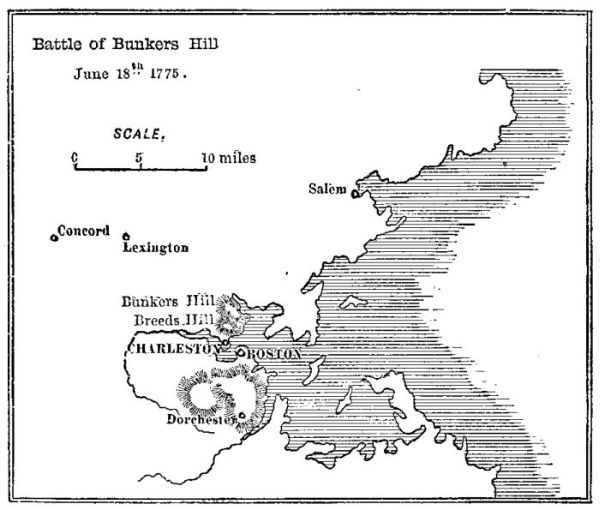
Battle of Bunker's Hill June 18, 1775.
Condition of the American army.
Although the insurgent troops were justly proud of the gallant stand they had made against disciplined forces, the army when Washington joined it was not such as a general would wish to command. Even in the late battle well authenticated cases of cowardice had occurred among the officers. The militia regiments of the various states regarded each other with jealous eyes; there was no sort of uniformity of dress, no trace of soldierly bearing; the soldiers showed little subordination to officers scarcely better than themselves; and, worse than all, there was a fearful deficiency of powder. It taxed the ability and temper of their new general to the full to bring the motley crowd into order. He exacted the sternest discipline, drew a sharp line between the officers and men, procured hunting shirts to supply the lack of uniform, and by unremitting toil gradually produced a tolerable army. Why General Gage looked quietly on while this process was being carried out it is difficult to say. Even setting aside the lack of ammunition, of which however he was fully informed, he had troops enough to have destroyed the enemy which were blockading him without difficulty, and might thus perhaps have ended the war at a blow.
The Olive Branch Petition.
The slowness which characterizes the English generals at the beginning of the war is probably to be traced to the prevalent idea that reconciliation was still possible, and that the terrible extremity of civil war might be avoided. Even at this very time the Congress was sending to the King a last appeal; but this document, known as the Olive Branch Petition, was not received in England. There was a technical objection to it which secured its rejection; it purported to come from the Congress—an illegal and unrecognized body. The Americans could scarcely indeed have expected that it would have produced any effect. It held out no hope of concession, but expressed only vague wishes for reconciliation. It probably served the turn of those who sent it by allowing them to throw the blame of the future war entirely on the English. It might have been wise on the part of the ministry, even thus late, to have accepted overtures of peace, but it would have been a stretch of wisdom which no man had a right to expect; for the Congress had undoubtedly by its action assumed a position of complete independence and hostility which a Government could scarcely be expected to overlook.
Attack on Canada.
Even before the Olive Branch was sent the Congress had determined to take advantage of the successes of the preceding year, and had organized, under Generals Montgomery and Arnold, an attack upon Canada, which General Carleton was ill prepared to repel with less than 1000 British troops. While Montgomery crossed Lake Champlain and pushed on to Montreal, Arnold, with incredible labour, had made his way up the valley of the Kennebec, and so down the Chaudière, to Quebec. Unable to prevent the junction of the armies, Carleton hastened to throw himself into the capital, and upon the Heights of Abraham succeeded in checking their advance, with the loss of Montgomery their leader. Arnold could do no more than keep up a nominal blockade, so ably was the defence conducted, and the general who superseded him, meeting with no sympathy from the Canadians, was forced to withdraw in disorder beyond Lake Champlain.
Meanwhile the dilatory conduct of Gage, who had now been succeeded by General Howe, had lost Boston to the English. Washington had at length found himself strong enough to take and fortify the Dorchester Heights, which commanded the English lines on Boston Neck. A general engagement, which could scarcely have Howe retires to Halifax. March, 1776. ended otherwise than favourably to the English, would have still rendered the town tenable, and Howe was inclined to bring on a battle. But a continued course of bad weather frustrated his plans, and thinking that for military reasons New York, where the royal party was strong, would make a better base of operations, he determined to withdraw; he accordingly removed all his troops to Halifax, there to await promised reinforcements. So long were the fresh troops in coming that Howe had to leave Halifax without them. There was considerable difficulty in supplying him. The military arrangements of England have been constantly found inefficient at the opening of a war; it was only by purchasing troops at an exorbitant price from the Duke of Brunswick and the Landgrave of Hesse that the immediate want could be supplied. It was therefore only on a limited scale that Howe was enabled to carry out that plan for the arrangement of the troops which was afterwards continued during the war; and which consisted of making New York the centre of operations, to be supported by two subsidiary forces, the one acting in the Southern States, the other from Canada. In pursuance of this plan, he despatched a force against Charleston, in Carolina, under General Clinton, while he himself moved to Sandy Hook, thus threatening New York, whither Washington had hastened from Boston. He was there joined in July by his brother, Admiral Lord Howe, and found himself, with his reinforcements and with the troops which had been sent to Charleston and had returned upon the failure of the expedition, at the head of nearly 30,000 men.
Fresh offers of conciliation rejected.
Lord Howe brought with him full powers for himself and his brother the general, empowering them, in accordance with a late Act of Parliament, to receive the submission of any colony, and after such submission to grant pardon and redress. An Imperial nation, defied by its colonies and not yet beaten, could hardly offer more, and to those not thoroughly conversant with what was going on in America, it must have seemed that there was every chance of such terms being accepted. Never as yet had the chances of the insurgents seemed so small. It is true that the revolt had become universal; but the spirit of the commercial population of the Northern States was severely tried, and seemed to be yielding under the depression of trade caused by the war. The English army was for the time actually more numerous than that of Washington, whose troops, nominally but 27,000 strong, were diminished by illness or absence. Those who remained were in a miserable condition, and consisted chiefly of men enlisted for short periods, who could scarcely be properly drilled before they returned to their homes. But the state of feeling was no longer what it had been. It was no longer a question of pardon or redress. The more earnest and violent men had, as is usual in civil commotions, been coming more and more to the front. The idea of a total separation from England had been rapidly gaining ground; republican and democratic principles had made their appearance; the writings of Thomas Paine had been published, and so largely were his views received, that a declaration, issued by the aristocratic State of Virginia, served afterwards as the model for the Declaration of the Rights of Man issued by the revolutionists of France; and already, before the arrival of Howe with his offer of pardon, the extreme party had determined to check all lukewarmness and put an end to all chance of reconciliation by taking an irretrievable step. In June, Lee of Virginia proposed in Congress that the colonies should declare Declaration of Independence. July 4, 1776. themselves independent. The numbers on division proved to be exactly equal, but Dickinson, the writer of the "Pennsylvanian Farmer's Letters," and the leader of the moderate party, consented to withdraw, and the motion for independence was thus carried by a majority of one. The document itself is not a very powerful one, but shows how abstract political views had become mingled with the original questions in dispute. It is based on the Declaration of Virginia, recapitulates all the real or fancied grievances of the colonies, and, with curious political dishonesty, attributes them all to the personal tyranny of the King. The Declaration of Independence, issued on July 4th, reached Washington's army just before Lord Howe's arrival; it of course rendered his pacific mission fruitless. The colonies had assumed the position of an independent nation, and claimed to be treated with all the respect due to such a position. Howe's letters to Washington were even returned unopened, because they were not addressed to him by his full military style and title.
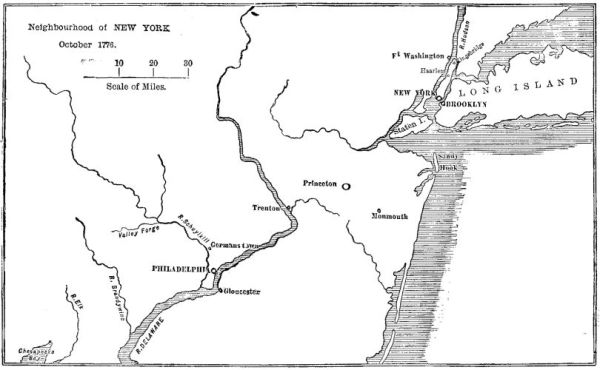
Neighbourhood of NEW YORK October 1776.
Battle of Brooklyn. Aug. 27.
To the English nothing now remained but to take advantage of the superiority of their troops. An attack upon the lines of Brooklyn, at the end of Long Island, separated from New York only by a narrow channel, was ordered. The Americans, in about equal numbers, came out of their intrenchments, and for the first time during the war a battle was fought in the open field. The victory of the English troops was immediate and complete. It was due only to Howe's want of vigour in pressing his success that Washington was able to withdraw his army to New York, whence, finding it impossible to hold his ground, he retired ultimately to the mainland, taking up a position at Kingsbridge, and leaving the city in the hands of the English. It was plain that the temporary militia of the colonists was useless against regular troops, and in spite of its republican dread of a standing army, the Congress at length listened to Washington's repeated representations, and authorized the enrolment of some regular troops. But for more than a year he was compelled to do his best with his old militia, and nothing but the continued and incomprehensible slowness of the English generals saved him from disaster. Step by step he was driven backwards, till he was compelled to cross the Delaware and leave the whole of the Jerseys in the hands of the English. The road to Philadelphia seemed open, and the Congress, in fear, withdrew to Baltimore. But the English, when they found that all the boats on the Delaware had been removed, quietly withdrew into winter quarters upon a very extended line, and waited in hopes of being able to cross the river on the ice. The time thus wasted lost them all the advantages they had won, and gave Washington an opportunity to recover. Eager to strike some blow which should raise the spirits of the colonists and enable him to fill the ranks of the army, he determined to take advantage of the weak and extended line of the English. On Christmas evening, trusting to the effects of the day's debauch, he crossed the river, and surprised and captured the garrison of Trenton. Cornwallis, who had the command of the advanced troops of the English, came to the rescue, but Washington Washington recovers New Jersey. Jan. 3, 1777. by another night march swept round the English army, and captured or destroyed two regiments at Princeton. He was unable to secure, as he had intended, the supplies at Gloucester, but before long he succeeded in clearing New Jersey of the English, and confining them, as before, to New York and Rhode Island.
Howe remained idle till June, thus allowing much time to the Americans, to whom time was everything. But in June preparations Threefold plan of the English. for a great joint movement were matured. Not only was the main army in New York again to resume the offensive, but advantage was to be taken of the possession of Canada, and an attack organized from that country. This branch of the combined movement was placed under the command of General Burgoyne. The cleft made by the valley of the Hudson is continued northward by the Lakes George and Champlain, and a natural road thus formed from Canada to New York. Down this the Canadian army was to march, assisted by the co-operation of Clinton, who was to lead troops from New York to meet it. Thus the disaffected provinces of New England would be severed from the rest of America.
Howe's expedition against Philadelphia. Sept. 1777.
Howe's army, which was now comparatively powerful, was expected to make its way through the Jerseys, and to complete the project of last autumn by capturing Philadelphia; but, finding Washington ready to oppose his advance, he suddenly withdrew his troops and embarked them in the fleet. He appeared for a moment off the mouth of the Delaware, but again, finding more obstacles than he had expected, took to the sea, and sailing all round the promontory between the Delaware and the Bay of Chesapeake, ultimately arrived at the top of that piece of water at the Head of Elk, nearly as far from Philadelphia as when he started. The time spent in making this long circuit enabled Washington to be fully prepared to cover Philadelphia. He took up his position in Brandywine Creek. He was there quite outmanœuvred. While one division of the English held the ground in front, another marched round and fell upon the rear and left flank, and completely routed his army. He still tried to hold the line of the Schuylkill, but it was passed by the English with little difficulty, and Philadelphia occupied. The capital was thus in the hands of the English, but the expeditionary character of the attack prevented it from being so effectual as a steady advance would have been, while it rendered the conquest nugatory by separating it entirely from New York, the real basis of operations. In some degree to correct this error, it became necessary to secure direct access by sea by the capture of the forts which held the mouth of the Delaware. For this purpose the English army was divided, one portion remained at Germanstown Battle of Germanstown. Oct. 4. to hold Philadelphia, and the rest were moved to the siege of the forts. Washington took advantage of the weakness of his immediate opponents and attacked the troops at Germanstown. At first he was successful, but a panic, such as not unfrequently seizes young and half-disciplined troops, changed his half-won victory to defeat. The forts of the Delaware were at length captured, and the operations of the English seemed to have been thoroughly successful.
It was indeed a moment of intense depression in the American army; nothing but the extraordinary patience and steadfastness Washington reorganizes the army. of Washington could have saved it. Half-disciplined troops, many of them inclined to desert, or to leave their standards as soon as their short time of enlistment was over, thousands without shoes, a commissariat ridiculously incompetent and notoriously fraudulent, a civil power inclined to meddle and complain of the military arrangements, such were some of the difficulties with which he had to contend. He managed in spite of all to keep his army together, and to induce his troops to go into winter quarters at Valley Forge, a wild but strong position among the hills on the Schuylkill river a little above Philadelphia. News from the North came to cheer him in his distressed condition.
Burgoyne's disasters.
Though successful in itself, the real object of Howe's expedition had not been obtained, it had not enabled the army of New York to go to the assistance of Burgoyne, and that general had been compelled to surrender with all his army on the 17th of October. In June he had advanced along the west side of Lake Champlain, and had taken the fortress of Ticonderoga, Fort Anne, and Fort Edward on the Hudson. Hearing that the Americans had supplies but slightly guarded at Bennington, on the road to the Connecticut river, he sent a small detachment to secure them. This was the beginning of his misfortunes; the difficulties proved greater than was expected, the expedition failed and had to retire in haste, with the loss of all its artillery. However, trusting to the co-operation of the army from New York, and of a force which was to make its way from the great lakes by Fort Stanwix down the upper Hudson and join him before Albany, Burgoyne continued to advance. He collected thirty days' supplies and crossed the Hudson, thus cutting himself off from Canada, and relying for safety upon his power of opening communication with New York. The militia of the neighbouring district at once rose behind him, thus completely severing his communications. His Indian auxiliaries had left him; he could not rely much on his Canadian troops, and now found himself in face of General Schuyler with 16,000 men. The help on which he had calculated did not come, Lieutenant Colonel St. Leger failed before Fort Stanwix, and Clinton was unable to leave New York. Burgoyne attempted an assault on the American position before Behmus's Heights, north of Stillwater, but failed. To advance seemed impossible, he therefore ordered a retreat, though this was scarcely less difficult. He had told Clinton that he could hold out till the 12th of October, and when that day came he was still close to Saratoga, and now neither retreat nor advance was possible. His boats upon the lake, which afforded him his sole means of procuring supplies or of transport, had been destroyed; he had no choice but to make some sort of surrender. On the 17th of October a convention was signed by which he surrendered his whole force to General Gates, who had assumed the chief command of the American troops. His army was allowed to march out of camp with the honours of war to the bank of the river, there to lay down their arms, and to be forwarded to England, under promise not to serve again during the war. Though the reception of the prisoners by both generals and men was most generous, and though Burgoyne lived as a guest in General Schuyler's house, the terms of the convention were not honestly fulfilled; Burgoyne, indeed, was allowed to return to England, but the main part of the army was detained in America for several years. The blame of this breach of treaty is held to attach to Congress only, and not to Washington.
Effect of American affairs on the Parliament. Oct. 1776.
The autumn session of 1776 had been opened with a speech full of the successes of the English arms. The battle of Brooklyn, the fall of New York, the expulsion of the invaders from Canada, were all topics of congratulation. The feeling of the nation went with the Government, and the opposition in Parliament dwindled to a very small minority; but in spite of their weakness they continued to urge conciliatory measures, and at the beginning of the session, both in the Upper and Lower House, amendments in that sense were moved to the address. So plain was it, however, that such efforts were wholly useless, that Lord Rockingham's party ostentatiously retired from all public questions, attending the House only during private business. Fox indeed, who had left the ministry in 1773, and had become the foremost champion of the American cause, remained in his place, but the rest of the party did not reappear, till, finding their step worse than useless, they took the opportunity of a debate upon the Civil List to return to public life.
Increase of the Civil List.
This debate arose on a demand for an increase to the Civil List of £100,000 a year, and £600,000 to pay off the debts already owing. Under the existing circumstances the necessity for the measure was obvious, for the King's ordinary tradesmen were unpaid, and his servants' wages in arrears. The Civil List already amounted to £800,000 a year, and the known personal frugality of the King and Queen rendered the disappearance of so large a sum the more scandalous. In fact, nearly £600,000 had been spent since 1769 in secret service. It was easy to explain the insufficiency of the Civil List and the permanence of the ministerial majority in Parliament; not only had the Pension List been largely increased, but there were a swarm of sinecure officers about the Court, from grand falconers in the House of Peers to turnspits of the kitchen who sat in the House of Commons. The Civil List was increased, but the grant was accompanied by a strong expression, on the part of Sir Norton Fletcher, of the feeling of the House, that under the existing pressure of taxation such extravagant use of public money was much to be blamed,—words which were subsequently formally accepted by the House as their own.
Chatham's motion. May 30, 1777.
The session closed with another effort on the part of the Opposition. On this occasion it was Lord Chatham who led the attack. He returned, after two years of illness, and still swathed in flannel, to move an address, urging the King to arrest the misfortunes in America. The measures he advised were unconditional redress of grievances, and repeal of all penal statutes; in other words, he would have granted all the demands of the Americans with the exception of their independence. But, while urging moderate counsels with regard to America, he blazed out at the idea of an alliance of the colonists with the French, and demanded instant war. American intrigues with France. His motion was of course lost. His fears of an alliance with France were not however unfounded; already, before the Declaration of Independence, Silas Deane had been sent over to Europe to try and make some arrangement. If the confession of the culprit is to be believed, Deane's handiwork was to be seen in the nefarious plans of a man called John the Painter, who in the December of the preceding year (1776) had attempted to fire the dockyards of Portsmouth. Again, immediately after the Declaration of Independence, Adams and Franklin had been sent over as accredited agents to make a commercial and defensive alliance with France. But though they had been well received both by the ministry and by the salons of Paris, where for the time Franklin was the fashion, their representations were mistrusted, and no real help was given. The French had no wish to engage in a failing cause, and continued to keep up an appearance of friendship with England, even, at the instigation of our ambassador, issuing, though probably intentionally too late, a lettre de cachet to stop the Marquis of Lafayette from sailing to join the colonists. He had no difficulty in avoiding it, and was present with Washington during the Philadelphian campaign. But the Court of France was in fact only watching the turn of events. The news of the defeat of Burgoyne had scarcely France acknowledges the independence of America. Dec. 1777. reached Europe before the independence of America was acknowledged and a commercial treaty made. In case of France becoming involved in the war with England, this treaty was to be extended into one by which France engaged to supply military assistance on the sole condition that America should never acknowledge the supremacy of Great Britain.
Chatham's energy in Parliament. Nov. 20, 1777.
Already, by the time of the meeting of Parliament for the autumn session, rumours of Burgoyne's difficulties had reached England, though no news of his final disaster had arrived. The danger of war with France, to which Chatham had alluded in the spring, seemed to increase, and men's thoughts began to turn towards the great statesman who had before saved England in similar difficulties. Nor did Chatham refuse to respond to the general expectation; not for many years had he shown such activity as in this session. In moving an amendment on the address, he demanded the withdrawal of all troops from America, stigmatized with due severity the employment of savage Indians in the war, and strove to rouse the national spirit against France. But the energy and eloquence he exhibited throughout the session were unavailing. He consistently upheld the view that conquest of America was quite impossible, that it was worse than useless to carry on the war, and that all the demands of the colonists should be granted with the exception of independence. This, he said in the strongest words, it was impossible for England to grant. He relied, no doubt, on the natural hostility between the colonists and France, and it is possible that, had he been placed in office, his policy might have been successful. He was loved and trusted by the Americans; concessions from his hands might have been received. He was feared by France; his plan of removing the troops from America would have left the resources of England free for a foreign war; his threats and his name might have deterred the French from war. But certainly no other man could carry out such a policy, and so it was generally felt; North himself acknowledged the impossibility, and was most desirous of resigning; Lord George Germaine, who, disgraced at Minden as a military man, had become as member of the Government the chief supporter of repressive measures in America, was also preparing to give up his post. The ministry seemed on the point of giving way, and indeed the necessity for such a step was increasing rapidly. Early in December came the terrible news of Saratoga, and three weeks later the preliminaries of the treaty between France and the colonies were agreed upon, though the French ministry had not scrupled to cover their intentions by false statements on the matter.
The Opposition began to feel triumphant. Though still quite outvoted in the House, they knew that the majority turned with the ministry, whatever it might be; but they did not sufficiently reckon on the King's obstinacy. He had been right in his boast at the beginning of his reign; he was thoroughly English; he reflected and sympathized with the most vulgar feelings and prejudices of the people. The disasters in America had called out considerable enthusiasm in England; money had been largely subscribed for keeping up more troops, and the temper of the nation was evidently The King insists on Lord North retaining office. for pressing the war with energy, regardless of consequences. In vain did Lord North express his desire to resign, and declare the necessity of conciliatory measures. The King, strong in the popular feeling, reproached him for intending to desert him, as he called it. On further pressure he gave him leave to apply to Chatham and the Whigs, but only on the absurd condition, that they should join the present ministry, serve under Lord North, and carry out the same policy as the existing Government. He would not hear of the ministry being put frankly into Chatham's hands. As usual, Lord North yielded, and consented to stay in office. He even consented to bring in bills absolutely reversing all his own policy, and which could have come with good grace only from the Opposition. His Conciliation Bill, now in the hands of the ministry, was carried without difficulty, and all Lord North's Conciliation Bill. American demands, short of independence, were granted; all officers appointed by Congress acknowledged, and commissioners, with the most ample powers to discuss and arrange all points of quarrel, appointed. North still wished that, as this was in fact the Opposition policy, the Opposition should have the duty of putting it into effect; but the King and the course of events were too strong for him. The Conciliation Bill had hardly Rupture with France. passed when an open rupture with France took place. The treaty concluded on the 6th of February was notified in insulting terms to the English Court. Such a treaty was followed by the inevitable withdrawal of ambassadors, and war with France was in fact upon us.
To the Opposition it seemed as if the play had been played out. They were inclined for immediate submission. If England could not conquer America alone, what hope was there of conquering America joined with France with the whole house of Bourbon in its wake? They urged the immediate recognition of the independence of the colonies. Such, as has been before explained, were not the views of Chatham; his spirit rose with the idea of war with his old enemy, and he relied on his own ability, not indeed to conquer, but to conciliate America while he crushed France. His plan was never put to the test. On the 7th of April the Duke of Richmond moved in the House of Lords that all troops should at once be withdrawn from America, and a peace concluded, which of course implied the independence of the contracting parties. Chatham, very weak and ill, and against the advice of his friends, went down on purpose to oppose the motion. Scarcely able to walk, his feeble steps were supported by his son William and his son-in-law Lord Mahon. After hearing the Duke of Richmond's motion, he rose with difficulty, and resting on his crutch, and with his eyes looking unnaturally vivid in his shrunk face and under his great wig, he proceeded to make a vigorous reply. His voice was very low, and at times his memory failed, but here and there his eloquence rose to its old pitch, and he again thrilled his hearers as he recounted the dangers which England had outlived, and demanded whether the country which but seventeen years ago was the terror of the world "was to stoop so low as to tell its ancient inveterate enemy, Take all we have, only give us peace." The Duke replied in a weak speech; and Chatham rose again, eager to answer him, but before he could speak he was seen to gasp, to lay his hand Death of Lord Chatham. May 11, 1778. upon his heart, and to sink back, apparently dying. The death of this greatest of English statesmen put an end to all hope of a new policy. Unless the Americans received the conciliatory measures of Lord North well—which was most unlikely—the war must be fought out. Every honour was paid to the memory of Chatham. He was voted a public funeral in Westminster Abbey, and a monument, which is placed over the door at the west end of the Abbey, and represents him with his arm raised in the act of speaking. His debts were paid and a large pension settled on his family. Four Lords protested against these honours and the ministerial people kept chiefly aloof from his funeral. But the feeling of regret and admiration was universal. The Duke of Richmond's motion was of course negatived, and it remained to be seen what the Commissioners could do.
Before that question could be answered a subject was brought before the notice of Parliament and nation which was destined to play an important part and to take the place of the American contest as a party test. This was the question of Catholic relief. The laws still existing against the members of the Roman Catholic religion Laws against Roman Catholics repealed. were most severe in character. They had been enacted chiefly in the reign of William III., when England was still in mortal terror of the restoration of the malign influence of the Stuarts and their religion, and they bore the marks of their origin; many of them were indeed, as Dunning said in seconding the motion for their repeal, a disgrace to humanity. Sir George Savile, member for Yorkshire and a great Whig leader, moved the repeal of some of them; he had no intention, he said, of touching the whole penal code against Catholics, and was willing to substitute a test; but he moved the repeal of some of the most obnoxious laws. These were the law which punished the celebration of Catholic worship as felony in a foreigner, as high treason in a native, and the laws by which the estates of Popish heirs educated abroad passed to the next Protestant heir, by which a Protestant heir could take possession of his father's or other relative's estate during the lifetime of the real proprietor, and by which Papists could acquire property only by descent. The first law was so monstrous, and the others so evidently tended to foster the worst forms of family division and public informing, that their repeal met with little opposition. Dundas, Lord Advocate, promised a similar Bill for Scotland. This was the beginning of opposition. The Scotch were indignant at any sign of toleration, and organized a resistance which speedily spread into England. The Protestants found a mouthpiece in Lord George Gordon, a young man of slender intellect, and nearly mad on religious topics; although his principles were so unsettled that he died a Jew, he now threw himself with frenzied vehemence into the Protestant movement. The King, with his usual power of sympathizing with the narrower views of his people, took up the same side, and during the remainder of the reign Catholic emancipation served as a test by which to try whether his ministers would be subservient or not.
America rejects conciliatory offers.
Meanwhile the Commissioners under the Conciliatory Bills had reached America (May 1778). It was at once plain that they were too late. The French alliance had been made known, and the Americans were as yet full of enthusiasm for their allies. For a time the influence of Washington had been shaken. His toilsome but inglorious work of reconstituting the army of Valley Forge had been unfavourably contrasted with the brilliant success of Saratoga; Gates, a man in every way his inferior, had been set up as his rival, and placed at the head of a war committee, which overruled Washington's advice and wishes. But the ridiculous failure of a plan which, in the interests of the French, the committee had suggested for attacking Canada had brought the Congress to reason, and their trust in Washington had been restored. The division of interests which had threatened the rising republic was thus healed, and the Commissioners found a unanimous feeling against entertaining their suggestions. Nor had the success of the English been such as to assist their views. After a winter idly spent in Philadelphia, Sir William Howe had been succeeded by Clinton, who had found it necessary to withdraw his army to New York, which with Rhode Island were the sole possessions left to England. The answer which the Commissioners received was therefore very decided. No such questions as were raised could be considered till the fleets and armies of England were withdrawn or the independence of the colonies acknowledged. The Commissioners could only retire, leaving behind them a manifesto threatening the utmost severities of war.
But, in spite of the confidence which the French alliance aroused in the minds of the Americans, the immediate effect of the treaty was not advantageous to them. A joint attack upon Rhode Island brought to light the dislike and jealousy between the new allies which Chatham had foreseen. The timely arrival of the English fleet compelled the French admiral, d'Estaing, to leave the coast. The Americans thought themselves deserted and gave up the siege. Their general, Sullivan, published an indignant general order, and addressed to Effect of the alliance between America and France. d'Estaing a sharp remonstrance. In deep dudgeon, he ceased for the rest of the year to assist the Americans, and acted wholly for French interests, trying to excite a national sympathy in Canada, and finally sailing away to the West Indies. For the time the French were almost as unpopular with the colonists as the English. In other respects the year's campaign was rather in favour of England. Georgia was occupied by an expedition sent from New York, and the Island of St. Lucia was captured from the French. But the object of the alliance was really obtained, for the war was no longer confined to America.
Weakness of North's ministry.
Resting on the support of the King, and backed in its American policy by the general feeling of the nation, North's ministry, in spite of the poor success which had attended our arms in America, had hitherto had an appearance of strength. It was now, after a struggle of a few years, to succumb to a succession of difficulties which brought to light its inherent inefficiency. The extension of the sphere of the war brought the first danger. A powerful fleet had been sent into the Channel under Keppel, which at the mere rumour of the approach of a superior fleet of the French retired. When strongly reinforced, it brought the enemy to action off Ushant, but after some hours' fighting the two fleets withdrew, without the slightest advantage on either side; not one ship of either nation had struck. To shield himself from the natural indignation felt at so ridiculous a result, Keppel tried to throw the blame on Pallisser, his second in command. As Keppel was in opposition, and Pallisser a Lord of the Admiralty, the recriminations of the admirals were taken up by their respective parties, and a vehement parliamentary war arose. At length Keppel succeeded in obtaining a court martial, but the people as well as the Parliament had joined in the quarrel; there were violent demonstrations in his favour, and the case being in fact prejudged, the trial ended in his triumphant acquittal. A far less complete and unqualified sentence of approval awaited Pallisser when he in turn was tried. Already it was evident that the hold of North's ministry was shaken; it had now to face a direct attack in Parliament. Burgoyne and Howe, both members of the House of Commons, were eager to throw all the blame of the recent miscarriages upon the shoulders of the Government; and an attack on the Admiralty was so successful, that Lord Sandwich was only rescued by a narrow majority from censure by the declaration of Lord North that he would resign were the censure carried. In his difficulties Lord North made some overtures to the Whigs, but all negotiations were rendered abortive by the restrictions placed on them by the King, who would indeed allow new ministers to be introduced, but would hear of no new measures. With the fatal facility which marred his character, North yielded to the King's stronger will, and remained in office against his own convictions, a mere official to carry out the policy of his master. His difficulties were further increased when Spain followed in the wake of France and also declared war; and the united fleets of the two countries assembled, apparently with the intention of invading England. In spite of a considerable exhibition of national spirit, it was all Sir Charles Hardy, who had command of the Channel fleet, could do to cover the coast of England and postpone a general engagement. Fortunately, though the allies were vastly superior in numbers, their ships were ill supplied and scarcely seaworthy, and they found it necessary to withdraw to their respective countries, leaving the Channel free.
But it was not only from abroad that dangers were gathering round England. The Irish, whom the people and Government of England have always regarded as a colony, and treated in the same Difficulties in Ireland. spirit of jealous selfishness that had alienated the Americans, began to think of following the example of these colonists. Their trade had always been avowedly governed and confined to suit, not Irish, but English interests. In addition to the usual restrictions, they had been suffering from an embargo on their provision trade with America, and their other industries were sinking in the general depression. When they saw Lord North proposing conciliatory measures, and promising relaxation of trade restrictions to America, they not unnaturally began to raise their claims to similar indulgences. Their requests were so reasonable that some small relief was given, but Lord North was afraid to carry out to the full a policy of free trade in face of the vigorous opposition of the great trading cities of England, where, with true commercial selfishness, any chance of a new competitor was regarded with vehement dislike. Burke was brave enough to speak heartily in favour of the Irish, in spite of instructions from his Bristol constituents; his bravery cost him his seat at the next election. With their fair claims thus trifled with, the Irish again learnt a lesson from America. What could not be got by asking might be yielded to an armed nation. On the pretext of an intended attack by the French on Belfast, soldiers were demanded. But Ireland had been denuded of troops for the American war; no troops could be sent. The inhabitants had now their excuse for arming themselves. Quite without disturbance, and with loyal protestations, volunteer corps sprang up all over the country; by the end of the year, in spite of the influence of Government, they numbered 50,000 men. In the presence of this army, with the Dublin companies in arms before the doors, the Irish Parliament of 1779 met. The national cause had found an energetic and eloquent leader in Henry Grattan. He moved an amendment to the address, demanding free trade as the national right of Ireland. The amendment passed unopposed, and was carried by the volunteers in triumph to the castle. Encouraged by this success, backed by the armed force around them, and by the populace of the city, the Parliament proceeded to the strong measure of granting supplies for six months only. Such events at once attracted attention in England, and votes of censure were moved by the Opposition on the Irish policy of the Government. But Lord North had also learnt wisdom from American affairs, and early in 1780 he passed Bills acknowledging the commercial equality of Ireland and a free export of their chief commodities.
Difficulties from the reform spirit in England.
But even Ireland was by no means the last of Lord North's troubles. The feeling against government by influence had been steadily on the increase. With characteristic selfishness, the mass of the people had sympathized with the war, which seemed to some rebellion against the natural supremacy of Englishmen, and which others saw clearly was a revolt against that commercial system which they regarded as the chief safeguard of their own interests. But want of success, increased taxation, and a diminution of trade, began to change the current of opinion, and men observed with jealousy the impossibility of carrying any measure against the influence of the Court. The King had completely triumphed, and by means of his friends, his pensioners, contractors, and sinecurists, could at all times command a large majority in Parliament. The Whigs, finding that influence which they had so long wielded thus transferred to other hands, began to see the enormity of such a system, and the great leaders of the party, whose territorial power was very great, put themselves at the head of a reform movement which soon became important. In the autumn of 1779 motions for economical reform were brought into the House of Lords. They were rejected; but in December the general feeling, and the determination of the Whigs to create an organization outside the House, were shown by a great meeting in York, attended by a large majority of the freeholders of the county. This influential meeting was followed by others of the same sort in many counties, and the organizers of the party went so far as to establish committees of correspondence on the model of the committees in America. Twenty-three counties and many large towns, in spite of the constant opposition of the Government, sent up petitions like the one agreed to in Yorkshire, demanding a reduction in exorbitant emoluments and the abolition of sinecures. Sir George Savile presented the Yorkshire petition on the 8th of February, and three days afterwards Burke introduced a great measure for economical reform of which he had already given notice. Lord North found it so impossible to oppose him, that the Bill passed almost unanimously into Committee. It there, however, encountered a most vigorous resistance, and was finally destroyed piecemeal. But the movement, once started, continued its course. Mr. Crewe introduced a Bill to deprive revenue officers of their votes, and Sir Philip Clerke another for the exclusion of contractors from the House. Outside the House the pressure became heavier and heavier, till at length, on the 6th of April, after a great meeting of the people of Westminster, where Fox had harangued, and which was thought sufficiently dangerous to demand the presence of troops, Dunning rose in the House, and after blaming the ministry for their underhand obstruction to Burke's Bill, produced the startling resolution, that "it is the opinion of this Committee that the influence of the Crown has increased, is increasing, and ought to be diminished." This resolution, with a very slight alteration, he was enabled to carry against Government by a majority of eighteen. It was followed by two other resolutions in the same direction, one declaring the right of the House to reform the Civil List, the other that the abuses complained of should be immediately redressed. Both were carried. But when the House again met, and he proceeded to more detailed motions, Dunning found that the corrupt body he addressed, though willing enough to affirm abstract resolutions, had no real liking for reform. His majorities rapidly diminished, and finally no action was taken upon the resolutions which he had carried.
The Lord George Gordon riots. June 1780.
Scarcely had the ministry managed to escape from Dunning's resolutions when a new danger came upon them. This time they did not stand alone. All parties in the House had to join to repel a common enemy. It has been mentioned that a measure of Sir George Savile's for the alleviation of the penal laws against Roman Catholics had been carried, and that the motion of introducing a similar measure for Scotland had caused much displeasure in that country. The feeling spread, and Protestant associations formed themselves throughout England, and fixed upon the crackbrained Lord George Gordon for their chief and representative. The agitation had been kept up during the last year, and now Lord George wanted a great demonstration and petition to be got up. He declined to present the petition unless accompanied by 20,000 followers, who were to meet in St. George's Fields, adorned with blue cockades. Instead of 20,000, some 60,000 men were present, and proceeded to march across London Bridge to the Parliament House. There, in Palace Yard, they held their position unmolested, while they attacked and ill used any obnoxious Peers, or broke into the lobby of the Lower House, and, with their excitement kept alive by addresses which Lord George delivered from the staircase above, demanded that their petition should be at once attended to. Lord George was brought to some reason by a threat of personal violence if he continued his foolish behaviour, and the military at length arriving, the immediate precincts of the Parliament House were cleared. But though foiled in their wish to intimidate the House, the mob were by no means satisfied, and the unaccountable and timorous delay on the part of the executive, whether ministry or magistrates, allowed the riot to reach such a height that it could be with difficulty controlled. That night the chapels of the Sardinian and Bavarian embassies were burnt, and after a day of comparative quiet, the mob, finding itself unopposed, proceeded to renewed acts of violence. For four days London was in its hands. The prisons were broken open, Catholic chapels burnt and sacked, the shops of Catholic tradesmen pillaged, and the houses of those who were known to be favourable to the Catholic claims either destroyed, as those of Lord Mansfield and Sir George Savile, or kept in a state of siege. Johnson tells us how he saw the mob, quietly and undisturbed, destroying the sessions house in the Old Bailey. Horace Walpole found Lord Hertford's house barricaded and the lord himself and his sons loading their muskets in expectation of an assault. On the 7th the tumult rose to its height. This was the fifth day of the riots. The town was so intimidated that blue flags and strips of blue were shown on most houses, and few came out without the blue cockade. The rioters had long since passed from under the control of their religious leaders, and were guided by leaders of their own. On this day more than one attack was made on the Bank, headed by a fellow mounted on a brewer's horse, with a harness of the chains of Newgate jingling about him. More chapels were sacked, more prisons opened. No less than thirty-six fires were blazing at once. The most fearful scene was in Holborn, where Mr. Langdale's distillery was broken open and set on fire. There, amid the flames fed by constant supplies of spirit, the wretched rioters flew upon the liquor, drinking the gin from pails, or lying grovelling and lapping it from the kennel; many died of actual drunkenness, many more perished helplessly in the flames. It was time that something should be done, yet the ministry and magistrates alike shrank from doing anything. There was a notion abroad that the military might not act till an hour after the Riot Act had been read by a magistrate, and courageous magistrates could not be found; nor was it forgotten that on previous occasions soldiers had been harshly treated by juries for over zeal. The emergency was one which well suited the dogged and courageous character of the King. On the 7th he summoned a Privy Council, and put to it the question whether the soldiers might be employed without the machinery of the Riot Act. None of the members of the Council would take the responsibility of recommending such a course, and the Council had almost separated without doing anything, when George called upon Wedderburn, who was present as legal assessor, to state the view of the common law. He unhesitatingly said that a soldier did not cease to be a citizen, and might, and should, interfere to prevent acts of felony. This was all the King required. There were 10,000 troops in London, and he now felt he might act energetically. Orders were sent to Lord Amherst, the commander-in-chief, to that effect, and that evening and during the night such vigorous measures were taken that the mob was at once crushed and the crisis over. The numbers killed and wounded by the military were not less than 500, and probably very many more, as many were carried off privately. Undoubtedly the King's decision on this occasion saved London. Of the prisoners some twenty-nine were executed. The Lord Mayor was tried and Trial of Lord George Gordon. convicted of criminal negligence. Lord George Gordon was arrested and foolishly tried for high treason. Wedderburn had meanwhile become Lord Chief Justice, and before him he was tried. The Judge's address was more like the pleading of an advocate than the charge of a judge, and people felt it so; the turn of feeling also had a little changed, and Lord George was acquitted. He died, a Jew, in 1793 of gaol distemper caught in Newgate, where he had been confined for libelling the Queen of France. When the House of Commons again assembled the gigantic Protestant petition was considered. It was met by five resolutions, the joint work of the political enemies Burke and North, which declared the continual approval of the Commons of the late Act of Toleration.
Gleams of success.
In the midst of these difficulties at home there had been some rays of comfort from the success of both fleet and army abroad. Early in the year Rodney had been placed in command of a fleet which was to act in the West Indies. On his way out he had Rodney's victory. instructions to relieve Gibraltar, which had been closely invested since the beginning of the war with Spain. While carrying out these orders he met the Spanish fleet off Cape St. Vincent and gained over it a complete victory. Four line of battle-ships were taken, four destroyed, only four made their escape. Gibraltar was then relieved, and Minorca also, so that Rodney could write home that the English were masters of the Mediterranean. He thence proceeded on his way to the West Indies, where De Guichen, with the French and Spanish fleets, could not be brought to an engagement, and where for the time nothing was done. Though Rodney's successes and those of Admiral Digby in the Bay of Biscay were somewhat neutralized by the entire destruction of our West and East India fleets, ably planned and carried out by the Spaniards off the Azores, they raised the spirits of the Government, coupled as they were with cheering news from the army. Just as the Gordon riots were suppressed, information arrived that Charleston, the capital of South Carolina, had Capture of Charleston. fallen into our hands. On several occasions during the war the eyes of the commanders had been turned southward. The feeling of loyalty was less shaken there than in the more northern provinces, and it seemed desirable that the efforts of England should not be confined to one little spot along the whole of the enormous seaboard of America. Savannah in Georgia had already been taken, and in pursuance of a general plan for acting on a more extended basis, Clinton moved with the bulk of his army from New York and besieged Charleston. The siege was carried on with vigour and skill, and General Lincoln found himself obliged to surrender. Clinton set actively to work to reduce the Carolinas. Virginia, one of the centres of disaffection, would thus be between two fires, and something more tangible might be effected than had yet been The interest of the war passes to the South. done by the army at New York. In fact, the interest of the war was now transferred to the South, for though Washington and the main American army still lay about New York, its effect there was only to neutralize the English army opposed to it, while the active operations which led to the end of the war were carried on at Carolina and Virginia.
Before describing the final struggle, it will be well to see the difficulties under which the English laboured. The war had become a world-wide one. Not only had the two maritime powers France and Spain engaged in it, but it was plain that our old rivals the England alone against all Europe. Dutch were soon going to do so also. Before the end of the year an unusually strong instance of our determination to insist on the right of searching neutral ships, when a convoy was searched and captured under the guns of the convoying War with the Dutch. ships of war, had raised the anger of the Dutch to a high pitch. The capture of a vessel containing Mr. Laurens, late President of the American Congress, and proofs that he was engaged in making an alliance with the States of Holland, rendered it impossible to avoid a declaration of war, and Holland was added to our armed opponents. Nor was this all. The same odious rigour of search nearly brought all the nations of the North upon us. The Empress of Russia had suffered from it at the hands of the Spaniards. She therefore, acting probably at the instigation of the King of Prussia, Armed neutrality of the North. constituted herself the champion of neutral rights, and succeeded in uniting the nations of the North in an armed neutrality in support of the doctrine that neutral ships made neutral cargoes, and that nothing was contraband of war except what had been definitely made so by treaty. In other words, she claimed for neutrals the right of carrying the property of belligerents unmolested, a right which virtually told against the English only, whose main hope lay in keeping dominion of the sea and stopping the trade and supplies of its enemies. The Armed Neutrality also upheld the now generally received principle that a blockade to be respected must be efficient, that is, that there must be sufficient force before a blockaded port to prevent the entrance of trading vessels. The whole maritime power of Europe was thus arrayed against England, and yet it was only by keeping the upper hand at sea that she could hope to carry out successfully her attempts on land. It was impossible to pour large armies into America and to subdue a continent without some easily accessible base of operations. This base the sea afforded. It will be seen in the sequel that the loss of naval supremacy was the immediate cause of the disaster of Yorktown.
But as yet the arms of England continued to be successful. Clinton, leaving Cornwallis to command in the South, had hastened back from Carolina to New York, that he might be ready to oppose the French fleet, whose arrival had been threatened. In June the expected armament arrived, consisting of seven line of battle-ships and 6000 men under the Count de Rochambeau. The rapidity with which Rhode Island was at once occupied and placed in a state of defence thwarted the efforts of the English to regain it, but the British fleet was so much stronger than that of the enemy that a blockade was maintained around the seaboard of the province, which paralyzed all action on the part of the French for the rest of the year. This forced inactivity of Rochambeau gave rise to one of the best known episodes of the war. Washington left his headquarters to Arnold's treachery. meet the French general and concert measures for action if possible. His absence was used for the purpose of carrying out a piece of treachery which had long been hatching. General Arnold was in command at West Point on the Hudson, a position of great importance, as it prevented the occupation of the valley which affords direct communication between New York and Canada. Married to a royalist wife, with a feeling that his undoubted genius was not sufficiently valued, and smarting under a public reprimand for some dishonest practices into which he had been led by his poverty and love of ostentation, Arnold had for some time been in secret correspondence with Clinton, making arrangements for changing sides, and handing over to the English the important post of which he had charge. The correspondence had been carried on through Major André, a young and very promising officer, now Adjutant-General of Clinton's army. Washington's departure seemed to offer an opportunity for carrying out the plan. To complete the negotiation a personal interview was required, and Major André, with instructions from Clinton not to enter the lines of the enemy and to wear uniform, repaired to the neighbourhood of West Point. When day dawned the interview was not over, and André was induced to continue it in a house within the American lines. On leaving he was also imprudent enough to dress as a civilian. He had already passed the lines on his homeward journey, when he was accidentally met and stopped by some militiamen; he avowed himself an English officer, but presented a pass from Arnold; the pass was disregarded, he was searched, and papers found in his boot. Under these circumstances there were about him all the outward marks of a spy, and as such he was Trial and death of Major André. treated. Much to the anger of the English, Washington, refusing to hear any representations in his favour, brought him to trial before a court of American officers, by whom he was condemned. He even rejected the last prayer of the enthusiastic soldier, that he might be saved from a felon's death, and had him hanged, with all the usual attendant circumstances of disgrace—a piece of stern but perhaps necessary justice, and, in spite of the outcry raised at the time, apparently in strict accordance with the laws of war. Timely information of André's capture enabled Arnold to escape from his house, where Washington was momentarily expected, and to obtain shelter on board the English man-of-war which had conveyed André to the ill-fated meeting. Washington was surprised on reaching Arnold's house to find no host, but it was not till he had paid a visit to West Point, and found the commander absent there also, that he discovered the real state of the case.
Campaign in Carolina.
While things were thus at a standstill round New York, the war had been actively prosecuted in Carolina. Alarmed by the fall of Charleston, the Americans had sent General Gates to take the command there; they regarded him as their ablest general, and he figured in some degree as a rival to Washington. He found the English in possession of a line of country extending from Pedee river to Fort 96. The main body of the English, under the command of Lord Rawdon, lay in the neighbourhood of Camden, towards the centre of this line. Against this position Gates advanced; his march was a very difficult one; he had to make his way through a rough uncultivated country, where provisions were not to be obtained; for several days his troops had to subsist on the peaches which are there almost indigenous. He was able, in spite of these difficulties, to bring into the field a force numerically double that of the English, who were no more than 2000 strong. His troops, however, were unable to withstand the attack of a well-disciplined force. On the left and centre they at once threw down their arms and took to flight. The troops from Maryland and Delaware upon the right showed, it is true, more firmness, but the victory of the English was complete, and Lord Cornwallis, who had hurried up to assume the command, improved it to the utmost. Colonel Tarleton, an officer of indefatigable energy, pushed rapidly forward, and succeeded in surprising Colonel Sumter, a partisan officer, on the Catawba, and the whole army moved steadily forward to Charlotte, with the intention of invading North Carolina. A slight check sustained by a body of loyal militia, however, alarmed Cornwallis, and, together with the smallness of the number of troops at his command, induced him to postpone his forward movement till the following year. In the interval he and Lord Rawdon, his second in command, were guilty of acts of most impolitic severity. Such prisoners as could be proved to be deserters from the royal army, or to have once accepted the royal Government and to have subsequently joined Gates, were hanged. Some of the disaffected residents of Charleston were deported to Saint Augustin, while the property of others was sequestrated. Rawdon in fact went even further, and ventured to set a price on the head of every rebel. Such acts went far to alienate the people, and by weakening the security of the communications increased the difficulties of the following year, and tended to neutralize the effects of a very promising campaign.
The same success which had attended the English arms in Carolina followed the efforts of the fleet in the early part of the next year; Rodney captured from the Dutch, who had joined the coalition St. Eustatia captured. 1781. against England, the enormously wealthy island of St. Eustatia. Much of the property collected there belonged however to English owners, and a vast clamour arose when the admiral declared it all prize of war. He asserted, and it subsequently became plain, that the island was used as an entrepôt for the collection of goods which were afterwards to be supplied to the enemy. Other charges brought against him, accusing him of hasty and over rigorous action, afterwards proved to be equally ill founded, for fortunately both military and naval commanders were members of Parliament, and had full opportunity of vindicating themselves before the House, and of stripping the charges against them of the exaggerations which surrounded them. Thus General Vaughan was charged with forcible removal of all Jews from the island, but was able to produce a written document from the Jews themselves thanking him for his considerate treatment of them.
Delusive character of these early successes.
These successes soon proved to be delusive. The coalition against England was becoming too powerful to be withstood. Already a great drawn battle with the Dutch had been fought off the Doggerbank, and Sir Hyde Parker had been compelled to withdraw his shattered fleet into English quarters; and it soon became evident that we had for the present lost our supremacy of the sea, or at least were unable to keep a commanding superiority in all parts of the world at once, for to such dimensions had the war grown. Thus the French made an attack upon Jersey, which was only saved, when it had already fallen into their hands, by the intrepidity of Major Pierson, a young soldier of twenty-five, who himself lost his life by almost the last shot fired; another and more successful expedition under the Duke of Crillon assaulted Minorca; while a great armament setting out from France parted midway across the Atlantic, thus becoming two fleets, one of which, under Bailli de Suffren, was able to give us full employment in the Indian waters, while the other, under De Grasse, raised the naval power in the West Indies above our own. Rodney found himself unable to save the Island of Tobago, and, broken by the climate, was compelled to return to England. Nor was his successor Sir Samuel Hood more fortunate; a detached squadron was found sufficient to counterbalance the English fleet in the West Indies, while De Grasse sailed with the bulk of his fleet to the American coast, where his arrival at once turned the balance against us, and deprived us of that command of the sea which was absolutely necessary for our success. The fatal effects of this loss were soon to be apparent.
The first warlike event of the year was an expedition under General Arnold (who had obtained a command from his new masters) directed against Virginia, in the hope that such a diversion might assist Cornwallis in what was intended to be the main effort of the year. It produced however no great effects beyond the destruction of a considerable amount of property, and when Cornwallis set himself in motion, he found himself faced by a more formidable opponent than General Gates. At the instigation of Washington, Nathaniel Greene, a self-made general, who had risen from a blacksmith's forge, had been given command in the South. He proved himself a man of great vigour and tenacity, and though invariably beaten when opposed to any large body of English troops, he contrived to recover so quickly, that the barren name of victory was usually all that was left to the English. The campaign opened by the defeat of Colonel Tarleton, who had rashly attacked the Americans under Morgan at Cow-pens; nor could Cornwallis succeed in getting between the victorious general and Greene's army; their united forces were compelled however to fall back before Cornwallis' advance till they had evacuated the whole of North Carolina. Political necessities checked the English advance, and Cornwallis attempted, without much success, to consolidate the royal influence in Battle of Guildford Courthouse. March 15. the province; but, by the middle of March, Greene found himself again in a position to re-enter Carolina and to give battle to Cornwallis in the neighbourhood of Guildford. He occupied a position at Guildford Courthouse; as usual the English were victorious, as usual they reaped nothing from their victory, for Cornwallis, finding his troops much diminished in numbers and not meeting with the assistance he expected from the inhabitants, was compelled to fall back upon Wilmington. Greene did not long pursue him, for by thus withdrawing to the coast he had laid open the road into South Carolina, where Rawdon had been left with a small detachment. Greene saw his opportunity, and pushing boldly southward, again approached the English post at Camden. Afraid to attack Rawdon without reinforcements, he occupied a strong position upon Hobkirk's Hill, about two miles from Camden. There Rawdon thought it prudent to attack him, and he was driven from his position. The ludicrous insufficiency of the Hobkirk's Hill. April 25, 1781. English troops (there were but 900 engaged in the battle) again prevented them from using their victory, and Greene was enabled, without risking another engagement, to compel Rawdon to withdraw his troops to the immediate defence of Charleston.
Meanwhile two courses had been open to Cornwallis at Wilmington; he might either hurry in pursuit of Greene and assist the hard pressed army of Rawdon, or push northward and effect a junction with the Virginian expedition, which has already been mentioned, under Arnold and Phillips. To pursue the first course was to give up all his previous successes, to relinquish all hope of striking a decisive blow; for independent action his own army, numbering only 1500, was too small: he decided therefore to march northward, and in May formed a junction with the expedition, by which the number of his troops was raised to 7000. He left Wilmington on the day on which the battle of Hobkirk's Hill was fought. Till the heat of summer compelled a cessation of active fighting, Cornwallis was always superior to his enemy; but as the autumn advanced, the Americans, who had been constantly reinforced, were again a match Position of the English armies. for him. The three English armies were then acting—the main body, 10,000 strong, under Clinton at New York—Cornwallis' army, about 7000 strong, on the coast of Virginia—Rawdon's handful of men, now under the command of Colonel Stewart, a little in advance of Charleston. Before the close of the year the whole of South Carolina and Georgia were lost, with the exception of Charleston and Savannah; for Greene, coming down from his summer position on Battle of Eutaw. Sept. 8. the Santee Hills, had succeeded, after a very severe struggle at the Eutaw Springs, in obliging Colonel Stewart to retire to Charleston Neck, leaving the whole open country to be overrun by the Americans.
The position of Cornwallis was also becoming critical. Cut off from support on the south, his only hope was to fight his way northwards to join Clinton, or to receive large reinforcements from this general by sea; but it was not likely that Washington would allow his army to be neutralized by the English troops in New York. It was almost certain that he would turn his attention southward, join General Cornwallis in Virginia. Wayne in Virginia, and render a northward movement of the English impossible. The only real hope was from the sea, but the sea was no longer a secure basis of operations. The English fleet, now under the command of Admiral Graves, who had succeeded Arbuthnot, tried its strength against De Grasse in September. The action was indecisive, but it became evident that, when all the fleets were joined, the French could muster thirty-six sail of the line in the Bay of Chesapeake, while the English force was no more than twenty-five. But as yet the English did not acknowledge the naval superiority of their enemies, and Cornwallis, acting as he believed, though apparently erroneously, on instructions from Clinton, took possession of Yorktown, a village on the high southern bank of York river, and there awaited assistance. The defensive position thus taken up by the English army and the want of energy shown is explained by the news which had reached Clinton, that the French were thinking of withdrawing if the war should last beyond the current year. He believed that, could he contrive to weather the difficulties which surrounded him, the opposition of the Americans, unable to stand alone, would on the loss of their allies disappear without further effort on his part. His hope was not unfounded; it was in truth a critical moment for the Americans. At a meeting between the American generals and De Grasse, the Admiral had declared that he had orders not to remain longer than November; the nation was on the verge of bankruptcy; the New England States, with the selfishness which had marked them throughout, were ready American armies close round Yorktown. to give in. It was thus absolutely necessary for Washington to act quickly and to win some striking success. What Clinton therefore ought to have foreseen happened; Washington turned his attention towards Virginia, and undeterred by an assault on the New England States which Clinton attempted as a diversion, the mass of the American army began steadily to gather round Cornwallis. The position which he occupied was not a happy one, it was in fact untenable without command of the sea, which, as has been mentioned, had already been lost. He occupied the southern bank of the York river, there about a mile wide, and on the northern side the little village of Gloucester. The fortifications were of no great value, and the advanced posts were at once withdrawn upon the receipt of a despatch from Clinton, stating that there was every hope that the fleet, with 5000 men, would attempt to relieve the army, and would leave New York for that purpose in about ten days' time. This was a fatal error, as it gave the enemy positions commanding the works. The besiegers numbered 18,000, their large and powerful artillery being in part supplied by the French ships. The first parallel was completed on the 9th of October; the fire from it was overwhelming: on the 11th the second parallel was opened, nor could the bravery of the besieged prevent the capture of two advanced redoubts on the 14th, which were at once included in it. It now became evident to the besieged that the expected reinforcements had failed them, and after a brilliant sally, during which many of the enemy's guns were spiked, Cornwallis, finding all his guns silenced and his ammunition drawing to a close, felt that he had to choose between surrender and an effort to withdraw his troops from their untenable position. He determined to attempt the latter plan; his scheme was a desperate one; his troops were to be transported in open boats to Gloucester, they were there to break through the enemy's lines, which were not strong in that direction, to seize the horses of the besiegers and of the neighbouring country people, and make their way to New York. The boats with their loads had already crossed once when a storm arose which rendered the further prosecution of the plan impossible, and when morning dawned Cornwallis had no alternative but to make terms. He agreed to surrender all his troops as prisoners of war, and on the 19th of October, 4000 British soldiers who remained fit for work marched out with the honours of war between the long lines of the French and American army and laid down their arms. It is worth mentioning, as a strange little piece of professional arrogance, Cornwallis compelled to surrender. Oct. 18, 1781. that when marching between the lines of French on the one side and Americans on the other, the English officers saluted punctiliously all the French officers as belonging to a regular army, but refused any acknowledgment to the Americans. This was virtually the close of the war. The infant Hercules had strangled its second serpent, as was afterwards portrayed on Franklin's medal.
New session of Parliament. Nov. 27.
The close of the war under such circumstances of failure could not but bring with it the fall of the ministry. The news arrived at a striking time, but two days before the opening of the session. With such a weapon in their hand, and with the stored-up rancour of ten years of opposition, the leaders of the Whigs pressed motion after motion against the Government. Tottering condition of the Government. Fox and Burke vied with each other in their bitter assaults, and the young Pitt, who had come into Parliament as member for Appleby, on the nomination of Sir James Lowther, rapidly assumed a high position on the same side. The Budget was in itself a proof that Lord North was yielding; the estimates were so small, that he had to explain that he intended to give up all notion of a war on a "continental plan by sending armies to march through the provinces from South to North;" he would henceforth content himself with holding some important harbours on the American coast. Outside Parliament, in the metropolitan counties, vigorous opposition meetings were held, and the public anger was raised to its climax by a succession of misfortunes which befell our arms. Admiral Kempenfeldt found himself completely outnumbered in the West Indies, and the whole of the Leeward Islands, except Barbadoes and Antigua, were lost. Minorca, which was regarded as of even more importance than Gibraltar, and the key to the Mediterranean, surrendered after a gallant defence. The Bailli de Suffren thwarted an expedition against the Cape of Good Hope, at the same time at home the Irish difficulties, which will be treated of more at length afterwards, were becoming most threatening. Under these circumstances, a motion by General Conway, that Defeat of the ministry on Conway's motion. the war on the continent of America should be discontinued was lost by one vote only, and a repetition of the same motion a week later was carried by a majority of 234 against 215. Lord George Germaine, who was pledged to the continuance of the war, withdrew from the Government, and finally a direct vote of no confidence on the 15th of March was only lost by a scanty majority of nine. North saw that further struggle was hopeless, and on the 20th compelled the King to allow him to declare the administration at an end. He went out of office with his usual tact and good humour. A great attack had been arranged for that evening, which was to be led by Lord Surrey; he and North rose at the same moment, and the cries from the rival parties could not be quelled till Fox rose and proposed a formal motion that Lord Lord North's resignation. Surrey be first heard. With admirable presence of mind, North rose and said that he would speak to that motion, and prove its inutility by declaring his government at an end. There is a well-known anecdote of his persistent good humour; expecting a long debate, the Opposition members had sent away their carriages, and as they stood awaiting them shivering in the drizzling rain, Lord North passed through them to get into his. "Gentlemen," he said, "you see the advantage of being in the secret," and drove off.
Shelburne refuses the Premiership.
North's resignation was the complete defeat for the time of the King's plans; but George III. was a man of the most obstinate and determined character, and he by no means intended as yet to give up the fight. The Opposition which had formed the alliance to drive North from office consisted of two sections. First, the old or Revolution Whigs, as they liked to call themselves, who, true to their aristocratic principle, had chosen for their leader the wealthiest but by no means the ablest man among them, Lord Rockingham, an agriculturist, a sporting man, of respectable talents and much honesty, though without any of the gifts of oratory which are necessary for the management of a public body; and secondly, those Whigs who had owned the leadership of Chatham, and who now followed the Earl of Shelburne; a party less tied by aristocratic connections, and representing, as far as could then be represented, the real liberal interests of the country. To avoid the necessity of putting himself into the hands of his particular enemies, the Whig families, it was to this section that the King at once applied. But, as Chatham had always found, it was of itself far too weak a party in Parliament to form a satisfactory ministry. Moreover, the eagerness with which Burke and Dunning had of late years demanded financial reform, and the share they had taken in driving North from office, made it impossible for their claims to be ignored. Shelburne therefore refused the King's request. The King's discomfiture seemed quite complete when Rockingham New Whig Government. accepted office. The ministry consisted of equal numbers of the two sections of the Liberals. Rockingham, Keppel, Lord John Cavendish, the Duke of Richmond, and Mr. Fox, of the one party; Lord Shelburne, Camden, General Conway, Lord Ashburton (Dunning), and the Duke of Grafton of the other. Strangely enough, the balance between them was held by the Tory Lord Thurlow, the King's personal friend, who remained in the position of Lord Chancellor. Pitt haughtily refused to accept any subordinate office.
The three questions which met it.
Three great questions at once presented themselves to the new administration,—to pacify the clamours of Ireland, to complete the economical reforms to which they were pledged, and by means of which they hoped to regain some of the power of which the successful policy of the King had robbed them, and to bring to conclusion as honourably as possible the American War.
The agitation in Ireland.
In Ireland the agitation had been constantly on the increase since the conciliatory measures of Lord North in 1780. Free trade had been granted, but this step towards independence had opened the way to still further demands; if they had followed the Americans thus far, why not follow them a step further and demand legislative independence also? The legislative superiority of England rested mainly upon two Statutes, Poynings' Law, or the Statute of Drogheda of the reign of Henry VII., by which all Bills brought forward in the Irish Parliament, except such as regarded money, were subject to revision or suppression by the English Privy Council, and the Statute 6 George I., which asserted the right of the English Parliament to legislate for Ireland. No sooner had Grattan succeeded in his first agitation, than he proceeded, in spite even of the wishes of his friends Lord Charlemont and Burke, to set to work the same machinery for the purpose of obtaining the reversal of these statutes. As early as April 1780 he had produced, though unsuccessfully, a motion in the Irish Parliament declaratory of Irish independence. Since that time his position had become stronger, disputes in Parliament had excited the national feeling, the volunteers had completed their organization, and appointed Lord Charlemont their commander-in-chief. A great meeting of deputies from the volunteers had been held at Dungannon, which had accepted to the full Grattan's propositions. With this great armed power behind him, and reinforced by the influence of the Roman Catholics, whose interests he had lately espoused, Grattan was enabled on the 16th of April to bring forward a final and successful address declaring the perfect legislative independence of Ireland. It was carried unanimously through both Houses. In face of this pressure, though not blind to the almost inevitable evils of a dual Government, Fox and Shelburne yielded the point, and the Statute of George I. was repealed in express terms.
Economical reforms.
The ministry had entered upon office supported by a vast agitation throughout the country, by county meetings, societies and corresponding associations, and these allies outside the walls of Parliament were eager for very sweeping measures of reform in all directions, especially financial reform, limitation of the influence of the Crown, the purity of the House, and reform of the representation. All these measures had a political as well as an economical side. They all formed portions of the avowed politics of the Whigs for breaking the power of the Crown. Both revenue officers and contractors assisted to uphold Government influence; the votes of the revenue officers were said to command no less than seventy boroughs, and contracts, given not because advantageous to the public, but for political purposes, were but so many indirect bribes. But the voice of the statesman is apt to be singularly tempered by his accession to office, and the Government Bills which Burke introduced in June proved but a weak reflection of his former measure. Certain obvious abuses were removed, secret service money was diminished, and a smaller share of it allowed to the Treasury; the Pension List was cut down, and £300 fixed as the outside limit for a single pension; the whole Board of Trade, which had proved useless, was swept away; but the expenses of the Principality of Wales and the Duchies of Lancaster and Cornwall, together with many useless offices of the Household, and public offices, were untouched, and the whole saving effected was only about £72,000 a year. Burke in thus limiting his propositions was doubtless acting under pressure from his colleagues. His own sincerity was proved by the limitation which he set to the inordinate emolument which as Paymaster he derived from his own office. But the honesty of the ministry as a whole was somewhat compromised when they forestalled the action of their own Bill, and hurriedly granted large pensions, varying from £2600 to £3200, to Lord Grantham, to the Chancellor, and to Colonel Barré. Still further proof that a limitation of the royal power and not real reform was the object in view, was given by the reception accorded to a measure for parliamentary reform introduced by William Pitt. Chatham had always seen and asserted that some measure of parliamentary reform was necessary if influence was to give way to any true national representation. But though constantly inveighing against Government influence when in the hands of their opponents, the Whig oligarchs, to whom parliamentary influence was as necessary as it was to the King himself, had no idea of lessening their own power, and Pitt's measure for transferring it to the counties, at that time the chief homes of independence, though ably supported, was defeated by a majority of twenty, swelled by the open opposition of some of the ministry and the lukewarmness of others. Fox and the Duke of Richmond however supported him. Divisions in the Cabinet upon so important a question, scandals such as the Barré pension and the unsatisfactory carrying out of promises of economical reform, tended to lessen the popularity of the ministry. But it was the management of the great question of all, the completion, namely, of an honourable peace, which displayed chiefly the weakness of the administration.
As far as America itself was concerned the fall of Yorktown had virtually put an end to hostilities, and the declared policy of England Conclusion of the American War. reached no further than the retention of certain posts and harbours. It may be a question whether this was wise, for it is certain that the condition of the Americans was very deplorable. Bankrupt and impoverished, the Congress was in no condition to support the army in a state of efficiency, and from its factions and intrigues had so lost public confidence, that Washington was earnestly intreated to make himself dictator, and take the management of the country into his own hands. But it was impossible for the Whigs, after the language they had used in Parliament, where they had not scrupled to rejoice at American successes, and to speak of the American armies as our armies, to think of anything but peace at once and on any terms. But though the war with America thus died out, that with the allied powers of Europe was by no means ended. Spain and France had joined the Americans with the cry of independence, absurd enough from such monarchies, but with the real object of destroying the power of England, and reversing the humiliating terms forced upon them by the Treaty of 1763. The Dutch had joined the coalition for commercial objects of its own; they were desirous of destroying the English Navigation Act and of restoring the freedom of the sea. The moment seemed to have arrived when all these wishes could be gratified, and negotiations for a general peace were therefore of a twofold character and by no means easy to complete, as America was pledged not to conclude a treaty without her allies. A further complication arose from the peculiar arrangements of the English ministry, by which American affairs fell to the lot of Shelburne as Home Secretary, while Fox, his rival in the ministry, in his capacity of Foreign Minister had the duty of negotiating with the European powers. As Dr. Franklin, the most important American diplomatist, was at this time in Paris, that city became the centre of negotiations, and thither both ministers sent agents. Mr. Oswald, on the part of Lord Shelburne, began to open the business with Franklin, while Mr. Thomas Granville was accredited as plenipotentiary from Fox to arrange matters with M. Vergennes, the French minister. With singular ingratitude, the Americans, though bound not to conclude a treaty without their allies, thought it right to complete all the arrangements except the actual conclusion secretly and separately with the English, although they had not thought it beneath them to let their allies undertake all the more arduous parts of the war. Although there was some difference of opinion as to the exact manner of granting the independence of America, all parties in England were agreed that it should be granted, and as this was the sole point at issue between the countries, there was little to be done but the arrangement of boundaries and some minor details.
Exorbitant demands of France.
Very different was the case with the French; when the basis of the Treaty of 1763 was proposed it was absolutely refused. It was plainly asserted that the very object of the war had been to annihilate that treaty, and hints were thrown out that England would be expected to surrender even a large part of her East Indian dominions. "Your arms are too long," said M. de Vergennes, "why not be satisfied with Bengal?" Before the year was over events happened which caused the French to lower their tone. The fall of Yorktown and the subsequent failure of the arms of England had made them believe that her power was gone, and they confidently looked forward to the success of two great enterprises then on foot to complete her discomfiture. De Grasse, with a large fleet, was to join the Spanish fleet in the West Indies, take troops on board, and seize Jamaica. The fall of Minorca had set De Crillon free to complete the fall of Gibraltar, with a vast armament which he had been engaged in organizing. To Rodney was intrusted the duty of protecting Jamaica; he determined to prevent the junction of the enemy's fleets. A line of frigates within signal distance extended from St. Lucia to the French position at Martinique, and the enemy had not been two hours at sea before he was in pursuit. After some ineffectual efforts he succeeded in getting to the windward of the enemy, and on the 10th of April brought the French fleet to action. The number of the fleets was exactly equal. The superiority in number of men and weight of metal was in favour of the French. The battle is famous for the introduction into naval tactics of the manœuvre called breaking the line. Before this time it was usual to meet the enemy in line, to close up ship to ship, and win the battle chiefly by hard fighting. The new manœuvre consisted in advancing in column against the enemy's line, passing through it, thus breaking it in half, and enveloping one of the halves with the whole fleet. On the present occasion its use resulted in a complete victory. The English took or destroyed eight ships; the loss of the French was very great, being much increased by the crowded state of their vessels, which had on board the soldiers intended for the Jamaica expedition.