GEORGE III.—CONTINUED. (continued 5)
Reading edition
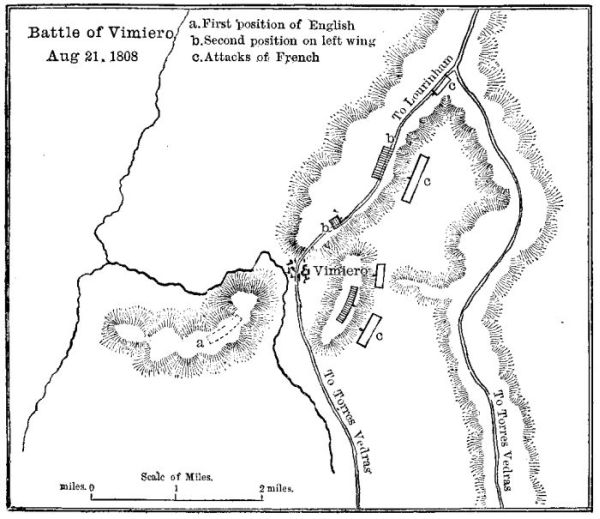
Battle of Vimiero, Aug 21, 1808
Wellesley was therefore obliged to return to his army, which was in position at Vimiero. A little hill covered the village to the front. On either side of it ran a chain of heights, from which on the east a branch ran off southwards. There was a direct road between Vimiero and Torres Vedras, and a second road from Torres Vedras to a place called Lourinham ran along the top of the branch ridge crossing the main ridge. On the hill before the village and upon the ridge to the west Wellesley took up his position, expecting to be attacked on his right. But early on the 21st the French Battle of Vimiero. Aug. 21, 1808. came into view on the Lourinham road, and as they pressed forward evidently threatened the left, and not the right, of the English position. A considerable body of troops was therefore moved from the right to the left ridge, a movement unobserved by the French, for the valley between the armies was thickly wooded. For the same reason a ravine which rendered the left wing nearly unassailable was unobserved by the French. Junot directed two main attacks, upon the central hill and upon the left ridge. The attack upon the centre was defeated, for it was open on the flank to the fire of an English brigade moving to the left, which halted half-way up the hill when the strength of the central attack was seen; the left attack was ruined by the ravine. Meanwhile troops had been sent to turn the English left by the Lourinham road and to advance along the left ridge, which the French believed almost unoccupied; but, as has been mentioned, it was now covered with troops, and Ferguson's brigade beat the assailants back, and pursued them along the ridge till he had wholly separated them from the rest of the French army. They must have capitulated had not an unexpected order arrived to halt. Sir Harry Burrard, who had been on the field all day, had just assumed the command, and the change of leaders became at once perceptible. When the battle was over, thirteen guns, and many prisoners, including a general, were in the hands of the English, and the French had lost between 2000 and 3000 men.
The road to Torres Vedras from Lourinham, on which the beaten French army had collected, was two miles longer than the direct road from Vimiero. Wellesley designed to push forward with his victorious army, part of which had not been engaged, to forestall the French at Torres Vedras, and cut them off from Lisbon, a measure which, had Sir John Moore been landed from Mondego, must have completed their ruin. Again the prudence of Sir Harry Burrard thwarted Wellesley's plan. He was compelled to allow his army to rest in their old position. Sir Harry Burrard having thus spoilt a great victory, was almost immediately superseded by the arrival of Sir Hugh Dalrymple. Their combined wisdom allowed an advance upon Lisbon, but insisted on bringing Sir John Moore to join the Convention of Cintra. Aug. 30. army. While this was being settled, an envoy arrived from the French offering to treat, and finally the convention known as the Convention of Cintra was entered into, in many points against Wellesley's advice. It stipulated for the evacuation of Portugal, but for the transport of the whole French army, with their guns and horses, to France. It was likewise arranged that the Russian fleet, at that time in Lisbon, should be regarded as in a neutral port; but as some English regiments had got possession of the mouth of the river, and had hoisted the English flag, this clause was overruled, and Siniavin, the Russian admiral, with his fleet, passed into the hands of the English.
Napoleon's position in Europe.
It was not to be supposed that Napoleon would calmly watch the defeat of his troops even in an obscure corner of Europe, still less when their defeat seemed to thwart the completeness of his system, and was connected with events which had driven his brother from his throne. Though he knew that conquered Prussia beneath the surface was glowing with inextinguishable hatred, and though Austria, in spite of the war against England in which she was nominally engaged, was strengthening her army and re-establishing her finances in a way which seemed to threaten fresh efforts at freedom on her part, he determined to turn the full strength of his Empire upon the devoted Peninsula. He felt that so long as his friendship with Russia existed, so long as the Peace of Tilsitt held firm, his position was tolerably secure. He therefore renewed his alliance with Russia at a meeting with the Czar at Erfurth (Oct. 12), and suddenly ordered the widely scattered divisions of the grand army to concentrate on Paris preparatory to marching into Spain.
Preparations in Spain.
Unconscious of the coming danger and of the vast strength of its enemy, the central Junta at Madrid went on with its ill-arranged preparations to secure the freedom of Spain, and with its idle boasts as to the strength of the national armies. The English Government had not yet lost faith in Spanish assertions, nor learnt the absolute worthlessness of Spanish generals and armies; the fables of the Junta gained credence, and while all the other generals who had gone to Portugal were recalled, some 25,000 men were intrusted to Sir John Moore, with orders to advance into Spain and assist the Spanish troops, which were now occupying the valley of the Ebro and closing the French frontier. Even had the Spanish troops been worth anything, there was an absurd disproportion between the forces prepared and the scene of action for which they were intended. Nor did this weakness fail to strike military men. The Duke of York, though by no means a first-rate general, called the attention of Government to the wide dissipation of the Spanish troops, and the great distance of Portugal from the scene of action, and gave it as his opinion that to employ less than 60,000 men was merely to waste them. The Government refused to listen to his advice, Lord Castlereagh, the War Minister, was unmoved, and Moore was sent forward to certain failure. With a raw commissariat, and ill supplied with money, although it was at that very time being lavished upon the Spaniards, he embarked upon his dangerous march through a country where the roads were so bad that his Sir John Moore's march to Salamanca. Oct. artillery to reach Salamanca had to proceed all up the valley of the Tagus almost to Madrid and come back to meet him at Salamanca, where he was to be joined by reinforcements from England under Sir David Baird. Moore's concentration at Salamanca was wholly based on the supposition that the Spanish armies were strong enough at all events to retard, if not wholly to resist, the invasion of the French. Yet the grand army was rapidly approaching, and before long the forces collected upon the frontier rendered resistance hopeless. In September arrangements were made for the incorporation of the troops coming from Germany with those already in Spain, and eight great corps d'armée, commanded by six French marshals and Generals Junot and St. Cyr, besides the Imperial Guard, were collected to bear down all opposition.
Napoleon arrives at Vittoria. Nov. 8, 1808.
While Moore was painfully completing his concentration at Salamanca, Napoleon himself arrived at Vittoria, and almost immediately the Spanish troops, which the English general was to support, were scattered to the winds.
Destruction of the Spanish armies. Napoleon at Madrid. Dec. 4, 1808.
From his central position the Emperor was able to concentrate his chief force now on his right, now on his left. In a rapid succession of victories Lefèbvre and Soult destroyed the armies upon the left and centre of the Spanish line, and on the 11th of November Blake was entirely ruined at Espinosa. Immediately the whole strength of the French army was turned against the right, and on the 23rd of the same month Lannes crushed Palafox and Castaños at Tudela. All the boasted armies of Spain were thus swept away as it were in a moment, and Napoleon advanced upon Madrid, forced the passage of the Somo-Sierra, and after some slight opposition took possession of the capital on the 4th of December. The news of the defeats of Espinosa and Tudela reached Moore at Salamanca before his artillery had joined him. He resolved to await its arrival, and then to retreat.
Meanwhile, although Napoleon at the head of nearly 400,000 men was pressing onward rapidly to Madrid, in a few days to drive the members of the supreme Junta fugitives to Badajos, the old system of misrepresentation was kept up. Mr. Frere, the English plenipotentiary, had been persuaded to share in the illusions of the Junta, and he wrote peremptory letters, urging Moore to advance, and to rally the Spanish armies around him behind the Tagus. But news had at length reached Moore that those Spanish armies did not exist; the national excitement he had been taught to expect was nowhere visible, and he presently heard that the capital itself was in the hands of Napoleon. For 25,000 or 30,000 English soldiers to oppose the grand army with Napoleon at its head was simply ridiculous; their retreat was a matter of necessity. But Moore determined before Sir John Moore's retreat. retreating to relieve if possible the pressure upon the south of Spain, by pushing forward against Soult and threatening the French communications with France. In acting thus he judged that Napoleon was far more likely to direct his efforts against the English force than to spend his time in subduing the southern provinces, which would easily fall into his hands afterwards. He therefore advanced towards the Carrion river, where Soult had collected his army. The measure succeeded. Napoleon heard of the advance on the 21st; dismissing all thought of the Spaniards, he checked the further advance of his troops, and turned all his attention to crushing the English. On receipt of the news that Napoleon had left Madrid, Moore, who had been hoping to strike a blow before the arrival of Napoleon, at once began his retreat. He was closely followed by Soult, while Napoleon, forcing the passes of the Guadarama, which were deep in snow, came up from the south upon his flank. The retreat was attended with great difficulty. Moore's troops were young, the subordination was not perfect, and the enemy pressed him close; and at length, on the 1st of January, Napoleon and Soult formed a junction at Astorga, and their combined army amounted to 70,000 men. In ten days Napoleon had moved in the depth of winter 50,000 men across 200 miles of hostile country. But Moore's rapidity had spoilt the effect of even this stupendous march; he had already passed Astorga.
Napoleon leaves Spain.
There news reached the Emperor of the approaching declaration of war from Austria, and he found it necessary to resign the command to Soult. Some of his troops he took with him; but Soult himself, and Ney, who supported him, still commanded upwards of 60,000 men, by whom the pursuit was recommenced. Amid many scenes of disorder the English army pursued its career towards Vigo, where it was expected that the fleet would be ready to receive it. But information was brought that the harbour was not fit for the embarkation of troops. The line of retreat was therefore changed to Corunna. At Lugo, so close was the pursuit that Moore thought it necessary to prepare for battle, and the troops, though they had suffered much and become disorderly in retreat, at once showed that their spirit was unbroken. To the number of 16,000 they formed willingly and regularly in array of battle. But as the French did not attack, and as the supplies would not permit of more than one great battle, the army being now concentrated and encouraged, Moore marched off at night, and resumed his course towards the sea. Although the movement was executed in the midst of a heavy storm, and though Moore reaches Corunna. Jan. 10. so much disorganization followed that the loss between Lugo and Betangos was more than in all the former part of the retreat, from thence to Corunna, the army being collected, marched in good order. As they approached the port, to their horror they discovered that the fleet had not arrived. Contrary winds were still detaining it at Vigo, "and the last consuming exertion made by the army was rendered fruitless." Battle was after all necessary. Large magazines of arms and ammunition left unappropriated and undistributed by the Spanish authorities, though their armies were in desperate want, were found and destroyed. The horses, many of them already broken down, were put to death. Soult's army, almost as exhausted by pursuit as Moore's by retreat, did not assemble till the 12th, but it was not till the 14th that the English transports arrived. The cavalry, who had lost their horses, the sick, and fifty pieces of artillery, were put on board, and preparations made for covering the embarkation of the troops. The ridge on which Soult's army was drawn up overlooked and commanded the position of the English, and some generals were desirous even then of entering into negotiations to secure the safe withdrawal of the army. Moore would not hear of it.
Battle of Corunna. Jan. 16.
It was determined that upon the evening of the 16th the embarkation should take place, but about the middle of the day the French army began the attack. Even in the last hour of retreat the English showed their strength; the assaults of the French were repulsed on all sides, and when night closed they were everywhere falling back in confusion. Moore had fallen in the battle, and the command devolved on Hope. Had he known that Soult's ammunition was nearly exhausted he would have continued the strife, and the disaster of the French would have been complete. As it was, he held it wiser to embark the English army during the night, an operation which was performed successfully and without confusion. The loss of the English was estimated at 800, that of the French at between 2000 and 3000. But though, no doubt, the battle of Corunna was an English victory, it was advantageous only in allowing the army to be withdrawn, and left the north-west provinces of Spain and the north of Portugal open to the French. Sir John Moore, whose character as a soldier had already been acknowledged, decoyed by false hopes and misled by false information, had yet nobly succeeded in withdrawing for a time the pressure of the French from the south of Spain, and in the midst of overwhelming difficulties had saved the British army and closed his career with a brilliant victory.
Discouragement of the English ministry.
The Convention of Cintra and the retreat of Sir John Moore, the greatness of which was not understood, discouraged the English ministry with regard to its policy in the Peninsula. The cause of the Spaniards was however so popular that it was not deemed advisable wholly to desert them. For three months after the convention Portugal had been left a prey to its own anarchy, but in December Sir John Cradock was sent out to command the English troops. The armaments which had been sent to Cadiz having failed to effect anything there, collected at Lisbon. The Portuguese were at length wise enough to demand an Beresford made commander of the Portuguese army. English general for their army, and Beresford was sent out to take the command, and thus something like order was re-established. But Napoleon had commanded the conquest of Portugal, the troops of Victor threatened it in the valley of the Tagus, while Soult had entered it from the north and mastered Oporto. Refusing to act with insufficient troops, and waiting for reinforcements, Sir John Cradock had wisely taken the position to defend Lisbon from the advance of Victor, and was stationed at Lumiar and Sacavem just above Lisbon. It was Wellesley arrives. April 22, 1809. in this position that Wellesley found the English army when he came to take the command on the 22nd of April. With his arrival begins what is properly called the Peninsula War, a war which, by constantly sapping the strength of Napoleon, by exhibiting the possibility of his defeat, and by showing him and his rule, in opposition not to a government, but to a people, was to do more than anything else to complete his final overthrow.
But the English ministry, even while continuing the war, by no means regarded it in this light. Their hopes were not unnaturally turned rather to political coalitions in Europe and to expeditions which appeared more directly to attack the heart of the French empire. Moreover, political feeling in England was strongly excited. Though Division of opinion in England. there was a general desire for the continuation of the war, there was no unanimity as to the means of carrying it on, or as to the people by whom it should be carried on. Every disaster was exaggerated for political purposes, every obstacle thrown in the way of ministerial action. Our system of party government is not well suited either to great European combinations (because the open hostility exhibited to the ministry of necessity gives an appearance of uncertainty to our engagements) or to the carrying on of war where secresy is necessary, and where reliance upon those to whom the war is intrusted is required. In domestic affairs its effect is different, and at this time the Opposition was doing good service in bringing abuses to light and rendering salutary reforms necessary. Early in the spring they found grounds for assaulting the ministry in the conduct of the Duke of York, the commander-in-chief, who was accused by a certain militia colonel, Wardle by name, of being influenced by his mistress, Mrs. Clark, in his appointments, while her favour was said to be procured by money. Scandal of the Duke of York. The scandal excited was great, and the immoral details of the story were in everybody's mouth. The inquiry made it evident that Mrs. Clark's influence had been used, but it was not so clear that the Duke had ever himself acted otherwise than conscientiously. The majorities in his favour, however, were so small, that he felt it necessary to resign his office, and Sir David Dundas was appointed in his place. Before long his accuser was himself sued by a tradesman for the price of goods with which he had furnished a house for Mrs. Clark. This gave such an air of malice to the charge, and displayed Colonel Wardle's desire for purity in so strange a light, that it greatly lessened the feeling against the Duke, who was before long restored to his office.
This quarrel, in addition to the case of Lord Melville, excited attention as to the general purity of the administration. Considerable sums of money, amounting to nearly £20,000,000, were unaccounted for. Nor did a committee of inquiry, though it sent in its report, throw much light on the matter. But in March the Chancellor of the Exchequer brought in a Bill to prevent the sale and brokerage of office. Among other matters, attention was drawn to patronage in Charges against Lord Castlereagh, May. India, and Lord Castlereagh confessed to having purchased a seat in Parliament for a friend by a gift of an Indian writership. Lord Castlereagh's frank confession induced the House to resolve that no criminating resolution was necessary. Again in May a fresh charge was brought involving Lord Castlereagh and Mr. Perceval also. They were charged with procuring the election of a certain Mr. Quintin Dick, and of afterwards influencing his vote. They were acquitted by a large majority. None the less, Romilly remarks in his Memoirs, "the decision of this night, coupled with some that had lately taken place, will do more towards disposing the nation in favour of a parliamentary reform than all the speeches that have been or will be made in popular assemblies." This question of parliamentary reform was now again beginning to occupy the public mind. Though still commanding majorities, the Cabinet was not at one with itself, and before the year was over the ministry had to be reorganized.
Opposition to Napoleon in Germany. 1809.
But meanwhile the war was proceeding in its course. The threatening news from Austria which checked Napoleon in his pursuit of Moore proved true. The cruelty and injustice of the attack upon Spain, and the spectacle of a people in revolt, had strongly excited the feelings of Germany. Earnest men of all ranks had enrolled themselves in the secret society known as the Tugendbund, which was shortly to show its strength. The same feeling of hostility to France had shown itself in irresistible force in Austria, smarting under its repeated disgraces. There the Court and Government put itself at the head of the movement, and the Archduke Charles, who was regarded as a military genius, issued a proclamation declaring that the liberty of Europe rested with the Austrian arms. There was no regular coalition formed, but Austria felt that it could rely upon the friendship of England (although still nominally at war with it), of Prussia, where the popular feeling ran high, and probably even of Russia. Armies numbering more than 200,000 men were set on foot, and on the 9th of April Austria declared war against Bavaria, an ally of France. The generals left in charge of Napoleon's army in Germany somewhat mistook his orders, and the Archduke succeeded in forming a partial concentration of his troops and occupying Ratisbon. The arrival of the Emperor on the field soon changed the face of affairs. A series of battles was fought; the left wing of Charles's army was separated from the right, and his forward advance entirely frustrated by defeats at Abendsberg (April 20), Eckmühl (April 21), and Ratisbon (April 22). Napoleon again advanced to Vienna. But there he found the Archduke Charles still fronting him upon the northern side of the Danube, and the great bridge which crosses the river at Vienna broken down. Near that city the course of the Danube is divided by an island called Lobau, about three miles in length. Napoleon constructed bridges at the Battle of Aspern. May 22, 1809. island, and brought his army across them into the level called the Marchefeldt on the northern side. There was fought the great battle of Aspern. Victory declared for neither party, and Napoleon found himself in an awkward situation, for the river had risen, and aided by the efforts of the Austrians, had swept away the bridge, and he was thus cut off from reinforcements. He contrived to get back to Lobau, and there awaited his opportunity.
His position was indeed precarious. The secret societies had shown themselves, and a partisan insurrection had broken out under Colonel Schill and the Duke of Brunswick in Saxony and Westphalia. It was premature, and without much difficulty suppressed. Revolt of the Tyrolese. The Tyrolese too, headed by Andrew Hofer, an inn-keeper of the valley of Passeyr, had burst into revolt; 25,000 Bavarians which marched to suppress them had been beaten back. Again and again in the mountain passes they encountered and defeated both the French and Bavarian troops. The revolt was unsuppressed, when Napoleon determined to break from his difficult position. In July, while pretending to build a massive bridge across the river, he brought his army rapidly across it on a temporary structure. The Archduke, who had expected to attack the French while crossing, had now to fight another pitched Battle of Wagram. July 6, 1809. battle, and two vast armies, numbering together between 300,000 and 400,000 men, encountered each other upon the tableland of Wagram. The French gained a hard-won victory. The Archduke was pursued to Zmaim, Peace of Vienna. Oct. 14, 1809. in Moravia, and there an armistice was made which ripened subsequently into the Peace of Vienna, signed on the 14th of October, by which fresh territory was torn from Austria for the advantage of Bavaria, France, and Russia; the kingdom of Spain was recognized; the insurgents of the Tyrol deserted, and a further pledge for the maintenance of the Continental System given. The close of the year was marked by a still further act of wickedness on the part of Napoleon, and a stronger proof of how completely he had deserted the principles of the Revolution. On the 6th of December he divorced his wife Josephine, and entered into negotiations, which were completed the following year, for his marriage with Maria Louisa, an Austrian princess.
The armistice of Zmaim was entered into on the 12th of July. On the 27th of that month, the very day on which the news of the armistice reached England, a great expedition left for the mouth of the Scheldt, for the English ministry had not deceived the hopes of The Walcheren expedition. July 1809. the Austrians, and were determined to undertake what they hoped would prove a diversion in their favour. For this purpose all the strength of England was to be employed. 40,000 soldiers were to be carried across in 400 transports under the charge of no less than 245 ships of war. Yet, great as was the effort, the commonest precautions were neglected. Although it was well known that the climate of the islands at the mouth of the Scheldt was pestiferous, the medical officers were not consulted, none of the proper medicines were sent, and the force was accompanied, in spite of the protest of the surgeon-general, by only one hospital ship. Moreover, the pomp and publicity with which the expedition, which was intended to be secret, was prepared deprived it of much of its value; and lastly, Court and ministerial favour secured the command for Lord Chatham, Master-General of the Ordnance, a man wholly unfitted for an important command. At length, after much delay caused by the want of harmony between the two branches of the service, the fleet set sail. It was the opinion of the best officers of the army that Antwerp might have been at once secured by a coup de main, yet it was determined to proceed more regularly and with deliberation; and Flushing (which, as the dykes had been cut, was Flushing taken. Aug. 15. regarded as impregnable) was taken in two days after the arrangements for the attack had been completed. It was not till the 21st of August that Lord Chatham began to think of moving towards Antwerp. But, as by that time the enemy's squadron had been withdrawn up the river to the city, and the intermediate fortresses had been so strengthened as to render the advance difficult, absolutely nothing further was even attempted. The army was kept lying in the plague-stricken swamps of Walcheren. Fever began to make fearful ravages. On the 29th Chatham wrote home that he could do no more—that already 3000 of the troops were sick. By September 11,000 men were stricken, and the great bulk of the army was ordered home. Lord Chatham, taking with him as many of the sick as he could, accompanied it. 15,000 men were left to occupy the island. Though the fever still spread with fearful rapidity, the only remedy supplied was a quantity of Thames water, which was constantly sent out. The roofs of the huts had fallen in, the men were removed to the churches, and the churches proved damp and worse than the roofless huts. At last 100 bricklayers were sent from England to repair the huts; the bricklayers were speedily themselves in hospital. The death rate was now 200 or 300 a week; and so terrible was the effect of the fever, that before the next June, of the 40,000 troops sent out 35,000 had been in hospital. Nor did this great folly produce the smallest effect on the general war. Even had the expedition not been so delayed that the Austrian armistice was already signed when it sailed, it could have done no good. Napoleon himself wrote of it, "Before six weeks, of the 15,000 troops which are in the Isle of Walcheren not 1500 will be left, the rest will be in hospital. The expedition has been undertaken under false expectations and planned in ignorance."
While wasting their strength in this idle display, the ministry were being taught, had they been willing to learn, where English forces might have been wisely employed. In Portugal, Wellesley, on taking Wellesley victorious in Portugal. the command, had marched against Soult in the north, had brought his army across the Douro in face of the French, who were occupying Oporto, had recaptured that city, and driven Soult to a desperate retreat. By extraordinary vigour and good fortune, Soult, though there were traitors in his camp, contrived to extricate his army, but Portugal was free. And Wellesley, victorious in the north, and deceived by the constant false information of the Spaniards as to the weakness of his enemies, determined to turn his arms against the other French army which was threatening Portugal in the valley of the Tagus. He was there to act with the Spanish army under Cuesta, an old man of crabbed temper and of great self-conceit. Victor's army fell back before the advancing English from Talavera behind the Alberche river.
Wellesley marches towards Madrid.
By this march Madrid was threatened, and Joseph collected for its defence the troops of Victor, Sebastiani, and his own guard, amounting to about 50,000 men. As Wellesley had with him less than 20,000 English troops, and as he could place no reliance upon the Spaniards of Cuesta though they were nearly 40,000 in number, it was a bold resolve to march against Victor. But Wellesley was ignorant of the extreme danger of his movement. Constantly misinformed by the Spaniards, he believed Soult's army in Castile and the plain of the Douro to consist of about 15,000 men; in reality it was more than 50,000 strong. With these it was possible, collecting them at Salamanca, to cross the mountains separating the plains of the Douro and the Tagus, to pass between Wellesley's troops and Portugal, and thus placing him between two armies, each virtually superior to his own, entirely ruin him. Ignorant as yet of the character of the Spaniards, Wellesley could not believe that he should be kept uninformed, nor could he believe that the Spanish troops supplied to occupy the passes of the mountains, and restrain, or at least check, Soult's movements, would give ground without striking a blow; nor, before entering on his enterprise, could he have conceived that his army would have been systematically kept without food. It is nevertheless true that the greatest difficulty was found in procuring rations, which often consisted merely of a few handfuls of grain, while the Spanish troops were very fairly fed. Victor and the King had taken up a position beyond the Alberche stream, a little river flowing from the north into the Tagus above Talavera. Beyond that stream, Wellesley, when he found how he was treated, positively refused to move. Beginning to appreciate the character of the Spanish troops, he urged Cuesta not to venture on a forward movement without him; but the obstinate old man persisting in passing the Alberche, was roughly handled by Victor, and only saved from the consequences of his rashness by English assistance.
Soult had informed Joseph of his great plan. All the King had to do was to remain quiet, and check the advance of the English till Wellesley was caught in the trap. But there was a second Spanish army apparently threatening Madrid from the south. It might well be that before Soult's arrival the capital would be lost, although, if Soult's plan answered, it would be immediately regained. The King could not bring himself to bear even the temporary loss of his capital, especially as the hospitals and supplies for his army were there. He therefore rashly listened to the advice of Victor, which was contrary Battle of Talavera. July 28, 1809. to that of Jourdan, his proper military adviser, and determined to attack the English. The position of Talavera is about two miles in length, crossing the plain from the river Tagus to a small range of hills which bounds the valley; beyond this range is a second valley of about half a mile in extent, and then come the mountains. The key of the position is the highest of the secondary hills, and this Wellesley occupied. The Spaniards he placed behind entrenchments in Talavera. Victor made a second error in making two preliminary attacks upon the key hill. Though these attacks failed, he still believed he could carry the position, and Joseph yielded to his desire for a general engagement. This was fought on the 28th of July. The advance of the French light dragoons so frightened the Spaniards that many regiments at once turned and fled, carrying the news down the valley that the English army was destroyed. Such as remained in their strong position proved sufficient to hold it, and were not seriously molested. The whole brunt of the battle fell upon the English in the centre and left wing. At one moment the centre was broken through, and disaster might have followed had not Wellesley at once seen what was wanted, and sent the 48th regiment down from the hill, though the fighting there was severe, and re-established the battle in the centre. An extraordinary and reckless charge of the 23rd light dragoons across an apparently impassable ravine, though carried out with the loss of almost half their number, had the effect of paralyzing a whole division of the French army, which was attempting to turn the English left by the valley between the hills and the mountains. When the evening closed the French had been defeated at all points, and the English remained masters of their position.
But by that time Soult had come almost unopposed through the mountains from Salamanca to Placentia and the direct road to Portugal was closed. All hopes of rendering the victory useful were therefore gone, and Wellesley was compelled to cross to the south of the Tagus, and take refuge among the mountains. After considerable loss and much suffering from the abominable usage he endured from the hands of the Spaniards, he came to a fixed determination that he would never again act in concert with them, that henceforward his first duty lay in saving Portugal, from which, if events favoured him, he might ultimately advance with an English and Portuguese army, and do for the Spaniards what they were totally unable to do for themselves.
Effect of the victory in England.
The victory of Talavera was a great one, and the English ministry recognized it as such by raising Wellesley to the Peerage as Viscount Wellington. Nevertheless it was open to the cavils of the Opposition, for it could be truly urged that it had not produced any permanent advantage, and had been followed by a somewhat disastrous retreat. In Parliament some Opposition speakers even went so far as to urge that the name of the commander should be omitted from the vote of thanks to be given to the army. But it was in fact the weak war administration in England which rendered it useless. Our resources had been wasted in the pompous and ridiculous Walcheren expedition, and in a second expedition, almost as useless, which was despatched to Italy, where it was unable to effect anything, and had to withdraw to Sicily.
French victories. Nov. 1809.
When Wellington withdrew from Talavera, after waiting some time on the Guadiana, he took up his position in the more northern part of Portugal, near Almeida, preparing for the defence of the country. During his inactivity there the advance of the French was nearly unchecked. They marched into Aragon and Catalonia, and defeated an army of 50,000 Spaniards at Ocana (Nov. 20), thus throwing open the province of La Mancha, and obtaining an opportunity for further advance into Andalusia. This province was also overrun, with the exception of Cadiz, which was saved by General Albuquerque. The invasion thus formed itself into three defined divisions; an army for the invasion of Portugal, an army for the completion of the conquest of Andalusia, and an army in Catalonia, while the King and his Imperial Guards formed an army in the centre. Having thus borne down all opposition in Spain, Napoleon's intention was to overrun Portugal in the following year. His army for the purpose was placed under the command of Massena, while Soult was intrusted with the operations next in importance, and directed against Cadiz.
The assault which Wellington had been long preparing to resist was now to come. The ministers in England—in part despairing of his success, in part unable to comprehend the greatness of his schemes—distinctly told him that he must rely upon himself. But, with extraordinary steadfastness and courage, he undertook the task. Ever since the October of the preceding year he had foreseen what would happen; he had known that in all probability his troops would be outnumbered, and that he should be unable to make head against the vast armies which Napoleon might set at motion against him. He had therefore designed a great defensive scheme, so that if the worst came to the worst he might still have some place to which to retire and avoid the necessity of evacuating Lisbon. He had therefore turned the promontory between the Tagus and the sea into a vast fortification. During the time of his delay on the Wellington fortifies the Lisbon promontory. 1810. Guadiana, and while wintering near Almeida, thousands of Portuguese workmen were turning the hills into impregnable fortresses. This great work, known as the lines of Torres Vedras, was threefold. The outer line, twenty-nine miles in length, extended from Alhandra on the Tagus to the mouth of the little river Zizandra close to Torres Vedras. The second, twenty-four miles in length, and which was intended originally to be the strongest of the two, was from six to ten miles in rear of the first, reaching from the Tagus at Quintella to the mouth of the St. Lorenza. In addition to this, a small fortification was erected to cover an embarkation in case the other two lines were forced. It enclosed an entrenched camp and Fort St. Julian, and was two marches in rear of the first line. Time had allowed Wellington so to strengthen the first line that it subsequently proved sufficient for all purposes. The General's great cares during the winter had been,—first, to instruct the Portuguese authorities to insist upon the inhabitants destroying all villages, mills, and crops in the course of the invading force when it should appear; secondly, to get the half-trained militia of the country over which he held command employed in such a manner as to oblige the French to act in a mass and prevent detailed fighting; and thirdly, so to arrange his troops that while spread abroad, for greater ease in procuring provisions, they should yet be within easy distance for concentration. He thus waited, fully prepared to carry out his great scheme when Massena should think fit to strike the first blow. So determined was he to adopt a waiting policy, that he even allowed the great fortress of Ciudad Rodrigo, the key of that part of Spain, to be taken before his eyes. Meanwhile he had to listen calmly to the assertions of the Opposition in Parliament, that no British soldier would leave the Peninsula but as a prisoner, and to see the City of London addressing the throne to inquire into his conduct, and protesting against conferring honours and distinctions on a general who had exhibited nothing but useless valour.
Massena advances against him. Sept. 1810.
Ciudad Rodrigo fell on the 11th of July. It was not till September that the great attack began. Then Massena, with an army of 65,000 men, set forward towards Lisbon by the valley of the Mondego, having been informed by friendly Portuguese that the road was easy, and that there was no important position between him and Coimbra, where he believed he could forestall Wellington. An accident lost the English commander the advantage that any opposition from the fortress of Almeida might have given him. The explosion of a magazine rendered the capitulation of the fortress necessary almost immediately. In spite of Massena's attempts to deceive him as to the road he intended to pursue, in spite of the distance at which some of the English troops were stationed, Wellington contrived to collect his army and to place it between Massena and Coimbra. Down the valley of the Mondego the march was continued. The orders for the destruction of the property were carried out as far as possible, and crowds of wretched fugitive peasants accompanied the army. A panic began to spread in Portugal. The intriguing regency did not carry out the orders for destruction with sufficient activity. There was yet enough food left between Mondego and the lines to supply the French during the ensuing winter. To raise the temper of the country, and to excite the people to the voluntary destruction of Battle of Busaco. Sept. 29, 1810. their property, Wellington was compelled (in entire opposition to his original plans) to fight a great battle with the advancing French. He selected the ridge of Busaco, which almost closes the valley of the Mondego, just north of Coimbra, as his battlefield. The English and Portuguese there stood at bay, and the French were completely defeated. The moral effect was all that could be desired—the Portuguese troops thenceforward became fitting comrades for the English, and the waning trust of the people was restored; but as a military operation it effected nothing. Massena found a pass through the hills upon his right, through which he withdrew with his beaten forces, and Wellington, not attempting to attack him, fell back, giving orders to the Portuguese militia to close upon the French rear. Thus harassed in his progress, Massena arrived before the famous lines (of the existence of which he had only heard five days before), only to find them thoroughly occupied by the English troops. Against the works he could do nothing; his operations were in fact reduced to a blockade. Massena's object, therefore, was to feed his army till reinforcements arrived, Wellington's, by closing up the Portuguese militia behind Massena retreats. Nov. the French army, rapidly to reduce it to starvation. The expected reinforcements did not come, and on the 14th of November Massena, who had lost upwards of 30,000 men since he had entered Portugal, was obliged to draw off his army and begin a regular retreat. He moved leisurely, hoping to strike another blow before he finally withdrew, but when reinforcements arrived for the English he proceeded with some haste to Almeida and Ciudad Rodrigo. The operations were closed by the combat of Sabugal (April 3, 1811), where Massena was again worsted, and after which he finally withdrew from Portugal.
While Massena was attacking Portugal, Soult had been vigorously prosecuting the siege of Cadiz, and had there made dispositions which would probably have ended in its capture, when he was ordered to assist Massena, for the Emperor was more anxious to put an end to the regular warfare in Portugal than to complete his conquests in Spain. Portugal is assailable either by the northern line from Salamanca, which Massena had already followed, a line covered by the fortress of Ciudad Rodrigo, or by a line south of the Tagus through Estremadura and Alemtejo, which is covered by Badajos and Elvas. In this latter direction Soult had marched; the fruit of his operations were the victory of Gebora (Feb. 19), where the Spaniards were completely defeated, and the capture of Badajos. The two great frontier fortresses between Spain and Portugal were thus in the hands of France. But the departure of Soult from Cadiz encouraged Graham, who commanded the English in that fortress, to attempt to drive Victor, who was left in command, from his lines. A combined force of about 12,000 men sailed from Cadiz southward, intending to march upon the back of the French lines. Victor, marching out to defend them, was defeated at Barosa (March 5) by the vigour and generalship of Graham, La Peña, the Spanish commander, as usual, adding nothing to the victory, and failing when the victory was won to put it to any use. The battle was however so severe a threat that Soult, not wishing to lose all the fruit of his former arrangements, withdrew from his attack on Portugal. Yet, as both Badajos and Ciudad Rodrigo were in the hands of the French, in the following campaign there were two scenes of operation of which those fortresses were the centres.
Wellington's great plans.
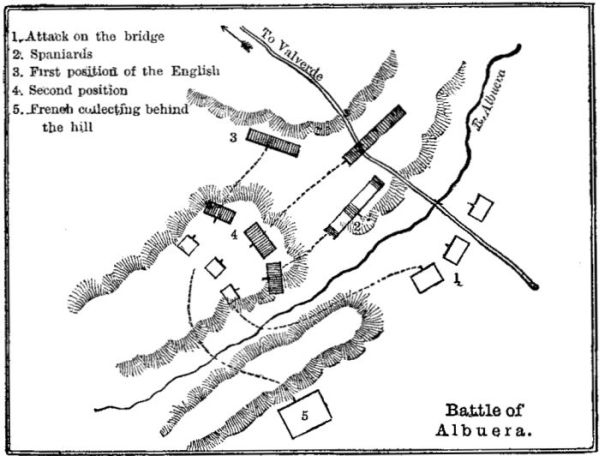
The ministry in England had at last begun to feel some confidence in their general, but they would have been content with the successful defence of Portugal. Not so Wellington; his mind was full of great projects for the relief of Spain. The two points on which the French pressure was strongest were Catalonia and Cadiz; and Wellington, believing that Massena, although his troops had been again raised to 50,000 men, would not be in a fit state for immediate action, had it now in his mind either to invest Almeida and Ciudad Rodrigo, betake himself with much of his army to Badajos, unite with the English and Portuguese troops there, and assault Soult in Andalusia; or to engage in a still more magnificent plan,—to march his army right across Spain, taking Madrid on the way, which would cut off the resources of Soult's army and oblige it to withdraw, and then upon the eastern coast to enter into communications with the English troops at that time in Sicily, and, working from a new base of operations, to attack the French in Catalonia. In either case the capture of Badajos was necessary, as its possession by the French was a constant threat to the Spaniards in Cadiz and to the southern provinces of Portugal. Wellington therefore, leaving the blockade of Almeida in the hands of Spencer, went to Elvas to arrange with Marshal Beresford, who commanded the troops in that direction, for the siege of Badajos. Before his arrangements were completed he was hastily summoned again to the north, where Massena had unexpectedly shown signs of activity, and was moving to relieve Almeida. Wellington was in time to check him at the hard-fought battle of Fuentes Onoro (May 5), which was followed by the evacuation of the fortress. He then returned to superintend the more important Battle of Albuera. May 16, 1811. operation of the siege of Badajos. But before he arrived the operations had been interrupted. Soult had advanced to succour his late prize, and Beresford had thought it necessary to fight a battle with him at Albuera. This battle, one of the bloodiest ever fought, took place on the 16th of May. The English and their allies had about 30,000 infantry and 2000 cavalry, but of these only 7000 were English, and the Spaniards were not to be trusted. Soult had with him only 19,000 good infantry and 4000 cavalry, but Beresford's faulty arrangements almost neutralized the superiority in forces. The English position was a ridge, in front of which ran the Albuera river. In the centre were the village and bridge of Albuera, through which ran the road to Valverde over the ridge. This road being Beresford's only line of retreat, he regarded a hill in the centre which defended it as the key of his position, and there put his best troops, intrusting the right to the Spaniards under Blake. He also neglected to place any troops across the river, and the enemy's movements were entirely hidden by the wooded heights on that side. For a direct attack Beresford's dispositions were correct, but upon his right a tableland stretched so far back as to command the Valverde road and to look along the back of the English position. Soult saw that by mastering this height he would cut off the English from retreat, oblige them to form a wholly new front, and in all probability destroy them. He therefore secretly, under cover of the hills, massed his troops upon his own left, and while a sufficiently important assault was made upon the bridge to attract Beresford's attention, the bulk of the French army rapidly proceeded to place itself at right angles to the English position upon the tableland. The main point of the battle was in the struggle for the possession of this vantage-ground. In vain Beresford entreated Blake to change his front and cover the right. The Spanish general insisted that the real attack was upon the village. Beresford himself took the command of the Spanish troops, the change of front was effected, but even then they could scarcely be induced to move. At length the English second division moved from the centre and mounted the hill. But, brought too recklessly into action, they suffered much. Scarcely a third of the regiments remained standing, and Beresford was already thinking of retreat when Colonel Hardinge induced Cole with the fourth division, and Abercrombie with the third brigade of the second division, neither of whom had been much engaged, to advance to the rescue. At the head of 6000 men Hardinge advanced to cover the hill. The crowded formation of the French, who were in column, impeded their movements, and the advance of the English was so irresistible, that at length, unable to open out, they gave ground, and in the words of Napier, "slowly and with a horrid carnage were pushed by the incessant vigour of the attack to the furthest edge of the hill," and at length "the mighty mass, breaking off like a loosened cliff, went headlong down the steep; the rain flowed in streams discoloured with blood, and 1800 unwounded men, the remnant of 6000 unconquerable British soldiers, stood triumphant on the fatal hill." In four hours nearly 7000 of the allies and 8000 French were struck down. The victory was however won, and after occupying a threatening position during the 17th, on the 18th Soult marched away. The advantages of this bloody battle were little or none.
Critical position of the French.
Yet though the battles of Fuentes Onoro and Albuera produced little result, although the French continued their successes in Catalonia, and Spain seemed entirely at their disposal, their position was by no means wholly prosperous. The broken armies of the Spanish had formed themselves into guerilla bands, their useless generals were superseded by daring partisan commanders, and troops wholly untrustworthy in pitched battles proved masters of the art of wild irregular warfare. It was only in large masses that the French were safe; yet, as Napoleon always acted on the principle that war should support war, and allowed only £80,000 for the maintenance of his armies in Spain, which at that time amounted to more than 300,000 men, the dispersion of the forces was an absolute necessity in order that food might be procured. No courier could be despatched except under escort; letters to Paris were guarded at first by 1400 dragoons, subsequently by 3000. Moreover, Joseph, and the Emperor were not at one. The Spanish King did not wish to rule only as the agent of his brother in a conquered country, and at length the vexatious tyranny of Napoleon pressed so heavily upon him, that he went to Paris and resigned his crown. He was induced to take it back again, but the mere fact of his visit, coupled with Wellington's success and the late victories, which were complete if not decisive, raised the spirits of the patriots and increased the energy and number of the guerillas. Moreover, affairs in Europe were beginning to take a turn which compelled Napoleon to act with less vigour in the Peninsula. His marriage with the Austrian archduchess was a deadly insult to the Czar, for a princess of whose house he had previously been negotiating; the Continental System was becoming almost unbearable, coupled as it was with the French occupation of the northern ports of Germany; and the addition of territory to the Duchy of Warsaw seemed to threaten a restoration of the Polish kingdom, and to be a violation of the Treaty of Tilsitt. The estrangement of the Czar was becoming so evident that Napoleon's mind began to turn more and more towards an expedition against Russia. The number of troops in Spain was lessened, and first-rate soldiers withdrawn to give place to new conscripts.
Position of Wellington.
But, in spite of this relaxation, this year forms in the opinion of the great historian of the war its most critical period. For Wellington was miserably supplied from home, and sickness was rife among his troops, so that he could not bring more than 8000 men into the field, while the Portuguese Government, quarrelling with him, frequently refused supplies, and so starved their own troops, that instead of 40,000 soldiers who had been available on Massena's advance, only 19,000 badly-fed men were now with the army, and against this weakened force a new combination of the French had been arranged. The battle of Albuera had been followed by a renewal of the siege of Badajos. Want of proper material rendered the progress of the siege slow, and Marmont, who had succeeded Massena in command of the army of Portugal, was ordered to co-operate with Soult coming from the south to relieve it. Their junction was effected and the siege was raised. To all appearance therefore the battle of Albuera had been a French victory, and two armies instead of one appeared to threaten Portugal by the southern line. Wellington had brought his troops down and The French refuse the battle at Caya. June, 1811. offered the combined generals battle upon the Caya. But, ignorant of the weakness of the English, and imposed upon by the confident front which Wellington with astonishing boldness showed them, the battle, which might easily have been decisive of the fate of the Peninsula, was refused by the French generals, and Soult moved southward, while Marmont returned to occupy the valley of the Tagus.
This critical year of 1811 was a bitter disappointment to Wellington. He had hoped that his period of inactivity was over, that the defensive might have been changed to an offensive warfare. The blunders of his subordinates, the wretched jealousies of the Portuguese regency, and the poor support he received from home, had rendered his efforts futile. He still found himself when the year closed obliged to be contented with preserving his defensive attitude in Portugal. It was even worse than this. The French had succeeded in completing the conquest of the east of Spain, and the army of Suchet had advanced as far as Valencia; while in the north Asturias and Galicia had again fallen into their hands. Some gleam of success had indeed been visible in the south, where Hill had checked Drouet in Estremadura, and where Soult had been beaten off in his attack upon the little fortress of Tarifa. But the reorganization of the French army (especially of the great army of the centre), and the threatened reappearance of Napoleon upon the scene, rendered the close of the year one of gloom and despair.
Threatened war between France and Russia.
Yet events were occurring in Europe which allowed Wellington still to hope. Already, as early as the beginning of 1810, the appropriation by Napoleon of the estates of the Duke of Oldenburg, a relative of Alexander, had induced the Czar to declare his freedom from the Continental System. It had become evident to him that, sooner or later, war would be forced upon him, and he had entered into open preparations. Under one pretext or another Napoleon had also been strengthening his troops upon the eastern frontier of his dominions, and though the forms of friendship were still kept up, it was plain that before long the two empires would be plunged into hostilities. During the whole of 1811 remonstrances and recriminations had passed between the courts. Alexander had at first intended to re-establish the kingdom of Poland, where the influence of Napoleon was still great, and to begin offensive movements. The success of Wellington at Torres Vedras is said to have suggested to him and to his counsellors the more prudent method of attracting the French into the heart of Russia, and of allowing the weather and the natural difficulties of the country to have their full force as his allies. He knew that, in spite of the marriage of the Austrian archduchess with Napoleon, he could rely upon the friendship of the Court of Vienna should any opportunity arise of successful opposition to France. Prussia likewise, since the battle of Jena, had undergone a complete though silent revolution; feudalism had been almost destroyed, the peasants given a share in the property of the land, and bourgeois and peasant alike endowed with self-government; the people and the government were absolutely at one. While ostensibly restricted to the treaty number of 42,000, the army had been practically increased to 150,000 men; and, by an extraordinary effort of patience and good administration, the broken nation had been re-established. There, too, it was certain that any successful effort to check Napoleon would be hailed with delight. But Napoleon, observing that Russia did not take the initiative, and seeing that both Austria and Prussia were to all appearance still at his service, forgetting the lesson which he should have learnt from Spain, that the enmity of the people is more to be feared than the enmity of the government, seemed irresistibly led to the war which was to complete his ruin. In August 1811 there took place another of those scenes which had so frequently preluded war. At a public meeting of ministers in the Tuileries the Russian ambassador had to undergo a violent attack from the Emperor. From that moment all Europe knew that the war with Russia was determined on. It was upon the certainty of the approach of this event and the nature of the French warfare in Spain that Wellington rested his hopes.
Wellington's plan for the campaign of 1812.
Marmont's army had been moved for the sake of procuring food into the valley of the Tagus, which was thus called upon to support two armies, that of the centre and that of Portugal. Wellington did not believe that it could do this for long, but while the armies were there barring the valley of the Tagus offensive movements of any importance were impossible, as Soult and Drouet occupied the south, and the northern army in Asturias, capable of being reinforced by Marmont, prevented action in the valley of the Douro. But meanwhile Ciudad Rodrigo was not itself within immediate reach of the covering army; a sudden attack and capture of this fortress would almost certainly bring Marmont northward to save the neighbouring country and to relieve the valley of the Tagus. Even a weak army covered by the fortress would probably be able to make good its position, while Wellington himself marching southward might also capture Badajos, and thence defeat Soult and Drouet in Andalusia. With infinite pains to avoid discovery he ripened his plan; preparations were secretly made at Almeida and at Elvas for the two sieges, and the first rapid blow was successfully struck, and Ciudad Rodrigo captured (Jan. 19). It had the effect expected; Marmont collected his troops at Salamanca, the scattered detachments of the French were everywhere drawn in, Hill's southern army was moved towards the north, and Wellington was sufficiently strong to fight a battle if necessary. Marmont for the present resigned the fortress and again distributed Capture of Rodrigo and Badajos. his troops. Wellington then proceeded to strike his second blow. Leaving one division behind him, with some Spanish troops and Portuguese militia, he moved southward, and at length succeeded in storming Badajos also, though with fearful loss (April 6). He acted with unusual skill, and the charge against him of having foolishly wasted life in the siege proves upon examination to be utterly groundless; for it was the extreme rapidity with which the fortress was captured which prevented Soult from coming to its relief. But again the fruits of his success were snatched from him; he was unable to follow out his plan of driving Soult from Estremadura, for he was badly seconded by the troops he had left in the north; Marmont, though somewhat slowly, had begun to carry out Napoleon's orders to regain Ciudad Rodrigo and to invade Portugal, and Wellington had to make all haste back to re-establish his affairs there. His rapid appearance from the south on Marmont's flank compelled that general to retreat, but the opportunity of a southern war was over, and the English army was again spread along the whole line of Portugal, but with this important advantage that the two key fortresses of Spain were now in its hands.
Wellington's attack on the northern army.
It was as yet only the spring, Wellington had to choose in which direction he would arrange the ensuing campaign. He determined to make his attack on the northern line; a victory over Marmont would throw open the road to Madrid, and Soult would either have to retire from the south or be cut off from his communications. A portion of his army might indeed be sent to assist Marmont; but the harvest in the valley of the Douro is considerably later than in the south, and it was impossible that a large additional number of troops should be subsisted for at least a fortnight to come. Thus for a while he could act against Marmont alone. Further to secure his position, he strengthened the army under Hill in the south, planned and executed an extraordinary capture of the French lines of communication at Almaraz, thus rendering the intercourse between the two armies lengthy, and at the same time re-established the bridge of Alcantara, close to the Portuguese frontier, by which his own communications with Hill were rendered ten days nearer. It was thus against an army of about equal numbers with his own, but isolated for the present at all events from reinforcements, that Wellington advanced. Salamanca and its forts were captured, and Marmont fell back before him.
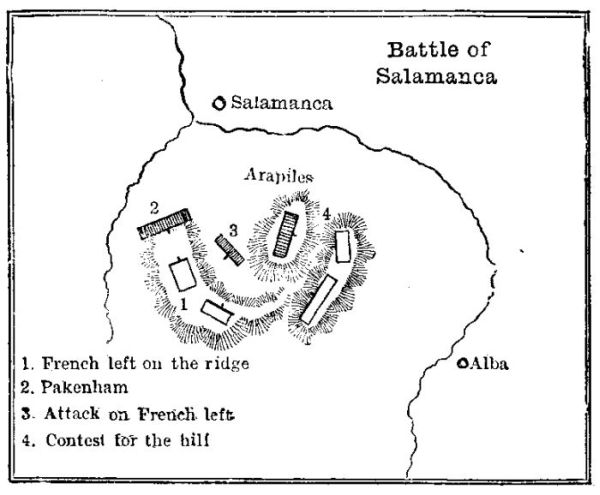
But his advance was not all triumphant, Marmont succeeded in turn in obtaining the ascendant. By a series of clever movements he compelled Wellington to retire, and moving towards the Battle of Salamanca. July 22, 1812. right flank of the English, seemed to threaten the communications between Salamanca and Ciudad Rodrigo, while he kept himself in communication with the central army under the king. Wellington saw that retreat was necessary, and he intended to return to Portugal. But Marmont was not contented with this success. He was eager to fight before his junction with the king, and brought on a battle beyond the Tormes, just south of Salamanca. The English occupied a sort of basin in a loop of the river; about the centre was a hill called the Arapiles; round the southern edge was a ridge which led to the point where the road by which the English must retreat ran. Marmont, hoping to envelop the English, sent forward his left along the ridge. Wellington saw the advantage thus offered. Holding the Arapiles with his left, he fell on the flank of the advancing column, while Pakenham faced it upon the ridge. The French left was thus entirely destroyed, their attacks upon the central hill were unsuccessful, their confusion was increased by the loss of their commander, who was wounded early in the day, and it was only because a Spanish garrison which should have cut off their retreat across the Tormes at Alba had been withdrawn without Wellington's knowledge that their army escaped destruction. As it was, Clausel, who had succeeded Marmont, was able to bring off the greater part of his troops in safety.
Wellington enters Madrid. Aug. 12, 1812.
The arrival of reinforcements under Sir Home Popham on the north of Spain had drawn a certain portion of the French troops in that direction, and against a weakened and defeated army Wellington proceeded in his triumphant advance toward Madrid. Joseph again left the city and retreated to Valencia, and with all the signs of wild rejoicing the conqueror was received in the capital of Spain. The effect of the late battle was exactly such as had been anticipated—King Joseph, acting as commander-in-chief, ordered Soult to evacuate Andalusia and the south. It was in vain that that general pointed out the possibility of holding his position there, and intreated the king to come with the other armies to his rescue: the orders were peremptory, and much against his will Soult withdrew and effected a junction with Joseph and Suchet in Valencia. The south and centre of Spain thus seemed clear of enemies, but the hold of the French was as yet shaken only, not broken; for in fact though Wellington's march had forced his enemies in two directions (Clausel, with the remainder of Marmont's army, having retired north, while the king withdrew south-east), such were their numbers that each division became the centre of an army as powerful as his own. Indeed, the very effect of his victory in drawing Soult from Andalusia had concentrated a vast power in Joseph's hands. Wellington was, however, aided by two circumstances. An expedition had been sent to Sicily under Sir William Bentinck; a portion of it under Maitland was landed at Alicante, and kept Suchet and the Catalonian army in play, while Sir Home Popham did the like for the army of the north.
His great plans thwarted.
Of the two armies against which Wellington had to contend by far the largest was the army of Soult and the king, on the south-east. On the other hand, Clausel's forces were beaten and retreating, so that it appeared to the general better to leave a detachment under Hill to cover Madrid, while he himself repaired with the bulk of his army to strike a final blow at Clausel by the capture of Burgos, intending to return at once and with his whole combined forces fight a great battle with Soult and the king before the capital. Again events occurred, upon which he could scarcely have calculated, which thwarted his purpose. The Spanish army, which had been intrusted with the duty of guarding his communications with Salamanca and of completing the capture of the fortresses of the Douro, and some English forces which had been left to assist it, were so badly handled that the retreating army was in fact left unmolested, while extreme want of money and political difficulties hampered Wellington's own march. Clausel, too, proved a general of great ability; his retreat up the valley of the Arlanzon towards Burgos was a masterpiece; while, to crown all, the resistance offered by Burgos and the deficiency of proper artillery proved greater obstacles than had been expected. The delay thus caused allowed the French to recover; the crisis was met with energy, fresh troops were poured across the frontier; Souham, who took the chief command, found himself at the head of a force almost double that of Wellington; and as Soult began to draw towards Madrid from Valencia, thus threatening the safety of Hill, there was no course left but to summon that He retreats to Portugal. general northward, and to make a combined retreat towards Salamanca and Portugal. It was not the most glorious passage of our arms. Want of pay and some other causes had somewhat slackened the discipline of the troops, and though no disaster occurred, and though the French were more than once checked, there were scenes of wild disorder and insubordination which called forth stern reprimands from the general.
Improvement in his position.
This was the last of Wellington's retreats. Events in Europe lessened the power of his enemies; while fighting for his very existence on the main continent of Europe, Napoleon could not but regard the war in Spain as a very secondary concern, and a great many old and valuable soldiers were withdrawn. The jealousy which existed between Joseph and the generals, and the dislike of the great generals to take upon themselves the Spanish war, threw it into inferior hands for some little while, and there is little more to chronicle than a succession of hard-won victories. Moreover, Wellington's position was in other ways much strengthened; he had received from the Brazils full power of action in Portugal, at Burgos he had been made commander-in-chief of the Spanish army, while the changes in the ministry at home, though they had deprived him of his brother's assistance, had yet been on the whole favourable to him; his greatness and success had become the chief support of the ministry. He had, moreover, by his personal authority established discipline in the Portuguese army, had used his power and influence to supply the commissariat and other trains, and even the Spanish troops which had been placed at his disposal had been brought into something like order. The whole active force of the French had been reduced to 197,000 men, while Wellington had contrived to prepare 200,000 allied troops for the campaign, although it was chiefly upon the 70,000 Anglo-Portuguese that he relied. The English fleets covered the coast, and every port thus became a little centre of action. A vigorous insurrection had arisen all along the northern provinces; and it was this more than anything else which decided Wellington's course of action. While leaving troops to occupy the attention of the French in the valley of the Tagus, he intended to march by his own left (thus avoiding the difficulties offered by the Douro and the Carrion rivers), connect himself with the northern insurgents, and directly threaten the communications with France, either fighting for or turning every position in which the king might try to intercept him.
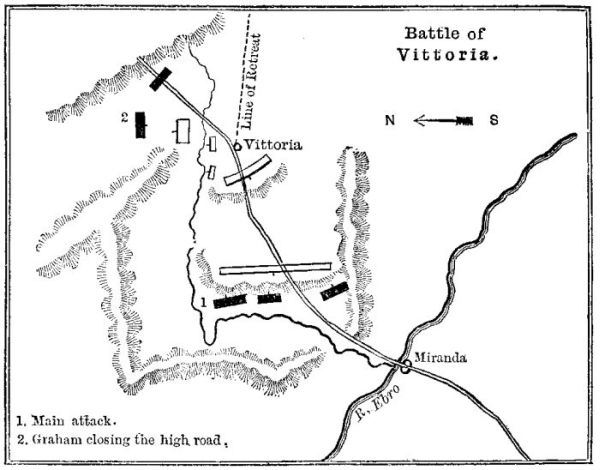
His movements, which had to be effected with considerable secresy, were well carried out; the various divisions of his army met at Toro on the Douro. As he had expected, the French had to fall back before him; he compelled them to evacuate Burgos and attempt to defend the Ebro. Their position there was turned, and they had again to fall back into the basin of Vittoria. This is the plain of the Battle of Vittoria. June 21, 1813. river Zadora, which forms in its course almost a right angle at the south-west corner of the plain, which it thus surrounds on two sides. Across the plain and through Vittoria runs the high road to France, the only one in the neighbourhood sufficiently large to allow of the retreat of the French army, encumbered with all its stores and baggage, and the accumulated wealth of some years of occupation of Spain. While Wellington forced the passage of the river in front south of the great bend, and drove the enemy back to the town of Vittoria, Graham beyond the town closed this road. The beaten enemy had to retreat as best he could towards Salvatierra, leaving behind all the artillery, stores, baggage, and equipments.
The offensive armies of France had now to assume the defensive and to guard their own frontier. Before advancing to attack them in the mountains, Wellington undertook the blockade of Pampeluna and the siege of St. Sebastian. It was impossible for the French any longer to regard diplomatic or dynastic niceties. Joseph was superseded, and the defence of France intrusted to Soult, with whom Battles of the Pyrenees. 1813. the king had hopelessly quarrelled. He proved himself worthy of the charge. A series of terrible battles was fought in the Pyrenees, but one by one his positions were forced. With fearful bloodshed, St. Sebastian was taken, the Bidasoa was crossed (Oct. 7), the battle of the Nivelle fought and won (Nov. 10), and at length, in January, Soult was driven even from the Adour and forced to surrender Bayonne.
But by this time events on the other side of France had changed the appearance of the war. Napoleon's threatened invasion of Russia had taken place; the defensive plan adopted by the Russians proved successful. The Emperor had himself hastened back to Paris after the conflagration of Moscow, while his ruined and broken army struggled home through the terrible suffering of the Russian winter. As Alexander had foreseen, the reverse of the French had been followed by the defection at first of Prussia and shortly afterwards of Austria. The powers of Europe were thus again formed in a coalition. With such troops as he could collect, Napoleon had hurried, in the summer of 1813, to the very furthest confines of Germany, and fought the great battles of Lutzen and Bautzen. But the flower of his troops had been lost in Russia, his armies were no longer what they had been. His enemies in vast numbers began to gather round him. Though victorious at the gigantic battle of Dresden (Aug. 24, 1813), he was unable to make a final stand against the vast armaments of the coalition. Several of his lieutenants were defeated, and at length, on the 19th of October, the battle of Leipsic was fought, which ended in his complete defeat. It is said that on the two sides the killed and wounded amounted to 110,000 men. The victorious allies swept onwards, and just at the close of the year 1813 entered France. The spring of the following year was occupied by the brilliant campaign in which Napoleon exerted all his genius in vain to check the huge masses of the invaders. While Wellington was making good his position in the south of France, in spite of the ability which he displayed, Napoleon was being constantly driven backward upon the east. The effect could not but be felt by the southern army, and Soult deserves great credit for the skill with which he still held at bay the victorious English. He was however defeated at Orthes (Feb. 27), lost Bordeaux (March 8), and was finally driven eastward towards Toulouse, intending to act in union with Suchet, whose army in Catalonia was as yet unbeaten. On the heights upon the east of Toulouse, for Wellington had brought his army across the Garonne, was fought, with somewhat Battle of Toulouse. April 10, 1814. doubtful result, the great battle of Toulouse. The victory has been claimed by both parties; the aim of the English general was however won, the Garonne was passed, the French position taken, Toulouse evacuated and occupied by the victors. The triumph such as it was had cost the victors 7000 or 8000 men, a loss of life which might have been spared, for Napoleon had already abdicated, and the battle was entirely useless. This was the last action of the Peninsula War, in which, after years of steadfast resistance, the English had at length triumphantly swept the French from the Peninsula, and done their full share in the great events which temporarily closed the career of Napoleon.
Long tenure of power of the Tory party.
The negotiations which had terminated in the abdication of Napoleon had, as far as England was concerned, been carried on by the same ministry which had had the duty of conducting the war. The Tory party which the French Revolution and the policy of Pitt had called into existence, robbed of the better and more liberal elements which the presence of Pitt himself and his friends had introduced into it, had succeeded in spite of its defects and of various opportunities for a change in continuing its hold upon the Government. There was at first one important member of it who kept up something Policy of Canning. of the views of Pitt. This was Canning, the Foreign Minister. But the presence of so incongruous an element tended rather to the weakness than to the strength of the administration; nor is it certain that in the present crisis of Europe his views were such as to render him the most efficient minister. Castlereagh, a man of narrower views and of much inferior talent, acted as War Minister. Between him and Canning a strong antagonism arose. Canning's errors were those of a liberal and noble mind. He was anxious to see the Spaniards carry out their insurrection as much as possible by their own means, and the wish led him to believe the false tales of their patriotism and resources with which the braggart spirit of the Spaniards supplied him. This credulity was strengthened by the reports of Mr. Frere, whom he had sent to the Peninsula as ambassador, and he was thus induced to misapply the wealth of England, and to misuse the opportunities which his position as Foreign Minister gave him, so as seriously to weaken the hands of Wellington. His desire for the political regeneration of Spain blinded him somewhat to the military necessities of the time, which required that our general should be invested with almost absolute authority, and the arrangement of political matters postponed till after the favourable conclusion of the war. But though he thus not unfrequently Canning's quarrel with Castlereagh. threw obstacles in Wellington's way, Canning by no means approved of the inefficient administration of Castlereagh, and the constant starvation of the military side of the Peninsula War. So far had the quarrel with the War Minister extended that Canning had contrived, not perhaps so openly and straightforwardly as could be wished, to extort from the Prime Minister a promise that Lord Castlereagh should be removed from his responsible situation, failing which he declared that he would himself withdraw. His support was so necessary to the Prime Minister that he had persuaded him to remain in office. But Canning had throughout privately expressed the strongest disapprobation of the Walcheren expedition, and when its failure became known, and when inquiries upon the subject brought to light the fact that, while sitting in the same Cabinet with Castlereagh, he had been in fact intriguing for his dismissal, the quarrel came to a point. Sharp words were exchanged between the ministers, and the consequence was a duel (Sept. 22), in which Canning was slightly wounded. It was of course impossible for the antagonists to serve longer in the same ministry. They both resigned, and their example was followed by the Duke of Portland, whose failing health had from the first rendered him unfit for his position, and whose weakness was exhibited in allowing so grave a quarrel to spring up within the limits of his Cabinet. It became necessary to reconstitute the ministry, and after a fruitless negotiation with Reconstruction of the ministry. Oct. 1809. Lords Grey and Grenville—with so little reality in it that Grey did not think it worth his while to come to London on the subject—Perceval, who had long been the most important person in the Cabinet, assumed the nominal direction, and Lord Wellesley, who had lately been serving as ambassador in Spain, where he had superseded Mr. Frere, was induced to accept the ministry of foreign affairs. Lord Castlereagh was succeeded by Lord Liverpool at the War Office, with Lord Palmerston as under secretary. The reconstruction of the ministry made no difference in its general tendencies. The introduction of Lord Wellesley was indeed a slight improvement; he entered the ministry chiefly for the purpose of supporting his brother's views in the Peninsula. This to the best of his abilities he did, but he was constantly thwarted by the mediocre men with whom he was joined, and with whom he was never able to work comfortably. By far the ablest and best writer in the Cabinet, his despatches were constantly criticised and altered. His colleagues could not understand the greatness of the openings afforded in the Peninsula, and after two years of office he withdrew (Feb. 19, 1812). The opportunity occurred in a great ministerial crisis caused by the renewed insanity Continuation of the same ministry till 1827. of the King, which it was believed must have produced a change of ministry. The Regent, however, retained Mr. Perceval in office, and upon his death Lord Liverpool was called to succeed him, and continued in office till 1827, so that in fact from the fall of the Grenville ministry to that date, though with some change in the personnel, there was a continuance of the Tory rule.
Illness of the King. Nov. 1810.
In November 1810 the King, who had never thoroughly got over the failure of the Walcheren expedition, and the disgrace of Lord Chatham and the Duke of York, was still further shaken by the death of the Princess Amelia, and before long it appeared that he had become hopelessly insane. After several prorogations it was resolved (December 20) that it was the duty of Parliament to supply the existing defect in the organization of Government. A precedent for the action of the ministry was drawn from Pitt's conduct under similar circumstances in 1788. It was determined to reproduce, though in a somewhat modified form, The Regency Bill. Feb. 1811. the restrictions then laid upon the power of the Regent. But the Prince of Wales was by no means disposed to submit to these restrictions, and induced his brothers to join in a protest against them. Nor did the Opposition fail to see the probable advantage which would accrue to them from a more unlimited regency; they regarded it as certain that Grenville and Grey would be called to office, and they had no wish to curtail the power of the Crown when wielded by men ready to rectify the mismanagement under which they thought the country was suffering. But their hopes were destined to be speedily extinguished. In spite of his protest the Bill restricting the Regent was passed (Feb. 5), and the Prince took the oaths before the Privy Council. He had already made up his mind that it would be better to continue the present ministry, for a personal quarrel had arisen between him and his Whig friends. He had requested Grenville and Grey to draw up a reply to addresses from the two Houses which had been presented to him in January. They had found considerable difficulty in complying with his request, for Grenville had been a member of Pitt's ministry when he restricted the regency in 1788, while Grey then as now was a member of the Opposition; but by careful suppression of the difficulties, a reply was drawn out and submitted to the Prince. Such a compromise was not what he had expected; he summoned his friend Sheridan to assist him in criticising the reply. The paper was returned with pungent and witty marginal remarks, and a wholly different form of reply suggested. The Whig Lords took umbrage at the levity and rudeness of the Prince, and did not refrain from expressing their anger, a line of conduct which, as might have been expected, in the case of a man of such selfish and merely personal politics as the Prince, was warmly resented. Moreover, the flattery of the Queen, and the adhesion to him of his brothers, who wished for the The Perceval ministry continued. continuation of the Perceval ministry, together with the falsely hopeful reports of the physicians, which led him to think that his regency would be a short one, induced him to accept the situation; and immediately after having taken the oaths he declared his intention to retain Mr. Perceval. Although at first expressing his dislike to his ministers, before long entirely won over by their courtly language, he began to speak of his old friends as "the wicked politicians." The regency was at first fixed for one year only. At the end of that time, that is, in February 1812, after a few more overtures to the Whig Lords to form a coalition with his present ministry, which he must have known was impossible, the Prince allowed the ministry to continue as before, Castlereagh being readmitted to office, and Lord Sidmouth becoming President of the Assassination of Mr. Perceval. May 1812. Council. The joy of Mr. Perceval at the happy issue of the affair was proportionate to the fear he had felt at the thought of losing office; but it was destined to be shortlived, for on the 11th of May, as he entered the House of Commons, he was assassinated by a lunatic of the name of Bellingham.
Lord Liverpool made Premier.
Again there was much negotiation, and an attempt to introduce Lord Wellesley and Mr. Canning to the ministry. Of course they could not serve with Castlereagh; they were then asked to form a ministry with Grenville and Grey, but these Lords objected to the Peninsula War, to which Wellesley was pledged. Grenville and Grey then attempted a ministry of their own, but quarrelled with Lord Moira on the appointments to the Household; and as an American war was threatening, and the ministry had already given up their Orders in Council (one of the chief causes of their unpopularity), the Regent, rather than remain longer without a ministry, intrusted Lord Liverpool with the premiership, with Castlereagh as his Foreign Secretary, and the old ministry remained in office.
War with America. May 1812.
Before the day of triumph of this ministry arrived, while Napoleon was still at the height of his power, and the success of Wellington as yet uncertain, England had drifted into war with America. It is difficult to believe that this useless war might not have been avoided had the ministers been men of ability. It arose from the obstinate manner in which the Government clung to the execution of their retaliatory measures against France, regardless of the practical injury they were inflicting upon all neutrals. The causes of irritation have already been mentioned. America, adopting the policy of England, had proceeded to retaliate; an embargo was laid upon trade both with England and France, and commercial relations with Europe practically broken off. An attempted arrangement between the two countries in 1809 had produced but little result. But though foreign trade had diminished, the demand for home manufactures in America had largely increased; the populations of the Northern and Eastern States were therefore satisfied with the existing state of things and decidedly averse to war, with its certain expenditure and probable injury to their manufactures. In the South the case was different. Without manufactures to supply the loss sustained by the restricted export of their tobacco and sugar, not in immediate contact with English territory, as were the Northern States, and led by an aristocratic and slave-owning race, the Whites of the South were inclined to war. The Presidents were Virginians, the Southerners had a superiority in Congress, and in May of 1812 it became plain that war must result unless the Orders in Council were repealed. But England was in confusion owing to the assassination of Perceval, and it was not till the middle of June, when war had been already declared, that Brougham's motion for the withdrawal of the Orders was carried. The concession, awkwardly made in the face of the American threats, came too late. The Americans had already made up their minds, and planned an invasion of Canada.
Character of the war.
It was a war without great events. The attempts of the Americans upon Canada failed. Here and there a slight success attended the English arms, and the deep anger of our enemies was moved by the irksome blockade of their coast, and the employment of the savage Indian tribes as our allies. But if fairly successful on land, the English were to their great astonishment thoroughly worsted upon the sea. Ship after ship was taken by the American frigates. Nor was it till our commanders consented to recognise the fact that the classification of the two navies was wholly different, and that an American frigate was in tonnage and weight of metal a match for an English fifty-gun ship, that these disasters were brought to an end. It was an additional blow to the pride of England that the sailors by whom her ships were defeated were largely drawn from her own people. From the wretchedness prevalent in England, from high taxes, commercial difficulties, and the severe laws of impressment, men fled for refuge to America; and it is said that as many as 16,000 Englishmen were serving on board the American fleet.
Attempted negotiations.
The war was really so causeless and so prejudicial to the success of the allies in Europe, that the Emperor of Russia attempted, in 1813, to bring it to a close by mediation, and although his offer was declined, a negotiation was entered into at Ghent which ultimately proved successful. But before the negotiators advanced far in their labours the war threatened to assume a more serious character. On the cessation of hostilities in the south of France, a considerable number of the English troops were embarked at Bordeaux direct for America, without even being allowed to return home, and increased energy began to show itself in all directions. A large fleet under Rear-Admiral Cockburn, and a body of troops under General Ross, were despatched to the Chesapeake, and a combined attack by land and water was made upon Washington, the Federal capital. The success of the expedition, Capture of Washington. which was complete, was stained by the destruction of all public property, offices, and buildings in the city. An outcry was raised, not only in America but in Europe, at what was regarded as an act of vandalism. It is said that the English Government had ordered it as a retaliation for the barbarities of the Americans on the Canadian frontier, and as it is confessed that private property was scrupulously spared, it may well be a question whether in fact such a destruction of national property is not a better manner of exhibiting the severity of war than the destruction of private property which so constantly attends it.
The capture of Washington was followed by other expeditions of a like nature with less satisfactory results. Large and systematic operations against a continent are at all times difficult, and certainly they were beyond the capacity of the English ministry as then constituted. They relapsed into all the old errors of the American War, and the military operations were reduced to mere piratical excursions. An effort was indeed made upon the only side where a base of operations existed, but on so small a scale and so badly directed as to be entirely useless. A combined attack by land and water was arranged against Plattsburg upon Lake Champlain. The dilatoriness of the commander, Sir George Prevost, allowed the flotilla to begin the fight unaided; it was completely beaten, and its destruction putting an end to all hope of success, the army withdrew. An attack on Baltimore met with no better fate, but the greater part of the province of Maine was taken and occupied. The arrival of the Peninsula troops, no longer well commanded, had produced but little effect; the negotiations at Ghent were gradually drawing to a conclusion. The Convention was signed on the 24th of December. It was, as might be expected from the temper of the two nations, little more than a compromise. The real points at issue were scarcely touched, the boundaries were left for future negotiation. Such as it was it came too late to save England from one more disaster. An expedition similar in character to those already mentioned had been directed against New Orleans. The place was vigorously defended by General Jackson. Natural difficulties and mismanagement met the English at every turn. The earth was too sandy to allow of redoubts; while the Americans used cotton bales, which answered admirably as defences, the English found nothing better than barrels of sugar and molasses. When the storming parties reached the enemy's lines they found that their fascines and scaling-ladders had been neglected; the assault became impracticable. As the approach of the town had been completely exposed to the fire of the enemy, very heavy loss had been sustained, three English generals, and among them Sir Edmund Pakenham, had been killed, and Lambert, who had succeeded to the command, thought it better to withdraw the army.
Abdication of Napoleon.
The American War was thus still at its height when the ministry had been called upon to arrange the fate of the late Conqueror of Europe. When the allies, in their advance towards France, had assembled at Frankfort, not yet certain of success, and conscious that their work would be easy could they separate Napoleon's interests from those of the nation, they had offered to negotiate at a general Congress upon the fixed condition that France should abandon Italy, Holland, Germany and Spain, and confine itself to its natural boundaries. Napoleon, suspecting not without reason their intentions in accepting the Congress, had refused the conditions. His refusal had been followed by a very able proclamation of the allies, separating the interests of the ruler from that of the people, and promising that France should retain its just weight in the balance of nations. Conscious of the effect of this declaration, which exactly suited the feelings of the majority of Frenchmen, Napoleon hastened to accept the conditions. But he was told it was too late. Traitors had already informed the allied sovereigns that they were strong enough to avoid compromise. The great campaign which followed had shown how much could yet be done by the Emperor's genius. Again negotiations were opened at Châtillon; Napoleon expressed the utmost readiness to accept the terms of Frankfort. But the ultimatum of the allies had now risen, the Rhine boundary was no longer to be conceded. Napoleon could not make up his mind to allow France to issue from the war less than when he had first taken possession of the Government. The Treaty of Châtillon was broken off and war was again resumed; and as though to express the completeness of their determination, the allied sovereigns entered into a treaty at Chaumont (March 1), by which they bound themselves together for twenty years, promised each to supply 150,000 men, to which England was to add a subsidy of £5,000,000. The knowledge of this treaty made Napoleon feel that some desperate stroke alone could save him. He passed with his forces into the rear of the allies; he was nearer, as he himself said, to Vienna than they were to Paris. The movement put them in great perplexity. To leave so formidable a person upon their communications seemed too dangerous a step. Again treason served them in good stead. Their friends in Paris, at the head of whom was Talleyrand, urged them at once to move upon the capital. Joseph Bonaparte, who had been left in charge there, with Marmont and Mortier, fought a last battle before the very walls. Joseph lost heart, and ordered the marshals to capitulate, the army was withdrawn behind the city, and Paris was in the hands of the allies. This was fatal to all Napoleon's hopes. He came to Fontainebleau, there found himself gradually deserted, heard how his marshals one after the other had joined the victorious allies, and on the 4th of April signed his abdication, consenting to withdraw to the Isle of Elba, which was to be constituted into a principality for his convenience. He was to be allowed 400 soldiers, his wife and child were to be placed in possession of Placentia and Parma, and he was to retain the title of Emperor. In the settlement of the affairs of France and Europe he was to have no voice. The last stroke of ill-fortune seemed to have come upon him when his Austrian wife, overpersuaded by her relations, deserted him, and set off with his young son to Vienna. During his ten months' residence in the Isle of Elba the settlement of Europe was being carried on by the diplomatists of all the powers assembled at Vienna.