Part 1 — CHAPTER VII. THE ROMANS.
Reading edition
For many centuries the Romans, according to the saying of Pliny, lived entirely “without doctors, although not without medicine;”108 that is, there existed without doubt a popular medicine and also a sacerdotal medicine, but still there were no persons whose exclusive occupation it was to cure disease.
The medical art, properly so called, was introduced into Rome by the Greeks. The first Greek doctor who went to Rome was Archagathus (in the year 535 after the foundation of the city, that is, 218 years before Christ). His arrival was at first welcomed, so much so that he was made a Roman citizen and a shop bought for him in the Acilian square, at the expense of the State. However, his popularity was of brief duration. Being an intrepid operator, the use and abuse he made of steel and fire gained for him the not very honorable qualification of the butcher, and he soon became the horror of all the population.
But it appears that dentistry had begun to be practised in Rome prior to the coming of Archagathus, that is, long before the medical profession existed. We have the clear proof of this in the Law of the Twelve Tables, wherein we find mention made of teeth bound with gold. The Law of the Twelve Tables was written in Rome 450 years before Christ, by a body of ten magistrates (decemviri) expressly named for that purpose, as up to that time no written law had existed.
As gold was at that time somewhat scarce, and fears were entertained that it would become still scarcer (to the great damage of the State) by reason of the custom that prevailed among the wealthy of burning or burying gold articles with the corpses to honor the memory of the deceased, or, rather, to satisfy the pride of the survivors, it was thought necessary to prohibit this abuse by a special disposition of the law referring to funeral pomps. This disposition was thus formulated: “Neve aurum addito, ast quoi auro dentes iuncti escunt (sunt) im cum illo sepelirei vrive sine fraude esto;”109 that is, “Neither shall gold be added thereto (to the corpse); but it shall not be unlawful to bury or to burn it with the gold with which the teeth may perchance be bound together.”
From this it results that at the time when the Law of the Twelve Tables was written, that is, four centuries and a half before the Christian era, there were already individuals in Rome who practised dental operations. And these individuals cannot have been medical men, as at that epoch (corresponding pretty nearly with the date of Hippocrates’ birth) Rome had as yet no doctors.
The inquiry naturally suggests itself whether the gold mentioned in the legal dispositions above cited was used for fixing artificial teeth or simply for strengthening unsteady natural teeth. Some authors, Serre among them,110 have pronounced in favor of the first hypothesis, others, as, for example, Geist-Jacobi,111 are rather disposed to accept the second. In truth, however, we do not possess sufficient historical data to definitely resolve this problem. I myself am rather of opinion that artificial teeth were already in use in Rome, as they were, even before this time, among the Etruscans. Indeed, if we take into consideration the priority of the Etruscan civilization to the Roman and the relations of vicinity existing between Etruria and the Roman State, of which it afterward became a part, it is even possible that dental prosthesis was first practised in Rome by Etruscans.
In a Greek-Roman necropolis near Teano (Province of Caserta, Italy) there was found in February, 1907, a prosthetic piece of a very peculiar construction, and which may be considered as quite unique in its kind. It is an appliance destined to support three inserted human teeth (the two lower central incisors and the lateral incisor on the right). These teeth—lost perhaps by the patient himself, in consequence of alveolar pyorrhea—were fixed by means of a system of rings, made of laminated gold wire, turned around the teeth and then soldered.
By the examination of the piece it is easy to argue that the author of this prosthesis made at first three separate rings by tightly turning the laminated gold wire around each of the three teeth to be applied, and by soldering together the ends of the wire forming each ring, after having taken away the tooth, in order not to spoil it in making the soldering. Then, with another laminated gold wire of sufficient length, he soldered the three rings together in due position, put the appliance in the mouth and turned the two ends of the wire around the sound teeth, serving as a support for the lateral incisor on the left and the two canines. After this, he took the apparatus delicately out of the mouth, made the soldering necessary for finishing the skeleton of the apparatus, forcibly put the three teeth in their respective rings again, and applied the prosthesis.
This ingenious appliance was found still adherent to the mandible of a skeleton, in a tomb which, according to the eminent archæologist Dalli Osso, belongs to a period comprised between the third and the fourth century before Christ.
From the nature of the objects found in the tomb near the skeleton (a necklace, perfume vessels, etc.) it was quite evident that the skeleton bearing the above-described prosthesis was that of a woman.
As the said appliance was found in South Italy (the ancient “Magna Græcia”) it is quite probable that it was made by some dentist of the Greek colonies.
The above apparatus belongs to the archæological collection of Signor Luigi Nobile, in Teano, in whose possession it was found.
Fig. 25 Seen from behind. Fig. 26 Seen from above.
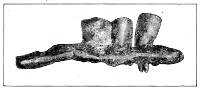
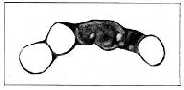
A prosthetic piece of very peculiar construction (see description), found in 1907 near Teano, Italy.
The Romans, as well as the Hebrews, and other peoples of antiquity, attributed great importance to the integrity of the dental system. This may be deduced with certainty from another article in the Law of the Twelve Tables (Table VII, at the rubric De delictis), which says: “Qui dentem ex gingiva excusserit libero homini, trecentis assibus multator, qui servo C L.” (Whoever shall cause the tooth of a free man to fall shall pay a fine of three hundred as, and for that of a slave one hundred and fifty.) The as was worth about ten cents American money, so that the first fine amounted to about thirty dollars and the second to about fifteen dollars. These sums, because of the difference in the monetary value in those times, were considered heavy fines.
After the Romans had conquered Greece (146 B.C.) a very great number of Greek doctors went to Rome. The wealth, luxury, and ever-increasing corruption of the metropolis caused the practice of the medical art (which was almost entirely in the hands of the Greeks) to become a great source of lucre. But an art practised with the sole purpose of making money soon degenerates to the level of a trade; it is, therefore, hardly to be wondered at if very few doctors of that epoch have merited being recorded in history.
Among these few, the name Asclepiades (born at Prusa, in Asia Minor; died in Rome ninety-six years B.C.) shines with particular lustre. He was the founder of the “methodic school,” whose curative precepts, largely based upon hygiene, come nearer to those of modern scientific medicine. Unfortunately, all the writings of this great physician, whose name is almost as glorious as that of Hippocrates, have been lost; we do not know, therefore, whether and in how far he contributed to the development of our specialty.
But one of the first places in the history of dental art is due without doubt to Cornelius Celsus, of whom we will now speak.
Cornelius Celsus. The historical researches in regard to the life of this celebrated author have given but meagre results. It is uncertain whether his birthplace was Rome or Verona. The precise dates of his birth and death are also unknown; but it is very probable that he was born about thirty years before Christ, and that he died during the fifth decade of the first century.
Aulus Cornelius Celsus belonged to the illustrious patrician family of the Cornelii. He was a man of great erudition, and wrote on the most varied subjects, and among others, on agriculture, on rhetoric, on the art of warfare, on medicine, etc. All these writings, however, are lost to us excepting his excellent treatise on medicine.
Some historians consider that Celsus was a true doctor by profession; others, instead, hold that he never undertook the cure of the sick. Neither the one nor the other of these opinions is quite acceptable; and it is much more likely, as Daremberg observes in his valuable Histoire des Sciences Médicales, that Celsus was one of those philiatri mentioned by Galen, who had studied medicine rather from books than at the bedside of the sick, but who, although not doctors by profession, in case of necessity, put their knowledge and skill into practice on behalf of their relations and friends.112
The work of Celsus, gathered in great part from Greek authors, has an especial value, because it sums up, in an admirable manner, the whole of the medical and surgical science of the ancients, from the earliest times up to the days of Augustus.
The first book of the work De Medicina113 does not contain anything of great importance in regard to dentistry. The following hygienic precept is, however, worthy of note: “After rising, if it be not winter, the mouth should be rinsed with a quantity of fresh water.” In regard to the hygiene of the mouth, nothing more is found in the work of Celsus; and it is also necessary to note that the aforesaid precept forms part of a chapter, in which he speaks of the rules of life, which must be observed by weak people, to which class—the author remarks—belong a greater part of the inhabitants of cities and almost all literary men. According to Celsus, therefore, perfectly healthy and strong people would not even need to wash their mouths with fresh water, and perhaps the keen-witted Roman doctor was not wrong; for it is very probable that the saliva and mucous secretion of the mouth, in perfectly healthy individuals with normal constitutions, have the power of combating the pathogenic germs that produce caries and other diseases of the teeth and mouth. In this way the fact can be explained of many peasants and the greater part of the individuals of the negro race having such good teeth, without possessing even the remotest idea of what hygiene of the mouth may be. And here I venture to refer to a passage in which Celsus alludes to the relation between diseases and civilization with its vices: “It is probable that in ancient times, although there was but little knowledge of medicine, health was for the most part well preserved; this being due to good habits, not yet spoiled by intemperance and idleness. These two vices, first in Greece and then among us, have brought upon us a very host of evils; whence it is that in our days, in spite of the intricate art of medicine—once not necessary to us, as it is not necessary to other peoples—few among us attain the beginning of old age.”114
In the second book, speaking of the various kinds of disease to which the different periods of life are subject, he writes: “Children are especially subject to serpiginous ulcers of the mouth, called by the Greeks aphthæ.... There are also infirmities due to dentition, such as ulceration of the gums, convulsions, fever, looseness of the bowels; and it is especially the eruption of the canine teeth which produces these disturbances. To these, however, very fat children are more particularly liable, and those, also, who have costive bowels.”
In Chapter XXV of the fifth book we find the receipt for a narcotic drug, recommended by the author for producing sleep in persons tormented with odontalgic and other pains. This receipt is very complicated, being composed of ten ingredients, among which are acorns, castoreum, cinnamon, poppy, mandrake, and pepper.
Most important for our subject is Chapter IX, of the sixth book, where the author treats of odontalgia. “In toothache, which may be numbered among the worst of tortures, the patient,” says Celsus, “must abstain entirely from wine, and at first, even from food; afterward, he may partake of soft food, but very sparingly, so as not to irritate the teeth by mastication. Meanwhile by means of a sponge he must let the steam of hot water reach the affected part, and apply externally, on the side corresponding with the pain, a cerate of cypress or of iris, upon which he must then place some wool and keep the head well covered up. But when the pain is violent, the use of purgatives is very beneficial, the application of hot cataplasms on the cheek, and the keeping in the mouth of some hot liquid, prepared with fitting medicine, changing this liquid, however, very frequently. For this purpose the root of cinquefoil may be boiled in wine, or that of hyoscyamus (henbane), or a poppy-head, seedless and not too dry, or the root of the mandrake. But in regard to the last three remedies, one must be careful not to swallow the decoction whilst it is kept in the mouth. For the same purpose one may boil the bark of the root of the white poplar in wine, or the scrapings off a stag’s horn in vinegar or figs in mulse115 or in vinegar and honey. It is useful also to pass repeatedly around the tooth the end of a probe which has first been wrapped around with wool and then dipped in hot oil. It is customary also to apply around the tooth certain remedies, after the manner of plasters. For this purpose the inside of the peel of dried, bitter pomegranates may be pounded with equal quantities of gall-nut and pine bark; to these must be added a little minium116 and the whole mixed together with the addition of rain water to form a paste; or else a similar paste may be formed with equal parts of panax,117 poppy, peucedanum,118 and taminia grape119 without stones; or with three parts of galbanum to one of poppy. On the cheek, however, must be applied at the same time the cerate spoken of above, covered over with wool.”
Celsus then speaks of a revulsive adopted, in his times, against odontalgia. It was composed of myrrh and cardamom, ana one part; saffron, pyrethrum, figs, pepper, ana four parts; mustard seed, eight parts. The plaster, spread on linen, was to be applied on the shoulder corresponding to the side of the pain, and, according as this was situated in a tooth of the upper or lower jaw, the revulsive was applied on the back of the shoulder, or in front.
When a tooth is decayed, Celsus advises that there should be no haste in drawing it; but that the pain be combated, if the above medicines are not sufficient, with others more energetic. A mixture may, for example be applied to the tooth, composed of one part of poppy, two of pepper, and ten of sory,120 pounded and mixed to a paste with galbanum; or else, especially in the case of a molar tooth, the remedy of Menemacus, resulting from saffron, one part; cardamom, soot from incense, figs, pepper, pyrethrum, ana four parts; mustard seed, eight parts; or even a more complicated remedy made with pyrethrum, pepper, and elaterium,121 ana one part; scissile alum,122 poppy, taminia grape, crude sulphur, bitumen, laurel berries, mustard seed, ana two parts.
“If, says Celsus, the pain renders necessary the removal of the tooth, this may be made to fall to pieces, by introducing into the cavity a pepper berry without its skin, or a berry of ivy, pared in the same way. The same result may be obtained in the following manner: The sharp bone (aculeus) of that flat fish called by the Greeks trygon and by us pastinaca, must first be roasted and then reduced to powder and mixed with resin, so as to form a paste; which applied around the tooth will make it fall out. Likewise, scissile alum induces the fall of the tooth, when introduced into its hollow. This substance, however, is best introduced into the small cavity, after being wrapped around with a tuft of wool, for thus the pain is soothed and the tooth preserved.”
Somewhat curious is the following passage, in which Celsus speaks of the superiority of a method of cure used by peasants, compared to the remedies advised by the doctors. From his words we clearly see that he, as we have already remarked, did not belong to the class of doctors properly so called.
“These are the remedies accepted and held in account among the doctors. But it is known through the experience of peasants, that when a tooth aches one must pluck up wild mint by the roots, put it into a large vessel, pour water on it, and make the patient sit near it, covered all around with a blanket; and red hot stones should then be thrown into the water, so that they be entirely immersed; and then the patient, wrapped all around, as we have said before, and keeping his mouth open, receives into it the steam evaporated from the water. Thus profuse perspiration is induced, and a great quantity of pituita flows from the mouth, and with this a cure is obtained for a very long period, often for more than a year.”
In the six following chapters of the sixth book, Celsus treats of the diseases which affect the soft parts of the mouth. Against tonsillitis, he recommends, among other things, the application of a remedy principally made of the juice of the sweet pomegranate, cooked, by a slow fire, to the consistency of honey. The same remedy is also of great value, according to the author, for the cure of ulcers of the mouth, when they are accompanied by inflammation, and are somewhat foul and of a reddish color. But under such circumstances it will also be necessary to keep frequently in the mouth an astringent decoction, to which a little honey has been added. The exercise of walking is also profitable, as well as the taking of food that is not acid. When, however, the ulcers begin to be clean, the mouth should be frequently filled with a softening liquid or even with simple pure water. It is also helpful to drink genuine wine and to eat rather freely, avoiding, however, acid food. The ulcers must be sprinkled with a powder composed of two parts of scissile alum to three of unripe gall-nuts. If, however, the ulcers are already covered with a scab similar to those produced on burns, some of those compositions should be used which are called by the Greeks antheræ; for example, a remedy may be formed of equal parts of cyperus,123 myrrh, sandarac, and alum; or another which contains saffron, myrrh, ana two parts; iris, scissile alum, sandarac, ana four parts; cyperus, eight parts.
“Much more dangerous, says Celsus, are those ulcers of the mouth which the Greeks call aphthæ; they oftentimes lead to death in children; in adult men and women, however, there is not the same danger. These ulcers begin in the gums; then they attack the palate and the whole of the mouth, and finally extend to the uvula and to the fauces; when these parts are attacked, it is not very likely that a child will recover.”
As to the ulcers of the tongue, Celsus says that those which are situated at the borders of this organ last a very long time, and he adds: “It should be seen whether there may not be some sharp tooth opposite, which hinders the ulcer from healing; in case such a tooth exists, it should have its edge taken off with a file.”
He then passes on to speak of the diseases of the gums: “Often small painful tumors, called by the Greeks parulides, are produced on the gums. It is necessary at the very first to rub them softly with powdered salt, or with a mixture of burnt mineral salt, cyperus, and catmint, meanwhile keeping the mouth open until there flows from it a good quantity of pituita; after which the mouth must be rinsed with a decoction of lentils. But if the inflammation is great, the same remedies must be used as are adopted for the ulcers in the mouth, and between the tooth and the gum must be inserted a small tent of soft lint, on which has been smeared some one of those compositions which we have said are called antheræ. If this, owing to the hardness of the tumor, is not possible, then by means of a sponge the steam of hot water should be made to act upon the diseased part, and, besides, an emollient cerate must be applied upon it.
“Should suppuration show itself, it will be necessary to use the above-mentioned steam for a longer period; to keep in the mouth hot mulse, in which some figs have been cooked, and to lance the tumor before it is perfectly ripe, so that the pus may not, by remaining too long in the diseased part, injure the bone. But if the tumor be of great size, it will be more advisable to remove it entirely, so that the tooth remain free on both sides. After the pus has been extracted, if the wound be a small one, it is sufficient to keep hot water in the mouth, and to use externally fomentations of steam, as mentioned above; if it be large, it will be fitting to use the decoction of lentils and the same remedies with which all other ulcers of the mouth are cured.
“It also happens, sometimes, that from an ulcer of the gums—whether it follow a parulis or not—one may have for a long period a discharge of pus, on account of a broken or rotten tooth, or else on account of a disease of the bone; in this case there very often exists a fistula. Then the latter must be opened, the tooth extracted, and if any bony fragment exist, this should be removed; and if there be anything else diseased, this should be scraped away. Afterward, the same remedies which have been indicated for the other ulcers of the mouth must be used.
“If the gums separate from the teeth, it will be useful, in this case also, to employ those remedies called antheræ. But it is also beneficial to chew unripe pears and apples and to keep their juices in the mouth. Equal advantage can be derived from keeping vinegar in the mouth, provided it be not too strong.
“Whenever ulcers of the mouth are attacked by gangrene, it is necessary first to consider whether the whole body be unhealthy, and in that case, to do what is necessary to strengthen it. When the gangrenous ulcer is superficial, the use of antheræ is sufficient; when it is somewhat deeper, a mixture must be applied on it, of two parts of burnt paper124 to one of orpiment;125 when it is very deep, three parts of burnt paper to a fourth part of orpiment must be used; or else, equal parts of roasted salt and roasted iris; or lastly, equal parts of chalcites, lime, and orpiment. It is, however, necessary to dip a small pledget of lint in oil of roses, and put it on the caustic medicinals, so that these may not injure the neighboring healthy parts. If the disease is in the gums, and some of the teeth are loose, it is necessary to pull them out, for they greatly hinder the cure. When this latter, however, cannot be obtained by drugs, the ulcer must be cauterized with a red-hot iron.”
Chapter XII of the seventh book is, of all the work of Celsus, the one which presents to us the greatest interest, since there the author treats of the surgical operations required by the diseases of the dental apparatus.
He first speaks of the looseness of the teeth, caused by the weakness of their roots, or by the flaccidity of the gums, and says that in these cases it is necessary to touch the gums lightly with a red-hot iron, then to smear them with honey and wash them with mulse, and later on to strengthen them by means of astringent substances.
“When a tooth aches, and it is thought well to extract it, because medicaments are of no use, the gum must be detached all around, and then the tooth must be shaken until it is well loosened, it being very dangerous to draw a firm tooth, as this may sometimes give rise to a dislocation of the lower jaw. And greater still is the danger in regard to the upper teeth, as this might cause a shock to the temples and eyes. After having well loosened the tooth, it must be pulled out by the fingers, if this is possible; or if not, with the forceps.”
Fig. 27
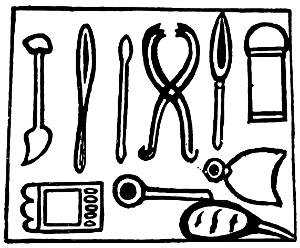
Dental and surgical instruments represented in a funeral marble of the Lateran Museum, Rome.
It is clear that this method of tooth drawing—so excessively cautious and timid—must have been very torturing to the poor patients. A thousand years and more after Celsus, Abulcasis still counsels the same exaggerated precautions, and says that the extraction of a tooth must not be performed in a rapid and violent way after the manner of the barbers. From this one may see that the operation spoken of was then very often performed by certain unprofessional persons, who, being very familiar with it, carried it out with great indifference and rapidity, thus sparing the patients the long-protracted martyrdom which the erudite doctors, followers of Celsus, thought necessary to make them endure. Very probably the same happened in the days of the wise Roman doctor.
When there is a large carious hollow in the tooth to be extracted, Celsus recommends that it should first be filled up either with lint or with lead, in order to prevent the tooth from breaking under the pressure of the instrument. “The latter,” he continues, “must be made to act in a straight direction, in order to avoid fracture of the bone. The danger of fracture is still greater in the case of short teeth; often the forceps, not being able to grasp the tooth well, takes hold of the bone with it and fractures the latter. When after the extraction of a tooth much blood flows from the wound, this indicates that some part of the bone has been broken. It is necessary then to search for the detached piece of bone with the probe and to extract it with the forceps. If this be not successful, an incision must be made in the gums just as large as is necessary for the extraction of the fragment. When this is not taken out, it often happens that the jaw swells in such a manner as to prevent the patient from opening his mouth. In such a case it is necessary to apply to the cheek a hot cataplasm of flour and figs, so as to induce suppuration, after which the gums must be lanced and the splinter of bone extracted.”
When the teeth show blackish stains, Celsus advises such stains to be scraped away, and the teeth afterward to be rubbed with a mixture of pounded rose leaves, gall-nuts, and myrrh, and the mouth to be frequently washed with pure wine. It is necessary besides, says the author, to keep the head well covered, to walk a great deal, and to partake of no acid food.
“If by effect of a blow or other accident some of the teeth become loose, it is necessary to bind them with gold wire to the neighboring firm teeth, and besides to keep in the mouth astringent substances, for example, wine in which the rind of pomegranates has been boiled, or into which some burning hot gall-nuts have been thrown.”
“When in a child a permanent tooth appears before the fall of the milk tooth, it is necessary to dissect the gum all around the latter and extract it; the other tooth must then be pushed with the finger, day by day, toward the place that was occupied by the one extracted; and this is to be done until it has firmly reached its right position.”
“Now and again it happens that when a tooth is pulled out its root remains in the socket; it is then necessary to extract it at once, with the forceps adapted for the purpose, called by the Greeks rizagra.”
The last book of the work of Celsus treats chiefly of fractures and dislocations. In the first chapter the position and form of the bones of the whole human body are described, although not very exactly. Speaking of the teeth, the author says: “The teeth are harder than the bones, and are fixed, some on the maxilla (lower jaw) and some on the overhanging bone of the cheeks.”126
“The first four teeth, being cutting teeth (incisors), are called by the Greeks tomici. These are flanked on both sides by one canine. Beyond this there ordinarily exist, on both sides, five grinders, except in the case of those persons in whom the last molars, which commonly are cut very late, have not yet appeared. The incisors and the canines are fixed with one single root; but the molars at least with two, some even with three or four. In general, the shorter the tooth, so much the longer is its root. A straight tooth commonly has a straight root, a curved tooth has it generally curved. The root of a temporary tooth produces in children a new tooth, which usually pushes out the first; sometimes, however, the new tooth appears either above or below it.”
In the seventh chapter Celsus treats of fractures in general, but in particular of those of the lower jaw.
“To reduce a fracture of this bone, it should be pressed in a proper manner, from the inside of the mouth and from the outside, with the forefinger and thumb of both hands. Then in the case of a transverse fracture (in which case generally an unevenness in the level of the teeth is produced), it is necessary, after having set the fragments in place, to tie together the two teeth nearest to the fracture with a silk thread, or else, if these are loose, the following ones. After this, one should apply externally, on the part corresponding to the lesion, a thick compress, dipped in wine and oil and sprinkled with flour and powdered olibanum. This compress is to be fixed by a bandage or by a strip of soft leather, with a longitudinal slit in the middle to embrace the chin, the two ends being tied together above the head. The patient must fast the first two days; then he may be nourished with liquid food, but in small quantities, abstaining, however, completely from wine. On the third day it is necessary to take off the apparatus, and after having fomented the part with the steam of hot water, to replace it. The same is to be done on the fifth day, and so on, until the inflammation has subsided, which generally happens from the seventh to the ninth day. After the symptoms of inflammation have vanished, the patient may take abundant nourishment; he must, however, abstain from chewing until the fracture is completely consolidated; and, therefore, he will continue to nourish himself with soups and like food. He must also entirely abstain from speaking, especially during the first few days. Fractures of the jaw commonly heal from the fourteenth to the twenty-first day.
“In luxations of the jaw (Chapter XII) the bone is always displaced forward; but sometimes only on one side, and sometimes on both sides. When the dislocation is only on one side, the chin and the whole jaw are found deviated toward the part opposite to the luxation; and the similar teeth of the two dental arches do not correspond; but instead under the upper incisors will be found the canine tooth of the dislocated part. If, however, the luxation is bilateral, the chin inclines and projects forward; the lower teeth are farther in front than the upper ones, and the muscles of the temples are tightly stretched. The reduction of the luxation must be performed as quickly as possible. The patient having been made to sit down, an assistant holds the head firmly from behind; or else the patient is made to sit with his shoulders against a wall, with a hard cushion between this and his head, whilst the assistant holds the head against the cushion, and so keeps it steady. Then the operator, after wrapping his two thumbs in linen cloth or strips, that they may not slip, introduces them into the patient’s mouth and, applying the other fingers on the outside, firmly grasps the jaw. Then whilst lowering the back part of the latter, he shakes the chin and pushes it upward and backward, seeking to shut the mouth, and in this way making the jaw return to its natural position.
“The bone having been replaced, if the accident should have given rise to pains in the eyes and neck, it will be well to draw blood from the arm. After the luxation has been reduced, the patient must be nourished for some time on liquid food, and abstain, as much as possible, from speaking.”
Caius Plinius Secundus. After Celsus, a very celebrated writer on medicine and natural science was Caius Plinius Secundus. He was born at Como in the year 23 of the Christian era, and flourished from the days of Nero to those of Vespasian. Endowed with a liberal education, he gave himself up to public life, filling many important posts, among which, that of Governor of Spain under Nero and his successors. In the year 79 after Christ, while he was in command of the Roman fleet at Misenum, the tremendous eruption of Vesuvius took place, by which Pompeii, Herculaneum, and other neighboring cities were destroyed. Pliny, driven by the desire to study that marvellous and awful natural phenomenon, betook himself to Stabia, but was there suffocated by the ashes and smoke erupted by Vesuvius.
In spite of the many places occupied by him, Pliny found time to write many works, and among these the thirty-seven books on Natural History, which have given him eternal fame.
It is not at all to be wondered at that this immense work contains a great number of fables, superstitions, and errors of every kind. To sift the true from the false was not an easy thing, at a time when there was almost no idea as to how natural phenomena were produced, and when all scientific criticism was impossible, for the very simple reason that true science did not exist.
To give an idea of the great absurdities which were believed in at that epoch, and which were considered possible even by higher intellects such as Pliny’s, the following passages will suffice: “In many mountains of India, according to what Ctesia writes, there are men with dogs’ heads, who clothe themselves with the skins of wild beasts and bark instead of speaking. There are also a kind of men having only one leg, and who have great speed in leaping. Others are without any neck and have their eyes between their shoulders. Megasthenes writes that among the nomad Indians are men who instead of a nose have only holes, and have their legs bent like serpents. At the extreme confines of India, toward the East, are men without any mouth and with their bodies entirely covered with hair, who live on nothing but air and odors, which they inhale through the nose.”127
In Pliny’s day the most prodigious virtues were attributed to herbs; in regard to this the following example is sufficient:
“The herb near which dogs may have made water, when gathered, but without being touched by iron, cures luxations very promptly.”128
It must not be thought that Pliny accepted such beliefs without reserve. He notes them, because preceding authors had accepted them, and because if certain things appear to us evidently absurd, their absurdity could not be equally evident at a period when little more than nothing was known in regard to physical and physiological laws, and when the impossibility of rationally explaining natural effects led men to admit the existence of marvellous virtues and influences in every being and in all bodies. On the other hand, Pliny expressly says, for his own justification, in Chapter I of Book VII: “I do not want to bind my faith in many things which I am about to say; but rather refer the readers to the authors from whom I have taken them.”
As is to be expected, we find in Pliny’s works, in regard to teeth, a strange mixture of truth and errors.
In Chapter XV of Book VII, after having said that some children are born with teeth, and after having cited, as examples, Manius Curius, who was therefore called Dentatus, and Gnæus Papirius Carbo, both illustrious men, he adds:
“In women such a thing was considered a bad augury in the days of the kings. In fact, Valeria having been born with teeth, the seers said that she would be the ruin of the city to which she would be taken; she was sent to Suessa Pometia, which in those days was a very flourishing city; and, in fact, the prediction was verified. Some, instead of teeth, have an entire bone; of this there was an example in the son of Prusias, King of Bithynia, who instead of upper teeth had one single bone.”
“The teeth alone are not consumed by fire, and do not burn with the rest of the body. And yet these teeth, which withstand the flames, are worn away and hollowed out by pituita. They wear out by being used. Nor are they necessary for mastication alone, for the foremost ones regulate the voice and words, producing by the beat of the tongue special sounds.”
“Men have thirty-two teeth, women a lesser number. It is, however, believed that augury may be taken from the teeth; and to have a greater number than usual is considered an indication of long life. The presence of two eye teeth at the right side of the upper jaw presages favorable fortune, as was verified in Agrippina, the mother of Domitius Nero; on the left side, however, they are of sad foreboding.”
“The last teeth, which are called the genuine teeth, appear toward the twentieth year of age; many persons, however, do not have them until their eightieth year. Teeth fall out in old age and then spring up again; of this there can be no doubt. Mutianus writes of having known a certain Zancle of Samothracia, in whom teeth reappeared after he had completed his one hundred and fourth year. Timarcus, son of Nicocles of Paphus, had two rows of molar teeth, whilst a brother of his did not change his incisor teeth at all, which, therefore, wore down little by little. There once lived a man who had a tooth in his palate. The canine teeth, when by any chance they fall out, do not reappear any more.”129
“In the teeth of man there exists a poisonous substance which has the effect of dimming the brightness of a looking-glass when they are presented uncovered before it; and if they are uncovered in front of young unfledged pigeons, these take ill and die.”130
The second of these two statements is but a prejudice, like many others; but we find the first very strange indeed, it being a surprising thing that a man like Pliny should have attributed to an imaginary poison of the teeth what is the simple effect of the moistures of the breath.
In Chapters CXV and CXVII of Book XI are found some observations which are somewhat interesting to us:
“A man’s breath becomes infected by the bad quality of food, by the bad state of the teeth, and still more by old age.”
“Simple food is very beneficial to man; the variety of flavors instead is very harmful. Sour or too abundant foods are digested with difficulty, and also those which are ravenously swallowed. As a remedy, vomiting has come into use; but it makes the body cold and is most pernicious to the eyes and to the teeth.”
There is no doubt that the habit of often provoking vomitus—which, in those times of excessive corruption and intemperance, had come into general use—must have resulted in enormous harm to the teeth, especially by the action exercised upon them by the hydrochloric acid contained in the gastric juice, and by the organic acids of fermentation.
Among the vegetable remedies in those times considered of use against odontalgia, the principal ones are mentioned in Chapter CV of Book XXV:
“It is beneficial against toothache to chew the root of panax, and likewise to wash the teeth with its juice. It is also useful to chew the root of hyoscyamus soaked in vinegar, or else that of the polemonium. It is also beneficial to chew the roots of the plantain, or to wash the teeth in a decoction of plantain in vinegar. A decoction of the leaves is also useful, not only in the case of simple toothache, but also when the gums are tender and easily bleed. The seed of the same plant cures inflammations and abscesses of the gums. The aristolochia strengthens the gums and the teeth. The same effect may be produced by masticating the verbena with its root, or by washing the mouth with a decoction of it in wine or vinegar. Similarly the roots of the cinquefoil are helpful when boiled down to a third, in wine or vinegar; however, they must first be washed in salt water or brine. The decoction must be kept for a long time in the mouth.
“Instead of using the decoction of cinquefoil, some prefer to rub the loose teeth with the ashes of this plant. Besides the above-mentioned remedies, the root of the verbascum boiled in wine, hyssop, and the juice of the peucedanum with opium are also employed; and it is also beneficial to pour into the nostrils, on the side opposite to that of the sick tooth, some drops of the juice of anagallis.
“It is said that if senecio be taken from the earth, and the aching tooth be touched three times with it, spitting alternatively three times, and then the herb be replanted in the same spot, so that it may continue to live, the tooth will never give pain any more.”131
“In the fuller’s thistle,132 an herb which grows near rivers, is found a small worm, which has the power of curing dental pains, when the said worm is killed by rubbing it on the teeth, or when it is closed up with wax in the hollow teeth.”133
“Apollonius writes that a very efficacious remedy for pains in the gums is to scratch them with the tooth of a man who has suffered a violent death.”134
“It is considered very beneficial for toothache to bite off a piece from wood which has been struck by lightning, and to touch the sick tooth with it; but whilst biting off the little piece of wood, it is necessary to keep both hands behind the back.”135
“Experience teaches that against the bad odor of the breath it is useful to wash the mouth with pure wine before sleeping, and that to avoid aching of the teeth, it is a good thing to rinse the mouth, in the morning, with several mouthfuls of fresh water, but of an odd number.”136
“A remedy for toothache is to touch the diseased teeth with the tooth of a hyena,137 or to scratch the gums with the tooth of a hippopotamus which has been taken from the left side of the jaw.”138
“The ashes of stag’s horn, rubbed over loose and aching teeth, makes them firm and soothes the pain. Some consider that to produce the same effect, of greater virtue is the powder of the horn, unburnt. Both the ashes and the powder of stag’s horn are employed as a dentifrice. The ashes of the head of a wolf are a great remedy for toothache. Such pains are also made to cease by wearing certain bones that are oftentimes found in the dung of this animal. The ashes of the head of a hare is a useful dentifrice; and if spikenard be added, it will lessen the bad smell of the mouth. Some mix with it the ashes of the heads of mice. In the side of the hare is a bone as sharp as a needle; and many advise pricking the teeth with this when they ache. The heel of the ox kindled and brought close to loose teeth makes them firm. The ashes of this bone mingled with myrrh is a good dentifrice. A good dentifrice is also made from the ashes of the feet of a goat. To strengthen teeth loosened by a blow, asses’ milk or the ashes of the teeth of this animal are very useful. In the heart of the horse there is a bone like an eye-tooth; it is said that it is very beneficial to pick with it the teeth that ache. The carpenter’s glue boiled in water and plastered on to the teeth also takes away their pain; but soon after it must be taken away and the mouth rinsed with wine in which have been boiled the rinds of sweet pomegranates. It is also thought beneficial to wash the teeth with goat’s milk or with ox-gall.”139
“Butter, either alone or with honey, is very useful for children; and is very helpful, especially during dentition, in the diseases of the gums, and to cure the ulcers of the mouth. To prevent the disorders that generally accompany dentition, it is a useful thing that the child should wear a wolf’s tooth, or one of the first teeth lost by a horse. The rubbing of the gums with goat’s milk or with hare’s brain renders the cutting of teeth much easier.”140
“To sweeten the breath it is very helpful to rub the teeth and the gums with wool and honey.”141
“The filth of the tail of sheep rolled up in little balls, and left to dry and then reduced to powder and rubbed on the teeth, is marvellously useful against the loosening and other diseases of the teeth themselves and against the cankerous ulcers of the gums.”142
“Eggshells deprived of their internal membrane and afterward burnt afford a good dentifrice.”143 (Hence we see that the use of carbonate of lime as a dentifrice is a very ancient one.)
“If the head of a dog that has died mad be burnt, the ashes obtained may be advantageously used against toothache, mixing it with cyprine oil and then dropping the mixture into the ear, on the side of the pain. It is beneficial also to pick the sick tooth with the longest tooth, on the left side, of a dog; or with the frontal bones of a lizard, taken from the head of the animal at full moon, and which have not touched the earth. The teeth of a dog, boiled in wine until this is reduced to one-half, thus, furnish a mouth wash which can be advantageously used against toothache. In the cases of difficult dentition, benefit is derived by rubbing the gums with the ashes of the teeth of a dog, mixed with honey. Such ashes are also used as a dentifrice. In hollow teeth it is useful to introduce the ashes of the dung of mice, or of the dried liver of lizards. It is the opinion of some, that in order not to be subject to toothache, a mouse should be eaten twice a month. If earth-worms be cooked in oil, this latter has the virtue of calming toothache when dropped into the ear on the side of the pain. The same effect is obtained by rubbing the teeth with the ashes of the aforesaid worms, after they have been burnt in a terra-cotta vase; and if such ashes be introduced into the hollow teeth, these fall out very easily. A good remedy against toothache is to wash the mouth with vinegar of squills in which earth-worms and the root of the mulberry have been boiled. The ashes of the shells of snails mixed with myrrh, rubbed on the gums, strengthens them. Even the slough which the snakes cast off in spring can furnish a remedy against toothache. For this purpose it must be boiled in oil, with the addition of resin of the larch, and then the oil dropped into the ear. For the same purpose, according to some, oil of roses is useful, when a spider, caught with the left hand, has been pounded in it. If a sparrow’s fledglings be burnt with dry vine twigs, the resulting ashes rubbed with vinegar on the teeth makes all pain cease in them.144 It is stated by many that to improve the odor of the breath, it is well to rub the teeth with ashes of mice mixed with honey. Some also mingle with this the root of fennel. Picking the teeth with the quill of a vulture renders the breath sour. It makes the teeth firm to pick them with a porcupine’s quill. A decoction of swallows in wine sweetened with honey cures ulcers of the tongue and lips. Scaldings in the mouth produced by hot food or drinks are readily healed with the milk of a bitch.”145
That Pliny did not put great faith in many of the things which he relates is clearly proved by several passages of his book, and among others by the following:
“One can hardly relate without laughing, some things, which, however, I will not omit, because they are found already written. They say that the ox has a small stone in the head, which it spits out when it fears death; but if its head be suddenly cut off, and the stone extracted, this, worn by a child, helps it in wondrous manner to cut its teeth.”146
In Book XXXI, Pliny speaks of various waters—mineral, thermal, etc.—especially from the medical point of view. It was already known in those days that those waters were most active agents. And in this respect a fact which the author relates in Chapter VI of Book XXV is worth mentioning:
“When Caesar Germanicus moved his camp beyond the Rhine, there was found, in the whole maritime tract of the country, only one spring of fresh water, the drinking of which, within two years, produced the fall of teeth and a loosening of the knee-joints. The doctors called these evils stomacace and scelotyrbe.”
Sea salt and nitre are of use, according to Pliny, against various maladies of the teeth and mouth. He counsels the application of salt on lint to the ulcers of the oral cavity, and to rub it on the gums when they are swollen. To prevent diseases of the teeth, it would be advantageous, every morning before breaking one’s fast, to keep a little salt under the tongue until it is dissolved. Against the pain of the teeth it would be beneficial to use common salt dissolved in vinegar, or nitre in wine.
“The rubbing of the blackened teeth with burnt nitre gives them back their natural color.”147
The prophylactic remedies against odontalgia believed in, at that period, were sufficiently numerous, and, among many other such things, Pliny informs us that in order not to be subject to toothache, it is sufficient to wash the mouth three times a year with the blood of the tortoise.148 Analogous virtue was also attributed to the brain of the shark, which was boiled in oil, and this put by for washing the teeth with once a year.
Besides the many anti-odontalgic remedies so far related, several others are found enumerated in Chapter XXVI of Book XXXII:
“The pain in the teeth is lessened by picking the gums with the bones of the sea dragon. It is also very beneficial to pick the gums with the sharp bone of the puffin.149 If the same be pounded together with white hellebore, and the mixture thus obtained be rubbed on the diseased teeth, they may be made to fall out without pain. The ashes, also, of salt fish burnt in an earthen vase, with the addition of powdered marble, is a remedy against toothache. Frogs are also boiled in a hemina150 of vinegar, the decoction being then used to wash the teeth with; but this, however, must be kept in the mouth for some length of time. In order to render this remedy less nauseous, Sallustius Dionisius used to hang several frogs, by their hind feet, over a vase in which he boiled the vinegar, so that the juices of the animals might drip into this from their mouths. To make loose teeth firm, some advise the soaking of two frogs, after having cut off their feet, in a hemina of wine, and the washing of the mouth with the latter. Others tie them, whole, on the jaws. Some, to strengthen unsteady teeth, rinse them with a decoction made by boiling ten frogs in three sextaries151 of vinegar, until the liquor is reduced to one-third. By others, thirty-six hearts of frogs are well boiled in a sextary of old oil, in a copper vessel, and the oil is then used against toothache, dropping it into the ear, on the side of the pain. Some, after having boiled the liver of a frog, pound it with honey, and smear it on the sore teeth. If the teeth are decayed and fetid, many counsel the drying of a hundred frogs in an oven, leaving them there for one night, then the addition of an equal weight of salt, reducing the whole to powder, and rubbing the teeth with it. In such cases the ashes of crabs are also used. That of the murex152 is adopted as a simple dentifrice.”
“The cutting of teeth is facilitated by rubbing the gums of the child with the ashes of dolphin’s teeth mixed with honey, or even simply by touching the gums with a tooth of this animal.”153
In Chapter XXXIV of Book XXXVI it is said that the decoction of gagates154 in wine cures the diseases of the teeth; and in Chapter XLII of the same book are praised the dentifrice powders made of pumice stone.
From the examination of Pliny’s work several important facts come out.
The diseases of the teeth were, in those days, most common; very often we find mention of loose teeth, and the medicines suited to make them firm again; from which we may deduce the great frequency of alveolar pyorrhea. It is reasonable to think that such a fact was caused principally by the intemperate life of those times, in which the followers of Epicurus were extremely numerous and the unbridled desire for pleasure reached such a degree that no abhorrence was felt of provoking vomit during the course of a long banquet, in order to continue dining merrily.
Concerning the teeth, their affections, and the means of healing and preventing them, the strangest superstitions existed, and this not only among the common, but also among educated and learned people. The number of remedies reputed useful against diseases of the teeth was extraordinarily great; but the modern saying, “therapeutic wealth is poverty,” could have been applied only too well.
Of the cleanliness of the teeth, it seems, great care was taken, for dentifrices were in great use. These, as we have already seen, were made of the most varied substances—stag’s horn burnt, ashes obtained by burning the head of the mouse, of the hare, of the wolf, etc., eggshells burnt and reduced to powder, pumice stone, and so on. For the cleanliness of the mouth, for strengthening the teeth and gums, mouth washes of sundry kinds were likewise adopted, especially formed of decoctions of astringent substances in water, wine, and vinegar.
Not only among the Romans was great care given to the cleanliness and beauty of the teeth, but also among many other nations. In this regard the following poem of Catullus, in which he lashes the silly vanity of a Celtiberian resident in Rome, who made continual show of his white teeth, is somewhat interesting:
“Egnatius, quod candidos habet dentes Renidet usquequaque; seu ad rei ventum est Subsellium, cum orator excitat fletum, Renidet ille: seu pii ad rogum filii Lugetur, orba cum flet unicum mater, Renidet ille; quidquid est, ubicumque est, Quodcumque agit, renidet: hunc habet morbum, Neque elegantem, ut arbitror, neque urbanum. Quare monendus es mihi, bone Egnati, Si Urbanus esses, aut Sabinus, aut Tiburs, Aut parcus Umber, aut obesus Hetruscus, Aut Lanuvinus ater, atque dentatus, Aut Transpadanus, ut meos quoque attingam, Aut quilibet, qui puriter lavit dentes: Tamen renidere usquequaque te nollem; Nam risu inepto res ineptior nulla est. Nunc, Celtiber, in celtiberia terra Quod quisque minxit, hoc solet sibi mane Dentem, atque russam defricare gingivam. Ut quo iste vester expolitior dens est, Hoc te amplius bibisse prædicet lotii.”155
Strabo. From Strabo we learn that the Cantabri and other peoples of Spain used to clean their teeth and sometimes even to wash their face not with fresh, but with old urine, which, so it seems, was kept for the purpose, in suitable cisterns!156
In regard to this filthy custom, Joseph Linderer says157 that the superstition has reached even to our times, although not widely diffused, that, to beautify the face, it is useful to wash it with urine. He relates that he knew a girl who, to become beautiful, had recourse to this heroic method, but, unfortunately, without at all obtaining the desired end!
Martial. In the epigrams of Martial (about 40 to 101 A.D.) allusions of great value with regard to several points concerning the subject we are treating of are found.
Toothpicks (dentiscalpia) are mentioned by this poet several times; from which we may argue that they were in great use. They were ordinarily made of lentisk wood (Pistacia lentiscus), as may be deduced from the Epigram LXXIV of Book VI, in which the author ridicules the old dandy who, stretched at length on the triclinium, cleans with lentiski the toothless mouth, to give himself the air of a man not too far stricken in years.158 Besides, in Book XIV, containing, for the greater part, saws and sayings on objects of common use, there is an epigram bearing the title of “Dentiscalpium,” in which the author says that toothpicks of lentisk are to be preferred, but that, in their absence, quill toothpicks may be used.159
Fig. 28

An ancient toothpick and ear-picker of gold, found in Crimea.
From other sources we learn that in those days metal toothpicks were also made use of. So in a satire of Petronius, it is said that Trimalchiones made use of a silver toothpick (spina argentea). Objects of this kind, both Roman and of other origin, are even now in existence, and may be found in various collections of antiquities. In Crimea a most elegant gold object, of Greek make, was found, which is, by its two ends, both a toothpick and an ear-picker. It belongs most probably to the fourth century before Christ.160
In an object found in the north of Switzerland, and coming from a Roman military colony of the times of the Empire, the toothpick and ear-picker are joined at one of their ends, by a pivot, to other toilet articles.161
Fig. 29
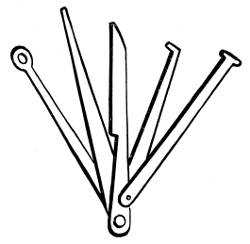
A metal toothpick and ear-picker joined to other toilet articles. An object found in Switzerland, in the ancient seat of a Roman military colony.
Fig. 30

An ancient toothpick and ear-picker of bronze, found in the north of France, at Bavai (the ancient Bagacum).
Caylus, in his valuable work Recueil d’antiquités égyptiennes, étrusques, grecques, romaines et gauloises (Paris, 1752 to 1767), gives the picture of a toothpick and ear-picker of bronze, two inches long, with the middle part wrought in spiral form, so as to increase the solidity of the article, and also to enable the hand to keep it easily firm in all positions. It was found in the north of France, at Bavai (the ancient Bagacum), and forms part of the collection of M. Mignon of Douai.162
Martial is one of the first Roman writers who speak clearly of artificial teeth. In Epigram LVI of Book XIV, the poet, by a bold personification, makes the dentifrice powder say to a toothless old woman, furnished with false teeth: “What have you got to do with me? Let a girl use me. I am not accustomed to clean bought teeth.”163
Elsewhere164 Martial atrociously derides a courtesan, who, among her other physical defects, was also without an eye: “Without any shame thou usest purchased locks of hair and teeth. Whatever will you do for the eye, Laelia? These are not to be bought!”165
This epigram shows that, while dental prosthesis was already in use, ocular prosthesis did not as yet exist.
To a plagiarist, who passed off Martial’s poetry as his own, the latter says: “With our verses, O Fidentinus, dost thou think thyself and desire to be thought a poet. Even so, it seems to Ægle that she has all her teeth, because of her false teeth of bone and ivory.”166
There is, therefore, not the least doubt that in the days of Martial artificial teeth were in use; and that these, as may be seen from the epigram just now quoted, were made of ivory and bone; we do not know whether they were formed also of other substances. The question, however, arises: In those times did they manufacture movable artificial sets, or was the dental art then limited to fixing the artificial teeth unmovably to the neighboring firm teeth, by means of silk threads, gold wire, and the like? The answer to this question may be found in another epigram of Martial,167 where the latter ridicules a wanton old woman, telling her, among other things still worse, that she at night lays down her teeth just as she does the silken robes.168
It is, therefore, beyond all doubt that, at that period, the manner of constructing movable artificial sets was known; and most probably not only partial pieces were made, but even full sets. In fact, from the verse quoted above we have justly the impression that the poet means a whole set rather than a few teeth.
From the words of Martial, it may also be concluded that these dentures could be put on and off with the greatest ease; or, as we may say, by a maneuver as simple as that of removing any articles of apparel; they must, therefore, have been extremely well constructed.
This alone should be sufficient, even were further proof wanting, to give us an idea of the degree of development and of the point of perfection reached by dental prosthesis at that time. But besides this, we now also possess an ancient Roman piece furnishing a palpable proof of the ability and ingenuity of the dentists of that epoch. Some few years since, I had occasion, in the pursuit of dental archæological research, to visit the Museum of Pope Julius in Rome, where I was shown a prosthetic piece, not yet exhibited to the general public, that had been discovered a few months previous in excavating at Satricum, near Rome. I was invited to give an opinion as to this appliance, and, after having examined it accurately, became aware, not without some emotion, I am fain to confess, that I held in my hands a prosthetic piece of exceptional historical importance, that is, no less than a specimen of ancient crown work.
Fig. 31 Fig. 32
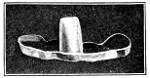
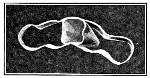
Roman appliance found at Satricum; crown of lower incisor made of gold. The same, seen from below.
The appliance found at Satricum (Fig. 31) is made in the following manner: Two small plates of gold, stamped out, represent respectively the lingual and labial superficies of a middle lower incisor; these two pieces soldered together form the crown of the tooth. At its base the crown is soldered, back and front, to a narrow strip of gold which folds back on itself at each end, so as to tightly encircle the two neighboring teeth on the right and on the left, which thus serve as supports to the appliance.
We are now, therefore, able not only to affirm that the Etruscans knew how to execute a kind of bridge work, but that later the dentists of ancient Rome even carried out crown work.
This, notwithstanding the examples of dental prosthesis discovered up to now in Roman and Etruscan tombs, can in no way be considered as representing all the varieties of dental prosthesis of ancient construction. It is to be hoped that, in spite of the destructive action of time, in continuing the excavations and archæological researches, many other specimens of early dental prosthesis will yet come to light. In any case, judging by some indications to be found in Latin literature, it must be admitted that the Roman dentists of antiquity constructed other kinds of prosthesis besides the specimens we possess, and in particular movable dentures. We are led to suppose this, not only from the above cited epigram of Martial, but also from what we read in one of the satires of Horace, who dates contemporarily with Augustus, and therefore anteriorly to Martial. Speaking of two old witches who had been put to flight by Priapus, Horace writes: “You would have laughed to see those two old witches run toward the town, losing in their flight, Canidia, her false teeth, Sagania, her false hair.”169
Now, as Prof. Deneffe very rightly observes, the prosthetic appliances of antiquity known to us are so firmly fixed to the natural teeth that no race, however unbridled, could ever have made them fall out of the mouth. It must, therefore, be admitted, as I have said, that the ancients constructed other kinds of dental appliances, of which no specimens have, as yet, been discovered.
Neither in Celsus nor in Pliny, nor in any other Roman writers on medicine, do we find any allusion to the art of dentistry. The doctors of those days probably had no idea of the advantages which could be derived from dental prosthesis in regard to digestion and consequently to the health of the whole body. They therefore must have considered artificial teeth as something totally foreign to their art, and intended solely to hide a physical defect. It is therefore not at all surprising that they have not treated of this subject.
As the art of setting artificial teeth was exercised by persons not belonging to the medical profession, it is very probable that these persons also undertook the extraction of teeth and the cure of dental pains. Martial (Book X, Epigram LVI) names a certain Cascellius, who, he says, “extracts or cures diseased teeth,”170 and this is the first dentist whose name has been sent down to us. In spite of this, nothing permits us to affirm that there existed at that time a class of real dentists, viz., of persons dedicated to the exclusive cure of dental disease. There are strong reasons for doubting this, especially when we consider that the Latin language has no word corresponding to the word dentist. If there had existed a true dental profession, there ought also to have existed a name for indicating the individuals who exercised it. Therefore, it must be considered highly probable that, although there undoubtedly existed individuals who were especially skilled in the cure of the diseases of the teeth, such persons did not form a special class; perhaps, among those to whom recourse was had for the cure of dental diseases, some were doctors, particularly skilled in such diseases, others were perhaps barbers, and so forth. As to the far-fetched deductions of Geist-Jacobi, according to whom the name given to dentists by the Romans must have been that of artifex dentium or artifex medicus dentium, these are founded, above all, on imagination. It is extremely improbable that such names existed, when one considers that they are not met with, even once, in the whole range of Latin literature.
Scribonius Largus. Among the writers on Medicine in the early period of the Empire, one of the most eminent was, without any doubt, Scribonius Largus, physician to the Emperor Claudius, whom he accompanied to England in the year 43.
Scribonius Largus, in his book De compositione medicamentorum, pronounces himself energetically against the division of Medicine into single special branches. He declaims against the many who attributed to themselves the name of doctors, simply because they knew how to cure some diseases. According to him, the true doctor must be skilled in curing all kinds of affections. This, in truth, was possible in those times, but would be almost impossible nowadays, on account of the enormous development of the healing art. The ideas, however, expressed by Scribonius Largus have a certain historical importance, for they show that in his times the medical art had certainly the tendency to split up into many special branches, among which there must certainly have been dentistry, but that the necessity of such separation was not by any means universally recognized; the great doctors of those days undertook the cure of the diseases of the teeth, as well as those of any other part of the body.
The tenth chapter of the book of Scribonius Largus treats of the cure of odontalgia. The author begins by saying that it is the opinion of many that the only true remedy against toothache is the forceps. With all this, he adds, there are many medicaments, from which great benefit may be derived against these pains, without it always being necessary to have recourse to extraction. Even when a tooth is affected with caries, says the author, it is not always advisable to extract it; but it is much better, in many cases, to cut away the diseased part with a scalpel adapted for the purpose.
“Violent toothache may be calmed in various ways, viz., with mouth washes, masticatories, fumigations, or by the direct application of fitting medicaments. It is beneficial to rinse the mouth frequently with a decoction of parietaria or of cypress berries, or to apply to the tooth the root or the seeds of the hyoscyamus wrapped up in a cloth, and dipped from time to time in boiling water, or to chew the portulaca (purslane), or to keep for some time its juice in the mouth.”
“Suitable also against toothache are fumigations made with the seeds of the hyoscyamus scattered on burning charcoal; these must be followed by rinsings of the mouth with hot water; in this way sometimes, as it were, small worms are expelled.”171
This passage of Scribonius Largus has given rise to the idea that the dental caries depends upon the presence of small worms, which eat away the substance of the tooth. Such an explanation must have well succeeded in satisfying the popular fancy; and it is for this that such a prejudice, although fought against by Jacques Houllier in the sixteenth century, has continued even to our days.
With regard to this I would like to record the following fact: Not many years ago there lived in Aversa, a small town near Naples, Italy, a certain Don Angelo Fontanella, a violin player, who professed himself to be the possessor of an infallible remedy against toothache. When summoned by the sufferer, he carried with him, in a bundle, a tile, a large iron plate, a funnel, a small curved tube adjustable to the apex of the funnel, a piece of bees’ wax, and a small packet of onion seed. Having placed the tile on a table, the iron plate was put upon it, after it had been heated red hot. Then the operator let a piece of bees’ wax fall upon the red-hot iron, together with a certain quantity of the onion seed; then, having promptly covered the whole with the funnel and made the patient approach, he brought the apex of the said funnel close to the sick tooth, in such a way as to cause the prodigious, if somewhat stinking, fumes produced by the combustion of the wax with the onion seed to act upon it. In the case of a lower tooth, the above-mentioned curved tube was adapted to the funnel, so that the fumes might equally reach the tooth. The remedy, for the most part, had a favorable result, whether because the beneficial effect was due to the action of the hot vapor on the diseased tooth, or to the active principles resulting from the combustion of the wax and onion seed, or to both, or perhaps also, at least in certain cases, to the suggestion that was thus brought to bear upon the sufferer. It would not be at all worth while to discuss here such a point. The interesting part is that when the patient had declared that he no longer felt the pain, Don Angelo, with a self-satisfied smile, turned the funnel upside down, and showed on its internal surface a quantity of what he pretended to be worms, which he affirmed had come out of the carious tooth. Great was the astonishment of the patient and of the bystanders, none of whom raised the least doubt as to the nature and origin of these small bodies, no one having the faintest suspicion even that these, instead of coming from the tooth, might come from the onion seed!
According to Scribonius Largus, toothache might also be taken away by fumigations of burnt bitumen. He affirms also that great benefit may be derived against odontalgia by masticating the wild mint, or the root of the pyrethrum, or by covering the diseased tooth with a plaster composed of peucedanum juice, opopanax, incense, and stoneless raisins. But before making use of this last remedy, he advises that the tooth and the gums near it should be fomented with very hot oil, by means of a toothpick or ear-picker wrapped around, at one end, with some wool. If the pain does not entirely cease, or comes on again, it is well, says the author, to continue the fomentations with hot oil, above the plaster, until the pain ceases. To strengthen loose teeth, Scribonius advises frequent rinsings of the mouth with asses’ milk or with wine in which have been cooked the roots of the sorrel until the liquid has boiled down to one-third. Another remedy which he recommends against looseness of the teeth is composed of honey and alum mixed together in a mortar, in the proportion of two parts of the first to one of the second, and then cooked in an earthen vase, so as to render the mixture more homogeneous, and to give it more consistency. He also speaks of a third medicament, resulting from cooking strong vinegar, alum, and cedria172 in a copper vessel until it has the consistency of honey. This remedy would serve not only to make loose teeth firm, but the author assures us also that whoever rubs the teeth with it, three times a month, will never be subject to dental pains.
Scribonius Largus gives the receipts for various dentifrice powders in use at that period. The skin of the radish dried in the sun, pounded to powder, and then passed through a sieve, would furnish a good dentifrice, suited to strengthen the teeth and to keep them healthy. Very white glass, similar to crystal, reduced to a very fine powder and mixed with spikenard, is also, according to Scribonius Largus, a valuable dentifrice.
Octavia, sister of Augustus, used a powder which our author highly commends, saying that it strengthens the teeth and makes them very beautiful.173 To prepare it, one must take a sextary174 of barley flour and knead it well to a paste with vinegar and honey mixed together, and must divide the mass into six balls, each of which must be mixed with half an ounce of salt; these balls must then be cooked in the oven until carbonized; and lastly pounded to powder, as much spikenard being added as is necessary to give it an agreeable perfume.
Scribonius Largus also lets us know the tooth powder made use of by Messalina, the wife of the Emperor Claudius; this was composed of calcined stag’s horn, mastic of Chios, and sal ammoniac, mixed in the proportion of an ounce of mastic and an ounce and a half of sal ammoniac to a sextary of the ashes of stag’s horn.
Servilius Damocrates, a Greek physician, who acquired great renown in Rome toward the middle of the first century, was the author of many valuable works, both in verse and prose, which, unfortunately, have been lost. His works are mentioned by Galen, who testifies to his great esteem for Damocrates, calling him an eminent physician, and quoting various passages from his works, and among others three poetical receipts for dentifrice powders. From these receipts it appears that Damocrates attached the greatest importance to the cleanliness of the teeth, and that he considered this the indispensable condition for avoiding disease of the teeth and gums.
Andromachus the Elder, of Crete, the physician of Nero, who conferred upon him, for the first time, the title of archiater, became famous through his theriac, an extremely complicated remedy, the virtues of which were sung by him in a Greek poem, dedicated to the Emperor. The theriac was considered an antidote against all poisons and a remedy against the greater part of diseases, in short, as a real panacea. It is not even necessary to remark that this portentous medicine, which has held a post of honor, from ancient times almost up to the present day, was also used against odontalgia; and in those cases in which this was produced by caries, Andromachus advised the filling up of the cavity with the electuary which he rendered so famous. As the chief basis of the theriac was opium, combined with stimulating and aromatic substances, there is no doubt that its use locally or even internally would prove beneficial, temporarily at least, in many cases of odontalgia.175
Archigenes, of Apamea, a city of Syria, lived in Rome toward the end of the first century and at the beginning of the second, under the Emperors Domitian, Nerva, Trajan, and Hadrian. He acquired great fame as a physician and as an operator, and distinguished himself particularly by daring amputations and trepannings. He recommends various remedies against odontalgia, among which are mouth washes of strong hot vinegar, in which gall-nuts or halicaccabum176 have been boiled. He usually introduced into carious teeth a mixture of turpentine and vitriol of iron (sory ægyptium), or a mixture of pepper, and oil of spikenard or of almonds, and this was also dropped into the ear, on the side on which the pain was felt.
Archigenes, too, like other great physicians of that time, recommended various remedies taken from the animal kingdom against diseases of the teeth, which now seem very strange to us, but at that period appear to have been in great use. Thus, it would be of great benefit to hold in the mouth for some length of time a mixture of vinegar and water in which a frog has been well cooked. The slough of a serpent, burnt and then reduced, by the addition of oil, to the consistency of solidified honey, would be a valuable remedy, which being introduced into a carious hollow, and plastered all around the tooth and on the surrounding parts, would cause the most violent pain to cease. And, moreover, desiring to cause a diseased tooth to fall out, it would be enough to apply to and press upon it a piece of the unburnt slough of a serpent. Two excellent anti-odontalgic remedies to be introduced into carious hollows would be roasted earth-worms and spikenard ointment mixed with the crushed eggs of spiders. It would be also of use to drop into the ear on the side of the aching tooth some oil of sesamum in which earth-worms have been cooked.
When the pain is situated in broken teeth, Archigenes advises them to be cauterized with a red-hot iron.
Against bleeding of the gums, he recommends rubbing them with very finely pulverized alum and myrtle and the application of astringent and tonic liquids.
When odontalgia appears to depend upon an inflammatory condition, he advises the aching teeth to be plastered up with a mixture composed of red nitre, pounded peach kernels, and resin.
Archigenes repeatedly recommends the cleaning of the teeth and of the carious cavities before applying to the former or introducing into the latter the appropriate remedies.177
But Archigenes’ principal merit, so far as concerns the art of dentistry, consists in his having guessed that odontalgia, in certain cases, arises from a disease of the interior part of the tooth (viz., from inflammation of the pulp) and in having discovered an excellent method for curing such cases. When a tooth appeared discolored, without being affected by caries, and was the seat of violent pains, against which every remedy had proved of no avail, Archigenes perforated it with a small trephine, invented by himself for the purpose. He applied the instrument to that part of the crown which was most discolored and drilled right down to the centre of the tooth.178
Without doubt this talented surgeon was induced to adopt this method of cure by the idea of the existence of morbid substances in the interior of the tooth and by the consequent indication of giving them a free exit.
The operation devised by Archigenes proves, among other things, two important facts: first, that the anatomical constitution of the teeth had already been explored, seeing that Archigenes did not ignore the existence of the pulp cavity; and secondly, that Archigenes was greatly opposed to the extraction of a tooth unless absolutely necessary. It might be thought that such aversion depended upon an exaggerated idea of the dangers connected with the extraction of a tooth, an idea widely diffused at that period; but regarding such a daring surgeon as Archigenes was, it is more logical to suppose that in similar cases he had recourse to trephining and not to extraction, especially on account of the importance he attached to the preservation of the tooth.
Surgery in ancient times was eminently conservative; later on—partly by effect of its own progress—it became too readily inclined to the removal of diseased parts; in modern times it has again become what it was originally, and what it must ever be, viz., conservative in the highest possible degree.
Claudius Galen, after Hippocrates the greatest physician of ancient times, was born at Pergamus, a city in Asia Minor, in the year 131 of our era. His father Nicon, a man of great abilities, who was at the same time a man of letters, a philosopher, a mathematician, and an architect, had put him, at a very early age, to the study of science and of the liberal arts. Galen began to study medicine at the age of seventeen, under the guidance of skilful doctors of his native country; he made several journeys in order to have the benefit of the instruction of celebrated masters, and finally frequented the renowned medical school at Alexandria. On going to Rome, in the thirty-fourth year of his life, he soon acquired in that city a very high renown. He died in the first decade of the third century, but we do not know exactly in what year.
Galen was a most prolific writer, and his works, considering the period in which they were written, form a real medical encyclopedia. Anatomy through his researches made considerable progress, for he studied with the utmost care and attention (especially in apes) the bones, muscles, heart, bloodvessels, brain, nerves, and every other part of the organism. His anatomical researches enabled him to correct many errors, but as he had dissected almost exclusively animals and not human corpses, he himself fell into several errors, especially in attributing to man parts which he does not possess, for example, the intermaxillary bone.
Galen justly observed that the inferior maxilla (resulting, according to him, from the union of two bones, which, indeed, is embryologically true) has in man, proportionally to the other bones of the skeleton, a lesser length than in animals.
He holds that the teeth must be enumerated among the bones, and does not admit any doubt to be raised on this point, as these parts can be looked upon neither as cartilages, nor as arteries, nor as veins, nor as nerves, nor as muscles, nor as glands, nor as viscera, nor as fat, nor as hair—a method of reasoning by elimination which is very specious but far too weak!
Galen indicates exactly the number of incisor, canine, and molar teeth (without, however, making any distinction between small and large molars), and speaks of the different functions of these three kinds of teeth. Not always, he says, are the molars of each jaw five in number on each side; in some individuals there appear only four; in others six. The incisors and canines have but one root; the upper molars have generally three, but sometimes, though not often, four; the lowers have for the most part two, rarely three.
Galen is the first author who speaks of the nerves of the teeth. He says that these organs are furnished with soft, that is sensitive, nerves179 belonging to the third pair.180 The teeth, according to him, are furnished with nerves, both because, as naked bones, they have need of sensibility, so that the animal may avoid being injured or destroyed by mechanical or physical agencies, and because the teeth, together with the tongue and the other parts of the mouth, are designed for the perception of the various flavors.181
In regard to odontalgia, Galen made some very important observations on his own person:
“Once when I was troubled with toothache, I directed my attention to the seat of the pain, and thus I perceived very clearly, that not only was the tooth painful but also pulsating, which is analogous to what happens in inflammations of the soft parts. To my astonishment, I had to persuade myself that inflammation may arise even in a tooth, in spite of the dental substance being hard and lapideous. But another time, when I again was attacked by odontalgia, I perceived very distinctly that the pain was not localized in the tooth, but rather in the inflamed gums. Having, therefore, suffered these two kinds of pain, I have acquired the absolute certainty that, in certain cases, the pain is situated in the gums, in others, on the contrary, in the very substance of the tooth.”
When a tooth becomes livid, Galen deduces from this that the tooth is the seat of a morbid process equivalent to inflammation. Besides, he says, we cannot be surprised that the teeth may be subject to a phlogistic process, when we consider that these, like the soft parts, assimilate nourishment. The teeth, by effect of mastication, are continually worn down, but nutrition repairs the losses, and they, therefore, preserve the same size. But when a tooth from want of its antagonist is consumed but little or not at all by mastication, we see that it grows gradually longer, for the very reason that under such conditions the increase due to nutrition is not counteracted by a corresponding waste.
The nutritive process of the teeth may, according to Galen, be altered either by excess or by defect; from which arise morbid conditions, quite different the one from the other. An excess of nutrition produces a phlogistic process analogous to that of the soft parts; a defect of nutrition makes the teeth thin, arid, and weak. The first of these pathological states is met with especially in young men and must be fought against with the ordinary antiphlogistic means, designed to eliminate the excess of humors (evacuant, resolvent, revulsive, and astringent remedies). As to defect of nutrition, this is met with most frequently in old people. It has the effect not only of making the teeth thin, but also of enlarging the alveoli, from which there results a looseness of the teeth more or less noticeable. Against this morbid condition we do not possess, says Galen, any direct remedy; however, it can be combated, up to a certain point, by strengthening the gums with astringent medicaments, so that they may close tightly around the teeth and thus make them firm.
Dental caries is produced, according to Galen, by the internal action of acrid and corroding humors, that is, it is produced in the same manner as those cutaneous ulcers which appear without any influence of external causes. The cure must consist in acting upon such vicious humors by means of local or general medicaments according to circumstances and also in strengthening the substance itself of the teeth by the use of astringents and tonic remedies.182
After these preliminary remarks, Galen gives a minute description of the numerous remedies which, from his own experience and from that of other great doctors, were to be considered useful for the cure of the various affections of the teeth and gums.
Against gingivitis and the pains deriving from it, the best remedy, according to Galen, consists in keeping in the mouth the oil of the lentisk moderately warm; noting, however, that such a remedy is the more efficacious the more recently it has been prepared.
A decoction of the root of the hyoscyamus in vinegar, used as a mouth wash, is another remedy recommended by Galen against the pains in the gums. It would also be of benefit to apply on the inflamed gums a powder composed of one part of salt to four of alum, afterward washing the mouth with wine or with a decoction of olive leaves. If the gums are ulcerated, Galen recommends them to be cauterized with boiling oil, using for the purpose a little wool wrapped around a probe or toothpick. This medicament, says Galen, greatly modifies the diseased part, exciting a reparative process in it, to aid which, however, suitable remedies must be used, and especially frictions with a mixture of gall-nuts and myrrh reduced to a fine powder.
For the cure of epulides the application of green vitrol, together with an equal quantity of powdered myrtle and a little alum, is especially recommended.
In dentition, if the gums are painful, it is advisable to rub them with the milk of a bitch. The teeth, moreover, appear very readily, says Galen, if the gums be rubbed with hare’s brain.
Against odontalgia, properly so called, independent, that is, of diseases of the gums, Galen particularly recommends warm applications, either on the cheek or directly on the tooth. Externally, on the side of the pain, may be applied dirty (!) pieces of linen, well warmed, or else small bags full of roasted salt, or cataplasms of linseed or barley flour. But if it is desired to act directly upon the sick tooth, this may be rubbed with a branch of origanum (wild marjoram) dipped in hot oil, or else, after applying a bit of wax on the tooth, the heated end of a probe may be laid upon it; or lastly, fumigations may be made by burning the seeds of the hyoscyamus. In case the above remedies, or others like them, be found of no use, Galen recommends them to be adopted anew after having perforated the sick tooth by means of a small drill. But if even from this no benefit be derived, and it is considered well to remove the tooth, this can be done without pain by the application of special medicaments. Among these the root of pyrethrum kept in very strong vinegar for forty days and then pounded takes the first place. The remedy is applied after having well cleaned the sick tooth, and after having covered the others with wax. At the end of an hour the tooth will have already become so loose that it can be drawn out with the fingers or with the mere help of a style. The same effect may be obtained, says Galen, by the application of blue vitriol mixed with very strong vinegar.
To prevent a carious tooth from producing pain or fetor, he advises the carious hollow to be filled up with black veratrum mixed to a paste with honey.
To restore to blackened teeth their whiteness, Galen advises them to be rubbed with special medicaments, one of which is made up of dried figs, burnt and pounded, with spikenard and honey. He gives, besides the receipts of many dentifrice powders and tinctures designed both to strengthen the teeth and gums and as preservatives against the diseases of these parts. Such powders and tinctures do not offer any interest to us, since they do not much differ from those recommended by other authors whom we have previously quoted.
When one or more teeth, in consequence of a trauma, or from other cause, become loose and project above the level of the others, Galen removes the whole exuberant part by means of a small iron file. In performing this operation, after having covered the gums with a soft piece of cloth, he holds the tooth to be filed steady with the fingers of the left hand, using the file in such a way as not to give the tooth any shock. Besides, he does not complete the operation at one sitting, but rather interrupts it as soon as the patient feels any pain, and continues it after one or two days. In the meanwhile, he makes use of remedies suited to strengthen the loosened teeth, and bids the patient remain silent and nourish himself with liquid or soft food.
When the teeth, without the action of external causes, become loosened, Galen holds that this is due to a relaxation of the dental nerve in consequence of an excessive abundance of humors. In such cases he counsels the use of desiccative remedies.
Galen, like ancient authors in general, is not very favorable to the extraction of teeth with the forceps. Even he seems convinced that a tooth may be made to fall out, without pain, by means of the application of certain remedies, to which we have already alluded. However, in one of the Galenic books183 we find the precept already given by Celsus, that before extracting a tooth the gums must be detached all around; from which one may argue that, at least in certain cases, instrumental extraction was considered inevitable. Galen even alludes to the pain which sometimes remains after the extraction of a tooth, and is of the opinion that this depends upon an inflammatory condition of the stump of the dental nerve.
In Galen are found recorded many means of cure, recommended by celebrated doctors of ancient times. Elsewhere we have already spoken of some remedies counselled by Damocrates, by Andromachus the elder, and by Archigenes. Apollonius, as a medicament against odontalgia, advised that the juice of the beet root be dropped into the nostrils, or else a liquid prepared from cumin seed, myrrh, cucumber, and woman’s milk. Heraclides of Tarentum recommended against the pains and looseness of teeth that a vinous decoction of black veratrum, mandrake, and hyoscyamus root should be kept in the mouth. Criton prescribed, for strengthening loose teeth, that the mouth should be frequently washed with a vinous decoction of lentisk, myrtle, and gall-nuts.