Part 3 — CHAPTER XII. THE EIGHTEENTH CENTURY. (continued 3)
Reading edition
Bunon studied with great accuracy the means of preventing anomalous positions of the permanent teeth, owing, according to him, almost always to want of space. In certain cases he advises the extraction of the milk tooth in order to facilitate the eruption of the permanent one, and, necessity urging, he does not hesitate to sacrifice one of the permanent teeth to procure the advantage of a normal position of the others. With regard to this subject, the following passage is worthy of note, for in it we find sketched out the theory of preventive extraction as a means of facilitating the eruption of the wisdom tooth: “It is better to have the teeth incomplete as to number than to have the ordinary number badly arranged; for the mouth will appear none the less well furnished because of having one or two teeth the less; the other teeth will be commodiously distributed, and the last molars will find sufficient room when they come forth; thus, the disorders which these teeth often occasion will be avoided.”546
After caries, Bunon considers dental tartar as the most potent enemy to the vitality of the teeth. He distinguishes three principal species: the black, the lemon or light yellow, and the brownish yellow; however, he allows of two other varieties of less frequent occurrence, the red and the green tartar.
At a period when an extraordinary confusion obtained with regard to gingivitis, because of the great number of varieties allowed, Bunon strongly affirms the unity of this morbid process, and considers tartar as the constant cause of it, without denying, however, that other causes of various kinds may contribute at the same time to produce it.
In cases of scorbutic stomatitis, Bunon advises, and very rightly, the complete removal of tartar from the teeth before having recourse to any other local treatment. He also insists on the necessity of attending to the teeth and gums, and especially of freeing the former from tartar before undertaking the specific treatment of syphilis, considering the good state of the teeth and gums as one of the most important prophylactic measures against mercurial stomatitis.
Anyone who takes the trouble of reading Bunon’s works attentively cannot help admiring his depth of insight, his spirit of observation, his exquisite clinical sense, and his ingenuity. As illustrating this last quality of his, we may cite two cases of fracture of the lower jaw that he succeeded in curing in a short time by the method of binding the teeth, the preceding attempts of experienced surgeons having entirely failed. One of these cases is particularly interesting. The seat of the fracture corresponded with the bicuspids, which, however, had fallen out from the effects of trauma; the neighboring teeth were also loosened. Bunon filled the empty space left by the bicuspids with a piece of ivory, provided with two holes; then, by an ingenious crossing of threads passing from the second molar on the one side to the second bicuspid on the other, very tightly tied, he formed, so to speak, one single block, and succeeded in bringing about the consolidation of the shaking teeth and the complete cure of the fracture, which was effected in less than a month.
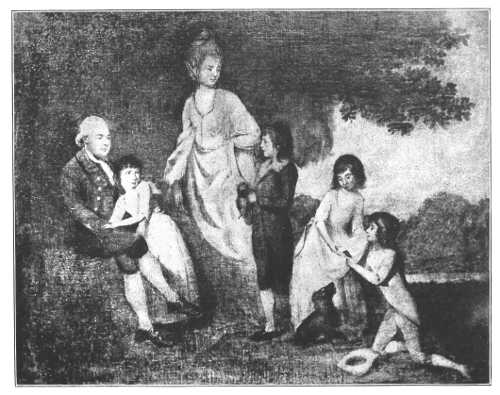
RUSPINI WITH HIS FAMILY IN A COUNTRY PLACE From an old painting in oil.
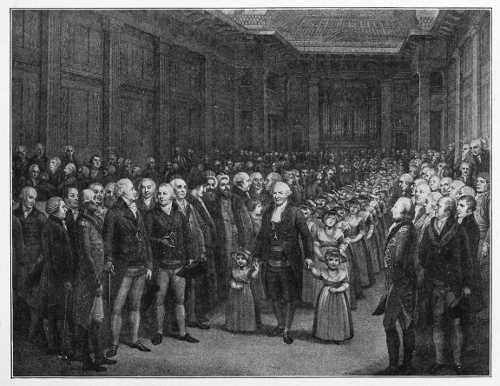
The Italian dentist Ruspini presenting the children of his orphanage to the members of the Free Masons Hall in London with whose aid the institution had been founded.
The unfavorable judgments passed on Bunon by some writers result, in a great measure, from the circumstance that one finds quoted in his books certain modes of treatment that today appear positively ridiculous. But those who, very wrongly and with deplorable levity, consider Bunon as nothing more than a vulgar empiric, ought to reflect that even the greatest men cannot altogether avoid the influence of the ideas and the prejudices of their time. Some tribute they are almost fatally bound to pay to these prejudices. It is, therefore, not to be wondered at, if one finds in Bunon’s works, as well as in those of many other old writers, indications given of more or less strange remedies. Thus, as facilitating the eruption of teeth, he recommends among other remedies the rubbing of the gums with a mixture of honey, fresh butter, hare’s brains, and oil of lilies, or with the fat of an old cock, dog’s milk, and pig’s brains. Against the disorders and dangers of the teething period he also advises rubbing the nape of the infant’s neck, the shoulders, the back, and the lower limbs, always taking care, however, to rub from above downward, thus offering opposition to the flow of humors toward the upper parts of the body.
These means and methods of treatment reflect, so to speak, the medical ideas and the curative practices of that time, and come down, in part, from remote ages, as evidently appears from what is said in different parts of this book. But such small blemishes ought certainly not to be taken into account in passing judgment on Bunon’s works, the most substantial part of which is made up of very original ideas and observations. The high intrinsic value of Bunon’s works gives him a just right to be considered one of the most illustrious forerunners of modern scientific dentistry.
Bartolomeo Ruspini, an Italian dentist, exercised his profession in London with great success for more than thirty years. He was patronized by all the greatest personages of the Kingdom and also by the Royal family, from whom he received special marks of distinction. He attained a very conspicuous position, and with the aid of the London Freemasons’ Lodge, of which he was an influential member, but chiefly by the results of his professional work, he was able to found an orphanage that was called by his name, being moved to do this by his great love for children, whose dental maladies and disorders had always been an object of particular study for him. In 1768 he published A Treatise on the Teeth, Their Structure and Various Diseases. This book was remarkably well received and went through a number of editions, the last in the year 1797. Ruspini did not, in reality, contribute very much to the development of dental science. He is, however, to be especially remembered as the inventor of a very good mouth mirror, a means of examination which afterward gradually came into general use.
Having brought our history of dentistry up to the end of the eighteenth century, in order to complete our work we must now speak of an innovation in dental prosthesis, which, although gradually brought to perfection in the following century, was first introduced at that time. We allude to the
INVENTION OF MINERAL TEETH.
The merit of this invention is due, in part, to an individual outside the dental profession, namely, to the French chemist Duchâteau, of St. Germain en Laye, near Paris, who first had the idea of employing porcelain as material for dental prosthesis. However, his idea would not have yielded fruitful results had it not been for the coöperation of the dentist Dubois de Chemant, who succeeded in putting it into practice.
The circumstances connected with this invention were the following: The chemist Duchâteau had for some time worn a denture of hippopotamus ivory, but as usually happened with all the prosthetic pieces of that time, which were made of organic material, and were, therefore, subject to decay, this denture had acquired a very disagreeable odor, resulting from the action of the buccal humors. Besides which, Duchâteau being obliged, by reason of his profession, to continually taste pharmaceutic preparations, his denture had gradually become impregnated with medicinal substances that imparted a nauseous taste to everything he ate. The unpleasantness of this was a subject of much consideration with him, and thus it was that, to remedy the evil, he gradually matured the idea of having a porcelain denture made, on the model of the ivory one. In the year 1774 he applied to the porcelain manufactory of M. Guerhard in Paris for the carrying out of his design. The first trial was not successful, for in the baking the paste contracted so much that the denture was no longer of the right dimensions. To remedy this, he now had another and larger denture made, to allow for its contraction in the baking. But the results did not correspond with his wishes, and many trials were still necessary before Duchâteau was able to obtain a denture which he judged fit for use, although not without defects. As this denture, because of its dead whiteness, produced an unpleasant effect, he had a yellowish tint, resembling that of the natural teeth, given to it, and, as is usual with painting on porcelain, fixed this color by baking a second time.
However, this denture proving unserviceable, Duchâteau was obliged to put it aside and begin new experiments. These were made with a special kind of porcelain paste used in France for the first time in 1740, which vitrified in baking at 12° to 25° by Wedgwood’s pyrometer, whilst the usual porcelain required a temperature of 72° to 75° by the same test; but the results thus obtained were no better than the preceding ones, and upon these new failures Duchâteau applied to the dentist Dubois de Chemant, of Paris, for his collaboration. Together they made fresh attempts, modifying the composition of the paste by adding a certain quantity of pipe clay and other coloring earths to it. These modifications enabled them to carry out the baking of the pieces at a much lower temperature, and after various experiments the final result was a denture that fitted the gums well enough, and which, in point of fact, Duchâteau was able to wear.
Encouraged by this success, he tried to manufacture like dentures for personages of high rank, hoping to gain money thereby, but his want of knowledge of the dental art prevented him from succeeding in his undertaking. However, in 1776 he laid this new process before the Royal Academy of Surgeons in Paris, receiving the thanks of that body as well as an honorable mention.
Whilst Duchâteau, discouraged by failure, was giving up all idea of deriving profit from the practical application of his invention, Dubois de Chemant, on the contrary, did not cease working for a moment, in order to bring the new method of prosthesis to perfection. Little by little he introduced important modifications into the composition of the mineral paste used in the manufacture of the dentures, incorporating therewith Fontainebleau sand, alicant soda, marl, red oxide of iron, and cobalt. His experiments and researches aimed at three principal ends, viz.:
1. The obtaining of mineral teeth offering all the gradations of color presented by natural ones.
2. The arriving at a rigorous calculation of the contraction of the mineral paste in the baking, so as to be able to make prosthetic pieces of the desired form and dimensions.
3. The perfecting of the means of attachment of the prosthetic pieces, and, in particular, of the springs.
By working with intelligence and perseverance, Dubois de Chemant gradually obtained satisfactory results, and when, in 1788, he published his first pamphlet on mineral teeth, he had already made dentures and partial prosthetic pieces for a certain number of persons, who wore them to great advantage.
As to the chemist Duchâteau, from 1776 to 1788, that is, during the twelve years subsequent to his communication to the Academy of Surgeons, he did absolutely nothing at all. He is, therefore, entitled to the credit of having had a happy idea and of having endeavored to put it into practice; but the merit of having given life to the idea, abandoned for so many years by him with whom it originated, is exclusively due to Dubois de Chemant; he is, therefore, with reason considered the true inventor of mineral teeth.
Dubois de Chemant, however, was so unjust as to take the whole credit of the invention for himself, declaring in his writings that the original idea had been exclusively his own, and was in no way due to Duchâteau.
In 1789 Dubois de Chemant made his invention known to the Academy of Sciences and to the Faculty of Medicine of Paris; both pronounced in favor of it, and in consequence of the opinion given by such high authorities, he soon after obtained an inventor’s patent from Louis XVI.
Dubois’ successes now aroused the envy of many of his colleagues, and especially of Dubois Foucou, the king’s dentist, who, together with the greater part of the dentists of Paris and the chemist Duchâteau, brought an action against him, accusing him of having usurped the invention of Duchâteau, and demanding, for this reason, the annulment of the inventor’s patent that had been granted him. But the law courts, in an opinion dated January 26, 1792, rejected the demand for annulment, recognized the patent of invention as fully valid, and condemned Dubois Foucou, Duchâteau, and their confederates to the costs of the judgment.
Paris being at that time in full revolution, Dubois de Chemant was induced to emigrate to England. He established himself in London, and there obtained a patent without much difficulty, according him the exclusive right, for fourteen years, of manufacturing dentures of mineral paste.
Dubois de Chemant wrote several pamphlets in order to make known to the public this new kind of dental prosthesis and its advantages; some of these were published in Paris (1788, 1790, 1824), and others during his long residence in London, where he remained from 1792 to 1817. In these pamphlets he upholds the great superiority of “the incorruptible teeth of mineral paste” over all other kinds of artificial teeth; he calls special attention to the fact that teeth of bone, ivory, and of every other organic substance whatever gradually become spoilt through the action of the saliva, of oral heat, of food and drink, etc., and not only lose their primitive color and assume a dirty hue, most unpleasant to the eye, but acquire a bad odor, at times quite insupportable, becoming, besides, a cause of irritation to the gums and the mucous membrane of the mouth, not to speak of their gradual softening and wearing out, which renders them unserviceable after a certain time. All these disadvantages were avoided by using the new prosthetic material, this being incorruptible and inalterable.
The prosthetic appliances by Dubois de Chemant were made in one single piece that represented the gums and teeth, whether in the case of one or more teeth, or of whole dental sets. He used to take a cast of the parts on which the prosthesis was to be applied, and by a process, the details of which are not known; he succeeded in obtaining prosthetic pieces that fitted the parts perfectly, notwithstanding the difficulties resulting from the shrinking of the paste in baking. If the piece required retouching, he did this by means of special tools for grinding down porcelain. He could, besides, drill holes in the porcelain for the application of the means of attachment. In fact, Dubois de Chemant was the creator of a new method of prosthesis applicable to any and every case, and which gained the praise and admiration of the great doctors and scientists of that day, among whom may be mentioned Geoffroy, Vicq d’Asyr, Descemet, Bajet, Petit Radel, Darcet, Sabatier, Jenner, and others. The Paris Faculty of Medicine gave it as their judgment that the prosthetic pieces manufactured by Dubois de Chemant united the qualities of beauty, solidity, and comfort to the exigencies of hygiene.
These eulogies must, however, be received with a certain reserve, as, beyond doubt, the mineral teeth of that time still left much to be desired. In England, where, as we have already said, they had been introduced by the inventor, they at first obtained a great success, which was, however, of short duration, and Maury547 tells us that toward 1814 they had fallen into great discredit and had been entirely abandoned; this signifies that practically they did not fulfil the expectations held out.
Dubois Foucou and Fonzi. Among the first who occupied themselves with the manufacturing of mineral teeth, contributing also to their improvement, are to be named Dubois Foucou, to whom we have already made reference, and Fonzi, an Italian by birth, who exercised the profession of dentist in Paris. Dubois Foucou made some improvements in the coloring of porcelain teeth, and in 1808 published a pamphlet in which he explained his mode of proceeding in manufacturing them.548 In the same year Fonzi made known a new kind of teeth,549 which he called terro-metallic. These differed from those of Dubois de Chemant in that they were all single teeth intended to be applied on a base by means of small hooks of platina, with which each tooth was furnished. In addition to this important innovation, Fonzi also discovered the means of imitating in some degree the semitransparent tint peculiar to natural teeth.
Notwithstanding this, the teeth made by Fonzi, of which there are still some specimens in various dental museums, had anything but a good appearance, and there still remained much to be done before mineral teeth reached the height of perfection which they attained later on.
Fig. 104
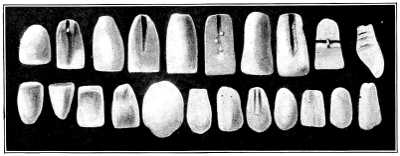
Earliest specimens of mineral teeth.
The credit of having introduced many new improvements in the manufacture of mineral teeth belongs especially to the Americans. Among those who particularly distinguished themselves in this department of dental art, we may note Charles W. Peale, Samuel W. Stockton, James Alcock, and Dr. Elias Wildman. But the most brilliant results, as is well known, were obtained by the celebrated Samuel S. White, who, by an intelligent and persevering activity, dedicated almost exclusively to improving mineral teeth and to bringing them into general use, contributed vastly to the progress of modern dental art. Samuel S. White undoubtedly stands forth as one of the noblest and grandest figures in the history of dentistry, and his name will ever be recorded with honor and veneration by dentists of all ages.