Part 3 — CHAPTER XII. THE EIGHTEENTH CENTURY.
Reading edition
Although there have been, even from the most remote times, individuals who have dedicated themselves exclusively to the cure of dental maladies, or to repairing the losses of the dental system by artificial means, and notwithstanding the progress gradually accomplished in this branch of the medical art, which progress was especially remarkable during the sixteenth and seventeenth centuries, it is not to be denied that, up to the beginning of the eighteenth century, dentistry was, in great part, considered one with medicine and surgery in general. It is but natural that dental art (and the same may be said of every special branch of medicine) could not assume a real individuality until it had attained to the higher grades of its development. As a matter of fact, dentistry, toward the end of the seventeenth century, was already a true specialty, although it counted but few worthy representatives at that time. The definite separation between the science and art of dentistry and general medicine and surgery, although it may have been retarded, could not fail to take place; and this, as we shall presently see, was effected by the celebrated French dentist Pierre Fauchard.
But, to remain faithful to chronological order, we will first speak briefly of some other writers.
Ludwig Cron, a barber of Leipsic, in a pamphlet published in 1717, with the title The barber’s apprentice versed in bleeding and tooth pulling,397 declares, in a still more emphatic and general way than De Lavauguyon, that it is useless to detach the gum before proceeding to extract a tooth. This barber, strong in his own experience, dares to assert absolutely useless this ancient practice, advised first by Cornelius Celsus, and recommended after him, and in homage to his authority, by many other writers. It is, therefore, possible that even previous to Cron and De Lavauguyon many operators had dispensed with the practice recommended by Celsus, although this had become an accepted canon of the high medical profession.
Lorenz Heister (1683 to 1758), of Frankfort-am-Main, one of the most celebrated surgeons of the eighteenth century, wrote a dissertation on toothache,398 treating besides very extensively of dental affections and their cure in a masterly work on surgery, published for the first time in 1718, and which went through numerous editions in various languages.
When the caries of a tooth is superficial, Heister advises the removal of the decayed part with the file; or, when the caries is deep down, the cavity ought first to be well cleaned with a toothpick or other like instrument, then filled with heated white wax, or mastic, the stopping being renewed as often as may be necessary. When a molar tooth is decayed, especially in the centre, the best way, says Heister, is to fill it with gold or lead leaf, or with a piece of the latter fitting into the cavity. If the carious cavity of a painful molar cannot be cleaned as it ought to be, the dropping of a little oil of cloves or of cinnamon or of guaiacum into it will be found useful, or even a few drops of spirit of vitriol; for in this manner one obtains at the same time the double advantage of destroying the impurities contained in the carious cavity and of soothing the pain. But if by chance the pain should persist, recourse must be had to the cauterizing iron, or to extraction. Sometimes, however, even the most violent toothache can be made to cease, either by scarifying the gums (a method already recommended by Pliny), by cauterizing the antitragus, or by pressing the aching tooth hard between the fingers, as Schelhammer399 and some other writers had advised.
Heister writes at length on the extraction of teeth, on the indications and counterindications appertaining thereto, on the instruments with which the operation should be carried out, and so on. Regarding the position of the patients, he thinks it best to place them on a low seat or on the ground, if the tooth to be extracted is situated in the lower jaw, but if an upper tooth is to be extracted, patients should be placed on a chair or on a bed.
Movable prosthetic pieces are mentioned for the first time by this author. Although he is very concise in his manner of speaking of artificial teeth (this indicating that dental prosthesis was considered outside the sphere of action of the general surgeon), we nevertheless learn from him that partial sets of teeth made of ivory or hippopotamus tusks, and without special appliances for fixing them, were then in use, which, when applied in the void between the neighboring teeth, were maintained in position simply by their form. The author advises keeping prosthetic pieces very clean, removing them every evening before going to bed, and not putting them back in the mouth until they have been well cleaned.
Heister also speaks of nasal prosthesis; this was then carried out by applying noses made of wood or of silver, properly painted. In cases of trismus, this author altogether rejects the forcible opening of the jaws by means of screw dilators and such like instruments, as they act too violently, and, according to him, only aggravate the morbid condition. Even the extraction of a tooth is useless in such cases, as the patient can always absorb a certain quantity of liquid food through the closed teeth. On the other hand, the author expresses himself in favor of the incision of the gums in cases of difficult dentition. According to him, convulsions and the other nervous symptoms which children are subject to during the period of dentition depend wholly on the hardness and strained condition of the gum. It is, therefore, natural that the symptoms should disappear when an incision of the gums, reaching to the tooth that is coming through, has caused the tension to cease.
The author speaks very particularly of the treatment of epulis and parulis; but his views on this subject contain nothing of great importance.
René Jacques Croissant de Garengeot (1688 to 1759), the celebrated French surgeon, speaks very little of dental surgery in his works. He declares himself averse to the carrying out of too many operations on the teeth, and especially disapproves the use of the file, because, according to him, it ruins the enamel.400 For a long time, especially in France, Garengeot was believed to have been the inventor of the key known by his name; but he merely perfected this instrument. In fact, through a later author, Lecluse, it clearly results that the key existed before Garengeot. “For extracting,” writes Lecluse, “one may make use of the pelican that Garengeot has constructed on the English key.” In a note, he afterward adds, “that the English key is an instrument used by dentists in England.” However, it is not in the least certain that the key is really an instrument of English origin.
Loder, who wrote at the end of the eighteenth century, informs us that the so-called English key was called the German key in England; it is, therefore, not improbable, that this instrument, as some maintain, had its origin in Germany.401
Johann Junker (1679 to 1759), professor of medicine at the University of Halle, wrote on dental maladies, not only in a treatise on surgery, published in 1721, but also in three dissertations which were published some time later, and were entitled respectively: De affectibus dentium (1740), De dentitione difficili (1745), De odontalgia (1746). The author, however, for the most part, only repeats things already known; his writings have, therefore, little or no importance for us. He counsels the Cowper-Drake operation in treating the affections of Highmore’s antrum; in carrying out the operation, however, he thinks the extraction of the second molar to be preferable to that of the first. To prevent the formation of tartar on the teeth, he advises assiduous care in keeping the mouth clean, and recommends, among other things, rubbing the teeth with sage. He disapproves having recourse too readily to metal instruments to remove tartar from the teeth, because, according to him, it favors the production of dental caries. He holds it dangerous to extract the upper or lower canines when they are not loose, as, by reason of the depth of their roots an injury to the surrounding nerves may be the result, which not only might cause great pain, but in the case of the upper canines might lead to inflammation of the eye, and even of the dura mater!
When the caries is incipient, Junker advises rubbing the teeth several times a day for some time with common salt, in order that this should penetrate into their structure.402
Guillaume Maquest de la Motte (1655 to 1737), a distinguished French surgeon and the writer of an excellent treatise (Traité complet de chirurgie, Paris, 1722), repeats the advice already given by preceding authors, to which he annexes the highest importance, that is, the opening in time of abscesses of the gums and of the palate even before they be completely matured, in order to prevent the suppurative process from extending and damaging the bone below. This author relates having several times arrested serious hemorrhage following on the extraction of teeth, by applying a little vitriol inside the alveolus, and, on this, graduated compresses, which the patient pressed on the part with the teeth of the opposite jaw.403
Johann Adolph Göritz, of Regensburg, in one of his writings published in 1725, disapproves the too frequent recurrence to extraction of the teeth, that is, carrying out the operation when it is not absolutely necessary. He is also averse to the application of artificial teeth. In support of his opinion he relates a case in which, a certain time after the application of an artificial tooth, the natural ones to which it had been fixed became loose, so that it was necessary to proceed to the fixing of all three, that is, the artificial tooth and the two neighboring ones, to the firm teeth beyond them; these, however, became loosened in their turn, and it was at last necessary to extract six teeth. The great space thus created was filled with a prosthetic piece made of hippopotamus tusk; but the author did not believe much good would come of this either. In fact, he is of opinion that the natural teeth should be preserved by every possible means, and that, on the other hand, even in the case of a few being lost, it is better not to resort to substitutes. In the worst case, should the dental void cause too great inconvenience by damaging the pronunciation, or for some other reason, it may be filled by an “imitation” in soft wood.404
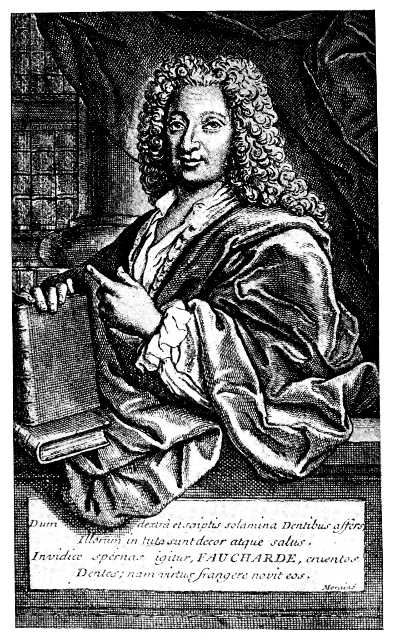
Pierre Fauchard.
If one takes into consideration the by no means slight inconvenience to which fixed artificial teeth gave rise, one cannot but admit the aversion to them, expressed by Göritz and others, to have been justified.
Ernst Ferdinand Gebauer, in 1726, made known a case in which, a tooth having been badly extracted by an incapable surgeon, the upper jaw was so seriously injured that a diffusive carious process ensued, which after many years’ suffering brought the patient to the grave.405
Johann Bernhardt Fischer (1685 to 1772), a very famous doctor, born in Lübeck, who had the honor of becoming archiater of the Russian Empire, related, in 1726, a case of replantation, similar to those by Pomaret and Carmeline; but Heinrich Bass (1690 to 1754), of Bremen, professor of anatomy and surgery in Halle, endeavored to demonstrate that in these cases the tooth did not really take root, but was rather maintained in position by the contracting of the surrounding gum. One perceives from this that there were still, at that time, discordant opinions on the subject of replantation, and that this operation was far from occupying, in dental surgery, the accredited position it has acquired today.
Heinrich Bass also combats the abuse of extracting teeth inconsiderately, without absolute necessity, and expresses the opinion that this is especially blamable in the case of teeth of the upper jaw, principally because the extraction of either the canine or of the first or second large upper molars might easily produce the opening of Highmore’s antrum, and thus give rise to regrettable accidents. He is not, however, averse, like Göritz, to the use of artificial teeth; indeed, he advises the application of whole dental sets, even in the upper jaw, so long as there be two natural teeth existing to fix the prosthetic piece to.406
Pierre Fauchard, the founder of modern scientific dentistry, was born in Brittany about the year 1690, and died at Paris in the year 1761. His celebrated work, Le Chirurgien Dentiste, was already written in the year 1723, but not published until 1728. It marks a new epoch in the history of dental art. The most renowned physicians, surgeons, and anatomists of the time testified their admiration for Fauchard’s work, which was translated into German in 1733, and afterward went through two French editions in the years 1746 and 1786.407 We have been able to obtain the second edition408 of this most important treatise, and of this we now intend making use for accurately analyzing the work, as it is probably more complete than the first, whilst the third, having been published after the author’s death, is probably merely a reprint.
The work consists of two volumes in duodecimo, in all 863 pages. In the beginning there is the portrait of the author and a long and interesting preface. The portrait, which we here reproduce, has also its historical importance, and this for two reasons, the first of which being that in it Fauchard is revealed to us as a person of very distinguished appearance, and this gives us an idea of the social condition of the surgeon-dentists of his time; the second, because there are annexed to the portrait the following Latin verses, by a certain Moraine, in which, whilst eulogizing the writings of the author and his ability in the treatment of the teeth, and in restoring force and beauty to them, he counsels him “to despise the tooth of envy,” as it will certainly break against his merit.
Dum dextra et scriptis solamina dentibus affers Illorum in tuto sunt decor atque salus. Invidiæ spernas igitur, Faucharde, cruentos Dentes; nam virtus frangere novit eos.
That Fauchard, in common with all men of rare merit, had to combat all his life against envy, we are able to perceive from what we read at the end of the second volume of his work. The author here says that “the rumor having been falsely set about that he has abandoned the profession; which rumor cannot have been invented otherwise than by those individuals who, sacrificing honor to interest, would attract to themselves the persons who honor the author with their confidence; he therefore finds it necessary to give warning that he still continues the practice of his art in Paris, in the Rue de la Comédie Française, together with his brother-in-law and sole student, M. Duchemin.”
More than a century and a half has passed by since Fauchard was obliged to defend himself against lies invented and set about to his damage by envious colleagues, but even at the present day, when, given the high grade that civilization has reached, and professional competition ought not to make use of other weapons than intelligence, study, and application, some do not hesitate to have recourse to means equally disloyal, ignoble, and shameless as those practised by some contemptible dentists of the middle of the eighteenth century.
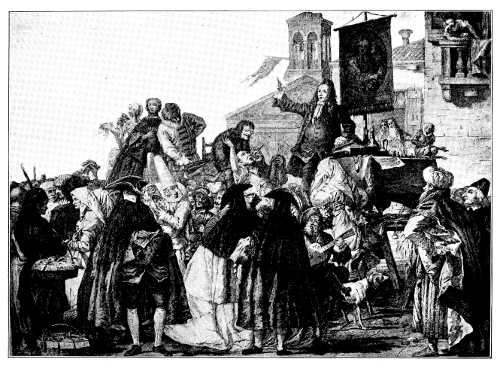
A CHARLATAN ON HIS PUBLIC STAGE
The preface of Fauchard’s book is especially important for the notices therein contained regarding the author, as well as the conditions of dental art at that period. And first of all, we find in it the proof of what we have already said elsewhere, namely, that even before Fauchard, there were not only tooth-pullers but also dentists properly so called. Indeed, Fauchard makes mention also of the examination that aspirant dentists had to undergo as far back as the year 1700. It may interest our readers if we here give in detail some extracts in which the author speaks on these subjects:
“Although surgery in general,” says Fauchard, “has been greatly perfected in these latter times; although important discoveries have been made in anatomy and in the modes of operating, and many learned and interesting observations have been published, nevertheless, dentists nowhere find in works on surgery sufficient aids to guide them in all their operations.” These last words should be sufficient alone to prove that the dentists spoken of by Fauchard were not mere tooth-pullers.
“The authors who have written on anatomy, on surgical diseases and operations, have only treated very superficially the part relating to maladies of the mouth and teeth. If some writers have spoken in particular about the teeth and their diseases, as, for instance, Urbain Hemard and B. Martin, they have not done so in a sufficiently ample manner.
“Besides, there does not exist any public or private course of surgery in which the theory of dental maladies is amply taught and in which one can receive fundamental instruction in this art, so necessary for the healing of these maladies and of those of the neighboring parts.
“This branch of the art having been but little cultivated, if not wholly abandoned by the most celebrated surgeons, their negligence has caused it to fall into the hands of persons without theory and without experience, who practise it in a haphazard fashion, guided neither by principles nor method. In Paris, it is only since 1700 that people’s eyes have become opened to this abuse.
“In this town, those who intend to become dentists are now obliged to undergo an examination, but although the examiners be most learned and well versed in all the other parts of surgery, I think, if I may be allowed to express my opinion, that as they do not ordinarily themselves practise dental surgery, it would not be amiss on these occasions to admit an able and experienced dentist, who might sound the aspirant as to the difficulties which have come before him in the course of the long practice of his art, and who could communicate to them the means of surmounting them. In this way one would not have to acknowledge that the attainment of the greater part of dental experts409 is below mediocrity.
“To supply this want of instruction it would have been of great use if some able dentist, for example the late Monsieur Carmeline, who, in his day, practised with general applause, had made us acquainted with his mode of operating and with the knowledge acquired through the successful treatment of a great number of important cases.
“What this celebrated surgeon-dentist has not done, I today dare to undertake. I shall at least afford an example of what he might have done with greater erudition and better success.
“From my youth I was destined to the surgical profession; the other arts I have practised410 have never made me lose sight of it. I was the disciple of Alexandre Poteleret, surgeon-in-chief to His Majesty’s ships, who had great experience in diseases of the mouth. To him I owe the first rudiments of the knowledge I have acquired in the surgical speciality I practise, and the progress I made under this able man gave me the emulation that has led me to further important discoveries. I have collected among different writers what seemed to me most reliable. I have frequently discussed these matters with the ablest surgeons and doctors of my acquaintance, and have neglected nothing in order to profit by their counsels and by their ideas.
“The experience which I have acquired during an uninterrupted practice of more than forty years has led me insensibly to the acquirement of further knowledge and to the modification of what seemed to me defective in my earlier ideas. I offer to the public the results of my labors and of my studies, hoping that they may be of some use to those who wish to exercise the profession of surgeon-dentist.”
The reason why dentists before the time of Fauchard published hardly anything concerning their art, was perhaps out of a sentiment of jealousy, which rendered them (that is, the best of the profession and therefore the ones most capable of writing) but little disposed to make known to others the results of their studies and of their experience, lest the fruits of their long labors should be utilized by others and they themselves be materially damaged by competition. That this sentiment of jealous egotism really existed in many dentists may be, in a certain manner, deduced from a few words of Fauchard himself, who, although he has the very great merit of breaking with mean, old-world prejudices, nevertheless expresses the prevalent idea of the time, consisting in the belief that every artificer, every inventor, had not only the right, but also the duty of surrounding his discoveries with secrecy and mystery. These are the words in which, making known a certain improvement in dental prosthesis invented by him, he at the same time expressed his conviction that by so doing he is acting against his own interests:
“I have perfected and also invented several artificial pieces both for substituting a part of the teeth and for remedying their entire loss, and these pieces substitute them so well that they serve perfectly for the same uses as the natural teeth. To the prejudice of my own interests I now give the most exact description possible of them.”
Now, although a man of elevated mind, such as Fauchard, may have been capable of sacrificing his material interests to higher aims, it is not, however, to be wondered at, taking also into consideration the lesser degree of culture and of professional ability of his predecessors, that none among them should have been found sufficiently disinterested to publish the results of their particular studies and experience, besides all those technical details which according to the ideas of that time constituted the secrets of the profession.
In the course of this history, we have seen that the dental art was practised from the most remote times and in the most various countries, remaining, notwithstanding, for centuries in an embryonal condition. It was toward the end of the seventeenth and the beginning of the eighteenth century that, in the midst of the highly advanced civilization of the great French capital, it attained a high degree of development, entitling it to be considered a special branch of the medical art.
It would, therefore, be wrong to believe that the dental art was created, for the most part, by Fauchard, and one clearly perceives, from the perusal of his work, that although he made most important contributions to this specialty, which he cultivated with passion, nevertheless, the greater part of the things therein treated of were already known before his time, although no reference to them is to be found in previous works; and this for the reasons we have already suggested. The highest merit of Fauchard consists, still more than in his inventions and improvements, in his having most ably collected and incorporated in a single work the whole doctrine of dental art, theoretical as well as practical, thus setting in full light the importance of the specialty, and giving it a solid scientific basis.
France is therefore the first country where modern dentistry reached a high degree of development and also the first country where, earlier than elsewhere, that is, about 1700, the dentists began to form a well-defined class, to belong to which it was necessary to pass a special examination. This examination, as we learn from Fauchard, was held before a commission of which no dentist formed a part, and exactly for this reason gave but negative results and responded but little to its intended aim. The greater number of those who were authorized to practise dentistry after undergoing this examination showed a professional ability below mediocrity. Nevertheless, although few in number, good and able dentists were in no way wanting, as clearly appears from the preface to Fauchard’s work, and better still from the following paragraph,411 wherein the author speaks of the great perfection reached by dental surgery in Paris:
“The teeth and the other parts of the mouth being subject, as we have seen in the course of this work, to so many important diseases, requiring the aid of the most able dentists, it is strange that the sovereigns of foreign countries, the heads of republics, and also the administrators of our own provinces do not provide for the expense of sending young surgeons to Paris, to be instructed in a part of surgery so essential, and, notwithstanding, so ignored and neglected everywhere excepting in this great city, where it has reached its highest perfection, both as regards the embellishment of the mouth and the cure of diseases, often of a most serious nature. These scholars would, thereafter, form others and would render great services to their nation and to their fellow citizens.”
In the first chapter of his work, Fauchard speaks “of the structure, position, and connection of the teeth; of their origin and of their growth.” He distinguishes in each tooth a body, a root, and a neck, making the remark, however, that this last is to be considered as forming part of the body. According to the author, the name of “crown” can only be applied suitably to the body of the molar teeth, but not to that of the incisors or of the canines, which has no resemblance with a crown. Although in the adult the number of the teeth is normally thirty-two, it may be that some persons have, nevertheless, thirty-one, thirty, twenty-nine, or even only twenty-eight teeth, and this independently of any eventual loss, but for the simple reason that the wisdom teeth are often cut very late in life (even after fifty years of age), or do not all come forth, or sometimes are never cut at all. The author refers to some cases of a supernumerary tooth situated in general between the two superior central incisors and similar in form to the lateral incisors. He also observed two individuals who had each thirty-four teeth, sixteen in the lower and eighteen in the upper jaw, and in these cases the two supernumeraries were situated behind the incisors. Fauchard declares the popular opinion expressed also by some ancient authors, of the milk teeth having no roots, to be false. The roots of these teeth, he says, are gradually worn away before the latter are shed, when the permanent teeth are just on the point of coming through; however, if it so happens that one or more of the milk teeth be extracted some time before the period in which they are usually shed, their roots are found to be as long and as strong in proportion to the body as those of the permanent teeth. In children one finds, besides the twenty deciduous teeth, the germs of the thirty-two permanent ones, for which reason it may be said that children have in all thirty-two teeth without counting the germs that may sometimes be found at the extremities of the roots of the large molars. As, however, the existence of such germs is an exceptional fact, the twelve large molars, if extracted, are not ordinarily regenerated. This may be possible, however, if the germs in question exist, and, indeed, the author observed two persons in both of whom a large molar had been regenerated in the place of the one which had to be extracted.
Fauchard gives an excellent description of the alveoli and of the roots of the teeth; he alludes to the varieties which these latter may present, and to the importance of the same from the point of view of extraction. Thus, speaking of the molars, he says: “Their roots sometimes touch one another at the points, whilst at the base, close to the body of the tooth, they are far apart. These are the so-called dents barrées (barred teeth), which it is so difficult to extract, it being unavoidable to bring away together with the tooth the spongy osseous part occupying the interval between the roots.”
In this same chapter the author calls our attention to some anomalies worthy of note. He says that he has observed teeth that seemed to him to be derived from the union of two or three germs. He also relates that a colleague of his showed him a tooth that appeared to be formed by the union of two, between the roots of which was a third tooth whose crown was united to the vault formed by the roots of the first two.
Fauchard describes exactly the pulp cavity and the root canals, and speaks of their gradual restriction, ending in an almost entire disappearance in old age.412 He treats of the nerves, of the arteries, and of the veins of the teeth in a most detailed manner; then, after alluding to their general structure, he goes on to speak of the microscopic constitution of the enamel, following in this the description given of it in 1699 by the academician La Hire.
In regard to the development of the teeth, Fauchard repeats what Urbain Hémard had previously written. He apparently ignores the researches of the Italian anatomists, from whom, and especially from Eustachius, Urbain Hémard had literally reproduced all that concerns odontogeny.
In the second chapter Fauchard speaks “of the maladies of children at the period of teething and of the remedies best adapted thereto.” Among other means of treatment, he advises the incision of the gum when this is red, swollen, and distended and the tooth below it can be felt. For the incisors and canines a simple incision ought to be made in the same curve as the dental arch; for the molars a crosswise incision should be made directly down to the tooth below, taking care not to leave any strips of uncut gingival tissue, lest these, being distended by the emerging tooth, should continue to be the cause of pain and other morbid phenomena.
Although Fauchard does not tell us anything substantially new about teething maladies and their treatment, he nevertheless treats this subject with much practical good sense, and does not merely make servile repetition of what preceding authors have written about it.
In the three following chapters the author speaks of the utility of the teeth, of the rules to be observed for their preservation, of the modes of keeping them white, and of strengthening the gums.
From a passage in the fifth chapter we learn that tooth brushes were then already in use. Fauchard, however, advises the use of small sponges in their stead. He says: “Those who use brushes of horsehair, or pieces of cloth or of linen for cleaning the teeth, do not reflect that all these materials are too rough, and that the practice of using them frequently and without discretion often exercises a destructive action upon the teeth.413 Not without good reason, I advise the abandonment of this usage, it being preferable, after having had the teeth cleaned by the dentist, to wash the mouth every morning with tepid water, and to rub the teeth up and down, inside and outside, with a small, very fine sponge wetted in water; and it is still better to add to this water a fourth part of aqua vitæ the better to fortify the gums and render the teeth firm.”
Instead of a small sponge, says Fauchard, the end of a root of marshmallow or lucern, which has first been subjected to a special preparation, may be used with benefit for rubbing the teeth. The author gives a long and minute description of this preparation, which we, however, omit, because devoid of historical interest.
As, however, the above means are not always sufficient for preserving the teeth and gums in good condition, it is necessary in many cases, says Fauchard, to make use of some paste, powder, or mouth wash. The author mentions a great number of compositions of this kind, giving the formula for each one—almost always most complicated—and indicating the peculiar advantages of each of them. We will here quote one of the formulæ as an example.
“A spirituous water, desiccative, balsamic, antiscorbutic, efficacious against many maladies of the mouth:
“℞—good sarsaparilla, four ounces; aristolochia rotunda, dried rinds of bitter organes, of lemons, and pomegranates, ana three ounces; pyrethrum, two ounces; cloves, one ounce; mustard seeds, one ounce; wild rocket seeds, two ounces. Pound well in a mortar and put the whole into a retort with a long neck. Add thereto half a pound of pulverized candied sugar and the same quantity of clarified rose honey. Pour in three pints of good spirit of wine. Cork the retort well and leave all to digest in a cool place for five or six days. Then heat the retort forty-eight hours in the water bath over a slow fire, without letting the liquid come to the boil. Afterward, when cold, decant in a glass bottle, to be kept well corked. Pour another three pints of spirit of wine on the residue of the drugs; cork the retort again, replacing it in the water bath for forty-eight hours, and regulating the fire as above. Then, after letting it cool, pour off the liquid into the same bottle. Next remove all the residue from the retort, place it in a thick, white linen cloth, and force the remaining liquid through it, and add to that in the bottle. Put back half of the entire quantity of liquid in the same retort, and add thereto aloetic elixir and baume du commandeur, ana four ounces; pulverized dragon’s blood, three ounces and a half; pulverized gum of guaiac and Peruvian balsam, ana three ounces; gum lac, two ounces. Cork the retort again and replace it in the water bath for forty-eight hours, as above. Let cool, decant the liquid in another glass bottle, and cork well. Pour the remaining half of the first liquid upon the rest of the drugs, replace the retort in the water bath for forty-eight hours, let cool, and pour the contents in the last bottle. Filter the liquid well, and pour it into a bottle of sufficient size to be able to add the following liquids: aqua vulneraria and first cinnamon water, ana three pints; second cinnamon water, three half-pints; spirit of cochlearia, four pints. Shake the bottle well, filter again, and store in well-corked bottles.”
The author adds that the doses of the different drugs may be reduced in proportion to the quantity of liquor to be prepared; and that he prepares so large a quantity at a time because of the great sale he has for it among his clients.
The preparation in question is counselled by the author as a remedy against pathological conditions, and of the gums especially. One makes use of it in the following manner: Pour from seven to eight drops into a wineglass of water; wet the tip of the finger and rub the gums and the teeth well. Or mix seven or eight drops in a good spoonful of water, using a fine sponge to rub the teeth and gums.
The example we have cited suffices to show how much care one took at that time in the preparation of substances destined to be used in the preservation of the teeth, and demonstrates at the same time that Fauchard, inventor of that and many other preparations, besides being an able surgeon-dentist, was also exceedingly well versed in dental materia medica.
Chapter VII treats of the general causes of dental, alveolar, and gingival diseases, and contains the complete enumeration of these maladies. The causes of dental affections may be of two orders, viz., internal (general diseases, dyscrasic conditions) and external (the action of heat and cold, mechanical causes, etc.).
After having spoken in particular of various causes, Fauchard adds: “Little or no care as to the cleanliness of the teeth is ordinarily the cause of all the maladies that destroy them.”
The author divides maladies of the dental apparatus into three classes, that is:
1. Maladies deriving from external causes and acting, therefore, especially on the crown or uncovered part of the tooth.
2. Maladies of the hidden parts of the tooth, that is, of the neck and root.
3. Symptomatic maladies, deriving from the teeth.
In the first class the author includes 45 pathological states, 17 in the second and 41 in the third, making up a total of 103 morbid conditions. This should be sufficient to give us an idea of the accuracy with which Fauchard studied the maladies of the dental apparatus, especially if one considers that preceding authors had reduced these maladies to a very small number. Fauchard’s classification is very complete, for notwithstanding the progress made in succeeding years in this science, the pathological conditions not to be found comprised in it are exceedingly few. Naturally, the 103 diseases enumerated by Fauchard do not represent as many distinct morbid entities. The author, in classifying dental maladies, keeps especially in view the requirements of the practitioner, and therefore makes numerous distinctions in each morbid process. Thus, he distinguishes a great many varieties of caries, viz., the soft and putrid caries, the dry caries, the caries in part dry and in part soft, the caries complicated by fracture, the superficial caries, the deeper and the deepest, the caries of the different surfaces of the crown, and so on. Also in the classification of other morbid processes, Fauchard makes multifarious distinctions.
The passage referring to worms in the teeth deserves to be here reproduced:414
“Sometimes worms are to be found in the carious cavities of the teeth, or in the deposit of tartar that covers them, and to these the name of dental worms has been given. Observations recorded by illustrious authors are extant which attest this. Not having ever seen these worms, I neither admit nor deny their existence. Nevertheless, I conceive the thing nor to be physically impossible, although at the same time I do not believe at all that these worms destroy the teeth or cause them to decay, but rather that the eggs of some insect having been introduced into the carious cavity of the tooth, either through alimentary substances or through the saliva, these eggs thus deposited have developed and produced the worms alluded to. However this may be, as they are not the real cause of the caries, their eventual presence does not require any particular consideration.” Fauchard again recurs to the subject of worms in Chapter VIII, in speaking of the particular causes of caries.415
“It was, and is still, believed by the vulgar and also by some writers that all toothache is caused by worms, which little by little destroy the tissue of the osseous fibers and the nervous threads. If this were so, the explanation of pains and of decay in the teeth would be very simple. This opinion is founded on pretended experiences relating to these insects, which may, it is said, be made to fall out of the teeth by the smoke of henbane seeds; this, however, has been declared fabulous by Andry, dean of the medical faculty of Paris, as well as other similar facts which he exposes in his book on the generation of worms.416
“Andry relates, however, that with the help of the microscope one may succeed in seeing certain worms that form beneath the deposit collected upon the teeth as the effect of want of cleanliness; these worms, he says, are exceedingly small and characterized by a small round head with a small black spot; the body is long and fine, pretty nearly like the worms seen in vinegar through the microscope. He adds that these worms destroy the teeth little by little, causing a bad odor, but not much pain. He believes it an error of the imagination to ascribe violent pains in the teeth to dental worms, and holds that these only produce a very slight, dull pain accompanied by itching.
“I have done everything possible,” continues Fauchard, “to convince myself with my own eyes of the existence of these worms. I have made use of the excellent microscopes of Manteville, sworn surgeon of Paris, and have made a great number of experiments with them both on caries in teeth newly extracted as well as on tartar of different consistency accumulated on the same, but have never succeeded in discovering any worms. I am also still less disposed to believe in the existence of these animals, because Hémard declares that he has never been able to find any worms in carious cavities. I am thoroughly convinced of Andry’s sincerity; neither do I doubt the truth of the facts he relates; but it is easy to perceive from his own words how little the pretended healers of teeth and their specifics for killing worms are to be held in account; from the moment that, according to this writer, the pains for which one is most obliged to have recourse to remedies are almost always those not proceeding from the cause in question.”
In short, Fauchard does not believe at all that dental caries is occasioned by worms; and only from respect for the authority of Andry and other writers does he admit the accidental existence of these little animals in the carious cavities or upon the teeth, refusing, however, to attribute any importance to the same as regards the etiology of caries.
This disease, says Fauchard,417 is produced by a humor that insinuates itself into the midst of the osseous fibers of the teeth, and displacing the particles which compose these fibers, gives rise to their destruction. The causes from which these disorders derive may be external or internal. The external causes are blows, violent efforts made by the teeth; the improper use of the file, the application of acids or of other substances that injure the enamel, alteration of the saliva, impressions of heat or cold, and also certain kinds of nourishment. Blows or violent efforts may produce caries, according to the writer, by occasioning the effusion of the liquid contained in the vessels. The author gives analogous explanations for the other external causes. As to the internal causes, they consist, he says, in alteration of the blood and of the humors.
The teeth, says Fauchard, are more subject to caries than all the rest of the bones in the human body, because, their tissues being denser, the vessels are on this account closer together and more easily liable to be obstructed, choked up, and broken. Besides, the position of the teeth exposes them more than the other bones to the immediate action of external causes capable of producing the disorders alluded to; and finally, what demonstrates the dental caries to be produced, for the most part, by external causes, is that false teeth, either human or formed from those of animals, sometimes become carious just in the same way as the natural ones; which evidently happens by the sole action of external causes.
It is undeniable that the ideas expressed by Fauchard on the pathogeny of caries, cannot hold good against criticism. Nevertheless, we owe a great deal to this author for having once for all put an end to the ridiculous theory of dental worms, and for having tried to find a reasonable explanation of the manner in which caries is produced.
The teeth, says Fauchard, have not all the same disposition toward this morbid process; indeed, notable differences are to be observed in this respect. The molars are, in fact, more apt to become decayed than the incisors or the canines; and the upper incisors and canines are more subject to this disease than the inferior ones, because, by reason of their position, they are more frequently uncovered and more exposed to heat and cold, whether in eating and drinking or whether in the mere aspiration or expiration of the air. It is to be observed, besides, that when the eruption of the last molars is considerably delayed they easily decay.418
Having very frequently observed the symmetrical decay of corresponding teeth on both sides of the same jaw, Fauchard considers that these cases are not simply accidental, but rather holds that the fact depends on a special cause, which, however, is not easy to determine. He offers, at any rate, a sufficiently good explanation when he says that as certain morbid causes (bad humors, etc.) must affect both sides of the mouth identically, it is but natural that the effects of such causes should be altogether analogous on the right and on the left, and manifest themselves symmetrically on teeth having the same configuration, the same structure, and the same consistence.
Before speaking of the treatment of caries,419 Fauchard alludes to the fallaciousness of the many remedies against toothache which were largely sold at his time by charlatans and impostors of every kind.
“Some pretend to cure toothache with an elixir or some special essence; others with plasters; others by means of prayers and signing with the cross; others with specifics for killing the worms that are supposed to gnaw the tooth and so cause pain; others pretend to be so clever that they can cure the most inveterate toothache by merely touching the tooth with a finger dipped into or washed with some rare and mysterious liquid; others finally promise to cure every kind of toothache by scarifying the ears with the lancet or cauterizing them with a red-hot iron.”
“I am well aware,” adds Fauchard, “that it can be alleged in favor of this last prejudice that the celebrated Italian doctor Valsalva indicates with great precision the point in which the actual cautery is to be applied to the ear, in order to calm toothache. He also determines the size of the iron and the manner of applying it. The authority of so celebrated an author, whose opinion is certainly worthy of respect, should induce me to believe that there may perhaps be some cases in which it is possible to use this remedy with success; nevertheless, I cannot persuade myself that such treatment can be useful in common cases of toothache.
“At Nantes, a city of Brittany, I knew a Turk, a watchmaker by profession, who was renowned for this mode of curing toothache. But I also know that, in spite of the pretended cures, the greater number of those who put themselves into his hands were obliged finally to have recourse to me, in order to find relief for their sufferings. I afterward saw several other persons use the same remedy with no better success.
“There are, besides, an infinity of other remedies vaunted as efficacious against toothache, but the greater number of them are so ridiculous and extravagant that it would be both tiresome and useless to speak of them. We will, nevertheless, give one more mentioned by M. de Brantôme.”420
The author here quotes a passage of this writer, wherein he says that, having been suffering from toothache for two days, the apothecary of Elizabeth of France, wife of Philip II of Spain, brought him a most singular herb, which when held in the hollow of the hand had the virtue of making the pain cease immediately; and in this way he was, in fact, effectually cured.
And here Fauchard expresses himself of the same opinion as Urbain Hémard, who believes the cure of toothache by means of words, or by the touch of paper on which certain signs are written, or remedies held in the hand, etc., to be merely the effect of the force of the imagination, and he opines that the patient, having a vivid belief in the mysterious thing proposed to him remains under the impression of an inward commotion, by the effect of which it may well be that the morbid humor is deviated from the painful part to other parts of the body. The effects of the various passions on the bodily functions are, says Fauchard, very well known. Thus, when under the influence of anger the wounded at times do not feel any pain, and those who suffering from a tormenting toothache go to a dentist to have the tooth drawn are sometimes seized by such great fear as not to feel the pain any longer, and go away, only to return later on renewal of their sufferings; although there have been cases where the pain ceased altogether.
In spite of this explanation, of which we will not here discuss the value, allowing it, however, as satisfactory enough, Fauchard continues by making a most curious consideration, which as it is of a somewhat surprising effect in a scientific work, we will not deprive our readers of it. He believes it to be his duty to give the following warning, namely, that “the modes of cure, by means of certain words, of certain signs, laying on of hands, written charms, etc., savoring much of superstition and of diabolic artifice, are prohibited by the Church as sinning against the first Commandment, as much in him who practises them as him who consents thereto.”
After the above preliminaries, the author passes on to treat the important subject of the mode of curing caries.421 According to him, when caries has not yet attacked the internal cavity of the tooth at all, or only in a very slight degree, there are four modes of curing it: the first consists in the use of files or scrapers, the second in the application of lead, the third in the use of oil of cinnamon or of cloves, and the fourth in the application of the actual cautery. Fauchard expresses most energetically his disapproval of the means of cure recommended by Dionis in cases of caries of the triturating surfaces, which consisted in the cauterizing of the decayed spot with a drop of oil of vitriol applied by means of a miniature paint brush, declaring this to be both dangerous and hurtful because of the destructive and corrosive action of the oil of vitriol and because of the impossibility of limiting its action solely to the affected part of the tooth.
The general method of cure followed by Fauchard is described by him in these terms:
“When a tooth is but slightly decayed, it is sufficient to remove the caries with the instruments of which I will speak hereafter, and to fill the cavity with lead. If, however, the cavity be rather deeper and occasions pain, one should, after having scraped it, put a small ball of cotton-wool soaked in oil of cinnamon or of cloves into the hollow of the caries every day. This medication must be continued for a sufficient time, taking care to squeeze in the cotton-wool by degrees to accustom the sensitive parts to the pressure. Four or five days later one removes the material from the carious cavity. This treatment sometimes prevents a return of the pain; it produces on the osseous fibers of the tooth a slight but sufficient exfoliation and impedes the progress of the caries. If the pain should not cease after having continued this method for a sufficient length of time, one should then have recourse to the actual cautery and stop the tooth after a certain time, if the form and situation of the decayed cavity permit it; for one sometimes meets with cavities that are not able to maintain the stopping.
“If the caries penetrates as far as the cavity of the tooth, it may give rise to an abscess; and this I have often observed in persons to whom the caries of the incisors or of the canines occasioned great pain. In such cases I introduce the extremity of the sound into the cavity of the tooth in order to facilitate the evacuation of matter. As soon as the pus is evacuated the pain ceases. I then leave these patients in repose for two or three months; after this time, I stop the decayed tooth or teeth to avoid their getting worse.”
As anyone may perceive, the methods used by Fauchard against caries left much to be desired, when compared with those now in use. With such imperfect methods it is but natural that one did not always succeed in obtaining the immediate cessation of the pain resulting from caries. The want of additional remedies was, therefore, felt; and, in fact, Fauchard tells us422 of two with which he had experimented and found most efficacious against toothache. The first is a resinous plaster to be applied to the temples; the other is a paste to be applied, in quantity equal to the size of a small bean, between the gums and the cheek, and which was composed of various ingredients, among others, pyrethrum, black pepper, ginger, stavesacre, mace, cloves, cinnamon, sea salt, and vinegar. After having given the mode of preparation and application of the two above-mentioned remedies, Fauchard adds: “These remedies prove especially efficacious if one takes care to introduce a little cotton-wool or lint into the decayed cavity, soaked in oil of cloves, or cinnamon, mixed with an equal quantity of extract of opium, and if one resorts opportunely to bleeding and purging; which ought never to be neglected in the case of plethoric persons.”
Finally, the author speaks of another remedy,423 and one which we never should have expected to find in his book; but he assures us that by it many persons who had almost all the teeth decayed and suffered very often from toothache found great relief.
“It consists in rinsing the mouth every morning and also in the evening before going to bed with a few spoonfuls of one’s own urine immediately after it has been emitted, always provided the individual be not ill. One is to hold it in the mouth for some time, and the practice ought to be continued. This remedy is good but undoubtedly not pleasant, except in so far as that it procures great relief. Some of those to whom I have recommended it, and who have used it, have assured me that in this manner they were relieved of pain to which, up to then, they had continually been subject. It is rather difficult in the beginning to accustom one’s self to it; but what would one not do to secure one’s self health and repose.”
In order to explain the virtue of the urine as a remedy, the author pauses to speak of its chemical composition, and then adds:
“The rectified spirit of urine424 could be substituted for the human urine. One should then take two drams of this substance and mix it with two or three ounces of aqua vitæ, or water of cresses or of cochlearia. Sal volatile425 has the same virtues. Those who wish to make use of it should dissolve fifteen to thirty grains of it in the same quantity of the above liquid.”
Fauchard then passes on to speak of trepanning of the teeth when they are worn away or decayed and cause pain.426 He begins by saying that most varieties of pain caused by the canines and the incisors when worn away or decayed cease after the use of the trepan. He, however, understands the term trepanning in a very wide sense, comprehending therein the use of any instrument whatever (even a needle or a pin) with which one penetrates into the inner cavity of the teeth.
In interstitial caries of the canines and incisors one ought, says Fauchard, first to enlarge the interstice with a small file of a convenient shape, then to scrape the decayed cavity, and finally to open up the canal or inner cavity of the tooth with a perforator or with a small trepan.
“In this way the pus or other humors that may have collected in the tooth can easily find their way out, and the pain will cease at once or in a short time.”
The author describes with much minuteness the manner of trepanning, and then adds:
“After this operation one should let a few weeks pass without doing anything to the affected tooth, and afterward, in order to impede further decay, one must put a little cotton-wool into it soaked in oil of cinnamon or of cloves. The tooth must be left in this state for some months, taking care to renew the cotton-wool. It is necessary to observe that in beginning to put in the cotton-wool this should be done with lightness and without pressing it down much, so that if pus should gather again it may be able to make its way through the cotton-wool, the principal object of this being to hinder the penetrating of alimentary substances into the tooth, which would be the cause of further decay. If the cotton were pressed into the tooth from the beginning, the pus, not being able to find an exit, would accumulate, and might cause much pain, if the nervous parts of the tooth were not yet dried up or destroyed. The same thing might happen after the application of a lead stopping, and one would be obliged to remove it and let considerable time pass before putting it in again.”
Further on the author says that while the trepanning of incisors or canines almost always causes the pain to cease, by opening up an exit to the morbid matter retained within the cavity of such teeth, the same is not the case with the molars, these having several roots and several cavities, of great variety, which lend themselves but little to accurate trepanning. “Hémard,” he adds, “judges it necessary to extract these teeth, or at least to break off the crown (les déchapeller), in order to give exit to the corrupt matter that is closed up in the cavity; this sometimes causes the pain to cease. He (Hémard) says that he has seen many abscesses in the interior of teeth, which were not externally decayed, and that after having broken off the crown he found within the cavity a corrupt matter of an insupportable smell.”
Relative to such cases, Fauchard says that, besides the teeth, also the surrounding parts suffer and are imperilled by these conditions. “The greater part of the violent fluxions deriving therefrom often terminate in abscesses and fistulæ of the gums and of the surrounding parts, and sometimes with considerable and dangerous decay of the bone, as I have related in some of my observations.”
One sees that Fauchard was clinically very well acquainted with the grave forms of pulpitis and their possible consequences, although ignoring the true nature of this process, which has only been studied and illustrated much more recently.
Chapter XL (page 177) treats of dental tartar, of its cause, of the harmful effects it produces, and of the prophylaxis and therapy relating thereto. Three illustrations which are added to this chapter represent the different aspects of a mass of tartar of exceptional size formed around the body of a lower molar. The surgeon Bassuel, a friend of the author, had removed this mass of tartar, together with the entire molar, from the jaw of an old woman. The mass itself was almost the size of a hen’s egg, the superficies being very irregular; it rendered mastication altogether impossible and caused the cheek to stand out in such a way as to give the appearance of a tumor.427
In the following chapter428 the author enumerates the various dental operations: “Cleaning the teeth, separating them, shortening them, removing the caries, cauterizing, stopping, straightening crooked teeth, steadying loose teeth, trepanning, simple drawing of teeth, replacing them in their own alveoli, or transplanting them to another mouth, and finally substituting artificial teeth for those wanting.” He then adds: “All these operations require in him who carries them out a light, secure, and skilful hand and a perfect theoretic knowledge, by which he may decide on the opportuneness of performing them, of deferring them, or of abandoning them altogether. In fact, one may know perfectly well how to carry out an operation and nevertheless undertake it in a case in which it is not at all proper to operate. Into such an error no one can fall save through sheer ignorance of the cause of the disease or of the right means of curing it. From this it must be concluded that the knowledge required in order to be a good dentist is not so limited as some imagine, and that the imprudence and the danger of placing one’s self in ignorant hands is as great as the temerity of those who undertake to exercise so delicate a profession without the knowledge of even its first elements.”
Before speaking in detail of all the above operations, the author dedicates a lengthy chapter429 to describing with the greatest minuteness the position to be given in general, as well as in special cases, to the head and body of the patient, and the manner in which the dentist should place himself with regard to the former, so as to be able to make a proper use of each of his hands. As a rule, Fauchard made the patient seat himself in a convenient arm-chair; in exceptional cases he placed him on a sofa, or on a bed. He draws this subject to a close with the following words:
“It is, indeed, surprising that the greater part of those who practise tooth drawing should ordinarily seat the patient on the ground, this being both indecent and not very clean. This position is not only uncomfortable, but causes sometimes a sense of fear, especially in pregnant women, to whom it may, besides, prove very harmful. But it is still more surprising that certain authors should even nowadays affirm this to be the most convenient position, while it is instead one to be entirely rejected.”
In speaking of extraction of the teeth,430 Fauchard begins by saying that the milk teeth, although destined to be shed, should never be extracted, except in cases of absolute necessity, as, for instance, when being decayed, they give rise to intolerable pain. The alveoli of the infantile jaw are weak, whilst the roots of the deciduous teeth are sometimes firmer and more solid than one would believe, and hence it is that in extracting a milk tooth one runs the risk of injuring the alveolus and even of carrying away a portion of it altogether with the tooth, not to speak of the danger of damaging or even destroying the germ of the permanent tooth lying below. Besides, Fauchard adds, there are sometimes deciduous teeth that are never shed and never renewed. One must, therefore, defer drawing children’s teeth as long as possible unless they are loose. When, however, intolerance of pain or a caries endangering the integrity of the neighboring teeth oblige one to recur without delay to extraction, one should carry out the operation with prudence and judgment, so as to avoid the dangers alluded to. It sometimes happens, says Fauchard, that one finds in children a crooked tooth by the side of a straight one; in these cases ignorant tooth-drawers have often been known to remove the crooked (permanent) tooth, and to leave the straight, viz., the deciduous one, which afterward falls of itself, the individual thus remaining deprived of one of his teeth for the rest of his life. The rule to be observed in order to avoid a similar error is always to extract the older of the two teeth and to leave the one that has been cut more recently, which is easily recognized by its being ordinarily firmer in the socket and of a better color than the first.
And here the author inveighs against all the charlatans of his day who dared, without being dentists, to perform dental operations, and whose number, it would seem, was ever increasing, so much so that he is led to exclaim: “There will shortly be more dentists than persons affected with dental diseases!” In proof of this he relates the case of a cutler of Paris, who extracted the molar tooth of a young girl because black spots having appeared on it, he believed it to be decayed; but perceiving that he had only removed the crown (it was a deciduous tooth about to fall out), and thinking that he had broken the tooth, proceeded to extract the root, removing, in his gross ignorance, the permanent tooth on the point of coming through.
Returning to the indications for the extraction of teeth, Fauchard says that when a tooth planted irregularly in the mouth cannot be straightened by any of those means to which he afterward alludes, and occasions damage or inconvenience or constitutes a deformity, the sole remedy is its removal. As to decayed teeth and the pain that they produce, when the evil cannot be remedied with oil of cinnamon or oil of cloves, with the actual cautery, or by stopping, one must have recourse to extraction, and this to satisfy four different indications, that is, before all, to procure the cessation of violent pain; in the second place, to prevent the caries from being communicated to the neighboring teeth; thirdly, to remove the fetid smell deriving from the substances that are retained within the carious cavity, and to impede the teeth on the same side from becoming covered with tartar, as inevitably happens when by reason of painfulness in eating they are forced to be inactive; fourth and lastly, because the dental caries, not infrequently gives rise to other diseases, which ordinarily cannot be cured unless the cause from which it arises be recognized and suppressed.
“Sometimes,” continues Fauchard, “such violent and obstinate pain arises in a tooth that we are obliged to extract it, although not decayed nor presenting deformity.”
The author combats the old prejudice, that it is not right to draw teeth in cases of pregnant women or of nursing mothers, lest the operation should prove dangerous to the patient or to the fetus, or produce alteration or arrest of the milk secretion. Only the fear arising from this prejudice can, according to the author, cause any of the dreaded contingencies. The dentist ought, therefore, to seek to dissipate the fears of these patients, by persuading them of the innocuous nature of the operation as well as of its short duration, and should represent to them, on the other hand (if the operation be really necessary), the advantages of promptly deciding on it, to avoid the harm and the peril that prolonged suffering and the tortures of sleeplessness might occasion to themselves as well as to the unborn child or to the suckling infant, such as abortion, premature confinement, alteration of the milk, etc.
According to Fauchard, “one should always take the precaution of hiding the instruments from the patient’s sight, especially in the case of extracting a tooth, so as not to terrify him.”
The author then speaks of cases where it is necessary to open the jaws by force;431 of the instruments to be used; of the mode of employing them; of all the precautions to be observed under such circumstances; of the necessity that may eventually arise of sacrificing some one tooth when the enforced opening of the jaws has been impracticable; of the advisability of sacrificing preferably in such cases one of the premolars in order to damage as little as possible the masticatory function and the appearance of the face; of the instruments best adapted for carrying out this operation; of the danger it presents and of the best mode of avoiding it; finally, of what it is necessary to do in given cases to keep the mouth open, in order to not be obliged to repeat the operation a second time.
The six following chapters of the first volume treat very extensively of the anatomy and physiology of the gums,432 of gingival diseases and their treatment.433 The subject is treated in a masterly manner, although these chapters do not offer anything of original importance.
The same may be said of Chapter XXII, in which the author speaks of scorbutic affections and of their treatment.
The chapters we have cited are accompanied by four plates, representing thirteen instruments for use in the treatment of the above diseases.
Fig. 78
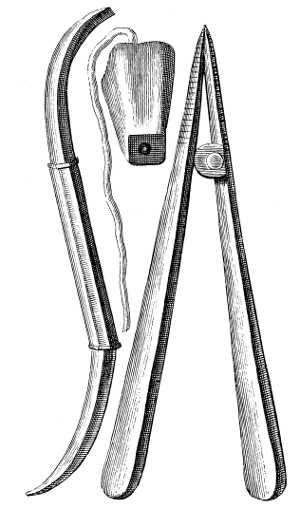
Instruments for opening the mouth in cases of lockjaw (Fauchard).
The author then speaks434 of the accidents which may arise from caries and from other dental diseases, not only in the parts nearest to the teeth, but also in localities more or less distant from them, for example, fistulæ reaching as far as the cheek bone or the eye, necrotic destruction of the maxillary bones, etc.
The first volume of Fauchard’s work finishes with a collection of most interesting cases, which may be read even at the present day with pleasure, and from which one may derive some useful information. These cases are about eighty in number, spread over fifteen chapters, according to the various nature of the cases themselves. This valuable collection gives clear evidence of Fauchard’s eminence both as operator and observer, and affords at the same time an idea of the extent of his practice which enabled him to collect so considerable a number of cases of more than common interest.
Chapter XXV contains some observations on “well-authenticated cases” of regeneration of permanent teeth in individuals of ages varying from fifteen to seventy-five years. We will here give two of them by way of curiosities:
“In the year 1708 Mademoiselle Deshayes, now the wife of M. de Sève, residing at Paris in rue de Baune, and who was then fourteen years of age, had the first large molar on the right side of the inferior jaw extracted by me, because decayed and causing pain. The following year she returned to have her teeth cleaned by me, and whilst doing this I observed that the tooth extracted had been wholly regenerated.”435
“In the year 1720 the eldest son of M. Duchemin, player in ordinary to the King, who was then sixteen years old, came to me to have the second large molar on the left side of the lower jaw extracted. It was very much decayed. I drew it, and a year and a half after the tooth was completely regenerated.”436
In Chapter XXVIII the author relates twelve cases of dental irregularities corrected by him with satisfactory and at times even surprising results. We here refer, in Fauchard’s own words, to the last two of these cases, not because of their being the most important, but because from them it is evident that Fauchard was not the only dentist who undertook such corrections, although he was perhaps the only one who, in certain cases, carried them out with a rapid method.
“In the year 1719 M. l’abbé Morin, about twenty-two years of age, whose countenance was greatly deformed from the bad arrangement of the incisors and canines, consulted various colleagues of mine as to the possibility of correcting the irregularity of his teeth. Some found the thing so difficult that they advised him to do nothing at all, that is, not to risk any attempt. He came to me by chance one day whilst another dentist was with me. We both examined his mouth with much attention. Now, as this dentist was my elder, and I believed him to have more experience than I had, I begged him to give me his opinion as to the best method to follow in this case, in order to insure success. Whether it be that he would not give me advice, or that he was not in a position to be able to do so, the fact is, that his answer was not such as I could have wished. I therefore felt myself obliged to tell him that I hoped to put this gentleman’s teeth in order within three or four days. My colleague was not aware that this could be done so quickly; urged by curiosity, he returned when the time I had indicated had elapsed, and found, not without surprise, M. Morin’s teeth reduced to perfect order.”437
“Several years ago the wife of M. Gosset, Reviseur des Comptes, sent for me to examine the teeth of her daughter, then twelve years of age. I found the lateral incisor on the left side of the lower jaw strongly inclined toward the palate in such a manner as to constitute a real disfigurement. Interrogated by the mother as to the possibility of remedying this, I replied that it could easily be done in eight or ten days, with the method of threads, if the young girl were only sent every day to my house. As, however, the young lady received instruction from several masters who came to her house each day, my proposal was not accepted, in order not to distract her from her studies. This induced me to say to the mother that, if she were willing, I would put the crooked tooth into its natural position in a few minutes. Surprised at so short a time being demanded for the operation, she consented to my performing it immediately. Making use of the file, I began by separating the tooth from the neighboring ones which pressed upon it, slightly diminishing the space it ought to have occupied. This done, I straightened the tooth with the pelican, placing it in its natural position, to the great astonishment of the young girl’s mother and of other persons present, who told me they had many times seen similar corrections that had been carried out by the late M. Carmeline and others, never, however, with this method or in so short a time. As soon as I had reduced the tooth to its normal position I fixed it to those next to it by means of a piece of common thread, which I left there eight days; and during that time I made the young girl rinse her mouth four or five times a day with an astringent mouth wash. After the tooth had become firm, it would not have been suspected that it had ever been out of its normal position.”438
In Chapter XXX the author gives an account of five cases of dental replantation and one of transplantation. This last operation was carried out on a captain who had the upper canines on the left side decayed and aching; he inquired of the author if it were possible to draw it and replace it by another person’s tooth. Having received an affirmative reply, the officer sent immediately for a soldier of his company to whom he had already spoken on the subject. This man’s canine was found by Fauchard to be too large; nevertheless, for want of better he extracted and transplanted it, after having diminished it in length and in thickness. This it was not possible to do without the cavity of the tooth remaining open, and for this reason, when, after about two weeks’ time it had become quite firm, he stopped it. But the stopping immediately caused such insupportable pain (which circumstance astonished the writer not a little) that he was obliged to take it out again the following day, on which the pain ceased directly. Fauchard saw this patient eight years afterward, and was assured by him that the transplanted tooth had lasted him six years, but that its crown had been gradually destroyed by caries. The root had been extracted by a dentist, not without considerable pain.439
We now give one of his cases of replantation in the words of the author himself:
“On April 10, 1725, the eldest daughter of M. Tribuot, organ builder to His Majesty the King, called on me; she was tormented by violent toothache caused by caries of the first small molar on the right side of the upper jaw; but although she was desirous of having the tooth removed, to be freed of the pain, she, on the other hand, could not, without difficulty, make up her mind, thinking of the disfigurement which its loss would occasion, and thus it was that she was induced to ask me if it would not be possible to put it back again after having extracted it, as I had already done in the case of her younger sister. I replied that this might very well be done, provided the tooth came out without being broken, without any splintering of the alveolus, or great laceration of the gum. The patient, upon this, completely made up her mind. I extracted the tooth very carefully so as not to break it, neither were the gum nor the alveolus injured in any way. I therefore was induced to put the decayed tooth back in its alveolus, and having done this, I took care to tie it to the neighboring teeth with a common thread, which I left in position for a few days. The tooth became perfectly firm, and only caused pain for two days after being replanted.... To better preserve it, I stopped the carious cavity.”440
Not without interest is a case of disease of Highmore’s antrum, originating in the following way. A charlatan attempted to extract by means of a common key a canine tooth which had erupted in an abnormal position. He applied the hollow of the key to the tooth and beat upon the handle with a stone. But the tooth, instead of penetrating into the hollow of the key, was driven into the maxillary sinus.441
Two important cases of “stony excrescence” of the gums (probably osteomas) are to be found in Chapter XXXII. One of these tumors was removed by the dentist Carmeline after the patient had been tortured with useless operations by surgeons, who, not recognizing the true seat of the evil and mistaking it for a tumor in the cheek, had, over and above all the rest, produced a permanent disfigurement of the patient’s face and a perforation of the cheek that he was obliged to keep closed for the remainder of his life with a wax plug, to prevent the exit of the saliva and of liquid or masticated aliments.442
Several important observations on obstinate cases of cephalalgia, prosopalgia, otalgia, and other varieties of pain arising from dental caries are to be found in Chapter XXXIII. In all these cases the removal of the decayed tooth or teeth procured the prompt cessation of pain. Among others worthy of note is a case of violent otalgia caused by the decay of a lower molar, which, however, was itself not painful. This circumstance drew Fauchard himself into error, causing him to believe that the otalgia was independent of the decayed tooth; he therefore merely stopped the tooth to prevent the caries from extending farther. The pain in the ear continued, however, and the patient therefore consulted a doctor of the Faculty of Paris, Coutier, who told her that the decayed tooth might be the cause of the earache, and that, therefore, before undertaking any other cure, she ought to have it extracted. This advice was followed and the earache ceased promptly and completely.443
In another case a patient twenty-seven years of age was tormented by violent pain in all her teeth on the left side, in the temple and the ear, as well as in the chin, the palate, and the throat. The doctors and surgeons consulted decided the cause to be rheumatism. The patient was bled not less than four times and subjected to various other methods of treatment (purgatives, clysters, poultices, etc.), but all in vain. She, however, perceiving that one of her teeth was decayed, had it taken out. It was believed that the cause of the malady had thus been found and removed; but an hour later the pain began again with the same violence as before, continuing for some months; after this it ceased of itself. On the return of the pain, later on, in all its former intensity, the patient consulted the very able surgeon Petit, who advised her to see Fauchard, as possibly the malady might have its cause and point of departure in some bad tooth. Fauchard found one of the inferior molars decayed. This being extracted, the pain promptly ceased, not to return any more.444
Chapter XXXV contains twelve cases of serious maladies arising from dental diseases. One of these cases was observed in a patient aged fifty-seven years, who in consequence of caries of the last inferior molar on the right lost through necrosis a considerable portion of the lower jaw, including the whole of the right condyle; he was affected, besides, with caries of the temporal bone, in so advanced a degree that the probe could reach the dura mater; he was, therefore, in serious danger of his life, had to undergo several surgical operations of exceptional gravity, and even after recovery remained permanently subject to various disturbances, such as a salivary fistula, paralysis of the lower eyelid, etc. And all this because the surgeons whom the patient had called in had directed all their attention to the secondary facts, instead of suppressing the primary cause of the evil, represented by a dental affection.
A case observed by the surgeon Juton and communicated by him to the author is also a very important one. The patient was suffering with a large abscess on the right side of the lower jaw, accompanied by such great swelling of the cheek that it was impossible to open the mouth wide enough to examine the teeth. Juton proposed opening the abscess immediately, but the patient would not consent. The following day he was sent for in great haste. The gathering had changed its seat, making its way between the skin and muscles of the neck, where it now formed so huge a tumefaction that the patient was in danger of being suffocated. The abscess was now immediately opened, but the swelling of the face still persisted; it was therefore only after a month had elapsed that it was possible to extract the root of the last molar, which had been the original cause of the whole malady. The surgeon observed that the liquid injected into the fistulous opening in the neck issued from the alveolus of the last molar. After the extraction of the root a prompt recovery was effected.445
The second volume of Fauchard’s work is entirely devoted to operative dentistry and prosthesis.
Before speaking of the modes of cleaning, filing, and stopping the teeth, the author combats the opinion maintained by some, that these operations are in part useless, in part also dangerous, as having the effect of loosening the teeth, of depriving them of their enamel, and ruining them.
Fauchard then describes the instruments proper for detaching the tartar;446 he speaks of the method to be followed in cleaning the teeth in order to not endanger the enamel;447 he speaks of the different kinds of dental files, of their different uses in relation to the various cases and indications; of the precautions to be taken in making use of them;448 of the instruments to be used for scraping and cleaning the carious cavities and of the mode of employing them.449
All of the above-named instruments are illustrated by figures, in contemplating which one cannot but reflect on the inferiority of the instruments then in use as compared with those of the present day. The greater admiration is therefore due to Fauchard’s talent, which, in spite of such imperfect and at times absolutely primitive means, enabled him to obtain the brilliant results cited in his observations.
Fig. 79
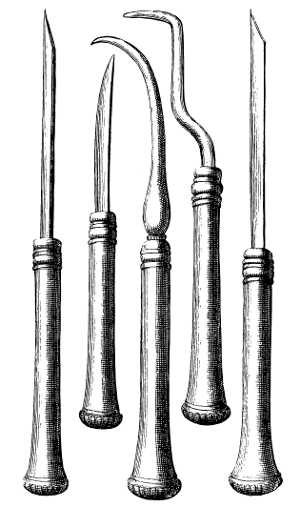
Instruments for detaching dental tartar (Fauchard).
Chapter VI is dedicated to the stopping of decayed teeth. The sole materials used by the author for stopping were lead, tin, and gold. “Fine tin,” he says, “is preferable to lead, for lead turns black much more easily and is much less durable; both are preferable to gold, because lighter and adapting themselves better to the unevenness of the carious cavities. Besides, gold being dear, not everyone can or will make the corresponding outlay.” The author here adds that those who, from vanity or because possessed by the opinion that gold has special virtues, will not have their tooth stopped except with it, not unfrequently find dentists who, as the saying, goes, content them and cozen them by using leaf tin or lead colored yellow, and making them pay for it as gold stopping!
Fig. 80
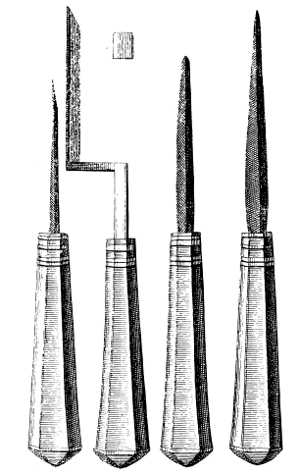
Some of the dental files used by Fauchard. The little square figure represents a small grooved wedge destined to be inserted in large interdental spaces, in order to give more firmness to the teeth to be filed.
The leaf metals were introduced and compressed into the carious cavities by means of three kinds of pluggers, which would nowadays be considered altogether insufficient and unfit for the purpose, but which then, nevertheless, served to produce excellent stoppings. The author speaks450 of a lead stopping which had lasted in perfect condition for forty years.
Before stopping the tooth the cavity was scraped and its opening widened, if necessary, but no special form was given to the cavity itself, as is done at the present day.
Fig. 81
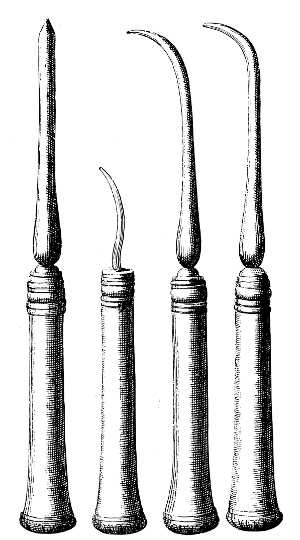
Instruments for scraping the carious cavities (Fauchard).
As at that time the state of the dental pulp was not taken into consideration before stopping a tooth, it often occurred that the stopping caused violent pain, which rendered its removal necessary.451
Fauchard says that “if the sensibility of the carious cavity be too great, the lead ought only to be pressed in very lightly at first, then after one or two days a little more, continuing thus until it is properly compressed and fitted in, always provided, of course, that the pain does not increase. The sensitive parts of the tooth become thus more easily used to the pressure of the lead, and the pain is in this manner avoided or moderated.”452
Fig. 82
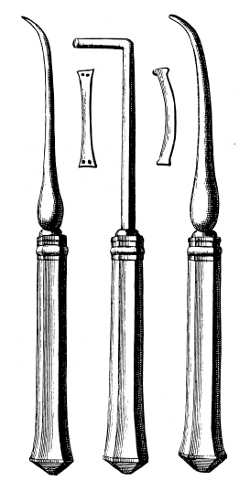
Three instruments for plugging teeth. The two small figures represent silver plates for straightening teeth (Fauchard).
The author also makes the remark453 that sometimes, in scraping a carious cavity, “it is not possible to avoid uncovering and touching the nerve with the instruments; one becomes aware of this by the pain caused, and better still by a little blood issuing from the dental vessels.” In such cases, Fauchard advises stopping of the tooth immediately, for if it be carried out with delay, it is sure to be followed by inflammation and great pain, rendering necessary the removal of the lead or even the extraction of the tooth.
Fig. 83
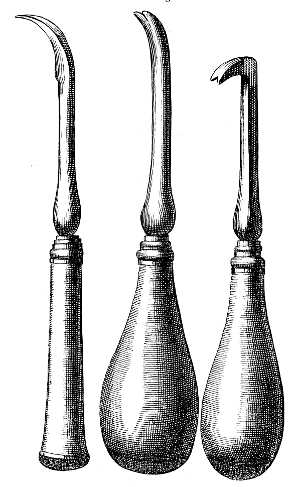
A gum lancet and two elevators, the second of which is destined to act from inside outward (Fauchard).
Cauterization of the teeth454 continued to be much used in Fauchard’s time, and this is very easily explainable when one considers that there was not then any other means of destroying the dental pulp. In making use of the actual cautery, the immediate end in view was to cause the cessation of obstinate toothache. “When the teeth give great pain and no relief is to be derived from the use of other remedies, one ought to cauterize the caries after having removed the extraneous substances that may eventually be found in the carious cavity. After the cauterization one scrapes the cavity and fills it up with cotton-wool soaked in oil of cinnamon. Later on one stops the tooth.”455
Fig. 84
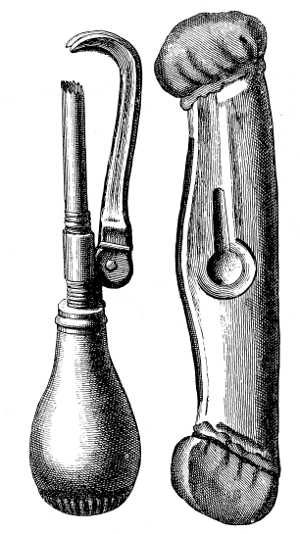
An extracting instrument called by Fauchard lever or tirtoire, and the handle of a pelican without the hooks.
The chapter in which Fauchard treats of the correction of dental irregularities is of particular interest. In speaking of his observations, we have already seen that in this field also he knew how to obtain splendid and admirable results. He, nevertheless, made use of the most simple means—the file, pressure with the fingers, common threads or silk ones, little plates of silver or gold. At times, for straightening teeth, he made use of the pelican and the straight pincers, afterward tying the teeth in their normal position. He rarely had recourse to extraction as a means of carrying out dental corrections.456
Fig. 85
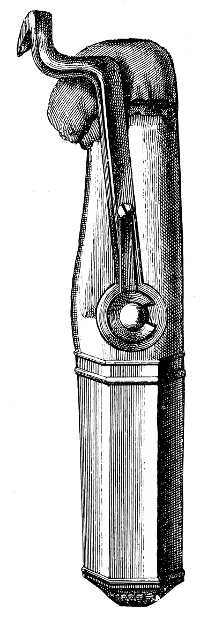
Fauchard’s simple pelican (with one changeable hook).
Fig. 86
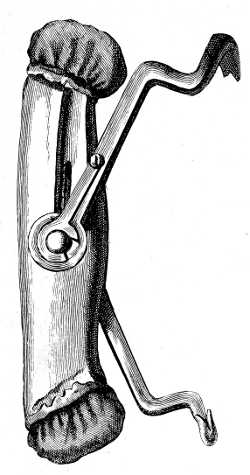
Fauchard’s double pelican.
To steady loose teeth,457 Fauchard, as did the ancients, made use of gold threads. When the spaces separating a loose tooth from the neighboring ones were too large, he introduced small pieces of hippopotamus ivory into them of about the height of a line, and not exceeding the tooth itself in thickness; on each side of these was a vertical groove destined to serve as a support to the next tooth. Each of these pieces was furnished with two holes, through which were passed the gold threads which served to bind together the teeth and the piece of ivory itself. This latter was fixed close down to the gum.
Fig. 87
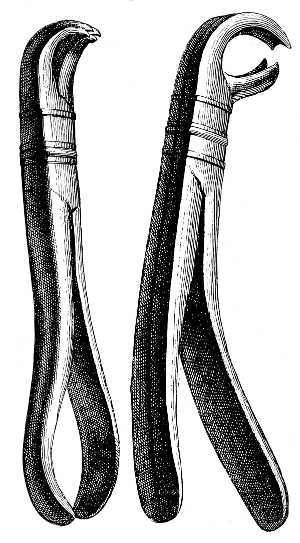
Dental forceps (Fauchard).
Fauchard occupies himself in three different chapters (X, XI, XII) at great length with the extraction of teeth. He describes a pelican of his own invention, and speaks of the advantages it presents over other pelicans previously in use. Notwithstanding this, it cannot be said that the instruments used by Fauchard for extracting teeth and roots show a sensible improvement on those in use before his time.
Fig. 88
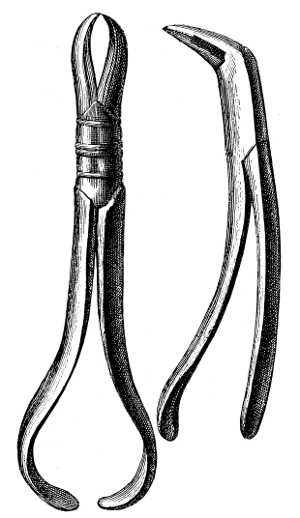
Straight forceps and crane’s bill or crow’s bill forceps (Fauchard).
Among the most usual operations, the author enumerates transplantation and especially replantation of the teeth.458 Whenever, says Fauchard, a wrong tooth is extracted by accident, it ought to be immediately replanted, and the same ought to be done when violent pain renders it necessary to extract a tooth that is not much decayed, as the patient is thus relieved without losing the tooth.459 Fauchard adds that this operation succeeds excellently in the case of incisors and canines, and very often, too, with small molars.
Fig. 89
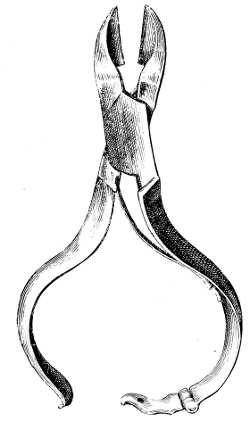
Cutting forceps (Fauchard).
Fig. 90
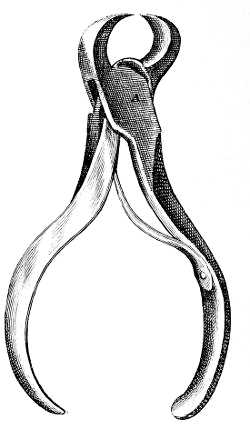
Cutting forceps (Fauchard).
After having spoken of transplantation, he says:460 “There is another mode of replacing human or natural teeth which I have never yet seen used except by a provincial dentist whose name I ignore.” This special method consists in the transplantation of a tooth—it matters little whether recently extracted or not—after having made three or four notches in its root of about a line in depth. The author goes on to describe all the particularities of the operation, and then adds: “After twenty-five or thirty days one removes the thread, and the tooth is found to be firm in the alveolus, owing to the fact that this latter, exercising a pressure on the root on every side, becomes perfectly moulded upon it. In this manner, the tooth will remain mortised, and may be preserved for a considerable time.”
Fig. 91
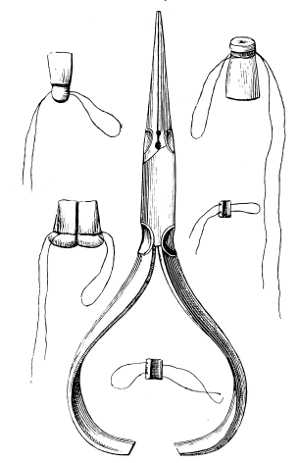
Pincers used by Fauchard in the operation of tying teeth with gold wire. The three larger figures represent natural or artificial teeth in which holes and horizontal grooves have been made in order to fix them with gold threads. The two smaller represent pieces of hippopotamus ivory with a vertical groove on each side, destined to fill large interdental spaces and to steady loose teeth by means of gold ligatures.
This method, invented by an unknown provincial dentist, has been recently applied by Znamenski, of Moscow, for the implantation of artificial teeth made of porcelain, of caoutchouc, or gutta-percha.
One of Fauchard’s greatest merits consists in the improvements introduced by him in dental prosthesis and in his having, besides, been the first to treat of this most important part of dental art in a clear and particularized manner.
The materials then most used in dental prosthesis were human teeth, hippopotamus tusks, ivory of the best quality, and ox bone.461
The author minutely describes the methods to be followed to repair dental losses in every possible case and of whatever extent.
According to the circumstances, Fauchard used, for maintaining artificial teeth in their place, linen, silk, or gold thread, passed through holes made in them, and tied to the natural teeth.
When a set of two, three, four, or more teeth was to be applied, Fauchard first prepared them separately and then united them together by means of one or two threads of gold or silver in such a manner that the set formed at last a single piece, which was then fixed to the natural teeth. When the piece consisted of several teeth it was reinforced with a small plate of gold or silver fixed to its inside by means of small tacks of the same metal riveted on one side to the plate, on the other to the front part of each tooth.
The author remarks that a similar prosthetic piece lasted longer than those previously described, but required proportionately much more work and much greater expense. He adds that, by employing this plate, one can even dispense with threading and fixing the teeth together with gold or silver wire; but that it was then necessary to make a horizontal groove at the back of each tooth corresponding to the width and thickness of the plate, which could be fitted into the serial groove and fixed to each single tooth by means of two small rivets.462
At other times the prosthesis was carried out in a single piece of material (ivory, hippopotamus tusk, etc.) that was carved in such a manner as to substitute exactly the teeth wanting, it being fixed to the natural teeth in the usual manner.
Fauchard sometimes left the dental roots in their place (if they were in good condition), applying upon them artificial crowns, which he either bound to the neighboring teeth or fixed with screws to the respective roots.
“When one wishes to apply an artificial crown to the root of a natural tooth, one files away the part of the root that emerges above the gum, and even more if possible. One then removes, with proper instruments, all that is decayed in the root itself; after which one stops the root canal with lead and fits the base of the artificial tooth to the root in such a manner that they correspond perfectly to each other. One drills one or two holes in the tooth through which to pass the ends of a thread, which serves to fasten it to the natural teeth on each side of it, as described above.
“If the root canal has been very considerably enlarged by the carious process, so as to have rendered it necessary to stop it, the root being, nevertheless, still quite steady, one bores a small hole in the lead as deep and as straight as possible, without, however, penetrating farther down than the root canal. The artificial crown is then united to the root by a pivot in the manner I shall now describe.”463
The method of applying pivot teeth is described with great accuracy. In it the author considers all the different circumstances that may present themselves, and says, among other things, that if the root is still sensitive to pain, one should apply the actual cautery inside the canal, before fitting the artificial crown to the root. For fixing the pivot inside the artificial crown (which was generally the crown of a human tooth), Fauchard used a special cement made with gum lac, Venetian turpentine, and powdered white coral.464
In the case of there not being any whole teeth to which the prosthetic piece would be fixed, but only roots, Fauchard made two holes in it in perfect correspondence with the canals of two roots, and fixed the prosthetic piece to these by means of two pyramidal screws.465