Part 1 — CHAPTER VII. THE ROMANS. (continued 2)
Reading edition
Celius Aurelianus. In the book De morbis acutis et chronicis, written by Celius Aurelianus (who lived, according to some, in the third century, according to others, in the fourth or at the beginning of the fifth), a very interesting chapter on odontalgia is found. He shows himself to be, for the most part, a follower of Celsus. During the violence of the pain he advises abstinence from food and rest in bed with the head somewhat raised. As remedies he recommends several mouth washes (infusions or decoctions made with wine or vinegar and with various drugs: ironwort, acacia, mercury herb, mandrake, cinquefoil, poppy, verbascum, hyoscyamus, figs, stag’s horns, etc.), and besides, the application of wool soaked in hot oil on the cheek of the affected side, or the application of little warm bags, and also that some hot oil, or the juice of fenugreek,184 should be kept in the mouth, or milk with honey. When the pain is excessively violent, he has recourse to bloodletting, and after two days’ fasting, he begins to feed the patient with liquid and warm food. If the bowels are closed he prescribes the use of clysters, and when, in spite of all, the pain persists, he has recourse to scarified cuppings on the cheek, in correspondence with the pain. In certain cases he also proceeds to scarification of the gums, or else he detaches them all around from the tooth, by means of a special instrument called a pericharacter. It would often turn out useful to apply to an aching tooth a grain of incense warmed by the fire and wrapped in a thin piece of cloth, or to press between the teeth, where the pain is situated, several pieces of cloth, in succession, in which some powder of incense has been wrapped, and which are dipped into hot oil before being used. The author, moreover, commends external fomentations made by means of sponges soaked with emollient decoctions and afterward squeezed; and also the application of moderately hot cataplasms.
Fig. 33
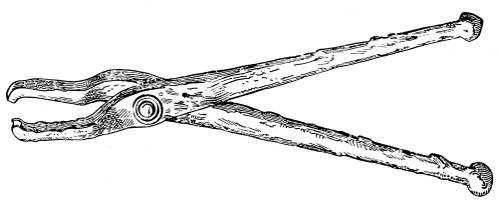
Roman dental forceps found (1894) at Hamburg, Germany, in the ancient Roman castle Saalburg. (Geist-Jacobi.)
When the odontalgia has already become inveterate and recurs in paroxysms, separated by intervals of calm, Celius Aurelianus counsels, among other things, that the general health be strengthened by temperate living, exercise, rubbing of the whole body (an ancient practice, now revived under the name of massage). He recommends, besides, special rubbing of the cheeks (to be carried out with a rough cloth), and also of the gums and teeth, and indicates a great number of medicaments, some of which are to be used during the paroxysms and others during the periods of calm. In regard to the use of narcotics, he very shrewdly observes that such remedies take away sensibility but not pain. Some doctors of those days, for the cure of odontalgia, had recourse to sternutatories, or to the dropping of special medicaments into the nose or into the ear, but Celius Aurelianus seems to have put but little faith in such means of cure. He, moreover, solemnly reproaches those who, to cure odontalgia, are too hasty in having recourse to the extraction of the aching tooth. To remove a part, says he, is not to cure it; and if every tooth that aches has to be extracted, it would be necessary to draw them all out when they all ache. Therefore, before having recourse to extraction, every other means of cure should first be tried. If the removal of the tooth becomes indispensable, he advises that it should never be performed during the violence of the pain, for from this serious consequences might arise (a prejudice which has not yet entirely vanished, and which is met with, sometimes, not only among common people, but even among physicians); and a still greater danger would be the extraction of teeth neither carious nor loose, seeing that, by consensus, the muscles, the eyes, and the brain might suffer. The author, on this point, quotes Herophilus and Heraclides of Tarentum, who related some cases in which the extraction of a tooth was followed by death. He alludes, moreover, to a passage of Erasistratus, regarding the “odontagogon of lead” (plumbeum odontagogum) which was exposed in the temple of Apollo at Delphi; as much as to show that it was not lawful to extract teeth other than those which were so loose that an instrument of lead was sufficiently strong to extract them.
When the looseness of the teeth seems to depend upon the flaccidity of the gums, Celius Aurelianus recommends astringent mouth washes: decoctions of rind of pomegranate, of gall-nuts, of acacia, of quince, of myrtle berries, etc.; and besides these, lentiscine oil and asses’ milk, which latter was also believed to possess astringent virtues. Against hemorrhages of the gums, he advises the use of very fine coral powder, or of alum with honey.
Gnaeus Marcellus Empiricus, of Burdigala (Bordeaux), who lived at the end of the fourth century and at the beginning of the fifth, wrote a book, De medicamenti, which shows, more than anything else, the decadence of the medical science in those days. Regarding the diseases of the teeth and their cure, Marcellus does not tell us anything new. He freely copies Scribonius Largus and other authors, not adding anything save a few methods of cure, which are exceedingly strange and superstitious. To get rid of toothache, it is sufficient that the patient, when the moon is waning, and in the days of Mars (Tuesday) or of Jupiter (Thursday), repeat seven times the words argidam, margidam, sturgidam. It is a great pity that a curative method so simple and easy be efficacious in two days of the week alone, and even then on condition that the moon be waning.
The following method is also a very good one: Whilst in the open country, one must take a frog by the head, open its mouth and spit into it, then having begged the animal to take the toothache with it, must replace it on the ground and let it free. To remove loose teeth easily, it is necessary to keep in reserve some juice of black ivy mixed with a little green oil; in case of necessity, the nose of the patient must be anointed with it, and after having drawn a deep inspiration, he must put a little stone between his teeth, and stay with his mouth open, inclined a little forward, so as to let all the morbid humor flow out, which sometimes flows very abundantly and even may reach to three herminæ.185 Having afterward rubbed the nose with pure oil, and washed the mouth with wine, the teeth will be free from every pain and may be very easily pulled out. If the root186 of a tooth be rubbed with dried African sponge, the tooth will fall out within three days; naturally, says the author, care must be taken not to touch, whilst doing this, any healthy tooth. He who desires never to be subject to pain in the teeth, may obtain this end by the following method: When at the beginning of spring he sees the first swallow, he must go in silence to some running water, take some of it in his mouth, rub his teeth with the middle fingers of both his hands, and say: “Hirundo, tibi dico, quomodo hoc in rostro iterum non erit, sic mihi dentes non doleant toto anno.”187
The same must be done each following year, so as to continue to enjoy the effects of such a cure!
Adamantius, an Alexandrine philosopher and physician, who probably lived in the fourth century, paid much attention to the diseases of the teeth, as may be argued from two chapters of the Tetrabiblos of Ætius. One of these chapters is entitled, according to the Latin translation of Giano Cornario: “Cura dentium a calido morbo doloroso affectorum, ex Adamantio, sophista.”188 This writer clearly belonged to the pneumatic school, founded as early as 69 A.D. by Athenæus of Cilicia. According to the pneumatics (so called, because they admitted the existence in the animal organism of an aëriform principle, pneuma, to which they attributed great importance), heat and dryness gave rise to acute maladies; the phlegmatic affections generally arose from humidity, and melancholy was brought on by cold and dryness, as every object dries up and becomes cold on the approach of death. The author says that the cure must vary according as the disease affects in a greater degree the gums or the teeth themselves with or without participation of the dental nerves and neighboring parts. He makes, in regard to this, many subtle distinctions; but the remedies which he counsels do not offer to us any special interest, being almost identical with those that had been recommended by Galen and by other doctors prior to Adamantius. The latter also gives much importance to dietetic therapy; he prescribes that such patients should nourish themselves with pottages of barley, or of spelt, with eggs, lettuce, pumpkins, and other cooling food, abstaining, however, from wine.189
The author enumerates among the causes of such dental affections the dryness of the air, the autumnal season, the dry constitution of the individual, a troubled life, and scanty nourishment. The use of sour and piquant substances is not favorable to these patients, so much so that the mulberry preserve produces, not unfrequently, violent dental pains in them. Adamantius, therefore, advises, in such cases, not to use strongly astringent mouth washes, but rather lenitive, moistening, and emollient substances; simple lukewarm water, decoction of bran, licorice juice, starch with boiled must of wine diluted with warm water, milk, especially asses’ milk, decoction of mallows and the like.190
The work of Adamantius from which Ætius has taken the above-mentioned chapters is lost to us. Of his writings there only remain to us the treatise on the winds and the one on physiognomics. In this latter book the author attributes great importance to the canine teeth as physiognomonic elements, and from their shape and size he makes deductions in regard to the character of the individual.
Oribasius (316 to 403), the most celebrated of all the compilers who appeared during that long period of decadence, wrote, by order of the Emperor Julian the Apostate, whose physician and friend he was, a whole medical encyclopedia and later on a summary (synopsis) of this same work of his. In the books of Oribasius are found many things about dentition and diseases of the teeth, but they are all taken, substantially, from preceding authors, and therefore it is not worth while repeating them.
Ætius of Amida, a celebrated Greek writer on medicine, lived at the end of the fifth century, and at the beginning of the sixth, and has also left us a kind of medical encyclopedia, which, being divided into four sections, each composed of four books, was called Tetrabiblos. He teaches that the mucous membrane of the gums, tongue, and mouth is provided with nerves from a portion of the third pair of cerebral nerves, and that the teeth, too, by a small hole existing at the end of every root, receive tiny ramifications of sensitive nerves, having the same origin. The nutrition of the teeth is understood by Ætius in the following way: The nourishment which reaches the dental nerves is not entirely assimilated by them; these only appropriate the liquid or soft part and reject the drier part. This accumulates in the alveoli, becomes by degrees more tenacious and denser, finally being transformed into osseous substance and forming the nutriment of the teeth; these, therefore, tend to grow continually, although the waste arising from the mechanical action of mastication prevents them from undergoing any real or visible growth. On the other hand, in the old, from the weakening of the nutritive functions, the teeth become thin and loose, and finally fall out.191
Ætius advises that during dentition hard objects to chew should not be given to children, seeing that the gums being hardened by these and becoming almost callous would render the cutting of the teeth very difficult.192
For curing parulides, he recommends emollients at the beginning of the disease, and later on astringents. But if the inflammation of the gums does not resolve and passes into suppuration, he prefers to perform the excision of the parulis, instead of making a simple incision, which might very easily cause the abscess to change into a fistula.193
The epulis, according to Ætius, is a fleshy excrescence of the gums, brought on by inflammation. To cure it, he uses, during the inflammatory period, emollients, and then, when the inflammation has subsided, astringents and weak caustics. Lastly, if the epulis resist these remedies, he takes hold of it with a vulsella and proceeds to remove it with a small scalpel.194
When the incision of a fistula of the gums and the use of appropriate remedies are not sufficient for curing it, Ætius advises the extraction of the diseased tooth, from which the fistula has its origin.195
Apart from what has been mentioned, Ætius does not tell us, in regard to dental diseases, anything worthy of note, and in many places he only repeats Galen’s observations.
Paul of Ægina (seventh century) establishes a very clear distinction between epulis and parulis. The epulis is a fleshy excrescence of the gums in the neighborhood of a tooth; the parulis is an abscess of the gums. To cure the former affection it is necessary, says the author, to seize and stretch the tumor with a vulsella or with a hook and to perform its excision. As to the parulis, although not unfrequently it is sufficient, for curing it, to give an exit to the pus by means of a slight incision, the author, however, usually prefers the method of cure recommended by Ætius, viz., excision. After such operations he orders the patient to rinse his mouth with wine and on the morrow with hydromel.196 From the third day onward he sprinkles the wound with a cicatrizing powder, until a complete cure is obtained. But if the wound, instead of healing, be transformed into a putrid ulcer resisting all the ordinary means of cure, it is necessary to cauterize the part affected with an oval-shaped cautery.197
In extracting a tooth, the operation is begun by detaching the gum all around it as far as the alveolar border; then the tooth is seized with the forceps, shaken loose, and drawn out. Paul of Ægina, like Celsus, recommends that before extracting a tooth deeply attacked by caries, the cavity be filled up with lint, in order to avoid the crumbling of the tooth under the pressure of the instrument. On the other hand, he too is convinced that a diseased tooth can be made to fall out without pain, by the use of suitable remedies.
When supernumerary teeth cause an irregularity of the dental arches, this must be corrected, says the author, either by resection of such teeth, if they are very firm, or by their extraction.
If a tooth projects above the level of the others, the protruding part must be removed with the file. This instrument must also be employed to remove the sharp edges of broken teeth.
Tartar incrustations must be removed either with scrapers or by means of a small file.198
During the period of dentition one must not give children any food which requires mastication, and to soften the gums they must be anointed with hen’s fat or with hare’s brain.199
To preserve the teeth and to keep them healthy, Paul of Ægina recommends all tainted food to be avoided, and also all possibility of indigestion and frequent vomitings; the use of very hard or glutinous food or of such as may easily leave a residuum between the teeth, for example, dried figs, and likewise very cold food and such as set the teeth on edge. He also advises that hard things should never be broken with the teeth and that the latter be carefully cleaned, especially after the last meal of the day.200
Paul of Ægina also belongs to the class of compilers; but in utilizing the writings of the great physicians who had preceded him, he gives evidence of exquisite good sense, and not infrequently subjects the assertions of his predecessors to an intelligent and enlightened criticism. Besides, he inserts here and there observations and experiences of his own that are not without interest. He has always been, and rightly so, considered one of the greatest physicians of ancient times, the great reputation which he justly held among the Arabs contributing not a little to his renown.
This author is the last of the Byzantine period, and with him, therefore, we must close the earlier part of the history of dentistry. If, before passing to the middle period, we cast a glance over the ground already traversed, it is easy to perceive that dental art, in ancient times, reached its highest degree of development at the time when the Roman civilization was in its greatest splendor, when, in the capital of the world, wealth, luxury, and the refinements of social life marvellously increased its needs, and by this also gave an impulse to the evolution of all human activity. But ancient civilization, after having reached its culminating point, soon fell into decadence, and this necessarily would result in a hindrance to the development of dental art. From the days of Archigenes right up to those of Paul of Ægina, dentistry did not make the least progress; indeed, as far as prosthetic dentistry is concerned, there was probably a retrograde movement, it being very likely that when Italy was subject to the dominion of the barbarians and when Christianity—which but recently had asserted itself—was strongly imposing on the human mind a deep contempt for all that regarded the welfare and beauty of the human body, no one could, any longer, think of artificially repairing the losses sustained by the dental system through disease or injury.