Part 3 — CHAPTER XII. THE EIGHTEENTH CENTURY. (continued 2)
Reading edition
This method suggests in a certain way the idea of bridge work.
In Chapters XVII, XVIII, XXIV, and XXV, Fauchard describes various methods for the application of entire sets of false teeth, both upper and lower, as well as double.
The author says that if the lower jaw is entirely toothless, a set of teeth can be adapted thereto without the need of any special contrivance; however, it is necessary that the prosthetic piece should fit perfectly, so that the configuration of the maxillary arch and the irregularities of the gum, finding themselves in complete correspondence with the piece itself, may keep it steady in its place. The support offered by the tongue interiorly, by the cheeks and the under lip exteriorly, contributes to keep the artificial set steady; one can thus masticate as easily with it as with one’s own teeth, especially if the teeth of the upper jaw be still existing and the individual be already sufficiently used to the wearing of it.466
With regard to the application of an entire set of upper teeth, one learns from Fauchard that although some attempt had been made in this direction before this time, the results had been very unsatisfactory. He relates that: “In 1737 a lady of high rank, of about the age of sixty, who had not lost any of her lower teeth, but was deprived entirely of the upper ones, applied to M. Caperon, dentist to the King, who was most able in his profession, in the hope that he might be able to furnish her mouth with an upper set. But he said that, no tooth whatever being left in existence, every possible point of attachment was wanting, and it would therefore be as difficult to do this as it would be to build in the air.”467 He, however, directed the lady to Fauchard, who asked for a few days to think the matter over, and succeeded in devising a means of applying an upper set of teeth, which, in fact, entirely satisfied the wishes and wants of the client. “As this lady,” says the author, “simply wished to have the front of her mouth decorated, and to be able to pronounce more perfectly, I gave less extension to the set. The lady eats easily with it and could not now do without it. For greater convenience she has two similar sets, which she uses alternately.”468
Fig. 92
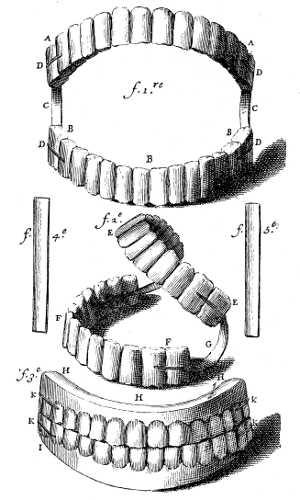
Complete dentures (Fauchard). f. 3 represents an enamelled denture with artificial gums; f. 4 and f. 5, steel springs.
Fig. 93
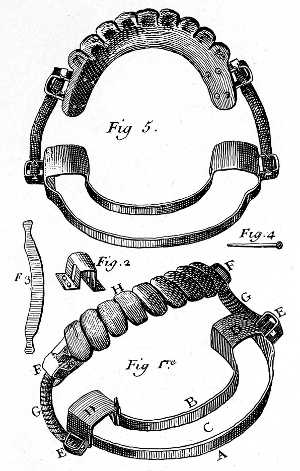
An upper denture supported by springs fixed to a gold appliance which embraces the natural teeth of the lower jaw (Fauchard).
The author describes with great minuteness the manner in which the prosthetic apparatus in question was constructed and supported, and then speaks of the successive improvements introduced by him into this most important part of prosthetic dentistry, particularly in what regards the springs destined for the support of the upper set of teeth.
Fig. 94
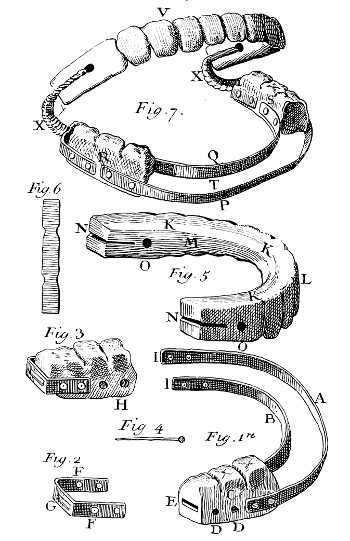
A spring denture for a case in which the lower front teeth still exist. Figs. 1 to 6, various parts of the apparatus (Fauchard).
Fauchard also relates having made an attempt to apply an upper set of teeth without the aid of springs, which proved successful in three cases. “One can,” says he, “adopt an entire set of teeth to the upper jaw, of much greater simplicity than those described, and which is maintained in its place by the sole support of the cheeks and the lower teeth. It must be very light indeed and serves almost solely to improve the appearance and the pronunciation; but when the individual gets used to it, he can also masticate with it. A set of teeth of this kind ought to adhere well to the gums and to be constructed in such a manner that the cheeks may afford it sufficient pressure and support together with the aid of the lower teeth; these latter sometimes bring it back into its place, without anyone perceiving the movement except the wearer himself. Not long since I had to renovate a set of teeth of this kind made by me more than twenty-four years ago, and worn by the owner to the greatest advantage. I have since made two others which have proved most useful to the persons wearing them. It is true that there are few mouths adapted for wearing these sets, so much so that, excepting the three referred to, I have never made any others. To be able to construct similar sets successfully, the dentist must be possessed of skill and ingenuity. Apart from this, they are the most suitable for persons who cannot spend much, as they cost less to make.”469
Fauchard did not merely content himself with having perfected dental prosthesis in the manner alluded to; he also succeeded in giving a quite natural appearance to artificial teeth. To reach this end he placed the art of the enameller under contribution to the dental art. Thus he had artificial pieces covered over with enamel, imparting to them the hue that seemed to him best adapted, and also imitating admirably the natural color of the gums, so as to render the illusion perfect. The pieces to be enamelled were worked by special rules, which are minutely given in Chapter XIX of the second volume of his book.
Fauchard also brought the palatine prosthesis to a high degree of perfection. He describes five different obturators of the palate, which of themselves alone would be sufficient to testify to the highly inventive genius of the author, although they are defective in being somewhat too complicated. Some of these fixtures are a combination of a dental set and palatine obturator.
We ought now to mention, in the order of chronology, some authors of lesser importance.
Vasse and De Diest wrote about the danger of fatal hemorrhage following on dental operations.470 They report a few cases of this kind, giving the blame of these accidents, however, to the carelessness of the operator.
Lavini published in Florence, in the year 1740, a very good treatise on dentistry (Trattato sopra la qualità de’ denti, col modo di cavarli, mantenerli e fortificarli), which, however, marks no advance on the work of Fauchard.
M. Bunon (died 1749), a French dentist, wrote four admirable works on dentistry, which were published from 1741 to 1744. We will here briefly allude to the most salient ideas therein contained.
This author combated strenuously some prejudices then generally diffused; such as that of its not being advisable to extract teeth during pregnancy, and that of the extraction of an upper canine (eye tooth) being attended with great danger. He demonstrated the absurdity of the latter idea by putting in evidence the anatomical fact that the upper canines are innervated by the infra-orbital nerve, which does not stand in any relation whatever to the organ of sight.471
Among the other remedies recommended by him against the disorders and perils of first dentition, there is one most curious, not to say ridiculous: he advises rubbing the nape of the neck, the shoulders, the back, and the lower limbs of the child, but in doing this the friction should proceed from above downward, in order to offer resistance to the flow of humors toward the upper parts of the body. The utility and efficacy of this kind of massage in favoring the process of dentition seems, of a truth, very open to question.
Bunon speaks at length of erosion of the teeth, and declares himself to be the discoverer of this disease, which destroys the enamel of the teeth already before their eruption. The first molars, the canines, and the incisors are much more frequently damaged and affected by it than the other teeth. According to Bunon, it is generally due to measles, smallpox, malignant fevers, or scurvy, when children are subject to these maladies during dentition, and more especially during the first. He is of the opinion that erosion not only generates caries, but may be considered as being the origin of the greater part of dental affections.
This author distinguishes three principal kinds of dental tartar, the black, the pale yellow, and the brownish yellow; he admits, however, two other kinds that are less frequent, that is, the red tartar and the green.
He relates having observed in the jaw of a child, who died at the age of three years and a half, a splintering of the alveolar parietes in all directions, and attributes this phenomena to disproportion between the size of the teeth and the alveoli. On the basis of his anatomical observations, he says that caries only appears on teeth that have already come out of the gums, whilst erosion is produced in teeth not yet erupted, indeed, at times, several years previous to their eruption.
We will also mention, by way of a curiosity, Bunon’s proposal to substitute the word legs for that of dental roots.472
Fr. A. Gerauldy, a French dentist, wrote (1737) an excellent treatise on dental maladies and on the mode of preserving the teeth. His book, which was also translated into German,473 contributed to the diffusion of knowledge relative to dental prophylaxis and therapeutics, but apart from this brought no increment to the progress of practical dentistry. Some of the ideas of the author, however, merit consideration. He clearly expresses the opinion that the shedding of the milk teeth is brought about by the pressure exercised upon them by the germs of the permanent teeth in course of development. The loss of the teeth in young subjects, or in those who have not yet reached forty years of age, is explained by the author in an altogether special manner. He relates that Louis XIV, at the age of thirty-five, had lost all his upper teeth, and the considerations he makes on the subject bring him to the conclusion that the precocious loss of the upper teeth depends in many cases on a paralysis of the nervous fibers that go to them, which paralysis is probably caused by a dissolute and intemperate life, having as its consequence the weakening of the organism and, above all, of the nervous system. Without doubt there is some truth in Gerauldy’s ideas, it being well known that the falling of the teeth (as well as of the nails and the hair) often depends on nutritive disorders deriving from nervous disturbances. We have the clear proof of this in certain cases of tabes dorsalis accompanied by the spontaneous falling of the teeth and nails.
Joseph Hurlock, an Englishman, published a treatise in 1742,474 in which he warmly recommends lancing the gums in cases of difficult dentition; he declares this to be entirely without danger, and affirms that it constitutes the sole means of salvation for not a few infants who without it would die of convulsions.
Mouton, in 1746, that is, in the same year in which the second edition of Fauchard’s work was issued, gave to the light a monograph, the first extant, on mechanical dentistry.475 The methods of this author for the most part do not differ from those of Fauchard, nevertheless one finds several important innovations in his work. To prevent the further deterioration of teeth already much destroyed, and to preserve them some time longer, Mouton had recourse to the application of “calottes d’or,” that is, gold crowns. He used this for the front teeth as well as for the molars, but in the former case he had them enamelled to give them the same appearance as natural teeth.
Mouton also invented a new method of applying artificial teeth. Up to then the ordinary method had been that of fixing them to the natural teeth by means of threads passed through holes made in the artificial teeth expressly for that purpose. Mouton is the first to speak of artificial teeth fixed to the natural teeth adjoining them by means of springs or clasps.
This author relates having carried out several transplantations with perfect success, a thing that contributed greatly to his renown not only in France, but also in England. He distinguished himself, besides, by the correction of dental irregularities. Lastly, it is to be noted that this author frequently had recourse, as a remedy against toothache, to the stretching of the dental nerve by means of moving and partially raising the tooth (subluxation).
A. Westphal. In proof of the great utility of lancing the gums in cases of difficult dentition, A. Westphal reports a case in which the difficult eruption of an upper canine tooth provoked considerable inflammation and protrusion of the eye on the same side as the tooth; these symptoms promptly disappeared, however, as soon as the gum was lanced down to the tooth itself.476
J. Bertin also declares himself in favor of this operation; he recommends never to neglect it in cases of difficult dentition, and to make the said incisions deep and wide enough.477
L. H. Runge, a surgeon of Bremen, published, in 1750, a monograph on the diseases of the frontal and maxillary sinuses. He says that in cases of inflammation of Highmore’s antrum, the pus may make its way, corroding the bone, as far as the alveoli, or, sometimes, as far as the orbital cavity; and, vice versa, alveolar suppuration can give rise, by diffusion, to abscess of the maxillary sinus. In this latter, tumors of various kinds may form (polypi, cysts, sarcomas, cancers, exostosis), the existence of which is ignored at first, and only becomes manifest tardily. Runge’s father, who was also a surgeon, had occasion to observe, and to treat an important case of disease of the maxillary sinus, with considerable dilatation of the same, not only on the side of the cheek, but also on the side of the palate and of the nasal fossæ. With a strong scalpel he perforated the outer wall of the antrum above the molars (keeping the cheek detached) and enlarged the aperture by making the instrument turn around on its own axis, thus giving exit to a considerable quantity of non-purulent liquid. Detersive and aromatic injections were used for some time. The canine tooth, situated obliquely, having been extracted, its alveolus was found to communicate with the antrum. From this moment, the injections being continued, a rapid improvement was obtained and the patient was so completely cured that no deformity of the face remained.
Runge relates a case in which, having extracted a canine tooth, he found a cyst adhering to its root. From this he is induced to believe that in the case related above the disorder was also to be attributed to a large cyst having its origin in the root of the canine.
According to him, the ozena always stands in relation to a suppurative affection of the maxillary sinus, and for its treatment one must, therefore, have recourse to Drake’s operations.478
Georg Heurmann, a surgeon in Copenhagen, recommends making use, after the Cowper-Drake operation, of a small cannula in order to facilitate the exit of the pathological material contained in the sinus, and also to render it easier to introduce into it medicated or detersive substances.479
Lécluse. One of the most celebrated French dentists of the eighteenth century is Lécluse. Dental literature was enriched by him with several works, partly written in popular style, partly addressed to dental specialists. In 1750 he published his Traité utile au public, où l’on enseigne la méthode de remédier aux douleurs et aux accidents qui précèdent et qui accompagnent la sortie des premières dents, de procurer un arrangement aux secondes, enfin de les entretenir et de les conserver pendant le cours de la vie. The work seems to have been very favorably received, as its first edition, printed in Nancy, was followed by a second, printed in Paris, only four years later. In 1755 he published another book: Eclaircissements essentiels pour parvenir à préserver les dents de la carie et le conserver jusqu’à l’extrème vieillesse. But the most important of his works is the Nouveaux éléments d’odontologie,480 the first edition of which was published in 1754, and followed by a second in 1782.
We do not enter into a minute examination of these works, which, taken altogether, do not contain anything very new. We will only remark that Lécluse treated in a succinct but correct manner the anatomy of the mouth; invented some and perfected other instruments, the most important of which is the elevator that still bears his name, and finally, that he frequently performed the operation of replantation, warmly recommended by him as an excellent means of cure in certain cases of caries. The extracted tooth was stopped and afterward replanted, and, says Lécluse, became fast within eight days, proving as serviceable as a perfectly healthy tooth, and never again causing any pain.
Philip Pfaff, dentist to Frederick the Great, King of Prussia, was the first among the Germans who wrote a real treatise on dentistry. His book481 contains, in 184 succinctly but well-written pages, the anatomical and physiological notions relative to the teeth, as well as all that belongs to dental pathology, therapy, and prosthesis.
Besides a few observations about supernumerary teeth, Pfaff relates several cases in which the incisors, inferior as well as superior, were renewed (twice consecutively), that is, once at the usual epoch, and the second time between the seventh and thirteenth years. He also cites from the anatomical tables of Kulmus the following epitaph in low Latin, that seems to allude to a case of third dentition:
“Decanus in Kirchberg, sine dente canus, ut anus Interum dentescit, ter juvenescit, his requiescit.”
In cases of hemorrhage ensuing on the extraction of teeth, the best hemostatic, according to Pfaff, is essence of turpentine, a remedy which in these cases he had always found efficient. He introduced a little ball of lint bathed in this essence as deeply as possible into the alveolus, applying upon it some blotting paper reduced to pulp or some dry lint that the patient compressed tightly by closing his teeth.
Gingival abscesses as well as fistulæ of the maxillary region almost always owe their origin, says Pfaff, to decayed teeth, and can, therefore, in general, not be cured except by the extraction of these teeth.
The prosthetic methods described by this author are, for the most part, identical with those of Fauchard and the other French dentists already mentioned. As to the materials used for prosthesis at different periods, Pfaff mentions, besides ivory, bone, hippopotamus tusk, teeth of sea cow, and human teeth, also teeth made of silver, of mother of pearl, and even of copper enamelled.
The chief merit one must concede to Philip Pfaff is that of having been the first to make use of plaster models. It is, therefore, to two Germans—Pfaff and Purmann, the latter who, as we have already seen, used wax models—that one of the greatest progressive movements in dental prosthesis is indebted, that is, the method of taking casts and making models, of which method one finds no trace whatever in the authors of antiquity, and which, it would appear, was not known even to Fauchard himself. The wax casts of an entire jaw were taken by Pfaff in two pieces, one of the right half of the jaw, and the other of the left; which were then reunited, and one thus avoided spoiling the cast in removing it from the mouth.
Another great merit of Philip Pfaff is that of having first carried out the capping of an exposed dental pulp, previous to stopping a tooth.
Notwithstanding this, Pfaff is not the first who, as Geist-Jacobi is inclined to believe,482 had dared to apply a filling over an exposed dental pulp without first cauterizing it. As we have already seen, Fauchard did not hesitate in the least to fill a tooth when the dental pulp had become exposed in scraping the carious cavity. But the French dentist carried out, with much delicacy, a simple filling, whilst Pfaff first capped the dental nerve.
Jacob Christian Schaffer. In 1757 the evangelical pastor, J. Ch. Schaffer (we do not know if he was at the same time a dentist, or merely an amateur in odontology), wrote a little book483 to disprove the existence of worms in decayed teeth, and to show the fallacy of believing that the supposed worms may be made to drop out by means of fumigations of henbane seeds. His book appeared, as a matter of fact, rather behind-hand, for in it Schaffer repeats in substance what Houllier had already said two centuries earlier, and after him various other authors, including Fauchard. At any rate, to coöperate in the complete destruction of error and in the diffusion of truth is always laudable. We feel, however, bound to add that in the very same year in which Schaffer’s pamphlet was published, Dufour, a Frenchman, described a worm that had been taken out of a decayed tooth, and called attention to the fact that it was altogether different from the “dental worms” described by Andry.484
Bourdet. An excellent book on dentistry485 appeared in France in the year 1757, the work of Bourdet, a celebrated dentist and elegant writer, in whom the gifts of literary and scientific culture were coupled with a vast experience and a profound spirit of observation. His merits procured him the honor of being appointed dentist to the King.
This author condemns as harmful the use of hard substances (such as bone rings, etc.) that people are in the habit of putting into children’s hands during the period of the first dentition, in the idea that by pressing these objects between the gums, as children instinctively do, they cut their teeth more easily. As to emollients, he holds them to be completely useless, and prefers to all these remedies the use of lemon juice.
According to Bourdet, the teeth are so apt to decay, partly because of the frequent changes of temperature to which they are exposed, and partly because, differently from the bones, they are not provided with any protective organic covering.
In many cases of caries, Bourdet extracted the tooth, filled it with lead or gold leaf, and replanted it; but if, in extracting, the alveolus had been somewhat injured (a thing very likely to happen with the instruments of the period), he replanted the tooth immediately, to preserve the alveolus from the damaging action of the air, and carried out the stopping at a later time.
Even in certain cases of violent toothache not depending on caries, Bourdet luxated the tooth and replaced it in position directly. But as some dentists had accused him of having passed off as new an operation already made known by Mouton since the year 1746, Bourdet defended himself by saying that whilst Mouton only shook the tooth, raising it a little, simply to distend the nerve, he, instead, effected a complete luxation, in order altogether to interrupt the continuity of the nerve. Anyhow, this operation was not new, as it had already been recommended and practised by Peter Foreest, in the sixteenth century, and in an even more remote epoch by the Arabian surgeon Abulcasis.
Sometimes, when the permanent canine comes forth, it has not room enough, and therefore grows outward. In this case Bourdet extracts the first premolar; the canine then advances gradually of itself toward the space left by the extracted tooth, until it occupies its place exactly. He also counsels the extraction of the first premolar on the opposite side of the jaw, in order to preserve the perfect symmetry of the dental arch on both sides. When the arch formed by the jaws is too large and of an ugly appearance, Bourdet advises extracting the first upper and lower premolars, so that the maxillary arches may acquire a more regular form. In cases in which the defect of form exists only in the lower jaw, that is, in children who have protruding chins, Bourdet corrects this deformity by extracting the first lower molars shortly after their eruption, that is, toward seven years of age. In this manner, says the author, the lower jaw grows smaller and the deformity disappears. The inventor of this method, as Bourdet himself tells us, was the dentist Capuron.
Bourdet made prosthetic pieces, whose base, representing the gums and the alveoli, was made entirely of gold and covered over with flesh-colored enamel on the outside, so as to simulate the natural appearance of the gums; the teeth were adjusted into the artificial alveoli and fixed with small pins. At other times he made use of a single piece of hippopotamus tusk, in which he carved not only the base, but also the three back teeth on each side, whilst the ten front teeth were human teeth fixed to the base with rivets.
One of Bourdet’s principal merits is that of having brought artificial plates to perfection by fixing them not, as heretofore, to the opening of the palate or inside the nose, but by means of lateral clasps fitted to the teeth.
In a special pamphlet, published in 1764,486 Bourdet treats of the diseases of Highmore’s antrum. To facilitate the exit of pathological humors from the sinus, after the Cowper operation, he introduced a small cannula, forked at one end, into the antrum and fixed the two branches of the fork to the neighboring teeth by tying.
In some diseases of the maxillary sinus (polypus, sarcoma, etc.) Bourdet recommends cauterizing.
Besides his principal work, the pamphlet on the diseases of Highmore’s antrum, and some others of less importance, Bourdet wrote an excellent book on dental hygiene,487 which had the honor of two translations, one German, the other Italian; the latter published in Venice in 1773.
This celebrated author inveighs bitterly against charlatans and quack dentists, and throws light on all their impostures. It appears, however, that in the midst of this despicable class, so justly condemned by him, there existed a courageous though unscientific operator, to whom posterity would have attributed due honor had his name been handed down, for he was the first, in all probability, to try the implanting of teeth in artificial alveoli. This is, at least, what we deduce from a passage in one of Bourdet’s works, in which we read that a charlatan sought to impose on the public the belief that he could make a hole in the jawbone and plant therein an expressly prepared artificial tooth, which in a brief space of time would become perfectly firm and as useful as a natural one. Bourdet adds that an attentive investigation led to the recognition of the said tooth being simply that of a sheep. It would appear, therefore, that the operation had been in reality performed, it matters but little whether with the tooth of a sheep or with one of another kind.
Jourdain was another eminent writer on dental matters, at this period. Rather than a true surgeon-dentist like Fauchard and Bourdet, Jourdain was a general surgeon who had dedicated himself with particular predilection to the study and treatment of oral and maxillary diseases. And precisely for this reason his writings, although of great scientific importance, are far from possessing for dental art, properly so-called, the same value as the works of Fauchard, Bourdet, and other great dentists of the eighteenth century. His works, as Geist-Jacobi justly observes, give us the impression of his having been a theorist rather than a practical dentist.
In 1759 Jourdain described in the Journal de Médecine488 an improved pelican and another instrument to be used for straightening teeth inclined inward. Two years later he published his treatise on the diseases of Highmore’s antrum and on fractures and caries of the maxillary bone.489 After this, appeared his book on the formation of the teeth.490 He therein describes with great accuracy the dental follicle from its first appearing to the moment of birth, following it throughout its evolution. This lengthy book is most interesting, for it is not a mere compilation, but gives the results of personal research and experience. But by far the most important of all the works of this author is his treatise on the diseases and surgical operations of the mouth.491 This book went through several French editions, was translated into German in 1784, and has had, besides, two English editions in America of comparatively recent date, that is, at Baltimore in 1849, and at Philadelphia in 1851; all of which proves the great value of the work; it treats, however, much more of general surgery of the mouth and neighboring regions than of dental art properly so called. The first volume of 626 pages is almost entirely dedicated to the diseases of the maxillary sinus, which, for this author, were ever the object of favorite and particular study. He is not in favor of carrying out irrigation of the antrum through the mouth, even when an alveolar opening has resulted spontaneously through the extraction of a decayed tooth; he prefers instead, whenever this is possible, the reopening of the nasal orifice, by means of sounds and cannulæ adapted for the purpose, that is, varying in thickness and in length, and curved according to the necessities of the case. The natural opening of the antrum being reëstablished, one irrigates the cavity through it by means of a cannula to which a small syringe has been screwed. When the teeth are sound, notwithstanding the diseased condition of the antrum, Jourdain is absolutely contrary to the performing of the Cowper-Drake operation. When, on the contrary, the malady owes its origin to decayed teeth, Jourdain extracts them, but, as already said, carries out the detersive and medicated injections through the natural opening.
The author divides the collections of the maxillary sinus into purulent and lymphatic. The purulent are painful and corrode the bone, the lymphatic are not painful and do not corrode the bone, but distend and soften it, producing external tumefaction which yields to pressure, and, on this being diminished, gave out a characteristic sound. These so-called lymphatic gatherings referred to by Jourdain are none other than mucous cysts of the maxillary sinus. Also the other diseases of Highmore’s antrum (polypi, etc.) are taken by this author into attentive and minute consideration.
The second part of the work is dedicated to the other diseases of the maxillary bones (especially of the inferior one), as well as to those of the lips, cheeks, salivary ducts, gums, frenum linguæ, etc. Dental hemorrhage and difficult dentition are also spoken of in this volume.
The author relates, with regard to the latter subject, that he had observed, in corpses of infants who had succumbed to a difficult dentition, that the crowns of the erupting teeth were covered by the alveolar margins folded upon them. This, according to him, must be the reason why even lancing of the gums proves useless in some cases of difficult dentition; it is therefore necessary, whenever it is possible to recognize the existence of this state of things, to destroy the bony margins that oppose the erupting of the teeth; the author declares that he has frequently done this, with fortunate results.
In 1784 Jourdain published a treatise on artificial dentures.492 He therein specially speaks of a complete denture with four springs, perfectly adapted to the purpose of mastication. The author attributes the merit of its invention to Massez, who had imagined it toward 1772. If we may judge, however, by what Joseph Linderer says,493 this denture appears to have been too complicated, even when compared with those described by Fauchard.
Lamorier and Russel, contemporaries of Jourdain, also studied the diseases of the maxillary sinus, and published in the Mémoires de l’Académie de Chirurgie, vol. iv, several important cases of polypi and other diseases of the antrum. Lamorier is not in favor of the Cowper-Drake operation. He recommends perforating the antrum immediately above the first molars, or rather between it and the malar bone. In this he seems to have been influenced by the considerations that the wall of the cavity here presents the least thickness, and that this is the most dependent part of the sinus. But he did not always deem it necessary to make a perforation here, when a fistulous opening had previously formed in some other place. His method of operating is as follows: The jaws being closed, the angle of the mouth is drawn outward and slightly upward with a curved instrument called by the author a speculum; this done, the gum is incised below the molar apophysis and the bone laid bare, and then pierced with a spear-pointed punch. The opening is afterward enlarged if found necessary.
Several contributions to the knowledge of the diseases of the maxillary sinus and their treatment were made about this time by Beaupréau, Dubertrand, Caumont, Dupont, Chastanet, Doublet, David, and especially by Thomas Bordenave, who published an important work on this subject, collecting a great number of clinical cases of great interest. Speaking of the Cowper-Drake operation, he expresses the opinion that the tooth to be extracted is not the same in all cases, for if some one of the teeth situated below the maxillary sinus should either show signs of decay or be the seat of persistent pain, the choice should fall upon that one. If, however, these teeth are all apparently sound, the one should be chosen that, under percussion, is most sensible to pain. In those cases in which the choice is altogether free, Bordenave prefers the extraction of the first large molar, for the double reason that it is generally situated in correspondence to the central part of the cavity, and that it is separated from the antrum by a very thin osseous lamina. In certain cases, the maxillary sinus is divided, by body lamellæ, into various cavities, and then, as one easily understands, it may be necessary to extract more than one tooth for the evacuation of the pathological contents. When the teeth situated below the antrum have fallen out, or have been extracted some time, and their alveoli are in consequence obliterated, it will be better to have recourse to Lamorier’s method. This method may besides be useful, according to Bordenave, either when all the teeth are sound and it would consequently be a pity to sacrifice any of them, or in special cases (such as large polypi of Highmore’s antrum, extraneous bodies, etc.) in which the Cowper-Drake operation would not afford sufficient space.
L. B. Lentin, a German, in 1756, published a pamphlet494 in which he recommended electricity as a means of cure for toothache. Other writers recommended the use of the magnet, which means of cure had already been advised for various affections by Patacelus. During the latter half of the seventeenth century, Talbot, J. J. Weckes, and P. Borelli related several cures of headache and toothache by the use of the magnet. In the eighteenth century F. W. Klaerich, a medical man in Göttingen, wrote that he had used the magnet advantageously in not less than 130 cases of toothache.495 We find it recommended later by others, Brunner, and particularly J. G. Teske, who, in 1765, wrote a pamphlet entitled New experiments for the curing of toothache by means of magnetic steel.496
He considers the use of the magnet as the most efficacious of all remedies against toothache, and believes its action to be similar to that of electricity.
In the following year, however, the belief in the new means of cure was sensibly shaken by F. E. Glaubrecht, who declared that although the magnet calms or causes the cessation of the pain at first, it returns constantly and with much greater violence.497 The curing efficacy of the magnet in cases of toothache was highly vaunted in France by Condamine.498
Pasch attributes the effects of the magnet to the chill produced in the parts to which it is applied; in proof of this he adduces the fact that if the magnet becomes heated by being kept some time in the hand, it loses its efficacy altogether, whilst on the other side one may obtain the very same beneficial results with a simple steel spatula, just on account of the action of the cold; finally, he adds that the chill produced by the magnet on the affected part explains very well not only the good, but also the bad effects which it produces in many cases, such as increase of the pain, inflammation, tumefaction, and even at times spasmodic contractions.499 Thenceforth the enthusiasm for the magnetic cure diminished gradually, all the more so inasmuch as that shortly after the celebrated English dentist Thomas Berdmore ridiculed it by placing it in the same class as charms, exorcisms, and other foolish and superstitious means of cure.500
Adam Anton Brunner. One of the most distinguished German dentists in the second half of the eighteenth century was Adam Anton Brunner. His two principal works are the Introduction to the science necessary for a dentist,501 and the Treatise on the eruption of the milk teeth.502
This author falls into various errors with regard to deciduous teeth. According to him they are twenty-four in number, and without roots; but these may develop in those milk teeth which in exceptional cases remain in their places after the period in which they generally are shed.
A milk tooth, says Brunner, ought never to be extracted unless there be manifest signs of the presence of the corresponding permanent tooth, or when it is painful and decayed. Badly grown teeth can often be put in order solely by the pressure of the fingers frequently repeated, but when this is not sufficient, one must have recourse to waxed threads or to special contrivances.
In applying a pivot tooth, he screws the pivot to the artificial crown and perforates the root canal only just sufficiently to admit the other extremity, which he drives in by little strokes of a hammer upon the crown, without its being necessary to use cement. We learn from this author that in his time there were turners and other craftsmen who occupied themselves with dental prosthesis.503
Brunner prefers gold for fillings to any other substance whatever.
J. G. Pasch, whose name we have already mentioned, relates the case of a young maidservant becoming suddenly affected with deafness, and who recovered her hearing completely on the eruption of one of her wisdom teeth. From a passage of this author’s we learn that at that time many had recourse to the crushing of the infra-orbital nerve as a cure for certain cases of toothache. He, however, decidedly rejects such a remedy, as it proves for the most part ineffectual and may, besides, produce very serious consequences. This author carried out many experiments as to the effects of acids on the teeth.504
C. A. Gräbner505 recommends not deceiving children by extracting their teeth unexpectedly, but rather to persuade them of the necessity of the operation; for by deceiving them one loses their confidence, and in many cases inspires them with an invincible aversion to the dentist.
This author invented a so-called “calendar of dentition,” for the purpose of showing at a glance the period of eruption of each of the deciduous and permanent teeth, and as well for noting down the time at which the various teeth are changed, so as to avoid every possible error in this respect. This calendar consists of a figure or diagram representing the two dental arches, with transversal lines that separate the different teeth one from the other, the relative indications being also given.
The observations of this most sensible and conscientious dentist with regard to the extraction of teeth are worthy of note: “The haphazard pulling out of a tooth is an easy enough thing; the only requisites for doing this are impudence and the audacity natural to the half-starved charlatan. But to carry out the extraction of a tooth in such a manner that, whatever be the circumstances of the case, no disgrace may accrue to the operator or damage to the patient, requires serious knowledge, ability, and prudence.”
Rueff relates the case of a man, aged forty years, who, having made use of fumigations of henbane seeds to relieve himself of violent toothache, obtained the desired end, but at the same time lost his virile power. He, however, reacquired his force by the care of the author.506
Thomas Berdmore was the dentist of George III of England, and one of the first and most eminent representatives of the dental art in that country. Before him, no one had had the appointment of dentist to the royal family. In the year 1768 he published an excellent work on dentistry,507 that was translated into various languages and went through many editions; the last of these appeared in Baltimore in the year 1844, that is, seventy-six years after the first English edition—a splendid proof of the worth and fame of this work.
Berdmore contributed to the progress of dentistry in England not only by his writings, but also by imparting theoretical and practical instruction to many medical students desirous of practising dental art as a specialty.508 One of these was Robert Wooffendale, who went to America in the year 1766, and was the first dentist whose name is there recorded.
Berdmore considers as the principal advantage of the application of single artificial teeth the support they afford to the neighboring ones. Although in no way an impassioned partisan of dental grafting, like his contemporary, the celebrated surgeon Hunter, he, nevertheless, sometimes had recourse to replantation, recognizing the advantages to be derived from this operation, provided it be ably and opportunely carried out; but he was decidedly averse to transplantation. Before definitely inserting a gold filling, Berdmore considers it a good practice to try the tolerance of the tooth with a temporary filling of cement or some other like substance. His experiments as to the action of acids on the teeth are most interesting. He found that nitric acid destroys the enamel in a quarter of an hour; muriatic acid acts almost as rapidly, but with the difference that it also alters the color of the interior parts; sulphuric acid renders the teeth very white, and, even if used for three or four days, only destroys a small portion of the dental substance, but by reason of its action the enamel becomes rough and can be easily scraped away with a knife. Remarkable experiments on this subject were also made later by Kemme.509
Pierre Auzebi, a dentist at Lyons, published a treatise on odontology in 1771, which is only remarkable for certain strange ideas that he therein exposes, the entire book being in complete contradiction with the great progress already realized, at that period, in dental science. Auzebi likens the human body to a hydraulic machine, formed by the union of solid and liquid parts. For him the bones are merely folded membranes and the teeth are bones composed of small membranes. The author declares that he is unable to admit the theory of germs in the genesis of the teeth because “these germs, being all in identical conditions as to heat and moisture, ought all to develop at the same time like the grains of corn in a field.” Rather than having their origin from special germs, the teeth, he says, are derived from lymph, this being, according to Auzebi, the fundamental substance from which all the hard parts of the body are generated. A drop of lymph gathered at the bottom of the alveolus hardens and constitutes the first beginning in the formation of the teeth. Beneath this other lymph is gradually collected, which pushes upward and the part of the tooth already formed, surrounds the dental vessels, and thus becomes the root of the tooth. To facilitate dentition he recommends, among other things, rubbing the gums with hard, rough, and angular bodies. He also maintains, as does Brunner, that the milk teeth have no roots, contradicting, in this respect, the opinion of Fauchard, of Bunon, of Bourdet, who decidedly affirm that the deciduous teeth are furnished with roots, precisely the same as the permanent ones. According to him, when it so happens that the milk teeth have roots, they are not shed. To calm toothache, the author recommended a sedative elixir, the aspirating of a few drops of which sufficed to obtain the desired effect.510
John Aitkin, in 1771, perfected the English key, so as to render the extraction of the teeth easier and to avoid the danger of fracturing the alveolus or the tooth itself, and of injuring the gums.511
Frère Côme, a celebrated French surgeon, also contributed to the perfecting of this instrument.512
In 1771-72, Fr. L. Weyland and Henkel recorded some very important cases of diseases of Highmore’s antrum.513
W. Bromfield, in a collection of surgical observations and cases published in London in the year 1773, also speaks of affections of the maxillary sinus. He says that he has had opportunity of persuading himself that the purulent gatherings of this cavity not unfrequently discharge spontaneously during the night, finding their exit through the natural orifice of the antrum, when the body is in the horizontal position.514
John Hunter, the celebrated surgeon, must be named among the most illustrious champions of odontology in England. He was born February 13, 1728. His first instructor in medical studies was his brother, William Hunter, a scientist of great merit, whose school of anatomy in London was attended by numerous students from all parts of the British Kingdom. Under so excellent a guide John Hunter made rapid progress, and in less than twenty years became the most famous physiologist and professor of surgery of that day. He was surgeon-general to the English army.
His Natural History of the Human Teeth (London, 1771) and his Practical Treatise on the Diseases of the Teeth (London, 1778) initiated in England a new epoch for the dental art, which, abandoning its blind empiricism, began to take its stand on the basis of rigorous scientific observation.
But although Hunter’s merits were great with respect to the scientific development of odontology, we must remember that he was a general surgeon, and not a dentist, and that precisely for this reason he had not, neither could he have, other than a restricted personal experience relative to the treatment of dental diseases. This explains why the anatomical and physiological part of Hunter’s works on the teeth is so far superior to the part concerning practical treatment.
Indeed, in the field of practice, this author often falls into grave contradictions, and is frequently hesitating and uncertain on important points of dental therapeutics.
Hunter gives a very long and detailed description of all the parts constituting the oral cavity and the masticatory apparatus. He sought to establish a scientific nomenclature for the teeth, and in fact the denominations of cuspidati for the canine teeth and of bicuspids or bicuspidati for the small molars originated with him. Hunter says that the enamel of the teeth is a fibrous structure, and that its fibers depart from the body of the tooth like rays. He believes it to be entirely inorganic, as it is absolutely impossible to convert it into animal mucus. The tooth is constituted for the most part by a long mass (it is thus he calls the dentine), which is, however, much harder and denser than any other bone. This part of the tooth is formed of concentric lamellæ, and is vascular, as is proved by the exostosis of the roots and the adhesions that exist at times between the roots and the alveoli. Hunter gives a good description of the pulp cavity and of the pulp itself. He studied odontogeny with great care, as is demonstrated by his special researches on this point. He admits the existence of distinct germs for the enamel and for the dentine. According to him the incisors are formed from three points of ossification, the canines from one, and the molars from three or four. The tooth after its eruption is an extraneous body “with respect to a circulation through its substance, but they have most certainly a living principle by which means they make part of the body, and are capable of uniting with any part of a living body.” The milk teeth, says Hunter, are not shed by a mechanical action of the second teeth, but by an organizing law of Nature. The physiology of the masticatory apparatus is treated by Hunter with great accuracy and most extensively. This author combats, by many arguments, the opinion that the teeth grow continually; he explains the apparent lengthening of those teeth whose antagonists are wanting, by the tendency of the alveoli to fill up, which, however, is not possible in normal conditions, because of the constant pressure exercised upon the teeth by their antagonists.
Caries, says Hunter, is a disease of altogether obscure origin; it is not owing to external irritation or to chemical processes, and seems to be a morbid form altogether peculiar to the teeth. Only in very rare cases does it attack the roots of the teeth. It rarely appears after fifty years of age. Hunter does not admit that this disease may be communicated by one tooth to another. As to its treatment, the caries, if superficial, may be completely removed by filing the decayed part of the tooth before the disease penetrates to the cavity, and its spreading will thus be arrested for a time at least. In cases where the caries penetrates to some depth, without, however, the destruction of the crown of the tooth being so extensive as to render it useless, Hunter believed the best mode of treatment to be extraction and replanting of the tooth after having subjected it to boiling in order to cleanse it perfectly and to destroy its vitality entirely, this being, according to him, the mode of preventing the further destruction of the tooth, which once dead can no longer be the seat of any disease. If, instead, one wishes to have recourse to cauterization of the nerve, it is necessary to reach as far as the apex of the root; which, however, is not always possible. This is a very important point, for no one before Hunter had yet affirmed the necessity of entirely destroying the diseased pulp as an indispensable condition of the success of the filling to be later carried out in order to conserve the tooth.
Hunter is extremely concise when speaking of the filling of teeth; considering the great importance of this argument, his conciseness can only depend on his having had no personal experience in the matter. He considers lead preferable for fillings.
The frequent occurrence of erosion of the teeth, whether of the cuneiform variety or of other kinds, did not escape the attention of this acute observer, but he was not able to give any explanation of it.
In cases of empyema of Highmore’s antrum, Hunter advises the opening of the cavity through the alveolus of the first or second large molar.
Periodontitis is classified by the author among the diseases of the alveolar process. He occupies himself with this affection at great length, seeking to explain the mode in which it is produced. He distinguishes two forms of the disease, according to whether or not there be exit of pus from the alveolus. The alveolar process is, in his opinion, the principal seat of the disease, to which, as a complication, is added the retraction of the gums. For the diseased alveolus the tooth becomes, in a certain manner, an extraneous body, of which it tends to rid itself. The alveolar margins undergo absorption; the bottom of the alveolus tends to fill up, analogously to what occurs after extraction, and the falling out of the tooth ensues as a natural consequence of this process. An altogether similar process, producing the falling out of the teeth, is the normal consequence of senility.
The author considers that the malady in question has as its point of departure an irritation caused by a tooth; and as almost a proof of this he relates a case in which the extraction of the affected tooth, an upper incisor which became too long, and the transplantation of another tooth caused the cessation of the morbid process and the perfect consolidation of the transplanted tooth. However, Hunter does not draw from this isolated case the conclusion that transplantation may be elevated to a method of cure for this malady. Indeed, he says that, so far as is known to him, there is no means of prevention or of cure for it. His treatment, therefore, is merely directed to the curing, in so far as is possible, the phlogistic symptoms, by scarifications of the gum and by the use of astringent remedies. He does not exclude the possibility of a complete recovery, but the mode in which this obtains seems to him as obscure as is the nature of the disease itself.
In speaking of the correction of dental irregularities, Hunter advises not to extract the milk teeth unless this be an absolute necessity. He says, besides, that it is useless to extract any tooth whatever, unless one endeavors at the same time to force the irregular tooth or teeth into their normal position by exercising the requisite pressure upon them. In young subjects the regulating of crooked teeth is an easy matter, because of the softness of the maxillary bone. However, it should not be undertaken before all the bicuspids have come through. To correct protrusion of the upper jaw, the author recommends the extraction of a bicuspid on each side. To regulate the incisors it is sometimes necessary to make them rotate on their axis with the forceps. In certain cases of protrusion of the lower jaw one may have recourse with advantage to the inclined plane.
As a general rule, it is useless to lay bare a tooth with the lancet before extracting it, although in certain cases this may be advantageous in order to render its extraction easier and less painful.
Hunter was a strenuous partisan of replantation and transplantation of the teeth; he made various experiments on animals, and treated this important argument with particular fulness and much better than had been done up to then by others.
In cases of difficult dentition he considered incision of the gums most useful and, if necessary, to be had recourse to several times.
Foucou, the French dentist, in 1774, made known a compressor invented by him for arresting hemorrhage ensuing on the extraction of teeth. This instrument, which could be used for either jaw, exercised its pressure not only in a vertical direction, but also laterally, and did not give much inconvenience to the patient. Carabelli, who wrote seventy years later, speaks with praise of Foucou’s compressor, which he considers the best instrument of its kind.
Courtois, in his book published in 1775,515 says that the enamel of the teeth only reaches its perfection of development at twenty to twenty-two years of age, and begins thenceforward to wear away gradually. In speaking of the enamel, he advises avoiding the use of the file as much as possible. This author’s book is interesting for the many important clinical cases it contains.
Willich, in 1778, related a most curious case relating to a woman, aged forty years, who had never had her menstrual function, but had, nevertheless, given birth to two children; the extraction of a tooth was followed by an alveolar hemorrhage that lasted an hour; thenceforward, this hemorrhage recurred regularly each month, for the space of eight years.
Bücking, in 1782, published a Complete Guide to the Extraction of the Teeth,516 wherein he minutely describes all the instruments, their use, the position of the operator and of the patient, indicating at the same time the instruments best adapted for the extraction of each tooth. He declares himself averse to the practice of subluxation as a means of cure for toothache, a method which, first recommended by the Arab physician Avicenna, and later, in the sixteenth century, by Peter Foreest, had fallen into oblivion for a long time, and was again brought into credit by two celebrated French dentists, Mouton and Bourdet, the latter of whom relates having had recourse to it successfully in not less than six hundred cases.
Notwithstanding the high authority of this illustrious dentist, Bücking does not consider this method of cure advisable, adducing, however, in support of his opinion, arguments of no great value, viz., that teeth after subluxation continue painful for a certain time, and that they always remain in an oblique position. The method in question, which has the effect of breaking the dental nerve, is, in our opinion, practically equivalent to a replantation, or is, in point of fact, a replantation, when the luxation of the tooth is complete. The arguments that Bücking brings forward against it are futile; the first objection, for the most part, does not subsist, and, in any case, the persistence of pain for a short time would be of small importance compared with the great advantage of preserving the tooth; as to the second, it is to be understood of itself that subluxation performed by means of the pelican (the instrument then used for the operation) would cause the tooth to assume an oblique position; but even supposing it did not straighten up of itself, there could not have been any difficulty for the good dentists of that period in forcing the tooth again into normal position and in maintaining it there. The weak side of the operation consisted rather in the fact of its being probably carried out without due consideration of the dangers resulting from the possible alterations of the dental pulp.
At the time of which we are writing many believed that the enamel of the teeth could be regenerated altogether or in part, and that, therefore, it was of no great consequence that it should be worn away by the use of the file or of abrasive dentifrice powders. Thus, for example, the renowned surgeon Theden expressly recommended such powders, as the best adapted for cleaning the teeth and for freeing them from tartar.517
Van Wy,518 the Dutch surgeon, in 1784, related two cases of regeneration of the maxillary bones; other cases of the same kind were related some years later by Percy and Boulet.519
Chopart and Desault recommended, in cases of difficult dentition, the excision of the gum in correspondence with the teeth that are to come out, rather than simple incisions.520
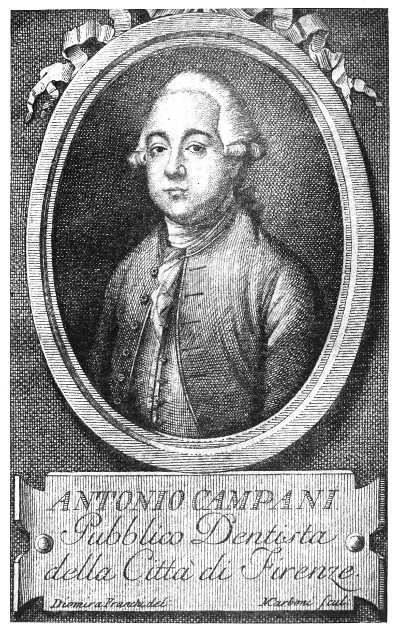
Antonio Campani.
Fig. 96
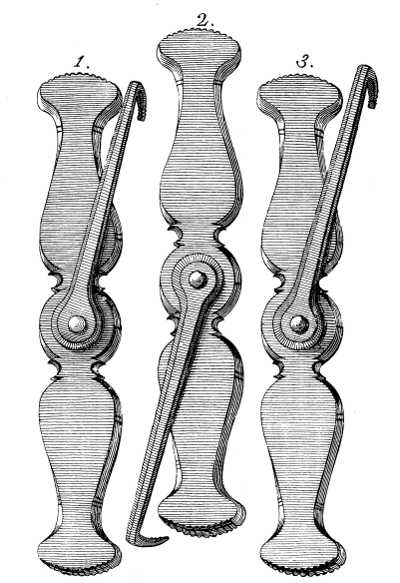
Pelican for extracting incisor, canine, and molar teeth (Campani, 1786).
Antonio Campani, of Florence, published in 1786 a treatise on dentistry,521 very elegantly printed, and illustrated with thirty-six plates very neatly carried out. This book, however, contains nothing of real importance for the development of dentistry.
Benjamin Bell, the English surgeon, a contemporary of Hunter, also devoted much attention to diseases of the teeth, and, if it may be argued from the clear and precise manner in which he expresses his opinions on various questions relating to dental pathology and therapy, it would seem that he had much greater experience in this field than the celebrated Hunter.
Fig. 97
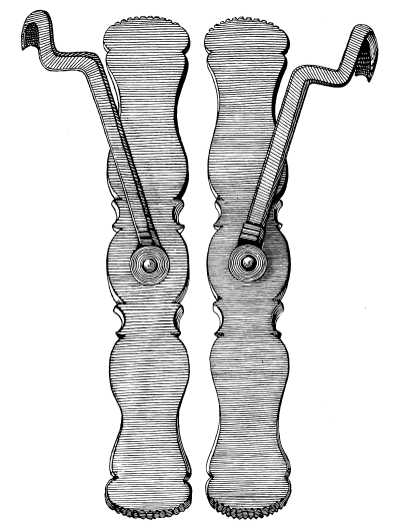
Pelicans for extracting wisdom teeth (Campani).
With regard to incision of the gums, in cases of difficult dentition, this author contradicts certain assertions of the German surgeon Isenflamm (1782), who argued that when the tooth is already to be perceived through the gum, the incisions are altogether useless, while if the tooth be still at some depth, the gingival incision will soon close again, so that the cicatrix will render the eruption of the tooth still more difficult. Bell admits, too, that lancing the gum is altogether superfluous when the tooth has pierced the tissue, all the more so that the accidents provoked by the eruption are then generally already passed and gone, but the operation ought, in his opinion, to take place much earlier; and should the wound close again before the tooth has erupted, the gum must be lanced a second time.
Fig. 98
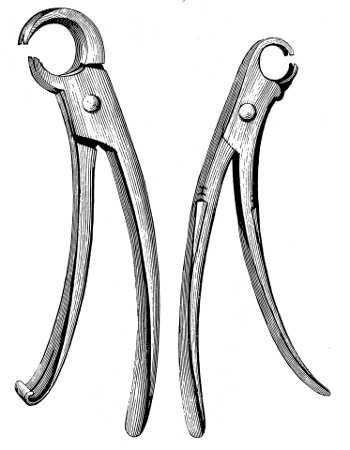
Campani’s forceps: The first for molar teeth when loose or after having been shaken with the pelican; the second for deciduous teeth.
Bell contradicts the opinion of Jourdain and Hunter that the morbid gatherings of Highmore’s antrum are generally consequent upon the closing of the normal opening of the cavity in the middle meatus. In many cases of disease of the maxillary sinus this orifice remains open, the liquid therein collected discharging itself not unfrequently through it, in certain positions of the body. Instead of penetrating into the antrum through the nasal orifice, as Jourdain would have it, Bell advises opening the cavity by Lamorier’s, or, better still, by Drake’s method. Except in special cases, the first or second molar ought to be extracted, but preferably the second. After trepanning the alveolus and emptying the cavity, the opening should be closed with a conically shaped peg to prevent its slipping into the cavity. From time to time the liquid that tends to reaccumulate should be allowed exit, and detersive injections should be made, preferably of lime water.
Fig. 99
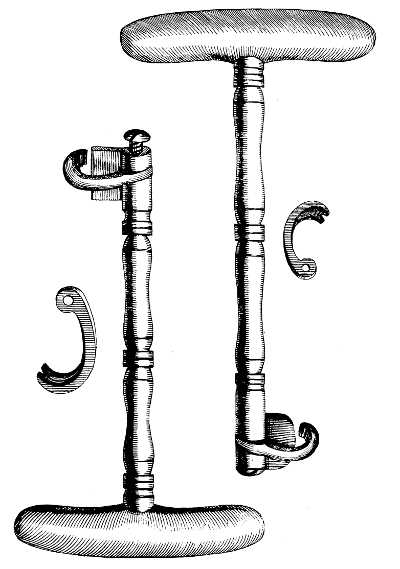
Two key instruments with changeable hooks (Campani).
Looseness of the teeth, which in old age may be considered a normal condition, is always a disease when it occurs in youth. In certain cases its cause is unknown, in others it depends on an affection of the gums, either of a scorbutic nature or consequent on an accumulation of tartar.
Fig. 100
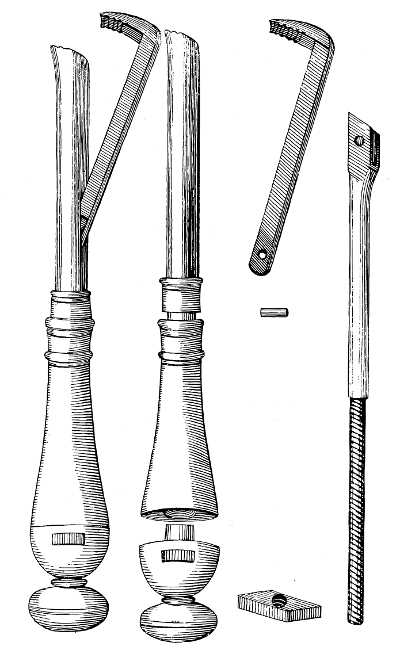
An instrument especially destined to extract loose bicuspid teeth. The screw in the interior of the instrument allowed the hook to be brought to just the right point in each case (Campani).
According to Bell, dental caries is generally owing to a bad condition of the humors of the entire body and to a peculiar morbid disposition, rather than to external causes acting locally, although these latter may contribute, together with the general causes, to the producing of the disease.
Fig. 101
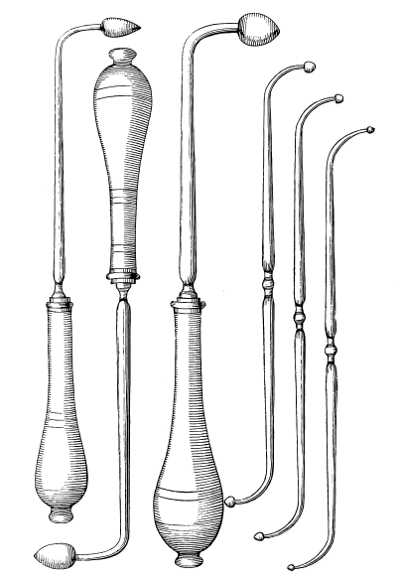
Campani’s dental cauteries: The large ones for cases of post-extractive hemorrhage; the small ones for the cauterization of carious cavities.
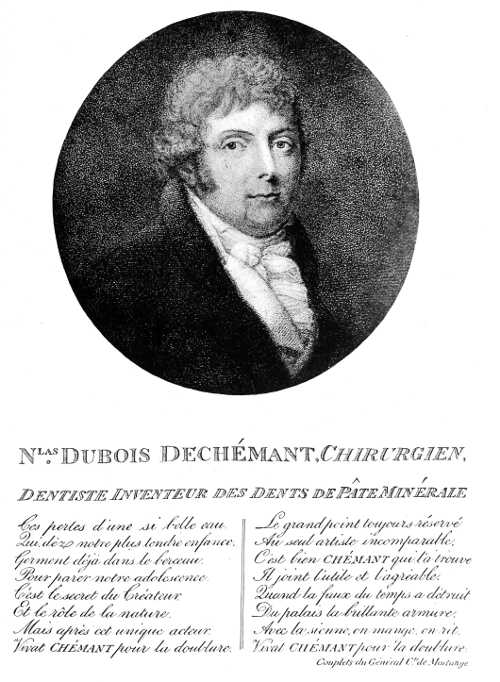
Nicholas Dubois Dechémant.
This author was decidedly averse to the use of the file. For stopping carious cavities he advises the use of mastic, gum lac, or wax, if the cavity is large and funnel-shaped; this stopping, however, requires to be renewed frequently. But when the cavity, wider at the bottom, narrows toward the surface, one ought to use gold or, still better, tin-foil. The pulp ought always to be destroyed previously by cauterization.
Bell advises great caution in carrying out transplantation, it having been proved by many examples that contagious maladies of a serious nature may easily be communicated in this way from one individual to another.522
In the case of a young woman who had an upper incisor transplanted, Watson observed undoubted symptoms of syphilitic infection with supervening accidents of exceptional gravity, which in spite of careful treatment ended in death.523
Hunter also relates having observed, in seven cases of transplantation, very serious accidents which, however, he did not believe to be owing to syphilis, although bearing a certain symptomatic resemblance to it. Contrariwise, the well-known German surgeon Richter not only admitted the possibility of transmitting syphilis through a transplanted tooth, but even that the transplantation of an altogether healthy tooth from the mouth of a person undoubtedly free from syphilis might be followed by serious accidents of a syphilitic nature, and this because the possible existence of a latent syphilis in the person to whose mouth the tooth was transplanted cannot be excluded; in which case the abnormal stimulus exercised by the transplanted tooth might very well give rise to syphilitic manifestations. Therefore, the fact that the person who furnished the tooth was and continued to be in a state of perfect health (as precisely in the case cited by Watson) would not be sufficient proof that the accidents ensuing on the transplantation might not be of a syphilitic nature.
Lettson also observed, in certain cases of transplantation, accidents of more or less gravity which he held to be due to syphilis, calling, however, to mind a case cited by Kuhn, of Philadelphia, where the possibility of syphilis was not to be thought of, as the morbid symptoms disappeared entirely, without any treatment, as soon as the transplanted tooth was removed.524
August G. Richter, the above-named German surgeon, in those portions of his work dedicated to dental affections and diseases of Highmore’s antrum, treated these subjects with admirable clearness and order, without contributing, however, anything original to the development of dental surgery.525
Nicholas Dubois de Chemant, in 1788, of whom we shall later have occasion to speak again, published in Paris his first pamphlet on mineral teeth, entitled Sur les avantages des nouvelles dents, et rateliers artificiels, incorruptibles, sans odeur.
Jean Jacques Joseph Serre (1759 to 1830). Among the dentists of the end of the eighteenth century and the beginning of the nineteenth, a special mention is due to Jean Jacques Joseph Serre. He was born at Mons, in Belgium, but his remarkable practical and scientific activity was chiefly called into exercise in Vienna and in Berlin. He published several works, the most important of which is a practical treatise on dental operations.526
Among his minor works, one edited in Vienna, in 1788, treats of toothache during pregnancy; another, printed in Leipsic in 1791, treats most extensively of diseases of the gums; a third speaks of the mode of maintaining the teeth and gums in good condition. This little book of dental hygiene, like the rest of Serre’s books, met with great favor, and went through two editions in a brief space of time (Berlin, 1809 to 1812).
The works of this author show great study, very wide practice, and an admirable spirit of observation and research. They had the merit of greatly contributing to raise the level of dental culture in Germany, and one finds in them a pretty nearly complete account of the dentistry of that period. Apart from this, they possess a special interest because of the vast number of dates and important historical facts therein contained.
As it would be useless here to enter into a minute analysis of the contents of these books, we will limit ourselves to mentioning a few ideas of which Serre was a strenuous supporter.
He combats an old prejudice that had recently been reinforced by the authority of Jourdain, that is, that it does harm to extract a tooth when the soft parts around it are inflamed and swollen. He likewise combats the prejudice, also of very ancient date, that teeth ought not to be extracted during pregnancy. Only, he considers it as well to avoid the cauterization of the dental pulp in cases of gestation. In extracting teeth, the forceps ought only to be used after the tooth has been luxated by means of the pelican. Serre highly approves of this instrument, although he recognizes it to be a dangerous one in the hands of those who do not know how to make a proper use of it. This author invented or perfected various extracting instruments, among which a conical screw for extraction of roots hollowed out by caries deserves particular mention, and which, under a somewhat modified form, is still in use.
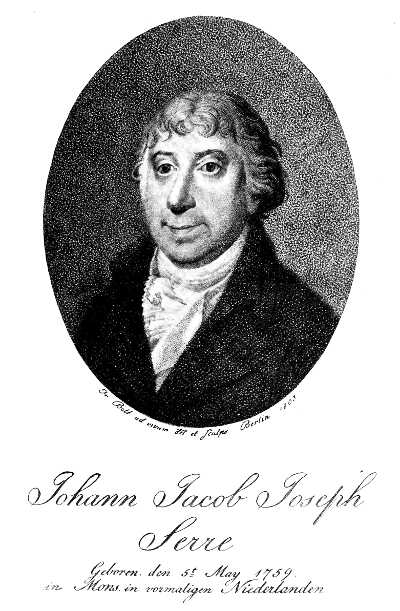
Jean Jacques Joseph Serre.
One of the most interesting chapters of Serre’s great work is the one in which he treats of affections of Highmore’s cavity.527 He speaks at length of the anatomy of the maxillary sinus, of its relation to the teeth situated below it, of the various modes in which the diseases of the antrum are produced, of their symptoms and treatment. He passes in review the various operative methods, and finds that in general the Cowper-Drake is the one to be preferred to all the others. He says that to open the sinus the simple extraction of a molar suffices in the greater number of cases, the trepanning of the alveolus not being generally necessary.
J. Arneman, in 1766, published at Göttingen a synopsis of surgical instruments528 that deserves mention in so far that the dental instruments of that time as well as those of earlier periods are therein taken into account with sufficient exactness.
A. F. Hecker attributed the accidents of difficult dentition to a special alteration of the saliva caused by the irritation deriving from the erupting teeth. In these cases the saliva is supposed by him to acquire a high degree of acridness and to become almost similar to the poison of rabies. Departing from this theory, the author declares it to be necessary to mitigate the irritation produced on the gums and other parts of the mouth by the altered condition of the saliva, as well as to modify the quality of the saliva itself and to promote the elimination of the same from the body by emetics and aperients. According to him, liquid carbonate of potash administered in drops, together with syrup of poppy heads, manna, etc., is a most useful remedy, having specially for its effect to diminish the acridness of the saliva.
Besides this remedy, the author extols the use of blisters behind the ears, as also of tepid baths, which calm pain and spasms, favor the excretions, and procure repose and sleep. He rejects the incision of the gums as altogether useless, and is most opposed to the use of opium, which he states renders children liable to apoplexy.
And here we will mention, rather by way of curiosity than for any real historical interest which they possess, two pamphlets on odontitis, published respectively in 1791 and 1794 by Ploucquet and Kappis, who maintained that not only the dental pulp, but all the parts that form the tooth are susceptible of inflammation.529 In Kappis’ pamphlet we find the following ideas developed, upon which we do not think necessary to comment. The inflammatory process consists essentially in the increased flow of humors to a given part and in a more or less intense reaction of the vital force. Both of these things may take place in the teeth. These are liable to swell, that is, to undergo an increase of all their dimensions, in proof of which assertion the author relates the case of an individual, who when attacked by a violent toothache had found the spaces between his teeth so narrowed that it was no longer possible to make use of his usual toothpick, even if he had tried to do so regardless of pain. But when the toothache was over, the same toothpick again became serviceable as before. He says that there is no cause for wonder that in odontitis no redness of the teeth is to be perceived, for in other inflammations as well, redness is wanting, and, moreover, it exists in the interior membrane of the tooth. As in other inflammations, so also in odontitis, the usual issue is resolution. Dental fistulæ may derive from internal suppuration. The impurities deposited on the teeth are by him supposed to be owing to an increase of their secretion! According to the author, caries, the breaking down of teeth apparently healthy, as well as their falling out, is generally caused by an inflammation of these organs, that is, by odontitis, an affection that, he says, may be of very varied kind, the principal forms being the rheumatic, arthritic, sympathetic, and gastric.
Ranieri Gerbi.530 In a book by this author we find recommended a very singular cure for toothache, even of the most violent nature. It is in no way scientific, and is besides not particularly pleasant, notwithstanding that the author, professor at the University of Pisa, was a scientist of merit, enjoying special esteem as a mathematician and cultivator of natural sciences.
Under the name of curculio anti-odontalgicus he describes an insect living habitually inside the flowers of the carduus spinosissimus, that could be used with great advantage against toothache, in the following manner: One crushes fourteen or fifteen larvæ of the insect between the thumb and forefinger, and then rubs the two fingers together until the matter remaining upon them is entirely absorbed. Instead of the larvæ (which, as is known, represent the first stage of insect life) one may also use the fully developed insects. One then applies the two fingers that have crushed the insects or their larvæ upon the decayed and aching tooth. If the pain is of a nature to be cured by this means, it diminishes almost instantaneously, and ceases altogether in a few minutes. It is said that the fingers preserve their healing power for a great length of time, even a whole year, and in proof of these assertions Ranieri Gerbi speaks of no less than six hundred cures performed! Other insects besides the curculio anti-odontalgicus, used in the same manner, are said to possess the same curative properties, among them the curculio jaceæ, carabus chrysocephalus, and the curculio Bacchus, which last, says Gerbi, has long been used for this purpose by the peasants of Tuscany. The author also says that some German doctors and naturalists experimented with success with several insects indigenous to Germany as remedies against toothache. These insects, also mentioned in a work published in Bayreuth in 1796, author unknown, are:531 the coccinella septempunctata, the coccinella bipunctata, the carabus ferrugineus, the chrysomela sanguinolenta, the chrysomela populi, the cantharis or Spanish fly, and others. Later on, Hirsch also extolled the healing power of another insect, the cynips rosarum. With regard to the mode of application, Gerbi says that instead of crushing and rubbing these insects or their larvæ between the fingers, one can use a piece of wash leather in a similar manner.
It is to be observed, however, that the insects that are found generally in the ripe wild teasle—or more precisely their larvæ—had already been used for a long time as a remedy against toothache; indeed, we even find these means of cure recommended in the natural history of Pliny. In a book entitled Histoire d’un voyage aux îles Malouines fait en 1763 et 1764, by a certain Dom Pernetty, this author speaks of some remedies made known to him by the Superior of the Franciscan friars of Montevideo; and among others one finds the following: “One draws out the worm that is generally found in the head of the fuller’s teasle when this is ripe. One rolls this worm between the index finger and the thumb, lightly pressing it until it dies of languor. The one or the other of the two fingers applied on the aching tooth will have the virtue, for a year at least, of making the toothache cease.”532
Heinrich Callisen, in an excellent treatise on surgery533 published at Copenhagen in 1788, writes at sufficient length and with great accuracy on dental and maxillary diseases. According to this writer, it rarely suffices to trepan one alveolus for the treatment of the morbid collections of Highmore’s antrum, as the maxillary sinus is very often divided by partitions into various cells, so that in order to give exit to the pus contained in each of them, it is necessary to extract several teeth and trepan their alveoli.534 One ought not, therefore, to give the preference to this method, unless in the case of the teeth in question being decayed. But should they all be in a good state, or should a large opening be necessary because of the nature of the disease in the cavity, it will be better to follow Lamorier’s method, that is, to incise the gum crosswise under the malar process and then, after scraping away the periosteum, trepan the bone. Further, in the case of the disease in the maxillary sinus having given rise to tumefaction, softening of the bone, and fluctuation in the palatine region, it is precisely there that the perforation ought to be carried out. To prevent the reclosing of the opening before the cure is completed, the author advises the use of pledgets, small bougies, a piece of prepared sponge, or even a small tube. According to Callisen, the injections through the nasal orifice of the maxillary sinus are partly impracticable, and partly of no utility.
It always does more harm than good to file or to scrape the decayed part of a tooth, without stopping it afterward, as by thus doing, says the author, one only renders it still more liable to the access and the action of harmful external influences. In preparing the cavity for stopping, the bottom of it should be more ample than its external aperture, that the filling may remain firm.
For extracting molars, he makes use either of the pelican or of the key; for the incisors and the canines, of the forceps; and for roots, of the goat’s foot.
Callisen treats incipient idiopathic epulis by destroying it through cauterization, after having covered the teeth with wax; if the epulis be large and more or less hard, he removes it with the bistoury; as to symptomatic epulis, he holds the removal of the original cause to be the best mode of treatment.
This author declares himself decidedly in favor of replantation and transplantation, expressing the idea that these methods are always to be preferred to the application of artificial teeth. He maintains that after a tooth has been replanted, and its consolidation has taken place, there is no possibility of any further pain, the nerve being broken. The author relates a brilliant cure which he carried out upon a lieutenant, who, during the siege of Copenhagen, had received a blow that had sent all his front teeth into his mouth. Callisen immediately put them all back in their places with such ability that they became perfectly firm again. With reference to transplantation, he only believes in its being possible for teeth with a single root.
In works published toward 1790, Lentin and Conradi, devoted their particular attention to the morbid conditions that produce looseness and spontaneous falling of the teeth. For the treatment of these conditions Conradi recommended general and local remedies. The general remedies were directed to the suppressing of acridness in the blood, which he considered to be an etiological element of primary importance. As to the local remedies, they ought specially to consist in keeping the teeth clean by the use of a toothbrush, in painting the gums with tincture of catechu and myrrh, and in rinsing the mouth frequently with a decoction of cinchona or of willow bark. Against toothache caused by caries, he particularly advises essence of cloves, introduced into the carious cavity on a piece of cotton-wool.535
Friedrich Hirsch was much less disposed than were many of the preceding writers to incision of the gums in cases of difficult dentition. Against the accidents connected with this morbid condition, he prefers, in general, the use of gentle aperients or of emetics, and regards the scarification of the gums as opportune only in cases where symptoms indicating a high degree of nervous tension manifest themselves.
Against incipient caries, Hirsch used simple cauterization, which he held to be capable of arresting the morbid process, at least in many cases. He says, however, that when a real carious cavity exists, it is absolutely necessary to stop it; and for this purpose, rather than metallic or resinous fillings, he prefers a cement of turpentine and quicklime, made into a paste with varnish of oil of linseed. Nevertheless, when it is a case of the lower teeth, tin-foil is also, according to him, an excellent filling material.
Like some of the preceding authors, Hirsch admitted the existence of interior caries in apparently healthy teeth, and was the first to indicate a good mode of diagnosticating these occult dental affections. It consists in tapping the suspected teeth with a sound until one finds the one in which the percussion provokes pain, and this will be the diseased tooth. One detaches the gum from the neck of this tooth, and at the point, on the neck itself or on the beginning of the root, where a small protrusion is found, one perforates the tooth with a chisel, or some other fit instrument, so as to penetrate to the interior of it. Through this passage one introduces into the tooth a fine, curved, red-hot sound, repeating the operation several times. Lastly, one fills the cavity with lead; and in this manner the tooth will be cured and no longer painful.
In speaking of the correction of dental anomalies, Hirsch relates a case in which the deformity consisted in the union of two central incisors, which formed one single piece, resembling a paddle, and spoiled the appearance of the face. He divided them with a saw, cauterized the surfaces of the section, scarified the gum, and, to gain a little space, introduced a small wedge, until the gum had grown up within the new dental interstice, thus giving an altogether normal appearance to the part.
It is noteworthy that Hirsch made use almost exclusively of the goat’s foot for the extraction of teeth, of whatever kind they might be, the instrument being rather longer, however, than that ordinarily known by this name, and making his left hand serve as a lever rest.
To arrest strong hemorrhage ensuing from the extraction of teeth, Hirsch used scraped parchment, which he introduced into the alveolus and pressed with force into it by means of a sound; then he superposed compresses and kept the jaws tight together with a bandage passed around the head.
This author, too, was very favorable to replantation. As to transplantation, he says that even when the gum and the alveolus are quite healthy, the individual entirely free from scurvy and syphilis, and not above fifty years of age, the transplanted teeth do not take root perfectly except in an average of one case in three. For carrying out this operation he never made use of teeth extracted from the mouth of a living person, but, on the contrary, he used the teeth of young and healthy subjects who had died a violent death; these were, besides, carefully cleaned before transplanting them, and in this way the author believed the transmission of disease to be nearly impossible.536
Fig. 102
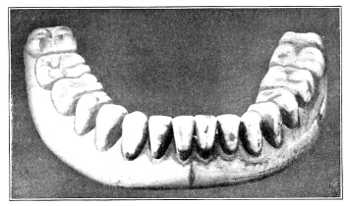
Full lower set in hippopotamus ivory, with human front teeth; seventeenth century. (From Guerini’s collection.)
Fig. 103
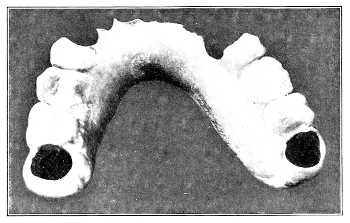
Upper denture in ivory, at the end of the eighteenth century, for a case in which the last molars and the front teeth were present. (From Guerini’s collection.)
J. E. Wichmann combated energetically the practice, then pretty general, of endeavoring to facilitate the eruption of the teeth by incision of the gums. He considered this practice as one to be absolutely rejected, supporting his opinion on the consideration that dentition, being an altogether physiological process, which, moreover, takes place in parts relatively of but little importance, never can give rise of itself alone to serious accidents. Besides this, he says, it is very difficult to say which tooth precisely is about to erupt and at what point. The incisions would, therefore, have to be made by chance, which would often render the morbid condition still more serious.
K. A. Blumenthal endeavored to confute Wichmann’s opinions, with but little success; for, indeed, the same opinions, expressed later by J. H. Sternberg in a more detailed manner and with ampler views of the subject, met with ever-increasing approval. Thenceforth, the practice of gingival incisions in cases of difficult dentition fell more and more into discredit.537
Robert Bunon,538 the French dentist, is one of the most illustrious personalities to be met with in the history of our profession. He was born at the beginning of the eighteenth century, and devoted himself betimes to the dental art, gathering instruction therein partly from different dentists and partly from the few odontological books he was able to find. In this manner he learned pretty much all that was known at that time by dentists in general. He then decided to travel, in order to acquire further knowledge and experience. He practised especially in the north of France and in what is now the state of Belgium; at Antwerp, Brussels, Givet, Maubeuge, Cambrai. In his ardent thirst for knowledge, when he happened to pass through a town where some dentist of note resided, he never neglected to call on him, thus acquiring fresh information and perfecting himself as well in the practical exercise of his profession. At the same time, his desire to learn all that was new concerning dental art and science was so intense that he had translations made of the medical and surgical works of Latin, Italian, German, and English authors. However, all this reading, although it enlarged his general knowledge, taught him nothing, or almost nothing, about those subjects that interested him above all the others. His practical experiences, meanwhile, brought a great number of patients to his notice, and, being by nature a very acute observer, he was able to establish the existence of many facts up to then unknown. At this time he commenced his studies on dental erosion, on the development of the teeth, and on the prophylaxis of dental maladies, his favorite subject. “I felt,” he writes, “that the necessity of having recourse day by day to the extraction of teeth resulted from deficient knowledge on our part, and I considered this extreme remedy as one of the greatest evils to humanity.”539 He therefore endeavored to extend his own knowledge in every possible way, and as one means of doing this he visited hospitals and schools; and, ardent champion as he was of conservative dentistry and of prophylaxis, he succeeded in interesting medical men and surgeons, midwives and schoolmasters, and parish priests as well, in the question of the preservation of the teeth. The teeth he extracted he kept for the purpose of studying the conformation, the lesions, the dental anomalies; sometimes he split them up to examine the dental pulp. And he never neglected an opportunity of procuring anatomical pieces that appeared interesting to him.
In 1728 Fauchard’s book, Le Chirurgien Dentiste, appeared. The fame of this work reached Belgium, where Bunon then was, and he immediately set about trying to get a copy of it. After searching in various towns, he finally found one in Givet. He read it with the greatest interest, and later, in one of his works, spoke of it in terms of highest praise. It would seem, however, that he did not learn much that was new to him by reading this book, which proves that he already possessed a vast odontological culture and was also profoundly versed in technical dentistry, which forms the most important part of Fauchard’s book. He was somewhat astonished at finding in this celebrated author’s work hardly anything on the subjects that principally interested him, that is, the erosion, the development of the teeth, and the prophylaxis of caries. This circumstance very clearly reveals the different mental tendencies in these two great men, the one, drawn toward the practical side of the profession which principally interests him and forms the basis of his work, the other, an impassioned searcher into causes, and student of prophylaxis.
After the perusal of Fauchard’s book, Bunon, who had already conceived the idea of publishing the results of his observations and of his own particular studies, felt more than ever the propriety and necessity of doing so; and to realize his idea, he established himself toward the year 1735 at Paris. Two years later, just when the manuscript of his work was almost finished, Gerauldy’s book appeared. Bunon relates that he opened this book in fear and trembling; its title, The art of preserving the teeth, gave him reason to fear that Gerauldy might have profited by some of the ideas and observations he had communicated to various persons, to write a book similar to the one that he himself had it in his mind to publish.540 He was able, fortunately, to convince himself immediately that his fears of being forestalled and plagiarized were unfounded.
Notwithstanding, Bunon was determined not to publish his book until the opportune moment and with all possible probability of success. With this object in view, he made up his mind first to obtain the diploma of surgeon-dentist. To reach this aim, he was obliged to conform to the regulations of the Edict of May, 1699, which then regulated the practising of dentistry, and this was as much as to say that he was obliged to enter the College of Surgery, to undertake two years’ practice with a regularly licensed surgeon, to undergo theoretical and practical examinations, and to take oath before the Chief Surgeon of the Realm. Once in possession of the diploma of surgeon-dentist, he was separated thenceforward from the vulgar crowd of charlatans and invested with all the prestige which a degree, so rarely acquired at that time, conferred upon its possessor; but before facing public opinion he desired to make himself known, and, so to say, first to try his ground, by making known some of his newer ideas, and see what reception they might meet with from his colleagues and the public in general. He, therefore, published, in January, 1741, in the newspaper Mercure de France, a letter on the so-called eye tooth,541 combating the then widely diffused prejudice that the extraction of an upper canine constituted a grave peril to the eye. He demonstrated the absurdity of this idea by putting in evidence the anatomical fact that the upper canines are innervated by the infra-orbital nerve, which has no relation whatever with the visual organ.
Still better to further his object of making himself a name, he published in the same year and in the aforementioned paper his dissertation on the teeth of pregnant women.542 There he demonstrated the falseness of the idea that one ought never to extract teeth during the state of gestation, and brought into relief the necessity of treating the dental diseases of pregnant women with still more accuracy than those of other persons.
These publications, bearing as they did the marks of good sense, favorably interested the public opinion. The way was therefore prepared, and Bunon judging the moment to have come for publishing his work, placed it in the hands of a literary man for the necessary corrections of style. He also showed his manuscript to several persons of consideration, but was grieved to perceive that the new ideas put forward in it were skeptically received. He now thought it might be as well to appeal to the judgment of a highly competent authority, and fixed on M. de la Peyronie, Head Surgeon of the Realm. This gentleman, after reading the work, highly praised the author, and Bunon gained permission to publish the book under his patronage, on consideration that he should give his word to furnish the proof of the many assertions made therein on all kinds of subjects.
The goal was now reached, and Bunon, on the strength of such illustrious patronage, published his book in March of 1743, under the title, Essay on the maladies of the teeth, wherein are suggested the means of obtaining their good conformation from the earliest age, and of assuring their preservation during the whole course of life.543
All the principal journals of the time (Journal des Savants, Journal de Trévoux, Journal de Verdun, Mercure de France, etc.) published extracts from the book and eulogized the author, who had even the high satisfaction of receiving an honorable mention from the Royal Academy of Surgery, in the public sitting held in 1743.
Bunon, therefore, was now famous, and had, besides, gained wealthy clients, as we see from the perusal of his observations, where the best names in France are to be met with, put in evidence by him without the least thought of professional secrecy. He could now enjoy his well-merited successes, in accordance with the thought expressed by him in one of his books: “All those who labor for the progress of an art have legitimate right to the honor and to all the recompenses to which success is entitled.”544
The study of Bunon’s work proves, in fact, that he had good right to be proud of having written it. The mere perusal of it, however, does not suffice to enable the reader to judge of its merits, for to do this properly, it is necessary to study at the same time his other book, published in 1746, entitled Experiences and demonstrations made at the Hospital of Salpêtrière and at St. Côme, before the Royal Academy of Surgery, serving as continuation and proof to the Essay on the maladies of the teeth.545 The essay is, in fact, a small 12mo book of 212 pages, written in a concise style, and, strange to say, most concise in the most important points.
Many facts of great moment are given under the form of rapid indications, or of assertions without proof; thus their importance is apt to pass completely unobserved by those who do not take the trouble of studying this work thoroughly and with the help of the explanations, illustrations, and comments contained in the second book we have referred to.
M. A. Barden, of the École Odontotechnique of Paris, was the first to undertake a serious and conscientious study of Bunon’s works. By so doing he has thrown full light on the author’s great merits, and brought forward the high scientific importance of his works.
One of the important questions studied by Bunon concerns the hygiene to be observed in order to obtain the development of a good dentition. On this question he rightly establishes the principle that hygiene and dental prophylaxis should begin from the period of the formation of the milk teeth. He works out this principle with rigorous logic, and finishes by tracing the hygiene of the mother during pregnancy, of the woman (be she mother or nurse) during the nursing period, and of the nursling as well.
As to the accidents of first dentition, Bunon sets forth a highly scientific opinion, fully coinciding with the ideas of modern writers, that is, that dentition is not the sole cause, nor even the principal cause, of such accidents, but simply a coöperating cause. He made the observation that in healthy infants, children of healthy parents and nursed by healthy women, the time of teething is gotten over without difficulty, while serious accidents occur frequently in weak and sickly children not brought up and nourished according to hygienic principles, or born, as not often happens, with special hereditary predispositions.
One of Bunon’s merits is that of having attributed to the first teeth all the importance they really have, and of having insisted on the necessity of attentively curing their maladies. He also drew attention to the dangers that may result from the eventual persistence of the first teeth at the epoch of the second dentition, or from the persistence of their roots after the destruction of the crown by caries. These roots, he says, by their contact with the neighboring permanent teeth may infect them, and cause them to decay.
Bunon’s researches into the development of the teeth enabled him to describe precisely the position that the various teeth of the second dentition occupy in the jaw with regard to the milk teeth, before these are shed.
Bunon was, besides, the first author who studied accurately dental hypoplasia, and it is greatly to his honor that his ideas and observations about this pathological condition have been accepted and confirmed in substance by the greater part of the authors who have come after him, having remarkable worth even at the present day. According to him, this congenital defect of the teeth is owing to infantile maladies, such as hereditary syphilis, infantile scurvy, malignant fevers, smallpox, or measles; the harmful effects of these maladies, however, are limited to the teeth in progress of development, and have no influence on those that have already come forth. Erosion, as this defect was termed by Bunon, sometimes affects the first teeth, but is to be found much more frequently in the second or permanent ones. Those most often affected are the first molars, and in frequency follow the incisors, the canines, the premolars; the second and third molars are the most rarely affected.